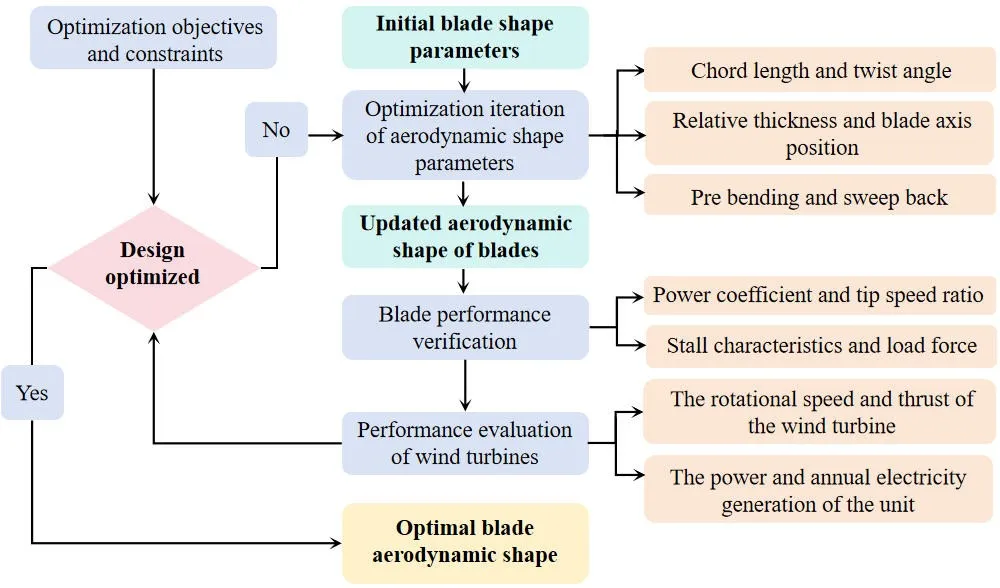
Optimizing aerodynamic performance with low loads is a core objective in high-power wind turbine blade design. This study develops a blade aerodynamic optimization design platform based on the performance of a wind turbine. By applying automated design principles, the platform rapidly iterates to obtain blade profiles that meet turbine development requirements, significantly improving design efficiency and reliability. Key findings include That Optimizing chord length and relative thickness distributions substantially contribute to enhancing power generation while reducing load levels. Relative thickness and twist angle distributions are critical parameters influencing stall characteristics during blade operation. Superior aerodynamic performance notably increases annual rated power generation hours but simultaneously elevates blade thrust and root loads. Among the evaluated designs meeting turbine specifications, the #436 blade achieves a maximum power coefficient of 0.4679 while maintaining low ultimate and fatigue loads. Furthermore, when paired with the wind turbine, its rated wind speed reaches 10.9 m/s, and its annual rated power generation hours under various inflow wind speed conditions all meet the turbine system’s development requirements. Consequently, the #436 blade demonstrates exceptional system compatibility, making the 8.5 MW turbine equipped with this blade highly competitive in the market.
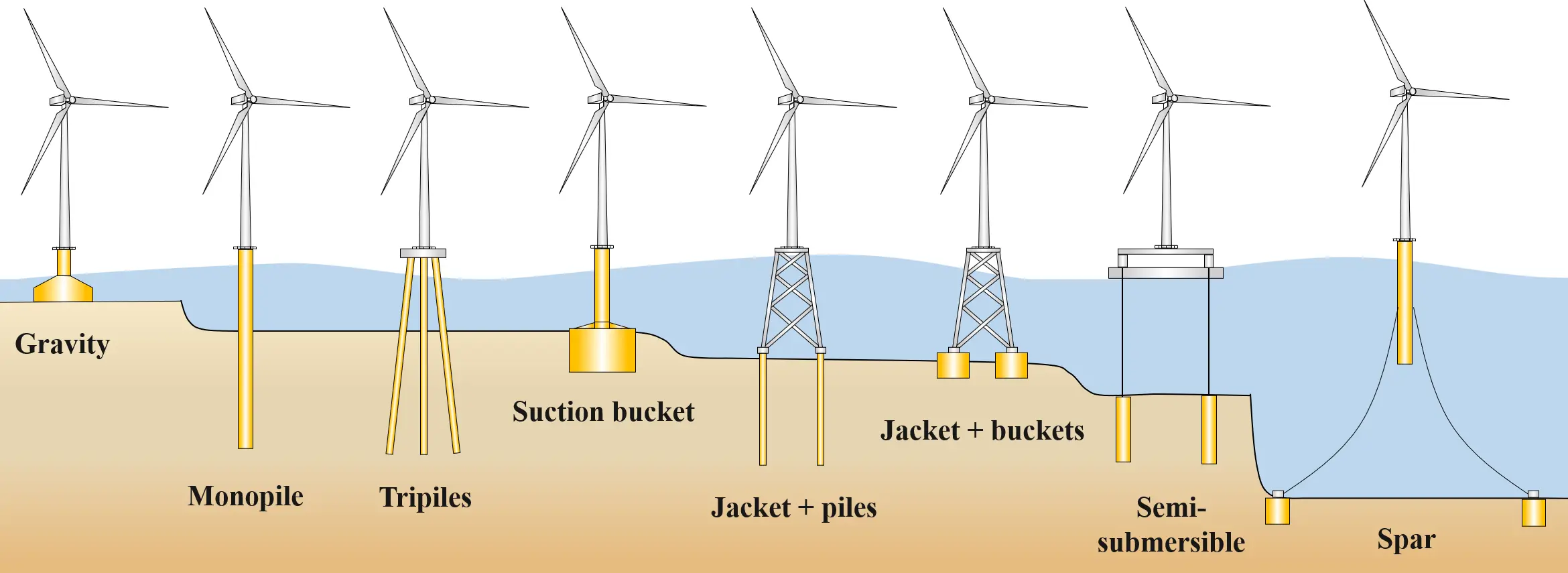
Floating offshore wind turbines (FOWTs) offer great potential for harnessing deep-sea wind energy. This study examines the effects of six-degree-of-freedom (6-DOF) platform motions on the dynamic structural responses of a FOWT blade by comparing its performance with a fixed-bottom system. Integrated aero-hydro-servo-elastic simulations for a 5-MW spar-type FOWT were conducted under various design load cases. Results indicate that the floating tower’s first-order natural frequency was about 29% higher than that of the fixed-bottom tower. Platform motions markedly influenced blade flapwise and torsional responses, with the effect intensifying under larger waves. For instance, as the significant wave height increased from 1.70 m to 9.90 m, the differences in peak response between the floating and fixed-bottom systems grew from 0.104 m to 0.363 m for blade-tip flapwise deflection, from 528.1 kN·m to 1817.4 kN·m for the root flapwise bending moment, and from 5.02 kN·m to 18.73 kN·m for the root torsional moment. In contrast, blade edgewise responses showed negligible changes, with peak deflection differences below 0.05 m. Blade loads were more sensitive to wave conditions, while platform motion magnitudes were more affected by wind. These findings offer insights into the load characteristics and structural design of FOWT blades.
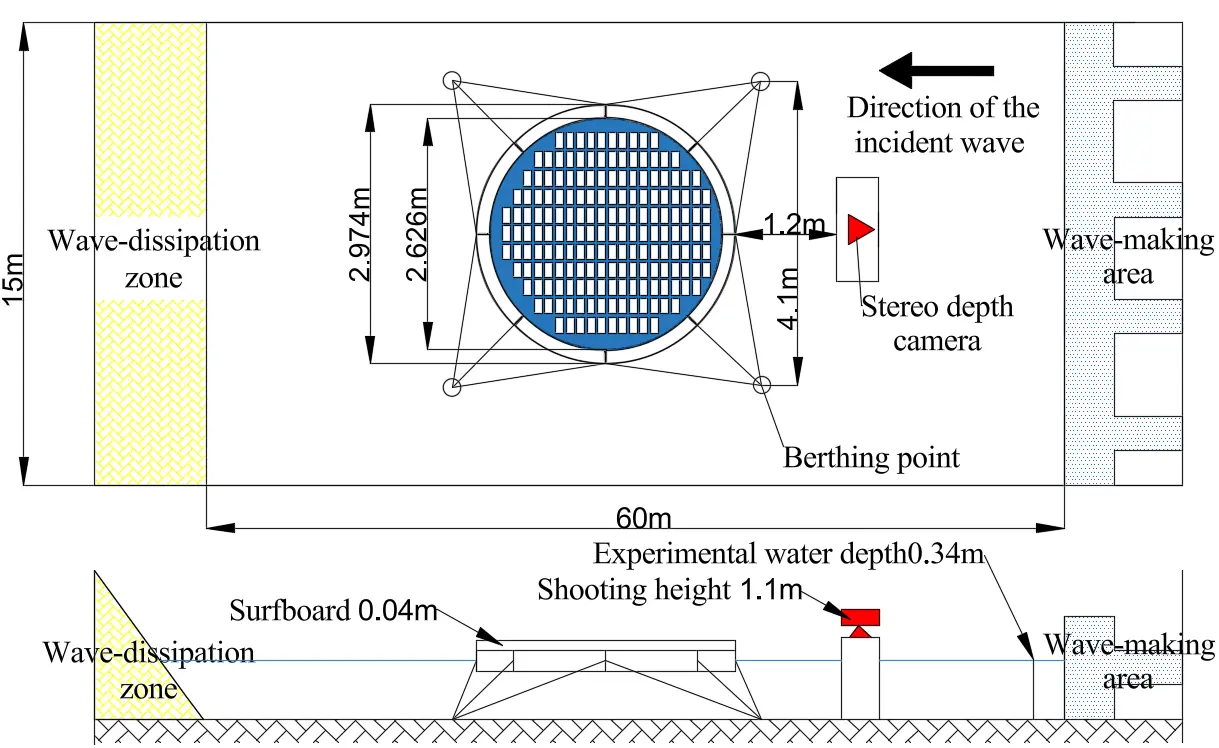
Driven by the global goal of carbon neutrality, offshore floating photovoltaic (OFPV) technology has become a primary focus of photovoltaic research. In particular, flexible thin-film structures have become a central focus of research in sustainable energy development. It offers numerous advantages, including light weight, low cost, and strong adaptability to the marine environment. However, traditional experimental methods still face challenges in accurately capturing the motion response of flexible thin films. To address this issue, this study proposes a motion measurement and monitoring framework based on binocular vision. The framework is validated using gyroscope data, and the results demonstrate its high accuracy and real-time performance. The research team conducted experiments on a flexible floating photovoltaic structure in a wave flume, applying the proposed framework to monitor its motion response under wave excitation. The experimental results show that wave height and wave period have significant effects on the acceleration response of the thin film: higher wave heights lead to notably greater accelerations, whereas longer wave periods result in a gradual decrease in acceleration. Overall, the proposed framework provides reliable technical support for the design optimization and safety assessment of flexible thin-film FPV structures.
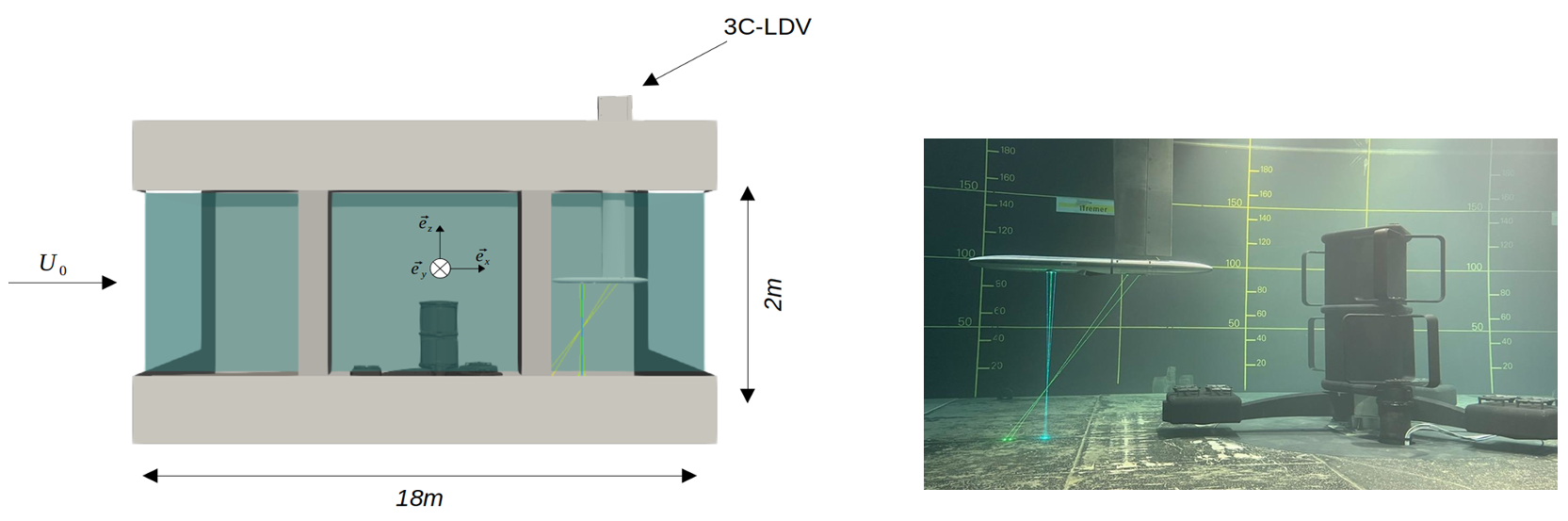
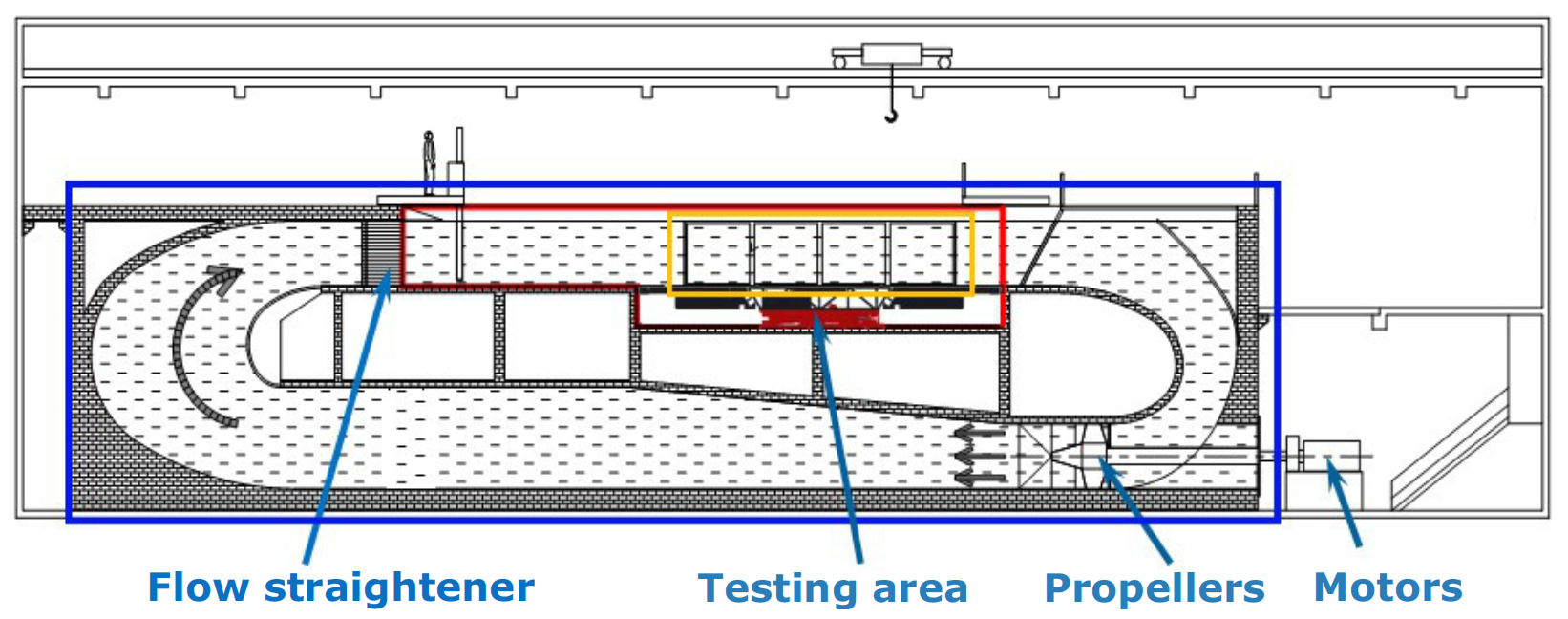
Tidal flow often contains large-scale turbulent flow structures mainly caused by bathymetric variations or offshore marine structures. Understanding how waves interact with these structures is crucial for ocean sciences, as they influence vertical mixing, energy transfer, and dissipation. In this work, two flow configurations with current and waves are studied in a flume tank using Particle Image Velocimetry measurements: waves propagate either following or opposing the current and interact with convected flow structures. Compared to current-only cases, the mean velocity is slightly impacted, but the mean velocity gradient increases for waves propagating with the current. Turbulent Kinetic Energy increases regardless of wave direction and its production is also affected by the wave’s propagation direction. The integral length scale and flow Gaussianity are the most affected flow parameters. For waves propagating against the current, the Probability Density Functions of fluctuating velocity fields exhibit a bimodal representation, largely deviating from a Gaussian curve. Preliminary quadrant analysis reveals that waves significantly influence flow organisation, especially when they propagate against the current. These observations are valuable for applications such as defining tidal turbine farm areas, improving turbine performance estimation, and assessing structural fatigue.
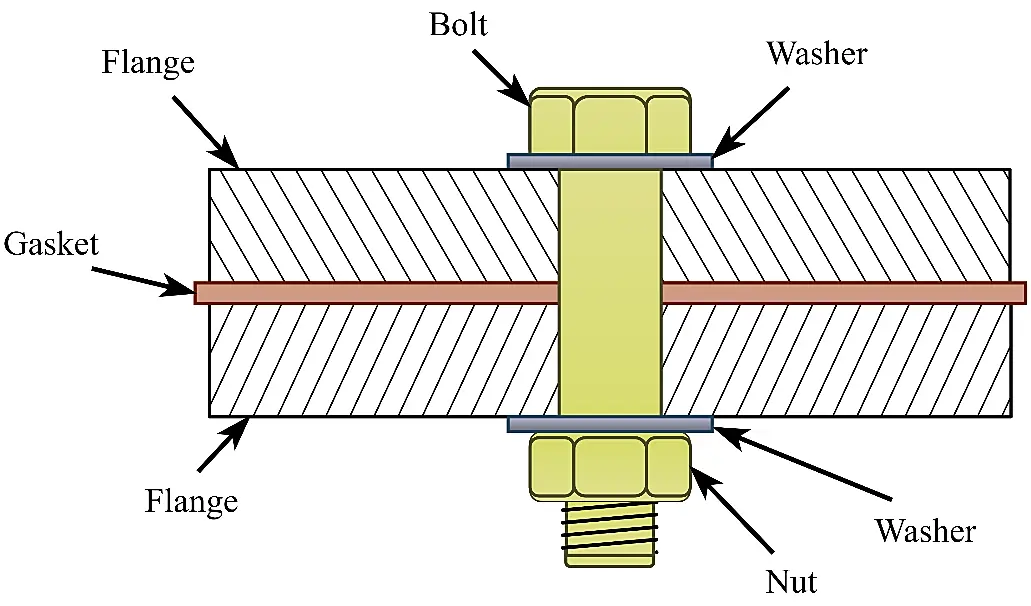
Bolted connections are being considered as an assembly method for the foundations of floating offshore wind turbines. A clear benefit of this method is the short assembly time of these foundations compared to welding. However, some concerns around corrosion, fatigue, and the ability of bolted connections to maintain preload remain. This review found that conventional ring flanges may not be suitable for the assembly of floating foundations, mainly due to the risk of bolt loosening and reduced fatigue life. However, the C1 Wedge Connection is an innovative bolted connection that has shown its ability to retain bolt preload during tests. Likewise, the Compact Flange Connection has shown its ability to retain preload without requiring maintenance during operational stages and furthermore, has a long and successful track record in offshore oil and gas applications. This review revealed several research gaps related to the use of bolted connections for the assembly of floating wind turbine foundations. These include: a lack of research on the effects of bolt loosening; dynamic loads and shear forces on bolted connections and their effect on fatigue life; structural health monitoring methods of bolted connections; and the health and safety of technicians in confined spaces with difficult accessibility. The Compact Flange Connection is perhaps the best suited bolted connection for the assembly of floating foundations. However, more research, and crucially, successful offshore demonstrations will be essential to increase confidence in the suitability of bolted connections for the floating offshore wind industry.
Tidal turbines are often subjected to complex flow conditions that can affect their power output and the risk of failure. In this article, an experimental study on a vertical axis tidal turbine with twin counter-rotating rotors is carried out at 1/20 scale, submitted to a sheared turbulent (ST) flow and a sheared weakly turbulent (SWT) flow. The performance and wake development comparison indicates that the turbine behaves differently depending on the shear rate considered. A 7% decrease in performance is observed at the turbine’s nominal operating point between uniform and ST conditions. The asymmetry of the flow along the vertical axis is reflected in the angular and frequency distributions of the rotor torque, indicating a production asymmetry between the lower and the upper rotors. Analysis of wake development reveals that transport terms constitute the main mechanism of wake dissipation. In the case of SWT and uniform flow, vertical advection largely dominates the other terms, whereas in ST flow, transverse advection is initially predominant. This results in a higher average wake height and a lower average wake width in the ST case compared to the other flow conditions, and a faster wake recovery.