Chromate-based corrosion protection, such as that on aluminum (Al), magnesium (Mg), titanium (Ti), and other alloys, has often been used with some success. Considering the pollution problem associated with chrome, it is necessary to search for an alternative process to conventional chromate coating technology. Plasma electrolytic oxidation processing (PEO) is an emerging, environmentally friendly surface engineering technique. The study in this article was to utilize the PEO technology to deposit aluminate coatings on magnesium alloy AE44 for corrosion protection. Potentiodynamic polarization measurements and electrochemical impedance tests were performed to investigate corrosion behaviors of coated and uncoated AE44 alloy samples immersed in 3.5 wt% NaCl solution. The surfaces of coated and uncoated samples before and after corrosion tests were observed by scanning electron microscopy (SEM). SEM and energy dispersive spectroscopy (EDS) and X-ray diffractometry (XRD) were used to study the effect of PEO coatings on the surface morphology change of the alloy in association to their corrosion behaviors. The differences in corrosion behaviors under different electrical parameters of aluminate-based coatings on Mg alloy AE44 were elucidated through potentiodynamic polarization measurements, complemented by SEM and EDS analysis.
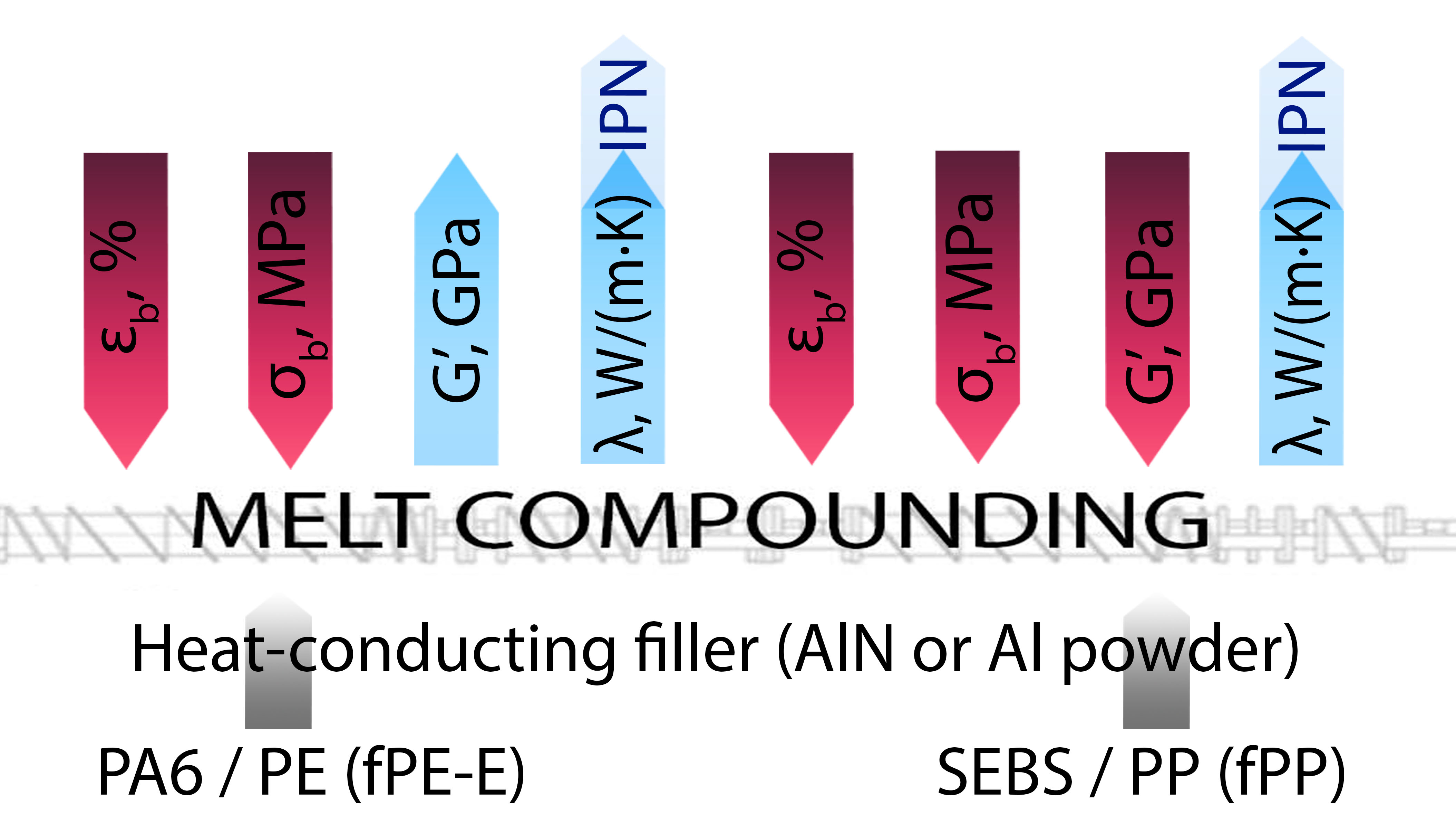
The structure and physical-mechanical properties of non-compatibilized and compatibilized blends of polyethylene with polyamide 6 and polypropylene with styrene-ethylene-butadiene-styrene, containing heat-conducting modifiers (aluminum and aluminum nitride) in their composition, were studied. Data were obtained on the influence of the ratio of polymer components in the blend and the functionalization of one of them, as well as the type of heat-conducting filler, on the mechanical and dynamic mechanical properties of composites and their thermal conductivity. Using SEM, no selective distribution of aluminum and aluminum nitride in the two-component polymer matrix was found when composites were obtained by extrusion compounding. It was found that the reinforcing effect of the filler (change in shear modulus) is largely determined by the presence of a polar polymer in the blend matrix. Both heat-conducting modifiers affect the position of the glass transition temperature maxima of the polymers used. The prospect of creating an interpenetrating polymer network structure to achieve additional thermal conductivity gain while maintaining the proportion of the conductive modifier is demonstrated.
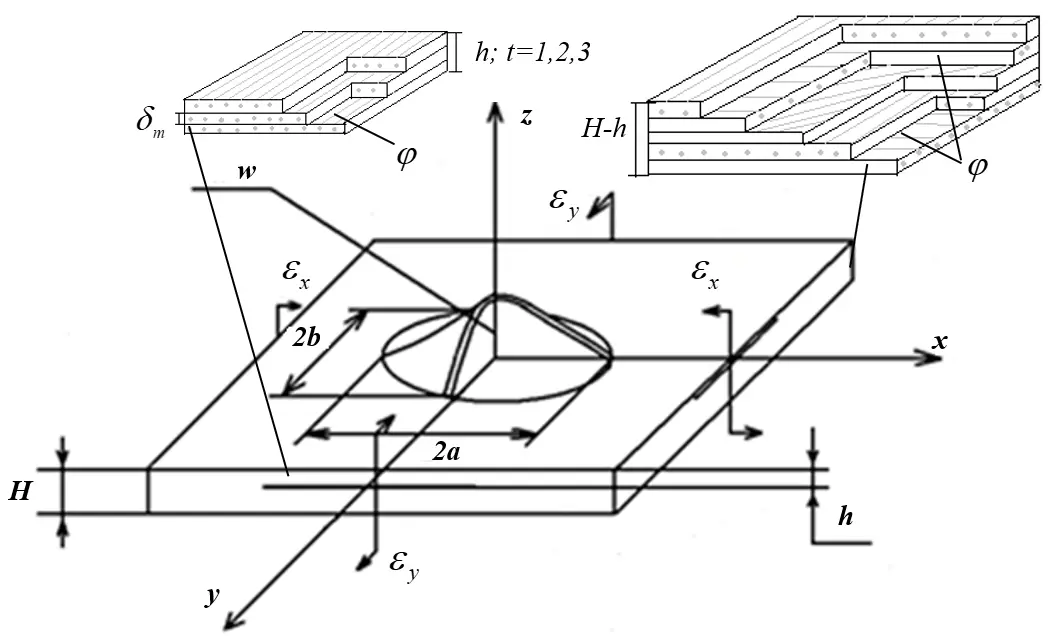
Multilayer composite materials, having high specific strength and rigidity, are sensitive to interlayer defects. The problem of interlayer laminations in a composite plate subjected to a plane compressive load is studied using a new analytical structure previously developed by the authors. Elastic characteristics of a multilayer package of thin lamination, including the elastic characteristics of separate layers, depending on modulus of elasticity, shear modulus, Poisson’s ratio, and angle of orientation of fibers of the unidirectional layer, are determined. Ratios are obtained for the unidirectional composite material that reflect the contribution of each component (fiber, matrix) in proportion to its volume fraction, according to the so-called “mixture rule”. This work examines the behavior after the loss of stability of an elliptical defect in a composite plate. Only the local bulging of the delamination type defect was considered. The difference between this work and others lies in the fact that the application of the developed method, based on the energy approach, makes it possible to obtain explicit analytical expressions for quantities characterizing the critical load and describing the supercritical behavior of the detached part. The energy method is generalized to the case of analyzing the stability of defects in a non-linear formulation. The value of the critical load was obtained, and the analysis of the supercritical deformation of the defect was made.
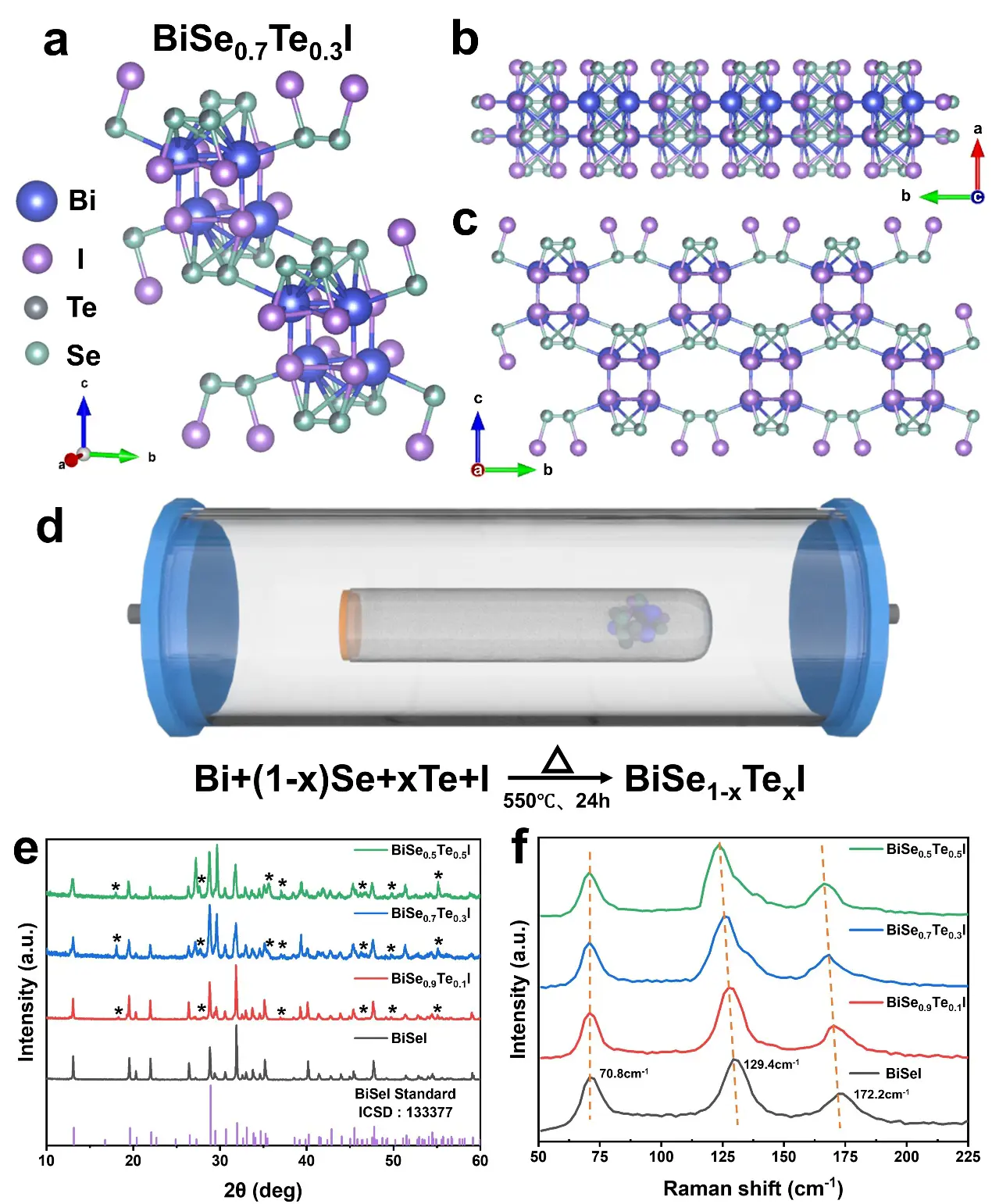
Halide-chalcogenide compounds are promising candidates for thermoelectric applications owing to their low thermal conductivity and tunable electronic structures. Here, we systematically investigate Te-substituted BiSe1−xTexI (x = 0, 0.1, 0.3, 0.5). Structural and spectroscopic analyses confirm the successful incorporation of Te into the BiSeI-type framework, accompanied by lattice expansion, vibrational softening, and pronounced bandgap tuning. X-ray photoelectron spectroscopy verifies that Te occupies Se sites and modifies the local electronic environment, while electron microscopy reveals a morphology evolution from ribbon-like grains to plate-like and fragmented particles with increasing Te content. Thermoelectric measurements show that Te substitution simultaneously enhances electrical conductivity and suppresses thermal conductivity, arising from band-structure modulation, increased carrier concentration, mass fluctuation, and strengthened phonon scattering. Consequently, BiSe0.7Te0.3I achieves the highest ZT (~0.27 at 400 K), substantially higher than pristine BiSeI. This work demonstrates that heavy-element doping is an effective strategy for optimizing the thermoelectric performance of halide-chalcogenides.
This study investigates the development of hybrid-reinforced polyester composites using corncob and urea particles as reinforcement for sustainable applications. Composites were fabricated by the stir casting method with varying weight fractions of corncob and urea. The mechanical and physical properties of the developed composites were evaluated, while fracture surface morphology was examined using scanning electron microscopy (SEM). The burning rates of the samples were investigated to evaluate their flame-retardant potential. The results demonstrate that incorporating corncob and urea effectively enhances stiffness-related mechanical properties, including tensile and flexural moduli and hardness. Composite containing 12 wt% urea and 3 wt% corncob exhibited the highest flexural moduli and hardness with an improvement of 122% and 45%, respectively. Composite with 3 wt% corncob and 18 wt% urea has the highest flexural strength with an increase of 44%, composite with 9 wt% corncob and 18 wt% urea has the highest tensile modulus with an improvement of 22%. In addition, it was found that the presence of corncob and urea reduced burning rates, with the sample containing 15 wt% corncob and 18 wt% urea exhibiting the lowest burning rate, indicating better flame-retardant potential. Thus, the findings indicate that corncob–urea hybrid reinforcement offers a promising, sustainable approach to enhancing the mechanical stiffness and reducing the burning rate of polyester composites. These materials have potential for use in applications requiring improved durability and low burning rate potentials while reducing reliance on conventional synthetic additives.