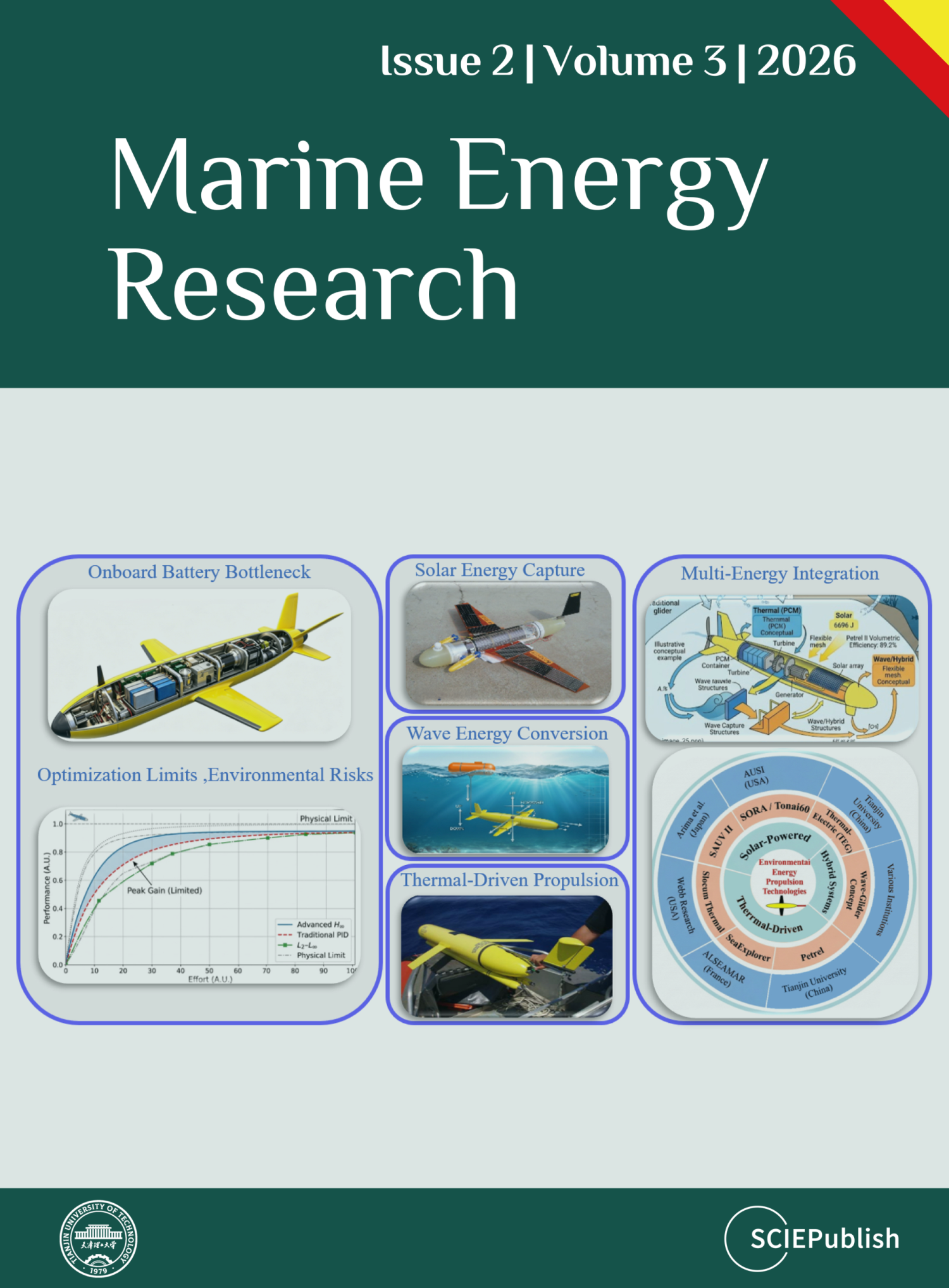
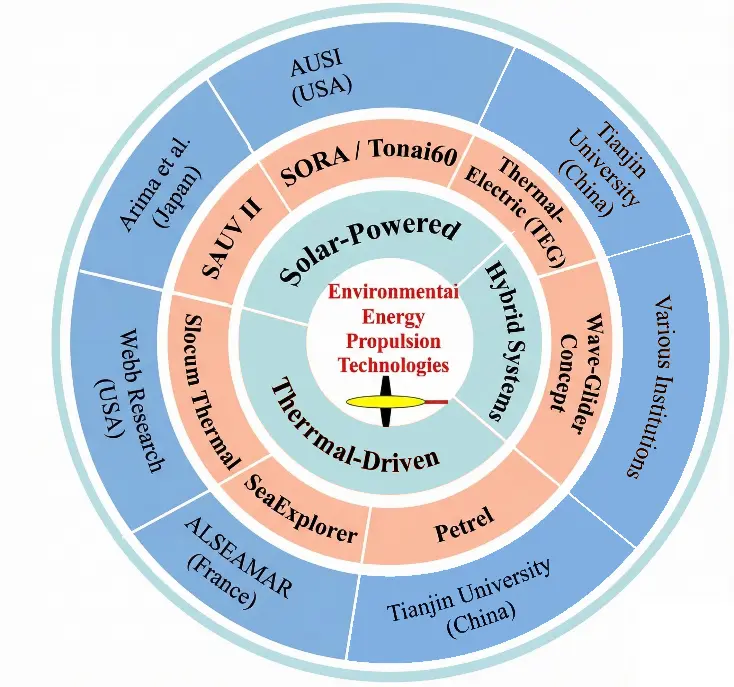
To address the endurance limitations of traditional electrically driven underwater gliders, which are constrained by onboard battery energy density, harnessing marine renewable energy for propulsion or supplemental power has emerged as a critical approach to overcoming their operational endurance bottleneck. This paper systematically reviews the research progress on underwater gliders powered by environmental energy sources, such as thermal and solar. It provides an in-depth analysis of the utilization mechanisms, core technologies, and current challenges associated with each energy type, with a focused exploration of technical pathways for achieving energy synergy and enhancing system endurance through multi-energy integration and intelligent energy management. Furthermore, this study is the first to establish a comprehensive technical evaluation framework for environmentally powered gliders from three dimensions: energy coupling, system design, and mission adaptability, offering a systematic reference for subsequent research. The paper also explores the application potential of this technology in advanced scenarios, such as long-term ocean observation and dynamic environmental monitoring. Future efforts should prioritize efficient multi-energy hybridization, dynamic energy management, and mission-adaptive control to comprehensively enhance the endurance and operational reliability of gliders in complex marine environments.
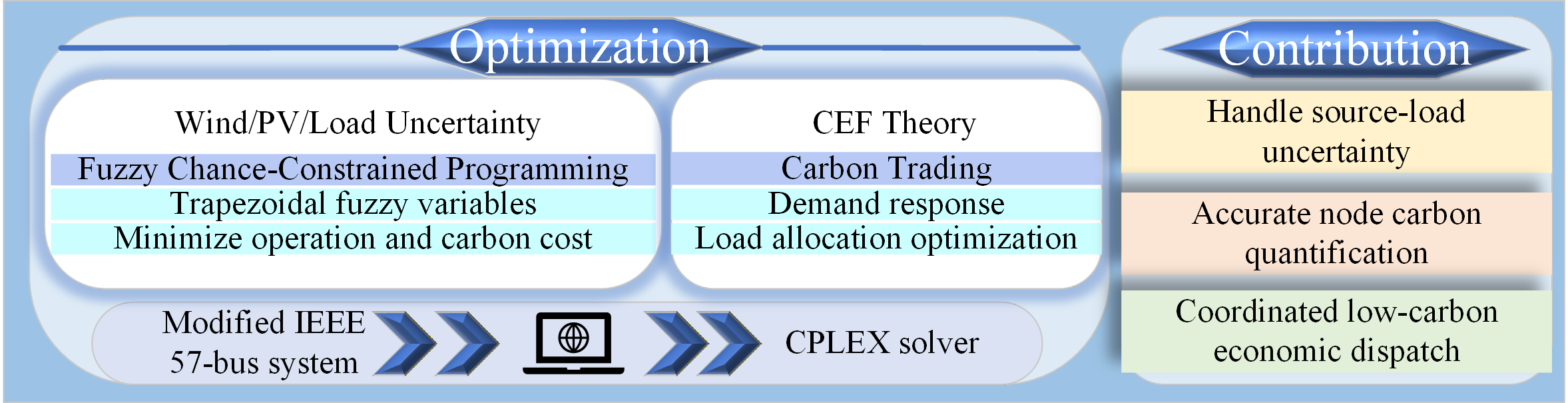
Marine are endowed with abundant renewable resources such as wind and solar energy. The rational utilization of these resources through offshore wind turbines and photovoltaic plays a vital role in achieving energy conservation and emission reduction for marine energy systems. However, the challenges of grid integration and prominent uncertainties caused by large-scale penetration of offshore wind and photovoltaic (PV) energy into marine power systems severely threaten power balance, operational stability, and reserve allocation. To pursue low-carbon economic operation and collaboratively address source-load uncertainties in marine energy systems, this paper proposes a low-carbon economic dispatch model for offshore wind-PV grid-connected systems that considers source-load uncertainties and carbon emission flow (CEF). A bi-level optimization framework is adopted. The upper level establishes a unit output optimization model to handle source-load uncertainties via fuzzy chance-constrained programming, which converts the uncertain problem into a deterministic equivalent under a predefined confidence level, with the objective of minimizing the total operation cost and carbon cost. The lower level constructs a load response model incorporating CEF theory and carbon trading mechanisms to optimize load allocation, thereby achieving coordinated reductions in carbon emissions and carbon-related costs. Finally, the modified IEEE 57-node system is employed for case studies, and the proposed model is solved and validated using the CPLEX solver. The results demonstrate that the presented method can effectively mitigate the adverse impacts of offshore renewable energy fluctuations, enhance the stability and low-carbon economy of marine power systems, and provide a feasible dispatch solution for large-scale grid integration of offshore wind and PV energy.
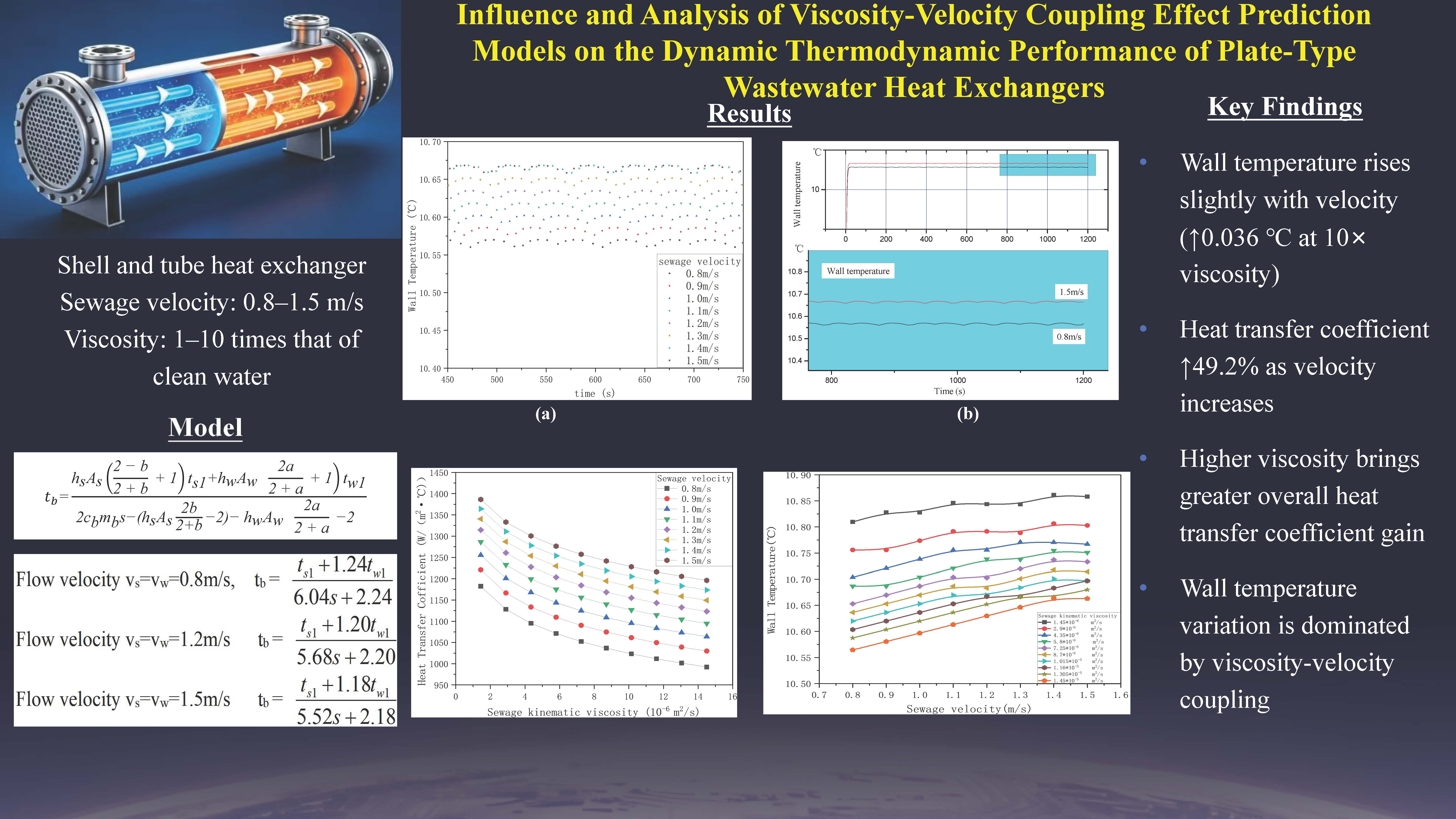
To address the lack of dynamic prediction methods for heat exchangers operating under variable-viscosity and fluctuating-flow conditions in marine integrated energy systems, this study develops a dynamic wall-temperature prediction model for a shell-and-tube heat exchanger under combined viscosity-flow conditions. The model is established over flow velocities of 0.8–1.5 m/s and kinematic viscosities of 1.45 × 10⁻⁶–1.45 × 10⁻⁵ m2/s, representing fouling-prone operating conditions relevant to seawater/sewage-source heat pump applications. The main novelty of the study lies in linking viscosity-flow combined with wall-temperature dynamics in a unified prediction framework and in quantifying the nonlinear thermal response over a practically relevant operating range. The results show that a quartic polynomial relationship with flow velocity and viscosity can describe wall temperature. A distinct dynamic response pattern is observed: under low-viscosity conditions, wall temperature exhibits pronounced multi-peak fluctuations, whereas under high-viscosity conditions, it shifts to a more stable single-peak or gently declining trend. This behavior helps clarify the physical mechanism governing wall-temperature evolution under combined transport effects. In addition, the sewage-side heat transfer coefficient increases by up to 41.3%, while the overall heat transfer coefficient increases by 18.2–20.6% over the investigated range. These findings provide a dynamic prediction tool for heat exchanger performance in seawater-source heat pump systems integrated with intermittent marine renewable energy (such as offshore wind and wave power), and further indicate that the proposed model can offer useful mechanism-level insight into the dynamic thermal behavior of fouling-prone heat exchangers, thereby supporting the design and operation of seawater/sewage-source heat pump systems integrated with intermittent marine renewable energy sources such as offshore wind power.
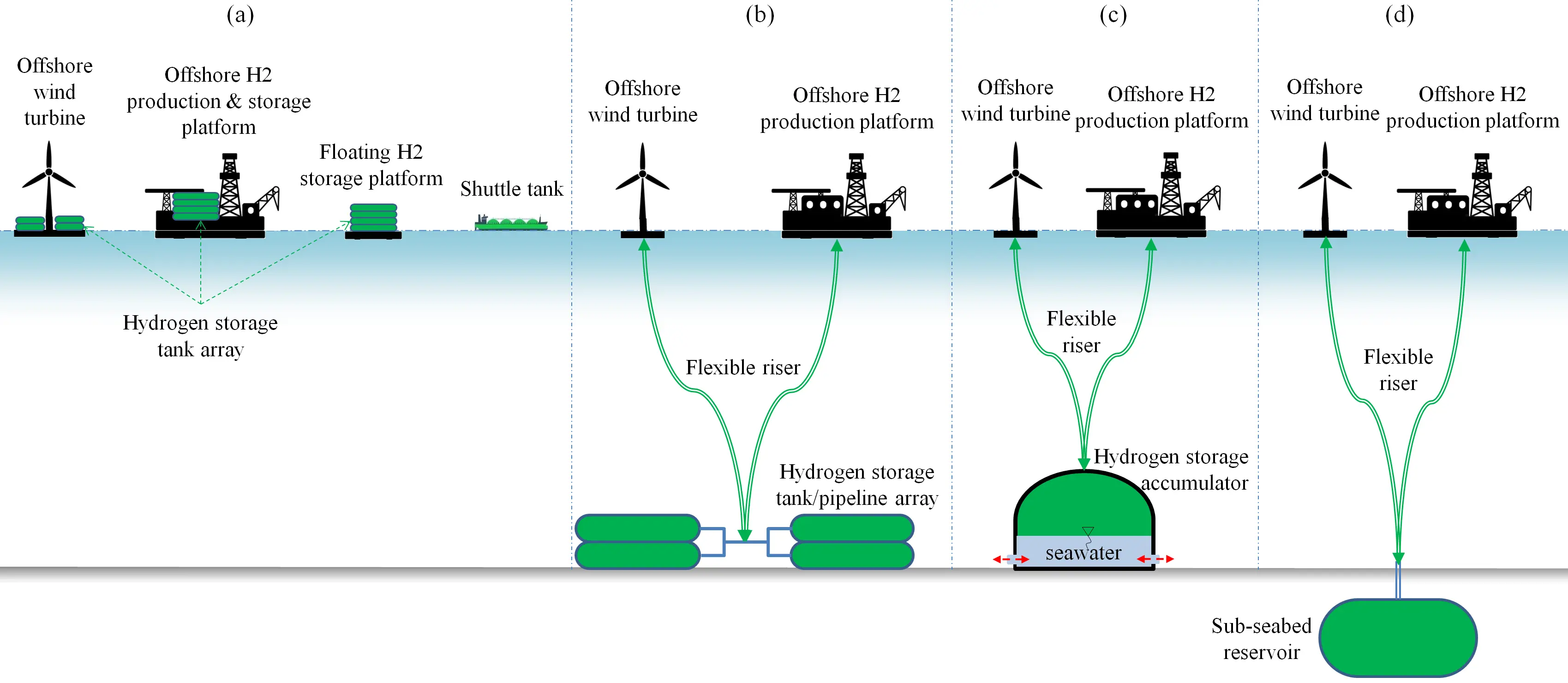
Floating offshore wind-based green hydrogen production has emerged as a viable alternative to conventional electricity generation and transmission. Large scale, long duration offshore hydrogen storage is a critical component. A subsea isobaric hydrogen storage concept is proposed in this study. A detailed levelized cost of storage (LCOS) analysis is conducted from the perspective of life cycle assessment for the first time. The findings yield several new insights and provide recommendations for optimizing the techno-economic performance of subsea isobaric hydrogen storage technology. Transportation and installation costs are significant contributors to overall expenses. In the benchmark scenario with a 200-m water depth and a weekly cycling rate, the calculated LCOS is 0.52 USD/kg H2, which is substantially lower than that of conventional pressurized container storage with the value of 1.33 USD/kg H2. And the LCOS decreases with the increasing water depth. The LCOS is 0.14 USD/kg H2 when the water depth is 800 m. Sensitivity analysis reveals that the LCOS is primarily influenced by the hydrogen storage accumulator, while the impact of the wind farm is marginal. The LCOS demonstrates high sensitivity to water depth of storage, storage volume per hydrogen accumulator, and the lifetime of hydrogen accumulators. These results provide valuable guidance for the design and deployment of cost-effective subsea isobaric hydrogen storage systems.
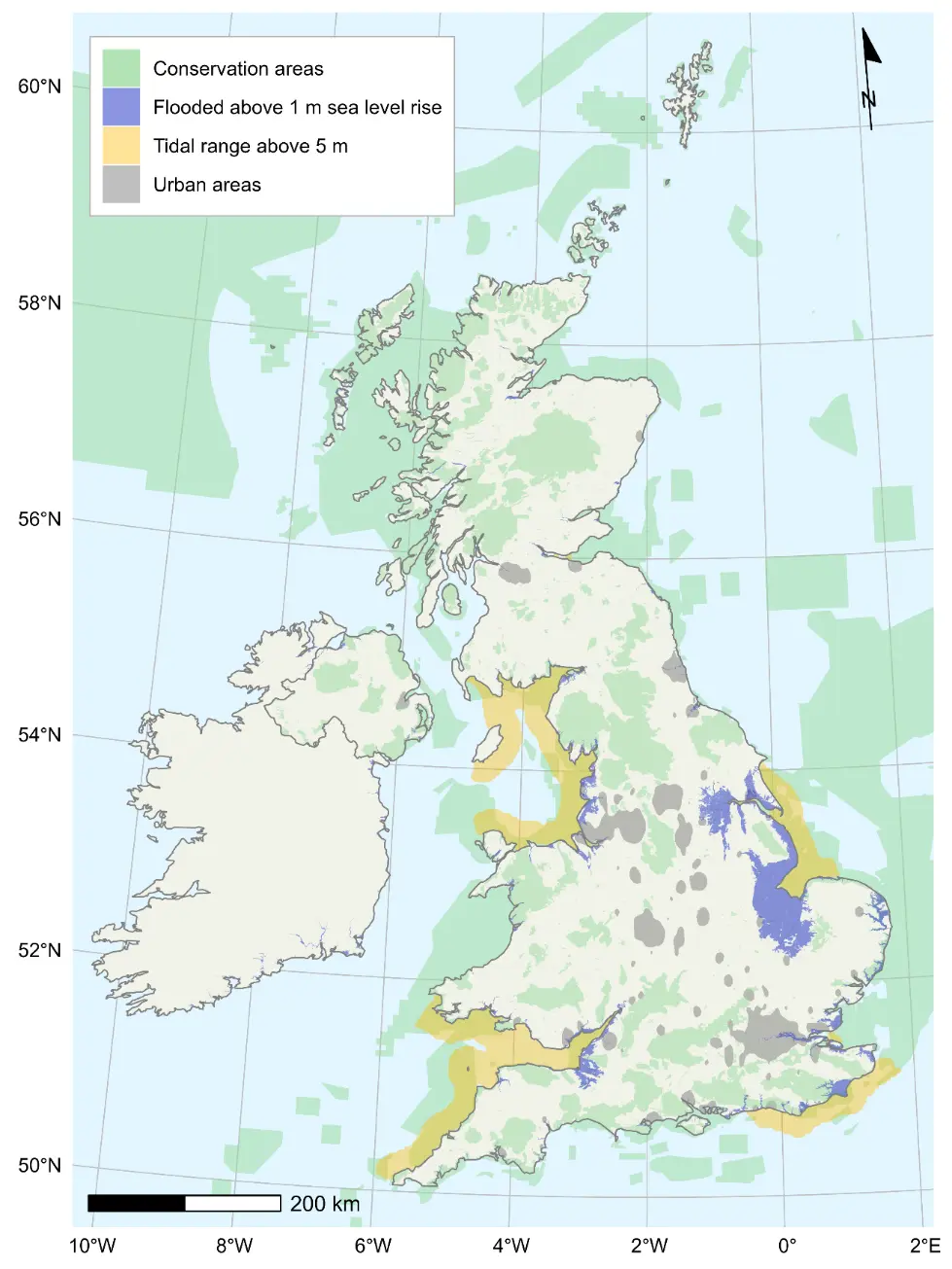
Tidal range power plants (TPPs) are reliable electricity generators with the la Rance TPP in France serving as an example of long-term (60+ years) s uccess. Despite their potential for energy delivery, the challenges surrounding TPP development remain substantial. High initial investment and concerns about environmental impacts on marine ecosystems have made it difficult to progress major proposals. With rising sea levels and more frequent, intense storm surges expected to lead to greater inundation of key coastal zones, co-benefits to ecosystems and infrastructure that TPPs may offer are being reconsidered. Using the UK as a case study, we map appropriate tidal resource (>5 m tidal range), 2050 1:25 flood risk areas (1 m rise), coastal zones with conservation specification and areas of high human density. Overlap in these factors reveals specific locations in which further research would usefully estimate potential costs and benefits, socially, ecologically and financially. Viewed together, reduced flood risk to people and infrastructure, ecosystem conservation opportunity and stable energy generation may highlight the future opportunity of TPPs.
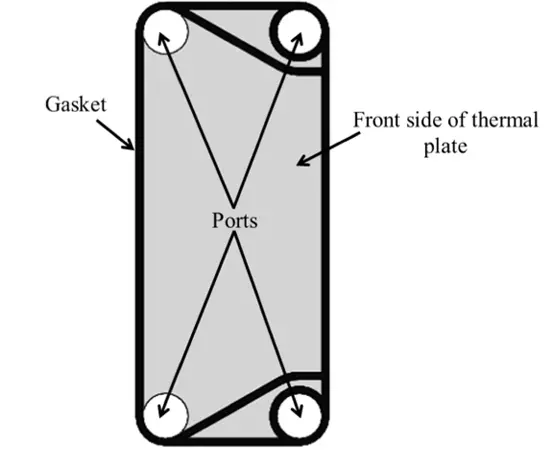
To address the difficulty of predicting plate heat exchanger performance under variable-flow and fouling-prone coastal conditions, this study developed a novel combined framework for a BR50 plate heat exchanger by integrating a steady-state heat transfer model with a transfer-function-based dynamic wall-temperature model. The main innovation is that the framework simultaneously captures steady thermal performance and transient wall-temperature response, while explicitly quantifying the coupled effects of flow velocity and kinematic viscosity. The model was evaluated for sewage-side velocities of 0.8–1.5 m/s and viscosities up to ten times that of clean water. Results show that wall temperature increases slightly with velocity and can be described by a fourth-order polynomial. Its transient response follows first-order inertia, and the time constant decreases as velocity increases, indicating faster thermal response at higher flow rates. Both the sewage-side heat transfer coefficient and the overall heat transfer coefficient increase with velocity but decrease with viscosity; increasing velocity from 0.8 to 1.5 m/s raises the sewage-side coefficient by 49.2%. Sensitivity analysis identifies kinematic viscosity as the dominant factor affecting thermal performance, followed by flow velocity and wall temperature. The framework provides a practical basis for seawater-source heat pumps and coastal heat recovery systems under fouling-influenced conditions.