Deadline for manuscript submissions: 30 September 2026.



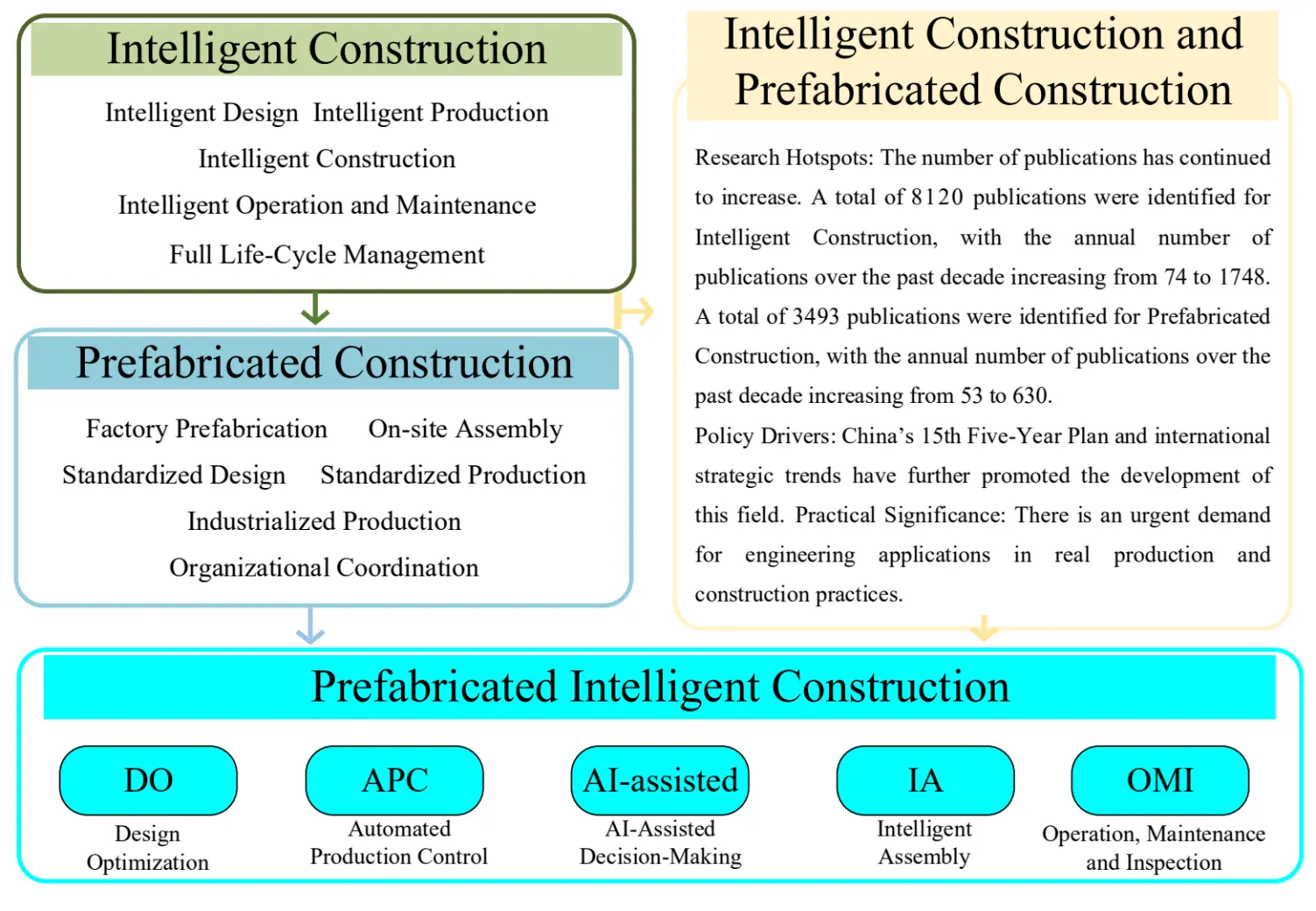
As the construction industry shifts toward industrialization, digitalization, intelligence, and low-carbon development, prefabricated intelligent construction has emerged as a key pathway for enhancing efficiency, quality control, resource utilization, and full life-cycle management. Yet existing studies remain largely confined to single-technology applications, local process optimization, or isolated engineering cases, lacking a systematic grasp of the field’s development trajectory, knowledge structure, research hotspots, and future challenges. Addressing this gap, this study presents a bibliometric review aimed at clarifying the research evolution, core knowledge domains, technological frontiers, and application-oriented challenges in prefabricated intelligent construction. Based on the Web of Science Core Collection, 583 journal articles published from 2015 to 2025 were retained after standardized search and screening. Using VOSviewer and bibliometrix, the study analyzed publication trends, subject distribution, national and institutional collaboration, author networks, keyword co-occurrence, thematic clustering, and research frontiers. Compared with traditional narrative reviews, this approach integrates quantitative bibliometric analysis with thematic content interpretation, constructing a panoramic and dynamic analytical framework for the field. Research shows that prefabricated intelligent construction underwent a leap from initial exploration to rapid expansion during 2015–2025, with publications and citations from 2023–2025 accounting for 76.16% and 84.07% of the total sample, respectively, establishing it as an active research frontier. In the global landscape, China contributes prominently in output volume, while Australia, the United States, the United Kingdom, and Germany demonstrate relatively high per-publication impact. The disciplinary structure is dominated by engineering, construction, and building technology, supported by multidisciplinary intersections, forming three major research hotspots: the integration of prefabricated construction and intelligent technologies, process innovation and intelligent equipment, and structural performance and engineering applications. In essence, this field represents a full life-cycle construction paradigm arising from the deep coupling of industrialization, digitalization, intelligence, and performance control. Future breakthroughs are needed in four dimensions: full life-cycle data standards, digital twin-driven closed-loop platforms, equipment–process collaborative optimization, and multi-scenario engineering validation to drive the transition toward large-scale application.
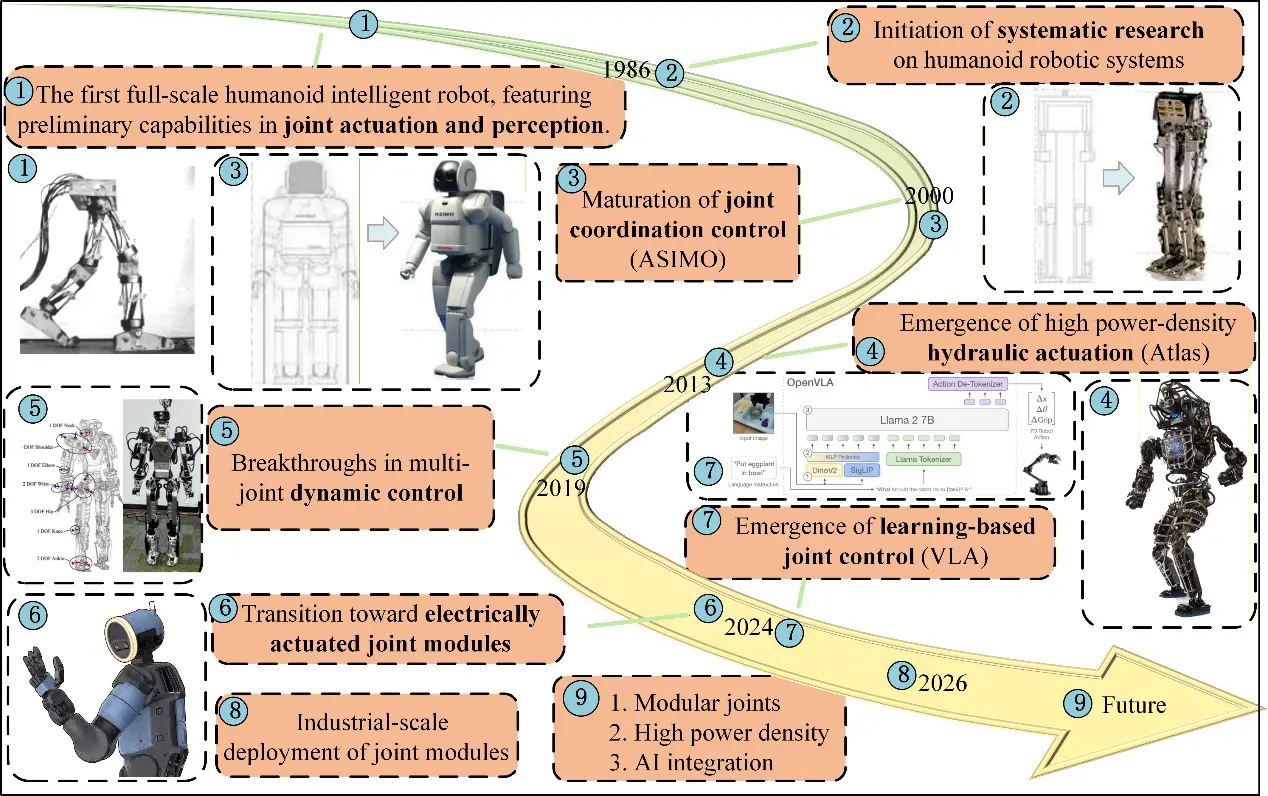
As an intelligence paradigm, embodied intelligence emphasizes that intelligent capabilities emerge from the dynamic interaction between an intelligent agent and its physical embodiment, and are realized through a continuous closed-loop process integrating perception, decision-making, action, and feedback. With the rapid development of embodied intelligence, humanoid robots have become increasingly important in intelligent manufacturing, service, and human-robot collaboration. Joint modules, as the core units responsible for perception, decision-making, and actuation, determine the motion performance, interaction capability, and intelligence level of humanoid robots. Research directions in this field remain fragmented, technological pathways are diverse, and systematic summaries of evolutionary patterns are lacking. First, publication trends, country and institutional collaboration networks, and major research contributors were analyzed. Research on humanoid robot joint modules has entered a phase of rapid growth since 2018, indicating a shift from early exploratory studies toward engineering and large-scale applications. Second keyword co-occurrence, clustering analysis, and burst detection were used to identify research hotspots and evolutionary features, research focus gradually shifted from traditional electromechanical actuation to compliant actuation, intelligent control, multimodal perception, and embodied intelligence. Furthermore, key technologies of joint modules were systematically summarized and reviewed from four aspects: structural design and performance optimization, motion control, human-robot interaction, and biomimetic actuation for human-like performance enhancement. Joint modules gradually evolved toward structural integration, intelligent control, natural interaction, and human-like system characteristics. Technical bottlenecks in current humanoid robot joint modules were analyzed, and future research directions were proposed to provide technical support and theoretical guidance for both industrial applications and academic research in humanoid robotics.
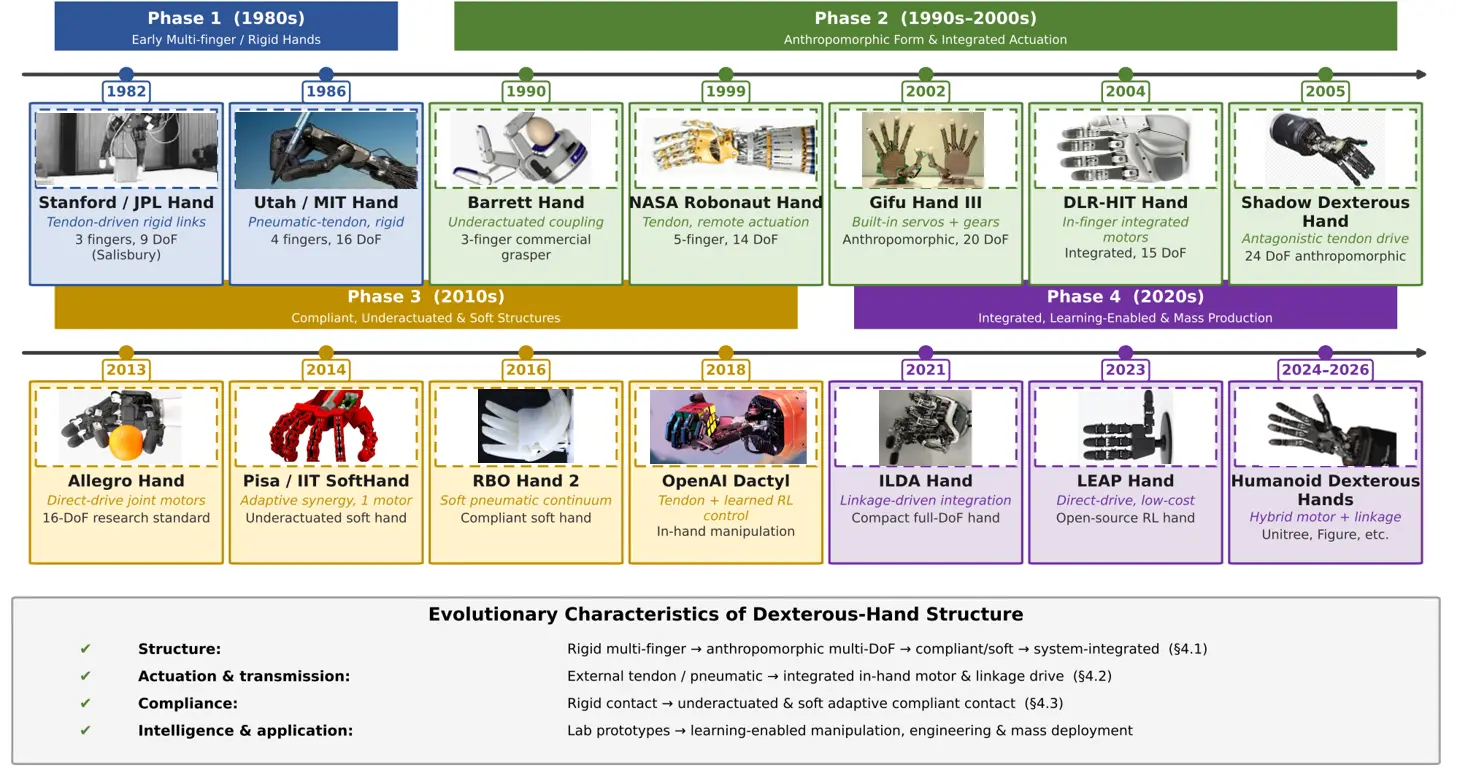
Robotic dexterous hands, as the primary end-effectors through which embodied agents interact with the physical world, directly determine grasp stability, manipulation accuracy, environmental adaptability, and human–robot interaction safety. Research on dexterous hand mechanical structures has expanded rapidly and become increasingly interdisciplinary, so conventional narrative reviews can no longer capture its knowledge base, research drivers, and the evolution of hotspots. A systematic framework that combines bibliometric quantification with mechanism-oriented synthesis is therefore needed. This study presents a bibliometric review of dexterous hand mechanical structures based on Web of Science Core Collection publications from 2016 to 2025, combining bibliometric statistics, collaboration-network analysis, keyword co-occurrence, cluster analysis, and trend synthesis to reveal the field’s research landscape, intellectual structure, and technological evolution. Publications increased steadily, rising from 64 in 2016 to 252 in 2025, with marked acceleration after 2022. China leads in publication volume, whereas the United States, Germany, and the United Kingdom show strong citation impact and international collaboration. Core journals concentrate on robotics, mechatronics, sensing, soft robotics, and rehabilitation engineering, and keyword evolution shows a shift from prosthetic hands and basic mechanism design toward compliant structures, soft actuation, tactile perception, and dexterous manipulation. Based on keyword clustering, three principal research streams are identified: body configuration and degree-of-freedom (DoF) evolution, drive and transmission structure design, and soft/compliant structure expansion. The central challenge of dexterous hand design is no longer the accumulation of DoFs but the coordinated optimization of DoF allocation, actuation mapping, contact stability, and compliant adaptation under strict constraints of space, energy, and reliability. Tendon-driven, internally integrated, and underactuated architectures emphasize lightweight dexterity, precision control, and adaptive grasping, respectively, while soft continuum, rigid–soft hybrid, and variable-stiffness structures are reshaping dexterous hands from rigid execution mechanisms into physically intelligent interaction systems. Overall, the field has entered a stage of interdisciplinary system integration, with its core mission shifting from building complex mechanical hands to constructing perceptive, adaptive, and controllable end-effectors. Future work should strengthen task-oriented structural optimization, hybrid actuation, rigid–soft coupling, integrated flexible sensing and closed-loop control, and unified performance evaluation, accelerating the transition from laboratory prototypes to standardized assessment and large-scale deployment.