
How Does Intelligent Construction Drive Prefabricated Construction from Synergistic Mechanisms to Engineering Applications

How Does Intelligent Construction Drive Prefabricated Construction from Synergistic Mechanisms to Engineering Applications
Rui Sheng 1 Jinan Ma 2 Feng Pang 1 Jianan Wen 1 Huijun Wu 3 Yingjie Xu 4 Qingfeng Bie 5 Xianxin Yin 5 Guanqun Li 5 Xianfeng Zhao 5 Guoqing Wang 6 Benkai Li 1 Teng Gao 1 Jingang Sun 1 Yonghong Wang 1 Xiao Ma 1,*
Received: 08 June 2026 Revised: 09 July 2026 Accepted: 17 July 2026 Published: 24 July 2026

© 2026 The authors. This is an open access article under the Creative Commons Attribution 4.0 International License (https://creativecommons.org/licenses/by/4.0/).
1. Introduction
Against the backdrop of the global construction industry’s accelerated transition toward high-quality development, green and low-carbon transformation, and sustainable construction [1], intelligent construction has become an important direction for promoting technological innovation and restructuring production modes in the industry [2]. As a comprehensive development paradigm formed through the deep integration of new-generation information technologies and engineering construction [3], intelligent construction connects key stages such as design, production, construction [4], and operation and maintenance through digital modeling, intelligent sensing, data interconnection [5], and collaborative decision-making. It promotes the transformation of the construction industry from traditional extensive [6], experience-based, and fragmented management toward a new model characterized by data-driven decision-making, system integration, and whole-process collaboration [7]. It should be noted that intelligent construction is not the simple application of a single technology [8], but a complex system encompassing multiple technological branches and application forms, including prefabricated construction, green construction, smart operation and maintenance, digital twins, and intelligent construction processes [9]. These branches differ in their research objectives and technical implementation approaches, yet they collectively serve the goals of industrialization, digitalization, and green transformation in the construction industry [10]. Among them, prefabricated construction, with its industrialized features of factory prefabrication and on-site assembly [11], is widely regarded as one of the most representative and readily implementable application scenarios of intelligent construction [12].
With the continuous evolution of intelligent construction technologies [13], the integration of prefabricated construction with key technologies such as BIM, the Internet of Things, artificial intelligence, robotics, and digital twins has continued to deepen [14]. Prefabricated construction has gradually evolved from the traditional model of component prefabrication and on-site installation into a full-process collaborative system covering intelligent design, automated production, smart construction, and digital operation and maintenance, namely, intelligent prefabricated construction [15]. This system is based on the industrialized organizational mode of prefabricated construction and supported by digital models and intelligent technologies. Through component design optimization [16], automatic control of factory production, precise coordination of on-site assembly, and condition monitoring and smart management during the service stage, it enables information continuity and collaborative operation throughout the full life cycle of building products [17]. Compared with traditional prefabricated construction, intelligent prefabricated construction not only significantly improves component production accuracy, construction organization efficiency [18], and quality control capability, but also demonstrates stronger systematic advantages in resource optimization, whole-process traceability, and the implementation of green construction [19]. As shown in Figure 1, intelligent prefabricated construction is not a mechanical superposition of intelligent construction and prefabricated construction [20]; rather, it is a targeted evolutionary form generated by the deep coupling of construction industrialization and construction intelligence, and represents the concretization and further development of the intelligent construction concept in prefabricated construction scenarios [21].
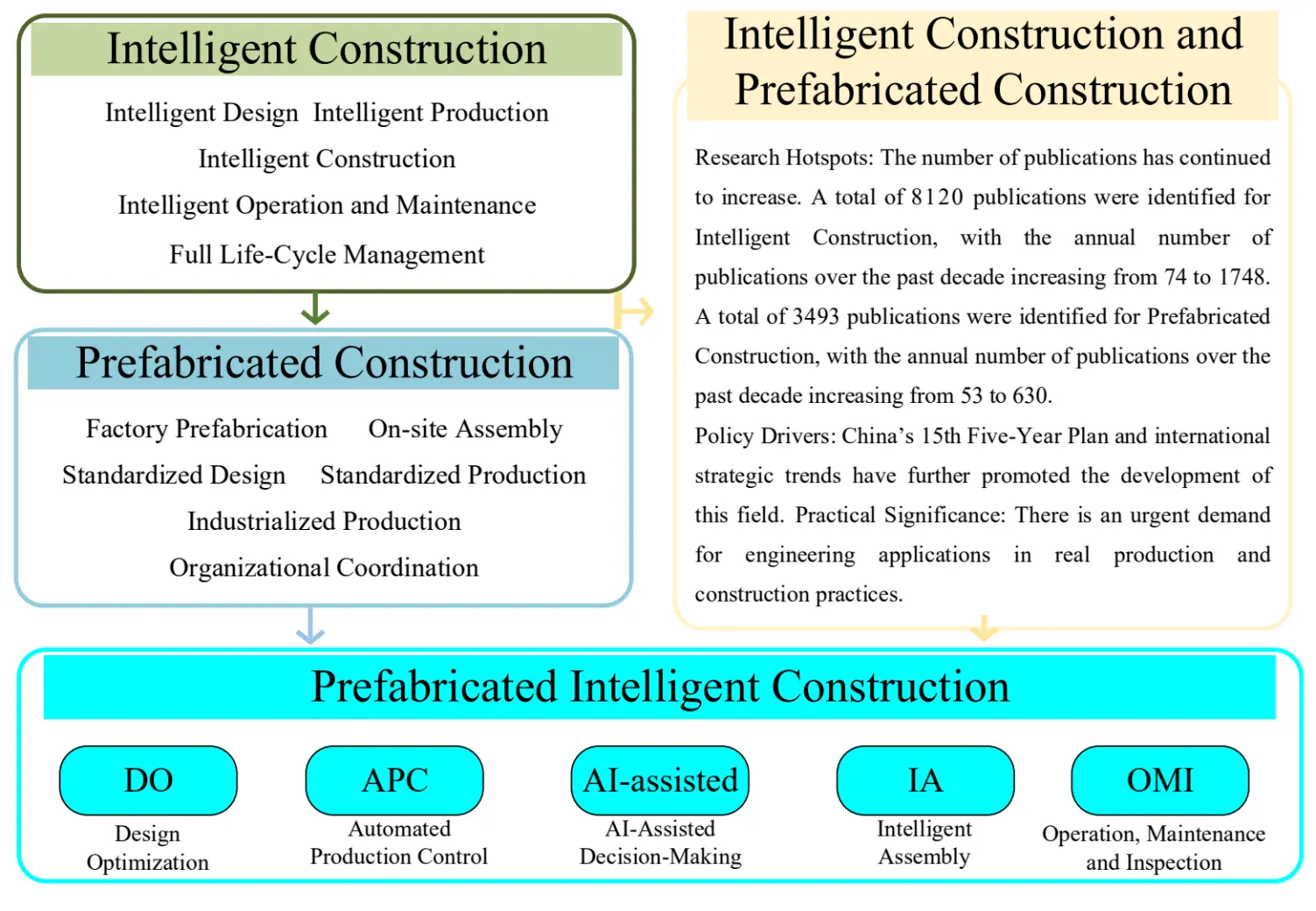
Driven by policy support, growing industrial demand, and the iterative advancement of key technologies, intelligent prefabricated construction has become a research hotspot of increasing interest to both academia and industry in recent years. Relevant studies have been widely distributed across multiple areas, including intelligent design algorithms, automated production of prefabricated components [22], intelligent monitoring of construction processes, quality traceability, and full life-cycle digital twins [23]. Overall, research in this field shows a continuous increase in publication output, an ongoing expansion of research topics, and a significantly strengthened trend toward interdisciplinary integration [24]. However, most existing studies still focus on single-technology applications, local process optimization, or specific engineering practices, while systematic investigations into the overall development trajectory, core research forces [25], knowledge structure, hotspot evolution, and potential research gaps in intelligent prefabricated construction remain insufficient [26]. Against this background, a panoramic, structured, and dynamic review of the field through the integration of bibliometric analysis and content analysis can not only help reveal its development patterns and research frontiers [27], but also provide more systematic references for subsequent theoretical advancement, technology integration, and industrial practice [28,29].
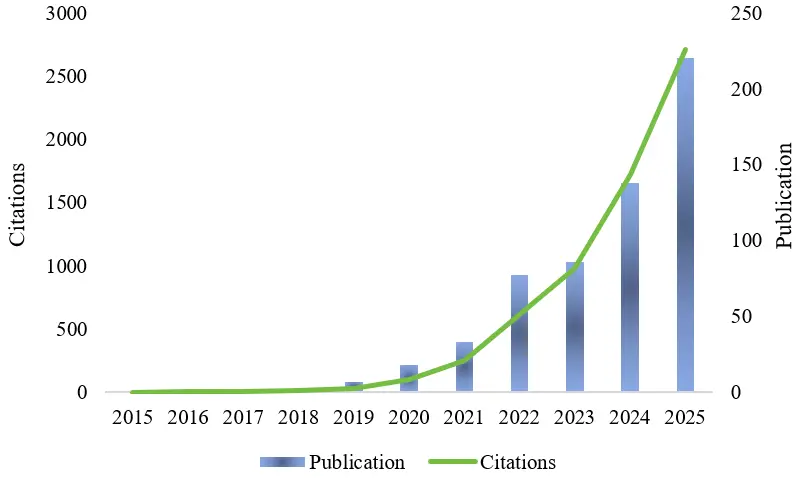
As shown in Figure 2, the annual publication output in the field of intelligent prefabricated construction generally exhibits a continuous upward trend, with a marked acceleration since 2020 and a peak in 2025. This indicates that, under the combined influence of sustained policy support, upgraded industrial demand, and the accelerated penetration of digital technologies, intelligent prefabricated construction has gradually become an important research frontier at the intersection of construction industrialization and intelligent construction. In terms of publication distribution by country or region, China ranks first with 349 publications, demonstrating its leading position in this research field. This is closely related to China’s recent policy orientation toward promoting the coordinated development of new-type construction industrialization, prefabricated buildings, and intelligent construction. Further analysis of major contributing institutions shows that Chinese universities, including Hebei University of Technology, Shenzhen University, South China University of Technology, Chongqing University, and Tianjin University, constitute important research forces in this field, indicating that universities play a crucial supporting role in knowledge production, key technology development, and theoretical innovation.
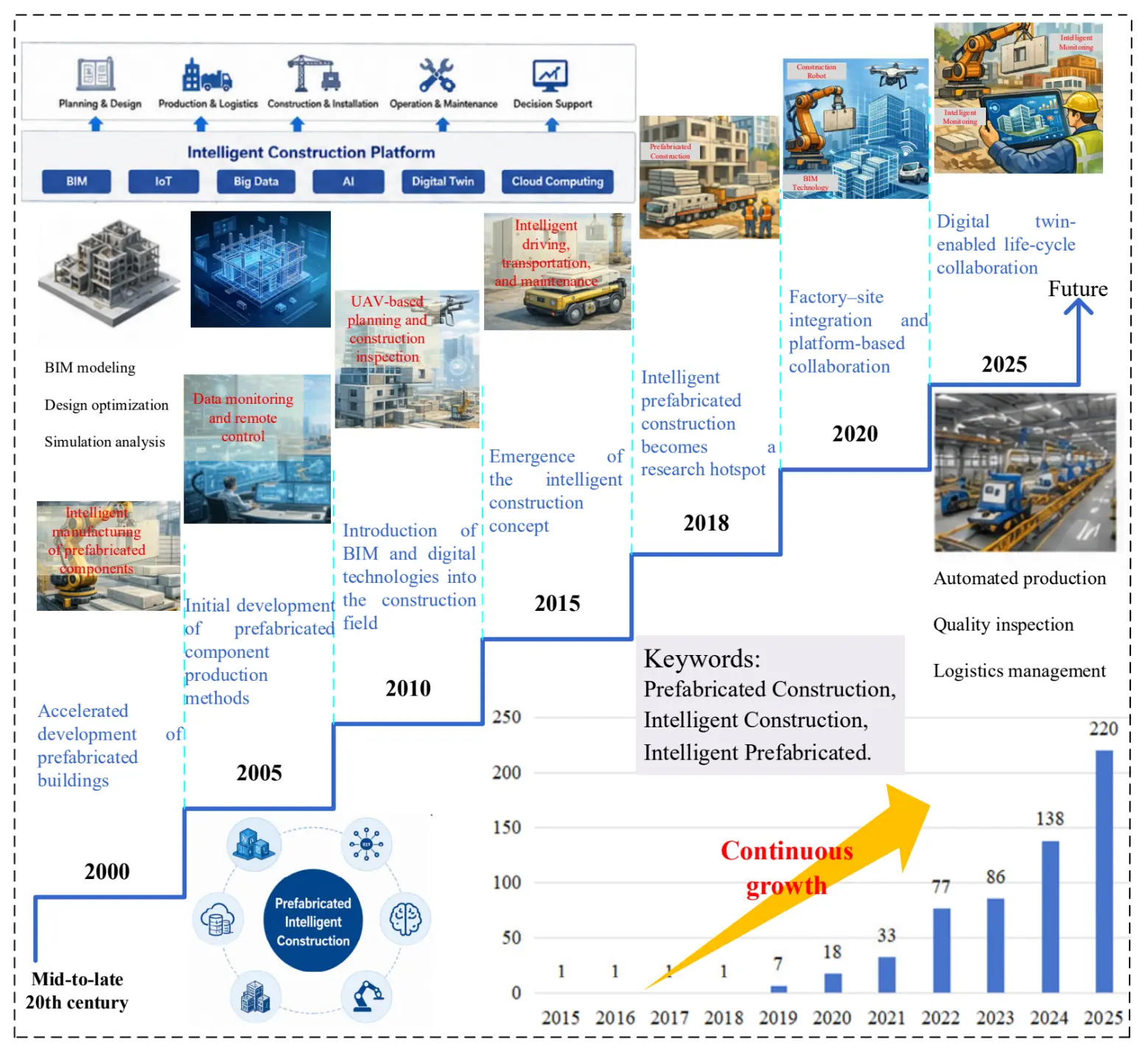
Meanwhile, the thematic evolution path shown in Figure 2 suggests that the integration of prefabricated construction and intelligent construction is not a simple superposition, but is continuously deepening along several directions, including BIM-driven information interconnection, the involvement of robotics and automated equipment, intelligent monitoring of construction processes, factory–site integrated collaboration, and platform-based and digital twin-enabled evolution. This demonstrates that intelligent prefabricated construction is developing rapidly, with digital design, automated production, intelligent construction, platform-based collaboration, and full life-cycle data integration as its main characteristics [30,31].
As shown in Figure 3, the framework of this paper follows the logical structure of Introduction-Methods-Results-Discussion-Conclusions and Prospects, and constructs a complete analytical pathway based on bibliometrics. First, the Introduction presents the research background and development process of intelligent prefabricated construction, clarifying the source of the research problem and the value of the study. Second, the Methods section focuses on data sources and data analysis, reflecting a research pathway based on literature data and centered on bibliometric analysis.
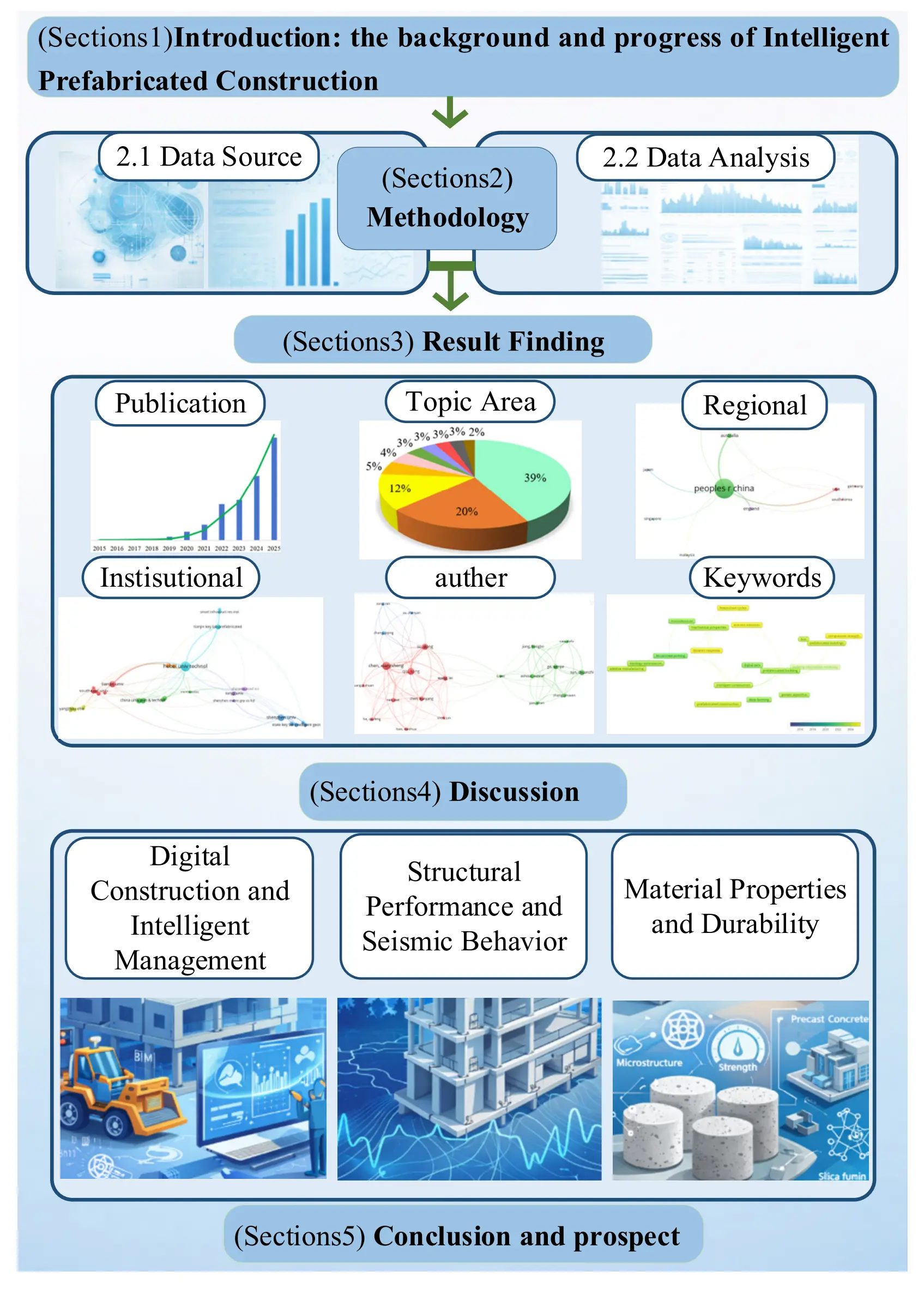
Subsequently, the Results section systematically presents the field’s knowledge structure, research forces, and hotspot evolution across multiple dimensions, including publication output, subject areas, regional distribution, institutions, authors, journals, highly cited literature, and keywords. In the Discussion section, key issues and development logic are further extracted based on the bibliometric results, enabling a transition from descriptive analysis to explanatory analysis. Finally, the Conclusions and Prospects section summarizes the research status, hotspot frontiers, and future development directions of intelligent prefabricated construction.
Compared with existing studies that mainly focus on single-technology reviews, summaries of local engineering practices, or experience-based generalizations, this paper conducts a bibliometric review of the field of intelligent prefabricated construction. Its main innovations are reflected in the following aspects.
First, from a conceptual perspective, this study establishes a progressive conceptual framework that follows the logic of intelligent construction prefabricated construction intelligent prefabricated construction. In this progressive cognitive framework, cognitive refers not to human cognition or artificial-intelligence cognition, but to the stepwise conceptual understanding of the research object. Specifically, intelligent construction is regarded as the broad technological paradigm, prefabricated construction as a representative industrialized application scenario, and intelligent prefabricated construction as the coupled and scenario-specific form generated by their integration. This clarification helps define the research scope, theoretical positioning, and scenario attributes of intelligent prefabricated construction.
Second, from the methodological perspective, this study introduces a research approach that integrates bibliometric analysis with thematic content analysis. Through quantitative statistics, relationship mining, and visual representation of the literature in this field, it overcomes the limitations of traditional narrative reviews in terms of systematicity, objectivity, and dynamics. Third, from the perspective of knowledge discovery, this study reveals the knowledge structure characteristics, hotspot migration patterns, and research frontier directions of intelligent prefabricated construction by examining multiple dimensions, including publication evolution, research actors, collaboration networks, keyword clustering, thematic evolution, and emerging frontiers. Fourth, from the perspective of application value, based on the systematic identification of research hotspots and potential gaps, this study provides a more comprehensive and forward-looking reference for future theoretical advancement, key technology breakthroughs, engineering application expansion, and industrial policy formulation.
2. Literature Data and Methods
2.1. Data Collection and Retrieval Methods
All data used for bibliometric analysis in this study were obtained from the Web of Science (WoS) Core Collection. With its massive academic literature reserve, comprehensive coverage of high-impact journals, and complete citation retrieval system, this database has become the most widely used international authoritative core academic database with both authority and comprehensiveness at present. The literature included in it is well-represented and can provide reliable data support for bibliometric analysis [32,33].
Accordingly, journals indexed in the Web of Science Core Collection were selected as the data source for literature retrieval. To ensure the comprehensiveness and high quality of the acquired literature, this study systematically designed and standardized both the retrieval strategy and the literature screening procedure [34,35].
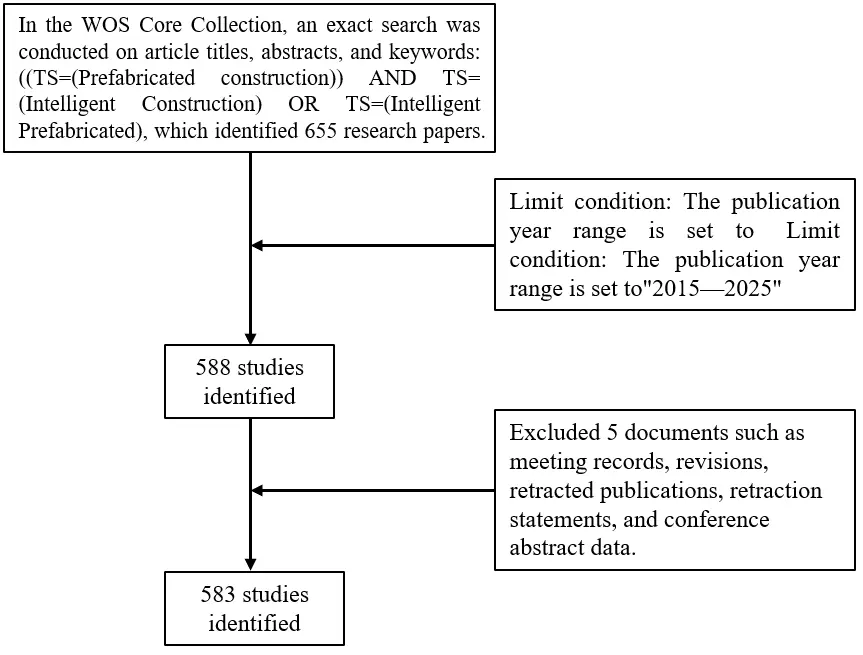
In designing the search strategy, the retrieval scope was limited to the Web of Science Core Collection to ensure the authority and representativeness of the literature. Meanwhile, synonyms, singular and plural forms, and abbreviations were considered comprehensively, and the three categories of search terms were combined based on logical relationships. After several rounds of testing and refinement, the final search formula was determined as follows: ((TS = (“Prefabricated construction”)) AND TS = (“Intelligent Construction”)) OR TS = (“Intelligent Prefabricated”). The publication year range was set as 2015–2025. A total of 588 relevant journal articles were initially retrieved.
To ensure the high quality of the data source, multiple screening procedures were conducted during the literature selection process. Each retrieved document was manually checked, and document types such as conference papers, revised manuscripts [36], retracted publications, retraction notices, and conference abstracts were excluded. After the above screening procedures, 5 invalid records were removed, and 583 high-quality publications were finally retained as the analytical data source for this study. The research data workflow for the bibliometric analysis is shown in Figure 4.
2.2. Data Analysis
In this study, the VOSviewer visualization tool and the R package bibliometrix were employed to present the logical relationships among topics in the target research field as knowledge graphs [37]. This visualization method effectively supports the systematic interpretation and in-depth analysis of research status, development context, and cutting-edge hotspots. The study systematically collected multidimensional data on research elements, including countries, institutions, keywords, and cited references, and then conducted a comprehensive bibliometric analysis of the 583 included publications across dimensions such as temporal evolution, spatial distribution, research fields, publishing institutions, core authors, and keyword co-occurrence clustering. This study aims to systematically review the research status, evolution, and hotspots in the field of minimum quantity lubrication technology applications, distill the field’s core research content, and provide a reference and support for subsequent related research [38,39].
All data adopted for bibliometric analysis in this study were retrieved from the Web of Science (WoS) Core Collection. Boasting a massive repository of academic literature, comprehensive coverage of high-impact journals, and a robust citation indexing mechanism, this database has emerged as the most widely used, authoritative, and comprehensive core academic database worldwide. The literature indexed therein is highly representative, providing a solid and reliable data foundation for bibliometric analysis [40,41].
3. Results and Analysis
3.1. Global Annual Publication Output
A total of 583 academic journal papers were collected in this study, with data including citation information, author names, publication years, author affiliations, keywords, and paper titles. Table 1 shows the annual proportion and growth rate of intelligent prefabricated construction in terms of publication volume and citation frequency, which are derived from the analysis of annual literature quantity and citation frequency. The research time range is set from 2015 to 2025.
Table 1. Annual Publication and Citation Trends in Intelligent Prefabricated Construction.
|
Year |
Publication |
Publication % |
Publication % Growth |
Citations |
Citations % |
Citations % Growth |
|---|---|---|---|---|---|---|
|
2015 |
1 |
0.17% |
- |
2 |
0.03% |
- |
|
2016 |
1 |
0.17% |
0.00% |
8 |
0.12% |
300.00% |
|
2017 |
1 |
0.17% |
0.00% |
10 |
0.16% |
25.00% |
|
2018 |
1 |
0.17% |
0.00% |
14 |
0.22% |
40.00% |
|
2019 |
7 |
1.20% |
600.00% |
28 |
0.43% |
100.00% |
|
2020 |
18 |
3.09% |
157.14% |
100 |
1.55% |
257.14% |
|
2021 |
33 |
5.66% |
83.33% |
252 |
3.91% |
152.00% |
|
2022 |
77 |
13.21% |
133.33% |
612 |
9.50% |
142.86% |
|
2023 |
86 |
14.75% |
11.69% |
981 |
15.23% |
60.29% |
|
2024 |
138 |
23.67% |
60.47% |
1723 |
26.75% |
75.64% |
|
2025 |
220 |
37.74% |
59.42% |
2710 |
42.08% |
57.28% |
During this period, representative relevant literature retrievable from the Web of Science Core Collection includes Research on the intelligent construction of prefabricated building and personnel training based on BIM5D [18] and Research on the intelligent construction of prefabricated building based on digital twin [42]. The former focuses on the discussion of intelligent construction of prefabricated buildings and personnel training modes based on BIM5D technology, while the latter elaborates on the application approaches and implementation methods of digital twin technology for the intelligent construction of prefabricated buildings.
The growth trend shown in the bar chart in Figure 5 indicates that the development of relevant publications can be broadly divided into three stages. In terms of publication output, only one relevant article was published each year from 2015 to 2018, with the annual publication proportion remaining at 0.17% and the growth rate at zero, indicating no significant increase. This suggests that research on intelligent prefabricated construction was still in its embryonic stage during this period. Although concepts such as prefabricated buildings, BIM, and intelligent construction had begun to attract attention, they had not yet formed stable research hotspots, and the number of research outputs and their academic influence remained limited. In 2019, the number of publications increased to seven, representing a 600.00% increase compared with the previous year. This indicates that the field began to show clear signs of research growth and marks the gradual transition of intelligent prefabricated construction from conceptual exploration to preliminary development.
The period from 2019 to 2023 represents an important stage of rapid growth in the number of publications in this field. The number of publications reached 18 in 2020, increasing by 157.14% compared with 2019; it further increased to 33 in 2021, with a growth rate of 83.33%; in 2022, the number of publications reached 77, with a growth rate of 133.33%; and in 2023, the number continued to increase to 86. During this stage, the proportion of publications increased from 3.09% in 2020 to 14.75% in 2023, indicating that intelligent prefabricated construction gradually became an important research direction at the intersection of construction industrialization, digital construction, and intelligent construction. In particular, the rapid development of BIM, digital twins, the Internet of Things, artificial intelligence, and intelligent construction management has provided new technical support for research on the intelligentization of prefabricated buildings. It has further promoted the continued increase in related publications.
From 2023 to 2025, relevant research entered a stage of pronounced high growth and concentrated expansion. In 2024, the number of publications reached 138, accounting for 23.67% of the total publications and representing a 60.47% increase compared with 2023. In 2025, the number further increased to 220, accounting for 37.74% of the total, the highest value during the study period. In the three years from 2023 to 2025 alone, the total number of relevant publications reached 444, accounting for 76.16% of all 583 publications, indicating that intelligent prefabricated construction has become a research hotspot in recent years. Although the growth rates in 2024 and 2025 were 60.47% and 59.42%, respectively, lower than the stage-specific high growth rates in 2019 and 2022, the significantly expanded publication base during this period still demonstrates the strong research activity and continuous expansion of the field. It also suggests that further breakthroughs in intelligent prefabricated construction research may require the support of new technologies or new driving forces to accelerate development.
Citation frequency can reflect the research value and academic quality of publications to a certain extent. In the field of intelligent prefabricated construction, the 583 publications included in this study received a total of 6440 citations, with an average of 11.05 citations per publication. The analysis of the citation-frequency line chart in Figure 5 indicates that the citation trend can also be divided into three stages: the first stage is 2015–2019, when the number of citations was relatively low, which is associated with the limited number of publications during this period; the second stage is 2019–2023, when citation frequency showed a steady upward trend; and the third stage is 2023–2025, when citation frequency increased rapidly, with citations during this period accounting for 84.07% of the total citations.
In terms of citation frequency, the annual citation counts from 2015 to 2018 were 2, 8, 10, and 14, respectively, each accounting for less than 0.25% of the total citations. This indicates that the number of relevant studies during this stage was limited and that their academic dissemination was relatively narrow. In 2019, the citation frequency increased to 28, representing a 100.00% increase compared with 2018, suggesting that early studies began to receive increasing academic attention. Overall, the citation frequency from 2015 to 2019 remained low, which was closely related to the small number of publications and the insufficient research foundation during this period.
From 2020 to 2023, citation frequency showed a relatively significant increase. The number of citations reached 100 in 2020, increasing by 257.14% compared with 2019; it rose to 252 in 2021, with a growth rate of 152.00%; further increased to 612 in 2022, with a growth rate of 142.86%; and reached 981 in 2023, accounting for 15.23% of the total citations. The rapid growth in citation frequency during this stage indicates that research on intelligent prefabricated construction not only increased in quantity but also gradually attracted more attention and citations from scholars, thereby continuously expanding its academic influence.
From 2023 to 2025, citation frequency entered a stage of rapid increase. In 2024, relevant publications received 1723 citations, accounting for 26.75% of the total citations. In 2025, the number further increased to 2710, accounting for 42.08%, the highest value during the entire study period. The total citation frequency from 2023 to 2025 reached 5414, accounting for 84.07% of the total 6440 citations, indicating that research outputs from the past three years have occupied a dominant position in the academic influence of this field. In particular, both the number of publications and citation frequency reached their highest levels in 2025, suggesting that intelligent prefabricated construction had formed a high degree of research activity and strong academic dissemination during this stage.
By comprehensively examining the trends in the publication-output bar chart and the citation-frequency line chart, it can be observed that the two show a strong consistency; that is, an increase in publication output is usually accompanied by an increase in citation frequency. This indicates that, as research outputs accumulate, the knowledge base of intelligent prefabricated construction continues to expand, citation connections among related studies become stronger, and an academic community is gradually being formed. At the same time, the growth in citation frequency lags behind the increase in publication output to some extent, but shows a stronger pattern of concentrated growth after 2023, indicating that high-impact research outputs in this field have mainly emerged in recent years.
Therefore, the growth trend reflected in Figure 5 suggests that research on intelligent prefabricated construction has generally experienced three stages of development. The first stage is the initial exploration period from 2015 to 2019, during which both publication output and citation frequency were relatively low, and research topics had not yet developed on a large scale. The second stage is the rapid development period from 2019 to 2023, during which publication output and citation frequency increased simultaneously, and research interest continued to grow. The third stage is the concentrated expansion period from 2023 to 2025, during which both the number of publications and citation impact reached their peak, indicating that intelligent prefabricated construction has become an important research hotspot in the fields of prefabricated buildings, intelligent construction, and digital construction. In the future, with the further integration of artificial intelligence, digital twins, BIM, the Internet of Things, robotic construction, and smart construction sites, this field will continue to have substantial research potential and development prospects.
3.2. Topics Area Distribution
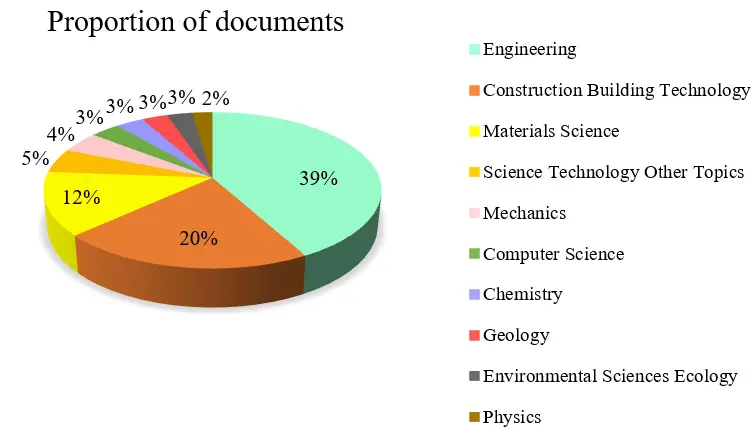
A precise search in the Web of Science (WoS) database yielded a total of 583 documents covering 43 subject areas. Table 2 lists the top 10 subject areas by number of publications. The results shown in Figure 6 indicate that the five disciplines with the highest document proportions are Engineering, Construction Building Technology, Materials Science, Science Technology Other Topics, and Mechanics.
From the perspective of disciplinary distribution, Engineering has the highest number of publications, with 421 papers, significantly exceeding other disciplines. This indicates that research on intelligent prefabricated construction is primarily focused on engineering practice and technological applications, with particular attention to structural design, construction organization, engineering management, quality control, and the improvement of construction efficiency. Construction Building Technology ranks second, with 211 publications, suggesting that this field is closely related to prefabricated building construction methods, prefabricated component production and installation, BIM technology application, and smart construction site management. This reflects the important role of construction building technology in promoting the intelligent transformation of construction methods.
Materials Science ranks third, with 131 publications, indicating that material performance, component quality, and new building materials are also important research topics in intelligent prefabricated construction. Since prefabricated buildings impose high requirements on the strength, durability, connection performance, and environmental performance of prefabricated components, materials science provides fundamental support for the development of this field. Science Technology Other Topics and Mechanics published 50 and 44 papers, respectively, suggesting that this research topic also involves issues such as digital technology integration, complex system management, structural mechanical behavior, connection performance of joints, and seismic performance.
In addition, Computer Science accounts for 33 publications, reflecting the gradual integration of technologies such as artificial intelligence, machine learning, digital twins, the Internet of Things, and data analytics into prefabricated building research. Although disciplines such as Chemistry, Geology, Environmental Sciences, Ecology, and Physics have relatively fewer publications, they also demonstrate the expansion of this field into areas such as building materials, green and low-carbon development, site adaptability, and physical performance.
Table 2. Subject Area Publication Output in Intelligent Prefabricated Construction Research.
|
Topics Areas |
Publications |
|---|---|
|
Engineering |
421 |
|
Construction Building Technology |
211 |
|
Materials Science |
131 |
|
Science Technology Other Topics |
50 |
|
Mechanics |
44 |
|
Computer Science |
33 |
|
Chemistry |
31 |
|
Geology |
29 |
|
Environmental Sciences Ecology |
28 |
|
Physics |
23 |
Overall, Table 2 and Figure 6 indicate that research on intelligent prefabricated construction has formed a disciplinary distribution pattern dominated by Engineering and Construction Building Technology, supported by Materials Science, Mechanics, and Computer Science, and extending toward Environmental Sciences, Chemistry, Geology, and Physics. This suggests that the field is no longer limited to traditional architectural engineering research but is gradually evolving into an interdisciplinary research direction that integrates engineering technology, digital intelligence, material performance, and green, low-carbon concepts.
3.3. Distribution and Collaboration of Countries and Regions
By analyzing 583 publications authored by researchers from 28 countries/regions in the Web of Science (WoS) database, this study identified 28 countries involved in publishing academic papers on prefabricated intelligent construction. On this basis, a country-level collaboration clustering map for prefabricated intelligent construction research was constructed, as shown in Figure 7. This clustering map provides a valuable perspective for revealing the geographical distribution characteristics and collaboration patterns in this research field. The map contains 10 nodes, representing countries that have published more than three papers related to prefabricated intelligent construction. The size of each circular node represents the number of publications of each country: the larger the node, the greater the publication output. The links between nodes indicate collaborative research relationships between countries, while the width of each link reflects the frequency of collaboration; the thicker the link, the stronger the collaboration.
In terms of publication output, China occupies an absolute leading position in prefabricated intelligent construction research. The data in Table 3 show that China has published 561 relevant papers, accounting for 96.2% of the total publications, far exceeding those of all other countries. This indicates that research on prefabricated intelligent construction is highly concentrated in China, reflecting China’s strong research foundation and policy support in prefabricated buildings, intelligent construction, construction industrialization, and digital construction. Meanwhile, in the collaboration network shown in Figure 7, China has the largest node and is at the core of the network, indicating that it is not only the major knowledge-producing country in this field but also a core node in the international collaboration network. Overall, China has become the absolute core of the global collaboration network in this field, occupying a dominant position in publication scale, academic influence, and international collaboration, and serving as a key force driving the development of prefabricated intelligent construction technologies.
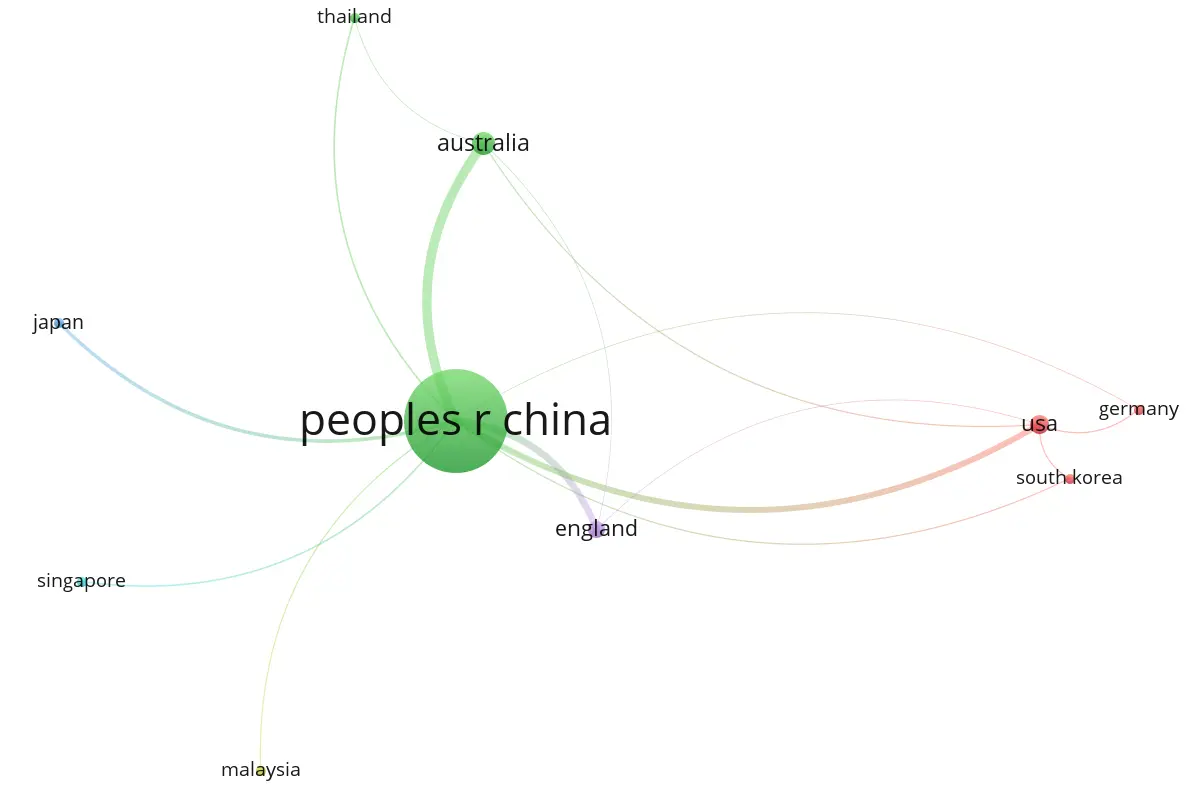
Figure 7. Country and Regional Collaboration Network in Intelligent Prefabricated Construction Research.
In addition to China, Australia, the United States, and the United Kingdom are also important participating countries in this research field. Specifically, Australia published 40 papers, accounting for 6.8%; the United States published 27 papers, accounting for 4.6%; and the United Kingdom published 23 papers, accounting for 3.9%. Although the publication outputs of these countries are significantly lower than those of China, their research outputs still exert a certain influence within the international collaboration network, indicating that prefabricated intelligent construction research has attracted academic attention across different countries and regions. Countries such as Japan, Germany, South Korea, Malaysia, Singapore, and Thailand have relatively few publications, all below 10, suggesting that their research participation in this field remains limited.
From the perspective of citation impact, Chinese publications have the highest total citation count, reaching 6543, indicating that China not only has an advantage in publication output but also demonstrates a high overall academic influence. However, in terms of average citations per paper, Germany ranks first with 33.0 citations, followed closely by Australia with 32.9 citations. The United States and the United Kingdom also achieve average citation counts of 22.8 and 21.5, respectively, both higher than China’s 11.7. This indicates that although China holds an absolute leading position in research output, countries such as Germany, Australia, the United States, and the United Kingdom show more prominent single-paper influence, reflecting relatively high research quality and academic dissemination capacity. The data suggest that the field of prefabricated intelligent construction presents a highly concentrated research output pattern centered on China, while the top ten contributing countries display diversified characteristics in citation impact, clearly illustrating the global development trajectory of this field.
The country collaboration network shown in Figure 7 further reveals the international collaboration structure of this field. As the core node in the network, China has collaborative links with multiple countries, indicating a relatively high level of international collaboration in prefabricated intelligent construction research and an important role in knowledge exchange and research coordination. Countries such as Australia, the United States, and the United Kingdom have also established collaborative relationships with China or other countries, forming a collaboration network centered on China and jointly participated in by multiple countries. However, from an overall perspective, the number of network nodes remains limited, and most countries have relatively small publication outputs, suggesting that the scope of international collaboration in this field still has room for further expansion.
It is worth noting that some countries, despite having relatively low publication outputs, show representative citation performance. For example, Germany published only 5 papers, but its total citation count reached 165, with an average of 33.0 citations per paper, indicating that its research outputs have considerable academic influence. Australia published 40 papers, with a total citation count of 1319 and an average of 32.9 citations per paper, suggesting that its research in this field has received strong international attention. In contrast, South Korea published 4 relevant papers but received 0 citations, indicating that the academic dissemination and influence of its research outputs have not yet been fully realized.
Table 3. Publication and Citation Performance by Country or Region.
|
Country |
Publication |
Percentage% |
Citation Count |
Average Citations |
|---|---|---|---|---|
|
China |
561 |
96.2 |
6543 |
11.7 |
|
Australia |
40 |
6.8 |
1319 |
32.9 |
|
Usa |
27 |
4.6 |
617 |
22.8 |
|
England |
23 |
3.9 |
494 |
21.5 |
|
Japan |
9 |
1.6 |
146 |
16.2 |
|
Germany |
5 |
0.9 |
165 |
33 |
|
South korea |
4 |
0.7 |
0 |
0 |
|
Malaysia |
3 |
0.5 |
35 |
11.7 |
|
Singapore |
3 |
0.5 |
6 |
2 |
|
Thailand |
3 |
0.5 |
32 |
10.7 |
Overall, the country/region distribution in the field of prefabricated intelligent construction exhibits the characteristics of a single dominant core with multi-country collaborative participation. With 561 publications and 6543 total citations, China occupies an absolute core position in the global research landscape and serves as the main driving force for the development of this field. Although countries such as Australia, the United States, the United Kingdom, and Germany have relatively smaller publication scales, they perform prominently in terms of average citations per paper and research quality, forming important international academic support for this field. In the future, as intelligent construction, digital twins, BIM, artificial intelligence, and prefabricated building technologies continue to develop, this field is expected to further strengthen cross-national collaboration and form a more open, diverse, and balanced global research network.
3.4. Institutional Distribution and Collaboration
A further statistical analysis was conducted on the authors’ affiliated institutions in the retrieved literature to identify core research institutions with high academic output and influence in the field of prefabricated intelligent construction. Table 4 presents the top ten research institutions in terms of publication output, while Figure 8 shows the institutional collaboration network constructed using VOSviewer, which reveals the collaboration relationships and clustering characteristics among different research institutions.
In terms of institutional publication output, research on prefabricated intelligent construction shows a clear pattern of institutional concentration. Among the top ten institutions, Chinese institutions account for up to 90%, indicating that Chinese universities and research institutions are the main drivers of academic research in this field. Among them, Hebei University of Technology ranks first with 123 publications, significantly exceeding other institutions. Meanwhile, its total citation count reaches 2282, with an average of 18.6 citations per paper, indicating that this institution has an absolute advantage not only in research output but also in academic influence. Shenzhen University ranks second with 50 publications, a total citation count of 709, and an average of 14.2 citations per paper, suggesting that it also demonstrates strong research activity and academic dissemination capacity in prefabricated intelligent construction. Universities such as Tianjin University, Southeast University, China University of Mining and Technology, and Chongqing University also rank among the top ten, maintaining relatively high publication outputs and reflecting the sustained research investment of Chinese universities in this field.
From the perspective of citation impact, certain differences can be observed among institutions. Hebei University of Technology has the highest total citation count, indicating that its research outputs possess a strong knowledge diffusion capacity and academic recognition in this field. Notably, although Curtin University in Australia ranks tenth with only 18 publications, its total citation count reaches 461, and its average citations per paper reach 25.6, the highest among the top ten institutions. This suggests that its individual papers demonstrate relatively high quality and strong international academic influence. By contrast, although institutions such as Tianjin University, Southeast University, and China University of Mining and Technology have relatively high publication outputs, their average citations per paper are comparatively lower, indicating that there remains room for improvement in the international dissemination and citation impact of their research outputs.
Table 4. Publication and Citation Performance of Major Research Institutions.
|
Rank |
Institution Name |
Country |
Citations |
Publication |
Average Citation per Paper |
|---|---|---|---|---|---|
|
1 |
Hebei University of Technology |
China |
2282 |
123 |
18.6 |
|
2 |
Shenzhen University |
China |
709 |
50 |
14.2 |
|
3 |
Tianjin University |
China |
249 |
39 |
6.4 |
|
4 |
Southeast University China |
China |
254 |
32 |
7.9 |
|
5 |
China University of Mining Technology |
China |
247 |
31 |
8 |
|
6 |
Chongqing University |
China |
283 |
28 |
10.1 |
|
7 |
Tianjin Key Lab Prefabricated Bldg Intelligent C |
China |
200 |
21 |
9.5 |
|
8 |
Beijing University of Technology |
China |
241 |
20 |
12.1 |
|
9 |
Tongji University |
China |
214 |
19 |
11.3 |
|
10 |
Curtin University |
Australia |
461 |
18 |
25.6 |
At the same time, this study employed VOSviewer to conduct a network analysis of institutional collaboration, aiming to reveal the core research teams in the field of prefabricated intelligent construction. The institutional collaboration network shown in Figure 8 further illustrates the collaborative structure of this field. In the network, nodes represent research institutions, node size reflects publication output, links between nodes indicate collaborative relationships among institutions, and link strength represents collaboration frequency. Overall, several relatively stable institutional collaboration clusters have formed in the field of prefabricated intelligent construction, with Chinese universities or research institutions serving as the core of the major clusters. This indicates that Chinese institutions not only hold an advantage in publication output but also play an important organizational and bridging role in the collaboration network.
In this study, institutions with no fewer than eight publications were selected, resulting in a set of interconnected institutional nodes. These nodes formed the main collaborative research clusters and were distinguished by different colors. Notably, the core nodes of all clusters are Chinese institutions. The largest cluster is centered on Hebei University of Technology and encompasses multiple associated nodes, such as the Tianjin Key Laboratory of Prefabricated Building and the Smart Infrastructure Research Institute, forming the most extensive collaborative network in this field. The second-largest cluster takes China University of Mining and Technology as its core. The third cluster is led by Tianjin University and Southeast University and focuses on regional academic cooperation in North China and East China. The fourth cluster is centered on Shenzhen University and integrates institutions such as Tongji University and Shenzhen Metro Group Co., Ltd., reflecting the in-depth characteristics of industry–university–research integration in this field.
The collaboration clustering characteristics of research institutions can reflect the overall collaboration pattern within the field. The results show that universities, especially institutions specializing in civil engineering and architecture, have made outstanding contributions. Chinese institutions occupy a significant advantage in both number and scale within the collaboration network, fully demonstrating their important influence and active role in the field of prefabricated intelligent construction.
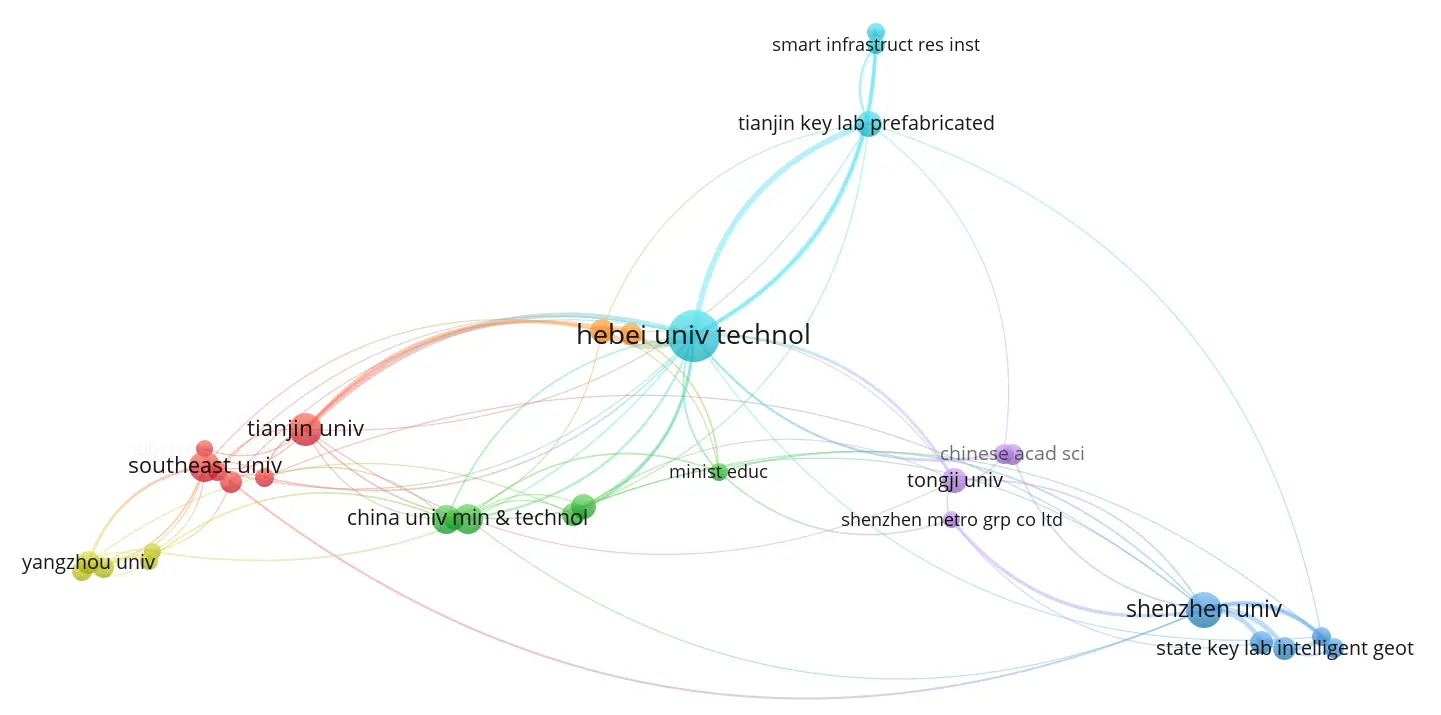
A comprehensive examination of Table 4 and Figure 8 indicates that the institutional distribution in the field of prefabricated intelligent construction has three main characteristics. First, research capacity is highly concentrated in Chinese universities, especially those with strong disciplinary strengths in civil engineering, construction engineering, and intelligent construction. Second, a small number of core institutions occupy dominant positions in both publication output and collaboration networks. Among them, Hebei University of Technology is the most prominent and represents one of the most influential core research institutions in this field. Third, although Chinese institutions have clear advantages in both quantity and scale, some overseas institutions, such as Curtin University, perform prominently in terms of average citations per paper, indicating that international research institutions also play an important role in producing high-impact research outputs.
Overall, the field of prefabricated intelligent construction has formed a research pattern dominated by Chinese universities, led by core institutions, and supported by multi-institutional collaboration. Universities, especially those specializing in civil engineering and architecture, play a key role in this field by advancing theoretical research and technical methods while facilitating industry–university–research collaboration with enterprises. In the future, with the further integration of intelligent construction, digital twins, BIM, artificial intelligence, and industrialized construction technologies, there remains considerable room for expanding cross-regional, interdisciplinary, and international collaboration among research institutions.
3.5. Author Distribution and Collaboration
This study further conducts a statistical analysis of core authors in the field of prefabricated intelligent construction, aiming to identify representative scholars with high academic productivity and influence in this field. Core authors are usually an important driving force behind the continuous development of a research topic. The number of publications reflects their research activity in the field, while citation frequency and average citations per paper further indicate the academic influence and knowledge dissemination value of their research outputs. Therefore, by integrating the indicators of publication volume, total citations, and average citations per paper, the distribution characteristics of authors in the field of prefabricated intelligent construction can be more comprehensively revealed.
As shown in Table 5, Ma Guowei ranks first with 44 publications. His total citation count reaches 1331, with an average of 30.3 citations per paper, indicating that he not only has a significant advantage in terms of publication output, but also that his research has gained high academic recognition and influence. He is therefore one of the most representative core authors in this field. Chen Xiangsheng ranks second with 40 publications, 423 citations, and an average of 10.6 citations per paper, suggesting that he maintains a high level of research activity and occupies an important position in the author collaboration network. Qiu Tong has published 29 papers, with 281 citations and an average of 9.7 citations per paper, making him another important academic contributor to research on prefabricated intelligent construction.
In addition to the above highly productive authors, Hao Yifei, Su Dong, Sun Chuanzhi, Ge Wenjie, and Wang Lei also demonstrate relatively stable academic output. Among them, Su Dong has published 24 papers, with 329 citations and an average of 13.7 citations per paper; Sun Chuanzhi has published 17 papers, with 258 citations and an average of 15.2 citations per paper; Ge Wenjie and Wang Lei have each published 14 papers, with citation counts of 254 and 212, and average citations per paper of 18.1 and 15.1, respectively. Although their publication volumes are slightly lower than those of Ma Guowei and Chen Xiangsheng, their research outputs still show a strong academic dissemination capacity and serve as an important foundation for the continuous development of this field.
It is worth noting that some authors do not have an absolute advantage in publication volume, but show outstanding performance in terms of average citations per paper, indicating the high influence of their individual studies. For example, Wang Li has published only 16 papers, but her total citation count reaches 942, with an average of 58.9 citations per paper, the highest among all authors listed in the table. This demonstrates the strong academic influence and citation value of her research. Zhang Mo has also published 16 papers, with 513 citations and an average of 32.1 citations per paper, indicating that his research has received considerable attention in the field. These results suggest that author influence in prefabricated intelligent construction is not determined solely by publication quantity; high-quality and highly cited research outputs are also important indicators of core authors’ academic contributions.
Table 5. Publication and Citation Performance of Core Authors.
|
Author |
Documents |
Citations |
Per Citations |
|---|---|---|---|
|
Ma Guowei |
44 |
1331 |
30.3 |
|
Chen Xiangsheng |
40 |
423 |
10.6 |
|
Qiu Tong |
29 |
281 |
9.7 |
|
Hao Yifei |
27 |
201 |
7.4 |
|
Su Dong |
24 |
329 |
13.7 |
|
Sun Chuanzhi |
17 |
258 |
15.2 |
|
Wang Li |
16 |
942 |
58.9 |
|
Zhang Mo |
16 |
513 |
32.1 |
|
Ge Wenjie |
14 |
254 |
18.1 |
|
Wang Lei |
14 |
212 |
15.1 |
The author collaboration network shown in Figure 9 further reveals the academic collaboration structure of this field. In the map, each node represents an author, the node size reflects the author’s publication scale and collaboration activity, and the links between nodes indicate co-authorship relationships. Thicker links and shorter distances represent closer collaborative relationships. From the overall network structure, the field of prefabricated intelligent construction has formed relatively clear collaborative groups and exhibits a certain core-periphery structure. Core authors are usually located at the center of the network and maintain stable collaborations with multiple researchers, playing a key role in knowledge dissemination, research coordination, and the formation of academic teams.
According to the clustering results, the current author collaboration network mainly consists of two prominent collaborative groups. The red cluster represents a relatively large, closely connected core academic community, with Chen Xiangsheng, Su Dong, and Qiu Tong as the main authors. They have established dense collaborative relationships with scholars such as Rao Wei, Chen Kunyang, and Wang Lei. The numerous internal links within this cluster indicate frequent collaboration among its members and the formation of a relatively stable research team. This team may have strong and sustained research capabilities in areas such as technological applications, construction management, intelligent methods, and engineering practice in prefabricated intelligent construction, making it an important academic group driving research output in this field.
The green cluster, with Li Wei, Ge Wenjie, and Sun Chuanzhi as its main core authors, forms a relatively stable secondary collaborative community. Although this cluster is smaller in scale, its internal collaboration relationships are relatively clear, reflecting a diversified and parallel pattern of academic collaboration in the field. Connections among different clusters are established through certain authors, indicating that research on prefabricated intelligent construction is not developing in complete isolation, but involves a certain degree of knowledge exchange and collaborative interaction among core teams.
However, from an overall network perspective, connections among clusters remain relatively limited, and cross-team collaboration is not yet sufficiently dense. This indicates that author collaboration in the current field of prefabricated intelligent construction is mainly concentrated within several stable teams, while cross-community, cross-institutional, and cross-regional collaboration still has room for further expansion. In the future, with the continuous integration of research directions such as intelligent construction, digital twins, BIM, artificial intelligence, robotic construction, and green low-carbon construction, collaboration among core authors and different research teams will help promote the field’s development from single-technology research toward a more systematic, integrated, and interdisciplinary direction.
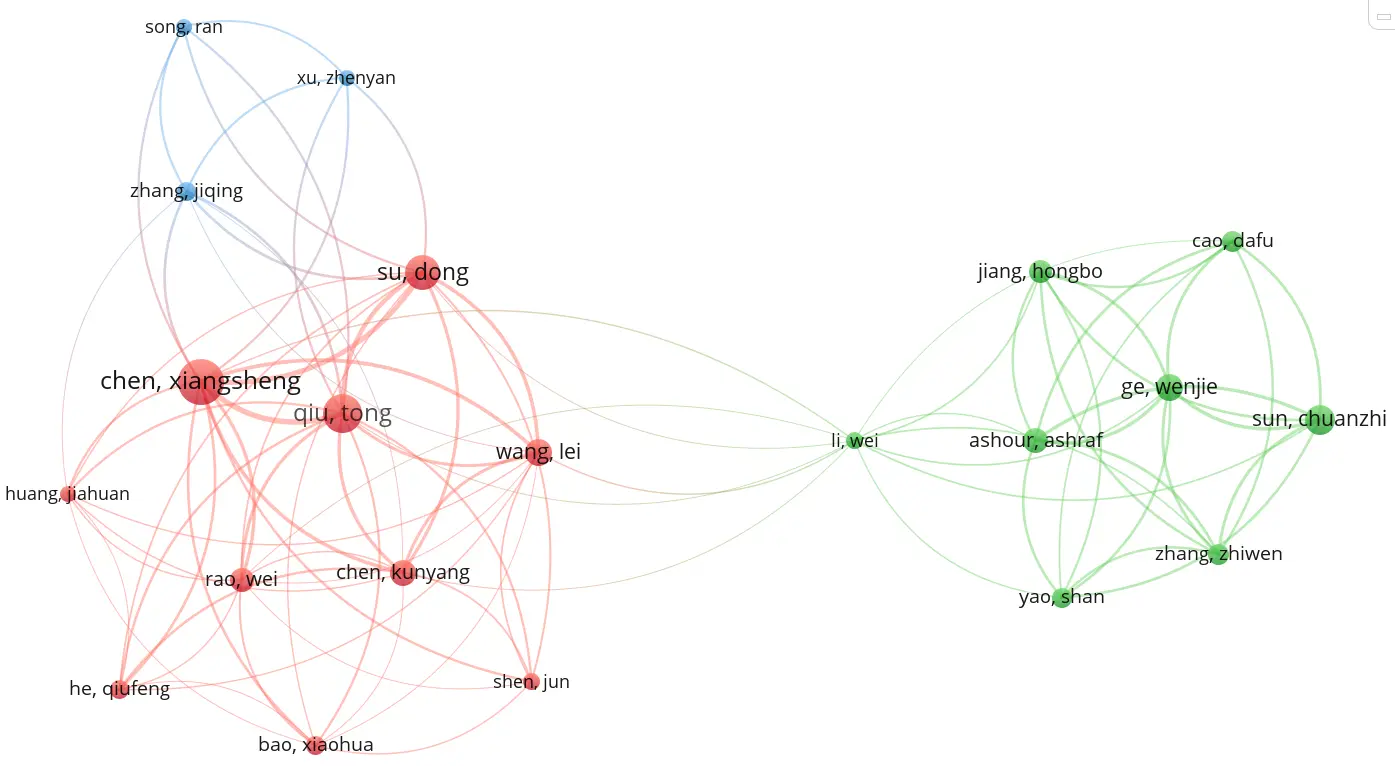
Overall, Table 5 and Figure 9 show that the field of prefabricated intelligent construction has formed an author distribution pattern led by highly productive core authors and supported by stable collaborative teams. Ma Guowei, Chen Xiangsheng, and Qiu Tong show outstanding performance in terms of publication volume, reflecting strong research continuity. Wang Li and Zhang Mo, meanwhile, demonstrate remarkable performance in average citations per paper, indicating high research quality and academic influence. The multiple clusters in the author collaboration network suggest that this field already has a certain foundation of academic communities, but cross-group collaboration still needs further strengthening. Future research should encourage broader cooperation among different research teams to promote knowledge integration, methodological innovation, and the international development of prefabricated intelligent construction research.
3.6. Keyword Co-Occurrence Analysis
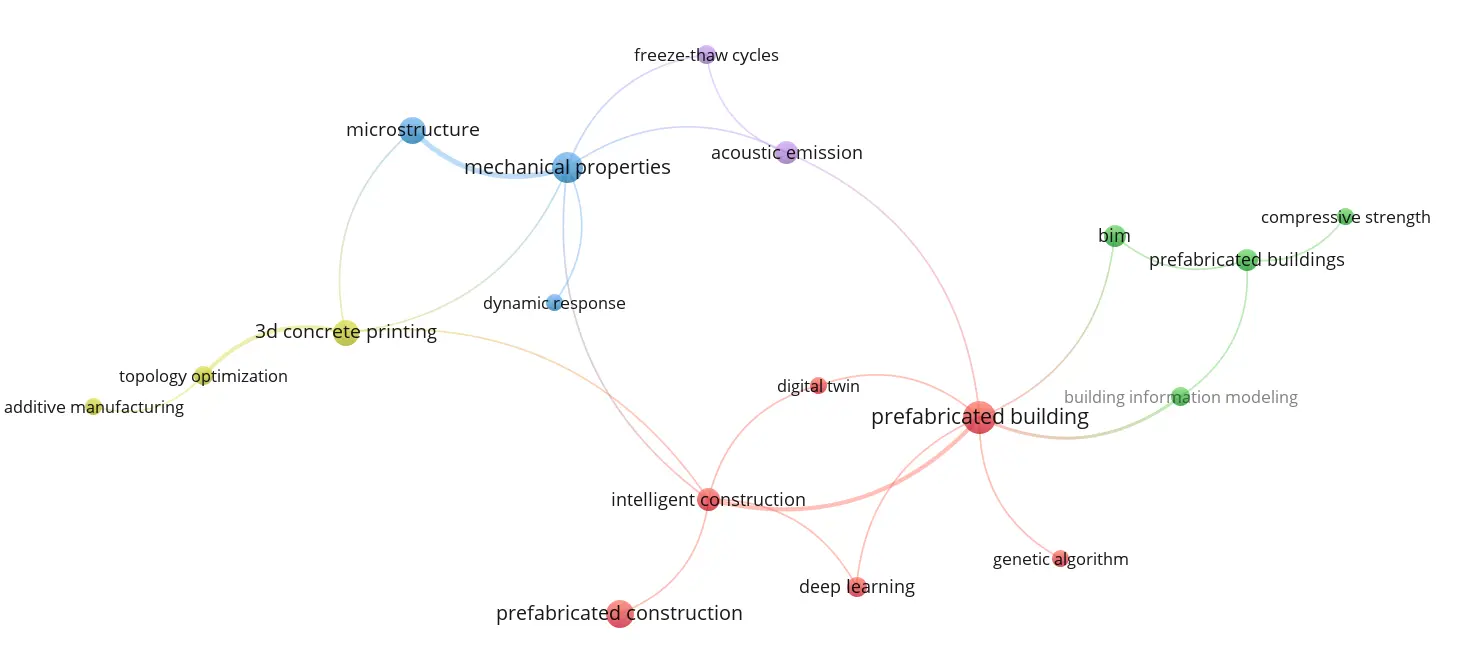
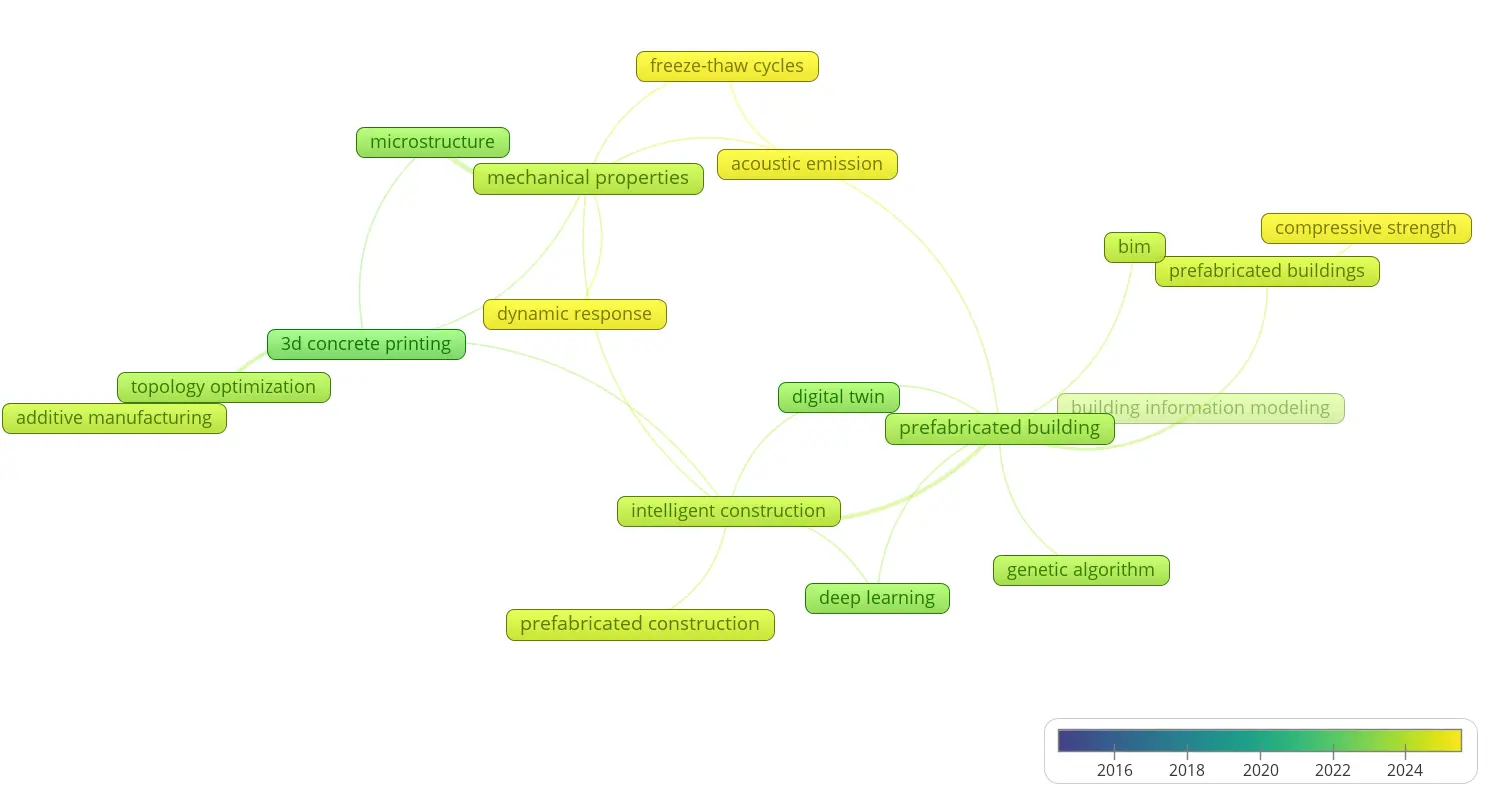
Keywords provide a highly condensed representation of the core research content of academic papers and serve as an important basis for identifying research hotspots, knowledge structures, and development trends. Based on 583 publications related to prefabricated intelligent construction retrieved from the Web of Science (WoS) database, this study used VOSviewer to conduct keyword co-occurrence analysis and clustering analysis, aiming to reveal the core themes, research hotspots, and evolutionary directions of this field. Figure 10 presents the keyword co-occurrence network, while Figure 11 further illustrates the temporal evolution characteristics of keywords based on the Average Publication Year (APY).
As shown in Figure 10, keywords such as prefabricated building, intelligent construction, building information modeling (BIM), and digital twin are located in the central area of the network, indicating that these themes have high co-occurrence frequencies and strong knowledge-linking functions in prefabricated intelligent construction research. Among them, prefabricated building is the fundamental research object of this field, intelligent construction represents its technological upgrading direction, and digital technologies such as BIM and digital twins constitute key technical support for promoting the intelligent development of prefabricated construction. This indicates that the field has developed a research framework in which prefabricated buildings serve as the research carrier, intelligent construction as the development goal, and digital and intelligent technologies as the methodological support.
According to the clustering results generated by VOSviewer, the keyword co-occurrence network can be divided into five major clusters, each corresponding to a different research theme. The red cluster primarily focuses on integrating core technologies for prefabricated intelligent construction, with keywords including prefabricated building, intelligent construction, prefabricated construction, digital twin, deep learning, and genetic algorithm. This cluster reflects the integration trend of frontier intelligent technologies, such as digital twins, deep learning, and genetic algorithms, with the prefabricated construction process. It also indicates that the field is gradually shifting from traditional construction management and component production research toward higher-level intelligent directions such as data-driven decision-making, intelligent decision support, and cyber–physical mapping.
The green cluster mainly focuses on the engineering application and structural performance of prefabricated buildings, with core keywords including prefabricated buildings, building information modeling, BIM, and compressive strength. This cluster indicates that BIM technology plays an important role in prefabricated building design, component information management, construction collaboration, and full life-cycle management. It also suggests that structural performance indicators, such as the compressive strength of prefabricated components, remain fundamental research topics in engineering practice. This type of research reflects a key pathway through which prefabricated intelligent construction moves from theoretical methods toward engineering implementation.
The yellow cluster highlights the development direction of emerging construction technologies and optimization methods, with major keywords including 3D concrete printing, additive manufacturing, and topology optimization. This cluster shows that scholars are increasingly focusing on frontier topics such as automated construction, intelligent manufacturing, and structural optimization design. 3D concrete printing and additive manufacturing offer new routes for producing prefabricated components, while topology optimization helps improve structural performance, reduce material consumption, and promote the lightweight, green development of building components.
The blue cluster mainly focuses on the mechanical properties and microstructural characteristics of prefabricated building materials, with core keywords including mechanical properties, microstructure, and dynamic response. This cluster indicates that material performance and structural safety remain important foundations of prefabricated building research. By investigating material microstructure, mechanical behavior, and dynamic response mechanisms, researchers can further reveal the performance evolution of prefabricated components under loading conditions, complex environments, and service processes, thereby providing a theoretical basis for the safe design and reliability assessment of prefabricated buildings.
The purple cluster mainly revolves around the durability and health monitoring of prefabricated building materials, with core keywords including freeze-thaw cycles and acoustic emission. This cluster reflects researchers’ attention to the long-term service performance and damage monitoring of prefabricated components under complex environmental conditions. Research on freeze-thaw cycles helps evaluate the durability degradation of components in cold regions or environments with large temperature variations, while acoustic emission technology can be used for structural damage identification, crack propagation monitoring, and safety warning, making it an important technical approach for achieving full life-cycle health monitoring of prefabricated buildings.
From the keyword temporal evolution results shown in Figure 11, research hotspots in the field of prefabricated intelligent construction have shown a clear trend toward digitalization, intelligentization, and algorithm-based development in recent years. Keywords with relatively high APY values include prefabricated construction (APY = 2023.9), Building Information Modeling (BIM) (APY = 2023.6), intelligent construction (APY = 2023.5), genetic algorithm (APY = 2023.2), digital twin (APY = 2022.8), and deep learning (APY = 2022.8). The relatively recent average publication years of these keywords indicate that they represent rapidly emerging research frontiers in recent years. Among them, BIM and digital twins focus on information integration and cyber–physical mapping in the construction process, while deep learning and genetic algorithms reflect the application potential of intelligent optimization, data mining, and automated decision-making in prefabricated construction.
According to the high-frequency keyword statistics, the most frequently occurring keyword is prefabricated building (18 occurrences), followed by seismic performance (17 occurrences), mechanical properties (16 occurrences), prefabricated construction (13 occurrences), microstructure (12 occurrences), and 3D concrete printing (11 occurrences). These results indicate that research on prefabricated intelligent construction focuses not only on intelligent technologies and digital tools, but also attaches great importance to fundamental issues such as structural safety, material performance, and emerging construction technologies. In particular, the high frequency of keywords such as seismic performance, mechanical properties, and microstructure suggests that structural reliability and material performance remain core scientific issues of long-term concern in this field.
In addition, keywords such as intelligent construction, acoustic emission, crack propagation, and numerical simulation also occur frequently, reflecting the importance of research directions such as intelligent technology integration, structural health monitoring, damage evolution mechanisms, and computational simulation analysis. Among them, numerical simulation is an effective method for predicting component performance and analyzing structural behavior, while crack propagation and acoustic emission are closely related to structural damage identification and safety assessment. This indicates that the field is expanding from purely construction-technology-oriented research toward structural performance evaluation, intelligent monitoring, and whole-process safety management.
Overall, Figure 10 and Figure 11, and the keyword frequency statistics in Table 6 collectively indicate that a relatively clear research hotspot system has been formed in the field of prefabricated intelligent construction. On the one hand, traditional themes such as prefabricated buildings, BIM, structural performance, and material performance remain important research foundations in this field. On the other hand, emerging themes such as digital twins, deep learning, genetic algorithms, 3D concrete printing, and additive manufacturing are developing rapidly and are gradually becoming important technological forces driving the transformation and upgrading of the field. Therefore, research on prefabricated intelligent construction presents the development characteristics of a solid foundation in engineering applications, the rapid integration of digital intelligence technologies, the continuous deepening of material and structural performance studies, and the gradual enhancement of full life-cycle safety management. In the future, this field is expected to conduct more in-depth research on digital twin-driven intelligent construction platforms, AI-assisted construction decision-making, intelligent manufacturing of prefabricated components, structural health monitoring, and green low-carbon construction.
Table 6. High-Frequency Keywords in Intelligent Prefabricated Construction Research.
|
Keyword |
Occurrences |
|---|---|
|
prefabricated building |
18 |
|
seismic performance |
17 |
|
mechanical properties |
16 |
|
prefabricated construction |
13 |
|
microstructure |
12 |
|
3d concrete printing |
11 |
|
intelligent construction |
9 |
|
acoustic emission |
9 |
|
crack propagation |
9 |
|
numerical simulation |
8 |
4. Discussion and Cluster Analysis
4.1. Global Research Trends
As highly condensed representations of the core research themes of the literature, keywords and their co-occurrence relationships, temporal evolution characteristics, and frequency distributions can accurately reveal the research hotspots and development trajectory of prefabricated intelligent construction [43]. Based on keyword co-occurrence clustering, average publication year (APY), and high-frequency keyword statistics, it can be observed that research on prefabricated intelligent construction is not driven by a single technological route. Instead, it has formed a composite knowledge structure characterized by digital intelligence empowerment, upgrading of construction processes and equipment, and support from structural performance and engineering applications [44,45].
Among these keywords, digital twin, BIM, deep learning, and genetic algorithm represent the rapidly emerging intelligent research frontiers in this field in recent years. Keywords such as 3D concrete printing [46], additive manufacturing, and intelligent equipment reflect the technological pathway through which prefabricated construction is evolving toward industrialization, automation, and intelligent manufacturing. Meanwhile, keywords such as seismic performance, mechanical properties, microstructure, crack propagation, and numerical simulation indicate that structural safety, reliability, and durability remain fundamental issues for the continued development of this field [47,48].
Based on the research logic visualized in VOSviewer, the core research hotspots in the field of prefabricated intelligent construction can be summarized into three major directions, as shown in Figure 12. These hotspots are both relatively independent and organically interconnected, jointly constituting a complete research system for this field.
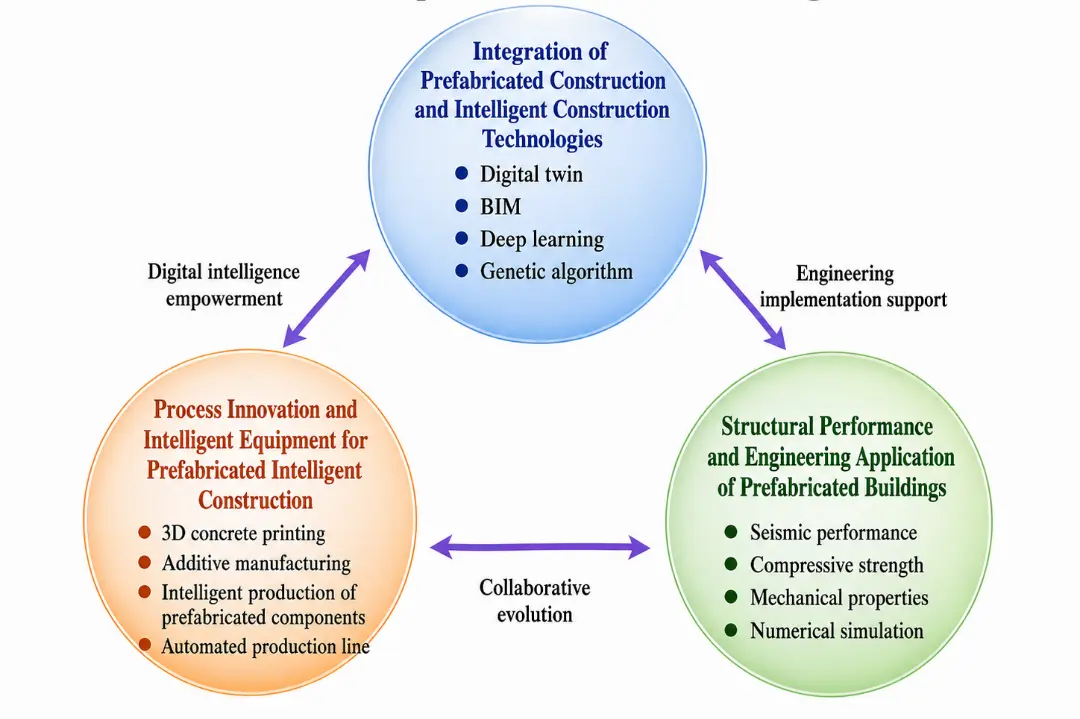
Integration of Prefabricated Construction and Intelligent Construction Technologies. With digital twin, Building Information Modeling (BIM) [49], deep learning, and genetic algorithm as core technological carriers, this hotspot focuses on the deep integration of frontier digital technologies with prefabricated construction. It represents a core research direction for the intelligent upgrading of the field [50]. As an emerging research focus in recent years, related keywords such as prefabricated construction, intelligent construction, and BIM have average publication years concentrated between 2022.8 and 2023.9, highlighting the role of digital technologies in enabling full life-cycle intelligent management and optimized construction decision-making in prefabricated construction. This direction also provides key support for the transformation of prefabricated buildings from industrialization to intelligentization.
Process Innovation and Intelligent Equipment for Prefabricated Intelligent Construction. This hotspot centers on process innovation and intelligent equipment upgrading in prefabricated construction. It focuses on the research and application of emerging processes and intelligent equipment, including 3D concrete printing, additive manufacturing, and intelligent production of prefabricated components. Relevant studies mainly address key issues such as component-forming mold optimization [51], adaptation of automated production lines, intelligent processing, and precision-forming equipment, thereby promoting the development of prefabricated construction toward greater efficiency, customization, and intelligence [52,53].
Structural Performance and Engineering Application of Prefabricated Buildings. As a traditional and fundamental research hotspot in this field, this direction focuses on the engineering implementation and structural safety assurance of prefabricated buildings [54]. It mainly examines key indicators such as seismic performance and compressive strength, while also covering the application of BIM in engineering practice and the structural performance evaluation of prefabricated components. High-frequency keyword statistics show that terms such as prefabricated buildings and seismic performance appear frequently, reflecting the core value of this direction in engineering implementation, structural optimization, and safety assurance. It therefore constitutes a fundamental research area that supports the large-scale application of prefabricated buildings [55,56].
4.2. Main Research Focuses
4.2.1. Research Hotspot 1: Integration of Prefabricated Construction and Intelligent Construction Technologies
Bottlenecks and Requirements of Prefabricated Intelligent Construction: Prefabricated buildings are evolving from a single industrialized production model toward deep integration of industrialization, digitalization, and intelligentization [57]. However, significant systemic bottlenecks still exist in current engineering practice. First, information remains fragmented across design, production, transportation, construction, operation, and maintenance stages. Technologies such as BIM, the Internet of Things, intelligent equipment [58], robotics, and artificial intelligence are mostly applied in isolated scenarios, and a cross-stage collaborative technical system has not yet been fully established. Second, the full life-cycle data of prefabricated components are complex in type, inconsistent in format, and heterogeneous in semantics, making it difficult to continuously track component status and accurately trace quality responsibilities. Third, traditional quality and safety management still relies mainly on post-event inspections and manual patrols, making it difficult to support real-time monitoring, risk prediction, and proactive prevention and control in complex construction environments [59,60].
In response to these bottlenecks, the development needs of prefabricated intelligent construction systems can be summarized into three aspects, as illustrated in Figure 13: the need for cross-disciplinary integration and collaboration of multiple technologies, the need for full life-cycle management of prefabricated components, and the need for proactive prevention and control of engineering quality and construction safety [61]. These three needs correspond respectively to the technical system, data system, and control system, and together constitute the core support for the intelligent transformation of prefabricated buildings [62].
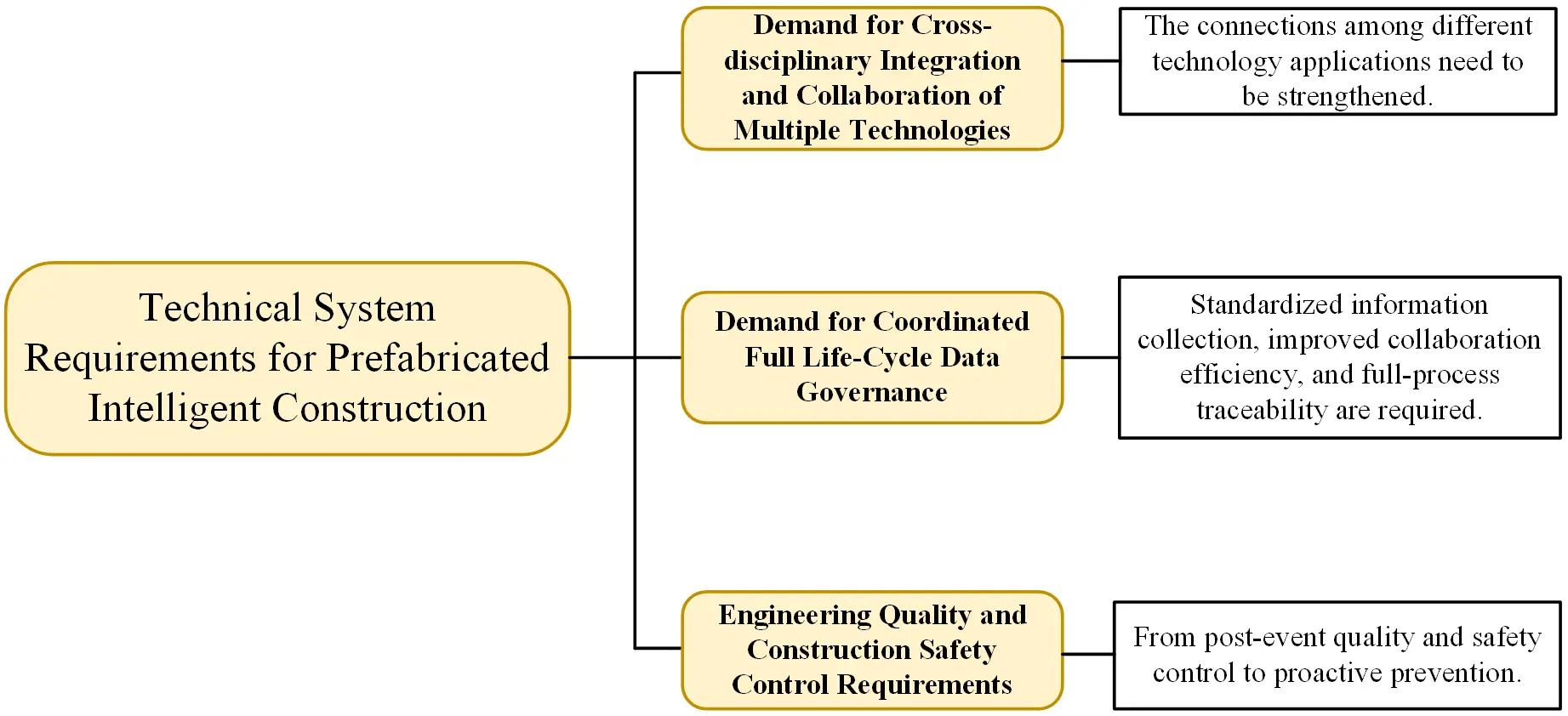
Therefore, the core demand of prefabricated intelligent construction is not the simple superposition of digital technologies, but the establishment of a full life-cycle-oriented system integration framework [63]. This framework should be based on a unified data foundation, supported by multi-technology collaboration, guided by full-process component traceability, and oriented toward proactive quality and safety control. It aims to realize a paradigm shift from experience-driven, stage-fragmented, and post-event management toward data-driven, process-coordinated, and intelligent decision-making [64,65].
Requirement 1: Multi-Technology Integration and Process Collaboration
Multi-technology integration is the fundamental support for the prefabricated intelligent construction system. At present, technologies such as BIM, the Internet of Things, construction robots, big data, and artificial intelligence have been applied to varying degrees in design optimization [66], component production, on-site construction, and operation and maintenance monitoring. However, due to inconsistencies in data interfaces, communication protocols, model semantics, and operational logic, obvious application silos still exist among these technologies [67].
To address this issue, future prefabricated intelligent construction should establish a data-bearing platform centered on BIM/digital twins, enabling unified modeling of architectural, structural, mechanical, and electrical component parameters, construction processes, and operation and maintenance information [68]. Real-time data access from production equipment, transport vehicles, on-site sensors, and operation and maintenance monitoring terminals should be achieved through the Internet of Things and 5G communication [69]. Construction robots and intelligent equipment should be used to automate key processes such as hoisting, welding, grouting, and inspection. Furthermore, artificial intelligence and big data analytics should be applied to quality prediction, construction risk warning, equipment scheduling optimization, and operation and maintenance fault diagnosis [70].
Relevant studies also indicate that integrating BIM with artificial intelligence and other digital technologies is becoming an important pathway to advancing prefabricated buildings. To facilitate the application of prefabricated buildings, Building Information Modeling (BIM), as a digital representation of the physical characteristics and functional attributes of buildings, has become an important knowledge resource throughout the full life cycle of facilities [71]. At present, BIM has been widely recognized and applied worldwide, and its integration with prefabricated buildings has demonstrated significant value in design, assembly, construction, and operation and maintenance stages [72]. By supporting designers in optimizing design schemes, improving construction processes, and reducing schedule delays, BIM has become a key technological foundation in modern prefabricated building practice [73]. For example, Yin et al. pointed out that the integration of BIM and prefabricated buildings plays an important role in improving construction efficiency and promoting sustainable development [74], a view that has gradually received broad attention in subsequent studies [75].
On the basis of the continuous deepening of BIM applications, artificial intelligence further promotes the intelligent development of prefabricated buildings. AI can be used to automate tasks such as design generation, supply chain management [76], and construction site layout, and it can promote digitalization, productivity improvement, and automation upgrading across the full value chain of prefabricated buildings in the context of Industry 4.0 [77]. Meanwhile, decisions made in the early design stage of prefabricated buildings have an important impact on subsequent scheme optimization and supply chain efficiency [78]. The integration of BIM and AI helps alleviate issues such as early design rigidity and insufficient sustainability, further strengthening their supporting role in sustainable innovation [79].
For example, Yuan et al. proposed a Design for Manufacture and Assembly (DFMA)-oriented parametric design method for prefabricated buildings and integrated it with BIM [80]. Wang et al. developed a BIM-based framework for mechanical, electrical, and plumbing (MEP) layout tasks in prefabricated buildings, which identified 78% of potential clashes [81]. Lobo et al. established a generative design framework integrating BIM and AI and applied it to drywall installation design in prefabricated projects, achieving favorable results in design optimization and material waste reduction [82]. In addition, Banihashmi et al. designed a workflow integrating parametric design and BIM, indicating that prefabricated buildings are gradually moving toward automation and innovation [83]. These studies provide effective insights for addressing design rigidity, logistics constraints, component size limitations, and hoisting constraints in prefabricated buildings [84].
To further clarify the integration pathways of BIM, AI, IoT, digital twins, blockchain, and other technologies in prefabricated intelligent construction, Table 7 summarizes relevant studies in recent years. The table compares them from four dimensions: research content, research methods, limitations, and implications. Its purpose is to identify the main concerns, common limitations, and supporting roles of current multi-technology integration studies in the construction of prefabricated intelligent construction systems.
As shown in Table 7, BIM has gradually evolved from a single modeling tool into a full life-cycle information carrier running through design, production, construction, operation, and maintenance. AI, IoT, and digital twins respectively enhance intelligent optimization, real-time sensing, and cyber–physical interaction, while blockchain further improves trusted data sharing and responsibility traceability. Meanwhile, existing studies still exhibit clear limitations: most results focus on a single stage or a local scenario, and a unified technical framework that covers the entire process has not yet been developed. Cross-platform data interoperability, semantic mapping, real-time synchronization, and multi-source data fusion remain key constraints on collaborative applications.
Therefore, Table 7 indicates that the future focus of prefabricated intelligent construction should shift from single-technology applications to the systematic integration of technologies. Specifically, BIM/digital twins should serve as the core carrier, IoT as the sensing foundation, AI as the decision-making support, and trusted data management mechanisms as the guarantee, so as to realize data connectivity and collaborative optimization throughout design, production, construction, and operation and maintenance.
Table 7. Technology Integration Analysis of Prefabricated Intelligent Construction.
|
Article |
Technology |
Main Contribution |
Limitations and Implications |
|---|---|---|---|
|
[85] |
BIM life-cycle evolution |
Reveals BIM research outputs, knowledge flows, technological demands, hotspots, and evolution across life-cycle stages. |
Limited discussion of engineering-level integration and interoperability; BIM should serve as a full life-cycle information carrier. |
|
[86] |
BIM + AI |
Reviews BIM–AI integration for efficiency, cost control, sustainability, design automation, and industrial productivity. |
Constrained by algorithm complexity, weak interoperability, and limited sustainability indicators; AI–BIM should support whole-process collaboration. |
|
[87] |
BIM + IoT |
Shows BIM and IoT complement engineering information through model semantics and real-time site data. |
Insufficient validation of data mapping, real-time interaction, and cross-platform interoperability; BIM–IoT can reduce technology silos. |
|
[42] |
Digital twin |
Highlights the connection between physical construction sites and digital model spaces in prefabricated intelligent construction. |
Real-project validation of synchronization, dynamic updating, and collaborative decision-making remains limited; digital twins can enable cyber–physical interaction. |
|
[88] |
BIM-enabled design |
Identifies BIM’s role in bridging design gaps and improving collaboration, component information management, and construction efficiency. |
Based mainly on practice experience and qualitative analysis; BIM data foundations should be strengthened at the design stage. |
|
[89] |
Digital twin + hoisting safety |
Develops a digital twin-based safety risk management framework for prefabricated building hoisting. |
Applicability across more construction scenarios needs verification; BIM, IoT, and algorithms can support proactive hoisting risk control. |
|
[90] |
Blockchain + IoT + BIM |
Proposes a blockchain-enabled IoT–BIM platform for modular construction supply chain management. |
Prototype applicability needs broader validation; integration should address interoperability, trustworthiness, responsibility, and supply chain collaboration. |
|
[17] |
BIM + IoT + GIS + digital twin |
Develops a digital twin framework for full life-cycle facility management of relocatable modular buildings. |
Focuses mainly on O&M; multi-technology integration should extend to manufacturing, assembly, relocation, renovation, and reuse. |
|
[91] |
BIM + AI + IoT |
Reveals research trends and knowledge gaps in BIM–AI–IoT integration for prefabricated construction. |
Lacks empirical analysis of architecture, interfaces, algorithms, and interoperability; integration enables semantic modeling, sensing, and intelligent decision-making. |
|
[92] |
IoT + BIM + RFID |
Proposes a multidimensional IoT–BIM platform for visualized and traceable prefabricated construction management. |
Mainly focuses on component tracking; IoT–BIM should integrate sensing, equipment, logistics, installation, and quality traceability data. |
Requirement 2: Full Life-Cycle Management of Prefabricated Components
Prefabricated components are the core objects of whole-process collaboration in prefabricated buildings [93]. Their life cycle covers multiple stages, including detailed design, industrialized production, warehousing and logistics, on-site hoisting, joint construction, completion acceptance, and operation and maintenance. Each stage continuously generates multi-source heterogeneous data, such as component codes, geometric parameters, reinforcement information, production processes, quality inspection records, logistics histories, installation records, and operation and maintenance archive [94]. Without a unified coding and data governance mechanism, problems such as data redundancy, discontinuous status tracking, and difficulty in responsibility traceability are likely to occur [95,96,97].
Therefore, the full life-cycle management of components should make unique identification the main thread and establish a component data chain that runs through design, production, transportation, construction, operation, and maintenance [98]. The system architecture can be divided into four layers. The bottom layer is the sensing and access layer, which is responsible for collecting data from production equipment, inspection instruments, logistics terminals, on-site mobile devices, and hoisting sensors. The middle layer is the data and model support layer, which integrates component databases, time-series data, BIM models, engineering rule bases, and intelligent algorithmic models [99]. The upper layer is the business application layer, which provides functions such as component traceability, quality control, process management, statistical analysis, and visualization-based decision-making [100]. The top layer is the integrated management and supervision layer, serving project management, enterprise control, and industry supervision [101,102].
The layers of the system are interconnected through standardized service interfaces and message buses. On-site sensing data are uniformly collected through terminals and gateways and transmitted to the data and model support layer. After processing, the data provides services for upper-level business applications through standard interfaces. The production system of prefabricated intelligent construction is shown in Figure 14.
Zhang et al. [103] systematically reviewed the multidimensional and multi-scale characteristics of intelligent manufacturing spaces and their modeling methods from the perspective of digital twins. The application achievements of digital twin technology in manufacturing also provide important insights for the transformation of the construction industry toward intelligent construction. Liu et al. [104] proposed a digital twin-based intelligent construction method for dynamically adjusting and correcting actual construction processes. Tao et al. [105] explained the intrinsic relationships among urban big data, cyber–physical interaction, and intelligent services, and proposed an operational framework for digital twin cities on this basis. Liu et al. further summarized the application frameworks of digital twins in fields such as vehicles, electromechanical equipment, space communication networks, three-dimensional warehousing, healthcare, and smart cities, making important contributions to the expansion of digital twin application scenarios. Based on this, they proposed a digital twin framework for the construction field, as shown in Figure 15 [106].
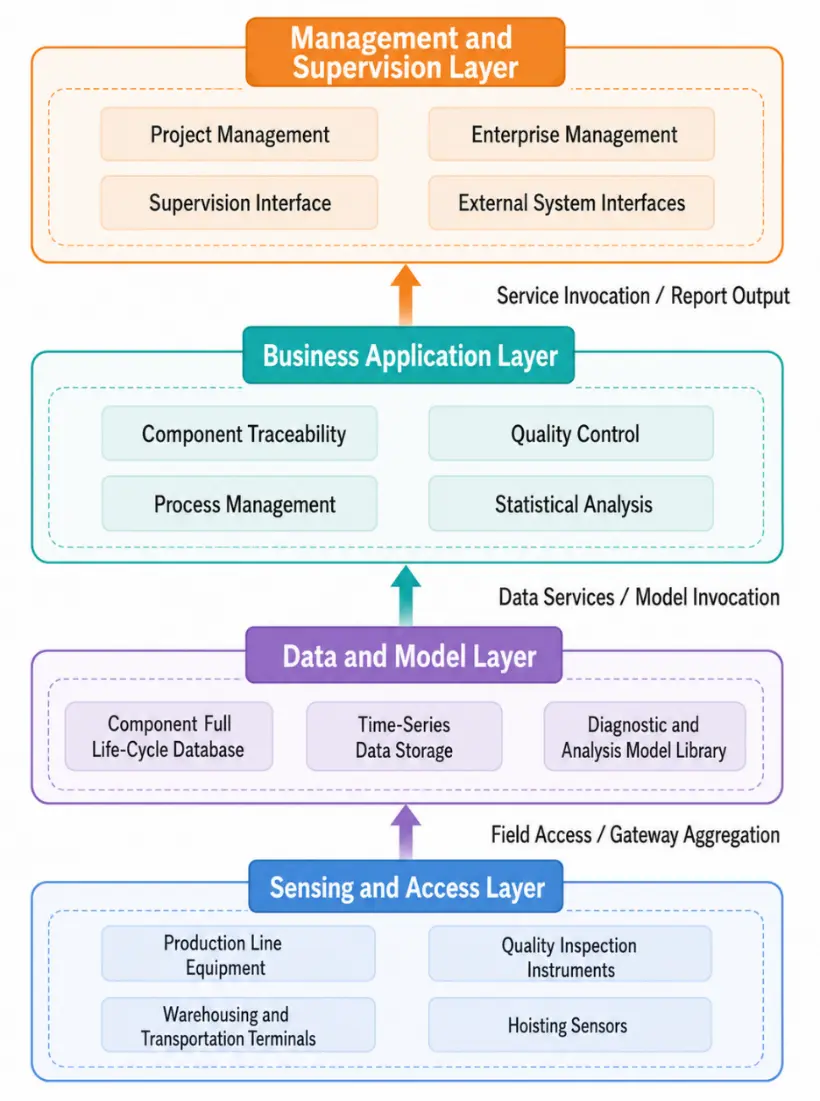
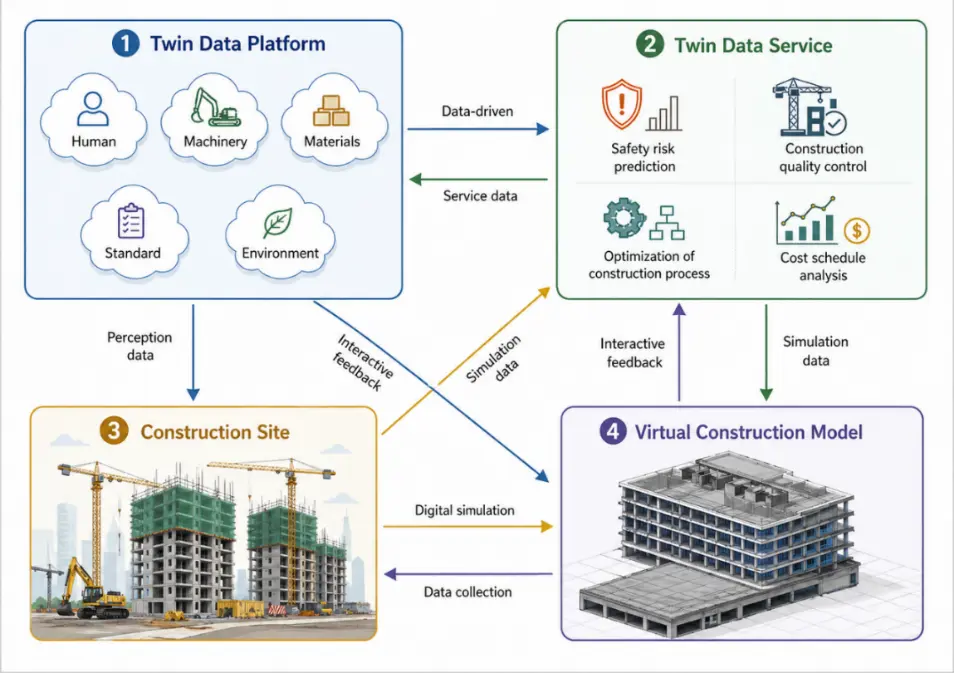
In summary, the full life-cycle management of prefabricated components is not only a core link for achieving whole-process construction collaboration, but also a fundamental guarantee for the efficient operation of the intelligent construction system. By integrating unique component identification with multi-source heterogeneous data, an information closed loop can be established across design, production, transportation, construction, and operation and maintenance stages, thereby addressing problems such as discontinuous status tracking, data redundancy, and difficulty in responsibility traceability.
Requirement 3: Engineering Quality and Construction Safety Prevention and Control
Quality and safety, prevention and control are key objectives for the implementation of prefabricated intelligent construction systems. Traditional quality management in prefabricated buildings mainly relies on factory inspection of components and random inspection on construction sites, which is essentially a post-event control mode. This makes it difficult to promptly identify production deviations, installation errors, and potential safety hazards. Meanwhile, high-risk operations such as working at height, heavy hoisting, joint connection, and collaborative operation of large equipment impose higher requirements on real-time sensing, intelligent identification, and proactive warning.
For quality control, an intelligent inspection system based on machine vision, laser scanning, nondestructive testing, and online monitoring should be established to collect and quantitatively compare data on component geometric dimensions, reinforcement spacing, concrete compactness, joint welding quality, and installation deviations in real time. Inspection data should be associated with production batches, raw material sources, operators, process parameters, and construction records, so as to enable the localization, traceability, rectification, and feedback optimization of quality problems. Furthermore, by integrating machine learning models, trends in quality parameter fluctuations can be predicted, and warnings can be triggered when risks approach threshold values, thereby promoting the shift from result inspection to process control.
Zhong et al. [92] constructed a multidimensional BIM platform to improve real-time visualization and traceability during the construction process of prefabricated components. Gunduz et al. [107] established a dynamic risk management and control model. Lin et al. [108] proposed an integrated framework for closed-loop structural safety management based on multi-source data fusion. Wang et al. [109] proposed a deep learning-based method for rapid and automatic identification of weathering and spalling damage in ancient buildings. Ni et al. [110] conducted a quantitative measurement of crack width using digital image methods and a dual-scale convolutional neural network.
Regarding construction safety prevention and control, methods such as machine learning, deep learning, Bayesian networks, and support vector machines have been gradually applied to the analysis of construction accident causation, the recognition of unsafe behavior, the detection of structural damage, and the prediction of construction risk. In construction safety risk assessment and prediction, the key challenge lies in the complex, multivariable, and nonlinear relationships among various influencing factors and risk levels [111]. At present, commonly used machine learning methods mainly include artificial neural networks (ANN), support vector machines (SVM) [112], and Bayesian networks (BN) [113].
Among them, Bayesian networks can infer and predict safety risk states through causal relationships between risk events and accidents. However, the construction of their network structure is relatively subjective and usually requires a large amount of sample data for learning [114]. Artificial neural networks are widely used in prediction tasks, but their internal mechanisms are weak in interpretability and still exhibit obvious “black-box” characteristics [115]. In contrast, support vector machines have a relatively mature theoretical foundation in kernel functions and show clear advantages in handling small-sample, high-dimensional, and nonlinear problems. Therefore, they are widely used in engineering safety risk prediction.
For example, Zhou et al. [116] proposed a hybrid deep learning model based on an attitude and position prediction framework for shield tunnel construction. Zhou et al. [117] proposed a new SVM-based safety risk prediction method for deep foundation pit construction in metro projects. However, current studies applying machine learning methods to construction safety risk management in prefabricated buildings remain relatively limited, especially in the field of hoisting safety risk management, where further research is still needed.
Overall, quality and safety prevention and control should shift from isolated inspection systems to an integrated production–inspection–construction–feedback coordination mechanism. In this way, quality warning results can directly inform production planning, component delivery, hoisting schemes, and process adjustments, thereby forming a proactive prevention and control closed loop that covers the whole process.
At the level of safety risk identification, for example, Roman et al. [118] used numerical simulation methods to study safety accidents in prefabricated building construction and proposed corresponding management countermeasures. Liu et al. [119] conducted numerical simulation analysis of prefabricated components based on BIM technology and further evaluated their reliability. Zhang et al. [120] used machine learning methods to analyze construction accident reports, thereby realizing classification and identification of accident causes. Ding et al. [121] proposed a new hybrid deep learning model for identifying unsafe behaviors during metro construction.
Liu et al. [122] constructed a multidimensional digital twin model, MDZ, for hoisting safety risk prediction in prefabricated buildings by combining risk influencing factors in the hoisting process with a digital twin framework for construction processes. The model can be expressed as Equation (1):
where MDZ represents the multidimensional digital twin model of the prefabricated building hoisting process; PCS refers to the actual physical hoisting process; DVT denotes the hoisting virtual model; DD represents the big data storage and management platform; SS refers to the hoisting safety risk prediction service; and CN describes the data collection, transmission, and interaction relationships among the physical hoisting process, hoisting virtual model, big data management platform, and hoisting risk prediction service. Based on Equation (1), this study further proposes a prefabricated building hoisting method integrated with digital twin technology, and its overall process is shown in Figure 16.
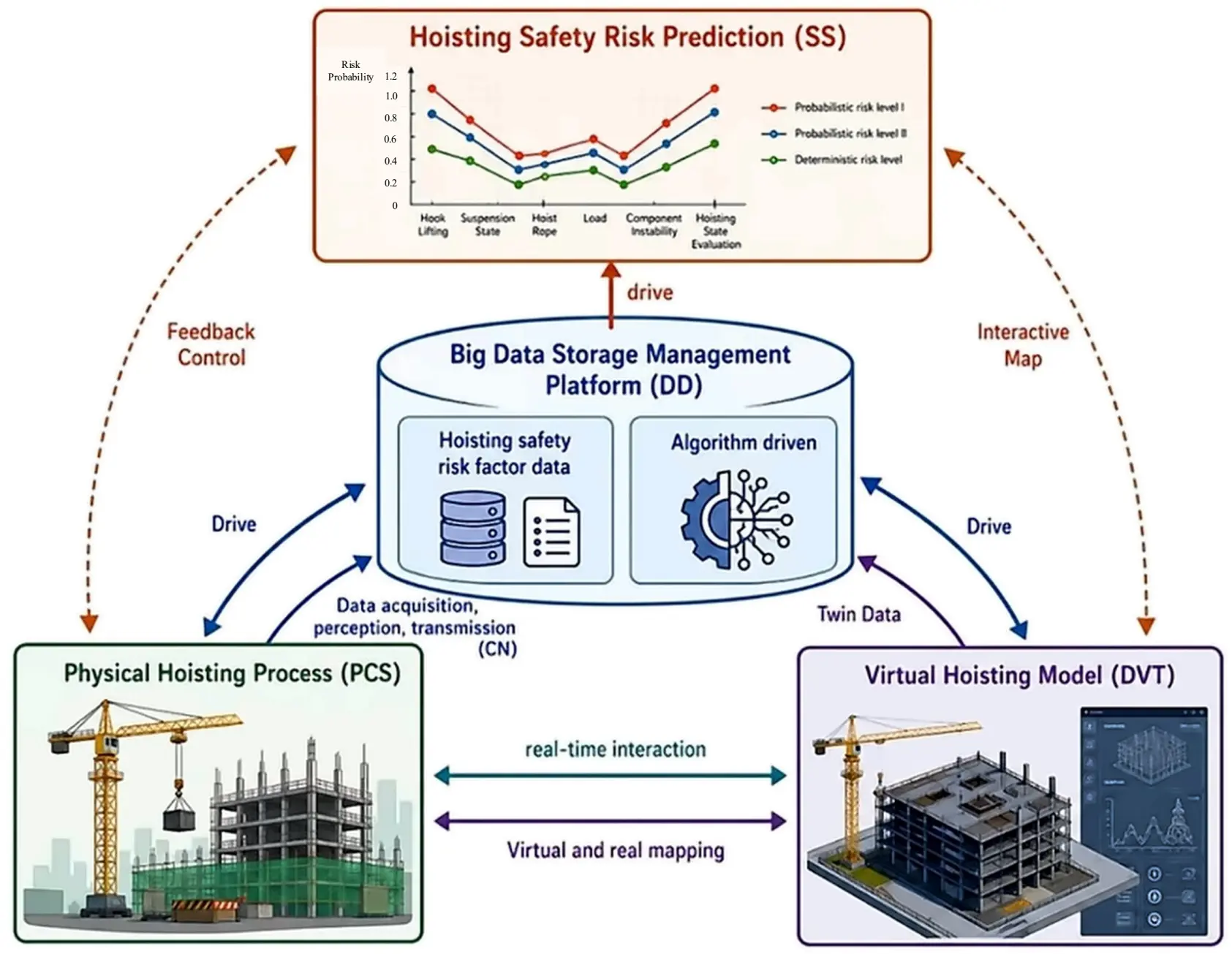
In summary, quality and safety prevention and control in prefabricated intelligent construction are not only prerequisites for the successful completion of construction, but also core objectives for the implementation of systematic intelligent construction. By shifting from the traditional post-event inspection mode to an integrated production–inspection–construction–feedback coordination mechanism, it is possible to achieve whole-process quantitative monitoring of component geometric dimensions, joint construction quality, reinforcement spacing, concrete compactness, and on-site construction deviations. Combined with machine vision, laser scanning, nondestructive testing, sensor networks, and artificial intelligence algorithms based on multi-source data fusion, such as deep learning, support vector machines, and Bayesian networks, construction risks can be dynamically identified, predicted, and warned against. The introduction of digital twin technology further integrates the physical construction process, virtual models, big data platforms, and safety prediction services, thereby enabling visualized and intelligent management of hoisting operations and other key high-risk procedures.
Case Analysis: Practical Engineering Application
The above analysis indicates that the key to the technical system of prefabricated intelligent construction lies in the integrated application of BIM, the Internet of Things, intelligent equipment, the industrial Internet, artificial intelligence, and other technologies to achieve data connectivity and collaborative linkage across design, production, transportation, construction, and quality control. Particularly in the production of prefabricated components, the deep integration of intelligent equipment and digital management platforms can effectively improve component processing accuracy, production efficiency, and quality traceability. To further illustrate the application effects of this technical system in real engineering practice, this study takes the smart beam plant of the Shiziyang Passage as a typical case and analyzes the practical application of prefabricated intelligent construction technologies in the production of prefabricated components for large-scale transportation infrastructure.
As shown in Figure 17. The Shiziyang Passage is an important transportation infrastructure project in the Guangdong–Hong Kong–Macao Greater Bay Area and a super-large cross-sea composite highway corridor connecting the east and west banks of the Pearl River. The project starts from Dagang Town, Nansha District, Guangzhou, and ends in Humen Town, Dongguan, with a total route length of approximately 35 km. Among them, Section T13, undertaken by China Railway No. 4 Engineering Group, is the prefabrication section. Its supporting smart beam plant is the largest beam production yard along the entire line and is primarily responsible for prefabricating 7790 box girders for contract sections T2–T4, covering an area of approximately 27.17 hectares.
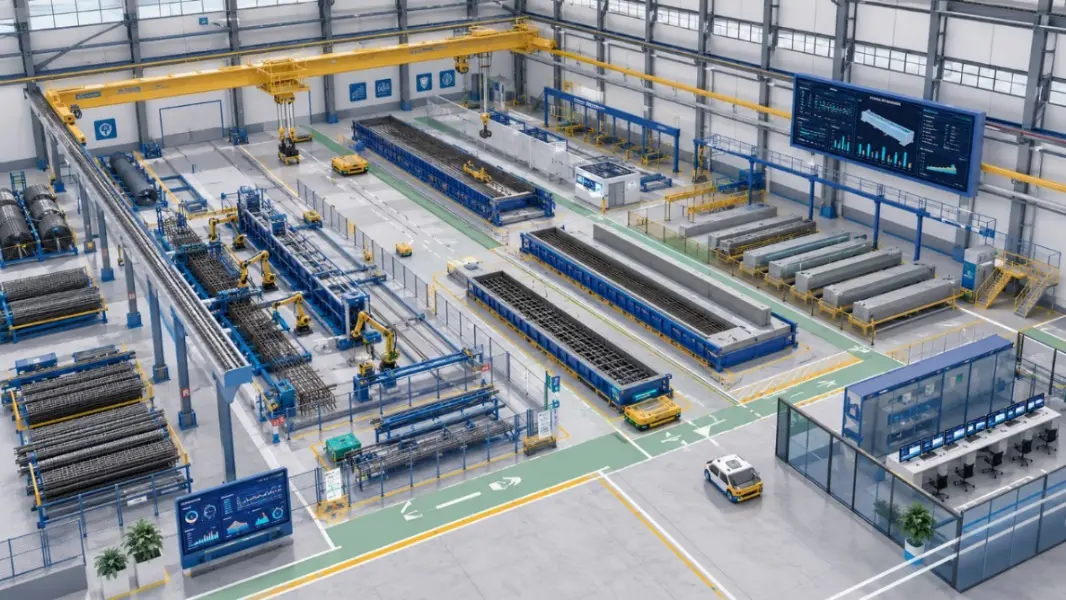
Given the large number of prefabricated box girders, the complexity of component types, and the high requirements for precision, the smart beam plant established a full-process digital reinforcement cage production line. By integrating BIM model data, intelligent processing equipment, automated assembly equipment, visual recognition systems, and an industrial Internet platform, the plant realized the direct transmission of design data to the manufacturing process. This model changed the traditional beam yard production mode that relied on manual binding and experience-based management, forming a prefabricated component production system characterized by data-driven operation, cyber–physical collaboration, and intelligent manufacturing.
The engineering application results show that the automated reinforcement cage production line significantly improved production efficiency and quality stability. Compared with the traditional manual binding method, the number of production workers was reduced from 12 to 3 per shift, reducing labor costs by approximately 72.3%. The forming time of a single reinforcement mesh was shortened from 4 h to 2 h, increasing production efficiency by approximately 100%. The spacing deviation of the main reinforcement in the cage could be stably controlled within ±2 mm, and the qualified rate of joint welding reached 99%.
This case demonstrates that the systematic integration of BIM data, intelligent equipment, the industrial Internet, and automated inspection technologies can effectively support efficient, precise, and traceable production of prefabricated components for large-scale transportation infrastructure. Its implication is that the future focus of prefabricated intelligent construction should shift from single-technology application to whole-process system integration, further strengthening the data closed loop and collaborative optimization among design, production, logistics, construction, and quality control.
Therefore, the engineering practice of the Shiziyang Passage smart beam plant further verifies the practical feasibility of the prefabricated intelligent construction technical system discussed above. This case shows that, for the production of prefabricated components in large and complex projects, relying solely on traditional manual experience and decentralized management can no longer meet the construction requirements of high efficiency, high precision, and high quality. Through the systematic integration of BIM data, intelligent equipment, industrial Internet platforms, and automated inspection technologies, design information can be directly transmitted to production and manufacturing, thereby transforming prefabricated component production from a labor-intensive model to a data-driven, intelligently collaborative one. This also indicates that the future development of prefabricated intelligent construction should further shift from single-technology application to whole-process system integration, strengthening the data closed loop and collaborative optimization among design, production, construction, and quality control.
4.2.2. Research Hotspot 2: Process Innovation and Intelligent Equipment for Prefabricated Intelligent Construction
The application of process innovation and intelligent equipment in prefabricated construction is one of the core research hotspots in the field of prefabricated intelligent construction [123]. Its research logic centers on the coordinated advancement of component performance, construction process optimization, and intelligent equipment upgrading. This direction aims to address key problems in traditional prefabricated construction, such as complicated construction processes, lagging equipment development, and insufficient performance control. It promotes the transformation of prefabricated construction toward higher efficiency, greater refinement, and stronger intelligence, thereby achieving simultaneous improvement in engineering quality, construction efficiency, and green benefits [97].
As shown in Figure 18. At the level of process innovation in prefabricated construction, the core objectives are to improve component adaptability, simplify construction procedures, and strengthen structural performance [124]. Relevant studies focus on process optimization and innovation in key links such as component connection and on-site assembly. To address problems in traditional prefabricated component connection processes, such as poor sealing performance, insufficient bearing capacity [125], and low construction efficiency, new connection processes have been developed, including modular joint connections and integrated prestressed grouting processes. By optimizing connection configuration design [126], these processes balance the mechanical performance of component connections with construction convenience, reduce on-site wet operations, decrease construction errors, and improve the overall stability and durability of prefabricated structures [127].
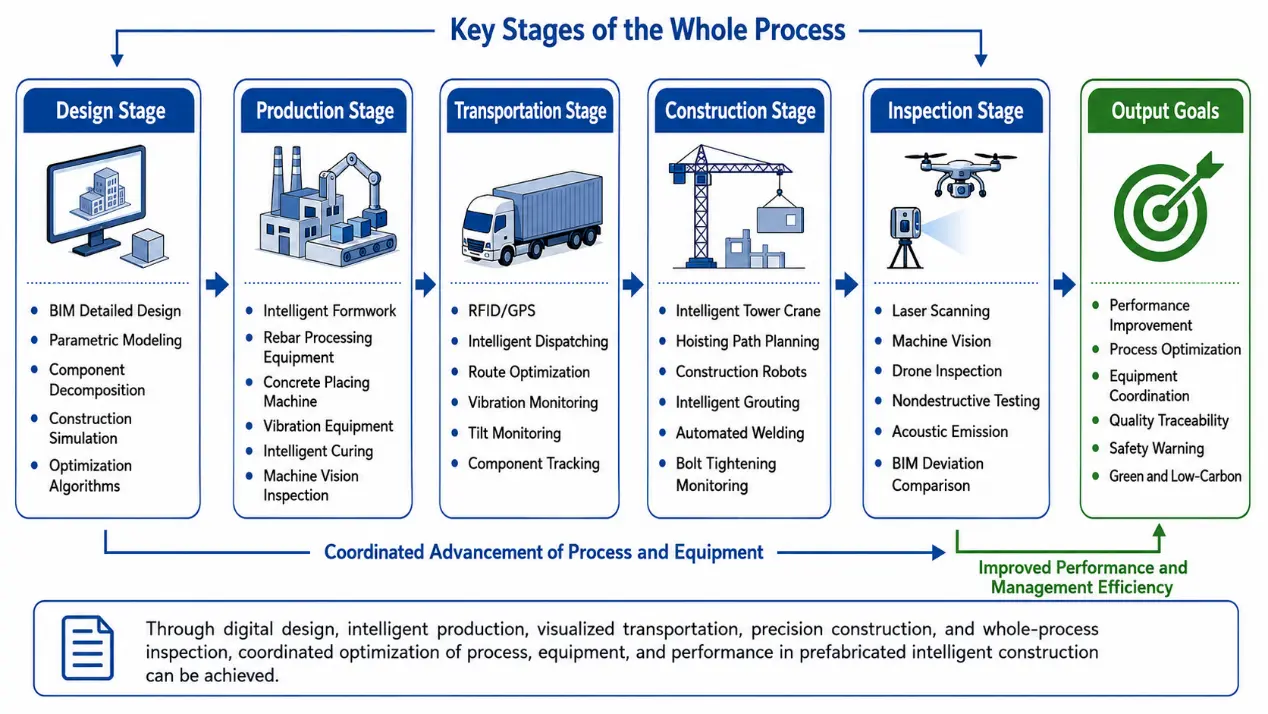
Therefore, the typical equipment and process methods in prefabricated intelligent construction can be discussed from three stages: early-stage design, production and transportation, and construction and inspection [128].
First, in the early-stage design stage, digital design platforms, BIM-based collaborative design systems, parametric modeling tools, and intelligent optimization algorithms constitute the front-end support for process innovation in prefabricated intelligent construction [129]. Early-stage design not only determines the spatial form and structural system of a building but also directly affects component decomposition, production processes and routes, transportation feasibility, and on-site assembly efficiency [130]. Therefore, the design stage in prefabricated intelligent construction is no longer limited to traditional two-dimensional drawing representation, but is gradually shifting toward an integrated design mode centered on BIM models, linked by data collaboration, and supported by intelligent algorithms [131]. Through BIM technology, collaborative integration of multi-disciplinary models, including architecture, structure, mechanical and electrical systems, and decoration, can be achieved. In addition, component decomposition, clash detection, embedded-part verification [132], hoisting path simulation, and construction sequence deduction can be completed during the design stage, thereby reducing design conflicts and on-site change risks from the source [133].
On this basis, parametric design and intelligent optimization algorithms further improve the efficiency and adaptability of prefabricated component design. Parametric modeling can rapidly generate multiple component decomposition schemes according to constraints such as building function [134], structural force conditions, transportation dimensions, hoisting capacity, and mold reuse rate. Meanwhile, multi-objective optimization methods, such as genetic algorithms [135], deep learning, and multi-objective optimization strategies, can comprehensively consider indicators, including component standardization rate, mold turnover efficiency, material consumption, construction cost, and carbon emissions. In the early-stage design of prefabricated intelligent construction [136], BIM technology not only supports multidisciplinary model collaboration and clash detection but also extracts information such as component quantities, types, transportation, and hoisting data, providing accurate data support for multi-objective optimization.
For the three objectives of construction cost, duration, and carbon emissions, a multi-objective optimization model is established as follows:
-
Construction and installation cost model [137]:
where $${C}_{ci}$$ denotes the construction and installation cost; $$n$$ denotes the number of component types; and $${P}_{i}$$, $${M}_{i}$$, $${R}_{i}$$, and $${T}_{i}$$ represent the labor, material, and machinery cost, management cost, profit, and tax of the $$i$$-th type of component, respectively.
- 2.
- Duration cost model [138]:
where $${C}_{cp}$$ denotes the duration cost; $$\alpha$$ denotes the daily project expenditure; $$N$$ denotes the number of days by which completion is advanced or delayed; $${C}_{R}$$ denotes the reward for early completion; and $${C}_{P}$$ denotes the penalty for delayed completion.
- 3.
- Carbon emission cost model:
where $${C}_{ce}$$ denotes the carbon emission cost; $$\beta$$ denotes the unit carbon emission trading price; $$\mathrm{\Delta }E$$ denotes the amount of carbon emission quota purchased or sold for the project; and $${C}_{Z}$$ denotes the total construction and installation cost.
The carbon emission calculation formula is given as [139]:
where $${M}_{c}$$ denotes the material consumption of component production; $${M}_{t}$$ denotes the energy consumption during transportation; and $$\mu$$denotes the carbon emission factor.
For multi-objective optimization problems in prefabricated buildings, existing studies commonly adopt intelligent optimization algorithms for solution searching. The particle swarm optimization (PSO) algorithm simulates the foraging behavior of bird flocks and searches for optimal solutions through collaboration and information sharing among individuals. It is characterized by simplicity, efficiency, and strong global search capability. However, since multi-objective optimization involves discrete decisions, such as whether a component adopts prefabricated or cast-in-situ construction, the traditional PSO algorithm in continuous space cannot be directly applied. Therefore, an improved binary PSO algorithm is introduced. By using the Sigmoid function to map particle velocity, continuous velocity is converted into a binary position to represent whether a component adopts prefabricated construction
where $$x_i^{(t+1)}$$ denotes the position of individual $$i$$ after the $$\left(t+1\right)$$-th iteration; $$\sigma\big(v_i^{(t+1)}\big)$$ denotes the probability of taking the value 1; and rand ( ) denotes a random number between 0 and 1. When the particle velocity is large, the probability of the position taking the value 1 is higher, indicating that the component adopts prefabricated construction. When the velocity is small, the probability of the position taking the value 0 is higher, indicating that the component adopts the cast-in-situ method.
To improve global search capability, accelerate convergence, and avoid falling into local optima, studies further combine the binary differential evolution (DE) algorithm with the PSO algorithm, forming a hybrid PSODE algorithm. Its basic process is as follows: the search space is determined, and the particle swarm is initialized; the fitness values of all individuals are calculated, and the optimal solution is recorded; a random strategy is used to select either binary PSO or binary DE for individual iterative updating; after updating, the fitness value is recalculated. If the termination condition is satisfied or the maximum number of iterations is reached, the optimal solution is output; otherwise, the iterative process continues. The operational process of the binary DE algorithm is shown in Figure 19 [140].
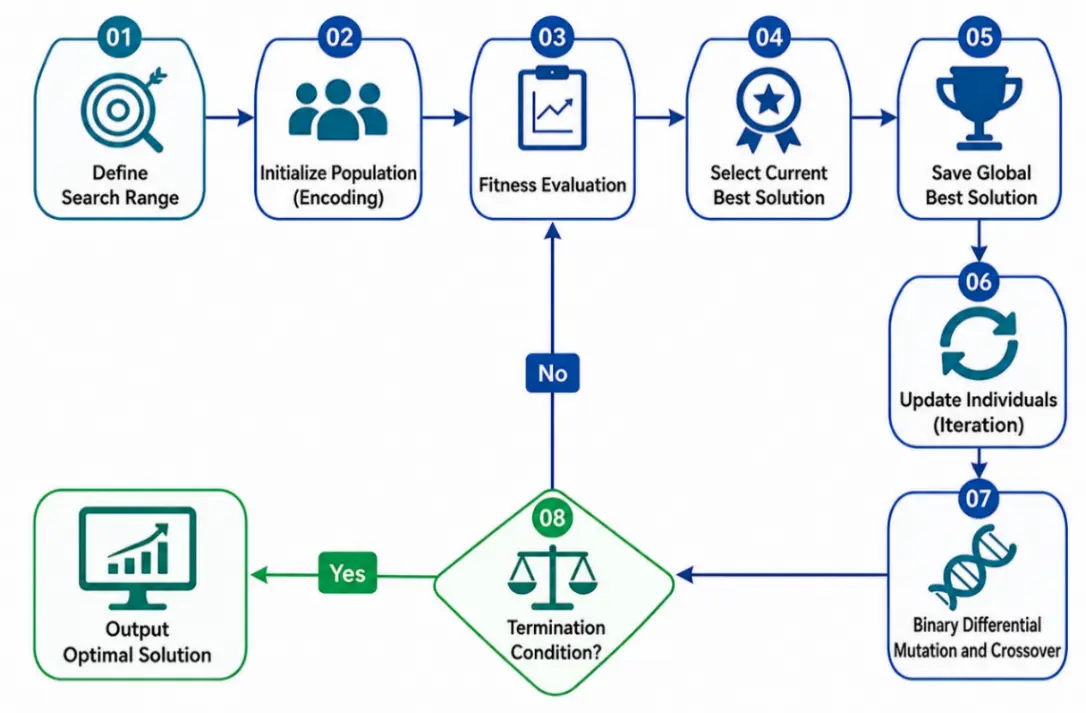
The iterative process of the PSODE algorithm. The algorithm first generates a random binary particle swarm and initializes the strategy parameters to determine whether binary PSO or binary DE is used for individual updating in each iteration. During the iteration process, the current particle positions are recorded, and fitness values are calculated. If the updated solution is superior to the previous one, the new fitness value is retained, and the optimal individual is updated [141].
The algorithm switches adaptively between PSO and DE through a random strategy, thereby balancing search efficiency and global optimization capability. When the stagnation threshold is satisfied, or the maximum number of iterations is reached, the algorithm terminates and outputs the optimal result.
Second, in the production and transportation stages, automated production lines, intelligent formwork tables, rebar processing equipment, concrete pouring and curing systems, component identification and tracking technologies, and intelligent logistics systems constitute the essential equipment foundation for upgrading prefabricated construction processes [142]. Prefabricated component production is the core link that distinguishes prefabricated buildings from traditional cast-in-situ construction. It is also the stage in which intelligent equipment is most intensively applied, and process control requirements are the highest. Traditional prefabricated component production suffers from high dependence on manual labor, difficulty in real-time monitoring of process parameters, large quality fluctuations, and isolated production information. To improve the precision, efficiency, and stability of component production, current research generally emphasizes the integrated application of automated production lines and digital control systems [143].
During component production, intelligent formwork tables and automated assembly lines can automatically organize processes such as mold layout, rebar positioning, embedded-part installation, concrete pouring, vibration, leveling, curing, and demolding according to BIM models and production plans. Automated rebar processing equipment can perform rebar cutting, bending, welding, and binding based on detailed component design data, thereby improving the processing accuracy of rebar cages [144]. Automatic concrete placing machines and vibration equipment can adjust pouring speed and vibration intensity based on component type, section size, and material performance parameters, thereby reducing quality defects such as honeycombs, voids, and insufficient compactness. Intelligent curing systems can dynamically regulate steam curing, constant-temperature curing, or natural curing processes through temperature and humidity sensors and control algorithms, thereby ensuring early strength development and dimensional stability of components [145].
Meanwhile, the intelligence of component production is not limited to equipment automation; more importantly, it lies in real-time production data collection, process tracking, and quality closed-loop control. Through component identity recognition technologies such as RFID, QR codes, laser marking, or embedded chips, a unique identification code can be established for each prefabricated component, linking component design information, raw material batches, production process parameters, quality inspection results, storage locations, transportation status, and on-site installation records [146]. This mechanism forms a continuous data chain from the production end to the construction end, providing a basis for quality traceability, responsibility clarification, and process optimization. In the transportation stage, prefabricated components are characterized by large volume, heavy weight, significant shape differences, and high sensitivity to transportation damage; therefore, whole-process control should be implemented by integrating intelligent logistics equipment with route optimization methods. Based on BIM models and construction schedules, component loading sequence optimization, transportation route planning, and site entry rhythm matching can be carried out in advance to avoid yard congestion, secondary handling, and on-site waiting. GPS positioning, vehicle-mounted sensors, tilt sensors, and vibration monitoring devices can record position, speed, vibration, inclination, and impact status in real time during transportation, thereby determining whether components are at risk of transportation damage. Through the dynamic linkage of production plans, logistics plans, and on-site installation plans, a collaborative organization mode of “on-demand production, just-in-time transportation, and precise site entry” can be achieved, thereby improving supply-chain efficiency and construction continuity in prefabricated construction [147].
Li Zhibin et al. [148] reported the practice of the CNOOC Tianjin Offshore Equipment Intelligent Manufacturing Base. The project used BIM LOD400–500 models to conduct detailed design and clash detection for modular steel structural components and combined CNC machine tool processing to achieve one-time forming of components. In the production and transportation stages, the project applied automated assembly lines, intelligent formwork tables, RFID/QR code component tracking, and intelligent logistics systems, realizing closed-loop production data management and precise on-site assembly. The component processing accuracy was high, the qualification rate reached 99%, and the production cycle was shortened by approximately 30%, providing a reference model for the intelligentization of the production stage in prefabricated buildings.
Dong Qingsen et al. [149] constructed a BIM model-driven steel structure cutting and welding process in offshore modular production. By combining automated welding robots, rebar processing equipment, AGV automatic transportation systems, and a digital twin monitoring platform, real-time monitoring and closed-loop control of the whole process of production, transportation, and assembly were realized. This model significantly reduced construction errors and rework rates and supported intelligent collaboration through full life-cycle information tracking, providing a replicable intelligent construction case for modular shipbuilding and offshore platform component production.
Jiang Zizhou [150] systematically reviewed the application of humanoid, wheeled, tracked, and robotic-arm robots in prefabricated construction factories and on-site construction from the perspective of intelligent construction robots. The study pointed out that robots can achieve stable rhythms and consistent quality in processes such as rebar processing, welding and cutting, component handling, concrete paving, and spraying. Meanwhile, when combined with BIM, sensing, and positioning technologies, robots can perform precise measurements and supervise assembly on construction sites, providing a reference technical path and management model for the production and transportation stages of intelligent construction.
Hou Yifen et al. [151] systematically studied process optimization, design-data connection, and robotic construction applications in the intelligent production and transportation stages of prefabricated components, based on the Longhua Street prefabricated residential project in Xuhui District, Shanghai. The study adopted optimized reinforcement for composite slabs, welded reinforcement mesh for walls, and unified keyway design. It also used an intelligent construction precision data platform to realize a “design–production” data closed loop, while deploying floor-leveling robots and putty-spraying robots to improve construction accuracy and efficiency. The results showed that intelligent equipment and data platforms significantly improved component processing accuracy and construction efficiency, supporting a construction mode of on-demand production, just-in-time transportation, and precise site entry.
As shown in Table 8, in the construction and inspection stages, intelligent hoisting equipment, construction robots, laser scanners, machine vision systems, nondestructive testing equipment, and intelligent safety monitoring systems constitute the key technical support for the intelligent upgrading of prefabricated construction sites. On-site construction is the stage where process innovation and intelligent equipment applications in prefabricated construction are most directly reflected. Compared with traditional cast-in-situ construction, prefabricated construction places higher requirements on component positioning accuracy, hoisting coordination, joint connection quality, and construction organization continuity. If on-site hoisting, temporary support, joint grouting, and installation verification are not properly controlled, even high-quality component production may still result in a degradation of overall structural performance. Therefore, the application of intelligent equipment in the construction stage focuses on improving component installation accuracy, reducing the intensity of high-risk operations, strengthening joint quality control, and realizing dynamic perception of the construction process.
In terms of component hoisting and installation, intelligent tower cranes, automatic guided hoisting systems, hoisting path planning systems, and component positioning technologies based on visual recognition have gradually become research focuses. By inputting component position information, hoisting sequence, and site spatial constraints from BIM models into hoisting scheduling systems, hoisting path simulation and collision risk identification can be completed in advance. Combined with technologies such as UWB positioning, visual recognition, laser ranging, and inertial measurement units, the posture and spatial position of components can be perceived in real time, assisting hoisting equipment in achieving precise placement. For large wall panels, composite slabs, precast columns, modular units, and other components, intelligent hoisting equipment can significantly reduce manual command errors and improve installation safety and construction efficiency.
In terms of joint construction and connection quality control, intelligent grouting equipment, automatic welding robots, bolt-tightening monitoring equipment, and joint inspection instruments have important application value. Key processes such as sleeve grouting connections, cast-in-situ joint connections, and dry connections are directly related to the overall mechanical performance of prefabricated structures. Traditional manual grouting has problems such as unstable pressure control, difficulty in real-time judgment of fullness, and difficulty in detecting concealed quality defects. Intelligent grouting systems can record grouting pressure, flow rate, time, temperature, and material status throughout the process, and evaluate grouting fullness based on sensor feedback, thereby improving the controllability of joint connection quality. For prefabricated steel structures, automatic welding robots and intelligent bolt-tightening equipment can improve the consistency of connection operations and reduce deviations caused by manual operation.
Table 8. Analysis of Intelligent Equipment in Prefabricated Intelligent Construction.
|
Typical Equipment |
Applicable Stage |
Function |
Features |
Application Value |
|---|---|---|---|---|
|
Intelligent Formwork Table |
Component production |
Component forming, rebar positioning, formwork installation |
BIM-linked; adaptable to multiple component types |
Reduces assembly errors and ensures component consistency |
|
Rebar Processing Robot |
Component production |
Automatic cutting, bending, welding, and tying of rebar cages |
High precision; automated; repeatable |
Improves rebar accuracy and shortens processing time |
|
RFID/QR Code Identification System |
Production and transportation |
Unique component identification and full-process tracking |
BIM-compatible; supports data linkage |
Enables quality traceability, responsibility clarification, and supply chain management |
|
Intelligent Logistics System/AGV |
Component transportation |
Automatic handling, warehousing, and route optimization |
Autonomous navigation; real-time monitoring |
Improves logistics efficiency and reduces secondary handling and damage |
|
Intelligent Tower Crane |
On-site hoisting |
Accurate hoisting, positioning, and component installation |
Hoisting path planning; BIM linkage |
Improves hoisting accuracy and reduces high-altitude operation risks |
|
Intelligent Grouting System |
Joint construction |
Automatic control of sleeve or dry grouting |
Real-time monitoring of pressure, flow, and temperature |
Improves joint quality control and construction consistency |
|
Transportation Monitoring Platform |
Production and transportation |
Transportation monitoring, vehicle dispatching, and site receiving |
RFID/GPS linkage; real-time data tracking |
Supports supply chain coordination and construction continuity |
In terms of construction inspection and quality acceptance, laser scanning, machine vision, photogrammetry, drone inspection, and nondestructive testing provide a new methodological system for on-site quality control. Three-dimensional laser scanning can rapidly acquire point cloud data after component installation and compare it with BIM design models to detect deviations in wall panel verticality, component axes, elevations, joint widths, and overall spatial geometry. Machine vision systems can be used to identify quality defects such as surface cracks, corner damage, contamination, and embedded-part misalignment. Nondestructive testing technologies, including ultrasonic testing, impact echo, infrared thermography, and acoustic emission, can be used to evaluate the compactness of grouting, internal concrete defects, and structural damage states. These inspection methods have transformed the traditional quality management model, which relied on manual visual inspection and sampling tests, shifting prefabricated construction quality control from “final acceptance” to “process monitoring” and “real-time feedback”.
In addition, construction site safety management is also an important direction for the application of intelligent equipment. Prefabricated building construction involves large-component hoisting, high-altitude operations, temporary support systems, and multi-trade cross operations, making safety risks dynamic and sudden. By deploying video surveillance, personnel positioning, hoisting load monitoring, edge-protection sensors, and environmental monitoring devices, real-time perception of worker behavior, equipment operating status, and hazardous areas on construction sites can be achieved. Combined with artificial intelligence recognition algorithms, the system can automatically identify safety hazards such as failure to wear safety helmets, workers entering hoisting danger zones, abnormal component inclination, and instability risks in support systems, and then issue timely warnings to management personnel. This indicates that intelligent equipment not only improves construction efficiency but is also becoming an important tool for proactive safety risk prevention and control in prefabricated construction.
Current research shows that BIM, the Internet of Things, artificial intelligence, digital twins, and construction robots are jointly promoting the transformation of prefabricated construction from a traditional industrialized production mode to a data-driven intelligent construction mode. Among them, BIM provides a model foundation for multi-disciplinary collaborative design and component information integration; the Internet of Things enables real-time sensing throughout component production, transportation, construction, and operation and maintenance; and artificial intelligence and big data analytics provide algorithmic support for construction scheduling optimization, quality defect identification, and safety risk warning. Digital twins further dynamically couple physical construction processes with virtual models, making full life-cycle status perception, process prediction, and intelligent decision-making for prefabricated buildings possible.
Overall, process innovation and intelligent equipment application in prefabricated construction demonstrate clear whole-process coordination characteristics. In the early-stage design stage, BIM, parametric design, and intelligent optimization algorithms enable front-end optimization of component decomposition, process routes, and construction organization. In the production and transportation stages, automated production lines, intelligent logistics, and component identification technologies improve the accuracy of component manufacturing and supply-chain coordination. In the construction and inspection stages, intelligent hoisting, construction robots, machine vision, and nondestructive testing technologies enable on-site assembly accuracy control, joint quality assurance, and safety risk warning. Together, these three stages constitute a technological pathway for prefabricated intelligent construction, progressing from digital design to automated production and further toward intelligent construction and traceable quality management.
4.2.3. Research Hotspot 3: Structural Performance and Engineering Application of Prefabricated Buildings
Structural performance and engineering application of prefabricated buildings constitute a fundamental and supporting research hotspot within the prefabricated intelligent construction research system. Compared with the previous two hotspots—technology integration and process equipment-this research direction pays greater attention to the safety, applicability, durability, and reliability of prefabricated buildings in real engineering environments. Its core concern lies in how to ensure the performance stability of prefabricated components, joint connections, and the overall structural system throughout production, transportation, installation, and service.
As shown in Figure 20. The keyword co-occurrence analysis shows that terms such as seismic performance, mechanical properties, compressive strength, microstructure, crack propagation, numerical simulation, and acoustic emission appear with relatively high frequency, indicating that structural performance research on prefabricated buildings remains an important knowledge foundation in this field. However, in the context of intelligent construction, structural performance research is no longer limited to traditional experimental testing, theoretical analysis, and finite element simulation. Instead, it is gradually expanding toward intelligent sensing, data-driven prediction, digital twin feedback, and whole-process engineering performance management [152,153].
From the perspective of intelligent construction, research on the structural performance of prefabricated buildings has gradually shifted from static analysis of component materials, joint connections, overall structural behavior, and durability to a dynamic evaluation and continuous optimization system centered on performance objective setting, intelligent sensing data [154], intelligent analysis methods, engineering application scenarios, and feedback optimization mechanisms [155]. This system integrates structural performance control throughout component production, transportation, construction, and installation [156], operation and maintenance, and health assessment, thereby improving the safety, reliability, and durability of prefabricated buildings [157].
Structural performance objectives form the foundation of intelligent control and primarily include bearing capacity, seismic performance, ductility, durability, crack control, and joint reliability [158]. Among them, component strength, crack resistance, shrinkage, and creep behavior, and interfacial bonding performance determine the basic bearing capacity of the structure. Joint connection performance affects load transfer, deformation coordination, and energy dissipation capacity [159]. The seismic performance, dynamic response, and stability of the overall structure determine the structural safety level, while service-stage durability is closely related to long-term reliability [160]. Therefore, structural performance evaluation of prefabricated buildings should be expanded from a single strength-based indicator to a comprehensive performance system covering components, joints [161], the overall structure, and service durability [162].
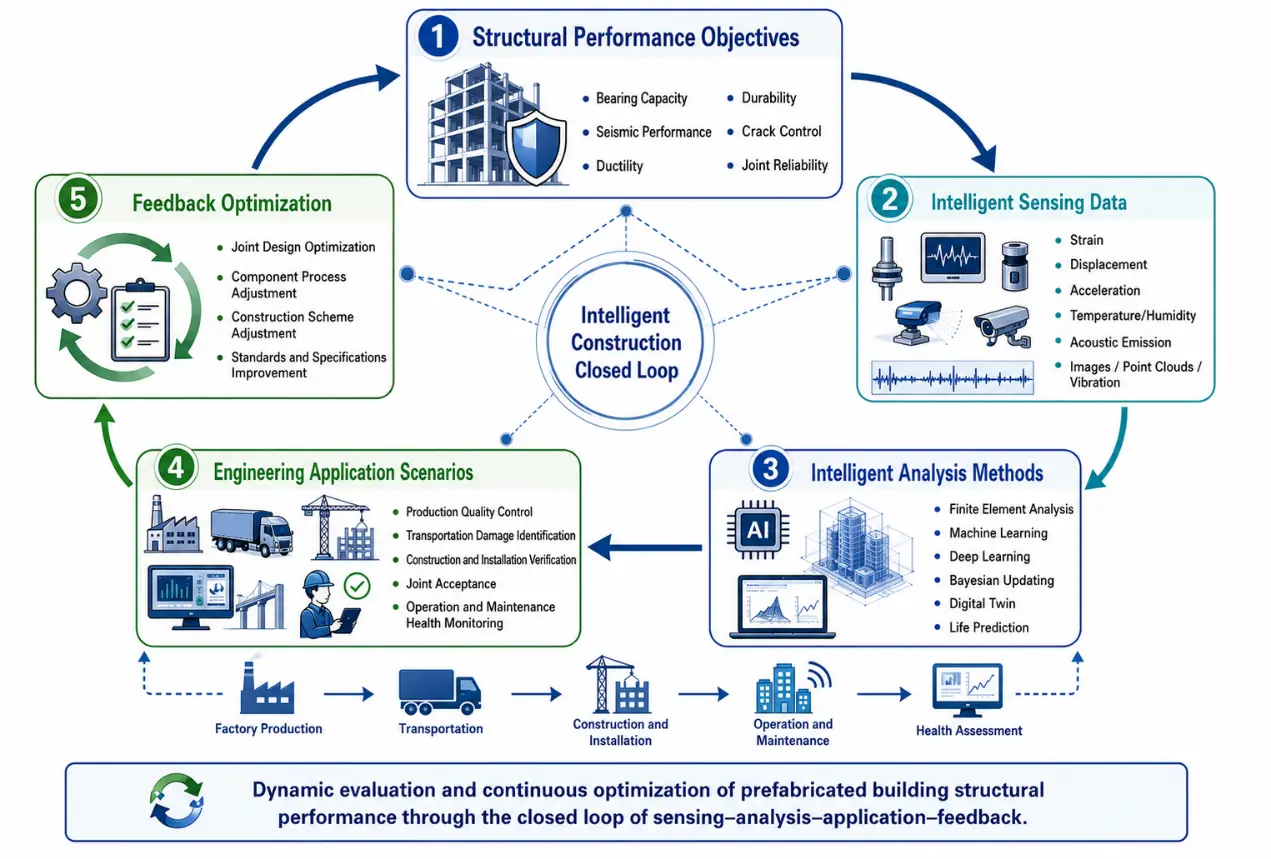
Figure 20. Framework of Structural Performance and Engineering Applications of Prefabricated Buildings.
Intelligent sensing data provide support for dynamic structural performance assessment. Multi-source data, including strain, displacement, acceleration, temperature, and humidity, acoustic emission [163], fiber-optic sensing, images, point clouds, and vibration monitoring, can be used to capture real-time state changes of components during production, transportation [164], hoisting, installation, and service [165]. For example, the production stage can monitor curing conditions, demolding strength, and dimensional deviations; the transportation and hoisting stages can identify risks of vibration, impact, and inclination; the installation stage can obtain information on joint quality, grouting compactness [166], and installation deviation; and the service stage can continuously track crack propagation, structural deformation, and changes in dynamic characteristics [167]. As a result, structural performance evaluation shifts from stage-based inspection to whole-process real-time sensing [168].
Intelligent analysis methods promote the transformation of structural performance research from experience-based judgment to data-driven prediction. Based on multi-source monitoring data, finite element simulation, machine learning, deep learning, Bayesian updating, digital twins, and life prediction methods can be used to construct structural performance prediction, damage identification, and durability assessment models [169]. At the component level, these methods can reveal the relationship between process parameters and macroscopic mechanical properties. At the joint level, they can analyze bearing capacity, stiffness degradation, ductility, and failure modes. At the overall structural level [170], they can evaluate dynamic responses and performance degradation under earthquakes [171], wind loads, and complex environmental conditions [172]. At the durability level, they can identify risks such as freeze–thaw damage, reinforcement corrosion, interface debonding, and material deterioration, thereby enabling a shift from post-event evaluation to pre-event prediction and process control [173].
Engineering application scenarios serve as important carriers for verifying the effectiveness of intelligent control. Structural performance control of prefabricated buildings runs through production quality control, transportation damage identification, construction and installation verification, joint acceptance, and operation-stage health monitoring [174]. In the production stage, intelligent inspection and data traceability can ensure component quality. In the transportation stage, vibration and posture monitoring can identify potential damage. In the construction stage, three-dimensional scanning, machine vision, and sensor monitoring can verify component positioning, joint width, connection quality, and grouting quality [175]. In the operation and maintenance stage, structural health monitoring systems and digital twin platforms can continuously assess structural states, supporting risk warning, repair and reinforcement, and life prediction [176].
The feedback optimization mechanism enables continuous improvement and closed-loop control of structural performance [177]. By feeding sensing data, analysis results, and engineering feedback back to the design, production, construction, operation, and maintenance stages, joint configurations, component sections, material mix proportions, curing regimes, hoisting schemes, connection processes, and maintenance strategies can be dynamically optimized [178]. Thus, structural performance research on prefabricated buildings no longer remains at the stage of static verification, but forms an intelligent construction closed loop of sensing [179], analysis, application, and feedback, enabling structural performance to be monitored, predicted, traced, and optimized [180].
In the context of intelligent construction, research on structural performance is closely coupled with intelligent technologies [181]. Traditional methods focus on experiments, theoretical analysis, and engineering experience, making it difficult to achieve whole-process dynamic monitoring and real-time early warning [182]. Intelligent sensing technologies can deploy strain, displacement, acceleration, acoustic emission, fiber-optic, and environmental sensors on components [183], joints, and key load-bearing areas to obtain real-time data on stress, deformation, vibration, cracks, and environmental actions, thereby enabling full life-cycle monitoring during production, transportation, hoisting, installation, and service [184]. Artificial intelligence and data-driven methods can integrate experimental, monitoring, and simulation data to establish structural performance prediction, damage identification [185], and life assessment models. For example, acoustic emission and image recognition can be used to track crack initiation and propagation; deep learning-based visual detection can identify surface cracks, spalling, exposed reinforcement [186], and joint defects; and multi-source data prediction models can provide early warnings of joint stiffness degradation [187], changes in bearing capacity, and durability risks, thereby transforming structural performance evaluation from post-event assessment to pre-event prediction and process control [188].
Chen Shunde [189] explored an intelligent component production method that combines a 3D printing construction system with carbon-fiber concrete for high-rise building construction. The project used BIM models for component segmentation design and construction path planning, and combined 3D printing equipment with automated support systems to achieve precise forming of complex components and joint optimization. While ensuring the compressive strength and durability of high-rise components, this mode improved production efficiency and optimized material consumption, providing a demonstrative experience for complex high-rise prefabricated buildings under intelligent construction. Vandi [190] investigated structural health monitoring of prefabricated building envelopes by integrating multi-parameter sensors, including FBG fiber optic sensors, accelerometers, and force washers, into a 1:1 full-scale curtain wall prototype. The results showed that the prototype successfully passed the performance tests without damage, confirming the effectiveness of the multi-parameter sensor kit for structural health monitoring of building envelopes. Mao [191] investigated a novel prefabricated shear wall system incorporating mechanical keyway joints and epoxy-bonded interfaces. Full-scale wall specimens were tested under cyclic lateral loading to evaluate the effects of different connection and reinforcement configurations on seismic performance. The study further integrated a GWO-WOA artificial intelligence optimization model to predict and optimize seismic resilience indicators, including ductility, peak load, and stiffness degradation. The results showed that epoxy-bonded joints increased energy dissipation by 28–34%; the GWO-WOA model achieved high predictive accuracy and improved the optimized specimens’ ductility by up to 12% and peak load by 8–10%, confirming the potential of artificial intelligence methods for resilience-oriented seismic design of prefabricated concrete structures, as shown in Figure 21.
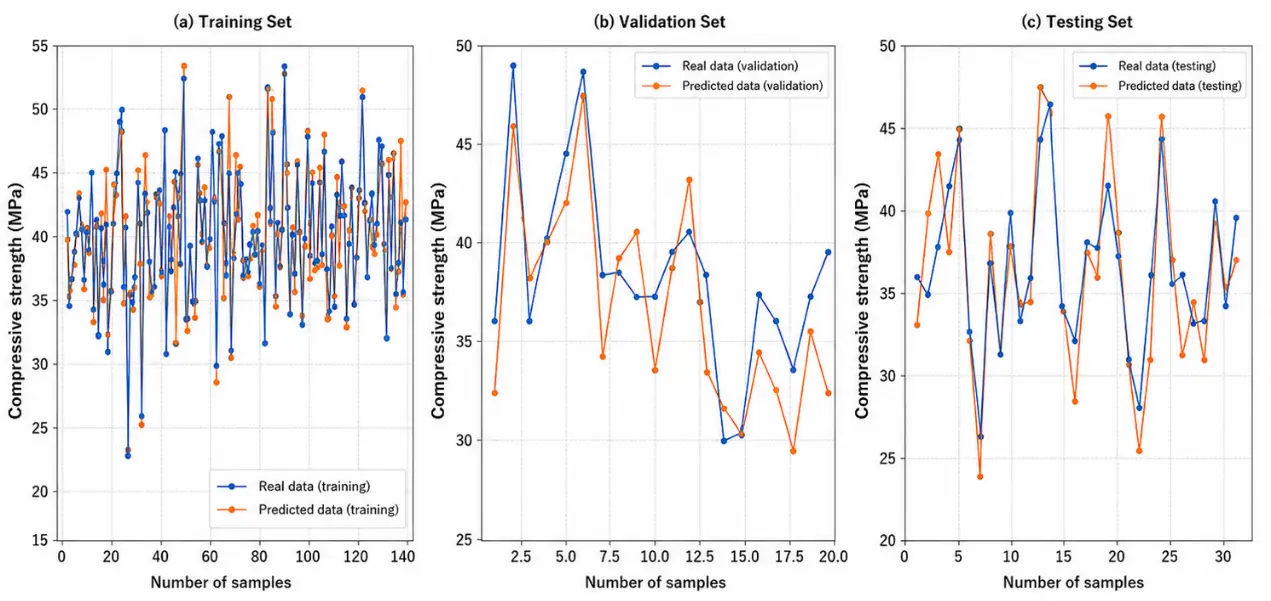
Danial Jahed Armaghani et al. [192] investigated the prediction of compressive strength in concrete containing waste foundry sand (WFS). Based on 234 experimental datasets, they developed a base XGBoost model and two hybrid models by coupling XGBoost with the tunicate swarm algorithm (TSA) and salp swarm algorithm (SSA). The results showed that the hybrid models achieved higher accuracy and efficiency than the base XGBoost model, with XGBoost-SSA exhibiting the best performance. Sensitivity analysis indicated that the WFS-to-cement ratio had a significant effect on compressive strength, whereas the WFS replacement percentage had a relatively minor influence. The combined effects of the water-to-cement ratio and WFS fineness modulus were therefore recommended for strength improvement, as shown in Figure 21 [192].
Digital twin technology further strengthens the connection between structural performance research and engineering applications. Prefabricated buildings are characterized by standardized components, clear information coding, and traceable production processes, making them naturally suitable for the construction of full life-cycle digital twin models [193]. By integrating BIM models, component identity codes, construction process data, sensor monitoring data, and structural analysis models, a cyber–physical mapping system that updates synchronously with the physical building can be established. In this system, structural performance is no longer merely a calculation result at the design stage [194], but can be dynamically updated according to changes in component production quality, transportation status, installation deviations, and service environments. Digital twin models can be used to simulate structural responses under different loading conditions, environmental actions, and damage states, thereby assisting in the assessment of structural safety reserves, weak areas, and maintenance needs, and ultimately enabling closed-loop performance control from design and construction to operation and maintenance management.
From the perspective of engineering applications, prefabricated intelligent construction is not limited to structural performance monitoring but spans the entire process of design, production, transportation, construction, acceptance, operation, and maintenance. Its core lies in relying on BIM, the Internet of Things, artificial intelligence, intelligent equipment, digital twins, and other technologies to connect data chains across different stages, thereby realizing digital collaboration, intelligent control, and refined management throughout engineering implementation [195].
In the design stage, BIM and parametric design can support multi-disciplinary collaboration, clash detection, component decomposition, standardized design, and hoisting path simulation, thereby improving the constructability of design schemes and the standardization level of components [196]. In the production stage, intelligent formwork tables, automated rebar processing, concrete placing, curing monitoring, and component coding technologies can realize automated, standardized, and fully traceable production of prefabricated components. In the transportation and construction stages, RFID, QR codes, positioning systems [197], IoT sensors, and construction management platforms can dynamically track component status, site entry plans, and on-site installation progress. Three-dimensional laser scanning, machine vision, and intelligent hoisting technologies can further improve component positioning, installation accuracy, and the efficiency of construction organization [198].
In terms of quality acceptance and process supervision, drone inspection, three-dimensional scanning, image recognition, and nondestructive testing technologies can rapidly identify component dimensional deviations, joint quality, installation accuracy, and surface defects [69]. By linking these data with BIM models and construction data [199], traceable quality management records can be formed [200]. In the operation and maintenance stage, digital twin platforms can integrate component information, monitoring data, and operation and maintenance records to support equipment management [201], space management, energy consumption monitoring, maintenance warnings, and full life-cycle information management [202].
Overall, the engineering application of prefabricated intelligent construction is shifting from isolated technology applications toward whole-process system integration [203]. Its value lies not only in improving construction efficiency and reducing labor dependence [204], but also in promoting information connectivity and collaborative optimization among design [205], production, construction, and operation and maintenance [206], thereby providing support for the upgrading of prefabricated buildings toward digitalized, networked, and intelligent construction [207,208].
5. Conclusions and Prospects
5.1. Conclusions
This study takes the Web of Science Core Collection as the data source and selects literature related to prefabricated intelligent construction from 2015 to 2025 as the research object. By comprehensively using tools such as VOSviewer and bibliometrix, this study systematically analyzes the knowledge structure, evolutionary characteristics, and frontier directions of prefabricated intelligent construction from multiple dimensions, including publication evolution, disciplinary distribution, country/region collaboration, institutional and author networks, keyword co-occurrence, and research hotspot clustering. The results show that prefabricated intelligent construction is not a simple superposition of prefabricated construction and intelligent construction technologies, but a new full life-cycle construction paradigm formed through the deep coupling of construction industrialization, digitalization, and intelligentization. Based on the above analysis, the main conclusions are as follows.
First, research on prefabricated intelligent construction shows significant staged growth characteristics and has shifted from early conceptual exploration to rapid expansion and concentrated growth. From 2015 to 2019, both annual publication output and citation frequency in this field remained at a low level, and the research topics had not yet formed a stable scale. From 2020 to 2023, with the accelerated penetration of BIM, the Internet of Things, artificial intelligence, and digital twins into the construction industry, both the number of publications and academic influence increased simultaneously. From 2023 to 2025, the field entered a stage of concentrated growth, during which the number of publications accounted for 76.16% of all sample publications and citation frequency accounted for 84.07% of the total citations. This indicates that prefabricated intelligent construction has become an important research frontier at the intersection of intelligent construction, construction industrialization, and digital construction. This growth trend suggests that the driving force of prefabricated intelligent construction research has gradually shifted from single policy promotion and conceptual introduction to sustained development jointly driven by technology integration, engineering demand, and industrial upgrading.
Second, prefabricated intelligent construction research has formed a global knowledge production pattern centered on China and supported by multi-country collaboration. The country/region analysis shows that China occupies a leading position in both publication output and total citation frequency, making it the major knowledge-producing country and core node in the collaboration network of this field. Although countries such as Australia, the United States, the United Kingdom, and Germany have relatively smaller publication scales, they perform prominently in terms of average citations per paper, indicating high single-paper influence. The institutional and author collaboration networks further show that this field has formed a research pattern dominated by universities and research institutions, characterized by continuous output from core teams and collaborative development among multiple institutions. Among them, universities with strengths in civil engineering, construction engineering, and intelligent construction play key roles in knowledge production, technical method development, and engineering application research. Overall, a relatively stable academic community has initially formed in the field of prefabricated intelligent construction, while its global research landscape still presents the characteristics of “concentrated output scale and diversified influence distribution”.
Third, prefabricated intelligent construction shows obvious interdisciplinary characteristics and has formed a knowledge structure dominated by engineering and construction building technology, supported by materials science, mechanics, computer science, and environmental science. The disciplinary distribution results indicate that engineering and construction building technology occupy dominant positions, showing that research in this field has consistently focused on core issues such as engineering practice, construction organization, quality control, and construction efficiency improvement. The continuous participation of materials science and mechanics indicates that material performance of prefabricated components, joint connection performance, structural safety, and durability remain fundamental supports for the large-scale application of prefabricated buildings. The growth of computer science-related literature reflects that artificial intelligence, machine learning, digital twins, data analytics, and intelligent decision-making methods are being rapidly embedded into the prefabricated construction process. Therefore, prefabricated intelligent construction is gradually evolving from traditional architectural engineering research into a composite research field that integrates engineering technology, digital intelligence, structural performance, and green, low-carbon concepts.
Fourth, keyword co-occurrence and clustering analysis show that research on prefabricated intelligent construction has formed three core hotspots: technology integration, process equipment, and structural performance and engineering application. Among them, the integration of prefabricated construction and intelligent construction technologies is the most frontier-oriented research direction at present. Keywords such as BIM, digital twin, deep learning, genetic algorithm, and the Internet of Things reflect the transformation of this field from information modeling to data-driven decision-making, cyber–physical mapping, and intelligent decision support. Process innovation and intelligent equipment for prefabricated construction indicate the extension of research from design optimization to manufacturing and on-site construction equipment upgrading. Technologies such as 3D concrete printing, additive manufacturing, intelligent formwork tables, construction robots, and automated inspection equipment jointly promote the development of prefabricated construction toward greater efficiency, refinement, and intelligence. Structural performance and engineering applications, as fundamental hotspots, focus on seismic performance, mechanical properties, compressive strength, microstructure, crack propagation, and acoustic emission monitoring, providing theoretical foundations and engineering verification for the safe application and large-scale promotion of prefabricated buildings. These three hotspots are not isolated or parallel themes but present a progressive logic that moves from digital technology empowerment and intelligent equipment implementation to engineering performance verification.
Fifth, prefabricated intelligent construction has formed a progressive knowledge structure of technology integration, process equipment, and structural performance and engineering application. BIM, digital twins, artificial intelligence, and the Internet of Things constitute the foundation for digital and intelligent empowerment. 3D concrete printing, additive manufacturing, intelligent formwork tables, construction robots, and automated inspection equipment promote the upgrading of construction processes and production modes. Research on seismic performance, mechanical properties, durability, and health monitoring provides safety and reliability support for the large-scale application of prefabricated buildings. Together, these three hotspots indicate that the core value of prefabricated intelligent construction does not lie in the substitution of a single technology, but in realizing collaborative optimization across design, production, construction, and operation and maintenance through data connectivity, equipment collaboration, algorithmic decision-making, and engineering feedback. In the future, this field will further deepen toward multi-source data fusion, digital twin-based closed-loop control, integrated application of intelligent equipment, and full life-cycle engineering evaluation.
5.2. Prospects
Future research on prefabricated intelligent construction should, on the basis of existing bibliometric findings and engineering applications, further shift from single-technology optimization to systematic collaborative innovation, from local scenario validation to full life-cycle engineering application, and from experience-driven management to data-driven decision-making. Based on the findings of this study, future research can focus on the following four directions.
First, it is necessary to establish full life-cycle-oriented data standards and collaborative mechanisms. Prefabricated intelligent construction involves multiple stages, including design, production, transportation, construction, acceptance, and operation and maintenance. Data sources vary across these stages, with inconsistent formats and non-unified semantic standards, which restrict cross-stage information sharing and whole-process traceability. Future research should establish a unified data governance framework around unique component identification, BIM model semantic standards, IoT sensing data formats, construction process data interfaces, and operation and maintenance data archiving specifications. In particular, it is necessary to overcome data interoperability bottlenecks among BIM, IoT, digital twin platforms, intelligent equipment, and project management systems, so as to form a continuous data chain throughout design-production-construction-operation and maintenance and provide fundamental support for process collaboration, quality traceability, and intelligent decision-making in prefabricated intelligent construction.
Second, digital twin-driven platforms for prefabricated intelligent construction should be developed. Existing studies have shown that digital twins are an important technical carrier that connects physical construction processes to virtual model spaces. However, most current studies still focus on individual links or local scenarios, and a dynamic twin system that covers the entire process has not yet been developed. Future research should further promote the deep integration of BIM models, component coding, sensor monitoring, construction progress, quality inspection, and structural analysis models, and construct a prefabricated intelligent construction digital twin platform that can be updated in real time, support predictive analysis, and enable feedback optimization. Such a platform should not only serve construction process visualization and quality control, but also support component production scheduling, hoisting risk warning, joint construction quality assessment, operation-stage health monitoring, and maintenance decision optimization, thereby realizing a transition from static modeling to dynamic sensing, intelligent simulation, and closed-loop control.
Third, the collaborative optimization of intelligent equipment and construction processes should be strengthened. The intelligent upgrading of prefabricated buildings depends not only on digital platforms but also on the deep adaptation between intelligent equipment and construction processes. Future research should focus on key links such as intelligent formwork tables, automated rebar processing, intelligent concrete placing and curing, construction robots, intelligent hoisting, machine vision inspection, and nondestructive testing equipment. It is necessary to establish the coupling relationships among equipment performance, process parameters, component quality, and construction efficiency. Meanwhile, more attention should be paid to the adaptability of intelligent equipment in complex real engineering environments, especially issues such as multi-equipment collaborative scheduling, robustness of robotic on-site operations, precise recognition of complex components, real-time correction of construction errors, and human–machine collaborative safety control. This will promote the transformation of prefabricated construction from equipment replacing labor to equipment-process-data collaborative optimization.
Fourth, a comprehensive evaluation and empirical research system oriented toward engineering applications should be improved. The ultimate value of prefabricated intelligent construction needs to be verified through real engineering projects. Future research should strengthen empirical analysis across multiple types of engineering scenarios, including residential buildings, public buildings, transportation infrastructure, industrial plants, and modular buildings, and build a comparable engineering case database. At the same time, a comprehensive evaluation index system should be established, covering construction efficiency, quality stability, cost control, carbon emissions, safety risks, operation and maintenance benefits, and user experience. This can avoid evaluating the effectiveness of intelligent construction solely based on a single technical performance or local efficiency improvement. Through long-term monitoring data, measured engineering data, and multi-case comparative analysis, future studies can further reveal the application boundaries and promotion pathways of prefabricated intelligent construction under different project types, technology combinations, and management modes, thereby providing more reliable evidence for industry standard formulation, technology route selection, and industrial promotion.
In summary, the key to the future development of prefabricated intelligent construction does not lie in isolated breakthroughs in single technologies, but in constructing a systematic construction system based on data connectivity, supported by intelligent equipment, enabled by digital twin platforms, and verified through engineering practice. With the further maturation of multi-source data fusion, artificial intelligence algorithms, intelligent construction equipment, and full life-cycle management platforms, prefabricated intelligent construction is expected to gradually move from local applications and demonstration projects toward standardized, platform-based, and large-scale applications, providing continuous support for the industrialized, digital, and green low-carbon transformation of the construction industry.
Statement of the Use of Generative AI and AI-Assisted Technologies in the Writing Process
During the preparation of this manuscript, the authors used AI to assist with language optimization. After using this tool/service, the authors reviewed and revised the content as necessary and take full responsibility for the entire content of the published article.
Author Contributions
Conceptualization, R.S. and X.M.; Methodology, R.S., F.P. and J.W.; Software, R.S.; Validation, J.M., H.W. and Y.X.; Formal Analysis, B.L. and T.G.; Investigation, X.Y., G.L. and X.Z.; Resources, G.W.; Data Curation, J.S. and Y.W.; Writing—Original Draft Preparation, R.S.; Writing—Review & Editing, X.M.; Visualization, F.P. and J.W.; Supervision, X.M.; Project Administration, X.M.; Funding Acquisition, Q.B.
Ethics Statement
Not applicable.
Informed Consent Statement
Not applicable.
Data Availability Statement
The raw data supporting the conclusions of this article can be obtained from the corresponding author upon reasonable request.
Funding
This research was financially supported by the following organizations: Open Fund of the Key Laboratory of Industrial Fluid Energy Saving and Pollution Control, Ministry of Education (No. CK-2024-0035), Shandong Provincial Young Scientific and Technological Talent Support Program (No. SDAST2021qt12), the Special Fund of Taishan Scholars Project.
Declaration of Competing Interest
The authors declare that they have no known competing financial interests or personal relationships that could have appeared to influence the work reported in this paper.
References
- Li CZ, Xue F, Li X, Hong J, Shen GQ. An Internet of Things-enabled BIM platform for on-site assembly services in prefabricated construction. Autom. Constr. 2018, 89, 146–161. DOI:10.1016/j.autcon.2018.01.001 [Google Scholar]
- Jin R, Gao S, Cheshmehzangi A, Aboagye-Nimo E. A holistic review of off-site construction literature published between 2008 and 2018. J. Clean. Prod. 2018, 202, 1202–1219. DOI:10.1016/j.jclepro.2018.08.195 [Google Scholar]
- Lu W, Li X, Xue F, Zhao R, Wu L, Yeh AGO. Exploring smart construction objects as blockchain oracles in construction supply chain management. Autom. Constr. 2021, 129, 103816. DOI:10.1016/j.autcon.2021.103816 [Google Scholar]
- Zhou JX, Shen GQ, Yoon SH, Jin X. Customization of on-site assembly services by integrating the internet of things and BIM technologies in modular integrated construction. Autom. Constr. 2021, 126, 103663. DOI:10.1016/j.autcon.2021.103663 [Google Scholar]
- Yevu SK, Owusu EK, Chan APC, Sepasgozar SME, Kamat VR. Digital twin-enabled prefabrication supply chain for smart construction and carbon emissions evaluation in building projects. J. Build. Eng. 2023, 78, 107598. DOI:10.1016/j.jobe.2023.107598 [Google Scholar]
- Zhao Y, Cao C, Liu Z. A Framework for Prefabricated Component Hoisting Management Systems Based on Digital Twin Technology. Buildings 2022, 12, 276. DOI:10.3390/buildings12030276 [Google Scholar]
- Zhu A, Pauwels P, De Vries B. Smart component-oriented method of construction robot coordination for prefabricated housing. Autom. Constr. 2021, 129, 103778. DOI:10.1016/j.autcon.2021.103778 [Google Scholar]
- Ye M, Li L, Pei B, Yoo DY, Li H, Zhou C. A critical review on shear performance of joints in precast Ultra-High-Performance Concrete (UHPC) segmental bridges. Eng. Struct. 2024, 301, 117224. DOI:10.1016/j.engstruct.2023.117224 [Google Scholar]
- Wang X, Wang S, Song X, Han Y. IoT-Based Intelligent Construction System for Prefabricated Buildings: Study of Operating Mechanism and Implementation in China. Appl. Sci. 2020, 10, 6311. DOI:10.3390/app10186311 [Google Scholar]
- Langston C, Zhang W. DfMA: Towards an Integrated Strategy for a More Productive and Sustainable Construction Industry in Australia. Sustainability 2021, 13, 9219. DOI:10.3390/su13169219 [Google Scholar]
- Yang B, Zhang B, Zhang Q, Wang Z, Dong M, Fang T. Automatic detection of falling hazard from surveillance videos based on computer vision and building information modeling. Struct. Infrastruct. Eng. 2022, 18, 1049–1063. DOI:10.1080/15732479.2022.2039217 [Google Scholar]
- Sun W, Antwi-Afari MF, Mehmood I, Anwer S, Umer W. Critical success factors for implementing blockchain technology in construction. Autom. Constr. 2023, 156, 105135. DOI:10.1016/j.autcon.2023.105135 [Google Scholar]
- Zhu A, Pauwels P, De Vries B. Component-based robot prefabricated construction simulation using IFC-based building information models. Autom. Constr. 2023, 152, 104899. DOI:10.1016/j.autcon.2023.104899 [Google Scholar]
- Lee S, Jeong M, Cho CS, Park J, Kwon S. Deep Learning-Based PC Member Crack Detection and Quality Inspection Support Technology for the Precise Construction of OSC Projects. Appl. Sci. 2022, 12, 9810. DOI:10.3390/app12199810 [Google Scholar]
- Mohammed BH, Safie N, Sallehuddin H, Hussain AHB. Building Information Modelling (BIM) and the Internet-of-Things (IoT): A Systematic Mapping Study. IEEE Access 2020, 8, 155171–155183. DOI:10.1109/ACCESS.2020.3016919 [Google Scholar]
- Xiao J, Ma S, Wang S, Huang GQ. Fine-grained digital twin sharing framework for smart construction through an incentive mechanism. Int. J. Prod. Econ. 2024, 276, 109382. DOI:10.1016/j.ijpe.2024.109382 [Google Scholar]
- Nguyen TDHN, Ly DH, Jang H, Dinh HNN, Ahn Y. Digital twin framework to enhance facility management for relocatable modular buildings. Autom. Constr. 2025, 176, 106249. DOI:10.1016/j.autcon.2025.106249 [Google Scholar]
- Wen Y. Research on the intelligent construction of prefabricated building and personnel training based on BIM5D. J. Intell. Fuzzy Syst. 2021, 40, 8033–8041. DOI:10.3233/JIFS-189625 [Google Scholar]
- Ullah H, Zhang H, Huang B, Gong Y. BIM-Based Digital Construction Strategies to Evaluate Carbon Emissions in Green Prefabricated Buildings. Buildings 2024, 14, 1689. DOI:10.3390/buildings14061689 [Google Scholar]
- Shufrin I, Pasternak E, Dyskin A. Environmentally Friendly Smart Construction—Review of Recent Developments and Opportunities. Appl. Sci. 2023, 13, 12891. DOI:10.3390/app132312891 [Google Scholar]
- Musarat MA, Sadiq A, Alaloul WS, Abdul Wahab MM. A Systematic Review on Enhancement in Quality of Life through Digitalization in the Construction Industry. Sustainability 2022, 15, 202. DOI:10.3390/su15010202 [Google Scholar]
- Du H, Gao J, Zhang L, Gong S, Zhao X. Research on the optimization of robot operation path in the automated production of precast concrete floor slab. Adv. Eng. Softw. 2025, 207, 103956. DOI:10.1016/j.advengsoft.2025.103956 [Google Scholar]
- You B, Chen Z, Xue Y, Zhang Y, Chen K. Modelling inter-relationships of barriers to smart construction implementation. J. Civ. Eng. Manag. 2024, 30, 738–757. DOI:10.3846/jcem.2024.22250 [Google Scholar]
- Ji Y, Tan Z, Liao L, Zhang D, Zhou Z. Overview of Intelligent Technology Applications in Open-Cut Tunnel Construction. Buildings 2025, 15, 3704. DOI:10.3390/buildings15203704 [Google Scholar]
- Shen Y, Wang J, Jin GH. Integrating PC Splitting Design and Construction Organization Through Multi-Agent Simulation for Prefabricated Buildings. Buildings 2025, 15, 3773. DOI:10.3390/buildings15203773 [Google Scholar]
- Fang M, Xu Z, Ye D, Stephane KS, Liu T, Tan P, et al. Review of robotic-assisted operation planning for large-scale printing in construction. Int. J. Adv. Manuf. Technol. 2026, 143, 51–67. DOI:10.1007/s00170-025-17274-0 [Google Scholar]
- Liu Z, Li W, Zhang Q, Zhu M, Liu Z. Research progress and trends of intelligent technology construction in large infrastructures: A CiteSpace-based visualization and analysis. Eng. Constr. Archit. Manag. 2025, 1–26. DOI:10.1108/ECAM-04-2025-0553 [Google Scholar]
- Lin J, Cai Y, Li Q. Development of Safety Training in Construction: Literature Review, Scientometric Analysis, and Meta-Analysis. J. Manag. Eng. 2023, 39, 03123002. DOI:10.1061/JMENEA.MEENG-5445 [Google Scholar]
- Habibi Rad M, Mojtahedi M, Ostwald MJ. Industry 4.0, Disaster Risk Management and Infrastructure Resilience: A Systematic Review and Bibliometric Analysis. Buildings 2021, 11, 411. DOI:10.3390/buildings11090411 [Google Scholar]
- Fu X, Ji K, Zhang Y, Xie Q, Huang J. Intelligent Optimization Method for Rebar Cutting in Pump Stations Based on Genetic Algorithm and BIM. Buildings 2025, 15, 1790. DOI:10.3390/buildings15111790 [Google Scholar]
- Li CZ, Gao T, Chen Z, Wu H, Deng Y, Tam VWY, et al. Exploring the Power of Laser Scanning Technology toward Smart Construction: Status Quo, Challenges, and Future Directions. J. Constr. Eng. Manag. 2025, 151, 03125004. DOI:10.1061/JCEMD4.COENG-16210 [Google Scholar]
- Mukherjee D, Lim WM, Kumar S, Donthu N. Guidelines for advancing theory and practice through bibliometric research. J. Bus. Res. 2022, 148, 101–115. DOI:10.1016/j.jbusres.2022.04.042 [Google Scholar]
- Öztürk O, Kocaman R, Kanbach DK. How to design bibliometric research: An overview and a framework proposal. Rev. Manag. Sci. 2024, 18, 3333–3361. DOI:10.1007/s11846-024-00738-0 [Google Scholar]
- Albahri AS, Duhaim AM, Fadhel MA, Alnoor A, Baqer NS, Alzubaidi L, et al. A systematic review of trustworthy and explainable artificial intelligence in healthcare: Assessment of quality, bias risk, and data fusion. Inf. Fusion 2023, 96, 156–191. DOI:10.1016/j.inffus.2023.03.008 [Google Scholar]
- Arsad AZ, Hannan MA, Al-Shetwi AQ, Mansur M, Muttaqi KM, Dong ZY, et al. Hydrogen energy storage integrated hybrid renewable energy systems: A review analysis for future research directions. Int. J. Hydrogen Energy 2022, 47, 17285–17312. DOI:10.1016/j.ijhydene.2022.03.208 [Google Scholar]
- Mariani MM, Machado I, Magrelli V, Dwivedi YK. Artificial intelligence in innovation research: A systematic review, conceptual framework, and future research directions. Technovation 2023, 122, 102623. DOI:10.1016/j.technovation.2022.102623 [Google Scholar]
- Debrah C, Darko A, Chan APC. A bibliometric-qualitative literature review of green finance gap and future research directions. Clim. Dev. 2023, 15, 432–455. DOI:10.1080/17565529.2022.2095331 [Google Scholar]
- Bahroun Z, Anane C, Ahmed V, Zacca A. Transforming Education: A Comprehensive Review of Generative Artificial Intelligence in Educational Settings through Bibliometric and Content Analysis. Sustainability 2023, 15, 12983. DOI:10.3390/su151712983 [Google Scholar]
- Hachicha F, Argoubi M, Guesmi K. The knowledge domain and emerging trends in Behavioral Finance: A Scientometric Analysis. Res. Int. Bus. Financ. 2024, 70, 102404. DOI:10.1016/j.ribaf.2024.102404 [Google Scholar]
- Dedousi O, Fassas AP, Philippas D. Investor behavior in the NFTs market: A bibliometric and systematic literature review. Financ. Res. Lett. 2025, 80, 107398. DOI:10.1016/j.frl.2025.107398 [Google Scholar]
- Li Z, Zhang D, Han B, Wan C. Risk and reliability analysis for maritime autonomous surface ship: A bibliometric review of literature from 2015 to 2022. Accid. Anal. Prev. 2023, 187, 107090. DOI:10.1016/j.aap.2023.107090 [Google Scholar]
- Wen Y. Research on the intelligent construction of prefabricated building based on digital twin. Proc. Inst. Civ. Eng. Struct. Build. 2025, 178, 851–863. DOI:10.1680/jstbu.25.00086 [Google Scholar]
- Balaji B, Bhattacharya A, Fierro G, Gao J, Gluck J, Hong D, et al. Brick: Metadata schema for portable smart building applications. Appl. Energy 2018, 226, 1273–1292. DOI:10.1016/j.apenergy.2018.02.091 [Google Scholar]
- Martinez P, Al-Hussein M, Ahmad R. A scientometric analysis and critical review of computer vision applications for construction. Autom. Constr. 2019, 107, 102947. DOI:10.1016/j.autcon.2019.102947 [Google Scholar]
- Alanne K, Sierla S. An overview of machine learning applications for smart buildings. Sustain. Cities Soc. 2022, 76, 103445. DOI:10.1016/j.scs.2021.103445 [Google Scholar]
- He CH, Liu SH, Liu C, Mohammad-Sedighi H. A novel bond stress-slip model for 3-D printed concretes. Discret. Contin. Dyn. Syst. Ser. S 2022, 15, 1669. DOI:10.3934/dcdss.2021161 [Google Scholar]
- Craveiro F, Duarte JP, Bartolo H, Bartolo PJ. Additive manufacturing as an enabling technology for digital construction: A perspective on Construction 4.0. Autom. Constr. 2019, 103, 251–267. DOI:10.1016/j.autcon.2019.03.011 [Google Scholar]
- Demirkesen S, Tezel A. Investigating major challenges for industry 4.0 adoption among construction companies. Eng. Constr. Archit. Manag. 2022, 29, 1470–1503. DOI:10.1108/ECAM-12-2020-1059 [Google Scholar]
- Fan C, Sun Y, Xiao F, Ma J, Lee D, Wang J, et al. Statistical investigations of transfer learning-based methodology for short-term building energy predictions. Appl. Energy 2020, 262, 114499. DOI:10.1016/j.apenergy.2020.114499 [Google Scholar]
- Fan C, Chen M, Wang X, Wang J, Huang B. A Review on Data Preprocessing Techniques Toward Efficient and Reliable Knowledge Discovery From Building Operational Data. Front. Energy Res. 2021, 9, 652801. DOI:10.3389/fenrg.2021.652801 [Google Scholar]
- Gholamzadehmir M, Del Pero C, Buffa S, Fedrizzi R, Aste N. Adaptive-predictive control strategy for HVAC systems in smart buildings—A review. Sustain. Cities Soc. 2020, 63, 102480. DOI:10.1016/j.scs.2020.102480 [Google Scholar]
- Fan Z, Yan Z, Wen S. Deep Learning and Artificial Intelligence in Sustainability: A Review of SDGs, Renewable Energy, and Environmental Health. Sustainability 2023, 15, 13493. DOI:10.3390/su151813493 [Google Scholar]
- Forcael E, Ferrari I, Opazo-Vega A, Pulido-Arcas JA. Construction 4.0: A Literature Review. Sustainability 2020, 12, 9755. DOI:10.3390/su12229755 [Google Scholar]
- Jiang Y, Li M, Guo D, Wu W, Zhong RY, Huang GQ. Digital twin-enabled smart modular integrated construction system for on-site assembly. Comput. Ind. 2022, 136, 103594. DOI:10.1016/j.compind.2021.103594 [Google Scholar]
- Ghosh A, Edwards DJ, Hosseini MR. Patterns and trends in Internet of Things (IoT) research: Future applications in the construction industry. Eng. Constr. Archit. Manag. 2020, 28, 457–481. DOI:10.1108/ECAM-04-2020-0271 [Google Scholar]
- Hannan MA, Faisal M, Ker PJ, Mun LH, Parvin K, Mahlia TMI, et al. A Review of Internet of Energy Based Building Energy Management Systems: Issues and Recommendations. IEEE Access 2018, 6, 38997–39014. DOI:10.1109/ACCESS.2018.2852811 [Google Scholar]
- Le LT, Nguyen H, Dou J, Zhou J. A Comparative Study of PSO-ANN, GA-ANN, ICA-ANN, and ABC-ANN in Estimating the Heating Load of Buildings’ Energy Efficiency for Smart City Planning. Appl. Sci. 2019, 9, 2630. DOI:10.3390/app9132630 [Google Scholar]
- Leung S, Ho K, Kung P, Hsiao VKS, Alshareef HN, Wang ZL, et al. A Self‐Powered and Flexible Organometallic Halide Perovskite Photodetector with Very High Detectivity. Adv. Mater. 2018, 30, 1704611. DOI:10.1002/adma.201704611 [Google Scholar]
- Huang P, Xiao L, Soltani S, Mutka MW, Xi N. The Evolution of MAC Protocols in Wireless Sensor Networks: A Survey. IEEE Commun. Surv. Tutor. 2013, 15, 101–120. DOI:10.1109/SURV.2012.040412.00105 [Google Scholar]
- Junker RG, Azar AG, Lopes RA, Lindberg KB, Reynders G, Relan R, et al. Characterizing the energy flexibility of buildings and districts. Appl. Energy 2018, 225, 175–182. DOI:10.1016/j.apenergy.2018.05.037 [Google Scholar]
- Lin K, Chen M, Deng J, Hassan MM, Fortino G. Enhanced Fingerprinting and Trajectory Prediction for IoT Localization in Smart Buildings. IEEE Trans. Automat. Sci. Eng. 2016, 13, 1294–1307. DOI:10.1109/TASE.2016.2543242 [Google Scholar]
- Li CZ, Chen Z, Xue F, Kong XTR, Xiao B, Lai X, et al. A blockchain- and IoT-based smart product-service system for the sustainability of prefabricated housing construction. J. Clean. Prod. 2021, 286, 125391. DOI:10.1016/j.jclepro.2020.125391 [Google Scholar]
- Halhoul Merabet G, Essaaidi M, Ben Haddou M, Qolomany B, Qadir J, Anan M, et al. Intelligent building control systems for thermal comfort and energy-efficiency: A systematic review of artificial intelligence-assisted techniques. Renew. Sustain. Energy Rev. 2021, 144, 110969. DOI:10.1016/j.rser.2021.110969 [Google Scholar]
- Li CZ, Zhong RY, Xue F, Xu G, Chen K, Huang GG, et al. Integrating RFID and BIM technologies for mitigating risks and improving schedule performance of prefabricated house construction. J. Clean. Prod. 2017, 165, 1048–1062. DOI:10.1016/j.jclepro.2017.07.156 [Google Scholar]
- Li D, Qi Z, Zhou Y, Elchalakani M. Machine Learning Applications in Building Energy Systems: Review and Prospects. Buildings 2025, 15, 648. DOI:10.3390/buildings15040648 [Google Scholar]
- Pan Y, Zhang L. Integrating BIM and AI for Smart Construction Management: Current Status and Future Directions. Arch. Comput. Methods Eng. 2023, 30, 1081–1110. DOI:10.1007/s11831-022-09830-8 [Google Scholar]
- Minoli D, Sohraby K, Occhiogrosso B. IoT Considerations, Requirements, and Architectures for Smart Buildings—Energy Optimization and Next-Generation Building Management Systems. IEEE Internet Things J. 2017, 4, 269–283. DOI:10.1109/JIOT.2017.2647881 [Google Scholar]
- Plageras AP, Psannis KE, Stergiou C, Wang H, Gupta BB. Efficient IoT-based sensor BIG Data collection–processing and analysis in smart buildings. Future Gener. Comput. Syst. 2018, 82, 349–357. DOI:10.1016/j.future.2017.09.082 [Google Scholar]
- Poyyamozhi M, Murugesan B, Rajamanickam N, Shorfuzzaman M, Aboelmagd Y. IoT—A Promising Solution to Energy Management in Smart Buildings: A Systematic Review, Applications, Barriers, and Future Scope. Buildings 2024, 14, 3446. DOI:10.3390/buildings14113446 [Google Scholar]
- Park JY, Ouf MM, Gunay B, Peng Y, O’Brien W, Kjærgaard MB, et al. A critical review of field implementations of occupant-centric building controls. Build. Environ. 2019, 165, 106351. DOI:10.1016/j.buildenv.2019.106351 [Google Scholar]
- Yang B, Fang T, Luo X, Liu B, Dong M. A BIM-Based Approach to Automated Prefabricated Building Construction Site Layout Planning. KSCE J. Civ. Eng. 2022, 26, 1535–1552. DOI:10.1007/s12205-021-0746-x [Google Scholar]
- Gbadamosi AQ, Oyedele L, Mahamadu AM, Kusimo H, Bilal M, Davila Delgado JM, et al. Big data for Design Options Repository: Towards a DFMA approach for offsite construction. Autom. Constr. 2020, 120, 103388. DOI:10.1016/j.autcon.2020.103388 [Google Scholar]
- Huang L, Pradhan R, Dutta S, Cai Y. BIM4D-based scheduling for assembling and lifting in precast-enabled construction. Autom. Constr. 2022, 133, 103999. DOI:10.1016/j.autcon.2021.103999 [Google Scholar]
- Yin X, Liu H, Chen Y, Al-Hussein M. Building information modelling for off-site construction: Review and future directions. Autom. Constr. 2019, 101, 72–91. DOI:10.1016/j.autcon.2019.01.010 [Google Scholar]
- Rizzi M, Ferrari P, Flammini A, Sisinni E. Evaluation of the IoT LoRaWAN Solution for Distributed Measurement Applications. IEEE Trans. Instrum. Meas. 2017, 66, 3340–3349. DOI:10.1109/TIM.2017.2746378 [Google Scholar]
- Sipahi S, Timor M. The analytic hierarchy process and analytic network process: an overview of applications. Manag. Decis. 2010, 48, 775–808. DOI:10.1108/00251741011043920 [Google Scholar]
- Pan Y, Zhang L. Roles of artificial intelligence in construction engineering and management: A critical review and future trends. Autom. Constr. 2021, 122, 103517. DOI:10.1016/j.autcon.2020.103517 [Google Scholar]
- Gan VJL. BIM-Based Building Geometric Modeling and Automatic Generative Design for Sustainable Offsite Construction. J. Constr. Eng. Manag. 2022, 148, 04022111. DOI:10.1061/(ASCE)CO.1943-7862.0002369 [Google Scholar]
- Shapi MKM, Ramli NA, Awalin LJ. Energy consumption prediction by using machine learning for smart building: Case study in Malaysia. Dev. Built Environ. 2021, 5, 100037. DOI:10.1016/j.dibe.2020.100037 [Google Scholar]
- Yuan Z, Sun C, Wang Y. Design for Manufacture and Assembly-oriented parametric design of prefabricated buildings. Autom. Constr. 2018, 88, 13–22. DOI:10.1016/j.autcon.2017.12.021 [Google Scholar]
- Wang J, Wang X, Shou W, Chong HY, Guo J. Building information modeling-based integration of MEP layout designs and constructability. Autom. Constr. 2016, 61, 134–146. DOI:10.1016/j.autcon.2015.10.003 [Google Scholar]
- Cuellar Lobo JD, Lei Z, Liu H, Li HX, Han S. Building Information Modelling‐ (BIM‐) Based Generative Design for Drywall Installation Planning in Prefabricated Construction. Adv. Civ. Eng. 2021, 2021, 6638236. DOI:10.1155/2021/6638236 [Google Scholar]
- Banihashemi S, Tabadkani A, Hosseini MR. Integration of parametric design into modular coordination: A construction waste reduction workflow. Autom. Constr. 2018, 88, 1–12. DOI:10.1016/j.autcon.2017.12.026 [Google Scholar]
- Marinelli M, Konanahalli A, Dwarapudi R, Janardhanan M. Assessment of Barriers and Strategies for the Enhancement of Off-Site Construction in India: An ISM Approach. Sustainability 2022, 14, 6595. DOI:10.3390/su14116595 [Google Scholar]
- Kuai X, Liu Y, Bi M, Luo Q. Deciphering Building Information Modeling Evolution: A Comprehensive Scientometric Analysis across Lifecycle Stages. Buildings 2023, 13, 2688. DOI:10.3390/buildings13112688 [Google Scholar]
- Rangasamy V, Yang JB. AI-driven generative design and optimization in prefabricated construction. Autom. Constr. 2025, 177, 106350. DOI:10.1016/j.autcon.2025.106350 [Google Scholar]
- Mohammed BH, Sallehuddin H, Yadegaridehkordi E, Safie Mohd Satar N, Hussain AHB, Abdelghanymohamed S. Nexus between Building Information Modeling and Internet of Things in the Construction Industries. Appl. Sci. 2022, 12, 10629. DOI:10.3390/app122010629 [Google Scholar]
- Zhou D, Chen L, Wei G, Zhang J, Guo P, Wang H, et al. Technology Gap Analysis on the BIM-Enabled Design Process of Prefabricated Buildings: An Autoethnographic Study. Buildings 2024, 14, 3498. DOI:10.3390/buildings14113498 [Google Scholar]
- Liu Z, Meng X, Xing Z, Jiang A. Digital Twin-Based Safety Risk Coupling of Prefabricated Building Hoisting. Sensors 2021, 21, 3583. DOI:10.3390/s21113583 [Google Scholar]
- Li X, Lu W, Xue F, Wu L, Zhao R, Lou J, et al. Blockchain-Enabled IoT-BIM Platform for Supply Chain Management in Modular Construction. J. Constr. Eng. Manag. 2022, 148, 04021195. DOI:10.1061/(ASCE)CO.1943-7862.0002229 [Google Scholar]
- Rangasamy V, Yang JB. The convergence of BIM, AI and IoT: Reshaping the future of prefabricated construction. J. Build. Eng. 2024, 84, 108606. DOI:10.1016/j.jobe.2024.108606 [Google Scholar]
- Zhong RY, Peng Y, Xue F, Fang J, Zou W, Luo H, et al. Prefabricated construction enabled by the Internet-of-Things. Autom. Constr. 2017, 76, 59–70. DOI:10.1016/j.autcon.2017.01.006 [Google Scholar]
- Zhai Y, Chen K, Zhou JX, Cao J, Lyu Z, Jin X, et al. An Internet of Things-enabled BIM platform for modular integrated construction: A case study in Hong Kong. Adv. Eng. Inform. 2019, 42, 100997. DOI:10.1016/j.aei.2019.100997 [Google Scholar]
- Zhang J, Li D, Wang Y. Toward intelligent construction: Prediction of mechanical properties of manufactured-sand concrete using tree-based models. J. Clean. Prod. 2020, 258, 120665. DOI:10.1016/j.jclepro.2020.120665 [Google Scholar]
- Tang S, Shelden DR, Eastman CM, Pishdad-Bozorgi P, Gao X. A review of building information modeling (BIM) and the internet of things (IoT) devices integration: Present status and future trends. Autom. Constr. 2019, 101, 127–139. DOI:10.1016/j.autcon.2019.01.020 [Google Scholar]
- Verma A, Prakash S, Srivastava V, Kumar A, Mukhopadhyay SC. Sensing, Controlling, and IoT Infrastructure in Smart Building: A Review. IEEE Sens. J. 2019, 19, 9036–9046. DOI:10.1109/JSEN.2019.2922409 [Google Scholar]
- Wong JKW, Li H. Application of the analytic hierarchy process (AHP) in multi-criteria analysis of the selection of intelligent building systems. Build. Environ. 2008, 43, 108–125. DOI:10.1016/j.buildenv.2006.11.019 [Google Scholar]
- Yu L, Qin S, Zhang M, Shen C, Jiang T, Guan X. A Review of Deep Reinforcement Learning for Smart Building Energy Management. IEEE Internet Things J. 2021, 8, 12046–12063. DOI:10.1109/JIOT.2021.3078462 [Google Scholar]
- Zhao Y, Du Y, Yan Q. Challenges, Progress, and Prospects of Ultra-Long Deep Tunnels in the Extremely Complex Environment of the Qinghai–Xizang Plateau. Engineering 2025, 44, 162–183. DOI:10.1016/j.eng.2024.05.020 [Google Scholar]
- Yu Y, Wang C, Gu X, Li J. A novel deep learning-based method for damage identification of smart building structures. Struct. Health Monit. 2019, 18, 143–163. DOI:10.1177/1475921718804132 [Google Scholar]
- Wu C, Li X, Guo Y, Wang J, Ren Z, Wang M, et al. Natural language processing for smart construction: Current status and future directions. Autom. Constr. 2022, 134, 104059. DOI:10.1016/j.autcon.2021.104059 [Google Scholar]
- Xu Z, Guan X, Jia QS, Wu J, Wang D, Chen S. Performance Analysis and Comparison on Energy Storage Devices for Smart Building Energy Management. IEEE Trans. Smart Grid 2012, 3, 2136–2147. DOI:10.1109/TSG.2012.2218836 [Google Scholar]
- Zhang C, Gholipour G, Mousavi AA. State-of-the-Art Review on Responses of RC Structures Subjected to Lateral Impact Loads. Arch. Comput. Methods Eng. 2021, 28, 2477–2507. DOI:10.1007/s11831-020-09467-5 [Google Scholar]
- Liu MQ, Li YP, Wang F, Chen X, Li RG, Li XZ. Safety early warning model for hoisting operations in prefabricated buildings based on RVM. China Saf. Sci. J. 2018, 28, 109–114. DOI:10.16265/j.cnki.issn1003-3033.2018.04.019 [Google Scholar]
- Tao F, Cheng J, Qi Q, Zhang M, Zhang H, Sui F. Digital twin-driven product design, manufacturing and service with big data. Int. J. Adv. Manuf. Technol. 2018, 94, 3563–3576. DOI:10.1007/s00170-017-0233-1 [Google Scholar]
- Liu ZS, Xing ZZ, Huang C, Du XL. Digital twin modeling method for construction process of assembled building. J. Build. Struct. 2021, 42, 213–222. DOI:10.14006/j.jzjgxb.2020.0475 [Google Scholar]
- Gunduz M, Laitinen H. Construction safety risk assessment with introduced control levels. J. Civ. Eng. Manag. 2018, 24, 11–18. DOI:10.3846/jcem.2018.284 [Google Scholar]
- Lin JR, Zhang JP, Zhang XY, Hu ZZ. Automating closed-loop structural safety management for bridge construction through multisource data integration. Adv. Eng. Softw. 2019, 128, 152–168. DOI:10.1016/j.advengsoft.2018.11.013 [Google Scholar]
- Wang N, Zhao X, Zhao P, Zhang Y, Zou Z, Ou J. Automatic damage detection of historic masonry buildings based on mobile deep learning. Autom. Constr. 2019, 103, 53–66. DOI:10.1016/j.autcon.2019.03.003 [Google Scholar]
- Ni F, Zhang J, Chen Z. Zernike-moment measurement of thin-crack width in images enabled by dual-scale deep learning. Comput.-Aided Civ. Infrastruct. Eng. 2019, 34, 367–384. DOI:10.1111/mice.12421 [Google Scholar]
- Seong H, Choi H, Cho H, Lee S, Son H, Kim C. Vision-Based Safety Vest Detection in a Construction Scene. In Proceedings of the 34th International Symposium on Automation and Robotics in Construction (ISARC 2017), Taipei, China, 28 June–1 July 2017. DOI:10.22260/ISARC2017/0039 [Google Scholar]
- Ryu J, Seo J, Jebelli H, Lee S. Automated Action Recognition Using an Accelerometer-Embedded Wristband-Type Activity Tracker. J. Constr. Eng. Manag. 2019, 145, 04018114. DOI:10.1061/(ASCE)CO.1943-7862.0001579 [Google Scholar]
- Wu X, Liu H, Zhang L, Skibniewski MJ, Deng Q, Teng J. A dynamic Bayesian network based approach to safety decision support in tunnel construction. Reliab. Eng. Syst. Saf. 2015, 134, 157–168. DOI:10.1016/j.ress.2014.10.021 [Google Scholar]
- Zhang L, Wu X, Skibniewski MJ, Zhong J, Lu Y. Bayesian-network-based safety risk analysis in construction projects. Reliab. Eng. Syst. Saf. 2014, 131, 29–39. DOI:10.1016/j.ress.2014.06.006 [Google Scholar]
- Das SK, Samui P, Sabat AK. Prediction of Field Hydraulic Conductivity of Clay Liners Using an Artificial Neural Network and Support Vector Machine. Int. J. Geomech. 2012, 12, 606–611. DOI:10.1061/(ASCE)GM.1943-5622.0000129 [Google Scholar]
- Zhou C, Xu H, Ding L, Wei L, Zhou Y. Dynamic prediction for attitude and position in shield tunneling: A deep learning method. Autom. Constr. 2019, 105, 102840. DOI:10.1016/j.autcon.2019.102840 [Google Scholar]
- Zhou Y, Su W, Ding L, Luo H, Love PED. Predicting Safety Risks in Deep Foundation Pits in Subway Infrastructure Projects: Support Vector Machine Approach. J. Comput. Civ. Eng. 2017, 31, 04017052. DOI:10.1061/(ASCE)CP.1943-5487.0000700 [Google Scholar]
- Wróblewski R, Gierczak J, Smardz P, Kmita A. Fire and collapse modelling of a precast concrete hall. Struct. Infrastruct. Eng. 2016, 12, 714–729. DOI:10.1080/15732479.2015.1042885 [Google Scholar]
- Liu ZS, Han ZB, Zhang Y, Xu RL. Numerical simulation of prefabricated wind power tower based on BIM technology. Archit. Technol. 2017, 48, 1131–1134. DOI:10.3969/j.issn.1000-4726.2017.11.003 [Google Scholar]
- Zhang F, Fleyeh H, Wang X, Lu M. Construction site accident analysis using text mining and natural language processing techniques. Autom. Constr. 2019, 99, 238–248. DOI:10.1016/j.autcon.2018.12.016 [Google Scholar]
- Ding L, Fang W, Luo H, Love PED, Zhong B, Ouyang X. A deep hybrid learning model to detect unsafe behavior: Integrating convolution neural networks and long short-term memory. Autom. Constr. 2018, 86, 118–124. DOI:10.1016/j.autcon.2017.11.002 [Google Scholar]
- Liu ZS, Meng XT, Xing ZZ, Cao CF, Jiao YY, Li AX. Digital Twin-Based Intelligent Safety Risks Prediction of Prefabricated Construction Hoisting. Sustainability 2022, 14, 5179. DOI:10.3390/su14095179 [Google Scholar]
- Kumar A, Sharma S, Goyal N, Singh A, Cheng X, Singh P. Secure and energy-efficient smart building architecture with emerging technology IoT. Comput. Commun. 2021, 176, 207–217. DOI:10.1016/j.comcom.2021.06.003 [Google Scholar]
- Hernandez L, Baladron C, Aguiar JM, Carro B, Sanchez-Esguevillas AJ, Lloret J, et al. A Survey on Electric Power Demand Forecasting: Future Trends in Smart Grids, Microgrids and Smart Buildings. IEEE Commun. Surv. Tutor. 2014, 16, 1460–1495. DOI:10.1109/SURV.2014.032014.00094 [Google Scholar]
- An H, Jiang L, Chen X, Gao Y, Wang Q. Cloud Model-Based Intelligent Construction Management Level Assessment of Prefabricated Building Projects. Buildings 2024, 14, 3242. DOI:10.3390/buildings14103242 [Google Scholar]
- Gao G, Li J, Wen Y. DeepComfort: Energy-Efficient Thermal Comfort Control in Buildings Via Reinforcement Learning. IEEE Internet Things J. 2020, 7, 8472–8484. DOI:10.1109/JIOT.2020.2992117 [Google Scholar]
- Wang Y, Zhao X, Yu X, Liu S, Feng M, Tao Y, et al. Analysis of Development Trends and Associations in Intelligent Construction of Chinese Corporations. Buildings 2025, 15, 716. DOI:10.3390/buildings15050716 [Google Scholar]
- Guan J, Liu B, Shen W. Development of an Evaluation System for Intelligent Construction Using System Dynamics Modeling. Buildings 2024, 14, 1489. DOI:10.3390/buildings14061489 [Google Scholar]
- Baduge SK, Thilakarathna S, Perera JS, Arashpour M, Sharafi P, Teodosio B, et al. Artificial intelligence and smart vision for building and construction 4.0: Machine and deep learning methods and applications. Autom. Constr. 2022, 141, 104440. DOI:10.1016/j.autcon.2022.104440 [Google Scholar]
- He L, Yuan D, Ren L, Huang M, Zhang W, Tan J. Evaluation Model Research of Coal Mine Intelligent Construction Based on FDEMATEL-ANP. Sustainability 2023, 15, 2238. DOI:10.3390/su15032238 [Google Scholar]
- Liu Y, Feng Y, Han S, Gao Y, Xu Z. Hotspots and future trends of estuarine nitrogen cycle: A bibliometric review. J. Hydrol. 2025, 657, 133056. DOI:10.1016/j.jhydrol.2025.133056 [Google Scholar]
- Jiang Y, Ai X, Wang C, Zhao Y, Zhou J. Advances and research trends in uncertainty theory: A bibliometric review (2008–2025). Fuzzy Optim. Decis. Mak. 2026, 25, 333–407. DOI:10.1007/s10700-026-09479-z [Google Scholar]
- El-Sayegh S, Romdhane L, Manjikian S. A critical review of 3D printing in construction: Benefits, challenges, and risks. Arch. Civ. Mech. Eng. 2020, 20, 34. DOI:10.1007/s43452-020-00038-w [Google Scholar]
- Jiang Y. Intelligent Building Construction Management Based on BIM Digital Twin. Comput. Intell. Neurosci. 2021, 2021, 4979249. DOI:10.1155/2021/4979249 [Google Scholar]
- Khan MA. ESG disclosure and Firm performance: A bibliometric and meta analysis. Res. Int. Bus. Financ. 2022, 61, 101668. DOI:10.1016/j.ribaf.2022.101668 [Google Scholar]
- Rejeb A, Abdollahi A, Rejeb K, Treiblmaier H. Drones in agriculture: A review and bibliometric analysis. Comput. Electron. Agric. 2022, 198, 107017. DOI:10.1016/j.compag.2022.107017 [Google Scholar]
- Hu CD, Weng ZJ, Li YY, Tan HJ, Wu C. Response surface method-based multi-condition and multi-objective optimization of structural parameter design for a novel prefabricated joint. Build. Struct. 2023, 53, 1229–1235. Available online: https://xueshu.baidu.com/usercenter/paper/show?paperid=1k7y0jr0hn2c0a10d64x0tu0r3062319&site=xueshu_se (accessed on 9 July 2026).
- Essam N, Khodeir L, Fathy F. Approaches for BIM-based multi-objective optimization in construction scheduling. Ain Shams Eng. J. 2023, 14, 102114. DOI:10.1016/j.asej.2023.102114 [Google Scholar]
- Huang JT, Xiao ZH, Zhang LM. Multi-objective optimization of construction schedule for super high-rise buildings based on BIM and NSGA-Ⅲ. J. Eng. Manag. 2024, 38, 111–117. DOI:10.13991/j.cnki.jem.2024.05.019 [Google Scholar]
- Hu W, Zhang Y, Liu L, Zhang P, Qin J, Nie B. Study on Multi-Objective Optimization of Construction Project Based on Improved Genetic Algorithm and Particle Swarm Optimization. Processes 2024, 12, 1737. DOI:10.3390/pr12081737 [Google Scholar]
- Shehadeh A, Alshboul O, Al-Shboul KF, Tatari O. An expert system for highway construction: Multi-objective optimization using enhanced particle swarm for optimal equipment management. Expert Syst. Appl. 2024, 249, 123621. DOI:10.1016/j.eswa.2024.123621 [Google Scholar]
- Chen W, Yu M, Hou J. Synergistic Relationship, Agent Interaction, and Knowledge Coupling: Driving Innovation in Intelligent Construction Technology. Buildings 2024, 14, 542. DOI:10.3390/buildings14020542 [Google Scholar]
- Liu Z, Shi G, Lu D, Du X, Zhang Q. Multi-equipment collaborative optimization scheduling for intelligent construction scene. Autom. Constr. 2024, 168, 105780. DOI:10.1016/j.autcon.2024.105780 [Google Scholar]
- Liu K, Meng Q, Kong Q, Zhang X. Review on the Developments of Structure, Construction Automation, and Monitoring of Intelligent Construction. Buildings 2022, 12, 1890. DOI:10.3390/buildings12111890 [Google Scholar]
- Yuan D, Li S, Ren L. Evaluation Study on the Application Effect of Intelligent Construction Technology in the Construction Process. Sustainability 2024, 16, 1071. DOI:10.3390/su16031071 [Google Scholar]
- Wang Y, Zhao J, Gao N, Shen F. A Dynamic Evaluation Method for the Development of Intelligent Construction Technology in the Construction Field Based on Structural Equation Model–System Dynamics Model. Buildings 2024, 14, 417. DOI:10.3390/buildings14020417 [Google Scholar]
- Xu X, Liu Y, Liu K, Ou G, Liu L. Pathways to enhance engineering resilience of railway engineering projects with intelligent construction technology: A perspective based on risk governance. Eng. Constr. Archit. Manag. 2025, 1–33. DOI:10.1108/ECAM-03-2025-0521 [Google Scholar]
- Li ZB, Gao ZM, Zhang H, Cai T, Pan XQ. Application of BIM technology in the construction stage of an offshore equipment “lighthouse factory”. Urban. Archit. 2026, 23, 207–211. DOI:10.3969/j.issn.1672-1675.2026.03.030 [Google Scholar]
- Dong QS, Liang R, Li SY. Intelligentization leads the high-quality development of the construction industry. Econ. Dly. 2016, 3, 38. Available online: https://10.28425/n.cnki.njjrb.2025.007090 (accessed on 9 July 2026). (In Chinese)
- Jiang Z. “Intelligent co-workers” on construction sites: How robots are reshaping construction sites. Beijing Sci. Technol. News Available online: https://10.28030/n.cnki.nbjkj.2026.000022 (accessed on 9 July 2026). (In Chinese)
- Hou YF, Fu XB, Shao ZB, Ye WQ. Research and application of intelligent construction technologies in prefabricated residential projects. Build. Constr. 2026, 48, 274–278. Available online: https://www.zhangqiaokeyan.com/academic-journal-cn_building-construction_thesis/02012177936435.html (accessed on 9 July 2026).
- Luo T, Xue X, Wang Y, Xue W, Tan Y. A systematic overview of prefabricated construction policies in China. J. Clean. Prod. 2021, 280, 124371. DOI:10.1016/j.jclepro.2020.124371 [Google Scholar]
- Tan T, Chen K, Xue F, Lu W. Barriers to Building Information Modeling (BIM) implementation in China’s prefabricated construction: An interpretive structural modeling (ISM) approach. J. Clean. Prod. 2019, 219, 949–959. DOI:10.1016/j.jclepro.2019.02.141 [Google Scholar]
- Hong J, Shen GQ, Mao C, Li Z, Li K. Life-cycle energy analysis of prefabricated building components: An input–output-based hybrid model. J. Clean. Prod. 2016, 112, 2198–2207. DOI:10.1016/j.jclepro.2015.10.030 [Google Scholar]
- Sah TP, Lacey AW, Hao H, Chen W. Prefabricated concrete sandwich and other lightweight wall panels for sustainable building construction: State-of-the-art review. J. Build. Eng. 2024, 89, 109391. DOI:10.1016/j.jobe.2024.109391 [Google Scholar]
- Li X, Jiang M, Lin C, Chen R, Weng M, Jim CY. Integrated BIM-IoT platform for carbon emission assessment and tracking in prefabricated building materialization. Resour. Conserv. Recycl. 2025, 215, 108122. DOI:10.1016/j.resconrec.2025.108122 [Google Scholar]
- Hong J, Shen GQ, Li Z, Zhang B, Zhang W. Barriers to promoting prefabricated construction in China: A cost–benefit analysis. J. Clean. Prod. 2018, 172, 649–660. DOI:10.1016/j.jclepro.2017.10.171 [Google Scholar]
- Li XJ, Xie WJ, Xu L, Li LL, Jim CY, Wei TB. Holistic life-cycle accounting of carbon emissions of prefabricated buildings using LCA and BIM. Energy Build. 2022, 266, 112136. DOI:10.1016/j.enbuild.2022.112136 [Google Scholar]
- Fang Z, Wu J, Xu X, Ma Y, Fang S, Zhao G, et al. Grouped rubber-sleeved studs–UHPC pocket connections in prefabricated steel–UHPC composite beams: Shear performance under monotonic and cyclic loadings. Eng. Struct. 2024, 305, 117781. DOI:10.1016/j.engstruct.2024.117781 [Google Scholar]
- Lee D, Lee SH, Masoud N, Krishnan MS, Li VC. Integrated digital twin and blockchain framework to support accountable information sharing in construction projects. Autom. Constr. 2021, 127, 103688. DOI:10.1016/j.autcon.2021.103688 [Google Scholar]
- Yuan M, Li Z, Li X, Li L, Zhang S, Luo X. How to promote the sustainable development of prefabricated residential buildings in China: A tripartite evolutionary game analysis. J. Clean. Prod. 2022, 349, 131423. DOI:10.1016/j.jclepro.2022.131423 [Google Scholar]
- Zhang Z, Guo F, Gao J, Deng E, Kong J, Zhang L. Seismic performance of an innovative prefabricated bridge pier using rapid hardening ultra-high performance concrete. Structures 2025, 74, 108558. DOI:10.1016/j.istruc.2025.108558 [Google Scholar]
- Wang J, Qin Y, Zhou J. Incentive policies for prefabrication implementation of real estate enterprises: An evolutionary game theory-based analysis. Energy Policy 2021, 156, 112434. DOI:10.1016/j.enpol.2021.112434 [Google Scholar]
- Liang C, Li B, Guo MZ, Hou S, Wang S, Gao Y, et al. Effects of early-age carbonation curing on the properties of cement-based materials: A review. J. Build. Eng. 2024, 84, 108495. DOI:10.1016/j.jobe.2024.108495 [Google Scholar]
- Quah TKN, Tay YWD, Lim JH, Tan MJ, Wong TN, Li KHH. Concrete 3D Printing: Process Parameters for Process Control, Monitoring and Diagnosis in Automation and Construction. Mathematics 2023, 11, 1499. DOI:10.3390/math11061499 [Google Scholar]
- Najafzadeh M, Yeganeh A. AI-Driven Digital Twins in Industrialized Offsite Construction: A Systematic Review. Buildings 2025, 15, 2997. DOI:10.3390/buildings15172997 [Google Scholar]
- Zhang ZK, Lai JX, Song ZP, Xie YL, Qiu JL, Cheng Y, et al. Investigating fracture response characteristics and fractal evolution laws of pre-holed hard rock using infrared radiation: Implications for construction of underground works. Tunn. Undergr. Space Technol. 2025, 161, 106594. DOI:10.1016/j.tust.2025.106594 [Google Scholar]
- Wang M, Wang CC, Sepasgozar S, Zlatanova S. A Systematic Review of Digital Technology Adoption in Off-Site Construction: Current Status and Future Direction towards Industry 4.0. Buildings 2020, 10, 204. DOI:10.3390/buildings10110204 [Google Scholar]
- Fan D, Zhu J, Fan M, Lu JX, Chu SH, Dong E, et al. Intelligent design and manufacturing of ultra-high performance concrete (UHPC)—A review. Constr. Build. Mater. 2023, 385, 131495. DOI:10.1016/j.conbuildmat.2023.131495 [Google Scholar]
- Li X, Li M, Gu J, Wang Y, Yao J, Feng J. Energy-Propagation Graph Neural Networks for Enhanced Out-of-Distribution Fault Analysis in Intelligent Construction Machinery Systems. IEEE Internet Things J. 2024, 12, 531–543. DOI:10.1109/JIOT.2024.3463718 [Google Scholar]
- Zhang L, Zhang X. Impact of digital government construction on the intelligent transformation of enterprises: Evidence from China. Technol. Forecast. Soc. Change 2025, 210, 123787. DOI:10.1016/j.techfore.2024.123787 [Google Scholar]
- Wang G, Ren H, Zhao G, Zhang D, Wen Z, Meng L, et al. Research and practice of intelligent coal mine technology systems in China. Int. J. Coal Sci. Technol. 2022, 9, 1. DOI:10.1007/s40789-022-00491-3 [Google Scholar]
- Zhang L, Li Y, Pan Y, Ding L. Advanced informatic technologies for intelligent construction: A review. Eng. Appl. Artif. Intell. 2024, 137, 109104. DOI:10.1016/j.engappai.2024.109104 [Google Scholar]
- Ren Z, Lin T, Feng K, Zhu Y, Liu Z, Yan K. A Systematic Review on Imbalanced Learning Methods in Intelligent Fault Diagnosis. IEEE Trans. Instrum. Meas. 2023, 72, 1–35. DOI:10.1109/TIM.2023.3246470 [Google Scholar]
- Yue H, Wang Q, Zhao M, Yang Z, Lu L. Advancements in Digital Twin Applications for Intelligent Construction Quality Management. J. Constr. Eng. Manag. 2026, 152, 03125011. DOI:10.1061/JCEMD4.COENG-17126 [Google Scholar]
- Liu Z, Li L, Fang X, Qi W, Shen J, Zhou H, et al. Hard-rock tunnel lithology prediction with TBM construction big data using a global-attention-mechanism-based LSTM network. Autom. Constr. 2021, 125, 103647. DOI:10.1016/j.autcon.2021.103647 [Google Scholar]
- Zhang Q, Dong Z, Zhao Y, Ge Y, Guan YL, Liu J, et al. Multi-Resolution Codebook Design and Multiuser Interference Management for Discrete XL-RIS-Aided Near-Field MIMO Systems. IEEE Trans. Wirel. Commun. 2026, 25, 2826–2842. DOI:10.1109/TWC.2025.3599514 [Google Scholar]
- Xu Y, Zhou Y, Sekula P, Ding L. Machine learning in construction: From shallow to deep learning. Dev. Built Environ. 2021, 6, 100045. DOI:10.1016/j.dibe.2021.100045 [Google Scholar]
- Zhu Y, Mao B, Kato N. On a Novel High Accuracy Positioning With Intelligent Reflecting Surface and Unscented Kalman Filter for Intelligent Transportation Systems in B5G. IEEE J. Select. Areas Commun. 2024, 42, 68–77. DOI:10.1109/JSAC.2023.3322805 [Google Scholar]
- Datta SD, Islam M, Rahman Sobuz MH, Ahmed S, Kar M. Artificial intelligence and machine learning applications in the project lifecycle of the construction industry: A comprehensive review. Heliyon 2024, 10, e26888. DOI:10.1016/j.heliyon.2024.e26888 [Google Scholar]
- Zhao Y, Tan S, Yu J, Yu R, Xu T, Zheng J, et al. A Rapidly Assembled and Camouflage‐Monitoring‐protection Integrated Modular Unit. Adv. Mater. 2025, 37, 2412845. DOI:10.1002/adma.202412845 [Google Scholar]
- Marinelli M. From Industry 4.0 to Construction 5.0: Exploring the Path towards Human–Robot Collaboration in Construction. Systems 2023, 11, 152. DOI:10.3390/systems11030152 [Google Scholar]
- Xiao G, Wang Y, Wu R, Li J, Cai Z. Sustainable Maritime Transport: A Review of Intelligent Shipping Technology and Green Port Construction Applications. J. Mar. Sci. Eng. 2024, 12, 1728. DOI:10.3390/jmse12101728 [Google Scholar]
- Chen L, Hu Y, Wang R, Li X, Chen Z, Hua J, et al. Green building practices to integrate renewable energy in the construction sector: A review. Environ. Chem. Lett. 2024, 22, 751–784. DOI:10.1007/s10311-023-01675-2 [Google Scholar]
- Xiao W, Shi S, Liu P, Hao Z, Tian Z, Gao Q, et al. Facile construction of intelligent flexible double layer honeycomb sandwich structure for tunable microwave absorption by 4D printing. Addit. Manuf. 2025, 99, 104661. DOI:10.1016/j.addma.2025.104661 [Google Scholar]
- Zhang B, Pan L, Chang X, Wang Y, Liu Y, Jie Z, et al. Sustainable mix design and carbon emission analysis of recycled aggregate concrete based on machine learning and big data methods. J. Clean. Prod. 2025, 489, 144734. DOI:10.1016/j.jclepro.2025.144734 [Google Scholar]
- Guo Q, Wang Y, Dong X. Effects of smart city construction on energy saving and CO2 emission reduction: Evidence from China. Appl. Energy 2022, 313, 118879. DOI:10.1016/j.apenergy.2022.118879 [Google Scholar]
- Gao Y, Wang J, Xu X. Machine learning in construction and demolition waste management: Progress, challenges, and future directions. Autom. Constr. 2024, 162, 105380. DOI:10.1016/j.autcon.2024.105380 [Google Scholar]
- Chen S. Structural Design Analysis of a 3D Printing Construction System for High-Rise Building Construction and Performance Study of Supporting Carbon Fiber Concrete. 2025. Available online: https://10.27232/d.cnki.gnchu.2025.005204 (accessed on 9 July 2026) (In Chinese)
- Vandi L, Calcagni MT, Belletti F, Pandarese G, Martarelli M, Revel GM, et al. Structural Health Monitoring for Prefabricated Building Envelope under Stress Tests. Appl. Sci. 2024, 14, 3260. DOI:10.3390/app14083260 [Google Scholar]
- Mao S, Wang R. AI-driven assessment and optimization of seismic resilience in prefabricated precast concrete shear walls. Structures 2025, 82, 110730. DOI:10.1016/j.istruc.2025.110730 [Google Scholar]
- Armaghani DJ, Rasekh H, Asteris PG. An advanced machine learning technique to predict compressive strength of green concrete incorporating waste foundry sand. Comput. Concr. 2024, 33, 77–90. DOI:10.12989/cac.2024.33.1.077 [Google Scholar]
- Yang Y, Zhang S, Hua Y, Wang H. Mapping the digital transformation of AEC industry: Content analysis of digital public policy in China. Dev. Built Environ. 2025, 21, 100621. DOI:10.1016/j.dibe.2025.100621 [Google Scholar]
- Fu K, Xue Y, Qiu D, Wang P, Lu H. Multi-channel fusion prediction of TBM tunneling thrust based on multimodal decomposition and reconstruction. Tunn. Undergr. Space Technol. 2026, 167, 107061. DOI:10.1016/j.tust.2025.107061 [Google Scholar]
- Chen C, Zhao K, Leng J, Liu C, Fan J, Zheng P. Integrating large language model and digital twins in the context of industry 5.0: Framework, challenges and opportunities. Robot. Comput.-Integr. Manuf. 2025, 94, 102982. DOI:10.1016/j.rcim.2025.102982 [Google Scholar]
- Rasheed A, San O, Kvamsdal T. Digital Twin: Values, Challenges and Enablers From a Modeling Perspective. IEEE Access 2020, 8, 21980–22012. DOI:10.1109/ACCESS.2020.2970143 [Google Scholar]
- You Z, Feng L. Integration of Industry 4.0 Related Technologies in Construction Industry: A Framework of Cyber-Physical System. IEEE Access 2020, 8, 122908–122922. DOI:10.1109/ACCESS.2020.3007206 [Google Scholar]
- Zheng Y, Yang S, Cheng H. An application framework of digital twin and its case study. J. Ambient. Intell. Humaniz. Comput. 2019, 10, 1141–1153. DOI:10.1007/s12652-018-0911-3 [Google Scholar]
- Su J, Wang Y, Niu X, Sha S, Yu J. Prediction of ground surface settlement by shield tunneling using XGBoost and Bayesian Optimization. Eng. Appl. Artif. Intell. 2022, 114, 105020. DOI:10.1016/j.engappai.2022.105020 [Google Scholar]
- Chen W, Liang L, Jiang F, Tang Z, Sun X, Yu J, et al. New opportunity: Materials genome strategy for engineered cementitious composites (ECC) design. Cem. Concr. Compos. 2025, 159, 106009. DOI:10.1016/j.cemconcomp.2025.106009 [Google Scholar]
- Zhang YX, Zhang Q, Xu LY, Hou W, Miao YS, Liu Y, et al. Transfer learning for intelligent design of lightweight Strain-Hardening Ultra-High-Performance Concrete (SH-UHPC). Autom. Constr. 2025, 175, 106241. DOI:10.1016/j.autcon.2025.106241 [Google Scholar]
- Yu Y, Karimi HR, Gelman L, Liu X. A novel digital twin-enabled three-stage feature imputation framework for non-contact intelligent fault diagnosis. Adv. Eng. Inform. 2025, 66, 103434. DOI:10.1016/j.aei.2025.103434 [Google Scholar]
- Yin S, Zhao Y. An agent-based evolutionary system model of the transformation from building material industry (BMI) to green intelligent BMI under supply chain management. Humanit. Soc. Sci. Commun. 2024, 11, 468. DOI:10.1057/s41599-024-02988-5 [Google Scholar]
- Guo Q, Zhong J. The effect of urban innovation performance of smart city construction policies: Evaluate by using a multiple period difference-in-differences model. Technol. Forecast. Soc. Change 2022, 184, 122003. DOI:10.1016/j.techfore.2022.122003 [Google Scholar]
- Shi Y, Cui L, Qi Z, Meng F, Chen Z. Automatic Road Crack Detection Using Random Structured Forests. IEEE Trans. Intell. Transport. Syst. 2016, 17, 3434–3445. DOI:10.1109/TITS.2016.2552248 [Google Scholar]
- Macrina G, Di Puglia Pugliese L, Guerriero F, Laporte G. Drone-aided routing: A literature review. Transp. Res. Part C Emerg. Technol. 2020, 120, 102762. DOI:10.1016/j.trc.2020.102762 [Google Scholar]
- Li J, Greenwood D, Kassem M. Blockchain in the built environment and construction industry: A systematic review, conceptual models and practical use cases. Autom. Constr. 2019, 102, 288–307. DOI:10.1016/j.autcon.2019.02.005 [Google Scholar]
- Wan J, Li X, Dai HN, Kusiak A, Martinez-Garcia M, Li D. Artificial-Intelligence-Driven Customized Manufacturing Factory: Key Technologies, Applications, and Challenges. Proc. IEEE 2021, 109, 377–398. DOI:10.1109/JPROC.2020.3034808 [Google Scholar]