
How Does the Mechanical Structure of a Dexterous Hand Drive Embodied Intelligence

How Does the Mechanical Structure of a Dexterous Hand Drive Embodied Intelligence
Hao Wu 1 Jixin Liu 2 Xiaotian Zhang 3 Guang Wang 4 Zhaopeng Hao 5 Qingan Yin 6 Zhenjing Duan 7 Guohao Jiang 8 Dezhi He 8 Guofeng He 9 Guoqing Wang 10 Aiguo Qin 11 Kaixu Zhang 12 Teng Gao 1 Mingzheng Liu 1,*
Received: 08 June 2026 Revised: 07 July 2026 Accepted: 10 August 2026 Published: 21 August 2026

© 2026 The authors. This is an open access article under the Creative Commons Attribution 4.0 International License (https://creativecommons.org/licenses/by/4.0/).
1. Introduction
The robotic dexterous hand is the primary end-effector through which an embodied agent interacts with the physical world, and its mechanical structure directly governs grasp stability, manipulation accuracy, and safe human–robot interaction. A recent review of humanoid dexterous hands traces the transition from simple grippers to highly integrated systems that connect mechanical design with gesture-level interaction [1]. In assistive and rehabilitation applications, soft actuators and wearable robotic devices are increasingly used to support or restore hand function [2]. Continued advances in soft-actuator technology are expanding the achievable ranges of force, deformation, and adaptability [3]. Rehabilitation robots extend these principles to a wider set of human-assistance tasks [4]. In prosthetic hands and human–machine interfaces, surface electromyography (sEMG) provides an important basis for precise motion control [5]. It also supports reliable recognition of hand gestures [6]. More recently, the integration of tactile sensing and adaptive intelligence has begun to enable more human-centered dexterous control [7]. Together, these developments motivate a systematic and quantitative examination of how dexterous-hand mechanical structures have evolved and where the field is heading.
Advances in intelligent manufacturing, medical rehabilitation, household services, education, and emergency rescue have raised the requirements for autonomous perception, flexible decision-making, and stable execution in complex environments [8]. These application domains increasingly demand systems that can operate reliably under real-world uncertainty [9]. Traditional artificial intelligence, which has largely relied on data training, rule-based design, and offline optimization, has achieved substantial progress in recognition and generation tasks [10]. Nevertheless, it still faces limitations in environmental adaptability, task generalization, and physical interaction in open, dynamic settings [11]. Industrial upgrading and population aging are accelerating demand for intelligent machines capable of performing practical physical tasks [12]. The need to replace people in hazardous operations further increases the urgency of moving intelligent systems from computation and recognition to perception, action, and adaptation [13]. Embodied-intelligence research, particularly research on embodied structure, therefore has growing practical significance [14].
Embodied intelligence has emerged as a major frontier in artificial intelligence and has attracted extensive attention from both academia and industry [15]. Its central premise is that intelligence arises not from abstract computation and symbolic reasoning alone, but from continuous interaction among an agent’s body, environment, and tasks [16]. Within this framework, physical structure provides the material basis for interaction [17]. It also constrains how sensing, actuation, and control can be coordinated in practice [18]. Body configuration and joint layout shape the reachable workspace and motion capability of an embodied agent [19]. Actuation systems, compliant mechanisms, end-effectors, and integrated perception units further determine how the agent interacts with objects and environments [20]. Structure, therefore, influences not only whether an agent can move, but also how it perceives, acts, and adapts [21]. As research on humanoid, quadruped, soft, and dexterous robots has deepened, embodied-structure studies have expanded to include body design, drive transmission, flexible compliance, and biomimetic configuration [22]. Multimodal integration has become another important direction within this broader structural research landscape [23].
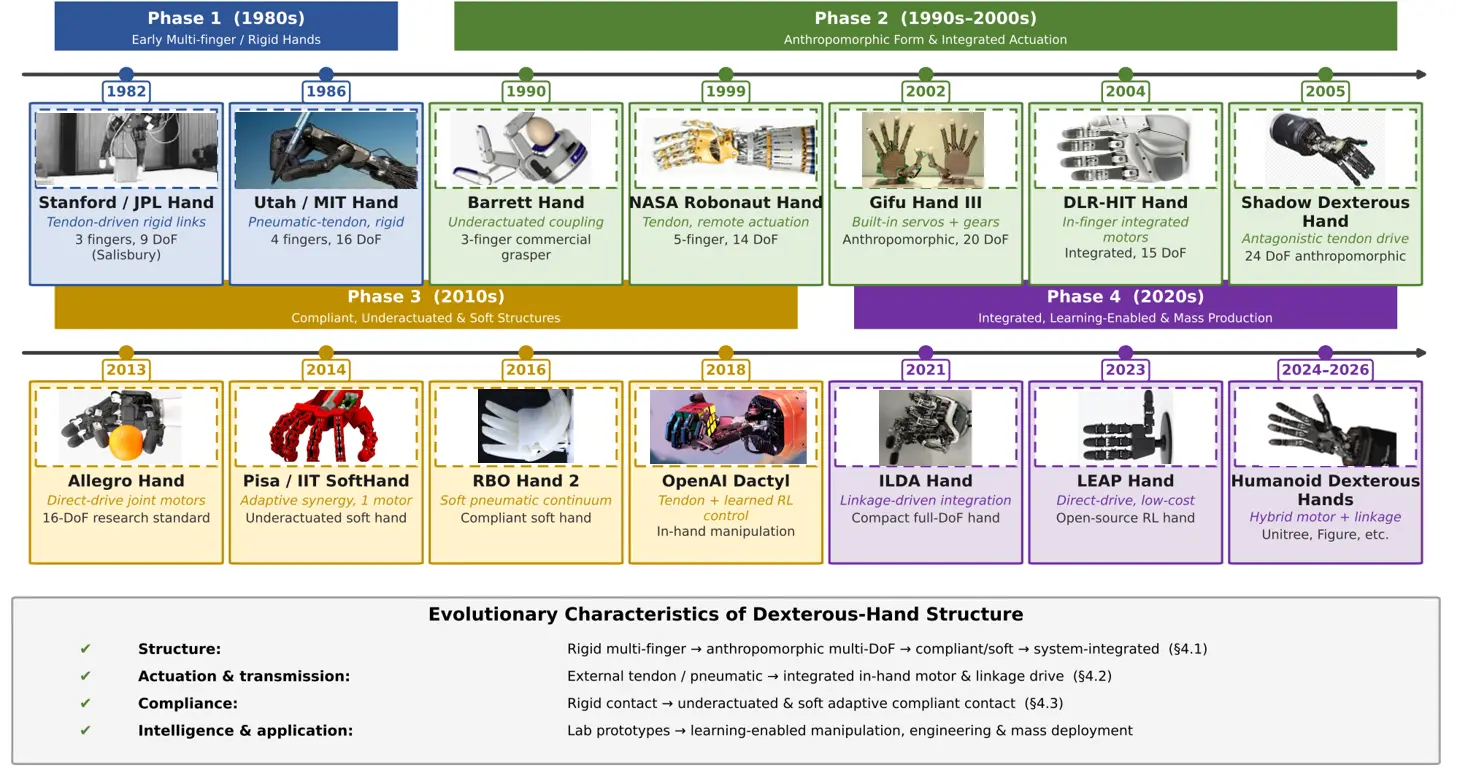
As shown in Figure 1, the development of embodied-intelligent robot structures has followed a long process of technological accumulation rather than occurring in isolation [24]. Its major stages have also been shaped by changing application demands [25]. Progress in artificial intelligence, control, and materials science has continuously created new possibilities for structural innovation [26]. The field has consequently moved from early rigid mechanisms toward legged and dynamic-motion platforms, humanoid forms, soft robots, and increasingly engineered systems for mass production and scenario validation [27]. This evolution expands the boundaries of perception, locomotion, manipulation, and environmental adaptation rather than merely changing the robot’s form [28]. Examining embodied intelligence through the evolution of physical structure can therefore clarify the field’s research foundations, major milestones, and future directions [29].
As research has deepened, publication output has grown rapidly, and the range of topics has broadened [30]. Cross-disciplinary convergence has also intensified [31]. Existing studies discuss these developments from the perspective of robot design and intelligent control [32]. Other work emphasizes biomimetic mechanisms and embodied cognition [33]. However, systematic reviews that jointly characterize the overall trajectory, principal research forces, research hotspots, and evolutionary trends remain limited [34]. Given the continuing expansion of the literature, traditional reading and experience-based judgment alone cannot comprehensively capture the field’s current status, knowledge base, and frontier directions.
Bibliometric analysis provides a quantitative approach to literature research by using statistical indicators, network analysis, knowledge maps, and visualization tools to examine research topics, core authors, major institutions, collaboration patterns, and hotspot evolution. For a field as interdisciplinary and rapidly expanding as embodied-structure research, this approach can reveal the research landscape and evolutionary patterns at the macro level while identifying major structural-design themes at the micro level [35].
Against this background, this study investigates embodied-structure research through a bibliometric framework. First, publication trends, country and regional distributions, institutions, core authors, and source journals are analyzed to clarify the field’s development history and overall landscape [36]. Second, keyword co-occurrence, clustering, and co-citation analyses are used to identify major hotspots, thematic structures, and knowledge bases, with particular attention to body configuration, joint and drive systems, compliant mechanisms, biomimetic structures, dexterous-manipulation structures, and structure–perception–control coordination [37]. Finally, keyword evolution is combined with frontier literature to discuss emerging trends and persistent challenges. Following the logic that practical needs generate research questions, urgency establishes value, bibliometrics reveals the current state, and hotspot synthesis informs future directions, the paper presents a systematic account of the development trajectory, key themes, and prospective directions of embodied-structure research.
2. Data Collection and Analysis
2.1. Data Sources and Literature Search Strategy
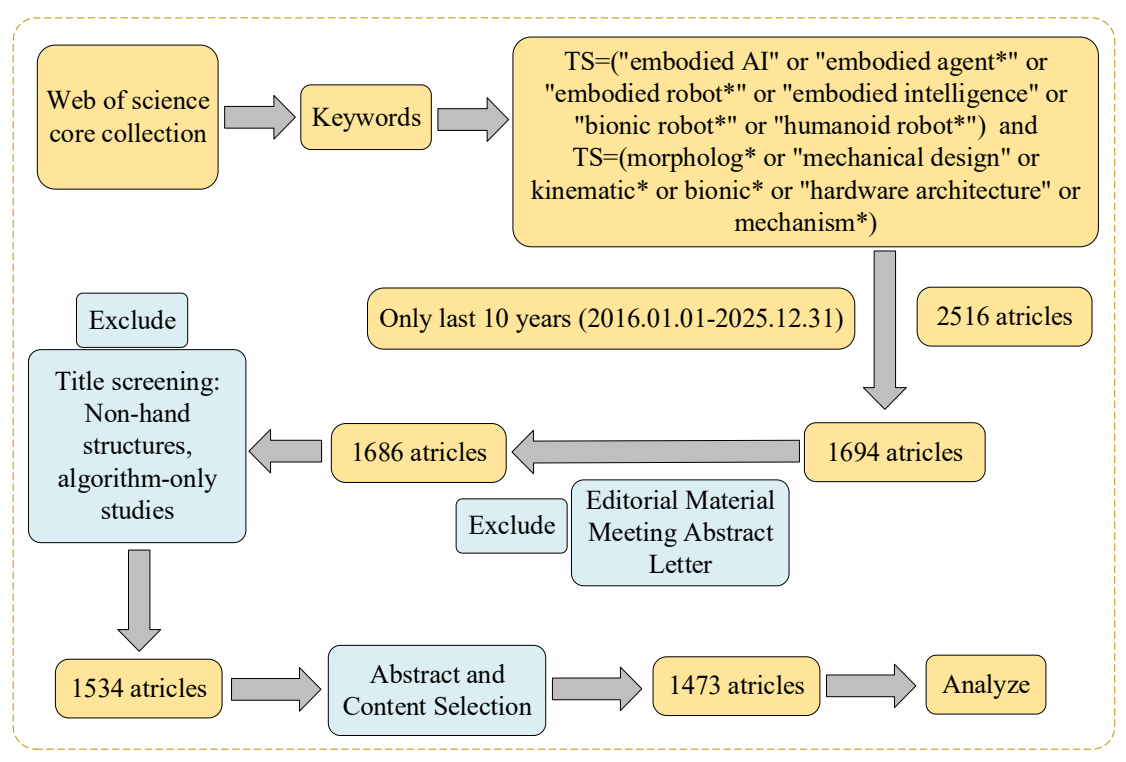
The Web of Science (WOS) Core Collection served as the citation information source for this bibliometric survey [38]. WOS is a widely used bibliographic database for quantitative research assessment [39] and provides standardized bibliographic records compatible with bibliometric software [40]. The data retrieval and collection process is illustrated in Figure 2. We performed an advanced search using the following query TS = (“embodied AI” or “embodied agent*” or “embodied robot*” or “embodied intelligence” or “bionic robot*” or “humanoid robot*”) and TS = (morpholog* or “mechanical design” or kinematic* or bionic* or “hardware architecture” or mechanism*). Publication time was restricted to 2016–2025. Retrieved papers were saved as “plain text”, and citation records were exported as “full text”, with files stored as “structure.TXT”.
To balance search recall and dataset relevance, a staged screening procedure was applied after the initial retrieval. The broad search strategy was intentionally designed to capture studies in which dexterous-hand structures were described as components of humanoid, bionic, or embodied robotic systems rather than explicitly indexed under “dexterous hand”. The initial search identified 2516 records. After restricting the publication period to 2016–2025, 1694 records remained. The document types were then limited to research articles and reviews, resulting in 1686 records. During title screening, 152 records were excluded because they focused on non-hand robot structures, locomotion, or whole-body mechanisms, or exclusively addressed algorithms, recognition, planning, or control without an identifiable mechanical-structure contribution. The remaining 1534 records underwent abstract screening and, where necessary, further content-based eligibility assessment. At this stage, 61 records were excluded because the dexterous hand was mentioned only as an application background, the study concerned conventional grippers outside the defined scope, or no direct contribution to hand configuration, joint or degree-of-freedom design, actuation and transmission, underactuation, compliant or soft structures, variable stiffness, rigid–soft coupling, or structure–sensing–control integration could be identified. The final dataset, therefore, comprised 1473 publications. These records formed the basis for all subsequent country, institution, author, journal, collaboration network, keyword, and clustering analyses.
2.2. Visualization Analysis
We used VOSviewer, CiteSpace, and Origin to analyze the statistical data collected from the WOS Core Collection. These tools are widely employed for data visualization in bibliometric studies. Co-author, co-occurrence, and co-citation analyses were performed [41,42,43]. Co-author analysis examines connections among institutions, authors, and countries. Co-occurrence analysis quantifies associations among multiple elements [44]. Co-citation analysis highlights the prominence of cited articles [45]. The following data fields were collected: authors, institutions, countries/regions, journals, keywords, and references.
3. Quantitative Results Analysis of Embodied Intelligent Robot Structure Research
3.1. Annual Publication Trend Analysis
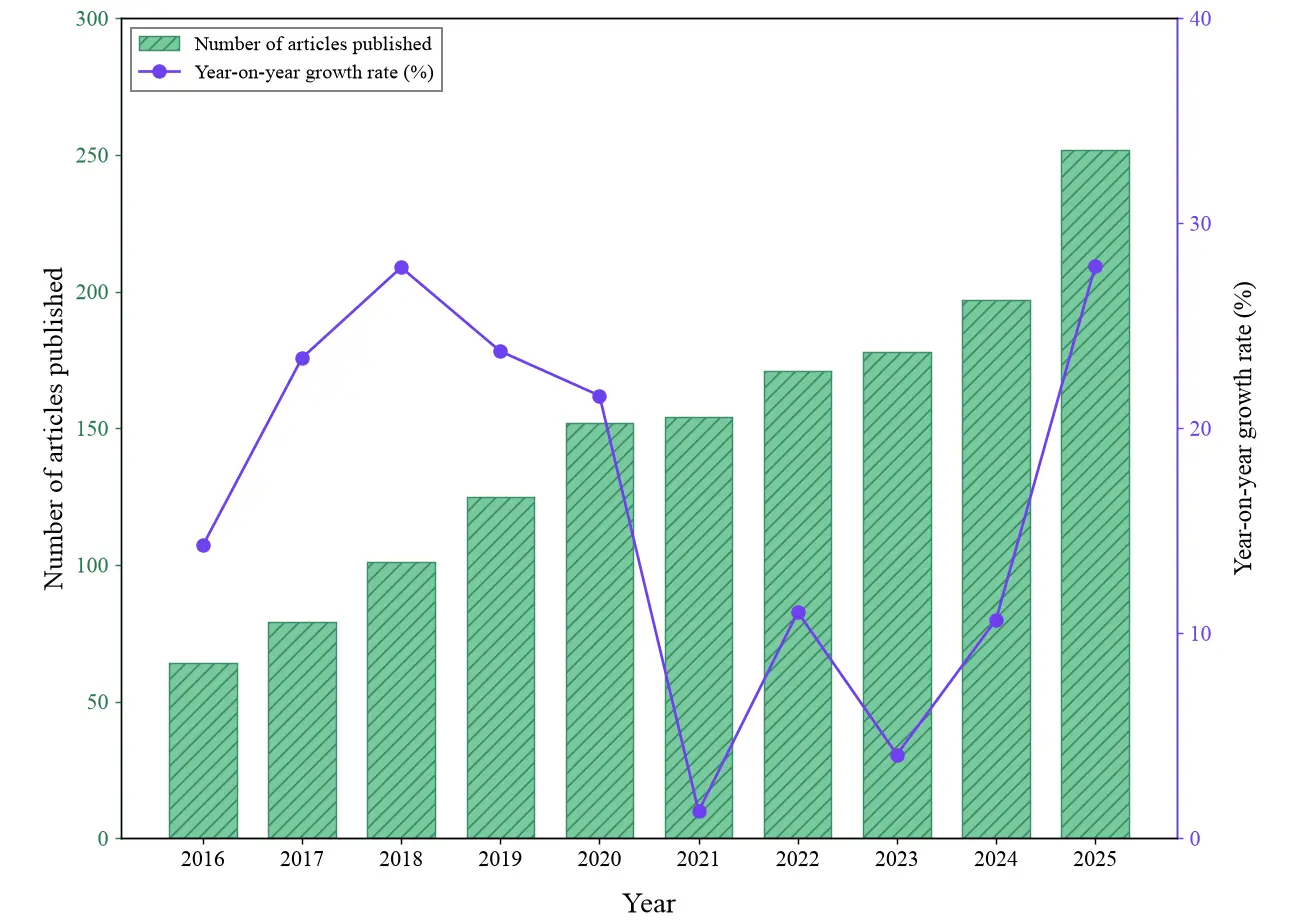
A total of 1473 articles on dexterous hand mechanical mechanisms, contributed by 4994 researchers from 71 countries, were retrieved from WOS. Figure 3 shows the global publication trend for dexterous hand mechanical structures from 2016 to 2025. The year-on-year growth rate was calculated as YoYt = (Nt − Nt−1)/Nt−1 × 100%, where Nt and Nt−1 denote the publication counts in the current and preceding years, respectively. The annual publication counts for 2016–2025 were 64, 79, 101, 125, 152, 154, 171, 178, 197, and 252, for a total of 1473 records. The 2015 publication count (n = 56) was used only as the baseline for calculating the 2016 year-on-year growth rate and was not included in the final 2016–2025 dataset. Accordingly, the increase from 152 publications in 2020 to 154 in 2021 corresponds to a positive year-on-year growth rate of 1.32%. Publication growth accelerated markedly after 2022, reaching 27.92% in 2025.
3.2. National Cooperation Network Analysis
Relevant articles have been published by researchers from 71 countries, demonstrating a broad international research base. Figure 4 displays the inter-country collaboration network, where circle size reflects publication volume and connecting lines represent collaboration intensity. Research is concentrated in Asia, Europe, and North America. China, the United States, Italy, Japan, South Korea, and the United Kingdom are the principal research forces.
Table 1 lists the top ten countries/regions by publication volume. China leads with 575 articles (39.0% of the total), substantially exceeding the output of other countries and reflecting a high level of research activity in body configuration, joint mechanisms, drive-transmission structures, and end-effector design. The United States ranks second with 155 articles (10.5%), followed by Italy (98), Japan (87), and South Korea (82). Dexterous hand mechanical structure research has therefore received sustained attention from Chinese scholars while also building stable research accumulations in European, American, and East Asian countries.
In terms of citation impact, China leads with 10,173 total citations, indicating that its contribution extends beyond publication volume to substantial scholarly influence. The United States follows with 5404 total citations, yet its citation-per-paper ratio (34.90) surpasses China’s (17.70), indicating a higher average impact per publication. Germany, although seventh in publication count (47 papers), achieves the highest citation-per-paper ratio among the top ten (37.30), suggesting a stronger concentration of high-impact publications. South Korea, the United Kingdom, and Canada also exhibit relatively high per-paper citations (29.70, 26.20, and 25.50, respectively), reflecting meaningful academic influence in robot mechanism design, biomimetic structures, and drive-transmission systems.
SCP (single-country publications) and MCP (multi-country publications) quantify domestic and international collaboration, respectively. China’s SCP is 456, and MCP is 119, indicating predominantly domestic collaboration supplemented by a growing international network. The United States, Italy, the United Kingdom, and Germany show MCP values of 37, 29, 32, and 23, respectively, indicating active international collaboration. By MCP%, Germany leads at 48.9%, followed by the United Kingdom (43.8%), Spain (31.3%), and Italy (29.6%), highlighting a stronger cross-national culture of collaboration among European countries.
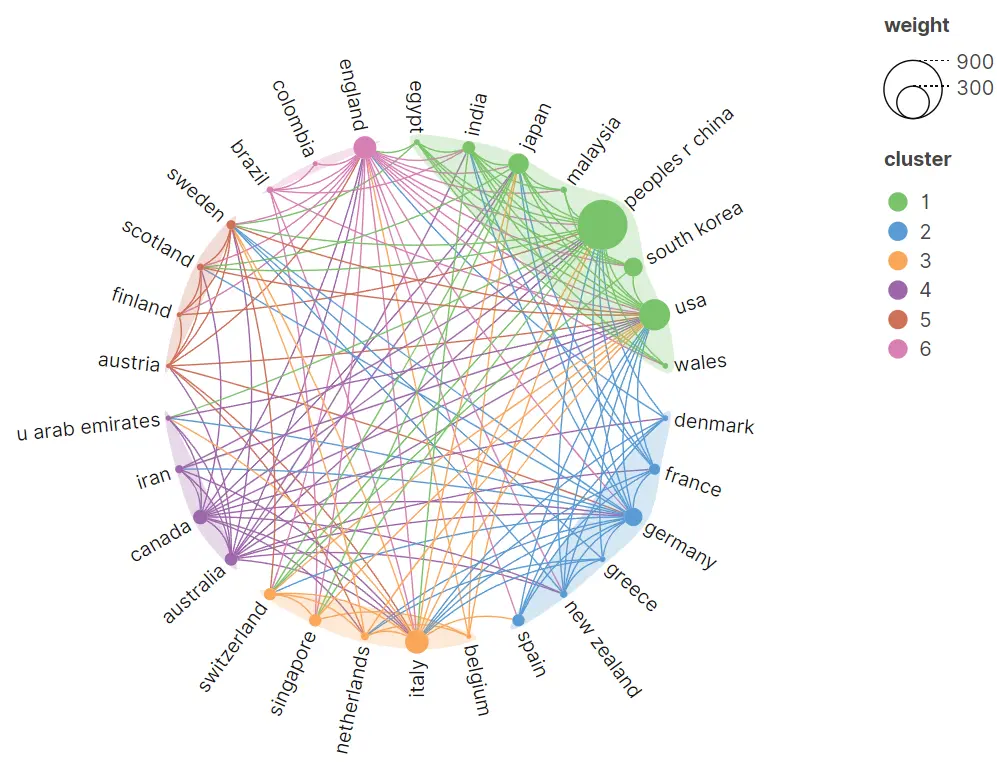
The country collaboration network in Figure 4 further illustrates that China occupies the largest node, consistent with its leading publication output, and maintains extensive links with the United States, Japan, South Korea, India, and Malaysia. The United States also holds a central position, collaborating with multiple European and Asian countries. European countries (Italy, Germany, France, Spain, and the United Kingdom) form a tightly connected cluster. Overall, research on dexterous hand mechanical structures has evolved into an international landscape with China as the primary publication force and the United States, Italy, Japan, South Korea, the United Kingdom, and Germany as key supporting players. China dominates in quantity, whereas the United States, Germany, and the United Kingdom stand out in citation impact and international collaboration, suggesting continued multi-country, cross-disciplinary convergence.
Table 1. Top ten high-output countries/regions regarding dexterous hand mechanical mechanisms.
|
Rank |
Country |
Counts |
Percentage |
SCP |
MCP |
MCP% |
Total Citations |
Average Citation per Paper |
|---|---|---|---|---|---|---|---|---|
|
1 |
China |
575 |
39.0 |
456 |
119 |
20.7 |
10,173 |
17.70 |
|
2 |
US |
155 |
10.5 |
118 |
37 |
23.9 |
5404 |
34.90 |
|
3 |
Italy |
98 |
6.7 |
69 |
29 |
29.6 |
2264 |
23.10 |
|
4 |
Japan |
87 |
5.9 |
76 |
11 |
12.6 |
1115 |
12.80 |
|
5 |
Korea |
82 |
5.6 |
72 |
10 |
12.2 |
2432 |
29.70 |
|
6 |
UK |
73 |
5.0 |
41 |
32 |
43.8 |
1912 |
26.20 |
|
7 |
Germany |
47 |
3.2 |
24 |
23 |
48.9 |
1752 |
37.30 |
|
8 |
India |
33 |
2.2 |
28 |
5 |
15.2 |
331 |
10.00 |
|
9 |
Spain |
32 |
2.2 |
22 |
10 |
31.3 |
374 |
11.70 |
|
10 |
Canada |
28 |
1.9 |
23 |
5 |
17.9 |
714 |
25.50 |
3.3. High-Performance Institutions and Collaborative Analysis
A total of 1292 research institutions have contributed to dexterous hand mechanical structure research. Table 2 ranks the top ten institutions by publication volume. High-output institutions are concentrated in China, Italy, the United Kingdom, and India. Five of the top ten are Chinese the Chinese Academy of Sciences, Shanghai Jiao Tong University, Harbin Institute of Technology, Tsinghua University, and Zhejiang University.
The Chinese Academy of Sciences leads with 167 papers, substantially exceeding the output of the other institutions and reflecting sustained research output. Shanghai Jiao Tong University and Harbin Institute of Technology rank second and third with 85 and 75 papers, respectively; both are prominent in robotics and mechanical engineering. Tsinghua University (68 papers, fourth) and Zhejiang University (55 papers, seventh) further demonstrate the strong presence of Chinese universities and research institutes in this field.
Table 2. Top 10 most productive institutions ranked by number of published papers.
|
Rank |
Institutions |
Country |
Counts |
|---|---|---|---|
|
1 |
Chinese academy of sciences |
China |
167 |
|
2 |
Shanghai jiao tong university |
China |
85 |
|
3 |
Harbin institute of technology |
China |
75 |
|
4 |
Tsinghua university |
China |
68 |
|
5 |
Istituto italiano di tecnologia—IIT |
Italy |
61 |
|
6 |
University of pisa |
Italy |
58 |
|
7 |
Zhejiang university |
China |
55 |
|
8 |
Scuola superiore sant’anna |
Italy |
35 |
|
9 |
University of london |
UK |
34 |
|
10 |
Indian institute of technology system (iit system) |
India |
33 |
Among non-Chinese institutions, Italy is particularly notable. Istituto Italiano di Tecnologia (IIT), the University of Pisa, and Scuola Superiore Sant’Anna entered the top ten with 61, 58, and 35 papers, respectively, reflecting Italy’s strength in biomimetic dexterous hands, flexible actuation, underactuated mechanisms, and human–robot interaction. The University of London (34 papers, ninth) and the Indian Institute of Technology System (33 papers, tenth) indicate that the field has achieved stable development across Europe and Asia.
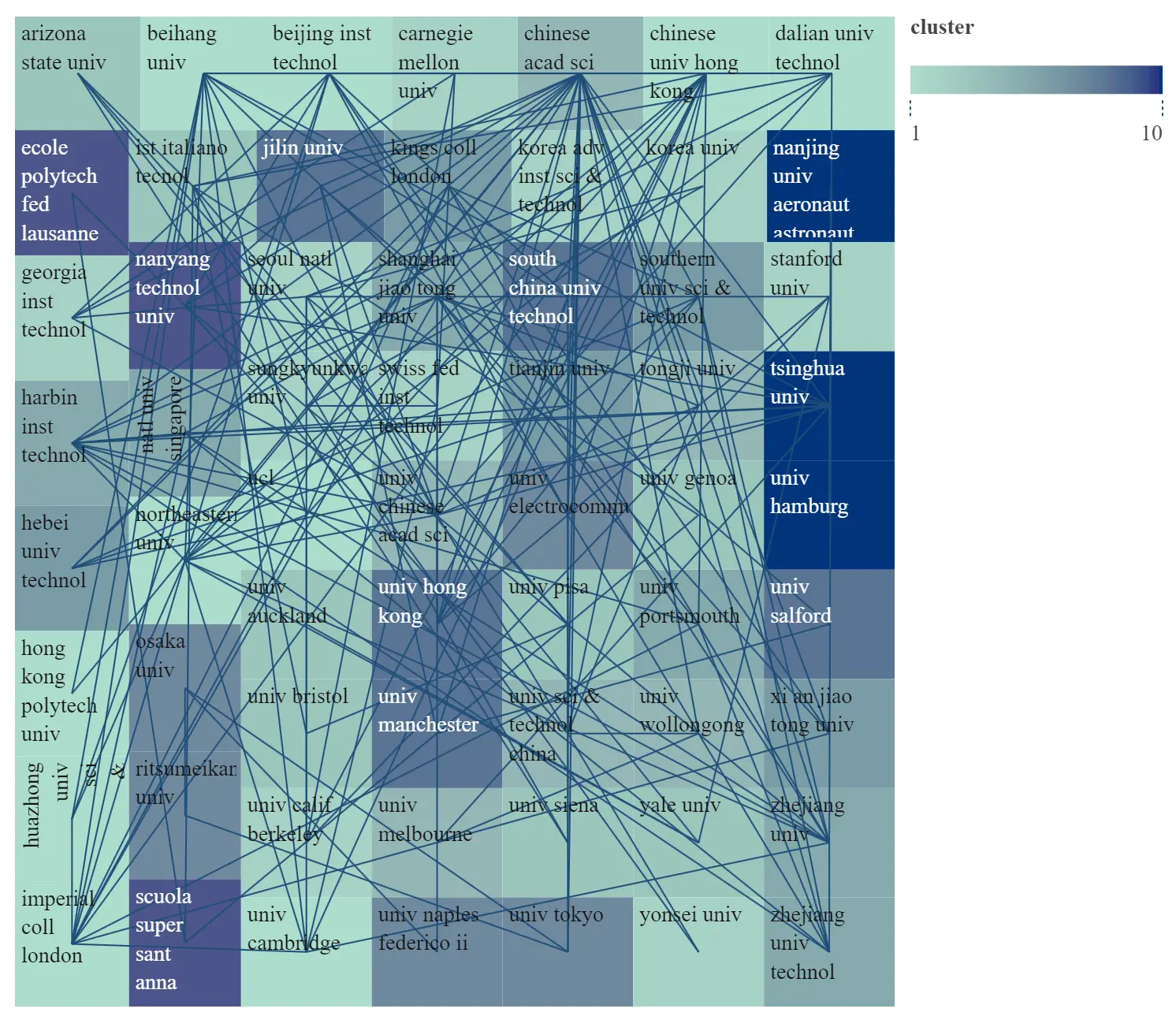
Figure 5 illustrates institutional collaboration patterns. Denser connecting lines and more concentrated nodes indicate stronger collaboration and higher research activity. Chinese institutions (Tsinghua University, Chinese Academy of Sciences, Shanghai Jiao Tong University, Harbin Institute of Technology, Zhejiang University, Beijing Institute of Technology, and South China University of Technology) have formed a dense domestic collaboration network. International connections are also evident: Istituto Italiano di Tecnologia, University of Pisa, Scuola Superiore Sant’Anna, Imperial College London, University College London, Nanyang Technological University, and Seoul National University all maintain active collaborative ties with multiple research units.
The institutional distribution, therefore, exhibits a pattern of “Chinese institutions leading, Italian institutions prominent, and European, American, and Asian countries jointly participating”. Chinese institutions dominate in terms of publication volume and serve as key knowledge-production centers. Italian, British, Singaporean, and South Korean institutions have formed distinctive research strengths in biomimetic dexterous hands, compliant mechanisms, underactuated structures, and human–robot collaborative manipulation. The collaboration network confirms that the field is moving beyond single-institution efforts toward multi-institution, multi-country collaborative innovation.
3.4. Analysis of High-Productivity Authors and Core Journals
The retrieved publications involve 4994 researchers, indicating a broad research community. Table 3 ranks the top ten high-output authors, and Figure 6 displays the author collaboration network. Circle size reflects publication volume or collaboration weight, connecting lines denote collaboration, and colors distinguish network clusters.
Liu H leads with 29 papers (H-index 14, G-index 23, 549 total citations), demonstrating sustained output and notable influence. Jiang L follows with 25 papers (H-index 10, G-index 14, 219 citations). Bicchi A ranks third with 23 papers but has accumulated 1012 citations, the highest among the top ten, indicating that his work has achieved substantial scholarly influence despite fewer publications.
Bicchi A and Liu H share an H-index of 14 and a G-index of 23, confirming comparable core influence. Catalano Mg (20 papers, 775 citations, H-index 12, G-index 20, M-index 1.333) exhibits the highest recent growth rate among the top ten. Grioli G (651 citations) also demonstrates a strong impact. Authors such as Sun Fc, Zhang Y, and Wang P have fewer publications but later start years, suggesting that they constitute emerging contributors in this direction.
Table 3. Top 10 high-output authors ranked by number of published papers.
|
Rank |
Author |
Counts |
H_Index |
G_Index |
M_Index |
PY_Start |
Citations |
|---|---|---|---|---|---|---|---|
|
1 |
Liu H |
29 |
14 |
23 |
1.273 |
2016 |
549 |
|
2 |
Jiang L |
25 |
10 |
14 |
0.909 |
2016 |
219 |
|
3 |
Bicchi A |
23 |
14 |
23 |
1.273 |
2016 |
1012 |
|
4 |
Catalano Mg |
20 |
12 |
20 |
1.333 |
2018 |
775 |
|
5 |
Bianchi M |
16 |
8 |
16 |
0.727 |
2016 |
458 |
|
6 |
Grioli G |
15 |
10 |
15 |
0.909 |
2016 |
651 |
|
7 |
Dollar Am |
14 |
11 |
14 |
1.000 |
2016 |
492 |
|
8 |
Sun Fc |
14 |
10 |
14 |
1.111 |
2018 |
288 |
|
9 |
Zhang Y |
14 |
7 |
14 |
0.778 |
2018 |
229 |
|
10 |
Wang P |
13 |
9 |
13 |
1.286 |
2020 |
235 |
Figure 6 reveals a team-based collaboration structure with several concentrated clusters. The network centered on Zhang Ting is relatively large, encompassing collaborative links with Fan Shaowei, Liu Hong, Jiang Li, Wu Xinyu, and Wei Wei. This team shows strong research continuity in dexterous hand structural design, mechanism optimization, drive transmission, and robot manipulation. A second cluster features Wei Guowu, Qian Zhihui, Ren Lei, and Dai Jians, while a local network connects Chou Chih-Hong and Lan Ning.
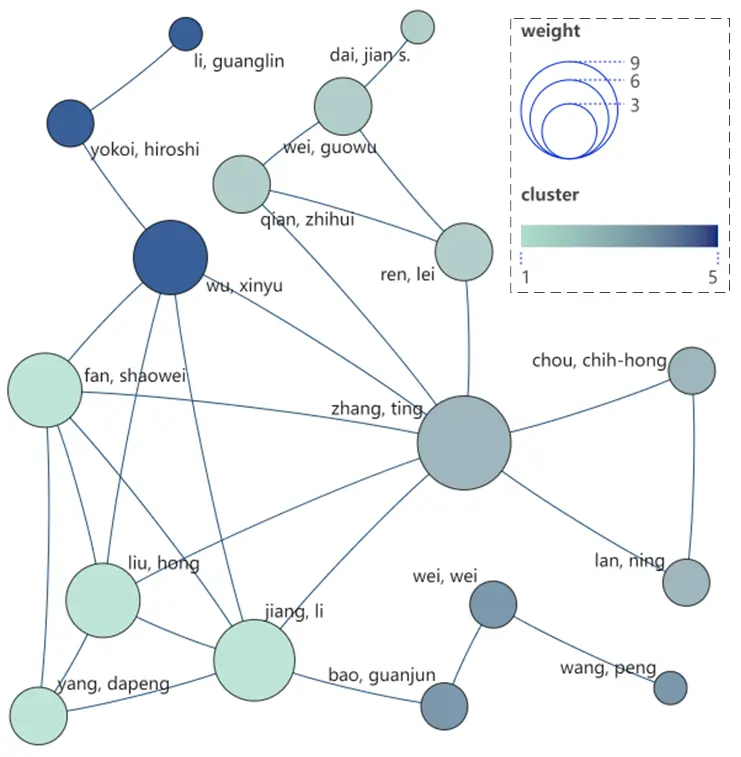
The author distribution is characterized by “a few high-output authors leading, with multi-team collaborative development”. Liu H, Jiang L, Bicchi A, and Catalano Mg stand out in both publication volume and academic influence. The collaboration network confirms a shift from individual authorship toward team collaboration and multi-author innovation. As the demand for dexterous hands continues to grow in embodied-intelligent robots, service robots, medical rehabilitation robots, and human–robot collaboration systems, cross-team and cross-institution collaboration is expected to intensify.
A total of 280 journals have published papers on dexterous hand mechanical structures, demonstrating that the topic spans robotics, mechanical engineering, sensing technology, soft robots, and rehabilitation engineering. Table 4 ranks the top ten journals by publication volume and local influence. NP denotes the publication count within this dataset, TC total citations, and H-index, G-index, and M-index reflect local academic influence.
IEEE Robotics and Automation Letters leads with 166 papers, substantially exceeding the output of other journals. It also holds the highest H-index (32), G-index (47), M-index (3.200), and total citations (3241) among the top ten. The journal’s focus on robot design, control, perception, and system integration is closely aligned with dexterous hand mechanism design, drive transmission, grasping manipulation, and embodied intelligence applications.
Table 4. Top ten publication journals.
|
Rank |
Journal |
H_Index |
G_Index |
M_Index |
TC |
NP |
PY_Start |
|---|---|---|---|---|---|---|---|
|
1 |
IEEE Robotics And Automation Letters |
32 |
47 |
3.200 |
3241 |
166 |
2017 |
|
2 |
IEEE Transactions On Robotics |
20 |
39 |
1.818 |
1540 |
40 |
2016 |
|
3 |
Sensors |
17 |
29 |
1.545 |
939 |
51 |
2016 |
|
4 |
Soft Robotics |
16 |
27 |
1.455 |
1270 |
27 |
2016 |
|
5 |
Frontiers In Neurorobotics |
15 |
32 |
1.364 |
1062 |
36 |
2016 |
|
6 |
IEEE-ASME Transactions On Mechatronics |
15 |
28 |
1.364 |
830 |
33 |
2016 |
|
7 |
Mechanism And Machine Theory |
13 |
21 |
1.182 |
509 |
21 |
2016 |
|
8 |
IEEE Access |
12 |
22 |
1.333 |
559 |
43 |
2018 |
|
9 |
IEEE Sensors Journal |
12 |
20 |
1.091 |
433 |
26 |
2016 |
|
10 |
IEEE Transactions On Neural Systems And Rehabilitation Engineering |
12 |
23 |
1.200 |
561 |
32 |
2017 |
Soft Robotics, despite only 27 publications, has accumulated 1270 citations (H-index 16, G-index 27), highlighting soft dexterous hands, compliant mechanisms, and biomimetic actuation structures as important hotspots. Frontiers in Neurorobotics (36 papers, 1062 citations) and IEEE-ASME Transactions on Mechatronics (33 papers, 830 citations) underscore the relevance of neural robots, mechatronics systems, actuator design, and human–robot collaborative control.
Mechanism and Machine Theory, an important journal in mechanical mechanisms, has 21 publications. Its close connection to body configuration, linkage mechanisms, underactuated mechanisms, kinematics analysis, and mechanism optimization demonstrates that mechanical structure design remains a foundational pillar of dexterous hand research. IEEE Access, IEEE Sensors Journal, and IEEE Transactions on Neural Systems and Rehabilitation Engineering also appear in the top ten, indicating expanding application to rehabilitation engineering, prosthetic hands, neural control, and human–robot interaction.
Dexterous hand mechanical structure publications are therefore concentrated in interdisciplinary journals spanning robotics, mechatronics, sensors, soft robots, and rehabilitation engineering. IEEE Robotics and Automation Letters dominates in both volume and influence. IEEE Transactions on Robotics, Soft Robotics, and Frontiers in Neurorobotics are notable for citation impact. The field has expanded from traditional mechanical mechanism design toward compliant actuation, perception integration, intelligent control, and human–robot coordination, displaying clear multidisciplinary convergence.
3.5. Analysis of Keyword Time Evolution
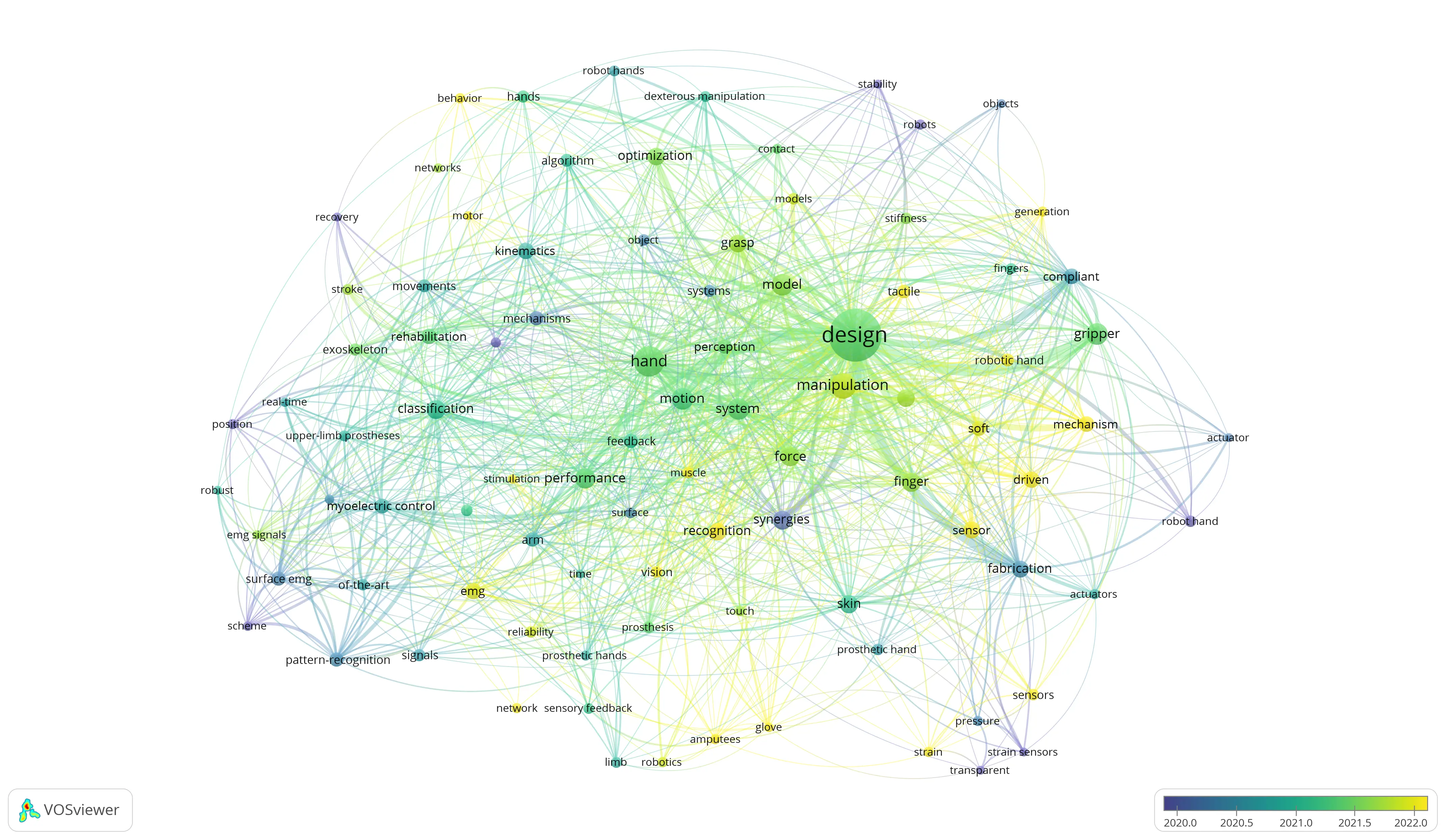
As illustrated in Figure 7, keywords such as design, hand, and grasp occupy central positions in the network, confirming that research on dexterous hand mechanical structures centers on structural design, grasping manipulation, finger mechanisms, drive transmission, mechanical analysis, and perception feedback. The design node is the largest and most widely connected, indicating that structural design constitutes the field’s central research content and the foundation linking grasping, actuation, perception, and control.
The temporal evolution reveals three phases. Early research focused on prosthetic hands, aiming at basic grasping and functional replacement. Research hotspots then shifted toward hand, grasp, kinematics, and optimization, reflecting growing attention to body structure, kinematics modeling, grasping stability, and mechanism optimization. More recently, newer keywords (soft, compliant, dexterous manipulation) indicate a shift toward compliance, soft-structure design, tactile perception, and structure-perception integration. The overall trajectory thus runs from simple grasping, through body-structure and kinematics modeling, to compliant and soft structures, tactile sensing, and intelligent dexterous manipulation. Dexterous hand mechanical structure research has evolved from a single mechanical execution device into a comprehensive direction that integrates structural design, drive transmission, perceptual feedback, and environmental adaptation.
4. Hotspot Analysis of Dexterous Hand Structure Research Based on Keyword Clustering
As a critical component of robot end-effectors, dexterous hand structural design directly determines grasping capability, manipulation precision, motion flexibility, and human–robot interaction safety [46]. As robot technology expands from industrial settings to service, medical, rehabilitation, and special-operation scenarios, dexterous hand research has progressed beyond single-mechanism optimization toward a comprehensive system encompassing body configuration, degree-of-freedom allocation, drive-transmission methods, and coordinated compliant-structure development [47]. Summarizing research hotspots through keyword clustering, therefore, helps to identify the principal directions and technical evolution logic of this field [48].
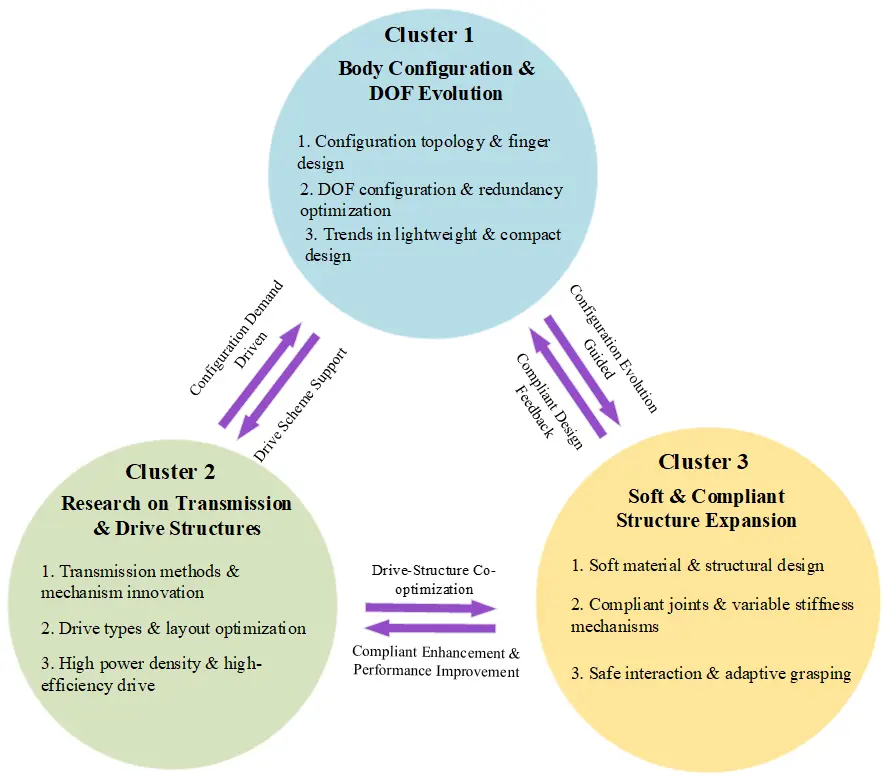
The cluster analysis of keywords is shown in Figure 8, three principal thematic clusters emerge. The first cluster, body configuration and degree-of-freedom evolution, focuses on finger configuration, joint layout, degree-of-freedom allocation, and structural lightweighting [49,50]. The second cluster, drive-transmission structure research, addresses actuation method selection, transmission mechanism design, drive-efficiency improvement, and structural compactness [51,52]. The third cluster, the expansion of soft and compliant structures, emphasizes flexible materials, compliant joints, variable-stiffness mechanisms, and safe interaction capabilities [53,54]. These clusters are not independent; they interact through structural requirements, actuation solutions, and compliant performance, jointly promoting the shift from rigid mechanical structures toward high flexibility, adaptability, and safety [55].
4.1. Cluster 1: Body Configuration and Degree-of-Freedom Evolution
The structural configuration design and degree-of-freedom (DoF) allocation of robotic end-effectors constitute the fundamental physical basis that determines the manipulation performance of robot embodied intelligence [56,57]. For a dexterous hand, the number of DoFs is not merely a quantitative metric; rather, it interacts with contact point distribution, joint kinematic capability, and actuation transmission mechanisms to determine its ability to transition from basic clamping to complex grasping, in-hand manipulation, and fine manipulation [58]. From the perspective of mechanical system design logic, the evolutionary process of dexterous hand configurations is fundamentally a process of expanding manipulation capabilities in unstructured environments by increasing contact dimensionality, enhancing kinematic redundancy, and optimizing actuation mapping [59].
From the perspective of grasping statics, the stable grasping of an object by a dexterous hand can be formulated as a mapping from contact forces to the generalized forces acting on the object [60,61]. Assuming a multi-fingered dexterous hand establishes several contact points with an object, let the contact force vector be denoted as f, and the resultant force and torque acting on the object constitute the generalized force w, Their relationship can be expressed as [62,63]:
|
```latexw=Gf``` |
(1) |
where $$G$$ represents the grasp matrix, which reflects the constraint capability of contact forces on the motion state of the object [64]. When the object is subjected to an external disturbance wrench $${w}_{\mathrm{e}\mathrm{x}\mathrm{t}}$$, a stable grasp must satisfy the static equilibrium condition [65,66]:
|
```latexGf + w_{\text{ext}} = 0``` |
(2) |
|
```latex\parallel {f}_{t}\parallel \le \mu {f}_{n},{f}_{n}\ge 0``` |
(3) |
where, $${f}_{t}$$ denotes the tangential contact force, $${f}_{n}$$ is the normal contact force, and $$\mu$$ represents the friction coefficient. Accordingly, the essence of dexterous hand configuration design lies not simply in increasing the number of fingers or joints, but rather in optimizing finger placement, contact point distribution, and contact directions to enhance the effective rank of the grasp matrix $$G$$, thereby enabling the contact forces to counteract external disturbances from a wider range of directions [69]. Low-DoF (degree-of-freedom) grippers typically establish limited contact modes, making them suitable primarily for the clamping and transporting of regular objects [70,71,72,73]. Conversely, high-DoF dexterous hands can form richer contact constraints through multi-finger collaboration, providing the structural foundation for force closure, form closure, and complex in-hand pose adjustments [74].
From the kinematic perspective, the manipulation capability of a dexterous hand depends on the velocity mapping from the joint space to the contact or fingertip space [75]. Defining the joint variables as $$q$$, joint velocities as $$\dot{q}$$, and fingertip or contact point velocities as $$\dot{x}$$, the mapping is described by [76]:
|
```latex\dot{x}=J\left(q\right)\dot{q}``` |
(4) |
where $$J\left(q\right)$$ represents the hand Jacobian matrix, reflecting the influence of joint motion on fingertip velocities [77]. Rank deficiency in $$J\left(q\right)$$ indicates that the system’s mobility degenerates in certain directions, driving the dexterous hand close to a singular configuration. To evaluate local manipulation performance, Yoshikawa’s manipulability index can be introduced [78]:
|
```latexM\left(q\right)=det\left(J\left(q\right)JT\left(q\right)\right)``` |
(5) |
A larger value of this index indicates a stronger velocity generation capability of the fingertips in different directions, implying higher local dexterity [79]. Thus, the theoretical significance of increasing DoFs is to expand the non-singular operational space and to enhance both the effective rank of J(q) and the manipulability index, rather than merely increasing the number of joints [80,81]. Two- or three-fingered grippers, constrained by few DoFs, are generally restricted to simple clamping and force control; multi-fingered, multi-joint dexterous hands, however, can achieve local relocation, pose adjustment, and in-hand manipulation while securely grasping objects [82].
In addition to grasping stability and kinematic dexterity, the actuation mode is another critical factor that influences the performance of the physical configuration [83]. Assuming a dexterous hand possesses n joint DoFs and m actuators, with actuation inputs denoted as u and joint torques as $$\tau$$, the actuation system can be generalized as [84]:
|
```latex\tau =B\left(q\right)u``` |
(6) |
where B(q) is the actuation mapping matrix, capturing the transmission relationship from actuator inputs to joint torques. When m = n and B(q) is full rank, the system approaches a fully actuated state, allowing independent control of each joint. Conversely, when m < n, the system becomes underactuated, requiring the motion and torque output of certain joints to be realized collectively via mechanical coupling, elastic elements, or passive compliance. Thus, the fundamental differences among various dexterous hand paradigms primarily manifest as design trade-offs among three matrices: the grasp matrix G, the Jacobian matrix J(q), and the actuation mapping matrix B(q). Based on transmission paths and actuation layouts, contemporary mainstream dexterous hands can be broadly categorized into three classes: tendon-driven, fully integrated, and underactuated [85]. As illustrated in Figure 9, These three paradigms exhibit distinct trade-offs across dexterity, load capacity, control complexity, and engineering applicability [86].
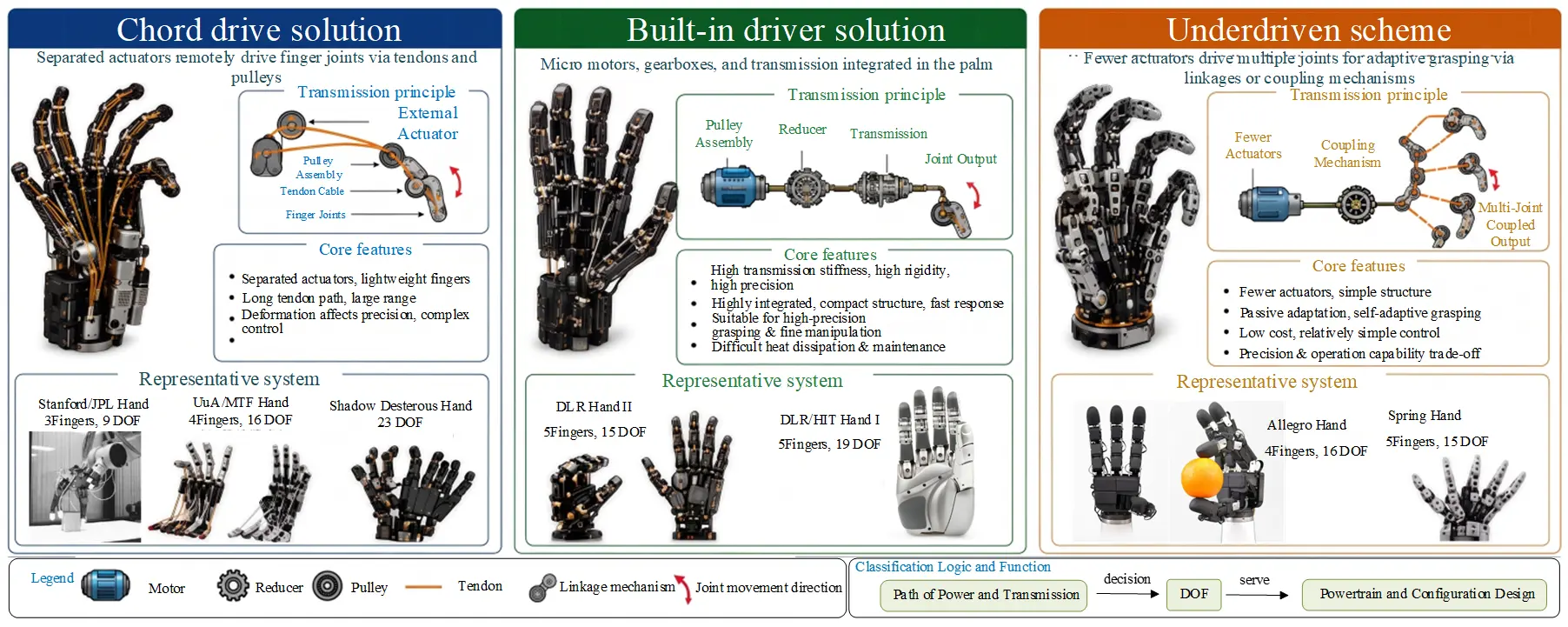
The first category comprises tendon-driven configurations. By biomimetically replicating the human tendon-bone transmission mechanism, actuators are externally situated around the palm or proximally within the arm. Finger joint motions are then driven through mechanisms such as cables, tendons, and pulleys. The corresponding joint torque can be approximated as [87]:
|
```latex\tau =RT\left(q\right)T``` |
(7) |
where T represents the tendon tension vector, and R(q) denotes the tendon moment arm matrix. The principal advantage of this configuration is the relocation of actuators away from the finger interiors, thereby reducing finger mass, enabling a greater number of joints and larger ranges of motion, and ultimately enhancing the potential manipulation capability of the dexterous hand. The Okada Hand, Stanford/JPL Hand, Utah/MIT Hand, and Shadow Dexterous Hand all adhere to this technological route [88]. Specifically, the Stanford/JPL Hand adopts a 3-finger, 9-DoF structure, utilizing an “n + 1” tendon routing design to minimize the number of driving cables; the Utah/MIT Hand is further expanded to a 4-finger, 16-DoF configuration employing antagonistic tendon actuation, yielding high anthropomorphic dexterity; the Shadow Dexterous Hand utilizes a large array of pneumatic artificial muscles combined with tendon transmission to achieve highly human-like finger kinematics [89].
However, tendon-driven configurations have several inherent limitations [90]. Because tendons can only transmit tensile forces and cannot actively exert pushing forces, long-distance transmission routing is particularly susceptible to friction, elastic elongation, and hysteresis effects, leading to deviations between the actual output torque and the theoretical values. This discrepancy reduces the mapping precision from tension to joint torque as formulated in Equation (7), further impairing contact force control and grasping stability [91]. Therefore, the essential characteristic of tendon-driven actuation is the trade-off of complex transmission and elevated control difficulty for lightweight fingers, high DoFs, and a large workspace. While highly suitable for dexterous manipulation research and anthropomorphic mechanism exploration, it suffers from high engineering maintenance costs and control complexity [92].
The second category is the fully integrated (built-in) actuation configuration. This configuration directly integrates miniature motors, reducers, transmission mechanisms, and sensors within the interior of the fingers or palm, shortening the transmission chain to enhance system stiffness and control precision. Compared to tendon-driven systems, the B(q) mapping relationship in integrated actuation is more direct, exhibiting minimal transmission errors and facilitating precise control over joint torque output [93]. Consequently, its primary advantages manifest in repetitive positioning accuracy, force control stability, and engineering reliability [94].
The DLR Hand II is a representative example of the fully integrated actuation paradigm [95]. It features four identical fingers, each possessing 4 joints and 3 DoFs, alongside an additional DoF situated in the palm, culminating in a 13-DoF structure. Its actuation system uses a combination of flat brushless DC motors, harmonic reducers, and timing belts to deliver high output torque within a constrained volume. The subsequent DLR/HIT Hand II evolved into a 5-finger structure, maintaining 4 joints and 3 DoFs per finger, but introducing wire coupling to achieve synergistic movement of the distal two joints, thereby reducing the number of actuation channels while preserving adequate dexterity [96,97]. Such dexterous hands typically incorporate highly integrated position, force/torque, and temperature sensors [98].
The principal trade-off in fully integrated actuation arises from spatial constraints [99]. Embedding motors, reducers, and sensors into the limited volumetric space of phalanges or the palm means that as the number of DoFs increases, the physical dimensions, weight, and thermal dissipation demands proportionally escalate, heavily restricting the expansion to extremely high DoFs [100]. Thus, the essential characteristic of fully integrated actuation is the compromise of larger spatial footprints and structural complexity in exchange for short transmission chains, high stiffness, and precise control, making it well-suited for precision grasping, stable manipulation, and robust engineering applications [101].
The third category comprises underactuated configurations. Underactuated dexterous hands utilize fewer actuators to govern a larger number of joints, typically satisfying m < n [102]. The underlying principle is not to control every joint via an independent actuator, but rather to automatically distribute motion and force upon object contact through differential mechanisms, tendon coupling, elastic elements, or passive joints. Its joint configuration can be generalized as the superposition of active inputs and passive compliance [103]:
|
```latexq=S\theta +qp``` |
(8) |
where $$\theta$$ represents the active driving variables, S is the joint synergy matrix, and $$qp$$ denotes the passive joint displacements induced by contact constraints, elastic elements, or passive mechanisms. This formulation dictates that the controller does not entirely predetermine the final grasping posture of an underactuated hand; rather, it emerges from the physical interactions among the mechanical structure, the object’s morphology, and the contact constraints. The advantages of underactuated configurations include structural simplicity, reduced actuator count, and robust environmental adaptability [104,105]. During the grasping process, when a specific phalanx contacts an object and its motion is constrained, the residual driving force propagates to the remaining joints via differential or elastic mechanisms, allowing the fingers to naturally conform to the object’s surface and form a multi-point enveloping grasp. Adaptive dexterous hands, such as the SPRING Hand, strongly exemplify the advantages of underactuated mechanisms in handling irregularly shaped objects.
Nevertheless, the limitations of underactuated configurations are equally distinct. Due to the mechanical coupling among multiple joints, joint torques are constrained to a limited subspace spanned by the actuation mapping matrix B(q), making independent joint movements and fine contact force adjustments highly challenging. Consequently, underactuated hands are better suited for enveloping grasps, robust grasping, and cost-effective applications, but fall short in complex in-hand manipulation, independent fingertip repositioning, and high-precision force control tasks. Its essential characteristic is the reduction of the active control dimensionality in exchange for structural simplification and passive adaptive capabilities [106]. Table 5 summarizes the key characteristics and trade‑offs of the three configurations.
Table 5. Comparison of Three Mainstream Dexterous Hand Configurations.
|
Tendon-Driven Paradigm |
Fully Integrated Actuation |
Underactuated Configuration |
|
|---|---|---|---|
|
Design philosophy |
Biomimetic human tendon-bone transmission |
Motors and transmissions embedded in fingers |
Fewer actuators, high joint coupling |
|
Typical actuation mapping |
$$\tau =RT\left(q\right)T$$ |
$$\tau =B\left(q\right)u$$, short transmission chain |
M < n, mechanical joint coupling |
|
Actuator layout |
Actuators placed externally; motion pulled via tendons |
Miniature motors and reducers are built into fingers/palm |
Integrated in the palm; differentially distributed |
|
Core advantages |
High dexterity, lightweight fingers, and a large workspace |
Short transmission chain, high stiffness, high precision, compact |
Fewer actuators, simple structure, adaptive enveloping, low cost |
|
Primary limitations |
Tendon friction and elasticity, complex control, high maintenance |
Restricted dof expansion, heavy phalanges, limited anthropomorphism |
Limited fine manipulation, trade-off between robustness and functionality |
|
Representative models |
Stanford/JPL, UTAH/MIT, shadow hand |
DlR hand II, DlR/HIT hand II |
Allegro hand, spring hand |
In summary, the evolution of dexterous hand structural configurations and degrees of freedom (DoFs) is not a simplistic process of increasing mechanical complexity, but rather reflects a continuous balance among grasp stability, kinematic dexterity, and actuation controllability. Theoretically, the grasp matrix $$G$$ determines the constraint capability of multiple contact points on an object; the Jacobian matrix $$J\left(q\right)$$ governs the mapping capability from joint space to fingertip motion space; and the actuation mapping matrix $$B\left(q\right)$$ dictates whether actuation inputs can be effectively transformed into joint torques. The tendon-driven, built-in integrated actuation, and underactuated configurations represent three distinct design paradigms: tendon-driven actuation emphasizes high DoFs and lightweight design; built-in integrated actuation emphasizes stiffness, precision, and engineering reliability; and the underactuated configuration emphasizes structural simplification and passive adaptability [107].
Therefore, the development of dexterous hand configurations has shifted from an initial emphasis on the number of DoFs to the comprehensive optimization of DoF allocation, actuation modes, transmission efficiency, and contact stability. The key to designing future high-performance dexterous hands lies not only in increasing the number of fingers or joints, but more importantly, in establishing a rational matching relationship among DoFs, actuators, and contact capabilities within a restricted spatial volume. This naturally leads to a subsequent inquiry: how can highly efficient actuation and power transmission be achieved for multi-DoF dexterous hands under strict constraints of limited volume and energy consumption [108].
4.2. Cluster 2: Drive Transmission Structure Research
Once the body-configuration design and degree-of-freedom allocation are complete, the drive transmission structure becomes a key determinant of engineering realizability [93]. If body configuration answers “what joints and motion capabilities a dexterous hand should have”, then drive transmission answers “how these degrees of freedom are effectively driven and converted into stable, precise, and controllable mechanical motion [109]”. This cluster, therefore, connects body configuration and degree-of-freedom allocation, focusing on actuator placement, transmission-path design, torque-amplification mechanisms, and motion-error control [110].
From the perspectives of mechanism kinematics and robotic dynamics, the fundamental task of the actuation and transmission system in a dexterous hand is to transmit the torque, velocity, and displacement generated by the actuators to the individual finger joints, thereby generating the fingertip manipulation force [111]. Let the joint torque be denoted as $$\tau$$, the fingertip contact force as $$F$$, and the finger Jacobian matrix as $$J\left(q\right)$$. According to the principle of virtual work, the relationship between the two can be expressed as [112]:
|
```latex\tau =JT\left(q\right)F``` |
(9) |
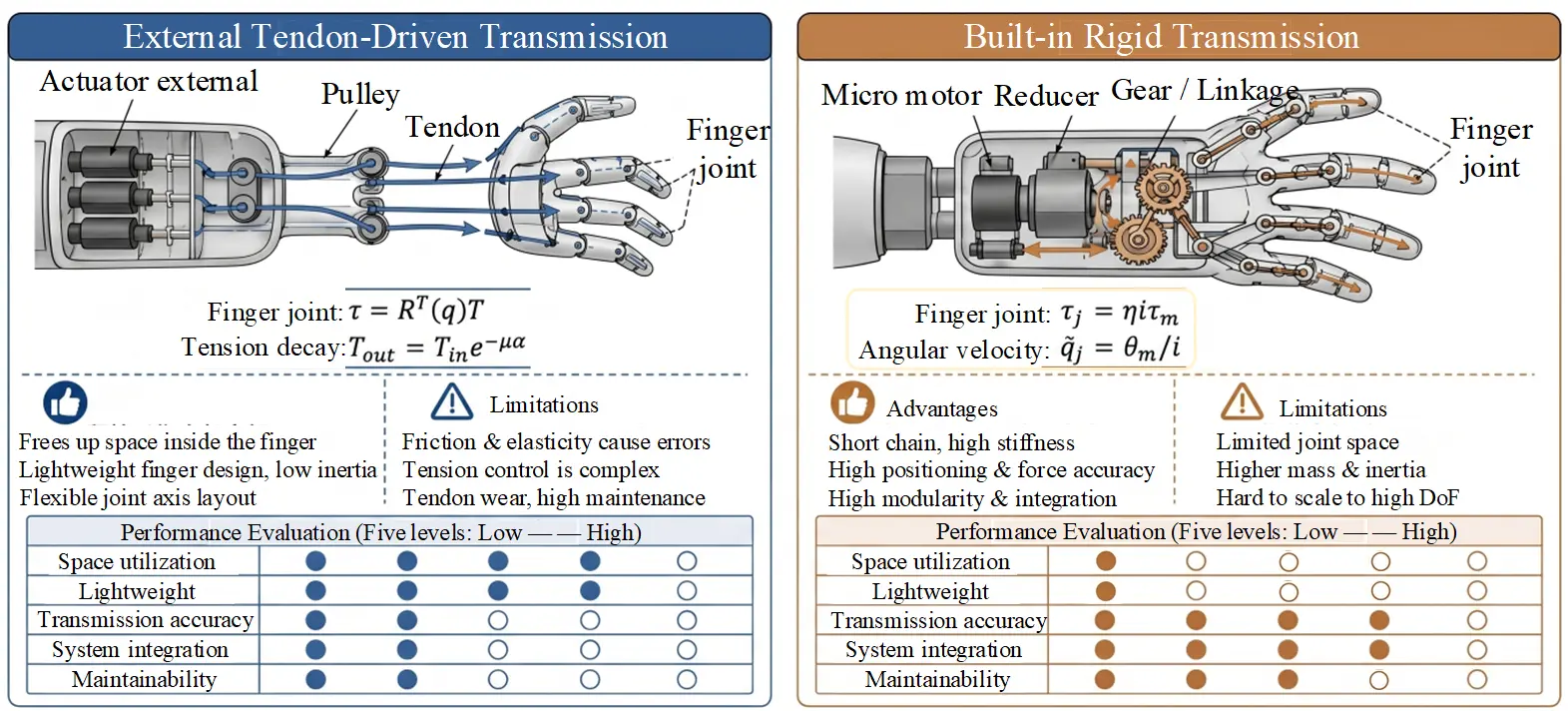
where $$q$$ represents the joint variables. This equation indicates that for a dexterous hand to exert a specific manipulation force at the fingertip, corresponding torques must be provided at the respective joints. Therefore, the actuation and transmission mechanisms not only influence the joint range of motion but also directly determine the fingertip grasping force, manipulation stability, and payload capacity [113,114]. For a dexterous hand conforming to anthropomorphic dimensions, the core engineering contradiction lies in how to configure sufficient actuation and transmission units within the highly restricted volumetric space of the phalanges and palm, while concurrently fulfilling the multifaceted requirements of joint output torque, kinematic precision, response speed, and system reliability, Figure 10 compares the two representative drive architectures in terms of transmission paths and integration levels.
From the perspective of system design mechanisms, the actuation and transmission structures are primarily subject to three categories of constraints. The first is the spatial constraint. The radial dimensions of phalanges in an anthropomorphic dexterous hand are limited, and the installation space of the end-effector restricts the thickness of the palm. Consequently, motors, reducers, tendons, pulleys, gears, sensors, and control circuitry must be compactly arranged within a confined space [115,116]. Second is the torque output constraint. During grasping and manipulation, the dexterous hand must generate fingertip forces ranging from several Newtons to over ten Newtons. The corresponding joint torques, determined by Equation (9), vary with contact point positions, finger postures, and moment arms [117,118]. Thus, the actuation system must possess sufficient power density and torque density. Third is the kinematic transmission accuracy constraint. Elastic elongation of tendons, gear backlash, friction in link hinges, and assembly errors all introduce transmission inaccuracies, that further impair fingertip positioning precision, contact force control, and grasping stability [119].
These constraints are interdependent and create a distinct engineering trade-off. Increasing motor size enhances output torque but encroaches on phalanx space and increases finger inertia. Raising the reduction ratio amplifies joint output torque but reduces output speed and back-drivability. Shortening the transmission chain improves transmission accuracy and system stiffness but limits the flexibility of actuator placement. For a single joint, if the motor output torque is $${\tau }_{m}$$, the reduction ratio is $$i$$, and the transmission efficiency is $$\eta$$, the ideal output joint torque can be expressed as [120,121]:
|
```latex\tau j=\eta i{\tau }_{m}``` |
(10) |
Although a reduction mechanism amplifies output torque, this amplification is achieved at the expense of motion speed. When the reduction ratio is excessively high, the system may suffer from diminished back-drivability, increased friction, and sluggish dynamic response. Therefore, the design of actuation and transmission structures is not simply a pursuit of high torque or high reduction ratios, but rather a search for a comprehensive optimal solution among torque, speed, precision, volume, and efficiency [122,123].
Based on the actuator layout and the force transmission media, contemporary dexterous hand drive structures can be classified into two categories: external tendon-driven and internal rigid transmission [124,125]. Both are intended to realize the motion of high-DoF configurations but exhibit different technical orientations in terms of spatial utilization, force transmission efficiency, control precision, and system integration [126,127].
4.2.1. External Tendon-Driven: Spatial Release and Flexible Transmission
The external tendon-driven paradigm places the actuators outside the palm or within the forearm housing, transmitting driving forces remotely to finger joints via steel wires, synthetic fiber tendons, conduits, and pulley blocks [128,129]. This scheme mimics the human tendon-bone transmission mechanism, enabling multi-joint actuation while maintaining lightweight fingers. It was a widely adopted technological route in early multi-fingered and anthropomorphic dexterous hands, such as the Stanford/JPL Hand, Utah/MIT Hand, and Shadow Dexterous Hand. Specifically, the Shadow Dexterous Hand utilizes a vast array of pneumatic muscles and tendon paths to achieve high-DoF anthropomorphic finger motion, with the design goal of replicating human hand kinematics and dexterity as closely as possible [130].
As indicated by Equation (11), tendon-driven systems can achieve flexible multi-joint actuation by varying routing paths and moment arm configurations [131]. The principal advantage is that actuators can be placed remotely from the fingers, thereby releasing internal phalanx space, reducing finger inertia, and enhancing motion safety and high-speed manipulation performance [132,133]. Furthermore, flexible tendon paths exhibit strong spatial adaptability, allowing them to bypass complex joint axes and making them suitable for integrating multi-axial, small-scale structures in anthropomorphic fingers.
However, tendon-driven systems exhibit inherent nonlinearities. Friction occurs as tendons move through conduits and pulleys; notably, when the tendon path involves wrapping angles, the input tension and output tension are no longer equal. This relationship can be described by the Capstan equation:
|
```latex{T}_{\mathrm{o}\mathrm{u}\mathrm{t}}= {T}_{\mathrm{i}\mathrm{n}} - \mu \alpha``` |
(11) |
where $${T}_{\mathrm{i}\mathrm{n}}$$ is the input tension, $${T}_{\mathrm{o}\mathrm{u}\mathrm{t}}$$ is the output tension, $$\mu$$ is the friction coefficient, and $$\alpha$$ is the cumulative wrap angle [134]. This equation indicates that longer paths, more bends, and higher friction coefficients result in greater tension loss. Research on tendon-driven robot hands indicates that friction effects are substantial and must be modeled and estimated to achieve accurate control and contact sensing [135].
In addition to friction, tendon materials exhibit elastic elongation [136]. For a tendon of length $$L$$, cross-sectional area $$A$$, and elastic modulus $$E$$, the axial elongation $$\Delta l$$ under tension $$T$$ is approximated as [137]:
|
```latex\Delta l=EATL``` |
(12) |
This deformation causes a discrepancy between actuator displacement and actual joint displacement, resulting in positioning errors, load-unload hysteresis, and control latency [138]. Friction and compliance within the tendon-conduit system introduce lag phenomena between joint torque and actuation displacement, a topic extensively discussed in transmission system studies of tendon-driven hands [139,140,141]. Consequently, while conducive to lightweight and high-DoF layouts, the control models for tendon-driven systems are typically more complex than those for rigid transmissions, requiring consideration of tension coordination, friction compensation, slack prevention, and material fatigue [142].
4.2.2. Internal Rigid Transmission: Short Transmission Chains and High Control Precision
In contrast to external tendon-driven configurations, the internal rigid transmission paradigm integrates miniature motors, reducers, gear pairs, lead screws, or link mechanisms directly within the fingers or palm, forming an integrated “motor-reduction-transmission-joint” rigid drive chain [143]. The primary objective is to shorten the force transmission path and eliminate flexible components and uncertain friction, thereby enhancing transmission stiffness, positioning accuracy, and torque controllability [144].
Internal rigid transmissions can generally be characterized by Equation (7) and Equation (10) [145,146]. Motors act directly on joints after torque amplification via reducers; the short transmission path leads to higher $$\eta$$ and lower transmission errors [147,148,149]. Compared to tendon-driven systems, torque output in rigid transmissions provides a more deterministic mapping, facilitating the establishment of precise joint dynamics and servo control models. For tasks requiring stable repetitive positioning, fine grasping, and force feedback control, internal rigid transmission offers significant advantages [150,151].
The DLR Hand II is a representative example of this paradigm. Its design features four identical fingers, each with three independent joints and one coupled joint. The drive system primarily includes brushless DC motors, timing belts, harmonic reducers, and differential bevel gear mechanisms at the base joints. This design exemplifies a highly mechatronic approach: by integrating drive, transmission, sensing, and communication modules into the finger structure, the modularity and reliability of the entire hand are improved [152,153].
The DLR/HIT Hand II further illustrates the application of integrated drives in five-fingered hands. It features five modular fingers and an independent palm. Each finger has four joints and three DoFs, utilizing small flat brushless DC motors, timing belts, and miniature harmonic reducers to minimize finger volume and mass [154]. Engineering metrics for this hand include a total mass of approximately 1.5 kg, a fingertip output force of up to 10 N, and integrated position, force/torque, and temperature sensing [155]. These indicators demonstrate that internal rigid transmission can achieve high torque density and comprehensive perception-actuation integration within a compact structure [156].
4.2.3. Comparison and Developmental Trends of the Two Fully-Actuated Paradigms
From the perspective of actuation, both external tendon-driven and internal rigid transmission mostly follow a fully-actuated or near-fully-actuated approach, where multiple actuators independently control multiple joint DoFs [157]. While this provides clear control targets and sufficient DoFs for complex manipulation, several inherent limitations become increasingly prominent: as the number of DoFs increases, the counts of actuators, transmission paths, sensors, and control variables rise synchronously, leading to increased system volume, mass, energy consumption, and control complexity [158].
The differences between the two reflect two distinct engineering trade-offs [159,160]. Tendon-driven systems externalize actuators, trading long, flexible transmission paths for lightweight fingers and layout flexibility. Internal rigid transmission integrates actuators within the hand, trading higher spatial occupancy for short transmission chains, high stiffness, and high control precision [161,162]. The former emphasizes anthropomorphic manipulation potential, while the latter emphasizes engineering reliability and precise controllability [163,164].
In summary, the actuation and transmission structures serve as the critical link between “structural configuration design” and “actual manipulation capability”. The high-DoF configuration of a dexterous hand can only be transformed into stable, precise, and controllable mechanical motion through a rational actuation and transmission system. Theoretically, the relationship between fingertip forces and joint torques is described by the constraint $$\tau ={J}^{T}\left(q\right)F$$. Furthermore, the relationship between joint torques and actuator outputs is constrained by transmission efficiency, reduction ratios, and actuation mapping. External tendon-driven systems trade transmission determinacy for spatial release and lightweight design, whereas internal rigid transmissions trade spatial flexibility for high stiffness and precision. Together, they demonstrate that the core challenge of dexterous hand actuation and transmission is not merely the selection of a specific transmission form, but rather the achievement of a comprehensive balance among torque output, transmission efficiency, motion precision, and control complexity under constraints of limited space, weight, and power [165], The detailed characteristics and trade-offs of the two structures are summarized in Table 6.
Accordingly, as the number of DoFs and the complexity of manipulation tasks continue to increase, traditional fully-actuated paradigms face significant challenges in terms of scalability. The future developmental trajectory of actuation and transmission structures will increasingly shift toward hybrid actuation, synergetic drive, underactuated transmission, high-power-density micro-actuators, and integrated “actuation-sensing-control” designs, aiming to achieve superior engineering realizability and manipulation performance within the anthropomorphic scale [166].
Table 6. Comparison of Two Types of Drive and Transmission Structures.
|
Feature |
External Tendon-Driven |
Internal Rigid Transmission |
|---|---|---|
|
Actuator Layout |
Actuators are primarily situated outside the palm or in the forearm. |
Actuators are integrated within the fingers or the palm. |
|
Governing Relations |
$$\tau =RT\left(q\right)T$$ |
$$\tau j=\eta i{\tau }_{m}$$ |
|
Transmission Media |
Tendons (cables), conduits, pulleys. |
Motors, reducers, gears, linkages, lead screws. |
|
Primary Advantages |
Lightweight fingers; flexible routing; ideal for high-DoF anthropomorphic structures. |
Short transmission chains; high stiffness; superior positioning and force control precision. |
|
Principal Error Sources |
Friction, elastic elongation, hysteresis, tendon slack, and wear. |
Backlash, assembly errors, internal reducer friction, and increased inertia. |
|
Spatial Utilization |
Releases internal phalanx space but involves complex external routing. |
High system integration but leads to spatial saturation in the phalanges/palm. |
|
Control Challenges |
Tension coordination, friction compensation, and tendon fatigue modeling. |
High-density thermal dissipation, inertia compensation, and miniaturization. |
|
Target Applications |
Anthropomorphic manipulation research; high-DoF experimental platforms. |
Precision grasping; industrial/engineering end-effectors; modular robotic systems. |
|
State-of-the-Art Systems |
Stanford/JPL Hand, Utah/MIT Hand, Shadow Hand. |
DLR Hand II, DLR/HIT Hand II. |
4.3. Cluster 3: Expansion Toward Soft and Compliant Structures
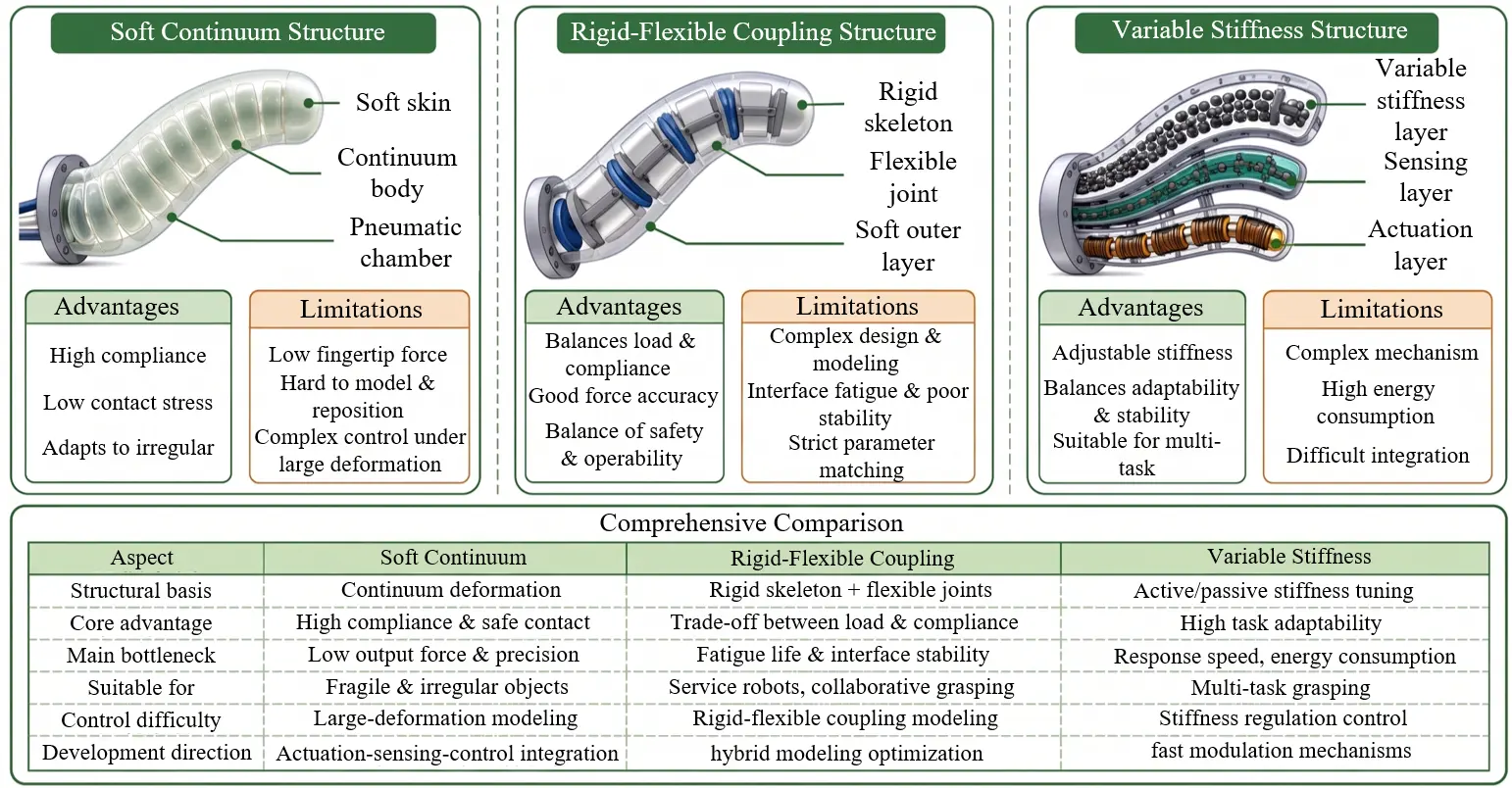
The evolution of underactuated and adaptive grasping structures has led to a growing recognition in the field that the enhancement of structural performance does not depend solely on increasing joint or actuator counts [167]. Instead, the strategic introduction of compliance, adaptability, and continuous deformation capabilities can significantly bolster grasping stability and environmental robustness [168]. Building on this insight, research into dexterous hand structures is progressively expanding from traditional rigid mechanisms toward soft and compliant architectures. Figure 11 provides a comparative overview of typical soft and compliant designs. The research focus is shifting from “how to precisely drive discrete joints” to “how to achieve safe, highly adaptive grasping and manipulation through material deformation, structural compliance, and flexible contact”. In recent years, soft robots and soft grippers have been widely deployed in scenarios involving fragile objects, irregular geometries, and human–robot collaboration [169]. Their core advantage lies in the ability of soft materials and biomimetic structures to attenuate contact stress and conform to complex boundary geometries [170].
Theoretically, the expansion into soft and compliant structures extends beyond the classical design paradigm of “rigid links—kinematic pairs—discrete degrees of freedom”. While conventional dexterous hands rely on joint variables $$q$$ to describe motion, soft dexterous hands emphasize the continuous deformation of continuum structures under external actuation fields and contact loads [171,172]. If the centerline of a soft finger is described by the arc-length parameter $$s$$, its curvature distribution $$\kappa \left(s\right)$$ can be expressed as [173]:
|
```latex\kappa \left(s\right)=EIM\left(s\right)``` |
(13) |
where $$\kappa \left(s\right)$$ represents the curvature at position S along the soft finger, $$M\left(s\right)$$ is the bending moment, $$E$$ is the material’s elastic modulus, and $$I$$ is the second moment of area of the cross-section. The total bending angle $$\theta$$ of the finger can be further formulated as:
|
```latex\theta ={\int }_{0}^{L}\kappa \left(s\right)ds``` |
(14) |
Equation (13) and Equation (14) indicate that the motion of a soft finger is governed by the interaction among material elasticity, geometric structure, and the distribution of actuation forces, rather than a few discrete joints [174]. Compared to rigid multi-joint structures, soft structures can establish large-area contact through continuous curvature changes, thereby reducing unit contact pressure and enhancing grasping safety for fragile, soft, or irregular objects.
From a contact-mechanics perspective, the primary role of compliant structures is to absorb external disturbances through structural deformation and to attenuate impact forces during contact [175]. Let the contact force be $$F$$, the end-effector deformation be $$\mathrm{\Delta }x$$, and the equivalent stiffness of the compliant structure be $$K$$; the relationship can be approximated as [176]:
|
```latexF=K\Delta x``` |
(15) |
Alternatively, $$\Delta x=CF$$ where $$C={K}^{-1}$$ is the compliance matrix. Rigid dexterous hands typically possess high $$K$$, which favors precise positioning and force transmission but tends to generate large impact forces under contact uncertainty or when handling fragile targets [177]. Conversely, soft or compliant structures reduce peak contact forces by increasing $$C$$, enabling the hand to achieve a stable fit without precise perception of the object’s shape. Thus, structural compliance does not merely involve reducing stiffness but rather a reconfiguration of structural stiffness to balance grasping safety, contact adaptability, and force transmission capability [178].
Based on the sources of flexibility and structural functions, soft and compliant dexterous hands can be classified into three categories: soft continuum structures, rigid–soft hybrid structures, and variable stiffness structures. These represent different technological pathways ranging from “material compliance” to “structural compliance” and finally to “tunable stiffness”.
4.3.1. Soft Continuum Structures: Achieving High-Compliance Grasping via Material Deformation
Soft continuum structures primarily employ elastomers such as silicone rubber, polyurethane, or PDMS, driven by pneumatic, hydraulic, tendon, fiber-reinforced, or smart material actuators to achieve continuous bending [179]. Unlike traditional articulated fingers, soft continuum structures theoretically possess infinite degrees of freedom (DoFs) [180]. Their motion originates from global material deformation rather than from the concatenation of a finite number of joint angles [181]. The principal advantages include large contact areas, low contact stress, and high adaptability to target geometries, making them particularly suitable for fragile objects such as eggs, fruits, food items, and biological tissues [182].
Among these, Pneumatic Network Actuators (PneuNets) are a representative design [183]. These structures consist of a series of inflatable chambers and a flexible base; when pressurized, the differential elongation between the top and bottom layers induces directional bending [184]. The Whitesides group at Harvard University pioneered the development of pneumatic elastomeric soft robots and grippers, emphasizing the use of elastic polymers and pneumatic actuation for complex motion and safe human–robot interaction [185]. The Soft Robotics Toolkit also features PneuNet bending actuators as a quintessential case, providing systematic resources for design, modeling, and testing, underscoring their role as a fundamental configuration in soft gripper research [186].
From a modeling perspective, the bending of a pneumatic soft finger is primarily influenced by chamber pressure, material modulus, wall thickness, chamber spacing, and fiber constraints. If the driving pressure is $$p$$ and the equivalent effective area of the chamber is $$A$$, the generated actuation force is approximately$$\,Fp=pA$$. This force is converted into a bending moment $$M\left(s\right)$$ through structural eccentricity and material deformation, with the curvature distribution dictated by Equation (13). Therefore, the design focus of soft continuum structures is not on joint allocation but on modulating the target bending morphology via chamber geometry, material parameters, and constraint layer distribution [187].
Festo’s Bionic Soft Hand provides a notable engineering example of a pneumatic soft anthropomorphic hand. According to Festo’s official documentation, the hand utilizes pneumatic bellows to control finger motion, is encased in a 3D-knitted textile cover to constrain the direction of expansion, and is equipped with proportional piezo valves for precise motion control [188,189]. Its design objective is to leverage flexible pneumatic kinematics and lightweight components for grasping and manipulation within collaborative workspaces. This case demonstrates that soft continuum structures are evolving beyond laboratory prototypes toward modularity, closed-loop control, and human–robot collaboration.
However, soft continuum structures also have distinct limitations:
-
-
Low Payload: The low elastic modulus limits fingertip output force and load capacity.
-
-
Modeling Complexity: Nonlinearity, hysteresis, and viscoelasticity under large deformations make precise modeling and repetitive positioning difficult.
-
-
System Integration: Pneumatic or hydraulic systems require external pressure sources, valves, and tubing, restricting system responsiveness and integration.
-
-
Durability: Soft materials are prone to fatigue, aging, and performance drift under long-term cyclic loading.
These limitations are not incidental drawbacks but direct consequences of the underlying physics. Because the achievable fingertip force of a soft finger scales with its effective material modulus and the bounded driving (pneumatic) pressure, an elastomer-based hand (modulus ~10 × 5–10 × 6 Pa) cannot approach the ~10 N fingertip force delivered by a rigid, harmonic-drive hand such as the DLR/HIT Hand II (metallic transmission, modulus ~10 × 11 Pa); this is a hard constraint rooted in material modulus and actuation pressure rather than a modeling gap that control can later resolve. Accordingly, soft continuum structures should be avoided a priori when the task requires high and deterministic fingertip force, sub-millimetre positioning repeatability, high-frequency (fatigue-limited) duty cycles, or self-contained actuation without an external pressure source. Rather than a harmonious convergence of rigid and soft paradigms, these are often competing design philosophies whose combination is a deliberate engineering compromise rather than a default synthesis.
4.3.2. Rigid-Soft Hybrid Structures: A Compromise Between Rigid Support and Compliant Contact
Rigid-soft hybrid structures seek to balance between traditional rigid fingers and purely soft fingers. The basic approach retains rigid skeletons, links, or joints as primary load-bearing structures while introducing elastic elements, compliant hinges, soft skins, or compliant actuators into the joints or transmission chains [190,191,192]. This maintains high force transmission precision and payload capacity while providing a degree of compliance during contact.
The theoretical basis of rigid–soft hybrid structures can be expressed in terms of equivalent serial stiffness [193]. If the equivalent stiffness of the rigid transmission chain is $${K}_{r}$$ and that of the flexible element is $${K}_{s}$$, the equivalent system stiffness $${K}_{eq}$$is [194]:
|
```latex\frac{1}{K_{\mathit{eq}}} = \frac{1}{K_{r}} + \frac{1}{K_{s}}``` |
(16) |
Since rigid components usually satisfy $${K}_{r}\gg {K}_{s}$$, the system’s compliance is dominated by the flexible element [195]. By selecting an appropriate $${K}_{s}$$, the hand can maintain high control precision during unloaded motion while buffering impacts and regulating contact forces upon interaction.
The recently developed rigid-compliant-soft (RCS) anthropomorphic finger provides a representative example of a hybrid grasping mechanism [196]. By synergistically combining rigid tubular bones, flexible joint springs, pneumatic membrane actuators, and a soft silicone epidermis, this configuration aims to reconcile the demand for safe manipulation with the necessity for substantial load capacity [197]. Traditional soft grippers, despite their superior morphological adaptability, are frequently limited by inadequate output force and stability. The RCS framework systematically overcomes this “output-compliance” dichotomy [198]. Subsequent empirical reports have evidenced its versatility in grasping objects of diverse physical properties, including highly delicate items such as egg yolks, potato chips, and even live amphibians, thereby underscoring its broad operational envelope.
4.3.3. Variable Stiffness Structures: Active Adaptation to Diverse Tasks
Variable stiffness structures emphasize the active modulation of structural stiffness [199]. The central concept is to maintain low stiffness during the approach and enveloping phases to enhance safety and adaptability, and then transition to high stiffness during transport or high-load tasks to enhance stability [200,201].
The equivalent mechanical characteristics of variable stiffness can be expressed as:
|
```latexF=K\left(t\right)\Delta x``` |
(17) |
where $$K\left(t\right)$$ represents the equivalent stiffness that varies with time, pressure, temperature, jamming state, or material phase. Common mechanisms for achieving variable stiffness include granular jamming, layer jamming, low-melting-point alloy (LMPA) phase change, shape memory alloys (SMA), and magnetorheological (MR) materials [202]. Variable stiffness benefits dexterous hands by enabling [203]:
-
Adaptive Transition: Adapting to complex object boundaries with low stiffness and securing them with high stiffness.
-
Reduced Complexity: Relying on structural adjustment rather than high-precision sensing/control.
-
Expanded Capability: Enabling soft hands to handle higher loads and more complex tasks.
Engineering bottlenecks remain, such as the need for external vacuum sources for jamming, the high energy consumption and slow thermal response of phase-change materials, and the limited lifespan of smart materials. Table 7 summarizes the key characteristics, actuation mechanisms, and typical applications of the main soft and compliant structure types.
In summary, the expansion of soft and compliant structures does not merely provide an alternative to traditional rigid dexterous hands; rather, it fundamentally extends and restructures the underlying design logic. While traditional rigid dexterous hands emphasize joint degrees of freedom (DoFs), actuation precision, and motion controllability—making them suitable for high-precision, high-stiffness tasks—soft continuum structures prioritize material deformation and contact compliance, rendering them ideal for safe grasping in unstructured environments. Rigid-soft hybrid structures seek a balance between these two, providing both load-bearing capacity and compliant interaction, while variable stiffness structures further enable the hand to switch between flexible adaptation and rigid stability according to task requirements. It should be emphasized, however, that this is not a harmonious convergence of the two paradigms: rigid and soft structures often embody competing design philosophies, and their combination is a deliberate, trade-off-laden engineering compromise rather than a default synthesis.
Table 7. Comparison of Soft and Compliant Structure Types.
|
Dimension |
Soft Continuum Structure |
Rigid-Soft Hybrid Structure |
Variable Stiffness Structure |
|---|---|---|---|
|
Design Basis |
Continuum deformation and material compliance |
Rigid skeleton + Flexible joints/Soft skin |
Active or passive stiffness modulation |
|
Analytical Model |
κ(s) = M(s)/(EI) |
1/Keq = 1/Kr + 1/Ks |
F = K(t)Δx |
|
Actuation Mode |
Pneumatic, hydraulic, tendon, smart materials |
Motor/Pneumatic + Elastic elements |
Jamming, phase change, smart materials |
|
Core Advantage |
High compliance, large contact area, high safety |
Balances payload and contact compliance |
Reversible switch between soft and rigid states |
|
Main Limitation |
Limited output force; poor positioning accuracy |
Material interface fatigue; complex hybrid modeling |
Response speed, energy consumption, and integration |
|
Target Tasks |
Fragile, irregular objects; safe grasping |
Service robots, prosthetic hands, HRC |
Multi-task grasping; varying load scenarios |
|
Representative Cases |
PneuNet, Bionic Soft Hand |
RCS anthropomorphic finger |
Jamming-based or SMA-based fingers |
From a theoretical perspective, the principal contribution of soft and compliant architectures is to expand the performance evaluation of dexterous hands from a narrow focus on DoF counts and joint control precision to a broader multi-dimensional metric system. This new framework encompasses material modulus, structural compliance, curvature distribution, contact area, and stiffness modulation capabilities. Their development suggests that future dexterous hand design should transcend the pursuit of “more DoFs” or “more actuators” and instead focus on the physical intelligence inherent in the mechanical body. This philosophy of “morphological computation”—where the material, geometry, and compliant mechanisms themselves shoulder functions of perception, adaptation, and stabilization—is precisely what distinguishes soft and compliant hands from their rigid counterparts.
Nevertheless, three critical challenges remain in the field of soft and compliant structures: (1) Precise modeling and controllability under large-deformation conditions; (2) Fatigue life and durability of soft materials and composite structures under long-term cyclic loading; (3) Monolithic integration of soft actuation, flexible sensing, and closed-loop control [204].
5. Challenges and Future Directions in Structural Research for Embodied AI Robots
5.1. Analysis of Critical Structural Issues
Based on the bibliometric results, keyword temporal evolution, and cluster analysis presented in the preceding sections, the results indicate that research on dexterous hand mechanical structures has shifted from an early focus on physical configuration and DoF allocation to a multidimensional expansion encompassing actuation, compliant structures, soft materials, sensor integration, and intelligent manipulation. The research focus is no longer confined to the mechanical hand itself but has evolved into an integrated system comprising structural design, actuation, sensory feedback, control strategies, and task adaptation. Consequently, the future development of dexterous hand structures necessitates a more rational balance among high DoFs, robustness, adaptability, and engineering realizability.
5.1.1. Shifting from High-DoF Design Toward Synergetic Optimization of Structure, Actuation, and Control
Traditional design paradigms often use the number of DoFs as a primary metric for dexterity, assuming that more joints and actuators lead to superior manipulation capabilities. However, our analysis suggests that an increase in DoFs does not inherently equate to improved performance. Without effective matching among DoF configuration, actuation mapping, and contact constraints, excessive DoFs can lead to structural complexity, high-dimensional control challenges, accumulated transmission errors, and diminished system reliability.
Therefore, future structural design should shift from the pursuit of high DoFs toward the synergetic optimization of structure, actuation, and control. Specifically, DoFs should be determined by task requirements rather than mechanical accumulation; finger layouts and joint axes should be optimized based on grasping objects and manipulation modes; and rational actuation mappings should be established considering actuator counts and transmission paths. The core of dexterous hand design must shift from “how many DoFs” to “whether the DoFs are effective, controllable, and task-serving”.
To translate this task-oriented perspective into practical design guidance, Table 8 maps representative manipulation scenarios onto the dominant structural paradigms according to four task constraints—payload/fingertip force, geometry and pose uncertainty, cycle time, and contact-safety requirement.
Table 8. Task-driven selection of dexterous-hand structural paradigms.
|
Representative Task |
Payload/Force |
Geometry Uncertainty |
Cycle Time |
Contact Safety |
Recommended Paradigm |
|---|---|---|---|---|---|
|
Logistics pick-and-place of regular items |
Low–moderate |
Low (known shapes) |
High (fast) |
Low |
Rigid two-finger/parallel gripper |
|
Mixed-SKU bin picking |
Low–moderate |
High (varied objects) |
Moderate |
Moderate |
Underactuated adaptive hand |
|
Precision industrial assembly |
Moderate–high |
Low |
Moderate |
Low |
Internal rigid/fully-integrated (DLR-type) |
|
Fragile/food handling(eggs, fruit) |
Low (<~2 N) |
High |
Low-moderate |
High |
Soft continuum |
|
Human–robot collaborative service (variable load) |
Variable |
Moderate–high |
Moderate |
High |
Rigid–soft hybrid/variable-stiffness |
|
Anthropomorphic in-hand manipulation |
Low–moderate |
High |
Low |
Moderate |
Tendon-driven, high-DoF |
For instance, a logistics pick-and-place task involving geometrically regular items is more effectively addressed using a rigidly actuated two-finger gripper, whose short transmission chain maximizes cycle rate and repeatability; underactuation becomes advantageous when object geometry is highly uncertain, and the cycle-time budget relaxes, so that passive shape adaptation outweighs the loss of fingertip controllability. Likewise, the choice between a soft continuum hand and a rigid–soft hybrid is governed less by object fragility per se than by the required fingertip force and positioning repeatability: soft continuum structures suit sub-2 N, high-uncertainty grasping, whereas rigid–soft hybrids are preferable when compliant contact must coexist with higher payload and precision.
5.1.2. Transitioning from Rigid Transmission Toward Rigid-Soft Hybrid and Hybrid Actuation
In terms of actuation and transmission, tendon-driven systems and internal rigid transmissions represent two distinct design philosophies. The former releases finger space via external actuators, favoring lightweight design, while the latter enhances stiffness and precision through short transmission chains, favoring engineering robustness. However, both have limitations: tendon-driven systems face friction, hysteresis, and maintenance complexity, while internal rigid transmissions are constrained by spatial occupancy, finger mass, and thermal dissipation.
Future developments will emphasize hybrid actuation and rigid–soft coupling. Hybrid actuation involves configuring differentiated mechanisms for different joints and task phases—for instance, using high-torque rigid drives for metacarpophalangeal joints to ensure payload capacity, while employing tendon-driven or underactuated mechanisms for distal joints to enhance compliance.
Rigid–soft hybrid structures provide a balance between the load-bearing capacity of rigid mechanisms and the contact safety of soft structures. Future dexterous hands should adopt a hierarchical structural system: a rigid skeleton for support, flexible joints for local compliance, soft skin for increased contact area, and sensory units for feedback.
From Passive Adaptation to Structural and Physical Intelligence. The development of soft and compliant structures demonstrates that performance enhancement does not rely solely on control algorithms but can be achieved through the mechanical body itself. This concept, referred to as Structural Intelligence or Physical Intelligence (and more formally, Morphological Computation), leverages material properties and geometric constraints to allow the hand to automatically form optimal postures and force distributions upon contact.
Compared to traditional high-precision control, physical intelligence reduces reliance on precise environmental modeling and enhances adaptability to unstructured objects and contact disturbances. However, physical intelligence does not imply abandoning precision; the future challenge lies in establishing synergy between passive adaptation and active control.
Toward Integrated Actuation-Sensing-Control Design Future high-performance dexterous hands must integrate actuation, sensing, structure, and control. Current bottlenecks include spatial congestion, thermal dissipation, and the mechanical coupling between sensors and soft materials. Future research should prioritize structure-sensing co-design, embedding flexible tactile arrays at fingertips and force/displacement sensors within transmission paths, while reserving signal transmission routes during the structural design phase to avoid reliability degradation.
5.2. Engineering Application Challenges
Despite significant progress, the transition from laboratory prototypes to stable applications faces four major challenges:
First, there is a trade-off between structural complexity and reliability. While high-DoF, multi-actuator, and multi-sensor systems enhance manipulation capabilities, they simultaneously increase potential failure points and maintenance costs. Factors such as tendon wear, gear backlash, fatigue in flexible materials, sensor drift, and assembly errors all compromise long-term stable operation.
Second, there is a conflict between dexterity and payload capacity. Soft and compliant structures improve adaptability and safety but often at the cost of reduced output force and positioning precision. Conversely, rigid structures provide high load-bearing capacity but may compromise safety and adaptability during complex interactions. Achieving an optimal balance among lightweight design, high payload, and high dexterity remains a critical issue for future design.
This conflict is not merely an optimization target for future design but an irreducible physical constraint: since the attainable fingertip force is bounded by the effective material modulus and the available actuation pressure, no control strategy can make a purely soft hand match the force and precision of a rigid one. Consequently, soft and compliant structures should be excluded at the outset when a task demands high deterministic fingertip force (e. g., the ~10 N of rigid harmonic-drive hands such as the DLR/HIT Hand II), sub-millimetre positioning repeatability, high-frequency fatigue-limited duty cycles, or self-contained actuation without an external pneumatic supply; conversely, rigid structures fundamentally fail where safe, conformal contact with fragile or highly uncertain objects is the governing requirement. Recognizing where each paradigm fundamentally fails, rather than assuming a seamless balance, is therefore essential to sound structural selection.
Third, a gap remains between precise modeling and physical complexity. While traditional rigid-body mechanisms can be clearly described through kinematic and dynamic models, soft structures, rigid–soft hybrid configurations, and tendon-driven systems exhibit strong nonlinearity, hysteresis, friction, and time-varying material properties, making precise modeling extremely challenging. Models that are too simplified fail to support high-precision control, whereas overly complex models escalate computational costs and engineering implementation difficulty.
Fourth, a standardized evaluation system has yet to be established. Currently, different dexterous hand prototypes are often compared based on DoF counts, actuation modes, grasping forces, or task demonstrations, yet they lack a unified structural performance evaluation standard. It is essential to establish a comprehensive evaluation framework for dexterous hand structures that encompasses indicators such as DoF effectiveness, grasping stability, fingertip force output, operational workspace, contact safety, energy consumption, reliability, maintainability, and task adaptability.
In summary, the future development of dexterous hand mechanical structures will not be characterized by one technological route replacing another, but rather a fusion of multiple pathways. High-DoF rigid structures, underactuated mechanisms, tendon-driven systems, rigid–soft hybrids, soft materials, variable stiffness structures, and flexible sensing will collectively constitute the essential technological foundation for future design.
6. Conclusions and Outlooks
6.1. Conclusions
Using publications related to dexterous hand mechanical structures from 2016 to 2025 in the Web of Science database as its data source, this study systematically reviews the developmental status, knowledge base, research hotspots, and future trends of the field by integrating bibliometric analysis, collaboration-network analysis, keyword co-occurrence analysis, and keyword cluster analysis. The main conclusions are as follows:
-
The overall developmental characteristics of the field are characterized through publication trends, international collaborations, institutional distributions, author groups, core journals, and keyword evolution. Between 2016 and 2025, the number of papers related to dexterous hand structures exhibited a steady upward trend, with a marked acceleration after 2022. This trend indicates sustained interest from fields such as robotics, mechanical engineering, soft robotics, rehabilitation engineering, and intelligent manufacturing. In terms of distribution, China holds a clear advantage in publication volume, while countries such as the USA, Germany, and the UK stand out in terms of citation impact and international collaboration. Institutional analysis identifies the Chinese Academy of Sciences, Shanghai Jiao Tong University, Harbin Institute of Technology, Tsinghua University, Zhejiang University, and various Italian research institutions as major knowledge producers. Keyword evolution reveals a shift in research themes from early prosthetic hands and basic mechanism design toward comprehensive directions such as compliant structures, soft actuation, tactile perception, and dexterous manipulation.
-
Based on keyword clustering results, the research hotspots of dexterous hand mechanical structures are summarized, and their underlying mechanisms are analyzed. The results indicate that structural design first centers on physical configuration and DoF allocation, where the core challenge is not simply increasing joint counts but optimizing the arrangement of DoFs and contact points to enhance stability and dexterity. Second, actuation and transmission structures serve as the vital link between configuration design and operational capability. Tendon-driven, internal rigid transmission, and underactuated mechanisms represent different design orientations (lightweight, high precision, and adaptive grasping, respectively), balancing torque output, precision, and control complexity under strict spatial and energy constraints. Thirdly, the expansion into soft and compliant structures is redefining the design logic. Soft continuum, rigid–soft hybrid, and variable stiffness structures rely on material deformation and structural compliance rather than discrete joint motions to adapt to complex environments.
-
Based on bibliometric and cluster analyses, the developmental trends and critical challenges are identified. Future designs are expected to move away from treating high DoFs as the sole objective, focusing instead on DoF effectiveness and task adaptation. In terms of actuation, hybrid drives and rigid–soft coupling will become increasingly important directions to satisfy complex operational demands. Regarding structural performance, while soft materials enhance safety and adaptability, further advances are required in modeling precision, output force, and fatigue life. Furthermore, future designs must integrate actuators, sensors, and controllers into the mechanical structure monolithically, shifting the core mission from “building complex mechanical hands” to “constructing perceptive, adaptive, and controllable high-performance robotic end-effector systems”.
In conclusion, the research on dexterous hand mechanical structures has entered a stage of interdisciplinary system integration. The focus is shifting from individual aspects such as joint configurations toward systemic synergy among structural layout, drive efficiency, compliant contact, tactile sensing, and intelligent control. With continued advances in soft materials, micro-actuators, and embodied AI, dexterous hands will demonstrate even greater potential in service robotics, healthcare, and human–robot collaboration. These directions should not be read as a promise of seamless rigid–soft convergence; rather, rigid and compliant paradigms remain, in key respects, competing design philosophies whose integration is an application-specific compromise guided by explicit task requirements (see the task-driven selection matrix, Table 8).
6.2. Outlooks
While this paper provides a systematic analysis of the field, several issues require further investigation:
-
Structural optimization for specific task scenarios requires greater attention. Performance requirements vary significantly across applications: industrial assembly prioritizes precision and reliability, while service robots emphasize safety and adaptability. Future research should establish mapping relationships between task types, structural parameters, and performance metrics to avoid the blind pursuit of complexity. As a concrete tool for this mapping, Table 8 (Section 5.1) links representative tasks and their constraints to recommended structural paradigms, replacing the earlier qualitative aspiration with an actionable selection guide.
Second, research into rigid–soft hybrids, hybrid actuation, and variable stiffness structures should be advanced. Combining rigid skeletons with flexible joints, soft skins, and underactuated mechanisms can achieve a better balance between payload capacity, dexterity, and contact safety, overcoming the inherent limitations of purely rigid or purely soft systems.
- 2.
-
Monolithic integration of flexible sensing and closed-loop control should be prioritized. Dexterous manipulation relies on multi-source information such as tactile, force, and slip sensing. Future studies should focus on embedding flexible sensors within fingertips and transmission paths, combined with closed-loop strategies, to improve stability in unstructured environments.
- 3.
-
A more unified, quantifiable, and reproducible performance evaluation system should be established. A comprehensive framework covering grasping stability, fingertip force, response speed, energy efficiency, and engineering applicability should therefore be developed. Such a framework would facilitate the transition of dexterous hand research from laboratory demonstrations toward standardized evaluation and large-scale practical application.
Statement of the Use of Generative AI and AI-Assisted Technologies in the Writing Process
During the preparation of this manuscript, the authors used Claude in order to refine the sentence overall. After using this service, the authors reviewed and edited the content as needed and take full responsibility for the content of the published article.
Author Contributions
Conceptualization, H.W. and M.L.; Methodology, H.W., J.L. and X.Z.; Software, H.W., G.W. and Z.H.; Validation, H.W., Q.Y., Z.D. and T.G.; Formal Analysis, H.W., G.J. and G.W.; Investigation, H.W., D.H. and G.H.; Resources, A.Q.; Data Curation, H.W., X.Z. and G.W.; Writing—Original Draft Preparation, H.W.; Writing—Review & Editing, H.W., J.L., K.Z. and M.L.; Visualization, H.W. and X.Z.; Supervision, K.Z. and M.L.; Project Administration, M.L.; Funding Acquisition, M.L. All authors have read and agreed to the published version of the manuscript.
Ethics Statement
Not applicable.
Informed Consent Statement
Not applicable.
Data Availability Statement
Data available on request.
Funding
This study was financially supported by Open Fund of the Key Laboratory of Industrial Fluids Energy Conservation and Pollution Control, Ministry of Education (CK-2024-0035), National Natural Science Foundation of China (52375447) and the Taishan Scholars Special Fund.
Declaration of Competing Interest
The authors declare that they have no known competing financial interests or personal relationships that could have appeared to influence the work reported in this paper.
References
- Li X, Xu W, Ye Z, Yuan H. Humanoid dexterous hands from structure to gesture semantics for enhanced human–robot interaction: A review. Biomim. Intell. Robot. 2025, 5, 100258. DOI:10.1016/j.birob.2025.100258 [Google Scholar]
- Pan M, Yuan C, Liang X, Dong T, Liu T, Zhang J, et al. Soft Actuators and Robotic Devices for Rehabilitation and Assistance. Adv. Intell. Syst. 2022, 4, 2100140. DOI:10.1002/aisy.202100140 [Google Scholar]
- Perera O, Liyanapathirana R, Gargiulo G, Gunawardana U. A Review of Soft Robotic Actuators and Their Applications in Bioengineering, with an Emphasis on HASEL Actuators’ Future Potential. Actuators 2024, 13, 524. DOI:10.3390/act13120524 [Google Scholar]
- Masengo G, Zhang X, Yin G, Alhassan AB, Dong R, Orban M, et al. A Design of Lower Limb Rehabilitation Robot and its Control for Passive Training. In Proceedings of the 2020 10th Institute of Electrical and Electronics Engineers International Conference on Cyber Technology in Automation, Control, and Intelligent Systems (CYBER), Xi’an, China, 10–13 October 2020; pp. 152–157. DOI:10.1109/CYBER50695.2020.9278952 [Google Scholar]
- Orban M, Zhang X, Lu Z, Marcal A, Emad A, Masengo G. Precise Control Method on Prosthetic Hand Using sEMG Signals. In Proceedings of the 2020 10th Institute of Electrical and Electronics Engineers International Conference on Cyber Technology in Automation, Control, and Intelligent Systems (CYBER), Xi’an, China, 10–13 October 2020; pp. 326–331. DOI:10.1109/CYBER50695.2020.9279179 [Google Scholar]
- Orban M, Zhang X, Lu Z, Zhang Y, Li H. An Approach for Accurate Pattern Recognition of Four Hand Gestures Based on sEMG Signals. In Proceedings of the 2019 2nd International Conference on Control and Robot Technology, Jeju, Republic of Korea, 12–14 December 2019; pp. 145–150. DOI:10.1145/3387304.3387323 [Google Scholar]
- Ahmed MR, Bakhy SH, Baqer IA. A review of adaptive intelligence in tactile sensing robotic hands for human centered dexterous control. Discov. Mech. Eng. 2026, 5, 89. DOI:10.1007/s44245-026-00275-y [Google Scholar]
- Junge K, Hughes J. ADAPT-Teleop: Robotic hand with human matched embodiment enables dexterous teleoperated manipulation. npj Robot. 2025, 3, 31. DOI:10.1038/s44182-025-00034-3 [Google Scholar]
- Veiga F, Akrour R, Peters J. Hierarchical Tactile-Based Control Decomposition of Dexterous In-Hand Manipulation Tasks. Front. Robot. AI 2020, 7, 521448. DOI:10.3389/frobt.2020.521448 [Google Scholar]
- Ozaki A, Takemura K. Grasping Experiments with Dexterous Soft Robot Hand Capable of Flexion and Adduction Motion of Finger. Proc. JSME Annu. Conf. Robot. Mechatron. (Robomec) 2020, 2020, 1A-J05. DOI:10.1299/jsmermd.2020.1A1-J05 [Google Scholar]
- Siddiqui MS, Coppola C, Solak G, Jamone L. Grasp Stability Prediction for a Dexterous Robotic Hand Combining Depth Vision and Haptic Bayesian Exploration. Front. Robot. AI 2021, 8, 703869. DOI:10.3389/frobt.2021.703869 [Google Scholar]
- Si Z, Zhang K, Kroemer O, Temel FZ. DeltaHands: A Synergistic Dexterous Hand Framework Based on Delta Robots. IEEE Robot. Autom. Lett. 2024, 9, 1795–1802. DOI:10.1109/LRA.2024.3349920 [Google Scholar]
- Seon JA, Dahmouche R, Gauthier M. On the contribution of adhesion and friction in planning dexterous in-hand micromanipulation. J. Micro-Bio Robot. 2017, 12, 33–44. DOI:10.1007/s12213-017-0096-4 [Google Scholar]
- Gu H, Zhang Y, Fan S, Jin M, Liu H. Grasp Configurations Optimization of Dexterous Robotic Hand Based on Haptic Exploration Information. Int. J. Human. Robot. 2017, 14, 1750013. DOI:10.1142/S021984361750013X [Google Scholar]
- Pfanne M, Chalon M, Stulp F, Ritter H, Albu-Schaffer A. Object-Level Impedance Control for Dexterous In-Hand Manipulation. IEEE Robot. Autom. Lett. 2020, 5, 2987–2994. DOI:10.1109/LRA.2020.2974702 [Google Scholar]
- Liu H, Nguyen KC, Perdereau V, Bimbo J, Back J, Godden M, et al. Finger contact sensing and the application in dexterous hand manipulation. Auton. Robot. 2015, 39, 25–41. DOI:10.1007/s10514-015-9425-4 [Google Scholar]
- Zhang Y, Gan Y. Design and Analysis of a Robotic Dexterous Hand: Combining Linkage Driven and Pneumatic Actuation. IEEE Robot. Autom. Lett. 2026, 11, 3844–3851. DOI:10.1109/LRA.2026.3662585 [Google Scholar]
- Lopez PR, Oh JH, Jeong JG, Jung H, Lee JH, Jaramillo IE, et al. Dexterous Object Manipulation with an Anthropomorphic Robot Hand via Natural Hand Pose Transformer and Deep Reinforcement Learning. Appl. Sci. 2022, 13, 379. DOI:10.3390/app13010379 [Google Scholar]
- Bhirangi R, DeFranco A, Adkins J, Majidi C, Gupta A, Hellebrekers T, et al. All the Feels: A Dexterous Hand With Large-Area Tactile Sensing. IEEE Robot. Autom. Lett. 2023, 8, 8311–8318. DOI:10.1109/LRA.2023.3327619 [Google Scholar]
- McCann C, Patel V, Dollar A. The Stewart Hand: A Highly Dexterous, Six-Degrees-of-Freedom Manipulator Based on the Stewart-Gough Platform. IEEE Robot. Automat. Mag. 2021, 28, 23–36. DOI:10.1109/MRA.2021.3064750 [Google Scholar]
- Abondance S, Teeple CB, Wood RJ. A Dexterous Soft Robotic Hand for Delicate In-Hand Manipulation. IEEE Robot. Autom. Lett. 2020, 5, 5502–5509. DOI:10.1109/LRA.2020.3007411 [Google Scholar]
- Qin Y, Su H, Wang X. From One Hand to Multiple Hands: Imitation Learning for Dexterous Manipulation From Single-Camera Teleoperation. IEEE Robot. Autom. Lett. 2022, 7, 10873–10881. DOI:10.1109/LRA.2022.3196104 [Google Scholar]
- Ding W, Li G, Jiang G, Fang Y, Ju Z, Liu H. Intelligent Computation in Grasping Control of Dexterous Robot Hand. J. Comput. Theor. Nanosci. 2015, 12, 6096–6099. DOI:10.1166/jctn.2015.4642 [Google Scholar]
- Puhlmann S, Harris J, Brock O. RBO Hand 3: A Platform for Soft Dexterous Manipulation. IEEE Trans. Robot. 2022, 38, 3434–3449. DOI:10.1109/TRO.2022.3156806 [Google Scholar]
- Miyazaki R, Kanno T, Takikawa K, Kawashima K. Dexterous and Lightweight Robotic Hand-held Forceps for Laparoscopy Surgery. In The Abstracts of the International Conference on Advanced Mechatronics: Toward Evolutionary Fusion of IT and Mechatronics: ICAM 2015.6; The Japan Society of Mechanical Engineers: Tokyo, Japan, 2015; pp. 23–24. DOI:10.1299/jsmeicam.2015.6.23 [Google Scholar]
- Tu B, Zhang Y, Li W, Ni F, Jin M. Enhancing dexterous hand control: A distributed architecture for machine learning integration. Ind. Robot. Int. J. Robot. Res. Appl. 2024, 51, 1006–1014. DOI:10.1108/IR-04-2024-0177 [Google Scholar]
- Pagoli A, Chapelle F, Corrales JA, Mezouar Y, Lapusta Y. A Soft Robotic Gripper with an Active Palm and Reconfigurable Fingers for Fully Dexterous In-Hand Manipulation. IEEE Robot. Autom. Lett. 2021, 6, 7706–7713. DOI:10.1109/LRA.2021.3098803 [Google Scholar]
- Jiang L, Huang Q, Yang D, Fan S, Liu H. A novel hybrid closed-loop control approach for dexterous prosthetic hand based on myoelectric control and electrical stimulation. Ind. Robot. Int. J. Robot. Res. Appl. 2018, 45, 526–538. DOI:10.1108/IR-12-2017-0209 [Google Scholar]
- Zhao C, Xie L, Huang B, Wang S, Ma D. Tactile-Driven Dexterous In-Hand Writing via Extrinsic Contact Sensing. IEEE Robot. Autom. Lett. 2025, 10, 8914–8921. DOI:10.1109/LRA.2025.3589168 [Google Scholar]
- Tao Z, Sheng S, Chen Z, Bao G. Novel design method for multi-configuration dexterous hand based on a gesture primitives analysis. Ind. Robot. Int. J. Robot. Res. Appl. 2021, 48, 463–472. DOI:10.1108/IR-09-2020-0211 [Google Scholar]
- Wang Y, Chen D, Liu Z. Judgment method of grasping stability for dexterous hand based on force balance theorem and Monte Carlo method. Ind. Robot. Int. J. Robot. Res. Appl. 2023, 50, 203–210. DOI:10.1108/IR-05-2022-0125 [Google Scholar]
- Zhou J, Yi J, Chen X, Liu Z, Wang Z. BCL-13: A 13-DOF Soft Robotic Hand for Dexterous Grasping and In-Hand Manipulation. IEEE Robot. Autom. Lett. 2018, 3, 3379–3386. DOI:10.1109/LRA.2018.2851360 [Google Scholar]
- Wang T, Xie Z, Li Y, Zhang Y, Zhang H, Kirchner F. DoraHand: A novel dexterous hand with tactile sensing finger module. Ind. Robot. Int. J. Robot. Res. Appl. 2022, 49, 658–666. DOI:10.1108/IR-12-2021-0303 [Google Scholar]
- Matsiko A. Dexterous grasping with an active palm. Sci. Robot. 2026, 11, eaei2046. DOI:10.1126/scirobotics.aei2046 [Google Scholar]
- Biswal DR, Parida PK, Biswal AR. Enhancing Dexterous Grasping and Manipulation through Linkage-Driven Underactuated Five- Fingered Robotic Hand: A Computational Approach. Int. J. Mech. Eng. Robot. Res. 2024, 13, 548–557. DOI:10.18178/ijmerr.13.5.548-557 [Google Scholar]
- Cheng J, Tillery SH, Miguelez J, Lachapelle J, Keefer E. Dexterous Hand Control Through Fascicular Targeting (HAPTIX-DEFT). J. Hand Surg. 2017, 42, S8–S9. DOI:10.1016/j.jhsa.2017.06.030 [Google Scholar]
- Shuang F, Du Y, Li S, Chen M. Design, modeling and kinematic analysis of a multi-configuration dexterous hand with integrated high-dimensional sensors. Ind. Robot. Int. J. Robot. Res. Appl. 2023, 50, 981–992. DOI:10.1108/IR-07-2023-0161 [Google Scholar]
- Grossard M, Martin J, Pacheco GFDC. Control-Oriented Design and Robust Decentralized Control of the CEA Dexterous Robot Hand. IEEE/ASME Trans. Mechatron. 2015, 20, 1809–1821. DOI:10.1109/TMECH.2014.2355040 [Google Scholar]
- Zhang T, Mo H. Research on Perception and Control Technology for Dexterous Robot Operation. Electronics 2023, 12, 3065. DOI:10.3390/electronics12143065 [Google Scholar]
- Hu X. Dexterous Prosthetic Hand with Force Perception and Electrical Stimulation. J. Mech. Eng. 2019, 55, 10. DOI:10.3901/JME.2019.11.010 [Google Scholar]
- van Eck NJ, Waltman L. Software survey: VOSviewer, a computer program for bibliometric mapping. Scientometrics 2010, 84, 523–538. DOI:10.1007/s11192-009-0146-3 [Google Scholar]
- Chen C. CiteSpace II: Detecting and visualizing emerging trends and transient patterns in scientific literature. J. Am. Soc. Inf. Sci. 2006, 57, 359–377. DOI:10.1002/asi.20317 [Google Scholar]
- Chen C, Ibekwe‐SanJuan F, Hou J. The structure and dynamics of cocitation clusters: A multiple‐perspective cocitation analysis. J. Am. Soc. Inf. Sci. 2010, 61, 1386–1409. DOI:10.1002/asi.21309 [Google Scholar]
- Chen M, Shuang F, Li S, Liu X. Robust dexterous hand control strategy cascading bare hand pose estimation and joint jitter suppression. Robot. Auton. Syst. 2025, 194, 105189. DOI:10.1016/j.robot.2025.105189 [Google Scholar]
- Duan H, Wang P, Yang Y, Li D, Wei W, Luo Y, et al. Reactive Human-to-Robot Dexterous Handovers for Anthropomorphic Hand. IEEE Trans. Robot. 2025, 41, 742–761. DOI:10.1109/TRO.2024.3508194 [Google Scholar]
- Liu Y, Xiao H, Hao T, Pang D, Wang F, Liu S. Dexterous all-soft hand (DASH) with active palm: Multi-functional soft hand beyond grasping. Smart Mater. Struct. 2023, 32, 125012. DOI:10.1088/1361-665X/ad07a3 [Google Scholar]
- Ma Y, Shang W, Zhang F, Pang S, Dai S, Yi Z, et al. Comprehensive Performance Optimization of a Novel Anthropomorphic Dexterous Hand. IEEE Robot. Autom. Lett. 2025, 10, 6816–6823. DOI:10.1109/LRA.2025.3572813 [Google Scholar]
- Noronha B, Accoto D. Exoskeletal Devices for Hand Assistance and Rehabilitation: A Comprehensive Analysis of State-of-the-Art Technologies. IEEE Trans. Med. Robot. Bionics 2021, 3, 525–538. DOI:10.1109/TMRB.2021.3064412 [Google Scholar]
- Zhang J, Liu W, Gao L, Zhang Y, Tang W. Design, Analysis and Experiment of a Tactile Force Sensor for Underwater Dexterous Hand Intelligent Grasping. Sensors 2018, 18, 2427. DOI:10.3390/s18082427 [Google Scholar]
- Guo W. Multimodal Perception Technology, Fusion, and Application of Robot Dexterous Hands for Complex Tasks in Intelligent Manufacturing. Acad. J. Sci. Technol. 2026, 20, 477–482. DOI:10.54097/b88jb554 [Google Scholar]
- Li H, Ye C, Jia R, Yu S, Tao G. A Dexterous Hand for Omnidirectional In-Hand Manipulation: Design, Analysis and Experimental Validation. Biomimetics 2026, 11, 167. DOI:10.3390/biomimetics11030167 [Google Scholar]
- Wang H, Hughes J. Balancing Anthropomorphism and Task Specificity for Dexterous Hand Design. IOP Conf. Ser. Mater. Sci. Eng. 2026, 1343, 012019. DOI:10.1088/1757-899X/1343/1/012019 [Google Scholar]
- Caldas A, Grossard M, Makarov M, Rodriguez-Ayerbe P. Task-Level Dexterous Manipulation with Multifingered Hand Under Modeling Uncertainties. J. Dyn. Syst. Meas. Control 2022, 144, 031001. DOI:10.1115/1.4052486 [Google Scholar]
- Woods S, Fisher C. Development of a self-contained robotic hand with dexterous grasping capabilities for research applications. SAIEE Afr. Res. J. 2023, 114, 87–92. DOI:10.23919/SAIEE.2023.10214228 [Google Scholar]
- Fritsch S, Oberschmidt D. Getting from a 3D, dexterous, single-port workspace to a one-segment continuum robot. Mechatronics 2024, 101, 103194. DOI:10.1016/j.mechatronics.2024.103194 [Google Scholar]
- Liu Y, Wei Y, Feng T, Wang C, Wu H. RWD-DOF: A dual-degree-of-freedom reconfigurable wheel design for improved robotic mobility. Sci. Rep. 2025, 15, 16360. DOI:10.1038/s41598-025-98239-x [Google Scholar]
- Yashinski M. Designing microrobots with embodied physical intelligence. Sci. Robot. 2026, 11, eaei0811. DOI:10.1126/scirobotics.aei0811 [Google Scholar]
- Zhang N, Ren J, Dong Y, Yang X, Bian R, Li J, et al. Soft robotic hand with tactile palm-finger coordination. Nat. Commun. 2025, 16, 2395. DOI:10.1038/s41467-025-57741-6 [Google Scholar]
- Kadalagere Sampath S, Wang N, Wu H, Yang C. Review on human‐like robot manipulation using dexterous hands. Cogn. Comput. Syst. 2023, 5, 14–29. DOI:10.1049/ccs2.12073 [Google Scholar]
- Lu H, Dong Y, Weng Z, Pokorny FT, Lundell J, Kragic D. Grasping a Handful: Sequential Multi-Object Dexterous Grasp Generation. IEEE Robot. Autom. Lett. 2025, 10, 11880–11887. DOI:10.1109/LRA.2025.3614051 [Google Scholar]
- Pavlichenko D, Behnke S. Dexterous Pre-Grasp Manipulation for Human-Like Functional Categorical Grasping: Deep Reinforcement Learning and Grasp Representations. IEEE Trans. Automat. Sci. Eng. 2026, 23, 2231–2244. DOI:10.1109/TASE.2025.3541768 [Google Scholar]
- Kansal S, Mukherjee S. Automatic single-view monocular camera calibration-based object manipulation using novel dexterous multi-fingered delta robot. Neural Comput. Appl. 2019, 31, 2661–2678. DOI:10.1007/s00521-017-3221-3 [Google Scholar]
- Aoyama T, Kohno Y. Temporal and quantitative variability in muscle electrical activity decreases as dexterous hand motor skills are learned. PLoS ONE 2020, 15, e0236254. DOI:10.1371/journal.pone.0236254 [Google Scholar]
- Shu X, Ni F, Fan X, Yang S, Liu C, Tu B, et al. A versatile humanoid robot platform for dexterous manipulation and human–robot collaboration. CAAI Trans. Intell. Technol. 2024, 9, 526–540. DOI:10.1049/cit2.12214 [Google Scholar]
- Wu YH, Santello M. Distinct sensorimotor mechanisms underlie the control of grasp and manipulation forces for dexterous manipulation. Sci. Rep. 2023, 13, 12037. DOI:10.1038/s41598-023-38870-8 [Google Scholar]
- Ichnowski J, Avigal Y, Satish V, Goldberg K. Deep learning can accelerate grasp-optimized motion planning. Sci. Robot. 2020, 5, eabd7710. DOI:10.1126/scirobotics.abd7710 [Google Scholar]
- Leggieri S, Canali C, Pistone A, Gloriani C, Gagliardi R, Cannella F, et al. Dexterous Gripper for In-Hand Manipulation with Embedded Object Localization Algorithm. Procedia Manuf. 2019, 38, 1354–1361. DOI:10.1016/j.promfg.2020.01.153 [Google Scholar]
- Chen J, Chen Y, Zhang J, Wang H. Task-Oriented Dexterous Hand Pose Synthesis Using Differentiable Grasp Wrench Boundary Estimator. In Proceedings of the 2024 IEEE/RSJ International Conference on Intelligent Robots and Systems (IROS), Abu Dhabi, United Arab Emirates, 14–18 October 2024; pp. 5281–5288. DOI:10.1109/IROS58592.2024.10802652 [Google Scholar]
- Li Y, Wang P, Li R, Tao M, Liu Z, Qiao H. A Survey of Multifingered Robotic Manipulation: Biological Results, Structural Evolvements, and Learning Methods. Front. Neurorobot. 2022, 16, 843267. DOI:10.3389/fnbot.2022.843267 [Google Scholar]
- Ikeda H, Mizukami Y, Sakamoto M, Saeki T, Lee H, Hori M. Page Turning Using Assistive Robot with Low-Degree-of-Freedom Hand. Sensors 2024, 24, 6162. DOI:10.3390/s24196162 [Google Scholar]
- Wu L, Wu Q. An Adaptive Grasping Multi-Degree-of-Freedom Prosthetic Hand with a Rigid–Flexible Coupling Structure. Sensors 2025, 25, 6034. DOI:10.3390/s25196034 [Google Scholar]
- Nishimura T, Muryoe T, Watanabe T. High-Payload and Self-Adaptive Robotic Hand with 1-Degree-of-Freedom Translation/Rotation Switching Mechanism. IEEE Robot. Autom. Lett. 2023, 8, 2470–2477. DOI:10.1109/LRA.2023.3254461 [Google Scholar]
- Nishimura T, Suzuki Y, Tsuji T, Watanabe T. 1-Degree-of-Freedom Robotic Gripper With Infinite Self-Twist Function. IEEE Robot. Autom. Lett. 2022, 7, 8447–8454. DOI:10.1109/LRA.2022.3187823 [Google Scholar]
- Tian Z, Cheng H, Zhao L, Zhao J. Research on two-stage grasping planning method for multifingered dexterous hand. Robot. Intell. Autom. 2023, 43, 431–442. DOI:10.1108/RIA-02-2023-0013 [Google Scholar]
- Zhou Y, Lee WS, Gu Y, She Y. Tactile-reactive gripper with an active palm for dexterous manipulation. npj Robot. 2026, 4, 13. DOI:10.1038/s44182-026-00079-y [Google Scholar]
- Ospina D, Ramirez-Serrano A. Sensorless In-Hand Manipulation by An Underactuated Robot Hand. J. Mech. Robot. 2020, 12, 051009. DOI:10.1115/1.4046652 [Google Scholar]
- Rahman N, Carbonari L, Caldwell D, Cannella F. Kinematic Analysis, Prototypation and Control of a Novel Gripper for Dexterous Applications. J. Intell. Robot. Syst. 2018, 91, 193–206. DOI:10.1007/s10846-017-0655-x [Google Scholar]
- Lundell J, Verdoja F, Kyrki V. DDGC: Generative Deep Dexterous Grasping in Clutter. IEEE Robot. Autom. Lett. 2021, 6, 6899–6906. DOI:10.1109/LRA.2021.3096239 [Google Scholar]
- Deng Z, Jonetzko Y, Zhang L, Zhang J. Grasping Force Control of Multi-Fingered Robotic Hands through Tactile Sensing for Object Stabilization. Sensors 2020, 20, 1050. DOI:10.3390/s20041050 [Google Scholar]
- Zhao Z, Shang W, He H, Li Z. Grasp prediction and evaluation of multi-fingered dexterous hands using deep learning. Robot. Auton. Syst. 2020, 129, 103550. DOI:10.1016/j.robot.2020.103550 [Google Scholar]
- Kansal S, Mukherjee S. Kinematic and dynamic analysis of a dexterous multi-fingered delta robot for object catching. Robotica 2022, 40, 2878–2908. DOI:10.1017/S0263574721002009 [Google Scholar]
- Elangovan N, Chang CM, Gao G, Liarokapis M. An Accessible, Open-Source Dexterity Test: Evaluating the Grasping and Dexterous Manipulation Capabilities of Humans and Robots. Front. Robot. AI 2022, 9, 808154. DOI:10.3389/frobt.2022.808154 [Google Scholar]
- Chen S, Deng Z, Gu H, Wei C. A Vision-Based Force/Position Fusion Actuation-Sensing Scheme for Tendon-Driven Mechanism. IEEE Robot. Autom. Lett. 2024, 9, 7549–7556. DOI:10.1109/LRA.2024.3422833 [Google Scholar]
- Lu Q, Rojas N. On Soft Fingertips for In-Hand Manipulation: Modeling and Implications for Robot Hand Design. IEEE Robot. Autom. Lett. 2019, 4, 2471–2478. DOI:10.1109/LRA.2019.2906544 [Google Scholar]
- Wei B, Deng C, Zhao J, Zhang Y. A motion-planning method for dexterous hand operating a tool based on bionic analysis. MATEC Web Conf. 2017, 139, 00070. DOI:10.1051/matecconf/201713900070 [Google Scholar]
- Deimel R, Brock O. A novel type of compliant and underactuated robotic hand for dexterous grasping. Int. J. Robot. Res. 2016, 35, 161–185. DOI:10.1177/0278364915592961 [Google Scholar]
- Zhang Y, Zhang G, Xu X, Zhao Q. Research on Region Division of Large Workpiece Based on Dexterous Workspace of Robot. J. Phys. Conf. Ser. 2021, 2095, 012059. DOI:10.1088/1742-6596/2095/1/012059 [Google Scholar]
- Yan Y, Guo S, Shen H, Wang B, Ding M. A Novel Dexterous Steerable Catheter Robot System: Design, Modeling and Evaluation. IEEE Robot. Autom. Lett. 2025, 10, 8770–8777. DOI:10.1109/LRA.2025.3588417 [Google Scholar]
- Zhou P, Yao J, Wei C, Zhang S, Zhang H, Qi S. Design and kinematic of a dexterous bioinspired elephant trunk robot with variable diameter. Bioinspir. Biomim. 2022, 17, 046016. DOI:10.1088/1748-3190/ac72e0 [Google Scholar]
- Poka A, Manara F, Ludovico D, Pistone A, Dal Verme LD, Canali C, et al. Alternative Solutions to Tendon-Driven Hyper-Redundant Manipulators: A Review on Design and Actuation Strategies. IEEE/ASME Trans. Mechatron. 2025, 30, 3938–3952. DOI:10.1109/TMECH.2025.3553289 [Google Scholar]
- Chen J, Zeng C, Lin S, Yang C. Object-Level Stiffness Control for the Dexterous Hand in Limited Perception with Grasping Learning and Data Fusion. IEEE Trans. Ind. Electron. 2025, 72, 650–659. DOI:10.1109/TIE.2024.3404154 [Google Scholar]
- Su C, Wang R, Cui S, Wang S. TIT Hand: A Novel Thumb-Inspired Tactile Hand for Dexterous Fingertip Manipulation. IEEE Trans. Instrum. Meas. 2024, 73, 1–13. DOI:10.1109/TIM.2024.3472894 [Google Scholar]
- Kim U, Jung D, Jeong H, Park J, Jung HM, Cheong J, et al. Integrated linkage-driven dexterous anthropomorphic robotic hand. Nat. Commun. 2021, 12, 7177. DOI:10.1038/s41467-021-27261-0 [Google Scholar]
- Kopicki M, Ansary SI, Tolomei S, Angelini F, Garabini M, Skrzypczyński P. Underactuated Dexterous Robotic Grasping With Reconfigurable Passive Joints. IEEE Robot. Autom. Lett. 2025, 10, 48–55. DOI:10.1109/LRA.2024.3497714 [Google Scholar]
- Butterfaß J, Grebenstein M, Liu H, Hirzinger G. DLR-Hand II: Next generation of a dextrous robot hand. In Proceedings of the Proceedings 2001 ICRA—IEEE International Conference on Robotics and Automation (Cat. No.01CH37164), Seoul, South Korea, 21–26 May 2001. [Google Scholar]
- Li C, Fahmy A, Sienz J. Development of a Neural Network-Based Control System for the DLR-HIT II Robot Hand Using Leap Motion. IEEE Access 2019, 7, 136914–136923. DOI:10.1109/ACCESS.2019.2942648 [Google Scholar]
- Al-Shahrabi A, Javid MJ, Fahmy AA, Griffiths CA, Li C. Modeling the DLR-HIT II Robotic Hand: A Dual-Platform Simulation Approach in MATLAB and CoppeliaSim. IEEE Access 2024, 12, 181332–181340. DOI:10.1109/ACCESS.2024.3510226 [Google Scholar]
- Kansal S, Kumar R, Mukherjee S. Color invariant state estimator to predict the object trajectory and catch using dexterous multi-fingered delta robot architecture. Multimed. Tools Appl. 2021, 80, 11865–11886. DOI:10.1007/s11042-020-09937-9 [Google Scholar]
- Tao L, Zhang J, Zhang X. Multi-Phase Multi-Objective Dexterous Manipulation with Adaptive Hierarchical Curriculum. J. Intell. Robot. Syst. 2022, 106, 1. DOI:10.1007/s10846-022-01680-7 [Google Scholar]
- Ikeda H, Saeki T. Transformation of foldable robotic hand to scissor-like shape for pinching based on human hand movement. Sci. Rep. 2023, 13, 19150. DOI:10.1038/s41598-023-46622-x [Google Scholar]
- Godoy RV, Dwivedi A, Liarokapis M. Electromyography Based Decoding of Dexterous, In-Hand Manipulation Motions with Temporal Multichannel Vision Transformers. IEEE Trans. Neural Syst. Rehabil. Eng. 2022, 30, 2207–2216. DOI:10.1109/TNSRE.2022.3196622 [Google Scholar]
- Ye J, Wang J, Huang B, Qin Y, Wang X. Learning Continuous Grasping Function with a Dexterous Hand From Human Demonstrations. IEEE Robot. Autom. Lett. 2023, 8, 2882–2889. DOI:10.1109/LRA.2023.3261745 [Google Scholar]
- Mahmood NT, Al-Muifraje MH, Salih SK. Real-time visual and EMG signals recognition to control dexterous prosthetic hand based on deep learning and machine learning. Period. Eng. Nat. Sci. (PEN) 2021, 9, 986. DOI:10.21533/pen.v9i2.1971 [Google Scholar]
- Liu Y, Jiang D, Liu Y, Yun J, Bai D, Li G, et al. Towards Multi-Finger Dexterous Hand Mechanics Control and Tactile Feedback. Int. J. Cogn. Inform. Nat. Intell. 2021, 15, 1–11. DOI:10.4018/IJCINI.286770 [Google Scholar]
- Wakabayashi Y, Shinagawa Y. CbR Hand: Cardboard Robot Hand. Proc. JSME Annu. Conf. Robot. Mechatron. (Robomec) 2020, 2020, 2P-K07. DOI:10.1299/jsmermd.2020.2P2-K07 [Google Scholar]
- Chen D, Li G, Jiang G, Fang Y, Ju Z, Liu H. Intelligent Computational Control of Multi-Fingered Dexterous Robotic Hand. J. Comput. Theor. Nanosci. 2015, 12, 6126–6132. DOI:10.1166/jctn.2015.4647 [Google Scholar]
- Catalano MG, Grioli G, Farnioli E, Serio A, Piazza C, Bicchi A. Adaptive synergies for the design and control of the Pisa/IIT SoftHand. Int. J. Robot. Res. 2014, 33, 768–782. DOI:10.1177/0278364913518998 [Google Scholar]
- Satheeshkumar R, Arivoli R. Real Time Virtual Human Hand for Diagnostic Robot (DiagBot) Arm Using IOT. JARDCS 2020, 12, 621–628. DOI:10.5373/JARDCS/V12SP1/20201111 [Google Scholar]
- Fernandez AJ, Weng H, Umbanhowar PB, Lynch KM. Visiflex: A Low-Cost Compliant Tactile Fingertip for Force, Torque, and Contact Sensing. IEEE Robot. Autom. Lett. 2021, 6, 3009–3016. DOI:10.1109/LRA.2021.3061378 [Google Scholar]
- Jiang Z, Wang Y, Liu D, Sun T. Calibration Optimization of Kinematics and Dynamics for Delta Robot Driven by Integrated Joints in Machining Task. Actuators 2024, 13, 219. DOI:10.3390/act13060219 [Google Scholar]
- Zhou J, Huang J, Dou Q, Abbeel P, Liu Y. A Dexterous and Compliant (DexCo) Hand Based on Soft Hydraulic Actuation for Human-Inspired Fine In-Hand Manipulation. IEEE Trans. Robot. 2025, 41, 666–686. DOI:10.1109/TRO.2024.3508932 [Google Scholar]
- Chen C, Yu Z, Choi H, Cutkosky M, Bohg J. DexForce: Extracting Force-Informed Actions From Kinesthetic Demonstrations for Dexterous Manipulation. IEEE Robot. Autom. Lett. 2025, 10, 6416–6423. DOI:10.1109/LRA.2025.3568318 [Google Scholar]
- Chen W, Xiong C, Wang Y. Analysis and Synthesis of Underactuated Compliant Mechanisms Based on Transmission Properties of Motion and Force. IEEE Trans. Robot. 2020, 36, 773–788. DOI:10.1109/TRO.2019.2963650 [Google Scholar]
- Yin J, Li J, Niu S, Xu Q. Bioinspired multi-joint hybrid finger: Fabric-reinforced pneumatic actuation for adaptive and human-like grasping. Robotica 2025, 43, 2975–2991. DOI:10.1017/S0263574725102014 [Google Scholar]
- Li ML. Arrangement of Machines Under Spatial Constraint by Using a Novel Algorithm. IEEE Access 2020, 8, 144565–144574. DOI:10.1109/ACCESS.2020.3013907 [Google Scholar]
- Duan H, Wang P, Li Y, Li D, Wei W. Learning Human-to-Robot Dexterous Handovers for Anthropomorphic Hand. IEEE Trans. Cogn. Dev. Syst. 2023, 15, 1224–1238. DOI:10.1109/TCDS.2022.3203025 [Google Scholar]
- Lu Z, Zhang T, Wang Y. Torque Constraint Modeling and Reference Shaping for Servo Systems. IEEE Control Syst. Lett. 2024, 8, 2637–2642. DOI:10.1109/LCSYS.2024.3509495 [Google Scholar]
- Ke A, Huang J, Wang J, Xiong C, He J. Optimal design of dexterous prosthetic hand with five-joint thumb and fingertip tactile sensors based on novel precision grasp metric. Mech. Mach. Theory 2022, 171, 104759. DOI:10.1016/j.mechmachtheory.2022.104759 [Google Scholar]
- Zhao S, Tao R, Ma Y, Fu Y, Hou J, Fan J, et al. A singularity-robust and sensorless-calibrated continuum robot system for dexterous laryngeal surgery. Robotica 2025, 43, 4152–4173. DOI:10.1017/S0263574725102725 [Google Scholar]
- Zhao L, Liu X, Zhang J, Wang T. Angle tracking control for double-joint dexterous hand systems based on a piecewise extended state observer. Control Eng. Pract. 2021, 110, 104754. DOI:10.1016/j.conengprac.2021.104754 [Google Scholar]
- Liang D, Zhang W. PASA-GB Hand: A Novel Parallel and Self-adaptive Robot Hand with Gear-belt Mechanisms. J. Intell. Robot. Syst. 2018, 90, 3–17. DOI:10.1007/s10846-017-0644-0 [Google Scholar]
- Dwivedi A, Kwon Y, McDaid AJ, Liarokapis M. A Learning Scheme for EMG Based Decoding of Dexterous, In-Hand Manipulation Motions. IEEE Trans. Neural Syst. Rehabil. Eng. 2019, 27, 2205–2215. DOI:10.1109/TNSRE.2019.2936622 [Google Scholar]
- Kim JW, Ahn SN. The Impacts of Combining Hand Function With Robot-Assisted Upper-Limb Rehabilitation in Children With Brain Lesions: A Pilot Study. HAND 2026, 15589447261430934. DOI:10.1177/15589447261430934 [Google Scholar]
- Hosonuma K, Inoue T. Design and Evaluation of Articulated Robotic Hand Using Round-belt Twist-mechanism with Movable Pulley. Proc. JSME Annu. Conf. Robot. Mechatron. (Robomec) 2022, 2022, 2A-J02. DOI:10.1299/jsmermd.2022.2A1-J02 [Google Scholar]
- Yoon JG, Lee MC. Design of tendon mechanism for soft wearable robotic hand and its fuzzy control using electromyogram sensor. Intell. Serv. Robot. 2021, 14, 119–128. DOI:10.1007/s11370-020-00347-2 [Google Scholar]
- Zuo S, Li J, Dong M. Design, modeling, and manipulability evaluation of a novel four-DOF parallel gripper for dexterous in-hand manipulation. J. Mech. Sci. Technol. 2021, 35, 3145–3160. DOI:10.1007/s12206-021-0636-7 [Google Scholar]
- Cao S, Bao G, Pan L, Yang B, Zhou X. Structural and Experimental Study of a Multi-Finger Synergistic Adaptive Humanoid Dexterous Hand. Biomimetics 2025, 10, 155. DOI:10.3390/biomimetics10030155 [Google Scholar]
- Lin B, Song S, Wang J. Reconfigurable Tendon-Driven Robots: Eliminating Intersegmental Coupling Via Independently Lockable Joints. IEEE/ASME Trans. Mechatron. 2026, 31, 2992–3003. DOI:10.1109/TMECH.2025.3638772 [Google Scholar]
- Pachouri V, Pathak PM. Dynamic model-based trajectory tracking of a planar-to-spatial tendon-driven continuum manipulator under external forces. Robotica 2026, 44, 169–194. DOI:10.1017/S0263574725103123 [Google Scholar]
- Tuffield P, Elias H. The Shadow robot mimics human actions. Ind. Robot 2003, 30, 56–60. DOI:10.1108/01439910310457715 [Google Scholar]
- Zhang J, Li Y, Kan Z, Yuan Q, Rajabi H, Wu Z, et al. A Preprogrammable Continuum Robot Inspired by Elephant Trunk for Dexterous Manipulation. Soft Robot. 2023, 10, 636–646. DOI:10.1089/soro.2022.0048 [Google Scholar]
- Heo SH, Park HS. Proximity Perception-Based Grasping Intelligence: Toward the Seamless Control of a Dexterous Prosthetic Hand. IEEE/ASME Trans. Mechatron. 2024, 29, 2079–2090. DOI:10.1109/TMECH.2023.3324051 [Google Scholar]
- Liu S, Yang Z, Zhu Z, Han L, Zhu X, Xu K. Development of a dexterous continuum manipulator for exploration and inspection in confined spaces. Ind. Robot. Int. J. 2016, 43, 284–295. DOI:10.1108/IR-07-2015-0142 [Google Scholar]
- Zhu T, Wu R, Hang J, Lin X, Sun Y. Toward Human-Like Grasp: Functional Grasp by Dexterous Robotic Hand Via Object-Hand Semantic Representation. IEEE Trans. Pattern Anal. Mach. Intell. 2023, 45, 12521–12534. DOI:10.1109/TPAMI.2023.3272571 [Google Scholar]
- Huang P, Zhang F, Cai J, Wang D, Meng Z, Guo J. Dexterous Tethered Space Robot: Design, Measurement, Control, and Experiment. IEEE Trans. Aerosp. Electron. Syst. 2017, 53, 1452–1468. DOI:10.1109/TAES.2017.2671558 [Google Scholar]
- Kim H, Ohmura Y, Kuniyoshi Y. Goal-Conditioned Dual-Action Imitation Learning for Dexterous Dual-Arm Robot Manipulation. IEEE Trans. Robot. 2024, 40, 2287–2305. DOI:10.1109/TRO.2024.3372778 [Google Scholar]
- Hu J, Zhang J, Zheng Y, Wang B, Wu J, Wang X, et al. Hybrid-Driven Continuum Robot With Decoupled Motion Patterns for Dexterous Manipulation. IEEE Robot. Autom. Lett. 2024, 9, 7437–7444. DOI:10.1109/LRA.2024.3427557 [Google Scholar]
- Al Saaideh M, Zhang L, Al Janaideh M. Output Feedback Displacement Control for Piezoelectric Deformable Mirrors with Unknown Hysteresis and Dynamics Coupling. IEEE Photonics J. 2026, 18, 1–10. DOI:10.1109/JPHOT.2026.3674234 [Google Scholar]
- Wang H, Du J, Mao Y. Cosserat Rod-Based Tendon Friction Modeling, Simulation, and Experiments for Tendon-Driven Continuum Robots. Micromachines 2025, 16, 346. DOI:10.3390/mi16030346 [Google Scholar]
- Jung Y, Bae J. Torque Control of a Series Elastic Tendon-Sheath Actuation Mechanism. IEEE/ASME Trans. Mechatron. 2020, 25, 2915–2926. DOI:10.1109/TMECH.2020.2997945 [Google Scholar]
- Cho Y, Kang B, Park C, Cheong J. Kinematics of Elastic Tendons for Tendon-Driven Manipulators with Transmission Friction. IEEE/ASME Trans. Mechatron. 2022, 27, 202–213. DOI:10.1109/TMECH.2021.3060424 [Google Scholar]
- Pollayil GJ, Meng X, Keppler M, Pfanne M, Bicchi A, Ott C. Elastic Structure Preserving Impedance Control for Nonlinearly Coupled Tendon-Driven Systems. IEEE Control Syst. Lett. 2022, 6, 1982–1987. DOI:10.1109/LCSYS.2021.3136749 [Google Scholar]
- Lu Y, Chang Z, Lu Y, Wang Y. Development and kinematics/statics analysis of rigid-flexible-soft hybrid finger mechanism with standard force sensor. Robot. Comput. Integr. Manuf. 2021, 67, 101978. DOI:10.1016/j.rcim.2020.101978 [Google Scholar]
- Kulkarni AD, Sujatha K, Shinde NA. A Pick and Place Robot: A Flexible Robot with Adjustable Rubber Hand. Int. J. Comput. Appl. 2015, 128, 16–19. DOI:10.5120/ijca2015906618 [Google Scholar]
- Zheng K. The improved force/position hybrid control system for multi joint humanoid multi fingered dexterous hand. J. Mech. Sci. Technol. 2024, 38, 4343–4352. DOI:10.1007/s12206-024-0730-8 [Google Scholar]
- Bao Y, Takaki T. Manipulator Equipped with Differential Wrist Mechanism to Combine the Torque of Two Motors to Increase Fingertip Force and Wrist Torque. IEEE Robot. Autom. Lett. 2022, 7, 10025–10032. DOI:10.1109/LRA.2022.3190802 [Google Scholar]
- Yang H, Wei G, Ren L, Qian Z, Wang K, Xiu H, et al. A low-cost linkage-spring-tendon-integrated compliant anthropomorphic robotic hand: MCR-Hand III. Mech. Mach. Theory 2021, 158, 104210. DOI:10.1016/j.mechmachtheory.2020.104210 [Google Scholar]
- Nishimura T, Okatsu H, Watanabe T. Single-Motor-Driven Robotic Hand With Multiple Grippers Using Gravity-Driven Torque-Path Switching Mechanism. IEEE Robot. Autom. Lett. 2026, 11, 7246–7253. DOI:10.1109/LRA.2026.3685935 [Google Scholar]
- Mo J, Luo S. Theory, mechanism design, and experimental verification of a high ratio gear reducer with involute-cycloid combined tooth profiles. Mech. Mach. Theory 2025, 217, 106256. DOI:10.1016/j.mechmachtheory.2025.106256 [Google Scholar]
- Özgür E, Gogu G, Mezouar Y. A Study on Dexterous Grasps via Parallel Manipulation Analogy. J. Intell. Robot. Syst. 2017, 87, 3–14. DOI:10.1007/s10846-017-0481-1 [Google Scholar]
- Wen K, Gosselin C. Static Model-Based Grasping Force Control of Parallel Grasping Robots with Partial Cartesian Force Measurement. IEEE/ASME Trans. Mechatron. 2022, 27, 999–1010. DOI:10.1109/TMECH.2021.3077448 [Google Scholar]
- Nazarpour K. A more human prosthetic hand. Sci. Robot. 2020, 5, eabd9341. DOI:10.1126/scirobotics.abd9341 [Google Scholar]
- Jin Y, Wang H, Ge H, Bao G. Design of a Hierarchical Control Architecture for Fully-Driven Multi-Fingered Dexterous Hand. Biomimetics 2025, 10, 422. DOI:10.3390/biomimetics10070422 [Google Scholar]
- Liu H, Meusel P, Seitz N, Willberg B, Hirzinger G, Jin MH, et al. The modular multisensory DLR-HIT-Hand. Mech. Mach. Theory 2007, 42, 612–625. DOI:10.1016/j.mechmachtheory.2006.04.013 [Google Scholar]
- Liu H, Meusel P, Hirzinger G, Jin M, Liu Y, Xie Z. The Modular Multisensory DLR-HIT-Hand: Hardware and Software Architecture. IEEE/ASME Trans. Mechatron. 2008, 13, 461–469. DOI:10.1109/TMECH.2008.2000826 [Google Scholar]
- Mayor JJV, Costa RM, Frizera Neto A, Bastos TF. Dexterous hand gestures recognition based on low-density sEMG signals for upper-limb forearm amputees. Res. Biomed. Eng. 2017, 33, 202–217. DOI:10.1590/2446-4740.08516 [Google Scholar]
- Ta QM, Khan GD, Li X, Cheah CC. Laser-Actuated Multi-Fingered Hand for Dexterous Manipulation of Micro-Objects. IEEE Access 2023, 11, 29650–29660. DOI:10.1109/ACCESS.2023.3261558 [Google Scholar]
- Li G, Xu P, Qiao S, Li B. Stability analysis and optimal enveloping grasp planning of a deployable robotic hand. Mech. Mach. Theory 2021, 158, 104241. DOI:10.1016/j.mechmachtheory.2020.104241 [Google Scholar]
- Wang D, Xiong Y, Zi B, Qian S, Wang Z, Zhu W. Design, analysis and experiment of a passively adaptive underactuated robotic hand with linkage-slider and rack-pinion mechanisms. Mech. Mach. Theory 2021, 155, 104092. DOI:10.1016/j.mechmachtheory.2020.104092 [Google Scholar]
- Kashef SR, Amini S, Akbarzadeh A. Robotic hand: A review on linkage-driven finger mechanisms of prosthetic hands and evaluation of the performance criteria. Mech. Mach. Theory 2020, 145, 103677. DOI:10.1016/j.mechmachtheory.2019.103677 [Google Scholar]
- Zhang T, Guo C, Jiang L, Liu H. An Anthropomorphic, Coupled-Adaptive, Lightweight, Dexterous Hand with Integrated Three-axis Tactile Sensors: Towards Prostheses with Dexterous and Stable Grasping Capabilities. IEEE Trans. Automat. Sci. Eng. 2026, 1. DOI:10.1109/TASE.2026.3692058 [Google Scholar]
- Ma Y, Shang W, Zhang F, Pang S, Dai S, Cong S. Development of a Flexible Cable-Driven Dexterous Hand and Arm–Hand Integrated System. IEEE/ASME Trans. Mechatron. 2025, 30, 7430–7442. DOI:10.1109/TMECH.2025.3574817 [Google Scholar]
- Kamal T. Robotic surgery: Innovation and empathy must go hand in hand. BMJ 2025, 391, r2336. DOI:10.1136/bmj.r2336 [Google Scholar]
- Carbone G, Rossi C, Savino S. Performance Comparison Between FEDERICA Hand and LARM Hand. Int. J. Adv. Robot. Syst. 2015, 12, 90. DOI:10.5772/60523 [Google Scholar]
- Controzzi M, Clemente F, Barone D, Ghionzoli A, Cipriani C. The SSSA-MyHand: A Dexterous Lightweight Myoelectric Hand Prosthesis. IEEE Trans. Neural Syst. Rehabil. Eng. 2017, 25, 459–468. DOI:10.1109/TNSRE.2016.2578980 [Google Scholar]
- Kumar V, Todorov E, Levine S. Optimal control with learned local models: Application to dexterous manipulation. In Proceedings of the 2016 IEEE International Conference on Robotics and Automation (ICRA), Stockholm, Sweden, 16–21 May 2016; pp. 378–383. DOI:10.1109/ICRA.2016.7487156 [Google Scholar]
- He Q, Cai S. Soft pumps for soft robots. Sci. Robot. 2021, 6, eabg6640. DOI:10.1126/scirobotics.abg6640 [Google Scholar]
- Kitamura T, Matsushita K, Nakatani N. Analysis of Contact Force and Shape Change on Grasping a Square Object Using an Actual Fin Ray Soft Gripper. Sensors 2023, 23, 9827. DOI:10.3390/s23249827 [Google Scholar]
- Liu W, Bai X, Yang H, Bao R, Liu J. Tendon Driven Bistable Origami Flexible Gripper for High-Speed Adaptive Grasping. IEEE Robot. Autom. Lett. 2024, 9, 5417–5424. DOI:10.1109/LRA.2024.3389413 [Google Scholar]
- Meitani K, Nisar S. Materials and Methods for Designing 3D-Printed Soft Robot Grippers in Low-Hardness TPU (60A–70A). IEEE Access 2025, 13, 210465–210473. DOI:10.1109/ACCESS.2025.3642169 [Google Scholar]
- Zhang N, Zhou P, Yang X, Shen F, Ren J, Hou T, et al. Biomimetic rigid-soft finger design for highly dexterous and adaptive robotic hands. Sci. Adv. 2025, 11, eadu2018. DOI:10.1126/sciadv.adu2018 [Google Scholar]
- Yang H, Patel DK, Johnson T, Zhong K, Olson G, Majidi C, et al. A compliant metastructure design with reconfigurability up to six degrees of freedom. Nat. Commun. 2025, 16, 719. DOI:10.1038/s41467-024-55591-2 [Google Scholar]
- Alian A, Zareinejad M, Talebi HA. Curvature Tracking of a Two-Segmented Soft Finger Using an Adaptive Sliding-Mode Controller. IEEE/ASME Trans. Mechatron. 2023, 28, 50–59. DOI:10.1109/TMECH.2022.3210030 [Google Scholar]
- Li Y, Liu Y, Li Q, Zeng Y, Yin C, Sun Z, et al. Modeling and Analysis of Stable Contact States in the Anthropomorphic Robotic Hand with Soft Materials and Rigid Structures. Electronics 2024, 13, 1319. DOI:10.3390/electronics13071319 [Google Scholar]
- Phodapol S, Harnkhamen A, Asawalertsak N, Gorb SN, Manoonpong P. Insect Tarsus-Inspired Compliant Robotic Gripper with Soft Adhesive Pads for Versatile and Stable Object Grasping. IEEE Robot. Autom. Lett. 2023, 8, 2486–2493. DOI:10.1109/LRA.2023.3251186 [Google Scholar]
- Zhu Y, Hao M, Zhu X, Bateux Q, Wong A, Dollar AM. Forces for free: Vision-based contact force estimation with a compliant hand. Sci. Robot. 2025, 10, eadq5046. DOI:10.1126/scirobotics.adq5046 [Google Scholar]
- Tang X, Yang J, Ding H. Precise and Smooth Contact Force and Stiffness Control for an Electromagnetic Variable Stiffness Actuator Used in Robotic Grinding. IEEE/ASME Trans. Mechatron. 2026, 1–11. DOI:10.1109/TMECH.2026.3681350 [Google Scholar]
- Shan X, Xu L, Li X. A variable stiffness design method for soft robotic fingers based on grasping force compensation and linearization. Robotica 2024, 42, 2061–2083. DOI:10.1017/S026357472400081X [Google Scholar]
- Li J, Wu S, Zhang W, Ma K, Jin G. 3D Printing of Silicone Elastomers for Soft Actuators. Actuators 2022, 11, 200. DOI:10.3390/act11070200 [Google Scholar]
- Hoque MA, Petersen E, Fang X. Effect of Material Properties on Fiber-Shaped Pneumatic Actuators Performance. Actuators 2023, 12, 129. DOI:10.3390/act12030129 [Google Scholar]
- Altuzarra O, Urizar M, Cichella M, Petuya V. Kinematic Analysis of three degrees of freedom planar parallel continuum mechanisms. Mech. Mach. Theory 2023, 185, 105311. DOI:10.1016/j.mechmachtheory.2023.105311 [Google Scholar]
- Chen G, Wu J, Zhang Z, Zhang B, Chu Z, Cui J. A Soft Robotic Gripper With a Belt Loop Actuated Adhesion Design for Gentle Handling of Fragile Object. IEEE Robot. Autom. Lett. 2024, 9, 6784–6791. DOI:10.1109/LRA.2024.3414248 [Google Scholar]
- Shin HG, Chung WK, Kim K. Soft and flexible robot skin actuator using multilayer 3D pneumatic network. Nat. Commun. 2025, 16, 5575. DOI:10.1038/s41467-025-60496-9 [Google Scholar]
- Mouazé N, Birglen L. Bistable compliant underactuated gripper for the gentle grasp of soft objects. Mech. Mach. Theory 2022, 170, 104676. DOI:10.1016/j.mechmachtheory.2021.104676 [Google Scholar]
- Caasenbrood BJ, Pogromsky AY, Nijmeijer H. Sorotoki: A Matlab Toolkit for Design, Modeling, and Control of Soft Robots. IEEE Access 2024, 12, 17604–17638. DOI:10.1109/ACCESS.2024.3357351 [Google Scholar]
- Xavier MS, Tawk CD, Zolfagharian A, Pinskier J, Howard D, Young T, et al. Soft Pneumatic Actuators: A Review of Design, Fabrication, Modeling, Sensing, Control and Applications. IEEE Access 2022, 10, 59442–59485. DOI:10.1109/ACCESS.2022.3179589 [Google Scholar]
- Polygerinos P, Wang Z, Overvelde JTB, Galloway KC, Wood RJ, Bertoldi K, et al. Modeling of Soft Fiber-Reinforced Bending Actuators. IEEE Trans. Robot. 2015, 31, 778–789. DOI:10.1109/TRO.2015.2428504 [Google Scholar]
- Nguyen PH, Zhang W. Design and Computational Modeling of Fabric Soft Pneumatic Actuators for Wearable Assistive Devices. Sci. Rep. 2020, 10, 9638. DOI:10.1038/s41598-020-65003-2 [Google Scholar]
- Glück T, Büchl D, Krämer C, Pfeffer A, Risle A, Hägele L, et al. Modeling and control of a novel pneumatic two-stage piezoelectric-actuated valve. Mechatronics 2021, 75, 102529. DOI:10.1016/j.mechatronics.2021.102529 [Google Scholar]
- Ouyang F, Guan Y, Yu C, Yang X, Cheng Q, Chen J, et al. An Optimization Design Method of Rigid-Flexible Soft Fingers Based on Dielectric Elastomer Actuators. Micromachines 2022, 13, 2030. DOI:10.3390/mi13112030 [Google Scholar]
- Pitakwatchara P, Arunrat J. Variable Stiffness Pad and Its Application to Hybrid Rigid-Soft Robots. IEEE Access 2022, 10, 123271–123282. DOI:10.1109/ACCESS.2022.3224575 [Google Scholar]
- Su Y, Lueth TC, Sun Y. Design of a one-shot FDM-printed adaptive robotic gripper with rigid–flexible hybrid fingers. Mechatronics 2026, 116, 103482. DOI:10.1016/j.mechatronics.2026.103482 [Google Scholar]
- Alkayas AY, Mathew AT, Feliu-Talegon D, Deng P, Thuruthel TG, Renda F. Soft Synergies: Model Order Reduction of Hybrid Soft-Rigid Robots via Optimal Strain Parameterization. IEEE Trans. Robot. 2025, 41, 1118–1137. DOI:10.1109/TRO.2024.3522182 [Google Scholar]
- Zhang Z, Chen G, Xun Y, Long Y, Wang J, Wang H, et al. Bioinspired Rigid-Soft Hybrid Origami Actuator With Controllable Versatile Motion and Variable Stiffness. IEEE Trans. Robot. 2023, 39, 4768–4784. DOI:10.1109/TRO.2023.3311630 [Google Scholar]
- Yamaguchi K, Endo T, Kawai Y, Matsuno F. Non-collocated boundary control for contact-force control of a one-link flexible arm. J. Frankl. Inst. 2020, 357, 4109–4131. DOI:10.1016/j.jfranklin.2020.01.018 [Google Scholar]
- Suo F, Hui X, Hua P, Bai X, Ma J, Tan M, et al. A Biomimetic Rigid-Soft Hybrid Underwater Gripper with Compliance, Stability, Precise Control, and High Load Capacity. IEEE Trans. Robot. 2025, 41, 3099–3112. DOI:10.1109/TRO.2025.3562458 [Google Scholar]
- Lyu B, Xiao H, Meng Q, Wu J, Wang Y, She J, et al. Humanoid finger with rigid-flexible-soft structure. Nat. Commun. 2025, 16, 9905. DOI:10.1038/s41467-025-65367-x [Google Scholar]
- Fu X, Zhang D, Xu N, Ren S, Chu Y, Zhao X. A Soft–Rigid Coupled Gripper Driven by a Self-Sensing Origami Actuator for Compliant and Robust Grasping. IEEE/ASME Trans. Mechatron. 2026, 31, 2542–2552. DOI:10.1109/TMECH.2025.3625778 [Google Scholar]
- Park H, Kim M, Lee B, Kim D. Design and Experiment of an Anthropomorphic Robot Hand for Variable Grasping Stiffness. IEEE Access 2021, 9, 99467–99479. DOI:10.1109/ACCESS.2021.3094060 [Google Scholar]
- Manti M, Cacucciolo V, Cianchetti M. Stiffening in Soft Robotics: A Review of the State of the Art. IEEE Robot. Automat. Mag. 2016, 23, 93–106. DOI:10.1109/MRA.2016.2582718 [Google Scholar]
- Pagoli A, Alkhatib M, Mezouar Y. A Soft Variable Stiffness Gripper with Magnetorheological Fluids for Robust and Reliable Grasping. IEEE Robot. Autom. Lett. 2024, 9, 4519–4526. DOI:10.1109/LRA.2024.3382424 [Google Scholar]
- Cho H, Kim J, Song Y, Kim K. Variable Stiffness Gripper for Fast and Safe Human–Robot Object Handover. IEEE Access 2025, 13, 217437–217451. DOI:10.1109/ACCESS.2025.3648343 [Google Scholar]
- Narang YS, Vlassak JJ, Howe RD. Mechanically Versatile Soft Machines through Laminar Jamming. Adv. Funct. Mater. 2018, 28, 1707136. DOI:10.1002/adfm.201707136 [Google Scholar]
- Müller VC, Hoffmann M. What Is Morphological Computation? On How the Body Contributes to Cognition and Control. Artif. Life 2017, 23, 1–24. DOI:10.1162/ARTL_a_00219 [Google Scholar]