Ningxiang pigs are resistant to roughage, have good meat quality, and are rich in polyunsaturated fatty acids. However, their growth rate is slow, and meat yield is low; therefore, it is necessary to analyse the molecular mechanisms of their muscle growth and development. Genes are important molecules that are involved in muscle growth and development. In this study, the transcripts of difference tables of Ningxiang pigs at two developmental stages (30 and 150 days after birth) were identified by transcriptome sequencing, and the molecular mechanism of their regulation of muscle development was further explored. A total of 22,411 transcripts were identified by transcriptome sequencing, and 9021 transcripts were obtained after screening with TPM > 1. Differential expression analysis revealed 1322 differentially expressed transcripts, 978 of which were up-regulated and 344 were downregulated. There were 1125 known and 197 novel identified differentially expressed transcripts, 823 upregulated and 302 downregulated known transcripts, and 155 upregulated and 42 downregulated novel transcripts. Quantitative PCR verification was consistent with the sequencing results. After gene ontology (GO) enrichment analysis of the differentially expressed genes, 15 known genes (15 transcripts) and six new genes (8 transcripts) related to muscle were screened. Kyoto Encyclopedia of Genes and Genomes (KEGG) enrichment analysis revealed that muscle-related genes were significantly enriched in the FoxO, MAPK, cAMP, IL-17, and PI3K-Akt signalling pathways. The prediction of PPI and transcription factors of 15 known genes showed that there were significant interactions among nine proteins (ATF3-EGR1-EGR2-FOS-HOMER1-KLF5 and KLHL40-LMOD2-MYOZ2) and eight transcription factors (KLF5, COPS2, FOXN2, EGR2, ATF3, EGR1, FOS, PAX7) among the 15 proteins. Furthermore, we elucidated the role of candidate gene HOMER1 in myoblast proliferation and differentiation. These results provide a theoretical basis for studying the mechanisms underlying muscle development in Ningxiang pigs.
Horticultural crops play a pivotal role in global agriculture by providing essential nutrients and bioactive compounds that contribute to human health, economic development, and environmental sustainability. However, understanding the complex genetic and molecular mechanisms underlying their growth, development, and stress responses remains challenging due to the inherent cellular heterogeneity in these organisms. The advent of single-cell transcriptome sequencing (scRNA-seq) has revolutionized the study of cellular heterogeneity, enabling researchers to uncover the regulatory networks governing critical traits, such as fruit quality, yield, and stress resilience in horticultural plants. This review provides a comprehensive overview of the scRNA-seq method, including its technological principles and workflow, and highlights its key applications in horticultural plant research. By bridging the gap between technological advancements and practical applications, this review aims to inspire further exploration and utilisation of scRNA-seq to unravel the complexities of horticultural crops and enhance their agricultural potential.
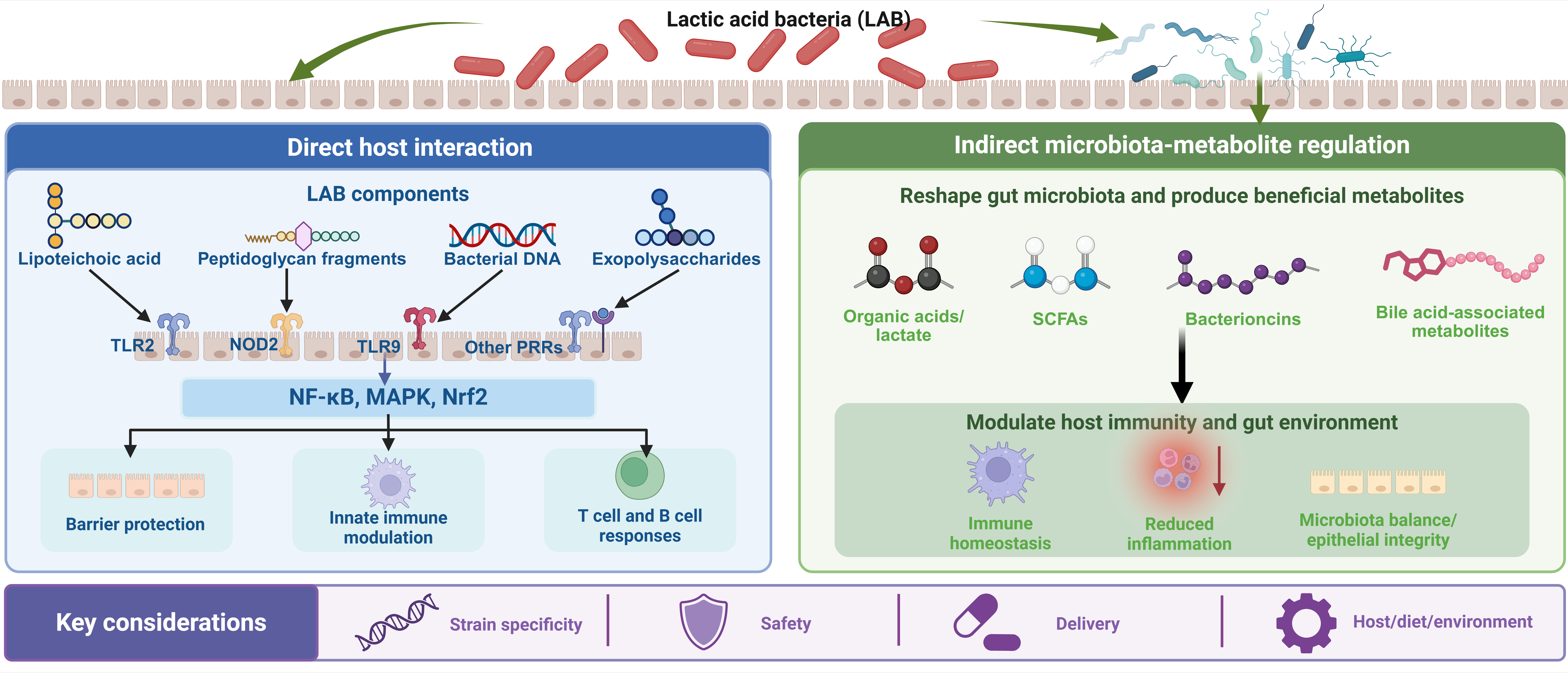
The increasing pressure to reduce antibiotic use in livestock and poultry production has intensified interest in lactic acid bacteria (LAB) as promising microbial interventions for improving animal health. Although accumulating evidence indicates that LAB can regulate host immunity, maintain intestinal barrier function, and enhance disease resistance, the underlying mechanisms remain incompletely understood, and their effects are influenced by bacterial strains, host species, dietary conditions, and other factors. Here, we comprehensively summarize the immunomodulatory mechanisms of LAB, with particular emphasis on the direct mechanisms through which microbial components interact with host immune signaling and cellular responses, as well as the indirect mechanisms through which LAB modulate the gut microbiota and its metabolic outputs. We further discuss the importance of strain specificity in determining the functional properties and immunomodulatory effects of LAB. In addition, we review the practical applications of LAB in livestock and poultry production and highlight the major challenges and limitations associated with their application. By integrating mechanistic insights with practical considerations, this review offers new perspectives on the rational application of LAB to improve immune function and animal health in livestock and poultry production.