Open Access
ISSN: 3080-9681 (Online)
3080-9673 (Print)
College of Horticulture, Hunan Agricultural University, Changsha, 410128, China
Boyce Thompson Institute, Cornell University, Ithaca, NY 14853, USA
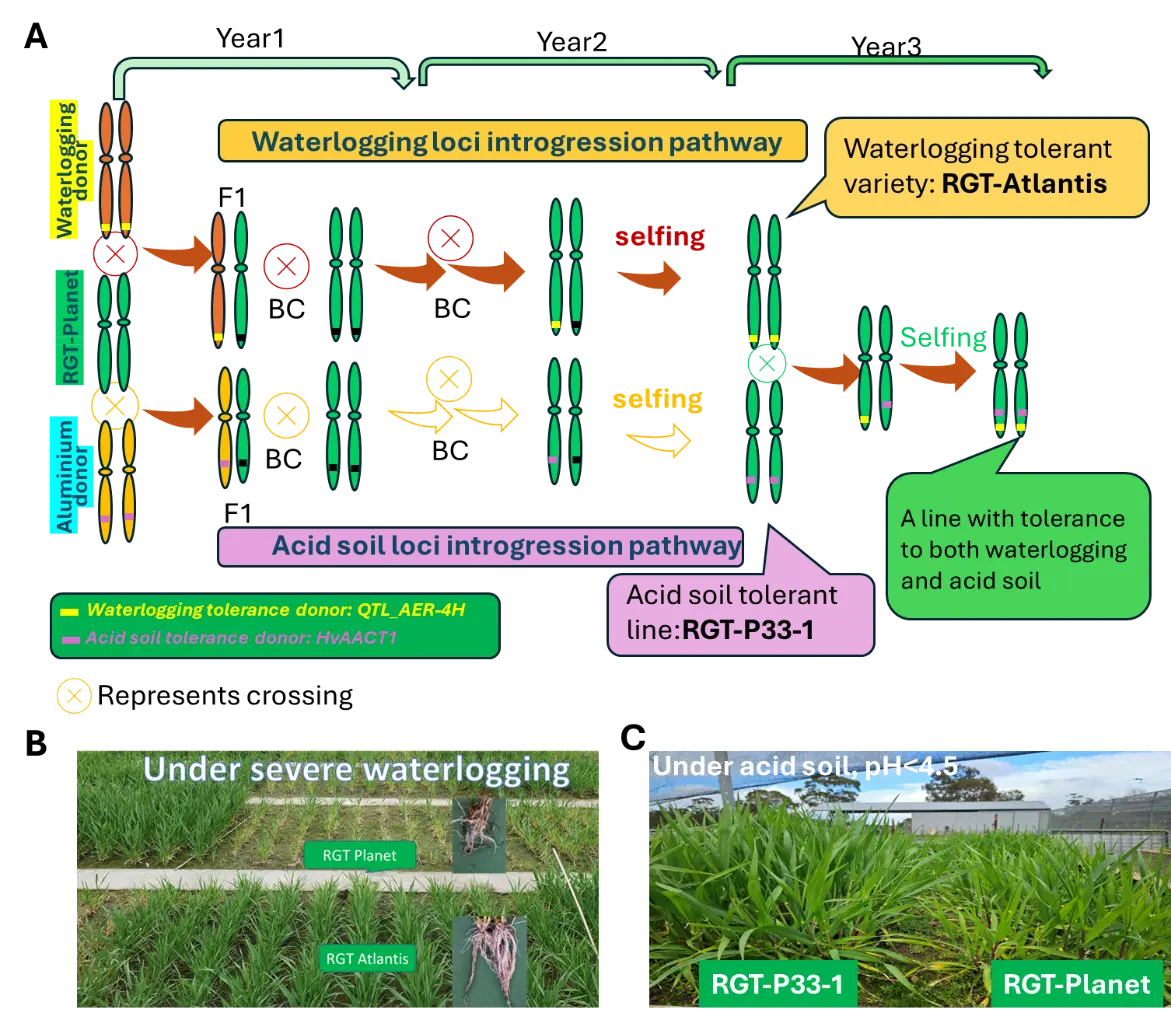
Abiotic stresses, including drought, heat, salinity, waterlogging, and acidic soils, are increasingly inhibiting the consistency of global food production, valued at USD 3.26 trillion during the last three decades. Although backcrossing efficiently transfers large-effect loci into elite backgrounds, conventional pipelines remain slow and vulnerable to linkage drag and unreliable genotype-to-phenotype translation. Here, we synthesize an operational fast backcross (FB) breeding framework that integrates (i) rapid generation advance (speed breeding), (ii) embryo culture to shorten generation intervals and unlock wide crosses, (iii) marker-assisted backcrossing with coordinated foreground, recombinant, and genome-wide background selection, and (iv) genomic selection to capture residual polygenic adaptation. We propose practical approaches to prioritize stress-adaptive loci and to validate yield and quality neutrality under non-stress conditions before pyramiding. Case studies in rice (SUB1, Saltol, Pup1 and DRO1), wheat (Nax1/Nax2) and barley (aerenchyma formation and HvAACT1 loci) illustrate how FB pipelines can compress variety development timelines from 8–10 years to 3–5 years while maintaining farmer-preferred agronomic and end-use traits; however, they also underscore the constraints of relying on whole-plant phenotyping alone. We show that FB succeeds only when early locus prioritisation, recombinant selection to minimise linkage drag, and pre-pyramiding neutrality testing are enforced, explaining why many accelerated pipelines underperform despite advanced genotyping tools. Further, we propose AI-enabled selection and targeted editing to scale FB breeding for climate-resilient agriculture.
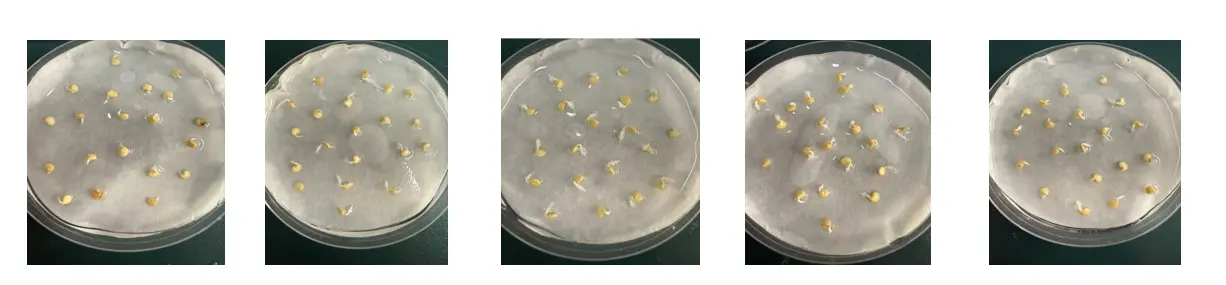
Diethyl aminoethyl hexanoate (DA-6) is a broad-spectrum high-energy plant growth regulator with multiple functions similar to auxin, gibberellin, and cytokinin. Research on crops such as corn, rice, peanuts, flowers, and vegetables has shown that it can increase the activity of plant peroxidase (POD) and nitrate reductase, promote plant cell division and elongation, and facilitate seed germination and seedling growth. This experiment used the seeds of the chili variety “Changxian Tianxia” as research materials. The experiment was conducted by designing DA-6 soaking experiments with different concentration gradients to determine physiological indicators of pepper growth, screen a suitable DA-6 concentration for pepper seed germination, and study the alleviating effect of DA-6 on pepper seed growth under salt stress. The aim is to provide a scientific basis for high-yield cultivation of chili in saline alkali soil. In the seed germination experiment, five DA-6 concentration treatment groups were set up, namely 0, 0.1 mmol/L, 0.5 mmol/L, 1 mmol/L, and 5 mmol/L. Three biological replicates were set up for each treatment group to screen for the most suitable DA-6 concentration for pepper seed germination. The germination and growth effects of pepper seeds under salt stress were then studied using this concentration. The growth physiological indicators were measured to investigate the alleviating effect of aminobutyric acid on pepper seed germination under salt stress. The experimental results showed that the appropriate concentration of aminobutyric acid ester (DA-6) promoted the germination of pepper seeds under salt stress. Under the treatment of soaking seeds in DA-6 at a concentration of 1 mmol/L, the activities of catalase (CAT) and POD increased by 8.6% and 14.6%, respectively, while inhibiting the accumulation of MDA (reducing it by 11.4%), improving the antioxidant effect of plant cell membranes, and enhancing the salt tolerance of pepper seeds. This experiment shows that soaking pepper seeds in 1 mmol/L DA-6 can effectively improve the antioxidant capacity of pepper seeds under salt stress environment, enhance seed germination rate and growth effect, and alleviate the damage caused by salt stress to pepper seedling growth to a certain extent.
Abiotic stresses, including drought, heat, salinity, waterlogging, and acidic soils, are increasingly inhibiting the consistency of global food production, valued at USD 3.26 trillion during the last three decades. Although backcrossing efficiently transfers large-effect loci into elite backgrounds, conventional pipelines remain slow and vulnerable to linkage drag and unreliable genotype-to-phenotype translation. Here, we synthesize an operational fast backcross (FB) breeding framework that integrates (i) rapid generation advance (speed breeding), (ii) embryo culture to shorten generation intervals and unlock wide crosses, (iii) marker-assisted backcrossing with coordinated foreground, recombinant, and genome-wide background selection, and (iv) genomic selection to capture residual polygenic adaptation. We propose practical approaches to prioritize stress-adaptive loci and to validate yield and quality neutrality under non-stress conditions before pyramiding. Case studies in rice (SUB1, Saltol, Pup1 and DRO1), wheat (Nax1/Nax2) and barley (aerenchyma formation and HvAACT1 loci) illustrate how FB pipelines can compress variety development timelines from 8–10 years to 3–5 years while maintaining farmer-preferred agronomic and end-use traits; however, they also underscore the constraints of relying on whole-plant phenotyping alone. We show that FB succeeds only when early locus prioritisation, recombinant selection to minimise linkage drag, and pre-pyramiding neutrality testing are enforced, explaining why many accelerated pipelines underperform despite advanced genotyping tools. Further, we propose AI-enabled selection and targeted editing to scale FB breeding for climate-resilient agriculture.
Diethyl aminoethyl hexanoate (DA-6) is a broad-spectrum high-energy plant growth regulator with multiple functions similar to auxin, gibberellin, and cytokinin. Research on crops such as corn, rice, peanuts, flowers, and vegetables has shown that it can increase the activity of plant peroxidase (POD) and nitrate reductase, promote plant cell division and elongation, and facilitate seed germination and seedling growth. This experiment used the seeds of the chili variety “Changxian Tianxia” as research materials. The experiment was conducted by designing DA-6 soaking experiments with different concentration gradients to determine physiological indicators of pepper growth, screen a suitable DA-6 concentration for pepper seed germination, and study the alleviating effect of DA-6 on pepper seed growth under salt stress. The aim is to provide a scientific basis for high-yield cultivation of chili in saline alkali soil. In the seed germination experiment, five DA-6 concentration treatment groups were set up, namely 0, 0.1 mmol/L, 0.5 mmol/L, 1 mmol/L, and 5 mmol/L. Three biological replicates were set up for each treatment group to screen for the most suitable DA-6 concentration for pepper seed germination. The germination and growth effects of pepper seeds under salt stress were then studied using this concentration. The growth physiological indicators were measured to investigate the alleviating effect of aminobutyric acid on pepper seed germination under salt stress. The experimental results showed that the appropriate concentration of aminobutyric acid ester (DA-6) promoted the germination of pepper seeds under salt stress. Under the treatment of soaking seeds in DA-6 at a concentration of 1 mmol/L, the activities of catalase (CAT) and POD increased by 8.6% and 14.6%, respectively, while inhibiting the accumulation of MDA (reducing it by 11.4%), improving the antioxidant effect of plant cell membranes, and enhancing the salt tolerance of pepper seeds. This experiment shows that soaking pepper seeds in 1 mmol/L DA-6 can effectively improve the antioxidant capacity of pepper seeds under salt stress environment, enhance seed germination rate and growth effect, and alleviate the damage caused by salt stress to pepper seedling growth to a certain extent.utf-8
Abiotic stresses, including drought, heat, salinity, waterlogging, and acidic soils, are increasingly inhibiting the consistency of global food production, valued at USD 3.26 trillion during the last three decades. Although backcrossing efficiently transfers large-effect loci into elite backgrounds, conventional pipelines remain slow and vulnerable to linkage drag and unreliable genotype-to-phenotype translation. Here, we synthesize an operational fast backcross (FB) breeding framework that integrates (i) rapid generation advance (speed breeding), (ii) embryo culture to shorten generation intervals and unlock wide crosses, (iii) marker-assisted backcrossing with coordinated foreground, recombinant, and genome-wide background selection, and (iv) genomic selection to capture residual polygenic adaptation. We propose practical approaches to prioritize stress-adaptive loci and to validate yield and quality neutrality under non-stress conditions before pyramiding. Case studies in rice (SUB1, Saltol, Pup1 and DRO1), wheat (Nax1/Nax2) and barley (aerenchyma formation and HvAACT1 loci) illustrate how FB pipelines can compress variety development timelines from 8–10 years to 3–5 years while maintaining farmer-preferred agronomic and end-use traits; however, they also underscore the constraints of relying on whole-plant phenotyping alone. We show that FB succeeds only when early locus prioritisation, recombinant selection to minimise linkage drag, and pre-pyramiding neutrality testing are enforced, explaining why many accelerated pipelines underperform despite advanced genotyping tools. Further, we propose AI-enabled selection and targeted editing to scale FB breeding for climate-resilient agriculture.utf-8
Online ISSN: 3080-9681
Print ISSN: 3080-9673