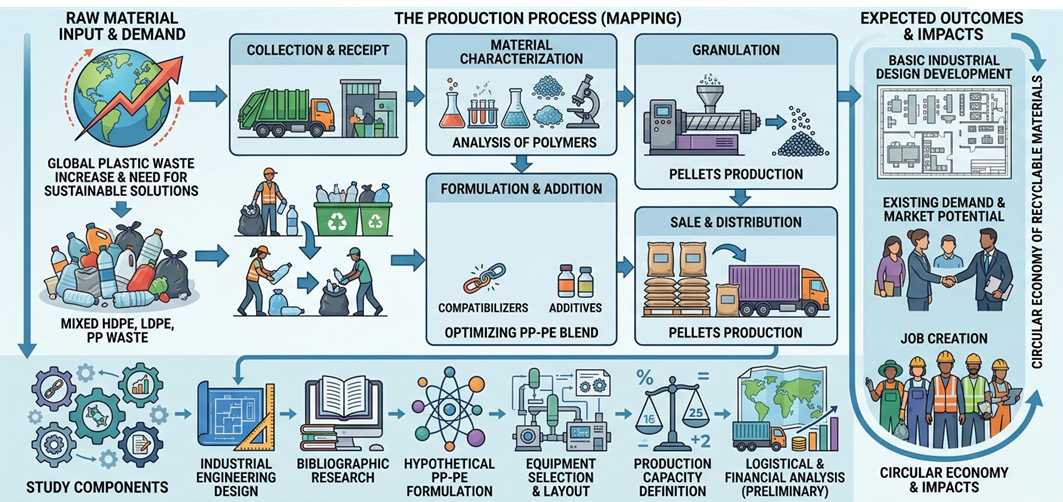
With the global increase in the production and disposal of polymeric waste, it becomes crucial to develop sustainable solutions that promote the circular economy of recyclable materials. This work presents a technical feasibility study for the implementation of a production unit for recycled polymer pellets, using a mixture of High-Density Polyethylene (HDPE), Low-Density Polyethylene (LDPE), and Polypropylene (PP) as raw material. The proposal aims to map the complete production process, from the collection and receipt of the recycled material to the granulation and sale of the pellets, including the characterization of the materials and the necessary compatibilizers and additives. The definition of production capacity, equipment selection, and industrial layout will also be addressed. The study includes a logistical and financial analysis, even if preliminary, for a hypothetical organization located in the region of São José dos Pinhais—PR, for the processing of recycled PP-PE blend. To carry out this study, basic concepts of industrial engineering design were applied. Information on the process and characteristics of a hypothetical PP-PE formulation was obtained through bibliographic research. The study allowed for important considerations regarding the development of a basic industrial design for processing recycled polymer. Preliminary results indicate existing demand in the metropolitan region of Curitiba (southern Brazil) and potential for job creation, including the use of labor from waste pickers distributed throughout the region.
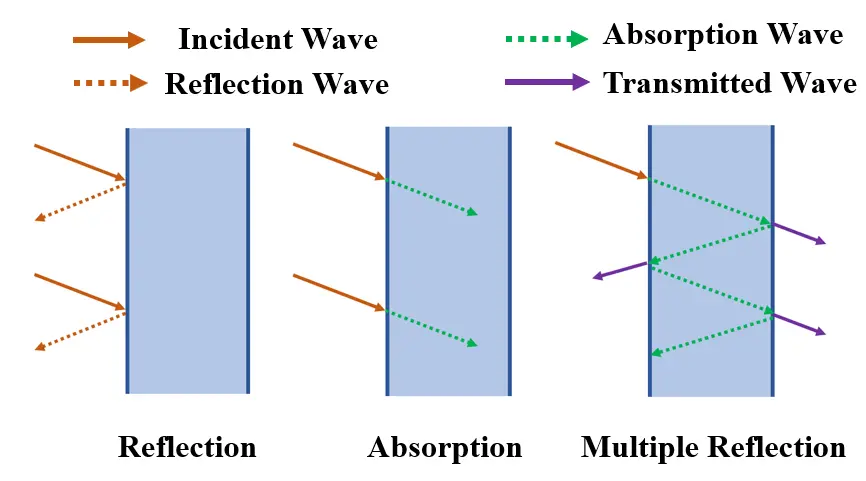
Electromagnetic waves are the foundation of modern communication and information transmission which take advantage of strong penetration and fast propagation. To prevent electromagnetic radiation pollution and improve application efficiency, the development of new types of electromagnetic wave absorption and shielding materials that can convert electromagnetic wave energy into thermal energy for absorption and shielding has become increasingly important. Although progress in different electromagnetic wave-absorbing and shielding materials is exciting, there are few reviews of new materials, especially two-dimensional materials. By analyzing the structure and loss mechanism of two-dimensional materials, this review systematically summarizes the current research status and unique advantages of two-dimensional materials in electromagnetic wave absorption and shielding. By extending traditional synthetic two-dimensional materials to natural two-dimensional mineral materials, the potential applications of these materials in future green development havee been explored. Based on different application scenarios, new challenges and future directions for highly efficient electromagnetic wave absorption and shielding materials are presented. The prospects for the development of two-dimensional materials are also clarified from aspects of macroscopic and microscopic structural design and functional integration.
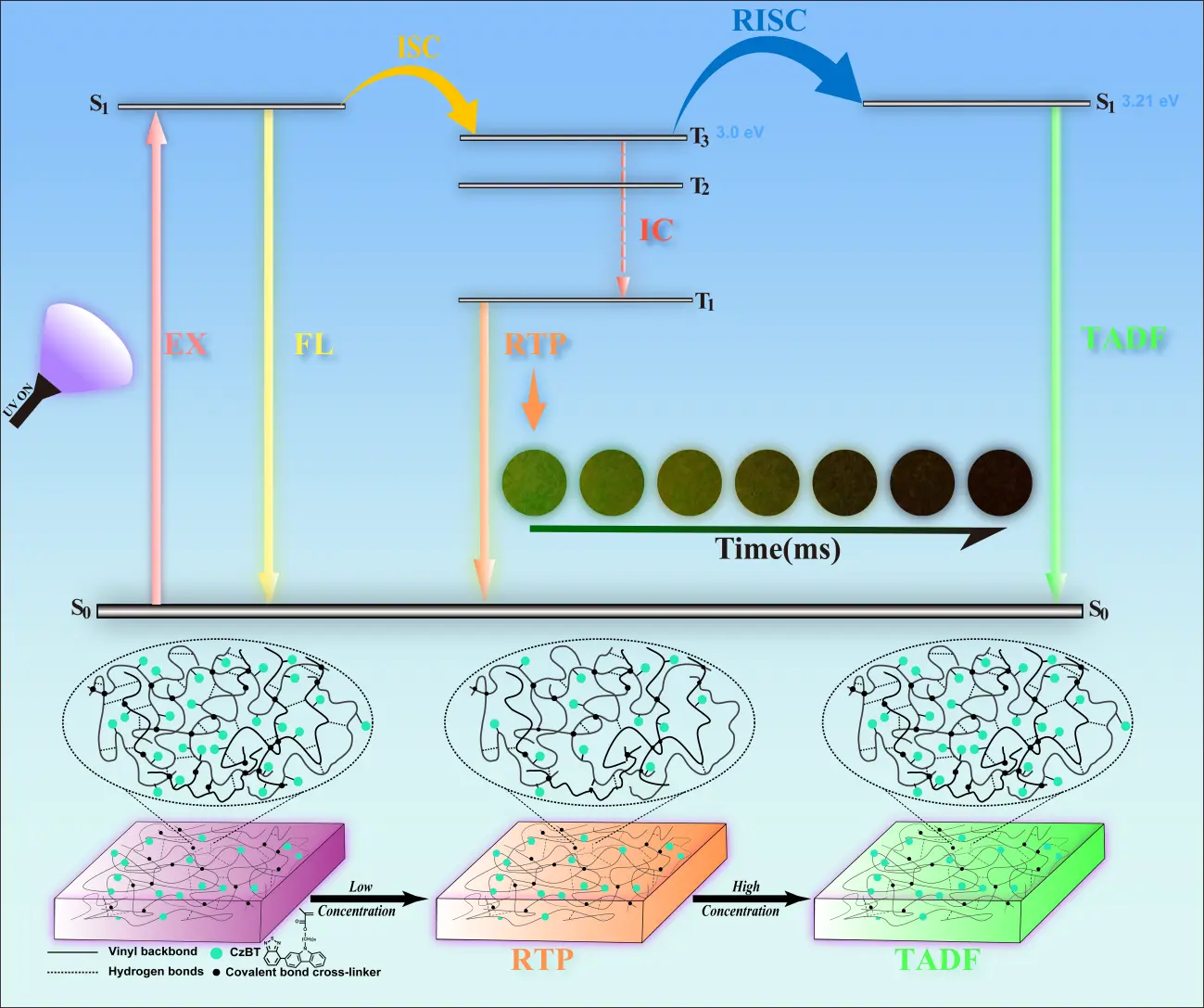
Room temperature phosphorescence (RTP) and organic thermally activated delayed fluorescence (TADF) materials have merited enormous application prospects in organic optoelectronics. In spite of this, TADF and RTP dual emissions based on single-chromophore polymers still face a great challenge. In this work, we develop a monomer (CzBT) with twisted electron donating carbazole and electron withdrawing benzothiadiazole (D-A) structure and then copolymerize it with N-isopropylacrylamide (NIPAM) in different ratios to adjust TADF and RTP emission. The polymers exhibit TADF emission from aggregated chromophores, RTP emission with a lifetime of 240 ms from dispersed chromophores, and a high absolute photoluminescence quantum efficiency (20%). Theoretical calculations confirm that the introduction of twisted D-A structure and heteroatoms can not only promote spin orbital coupling to facilitate the accumulation of triplet excitons for RTP emission, but also help RISC to emit TADF in the aggregated state. When applied to solution-processable organic light emitting diodes (OLEDs) devices, excellent current efficiency of 62.7 cd/A and maximum external quantum efficiency of 19.9% were achieved attributing to the dominant TADF emission. This class of polymers paves the way for high-efficiency optoelectronic devices.
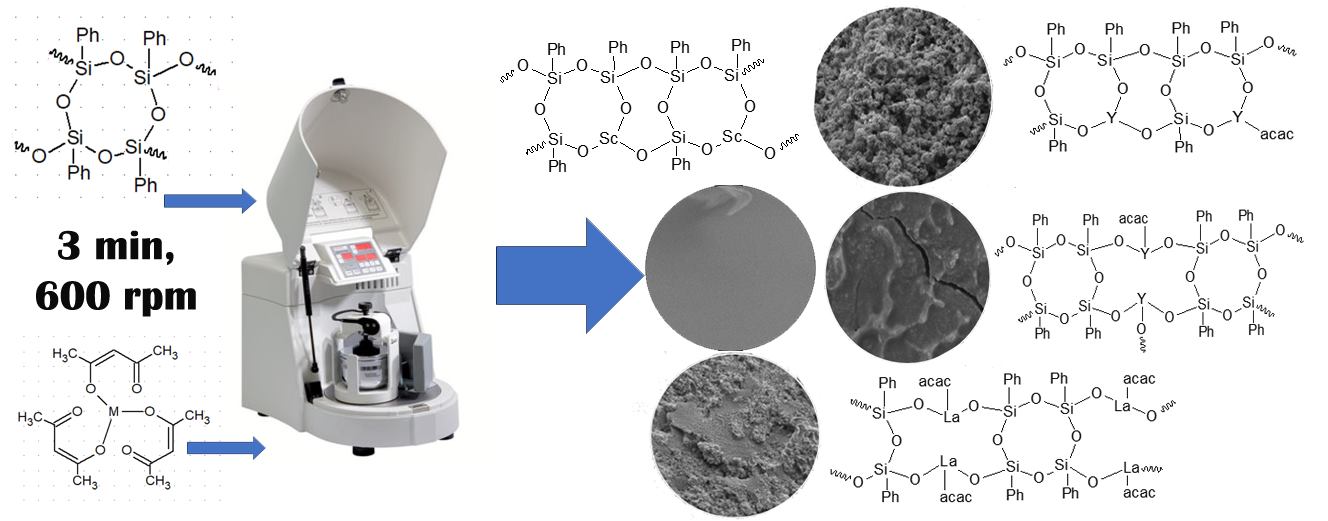
The present study pioneers the investigation of mechanochemical synthesis based on polyphenylsilsesquioxane and β-diketonate complexes of scandium, yttrium, and lanthanum. It has been demonstrated that the degree of metal incorporation into the polymer chain increases with the growth of the ionic radius and with the decrease in the stability of the initial acetylacetonate complex. The resulting polymers exhibit high thermal stability, comparable to that of the parent organosilicon polymer. Moreover, owing to their developed surface area and light-transforming properties, the synthesized compounds hold promise for applications in catalysis, production of electronic materials, and fabrication of nanoelectronic components.
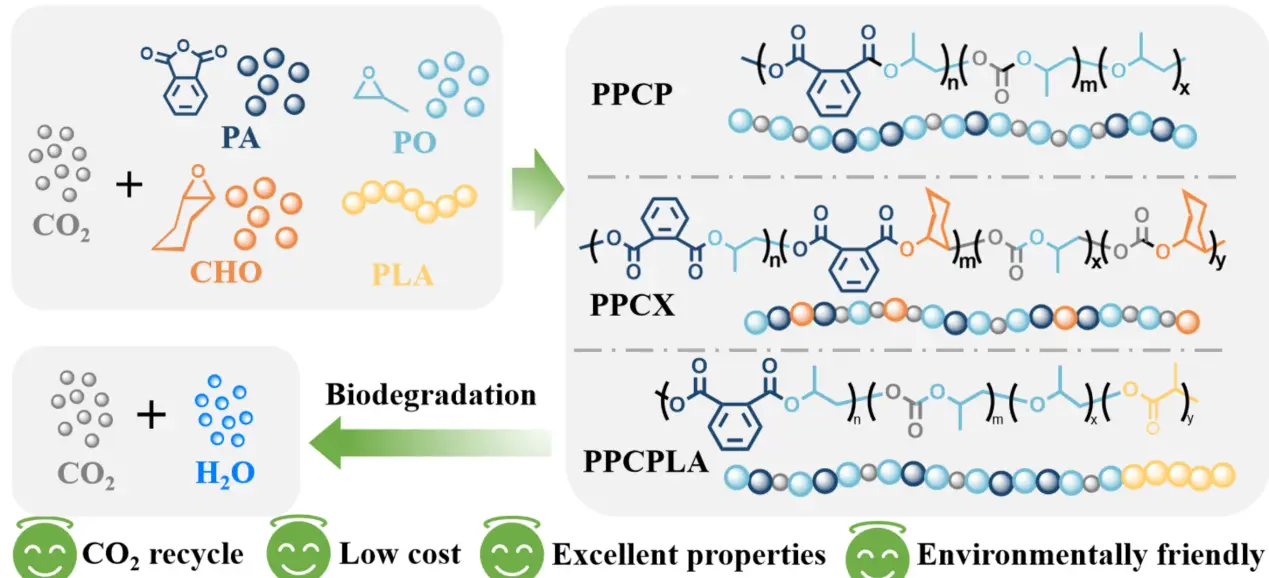
Research into biodegradable polymers, driven by environmental imperatives, has progressed significantly. The copolymerization of CO2 and epoxides produces poly(propylene carbonate) (PPC), which exhibits favorable biodegradability but suffers from poor thermomechanical properties. To address this, recent studies have incorporated rigid monomers or crystalline segments into such copolymerizations, generating a diverse range of CO2-derived copolymers with enhanced thermal and mechanical performance. However, their degradation profiles remain insufficiently characterized. In this study, we selected several representative CO2-derived copolymers, recently synthesized by our group, to systematically investigate the structure-property relationship. We evaluated their biodegradability through a series of tests, including biodegradation rate analysis, compost disintegration, and seed germination assays. These polymers, developed by our research team, offer advantages such as low cost, tunable properties, broad applicability, and environmental compatibility. They are thus promising candidates for introducing new materials into the biodegradable plastics market.