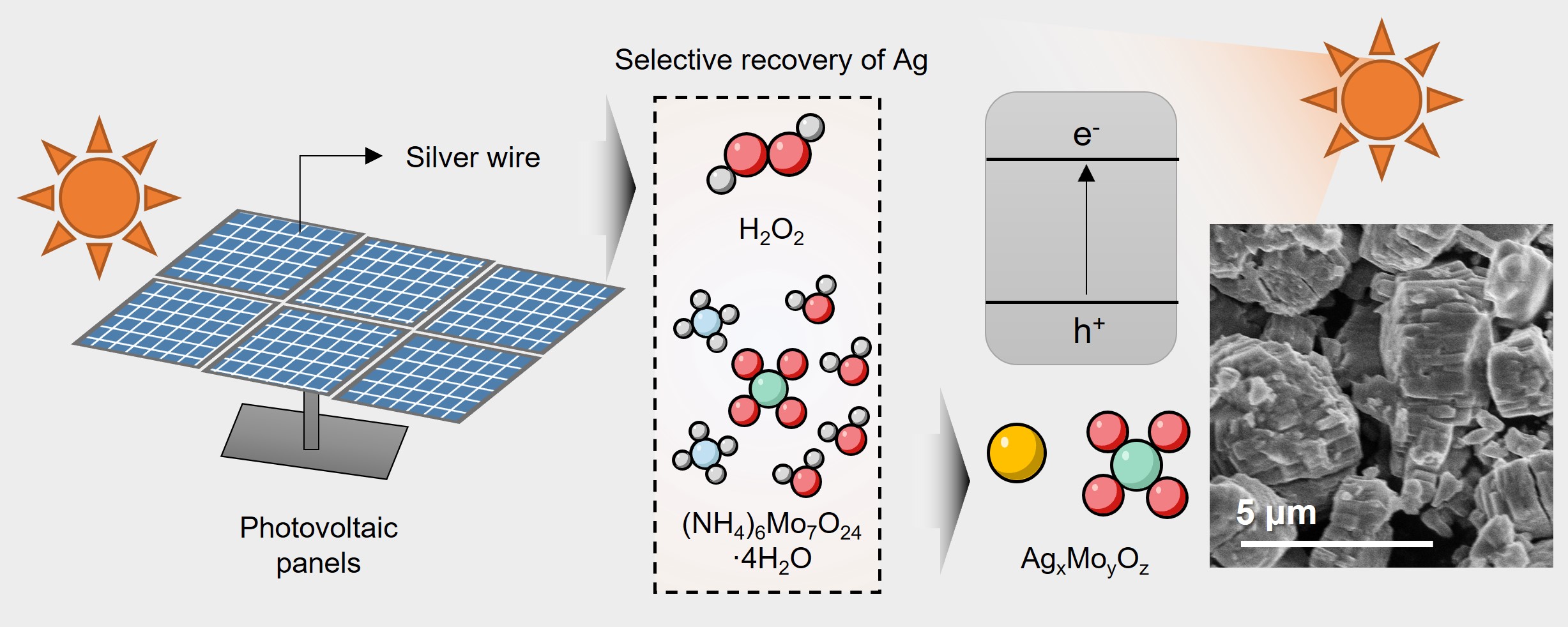
The rapid accumulation of end-of-life photovoltaic (PV) modules calls for the sustainable recovery of valuable metals contained within them. In crystalline silicon PV modules, silver (Ag) is the metal with the highest economic value, but its selective recovery remains challenging. Here, we report a method based on an ammonium molybdate tetrahydrate ((NH4)6Mo7O24·4H2O)-hydrogen peroxide (H2O2) system for selectively leaching Ag from end-of-life PV modules. During the Ag recovery process, aluminum remains largely insoluble, while lead is partially leached and separated. During leaching, Ag+ reacts in situ with molybdate ions to form silver molybdate (AgxMoyOz). Singlet oxygen (1O2), hydroxyl radicals (•OH), and peroxy (•OOH) radicals were identified as active species during the leaching process. The recovered silver molybdate can be directly used as a photocatalyst for pollutant degradation, providing proof of concept for a “waste-to-useful” strategy. This study establishes a closed-loop pathway from end-of-life PV modules to functional photocatalysts, eliminating the need for additional silver purification or catalyst synthesis steps.
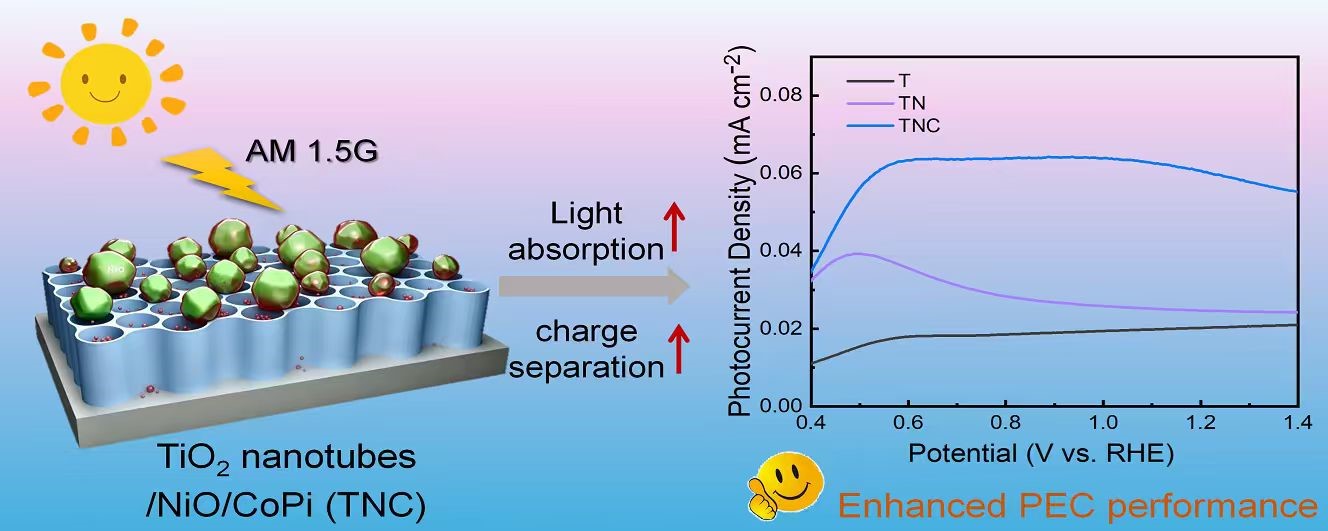
Photoelectrochemical (PEC) water splitting is promising for solar-to-hydrogen conversion, but its efficiency is limited by sluggish oxygen evolution reaction (OER) kinetics and severe charge recombination at the photoanode. Constructing heterojunctions with oxygen evolution cocatalysts is an effective strategy to overcome these limitations. Herein, a CoPi cocatalyst-decorated TiO2/NiO heterojunction photoanode (TNC) was fabricated by anodization of Ti sheets, NiO electrodeposition, and CoPi photodeposition. Characterization confirmed the successful anchoring of cubic NiO nanoparticles on anatase TiO2 nanotube arrays and the homogeneous deposition of amorphous CoPi on the TiO2/NiO surface. The resulting TNC photoanode exhibited extended visible-light absorption from 400 to 800 nm, efficient charge separation, and excellent PEC performance. Compared with pristine TiO2 and TiO2/NiO, TNC delivered the highest photocurrent density, the smallest charge-transfer resistance, the most negative open-circuit potential, and the shortest carrier decay lifetime. The enhanced PEC performance is attributed to the TiO2/NiO heterojunction, which promotes charge separation, and the CoPi layer, which acts as a hole-extraction layer, passivates surface trap states, and accelerates interfacial hole transfer for water oxidation. This work provides a rational strategy for constructing efficient multi-component photoanodes for solar water splitting.
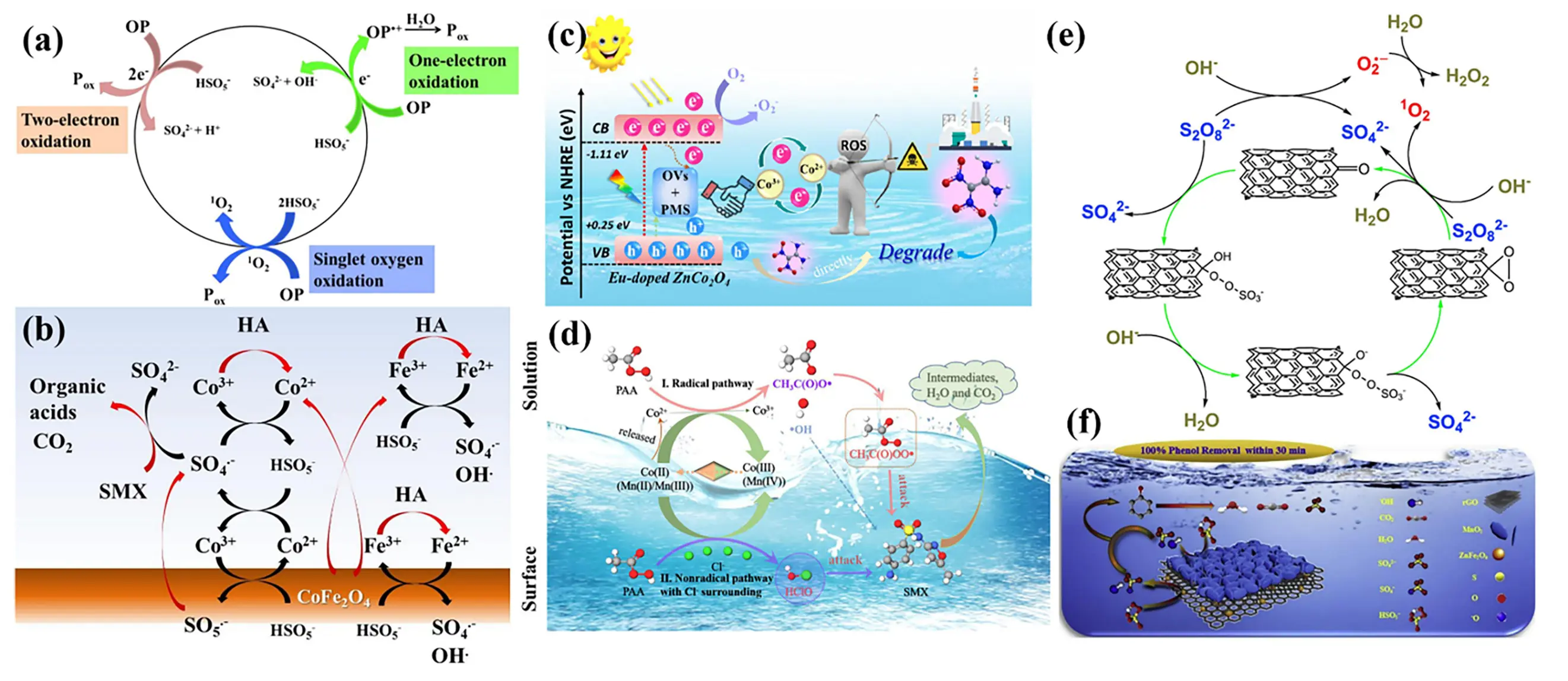
The widespread detection of antibiotics in aquatic environments and their potential threats to ecosystems and human health represent a significant global environmental issue. Sulfate radical-based advanced oxidation technologies (SR-AOPs) have garnered considerable attention because the activation of persulfate (PMS) produces various highly reactive oxygen species. In recent years, photocatalyst-coupled PMS activation systems have exhibited unique potential in antibiotic degradation, owing to their synergistic advantages of efficient separation of photo-generated charge carriers and targeted PMS activation. This review is structured around a three-dimensional analytical framework that includes “catalytic mechanism type—photocatalytic material system—reactive oxygen species generation pathways”. It systematically examines the mechanistic characteristics and performance limitations of classical peroxymonosulfate (PMS) activation pathways, including transition-metal catalysis, carbon-based material catalysis, physical energy field activation, and electrocatalysis. Furthermore, it provides a comprehensive discussion of the thermodynamic foundations, kinetic regulation, and mechanisms of radical and non-radical competition involved in the photocatalytic activation of PMS. Building on this foundation, the review categorizes and assesses the latest advancements in the coupled activation of PMSs, addressing Type-II, Z-scheme, and S-scheme heterojunctions, as well as single-atom and diatomic catalysis, metal-organic framework (MOF) and covalent organic framework (COF)-based systems, and metal-free photocatalytic systems. To evaluate the advantages and limitations of photocatalytic coupling systems, along with future development directions, this review considers three key aspects: quantification of synergistic effects, adaptability to real water bodies, and engineering bottlenecks. This assessment aims to provide a systematic reference for material design and process optimization within this field.