
SciEPublish

CoPi Cocatalyst-Decorated TiO2/NiO Nanotube Heterojunction Photoanode for Enhanced Photoelectrochemical Performance

Article Open Access

CoPi Cocatalyst-Decorated TiO2/NiO Nanotube Heterojunction Photoanode for Enhanced Photoelectrochemical Performance

Author Information
1
Hubei Province Key Laboratory of Coal Conversion and New Carbon Materials, School of Chemistry and Chemical Engineering, Wuhan University of Science and Technology, Wuhan 430081, China
2
College of Chemistry and Environmental Science, Qujing Normal University, Qujing 655400, China
3
Hubei Provincial Engineering Research Center of Racing Horse Detection and Application Transformation, Equine Science Research and Horse Doping Control Laboratory, Wuhan Business University, Wuhan 430056, China
4
School of Resources and Safety Engineering, Wuhan Institute of Technology, Wuhan 430074, China
*
Authors to whom correspondence should be addressed.

Received: 15 September 2026 Revised: 16 October 2026 Accepted: 02 November 2026 Published: 16 November 2026

Creative Commons

© 2026 The authors. This is an open access article under the Creative Commons Attribution 4.0 International License (https://creativecommons.org/licenses/by/4.0/).
Views:9
Downloads:2
Photocatal. Res. Potential 2026, 3(4), 10007; DOI: 10.70322/prp.2026.10007
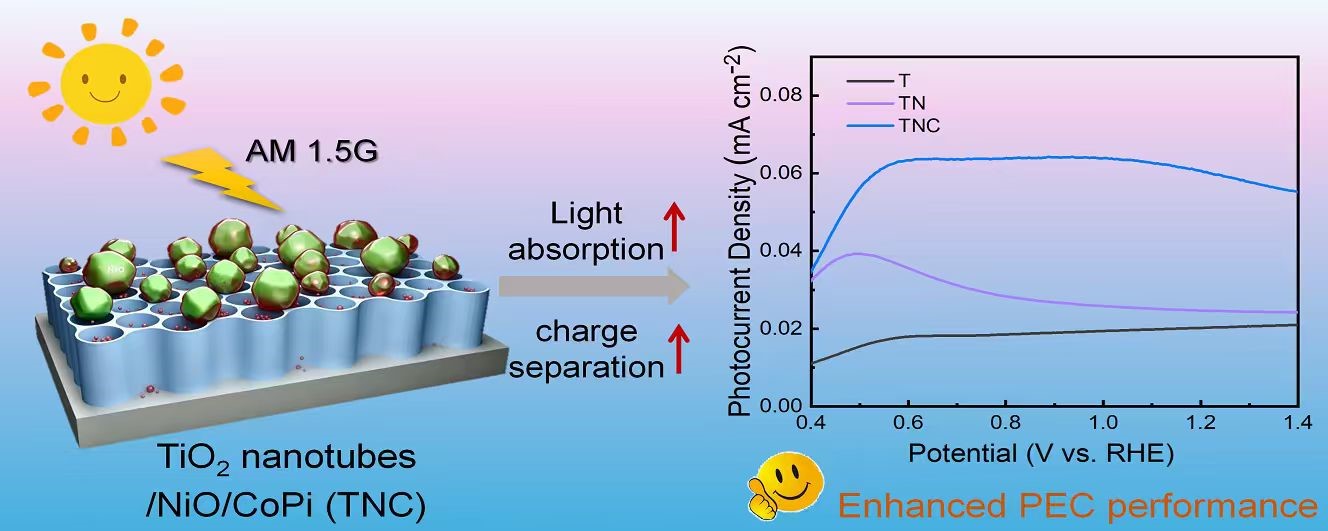
ABSTRACT: Photoelectrochemical (PEC) water splitting is promising for solar-to-hydrogen conversion, but its efficiency is limited by sluggish oxygen evolution reaction (OER) kinetics and severe charge recombination at the photoanode. Constructing heterojunctions with oxygen evolution cocatalysts is an effective strategy to overcome these limitations. Herein, a CoPi cocatalyst-decorated TiO2/NiO heterojunction photoanode (TNC) was fabricated by anodization of Ti sheets, NiO electrodeposition, and CoPi photodeposition. Characterization confirmed the successful anchoring of cubic NiO nanoparticles on anatase TiO2 nanotube arrays and the homogeneous deposition of amorphous CoPi on the TiO2/NiO surface. The resulting TNC photoanode exhibited extended visible-light absorption from 400 to 800 nm, efficient charge separation, and excellent PEC performance. Compared with pristine TiO2 and TiO2/NiO, TNC delivered the highest photocurrent density, the smallest charge-transfer resistance, the most negative open-circuit potential, and the shortest carrier decay lifetime. The enhanced PEC performance is attributed to the TiO2/NiO heterojunction, which promotes charge separation, and the CoPi layer, which acts as a hole-extraction layer, passivates surface trap states, and accelerates interfacial hole transfer for water oxidation. This work provides a rational strategy for constructing efficient multi-component photoanodes for solar water splitting.
Keywords: TiO2 nanotube arrays; Heterojunction; CoPi cocatalyst; Photodeposition

Graphical Abstract

TOP