
Review of Research on the Activation and Degradation of Antibiotics in Water by Photocatalysis Coupled with Persulfate
Review of Research on the Activation and Degradation of Antibiotics in Water by Photocatalysis Coupled with Persulfate
Wen Dong 1,† Hongqing Song 1,† Xuhui Wu 1 Ziqian Gao 1 Qizhao Wang 1,2,*
Received: 15 September 2026 Revised: 08 October 2026 Accepted: 06 November 2026 Published: 19 November 2026

© 2026 The authors. This is an open access article under the Creative Commons Attribution 4.0 International License (https://creativecommons.org/licenses/by/4.0/).
1. Introduction
As one of the most widely used drugs in the medical, livestock, and aquaculture sectors [1], the production and use of antibiotics have increased significantly over the past few decades [2]. However, traditional wastewater treatment processes demonstrate limited efficiency in removing antibiotics [3,4], resulting in the continuous discharge of substantial quantities of antibiotics and their metabolites into surface water, groundwater, and soil at concentrations ranging from ng/L to μg/L [5]. Sulfonamides, tetracyclines, and fluoroquinolones are the most frequently detected classes of antibiotics in aquatic environments due to their widespread use and high environmental persistence [6,7]. Residual antibiotics threaten ecological safety by promoting the spread of resistance genes and may also pose long-term cumulative risks to human health through exposure via drinking water and the food chain [8]. Therefore, developing efficient, cost-effective, and environmentally friendly technologies for treating antibiotic-contaminated wastewater holds significant practical importance.
Sulfate radical-based advanced oxidation technologies (SR-AOPs) have emerged as a promising alternative to the traditional Fenton reaction in recent years [9,10]. This shift is attributed to the advantages of the sulfate radical (SO4•−), which include a high oxidation potential (E0 = 2.5–3.1 V vs. NHE), a wide operational pH range (pH = 2–9), and a long half-life (30–40 μs) [11]. Persulfate (PMS, HSO5−), the primary oxidizing agent in SR-AOPs, possesses an asymmetric molecular structure that facilitates the activation of its O–O bond (with a bond energy of approximately 140–213 kJ/mol) more readily than that of persulfite (PDS, approximately 140–292 kJ/mol) and hydrogen peroxide (H2O2, approximately 213 kJ/mol) [12]. Furthermore, the activation pathways of PMS can be flexibly controlled through various activation methods [13,14].
Photocatalytic technology employs the generation of electron-hole pairs in semiconductors under light irradiation to activate peroxymonosulfate (PMS) [15,16]. This activation occurs either through the direct reduction of PMS by photo-generated electrons or through the indirect involvement of photo-generated holes in PMS transformation [2,17]. Compared to conventional PMS activation pathways, photocatalytic coupling systems present three significant advantages: (1) They utilize renewable light energy, eliminating the need for additional chemical reagents or high-energy inputs; (2) the efficient separation of photo-generated charge carriers facilitates simultaneous PMS activation and pollutant degradation; (3) the generation pathways of reactive oxygen species (ROS) can be adaptively modified through band structure engineering and interface regulation.
Several reviews have already surveyed parts of this field, and their scope defines the position of the present work. Ghanbari and Moradi [18] and Wang and Wang [19] summarized thermal, alkaline, radiation, transition-metal, and carbonaceous activation together with the associated mechanisms; Kohantorabi et al. [20] extended the coverage to supported metals, layered double hydroxides, MOFs, zeolites, and perovskites and compared radical with non-radical pathways; Zheng et al. [21] focused on heterogeneous activation by metal-based catalysts. Within individual material classes, biochar activation of PMS has been reviewed three times, covering active sites and activation mechanisms [22], influencing factors and catalyst reuse [23], and technical feasibility and life-cycle considerations for antibiotic removal [24]. For reactive species, the generation pathways and characterization methods of 1O2 have been reviewed in detail [25], and ultrasound activation has been summarized in terms of synergy mechanisms and sonoreactor design [26,27], including a bibliometric analysis of the topic and a critical re-assessment arguing that the reported synergy is often overestimated [28,29]. These works address activation methods, material classes, or individual reactive species. A framework that compares the activation technologies on a single scale and places degradation performance alongside engineering scalability is still missing, and the present review is organized to fill that gap.
In this context, this review presents a three-dimensional analytical framework focused on “catalytic mechanism type—photocatalytic material system—reactive oxygen species generation pathway” to systematically assess research advancements in the degradation of antibiotics in water through photocatalytic-coupled PMS activation. The text begins by utilizing established PMS activation pathways—namely, transition-metal catalysis, carbon-based material catalysis, physical energy field activation, and electrocatalysis—as benchmarks for comparing performance and mechanisms. It then delves into the electron transfer principles underlying photocatalytic PMS activation and clarifies the functional boundary of typical reactive oxygen species in the coupled system: O2•− may contribute to pollutant degradation, either directly for certain substrates or indirectly via conversion to other ROS, but its direct role should not be generalised. Subsequently, the review categorizes advancements in the coupled applications of heterojunction photocatalytic systems, single-atom and diatomic photocatalytic systems, and MOF/COF-based and metal-free photocatalytic systems. Finally, a comprehensive evaluation is performed across three dimensions: quantification of synergistic effects, identification of bottleneck challenges, and exploration of future directions.
2. The Basis of PMS Activation and Classic Activation Pathways
PMS (HSO5−), the active oxidizing component of potassium monopersulfate (H2O2SO3), features an asymmetric O–O bond in its molecular structure. One end of this bond is connected to an SO3 group, while the other end is linked to a hydrogen atom [30,31,32]. This asymmetry results in the bond energy of PMS’s O–O bond, which ranges from approximately 140 to 213 kJ/mol, falling between that of H2O2 (approximately 213 kJ/mol) and that of PDS’s O–O bond. However, thermodynamically, PMS is more readily reduced through single-electron transfer (Figure 1a). The activation of PMS requires the input of energy or electrons through various pathways, facilitating the cleavage of the O–O bond and leading to the generation of radical species centered on SO4•− or, via non-radical pathways, the production of 1O2 and high-valent metal oxygen species [33,34]. Based on distinct activation mechanisms, classical PMS activation pathways are categorized into four major types: transition metal and spinel catalysis, carbon-based material catalysis, activation by physical energy fields, and electrocatalytic activation.
2.1. Molecular Characteristics and Activation Chemical Basis of PMS
Although PMS, PDS, and H2O2 are all members of the peroxide family, their molecular structural differences dictate their activation characteristics [35,36]. The asymmetric structure of PMS (HO-O-SO3−) renders it more polar than the symmetric PDS (-O3S-O-O-SO3−), leading to increased electrophilic reactivity under identical conditions [37]. From a thermodynamic standpoint, the reduction potential of PMS, E0 (HSO5−/SO4•−) = +1.82 V vs. NHE, is lower than that of PDS (E0 (S2O82−/SO4•−) = +2.01 V) but higher than that of H2O2 (E0 (H2O2/OH) = +1.78 V vs. NHE) [13,38]. The fundamental chemical principle underlying PMS activation is the cleavage mechanism of the O–O bond: Homolytic cleavage, in which both electrons are assigned to a single oxygen atom, primarily produces SO4•− and •OH radicals. In contrast, heterolytic cleavage, where one electron is assigned to a single oxygen atom, tends to generate high-valent metal-oxygen species (such as Fe(IV)=O and Co(IV)=O) or produce H2O2 through electron transfer [39]. His selectivity between homolytic and heterolytic cleavage establishes a theoretical foundation for the precise regulation of ROS generation pathways [40].
2.2. Catalytic Activation by Transition Metals and Spinel
The activation of peroxymonosulfate (PMS) by transition metal ions via the Mn+/M(n+1)+ redox cycle represents one of the earliest identified classical activation pathways. Pioneering research conducted by Anipsitakis and Dionysiou [30,39] systematically examined the efficacy of transition metal ions, including Co2+, Fe2+, Cu2+, Mn2+, and Ni2+, in activating PMS. Their findings revealed that Co2+ demonstrated the highest activation activity, with a reaction rate constant significantly surpassing that of the other metal ions. Nevertheless, the homogeneous Co2+/PMS system encounters challenges related to the recovery of metal ions and the potential for secondary pollution, which has led researchers to explore heterogeneous catalytic systems [41].
Spinel-type ferrites (MFe2O4, where M = Co, Cu, Mn, Zn, etc.) represent a significant class of materials for the catalytic activation of polyphase peroxymonosulfate (PMS) due to their exceptional magnetic separation properties and stable crystal structure [42]. CoFe2O4 efficiently activates PMS to generate sulfate ions (SO42−) through the cycling of surface Co2+/Co3+, while the presence of Fe3+ in the spinel lattice effectively mitigates Co leaching (Figure 1b) [43,44,45]. MnFe2O4 further enhances electron transfer capacity through the synergistic interaction of Mn2+/Mn3+ and Fe2+/Fe3+ bimetallic species (Figure 1c) [46,47,48]. Additionally, Co–Mn bimetallic spinel (CoMn2O4) facilitates the regeneration of Co active sites via Mn species [49], resulting in more sustainable catalytic activity compared to single-metal oxides (Figure 1d) [50,51]. Recent research has also focused on modulating spinel catalytic activity through structural factors, including surface oxygen vacancies, lattice strain, and exposed crystal faces [52,53,54].
2.3. Catalytic Activation of Carbon-Based Materials
The activation of peroxymonosulfate (PMS) by carbon-based materials primarily occurs through non-radical pathways, thus addressing the challenge of metal leaching associated with transition metal catalysis [55,56]. Carbon materials with sp2 hybridization, including carbon nanotubes (CNTs), graphene, mesoporous carbon, and biochar, facilitate electron transfer to PMS via electron-rich carbon networks (Figure 1f) [57]. The resulting reactive oxygen species (ROS) predominantly consist of singlet oxygen (1O2) or arise from direct electron transfer, rather than sulfate radicals (SO42−) and hydroxyl radicals (OH) [58,59,60]. Research indicates that topological defects and edge carbon sites in CNTs serve as the primary active sites for PMS adsorption and activation (Figure 1e). Heteroatom doping significantly modulates the electronic properties of carbon materials. Specifically, graphitic nitrogen introduced through nitrogen doping enhances electron transfer efficiency by increasing the electron-donating capacity of the carbon framework [61]. In contrast, sulfur doping primarily promotes the generation of singlet oxygen (1O2) by regulating the concentration of defect sites [62]. Biochar has garnered considerable attention because of its diverse feedstock sources and low production costs; however, its catalytic activity depends on the interplay among pyrolysis temperature, oxygen-containing functional groups, defect concentration, and specific surface area [63,64]. Non-radical activation pathways in carbon-based materials demonstrate excellent resistance to anion interference in aqueous systems, yet they exhibit limited mineralization efficiency for high-concentration organic pollutants and typically necessitate combination with other activation pathways.
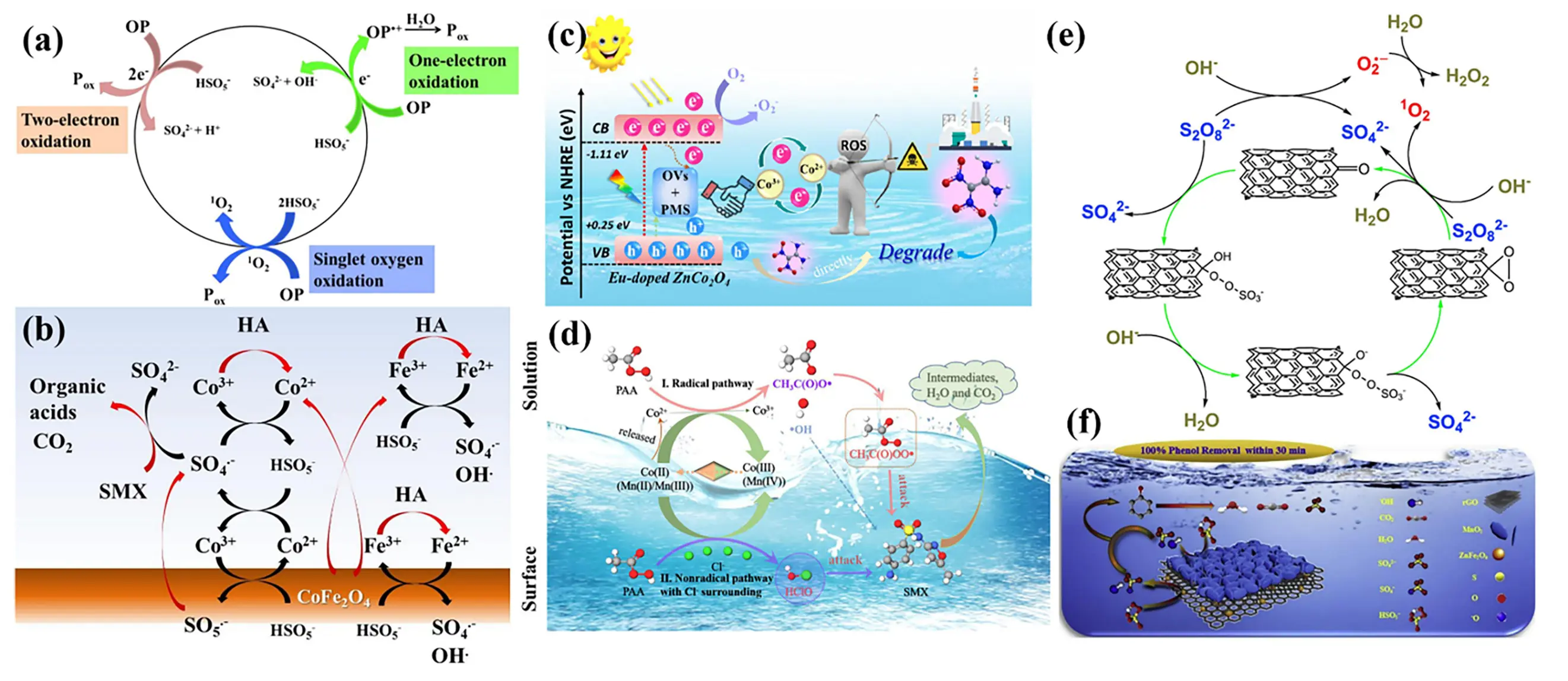
Figure 1. (a) The routes of PMS−induced direct oxidation of organic pollutants. OP and Pox represent organic pollutants and oxidation products, respectively. (b) Proposed reaction mechanism for the SMX degradation by a CoFe2O4/PMS/HA system. (c) The proposed photocatalytic mechanism for the Eu−doped ZnCo2O4. (d) The proposed photocatalytic mechanism for the Co3−xMnxO4. (e) The proposed photocatalytic mechanism for the Carbon Nanotube. (f) The proposed mechanism of phenol degradation in the γ−MnO2 @ZnFe2O4/rGO nanohybrid/PMS system. Reprinted from ref. [13]. Reprinted from ref. [43]. Reprinted from ref. [48]. Reprinted from ref. [50]. Reprinted from ref. [55]. Reprinted from ref. [57].
2.4. Physical Energy Field and Electrocatalytic Activation
The physical energy field breaks the O–O bond by directly supplying energy to the PMS molecule, eliminating the need for a catalyst. Thermal activation adheres to the Arrhenius equation, with an activation energy of approximately 100–200 kJ/mol. The reaction temperature generally must exceed 60 °C to attain a significant PMS conversion efficiency [65]. Photolysis at 254 nm generates SO4•− and OH by directly exciting the O–O bond in PMS, with a quantum yield of approximately 0.5–1.0. However, the penetration depth of UV light is limited, and energy consumption remains high. Ultrasonic activation uses the localized high temperatures (approximately 5000 K) and high pressures (approximately 1000 atm) produced by cavitation to facilitate rapid PMS decomposition. The collapse of cavitation bubbles releases a substantial amount of energy within microseconds [26]. Microwave-assisted activation integrates both thermal and non-thermal effects, significantly enhancing the efficiency of PMS activation and reducing reaction time [66].
Electrocatalytic activation of Persulfate (PMS) occurs through electrode reactions. At the anode, sulfate ions (SO42−) undergo direct oxidation to generate sulfate radicals (SO4•−). Concurrently, at the cathode, oxygen (O2) is reduced in situ to produce hydrogen peroxide (H2O2), which further activates PMS, establishing a synergistic pathway of “anodic oxidation + cathodic activation” [67,68]. This method provides advantages such as enhanced reaction controllability and the feasibility of continuous processing. However, the primary limitations currently lie in the costs associated with electrodes and energy consumption.
3. Electron Transfer Mechanism of Photocatalytically Activated PMS
The primary characteristic that differentiates the photocatalytic activation of PMS from traditional dark activation is the involvement of both photo-generated electrons and holes in the PMS activation process (Figure 2a,b) [69]. When a semiconductor is excited by photons with energy exceeding its bandgap width, electrons in the valence band transition to the conduction band, resulting in the formation of holes in the valence band. Electrons (e−) in the conduction band exhibit significant reducing power and can directly reduce PMS to SO4•− (HSO5− + e− → SO4•− + OH−) (Figure 2c) [70]. The hole (h+) in the valence band exhibits strong oxidative properties, enabling it to oxidize PMS to produce SO5•− (HSO5− + h+ → SO5•− + H+), which can subsequently be converted to O2 (Figure 2d) [71]. Consequently, the efficiency of photo-generated carrier separation in the photocatalytic system directly influences the activation performance of PMS.
Dissolved oxygen (O2) can be reduced to the superoxide OH (O2−) through the action of conduction band electrons. The superoxide anion can either directly degrade pollutants or be converted to hydrogen peroxide (H2O2) via dismutation or hole oxidation (Figure 2e–g) [72]. The relationships among the formation and transformation of these reactive oxygen species (ROS) create a complex reaction network within the photocatalytically activated persulfate (PMS) system. Regulating this network necessitates multidimensional approaches, including band engineering, surface modification, and optimization of operating parameters [73].
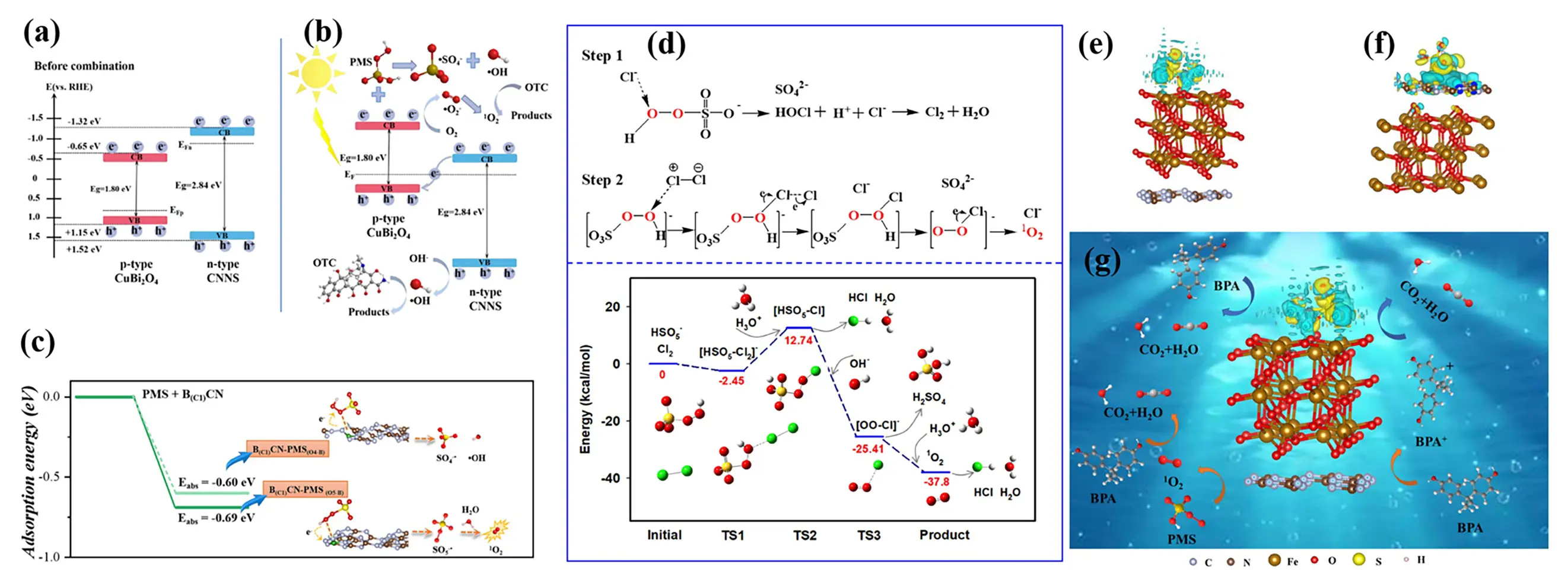
Figure 2. (a) The band structure diagrams of CuBi2O4 and CNNS; (b) The possible degradation mechanism in the 10% CNNS/CuBi2O4 + PMS + Vis system. 25 unique mechanisms of reactive species production from PMS activation by the free-metal BCN could be proposed in (c), (d) Proposed mechanisms of 1O2 formation from the interaction of PMS and Cl− in aqueous solution. (e,f) charge density difference in Fe2O3/g −C3N4−2; (g) possible mechanism of contaminant degradation in the PMS/Fe2O3/g−C3N4−2 system. Reprinted from ref. [69]. Reprinted from ref. [70]. Reprinted from ref. [71]. Reprinted from ref. [72].
3.1. Band Matching and PMS Activation Thrmodynamics
The thermodynamic feasibility of photocatalytic activation of peroxymonosulfate (PMS) relies on the relationship between the band positions of the semiconductor and the redox potential of PMS. For the transfer of electrons from the conduction band to PMS to be thermodynamically favorable, the conduction band minimum (CBM) must be more negative than the reduction potential of PMS (E0 (HSO5−/SO4•−) = +1.82 V vs. NHE) [69]. Both TiO2 (CBM ≈ −0.3 V vs. NHE) and g-C3N4 (CBM ≈ −1.2 V vs. NHE) meet this criterion; however, g-C3N4 provides a stronger driving force for electron reduction due to its more negative conduction band position. Wide-bandgap semiconductors, such as TiO2 (Eg ≈ 3.2 eV), are thermodynamically feasible but can only be excited by ultraviolet light, which restricts the utilization of visible light. The valence band maximum (VBM) plays a critical role in the oxidative activation of peroxymonosulfate (PMS). If the VBM exceeds the oxidation potential of PMS, holes can directly oxidize PMS to generate SO5•−. Bi-based oxides, such as Bi2WO6, which has a VBM of approximately +3.0 V vs. NHE, demonstrate a strong capacity to oxidize PMS through hole-mediated processes due to their highly positive VBM. Consequently, the ideal objective in photocatalyst design is to create a material whose band positions fulfill the dual requirements of reducing PMS via the conduction band and oxidizing PMS via the valence band.
3.2. Carrier Separation and PMS Activation Kinetics
Thermodynamic feasibility serves as a prerequisite; however, the migration rate of photo-generated charge carriers to the PMS molecules at the interface constitutes the kinetic bottleneck that dictates PMS activation efficiency. The rapid recombination of photo-generated electrons and holes, both in the bulk and at the surface, primarily limits the efficiency of photocatalytic PMS activation [73]. Previous studies demonstrate that surface modification strategies, including co-catalyst loading and oxygen/nitrogen vacancy defect engineering, effectively promote carrier separation and accelerate electron transfer to the PMS [70]. Introducing nitrogen vacancies into g-C3N4 nanosheets creates intermediate energy levels within the bandgap, which significantly enhances carrier separation efficiency and reduces interfacial charge transfer resistance [72].
The construction of heterostructures represents a crucial strategy for effectively coupling carrier separation with PMS activation. A heterojunction formed between two semiconductors with compatible bandgap widths and band positions generates an intrinsic electric field that drives photo-generated electrons and holes to migrate in opposite directions, thereby effectively suppressing carrier recombination [73]. Transient photocurrent response measurements and electrochemical impedance spectroscopy (EIS) serve as the most direct electrochemical methods for evaluating carrier separation efficiency and interfacial charge transfer performance. Additionally, time-resolved fluorescence spectroscopy and surface photovoltage spectroscopy provide insights into carrier transport kinetics across various time scales.
3.3. Competition Mechanism Between Free Radical and Non-Radical Pathways
In a photocatalytically activated PMS system, the competition between radical pathways (SO4•−, •OH, O2•−) and non-radical pathways (1O2, high-valent metal oxygen species, direct electron transfer) determines the degradation mechanism and mineralization efficiency [71]. This competitive relationship is regulated by the surface properties of the catalyst and the reaction conditions. The electron density and types of defects at the active sites on the catalyst surface decisively influence the adsorption configuration of PMS. Metal-center sites with unsaturated coordination tend to adsorb PMS through terminal oxygen, which promotes the heterolytic cleavage of the O–O bond, resulting in the formation of high-valent metal-oxygen species. In contrast, defect sites with lower electron density typically adsorb PMS via side oxygen, leading to homolytic cleavage and the formation of SO4•− [72]. Among the operational parameters, pH and PMS concentration exert the most significant effects. Under weakly alkaline conditions (pH = 8), the decomposition rate of PMS decreases, leading to an increased contribution from non-radical pathways, such as 1O2 and electron transfer. Dissolved oxygen concentration indirectly influences 1O2 production by regulating the generation of O2−. Precise control of the reaction pathways holds significant engineering importance for enhancing treatment efficiency and optimizing PMS utilization. While the radical pathway exhibits high reactivity, it is vulnerable to quenching by the aquatic matrix. In contrast, the non-radical pathway demonstrates considerable resistance to interference but has relatively low mineralization efficiency. The synergy between these two pathways is anticipated to yield optimal degradation outcomes.
4. Heterojunction Photocatalytic System Coupled with PMS Activation
Research on the photocatalytic activation of peroxymonosulfate (PMS) indicates that single-semiconductor photocatalysts typically encounter challenges, including high rates of photo-generated carrier recombination and limited PMS activation efficiency. Constructing heterostructures serves as a crucial strategy to overcome these limitations. Heterojunctions can be categorized into three primary types based on variations in band alignment and charge transfer pathways: Type-II, Z-scheme, and S-scheme [74,75]. Each configuration offers a unique basis for material design, facilitating PMS activation through distinct mechanisms of carrier separation.
4.1. Carrier Separation and PMS Activation of Type-II Heterojunction System
A Type-II heterojunction comprises two semiconductors with distinct bandgap widths and band positions. Upon photoexcitation, electrons in the conduction band migrate from semiconductor I, which possesses a more negative potential, to semiconductor II, characterized by a more positive potential. Concurrently, holes in the valence band move in the opposite direction toward semiconductor I, facilitating space charge separation. In this arrangement, electrons accumulate in semiconductor II, which exhibits a lower absolute value of the conduction band minimum (CBM), leading to a reduced reducing capacity; nonetheless, this capacity remains adequate to reduce PMS and generate SO4•−. For instance, in the Bi2WO6/BiOCl heterojunction, the CBM of Bi2WO6 (approximately +0.46 V vs. NHE) is more positive than that of BiOCl (approximately −1.0 V vs. NHE). Following the transfer of photo-generated electrons from BiOCl to the conduction band of Bi2WO6, these electrons effectively activate PMS, resulting in a degradation rate constant for tetracycline that is 4 times greater than that of pure Bi2WO6 (Figure 3a,b). The 2D/2D g-C3N4/BiOBr heterojunction significantly accelerates inter-interface carrier transport due to its large-area contact interface (Figure 3e). Similarly, the 2D/2D g-C3N4/BiOBr heterojunction significantly accelerates the cross-interface transfer of charge carriers through a large-area contact interface. The kinetic constant for PMS activation to degrade sulfamethoxazole under visible light is increased by several times compared with those of g-C3N4 and BiOBr monomers, respectively (Figure 3c,d). However, the inherent limitation of Type-II heterojunctions, dictated by their sacrificial redox potential, results in reactive oxygen species (ROS) that are predominantly SO4•− and OH−, with relatively limited contributions from non-radical pathways. This limitation may constrain their effectiveness in water bodies characterized by high matrix interference.
4.2. Applicability Boundaries and Cross-Interference of Reactive-Species Identification Methods
The assignment of radical versus non-radical contributions in photocatalysis-coupled PMS systems relies mainly on three families of methods: quenching (scavenging) experiments, EPR spin trapping, and probe-compound assays. Each method has applicability boundaries, and evidence from a single method is prone to cross-interference [76]. Quenching experiments infer the contribution of a species from the suppression of degradation after a selective scavenger is added; their reliability depends on the ratio of the scavenger rate constants toward the target and the interfering species. Methanol is often used to scavenge both SO4•− and •OH, but its ability to distinguish them is limited: its rate constant with •OH (about 109 M−1s−1) exceeds that with SO4•− (about 107 M−1s−1) by only about two orders of magnitude, so methanol suppression can serve only as qualitative evidence for a radical pathway and cannot apportion the two radicals [77]. tert-Butanol is more selective for •OH and is often combined with methanol to distinguish •OH from SO4•−, yet its own competing reaction with the target still requires control experiments.
The identification of 1O2 suffers similar interference. Common 1O2 quenchers such as furfuryl alcohol, sodium azide and histidine react directly with PMS and are consumed, so suppressed degradation can reflect depletion of the oxidant rather than 1O2 quenching [78]. In carbon-based/PMS systems, furfuryl alcohol inhibition is more closely related to its competing reaction with SO4•−, which tends to overestimate the 1O2 contribution; conclusions that distinguish 1O2 from mediated electron transfer on the basis of scavenger experiments therefore need reassessment [79,80]. EPR spin trapping identifies radicals from the hyperfine splitting of the adducts formed with spin traps such as DMPO, but the DMPO-OH signal can also arise from direct oxidation or nucleophilic addition of DMPO, and a weak or absent signal cannot exclude the presence of radicals, so the assignment of SO4•− versus •OH remains uncertain [76,81].
In view of these limitations, a multi-technique evidentiary standard is recommended for reactive-species assignment: the conclusion that a species dominates should be supported by at least two mutually independent techniques (for example, quenching combined with EPR, or probe-compound kinetics combined with in situ spectroscopy), reported under identical reaction conditions with the scavenger concentration, dosing order and control experiments stated. For high-valent metal-oxo species and electron-transfer pathways, conventional quenching experiments provide little reliable evidence, and in situ Raman spectroscopy, isotope labeling, electrochemical impedance, and competition kinetics are needed to constrain them. Where direct evidence is lacking, the relevant species are better described as possible or minor, rather than assigning precise contributions that cannot be verified [76,77].
4.3. Z-Scheme Heterojunction Coupled PMS Activation
In a Z-scheme heterojunction, photo-generated electrons from Semiconductor I recombine with photo-generated holes from Semiconductor II through a conductive medium, such as Au, Ag, conductive carbon materials, or direct contact at the solid-state interface. This process retains the strongly reducing electrons from Semiconductor II and the strongly oxidizing holes from Semiconductor I, thereby achieving both high reducing and high oxidizing capabilities simultaneously [17]. This configuration offers a broader potential window for multi-path activation of PMS. The strong reducing electrons on the Semiconductor II side can efficiently reduce PMS to produce SO4−·, while the strong oxidizing holes on the Semiconductor I side can directly oxidize PMS to generate SO5•−, which is subsequently converted to H2O2.
The C-LaFeO3/Co-doped g-C3N4 direct Z-scheme heterojunction facilitates Z-type carrier migration via direct solid-state interface contact. Under visible light, the reaction rate constant for PMS-catalyzed tetracycline degradation is 7 times greater than that of the dark-state PMS system, with •OH and SO4•− acting as the primary active species (Figure 3f,g). The primary challenges in Z-scheme configurations involve the encapsulation strategy for the conductive medium and the optimization of ohmic contacts at the interface. Inadequate interface engineering can lead to carrier recombination within the conductive medium instead of facilitating conduction across the interface, ultimately diminishing photocatalytic efficiency.
4.4. Interface Electronic Control and PMS Activation of S-Scheme Heterojunction
The S-scheme heterojunction (Step-scheme) represents a novel type of heterostructure that has gained attention in recent years. Its defining characteristic is the intrinsic electric field generated at the interface between two n-type semiconductors, which results from the disparity in their Fermi levels. Before contact, the oxidized photocatalyst (OP) possesses a positive band gap and a lower Fermi level, whereas the reduced photocatalyst (RP) exhibits a negative band gap and a higher Fermi level. Following contact, electrons flow spontaneously from the RP to the OP until the Fermi levels reach equilibrium, thereby establishing an intrinsic electric field at the interface that directs from the RP to the OP [82]. The built-in electric field drives the recombination of excess electrons in the OP conduction band with excess holes in the RP valence band, while retaining the most reducing electrons in the RP conduction band and the most oxidizing holes in the OP valence band. This process achieves optimal kinetic and thermodynamic conditions for PMS activation.
The MnFe2O4/MoS2 S-scheme heterojunction achieves 89.57% efficiency in degrading ofloxacin through PMS activation under visible light (Figure 3h–j). DFT calculations indicate that Fe–S bonds at the interface reduce the carrier migration barrier, thereby accelerating electron transfer from the MoS2 conduction band to MnFe2O4. Reports of comparable systems are accumulating: a 1D/2D CoNi-LDH/ZnIn2S4 S-scheme heterojunction degrades tetracycline more efficiently than its single components under photocatalytic-PMS activation [33]; BiVO4/Cu-TCPP accelerates carrier transport through an interfacial built-in field for ultrafast ciprofloxacin degradation [83]; and MoO3−x@MoS2 strengthens PMS activation through oxygen vacancies and Mo4+/Mo5+/Mo6+ redox cycling [84]. The common feature of these systems is that the interfacial built-in field retains the most reducing conduction-band electrons and the most oxidizing valence-band holes, making both the reductive generation of SO4•− and the oxidative generation of SO5•− accessible [85].
The three heterojunction configurations differ systematically in PMS activation pathway selectivity [86]. Type-II heterojunctions rely on spatial charge separation, with electrons and holes migrating to band positions of reduced reducing and oxidizing power, so the reactive oxygen species are dominated by radicals such as SO4•− and •OH, with limited driving force for non-radical pathways such as high-valent metal-oxo species and 1O2. Z-scheme heterojunctions broaden the ROS spectrum by retaining strongly reducing electrons and strongly oxidizing holes, and radical and non-radical pathways often coexist; metal-based Z-scheme systems frequently show higher SO4•− and 1O2 contributions [17], whereas metal-free Z-scheme systems (such as PPy/MCN) maintain the synergy of photocatalysis and PMS activation while avoiding metal leaching [87]. S-scheme heterojunctions further exploit a Fermi-level-driven interfacial built-in field to retain strong redox capability and improve carrier utilization, often giving higher SO4•− yields and a more pronounced direct hole-oxidation contribution. The differences can be summarized as follows: Type-II excels at separation efficiency at the cost of redox potential; Z-scheme excels at potential retention but depends on interface contact quality; S-scheme attempts a balance, and whether its gain materializes depends on the strength and stability of the interfacial built-in field.
Heterojunction photocatalytic systems coupled with PMS activation combine clear advantages with notable limitations. The advantage lies in band-aligned spatial charge separation, which raises PMS activation and photo-generated carrier utilization without increasing oxidant dosage and allows the ROS spectrum to be tuned by configuration choice. The limitations center on a strong dependence on interface quality: interface defects, lattice mismatch, and imperfect encapsulation of the conductive medium cause carriers to recombine at the interface rather than migrate directionally; the potential sacrifice of Type-II, the interface-engineering complexity of Z-scheme and the requirement for built-in-field stability in S-scheme jointly limit reliability in long-term operation. Open questions include how to confirm the actual charge-transfer pathway of the Z-scheme and S-scheme at the atomic scale rather than inferring it from band positions, how to keep the interface stable in real water, and how to establish a quantitative correspondence between configuration and PMS activation pathway selectivity [85,86].
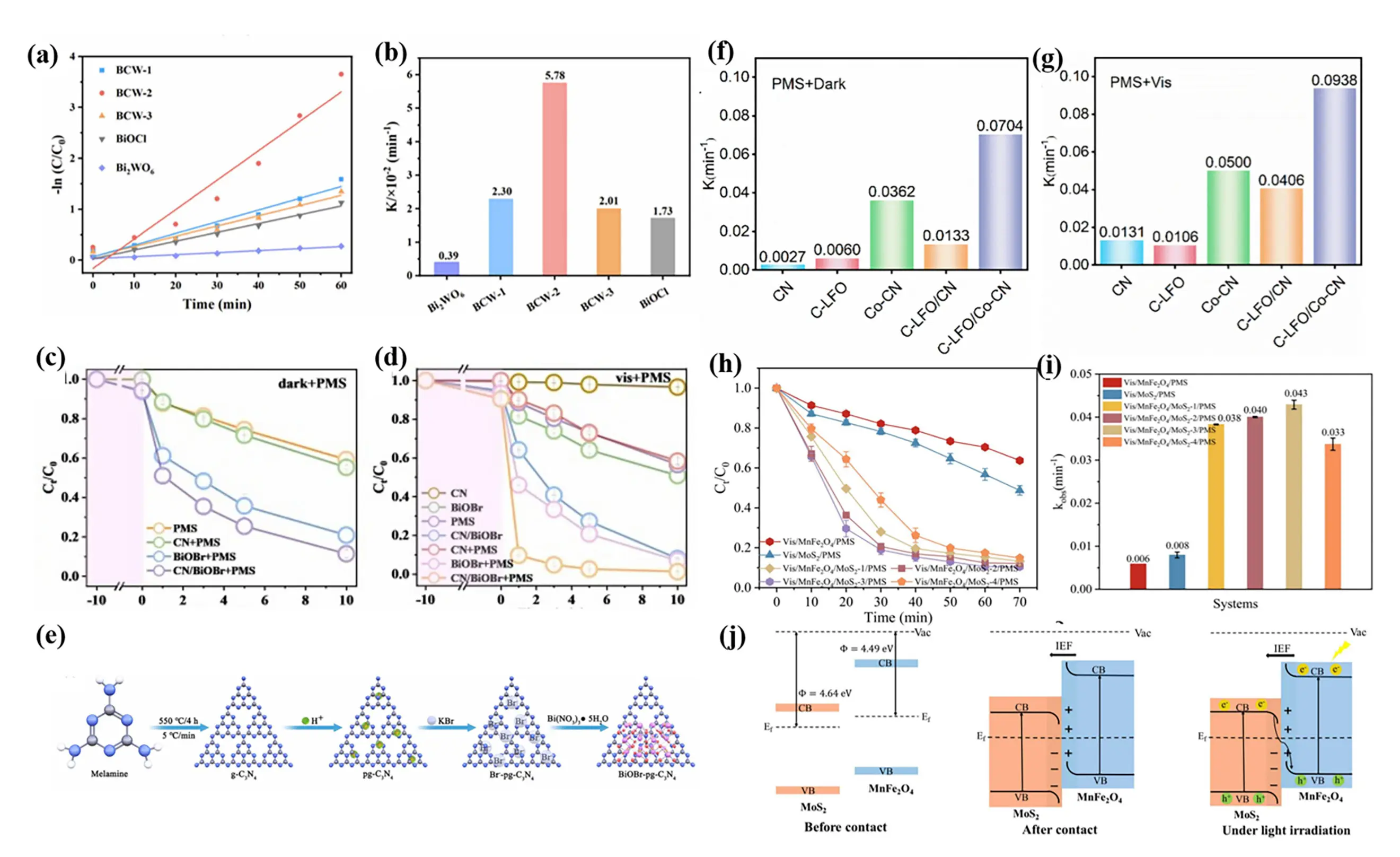
Figure 3. (a) Pseudo−first−order kinetic fitting curves for different samples; (b) Apparent rate constants for all samples; Degradation effects of different catalytic systems (c) in dark conditions and (d) under visible light irradiation. (e) Schematic diagram illustrating the synthesis of CN/BiOBr heterojunction. Apparent degradation rate constants of NOR within the initial 30 min over different catalysts under various activation conditions: (f) PMS activation, and (g) combined PMS-Vis activation. Ofloxacin degradation efficiencies (h) and kobs values (i); schematic diagram of the band configuration before contact, after contact in the dark, and photo-generated charge carrier transfer process (j). Reprinted from ref. [74]. Reprinted from ref. [75]. Reprinted from ref. [17]. Reprinted from ref. [82].
5. Single-Atom and Di-Atom Catalytic Photosystems
Single-atom catalysts (SACs) exhibit 100% atomic utilization efficiency of metal atoms and allow for precisely controllable coordination environments, positioning them at the forefront of atomic-level catalyst design [88]. In the field of photocatalytic coupling for PMS activation, single-atom catalysts (SACs) achieve selective control over activation pathways by transitioning from radical-mediated to non-radical-mediated mechanisms, which include high-valent metal-oxygen species, singlet oxygen (1O2), and electron transfer. This unique electronic structure has facilitated significant advancements in recent years [89,90]. This section addresses three key aspects: the regulation of activation pathways by the coordination environment, the relationship between the type of metal center and activation selectivity, and the phenomenon of diatomic synergy.
5.1. Regulation of PMS Activation Pathways by Coordination Environment
The coordination environment at a single-atom site directly influences the adsorption configuration of PMS and the O–O bond cleavage pathway by modulating the electron density and the position of the d-band center of the metal center [91,92]. Using a single Co atom as an example, the Co–N4 coordination configuration exhibits a moderate d-band center for Co. In this arrangement, PMS tends to adsorb at the Co site through terminal oxygen, which facilitates the heterolytic cleavage of the O–O bond and results in the formation of the higher-valent Co(IV)=O species instead of the SO4•− radical. When the coordination environment shifts to Co–N3, the increased coordination unsaturation diminishes the electron density of Co, prompting the PMS adsorption configuration to transition toward a side-oxygen mode. This change enhances homolytic O–O bond cleavage and fosters the formation of radical pathways. Coordination engineering of Fe single atoms demonstrates similar regulatory patterns: Fe–N4 sites typically yield the higher-valent Fe(IV)=O species, while Fe–N2O2 or Fe–N3 sites are more inclined toward radical pathways [93]. Consequently, designing the coordination environment emerges as a crucial strategy for precisely regulating PMS activation pathways.
5.2. Metal Center Types and Activation Selectivity
Different transition metal single-atom sites demonstrate distinct selectivity for the activation of peroxymonosulfate (PMS). Experimental results and density functional theory (DFT) calculations indicate that cobalt (Co) single-atom sites predominantly facilitate non-radical pathways through the mediation of high-valent Co(IV)=O species [94]. In contrast, iron (Fe) single-atom sites exhibit the ability to switch flexibly between radical and non-radical pathways, influenced by the coordination environment and pH conditions. Under acidic conditions, high-valent Fe(IV)=O species are predominant, while under basic conditions, the contribution of singlet oxygen (1O2) increases [93]. The high redox cycling activity of Cu(I)/Cu(II) allows Cu single-atom sites to primarily activate peroxymonosulfate (PMS) through a radical pathway. In contrast, Ni–N4 single-atom sites activate PMS via a dual, non-radical synergistic pathway involving direct electron transfer and high-valent Ni(IV)=O species. This mechanism demonstrates exceptionally high atomic efficiency and PMS utilization in the degradation of sulfamethoxazole [95]. Conversely, Mn single-atom sites show relatively low activation activity due to the instability of the Mn(III)/Mn(IV) cycle [96,97].
These conclusions on metal-center selectivity come from two distinct evidence sources, and distinguishing them helps to judge the reliability of the conclusions. Some rest primarily on density functional theory (DFT) calculations, which predict pathway selectivity by comparing the PMS adsorption energy, d-band center, and O–O bond activation barrier across metal sites [98]. Others are supported by experiment, including X-ray absorption spectroscopy (XANES/EXAFS) and aberration-corrected electron microscopy to confirm single-atom site structure, in situ spectroscopy to trap high-valent metal-oxo species, and isotope labeling to trace oxygen-transfer pathways. For Co–N4 sites, the mechanism of selective oxidation via radical and non-radical pathways was established by experiment and theory together [99]; whereas the study of Cu single atoms activating PMS for oxytetracycline degradation relied mainly on structural characterization by XANES/EXAFS [100]. Because both purely theoretical and experimentally validated systems coexist in the literature, the evidence type should be noted when citing pathway-selectivity conclusions.
5.3. Diatomic Synergistic Effect and Ultra-Efficient PMS Activation
Dual-atom catalysts (DACs) overcome the linear proportionality constraints associated with single-atom sites by leveraging electronic synergy between neighboring metal centers. This synergy enhances the overall processes of PMS adsorption, activation, and electron transfer. The strong electronic coupling between Fe and Co in the Fe–Co bimetallic catalyst (FeCoN6) produces a synergistic effect akin to that observed in natural enzyme catalysis. In this system, Co sites preferentially adsorb peroxymonosulfate (PMS) and facilitate its activation, while Fe sites sustain the high-activity state of the Co sites through electronic regulation. This synergistic mechanism induces a novel surface collision oxidation pathway, leading to an electron transfer efficiency of nearly 100% for PMS [101]. An MXene-based Fe–Co metal pair array facilitates the directed cleavage of O–O bonds in PMS through asymmetric coordination, thereby enabling selective control over the formation pathways of high-valent metal-oxygen species [102]. A synergistic system comprising Co single atoms and clusters modulates the electronic structure of the single-atom Co sites through the clusters, resulting in ultra-high PMS utilization and enhanced antibiotic degradation rate constants [103].
6. MOF/COF-Based and Metal-Free Photocatalytic Systems
Metal-organic frameworks (MOFs) and covalent organic frameworks (COFs) serve as unique photocatalytic platforms for activating peroxymonosulfate (PMS) because of their tunable pore structures, high specific surface areas, and customizable metal/ligand compositions. In contrast, metal-free photocatalysts, such as g-C3N4 and its derivatives, do not contain metal components, which eliminates the problem of metal leaching. Recently, defect engineering and heteroatom doping have successfully broadened their response range to visible light [70,104].
6.1. MOF-Based Photocatalytic Activation of PMS
The primary advantage of metal-organic frameworks (MOFs) in the photocatalytic coupling of peroxymonosulfate (PMS) activation is that, upon illumination, ligand-to-metal charge transfer (LMCT) occurs at metal-oxygen cluster nodes. This process results in the in situ reduction of high-valent metal ions, such as Fe(III) to Fe(II) and Ti(IV) to Ti(III), thereby accelerating the metal redox cycle and enhancing PMS activation (Figure 4a–c) [105]. Bimetallic metal-organic frameworks (MOFs), such as CuCo-MOF, achieve enhanced activation of peroxymonosulfate (PMS) through the synergistic interaction of two metal sites (Figure 4d–f). The copper site functions as the primary photo-generated electron acceptor, whereas the cobalt site acts as the catalytic active center for PMS activation. This spatial synergy improves both electron transfer efficiency and the rate of PMS activation (Figure 4g,h) [106].
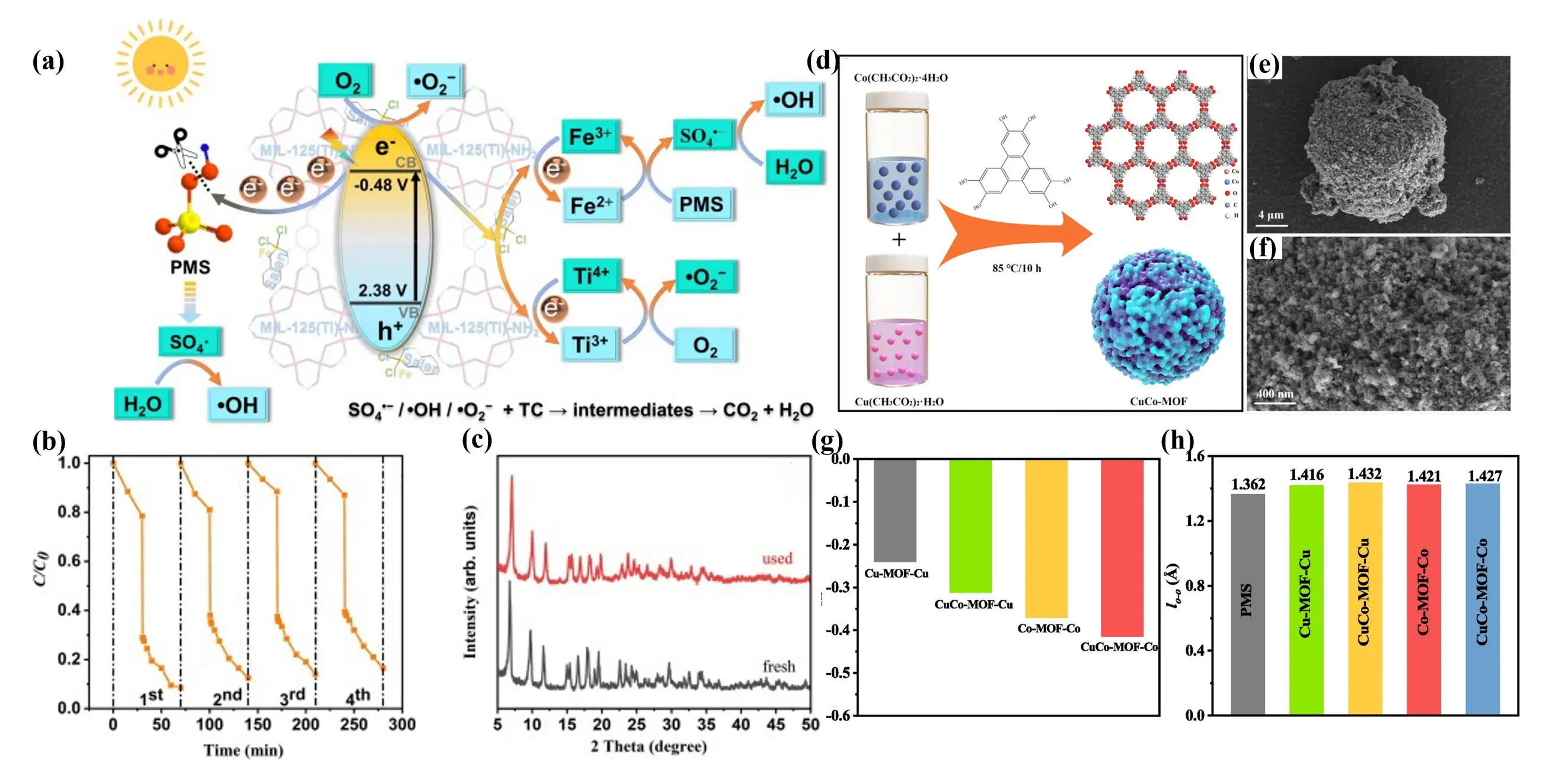
Figure 4. (a) Possible mechanism for TC degradation by MSF/PMS/Light system. (b) Reusability experiments over MIL−125(Ti) −NH2−Sal−Fe for TC degradation. Condition: [photocatalyst] = 0.1 g/L, [PMS] = 0.7 mM, pH = 4.5 and [TC] = 0.02 g/L; (c) PXRD patterns; (d) Schematic illustration for the preparation of CuCo-MOF. (e,f) SEM images of CuCo-MOF at different magnifications; (g) Adsorption energy of PMS on metal sites of different structures; and (h) bond length of peroxy bonds (lO–O) in the PMS. Reprinted from ref. [105]. Reprinted from ref. [106].
MOF-derived carbon materials retain the pore structure of MOFs through high-temperature carbonization and incorporate nitrogen doping, resulting in excellent electron-transfer performance during PMS activation [107]. However, Single-atom and diatomic catalytic photosystems offer advantages and limitations. The advantages are near-100% atomic utilization, a well-defined active-site structure that supports atomic-level structure-activity relationships and selective control from radical toward non-radical pathways, and diatomic synergy that overcomes the proportional-relationship constraint of a single metal site. The limitations are that single-atom sites are prone to aggregation and loss in long-term oxidizing environments, with stability highly sensitive to the support and coordination environment; that the high-selectivity conclusions often depend on a combination of DFT predictions and in situ characterization, and differences in computational models and experimental conditions hamper cross-study comparison; and that synthesis cost and scale-up remain practical obstacles. Open questions include the long-term stability mechanism of single-atom sites in real water, direct experimental evidence for the diatomic synergistic electron-transfer pathway, and translating high-selectivity mechanisms into scalable synthesis processes.
6.2. Metal-Free Photocatalyst Defects and Doping Engineering
As a representative metal-free visible-light catalyst, g-C3N4 attracts significant attention in the field of photocatalysis-PMS coupling due to its tunable electronic structure and thermal and chemical stability. However, the photocatalytic activity of pristine g-C3N4 is constrained by a high rate of photo-generated carrier recombination and a narrow range of visible-light absorption. Defect engineering and heteroatom doping serve as effective strategies for enhancing the performance of g-C3N4 in activating peroxymonosulfate (PMS). Introducing nitrogen vacancies generates defect states within the g-C3N4 bandgap, enhancing the n→π* electronic transition and extending visible-light absorption beyond 600 nm. Concurrently, the adsorption energy of PMS at these defect sites decreases significantly, resulting in a notable improvement in PMS activation efficiency [70]. Boron doping shifts the conduction band position of g-C3N4 upward, which enhances the reducing ability of the conduction band electrons and increases the thermodynamic driving force for the reduction of PMS to SO4•− as a result of PMS reduction. As a homologue of g-C3N4, g-C3N5 exhibits superior light absorption and PMS activation capabilities compared to g-C3N4 in visible-light-PMS coupling systems. This superiority arises from its narrower bandgap (approximately 1.9 eV) and more negative conduction band potential [108]. Furthermore, g-C3N4 modified with carbon quantum dots (CQDs) significantly enhances carrier separation via interfacial charge transfer. Nevertheless, the overall catalytic activity of the metal-free catalyst remains considerably lower than that of the metal-based catalyst, particularly evident in the differences in the PMS activation rate constant and the pollutant mineralization rate. The accurate identification of atomic-level active sites, along with the stability challenges associated with high vacancy concentrations, continues to pose significant bottlenecks.
MOF/COF-based and metal-free photocatalysts offer tunable pores, designable composition, and environmental friendliness, alongside clear limitations. The advantage is that MOFs allow molecular-level design of the light response and active sites through their metal nodes and linkers, while metal-free catalysts avoid metal leaching at the source; the limitations are that MOF hydrolytic stability and photocorrosion restrict long-term operation, and metal-free catalysts lag metal-based systems in catalytic activity, active-site density, and mineralization. Open questions include quantitative stability data for MOF/COF under PMS oxidation (rather than activity retention over only a few cycles), on-line monitoring methods for photocorrosion and metal leaching, and accurate identification of active sites in metal-free catalysts together with the stability trade-off posed by high vacancy concentrations.
7. Advantages, Boundaries and Challenges of Photocatalytic Coupling Systems
Building on the systematic review of classical activation pathways and diverse photocatalytic coupling systems, including heterojunctions, single-atom/dual-atom catalysis, MOF/COF-based systems, and metal-free systems, this section evaluates the optimal boundaries and applicable conditions for PMS activation through photocatalytic coupling. This evaluation is conducted from three perspectives: quantification of synergistic effects, analysis of key bottlenecks, and development of mitigation strategies.
7.1. Quantification of Synergy Effects and Applicable Conditions
The synergy factor (SF = kphoto+PMS/(kphoto + kPMS)) compares the apparent rate constant of the combined system with the sum of the rate constants of the two individual processes, to test whether coupling produces an additional gain; an SF greater than 1 indicates positive synergy [109]. The definition presumes that kphoto, kPMS and kphoto+PMS are measured under identical light, oxidant dose and water matrix, and that photocatalysis and PMS activation are independent and additive. When these premises fail, the physical meaning of SF becomes unclear: the denominator is the sum of two single-process rate constants, and although its dimension matches the numerator, the ratio deviates from the true degree of synergy when kphoto is measured in the dark or at a different light intensity. Moreover, SF is defined inconsistently across studies, some using the ratio of rate constants, some the ratio of removal efficiencies, and some a fold-increase relative to a single process, so cross-study comparison lacks a common basis [81]. SF is therefore best used as a relative index within a single study, not as an absolute criterion across systems or literature.
7.2. Supplementary Performance Indicators
Because of these limitations, SF alone is insufficient to judge the merit of a coupled system, and several complementary indicators are needed [109]. Apparent quantum efficiency (AQE, the ratio of reacting electrons to incident photons) reflects the utilization of light energy and can be measured at a defined wavelength and light intensity, allowing cross-system comparison of the intrinsic activity of the photocatalytic part; its value depends on the light spectrum, scattering, and reactor geometry, so the incident wavelength and the photon-flux measurement method must be stated [14]. PMS utilization efficiency, defined as the amount of target degraded or mineralized per mole of PMS consumed, directly reflects oxidant economy and can be calculated from residual-PMS measurements, with related indicators including net oxidant utilization and reaction stoichiometric efficiency [110,111]; improving PMS utilization efficiency requires suppressing the self-scavenging side reaction between SO4•− and excess PMS, which is an important cause of the low mineralization efficiency of the radical route [112]. TOC removal reflects the degree of deep mineralization and is a necessary indicator of product toxicity and complete removal, and should be reported alongside the parent-compound degradation. Notably, not all coupled systems show positive synergy: when the PMS dosage is too high, or the illumination is mismatched, a negative synergy with SF below 1 can occur, in which case the above supplementary indicators more accurately reflect the practical value of the system [113].
7.3. Key Bottlenecks and Coping Strategies
As photocatalytic PMS-coupled systems advance toward practical applications, they encounter the challenge of addressing the coupled “triple bottleneck” of photochemistry and engineering. The first issue is the kinetic conflict between the recombination of photo-generated charge carriers and PMS activation. Although PMS serves as an electron acceptor that can enhance charge carrier separation, insufficient PMS concentration or adsorption rates result in charge carrier recombination becoming the dominant competitive process, which significantly reduces photocatalytic activity. Strategies to mitigate this bottleneck include accelerating interfacial electron transfer through atomic-level control methods, such as coordination engineering and defect modification [93], as well as developing carrier materials with a strong capacity for PMS adsorption.
Second, the long-term operational stability of photocatalysts presents a significant challenge. MOF-based and certain metal oxide catalysts exhibit susceptibility to photocorrosion and metal leaching when exposed to light and the oxidizing environment of PMS, resulting in a gradual decrease in catalytic activity. Surface protective layers, such as SiO2 or carbon coatings, along with defect passivation techniques, effectively address this issue. For instance, a carbon-coated CoFe2O4 core-shell structure retains high catalytic activity even after multiple cycles.
Third, the engineering challenges associated with transitioning from laboratory-scale batch reactors to continuous-flow systems are significant. Currently, most photocatalytic PMS studies occur in idealized batch reactors, where pollutant concentrations typically range in the mg/L scale. However, the complex background components present in real wastewater matrices, including natural organic matter, anions, and suspended solids, exert a substantial quenching effect on reactive oxygen species (ROS). The development of continuous-flow photocatalytic membrane reactors, along with ultrasonic and microwave-assisted process intensification, has emerged as a key strategy for addressing these engineering bottlenecks [114].
7.4. Real Water Matrix Adaptability and Scale-Up Validation
Photocatalytic PMS-coupled systems are usually tested in pure water at mg/L pollutant levels, whereas anions, natural organic matter (NOM), and suspended solids in real water matrices interfere with reactive species and change degradation performance. Chloride is common in real water and is oxidized by SO4•− and •OH to generate reactive chlorine species (RCS) such as Cl• and Cl2•−, whose redox potential and selectivity differ from those of SO4•−; low Cl− concentrations can promote degradation, whereas high concentrations quench radicals and may generate chlorinated by-products [115,116]. Bicarbonate and carbonate scavenge SO4•− and •OH to form carbonate radicals (CO3•−), a weak oxidant, so that the removal of electron-rich pollutants is inhibited. The relative magnitude and direction of these effects depend on anion concentration, pH, and the dominant reactive species, so anion tolerance should be evaluated by concentration-gradient experiments in a real matrix rather than by pure-water kinetics alone.
NOM quenches SO4•− and •OH by competing for photons and radicals, and it also adsorbs on the catalyst surface to occupy active sites and further inhibits degradation; the resulting matrix effect is often the main reason that activity in real water falls below that in pure water [117]. Because NOM and inorganic anions act simultaneously, their combined effect cannot be extrapolated from single-component experiments, which highlights the need for systematic evaluation in real matrices.
Continuous-flow photocatalytic membrane reactors are an important route to engineering scale-up, but membrane fouling and catalyst leaching are the main obstacles. Fouling from NOM, colloids, and biomass covered the membrane surface, increases transmembrane pressure, and reduces permeate flux, while light screening by the cake layer reduces the photon flux reaching the photocatalyst. For immobilized catalysts, the loss of catalyst particles through detachment and metal leaching into the effluent raises the questions of whether the effluent meets discharge standards and whether the process is economically viable; a solution retaining low metal leaching and stable activity over a long-flow test has been reported, but such data are still scarce [118,119]. We recommend that future work report transmembrane-pressure rise, flux decline, catalyst-loss rate and the long-term change of leached-metal concentration together, so that membrane fouling and catalyst stability can be reasoned about jointly, and that a fouling-control and catalyst-regeneration protocol be adopted.
8. Conclusions and Outlook
This review systematically summarizes the research progress in antibiotic degradation in water through photocatalytic coupling with Persulfate (PMS) activation. It employs a three-dimensional analytical framework that includes “catalytic mechanism type, photocatalytic material system-reactive oxygen species generation pathway”. The primary conclusions are as follows:
Classical pathways for activating Persulfate (PMS), including transition-metal catalysis, carbon-based material catalysis, physical energy field activation, and electrocatalysis, break O–O bonds in PMS through distinct physicochemical mechanisms. These processes primarily generate reactive oxygen species (ROS), such as SO4•−, OH, and H2O2. The diversity and limitations of these mechanisms provide a crucial reference framework for assessing photocatalytic coupling pathways. Transition-metal catalysis demonstrates high efficiency but poses a risk of metal leaching. In contrast, carbon-based materials are environmentally friendly yet exhibit limited mineralization capacity. Physical activation operates under mild conditions but is energy-intensive, while electrocatalytic activation offers high controllability, although the costs associated with electrodes restrict its large-scale application.
The electron transfer mechanism for photocatalytic activation of PMS involves three progressive levels: thermodynamic band alignment, kinetic carrier separation, and radical/non-radical competition. The dual driving force of photo-generated electrons and holes offers unique advantages for PMS activation, distinguishing it from classical dark activation. Heterojunction engineering, including Type-II, Z-scheme, and S-scheme configurations, has significantly improved PMS activation efficiency through various carrier-separation strategies. Among these, the S-scheme heterojunction attains the optimal balance between strong redox capacity and separation efficiency. The three configurations differ systematically in PMS activation pathway selectivity, and the S-scheme advantage should be judged by actual radical/non-radical contributions rather than removal efficiency alone.
The introduction of monoatomic and diatomic catalysts advances the selective control of Persulfate (PMS) activation with atomic-level precision. The coordination environment of monoatomic sites determines the adsorption configuration of PMS and the pathway for O–O bond cleavage. Additionally, diatomic synergistic effects overcome the limitations imposed by the stoichiometric ratio of a single site, facilitating an electron transfer pathway that approaches 100%. This strategy exemplifies the forefront of catalyst design for PMS activation.
MOF/COF-based and metal-free photocatalysts provide tunable pore structures and environmentally friendly alternatives for PMS activation. However, their overall catalytic activity and long-term stability require significant improvement. Defect engineering and heteroatom doping serve as effective strategies for enhancing the performance of metal-free catalysts; nonetheless, their catalytic activity continues to lag considerably behind that of metal-based catalysts, which constitutes the primary bottleneck.
The primary advantage of photocatalytic PMS coupling is its capacity to achieve antibiotic degradation efficiencies that surpass those of conventional systems under near-neutral pH, room temperature, and low PMS dosage conditions. When SF is defined consistently and measured under identical conditions, the reported synergy factors of coupled systems span roughly 1.3 to 7, depending on the material, oxidant dose, and water matrix; cross-study comparison is meaningful only once definition and conditions are aligned. However, the main challenges involve three key aspects: low photonic quantum efficiency, inadequate long-term catalyst stability, and difficulties in scaling up for engineering applications. These factors represent significant barriers to translating laboratory advancements into practical applications.
In the coming decade, several areas are poised for significant advancements. High-throughput rational catalyst design, leveraging DFT calculations and machine learning, is anticipated to substantially reduce the time required for material discovery and performance validation through computational screening. Additionally, the integration and optimization of photocatalytic-coupled PMS processes will focus on real wastewater matrices, specifically addressing the quenching effects of coexisting ions and natural organic matter on reactive oxygen species (ROS) in actual wastewater, and will establish quantitative links between matrix indicators (anion type and concentration, NOM aromaticity, turbidity) and degradation performance through batch-to-continuous validation. Furthermore, engineering demonstrations of solar-driven, carbon-neutral photocatalytic water treatment technologies will use solar energy as the sole energy input, aiming for zero carbon emissions during the PMS activation process, while addressing membrane fouling control, catalyst regeneration, and replacing noble-metal co-catalysts with earth-abundant alternatives in real water treatment.
Statement of the Use of Generative AI and AI-Assisted Technologies in the Writing Process
During the preparation of this manuscript, the authors used ChatGPT to assist with language polishing and grammar correction. After using this tool, the authors reviewed, revised, and edited the full content of the manuscript. All authors take full responsibility for the content of this published article.
Acknowledgments
The authors thank the College of Chemistry and Chemical Engineering, Northwest Normal University, for providing administrative and technical support. This research received no specific grant from any funding agency beyond that declared in the Funding section.
Author Contributions
W.D.: investigation, writing—original draft; H.S.: writing-revised draft; X.W.: writing—original draft; Z.G.: visualization; Q.W.: conceptualization, funding acquisition. All authors reviewed the results and approved the final version of the manuscript.
Ethics Statement
Ethical review and approval were waived for this study, as it is a review article that does not involve humans or animals.
Informed Consent Statement
Not applicable.
Data Availability Statement
The datasets generated during and analyzed during the current study are available from the corresponding author on reasonable request.
Funding
This work was financially supported by the Key Research and Development Program of Gansu Province (24YFFA060) and the Lanzhou Science and Technology project (2025-2-106).
Declaration of Competing Interest
The authors declare that they have no known competing financial interests or personal relationships that could have appeared to influence the work reported in this paper.
References
-
Barkat H, Nasrullah AR, Hussain M, Sheikh NUA, Amjad N, Shi DD, et al. Next generation bismuth-based photocatalysts for emerging water contaminants: Design principles and future directions. Coord. Chem. Rev. 2026, 562, 217954. DOI:10.1016/j.ccr.2026.217954 [Google Scholar]
-
Chen G, Yu Y, Liang L, Duan X, Li R, Lu X, et al. Remediation of antibiotic wastewater by coupled photocatalytic and persulfate oxidation system: A critical review. J. Hazard. Mater. 2021, 408, 124461. DOI:10.1016/j.jhazmat.2020.124461 [Google Scholar]
-
Singh A, Majumder A, Saidulu D, Bhattacharya A, Bhatnagar A, Gupta AK. Oxidative treatment of micropollutants present in wastewater: A special emphasis on transformation products, their toxicity, detection, and field-scale investigations. J. Environ. Manag. 2024, 354, 120339. DOI:10.1016/j.jenvman.2024.120339 [Google Scholar]
-
Sathish S, Madhu M, Muthu Prabhu S, Tseng WL. Emerging frameworks (MOFs/COFs) and selected carbon nanomaterials for the effective removal of per- and polyfluoroalkyl substances: Prospects and future directions. Coord. Chem. Rev. 2026, 553, 217560. DOI:10.1016/j.ccr.2025.217560 [Google Scholar]
-
Huang Z, Hu LX, Yang JB, Liu YH, He LY, Liu YS, et al. Suspect and Nontarget Screening of Sulfonamides and Novel Transformation Products in Pharmaceutical Wastewater-Contaminated Areas: Distribution, Migration, and Environmental Risks. Environ. Sci. Technol. 2025, 59, 15978–15989. DOI:10.1021/acs.est.5c06191 [Google Scholar]
-
Honarmandrad Z, Sun X, Wang Z, Naushad M, Boczkaj G. Activated persulfate and peroxymonosulfate based advanced oxidation processes (AOPs) for antibiotics degradation—A review. Water Resour. Ind. 2023, 29, 100194. DOI:10.1016/j.wri.2022.100194 [Google Scholar]
-
Aftab M, Haq Khan ZU, Shah NS, Ullah F, Khasim S. Advanced oxidation processes for pesticide degradation: A comprehensive review on the role of nano zero-valent metals and persulfate activation. RSC Adv. 2025, 15, 40619–40654. DOI:10.1039/D5RA06043E [Google Scholar]
-
Ding Y, Wang X, Fu L, Peng X, Pan C, Mao Q, et al. Nonradicals induced degradation of organic pollutants by peroxydisulfate (PDS) and peroxymonosulfate (PMS): Recent advances and perspective. Sci. Total Environ. 2021, 765, 142794. DOI:10.1016/j.scitotenv.2020.142794 [Google Scholar]
-
Kiejza D, Kotowska U, Polińska W, Karpińska J. Peracids—New oxidants in advanced oxidation processes: The use of peracetic acid, peroxymonosulfate, and persulfate salts in the removal of organic micropollutants of emerging concern—A review. Sci. Total Environ. 2021, 790, 148195. DOI:10.1016/j.scitotenv.2021.148195 [Google Scholar]
-
Zhou X, Guo Z, Tang X, Wang W, Wu M, Song B, et al. Sulfate radical-based advanced oxidation processes for simultaneous removal of antibiotic-resistant bacteria and antibiotic resistance genes and the affecting factors. Chem. Eng. J. 2024, 498, 155149. DOI:10.1016/j.cej.2024.155149 [Google Scholar]
-
Guo R, Bi Z, Xi B, Guo C, Zhang H, Lv N, et al. A new generation pathway of singlet oxygen in heterogeneous single-atom Mn catalyst/peroxymonosulfate system. Chem. Eng. J. 2024, 481, 148629. DOI:10.1016/j.cej.2024.148629 [Google Scholar]
-
Song W, Li J, Fu C, Wang Z, Zhou Y, Zhang X, et al. Establishment of sulfate radical advanced oxidation process based on Fe2+/O2/dithionite for organic contaminants degradation. Chem. Eng. J. 2021, 410, 128204. DOI:10.1016/j.cej.2020.128204 [Google Scholar]
-
Li N, Wang Y, Cheng X, Dai H, Yan B, Chen G, et al. Influences and mechanisms of phosphate ions onto persulfate activation and organic degradation in water treatment: A review. Water Res. 2022, 222, 118896. DOI:10.1016/j.watres.2022.118896 [Google Scholar]
-
Wei Z, Yue X, Ji Y, Mu H, Wu L, Chen S, et al. Nanoarchitecture design for improved photocatalytic performance: A case study of titania mesocrystals modified with noble metals. Appl. Catal. B Environ. Energy 2026, 383, 126112. DOI:10.1016/j.apcatb.2025.126112 [Google Scholar]
-
Ali S, Zuhra Z, Wang J. MOF-Derived Hollow CoFe@NC Nanocages for Highly Efficient Degradation of Textile Fibers. Angew. Chem. Int. Ed. 2026, 65, e6433467. DOI:10.1002/anie.6433467 [Google Scholar]
-
Tripathy H, Balakrishnan A, Chinthala M, Kumar A. Peroxymonosulfate-activated photocatalytic reclamation of sulfamethoxazole using In2S3/CuSe infused carboxymethyl cellulose photocatalytic heterojunction hydrogels: Insights into operations and mechanisms. Chem. Eng. J. 2025, 518, 164360. DOI:10.1016/j.cej.2025.164360 [Google Scholar]
-
Huang Z, Huang L, Fang S, Yang Y, Lai M, Zhong X, et al. Construction of Z-scheme C-LaFeO3/Co-doped g-C3N4 heterojunction for synergistic photocatalysis-PMS activation in antibiotic degradation. Chem. Eng. J. 2026, 537, 176283. DOI:10.1016/j.cej.2026.176283 [Google Scholar]
-
Ghanbari F, Moradi M. Application of peroxymonosulfate and its activation methods for degradation of environmental organic pollutants: Review. Chem. Eng. J. 2017, 310, 41–62. DOI:10.1016/j.cej.2016.10.064 [Google Scholar]
-
Wang J, Wang S. Activation of persulfate (PS) and peroxymonosulfate (PMS) and application for the degradation of emerging contaminants. Chem. Eng. J. 2018, 334, 1502–1517. DOI:10.1016/j.cej.2017.11.059 [Google Scholar]
-
Kohantorabi M, Moussavi G, Giannakis S. A review of the innovations in metal- and carbon-based catalysts explored for heterogeneous peroxymonosulfate (PMS) activation, with focus on radical vs. non-radical degradation pathways of organic contaminants. Chem. Eng. J. 2021, 411, 127957. DOI:10.1016/j.cej.2020.127957 [Google Scholar]
-
Zheng X, Niu X, Zhang D, Lv M, Ye X, Ma J, et al. Metal-based catalysts for persulfate and peroxymonosulfate activation in heterogeneous ways: A review. Chem. Eng. J. 2022, 429, 132323. DOI:10.1016/j.cej.2021.132323 [Google Scholar]
-
Zhao C, Shao B, Yan M, Liu Z, Liang Q, He Q, et al. Activation of peroxymonosulfate by biochar-based catalysts and applications in the degradation of organic contaminants: A review. Chem. Eng. J. 2021, 416, 128829. DOI:10.1016/j.cej.2021.128829 [Google Scholar]
-
Luo J, Gao Y, Song T, Chen Y. Activation of peroxymonosulfate by biochar and biochar-based materials for degrading refractory organics in water: A review. Water Sci. Technol. 2021, 83, 2327–2344. DOI:10.2166/wst.2021.147 [Google Scholar]
-
Li M, Li P, Zhou Q, Lee SLJ. A Mini Review on Persulfate Activation by Sustainable Biochar for the Removal of Antibiotics. Materials 2022, 15, 5832. DOI:10.3390/ma15175832 [Google Scholar]
-
Dong C, Yi Q, He J, Xing M, Zhang J. Evolution of singlet oxygen in peroxymonosulfate activation: A review. EES Catal. 2023, 1, 103–116. DOI:10.1039/D2EY00107A [Google Scholar]
-
Gujar SK, Divyapriya G, Gogate PR, Nidheesh PV. Environmental applications of ultrasound activated persulfate/peroxymonosulfate oxidation process in combination with other activating agents. Crit. Rev. Environ. Sci. Technol. 2023, 53, 780–802. DOI:10.1080/10643389.2022.2085965 [Google Scholar]
-
Li Y, Zhou Y, Zhou Y. Ultrasonic enhancement of persulfate oxidation system governs emerging pollutants decontamination. Green Energy Environ. 2024, 9, 1666–1678. DOI:10.1016/j.gee.2024.01.004 [Google Scholar]
-
Wang L, Luo D, Hamdaoui O, Vasseghian Y, Momotko M, Boczkaj G, et al. Bibliometric analysis and literature review of ultrasound-assisted degradation of organic pollutants. Sci. Total Environ. 2023, 876, 162551. DOI:10.1016/j.scitotenv.2023.162551 [Google Scholar]
-
Choi J, Lee D, Son Y. Ultrasonic activation of persulfate for removal of aqueous pollutants: Cavitational versus thermal mechanisms. Curr. Opin. Chem. Eng. 2025, 48, 101136. DOI:10.1016/j.coche.2025.101136 [Google Scholar]
-
Anipsitakis GP, Dionysiou DD. Transition metal/UV-based advanced oxidation technologies for water decontamination. Appl. Catal. B Environ. 2004, 54, 155–163. DOI:10.1016/j.apcatb.2004.05.025 [Google Scholar]
-
Chen R, Zhang H, Dong Y, Shi H. Dual metal ions/BNQDs boost PMS activation over copper tungstate photocatalyst for antibiotic removal: Intermediate, toxicity assessment and mechanism. J. Mater. Sci. Technol. 2024, 170, 11–24. DOI:10.1016/j.jmst.2023.07.005 [Google Scholar]
-
Cui Y, Chen Z, Feng X, Ran X, Zhou S, Jiang F. Steering non-radical peroxymonosulfate activation via Au–S interfacial electronic engineering on defect-rich MIL-101(Fe)-NH2: From radical suppression to singlet oxygen domination. J. Clean. Prod. 2026, 568, 148668. DOI:10.1016/j.jclepro.2026.148668 [Google Scholar]
-
Zhou Q, Jiang B, Zhang L, Sun Y, Yang X, Zhang L. 1D/2D CoNi-LDH/ZnIn2S4 S-scheme heterojunction for effectively tetracycline degradation under photocatalytic-peroxymonosulfate activation system: DFT calculations and mechanism insights. Chem. Eng. J. 2023, 478, 147535. DOI:10.1016/j.cej.2023.147535 [Google Scholar]
-
Bi Q, Zhang Y, Zhang C, Wang K, Zhao S, Xue J. Precise control of cobalt active site size to switch ROS pathways: Millimeter-scale carbon beads derived from dual MOFs for targeted degradation of drug pollutants. Appl. Catal. B Environ. Energy 2026, 383, 126046. DOI:10.1016/j.apcatb.2025.126046 [Google Scholar]
-
Wang Z, Du M, Zhang Y, Qian Y, Chen Z, Qiu B, et al. Unlocking the potential of covalent organic frameworks: Fundamental investigation of molecular structures for in-situ H2O2 photosynthesis and antibiotic wastewater degradation. Appl. Catal. B Environ. Energy 2026, 386, 126435. DOI:10.1016/j.apcatb.2026.126435 [Google Scholar]
-
Gao Y, Wang Q, Ji G, Li A. Degradation of antibiotic pollutants by persulfate activated with various carbon materials. Chem. Eng. J. 2022, 429, 132387. DOI:10.1016/j.cej.2021.132387 [Google Scholar]
-
Zhang X, Yang X, Li Y, Li J, Zhang J, Zhang L, et al. Study on the mechanism of two-dimensional heterostructured interlayer-confined catalysts for efficient PMS activation in antibiotic degradation: Interface engineering and 1O2 selective dominant pathway. Chem. Eng. J. 2025, 521, 166973. DOI:10.1016/j.cej.2025.166973 [Google Scholar]
-
Li J, Wang D, Cheng K, Guan J, Wang L, Ma H, et al. Photothermal-assisted PMS activation via core-shell FeS2/Bi2MoO6-OVs S-scheme heterojunction for efficient antibiotic degradation and algal inactivation. Chem. Eng. J. 2025, 523, 168768. DOI:10.1016/j.cej.2025.168768 [Google Scholar]
-
Anipsitakis GP, Tufano TP, Dionysiou DD. Chemical and microbial decontamination of pool water using activated potassium peroxymonosulfate. Water Res. 2008, 42, 2899–2910. DOI:10.1016/j.watres.2008.03.002 [Google Scholar]
-
Hong J, Dong J, Zhang X, Liu G, Li L, Wang B, et al. The synergistic effect of low concentration of peroxymonosulfate and visible light photocatalysis over FeOOH quantum dots/hollow g-C3N4 nanotubes S-scheme heterojunction for effectively antibiotics degradation. J. Environ. Chem. Eng. 2025, 13, 115777. DOI:10.1016/j.jece.2025.115777 [Google Scholar]
-
Li Y, Chen L, Zhang J, Zhu C, Liu L. Synergistic photocatalytic degradation of TC-HCl by Mn3+/Co2+/Bi2O3 and PMS. Inorg. Chem. Commun. 2023, 150, 110468. DOI:10.1016/j.inoche.2023.110468 [Google Scholar]
-
Peng Y, Tang H, Yao B, Gao X, Yang X, Zhou Y. Activation of peroxymonosulfate (PMS) by spinel ferrite and their composites in degradation of organic pollutants: A Review. Chem. Eng. J. 2021, 414, 128800. DOI:10.1016/j.cej.2021.128800 [Google Scholar]
-
Oh D, Lee CS, Kang YG, Chang YS. Hydroxylamine-assisted peroxymonosulfate activation using cobalt ferrite for sulfamethoxazole degradation. Chem. Eng. J. 2020, 386, 123751. DOI:10.1016/j.cej.2019.123751 [Google Scholar]
-
Li Y, Zhu W, Guo Q, Wang X, Zhang L, Gao X, et al. Highly efficient degradation of sulfamethoxazole (SMX) by activating peroxymonosulfate (PMS) with CoFe2O4 in a wide pH range. Sep. Purif. Technol. 2021, 276, 119403. DOI:10.1016/j.seppur.2021.119403 [Google Scholar]
-
Ma T, Guo M, Cao Y, Zhong W, Ding C, Ye H, et al. Switch PMS activation pathway from free radical to non-radical by introducing hexagonal boron nitride in supported CoFe2O4: The role of lattice oxygen and PMS adsorption. J. Environ. Chem. Eng. 2024, 12, 114823. DOI:10.1016/j.jece.2024.114823 [Google Scholar]
-
Si Y, Wang D, Han Y, Sun C, Xu L, Chen M. Modulating Fe sites by La in porous MnFe2O4 for enhanced removal of ROX: Synergy of efficient adsorption and PMS activation. J. Hazard. Mater. 2025, 483, 136600. DOI:10.1016/j.jhazmat.2024.136600 [Google Scholar]
-
Chen W, Guo X, Xu Z, Wang J, Liu Z, Xie H, et al. Hydroxylamine enhanced peroxymonosulfate activation with MnFe2O4@NBC for naphthalene degradation: Performance and mechanism insights. J. Water Process Eng. 2025, 73, 107706. DOI:10.1016/j.jwpe.2025.107706 [Google Scholar]
-
Zhang X, Yang X, Chen S, Dong S, Liu E, Li H, et al. Unravelling the synergy of Eu dopant and surface oxygen vacancies confined in bimetallic oxide for peroxymonosulfate activation. Chem. Eng. J. 2023, 452, 139192. DOI:10.1016/j.cej.2022.139192 [Google Scholar]
-
Yang X, Wei G, Wu P, Liu P, Liang X, Chu W. Controlling oxygen vacancies of CoMn2O4 by loading on planar and tubular clay minerals and its application for boosted PMS activation. J. Hazard. Mater. 2022, 436, 129060. DOI:10.1016/j.jhazmat.2022.129060 [Google Scholar]
-
Zhang L, Chen J, Zheng T, Xu Y, Liu T, Yin W, et al. Co–Mn spinel oxides trigger peracetic acid activation for ultrafast degradation of sulfonamide antibiotics: Unveiling critical role of Mn species in boosting Co activity. Water Res. 2023, 229, 119462. DOI:10.1016/j.watres.2022.119462 [Google Scholar]
-
Wang L, Han C, Kong XY, Ye L, Huang Y. Piezoelectric Activation of Peroxymonosulfate by CoMn2O4 for Highly Efficient Tetracycline Degradation. Langmuir 2025, 41, 755–764. DOI:10.1021/acs.langmuir.4c04040 [Google Scholar]
-
Hu X, Wang J, Wang J, Deng Y, Zhang H, Xu T, et al. β particles induced directional inward migration of oxygen vacancies: Surface oxygen vacancies and interface oxygen vacancies synergistically activate PMS. Appl. Catal. B Environ. 2022, 318, 121879. DOI:10.1016/j.apcatb.2022.121879 [Google Scholar]
-
Zhang Q, Xu S, Fan Q, Zhang J, Zhou X, Sheng T, et al. Strain effect of Co-Mn spinel oxides boosts efficient peroxymonosulfate activation for water decontamination. J. Environ. Chem. Eng. 2026, 14, 122002. DOI:10.1016/j.jece.2026.122002 [Google Scholar]
-
Wang J, Yao J, Yin L, Wang B, Liu X, Yuan L, et al. Facet engineering of metal-organic frameworks for efficient tetracycline degradation by photocatalytic activation of peroxymonosulfate. Chem. Eng. J. 2024, 497, 154836. DOI:10.1016/j.cej.2024.154836 [Google Scholar]
-
Cheng X, Guo H, Zhang Y, Wu X, Liu Y. Non-photochemical production of singlet oxygen via activation of persulfate by carbon nanotubes. Water Res. 2017, 113, 80–88. DOI:10.1016/j.watres.2017.02.016 [Google Scholar]
-
Hao L, Zhang J, Liu J, Min Y, Chen C. Applications of Carbon-Based Materials in Activated Peroxymonosulfate for the Degradation of Organic Pollutants: A Review. Chem. Rec. 2023, 23, e202300203. DOI:10.1002/tcr.202300203 [Google Scholar]
-
Mady AH, Baynosa ML, Tuma D, Shim JJ. Heterogeneous activation of peroxymonosulfate by a novel magnetic 3D γ-MnO2@ZnFe2O4/rGO nanohybrid as a robust catalyst for phenol degradation. Appl. Catal. B Environ. 2019, 244, 946–956. DOI:10.1016/j.apcatb.2018.11.086 [Google Scholar]
-
Luo R, Li M, Wang C, Zhang M, Nasir Khan MA, Sun X, et al. Singlet oxygen-dominated non-radical oxidation process for efficient degradation of bisphenol A under high salinity condition. Water Res. 2019, 148, 416–424. DOI:10.1016/j.watres.2018.10.087 [Google Scholar]
-
Zhang H, Gan X, Chen S, Yu H, Quan X. Non-doping 3D porous carbon with rich intrinsic defects for efficient nonradical activation of peroxymonosulfate toward the degradation of organic pollutants. Sep. Purif. Technol. 2022, 292, 121048. DOI:10.1016/j.seppur.2022.121048 [Google Scholar]
-
Jiang M, Yang D, Wu J, Fan G. Nitrogen-doped hollow carbon spheres as efficient metal-free peroxymonosulfate activator for degradation of organic pollutant. Diamond Relat. Mater. 2024, 141, 110669. DOI:10.1016/j.diamond.2023.110669 [Google Scholar]
-
Liu S, Pan Q, Li J, Wang M, Zhang J, Song Y, et al. Enhanced Mediated Electron Transfer Pathway of Peroxymonosulfate Activation Dominated with Graphitic-N for the Efficient Degradation of Various Organic Contaminants in Multiple Solutions. ACS EST Water 2022, 2, 817–829. DOI:10.1021/acsestwater.1c00495 [Google Scholar]
-
Liu S, Lai C, Zhou X, Zhang C, Chen L, Yan H, et al. Peroxydisulfate activation by sulfur-doped ordered mesoporous carbon: Insight into the intrinsic relationship between defects and 1O2 generation. Water Res. 2022, 221, 118797. DOI:10.1016/j.watres.2022.118797 [Google Scholar]
-
Peng W, Liao J, Yan Y, Chen L, Ge C, Lin S. Enriched nitrogen-doped carbon derived from expired drug with dual active sites as effective peroxymonosulfate activator: Ultra-fast sulfamethoxazole degradation and mechanism insight. Chem. Eng. J. 2022, 446, 137407. DOI:10.1016/j.cej.2022.137407 [Google Scholar]
-
Tian S, Xu Y, Ma Y, Jiang S, Ma J, Lin Y, et al. Exploring the electron transfer regime occurring in peroxides activation by graphite: Origin, mechanism and efficiency in complicated water matrices. Chem. Eng. J. 2024, 485, 150016. DOI:10.1016/j.cej.2024.150016 [Google Scholar]
-
Wei Z, Villamena FA, Weavers LK. Kinetics and Mechanism of Ultrasonic Activation of Persulfate: An In Situ EPR Spin Trapping Study. Environ. Sci. Technol. 2017, 51, 3410–3417. DOI:10.1021/acs.est.6b05392 [Google Scholar]
-
Zuo S, Li D, Xu H, Xia D. An integrated microwave-ultraviolet catalysis process of four peroxides for wastewater treatment: Free radical generation rate and mechanism. Chem. Eng. J. 2020, 380, 122434. DOI:10.1016/j.cej.2019.122434 [Google Scholar]
-
Kuang C, Zeng G, Zhou Y, Wu Y, Li D, Wang Y, et al. Integrating anodic sulfate activation with cathodic H2O2 production/activation to generate the sulfate and hydroxyl radicals for the degradation of emerging organic contaminants. Water Res. 2023, 229, 119464. DOI:10.1016/j.watres.2022.119464 [Google Scholar]
-
Li D, Zhang S, Li S, Tang J, Hua T, Li F. Mechanism of the application of single-atom catalyst-activated PMS/PDS to the degradation of organic pollutants in water environment: A review. J. Clean. Prod. 2023, 397, 136468. DOI:10.1016/j.jclepro.2023.136468 [Google Scholar]
-
Hu J, Tian J, Yang Y, Li S, Lu J. Enhanced antibiotic degradation via photo-assisted peroxymonosulfate over graphitic carbon nitride nanosheets/CuBi2O4: Highly efficiency of oxygen activation and interfacial charge transfer. J. Colloid Interface Sci. 2024, 661, 68–82. DOI:10.1016/j.jcis.2024.01.135 [Google Scholar]
-
Tong Y, Huang S, Zhao X, Yang Y, Feng L, Han Q, et al. Peroxymonosulfate activation by boron doped C3N5 metal-free materials with n → π* electronic transitions for tetracycline degradation under visible light: Insights into the generation of reactive species. Chem. Eng. J. 2024, 480, 147693. DOI:10.1016/j.cej.2023.147693 [Google Scholar]
-
Wang A, Zhu BZ, Huang CH, Zhang WX, Wang M, Li X, et al. Generation mechanism of singlet oxygen from the interaction of peroxymonosulfate and chloride in aqueous systems. Water Res. 2023, 235, 119904. DOI:10.1016/j.watres.2023.119904 [Google Scholar]
-
Zuo S, Xia D, Guan Z, Yang F, Zhang B, Xu H, et al. The polarized electric field on Fe2O3/g-C3N4 for efficient peroxymonosulfate activation: A synergy of 1O2, electron transfer and pollutant oxidation. Sep. Purif. Technol. 2021, 269, 118717. DOI:10.1016/j.seppur.2021.118717 [Google Scholar]
-
Zhu KA, Chen XJ, Yuan CW, Bai CW, Sun YJ, Zhang BB, et al. Orientated construction of visible-light-assisted peroxymonosulfate activation system for antibiotic removal: Significant enhancing effect of Cl−. J. Hazard. Mater. 2023, 445, 130476. DOI:10.1016/j.jhazmat.2022.130476 [Google Scholar]
-
Xu M, Lu M, Yang Y, Ai L, Fan H, Guo N, et al. Efficient degradation of pollutants by Bi2WO6/BiOCl heterojunction activated peroxymonosulfate: Performance and mechanism. J. Environ. Chem. Eng. 2024, 12, 112156. DOI:10.1016/j.jece.2024.112156 [Google Scholar]
-
Zhang BB, Bai CW, Chen XJ, Sun YJ, Yang Q, Chen F. 2D/2D heterojunctions for rapid and self-cleaning removal of antibiotics via visible light-assisted peroxymonosulfate activation: Efficiency, synergistic effects, and applications. J. Hazard. Mater. 2024, 468, 133816. DOI:10.1016/j.jhazmat.2024.133816 [Google Scholar]
-
Wang L, Lan X, Peng W, Wang Z. Uncertainty and misinterpretation over identification, quantification and transformation of reactive species generated in catalytic oxidation processes: A review. J. Hazard. Mater. 2021, 408, 124436. DOI:10.1016/j.jhazmat.2020.124436 [Google Scholar]
-
Wang J, Wang S. Reactive species in advanced oxidation processes: Formation, identification and reaction mechanism. Chem. Eng. J. 2020, 401, 126158. DOI:10.1016/j.cej.2020.126158 [Google Scholar]
-
Yang Y, Banerjee G, Brudvig GW, Kim JH, Pignatello JJ. Oxidation of Organic Compounds in Water by Unactivated Peroxymonosulfate. Environ. Sci. Technol. 2018, 52, 5911–5919. DOI:10.1021/acs.est.8b00735 [Google Scholar]
-
Yun ET, Lee JH, Kim J, Park HD, Lee J. Identifying the Nonradical Mechanism in the Peroxymonosulfate Activation Process: Singlet Oxygenation Versus Mediated Electron Transfer. Environ. Sci. Technol. 2018, 52, 7032–7042. DOI:10.1021/acs.est.8b00959 [Google Scholar]
-
Wang L, Li J, Liu X, Zhang J, Zeng P, Song Y. Overestimation of 1O2 role in N-doped carbon materials/peroxymonosulfate system: The misleading of furfuryl alcohol quenching effect. Chemosphere 2023, 324, 138264. DOI:10.1016/j.chemosphere.2023.138264 [Google Scholar]
-
Nosaka Y, Nosaka AY. Generation and Detection of Reactive Oxygen Species in Photocatalysis. Chem. Rev. 2017, 117, 11302–11336. DOI:10.1021/acs.chemrev.7b00161 [Google Scholar]
-
Fu Y, Zhao Q, Wang Y, Su R, Li X, Liu R, et al. Enhancing peroxymonosulfate activation via MnFe2O4/MoS2 S-scheme heterojunction for efficient photodegradation of ofloxacin: DFT calculations and mechanism insights. Sep. Purif. Technol. 2026, 401, 138561. DOI:10.1016/j.seppur.2026.138561 [Google Scholar]
-
Wang Y, Xu D, Yang X, He JH. Novel 2D/2D S-scheme heterojunction photocatalyst for peroxymonosulfate activation enables ciprofloxacin ultrafast degradation: High-efficiency photogenerated carrier transport. Chem. Eng. J. 2024, 488, 150844. DOI:10.1016/j.cej.2024.150844 [Google Scholar]
-
Yang Y, Hu P, Chen T, Yang S, Dong Z, Guo H, et al. Enhanced and synergistic photocatalytic peroxymonosulfate activation driven by S-scheme heterojunction for water purification: Redox cycle and oxygen vacancy effects. Chem. Eng. J. 2026, 538, 176697. DOI:10.1016/j.cej.2026.176697 [Google Scholar]
-
Nie C, Wang X, Lu P, Zhu Y, Li X, Tang H. Advancements in S-scheme heterojunction materials for photocatalytic environmental remediation. J. Mater. Sci. Technol. 2024, 169, 182–198. DOI:10.1016/j.jmst.2023.06.011 [Google Scholar]
-
Xu Q, Zhang L, Cheng B, Fan J, Yu J. S-Scheme Heterojunction Photocatalyst. Chem 2020, 6, 1543–1559. DOI:10.1016/j.chempr.2020.06.010 [Google Scholar]
-
Kou L, Lei J, Jia J, Li Q, Zhang S, Tian Z, et al. A metal-free Z-scheme PPy/MCN heterojunction for antibiotic removal via synergism of photocatalysis and peroxymonosulfate activation. Sep. Purif. Technol. 2025, 353, 128573. DOI:10.1016/j.seppur.2024.128573 [Google Scholar]
-
Gao Y, Liu YZ, Wang WL, Wu QY. Recent advances in the single-atom catalysts for persulfate activation and pollutant oxidation: A review. J. Clean. Prod. 2023, 397, 136576. DOI:10.1016/j.jclepro.2023.136576 [Google Scholar]
-
Zhou D, Li Z, Hu X, Chen L, Zhu M. Single Atom Catalyst in Persulfate Oxidation Reaction: From Atom Species to Substance. Small 2024, 20, e2311691. DOI:10.1002/smll.202311691 [Google Scholar]
-
Wang C, Wang X, Wang H, Zhang L, Wang Y, Dong CL, et al. Low-coordinated Co–N3 sites induce peroxymonosulfate activation for norfloxacin degradation via high-valent cobalt-oxo species and electron transfer. J. Hazard. Mater. 2023, 455, 131622. DOI:10.1016/j.jhazmat.2023.131622 [Google Scholar]
-
Li X, Wen X, Lang J, Wei Y, Miao J, Zhang X, et al. CoN1O2 Single-Atom Catalyst for Efficient Peroxymonosulfate Activation and Selective Cobalt(IV)=O Generation. Angew. Chem. Int. Ed. 2023, 62, e202303267. DOI:10.1002/anie.202303267 [Google Scholar]
-
Deng Y, Ye YX, He Y, Xu J, Ke Z, Zhang X, et al. Highly effective activation of peroxymonosulfate via oxygen-coordinated single-atom iron for water decontamination. Chem. Eng. J. 2024, 485, 149782. DOI:10.1016/j.cej.2024.149782 [Google Scholar]
-
Hu J, Zou Y, Li Y, Xiao Y, Li M, Lin L, et al. Efficacy and mechanism of peroxymonosulfate activation by single-atom transition metal catalysts for the oxidation of organic pollutants: Experimental validation and theoretical calculation. J. Colloid Interface Sci. 2023, 645, 1–11. DOI:10.1016/j.jcis.2023.04.093 [Google Scholar]
-
Zeng Q, Wen Y, Duan X, Xu X, Tan J, Zhang Q, et al. Single-atom Ni–N4 sites coordinate dual nonradical oxidation pathways via peroxymonosulfate activation: Computational insights and in situ spectroscopic analyses. Appl. Catal. B Environ. Energy 2024, 346, 123752. DOI:10.1016/j.apcatb.2024.123752 [Google Scholar]
-
Zhou C, Liang Y, Xia W, Almatrafi E, Song B, Wang Z, et al. Single atom Mn anchored on N-doped porous carbon derived from spirulina for catalyzed peroxymonosulfate to degradation of emerging organic pollutants. J. Hazard. Mater. 2023, 441, 129871. DOI:10.1016/j.jhazmat.2022.129871 [Google Scholar]
-
Zhao HQ, Song JS, Lu P, Mu Y. Single atom Co-anchored nitrogen-doped graphene for peroxymonosulfate activation with high selectivity of singlet oxygen generation. Chem. Eng. J. 2023, 456, 141045. DOI:10.1016/j.cej.2022.141045 [Google Scholar]
-
Zhu C, Cun F, Fan Z, Nie Y, Du Q, Liu F, et al. Heterogeneous Fe–Co dual-atom catalyst outdistances the homogeneous counterpart for peroxymonosulfate-assisted water decontamination: New surface collision oxidation path and diatomic synergy. Water Res. 2023, 241, 120164. DOI:10.1016/j.watres.2023.120164 [Google Scholar]
-
Hu J, Li Y, Zou Y, Lin L, Li B, Li XY. Transition metal single-atom embedded on N-doped carbon as a catalyst for peroxymonosulfate activation: A DFT study. Chem. Eng. J. 2022, 437, 135428. DOI:10.1016/j.cej.2022.135428 [Google Scholar]
-
Yang M, Hou Z, Zhang X, Gao B, Li Y, Shang Y, et al. Unveiling the Origins of Selective Oxidation in Single-Atom Catalysis via Co–N4–C Intensified Radical and Nonradical Pathways. Environ. Sci. Technol. 2022, 56, 11635–11645. DOI:10.1021/acs.est.2c01261 [Google Scholar]
-
Liu X, Pei Y, Cao M, Yang H, Li Y. Highly dispersed copper single-atom catalysts activated peroxymonosulfate for oxytetracycline removal from water: Mechanism and degradation pathway. Chem. Eng. J. 2022, 450, 138194. DOI:10.1016/j.cej.2022.138194 [Google Scholar]
-
Li Z, Ji X, Li Q, Zhen Y, Zhu S, Xu X, et al. Asymmetric Coordination Engineering of MXene-Based Metal Arrays for Oriented Generation of High-Valent Metal-Oxo Species from Peroxymonosulfate for Fast Water Decontamination. Angew. Chem. Int. Ed. 2026, 65, e22714. DOI:10.1002/anie.202522714 [Google Scholar]
-
Chen J, Liu X, JiKe A, Liu Z, Zhang L, Jin Z, et al. Cobalt single-atom/cluster synergy for precision water decontamination: Unlocking a nearly 100% electron-transfer pathway in peroxymonosulfate activation. J. Hazard. Mater. 2026, 503, 141095. DOI:10.1016/j.jhazmat.2026.141095 [Google Scholar]
-
Ijaz I, Bukhari A, Shaheen A, Nazir A, Gilani E, Zain H, et al. Activation of persulfate, peroxymonosulfate, and peroxydisulfate using metal-organic framework catalysts for degradation of antibiotics: Identification, quantification, interconversion, and transformation of reactive species. J. Environ. Chem. Eng. 2024, 12, 112838. DOI:10.1016/j.jece.2024.112838 [Google Scholar]
-
Yin R, Chen Y, He S, Li W, Zeng L, Guo W, et al. In situ photoreduction of structural Fe(III) in a metal–organic framework for peroxydisulfate activation and efficient removal of antibiotics in real wastewater. J. Hazard. Mater. 2020, 388, 121996. DOI:10.1016/j.jhazmat.2019.121996 [Google Scholar]
-
Fan Y, Zhang W, He K, Wang L, Wang Q, Liu J. Half-salen Fe(III) covalently post-modified MIL-125(Ti)-NH2 MOF for effective photocatalytic peroxymonosulfate activation. Appl. Surf. Sci. 2022, 591, 153115. DOI:10.1016/j.apsusc.2022.153115 [Google Scholar]
-
Liu X, Zhou J, Liu D, Liu S. Co isomorphic substitution for Cu-based metal organic framework based on electronic structure modulation boosts Fenton-like process. Sep. Purif. Technol. 2023, 306, 122526. DOI:10.1016/j.seppur.2022.122526 [Google Scholar]
-
Xu Y, Xia P, Wang C, Cai J, Li H, Ye Z, et al. A mini-review on MOFs activated peroxide processes and the enhancement with the external energy. Chem. Eng. J. 2023, 462, 142021. DOI:10.1016/j.cej.2023.142021 [Google Scholar]
-
Wu S, Shen L, Lin Y, Yin K, Yang C. Sulfite-based advanced oxidation and reduction processes for water treatment. Chem. Eng. J. 2021, 414, 128872. DOI:10.1016/j.cej.2021.128872 [Google Scholar]
-
Cabrera-Reina A, Martínez-Piernas AB, Bertakis Y, Xekoukoulotakis NP, Agüera A, Sánchez Pérez JA. TiO2 photocatalysis under natural solar radiation for the degradation of the carbapenem antibiotics imipenem and meropenem in aqueous solutions at pilot plant scale. Water Res. 2019, 166, 115037. DOI:10.1016/j.watres.2019.115037 [Google Scholar]
-
Wang P, Zhang H, Wu Z, Zhao X, Sun Y, Duan N, et al. A data-based review on norfloxacin degradation by persulfate-based advanced oxidation processes: Systematic evaluation and mechanisms. Chin. Chem. Lett. 2023, 34, 108722. DOI:10.1016/j.cclet.2023.108722 [Google Scholar]
-
Chen Y, Zeng B, Lai L, Luo L, Xie P, Shao Q, et al. Sulfite activation using FeO as a source of ferrous ions for fluoxetine degradation: A collaborated experimental and DFT study. Chem. Eng. J. 2022, 441, 135960. DOI:10.1016/j.cej.2022.135960 [Google Scholar]
-
Wang S, Wang J. A novel strategy of successive non-radical and radical process for enhancing the utilization efficiency of persulfate. Chemosphere 2020, 245, 125555. DOI:10.1016/j.chemosphere.2019.125555 [Google Scholar]
-
Dinesh GK, Chakma S. Mechanistic investigation in degradation mechanism of 5-Fluorouracil using graphitic carbon nitride. Ultrason. Sonochem. 2019, 50, 311–321. DOI:10.1016/j.ultsonch.2018.09.032 [Google Scholar]
-
Sun Q, Wang X, Liu Y, Zhang Y, Xia S, Zhao J. Visible-light-driven g-C3N4 doped CuFe2O4 floating catalyst enhanced peroxymonosulfate activation for sulfamethazine removal via singlet oxygen and high-valent metal-oxo species. Chem. Eng. J. 2023, 455, 140198. DOI:10.1016/j.cej.2022.140198 [Google Scholar]
-
Li W, Orozco R, Camargos N, Liu H. Mechanisms on the Impacts of Alkalinity, pH, and Chloride on Persulfate-Based Groundwater Remediation. Environ. Sci. Technol. 2017, 51, 3948–3959. DOI:10.1021/acs.est.6b04849 [Google Scholar]
-
Liu Y, He X, Duan X, Fu Y, Fatta-Kassinos D, Dionysiou DD. Significant role of UV and carbonate radical on the degradation of oxytetracycline in UV-AOPs: Kinetics and mechanism. Water Res. 2016, 95, 195–204. DOI:10.1016/j.watres.2016.03.011 [Google Scholar]
-
Li X, Wang J, Xia L, Cheng R, Chen J, Shang J. Peroxymonosulfate activation by nitrogen-doped herb residue biochar for the degradation of tetracycline. J. Environ. Manag. 2023, 328, 117028. DOI:10.1016/j.jenvman.2022.117028 [Google Scholar]
-
Li N, Chen G, Zhao J, Yan B, Cheng Z, Meng L, et al. Self-cleaning PDA/ZIF-67@PP membrane for dye wastewater remediation with peroxymonosulfate and visible light activation. J. Membr. Sci. 2019, 591, 117341. DOI:10.1016/j.memsci.2019.117341 [Google Scholar]
-
Zhang X, Xu S, Feng K, Li X, Yu P, Liu Q, et al. Fenton-like membrane reactor assembled by electron polarization and defect engineering modifying Co3O4 spinel for flow-through removal of organic contaminants. Water Res. 2024, 254, 121351. DOI:10.1016/j.watres.2024.121351 [Google Scholar]