
SciEPublish

Sustainable Silver Recovery from End-of-Life Photovoltaic Panels and Photocatalytic Valorization

Article Open Access

Sustainable Silver Recovery from End-of-Life Photovoltaic Panels and Photocatalytic Valorization

Author Information
1
MOE Key Laboratory of Resource Chemistry and Shanghai Key Laboratory of Rare Earth Functional Materials, Shanghai Normal University, Shanghai 200234, China
2
Graduate School of Human and Environmental Studies, Kyoto University, Yoshida Nihonmatsu-cho, Sakyo-ku, Kyoto 606-8501, Japan
3
SANKEN, The University of Osaka, 8-1 Mihogaoka, Ibaraki, Osaka 567-0047, Japan
4
Division of Materials and Manufacturing Science, Graduate School of Engineering, The University of Osaka, 2-1 Yamada-oka, Suita, Osaka 565-0871, Japan
*
Authors to whom correspondence should be addressed.

Received: 14 September 2026 Revised: 08 October 2026 Accepted: 30 October 2026 Published: 13 November 2026

Creative Commons

© 2026 The authors. This is an open access article under the Creative Commons Attribution 4.0 International License (https://creativecommons.org/licenses/by/4.0/).
Views:38
Downloads:23
Photocatal. Res. Potential 2026, 3(4), 10006; DOI: 10.70322/prp.2026.10006
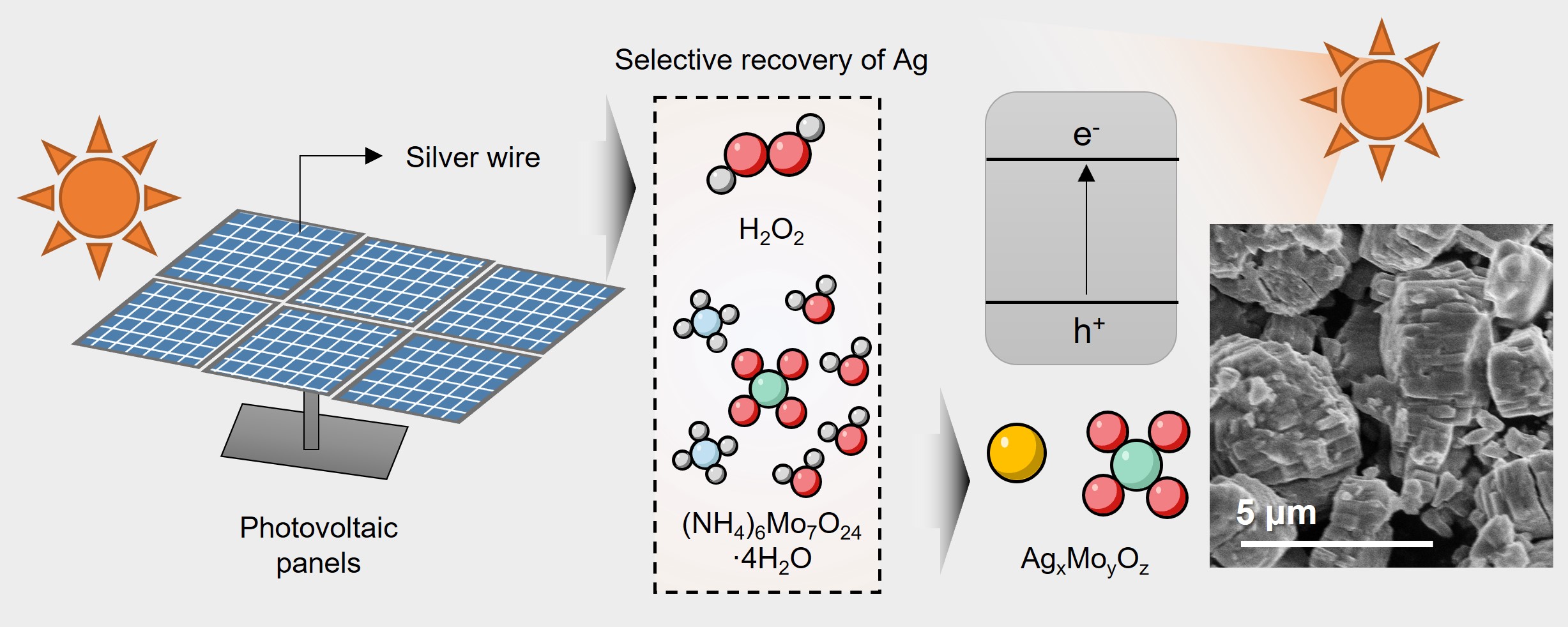
ABSTRACT: The rapid accumulation of end-of-life photovoltaic (PV) modules calls for the sustainable recovery of valuable metals contained within them. In crystalline silicon PV modules, silver (Ag) is the metal with the highest economic value, but its selective recovery remains challenging. Here, we report a method based on an ammonium molybdate tetrahydrate ((NH4)6Mo7O24·4H2O)-hydrogen peroxide (H2O2) system for selectively leaching Ag from end-of-life PV modules. During the Ag recovery process, aluminum remains largely insoluble, while lead is partially leached and separated. During leaching, Ag+ reacts in situ with molybdate ions to form silver molybdate (AgxMoyOz). Singlet oxygen (1O2), hydroxyl radicals (•OH), and peroxy (•OOH) radicals were identified as active species during the leaching process. The recovered silver molybdate can be directly used as a photocatalyst for pollutant degradation, providing proof of concept for a “waste-to-useful” strategy. This study establishes a closed-loop pathway from end-of-life PV modules to functional photocatalysts, eliminating the need for additional silver purification or catalyst synthesis steps.
Keywords: End-of-life photovoltaic panels; Silver recovery; Silver molybdate; Photocatalysis; Pollutant degradation

Graphical Abstract

TOP