(I) Large dams alter flow regimes and water-level
fluctuations, reshaping riparian disturbance regimes and shoreline habitat
conditions, with important implications for vegetation recovery, biodiversity
maintenance, non-native species establishment,
and reservoir shoreline management. However, how these effects vary among flow
regulation types and water-level fluctuation (WLF) zonation
remains insufficiently understood in cascade reservoir systems. We asked: (1)
how species richness, alpha diversity, beta diversity, and the proportion of
non-native species vary among flow regulation types and WLF zonation; (2) which plant species indicate different
regulation types and WLF zonation; and (3) which biotic or abiotic factors best
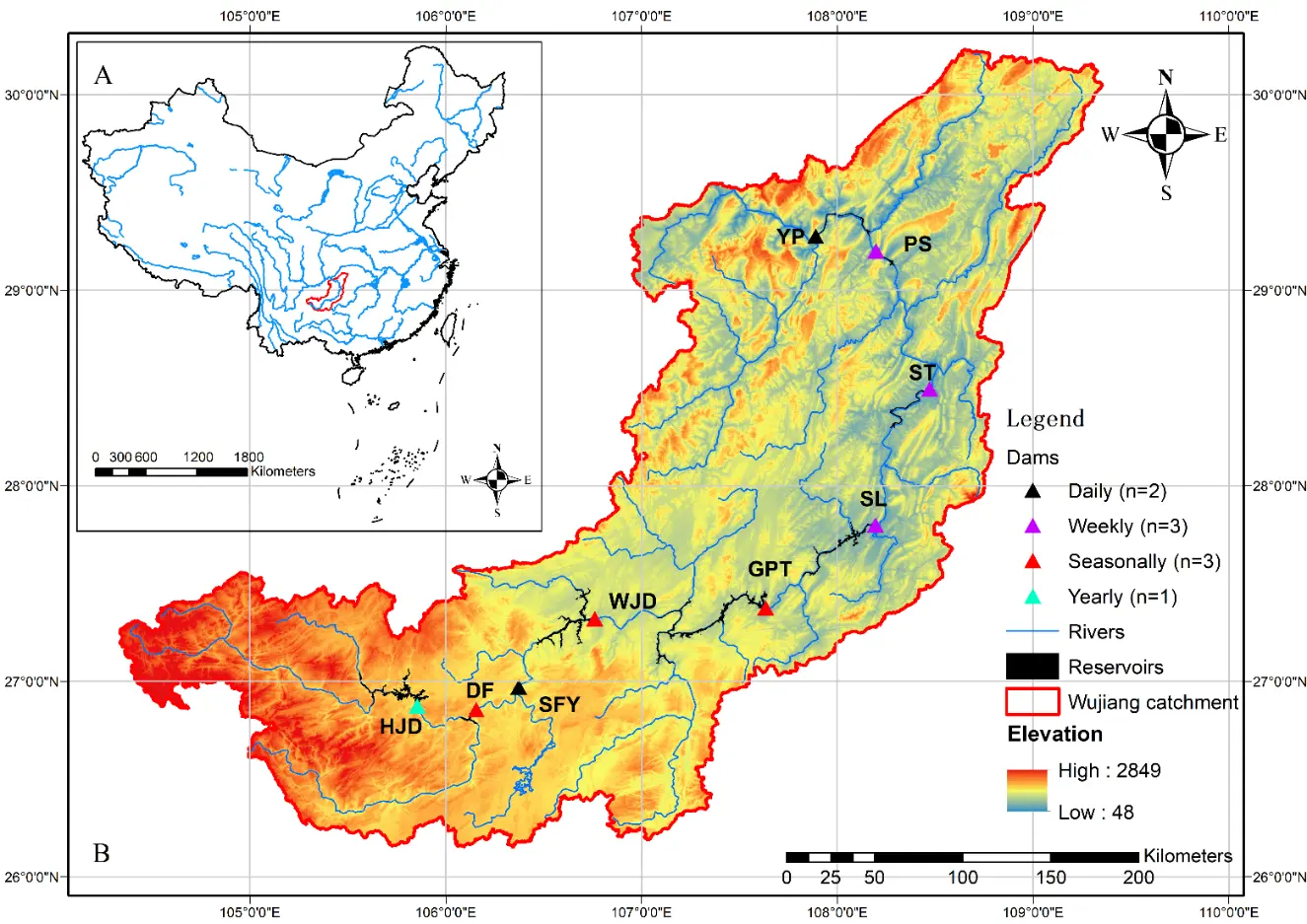
explain variation in riparian species composition. (II) WLF zonation of nine cascade reservoirs along the Wujiang
River, central China. (III) We
surveyed 573 quadrats across 72 sites in inundation, transitional, and
unflooded zones of reservoirs with daily, weekly, seasonal, or yearly
regulation. Vegetation composition and local environmental variables were
recorded. ANCOVA was used to test differences in vegetation diversity and
non-native species proportion among regulation types and WLF zonation. Redundancy analysis and variation partitioning
were used to assess the relative effects of dam properties, hydrological
alteration, and local environmental factors on species composition. (IV) Riparian vegetation differed clearly among regulation
types and WLF zonation.
Seasonally regulated reservoirs supported the highest herbaceous species
richness in the inundation zone, followed by daily and weekly reservoirs, and
then the yearly regulated reservoir. Daily reservoirs had the highest beta
diversity, whereas the yearly reservoir had the lowest. Annual species were
mainly associated with yearly regulated shorelines, while perennial species
dominated daily and weekly reservoirs. Non-native species also varied among
regulation types and WLF zonation, with Alternanthera
philoxeroides and Erigeron canadensis associated with weekly and seasonally reservoirs, respectively. Indicator
species differed among regulation types and WLF zonation, suggesting distinct vegetation assemblages
under contrasting regulation regimes. Dam properties were the strongest
predictors of riparian species composition, while hydrological alteration and
local environmental conditions also contributed. (V) Riparian
vegetation composition in cascade reservoirs reflects the cumulative effects of
contrasting long-term
flow regulation regimes, WLF zonation, and associated environmental filtering.
Regulation type was linked to differences in plant diversity, annual-perennial dominance, non-native species occurrence, and community
composition. These findings highlight the need to consider long-term
hydrological regulation and invasion risk when managing and restoring reservoir
WLF zonation.

 Open Access