Cadmium, a toxic heavy metal with no physiological role in the human body, is encountered mainly through inhalation or ingestion and accumulates due to its slow excretion rate. It negatively impacts health by causing oxidative stress, cellular damage, and apoptosis, especially affecting the kidneys, lungs, and immune system. The endocannabinoid system (ECS), comprising compounds, receptors (CB1, CB2), and enzymes (FAAH, MAGL), regulates immune cell function and homeostasis. The ECS influences various immune cells—including T and B lymphocytes, macrophages, mast cells, dendritic cells, and natural killer cells—mainly by modulating cell proliferation, apoptosis, cytokine secretion, and inflammatory responses. Cadmium disrupts innate immunity by impairing macrophage, neutrophil, mast cell, and NK cell functions, largely through oxidative stress and altered signaling, leading to diminished inflammatory responses and reduced ability to recognize and eliminate threats. In adaptive immunity, cadmium exposure inhibits B and T cell activation and proliferation, induces apoptosis, alters immune memory, and disrupts the balance of helper and cytotoxic T cells, weakening the body’s defense mechanisms. While there is ample evidence for cadmium’s detrimental effects on immune cells and for the ECS’s regulatory role in immunity, direct research on how cadmium affects the ECS specifically is lacking. Current literature suggests possible overlap in the pathways affected by cadmium toxicity and ECS signaling—particularly in the induction of apoptosis and the suppression of immune function—raising the hypothesis that cadmium may modulate immune responses by interacting with endocannabinoid receptors. Further research is needed to clarify these interactions and their implications for immunity.
Innate immune sensing constitutes the first line of host defense against viral infections and critically shapes subsequent immune responses. Recent advances have redefined this system as a highly specialized and dynamic network capable of discriminating between diverse viral signatures and mounting tailored antiviral programs. Cytosolic and endosomal pattern recognition receptors, including RIG-I-like receptors, cGAS–STING, and Toll-like receptors, detect viral nucleic acids and initiate signaling cascades that culminate in interferon production and inflammatory responses. Emerging evidence highlights that the timing, magnitude, and cellular context of these early sensing events are key determinants of viral pathogenesis. Rapid and coordinated activation of innate pathways promotes viral control, whereas delayed or dysregulated responses can result in excessive inflammation and tissue damage. In parallel, viruses have evolved sophisticated strategies to evade or subvert host sensing mechanisms, thereby influencing disease severity and transmission. Furthermore, recent technological advances, particularly in single-cell and systems immunology, have uncovered previously unrecognized layers of complexity in antiviral sensing and response heterogeneity. In this review, we synthesize current knowledge on innate immune sensing pathways and discuss how their regulation dictates the balance between protective immunity and immunopathology. We also highlight emerging therapeutic opportunities targeting these pathways and highlight important areas for future investigation in viral immunology.
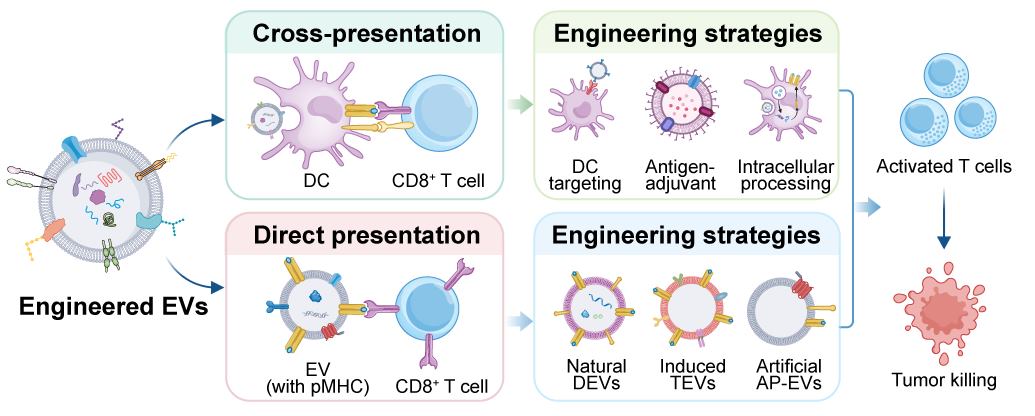
The central goal of therapeutic tumor vaccines is to activate tumor-specific CD8+ cytotoxic T lymphocytes (CTLs), a process critically dependent on efficient antigen presentation through major histocompatibility complex class I (MHC-I). Extracellular vesicles (EVs), natural mediators of intercellular communication, offer a versatile platform for tumor vaccine development because of their biocompatibility, lymphatic trafficking, and engineering flexibility. In this review, we summarize the biological basis of EV-mediated antigen presentation and highlight engineering strategies to enhance cross-presentation, including DC targeting, antigen–adjuvant co-delivery, and modulation of intracellular antigen processing. We further discuss strategies for direct antigen presentation, encompassing DC-derived EVs, tumor cell-derived pMHC-enriched EVs, and artificial antigen-presenting EVs (AP-EVs). In addition, we discuss synergistic strategies that integrate direct presentation with cross-presentation through EV hybridization and physiological modulation. By combining these complementary pathways, EV-based vaccines may achieve both rapid T-cell activation and sustained antitumor immunity. Finally, we discuss current challenges in standardized production, engineering efficiency, in vivo behavior, and clinical translation, and highlight future opportunities for intelligent, personalized, and AI-assisted EV vaccine design.
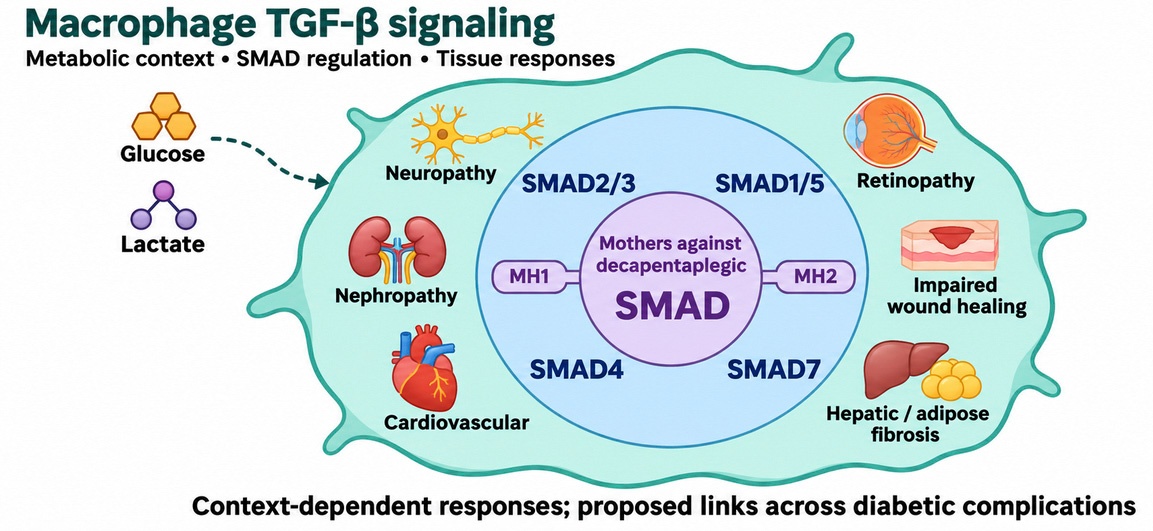
Transforming growth factor-β1 (TGF-β1) is a pleiotropic cytokine that plays pivotal but often opposing roles in immune regulation and tissue homeostasis. In macrophages, TGF-β1 signaling integrates inflammatory, metabolic, and fibrotic responses in a highly context-dependent manner. This review comprehensively investigates TGF-β1 signaling mechanisms, metabolic crosstalk, and clinical significance in macrophages, with a focus on diabetic complications. The canonical SMAD2/3-dependent pathway, together with alternative SMAD1/5-dependent signaling and non-SMAD routes (including mitogen-activated protein kinase (MAPK) and phosphoinositide 3-kinase/protein kinase B (PI3K/AKT) signaling), enables signaling divergence that allows TGF-β1 to exert both anti-inflammatory and profibrotic effects. Pioneering work established the core mechanistic framework, while other studies elucidated its role in alternative macrophage activation and tissue remodeling. Recent investigations associate high-glucose culture conditions with increased lactate and altered TGF-β1/SMAD1/5 signaling in human macrophages, suggesting a link between metabolic reprogramming and pro-atherogenic programs. In diabetes, chronic hyperglycemia can reprogram macrophages and alter their responses to TGF-β1, potentially sustaining inflammation and fibrosis. These macrophage responses are discussed in relation to diabetic kidney disease, retinopathy, neuropathy, cardiomyopathy, and impaired wound healing. The glucose–lactate–TGF-β1/SMAD1/5 sequence remains a candidate mechanism: lactate mediation, osmotic effects, and consequent organ injury have not been resolved. Therapeutic targeting of TGF-β1 remains challenging because of its dualistic nature, which requires context-specific modulation and direct assessment of repair and safety. This review discusses emerging strategies, including macrophage-targeted approaches and combined immunometabolic interventions. A deeper understanding of context-dependent TGF-β1 signaling in macrophages is essential for developing precision therapies that mitigate diabetic complications while preserving physiological immune and reparative functions.