Open Access
ISSN: 3107-2984 (Online)
3107-2976 (Print)
Institute of Radiation Medicine, Shanghai Medical College, Fudan University, Shanghai 200031, China
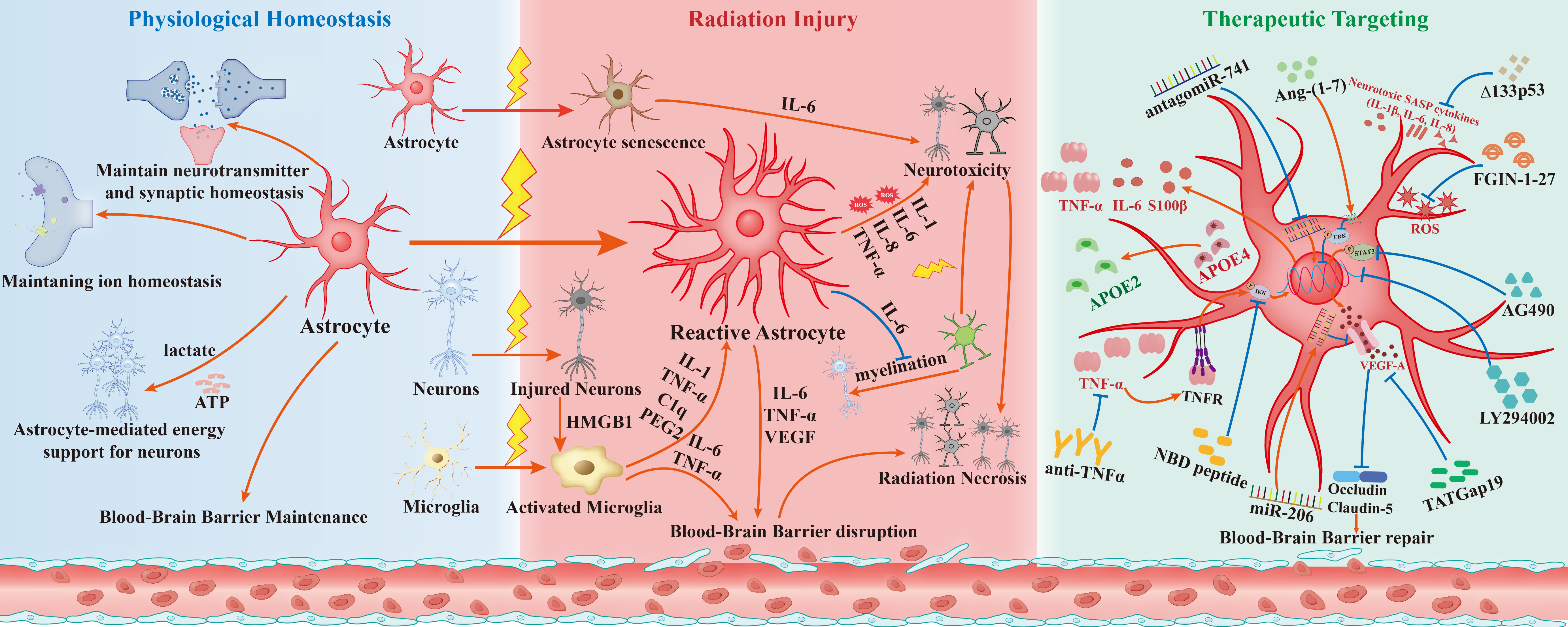
Radiation-induced brain injury (RIBI), a common adverse effect of cranial radiotherapy for head malignancies, causes severe complications, including blood-brain barrier (BBB) disruption, neuroinflammation, cognitive decline, and radiation necrosis (RN) that impair patients’ quality of life. The pathophysiology of RIBI involves intricate crosstalk between various central nervous system (CNS) cell types, with astrocytes, the principal CNS glial cells, serving as key mediators. Under physiological conditions, they sustain brain homeostasis, but their transition to reactive phenotypes and subsequent dysfunction propel RIBI development. This review summarizes recent advances in astrocytes’ pathophysiological roles in RIBI, focusing on mechanisms like reactive astrocyte polarization, neuroinflammation, BBB impairment, radiation-induced senescence, astrocyte-mediated RN progression, and pathological crosstalk with other CNS cells. It also outlines astrocyte-targeted therapeutic strategies with preclinical efficacy, including anti-inflammatory therapies, anti-vascular endothelial growth factor A (VEGFA) interventions, TSPO ligands, RAS blockers, apolipoprotein E (ApoE) regulation, Δ133p53, and microRNAs (miRNAs), which alleviate RIBI by targeting these pathological processes. A comprehensive understanding of astrocyte-mediated mechanisms and preclinical evidence will lay the foundation for developing targeted, low-toxicity therapies to mitigate RIBI in cranial radiotherapy patients.
Radiation-induced brain injury (RIBI), a common adverse effect of cranial radiotherapy for head malignancies, causes severe complications, including blood-brain barrier (BBB) disruption, neuroinflammation, cognitive decline, and radiation necrosis (RN) that impair patients’ quality of life. The pathophysiology of RIBI involves intricate crosstalk between various central nervous system (CNS) cell types, with astrocytes, the principal CNS glial cells, serving as key mediators. Under physiological conditions, they sustain brain homeostasis, but their transition to reactive phenotypes and subsequent dysfunction propel RIBI development. This review summarizes recent advances in astrocytes’ pathophysiological roles in RIBI, focusing on mechanisms like reactive astrocyte polarization, neuroinflammation, BBB impairment, radiation-induced senescence, astrocyte-mediated RN progression, and pathological crosstalk with other CNS cells. It also outlines astrocyte-targeted therapeutic strategies with preclinical efficacy, including anti-inflammatory therapies, anti-vascular endothelial growth factor A (VEGFA) interventions, TSPO ligands, RAS blockers, apolipoprotein E (ApoE) regulation, Δ133p53, and microRNAs (miRNAs), which alleviate RIBI by targeting these pathological processes. A comprehensive understanding of astrocyte-mediated mechanisms and preclinical evidence will lay the foundation for developing targeted, low-toxicity therapies to mitigate RIBI in cranial radiotherapy patients.utf-8