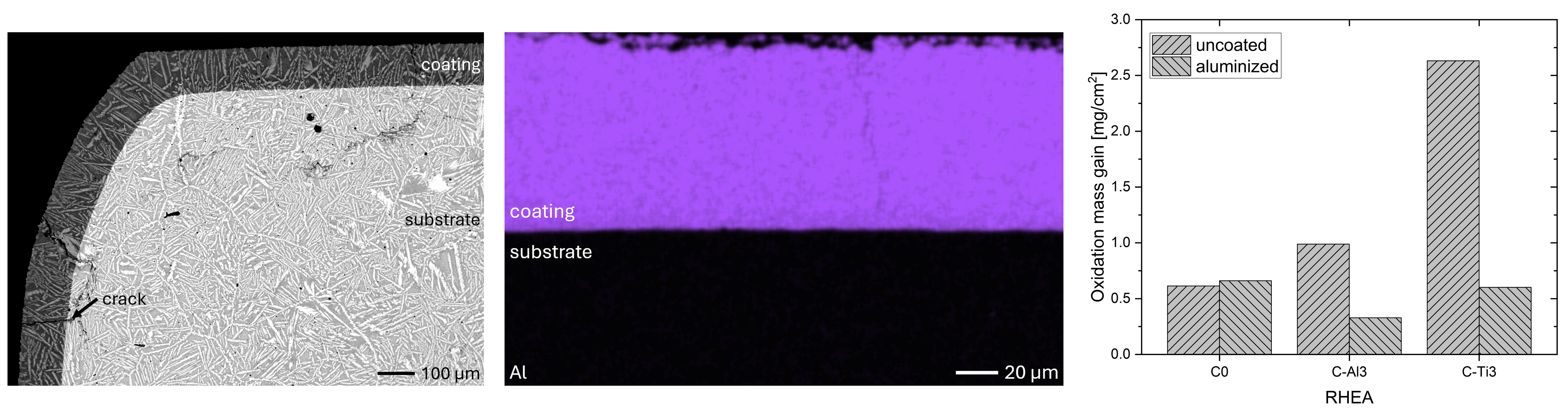
Refractory high-entropy alloys (RHEAs) show promising properties for applications as structural materials in high-temperature applications, such as high solidus temperature and high strength. Improving their density, oxidation resistance, and room temperature ductility are still the aims of research in alloy development. In this study, Al-rich diffusion coatings by pack cementation are developed for three different alloys in the system Al-Cr-Mo-Ta-Ti in order to improve their high-temperature oxidation resistance. Equimolar AlCrMoTaTi, Al-rich Al3CrMoTaTi, and Ti-rich AlCrMoTaTi3 are synthesized by vacuum arc melting with subsequent milling to powder, consolidation to bulk material by field-assisted sintering technology/spark plasma sintering (FAST/SPS), and homogenization heat treatment. The applied aluminizing coatings are investigated by gravimetry, scanning electron microscopy (SEM), energy-dispersive X-ray spectroscopy (EDS), and X-ray diffraction (XRD). Experimental analyses are supplemented by CALPHAD simulations. Compact, uniform, and adhesive Al-rich diffusion coatings are produced on all three substrate RHEAs and exhibit single-layered D022 Al3(Cr,Mo,Ta,Ti) intermetallic compound analogous to Al3Ti in the binary Al-Ti system. Isothermal oxidation at 1000 °C for 48 h in ambient air results in the formation of 1–2 µm thin protective single-layered alumina scale—in contrast to multi-layered oxide scales in uncoated condition—and mass gains as low as binary Al3Ti and Ni-based superalloys.
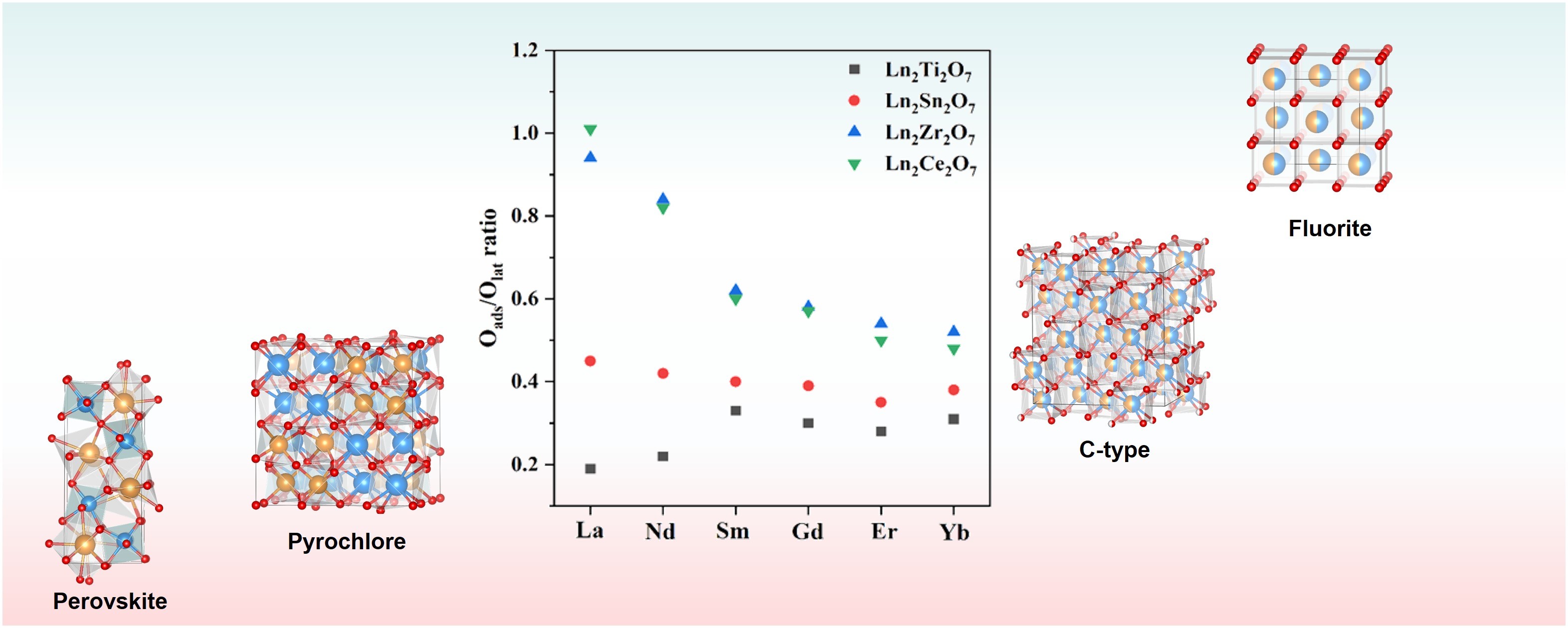
A2B2O7 complex oxides have a great potential to be used in high-temperature catalytic processes. Herein, a series of A2B2O7 (A = La, Nd, Sm, Gd, Er, Yb; B = Ti, Sn, Zr, Ce) compounds with all four kinds of typical sub-crystalline phases were synthesized to study their bulk and surface properties. FTIR spectroscopy was adopted as a novel method in this study to identify distinctively these phases. Whereas, it cannot be used to distinguish the subtle structure difference between disordered and ordered pyrochlores, nor that between the disordered defect fluorite and the rare earth. To discriminate these exquisite phase differences, XPS spectra must be supplementarily used. Specifically, it was discovered that the coordination numbers of the A- and B-site cations are the key factor affecting their binding energies. Furthermore, the electronegativity of the A- and B-site elements significantly influences the binding energy of surface lattice oxygen, reflecting their electrophilic and nucleophilic properties, which can thus be used to effectively identify the sub-crystalline phase. The oxygen vacancy concentration of different sub-crystalline phases is the primary factor controlling the amount of surface chemisorbed oxygen species on A2B2O7 compounds, with superoxide anions (O2−) identified as the major species.
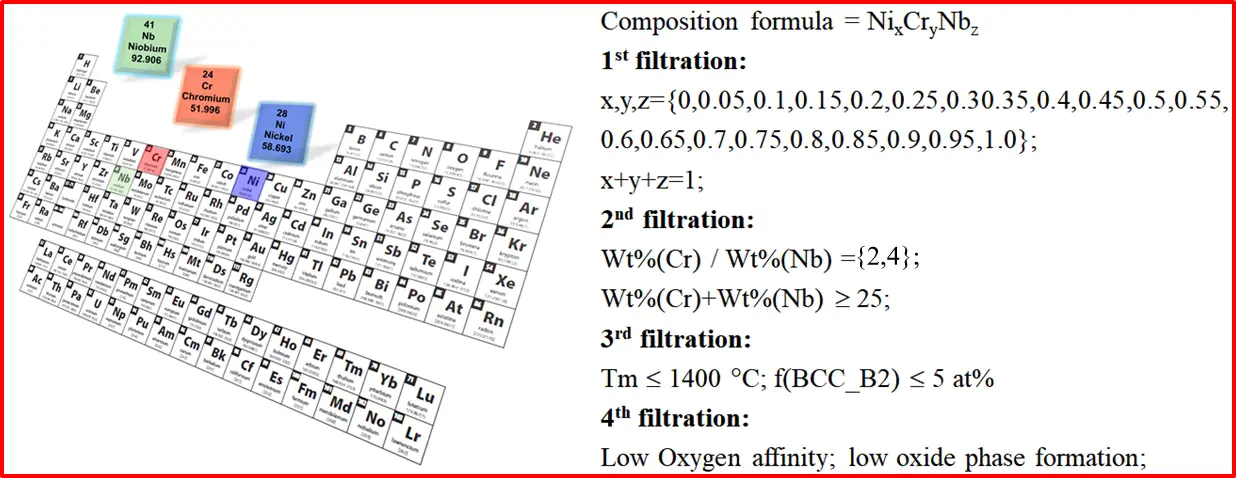
To address the challenge of further reducing impurities in raw materials for high-purity melting of industrial-superalloys such as GH4169D, this study employed a CALPHAD-based high-throughput computational approach to establish the composition-phase stability-impurity behavior relationship. A low-melting-point, high-cleanliness Ni–Cr–Nb master alloy was developed and characterized with oxygen and nitrogen contents of 76 ppm and 36 ppm, respectively, and an inclusion number density of approximately 540 ± 20 cm−2 and an average inclusion size of 2.2 ± 0.15 μm, demonstrating excellent cleanliness and compositional controllability. In industrial-scale 3-ton GH4169D melting trials using the Ni–Cr–Nb master alloy, the oxygen content was reduced from 12 ppm to 8 ppm. The inclusion number densities at the ingot center, R/2 position, and edge were decreased by 7.75%, 36.1%, and 81.5%, respectively, while the maximum inclusion size was reduced from approximately 28 μm to 9–17 μm. The results indicate that the developed master alloy effectively suppresses the formation, growth, and radial segregation of inclusions in GH4169D, significantly enhancing its metallurgical uniformity and cleanliness. Furthermore, melting efficiency increased by 52.6%, and production costs decreased by approximately 2.3% per ton, highlighting substantial process and economic advantages. This work establishes a closed-loop research framework integrating “CALPHAD-based experimental design—industrial pilot-scale validation—production-line metallurgical quality evaluation”. It confirms the effectiveness of the master alloy strategy for high-purity scale-up superalloy production and provides a transferable technological pathway for the compositional design and industrial application of other master alloy systems and commercial alloys.
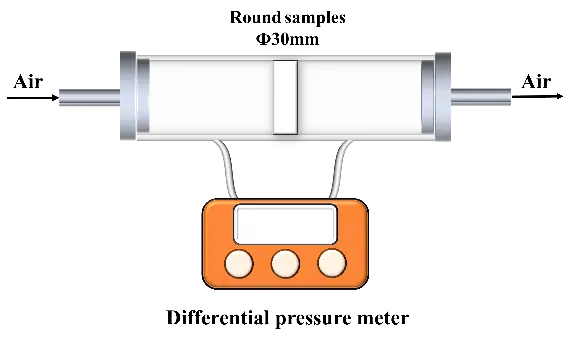
Porous ceramic filters exhibit excellent prospects for application in the field of high-temperature flue gas filtration. In this study, the MgAl2O4 porous ceramics were prepared using α-Al2O3, MgO, and EDTA-MgNa2 as raw materials by the in-situ decomposition method. The effect of the introduction of EDTA-MgNa2 on phase composition and microstructure, as well as the correlation between the content of EDTA-MgNa2 and ceramic properties, was investigated using XRD, SEM, and EDS. The results revealed that the introduction of EDTA-MgNa2 formed pores, thereby improving gas permeability. Additionally, the addition of EDTA-MgNa2 was beneficial for the formation of a transitional liquid and promoted sintering, thereby slowing the decrease in compressive strength. The optimal specimen is the ceramic with 10 wt% EDTA-MgNa2, which exhibits a high porosity of 56.28%, a compressive strength of 10.93 MPa, and a high gas permeability coefficient (8.84 × 10⁻⁹ m2).
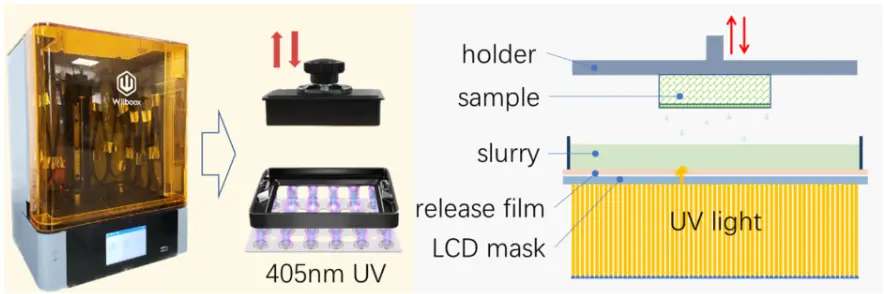
Stereolithography 3D printing technology is widely used in aerospace, automotive, medical, weapons, and other fields because of its high processing accuracy, low cost, simple operation, and flexible manufacturing. The photocuring 3D printing ceramic slurry is a key part of the photocuring 3D printing ceramic technology. The preparation techniques of photocurable 3D printing ceramic slurry mainly include the mechanical mixing method, sol-gel method, ultrasonic dispersion method, and in-situ polymerization method. This paper summarizes the preparation methods and research progress of photocuring 3D printing ceramic slurry, expounds the essence of photocuring and the composition and function of ceramic slurry, and analyzes the influence of various properties of photocuring 3D printing ceramic slurry on the properties of final products, such as rheological properties, solid content, curing thickness, and stability. Finally, the existing problems and future development potential of photocuring 3D printing ceramic slurry preparation technology are summarized.
To meet the demand for intelligent masonry of large-sized silica bricks, calcium silicate cement synthesized from high-purity nano CaCO3 and microsilica was used as both binder and mineralizer in quartz-based castables. The effects of cement content (3−5 wt%) on performance were systematically investigated. With optimal retarder (0.015% citric acid monohydrate), the samples achieved early flexural and compressive strengths of 1.30 MPa and 7.0 MPa, respectively, after 24 h curing. During firing at 1430 °C for 20 h, CaO from cement effectively promoted quartz transformation to tridymite. Compared to conventional silica bricks, castables with 5% cement showed residual quartz below 1%, lower apparent porosity, over 2.5−fold higher cold crushing strength, comparable high-temperature creep, and superior refractoriness under load. This study demonstrates the dual gelling and mineralizing role of calcium silicate cement, offering a feasible route for producing large-sized quartz-based precast components.