
An Overview for Optimal Planning and Reliable Operations of Multi Vector Energy Systems for On-Grid and Standalone Applications

An Overview for Optimal Planning and Reliable Operations of Multi Vector Energy Systems for On-Grid and Standalone Applications
Received: 25 March 2026 Revised: 21 May 2026 Accepted: 01 July 2026 Published: 15 July 2026

© 2026 The authors. This is an open access article under the Creative Commons Attribution 4.0 International License (https://creativecommons.org/licenses/by/4.0/).
1. Introduction
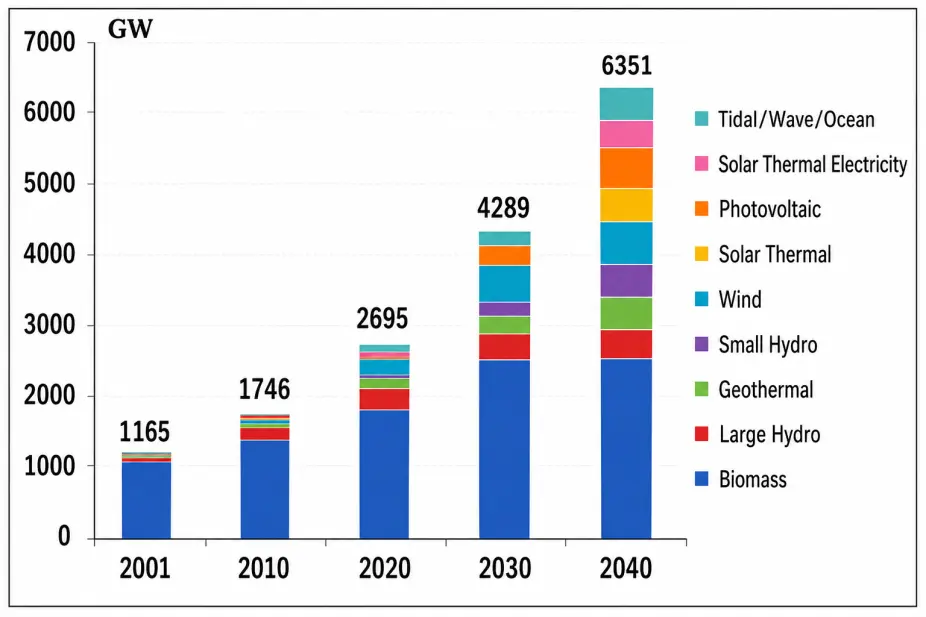
The need for alternative energy sources was driven by the depletion of fossil fuels and their severe environmental impact. The most widely used renewable energy sources currently are solar and wind power, and they will continue to be so as the global need for electricity rises. The growing depletion of conventional fossil fuel resources, coupled with their adverse environmental impacts such as greenhouse gas emissions, air pollution, and climate change, has accelerated the global transition toward renewable energy technologies. Among the various renewable energy sources, solar and wind energy have emerged as the most promising and widely deployed alternatives due to their abundance, sustainability, and declining installation costs. Rapid technological advancements in photovoltaic modules and wind turbines have significantly improved their efficiency and economic viability, making them key contributors to modern power systems. Furthermore, the continuous increase in global electricity demand, driven by population growth, urbanization, and the electrification of transportation and industrial sectors, necessitates the large-scale integration of clean energy resources. Consequently, solar and wind power are expected to play a dominant role in future energy generation portfolios, supporting energy security, reducing carbon emissions, and facilitating the transition to sustainable, low-carbon energy systems. Based on the projected global renewable energy capacity shown in the Figure 1, the total installed renewable energy generation capacity is expected to increase substantially from 1165 GW in 2001 to approximately 6351 GW by 2040, representing more than a fivefold growth. Biomass remains a major contributor throughout the period, while significant expansion is observed in photovoltaic, wind, solar thermal, geothermal, and hydropower technologies. The rapid growth after 2020 highlights the accelerating global transition toward sustainable energy systems driven by increasing energy demand, environmental concerns, and supportive policy frameworks. Notably, solar and wind technologies exhibit the highest growth rates, reflecting technological advancements, declining installation costs, and improved conversion efficiencies. Emerging resources such as tidal, wave, and ocean energy will also contribute to the diversified renewable energy portfolio by 2040. Overall, the projected energy mix demonstrates a gradual shift from conventional renewable sources toward a more balanced and diversified renewable energy ecosystem, emphasizing the critical role of renewable technologies in achieving long-term energy security, reducing greenhouse gas emissions, and supporting global decarbonization objectives [1].
Owing to increasing environmental concerns, depletion of fossil fuel reserves, and the growing demand for sustainable energy solutions, significant research efforts have shifted toward distributed generation (DG) technologies based on renewable energy resources such as solar photovoltaic (PV), wind, biomass, and fuel cell systems. Distributed generation offers several advantages, including reduced transmission losses, improved energy efficiency, enhanced energy security, and lower greenhouse gas emissions. However, the large-scale integration of renewable energy sources into conventional power grids, or their operation in standalone and microgrid configurations, introduces several technical challenges due to the intermittent and stochastic nature of renewable resources. The variability of solar irradiance and wind speed can lead to power fluctuations, voltage instability, frequency deviations, power quality deterioration, and difficulties in maintaining the balance between generation and demand. Furthermore, component failures, communication system malfunctions, energy storage limitations, and uncertainties in load demand can significantly affect overall system performance. These challenges become even more critical in standalone systems, where the absence of grid support increases the risk of supply interruptions and reliability degradation. Therefore, reliability assessment has become one of the most important aspects of modern power system planning, design, and operation. Reliability represents the ability of a power system to continuously deliver adequate electrical energy to consumers while maintaining acceptable quality and security standards. To ensure an uninterrupted power supply and optimal system performance, it is essential to systematically evaluate the reliability of renewable energy-based power systems by considering generation uncertainties, component outage characteristics, load variations, and operational constraints. Consequently, the development of robust reliability assessment methodologies and reliability-oriented optimization strategies has emerged as a critical research area for enhancing the performance, resilience, and sustainability of renewable energy-integrated power systems.
Numerous studies that have looked at reliability issues have come to the conclusion that distributed generation systems based on renewable energy improve distribution system reliability. On the other hand, reliability has emerged as the most talked-about issue that needs to be evaluated and improved if these renewable energy-based generation systems are employed for off-grid applications. There have been numerous studies done on DG technologies, DG siting and sizing, impact studies of DG penetration, economic and financial analysis combined with DG integration, etc. [2]. However, problems resulting from DG integration in the distribution network do not need to be addressed while the DGs are operated as standalone units. Reliable operation of such a type of standalone unit for off grid applications, subjected to weather conditions, proper storage management system, and DG siting and sizing as well as reliability. Energy storage systems must be linked with fluctuating power from renewable sources to increase system reliability and mitigate the effects of distributed generation’s intermittent behavior [3]. Researchers have, however, conducted a great deal of studies that take reliability and Off-Grid applications into account. HG Ahangar et al. (2023) proposed an optimal model for a smart local energy system for online charging of electric vehicles, in which the authors suggested two energy scenarios: winter and summer. PSO-based Meta-heuristic algorithms are employed for optimization and convergence statistics to find the various reliability indices, i.e., LOLE (Loss of Load Expectation), LOEE (Loss of Energy Expected), and ELF (Equivalent Loss Factor) [4]. AI-based new-age technology has now become a powerful statistical tool for achieving better optimization and reliability results. M. Talaat et al. (2023) surveyed various AI-based approaches to find the best possible results for optimal design, control strategies, and reliability [5]. Harin N. Mohan et al. (2023) proposed a comprehensive energy management system to address the various challenges and unpredictable events. The developed system was analyzed using a hybrid intelligent algorithm, and it was concluded that the system maintained the power balance between the source and the energy storage system [6]. Renqi Guo et al. (2022) reported a comprehensive survey on fuel cells and concluded that the presence of fuel cells in distributed generation systems supports the grid [7]. Tarek Selmi et al. (2022) reviewed the EV technologies and their superiority over traditional ICE vehicles using fuel cell technology on the basis of the proper topology and thermal performance of the semiconductors used [8]. Abir Muhtadi et al. (2021) report that renewable energy source-based micro-grids enhance performance through proper interactions between the EV fleet and a proper control strategy [9]. Gang wang et al. (2021) introduced a review of Evolutionary Game Theory (EGT)-based research work that addressed issues in connection with energy saving, CO2 emissions, distribution networks, and new-age electric vehicles [10]. Asif khan et al. (2020) proposed a hybrid system with a combination of solar PV-WT-FC, PV-FC, and WT-FC and evaluated the reliability indices and maximum allowable loss of power supply probability (LPSP) for the most cost-effective system, which revealed that the PV-FC system is the most cost-effective system in comparison to other combinations [11]. Vipin das et al. (2017) reported on operations, various types of fuel cell technology, and key issues during fuel cell injections in grid-connected power systems. The authors also revealed that by 2030, fuel cells will replace conventional IC engines [12]. Anurag Chouhan et al. (2014) reviewed the Integrated Renewable Energy System (IRES) for standalone applications on the ground of configuration, control, and sizing methodologies through an AI-based optimization approach and revealed various merits and demerits of the methodologies used [13]. Some studies that contributed to the landscape of renewable and reliable planning framework are listed in Table 1.
Table 1. List of methods based on optimization and reliability assessment framework.
|
S. No. |
Type of Optimization Approach/Technique |
Objective Function(s) Used |
Merits |
Demerits |
References |
|---|---|---|---|---|---|
|
1 |
Genetic Algorithm (GA) |
Minimize system cost, maximize reliability, minimize EENS |
Global search capability, suitable for multi-objective problems |
Slow convergence, parameter tuning required |
[14] |
|
2 |
Particle Swarm Optimization –Andean Condor Algorithm (PSO-ACA) |
Minimize cost and LOLE, maximize system availability |
Simple implementation, fast convergence |
May converge to a local optimum |
[15] |
|
3 |
Differential Evolution (DE) |
Minimize lifecycle cost and reliability indices |
Robust optimization performance |
Computationally intensive for large systems |
[16] |
|
4 |
MOGWO |
Optimal sizing of renewable resources and storage |
Good exploration-exploitation balance |
Performance depends on population size |
[17] |
|
5 |
Ant Colony Optimization (ACO) |
Reliability enhancement and network reconfiguration |
Effective for combinatorial problems |
High computational burden |
[18] |
|
6 |
Multi-Objective Evolutionary Algorithm (MOEA/NSGA-II) |
Simultaneous minimization of cost and emissions while maximizing reliability |
Generates Pareto-optimal solutions |
Increased computational complexity |
[19] |
|
7 |
Artificial Neural Network (ANN)-assisted Optimization |
Reliability prediction and optimal operational planning |
Fast prediction after training |
Requires large datasets and validation |
[20] |
|
8 |
Hybrid AI-Optimization Techniques |
Cost, reliability, and sustainability objectives |
Improved solution quality and adaptability |
Complex implementation |
[21] |
Masouma et al. [22] proposed a smart charging management strategy for plug-in electric vehicles to reduce peak demand, minimize power losses, and improve voltage profiles in distribution networks. Banerjee et al. investigated the optimal placement of distributed generation units based on reliability criteria and demonstrated improvements in system reliability and operational performance [23]. Shirazi et al. applied multi-objective optimization to a solid oxide fuel cell–gas turbine hybrid system, simultaneously considering economic, environmental, and thermal performance [24]. Deb et al. reviewed the application of multi-objective evolutionary algorithms for renewable energy optimization and highlighted their effectiveness in addressing conflicting objectives such as cost, reliability, and sustainability [25]. These studies demonstrate the significant role of optimization techniques in enhancing the performance and reliability of modern renewable energy systems. Although substantial research has been conducted using analytical, Monte Carlo, optimization-based, and AI-driven reliability assessment techniques, limited studies have integrated these perspectives within a unified framework for hybrid renewable energy systems supporting electric vehicle charging infrastructure. The novelty of the present work lies in combining analytical reliability evaluation with AI-assisted optimization to determine the optimal sizing and operation of photovoltaic, wind, and fuel-cell resources while simultaneously improving system reliability and sustainability of EV charging stations. This research provides a thorough analysis of renewable-based distributed power, taking into account reliability, ideal planning, and applications. Although AI-based methods have shown promising results for reliability prediction, most existing studies focus either on reliability estimation or optimization independently. Limited research has integrated AI-driven reliability prediction with optimal sizing and operational planning of photovoltaic–wind–fuel cell hybrid energy systems for electric vehicle charging applications. Therefore, a comprehensive framework combining reliability assessment, optimization, and intelligent decision support remains an important research direction.
The next section describes the distributed generation technologies based on a grouping of work already done. Standalone hybrid renewable energy systems are briefly introduced in Section 3. Section 4 covered the concept component modeling. Economic considerations, reliability, ideal planning, and a framework for system assessments were discussed in Sections 5 and 6. Section 7 offered a number of methodologies for reliability assessments, each with its own limitations. Section 8 discussed various reliability indices, while Section 9 discusses findings and challenges after comprehensive research. Section 10 concludes the review along with its future scope.
2. Distributed Generation Technologies
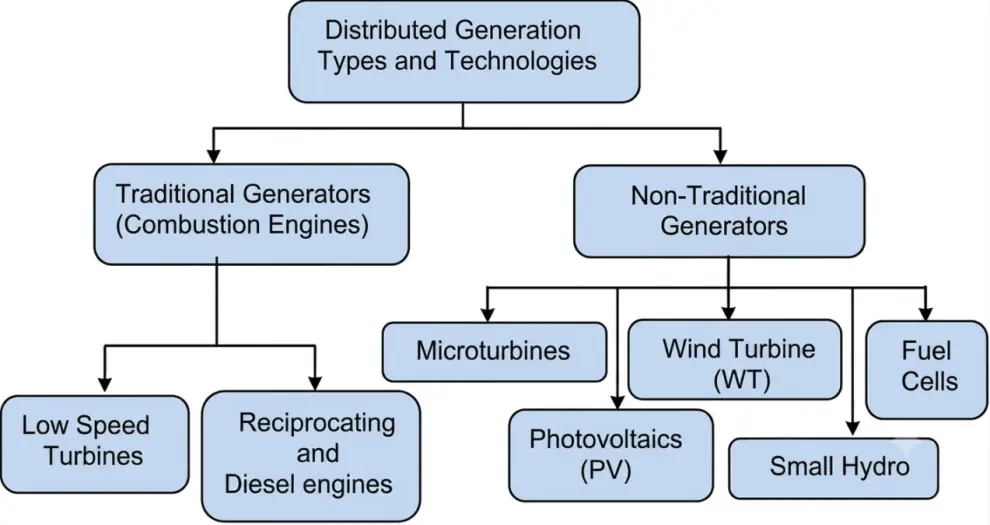
In general, there are two terms that have been used to address production through DG technologies, i.e., distributed generation and decentralized production. DGs are standalone generators that can be defined as the generation and storage of electricity, used in on-grid and off-grid applications to meet electrical supply demand. These are also known as embedded generators or dispersed generations. Nonetheless, it is prudent to look to the next generation to the distribution systems, often referred to as smart grids, by incorporating networks, DG, energy storage, electronic controls, self-healing designs, and improved protection systems [26,27]. Ranges of generators used in DG technologies, varying from 1 W to 300 MW, depend upon the installer units. Figure 2 demonstrates ratings of the distributed generators.
2.1. Conventional or Non Renewable Energy Based DG Technologies
Conventional energy based DG generators often range from 25 KW to 500 KW and fall in the category of micro turbines. This type of combustion turbine produces both heat and electricity on a relatively small scale. Fuels used to drive for this type of DG technologies are mainly coal, gas, and oil. Conventional generators have come a long way to meet the electricity supply demand and are not renewable in nature. The conventional energy based DGs are run relatively at low pressure, temperature, and faster speed. The advantages of micro turbines are compact size, light weight, large efficient and have less emissions, lower capital and electricity costs than any other DG technology costs [28]. The main drawbacks of conventional DG generators are its dependency on fuels, lower efficiencies, and wastage of heat also use of fossil fuels affecting the environment. Some of the conventional DG generators are combustion engines, micro turbines, and other generators are shown in Table 2.
Table 2. Rating of DGs based on conventional energy.
|
S. No. |
Technologies for DG |
Available Size |
|---|---|---|
|
1 |
Combine cycle gas turbine |
35–400 MW |
|
2 |
Micro-Turbines (MT) |
35 KW–1 MW |
|
3 |
Internal combustion engine |
5 KW–10 MW |
|
4 |
Combustion Turbine |
1–250 MW |
|
5 |
Fuel Cells |
1 KW–5 MW |
|
6 |
Battery Storage |
0.5–5 MW |
2.2. Non-Conventional or Renewable Energy Based DG Technologies
Most of the DGs are based on renewable energy as depicted in Table 3. Wind turbines, solar PV, geothermal, tidal, and small hydroelectric plants are placed in renewable energy based technology. Renewable energy sources are smaller and more widely spread due to their low energy density and intermittent behavior [29]. The main difference between conventional and renewable-based DGs is that the output of renewable-based generators is subject to variable inputs, i.e., wind speed, solar power, and weather conditions, which are difficult to forecast [30].
Table 3. Rating of DGs based on renewable energy.
|
S. No. |
Technologies for DG |
Available Size |
|---|---|---|
|
1 |
Small Hydro |
1–100 MW |
|
2 |
Micro Hydro |
25 KW–1 MW |
|
3 |
Wind Turbine |
200 W–3 MW |
|
4 |
Photovoltaic Arrays (PV Arrays) |
20 W–100 KW |
|
5 |
Biomass Gasification |
100 KW–20 MW |
|
6 |
Geothermal |
5–100 MW |
|
7 |
Ocean Energy |
0.1–1 MW |
3. Hybrid Renewable Energy System (HRES)
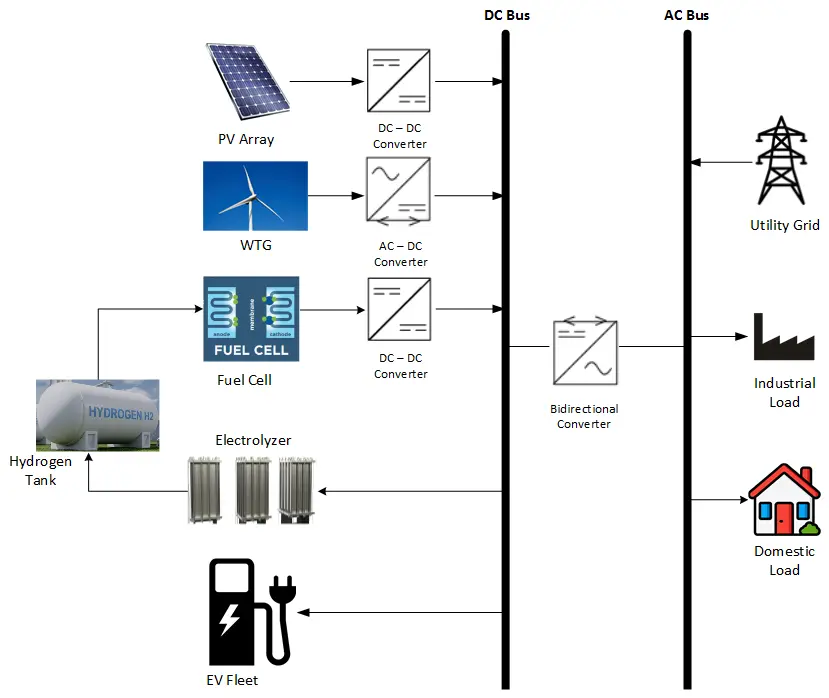
A hybrid system, as the name implies, consists of more than two renewable energy sources to supply the desired load. In addition to sources, battery storage is also integrated due to the intermittent behaviour of solar and wind power in order to maintain the continuity of the supply. When multiple energy sources are combined into a single hybrid system, the weaknesses of each resource are compensated. Various energy storage schemes are introduced in connection with hybrid energy systems to ensure supply continuity, including pumped hydroelectric energy, Batteries, thermal energy, flywheel energy, compressed air energy, and so forth. The combination of photovoltaic (PV), wind turbine generation (WTG), and fuel cells, among others, could be used as distributed generators. The most popular usage of these for distribution network and micro-grid reliability assessment is PV, followed by WTG [31]. Green hydrogen is an emerging factor in the worldwide decarbonization process. By electrifying heat and transportation, green hydrogen can offer a sustainable energy source. In this review study, we surveyed the best possible way to construct a standalone hybrid green power system (HGPS) to serve a particular load demand. For the sake of a reliability study, it is also presumptively possible for the WT, PV, FC, and DC/AC converter to fail. In order to maintain profitable and reliable energy services, our analysis highlights the significance of comprehending local demand in the most optimized way possible. Energy networks, both on-grid and hybrid, have to deal with new uncertainties in energy demand profiles and network limits i.e., voltage violations. However, while integrating RESs into the HGPS, it is important to take into account their erratic output power. Due to the environmentally beneficial character of these resources on the one hand and the rising expense of traditional energy sources on the other, the deployment of renewable energy resources, such as photovoltaic (PV) and wind energy systems, has rapidly increased in electric power networks. In large countries with remote and inaccessible locations, using renewable energy sources also has significant technical and financial benefits, such as reducing the cost of building transmission lines and transporting fuel. Energy storage systems, for instance, are frequently used for such purposes, especially when the system must be completely pollution-free. Significant research has been done in this area regarding the use of renewable resources with high penetration levels. In standalone renewable energy system applications, energy storage systems are charged and discharged at various periods over the course of their lifetimes; in other words, they operate in a cyclical fashion [32]. Proposed hybrid systems that can support on and off-grid operations are shown in Figure 3.
4. Components of Hybrid Systems
A combination of FCs, electrolyzers, and Hydrogen Fuel Tanks (HFTs) can be used for energy storage to ensure the reliability of the system. Because all of the Renewable energy and Energy storage systems that are being evaluated are environmentally friendly, the planned power generation and storage can be seen as an entire “green” system. In the event that there is surplus PV/WT energy available, the electrolyzer begins to produce H2, which is then stored in the HFTs. In a different scenario, where the RERs’ energy output is lower, the FC is used to generate energy to support the consumer’s load. The following section provides a summary of HGPS components modeling [33].
4.1. Wind Turbine
A wind turbine is a mechanical device that efficiently produces electricity using wind power. Depending on the quantity, pressure, and speed of the wind, electrical energy (AC) can be produced. The WT generator’s technique for generating electricity is depending on the wind speed. The following equation is used to calculate the power POWwt of the wind turbine:
where ρ shows the air density (typically 1.225 kg/m3), A displays the total area being swept by the rotor blades of the turbine in m2, v represents the wind velocity in meter per second (m/s), and $${C}_{p}$$ is the coefficient of power.
The wind speed has an impact on the WT generation capacity. The WT generator begins to generate power when the wind speed exceeds the cut-in value. If the wind speed is greater than the rated speed, a WT generator will produce power continuously. When wind speed exceeds the cut-out threshold, the WT generator is shut off to protect important generator components. Thus, using this phenomena as a basis, Equation (2) calculates the produced WT power POWwt at time (t) [34].
where v represents the wind speed, $${\mathrm{P}}_{\mathrm{r}}^{\mathrm{w}\mathrm{t}}$$ represents the wind turbine rated power, and $${\text{v}}^{\text{r}}$$, $${\text{v}}^{\text{ci}}$$, and $${\text{v}}^{\text{co}}$$ represent the rated, cut-in, and cut-out wind speeds, respectively, in Equation (2). The total power produced by an area with Nwt number of WTs placed can be calculated using the formula:
4.2. Solar Photovoltaic
The conversion of solar energy into electrical energy is aided by solar panels. The point, location, and strength of the solar radiation all affect how much DC is produced. The following formula can be used to calculate each PV system’s output power POWpv from solar radiation at time t [35]:
where solar radiation is represented by I, PV area is represented by A, and the overall efficiency of the PV panels and DC-DC converter is represented by ηpv.
The PV panels are believed to feature a maximum power point tracking (MPPT) system. If the effects of ambient temperature on the PV panels are disregarded the total power generated by Npv Solar PV shall be governed by the equation;
The total electricity produced by both RERs, including PV and WT, can be represented as follows:
where ηi is the efficiency of the converter.
Customers load ξload(t) at the time t, which depends upon the load appliances that are to be operable and can be calculated by the formula given below in Equation (7).
Here i, and P stand for the quantity of appliances and their corresponding power ratings. The Boolean integer $$\mathrm{\chi }\left(\mathrm{t}\right)$$ represents the state of an appliance. Appliance status is deemed ON in hour t when $$\mathrm{\chi }\left(\mathrm{t}\right)$$ = 1 and OFF otherwise.
4.3. Fuel Cell
The fuel cell’s basic working concept is to turn fuel into energy. A fuel cell and a battery vary in that a fuel cell can be thought of as a device that converts chemical energy from fuel sources into electrical energy without being consumed. Fuel cell with a proton exchange membrane (PEMFC) and solid-oxide fuel cells (SOFC) are two really well liked varieties. A fuel cell’s fundamental composition and properties are depicted in Figure 4.
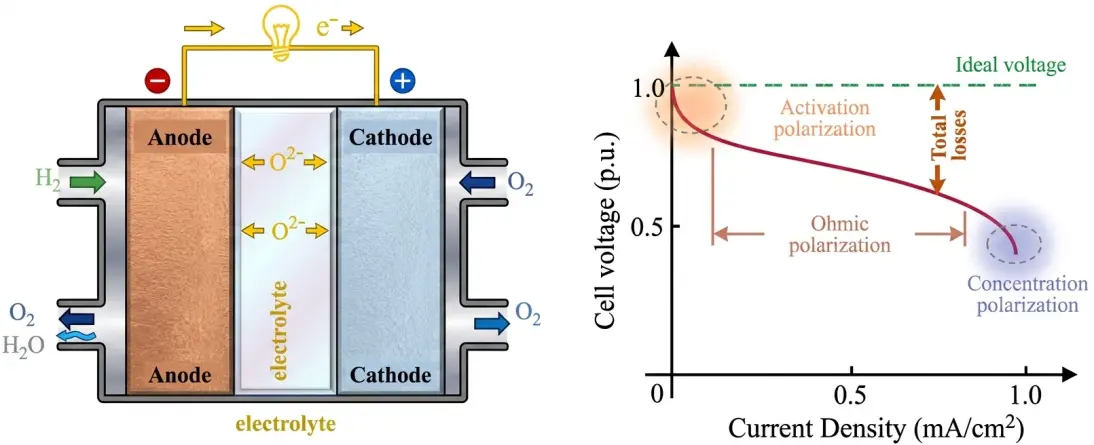
As can be seen from the Figure, there are two reactions that make up the hydrogen combustion reaction. Since the electrolyte prevents the electrons from moving through it, they are forced to flow via the external circuit, creating the current. The ions move through the electrolyte in the interim. These responses change the input, which causes water, heat, and electricity to be produced from hydrogen and oxygen. The typical i-V curve shows that the current increases, the cell voltage will decrease. The voltage drop in the often used operating area of ohmic polarization is mostly caused by ionic and electronic conduction in the cell. FC is superior to batteries in terms of energy density. A fuel cell also requires little time to recharge because it can keep running as long as a fuel source is immediately available and the recharging process is short. An FC-based electric vehicle (EV), for instance, may be refueled in 3–5 min, which is quicker than charging a battery-based EV [36].
4.4. Electroyzer and Hydrogen Tank
An electrolyzer is a device that turns water into oxygen and hydrogen gas. The electrolyzer begins producing high electric current by producing more H2 when a specified range of high DC voltage is given to it, and vice versa. Later, as seen in Figure 1, the FC is employed to generate DC electricity. Therefore, the electrolyzer uses the extra energy when the entire load demand of the customer at time slot t is less than the power generated by the HRES to fill up the HFTs. The following formula in Equation (8) provides the amount of H2 stored in the HFTs during time slot t [37].
where ξstore(t) and ξstore(t − 1) represent the energy that has been stored in the HFTs in time slots (t) and (t − 1) respectively, while the inverters and electrolyzer’s efficiency are denoted by ηi and ηe.
The energy stored in HFTs is used by FC to satisfy the increased demand in the event that the overall load demand at time slot t exceeds the energy produced by the WT and PV systems combined. Here, the following formula as given by Equation (9), is used to determine the amount of H2 in tanks during time slot t:
where $${\mathrm{\eta }}_{\mathrm{f}\mathrm{c}}$$ represents the overall efficiency of fuel cells corresponding to DC-DC converter. Eventually, the final output power delivered to the converter by the fuel cell can be calculated using Equation (10).
where ξstore(t) and $${\mathrm{\eta }}_{\mathrm{f}\mathrm{c}}$$ represent the energy that has been stored in the HFTs in time slots t and the efficiency of the fuel cell, respectively [38].
4.5. Hydrogen Fuel Tank (HFT) Calculations
Calculating the total number of hydrogen fuel tanks (Nt) needed for a system is a key decision factor in hybrid systems. The (Nt) is determined by the consumer’s load requirement and the renewable energy resources capacity to generate power. The required storage capacity for the suggested hybrid system is calculated using Equation (11).
where max (temp) is the maximum generation points of the temp curve. $${\mathrm{P}}_{\mathrm{L}}\left(\mathrm{t}\right)$$ is the total load demand, $$\mathrm{\Delta }\mathrm{t}$$ is the time interval, and $${\mathrm{\xi }}_{\mathrm{g}\mathrm{e}\mathrm{n}}\left(\mathrm{t}\right)$$ is the power output from the renewable sources. As a result, the formula as depicted in Equation (12) can be used to calculate the (Nt) needed for the system [39]:
where (Nt) is the total number of HFTs, $${M}_{{H}_{2}}$$ is the required hydrogen mass, and $${M}_{tank}$$ is the hydrogen capacity of the single tank.
4.6. Energy Storage System (ESS)
The Essential Energy Storage System (ESS) is a critical component that enables contemporary power grids to fully integrate renewable energy sources while ensuring safe grid operations. The system stores extra electrical power when both electricity demand and power generation reach low levels and distributes stored energy during times when demand surpasses available power. Energy Storage Systems use various technologies, which include electrochemical storage systems that operate with lithium-ion and lead-acid batteries, and mechanical systems that include pumped hydro systems, flywheel systems, and hydrogen-based storage systems. An Energy Storage System contains four essential components, which include a storage medium and power conversion system and battery management system, and a control unit that work together to maintain safe and efficient system performance. The primary performance metrics for a system include its energy density, efficiency, cycle life, and state of charge. ESS supports multiple functions, which include renewable energy smoothing and peak load management and backup power and electric mobility applications. The system maintains essential status as an Energy Storage Solution because it enables the development of energy systems that meet sustainability requirements while maintaining operational resilience and decentralized energy production capabilities [40].
4.7. Converter Topologies
The operation of power conversion elements becomes essential for renewable energy systems because these components enable different energy sources to work together with energy storage systems and existing electrical devices. Most renewable energy systems receive their electricity from solar photovoltaic systems, which produce direct current (DC) power. On the other hand, if the system employed wind turbine (WT) then the output AC power must be compatible for grid integration. The system generates electrical power to meet battery charging needs and power devices that use direct current (DC) electricity. The system uses DC-DC converters that provide a stable output voltage to meet the power needs of each component. The system operation receives multiple benefits from power electronic interfaces and achieves operational flexibility by using renewable resources while decreasing energy consumption.
Renewable energy systems use different converter topologies because their power conversion requirements depend on the specific source and load conditions, as well as the grid needs of their systems. The voltage source inverter (VSI) system serves as the primary technology for connecting solar photovoltaic systems to the power grid because it enables operators to maintain stable voltage and frequency levels. High-power systems require current source inverters (CSI) because these devices enable operators to control current flow in their electrical circuits. Diode-clamped, flying-capacitor, and cascaded H-bridge converter topologies enable grid-connected systems to operate with lower harmonic distortion, better power quality, and reduced switching losses. Engineers choose between isolated and non-isolated DC-DC converter topologies because they need to match specific voltage requirements while maintaining high efficiency throughout their systems. The choice of converter topology significantly influences system performance, including efficiency, reliability, power quality, and compliance with grid codes, thereby playing a vital role in the seamless integration of renewable energy sources into modern power systems. The inverter’s efficiency (ηi) can be used to display the losses of the inverter. Efficiency is about intended to remain steady throughout the whole inverter working range [41]. Power output of the converter can be estimated using Equation (13).
5. Economic Considerations
The hybrid system uses advanced optimization methods to reach its maximum size and energy control capabilities, achieving the most efficient life-cycle cost reduction, including all expenses, operational and maintenance costs, and replacement costs, while maintaining system performance and load capacity. The assessment of economic performance uses net present cost (NPC), levelized cost of energy (LCOE), and system efficiency as evaluation metrics. The integration of fuel cells into the system enables operators to achieve operational flexibility while reducing requirements for both excessive renewable energy production and extensive energy storage capabilities. The hybrid system, which integrates solar power and wind energy with fuel cell technology, provides an economical solution for decentralized energy generation, which performs well under various environmental conditions and load changes [42].
5.1. Net Present Cost (NPC)
The main objective function is to minimize the net present cost (NPC) that comprising capital cost, maintenance cost, and repair cost. All these factors are frame out in a single economical index as shown in Equation (14).
Equation (14), $${NPC}^{i}$$ represents the net present investment cost of the installed components, $${NPC}^{loss}$$ denotes the present value of distribution system power losses, and $${C}_{Penalty}$$ represents the penalty imposed for violation of system constraints such as voltage limits, reliability requirements, and power balance constraints.
From Equation (15), $${C}^{C}, {C}^{M}, \mathrm{a}\mathrm{n}\mathrm{d} {C}^{R}$$ are Capital cost, Maintenance cost, and Repair cost, summarized using Equation (16), Equation (19) and Equation (20).
where CPV, CWT, Ct, CFE, and Cinv denoted the unit cost of Solar PV, Wind turbine, HFT’s, Fuel cell/Electrolyzesrs and inverters respectively, While N expressed the number of units employed.
To convert the maintenance and repair cost of PV, WT, Fuel cell, HFT’s, and Electrolysers in total annual cost, formula depicted in Equation (17) and Equation (18) shall be employed. Cost Recovery Factor (CRF) plays an important role in expressing the maintenance and repair costs of the equipment into the total cost of the system.
where
f and $${ir}_{nom}$$ are the inflation rate and nominal interest rate, respectively.
Equation (19) is used to compute the maintenance cost (CM) of the various system components utilized in the model on a yearly basis:
where PV, WT, FC, electrolyzer, and inverter maintenance costs are indicated by $${\mathrm{C}}_{\mathrm{M}}^{\mathrm{P}\mathrm{V}}$$, $${\mathrm{C}}_{\mathrm{M}}^{\mathrm{W}\mathrm{T}}$$, $${\mathrm{C}}_{\mathrm{M}}^{\mathrm{F}\mathrm{C}}$$, $${\mathrm{C}}_{\mathrm{M}}^{\mathrm{e}\mathrm{l}}, {\mathrm{C}}_{\mathrm{M}}^{\mathrm{i}\mathrm{n}\mathrm{v}}$$ respectively. The costs of maintaining HFTs are considered to be ignored. Equation (20) is used for the calculation of repair cost.
$${\mathrm{C}}_{\mathrm{R}}^{\mathrm{P}\mathrm{V}}$$, $${\mathrm{C}}_{\mathrm{R}}^{\mathrm{W}\mathrm{T}}$$, $${\mathrm{C}}_{\mathrm{R}}^{\mathrm{F}\mathrm{C}}$$, $${\mathrm{C}}_{\mathrm{R}}^{\mathrm{e}\mathrm{l}}$$, and $${\mathrm{C}}_{\mathrm{R}}^{\mathrm{i}\mathrm{n}\mathrm{v}}$$ denoted repair cost of PV array, Wind turbine, Fuel cells, Electrolyzer, and Inverter respectively.
In Equation (21), K is the present value of annual payment that converts repair cost into the factor of total cost for the entire operation. L is the useful lifetime, and n represents the counter.
Cost due to unmet load is measured in terms of loss of energy expectation (LOEE) and formulated using Equation (22) [43].
5.2. Levelized Cost of Energy (LCOE)
The second objective is to minimize the cost of energy (COE) on the basis of optimal planning of HRES by taking loss of load probability (LOLP) reliability index into account [44]. To minimize the cost of energy (COE), following Equation (23) to address the objective function:
6. Reliability and Optimal Planning Framework
Reliability of any system can be defined as the probability that a device or system will function appropriately for the desired operating time. One of the fundamental roles of an electrical power system is to provide consistent power with high levels of security and sufficiency. Billinton [45] and Endrenyi [46] use a reliability analysis approach for this issue that makes use of the Markov process model. Reliability evaluation of distribution systems with DG using Monte-Carlo simulation (MCS) was most likely developed by Hegazy et al. [47]. Due to the lengthy nature of reliability evaluation utilizing Monte-Carlo simulation (MCS), it may not be possible to make a quick judgment for 24 h of operation when sufficiency assessment is needed for the expected load [48]. While analytical strategies use various mathematical formulations to obtain the reliability indices, the Monte Carlo method samples network component failures to compute the probabilities of the reliability indices. An artificial neural network (ANN) is a cutting-edge machine learning technology that was created and adapted from human’s capacity to duplicate or imitate after learning. One such area where an ANN can be used to reach the highest standards is a power system [49]. Furthermore, system reliability cannot be achieved without effective DG unit optimization. The positioning and sizing of the DG are crucial for reporting a trustworthy system [50]. However, a rapid and trustworthy system for optimization has been formulated using a variety of metaheuristics, Artificial Intelligence (AI), Genetic Algorithms (GA), and other hybrid approaches. In order to effectively identify the optimal or nearly optimal solutions to the optimization problem, a meta-heuristic is an iterative generation process that can serve as a guide for its subordinate heuristics [51]. To enhance performance, it cleverly blends many artificial intelligence-derived principles. The most recent advancement in approximate search techniques, known as meta-heuristics, has proven to be extremely effective at resolving challenging optimization issues across a variety of domains. Simulated Annealing (SA), GAs, Tabu Search (TS), Particle Swarm Optimization (PSO), and Ant Colony Optimization (ACO) are a few algorithms that use meta-heuristics notions.
The ability of a distributed Generation system to provide loads with adequate, uninterrupted, and reliable power can be measured using a number of quantitative reliability indices. The following are the main guidelines for sequential probabilistic methodologies for evaluating the reliability of distributed generation:
-
-
System and Component Modeling (Step 1): Establishing probabilistic state models for system components, such as wind turbines, solar PV, Fuel cells, converters, and loads, based on actual statistical data, such as the failure rate of components, etc., is known as component modeling.
-
-
System Reliability Indices (Step 2): Based on the analytical or any other simulation technique, simulate the system state transition process over time.
-
-
Assessment of Reliability Indices (Step 3): This step is a fundamental phase in the reliability evaluation process. It involves evaluating the reliability implications of each system state created in step 2.
-
-
Convergence Criteria (Step 4): If the convergence requirement is met, output reliability is obtained; otherwise, move on to step 2 as shown in Figure 5.
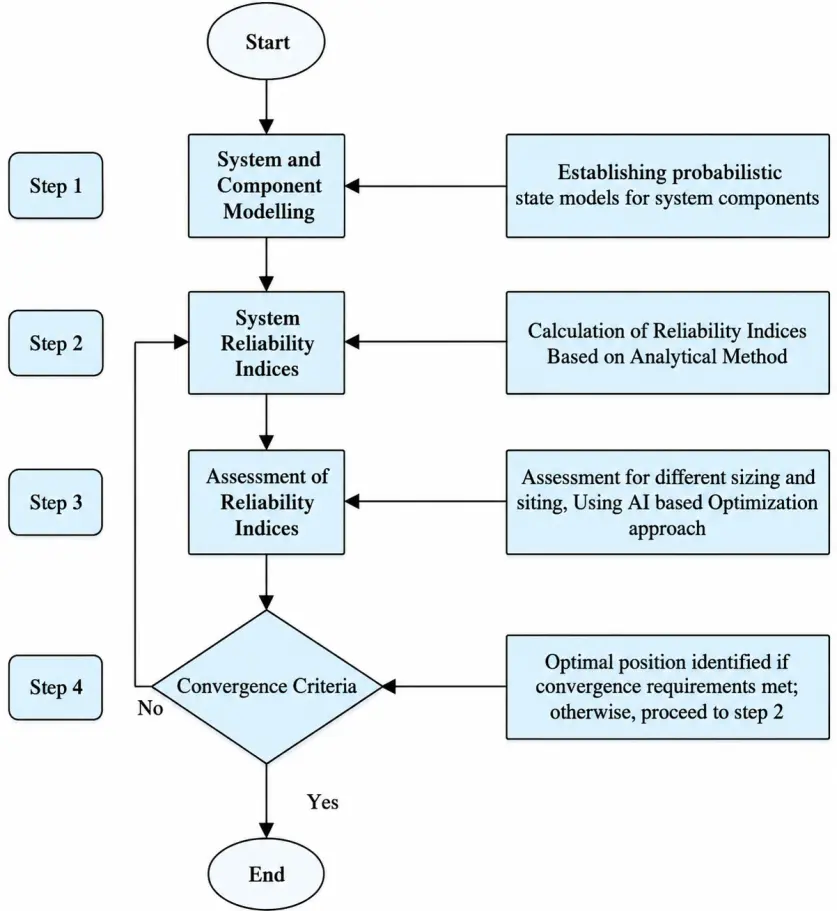
Based on the aforementioned generic methods of reliability evaluation, AI-based reliability evaluation framework for distributed generating systems is proposed in this review research work. The proposed framework’s key changes, as shown in Figure 2, are found in step 3, where an AI-based technique is used to automatically mine the correlation between the system fault status and its reliability implications. In additional steps, the machine-learning-based framework also reconstructs the reliability index model, reliability evaluation algorithm, etc.
7. Reliability Assessment Methods
There are generally two distinct groups of approaches for evaluating the reliability of an electrical power system. The first class, which applies to generation units for non-intermittent energy sources, is based on the analytical method. The second class, which is based on Monte Carlo simulation, can aggregate the load variation curve and represent generation units of intermittent energy sources. Hybrid techniques that combine the benefits of each of the preceding ones are also an option [52]. Methods of reliability assessments can be broadly categorized as follows:
-
-
Analytical methods
-
-
Monte Carlo simulation (MCS)
-
-
Optimization Based Approaches
-
-
Artificial Intelligence (AI) Based Approaches
The assessment of power system reliability provides a fundamental method for testing whether electrical energy distribution systems can maintain operation during times of component breakdowns, system maintenance, and unpredictable operational conditions. Researchers have created multiple reliability evaluation methods, which can be categorized into three main groups that include analytical methods, Monte Carlo simulation (MCS), and hybrid methods. The three methods show distinct characteristics because they require different levels of modeling complexity and total computing power and provide different levels of precise results. Analytical methods assess system reliability through mathematical and probabilistic models, which utilize known failure and repair rates to calculate the reliability of system components. The methods use reliability block diagrams, fault tree analysis, and Markov modeling techniques to calculate reliability metrics, which include loss of load probability, expected energy not supplied, and customer interruption indices. The computational efficiency of analytical methods enables fast assessment of system behavior, but their performance suffers when applied to large systems with varying load patterns, renewable energy components, and complex operational rules. The Monte Carlo simulation method uses a stochastic technique to determine system reliability by conducting multiple simulations of component failures and repairs, which occur at random times. Through its ability to create many operating scenarios, MCS enables the realistic simulation of electric vehicle charging patterns, energy storage, renewable generation, and load demand variations in real time. The Monte Carlo methods provide users with accurate results that match their specific requirements, but these methods demand extensive computing power and take extended periods to complete simulations, especially in systems that experience infrequent failure incidents [53].
Analytical approaches use mathematical equations to model the system and use direct numerical solution to assess the required reliability indices [54]. The system’s true, chaotic behaviours cannot be accurately simulated by it. By considering the issues as a series of actual experiments and replicating the random behaviour of system components, Monte Carlo simulation is able to overcome this [55]. The 1980s saw the beginning of the reliability assessment of renewable energy-based power systems. New dependability terms and concepts that apply to PV technology and applications were introduced in [56]. These novel ideas take into consideration both the particularities of the PV array and the variability of the solar energy input. Several researchers have contributed in different ways to the modelling of renewable energy sources for reliability assessment [57,58]. S. A. Klein et al. [59] adopted a simulation-based approach, while I. Abouzahr et al. [60] and C. Singh et al. [61] employed simulation-based techniques. E. Ofry et al. [62] utilized loss of power supply probability (LPSP) for standalone photovoltaic system design. I. Abouzahr et al. [63] developed a closed-form solution method to assess the probability that standalone solar energy systems with battery storage will experience a loss of power supply. Y. Ding et al. [64] assess the reliability of systems based on renewable energy sources is done using the universal generating function. For a PV-wind-storage system, a novel approach for reliability assessment utilising a probabilistic storage model is proposed in [65]. According to the precision and computational requirements of the analysis, both analytical and simulation methodologies have been employed to evaluate the reliability of a Distributed Generation System for off-grid applications. Some techniques combine the analytical method’s simplicity with Monte Carlo simulation’s ability to describe stochastic events. A Hybrid approach is used to accomplish the reliability evaluation in, where an analytical method is used to assess the network, while random sampling techniques are used to represent intermittent generation. However, there aren’t many publications that model independent distributed generation for off-grid applications. In this context, a hybrid model employing fuel cells in Distributed Generation systems has been proposed. The developed model is applied to evaluate the reliability of a remote system identified with various reliability indexes.
Artificial Intelligence (AI) based solutions provide substantial benefits to modern power and energy systems, which need their reliability assessment and optimization, and operational planning work done through traditional analytical methods and Markov-based methods. Analytical and Markov models rely on simplifying assumptions that define their operational boundaries, including constant failure and repair rates, AI-based methods can model complex system behavior because they discover nonlinear system behavior, high-dimensional system relationships, and all system component interactions without needing mathematical expressions. The system models achieve better accuracy because they include renewable energy sources, energy storage units, electric vehicle loads, and demand-side uncertainties. The main drawback of Markov-based methods is that they experience state-space explosion, which occurs when more components are added to the system. AI-based techniques learn how systems function by analyzing past data and simulation results, which allows them to skip the step of mapping all possible system states. Machine learning algorithms, including neural networks and deep learning models, can accurately forecast reliability indices and system performance indicators for extensive and interconnected power grid systems, leading to major decreases in required computation time. Table 4 explicitly demonstrates the comparative analysis of various methods for reliability evaluation.
Table 4. Comparative analysis of various reliability evaluation methods.
|
Category |
Principle |
Advantages |
Limitations |
Typical Applications |
|---|---|---|---|---|
|
Analytical Methods |
Mathematical and probabilistic modeling (Markov, state-space, reliability block diagrams) |
Fast computation, clear theoretical basis, suitable for large systems |
Limited ability to model renewable intermittency and complex uncertainties |
Conventional generation and transmission systems |
|
Monte Carlo Simulation (MCS) |
Repeated random sampling of system states and failures |
High accuracy, captures stochastic behavior and renewable variability |
Computationally intensive, long simulation times |
Renewable-rich and hybrid energy systems |
|
Optimization-Based Methods |
Reliability assessment integrated with optimization algorithms (GA, PSO, DE, GWO, etc.) |
Identifies optimal sizing, siting, and operation strategies |
May converge to local optima; parameter-sensitive |
Distributed generation planning and micro-grids |
|
AI-Based Methods |
Data-driven learning using ANN, Fuzzy Logic, SVM, Deep Learning |
Handles nonlinearities, rapid prediction, adaptive decision-making |
Requires large datasets and model training |
Smart grids, predictive reliability assessment, EV charging systems |
Based on the taxonomy presented in Table 5, reliability assessment methods can be systematically compared by their underlying principles, advantages, limitations, and typical applications. Analytical methods rely on mathematical and probabilistic formulations, offering low computational complexity and clear theoretical interpretation; however, they are less capable of representing the stochastic behavior of renewable energy sources. Monte Carlo Simulation (MCS) methods provide a more realistic representation of uncertainty by using repeated random sampling of system states and component failures, but they generally require substantial computational effort. Optimization-based approaches extend reliability assessment by integrating planning and operational decision variables, enabling the optimal sizing, siting, and operation of distributed energy resources, although their performance depends on convergence characteristics and parameter tuning. In contrast, AI-based methods employ data-driven learning techniques to model complex nonlinear relationships and provide rapid reliability predictions, making them attractive for real-time applications, but they require high-quality training data and rigorous validation procedures. Consequently, each category exhibits distinct trade-offs among accuracy, computational efficiency, uncertainty-modeling capability, and practical applicability, highlighting the need for integrated frameworks that combine the strengths of multiple approaches for renewable-rich power systems [66].
Table 5. Comparative analysis based on technical verticals.
|
Method |
Accuracy |
Computational Time |
Renewable Uncertainty Handling |
Real-Time Capability |
|---|---|---|---|---|
|
Analytical |
Moderate–High |
Low |
Limited |
High |
|
Monte Carlo Simulation |
High |
Very High |
Excellent |
Low |
|
Optimization-Based |
High |
Moderate–High |
Good |
Moderate |
|
AI-Based |
High (after training) |
Very Low |
Excellent |
Very High |
8. Reliability Indices
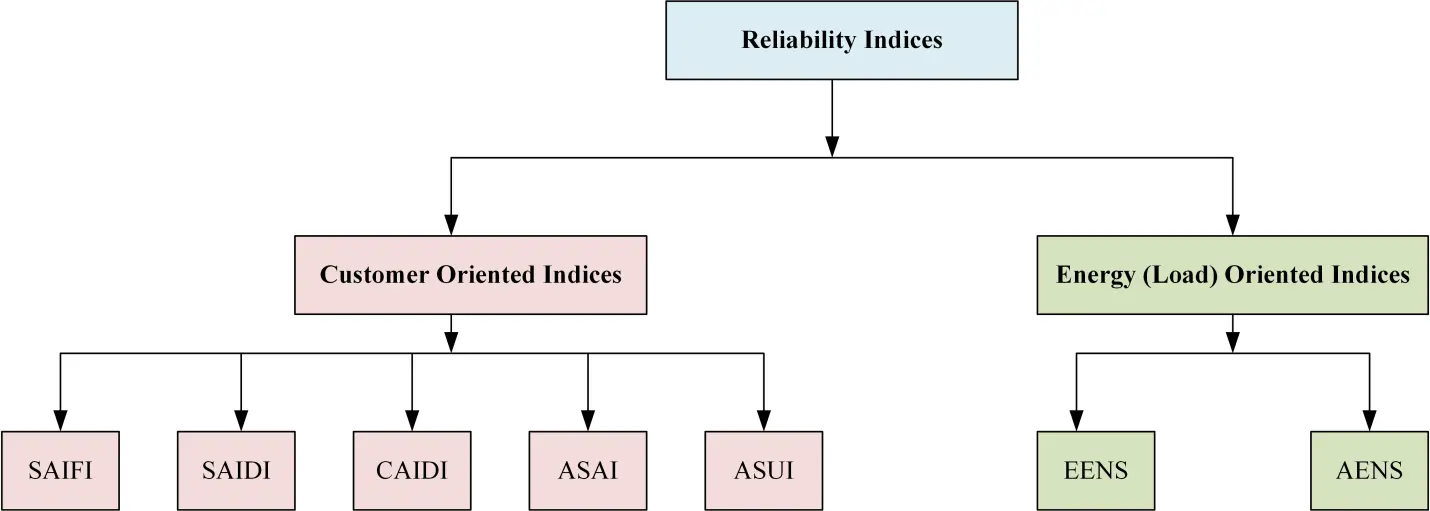
Reliability evaluation is the basis for identifying whether capacity planning is compatible to meet demand or not. Furthermore, the operation of power systems becomes more complex if the integration of DGs is considered simultaneously. In recent scenarios of increasing load demand as well as diversified load conditions over the distribution network, the only objective of the utility is to maintain a reliable power supply. Power system reliability is categorized based on customer and energy based indices as demonstrated by Figure 6. Customer based reliability indices, such as SAIFI, SAIDI, CAIDI, ASAI, ASUI, EENS, and AENS are crucial for evaluating the performance of electrical power systems. They measure the frequency, duration, availability, and impact of outages on customers and energy supply. SAIFI measures the average number of interruptions; SAIDI measures the total duration of interruptions per customer; CAIDI provides the recovery time; ASAI measures the percentage of available power; ASUI measures the unavailable service; EENS measures the total energy not supplied per customer; and AENS quantifies the average energy not supplied. Both Customer and energy based reliability indices deviated from the base case and started to decrease once the DGs were integrated into the existing distribution network [67].
8.1. Customer-Oriented Indices
Some key reliability indices, such as the Average Interruption Frequency (SAIFI), Average Interruption Duration (SAIDI), and Average Interruption Duration for Customer (CAIDI), Expected Energy Not Supplied (EENS), Average Energy Not Supplied (AENS), Average System Availability Index (ASAI) and Average System Unavailability Index (ASUI) are used for performance assessment of electrical distribution systems. SAIFI details the number of outages experienced by the average customer and SAIDI calculates the average time without power for those customers [68]. CAIDI reflects the average period of time for the service to be restored following an interruption.
Average service availability and unavailability index (ASAI and ASUI) are the indices that give information about the system performance. Both indices are informative about service availability and unavailability for customers. ASAI informs about the proportion of time during which supply is available, while ASUI identifies the duration during which supply is not available. Both the indices are expressed in per unit, as depicted in Equation (27) and Equation (28).
8.2. Energy-Oriented Indices
Energy (Load) oriented indices are measures to quantify the power system reliability in the context of energy. Energy oriented indices are $$\mathrm{E}\mathrm{E}\mathrm{N}\mathrm{S}$$ and $$\mathrm{A}\mathrm{E}\mathrm{N}\mathrm{S}$$, both of which are crucial for power system planners as well as operators because they provide collective information about quality of service and quantitative measurement of reliability. $$\mathrm{E}\mathrm{E}\mathrm{N}\mathrm{S}$$ is the expected energy that is not supplied to the customer due to an outage over a specified period of time.
$$\mathrm{A}\mathrm{E}\mathrm{N}\mathrm{S}$$ represents the average energy per customer that is not supplied due to an outage.
|
```latex\mathrm{A}\mathrm{v}\mathrm{e}\mathrm{r}\mathrm{a}\mathrm{g}\mathrm{e}\,\mathrm{ }\mathrm{E}\mathrm{n}\mathrm{e}\mathrm{r}\mathrm{g}\mathrm{y}\,\mathrm{ }\mathrm{N}\mathrm{o}\mathrm{t}\,\mathrm{ }\mathrm{S}\mathrm{u}\mathrm{p}\mathrm{p}\mathrm{l}\mathrm{i}\mathrm{e}\mathrm{d}\,\mathrm{ }\left(\mathrm{A}\mathrm{E}\mathrm{N}\mathrm{S}\right)=\mathrm{ }\frac{\sum \mathrm{E}\mathrm{E}\mathrm{N}\mathrm{S}\,\mathrm{ }\mathrm{a}\mathrm{t}\,\mathrm{ }{\mathrm{q}}^{\mathrm{t}\mathrm{h}}\,\mathrm{ }\mathrm{l}\mathrm{o}\mathrm{a}\mathrm{d}\,\mathrm{ }\mathrm{P}\mathrm{o}\mathrm{i}\mathrm{n}\mathrm{t}}{\mathrm{T}\mathrm{o}\mathrm{t}\mathrm{a}\mathrm{l}\,\mathrm{ }\mathrm{n}\mathrm{u}\mathrm{m}\mathrm{b}\mathrm{e}\mathrm{r}\,\mathrm{ }\mathrm{o}\mathrm{f}\,\mathrm{ }\mathrm{c}\mathrm{u}\mathrm{s}\mathrm{t}\mathrm{o}\mathrm{m}\mathrm{e}\mathrm{r}\mathrm{s}}\,\, \mathrm{(MWh/Customer/Year)}``` |
|
|
```latex\mathrm{A}\mathrm{E}\mathrm{N}\mathrm{S}=\mathrm{ }\frac{\sum _{\mathrm{q}=1}^{{\mathrm{z}}_{\mathrm{q}}}{\mathrm{L}}_{\mathrm{q}}{\mathrm{N}}_{\mathrm{q}}\mathrm{ }}{\sum _{\mathrm{q}=1}^{{\mathrm{Z}}_{\mathrm{q}}}{\mathrm{N}}_{\mathrm{q}}}\mathrm{ }\,\mathrm{M}\mathrm{W}\mathrm{h}\,\mathrm{ }\,\mathrm{p}\mathrm{e}\mathrm{r}\,\mathrm{ }\mathrm{c}\mathrm{u}\mathrm{s}\mathrm{t}\mathrm{o}\mathrm{m}\mathrm{e}\mathrm{r}\,\mathrm{ }\mathrm{p}\mathrm{e}\mathrm{r}\,\mathrm{ }\mathrm{y}\mathrm{e}\mathrm{a}\mathrm{r}``` |
(30) |
Various indices that defined for calculating reliability level exclusive for distributed generation systems while operating in off-grid mode include Loss of Load Probability (LOLP), Loss of Load Expectation (LOLE), Loss of Energy Expected (LOEE), Loss of Power Supply Probability (LPSP), Net Present Cost (NPC), and the Equivalent Loss Factor (ELF). LOLE is a loss of load index among them, whilst the others fall under the category of loss of energy indices. The following sections provide definitions for these indexes [69].
8.3. Loss of Load Probability (LOLP)
The loss of load probability (LOLP) is the most commonly employed evaluation index. The probability that the electricity generated will not be enough to meet demand is known as the LOLP. The source of the LOLP for both traditional and renewable DG is
where pj and tj are the probability of a capacity outage and the percentage of time when the load exceeds generation, respectively.
8.4. Loss of Load Expectation (LOLE)
The terms LOLE and LOLP are closely related. The LOLE is produced rather than the LOLP if the quantity utilized for the LOLP is stated in terms of time units rather than proportion values.
E[LOL(h)] is the expected value of loss of load at the h-th time step and is defined as follows:
Given that states are expected to occur and S is the set of all possible states, f(s) in the equation above represents the possibility of meeting states, and T(s) represents the loss of load duration (h).
8.5. Loss of Energy Expected (LOEE) or Expected Energy Not Supplied (EENS)
where E[LOE(h)] is the expected amount of energy lost or not supplied at time step h as described by:
Here, Q(s) is the energy loss experienced by the system when it reaches states, expressed in kWh.
8.6. Loss of Power Supply Probability (LPSP)
where D(h) is the load demand in KWh.
8.7. Equivalent Loss Factor (ELF)
The ratio of effective load outage hours to the overall number of hours is known as the equivalent loss factor (ELF). It includes details on both the quantity and size of outages [70].
Power system reliability indices, which include SAIFI, SAIDI, CAIDI, and loss of load probability (LOLP), together with expected energy not supplied (EENS), demonstrate a strong dependence on equipment failure rates and outage durations, which determine both the regularity and intensity of power interruptions.
9. Findings & Challenges
This review article provides a thorough analysis of several challenges pertaining to Distributed Generation (DG)-based power generation for stand-alone applications. Details on topics including the need for renewable energy sources, optimal planning, storage alternatives, reliable operation, and energy management are covered. For stand-alone applications, a system based on a single technology is acceptable for a location with a low energy need. However, single technology-based systems are linked to high system costs and limited reliability as demand rises. The concept of the Distributed Generation system has evolved to address these single-technology restrictions. The need for an energy storage system (ESS) in the DG system is also addressed in the paper. Storage systems balance out the unpredictably fluctuating energy supply from intermittent renewable energy sources like solar, wind, etc. Fuel cell technology is paving the way for storage management and CO2 emissions. Optimal system component sizing in DG system is crucial for both technical and economic reasons. Under design restrictions such as the number of generators, energy balance, battery state of charge (SOC), and reliability of the system (LOLP, LOEE, LPSP, EENS, and ELF), the majority of researchers optimized the net present cost, annualized cost of the system, and cost of energy [71]. When the sizing and siting of distributed generation system components are considered, artificial intelligence and multi-objective design are widely used by researchers, helping to converge on a globally optimal solution with comparatively simple computational methods. In contrast to other similar review studies, the current study covers all relevant challenges. Along with the concerns and issues, it has also been discovered that standalone applications are compatible with EV charging and that running EV load in V2G (Vehicle to Grid) and G2V (Grid to Vehicle) mode of operations improves the reliability of DG systems. Regardless of the range of off-grid applications that standalone DGs are used for, optimal planning and reliable operations are always the most appropriate choices, and one of the most frequently discussed worries among researchers is the need for a more effective algorithm for both optimization and reliable operations. Even though distributed power generation is environmentally friendly and depends on renewable energy sources, it always faces a number of challenges. Renewable energy sources unpredictable behavior, which affects the efficiency of the entire system, is always a major problem. In terms of capital cost, renewable energy sources do not meet economic requirements compared with conventional generators. Solar panel efficiency and storage device life cycles continue to pave the way for desired operations. Load transients during standalone operations also influence stability and necessitate corrective steps for the DG system to operate consistently [72].
10. Conclusions & Future Scope
Electrical power grids have faced increasing stress in recent decades due to two factors: the fast-growing demand for electricity and the widespread use of nonlinear and unpredictable loads, as well as the extensive adoption of renewable energy systems. The elemental uncertainty in consumer needs, together with the unpredictability of power generation, has created major disturbances that affect grid stability, power system reliability, and the quality of electric power. Operational strategies for grid-connected and remote systems require unified development to meet technical requirements, including voltage control, frequency maintenance, operational system losses, and associated expenses that cover day-to-day operations, equipment efficiency, and product lifespan.
For off-grid applications, renewable energy systems are the most widely used technology. A thorough analysis covering all relevant topics, including off-grid applications, ideal planning, and reliable operation, has been conducted in this study. Distributed generating systems can be used in standalone mode for a variety of off-grid applications, including powering residential and commercial loads in areas where access to electricity is still an issue. The review also demonstrates that the DG based micro-grids achieve improved performance with efficient ESS operation procedures. According to the review, operating DG’s while taking reliability and economics into account remains a difficult task for scientists. The researcher has recently used a variety of approaches to address reliability and economic operating difficulties. Due to the stochastic nature of solar and wind-powered generators, artificial intelligence based optimization techniques have been crucial in determining the optimum results in terms of computational simplicity. The optimal operation, sizing, sitting, and reliability related contingencies of renewable energy sources have been the subject of extensive research; however, more needs to be done in this area to ensure more reliable operation of distributed generation systems for off-grid applications. Future work has been suggested in this research to enhance the reliability and energy management of distributed generation systems for off-grid applications. To increase the useful life and performance of battery and hydrogen storage systems while simultaneously lowering their cost, more research is needed. The proposed hybrid renewable energy system offers significant benefits for both industry and society. From an industrial perspective, the optimized integration of photovoltaic, wind, and fuel cell technologies enhances system reliability, reduces operational costs, and supports the deployment of sustainable electric vehicle charging stations. For the broader community, the system contributes to reduced greenhouse gas emissions, improved energy security, and increased utilization of clean energy resources. The research supports the transition toward sustainable transportation and smart energy infrastructure, thereby contributing to environmental protection and long-term socio-economic development.
Author Contributions
Conceptualization, K.A.; Methodology, K.A. and D.S.; Validation, K.A. and C.S.; Formal Analysis, C.S.; Investigation, K.A. and D.S.; Resources, K.A.; Data Curation, C.S.; Writing—Original Draft Preparation, K.A.; Writing—Review & Editing, C.S.; Supervision, D.S. and C.S.
Ethics Statement
Not applicable.
Informed Consent Statement
Not applicable.
Data Availability Statement
The databases utilized are thoroughly outlined and referenced in the citation provided within the text, and they are publicly available.
Funding
This research received no external funding.
Declaration of Competing Interest
The authors declare that they have no known competing financial interests or personal relationships that could have appeared to influence the work reported in this paper.
References
-
Ahmed K, Sakravdia D, Sharma C. An Overview of Distributed Generation System: Considering Optimal Planning and Reliability for EV Charging Stations. In Proceedings of the 2024 International Conference on Recent Innovation in Smart and Sustainable Technology (ICRISST), Bengaluru, India, 15–16 March 2024; pp. 1–6. DOI:10.1109/ICRISST59181.2024.10921936 [Google Scholar]
-
Singh SN. Distributed Generation in Power Systems: An Overview and Key Issues. In Proceedings of the 24th Indian Engineering Congress, NIT Surathkal, Kerala, India, 10–13 December 2009. [Google Scholar]
-
Belfkira R, Hajji O, Nichita C, Barakat G. Optimal sizing of stand-alone hybrid wind/PV system with battery storage. In Proceedings of the 2007 European Conference on Power Electronics and Applications, Aalborg, Denmark, 2–5 September 2007; pp. 1–10. DOI:10.1109/EPE.2007.4417586 [Google Scholar]
-
Ahangar HG, Yew WK, Flynn D. Smart Local Energy Systems: Optimal Planning of Stand-Alone Hybrid Green Power Systems for On-Line Charging of Electric Vehicles. IEEE Access 2023, 11, 7398–7409. DOI:10.1109/ACCESS.2023.3237326 [Google Scholar]
-
Talaat M, Elkholy MH, Alblawi A, Said T. Artificial intelligence applications for microgrids integration and management of hybrid renewable energy sources. Artif. Intell. Rev. 2023, 56, 10557–10611. DOI:10.1007/s10462-023-10410-w [Google Scholar]
-
Mohan HM, Dash SK. Renewable Energy-Based DC Microgrid with Hybrid Energy Management System Supporting Electric Vehicle Charging System. Systems 2023, 11, 273. DOI:10.3390/systems11060273 [Google Scholar]
-
Guo R, Li Q, Zhao N. An overview of grid-connected fuel cell system for grid support. In Proceedings of the 4th International Conference of Clean Energy and Electrical System (CEES 2022), Tokyo, Japan, 2–4 April 2022. [Google Scholar]
-
Selmi T, Khadhraoui A, Cherif A. Fuel cell–based electric vehicles technologies and challenges. Environ. Sci. Pollut. Res. 2022, 29, 78121–78131. DOI:10.1007/s11356-022-23171-w [Google Scholar]
-
Muhtadi A, Pandit D, Nguyen N, Mitra J. Distributed Energy Resources Based Microgrid: Review Architecture, Control and Reliability. IEEE Trans. Ind. Appl. 2021, 57, 2223–2235. DOI:10.1109/TIA.2021.3065329 [Google Scholar]
-
Wang G, Chao Y, Cao Y, Jiang T, Han W, Chen Z. A comprehensive review of research works based on evolutionary game theory for sustainable energy development. Energy Rep. 2022, 8, 114–136. DOI:10.1016/j.egyr.2021.11.231 [Google Scholar]
-
Khan A, Javaid N. Optimal sizing of a stand-alone photovoltaic, wind turbine and fuel cell systems. Comput. Electr. Eng. 2020, 85, 106682. DOI:10.1016/j.compeleceng.2020.106682 [Google Scholar]
-
Das V, Padmanaban S, Venkitusamy K, Selvamuthukumaran R, Blaabjerg F, Siano P. Recent advances and challenges of fuel cell based power system architectures and control—A review. Renew. Sustain. Energy Rev. 2017, 73, 10–18. DOI:10.1016/j.rser.2017.01.148 [Google Scholar]
-
Chauhan A, Saini RP. A review on Integrated Renewable Energy System based power generation for stand-alone applications: Configurations, storage options, sizing methodologies and control. Renew. Sustain. Energy Rev. 2014, 38, 99–120. DOI:10.1016/j.rser.2014.05.079 [Google Scholar]
-
Lujano-Rojas J, Dufo-López R, Domínguez-Navarro JA. Optimization of renewable energy systems by genetic algorithms. In Genetic Optimization Techniques for Sizing and Management of Modern Power Systems; Elsevier: Amsterdam, The Netherlands, 2023; pp. 247–281. DOI:10.1016/B978-0-12-823889-9.00007-2 [Google Scholar]
-
Ahmed K, Sakravdia D, Sharma C. Impact Analysis of Combining Distributed Generation with Charging Loads for Electric Vehicles Accounting Reliability. Energy Storage 2025, 7, e70138. DOI:10.1002/est2.70138 [Google Scholar]
-
Dinh QV, Dinh VN, Leahy PG. A differential evolution model for optimising the size and cost of electrolysers coupled with offshore wind farms. Int. J. Hydrogen Energy 2025, 124, 318–330. DOI:10.1016/j.ijhydene.2025.03.440 [Google Scholar]
-
Makhadmeh SN, Al-Betar MA, Al-Obeidat F, Alomari OA, Abasi AK, Tubishat M, et al. A multi-objective grey wolf optimizer for energy planning problem in smart home using renewable energy systems. Sustain. Oper. Comput. 2024, 5, 88–101. DOI:10.1016/j.susoc.2024.04.001 [Google Scholar]
-
Ansari S, Bansal RC, Elsahar Y. Optimization of renewable energy-based transmission system: an application of the genetic, ant colony optimization, Q-learning, and Dijkstra’s algorithms. Int. J. Model. Simul. 2024, 44, 386–405. DOI:10.1080/02286203.2023.2174740 [Google Scholar]
-
Khan WA, Pakseresht A, Chua C, Yavari A. Multi-objective optimization of hydrogen-integrated hybrid renewable energy systems using an adaptive evolutionary framework. Int. J. Hydrogen Energy 2026, 232, 155001. DOI:10.1016/j.ijhydene.2026.155001 [Google Scholar]
-
Maharjan K, Zhang J, Kim D, Cho H. AI-assisted modeling and optimization of integrated distributed energy systems. Discov. Energy 2026, 6, 23. DOI:10.1007/s43937-026-00125-8 [Google Scholar]
-
Giedraityte A, Rimkevicius S, Marciukaitis M, Radziukynas V, Bakas R. Hybrid Renewable Energy Systems—A Review of Optimization Approaches and Future Challenges. Appl. Sci. 2025, 15, 1744. DOI:10.3390/app15041744 [Google Scholar]
-
Masoum AS, Deilami S, Moses PS, Masoum MAS, Abu-Siada A. Smart load management of plug-in electric vehicles in distribution and residential networks with charging stations for peak shaving and loss minimisation considering voltage regulation. IET Gener. Transm. Distrib. 2011, 5, 877–888. DOI:10.1049/iet-gtd.2010.0574 [Google Scholar]
-
Banerjee B, Islam SM. Reliability based optimum location of distributed generation. Int. J. Electr. Power Energy Syst. 2011, 33, 1470–1478. DOI:10.1016/j.ijepes.2011.06.029 [Google Scholar]
-
Shirazi A, Aminyavari M, Najafi B, Rinaldi F, Razaghi M. Thermal–economic–environmental analysis and multi-objective optimization of an internal-reforming solid oxide fuel cell–gas turbine hybrid system. Int. J. Hydrogen Energy 2012, 37, 19111–19124. DOI:10.1016/j.ijhydene.2012.09.143 [Google Scholar]
-
Deb K. Multi-objective Optimisation Using Evolutionary Algorithms: An Introduction. In Multi-Objective Evolutionary Optimization for Product Design and Manufacturing; Springer: London, UK, 2011; pp. 3–34. DOI:10.1007/978-0-85729-652-8_1 [Google Scholar]
-
Ackermann T, Andersson G, Söder L. Distributed generation: A definition. Electr. Power Syst. Res. 2001, 57, 195–204. DOI:10.1016/S0378-7796(01)00101-8 [Google Scholar]
-
Heydt GT. The Next Generation of Power Distribution Systems. IEEE Trans. Smart Grid 2010, 1, 225–235. DOI:10.1109/TSG.2010.2080328 [Google Scholar]
-
Hashmi M, Hanninen S, Maki K. Survey of smart grid concepts, architectures, and technological demonstrations worldwide. In Proceedings of the 2011 IEEE PES Conference on Innovative Smart Grid Technologies Latin America (ISGT LA), Medellin, Colombia, 19–21 October 2011; pp. 1–7. DOI:10.1109/ISGT-LA.2011.6083192 [Google Scholar]
-
Del Monaco JL. The role of distributed generation in the critical electric power infrastructure. In Proceedings of the 2001 IEEE Power Engineering Society Winter Meeting. Conference Proceedings (Cat. No.01CH37194), Columbus, OH, USA, 28 January–1 February 2001; Volume 1, pp. 144–145. DOI:10.1109/PESW.2001.917019 [Google Scholar]
-
Das B. Impact of Distributed Generation on Reliability of Distribution System. IOSR J. Electr. Electron. Eng. 2013, 8, 42–50. DOI:10.9790/1676-0814250 [Google Scholar]
-
Al-Muhaini M, Heydt GT. Evaluating Future Power Distribution System Reliability Including Distributed Generation. IEEE Trans. Power Delivery 2013, 28, 2264–2272. DOI:10.1109/TPWRD.2013.2253808 [Google Scholar]
-
Awale K, Karki NR. Reliability Assessment of Standalone Hybrid Energy System for Remote Telecom Tower. In Proceedings of the 2015 IOE Graduate Conference, Lalitpur, Nepal, 27–28 November 2015; pp. 27–37. [Google Scholar]
-
Sanajaoba S. Optimal sizing of off-grid hybrid energy system based on minimum cost of energy and reliability criteria using firefly algorithm. Sol. Energy 2019, 188, 655–666. DOI:10.1016/j.solener.2019.06.049 [Google Scholar]
-
Georgioudakis M, Plevris V. A Comparative Study of Differential Evolution Variants in Constrained Structural Optimization. Front. Built Environ. 2020, 6, 102. DOI:10.3389/fbuil.2020.00102 [Google Scholar]
-
Jouhara H, Żabnieńska-Góra A, Khordehgah N, Ahmad D, Lipinski T. Latent thermal energy storage technologies and applications: A review. Int. J. Thermofluids 2020, 5, 100039. DOI:10.1016/j.ijft.2020.100039 [Google Scholar]
-
Tong Z, Cheng Z, Tong S. A review on the development of compressed air energy storage in China: Technical and economic challenges to commercialization. Renew. Sustain. Energy Rev. 2021, 135, 110178. DOI:10.1016/j.rser.2020.110178 [Google Scholar]
-
Makandar M, Atla CSR, Velamuri S. Reliability assessment of distribution system with renewable Distributed Generation. In Proceedings of the 2016 Biennial International Conference on Power and Energy Systems: Towards Sustainable Energy (PESTSE), Bengaluru, India, 21–23 January 2016; pp. 1–5. DOI:10.1109/PESTSE.2016.7516365 [Google Scholar]
-
Mokhtar M, Robu V, Flynn D, Higgins C, Whyte J, Loughran C, et al. Prediction of voltage distribution using deep learning and identified key smart meter locations. Energy AI 2021, 6, 100103. DOI:10.1016/j.egyai.2021.100103 [Google Scholar]
-
Andoni M, Robu V, Couraud B, Fruh WG, Norbu S, Flynn D. Analysis of Strategic Renewable Energy, Grid and Storage Capacity Investments via Stackelberg-Cournot Modelling. IEEE Access 2021, 9, 37752–37771. DOI:10.1109/ACCESS.2021.3062981 [Google Scholar]
-
Norbu S, Couraud B, Robu V, Andoni M, Flynn D. Modelling the redistribution of benefits from joint investments in community energy projects. Appl. Energy 2021, 287, 116575. DOI:10.1016/j.apenergy.2021.116575 [Google Scholar]
-
Couraud B, Norbu S, Andoni M, Robu V, Gharavi H, Flynn D. Optimal Residential Battery Scheduling with Asset Lifespan Consideration. In Proceedings of the 2020 IEEE PES Innovative Smart Grid Technologies Europe (ISGT-Europe), The Hague, The Netherlands, 26–28 October 2020. DOI:10.1109/ISGT-Europe47291.2020.9248889 [Google Scholar]
-
Khare V, Nema S, Baredar P. Solar–wind hybrid renewable energy system: A review. Renew. Sustain. Energy Rev. 2016, 58, 23–33. DOI:10.1016/j.rser.2015.12.223 [Google Scholar]
-
Sangeetha P, Sowjanya S. Reliability Evaluation of Roy Billinton Test System. IJETER 2021, 9, 491–498. DOI:10.30534/ijeter/2021/27942021 [Google Scholar]
-
Billinton R. Power Systern Reliability Evaluation; Gordon and Breach Science, Pub.: New York, NY, USA, 1970. [Google Scholar]
-
Billinton R, Nerode R, Wood AJ. Power-System Reliability Calculations; MIT Press: Cambridge, MA, USA, 1973. [Google Scholar]
-
Endrenyi J. Reliability Modeling in Electric Power Systems; John Wiley & Sons: Chichester, UK, 1978. [Google Scholar]
-
Hegazy YG, Salama MMA, Chikhani AY. Adequacy assessment of distributed generation systems using monte carlo simulation. IEEE Trans. Power Syst. 2003, 18, 48–52. DOI:10.1109/TPWRS.2002.807044 [Google Scholar]
-
Koshti A, Purey P, Titare LS, Arya LD. Reliability evaluation of distribution system accounting distributed generation using functional link network. In Proceedings of the 2009 International Conference on Power Systems, Kharagpur, India, 27–29 December 2009; pp. 1–6. DOI:10.1109/ICPWS.2009.5442780 [Google Scholar]
-
Frizzo Stefenon S, Waldrigues Branco N, Nied A, Wildgrube Bertol D, Cristian Finardi E, Sartori A, et al. Analysis of training techniques of ANN for classification of insulators in electrical power systems. IET Gener. Transm. Distrib. 2020, 14, 1591–1597. DOI:10.1049/iet-gtd.2019.1579 [Google Scholar]
-
Viral R, Khatod DK. Optimal planning of distributed generation systems in distribution system: A review. Renew. Sustain. Energy Rev. 2012, 16, 5146–5165. DOI:10.1016/j.rser.2012.05.020 [Google Scholar]
-
Osman IH, Kelly JP. Meta-Heuristics: Theory and Applications; Kluwer Academic Publishers: New York, NY, USA, 1996. [Google Scholar]
-
Griffin T, Tomsovic K, Secrest D, Law A. Placement of dispersed generations system for reduced losses. In Proceedings of the 33rd Annual Hawaii International Conference on System Sciences, Maui, HI, USA, 7 January 2000. [Google Scholar]
-
El-Khattam W, Bhattacharya K, Hegazy Y, Salama MMA. Optimal Investment Planning for Distributed Generation in a Competitive Electricity Market. IEEE Trans. Power Syst. 2004, 19, 1674–1684. DOI:10.1109/TPWRS.2004.831699 [Google Scholar]
-
Golshan MEH, Ali Arefifar S. Optimal allocation of distributed generation and reactive sources considering tap positions of voltage regulators as control variables. Eur. Trans. Electr. Power 2007, 17, 219–239. DOI:10.1002/etep.130 [Google Scholar]
-
Ardakani AJ, Kavyani AK, Pourmousavi SA, Hosseinian SH, Abedi M. Siting and Sizing of Distributed Generation for Loss Reduction; International Camivorous Plant Society: Walnut Creek, CA, USA, 2007. [Google Scholar]
-
Falaghi H, Haghifam MR. ACO Based Algorithm for Distributed Generation Sources Allocation and Sizing in Distribution Systems. In Proceedings of the 2007 IEEE Lausanne Power Tech, Lausanne, Switzerland, 1–5 July 2007; pp. 555–560. DOI:10.1109/PCT.2007.4538377 [Google Scholar]
-
El-Zonkoly AM. Optimal placement of multi-distributed generation units including different load models using particle swarm optimisation. IET Gener. Transm. Distrib. 2011, 5, 760–771. DOI:10.1049/iet-gtd.2010.0676 [Google Scholar]
-
Billinton R, Karki R. Application of Monte Carlo simulation to generating system well-being analysis. IEEE Trans. Power Syst. 1999, 14, 1172–1177. DOI:10.1109/59.780954 [Google Scholar]
-
Klein SA, Beckman WA. Loss-of-load probabilities for stand-alone photovoltaic systems. Sol. Energy 1987, 39, 499–512. DOI:10.1016/0038-092X(87)90057-0 [Google Scholar]
-
Abouzahr I, Ramakumar R. An approach to assess the performance of utility-interactive photovoltaic systems. IEEE Trans. Energy Convers. 1993, 8, 145–153. DOI:10.1109/60.222697 [Google Scholar]
-
Singh C, Kim Y. An efficient technique for reliability analysis of power systems including time dependent sources. IEEE Trans. Power Syst. 1988, 3, 1090–1096. DOI:10.1109/59.14567 [Google Scholar]
-
Ofry E, Braunstein A. The Loss of Power Supply Probability as a Technique for Designing Stand-Alone Solar Electrical (Photovoltaic) Systems. IEEE Trans. Power Appar. Syst. 1983, PAS-102, 1171–1175. DOI:10.1109/TPAS.1983.318057 [Google Scholar]
-
Abouzahr I, Ramakumar R. Loss of power supply probability of stand-alone wind electric conversion systems: A closed form solution approach. IEEE Trans. Energy Convers. 1990, 5, 445–452. DOI:10.1109/60.105267 [Google Scholar]
-
Ding Y, Wang P, Goel L, Loh PC, Wu Q. Long-Term Reserve Expansion of Power Systems with High Wind Power Penetration Using Universal Generating Function Methods. IEEE Trans. Power Syst. 2011, 26, 766–774. DOI:10.1109/TPWRS.2010.2054841 [Google Scholar]
-
Paliwal P, Patidar NP, Nema RK. A novel method for reliability assessment of autonomous PV-wind-storage system using probabilistic storage model. Int. J. Electr. Power Energy Syst. 2014, 55, 692–703. DOI:10.1016/j.ijepes.2013.10.010 [Google Scholar]
-
In-Su Bae, Jin-O Kim. Reliability Evaluation of Customers in a Microgrid. IEEE Trans. Power Syst. 2008, 23, 1416–1422. DOI:10.1109/TPWRS.2008.926710 [Google Scholar]
-
Conti S, Nicolosi R, Rizzo SA. Generalized Systematic Approach to Assess Distribution System Reliability With Renewable Distributed Generators and Microgrids. IEEE Trans. Power Deliv. 2012, 27, 261–270. DOI:10.1109/TPWRD.2011.2172641 [Google Scholar]
-
Costa PM, Matos MA. Assessing the contribution of microgrids to the reliability of distribution networks. Electr. Power Syst. Res. 2009, 79, 382–389. DOI:10.1016/j.epsr.2008.07.009 [Google Scholar]
-
Ahmed K, Sakravdia D, Sharma C. A Novel Integration Approach for Photovoltaic/Wind/Fuel Cell‐Based Hybrid Renewable Energy Systems With Reliability Indices for Sustainable Electric Vehicle Charging. Fuel Cells 2025, 25, e70012. DOI:10.1002/fuce.70012 [Google Scholar]
-
Ahmed K, Sakravdia D, Sharma C. Reliability Optimization with Strategic Placements of Distributed Generation in Distribution Systems Accounting Network Reconfiguration. Int. J. Rel. Qual. Saf. Eng. 2026, 33, 2550029. DOI:10.1142/S0218539325500299 [Google Scholar]
-
Sen S, Ganguly S, Das A, Sen J, Dey S. Renewable energy scenario in India: Opportunities and challenges. J. Afr. Earth Sci. 2016, 122, 25–31. DOI:10.1016/j.jafrearsci.2015.06.002 [Google Scholar]
-
Ahmed K, Sakravdia D, Sharma C. Optimal Planning of Distributed Generation System for EV Charging Stations using Hybrid CPSO-ACA Optimization. In Proceedings of the 2024 2nd International Conference on Computer, Communication and Control (IC4), Indore, India, 8–10 February 2024; pp. 1–5. DOI:10.1109/IC457434.2024.10486704 [Google Scholar]