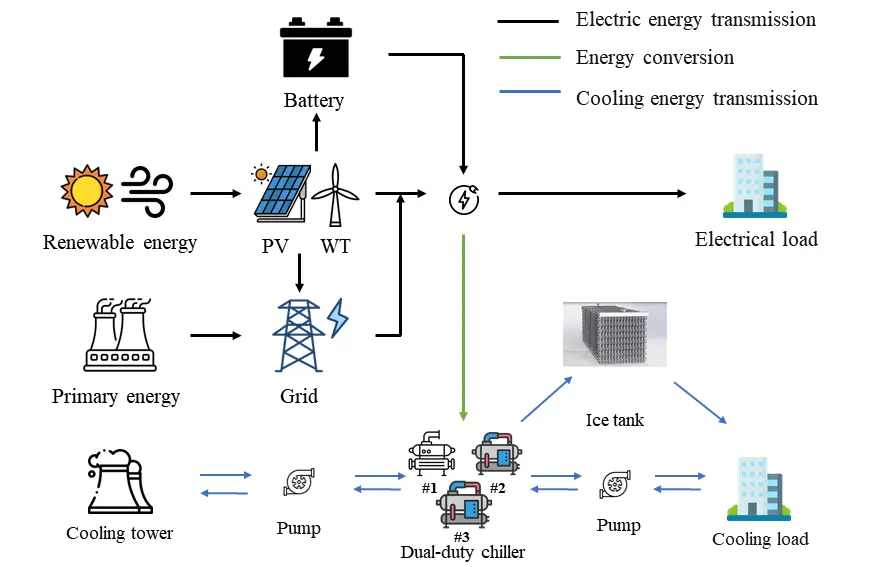
This study proposes an integrated energy system that combines photovoltaic power, wind power, battery storage, and ice storage to meet the electricity and cooling demands of buildings. The model for the ice storage tank incorporates the nonlinear ice-melting characteristics. An improved Multi-Objective Proximal Policy Optimization algorithm is employed for multi-objective optimization. In a case study of an office building in Shanghai, the optimization results demonstrate that the proposed method reduces daily operating costs by 6.52% and improves the CO2 emission reduction rate by 9.54%. The results demonstrate that the synergistic operation of electrical and ice storage effectively maintains supply-demand balance across different seasons. Sensitivity analysis further reveals that a 40% reduction in the unit cost of ice storage leads to a 5.7% decrease in battery capacity and a significant drop in grid dependency from 28.9% to 15.3%, highlighting the critical role of reducing ice storage costs in improving the system’s economic viability and renewable energy integration capability.
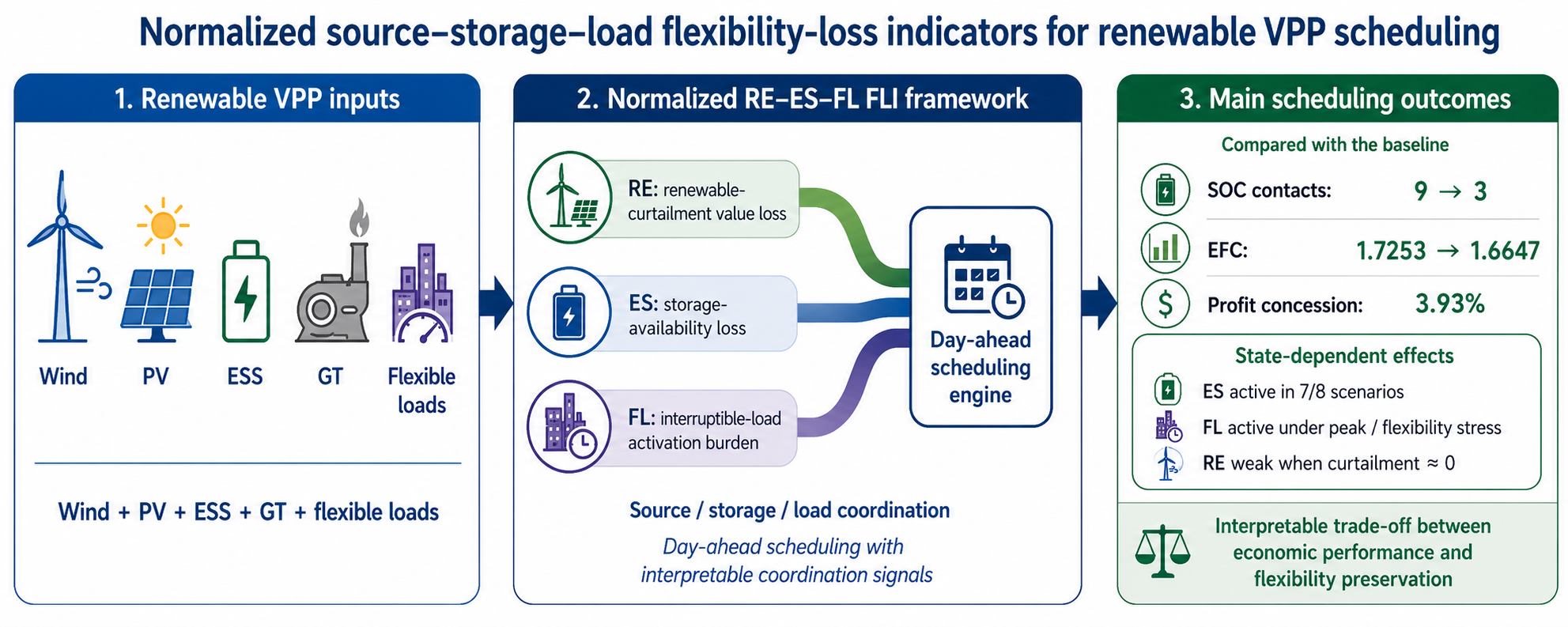
Renewable virtual power plants (VPPs) require day-ahead schedules that coordinate renewable generation, storage, gas turbines, and demand-side flexibility while retaining interpretable operating signals. This paper develops a normalized source-storage-load flexibility-loss-indicator (FLI) framework for renewable VPP scheduling. The indicators are engineering proxies for renewable-curtailment value loss, storage availability loss, and interruptible-load activation burden, rather than market-settled opportunity costs or a complete uncertainty-risk measure. The scalar objective combines net operating cost, operating coordination cost, and normalized FLI terms with reference scales fixed within each comparative setting. In a PJM-scaled day-ahead scheduling case, the baseline, scalarized multi-term reference, and proposed FLI schedules achieved net operating profits of 69,590.98 USD, 60,377.26 USD, and 66,856.81 USD. The proposed schedule reduced SOC boundary contacts from 9 to 3 and equivalent full cycles from 1.7253 to 1.6647, with a 3.93% profit concession relative to the baseline. Weight sensitivity, channel ablation, and eight representative operating and stress-test scenarios show state-dependent effects: the storage channel was active in seven scenarios, the interruptible-load channel under peak and flexibility-stressed conditions, and the renewable channel remained weak because curtailment was nearly zero. The framework provides a diagnostic coordination signal for renewable VPP operation.
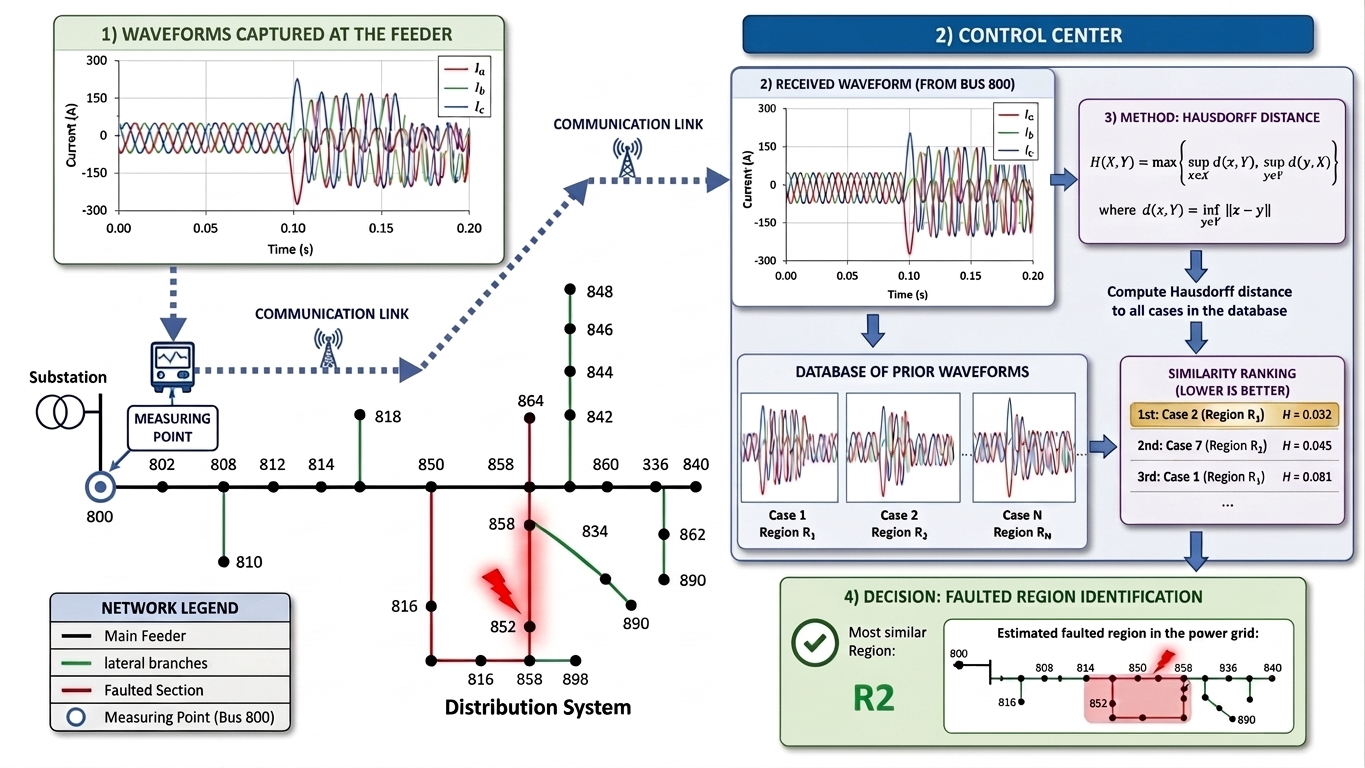
Nowadays, fast fault location in distribution systems plays a vital role for both utilities and end-users, improving grid availability and thereby reducing utility penalties and minimizing disturbances in consumers’ daily lives. Therefore, this work presents a simple yet accurate and robust method for identifying the faulted region in electrical distribution systems. To perform this task, the proposed method requires only local fault current measurements (available from digital relays) and a database built from historical data, simulations, or both, thereby eliminating the need for additional hardware or communication links. The Hausdorff distance (HD) was used to measure the similarity level between a fault current waveform acquired from the field and reference current waveforms previously stored in a database, thereby implementing a waveform pattern-matching approach. The method was initially developed and tested on a small distribution system, and subsequently validated using the IEEE 34-bus test feeder. After a sensitivity analysis regarding the most suitable data window length, sampling frequency, and input signals, the results demonstrate that the proposed method is reliable and accurate, even under different fault characteristics and loading conditions.
The increasing penetration of renewable resources in smart energy systems has increased the need for accurate forecasting of photovoltaic (PV) power to reduce uncertainty and improve operational planning. Rapid changes in atmospheric conditions, especially cloud movement, cause severe fluctuations and pose a significant challenge to PV power forecasting in the short term. In this paper, an integrated Deep Learning-based framework for short-term PV power forecasting is proposed that models the relationships among sky conditions, solar irradiance, and PV power. First, the cloud movement is forecasted based on the Optical Flow algorithm using sky images. Then, the forecasted images are fed into a ResNet50 network to estimate the solar irradiance. Finally, the forecasted solar irradiance, meteorological parameters, and historical PV power data are fed into the CNN-BiGRU-Attention model, whose hyperparameters are optimized using Bayesian Optimization to forecast the PV power for the next hour. The performance of the proposed model was evaluated under different atmospheric conditions and compared with other benchmark models. The results showed that the proposed model achieves high forecasting accuracy, obtaining a R2 of 0.987 and RMSE, MAE, and MAPE error values of 0.231 Kw, 0.147 Kw, and 8.69%, respectively, and outperforming benchmark models.
Electric-vehicle (EV) charging and flexible building loads can increase or relieve distribution-level loading and voltage stress, depending on timing, placement, and flexibility. This paper empirically evaluates a shared service-enriched flexibility-contract representation for coordinating EV departure-energy service and building comfort service. Individual EV and building records encode service limits, deadlines or comfort bounds, and feeder locations. The evaluation compares uncontrolled, service-constrained, feeder-aware, and heuristic uncertainty-aware control, with inputs from empirical residuals or split-conformal scalar service-score quantiles. In the simplified study, 256 scenarios under four modes produce 1024 evaluations. Realized nominal EV energy shortfall and building comfort violations are zero in the tested scenarios, while a separate earlier-departure stress audit shows heuristic uncertainty-aware tightening reducing EV stress-risk cases from 106 to 64. Open Distribution System Simulator (OpenDSS) audits on IEEE 123 and IEEE 34 each include 2048 scenarios and 8192 evaluations; stress-risk cases fall from 1005 to 536, with mean peak tradeoffs of 17.66 kW and 18.26 kW. A reduced-information experiment compares raw-state, individual-contract, and noisy/coarsened information-view proxies for exposure and payload rather than formal privacy. The results provide bounded empirical evidence that service-enriched EV/building contracts can expose service-grid and information-view tradeoffs in the tested simplified and OpenDSS feeder studies and audits.
