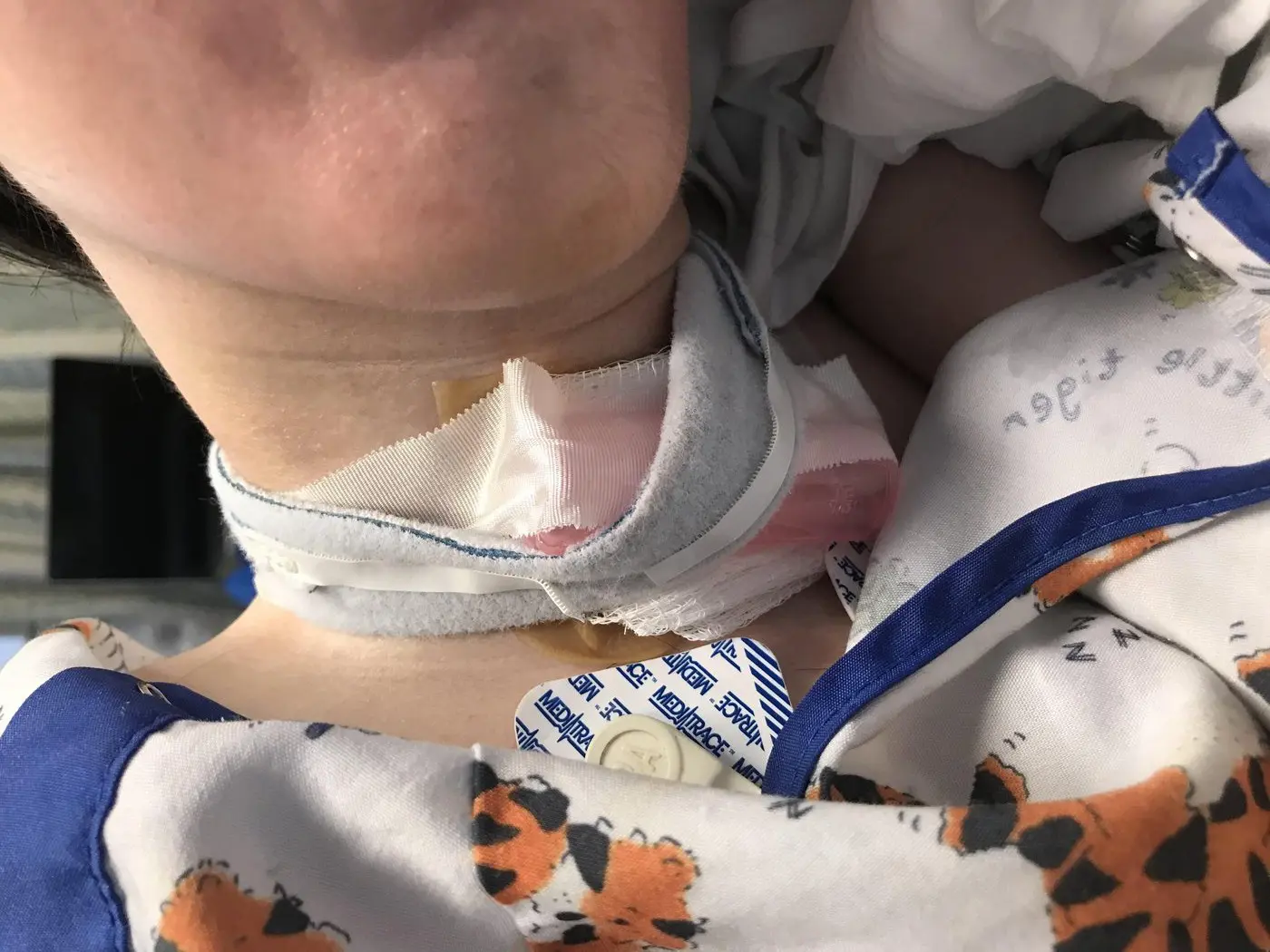
Ventilatory pump failure is respiratory insufficiency caused by weakness of the inspiratory and expiratory muscles, leading to hypoventilation, hypercapnia, and ineffective cough rather than primary lung disease. This article analyzes five medicolegal cases in which conventional acute-care management of ventilatory pump failure resulted in death, anoxic injury, prolonged tracheostomy mechanical ventilation, or avoidable institutionalization. The cases were reviewed to identify recurrent clinical and legal failures, including removal of continuous noninvasive ventilatory support, administration of supplemental oxygen without correction of hypoventilation, inadequate low-pressure noninvasive ventilation, failure to use mechanical insufflation-exsufflation for airway clearance, and refusal to consider extubation to continuous noninvasive ventilatory support despite available published protocols. Across the cases, tracheostomy or death was often framed as inevitable, although feasible noninvasive alternatives existed. From a medicolegal perspective, these omissions raise concerns about breach of duty, failure to obtain informed consent, and loss of chance. The analysis suggests that customary practice is not necessarily reasonable practice when evidence-based alternatives are available and clinically applicable. For cognitively intact patients with ventilatory pump failure, acute-care teams should consider and document noninvasive ventilatory support and mechanical insufflation-exsufflation before proceeding to invasive or palliative pathways.
The increasing use of quantitative evidence in legal proceedings reflects a broader shift towards data-informed forms of proof. Statistical analyses, probability estimates, and forensic calculations are frequently presented as objective indicators of truth; however, their evidential value depends not on the mathematics itself, but on how the relationships they describe are interpreted. This paper examines the misinterpretation of quantitative evidence in courtroom settings, arguing that numerical outputs are often treated as conclusions rather than as components of structured inference. Focusing on conditional probability, the prosecutor’s fallacy, base rate neglect, witness testimony, and DNA evidence, the paper demonstrates how common errors arise from a failure to engage with the conditional and relational nature of probabilistic reasoning. Consistent with earlier work highlighting the interpretive limits of quantitative evidence, the analysis of key cases, including the Sally Clark case and People v Collins, together with contemporary examples drawn from forensic science and algorithmic decision-making, demonstrates how numerical evidence can assume persuasive authority that exceeds its probative value when underlying assumptions are not made explicit. Building on established scholarship concerning the persuasive authority of numerical evidence, expert testimony, and probabilistic reasoning in legal decision-making, this paper proposes the Statistical Theatre Model to describe situations in which quantitative evidence acquires persuasive force independent of its inferential value. The paper further considers cognitive and institutional factors that contribute to these errors and argues that improvement lies not in increased mathematical complexity, but in greater conceptual clarity. In addition to identifying common interpretive failures, the paper proposes practical reforms to improve the communication and evaluation of quantitative evidence by experts, lawyers, judges, and jurors. In doing so, it highlights the importance of aligning the presentation of quantitative evidence with the interpretive demands of legal decision-making. Statistical evidence must remain a tool of inference rather than an unwarranted source of certainty.
Forensic odontology can be considered a very reliable tool for human identification, especially when the use of fingerprints and DNA analysis is not feasible. Forensic odontology achieves this reliability through the comparison between antemortem dental records and postmortem dental findings. Antemortem dental records can include radiographs, charts, photographs, and three-dimensional images of the deceased, while postmortem records include photographs, radiographs, and all the records of dental findings obtained from the deceased. However, the conclusion for identification results from the comparison of unique features present in the antemortem and postmortem records. Features that can offer the best results for comparison include dental treatments such as fillings, crowns, root canal treatment, dental implants, and prostheses. Therefore, dental treatment can be considered the gold standard, as no two people typically can have the same dental work. In the absence of dental work, the unique features of dentition, maxillofacial morphological structures, along with congenital anomalies, can offer the best results for identification. The present research aims to assess the usefulness of dental information sources for human identification, focusing on different age groups. This research article is a retrospective analysis of 81 forensic odontology cases conducted at the Department of Applied Forensic Sciences at Mercyhurst University. The cases were divided into three different age groups: juvenile, adult, and elderly. Each case was analyzed with respect to the types of dental information used for human identification, such as restorations, prostheses, surgical devices, and anatomy. The results showed that, for human identification, each of the three age groups has different challenges and benefits. In the juvenile group, individuals lacked dental treatment, requiring the use of anatomy for human identification. In the adult group, individuals showed unique restoration procedures that served as effective markers for human identification. In the elderly, the presence of dentures and the use of prosthetics made the label on the dentures and the fit of the bone critical for human identification. This research article confirms the importance of the role of forensic odontology in human identification.
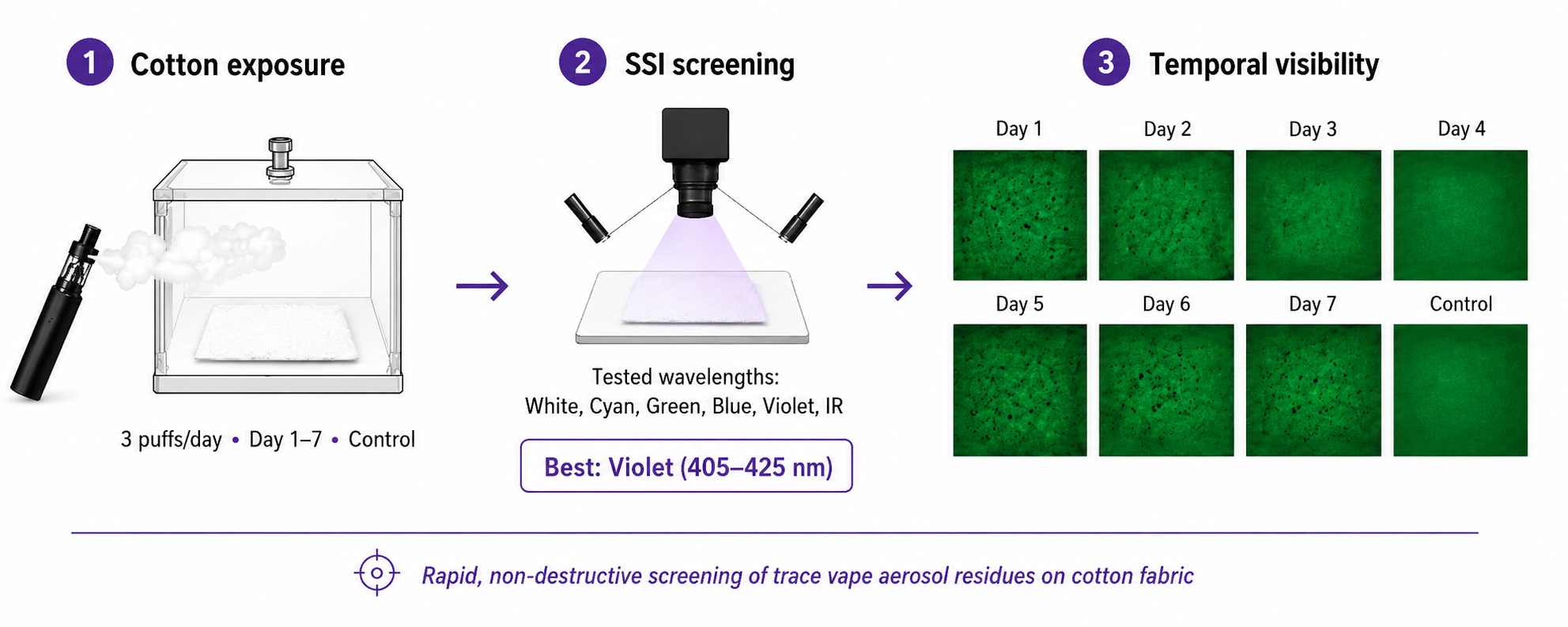
E-cigarette use may deposit vape aerosol residues on indoor textile surfaces, creating a potential but underexplored source of trace evidence in forensic environments. Detecting these residues visually is challenging because they are low contrast and may be distributed microscopically across porous substrates. This study assessed the capability of multi-wavelength superspectral imaging (SSI) to visualise trace vape aerosol residues on cotton fabric and identify illumination conditions that improve residue detectability. Cotton samples were exposed to controlled vape aerosol deposition over seven consecutive days, with one exposed sample collected daily and compared with an unexposed control. Samples were examined using SSI under multiple illumination wavelengths, followed by qualitative image-based assessment of residue visibility and contrast characteristics. Violet illumination (405–425 nm) produced the clearest contrast and most effective visualisation of residue features on the cotton surface. Temporal imaging showed a non-linear visibility pattern, with prominent features on Day 1, reduced detectability from Days 2 to 4, and increased visibility from Day 5 onwards. No comparable residue features were observed in control samples. These findings demonstrate the potential of multi-wavelength SSI as a non-destructive preliminary screening approach for visualising trace vape aerosol residues on textile substrates under controlled conditions.
Forensic handwriting examination requires not only the assessment of similarities and differences but also an evaluation of their relative importance for writer identification. This methodological study proposes a formalized framework for quantifying the identification value of handwriting features and individual graphical elements. The model distinguishes identification value from similarity grade and combines three components: objective discrimination power based on feature prevalence, relative discrimination power derived from forensic comparison data, and case-specific presence and representation. Identification values are subsequently transformed into weights for use in a formalized handwriting comparison model. Data from the HSDetect handwriting database and the HSForen forensic examination database are used to illustrate the calculation and practical behavior of the proposed components. The numerical values obtained from the current databases are treated as preliminary and illustrative rather than as validated population parameters or established measures of forensic performance. The proposed framework provides a transparent and empirically adjustable method for differentiating the contribution of handwriting findings while preserving expert interpretation. Further research using larger datasets, independently established ground truth, reliability testing, and external validation is required before the resulting weights can be considered validated for forensic casework.
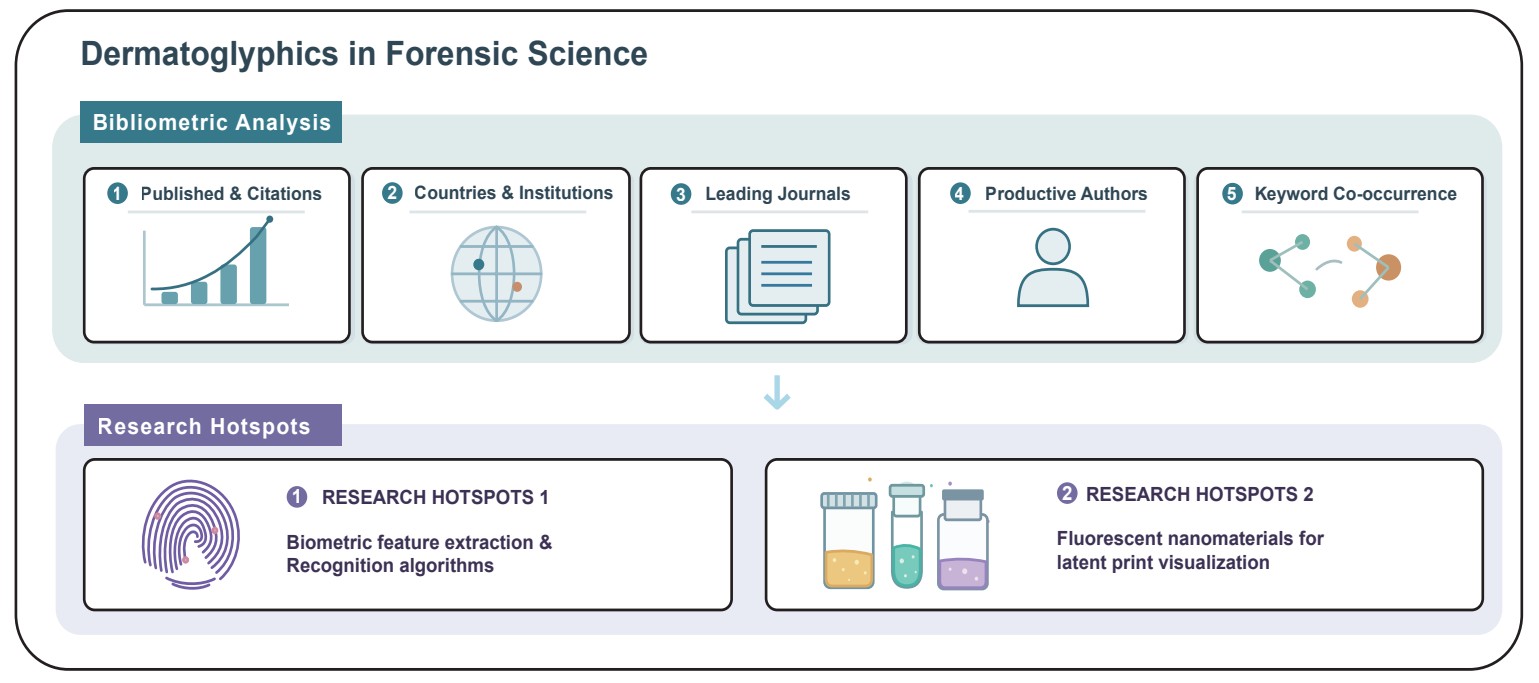
Dermatoglyphics traits—including fingerprints, palmprints, and footprints—are highly specific biometric markers that serve as critical evidence for individual identification in criminal investigations. To map the intellectual trajectory of this field, we conducted a bibliometric analysis of 796 publications indexed in the Web of Science Core Collection from 1976 to 2025. Since its emergence, research output has grown substantially. While India leads in total publications (207) and citations (3579)—largely driven by highly productive institutions such as Tumkur University and Jain University—the United States maintains the highest average citations per paper (36.8). Forensic Science International and the Journal of Forensic Sciences remain the core publishing venues. Notably, A. Jain’s 1997 work on automated fingerprint recognition remains the field’s most impactful publication, while N. Hanumanthappa has emerged as the most prolific and highly cited contemporary author. Keyword analysis reveals a distinct paradigm shift: early research focused on foundational identification principles, whereas recent hotspots center on dermatoglyphics feature extraction, algorithmic optimization, and the application of novel fluorescent nanomaterials for latent fingerprint visualization. This multidisciplinary evolution highlights an urgent paradigm shift: future advancements must bridge the translational gap between laboratory innovation and practical forensic demands by improving the transparency and judicial reliability of AI-assisted fingerprint analysis, establishing standardized evaluation systems for novel nanomaterials, and ensuring analytical compatibility with downstream genomic and multi-omics workflows.