
Multi-Wavelength Superspectral Imaging of Trace Vape Aerosol Residues on Cotton Fabric

Multi-Wavelength Superspectral Imaging of Trace Vape Aerosol Residues on Cotton Fabric
Loke Huey Shyan
1
Ana Naseer
1
Mohd Nadiman Radzali
2
Sarah Aliah Amir Sarifudin
1,*
Muhammad Jefri Mohd Yusof
1,3,*

Received: 25 May 2026 Revised: 29 July 2026 Accepted: 18 August 2026 Published: 01 September 2026

© 2026 The authors. This is an open access article under the Creative Commons Attribution 4.0 International License (https://creativecommons.org/licenses/by/4.0/).
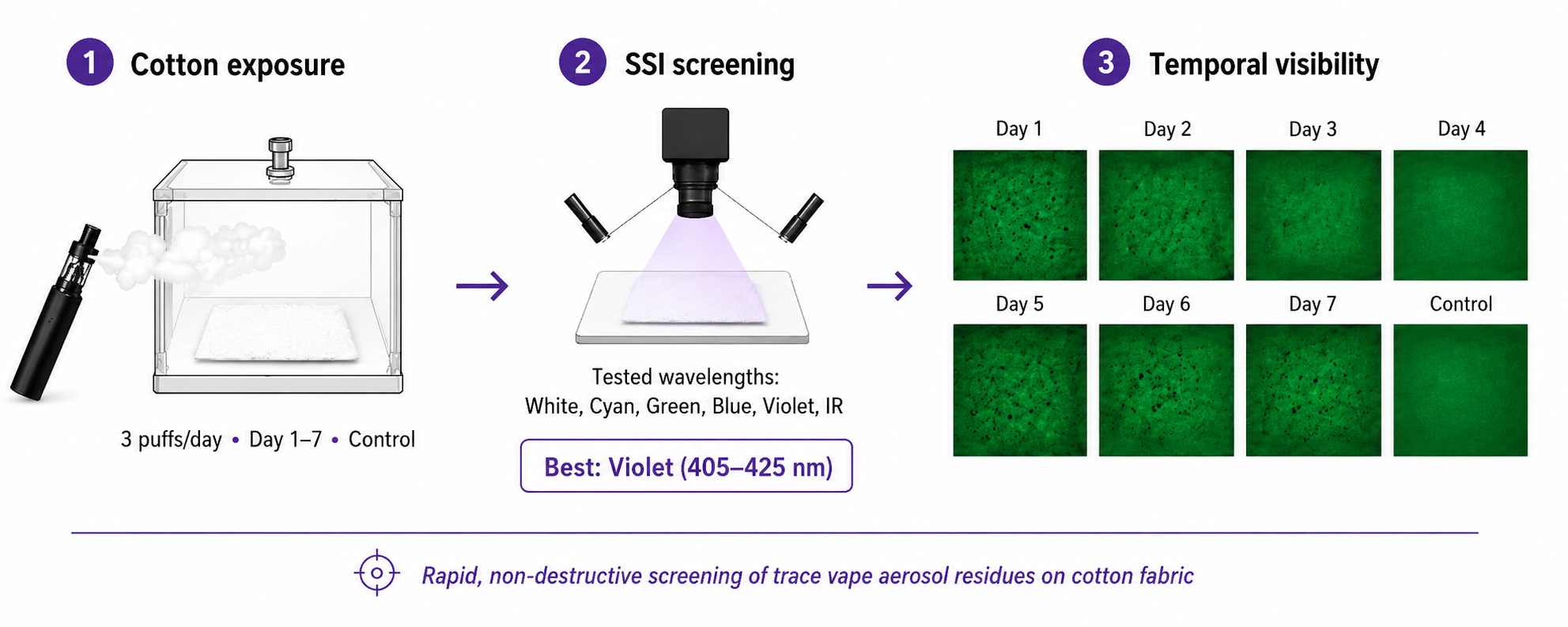
Graphical Abstract
1. Introduction
The increasing use of e-cigarettes has introduced vape aerosol residues as a potential form of trace evidence within indoor environments. During vaping, aerosols containing nicotine and other chemical constituents are released into the air and subsequently deposited onto nearby surfaces, including textile materials [1,2]. These residues may persist beyond the period of active use and provide indirect evidence of prior vaping activity at a scene [3]. However, their microscopic distribution and low intrinsic contrast on porous substrates make visual detection challenging during routine crime scene examinations, increasing the likelihood that such traces may be overlooked.
Following release into the indoor environment, e-cigarette aerosols may deposit a chemically heterogeneous residue containing constituents derived from the original e-liquid as well as aerosolisation products. Major constituents may include propylene glycol, glycerol, nicotine, and flavouring compounds, while nicotine-related alkaloids and other transformation products may also be present. The persistence of these constituents is influenced by their physicochemical properties, substrate characteristics, and environmental conditions. Importantly, nicotine has been experimentally demonstrated to persist on cotton surfaces for at least 72 h, with modelling suggesting substantially longer persistence before returning to background levels [4]. Other e-cigarette aerosol constituents, including PG, glycerol, and flavouring compounds, have also been detected in environmental residues, although their component-specific persistence on textile surfaces remains less well characterised [5]. A summary of representative deposited constituents and currently available evidence of persistence is provided in Table 1.
Table 1. Representative constituents of deposited e-cigarette aerosol residues and reported evidence of surface persistence.
|
Residue Constituent |
Possible Origin/Relevance |
Reported Surface Persistence or Evidence |
References |
|---|---|---|---|
|
Propylene glycol (PG) |
Major e-liquid carrier and aerosol constituent |
Detected in environmental e-cigarette aerosol residue; precise persistence duration on textile surfaces remains incompletely characterised |
[5] |
|
Glycerol/vegetable glycerin |
Major e-liquid carrier; comparatively less volatile component |
Detected in environmental e-cigarette aerosol residue; textile-specific persistence time remains insufficiently quantified |
[5] |
|
Nicotine |
Principal alkaloid in nicotine-containing e-liquids |
Detectable on glass and cotton for at least 72 h; modelled return to background at approximately 4 days on glass and 16 days on cotton terrycloth |
[4] |
|
Flavouring compounds/menthol |
Added e-liquid constituents that may transfer into emitted aerosol |
Flavour-related compounds, including menthol, have been detected in environmental aerosol residue; persistence varies according to chemical composition and surface |
[5] |
|
Nicotine-related alkaloids and tobacco-specific nitrosamines |
Deposited constituents and/or products associated with aged aerosol residues |
Detected after short-term exposure and in samples subjected to longer exposure periods ranging from days to months |
[6] |
Spectral imaging approaches exploit wavelength-dependent differences in light absorption, reflection, scattering, and fluorescence to enhance features that may exhibit little or no contrast under conventional white-light examination. Unlike conventional RGB photography, multi-wavelength imaging allows the same surface to be examined under selected illumination bands and optical filter combinations, thereby facilitating the identification of spectral conditions that maximise contrast between a trace material and its underlying substrate. In the present study, superspectral imaging (SSI) refers to a multi-wavelength forensic imaging approach in which samples are sequentially examined under different illumination and filter conditions while retaining their spatial characteristics. This is particularly advantageous for forensic trace examination because the technique is rapid, contact-free, and non-destructive, allowing subsequent confirmatory analyses to be performed if required. Spectral imaging has previously demonstrated the capability to detect and spatially differentiate chemical residues on heterogeneous textile surfaces [7]. Furthermore, e-liquids have been reported to exhibit wavelength-dependent autofluorescence, with comparatively strong responses under near-ultraviolet and short-wavelength excitation, including around 405 nm, supporting the potential utility of violet illumination for visualising deposited vape aerosol residues [8]. However, the application of multi-wavelength SSI to vape aerosol residues on textile substrates, particularly their time-dependent visibility, remains largely unexplored.
From a forensic perspective, visually inconspicuous residues on textile surfaces may be overlooked during initial evidence screening, particularly when deposits are spatially heterogeneous and exhibit limited contrast against the underlying substrate. Spectral imaging has demonstrated potential for the non-destructive detection and spatial differentiation of chemical residues on textiles [9], while fluorescence-based approaches have shown that deposited e-liquid can exhibit wavelength-dependent optical responses [8]. Nevertheless, previous studies have primarily addressed either general chemical residues on textiles or the fluorescence characteristics of e-liquid deposits, rather than the multi-wavelength SSI appearance of deposited vape aerosol residues on cotton and their changes in visibility across repeated exposure periods. The present study addresses this methodological gap by evaluating wavelength-dependent residue visibility and its temporal imaging behaviour under controlled conditions. Accordingly, this study has two linked objectives. Methodologically, it aims to (i) determine the illumination condition that provides the greatest visual contrast between deposited vape aerosol residues and cotton fabric and (ii) characterise changes in residue visibility across a seven-day exposure period. From a forensic perspective, the study evaluates the potential of SSI as a rapid, non-destructive preliminary screening approach for locating visually inconspicuous vape aerosol residues on textile surfaces prior to confirmatory chemical analysis.
2. Methods
2.1. Study Design and Sample Preparation
An experimental laboratory study was conducted to investigate the time-dependent accumulation of trace vape aerosol residues on cotton fabric using SSI. Plain-woven 100% cotton fabric (Premier Cotton Pads) was selected as the substrate due to its high absorbency and widespread use in textile applications. Fabric samples were cut into uniform dimensions (6 × 5 cm) to ensure consistent exposure conditions.
Seven samples were sequentially exposed to vape aerosol under controlled laboratory conditions, with one sample collected per day over a seven-day period. An additional unexposed sample was retained as a control. All samples were stored at room temperature in sealed polyethylene bags before and after exposure to minimise contamination and environmental interference.
2.2. Vape Aerosol Exposure
Vape aerosol exposure was conducted in a sealed Perspex chamber (25 × 20 × 25 cm) to provide a controlled, enclosed exposure environment. A commercially available e-cigarette device and e-liquid were used as the aerosol source. The same device and e-liquid were maintained throughout all exposure sessions to ensure consistency across experimental samples. For each exposure, three controlled puffs were introduced into the chamber to represent low-intensity vaping conditions. One fabric sample was placed inside the chamber per exposure cycle, with cumulative exposure durations ranging from one to seven days. The chamber was ventilated between exposure sessions to minimise residual aerosol accumulation and cross-contamination. All sample handling procedures were conducted using disposable gloves and sterile forceps.
2.3. SSI
All samples were analysed on Day 8 using a Forenscope SSI system (Turkey). Spectral imaging has previously been applied for the non-destructive detection and spatial assessment of chemical residues on textile substrates [9]. Imaging was conducted under controlled conditions with fixed camera positioning, constant working distance, and uniform background to ensure reproducibility. Samples were imaged sequentially under multiple illumination wavelengths, including white, infrared, green, cyan, blue, and violet light, using the system’s standard acquisition settings.
Automated wavelength optimisation was performed using the system’s built-in intelligent analysis mode to identify illumination conditions that enhanced contrast between residue features and the textile substrate. All imaging parameters, including exposure conditions and acquisition settings, were maintained constant across all samples.
2.4. Image and Data Analysis
Spectral images obtained under different illumination wavelengths were compared to identify the illumination conditions that produced the greatest visual contrast between exposed and control surfaces, consistent with spectral imaging approaches previously applied to detect chemical residues on textile substrates [9]. Comparative evaluation was performed by analysing exposed samples alongside the unexposed control to identify wavelength conditions that enhanced residue visibility while minimising background interference.
Time-dependent changes in residue appearance were evaluated through qualitative comparison of images obtained from samples exposed over the seven-day period. Visual assessment focused on the presence, contrast, and spatial distribution of residue features across exposure time points. All images were analysed under identical imaging conditions to ensure consistency and reduce observer-related variability. The present analysis was designed as an exploratory qualitative comparison of wavelength-dependent residue visibility; therefore, no inferential statistical analysis was performed.
3. Results
3.1. Spectral Response and Optimal Illumination for Residue Visualisation
The effectiveness of different illumination wavelengths for visualising trace vape aerosol residues on cotton fabric was evaluated using the SSI system. Representative images from a Day 1 exposed sample are presented in Figure 1.
Under white light illumination (Figure 1a), the fabric surface appeared visually uniform, with no discernible residue features. Imaging under cyan (Figure 1b), green (Figure 1c), and blue light (Figure 1d) similarly produced minimal contrast variation, limiting differentiation between exposed regions and the unexposed control. These wavelengths did not provide sufficient optical contrast to enable reliable identification of residue-related features.
In contrast, violet illumination (405–425 nm) (Figure 1e) produced a pronounced increase in surface contrast, revealing diffuse and spatially distributed features across the cotton substrate. These features were not observed under other visible wavelengths and are consistent with the presence of deposited vape aerosol residues. Infrared imaging using LP715 and LP850 filters, in both monochrome and negative modes (Figure 1f–i), altered the overall tonal characteristics of the fabric but did not enhance residue visibility. No distinct residue-related features were observed under infrared conditions.
Overall, violet illumination provided the highest contrast for visualising trace vape aerosol residues on cotton fabric among the tested spectral conditions and was therefore selected for subsequent temporal analysis.
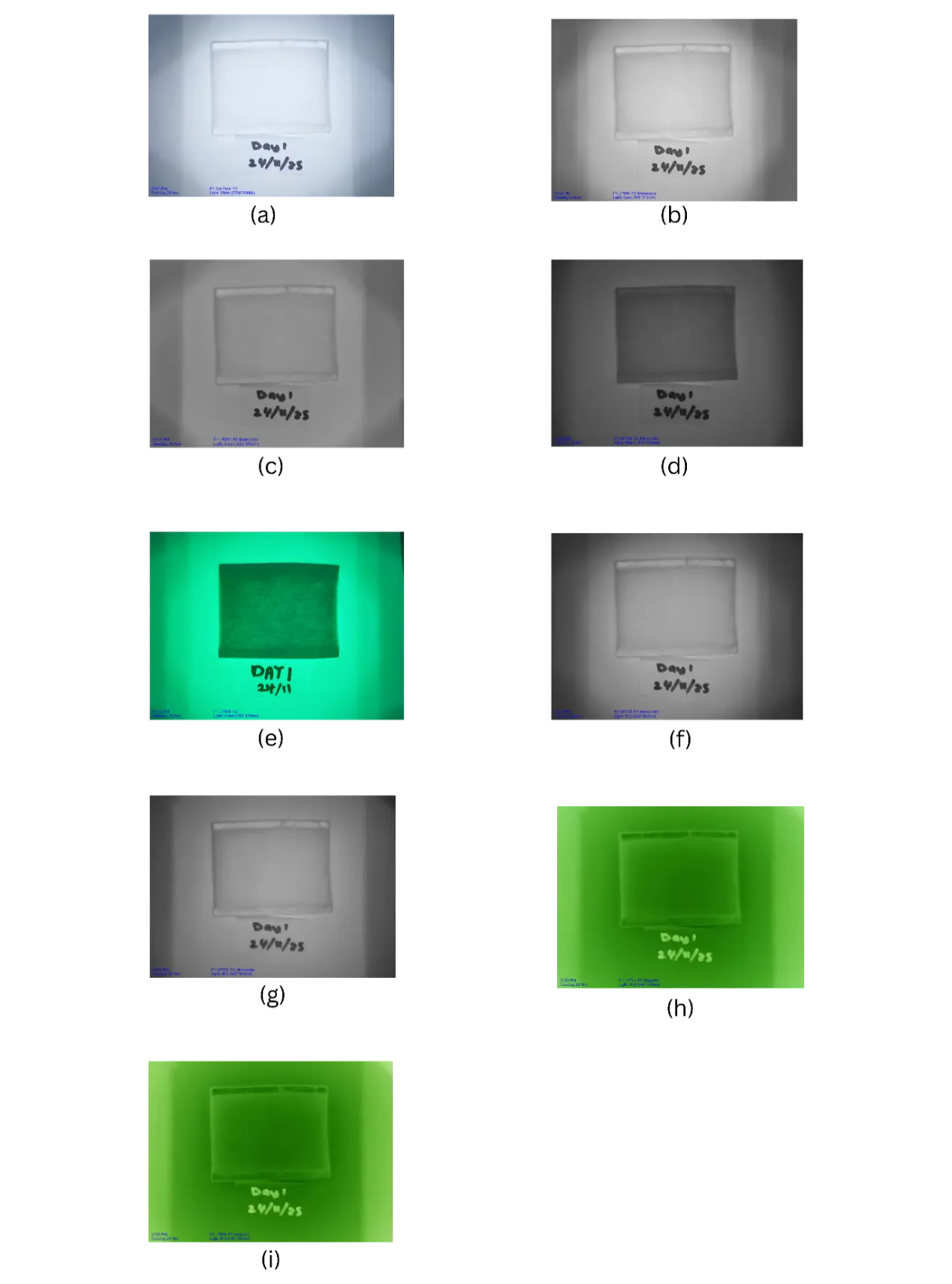
Figure 1. SSI of a Day 1 cotton fabric sample under different illumination conditions: (a) white light; (b) cyan light; (c) green light; (d) blue light; (e) violet light (405–425 nm); (f) infrared light (LP715, monocolour); (g) infrared light (LP850, monocolour); (h) infrared light (LP715, negative); and (i) infrared light (LP850, negative).
3.2. Temporal Evolution of Residue Visibility
Temporal changes in residue appearance were evaluated using violet illumination (405–425 nm), identified as the optimal spectral condition. Representative images of samples exposed over seven consecutive days, together with the unexposed control, are shown in Figure 2.
On Day 1, multiple discrete residue features were observed as localised regions of increased contrast across the fabric surface. On Day 2, a reduction in both the number and apparent intensity of these features was noted, with fewer distinguishable regions visible. This reduced detectability persisted on Days 3 and 4, where residue features appeared more diffuse and less defined. From Day 5 onwards, residue features became progressively more visible, with an increase in both spatial extent and contrast of detectable regions across the fabric surface. The unexposed control sample exhibited a uniform surface appearance with no comparable detectable features, indicating that the observed contrast features were absent from unexposed cotton under the controlled experimental conditions.
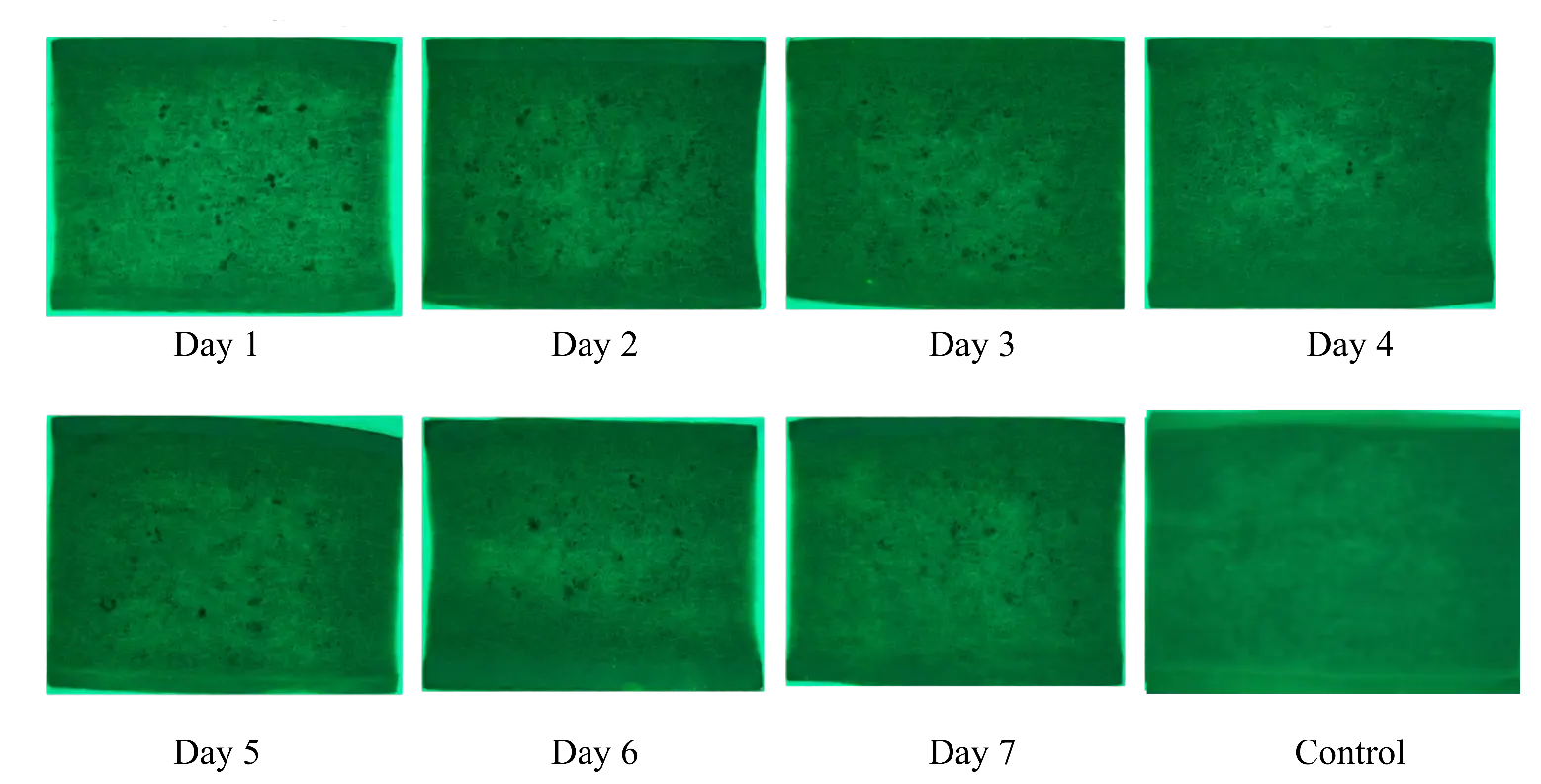
Figure 2. Time-dependent visualisation of vape aerosol residue features on cotton fabric under violet illumination (405–425 nm) using the SSI system. The figure shows samples corresponding to Day 1 through Day 7 exposure periods, together with the unexposed control sample. All images were acquired under identical SSI conditions.
4. Discussion and Conclusions
This study demonstrates that illumination wavelength plays a critical role in the visualisation of trace vape aerosol residues on cotton fabric using SSI. Among the tested conditions, violet illumination (405–425 nm) consistently produced the highest contrast, whereas white, cyan, green, blue, and infrared wavelengths did not enable reliable detection of residue features. This finding reflects the optical characteristics of vape aerosol residues, which typically consist of thin films of semi-volatile organic compounds, including propylene glycol, glycerol, nicotine, and flavouring agents [10,11]. These residues do not form opaque deposits and are therefore poorly visualised under broad-spectrum or longer-wavelength illumination. As the individual residue constituents were not examined separately, the present study cannot determine the relative contribution of propylene glycol, glycerol, nicotine, or individual flavouring compounds to the observed SSI contrast.
The enhanced visibility observed under violet illumination may be associated with wavelength-dependent interactions involving scattering, absorption, and fluorescence between the deposited aerosol residue and the cotton substrate. Previous experimental work has demonstrated that e-liquids can exhibit wavelength-dependent autofluorescence, with comparatively strong responses under near-ultraviolet and short-wavelength excitation, including around 405 nm [8], which closely approaches the 405–425 nm range identified in the present study. The fibrous structure of cotton may additionally influence diffuse reflectance and background contrast [12]. However, because component-specific optical spectra and individual constituent experiments were not performed in the present study, the exact mechanism responsible for the enhanced violet-light contrast cannot be conclusively established. The observed response should therefore be interpreted as the optical behaviour of the composite deposited aerosol–cotton system rather than as a component-specific spectral response. Infrared illumination did not enhance residue visibility under the experimental conditions investigated in the present study. These findings are consistent with previous imaging studies demonstrating that short-wavelength illumination is more effective for detecting low-contrast organic residues on porous substrates [9,13,14].
Temporal imaging revealed a non-linear pattern in residue visibility over the seven-day exposure period, characterised by relatively prominent features on Day 1, reduced visibility during Days 2–4, and increased visibility from Day 5 onwards. These observations demonstrate changes in the optical appearance of deposited material over time but do not, by themselves, establish corresponding changes in chemical composition. Processes such as volatilisation, absorption into textile fibres, redistribution of deposited material and accumulation following repeated exposure may potentially influence the observed pattern [15,16]; however, their relative contributions cannot be determined from SSI alone. Previous studies have demonstrated that e-cigarette-derived residues can deposit and persist on exposed surfaces, including cotton materials [4,5,6]. Chemical profiling using complementary techniques such as GC–MS at defined exposure intervals would therefore be required to determine whether the temporal optical changes observed here correspond to compositional changes in the residue.
From an imaging perspective, these results highlight the importance of wavelength selection when targeting chemically subtle and spatially heterogeneous residues on textile substrates. The ability of SSI to enhance contrast under specific illumination conditions demonstrates its potential as a non-destructive method for preliminary surface screening. Compared with conventional forensic light sources, which are typically optimised for biological evidence, multi-wavelength imaging provides greater flexibility for detecting non-biological trace residues.
Several limitations should be noted. Only unexposed cotton control was included in the present study, while potential interferents such as cigarette smoke residues, perfumes, cosmetics, and skincare products were not evaluated. Accordingly, the observed SSI features should not be interpreted as chemically specific to vape aerosol residues. The analysis was primarily qualitative and based on visual assessment of contrast differences, which introduces potential observer-related subjectivity. Objective image metrics, including grayscale intensity, contrast-to-background ratio, signal-to-noise ratio, and feature area, were not quantified in the present proof-of-concept study. Furthermore, the controlled chamber environment does not reproduce the variability encountered in operational forensic scenes, including differences in ventilation, environmental contamination, substrate condition, and competing surface residues. Therefore, the present findings should be regarded as laboratory proof-of-concept evidence rather than field validation. Future studies should incorporate relevant interference controls, predefined regions of interest, quantitative image-analysis metrics, a broader range of textile substrates, and simulated or operational forensic-scene conditions to establish detection specificity, objective detection thresholds, reproducibility, and practical applicability.
In conclusion, this Communication demonstrates that multi-wavelength SSI can enhance the visibility of trace vape aerosol residues deposited on cotton fabric, with violet illumination at 405–425 nm providing the clearest visual contrast among the conditions investigated. The principal methodological contribution is the identification of a wavelength-selective, non-destructive imaging approach for preliminary localisation of visually inconspicuous aerosol residues on a porous textile substrate. In a forensic context, such screening could potentially assist the examination of clothing, upholstery, and other cotton-based textile surfaces when prior vaping activity is relevant to an investigation, while preserving the material for subsequent confirmatory chemical analysis. However, SSI should presently be regarded as a preliminary screening approach rather than a chemically specific or field-validated identification method. Quantitative image analysis, interference testing, chemical confirmation, and realistic scene validation are required before operational forensic implementation can be established.
Statement of the Use of Generative AI and AI-Assisted Technologies in the Writing Process
During the preparation of this manuscript, the authors used ChatGPT (OpenAI) solely for English language refinement, including grammar checking, sentence clarity, and improvement of academic writing style. The tool was not used to generate research data, conduct analyses, interpret results, or formulate the scientific conclusions of the study. After using this tool, the authors reviewed and edited the content as needed and take full responsibility for the content of the published article.
Acknowledgments
The authors would like to acknowledge Management and Science University (MSU) for providing the laboratory facilities and Nexnad Solution Sdn. Bhd. for supplying the ForenScope camera device.
Author Contributions
Conceptualization, M.J.M.Y.; Methodology, L.H.S., A.N., M.N.R. and M.J.M.Y.; Software, A.N. and L.H.S.; Validation, M.N.R., S.A.A.S. and M.J.M.Y.; Formal Analysis, A.N. and L.H.S.; Investigation, L.H.S.; Resources, A.N. and M.N.R.; Data Curation, S.A.A.S.; Writing—Original Draft Preparation, L.H.S. and M.J.M.Y.; Writing—Review & Editing, S.A.A.S. and M.J.M.Y.; Visualization, A.N. and L.H.S.; Supervision, S.A.A.S. and M.J.M.Y.; Project Administration, M.J.M.Y.; Funding Acquisition, S.A.A.S. and M.J.M.Y.
Ethics Statement
Not applicable.
Informed Consent Statement
Not applicable.
Data Availability Statement
The original contributions of this study are presented within the article. Any further inquiries may be directed to the corresponding authors.
Funding
This work was supported by MSU under the Seed Grant (SG-007-022022-FHLS).
Declaration of Competing Interest
The authors declare that they have no known competing financial interests or personal relationships that could have appeared to influence the work reported in this paper.
References
- Chavan P, Norman C, Marland V, Murphy B, Cracknell A, Pudney CR, et al. Development and evaluation of a washing method for the removal of drugs infused on clothing. Forensic Chem. 2025, 46, 100695. DOI:10.1016/j.forc.2025.100695 [Google Scholar]
- Wang Y, Gu J. The Physical Processes and Chemical Transformations of Third-Hand Smoke in Indoor Environments and Its Health Effects: A Review. Atmosphere 2025, 16, 370. DOI:10.3390/atmos16040370 [Google Scholar]
- Kycler M, Rzepczyk S, Van Der Veer J, Świderski P, Żaba C. E-cigarettes, e-liquids and drug vaping—Forensic perspectives on electronic nicotine delivery systems. Probl. Forensic Sci. 2023, 135, 239–254. DOI:10.4467/12307483PFS.23.014.19430 [Google Scholar]
- Marcham CL, Floyd EL, Wood BL, Arnold S, Johnson DL. E-cigarette nicotine deposition and persistence on glass and cotton surfaces. J. Occup. Environ. Hyg. 2019, 16, 349–354. DOI:10.1080/15459624.2019.1581366 [Google Scholar]
- Hua M, Luo W, Khachatoorian C, McWhirter KJ, Leung S, Martinez T, et al. Exposure, Retention, Exhalation, Symptoms, and Environmental Accumulation of Chemicals During JUUL Vaping. Chem. Res. Toxicol. 2023, 36, 492–507. DOI:10.1021/acs.chemrestox.2c00390 [Google Scholar]
- Khachatoorian C, Jacob P, III, Benowitz NL, Talbot P. Electronic cigarette chemicals transfer from a vape shop to a nearby business in a multiple-tenant retail building. Tob. Control. 2019, 28, 519–525. DOI:10.1136/tobaccocontrol-2018-054316 [Google Scholar]
- Pozuelos GL, Jacob P, Schick SF, Omaiye EE, Talbot P. Adhesion and Removal of Thirdhand Smoke from Indoor Fabrics: A Method for Rapid Assessment and Identification of Chemical Repositories. J. Environ. Res. Public Health 2021, 18, 3592. DOI:10.3390/ijerph18073592 [Google Scholar]
- Davis ES, Sassano MF, Goodell H, Tarran R. E-Liquid Autofluorescence can be used as a Marker of Vaping Deposition and Third-Hand Vape Exposure. Sci. Rep. 2017, 7, 7459. DOI:10.1038/s41598-017-07862-w [Google Scholar]
- Kampik L, Gruber SH, Weisleitner K, Bauer G, Steiner H, Tous L, et al. Hyperspectral Imaging for Non-Destructive Detection of Chemical Residues on Textiles. Textiles 2025, 5, 42. DOI:10.3390/textiles5040042 [Google Scholar]
- Hamzah NH, Aris FNM, Mukhni NH, Balayssac S, Danoun S, Gilard V, et al. Dataset of NIR, MIR, FIR and NMR spectroscopy and GC-MS of real samples of e-liquids from Malaysia. Data Brief 2025, 60, 111591. DOI:10.1016/j.dib.2025.111591 [Google Scholar]
- Kubica P. Determination of Glycerol, Propylene Glycol, and Nicotine as the Main Components in Refill Liquids for Electronic Cigarettes. Molecules 2023, 28, 4425. DOI:10.3390/molecules28114425 [Google Scholar]
- Gao W, Rigout M, Owens H. Optical properties of cotton and nylon fabrics coated with silica photonic crystals. Opt. Mater. Express 2017, 7, 341. DOI:10.1364/OME.7.000341 [Google Scholar]
- Kaur R, Chaudhry MMA, Findlay C, Nadimi M, Rahman M, Paliwal J. Characterization of Near Infrared-Dye Colored Fabrics Using Hyperspectral Imaging. Appl. Spectrosc. 2024, 78, 951–961. DOI:10.1177/00037028241258111 [Google Scholar]
- Giordano AN, Rao R. Beyond the Visible: A Review of Ultraviolet Surface-Enhanced Raman Scattering Substrate Compositions, Morphologies, and Performance. Nanomaterials 2023, 13, 2177. DOI:10.3390/nano13152177 [Google Scholar]
- Cheng WH, Chang CY, Chen YY, Su HW. Chemical Composition of Aerosols of an Electronic Cigarette. Aerosol Air Qual. Res. 2021, 21, 200672. DOI:10.4209/aaqr.200672 [Google Scholar]
- Li L, Lee ES, Nguyen C, Zhu Y. Effects of propylene glycol, vegetable glycerin, and nicotine on emissions and dynamics of electronic cigarette aerosols. Aerosol Sci. Technol. 2020, 54, 1270–1281. DOI:10.1080/02786826.2020.1771270 [Google Scholar]