
Age-Related Utility of Dental Records in Human Identification

Age-Related Utility of Dental Records in Human Identification
Received: 18 March 2026 Revised: 26 March 2026 Accepted: 24 July 2026 Published: 06 August 2026

© 2026 The authors. This is an open access article under the Creative Commons Attribution 4.0 International License (https://creativecommons.org/licenses/by/4.0/).
1. Introduction
Forensic dental identification is one of the most reliable and widely used techniques for the identification of humans in forensic cases, especially in situations where decomposition, burning effects, and environmental exposure complicate the process of identification. Forensic odontology is a highly scientific and quick method of identification in such situations. Forensic identification of humans involves the division of evidence into primary and secondary identifiers. Primary identifiers are the most reliable and scientifically supported evidence. According to the INTERPOL Disaster Victim Identification (DVI) Guidelines, primary identifiers include DNA analysis, fingerprinting, and comparative dental analysis. These are highly specific to individuals and can be relied upon even when the evidence has been extensively damaged. At times, the serial numbers on medical implants can also be used as evidence of identity in comparative situations. Secondary identifiers include evidence that aids the process of identification but is insufficient to establish identity. Personal belongings, tattoos, scars, medical evidence, and biological evidence, such as sex, age, and stature, are among the secondary identifiers. All evidence available in antemortem and postmortem cases has to be extensively gathered and recorded. Quality assurance should be established early on to ensure accuracy and reliability of evidence throughout the process [1]. Among the main identifiers, forensic odontology stands out for the durability of dental materials, reliability, and ease of use. Dental records enable faster and more reliable identification, especially in cases of mass fatalities, where antemortem dental information is readily available [2]. Dental characteristics stand out from DNA and fingerprinting methods, as they can withstand extreme heat, trauma, and postmortem intervals. The three principles of forensic odontology identification are: (i) teeth are the hardest substance in the human body, (ii) teeth exhibit great individuality in both natural anatomy and dental treatment history, and (iii) dental characteristics can be accurately recorded and compared between antemortem and postmortem records. The three-stage system of identification of human remains using odontology is as follows: The first step in the identification process is postmortem (PM) data collection, which entails a thorough dental examination of the human remains, including the presence or absence of teeth, fillings, prostheses, abnormalities, trauma, and any odontological characteristics of value to identification [3]. The postmortem dental characteristics are recorded in the postmortem odontogram and images, which include conventional images such as radiographs and photographs, but additional images such as 3D images, surface scans, and CT scans may be used depending on the requirements of the case. Second, antemortem (AM) data collection occurs. Antemortem data refers to dental records collected from the life of the deceased, such as dental treatment records, panoramic and bitewing radiographs, oral photographs, and dental casts, usually obtained from the entity that provided the deceased with dental services [4]. Third, the antemortem and postmortem datasets are compared, which is the most critical phase of the identification process. In this phase, the forensic odontologist compares the antemortem and postmortem features to find matching features such as fillings and other dental procedures, crowns and roots, and sinuses, to make a positive identification with a high level of certainty [5]. In the United States, cases of AM-PM data follow standardized processes and terminology set forth by the American Board of Forensic Odontology. Similar standardization exists through organizations such as the British Association for Forensic Anthropology and Odontology (BAFA) in the United Kingdom. The basic principles of comparison remain the same, despite different terminology used in each organization. A match indicates that a particular feature is identical in both the AM and PM data, such as a restoration that is in the same place, has the same shape, and is made of the same material. A reconcilable discrepancy indicates a difference that can be logically explained, such as a filling that may have been lost. An irreconcilable discrepancy indicates a true inconsistency in the data, such as a tooth missing in the AM data but present and unrestored in the PM data. The results of the data comparison lead to a final identification conclusion. The presence of a consistent number of matches with no irreconcilable discrepancies indicates a positive identification result. The presence of limited or non-unique features leads to a possible identification or insufficient dental evidence. The presence of one or more irreconcilable discrepancies leads to exclusion, thereby affirming that the human remains do not belong to the suspected person [1,3,5,6]. Moreover, age plays a major role in the utility and reliability of dental records for identification. As people progress through their lives, changes in dental anatomy and treatment history have a direct impact on the amount of information available for comparison. In fact, recent epidemiologic studies have demonstrated clear age-related differences in the prevalence of dental treatment. This directly correlates with the amount of antemortem information available for comparison in the field of forensic science. The Centers for Disease Control and Prevention surveillance of children in the United States indicates that 46 percent of children between the ages of 2 and 19 have at least one untreated or restored carious tooth [7]. In Denmark, nationwide surveillance of children and adolescents indicates a very low disease prevalence in this population. For example, the mean decayed teeth for 12- and 15-year-old children was only 0.13 and 0.23, respectively. In contrast, older adults have a greater restoration prevalence. In 2021, the mean number of filled/crowned teeth was 13.9 in 65-year-old adults, with an average of 26.0 teeth remaining. Adults between the ages of 20 and 64 have a mean of six restored teeth, with an average of two teeth missing due to disease. In older adults, changes in dental status continue to progress. For example, a recent national oral health survey of adults in England found that 39 percent of adults aged 75 and older wore dentures. In fact, only slightly more than half of this population had at least 21 natural teeth remaining in their mouths [8]. In fact, a recent reviews found clear increases in prosthetic dependency after the age of 70 [9]. Despite the fact that dental identification is a well-recognized and successful technique in forensic science, surprisingly little research has been conducted on the effectiveness of this process in different life stages. This particular study aims to investigate the impact of age-related dental characteristics on the effectiveness of forensic dental identification. By using a forensic casework database from the Department of Applied Forensic Sciences at Mercyhurst University, this research aims to examine the patterns of identification results for juveniles and adult individuals. Furthermore, this research identifies the different forms of dental evidence that are commonly used in each age group. This research aims to elucidate the significance of age in the effectiveness of dental identification and how this process could be made more accurate and consistent in all age groups.
2. Materials and Methods
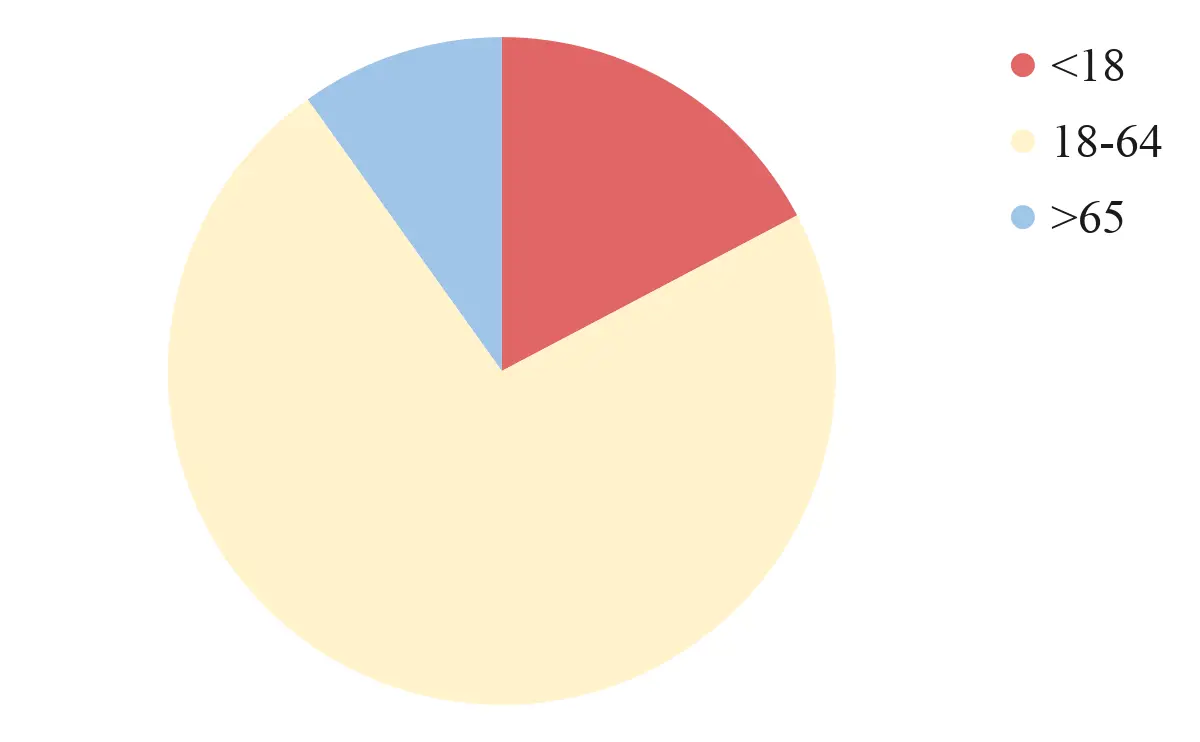
The current study aims to provide a retrospective study of 98 forensic odontology cases conducted at the Department of Applied Forensic Sciences at Mercyhurst University, from 2019 to 2025. Each of the included forensic odontology cases includes a set of unidentified remains. Data collected for the study includes the subject’s age, sex, state of remains, postmortem interval, and the major dental modality used for identification. To determine the effect of the subject’s age, the forensic odontology cases were divided into three groups: juvenile (<18 years old), adult (18–64 years old), and elderly subjects aged >65 years (Figure 1). The methods of identification were classified based on the type of dental evidence used, which included restorative treatment, anatomical variation, and surgical devices.
A Mann-Whitney test was utilized to test for differences in median age between individuals with and without antemortem records. This test was selected over parametric alternatives as the no-records group did not pass the normality test (Anderson-Darling: A2* = 0.931).
A logistic regression (Logit) with age as independent variable and presence vs. absence of antemortem records as the dependent variable was used as a complementary approach to test the same hypothesis, this time expressed as the relationship between age and the probability of antemortem records being available for a case. In the logistic model, a likelihood ratio test was utilized to test for independence, and Tjur’s R2 to estimate goodness of fit, as well as the strength of the relationship in terms of variance explained.
As the presence of ante-mortem records does not necessarily imply that they are appropriate for dental identification, we also tested for differences by age class in the frequencies of cases identified utilizing dental anatomy, those identified based on dental restorations, and those where identification was not attempted either due to a lack of antemortem records or to insufficient quality or level of detail of those records. In this analysis, identification included both positive identifications and identity exclusions. Based on sample size restrictions and the very similar observed frequencies of the two adult classes, we pooled those two adults classed for this analysis (Chi-square test), testing only for differences between individuals below 18 years of age, and those equal to or above that age.
3. Results
Of the 98 forensic odontology cases reviewed, 66 cases were provided with AM records for comparison, while 32 lacked these AM records, so no comparison was possible. Figure 2 presents the cases in which AM records were provided versus those in which no AM records were available, for each age group. The figure demonstrates that most comparisons across all age categories included antemortem information, with the highest proportion observed in adult cases.
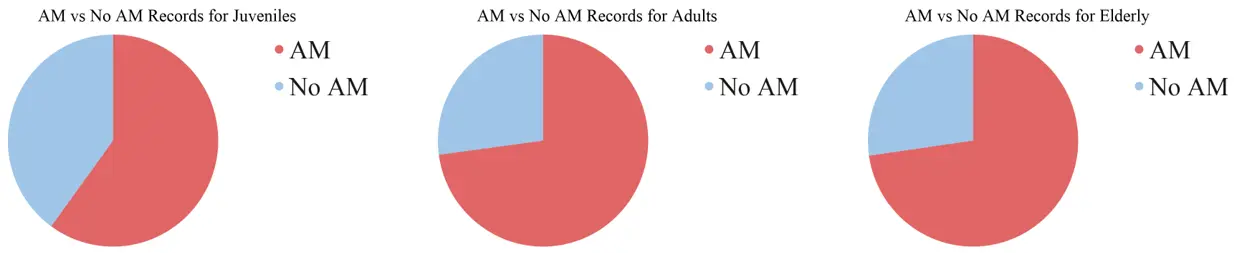
Figure 2. Proportion of cases with no available antemortem records compared to cases with antemortem records in all three age groups (Juveniles: <18 years of age; Adults 19–64 years of age; and Elderly >65 years of age).
Figure 3 displays the distributions of age for the individuals with (n = 66) and without (n = 32) antemortem records, as well as the relationship between age and the probability of having antemortem records. The Mann-Whitney test did not reveal any significant differences between the median ages of both groups (Mann-Whitney U = 1017; p = 0.77). Similarly, the slope of the logistic regression did not depart from zero (G2 = 0.594, p = 0.44).
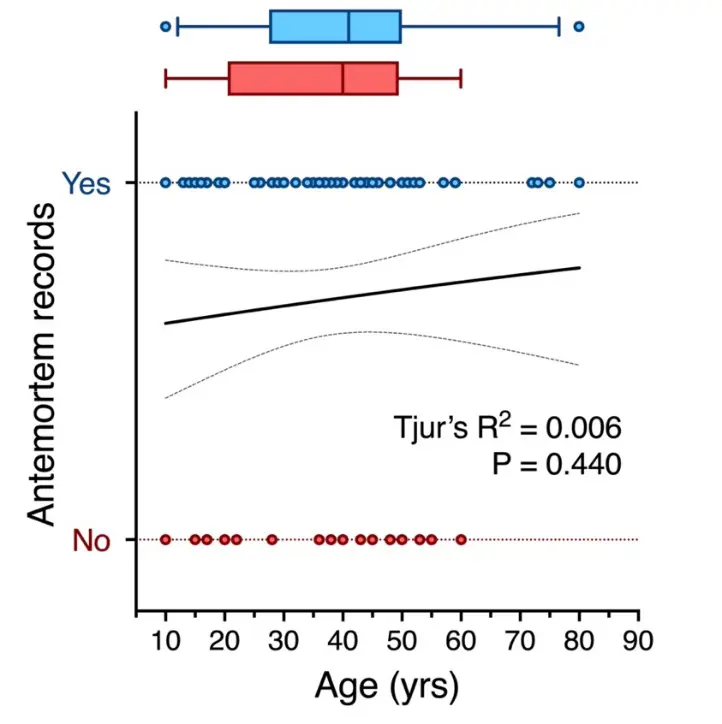
Figure 3. Age distributions of the individuals with (blue) and without (red) antemortem records in our sample, and logistic regression of the relationship between age and the probability of antemortem records being available or not for the case. Neither the mean differences nor the logistic tests were significant. However, note how the age distribution is biased toward higher ages in the group with antemortem records, and toward lower ages in the group lacking antemortem records. Similarly, no individuals above 60 years lacked antemortem records.
Regarding the identification frequencies, identification was 20% more likely to be attempted in adults than in juveniles (36% vs. 56%), based on the presence or distinctiveness of antemortem records (Figure 4). This is consistent with the observed frequencies of identifications that were based solely or in part on dental treatments, which were more than double in adults than in juveniles (close to 44% vs. 20%; Figure 4). On the other hand, the frequency of utilization of dental anatomy in the identification was similar in both age classes (24% in adults as compared to 20% in juveniles). However, the Chi-square test failed to detect significant differences between the frequencies in both age groups (χ2 = 4.75, d.f. = 2; p = 0.09. A Fisher’s exact text rendered the same p-value).
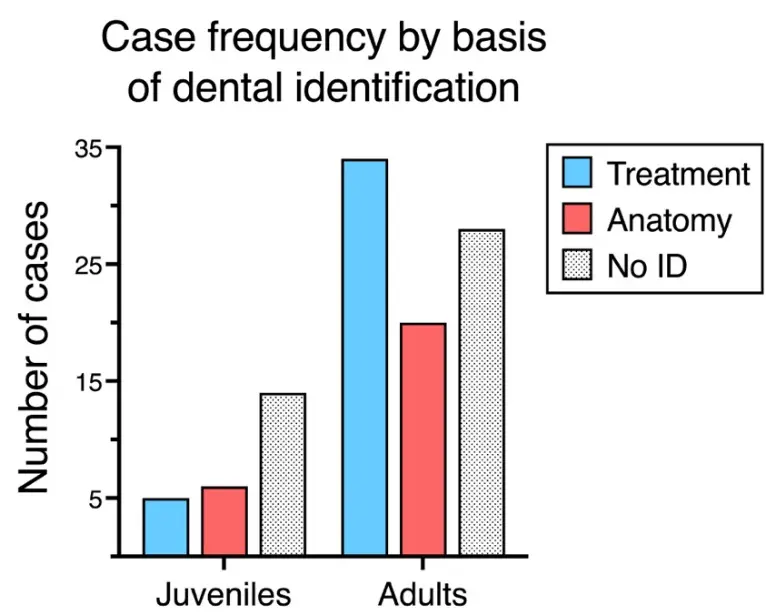
Figure 4. Frequencies of cases in which treatment or anatomy were utilized in the identification, as well as of those in which identification was not even attempted, in juveniles (n = 25) and adults (n = 78). Both positive identifications and positive exclusions are considered in this plot, and the attached frequency analyses, and the same case can be included in both the Treatment and Anatomy categories, if both contributed to the identification.
Note the much higher adult frequency of identifications based on dental treatments, as well as the higher relative proportion of no attempted identifications in juveniles. No attempted identifications can be due to either a complete lack of antemortem records or to the available records not displaying enough quality or potentially individualizing characteristics.
Anatomical variation markers provided individualized characteristics that supported highly reliable points of comparison even without restorative history. The adult group showed the greatest diversity of dental interventions, reflected in the distribution of identification strategies. Restorative treatment comparison served as the most frequent and successful method, consistent with the high percentage of cases identified through dental treatment evidence. A smaller subset of adult cases required combined approaches that incorporated dental evidence alongside additional forensic modalities, such as surgical devices or DNA comparison. Elderly individuals presented distinct forensic characteristics; several presented complete edentulism. In edentulous comparisons, dentures and dental implants served as the primary source of identification. When implants were present, their permanence and unique positioning supported positive identifications. However, edentulism was not confined to individuals over 65, as some younger adult individuals in the dataset were also fully edentulous. Edentulous individuals were more frequently observed in cases where antemortem dental information was unavailable. Thus, dental status rather than age alone determined the identification strategy.
All these findings confirm that dental identification remains highly reliable across all life stages, with method selection shifting based on age, dental status, and treatment history.
4. Discussion
This retrospective study of 81 forensic odontology cases completed at Mercyhurst University verifies the continued value of dental identification as a primary identifier throughout the lifespan, where the value of dental identification was significantly influenced by age, dental status, and treatment history. Of the 64 cases where antemortem data were available, dental identification was confirmed by appropriate age-specific methods. Although the cases for juveniles, adults, and the elderly varied in the amount of information available, they also varied in the methods used, including the specific dental characteristics considered most useful for identification and the methods by which those characteristics were compared between antemortem and postmortem records.
The relative lack of restorative dental treatment among the juvenile population necessitates the use of anatomical and developmental characteristics, including the stage of dental eruption, root development, congenitally missing or supernumerary teeth, and crown form, which served as individualized characteristics when the antemortem records provided such information and the postmortem examination was conducted with consideration of these characteristics. Adults, however, provided restorative dental treatment, crowns, root canal therapy, implants, and other interventions, which provided individualized characteristics that could be clearly visualized, such as restoratives, crowns, root canals, implants, and other treatments, which served as the backbone of the positive identification of the deceased, reaffirming the value of restorative dental comparison as a mainstay of the field of forensic odontology for adults [9,10,11]. Nevertheless, the value of multiple records for adults also becomes clear, where anatomical characteristics, restorative characteristics, and surgical hardware combine to provide a more robust evidentiary profile for the deceased.
The elderly had a unique profile in that many had progressed to partial or complete edentulism. This meant fewer natural teeth were available for direct comparison. However, it does not mean the information obtained was any less relevant. For the edentulous individuals, identification was achieved through dentures and their fit to the residual alveolar ridges. This was also achieved through the form and structure comparison of the maxillary and mandibular bones and the presence of dental implants. When dentures had been labeled appropriately, the label was helpful in achieving an identification [4,10,11].
When dentures had not been labeled, the fit of the dentures to the edentulous jaws and the radiographic appearance of the implants provided individualized markers to support identification. This study has confirmed that anatomic variation can provide information in the absence of natural dentition, provided careful examination of the edentulous anatomy and interfaces is undertaken.
Although the age distribution of individuals without antemortem records is skewed toward lower ages, and that of individuals with antemortem records toward higher ages (Figure 3), and no individuals above 60 years lacked antemortem records, we detected neither median age differences between the two groups, nor any significant relationship between age and the probability of having antemortem records available or lacking them.
As expected, in our sample, dental treatments played a much higher role in the identification of adults than in juveniles, with adult identifications using dental treatment data more than twice as often as in juveniles, while dental anatomy played a similar role in both age groups. As the probability of undergoing identifying dental treatments increases with age, this translated into a much higher probability of even attempting dental identification in adults, due either to a total lack of antemortem dental records, or to the available records not displaying enough clear identifying characteristics. Although the frequency tests did not reveal these apparently clear pattern differences as significant, we hypothesize that this may be due to the small sample size of the juvenile group in our study, and must be confirmed by further studies utilizing a larger sample.
Knowledge of the types of dental antemortem information that are most likely to be available at different ages and the types of information that are most relevant in each type of case is key to facilitating faster and more accurate identifications [12,13]. For juvenile cases, there is a particular need to know which types of anatomical information are most stable and most likely to be relevant to forensic identifications. For elderly and edentulous individuals, there is a particular need to know which types of information regarding alveolar ridge form, dentures, and denture fit can aid in the identification process. Advances in clinical record-keeping and technology are also critical to facilitating future identifications. More detailed and standardized recording of developmental characteristics in juvenile patient records, better labeling of dentures, and greater use of digital radiographs and models can greatly enhance the future forensic potential of routine dental care. New technologies, such as radiographic comparison machines, can also aid in matching antemortem and postmortem information.
5. Conclusions
This study shows that age directly affects the categories of dental data that are available, as well as the identification strategies that are more likely to result in a positive identification. In juvenile cases, restorations are typically absent, making anatomical characteristics, such as root and crown morphology, and developmental anomalies the main focus of comparison. In adult cases, restorative treatment, including dental restorations, crowns, and root canals, is commonplace and highly individualized in nature. These features are typically well-documented in the panoramic or other radiographic (AM) images taken during treatment, making comparisons straightforward. In elderly individuals, tooth loss and prosthetic appliances such as dentures or implants are more common, meaning identification may rely on prosthetic features, implant placement, or remaining anatomical characteristics.
Overall, these patterns show that age significantly influences the type of dental evidence available and the most effective methods used for forensic identification.
Statement of the Use of Generative AI and AI-Assisted Technologies in the Writing Process
AI-assisted technologies (ChatGPT) were used to refine the clarity of some sentences in this manuscript.
Acknowledgments
We would like to express our appreciation for the forensic cases that have contributed to the development of this text. We are especially grateful for the valuable lessons learnt from each case, which continue to shape the understanding in both theory and practice. They have not only provided learning but have reaffirmed the importance of accuracy and professionalism in our discipline.
Author Contributions
R.B.: Methodology, Data analysis, Graphics Creation, Manuscript Writing. H.S.: Conceptualization, Data analysis, Manuscript Writing, Review and Editing. L.L.C.: Statistical Analyses, Manuscript Editing. J.A.-G.: Conceptualization, Data analysis, Manuscript Writing, Review and Editing.
Ethics Statement
Not applicable. No research has been conducted on humans or non-humans.
Informed Consent Statement
Not applicable. No research has been conducted on humans or non-humans.
Data Availability Statement
Not applicable.
Funding
This research received no external funding.
Declaration of Competing Interest
The authors declare that they have no known competing financial interests or personal relationships that could have appeared to influence the work reported in this paper.
References
- Interpol. Disaster Victim Identification (DVI) Guide. 2023. Available online: https://www.interpol.int/content/download/589/file/DVI_DVI%20Guide%202023.pdf (accessed on 29 November 2025).
- Pretty IA, Sweet D. A look at forensic dentistry—Part 1: The role of teeth in the determination of human identity. Br. Dent. J. 2001, 190, 359–366. DOI:10.1038/sj.bdj.4800972 [Google Scholar]
- Berman G, Bush M, Bush P, Freeman A, Loomis P, Miller R. Dental Identification. In Manual of Forensic Odontology, 5th ed.; Seem D, Weems R, Eds.; CRC Press: Boca Raton, FL, USA, 2013. [Google Scholar]
- Miller RG. Forensic odontology in disaster victim identification. J. Forensic Sci. 2024, 69, 1630–1636. DOI:10.1111/1556-4029.15471 [Google Scholar]
- Adserias-Garriga J, Rettger J, Hostetler SD. Principles in Identification of Human Remains through Forensic Odontology. Perspect. Leg. Forensic Sci. 2024, 1, 10006. DOI:10.70322/plfs.2024.10006 [Google Scholar]
- ABFO. Body Identification Guidelines. 2017. Available online:https://abfo.org/wp-content/uploads/2012/08/ABFO-Body-ID-Information-Guidelines-Feb-2017.pdf (accessed on 29 November 2025).
- CDC. Oral Health in America: Selected Findings from the 2024 Surveillance Report. Centers for Disease Control and Prevention. 2024. Available online: https://www.cdc.gov/oral-health/php/2024-oral-health-surveillance-report/selected-findings.html (accessed on 29 November 2025).
- Office for Health Improvement and Disparities. UK Government. 2024. Available online: https://assets.publishing.service.gov.uk/media/672a2d81541e1dfbf71e8bc2/NDEP-Protocol-Care-Homes-2025.pdf (accessed on 29 November 2025).
- Atanda AJ, Livinski AA, London SD, Boroumand S, Weatherspoon D, Iafolla TJ, et al. Tooth retention, health, and quality of life in older adults: A scoping review. BMC Oral Health 2022, 22, 185. DOI:10.1186/s12903-022-02210-5 [Google Scholar]
- Chiam SL, Page M, Higgins D, Taylor J. Validity of forensic odontology identification by comparison of conventional dental radiographs: A scoping review. Sci. Justice 2019, 59, 93–101. DOI:10.1016/j.scijus.2018.08.008 [Google Scholar]
- Adams B. Establishing Personal Identification Based on Specific Patterns of Missing, Filled, and Unrestored Teeth. J. Forensic Sci. 2003, 48, JFS2002226. DOI:10.1520/JFS2002226 [Google Scholar]
- Krishan K, Kanchan T, Garg AK. Dental Evidence in Forensic Identification—An Overview, Methodology and Present Status. Open Dent. J. 2015, 9, 250–256. DOI:10.2174/1874210601509010250 [Google Scholar]
- Forrest A. Forensic odontology in DVI: Current practice and recent advances. Forensic Sci. Res. 2019, 4, 316–330. DOI:10.1080/20961790.2019.1678710 [Google Scholar]