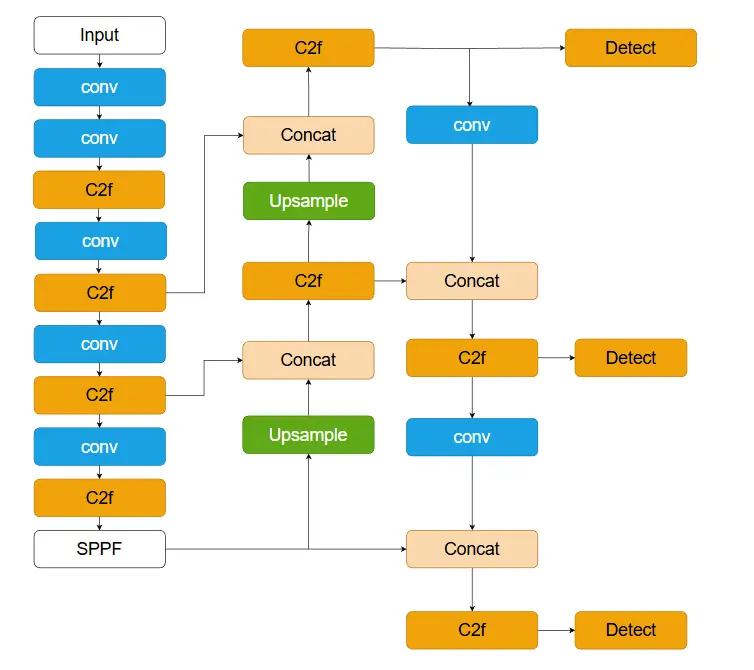
Small object detection in complex scenes, particularly for Unmanned Aerial Vehicle (UAV) aerial imagery, remains a core challenge in computer vision, primarily due to scarce feature information, vulnerability to background interference, high sensitivity of the traditional intersection over union (IoU) metric to minor positional deviations, and severe background clutter. To address these issues, this paper proposes a small-object detection model based on multi-module collaborative optimization. Built upon the YOLOv8 framework, the model introduces systematic improvements in three aspects: feature fusion, feature enhancement, and loss function design. Specifically, a weighted bidirectional feature pyramid network (BiFPN) is incorporated to provide richer multi-scale contextual information for small objects; a novel global-local collaborative attention mechanism (GLSA) is embedded to enhance the discriminative power of key features; and a bounding box regression loss based on Wasserstein distance is adopted to deliver smoother gradient behavior during training. The proposed model is comprehensively evaluated on a public dataset comprising numerous aerial and ground small objects. Compared with the baseline YOLOv8, our model achieves substantial performance gains: the optimal F1-confidence threshold rises from 0.42 to 0.67, while the mean average precision at IoU = 0.5 (mAP@0.5) increases from 81.4% to 81.8%, yielding a 0.4 percentage point improvement. These results indicate that the predicted confidences are better calibrated with respect to true accuracy, thereby enhancing the reliability of output detections. Meanwhile, the F1-score, which balances precision and recall, improves from 77% to 78%. Ablation studies further confirm that BiFPN and GLSA jointly improve classification and recall for small objects, whereas the Wasserstein Loss specifically optimizes localization accuracy. Together, these three modules constitute a cohesive high-performance detection pipeline. This work provides an effective and reliable solution for real-time small object detection in complex environments.
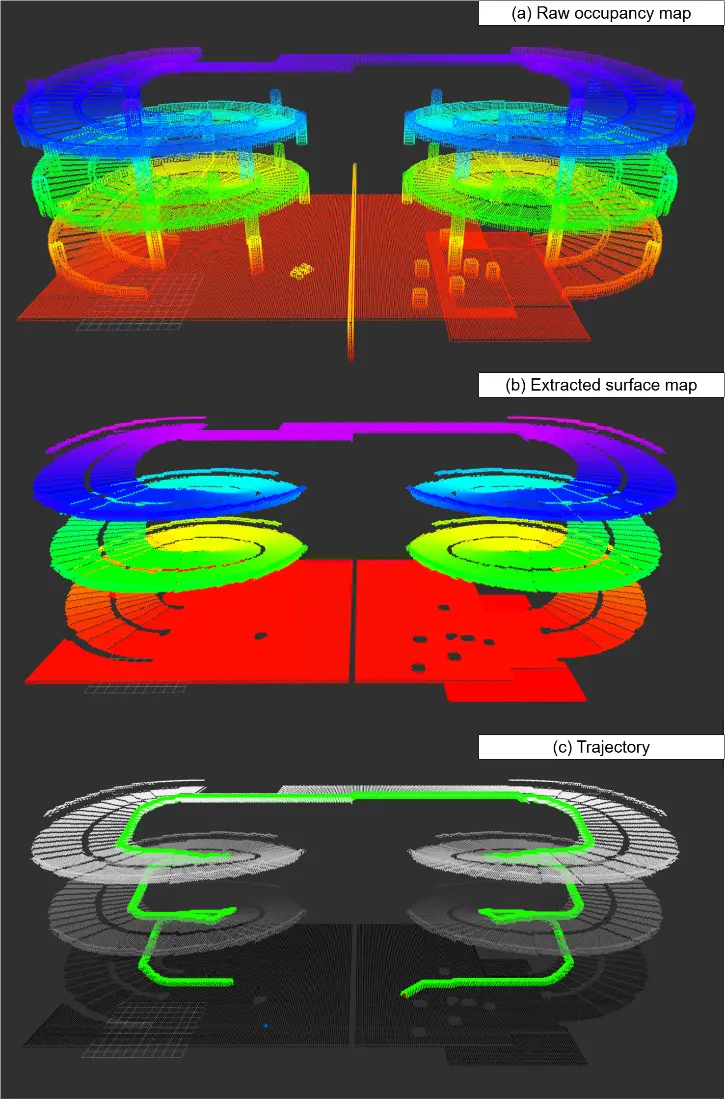
Long-horizon ground robots answer thousands of navigation queries on persistent 3D maps, making repeated planning a computational burden. We present a topology-grounded framework combining seed-reachable surface extraction, persistent-homology room segmentation, and a compact Transition Graph (TG). Surface extraction removes more than 80% of states in furniture-rich scenes. Room segmentation selects its persistence threshold automatically from map statistics, without using query outcomes. Paired boundary portals, cached Dijkstra-tree paths, and a consistent directed landmark bound reduce online computation. On 100 Habitat-Matterport 3D (HM3D) scenes and 500 queries at 0.1 m resolution, TG with one portal per boundary achieves a 0.054 ms median query time, 2.52× faster than corrected surface ALT (A*, landmarks, and triangle inequality). Five portals reduce median geometric path overhead to 3.27%, with 2.24× speedup. All three configurations return 451/500 positive-length paths, all passing the surface-adjacency check. Directed search costs match independent Dijkstra references in a separate targeted validation. Earlier cross-dataset measurements provide additional context: 452× faster search than 3D2M with 100% versus 66% success, and an approximate Geekbench-normalized cross-platform pipeline speedup exceeding 10× over point cloud tomography (PCT). These results support topology-grounded planning for repeated queries on persistent maps.
Reliability and safety assurance in autonomous vehicle systems and related cyber-physical systems (CPSs) deployed in life-critical domains—such as automotive safety, avionics, industrial automation, and transportation—require rigorous verification and validation (V&V). Design errors in system specifications and hardware/software (HW/SW) faults within architectural models can compromise functionality and lead to catastrophic outcomes. This paper introduces a model-based verification framework that integrates formal verification with hybrid fault-tolerance mechanisms, demonstrated through a safety-critical Seatbelt Reminder (SBR) subsystem as part of intelligent vehicle safety architectures. The proposed design employs Simulink Design Verifier (SLDV) as a formal model checker to validate safety properties, while an embedded Triple Modular Redundancy (TMR) scheme detects and masks both transient and permanent faults. Simulation results show that safety property proofs were achieved with preprocessing and analysis times of 10 and 12 s, respectively. Runtime execution of the verifiable model demonstrated high dependability across diverse safety-critical properties, and the TMR system meets high reliability equal to 99.3096 × 10⁻² with a failure rate of 0.005 failure per hour. Validation on a processor operating at 1500 MHz with 16 GB memory confirmed the effectiveness of the approach in enhancing reliability, fault resilience, and overall dependability in autonomous vehicle CPS design.
