
Physicochemical Characterisation of Commercial Brazilian Sparkling Wines Produced by the Charmat and Traditional Methods
Physicochemical Characterisation of Commercial Brazilian Sparkling Wines Produced by the Charmat and Traditional Methods
Natália I. Cavagnolli
1,2
 Daniel A. G. Massens
1
Patrícia K. W. Dalla Santa
1
Ana Paula L. Delamare
3
Vitor Manfroi
2
Juliano D. Perin
4
Bruno Cisilotto
5,*
Daniel A. G. Massens
1
Patrícia K. W. Dalla Santa
1
Ana Paula L. Delamare
3
Vitor Manfroi
2
Juliano D. Perin
4
Bruno Cisilotto
5,*
Received: 22 January 2026 Revised: 20 March 2026 Accepted: 14 April 2026 Published: 27 April 2026

© 2026 The authors. This is an open access article under the Creative Commons Attribution 4.0 International License (https://creativecommons.org/licenses/by/4.0/).
1. Introduction
In recent decades, sparkling wines have emerged as the fastest-growing segment of the international wine trade, with a compound annual growth rate of 7.5% in value and 5.6% in volume over the past 12 years. This expansion has mainly been driven by the popularity of Italian Prosecco, followed by Traditional French Champagne and Spanish Cava. This expansion reflects a shift in global consumption patterns, with white wines outselling red wines, highlighting a growing consumer preference for fresher, lighter, and more versatile beverages [1]. Similarly, sparkling wine production and consumption have increased significantly in Brazil in recent decades, establishing the sector as one of the most dynamic in the national wine industry [2,3].
The southern region of Brazil (Serra Gaúcha, Rio Grande do Sul) is the country’s largest producer of sparkling wines. The diversity and quality of these wines are due to various factors, including the characteristics of the terroir [4,5], the distinct producing regions [6,7,8], regulatory flexibility, and the adoption of different production techniques, such as the Charmat and Traditional methods [9]. Most sparkling wines produced from a base wine undergo a second fermentation and effervescence development using either the Traditional or Charmat method. In the Traditional method, this second fermentation takes place in the bottle, whereas in the Charmat method, it occurs in pressurised stainless-steel tanks [10]. In Brazil, in terms of production volume, the Charmat method is the most widely used, primarily by large wine companies. According to SEAPI data [11], approximately 2.9 million litres of sparkling wine base were produced using the Charmat method in the southern region of Brazil in 2024, compared with around 1 million litres using the Traditional method—roughly 2.7 times more. This predominance of the Charmat method has been recurrent, with volumes approximately two to three times higher than the Traditional method over the past decade.
The investment of Brazilian companies in producing sparkling wines using the Charmat method may be linked to climatic and geological factors influencing the economic viability of large-scale production. The winegrowing climate of Serra Gaúcha is classified as IH+1, IF–1, and IS–2: humid and warm temperate with temperate nights [12]. The warm temperate climate and basaltic rock matrix with shallow soils [13,14] make it difficult to construct underground cellars or air-conditioned warehouses, which are essential for the Traditional bottle fermentation method, particularly for large-scale production. The combination of these climatic and geological challenges, together with high infrastructure costs, makes the Traditional process less economically attractive for large wineries. In contrast, the Charmat method uses stainless-steel pressure tanks that enable greater precision in temperature control during fermentation and ageing, and it is also more adaptable to large-scale production.
Despite Brazil’s consolidation as a producer of sparkling wines and its recognition in markets, few studies have been dedicated to the physicochemical characterisation of commercial Brazilian sparkling wines, resulting in a limited understanding of their analytical profiles. Previous research has primarily addressed sparkling wines produced with two fermentations [9,15] and aromatic sparkling wines made using the Asti method [15,16,17], yet the overall database remains insufficient. Given the growth in national production, expanding technical and scientific knowledge is necessary to understand the characteristics of these wines. This limited body of research is consistent with a broader scarcity of studies on sparkling wines from emerging New World regions. This study aims to address this gap by characterising Brazilian sparkling wines produced via the Traditional and Charmat methods through an analysis of key physicochemical parameters. A range of commercial white and rosé samples from the domestic market was examined to determine the profiles associated with each production method. The findings provide a benchmark for the scientific community, contributing to the understanding of the oenological potential and characteristics of sparkling wines from Brazil.
2. Materials and Methods
2.1. Sparkling Wines Analysed
A total of 261 commercial sparkling wine samples produced using the two-fermentation process were analysed, including 142 produced by the Traditional method and 119 by the Charmat method. Of these, 75 were rosé sparkling wines (46 produced using the Charmat method and 29 using the Traditional method), while the remaining 186 were white sparkling wines. The samples corresponded to vintages ranging from 2012 to 2021, with only 18% classified as vintage sparkling wines. The analytical values, together with all other information used in this study, are provided in Supplementary Material (Table S1).
2.2. Physicochemical Analyses
Physicochemical analyses were conducted based on official and validated methods. Total titratable acidity was determined according to the method OIV-MA-AS313-01 Total acidity [18], after decarbonation of the samples. A preliminary test with a buffer solution was carried out to ensure the correct colouration of the titration endpoint, followed by the addition of bromothymol blue solution and titration with sodium hydroxide until the colour changed to blue-green. The results were expressed in g/L of tartaric acid. Volatile acidity was quantified according to Method 06 of the MAPA Manual of Methods for the Analysis of Beverages and Vinegars [19], using a Super Dee distiller and the Bubble Quick automatic titrator (Gibertini). The decarbonated samples were subjected to steam distillation and subsequently titrated electronically, with the results expressed in g/L of acetic acid. Malic, tartaric, and citric acids were quantified by enzymatic analysis using Multiparametric Hyperlab Smart equipment (Steroglass®) with commercial kits of the same brand. The decarbonated samples were analysed after calibration with specific standards and curves, and results were expressed in g/L.
The concentration of total reducing sugars was determined according to Method 13 of MAPA [19], by titration with Fehling A and B solutions after dealcoholisation, fractionation, acidification, heating, and neutralisation of the sample. Results were expressed in g/L of glucose. Alcohol content was determined by distillation according to Method 03 of MAPA [19], using the Super Dee distiller and the Super Alcomat hydrostatic balance (Gibertini), with the results expressed as a percentage by volume (v/v). The pH was measured using a digital pH meter according to Method 04 of MAPA [19] after verifying and adjusting the standard solutions (1.68, 4.01, and 6.86 pH) and taking duplicate readings to calculate the final mean.
The free sulfur dioxide content was obtained by air-stream distillation according to the modified Ripper method [20], using automated titration in the Bubble Quick system. Total SO2 was determined using Method 06 of MAPA [19], which also involved distillation and electronic titration. Both results were expressed in mg/L. Bottle pressure was measured using the method OIV-MA-AS314-02 ‘Overpressure measurement of sparkling wines’ [21], after the samples had been stabilised for 24 h in a refrigerator (4 °C). Measurements were performed using an appropriate analogue pressure gauge, and results were expressed in atmospheres (atm) at 20 °C.
2.3. Statistical Analysis
The data were analysed using descriptive and exploratory statistical approaches. The results are presented as scatter plots showing the individual data points for each sample. The median (horizontal line) represents the central tendency, and the interquartile range (IQR, error bars) represents variability. The dataset was further explored using principal component analysis (PCA) after standardisation (mean = 0; standard deviation = 1) to evaluate patterns and relationships among the samples and variables. The number of components to be retained was determined using parallel analysis (Monte Carlo simulation) with 1000 simulations and the 95th percentile. PCA was performed using the continuous quantitative variables that were active in the model: total acidity; malic, lactic, and citric acids; volatile acidity; pH; residual sugars; alcoholic strength; pressure at 20 °C; and lees contact time (in months). Missing values in the variables volatile acidity and lees contact time (see Supplementary Material Table S1 for details of missing values, including ND—not detected or not reported) were handled by imputation using a central tendency measure, calculated as the median of each treatment.
3. Results and Discussion
A total of 261 sparkling wines were analysed: 119 were produced using the Charmat method and 142 using the Traditional method (Figure 1). Of the 142 sparkling wines analysed that were produced using the Traditional method, 42 are single-varietal, indicating that approximately 70% are blends (Figure 1b). Among the sparkling wines produced using the Charmat method, of the 119 analysed, 52 are single-varietal, showing that around 56% are blends (Figure 1b). The higher number of varietal sparkling wines produced using the Charmat method may be associated with the more frequent use of the Glera grape, which is normally linked to the production of young, fresh, varietal sparkling wines (Figure 1c).
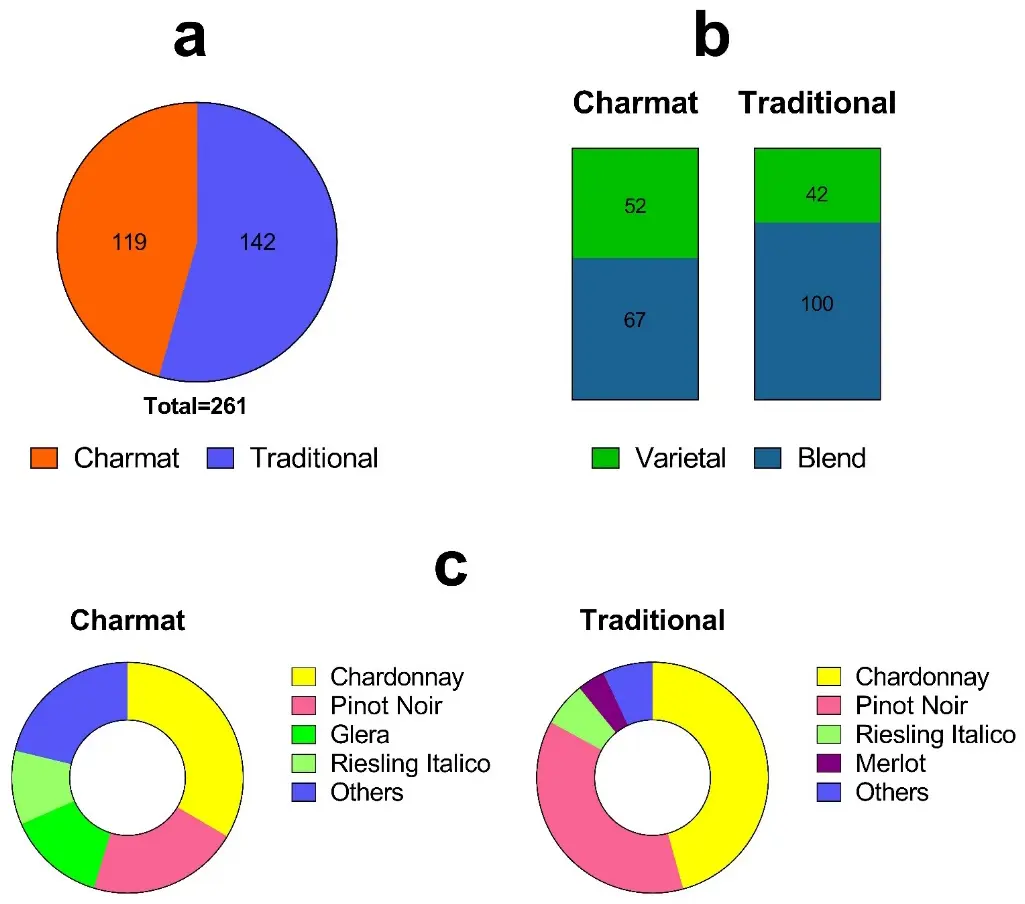
Figure 1. Composition of Brazilian sparkling wine. (a) Commercial sparkling wines analysed; (b) Number of varietal sparkling wines and blends; (c) Prevalence of grape varieties in each method.
In the Traditional method, the predominant varieties are Chardonnay, Pinot Noir, and Riesling Italico (Welschriesling—variety number VIVC 13217—origin: Italy) [22]. Around 46% of sparkling wines contain Chardonnay, 37% contain Pinot Noir either as a varietal or in a blend, and approximately 6% contain Riesling Italico as a minor component. Additionally, 4% of sparkling wines contain Merlot, and 7% contain other varieties, totalling 10 varieties in this category. Of the 19 sparkling wines that include Merlot in their composition, only three are white; the remainder are rosés produced using both methods (Table S1).
Of sparkling wines produced using the Charmat method, 31% contain Chardonnay, 21% use Pinot Noir, 14% are made with Glera, 10% contain Riesling Italico (in blends), and 21% include other varieties. This covers a total of 25 different grape varieties in addition to the four main ones (Table S1). Generally, Charmat sparkling wines display greater varietal diversity, with the ‘other’ category representing 21% of the total and encompassing 29 different grape varieties. In contrast, sparkling wines produced using the Traditional method have a more conservative profile, with the ‘other’ category corresponding to 7% and comprising 14 different grape varieties.
The Italian variety Riesling Italico is one of the four most frequently used grape varieties in both production methods, alongside Chardonnay and Pinot Noir. In Brazil, this grape variety has long been used to produce sparkling wines [6,9,23] and is included in blends due to its distinctive acidity profile (attack acidity). Its base wines demonstrate consistent quality across vintages, which may justify its continued use.
These findings demonstrate that although Brazil has an established tradition of sparkling wine production, its approach differs from that of European regions with established appellations of origin, where the authorised varieties are limited [10,24]. Therefore, Brazil can be considered a ‘sparkling wine laboratory’, as except in regions with an Indication of Origin (IO) or one of the two Designations of Origin (DO), Vale dos Vinhedos and Altos de Pinto Bandeira, which specify permitted varieties and production criteria—any variety of the Vitis vinifera species can be used to produce sparkling wines, regardless of the method employed or variations within each method.
Figure 2 provides an overview of the acidity of Brazilian sparkling wines. In terms of pH (Figure 2a), most samples produced using either the Charmat or Traditional method fall within the range of 3.2 to 3.4. This range reflects the typical acidity of Brazilian sparkling wines, which tend to have a higher pH (lower acidity) than products from cooler regions such as Champagne in France, where mean pH values are usually closer to 3.0 [25,26].
Total acidity (Figure 2b) exhibits a similar pattern to that of pH, with values consistent with those observed in sparkling wine-producing regions with milder climates. Most samples exhibited total acidity above 5.5 g/L, which is the minimum reference value for sparkling wines from the Cava region in Spain [27]. Examining the data distribution revealed that sparkling wines produced using the Traditional method exhibited greater variability in both pH and total acidity, whereas those produced using the Charmat method were more concentrated around the median (Figure 2a,b). Regarding organic acids, malic and lactic acid concentrations (Figure 2c,d) varied among samples in a manner associated with production practices. Sparkling wines produced using the Charmat method generally displayed higher levels of malic acid and lower levels of lactic acid compared with those produced using the Traditional method. This pattern reflects differences in winemaking style, varietal selection, and product characteristics. Grape varieties that are naturally lower in acidity, such as Glera and Riesling Italico, benefit from the preservation of malic acid for freshness and vibrancy. In contrast, varieties such as Pinot Noir and Chardonnay typically exhibit lower levels of malic acid in the final product (Figure 3d).
Figure 2e shows that a higher concentration of citric acid was observed in sparkling wines produced using the Charmat method. This acid occurs naturally in musts at concentrations generally below 0.5 g/L, and levels above this value may result from its addition through the expedition liqueur. Approximately 27% of Charmat wines exhibited citric acid concentrations exceeding 0.5 g/L, compared to closer to 15% of Traditional method wines. Using citric acid to adjust acidity levels is a common oenological practice [28,29,30,31], and the OIV permits its use at concentrations of up to 1.0 g/L [32]. Unlike tartaric acid, citric acid does not induce tartrate instability when added to microbiologically stabilised wines [27,30]. Regarding volatile acidity, sparkling wines produced using the Traditional method exhibited slightly higher median values (Figure 2f), though all samples remained below the OIV limit of 1.2 g/L, expressed as acetic acid [32].
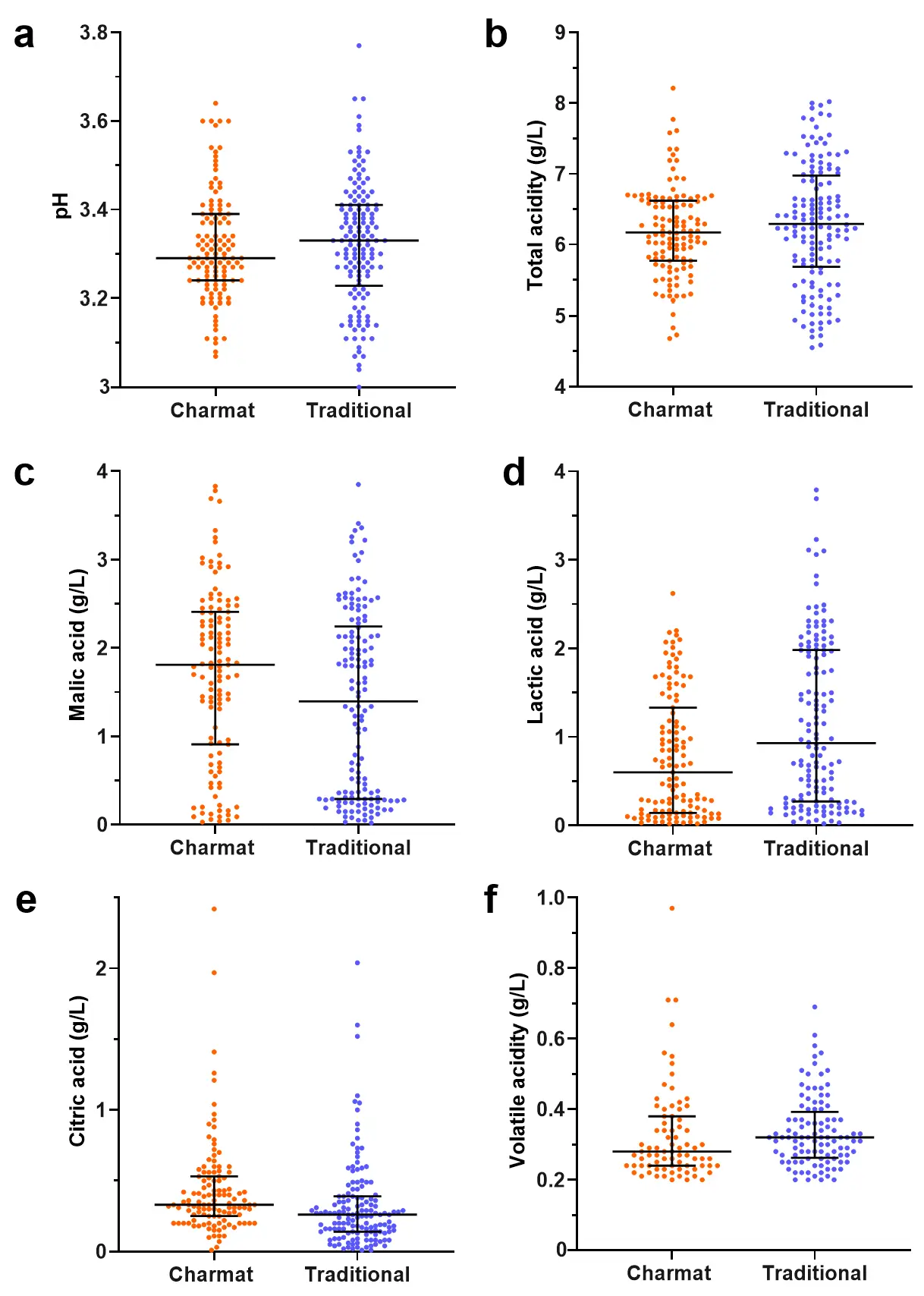
Figure 2. The acidity of Brazilian sparkling wine. (a) pH; (b) Total acidity (expressed as tartaric acid); (c) Malic acid; (d) Lactic acid; (e) Citric acid; (f) Volatile acidity (expressed as acetic acid). Scatter plots show individual data points for each sample. The error bars represent the interquartile range (IQR), and the central line indicates the median.
Figure 3 illustrates compositional differences related to sparkling wine style. Alcohol content was generally higher in wines produced by the Traditional method, whereas Charmat wines tended to show lower ethanol levels. These differences can be associated with grape variety selection (e.g., Glera, which typically accumulates less sugar) and the fresher, more youthful style characteristic of Charmat wines. Additionally, Charmat wines generally received slightly lower sugar additions in the tirage liqueur (approximately 2–4 g/L less), which may contribute to the observed variation in alcohol content. Regarding bottle pressure (Figure 3b), Charmat wines tended to exhibit lower, more consistent internal pressures, with values concentrated around the median. Traditional method wines showed a wider range of pressures, reflecting variability in production practices related to second fermentation and ageing [33,34].
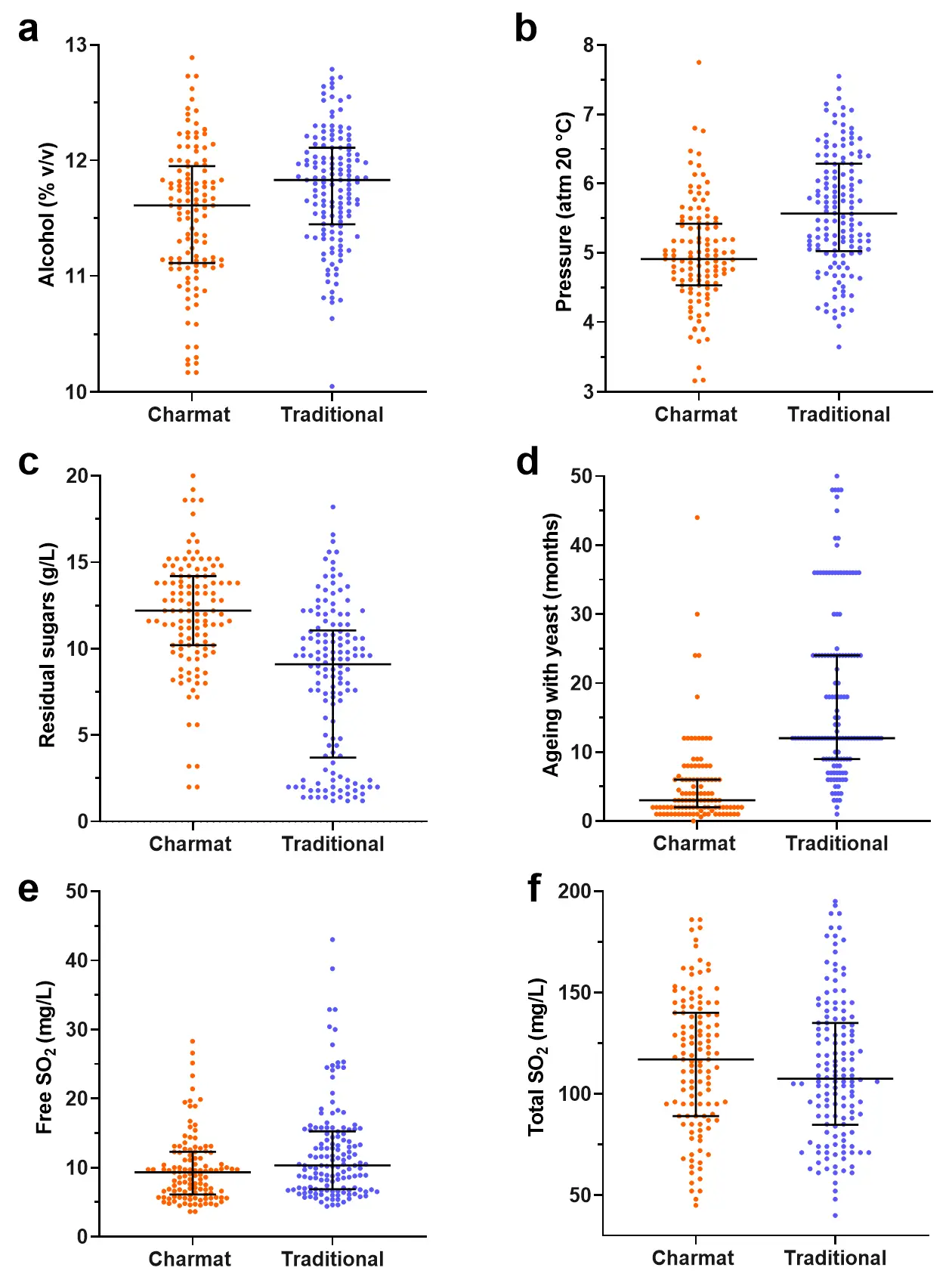
Figure 3. Physical and chemical characteristics of Brazilian sparkling wine. (a) Alcohol content; (b) Pressure; (c) Residual sugars; (d) Ageing with yeast; (e) Free SO2; (f) Total SO2. Scatter plots show individual data points for each sample. The error bars represent the interquartile range (IQR), and the central line indicates the median.
Another relevant parameter is residual sugar concentration (Figure 3c). Over 75% of the Brazilian Charmat sparkling wines analysed were classified as Brut (8.1–15 g/L) under national legislation [35], whereas wines produced by the Traditional method showed a broader distribution of dosage levels. A considerable proportion of these wines fell into the Nature (≤3 g/L) and Extra-Brut (3.1–8 g/L) categories, representing 24% and 19% of the samples, respectively. This distribution reflects the diversity of styles observed among Brazilian sparkling wines, with Charmat wines generally associated with fruit-forward profiles and Traditional method wines encompassing a wider range of compositional profiles.
Figure 3d illustrates the duration of contact with the lees. In the Traditional method, most sparkling wines remained sur lie for one to two years, with some exceeding three years, while shorter ageing periods of less than one year were also observed. Although Brazilian federal legislation does not stipulate minimum ageing periods for sparkling wines on the lees, regional appellations such as Altos de Pinto Bandeira require a minimum of 12 months, whereas Vale dos Vinhedos requires a minimum of 9 months. In the Charmat method, most wines are marketed within five months of the second fermentation. However, a substantial proportion of the samples analysed (30%) showed lees contact exceeding six months, with some wines remaining in tank for more than two years. This approach, referred to as ‘Long Charmat’ [10], has been increasingly reported in the Brazilian context. Wines produced under these conditions are associated with more complex and evolved profiles, approaching those observed in Traditional method sparkling wines with comparable ageing times. A Brazilian study [36] reported similar behaviour, indicating that sparkling wines produced by both methods from the same base wine and under identical secondary fermentation conditions showed comparable sensory profiles.
Regarding free SO2 (Figure 3e), sparkling wines produced using the Traditional method tended to show slightly higher levels, although values were generally comparable between the two methods. In most cases, free SO2 did not exceed 20 mg/L. Total SO2 content showed a similar distribution, with median values ranging from 100 to 150 mg/L. All analysed sparkling wines complied with OIV regulations, which establish a maximum limit of 200 mg/L for white and rosé wines [32].
Principal component analysis (PCA) applied to the ten physicochemical variables of the sparkling wines resulted in the retention of three principal components, selected by parallel analysis, which together explained 54.87% of the total variance (PC1 = 26.79%; PC2 = 15.04%; PC3 = 13.04%). PC1, which explained the largest proportion of the variance, showed high positive loadings for total acidity (0.747) and malic acid (0.845), and negative loadings for lactic acid (−0.832) and pH (−0.569). This component describes a gradient associated with the relative distribution of organic acids and pH among the samples. The opposition between malic and lactic acids along this axis reflects differences in acid composition within the dataset. PC2 explained 15.04% of the total variance and was influenced by residual sugars (0.691), alcoholic strength (−0.593), and lees contact time (−0.587), representing a compositional gradient associated with sweetness level, alcohol content, and maturation. PC3, responsible for 13.04% of the variance, showed greater contributions from internal pressure (−0.593), pH (−0.483), alcohol (−0.441), and lees contact time (0.417), representing a secondary axis with lower interpretative relevance compared to the first two components.
Projection of the samples in the multivariate space revealed patterns of distribution between sparkling wines produced by the Charmat and Traditional methods, particularly along PC1 (Figure 4). Wines produced by the Traditional method were generally located towards negative values of this axis, associated with higher lactic acid and lower malic acid levels (Figure 2), whereas Charmat wines were more frequently distributed towards positive PC1 values, reflecting higher malic acid and lower lactic acid contributions (Figure 4). Along PC2 (Figure 4), additional dispersion of samples was observed, mainly associated with residual sugar content, alcohol level, and lees contact time. Although some overlap between the two production methods was evident, the distribution suggests differences in compositional profiles, with Charmat wines generally associated with higher residual sugar levels, lower alcohol content, and shorter maturation periods. Overall, PCA highlights variability in acid composition and technological parameters among Brazilian sparkling wines, suggesting that multiple factors, including grape variety and production practices, contribute to the observed physicochemical profiles. Similar patterns have been reported for sparkling wines from other regions [37,38], where organic acids and fermentation-related parameters are important descriptors of compositional variability.
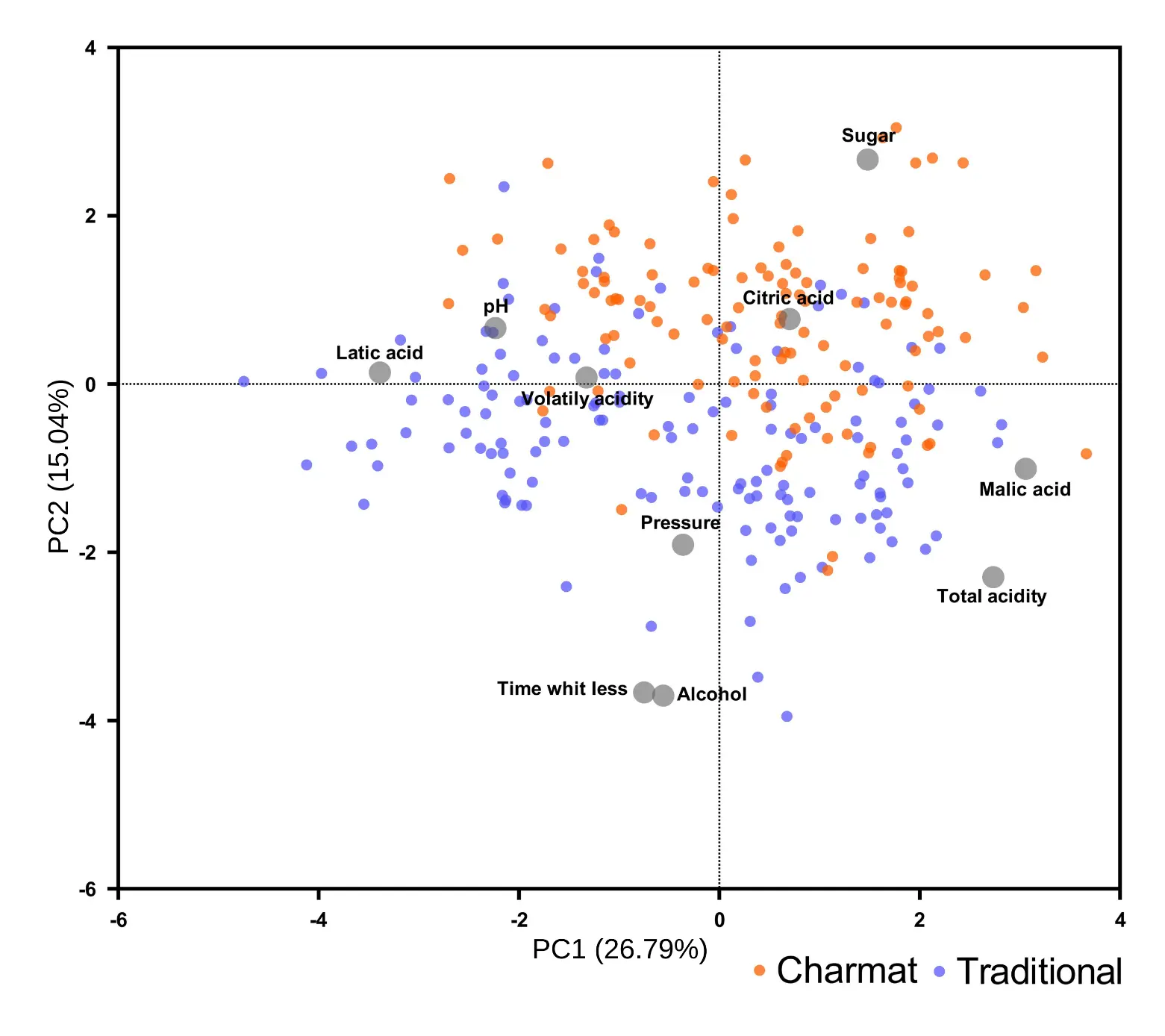
Figure 4. Principal component analysis (PCA) biplot (PC1 × PC2) of sparkling wines produced by the Traditional and Charmat methods. Vectors represent the physicochemical variables, while points correspond to individual samples.
In summary, the results emphasise the diversity of production practices and compositional profiles among Brazilian sparkling wines. The coexistence of the Charmat and Traditional methods, combined with a broad varietal base and flexible oenological approaches, illustrates the range of production practices and compositional variability in the Brazilian sparkling wine industry in response to climatic conditions and market demands. This study provides a framework for understanding the oenological characteristics of Brazilian sparkling wines and supports future studies of their quality attributes and sensory expression.
4. Conclusions
This study provides a comprehensive characterisation of Brazilian sparkling wines, highlighting the coexistence of the Charmat and Traditional methods and a broad varietal base, including the recurrent use of Riesling Italico (Welschriesling), which is less common in other sparkling wine-producing regions. Variations in organic acid composition, alcohol content, pressure, and residual sugar illustrate the diversity of compositional profiles observed, reflecting differences in grape varieties and production practices. In this context, wines produced by the Traditional method were generally associated with higher levels of lactic acid, whereas Charmat wines tended to show higher concentrations of malic and citric acids. These compositional features span a range of styles, from fresh, fruit-driven profiles to more structured, evolved expressions. An interesting aspect of Brazilian sparkling wines is that the relatively high proportion of products made using the ‘Long Charmat’ approach is associated with increased compositional complexity and contributes to a distinctive production style. Overall, these results emphasise the versatility of Brazilian sparkling wine production, its ability to diversify styles in response to market demands, and its capacity to establish a unique oenological identity on a global scale.
Supplementary Materials
The following supporting information can be found at: https://www.sciepublish.com/article/pii/980, Table S1: Physical and chemical analyses of Brazilian sparkling wines.
Statement of the Use of Generative AI and AI-Assisted Technologies in the Writing Process
During the preparation of this manuscript, the authors used ChatGPT in order to assist with the translation of the text. After using this tool/service, the authors reviewed and edited the content as needed and take full responsibility for the content of the published article.
Acknowledgments
We would like to thank the Brazilian Association of Oenology (Associação Brasileira de Enologia—ABE) and the Lavin Laboratory for providing the data and analyses. We would also like to express our gratitude to Sérgio Echeverrigaray Laguna (in memoriam) for his invaluable personal and professional contributions to this research and to the scientific community.
Author Contributions
The authorship of this article was a collective effort, and the specific contributions of each researcher are detailed as follows. The conception and design of the work were carried out by N.I.C., V.M. and B.C. The data collection, analysis, and interpretation were performed by all authors: N.I.C., D.A.G.M., P.K.W.D.S., A.P.L.D., V.M., J.D.P. and B.C. The execution of the analysis was conducted by N.I.C. and J.D.P. The writing of the article was undertaken by B.C., N.I.C., V.M. and A.P.L.D. Finally, the critical revision and final approval of the version to be published involved all team members: N.I.C., D.A.G.M., P.K.W.D.S., A.P.L.D., V.M., J.D.P. and B.C.
Ethics Statement
Not applicable.
Informed Consent Statement
Not applicable.
Data Availability Statement
The data supporting the findings of this study are available from the corresponding author upon reasonable request.
Funding
This research received no external funding.
Declaration of Competing Interest
The authors declare that they have no known competing financial interests or personal relationships that could have appeared to influence the work reported in this paper.
References
- Lamonaca E, Seccia A, Santeramo FG. Climate Cha(lle)nges in global wine production and trade patterns. Wine Econ. Policy 2023, 12, 85–102. DOI:10.36253/wep-13852 [Google Scholar]
- Wurz DA, Allebrandt R, de Bem BP, Reinehr J, Canossa AT, Dalmolin LG, et al. Brazilian sparkling wine: A successful trajectory. BIO Web Conf. 2017, 9, 03008. DOI:10.1051/bioconf/20170903008 [Google Scholar]
- Castro VA, Giraldi JDME. Spirals of knowledge in geographical indications: The Brazilian wine sector case. Rev. Adm. UFSM 2024, 17, e6. DOI:10.5902/1983465986655 [Google Scholar]
- Cavalcante CM. An institutional approach to the history of wine in Brazil. BIO Web Conf. 2016, 7, 03025. DOI:10.1051/bioconf/20160703025 [Google Scholar]
- Sarmento EC, Weber E, Hasenack H, Tonietto J, Mandelli F. Topographic modeling with GIS at Serra Gaúcha, Brazil: Elements to study viticultural terroir. In Proceedings of the VIth International Terroir Congress 2006, Bordeaux/Montpellier, France, 2–7 July 2006. [Google Scholar]
- Castro VA, Giraldi JDME, Lourenção MTA. Geographical indication as a strategic brand resource in the wine sector in Rio Grande do Sul/Brazil. Rev. Adm. UFSM 2021, 14, 276–296. DOI:10.5902/1983465934790 [Google Scholar]
- Hoff R, Falcade I, Tonietto J. The geology in the context of geographical indications of fine wines in Serra Gaúcha region (Brazil). In Proceedings of the IXe Congrès International des Terroirs Vitivinicoles, Dijon, France, 25–29 June 2012; pp. 8–41. [Google Scholar]
- Modena RCC, Hoff R, Farias AR, Viel JA, Coelho OGW. Gamma ray spectrometry for distinguishing acid and basic rocks of the Serra Geral Formation, in the Serra Gaúcha wine region, Brazil. Rev. Bras. Geofís 2016, 34, 455–467. DOI:10.22564/rbgf.v34i4.889 [Google Scholar]
- Gabbardo M, Celotti E. Caracterização físico-química de espumantes brasileiros. Ciênc Tec. Vitiviníc 2015, 30, 94–101. DOI:10.1051/ctv/20153002094 [Google Scholar]
- Di Gianvito P, Arfelli G, Suzzi G, Tofalo R. New trends in sparkling wine production: Yeast rational selection. In Alcoholic Beverages; Woodhead Publishing: Cambridge, UK, 2019; pp. 347–386. DOI:10.1016/B978-0-12-815269-0.00011-8 [Google Scholar]
- Secretaria da Agricultura, Pecuária e Desenvolvimento Rural do Rio Grande do Sul (SEAPI). Dados—Uvas e Vinhos. Available online: https://www.agricultura.rs.gov.br/dados-uvas-vinhos (accessed on 3 August 2025).
- Tonietto J, Mandelli F, Zanus MC, Guerra CC, Pereira GE. O clima vitícola das regiões produtoras de uvas para vinhos finos do Brasil. In Clima, Zonificación y Tipicidad del Vino en Regiones Vitivinícolas Iberoamericanas; Tonietto J, Sotés Ruiz V, Gómez-Miguel VD, Eds.; CYTED: Madrid, Spain, 2012; pp. 111–145. [Google Scholar]
- Hasenack H, Weber EJ, Boldrini II, Trevisan R, Flores CA, Dewes H. Biophysical delineation of grassland ecological systems in the State of Rio Grande do Sul, Southern Brazil. Iheringia, Sér Botânica 2023, 78, e2023001. DOI:10.21826/2446-82312023v78e2023001 [Google Scholar]
- Meucci MC, Lima EF, Rossetti LMM, Pasqualon NG, Mohr IM, Brose GC. Stratigraphy and petrophysical properties of the volcanic rocks of Serra Geral Group: A case study in the Antas River Valley region, Rio Grande do Sul, Brazil. J. S. Am. Earth Sci. 2025, 154, 105376. DOI:10.1016/j.jsames.2025.105376 [Google Scholar]
- Santos VHD, Celso PG, Rocha AL, Giovanaz S, Guerra CZ, Pires JP, et al. Exploratory analysis of sparkling wines based in the combined data of stable isotope analysis with physicochemical variables and volatile profile. J. Braz. Chem. Soc. 2017, 28, 1534–1546. DOI:10.21577/0103-5053.20170006 [Google Scholar]
- Marcon ÂR, Delamare APL, Schwarz LV, Pasini L, Versari A, Parpinello GP, et al. Volatile and sensory composition of Brazilian Muscat sparkling wine and Asti. J. Food Process Preserv. 2021, 45, e15240. DOI:10.1111/jfpp.15240 [Google Scholar]
- Nicolli KP, Welke JE, Closs M, Caramão EB, Costa G, Manfroi V, et al. Characterization of the volatile profile of Brazilian moscatel sparkling wines through solid phase microextraction and gas chromatography. J. Braz. Chem. Soc. 2015, 26, 1411–1430. DOI:10.5935/0103-5053.20150110 [Google Scholar]
- International Organisation of Vine and Wine (OIV). OIV–MA-AS 313-01: Total Acidity; OIV: Paris, France, 2025; p. 433. [Google Scholar]
- Brasil, Ministério da Agricultura. Portaria nº 76 de 26 de novembro de 1986: Dispõe sobre os métodos analíticos de bebidas e vinagre. In Diário Oficial da República Federativa do Brasil; Brasil, Ministério da Agricultura: Brasília, Brazil, 1986; Seção 1, Parte 2. [Google Scholar]
- Gibertini. Metodi di Analisi dei Vini e delle Bevande Spiritose, 9th ed.; Gibertini: Milan, Italy, 2007. [Google Scholar]
- International Organisation of Vine and Wine (OIV). OIV–MA-AS 314-02: Overpressure Measurement of Sparkling Wines; OIV: Paris, France, 2025; p. 630. [Google Scholar]
- Röckel J, et al. Vitis International Variety Catalogue. Available online: https://www.vivc.de (accessed on 15 August 2025).
- Stefenon CA, de Martini Bonesi C. Interesting approaches on the quality in sparkling wines around the world. EC Nutr. 2017, 11, 186–193. Available online: https://ecronicon.net/assets/ecnu/pdf/ECNU-11-00388.pdf (accessed on 15 August 2025).
- Jones JE, Kerslake FL, Close DC, Dambergs RG. Viticulture for sparkling wine production: A review. Am. J. Enol. Vitic. 2014, 65, 407–416. DOI:10.5344/ajev.2014.13099 [Google Scholar]
- Liu PH, Vrigneau C, Salmon T, Hoang DA, Boulet JC, Jégou S, et al. Influence of grape berry maturity on juice and base wine composition and foaming properties of sparkling wines from the Champagne region. Molecules 2018, 23, 1372. DOI:10.3390/molecules23061372 [Google Scholar]
- Ribéreau-Gayon P, Glories Y, Maujean A, Dubourdieu D. Handbook of Enology, Volume 2: The Chemistry of Wine Stabilization and Treatments, 3rd ed.; John Wiley & Sons: Hoboken, NJ, USA, 2021. [Google Scholar]
- Togores JH. Tratado de Enología; Ediciones Mundi-Prensa: Madrid, Spain, 2018; Volume I–II. [Google Scholar]
- Buechsenstein J, Ough CS. Comparison of citric, dl-malic, and fumaric acids as wine acidulants. Am. J. Enol. Vitic. 1979, 30, 93–97. DOI:10.5344/ajev.1979.30.2.93 [Google Scholar]
- Gancel AL, Payan C, Koltunova T, Jourdes M, Christmann M, Teissedre PL. Solubility, acidifying power and sensory properties of fumaric acid in water, hydro-alcoholic solutions, musts and wines compared to tartaric, malic, lactic and citric acids. OENO One 2022, 56, 137–154. DOI:10.20870/oeno-one.2022.56.3.5455 [Google Scholar]
- Payan C, Gancel AL, Jourdes M, Christmann M, Teissedre PL. Wine acidification methods: A review. OENO One 2023, 57, 113–126. DOI:10.20870/oeno-one.2023.57.3.7476 [Google Scholar]
- Waterhouse AL, Sacks GL, Jeffery DW. Understanding Wine Chemistry; John Wiley & Sons: Hoboken, NJ, USA, 2024. [Google Scholar]
- International Organisation of Vine and Wine (OIV). International Code of Œnological Practices: 2025 Issue; OIV: Paris, France, 2025; ISBN 978-2-85038-106-5. [Google Scholar]
- Liger-Belair G. The physics behind the fizz in champagne and sparkling wines. Eur. Phys. J. Spec. Top. 2012, 201, 1–88. DOI:10.1140/epjst/e2012-01528-0 [Google Scholar]
- Cilindre C, Liger-Belair G, Villaume S, Jeandet P, Marchal R. Foaming properties of various Champagne wines depending on several parameters: Grape variety, aging, protein and CO2 content. Anal. Chim. Acta 2010, 660, 164–170. DOI:10.1016/j.aca.2009.10.021 [Google Scholar]
- Ministério da Agricultura, Pecuária e Abastecimento (MAPA). Instrução Normativa nº 14, de 8 de fevereiro de 2018. Estabelece os padrões de identidade e qualidade para vinhos e derivados da uva e do vinho; Diário Oficial da União; MAPA: Brasília, Brazil, 2018. [Google Scholar]
- Cisilotto B, Delamare APL, Echeverrigaray S, Rocha RKM, Scariot FJ, Schwarz LV. Are the characteristics of sparkling wines obtained by the Traditional or Charmat methods quite different from each other? OENO One 2023, 57, 321–331. DOI:10.20870/oeno-one.2023.57.1.7313 [Google Scholar]
- Izquierdo-Llopart A, Saurina J. Multi-sensor characterization of sparkling wines based on data fusion. Chemosensors 2021, 9, 200. DOI:10.3390/chemosensors9080200 [Google Scholar]
- Sommer S, Sommer SJ, Liu C, Burken O, Anderson AF. The impact of microbial activity on the chemical composition and aroma profile of traditional sparkling wines. Fermentation 2024, 10, 212. DOI:10.3390/fermentation10040212 [Google Scholar]