
Flexible Zinc-Ion Battery-Powered Wearable Devices for Vital Sign Monitoring
Flexible Zinc-Ion Battery-Powered Wearable Devices for Vital Sign Monitoring
Received: 20 January 2026 Revised: 03 March 2026 Accepted: 01 April 2026 Published: 09 April 2026

© 2026 The authors. This is an open access article under the Creative Commons Attribution 4.0 International License (https://creativecommons.org/licenses/by/4.0/).
1. Introduction
1.1. Wearable Devices and Health Monitoring
Wearable devices have become important tools in modern medicine and health management, proving highly valuable for real-time, continuous monitoring of physiological signs [1,2]. Advances in technology now allow these devices to track indicators such as heart rate, blood oxygen saturation, blood pressure, and body temperature [3], providing users with timely feedback on their health.
In healthcare, wearable devices are becoming commonplace, and for good reason. They offer valuable support in spotting early signs of illness and managing long-term conditions. Take neuromuscular disorders, for example. By tracking blood-oxygen levels around the clock, these tools can lower the chance of related health issues. Real-time data keeps patients informed, but reliable long-term monitoring rests on one critical factor: a power source that is both dependable and safe. The next wave of wearables is headed toward smarter, more personalized designs that integrate smoothly into daily life. Here, advances in flexible power are key. Innovations like the flexible zinc-ion battery are opening new paths—enabling smaller, more comfortable devices that adapt to varied settings, from exercise routines to overnight sleep tracking.
In the future, with the convergence of materials science and Internet of Things technology, wearables are expected to enable more accurate multimodal monitoring and, in combination with artificial intelligence, provide predictive health management solutions that revolutionize the field of health monitoring.
1.2. Challenges of Flexible Power Sources
Conventional power systems, such as lithium-ion batteries, usually rely on rigid electrodes and packaging. That makes them poorly suited to the repeated bending and stretching required in dynamic wearable applications like motion tracking or medical rehabilitation [4]. Batteries based on lithium or sodium metals suffer from high overall impedance due to porous substrate structures and low electronic conductivity. They also lack the high-modulus elasticity needed for comfortable, flexible wearables. Safety presents another hurdle. Lithium and sodium metals are highly reactive and tend to form dendrites during cycling, which can puncture separators, cause short circuits, and even lead to fires or explosions. Moreover, the organic carbonate solvents commonly used in lithium-ion electrolytes have low flash points, increasing combustion risk if the device is damaged or overheated. From a resource standpoint, global lithium reserves are roughly 1/300 of those of zinc, and lithium extraction, storage, and air-sensitivity add cost and safety concerns. Biocompatibility is also an issue: organic electrolytes and heavy-metal ions (e.g., cobalt, nickel) in some cathode materials can be toxic, potentially causing inflammation or tissue damage if used in skin-patch or implantable sensors. The rigid structure of these batteries, moreover, mismatches the mechanical properties of human skin, often causing discomfort and limiting long-term use for monitoring.
The core challenge for flexible energy systems lies in balancing material properties with structural design. Some carbon-based materials suffer from insufficient electron conductivity, while newer materials like MXene remain costly. This drives the need for highly conductive, lightweight composite flexible collectors. On the chemistry side, strong electrostatic interactions between Zn2+ and cathode materials hinder ion insertion/extraction, and manganese-based cathodes experience Mn2+ dissolution, undermining structural stability and cycle life. Zinc anodes, meanwhile, tend to form dendrites during cycling, along with hydrogen evolution, corrosion, and other side reactions that reduce reversibility and lifespan. Aqueous electrolytes, though flame-retardant, can promote unwanted side reactions at the zinc anode. Gel electrolytes [5] must strike a balance between ionic conductivity (typically 10−3–10−2 S·cm−1) and mechanical strength (e.g., tensile strength > 1 MPa). Traditional glass-fiber separators show limited mechanical durability; researchers are now exploring metal-organic framework (MOF) modifications or natural polymers like cellulose to engineer pore structures that suppress dendrites and improve interfacial stability. Integrating flexible zinc-ion batteries with wearable sensors remains difficult, as the power system must align with the sensor’s low-power demand and operate reliably under constant deformation. For implantable sensors, batteries should ideally be biodegradable and free of toxic materials—an area still largely confined to lab-scale exploration.
In short, flexible zinc-ion batteries offer clear advantages in safety, cost, and mechanical flexibility, yet practical deployment still faces material, interfacial, integration, and biocompatibility hurdles. Solving these will require interdisciplinary collaboration and system-level optimization to fully realize their potential in next-generation wearable sensing platforms.
1.3. Advantages of Flexible Zinc-Ion Batteries
Despite the fact that the energy density of zinc-ion batteries (roughly 100 Wh/kg) is lower than that of commercial lithium-ion batteries (150–250 Wh/kg), which limits the application in volume/weight-sensitive areas such as electric vehicles, the zinc-ion batteries may be more suitable for scenarios like large-scale energy storage where energy density requirements are relatively relaxed owing to the potential advantages in terms of security and cost. In this scenario, flexible zinc-ion batteries (FZIBs) stand out as a particularly promising power source for wearable and portable electronics [6,7]. Their most compelling advantage is safety. By employing non-flammable aqueous electrolytes, FZIBs completely avoid the thermal runaway and combustion risks inherent to conventional lithium-ion batteries, which rely on organic carbonates with low flash points. Some designs adopt a planar, miniature architecture that shortens the distance between electrodes and even removes the separator. This approach significantly lowers the risk of internal short circuits caused by zinc dendrites, further enhancing safety during dynamic use. Cost and sustainability are equally strong points. Zinc is abundant in the Earth’s crust (around 70 mg/kg), and its raw material cost is far lower than that of lithium or cobalt. Using zinc powder instead of zinc foil for the anode not only improves electrode flexibility and processability but also cuts material costs. The introduction of 3D printing technology enables digital, precise material deposition, greatly improving material utilization, reducing waste, and aligning with the needs of low-cost, large-scale production [8]. Environmentally, FZIBs also hold an edge. Their electrode materials (like MnO2 and carbon nanotubes) and aqueous electrolytes are inherently benign, avoiding the toxicity associated with the organic solvents and heavy metals (e.g., cobalt, nickel) found in many lithium-ion batteries. The additive nature of 3D printing itself tends to lower chemical reagent consumption and energy use, resonating with green manufacturing principles. Mechanically, FZIBs excel. Take the CNT@MnO2 composite electrode fabricated via 3D printing as an example: its multi-level channel structure and nanoscale particles effectively dissipate bending stress, granting it exceptional deformation tolerance. Experiments show a maximum capacity loss of only 2.72% under various bending states, confirming stable electrochemical performance even when folded or curled [9]. FZIBs can be designed in diverse forms—planar miniature, cable-like, or sandwich structures—allowing them to adapt flexibly to different wearable device shapes. As a practical demonstration, 3D-printed tandem batteries have powered LED lights and digital clocks, while a single unit can drive a small fan, showcasing their value as lightweight, highly integrated miniature power supplies. This technology also enables the integrated printing of multiple battery structures (parallel or series), offering modular, customized power solutions for wearable systems.
1.4. Review Objectives and Structure
This review systematically surveys and critically assesses the latest progress, technical challenges, and future directions of flexible zinc-ion batteries (FZIBs) as a next-generation power solution for wearables. With the rapid growth of flexible electronics and personalized health monitoring, the development of power sources that combine high energy density, excellent mechanical flexibility, robust safety, and good biocompatibility has become a critical bottleneck. FZIBs are attracting intense research interest precisely because of their foundational advantages: the intrinsic safety of aqueous electrolytes, the abundance of zinc, and favorable economics. However, their journey from material systems to device design and final system integration still faces numerous scientific and technical obstacles.
To present a clear picture of this field’s development and cutting-edge trends, we have organized this review along a logical progression: from material fundamentals to system integration, and finally to applications in vital sign monitoring. First, Section 2 delves into the technological foundations of FZIBs, covering design strategies for key materials (current collectors, cathodes/anodes, electrolytes/separators, and encapsulation), the characteristics of different device configurations (e.g., sandwich, fiber-shaped, coplanar interdigitated, and all-in-one structures), and their corresponding performance metrics (electrochemical, mechanical, and environmental adaptability). Section 3 focuses on integration technologies, discussing strategies like direct encapsulation, textile integration, and on-skin patches, and analyzing how FZIBs couple with physical/chemical sensors, wireless modules, and energy management systems. Section 4 details specific application cases across various monitoring scenarios, including electrocardiogram/electromyogram monitoring, body temperature/sweat analysis, motion sensing, and chronic disease management. Building on this analysis, Section 5 summarizes current technical challenges—such as balancing energy density with cycle life and ensuring mechanical-electrochemical stability—and outlines future research directions in new materials, novel structures, intelligent integration, and standardization. Finally, Section 6 concludes by emphasizing the technical advantages of FZIBs, the necessity of interdisciplinary collaboration, and the urgency of industry-academia-research partnerships to propel them toward practical use.
Through this structured approach, we hope to provide a thorough and insightful reference for researchers and engineers in flexible energy storage, wearable electronics, and biomedical engineering, and to help accelerate the practical application and industrialization of FZIB technology in next-generation intelligent health monitoring systems.
2. Fundamentals of Flexible Zinc-Ion Batteries
2.1. Key Components and Materials
2.1.1. Current Collectors
Two mainstream choices dominate current collector design: carbon-based and metal-based materials. Each has its drawbacks. Carbon-based collectors often struggle with high cost, inadequate mechanical strength, and inferior conductivity [10]. Metal-based ones, while conductive, are typically dense and heavy. They are prone to fatigue cracks or even fracture under repeated bending and may corrode under high voltage or in certain electrolytes [11]. To navigate these trade-offs, flexible current collectors based on MXene materials have recently emerged. As demonstrated by Zeng et al., MXene-based electrodes combine high electronic conductivity with good ionic conductivity. For example, cathode films with high ɑ-MnO2 content (about 50 or 70 wt.% MXSC) delivered satisfactory specific capacities (approximately 130 or 159 mAh·g−1) at 1 A·g−1 [12]. For flexible zinc-ion battery cathode materials, the specific capacity reported in current literature typically ranges from 100–300 mAh·g−1 (depending on the material system and testing conditions). For example, typical manganese-based materials are around 200–300 mAh·g−1, while vanadium-based materials are about 300–400 mAh·g−1, although the latter often comes with issues of cycling stability or toxicity. Therefore, considering both electrode flexibility and long-term cycling stability, 130–159 mAh·g−1 (at 1 A·g−1) (Table 1) can be regarded as moderately above average, sufficient to meet the basic power consumption needs of most flexible wearable devices. However, their cycle life was limited to around 250 cycles, indicating that the overall cycle life of current flexible zinc-ion batteries is still difficult to compare with commercial lithium-ion batteries (typically more than 8000–10,000 cycles). Problems such as electrode structure degradation, zinc dendrite growth, and side reactions remain severe in large-scale long-cycle applications. To address this, the same group introduced carbon materials during electrode fabrication to suppress manganese dioxide dissolution, significantly enhancing cycling stability and taking a key step toward solving the cycle-life problem [12].
2.1.2. Cathode Materials
The cathode is central to achieving both high performance and deformability in flexible zinc-ion batteries (FZIBs). Current research focuses primarily on three families: manganese-based materials, vanadium-based materials, and Prussian blue analogues (PBAs). Manganese-based materials, such as MnO2, attract significant attention due to their high theoretical capacity, environmental friendliness, and low cost. Yet, they are susceptible to structural collapse and manganese dissolution during cycling, leading to rapid capacity decay. Common strategies to bolster structural integrity and electronic conductivity include nano-architecture engineering, compositing with conductive carbons, and strategic ion doping. Vanadium-based materials possess a layered structure with tunable interlayer spacing, which facilitates rapid Zn2+ insertion and extraction, granting them excellent rate capability and cycling stability. Their main limitations are relatively low energy density and the inherent toxicity concerns associated with vanadium [13]. Prussian blue analogues (PBAs), with their open framework and uniform ion channels, demonstrate good cycling stability and fast kinetics, though their specific capacity is typically lower. Recently, flexible composite cathodes—such as those combined with carbon nanotubes, graphene, or conductive polymers—have shown they can maintain stable electrochemical performance even under bending and stretching. This progress significantly enhances the practicality and integration potential of FZIBs.
Take the layered Bi2Te3@PPy composite cathode developed by Zeng Guifang’s team [14] as an example (Table 1). This material achieved a high initial reversible capacity of 377.9 mAh·g−1 and demonstrated superior stability compared to bulk Bi2Te3 (as shown in Figure 1a). The key to its performance improvement lies in the polypyrrole coating—this elastic layer acts like a flexible buffer pad, effectively absorbing the repeated stress during the charging and discharging process. Thanks to this structural design, the cathode still maintains significantly improved electrochemical performance after 5000 cycles, with an extremely low capacity decay rate of only 0.004% per cycle (as shown in Figure 1b). This case reveals a universal rule: through a composite strategy, both energy density and cycle life can be simultaneously enhanced. Such research has pointed out a promising development path for promoting the practical application of flexible zinc-ion batteries.
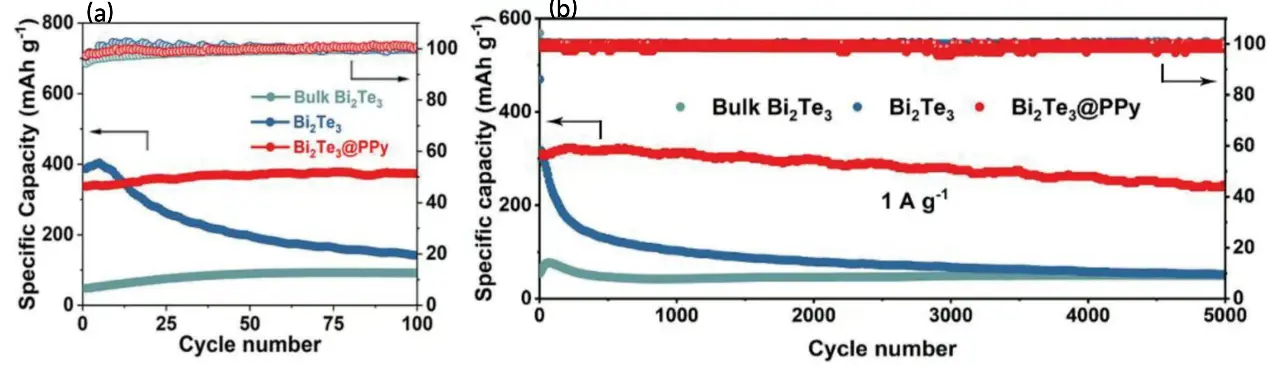
Table 1. Performance comparison of typical positive electrode materials for flexible zinc-ion batteries.
2.1.3. Anode/Zinc Metal Treatment
The metallic zinc anode is a core component of FZIBs, prized for its high theoretical capacity, low redox potential, low cost, and environmental friendliness. However, its performance is hampered by a critical challenge: the uncontrollable growth of zinc dendrites during charge/discharge cycles. This dendritic growth severely limits cycle life, safety, and the overall practical potential of FZIBs.
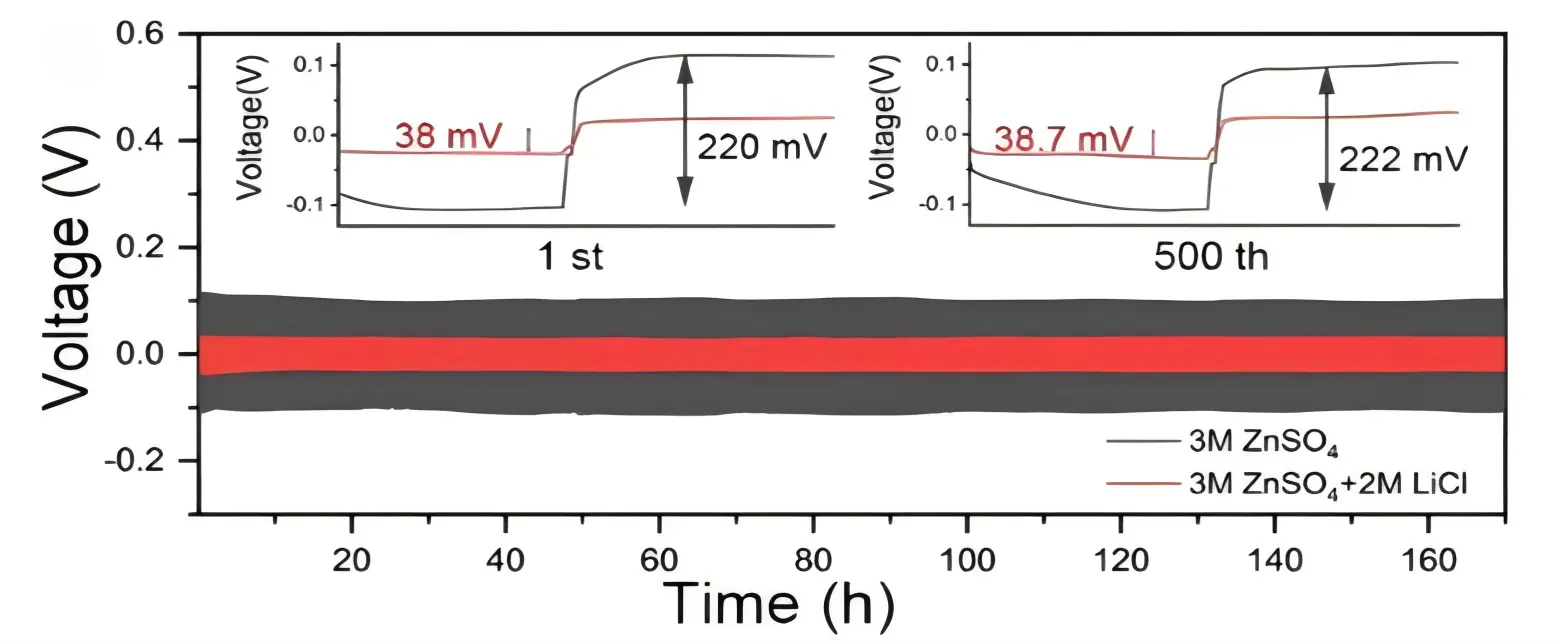
Recent research tackles this problem through three complementary strategies: interface modification, three-dimensional (3D) structure design, and electrolyte engineering. Interface modification aims to build a stable, ion-conductive, and mechanically flexible protective layer on the zinc anode surface. This layer isolates the zinc metal from direct electrolyte contact, reduces side reactions, provides uniform ion transport channels to guide even zinc deposition, and thereby inhibits dendrite formation. The 3D structure design strategy provides a larger specific surface area and a confined space for zinc deposition, effectively reducing local current density and mitigating dendrite growth. Finally, incorporating functional additives into the electrolyte is one of the most common and effective tactics for dendrite mitigation. For instance, cations like Li+ and anions like Cl− can work together to form a protective layer on the zinc surface in situ. Research shows that adding 2 M LiCl as an electrolyte additive dramatically reduced the overpotential for zinc deposition from 220 mV to just 38 mV, as seen in a comparison of voltage profiles from the first and five-hundredth cycles (as shown in Figure 2) [16]. This demonstrates how suitable additives can effectively curb dendrite growth, enhancing both battery performance and safety.
2.1.4. Electrolyte/Separator
The electrolyte and separator are pivotal, directly influencing ion transport, interfacial stability, mechanical flexibility, and biocompatibility. Traditional liquid electrolytes risk leakage and offer poor safety. In contrast, hydrogel electrolytes with their three-dimensional network structure provide excellent ionic conductivity, good mechanical flexibility, and biocompatibility, making them an ideal choice for flexible batteries.
Ionic Conductivity and Electrochemical Performance
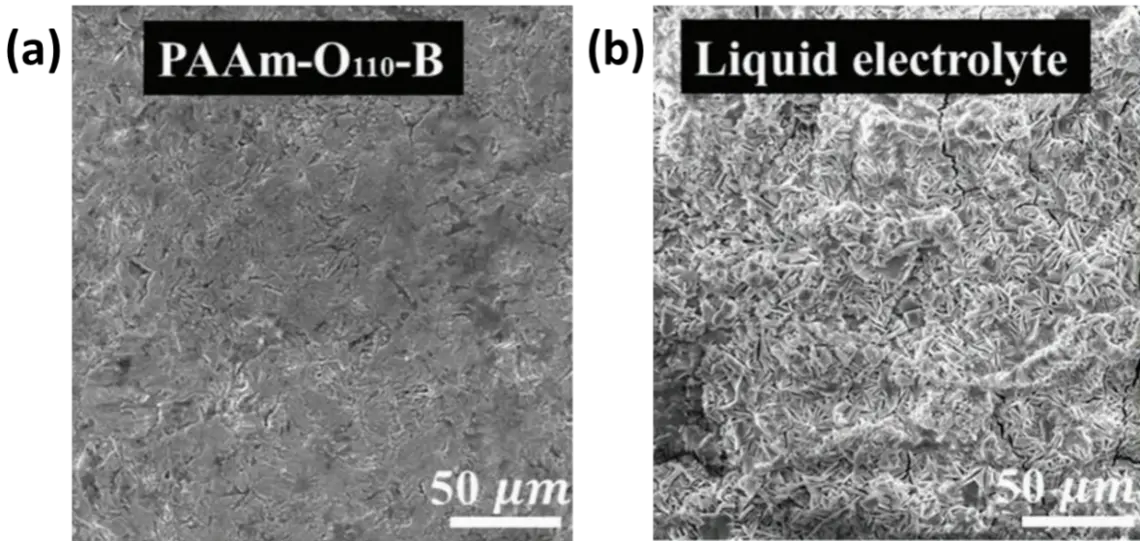
A hydrogel’s ionic conductivity depends on its polymer matrix, salt type, and network structure. The double-network cross-linked polyacrylamide-hydroxypropyl methylcellulose hydrogel electrolyte (PHHE) incorporates high-viscosity HPMC as a second network. This improves the ink’s rheology for 3D printing while achieving a high ionic conductivity of 31.72 mS·cm−1, a wide voltage window (0–2.3 V), and good cycling stability (600 h at 0.5 mA·cm−2) [17]. Another example, the PAAm-O-B hydrogel, enhances network stability through hydrophobic interactions, reaching an ionic conductivity of 28.3 mS·cm−1 and a Zn2+ transference number of 0.7. This significantly improves the uniformity of zinc deposition and extends cycle life (as shown in Figure 3) [18].
Mechanical Properties and Structural Design
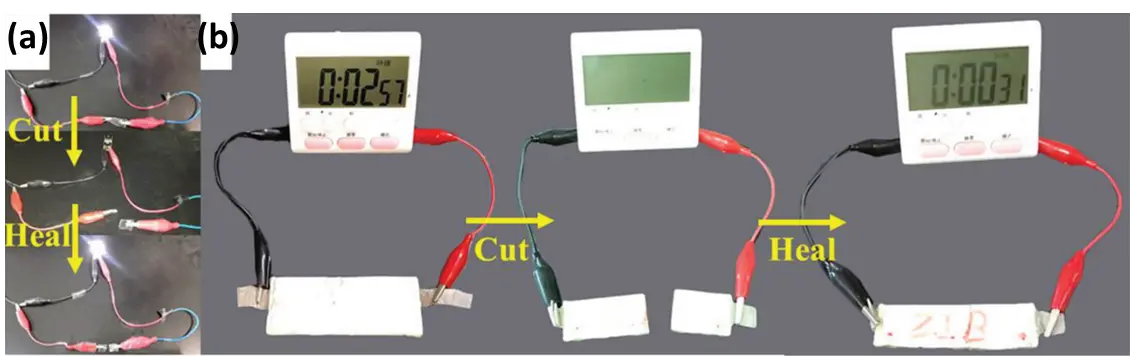
The mechanical properties of hydrogels are directly related to the stability of batteries under deformation states such as bending and stretching. For instance, PHHE hydrogels can be constructed with complex structures through 3D printing technology, with an elongation at break of up to 533% and the ability to withstand 360° torsion, demonstrating excellent mechanical adaptability [17]. The PAAm-O-B hydrogel combines chemical cross-linking and hydrophobic interaction, with a tensile strength of 75 kPa and an elongation at break exceeding 1300%. Even after 50 cut-healing cycles, this material can still maintain good mechanical properties, demonstrating excellent self-healing ability and durability (as shown in Figure 4) [18]. The above-mentioned characteristics enable this type of hydrogel to effectively adapt to the stress changes generated during the dynamic deformation of flexible devices.
Wide-Temperature Range Adaptability
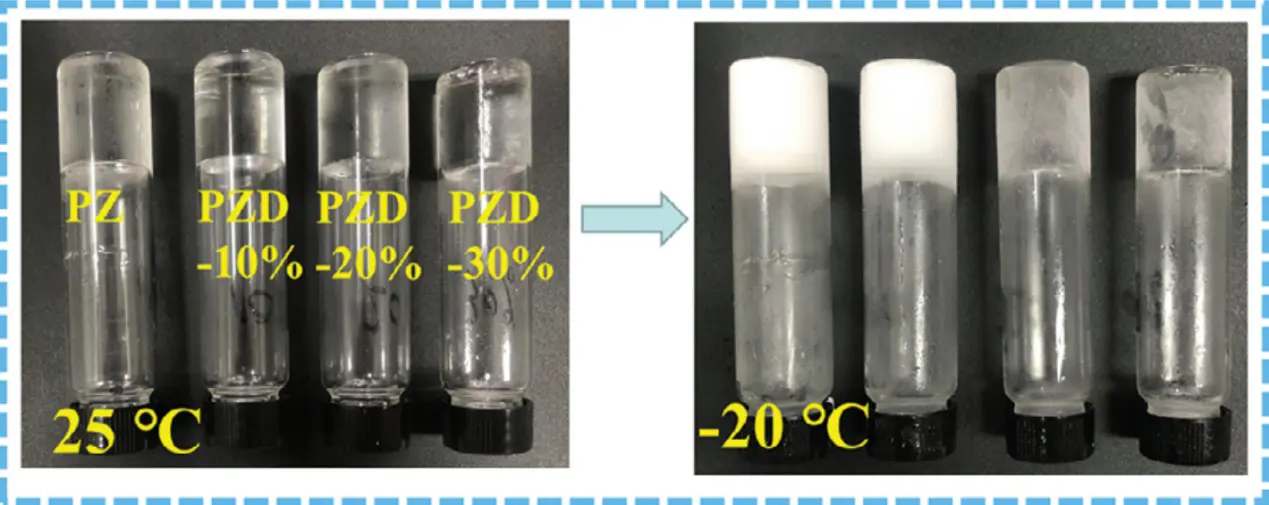
For using in complex environments, hydrogel electrolytes remain stable across a broad temperature range. The PZD hydrogel incorporates N,N-dimethylformamide (DMF) as a binary solvent, which disrupts the hydrogen-bonding network between water molecules and significantly lowers the freezing point. This hydrogel remains transparent at −20 °C, exhibits good ionic conductivity, and enables reversible zinc deposition/stripping even at −30 °C (as shown in Figure 5) [19].
Dendrite Inhibition and Interfacial Stability
The internal architecture and chemical functionality of a hydrogel directly influence how zinc ions deposit during battery operation. A case in point is the dual-network PHHE hydrogel, whose microporous structure serves as both an electrolyte reservoir and a smooth pathway for Zn2+ movement. By incorporating a blend of zinc salts (Zn(ClO4)2 and Zn(CF3SO3)2), researchers achieved a less corrosive environment and more reversible plating, thanks to a synergistic effect between the salts and the polymer matrix [17]. The PZD hydrogel illustrates another approach. Here, the combined action of DMF solvent and the PAM network steers zinc ions to deposit preferentially onto the Zn(002) crystal plane. This oriented growth minimizes the formation of jagged dendrites, allowing a symmetric cell to operate steadily for an impressive 5600 h at 0.5 mA·cm−2 [19]. Then there is the PAAm-O-B hydrogel, which takes a different route. Its network stability—derived from both chemical bonds and hydrophobic interactions—creates a robust environment that consistently stifles dendrite formation. This design has enabled stable zinc cycling for over 900 h [18]. Together, these examples highlight how tailored hydrogel chemistry and structure are proving essential for guiding uniform metal deposition and extending battery life.
Biocompatibility and Environmental Friendliness
Most hydrogel electrolytes show good biocompatibility and degradability, suiting them for wearable and implantable devices. Other biocompatible systems like PVA-boric acid-glycerol/sodium alginate-calcium chloride, nanocellulose/gelatin, and SA/AG/GL, also hold promise due to their low toxicity, flexibility, and tunable properties.
Through thoughtful polymer network design, cross-linking optimization, and the introduction of functional components, hydrogel electrolytes can balance high ionic conductivity, robust mechanics, wide-temperature operation, and dendrite inhibition. Future work should further explore their long-term interfacial compatibility with electrodes and performance in extreme environments to advance FZIBs toward practical wearable applications.
2.1.5. Encapsulation Materials
In practical applications, especially in scenarios such as wearable electronics, smart textiles, and implantable medical devices, the long-term stability and reliability of flexible zinc-ion batteries not only rely on the performance support of core electrochemical components like electrodes and electrolytes, but also largely depend on the effective protection of packaging technology. The traditional rigid metal or hard plastic packaging methods simply cannot meet the dynamic usage requirements of flexible devices. For this reason, the current research focus is gradually shifting to flexible polymer films, elastomers, and multi-layer composite packaging structures.
Take polydimethylsiloxane (PDMS) as an example. This material has been widely used in flexible packaging due to its excellent flexibility, chemical inertness, biocompatibility, and moderate air permeability. However, its barrier properties against water vapor and oxygen remain relatively limited [20].
In wearable applications, the breathability of packaging materials is particularly crucial. The breathable structure benefits the evaporation of sweat on the skin surface, enhancing wearing comfort. At the same time, it can prevent moisture from accumulating under the packaging, thereby preventing the battery from failing due to corrosion. In addition, with the rise of implantable devices and sustainable electronic products, biocompatibility and biodegradability have become increasingly important research areas in packaging materials. Using natural polymers (such as silk fibroin, chitosan) or biodegradable synthetic polymers (such as polylactic acid (PLA), polycaprolactone (PCL)) as encapsulation materials can ensure the safe degradation of the battery in vivo or in the natural environment after it has completed its intended functions. However, this must be predicated on ensuring the integrity of the battery’s packaging during use [21].
In the future, through innovative material designs (such as self-healing packaging layers and intelligent responsive packaging) and advanced micro-nano processing techniques (such as transfer printing and patterned deposition), developing packaging solutions that can operate stably for a long time in complex dynamic environments and integrate multiple functions is expected to fully leverage the potential of flexible zinc-ion batteries in the next generation of flexible electronic systems.
2.2. Device Configurations
2.2.1. Sandwich Structure
The conventional stacked, or sandwich, structure assembles the battery by layering the cathode, separator, and anode. This design maximizes electrode contact area, reduces internal resistance, and boosts overall performance. Its manufacturing process is mature after decades of optimization. However, it suffers from a critical flaw: during the cycling of rechargeable zinc batteries, zinc ions often deposit unevenly on the anode, forming dendrites that may pierce the separator, cause internal short circuits, and pose a fire hazard—a significant risk for wearable electronics. The design philosophy of planar flexible ZIBs integrates the electrode materials, electrolyte, and current collector on the same plane. As Ren Yujin et al. noted, eliminating the separator optimizes ion transport kinetics [9]. The planar design ensures rapid ion movement through in-plane channels even under high bending or rolling. Moreover, this unique architecture itself helps minimize the short-circuit risk posed by dendrite formation, broadening the application scope for flexible zinc-ion batteries.
2.2.2. Fiber/Linear Batteries
Fiber-shaped Zinc-Ion Batteries (FZIBs) represent a novel energy storage architecture. They are made by processing electrode materials into fibers using techniques such as surface coating, in-situ growth, or wet spinning. These battery fibers can then be woven into fabrics or textiles, merging the safety and cost benefits of zinc-ion chemistry with the inherent flexibility and weaveability of fibers. Using hydrogel electrolytes (HEs), these batteries avoid the flammability and explosion risks of traditional lithium battery organic electrolytes, making them ideal for wearables. HEs, in a quasi-solid-state, offer a stable network structure that prevents leakage and helps control zinc anode reversibility. Their functional groups can be tuned to impart special properties, such as self-adhesion, thermal self-protection, and self-healing [19]. Their soft, wet nature ensures good compatibility with electrode surfaces, preventing active material dissolution. Superior biocompatibility and breathability allow hydrogels to connect seamlessly with human tissue and other device components. The inherent mechanical flexibility of these fibrous batteries facilitates the stable operation under bending, knotting, and some stretching. Their compatibility with textile weaving techniques enables integration into fabrics, resulting in soft, breathable, and comfortable battery textiles.
2.2.3. Coplanar/Interdigitated Structure
The coplanar or interdigitated structure arranges positive and negative electrodes side-by-side on the same plane, with electrode fingers interlocking like two combs. This design allows electrodes to take on a wavy shape, absorbing external tensile forces through geometric deformation rather than material stretching. It also eliminates the risk of layer delamination seen in traditional stacked designs, making the structure more stable and secure. Furthermore, the interdigitated pattern allows micrometer-level control of electrode spacing, significantly reducing internal resistance and ensuring more uniform current distribution across the plane. In practice, Fanbo Meng et al. designed a five-axis curved multi-material printing process to construct aqueous zinc-ion battery modules by conformally printing functional circuits onto complex surfaces [22]. This approach is ideal for space-constrained applications and lays the groundwork for the miniaturization and conformal production of next-generation wearable electronics.
2.2.4. Fully-Integrated Battery
The all-in-one, or fully integrated, battery breaks down the physical boundaries between traditional components. It integrates functions like ion conduction, electron conduction, active material storage, and mechanical support into a single, seamless structure through precise material and structural design. Yongyi Lu et al. designed a dual-network cross-linked structure (polyacrylamide-PAM and hydroxypropyl methylcellulose-HPMC) [17]. By adjusting HPMC content, they optimized ink rheology for 3D printing. Using a composite salt of Zn(ClO4)2 and Zn(CF3SO3)2 enhanced electrochemical performance. Via 3D printing, they then customized hydrogel electrolytes to construct flexible zinc-ion microbatteries (FZIMBs) and integrated sensing systems. The resulting FZIMBs showed high area capacity, considering the fact that the areal capacity of flexible batteries is usually constrained by the electrode thickness and the load-bearing ability of the flexible substrate, and the areal capacity of typical flexible zinc-ion batteries is mostly between 1–3 mAh·cm−2. In this sense, the 4.02 mAh·cm−2 achieved through 3D printing technology (at 0.5 mA·cm−2) is significantly higher than most similar studies and even approaches the level of some flexible lithium-ion batteries (approximately 3–5 mAh·cm−2), thus it can be referred to as ‘high areal capacity’. Meanwhile, The resulting FZIMBs possessed mechanical flexibility; after integrating pressure sensors, they achieved “sensing interaction” functionality, offering a novel solution for energy devices in flexible wearables. In another approach, Hui Ma et al. used direct-ink-writing (DIW) 3D printing to construct a cathode from calcium vanadium oxide nanobelts (CaVO NR) and an anode host from reduced graphene oxide nanosheets (rGO NS) [23]. A subsequent copper modification strategy yielded a dendrite-suppressed zinc anode with lower polarization and a more stable voltage plateau during long-term cycling. This study also presents a fresh integration strategy for flexible wearable energy devices.
2.3. Performance Metrics
2.3.1. Electrochemical Performance
A battery’s performance can be evaluated as a balance of three key traits: how much energy it holds, how quickly it delivers that energy, and how long it lasts. First is energy density measured in watt-hours per liter or kilogram, indicating how long a device can run. To improve it, researchers work on creating flexible electrodes that store more charge, increasing the amount of active material, and trimming down every non-essential component. Second is power density, which reflects how quickly the battery can charge or deliver energy. This is largely governed by the speed at which ions and electrons travel inside the cell. But for flexible zinc-ion batteries, possibly cycle life matters more: the number of times of recharging before its capacity drops to 80% of the initial value. It’s this endurance that determines whether a battery can withstand the repeated bending and daily use that flexible devices demand.
Currently, achieving long cycle life is a major hurdle. Repeated mechanical deformation (bending, stretching) can cause electrode delamination, current collector fatigue, or deteriorating electrolyte/electrode contact, accelerating electrochemical failure. Therefore, extending cycle life demands not only electrochemically stable materials but also device-level designs that preserve the integrity and function of all internal interfaces throughout continuous mechanical stress.
2.3.2. Mechanical Performance
Mechanical properties are the key indicators for evaluating the quality of flexible devices. This type of performance enables the device to maintain functional stability even when it undergoes deformation, while also adapting to a variety of integration methods. Among various mechanical properties, bending stability is the most fundamental mechanical requirement that flexible zinc-ion batteries must meet. Specifically, it refers to the attenuation of electrochemical performance, such as capacity retention rate and internal resistance change of the battery after thousands or even tens of thousands of bending cycles at different bending radii (such as 1 mm to 10 mm).
In contrast, tensile stability corresponds to a higher performance standard. In application scenarios that need to be integrated with human skin or elastic textiles, batteries often need to have a certain tensile capacity, usually being able to adapt to a strain range of 20% to 100% or even higher. This not only requires that the materials that make up the battery itself have good elasticity, but also ensures that the conductive path of the entire device structure remains continuous and that the electrochemical interface remains intact during repeated stretching and relaxation.
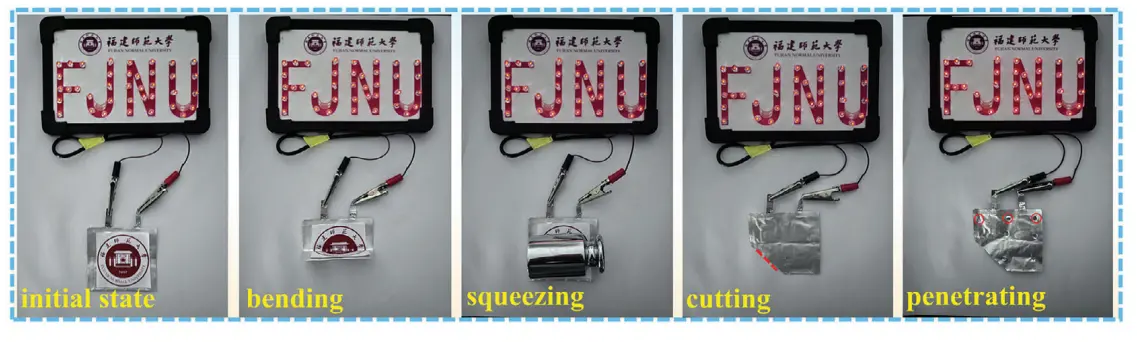
Taking the bag-type Zn//PZD-20%//MnO2 battery developed by Zhang Jingran et al. as an example, this battery can continuously supply power to the indicator light LED under various pressure and bending conditions, and can still work normally even after being cut or punctured (as shown in Figure 6) [19].
2.3.3. Environmental Adaptability
Beyond the controlled lab environment, flexible batteries must endure far more demanding real-world conditions. Their reliability depends on how well they handle variable external factors. As for temperature adaptability, these batteries must function steadily across a wide range (e.g., −20 °C to 60 °C). In the cold, electrolyte conductivity can plummet, sapping capacity and power. Under heat, unwanted chemical reactions may accelerate, electrolytes can evaporate, and protective layers may degrade. Also, biocompatibility is an absolute requirement for devices worn against the skin or implanted in the body. Every component—particularly the outer casing and any electrolyte in contact with tissue—must be nontoxic, non-irritating, and meet biosafety standards, such as ISO 10993. That’s why researchers often turn to natural polymers like sodium alginate or gelatin, or to proven synthetics such as PDMS or parylene [24]. It’s not just about safety, but about ensuring the battery can integrate smoothly with the human body over the long term.
3. Integration of FZIBs into Wearable Devices
3.1. Integrated Strategy
3.1.1. Direct Encapsulation
Stepping beyond conventional designs, the integrated configuration developed by Penghui Chen et al. addresses the core limitations of traditional battery packaging [25]. While standard casings offer physical protection, they often create uneven current flow, raise internal resistance, and lack the pliability needed for flexible electronics. Chen’s approach rethinks the assembly from the ground up. The design ensures continuous, seamless connections between components so that nothing detaches when the device bends—maintaining steady electron transfer throughout. At the same time, interfacial contact is significantly improved, reducing contact resistance and minimizing polarization. Further, a protective coating applied directly to the zinc anode helps suppress dendrite growth and promotes more uniform metal deposition. Lastly, strong adhesion between the cathode and separator keeps the active material firmly in place, preventing detachment and resistance increase during repeated flexing. Together, these refinements do more than enhance flexibility; they provide the battery with robust structural stability, improved electrochemical kinetics, and consistently stable performance even under various bent states.
3.1.2. Textile Integration
Smart clothing usually relies on rigid, externally attached batteries—a design that limits comfort, wearability, and even washability. To move beyond this, Lu and colleagues turned to 3D printing, building a battery layer by layer directly onto ordinary cotton fabric [26]. In this process, silver current collectors were printed first, followed by assembly with a cathode made from polyvinylpyrrolidone-induced ammonium vanadate nanobelts (P-NVO) and a zinc-powder anode. The entire assembly was then coated with a dual-network hydrogel electrolyte (PAM-PVP), resulting in fully-printed flexible zinc-ion microbatteries (PZIMBs). These fabric-based batteries achieved an areal capacity of 4.02 mAh·cm−2 at 0.5 mA·cm−2 and proved highly durable, retaining 84.3% of their initial capacity after a thousand bending cycles. Subsequently, by connecting the PZIMBs to a pressure-sensing array, they created an interactive e-skin system: simply bending the wrist brought sensors into contact, lighting up an LED display. This prototype effectively merges energy storage, sensing, and visual feedback into a single, wearable platform—pointing toward a future where smart textiles are truly seamless and functional.
3.1.3. Skin Patch Integration
The key features of skin patch integration include:
-
Ultra-thin Flexibility: A combination of printed electrodes with gel electrolytes yields an overall thin structure capable of excellent bending and twisting, conforming closely to the skin surface [26] (as shown in Figure 7a,b).
-
Breathable Adhesion: The PAM-PVP dual-network hydrogel electrolyte has a microporous structure and demonstrates strong interfacial adhesion, enabling stable skin contact [26] (as shown in Figure 7c,d).
-
System Integration: Research has integrated the battery co-planarly with pressure sensors and LEDs on the back of the hand, creating a skin-interactive system that controls LED brightness through finger bending (as shown in Figure 7e–g) [26]. This showcases its potential in flexible electronics and wearable devices.
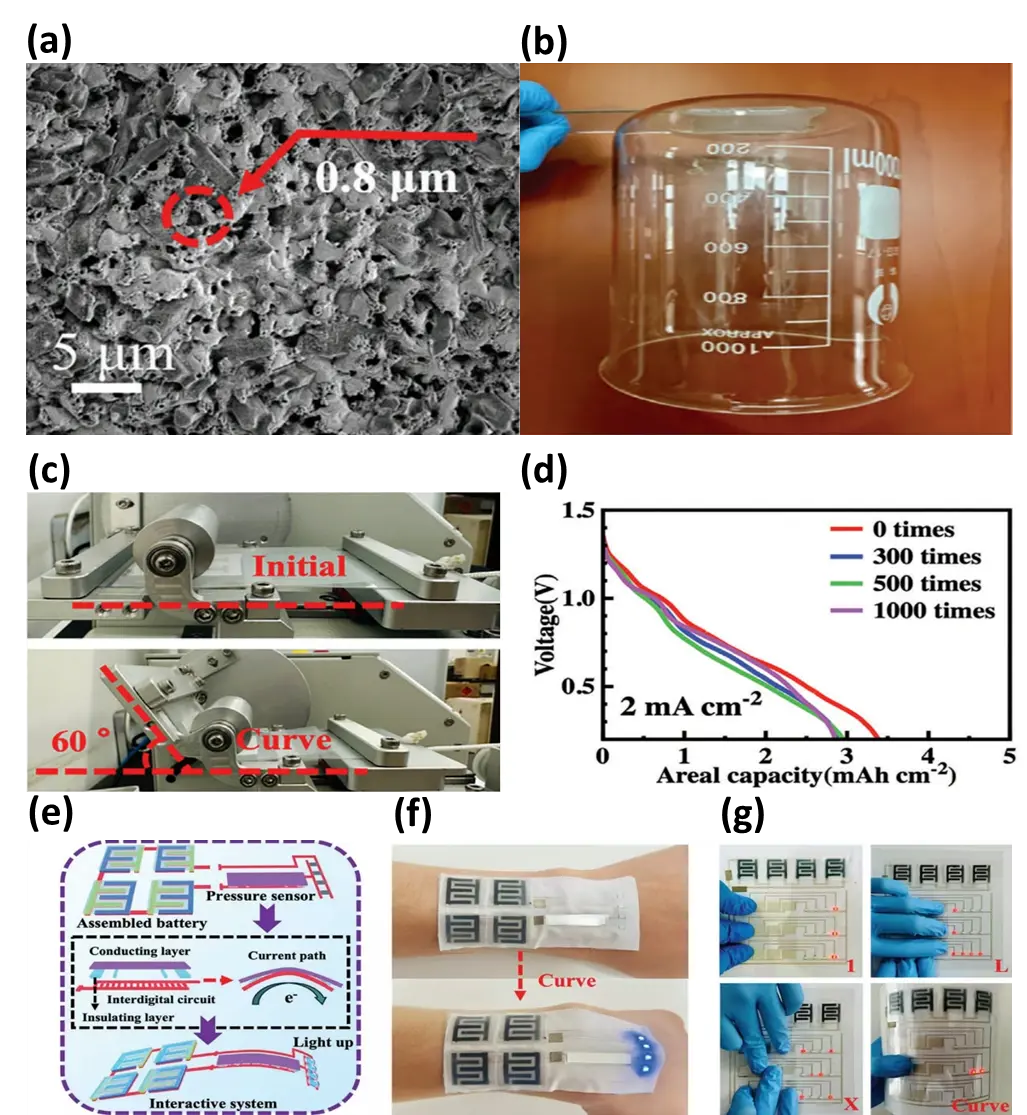
Figure 7. (a) SEM image; (b) PAM-PVP hydrogel electrolyte; (c) Optical image of PZIMBs bending test; (d) Discharge curves of zinc-based alloy under different bending cycles; (e) Schematic diagram of the working principle and optical image of the integrated device; (f) An interactive integrated system similar to electronic skin for the integrated device; (g) Integrated device with an interactive system integrating a pressure sensing array and an LED array. (Source: [26]).
3.2. Coupling with Sensors
3.2.1. Physical Sensors
Traditionally, sensors and batteries are integrated through physical stacking, which can lead to high interfacial impedance and signal crosstalk. Co-integration requires a structure where sensors and batteries share a common substrate, electrodes, and encapsulation, ensuring system stability under deformation or temperature swings. Advanced hydrogel electrolytes, like the PZD hydrogel, provide a key solution for such integration.
Even under extreme temperatures and mechanical stress, the PZD hydrogel keeps ions moving efficiently while staying flexible and tough. This dual capability allows flexible zinc-ion batteries and physical sensors to work together reliably. Taking the research by Jingran Zhang et al. as an example: when temperatures drop, standard hydrogels tend to become brittle, but formulations such as PZD-20% and PZD-30% retain both their strength and their ability to bounce back after deformation [19]. What sets this material apart is its endurance under combined thermal and mechanical pressure. That makes PZD hydrogel especially suitable for integrating strain, pressure, or temperature sensors with batteries into a single, integrated system. By ensuring structural cohesion and stable signal transmission, it provides the material groundwork needed to create durable, environmentally resilient sensing systems that perform consistently in real-world conditions.
3.2.2. Chemical/Biological Sensors
Integrating chemical/biological sensors aims for high sensitivity, rapid response, and system stability. Powered by FZIBs, these can be combined with biosensors (e.g., for glucose or pH) in a one-stop manufacturing process to build self-powered, wearable real-time monitoring systems.
A typical integrated, self-powered biosensing patch has three core modules: the FZIB power supply, the specific sensing element (like an enzyme layer or ion-selective membrane), and integrated circuitry for signal processing. These components are often built together on a shared, flexible substrate (PET, textiles) using micro- and nano-fabrication techniques such as screen or inkjet printing. Signal acquisition typically relies on electrochemical principles. For glucose monitoring, glucose oxidase catalyzes an oxidation reaction, producing a current or potential change proportional to concentration. This signal is collected and processed by the detection circuit powered by the integrated FZIB on the same substrate. This integrated design significantly boosts overall reliability. Research shows that glucose monitoring systems based on integrated FZIBs can operate continuously for tens of hours while bending, maintaining high sensitivity to physiological glucose concentrations [27]. Therefore, flexible zinc-ion batteries are a promising primary power source for future wearable biochemical sensors.
3.2.3. Signal Transmission Module
Real-time, stable transmission of sensor data in wearable health monitors relies on low-power wireless modules like Bluetooth Low Energy (BLE) and Near Field Communication (NFC). Flexible zinc-ion batteries, with their ~1.4 V discharge plateau, long cycle life, and excellent mechanical flexibility, have become the ideal power source to drive these modules for long-term continuous monitoring.
Voltage Matching and Boosting Solutions
Most BLE and NFC modules operate between 1.8 and 3.6 volts, which exceeds the nominal 1.4 V output of a single flexible zinc-ion battery. To bridge this gap, researchers have pursued two practical paths: stacking cells in series or employing efficient voltage-boost circuitry. For instance, Zhang and colleagues powered an nRF52840 Bluetooth system-on-chip directly from a single FZIB, allowing it to broadcast data every five minutes for more than two days [28]. Alternatively, other designs integrate a dedicated boost converter like the TPS61221, which raises the battery’s 1.4 V to the required level with about 88% efficiency. In one implementation, this approach sustained a BLE module for over two weeks [28]. Each strategy offers a trade-off between size, complexity, and runtime, providing flexible options for integrating energy-storage and wireless functions in wearable systems.
Cycle Life Support for Long-Term Operation
The long cycling capability of FZIBs is the key to “maintenance-free” operation. Li et al. reported fibrous FZIBs can retain 67% capacity after 5000 cycles, theoretically supporting a BLE Beacon for over 3 months [29]. Zeng et al. showed FZIBs with Bi2Te3@PPy cathodes retained >80% capacity after 5000 cycles, and with a single-cycle degradation rate of just 0.004% [14].
3.3. Energy Management
For wearable health monitors intended for prolonged, unattended use, two energy aspects are paramount: a continuous, sufficient power supply and its intelligent, efficient management. Together, these guarantee the device’s long-term, stable, and reliable operation. Flexible zinc-ion batteries need not only high energy density and stable output but also synergistic integration with energy harvesters and power management circuits to form self-sustaining systems.
3.3.1. Self-Charging Systems
To extend the service life of wearable devices and reduce reliance on traditional charging methods, current research is increasingly focusing on combining flexible zinc-ion batteries with energy-harvesting technology to build self-charging systems. For instance, after integrating flexible solar cells, the power of flexible zinc-ion batteries can be replenished under conditions of sunlight. Energy collectors based on triboelectric or thermoelectric effects can achieve in-situ conversion and storage of energy using mechanical energy generated by human movement or environmental temperature differences.
Although existing research has not yet delved deeply into the specific design of self-charging systems, the exploration of the high adaptability and stable operation capabilities of batteries in complex environments has laid a solid material and structural foundation for their future compatibility and integration with various energy harvesting modules.
3.3.2. Power Management and Electrical Interface Design
High internal resistance in flexible zinc-ion batteries and low-power silicon-based components (such as wireless modules) face impedance mismatch and voltage incompatibility issues at their electrical interfaces, directly affecting power transfer efficiency and system startup reliability. To efficiently extract energy from a high-impedance source, a boost converter based on maximum power point tracking (MPPT) is needed to increase the 1.4 V battery voltage to a 1.8–3.6 V load voltage, while selecting a converter with a quiescent current as low as 1.3 µA to extend battery life. To address cold start difficulties caused by voltage drops under low battery charge or large current pulses, optimization can be made by referencing the low-voltage startup circuits of energy-harvesting PMICs (e.g., 275 mV startup). Integrated power management integrated circuits (PMICs) maintain system stability during battery voltage fluctuations through power path management and quiescent currents as low as 7 µA, minimizing leakage. By referencing the design concepts of wireless BMS in electrical isolation and low-power communication, guidance can be provided for the deep integration of future flexible batteries with wireless modules. Therefore, refined power management and electrical interface design are key to achieving system-level reliable applications of flexible zinc-ion batteries.
4. Applications in Vital Sign Monitoring
4.1. Physiological Signal Monitoring
Leveraging their high safety, excellent flexibility, and stable discharge plateau, FZIBs provide an ideal power solution for high-precision, continuous, multimodal physiological signal monitoring systems.
4.1.1. ECG/EMG/EEG Monitoring
A patch electrode system driven by flexible zinc-ion batteries makes it possible to achieve long-term dynamic acquisition of bioengineering signals, such as ECG, EMG, and EEG. Such systems, which typically integrating high impedance, low-noise sensing circuits, and flexible zinc-ion batteries not only provide a constant operating voltage, but their inherent flexibility ensures a conformal fit of the electrodes to the skin surface, which effectively reduces motion artifacts, resulting in significantly improved signal quality. Studies have shown that flexible ECG patches combined with self-powered capability show great potential for continuous monitoring and early warning of cardiac arrhythmias [30]. This not only provides a convenient means of monitoring patients with cardiovascular disease, but also promotes the development of daily health management in a more continuous and accurate direction.
The structural properties of fiber-like flexible zinc-ion batteries make their integration with bioelectronic sensors exhibit unique advantages. The Li team developed a fiber-like flexible zinc-ion battery based on carbon nanotubes with molybdenum oxide, which remains stable in electrochemical properties after undergoing multiple bends, with a volumetric energy density of 32.1 mWh·cm−3, sufficient to power miniature radiocardiogram or EMG sensing nodes for long periods [29]. This “wire-like” form opens revolutionary possibilities for its applications: batteries can be woven directly into the fibers of smart clothing, or embedded seamlessly into the structural sandwich of a sensing patch. The monitoring system constructed from this can not only maintain a high degree of wearable comfort and concealment, but also be virtually undetected by the user due to its flexible, slim form when collecting physiological electrical signals, truly achieving “insensory monitoring”. This property provides important technical support for long-term, continuous, and undisturbed health surveillance of daily activities.
4.1.2. Body Temperature and Sweat Analysis
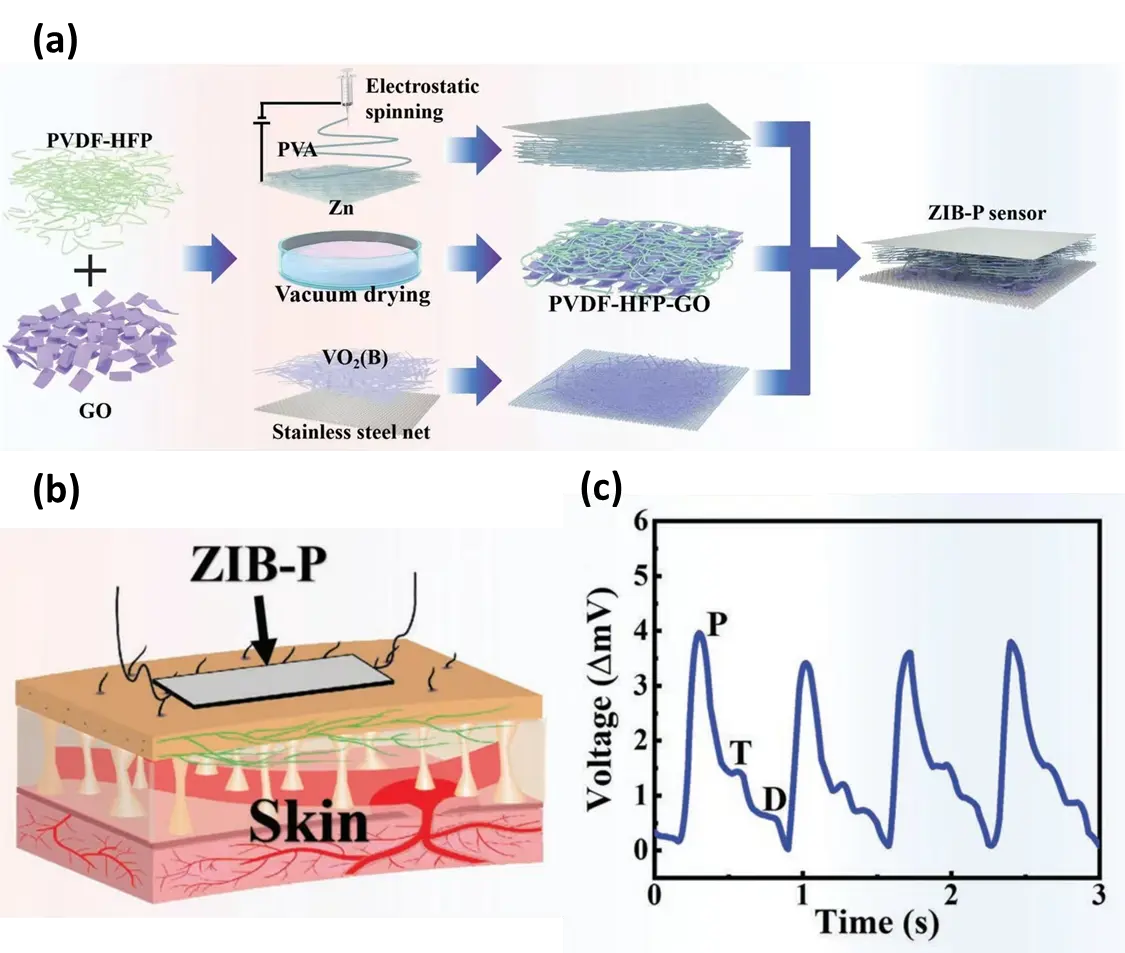
Continuous monitoring of physiological signals is essential for health management, and flexible self-powered sensing technology offers new possibilities for this. Zhang et al. propose an integrated zinc-ion battery type self-actuated pressure sensor (the Zib-P sensor) that brings innovative solutions to wearable health monitoring devices [28]. The sensor is based on a rechargeable solid state zinc-ion battery design and is essentially a flexible pressure sensor. It exhibits a number of excellent performances: 76.0 ms response and 88.0 ms recovery times, cycle stability up to 100,000 times, and a wide range of pressure detection from 2.0 Pa to 368 KPa [28]. These properties allow it to fit directly into the human skin, enabling accurate continuous monitoring of pulse signals. In applications, the sensor is capable of clearly identifying the tapping wave (P wave), tidal wave (T wave), and diastolic wave (D wave) in the pulse wave (as shown in Figure 8). This precise waveform resolution capability not only contributes to real-time acquisition of key physiological parameters such as heart rate and vascular elasticity but also provides reliable tools for cardiovascular health assessment and early risk cueing, demonstrating significant potential in the field of medical health [28].
Sweat, as a biological fluid rich in physiological information, is able to reflect changes in pH, concentration of electrolytes (such as Na+, K+, Cl−), and levels of metabolism (such as glucose, nitric acid) in real time, and is important for assessing body hydration, monitoring exercise physiology, and managing metabolic diseases. Based on this, a promising development direction is to develop precise, multi parameter sweat sensing patches. By integrating a range of selective biosensors with reliable, flexible zinc-ion batteries on a single flexible substrate, such devices promise to enable truly non-invasive, continuous, multichannel monitoring of biochemical indicators directly from the skin surface. Not only is this integrated design capable of providing a consistently stable power source for complex sensing circuits, but its flexible nature also ensures a close fit to the skin’s surface, thus ensuring high-quality sweat analysis data is still collected during dynamic activities.
4.2. Motion and Activity Monitoring
4.2.1. Joint/Limb Motion
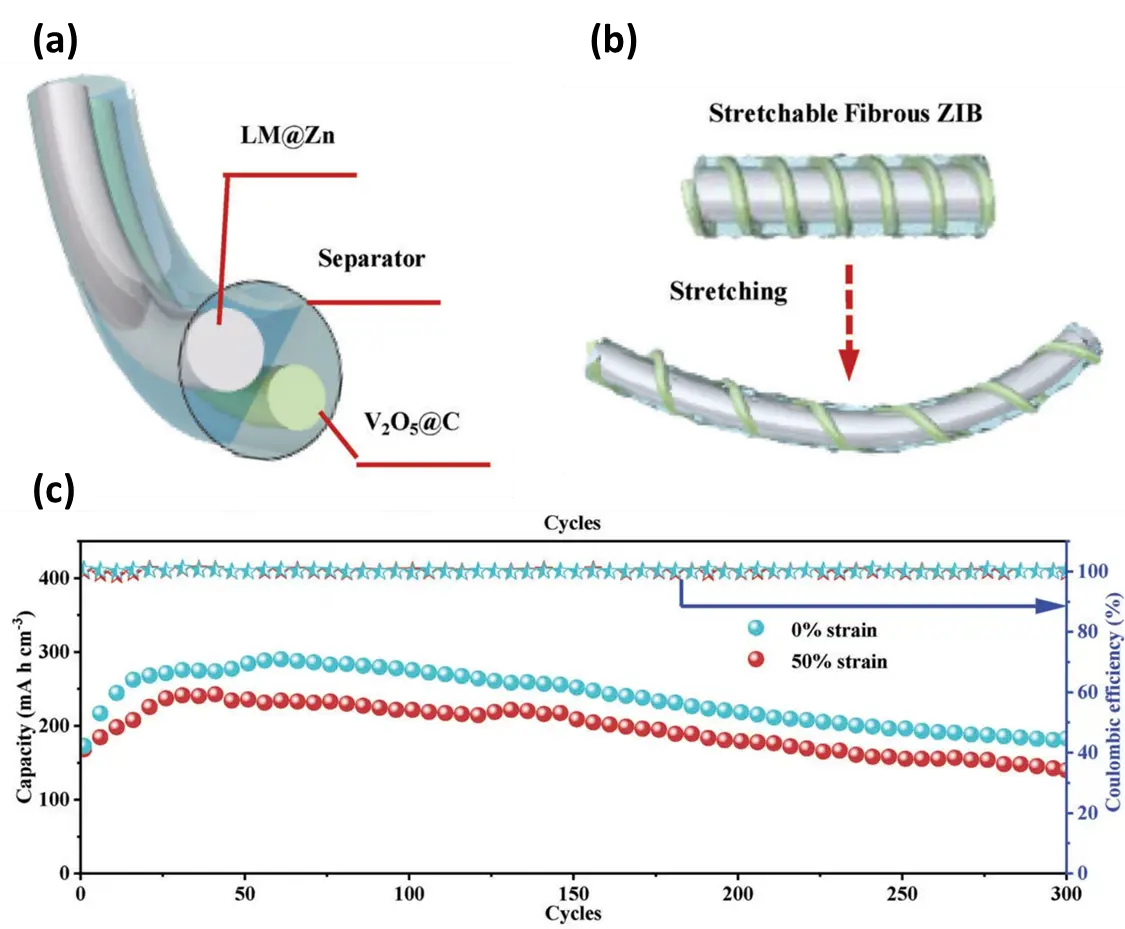
Flexible zinc-ion batteries combined with flexible strain sensors could be designed to monitor movement parameters such as joint angle, gait cycle, and muscle contraction with smart fabrics or electronic skin. For example, Shao et al. developed a fiber-like zinc-ion battery with woven and deformation resistance, capable of continuously powering sensors integrated into the fabric (as shown in Figure 9). Such devices are suitable for joint activity and gait monitoring, meeting long-term, comfortable motion-monitoring needs and thereby supporting motion performance analysis, rehabilitation training instruction, or anomalous attitude recognition [15]. In this way of integration, flexible zinc-ion batteries not only provide the sensor with a stable and fit worn form of energy, but their own mechanical durability also ensures continuity of power supply during dynamic activities. This further drives the movement-monitoring technology toward a more natural, durable, and integrated approach for everyday wear.
4.2.2. Gait/Posture Analysis
An integrated platform capable of all-weather activity monitoring can be built by combining inertial sensors such as accelerometers, gyroscopes, and flexible zinc-ion battery systems. In the field of intelligent sports equipment, the customizable manufacturing characteristics of flexible zinc-ion batteries and fabric compatibility show great potential. Using 3D printing techniques as an example, researchers have been able to print zinc-ion batteries directly onto a variety of flexible substrates such as textiles and PET films [25]. This technology makes it possible for batteries to be customized in situ according to the structure of a smart insole. Such conformal printed batteries are designed to withstand repeated mechanical stresses while walking and running, and their primary function is to provide constant electrical power to a network of pressure sensors within the insole and embedded microprocessors to map the sole pressure distribution and analyze gait patterns in real time. Similarly, printable flexible batteries can be integrated into the fabric of a sports lap belt to provide local power to the inertial measurement unit, reducing reliance on external bulky batteries. This integrated power supply not only improves comfort and freedom of movement but also provides a reliable energy base for long-term, continuous data acquisition of exercise physiology, further advancing the development of intelligent exercise equipment towards lightweight and stealth.
4.3. Health and Disease Management
FZIBs demonstrate significant clinical application potential in the long-term management of chronic diseases and post-operative rehabilitation monitoring. Their safety, flexibility, and sustainability align well with the needs of personalized, long-term health management.
4.3.1. Chronic Disease Monitoring
Flexible zinc-ion batteries offer a reliable energy solution for the management of chronic diseases such as diabetes and cardiovascular diseases that require long-term and continuous monitoring. Its safety, flexibility, and biocompatibility are particularly crucial for application scenarios that are close to the human body. The design scheme adopting water-based or gel electrolytes fundamentally avoids the flammability and explosion risks of traditional lithium-ion batteries [31], making it more suitable for long-term close contact with the human body. Meanwhile, this type of battery features excellent mechanical flexibility and stable discharge characteristics, ensuring that patients receive a continuous and stable power supply in their daily lives. It is particularly suitable for wearable monitoring devices related to cardiovascular monitoring, respiratory monitoring, and diabetes care.
In the field of cardiovascular disease monitoring, flexible zinc-ion batteries can continuously supply power to flexible electrocardiogram patches, enabling continuous capture and early warning of arrhythmias, and providing strong support for timely clinical intervention. At present, proof-of-concept studies have confirmed the feasibility of this application direction. For instance, researchers integrated zinc-ion batteries with piezoresistive pressure sensors to develop a single-chip self-powered device that can collect pulse wave signals in real time for cardiovascular-related monitoring work. This sensor is directly driven by a zinc-ion battery. Even at a current density of 2 A·cm−3, the battery can still maintain a stable discharge platform of approximately 1.4 V, which can fully meet the energy consumption requirements of low-power sensing circuits and wireless transmission modules. Experimental data show that the sensor integrated with this battery can not only respond to human body signals at a millisecond speed, but also operate continuously for more than 72 h without significant voltage attenuation [28].
In the monitoring of respiratory systems, such as chronic obstructive pulmonary disease and sleep apnea, flexible zinc-ion batteries have shown broad application prospects due to their high safety, excellent mechanical flexibility, and easy integration with wearable devices. Its fibrous or thin-film electrode structure (as shown in Figure 10a,b) can be woven into smart textiles or integrated into physiological monitoring patches, making it suitable for long-term, comfortable wearable monitoring [32,33]. In addition, the hydrogel electrolyte used in zinc-ion batteries exhibits self-healing properties and maintains stable electrochemical performance under harsh conditions, such as cutting and bending. Therefore, it is highly suitable for wearable systems with high requirements for safety and durability.
In the field of diabetes management, flexible zinc-ion batteries are expected to be integrated into continuous blood glucose monitoring patches, enabling patients to obtain real-time, painless analysis of blood glucose trends. Its thin-film electrode and “integrated” thin, light, and flexible design can be seamlessly integrated with flexible sensors, while still maintaining a high energy density and cycling stability. In terms of battery performance, the polyaniline/carbon fiber—zinc system can still maintain a capacity retention rate of 77.6% after 1000 cycles of charge and discharge (as shown in Figure 10c), demonstrating excellent cycle stability [32].
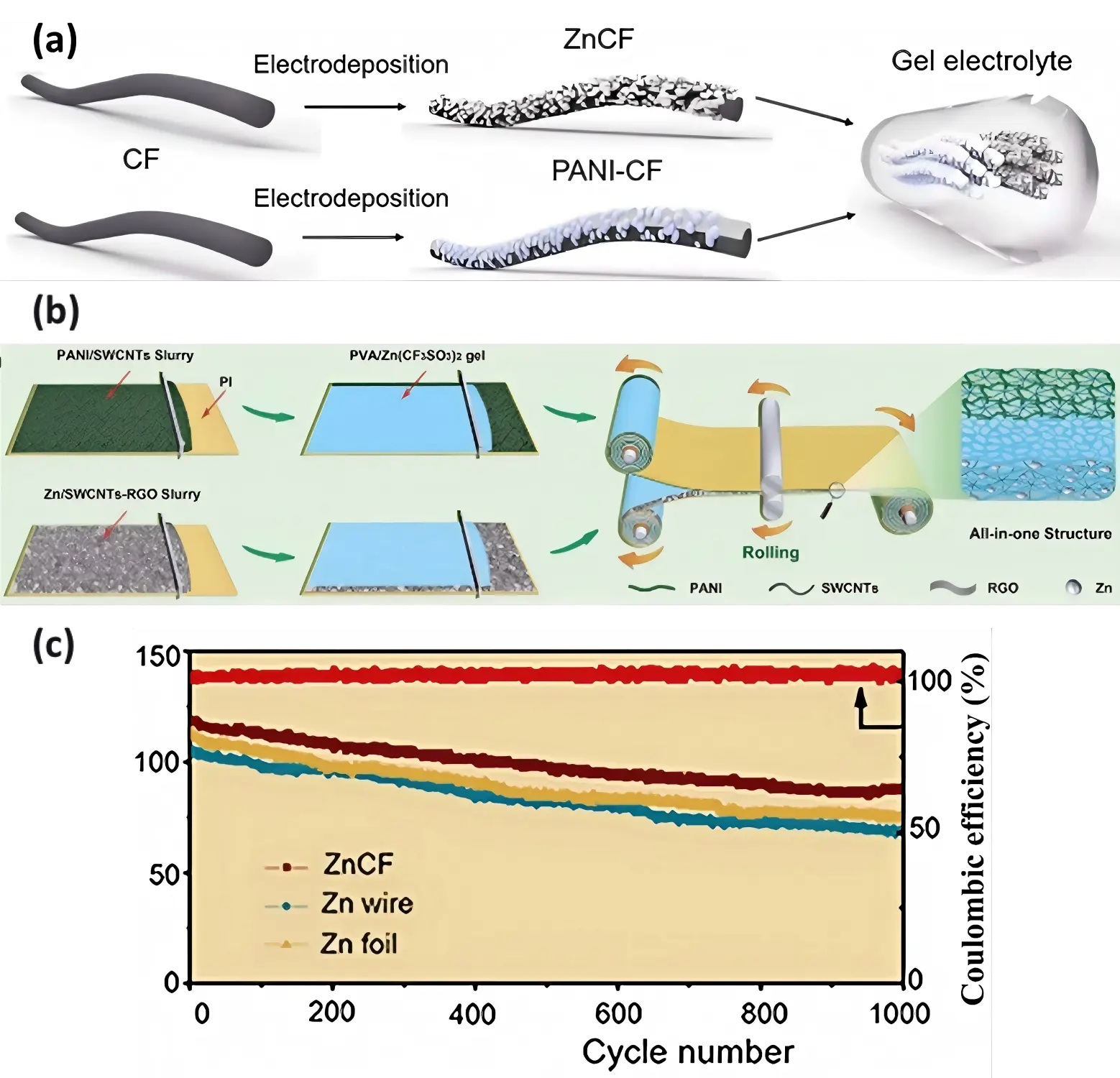
Figure 10. (a) Schematic illustration of the fabrication process for a fiber-shaped PANI/CF-Zn/CF FZIB. (Source: [32]). (b) The design of an ultrathin all-in-one PANI/SWCNT-Zn/SWCNTs/RGO FZIB. (Source: [33]). (c) Cycling performances of PANI/CF-Zn/CF, PANI/CF-Zn foil, and PANI/CF-Zn wire FZIB at 2 A·g−1. (Source: [32]).
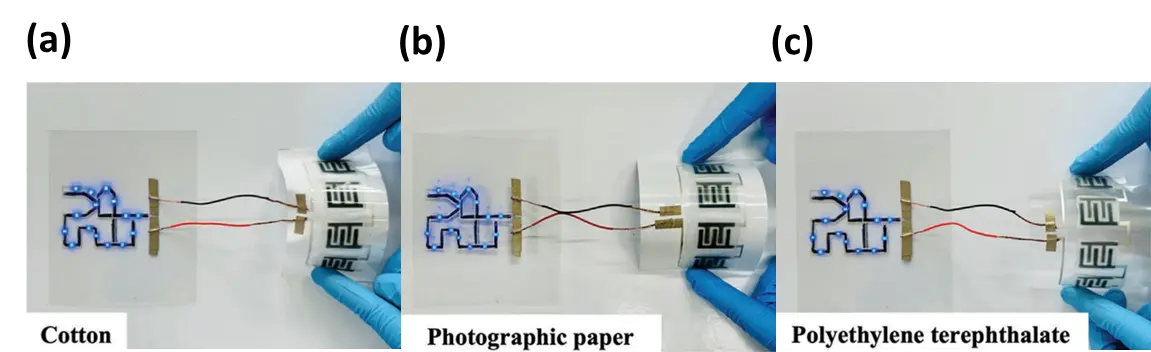
Although the direct integration of flexible zinc-ion batteries into continuous glucose monitoring patches is still at the forefront of research, existing achievements have shown that flexible zinc-ion batteries can be fabricated and integrated on flexible substrates (such as textiles and paper materials) through 3D printing technology (as shown in Figure 11), thereby constructing skin interaction systems compatible with multiple sensors [26]. The flexible zinc-ion battery manufactured by 3D printing can achieve a high surface capacity of 4.02 mAh·cm−2 at a current density of 0.5 mA·cm−2, and still maintain a capacity retention rate of over 85% after 500 charge and discharge cycles. This type of battery can be directly printed on flexible substrates such as fabrics and medical tapes. When such printable flexible zinc-ion batteries are integrated with arrays of pressure, temperature, and other sensors, the resulting epidermal system can simultaneously collect and wirelessly transmit multiple channels of physiological data. This system integration strategy points out the development direction for the next generation of chronic disease management patches. In the future, such patches are expected to have greater autonomy (longer battery life), better wear comfort, and more advanced features than existing solutions.
4.3.2. Post-Operative/Rehabilitation Monitoring
During the postoperative recovery stage, flexible zinc-ion batteries can be integrated with smart wound dressings or rehabilitation monitoring patches to power various sensors, such as temperature, pH, and humidity, tracking changes in the microenvironment in real time during the wound-healing process, thereby enabling early warning of infection or inflammation. In addition, the flexible sensing system built on flexible zinc-ion batteries can also be used for quantitative assessment of rehabilitation indicators such as joint range of motion and muscle strength, providing objective continuous data feedback for rehabilitation treatment and promoting the development of rehabilitation medicine towards intelligence and personalization.
For instance, in the postoperative rehabilitation scenario, Pu et al. [15] integrated elastic battery fibers (with a diameter of 500 μm) composed of liquid metal-zinc anodes and V2O5@C fiber cathodes into medical bandages (Table 1). After 300 cycles under 50% tensile strain, this battery can still maintain an output of 139.8 mAh·cm−3, continuously powering the wound temperature impedance sensor, thereby achieving the wireless infection early warning function.
4.4. Typical System Cases
4.4.1. Integrated Bio-Monitoring System
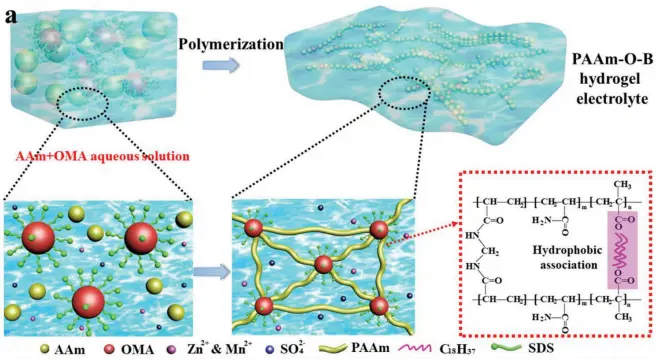
The integrated system employs a PAAm based double cross-linked hydrogel electrolyte with excellent mechanical strength and self-healing capability, successfully enabling deep structural and functional fusion of flexible zinc manganese batteries with multiple biosensors, such as motion, breathing, and voice monitoring sensors. This hydrogel electrolyte, prepared by the micelle copolymerization of the hydrophobic monomer octadectyl methacrylate with the hydrophilic monomer acrylamide, contains both chemical cross links of the BIS and relies on the dynamic physical cross links formed by the hydrophobic chain segment OMA, thereby possessing both high mechanical strength and self healing properties (as shown in Figure 12). The PAAm component efficiently absorbs zinc ions, guiding uniform deposition and inhibiting dendrite growth, enabling the battery to cycle steadily for more than 900 h at a current density of 0.5 mA·cm−2. Flexible zinc-manganese batteries based on the anode exhibited excellent deformation adaptability and structural reliability: after 1000 bending cycles, the capacity retention rate was still 76.68%; even after suffering 50 mechanical cutoffs, the battery was able to restore its electrical properties by self repair, with a capacity retention rate of up to 83% [18] after 1000 cycles at 8 C magnification. These deformation-resistant and self-repairing properties make the battery system particularly suitable for long-term, dynamic wearable monitoring scenarios, where reliable energy support enables deep integration of flexible electronics with health sensing.
 |
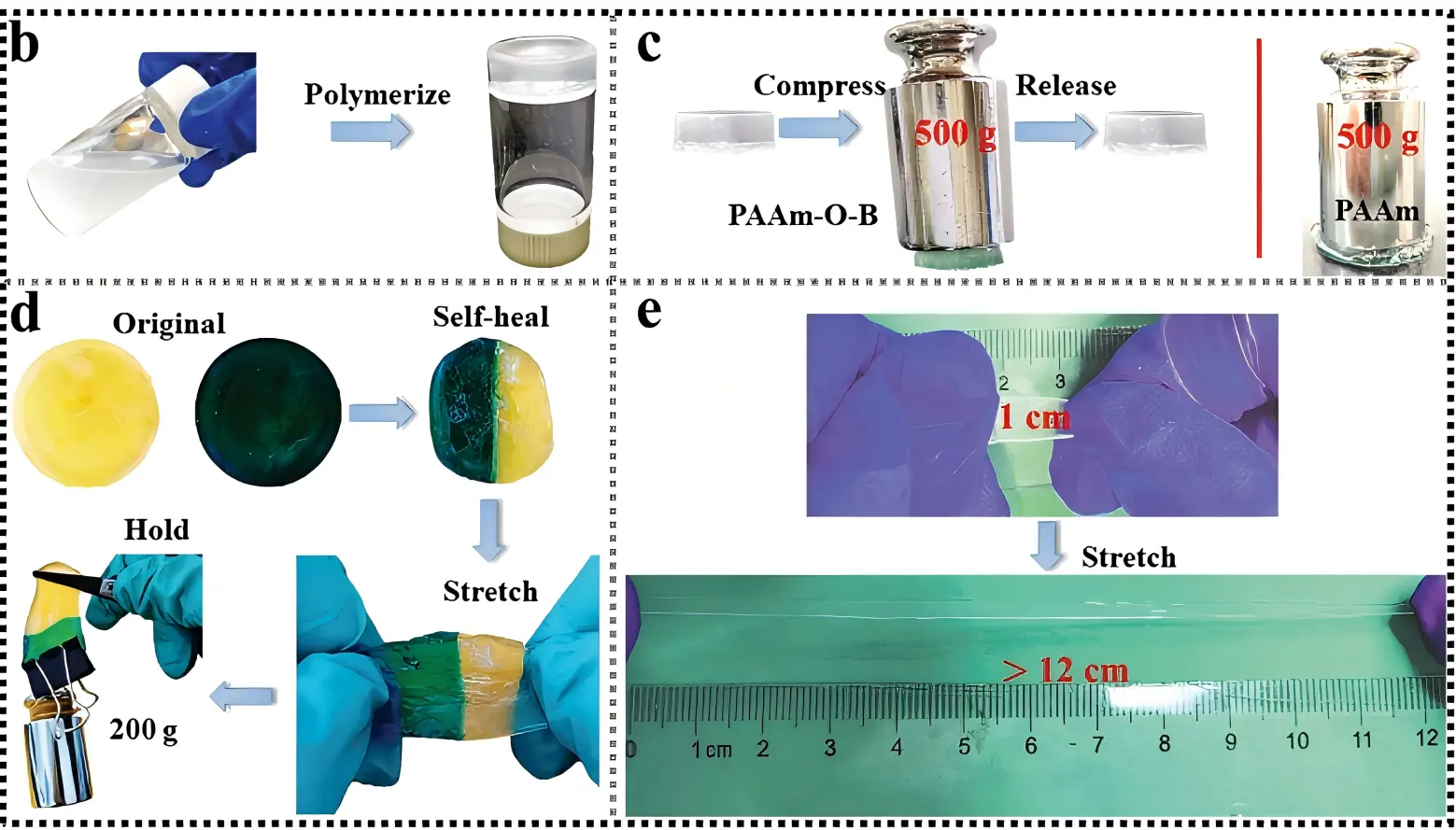 |
Figure 12. (a) Schematic illustration of the synthesis of PAAm-O-B hydrogel electrolyte. (b) Photographs of PAAm-O-B hydrogel electrolyte before and after polymerization. Mechanical properties of PAAm-O-B hydrogel electrolyte at (c) compressing, (d) self-healing, and (e) stretching states. (Source: [18]).
4.4.2. Smart Electronic Skin
Intelligent electronic skin is a typical representative of the deep integration of flexible electronics and biosensing. Its core lies in integrating multiple sensors, such as touch, temperature, and humidity, with flexible zinc-ion batteries on a unified flexible substrate, thereby building a self-powered, integrated system capable of multi-modal sensing and real-time signal processing. For instance, Chen et al. fabricated a multifunctional electronic skin by using two-dimensional nanosheets to enhance the one-step curing strategy of eutectoid. This material system takes waterborne polyurethane (WPU) as the framework, deep eutectic solvent (DES) as the conductive medium, and uses two-dimensional vermiculite nanosheets (2D VMT/Ag) loaded with silver nanoparticles as reinforcing and conductive fillers. The obtained composite material exhibits outstanding comprehensive performance: the light transmittance reaches 96%, the elongation at break exceeds 1613%, and the toughness can reach 17.22 MPa. Meanwhile, this electronic skin integrates ultra-sensitive strain sensing (with a detection limit as low as 0.02%), temperature sensing (operating range of 25–200 °C), and humidity sensing (covering 20–85% relative humidity) functions. In addition, the system also features a high-performance single-electrode triboelectric nanogenerator (TENG) with an open-circuit voltage of up to 224 V and a short-circuit current of 7.1 μA, which is sufficient to light up 130 LEDs or drive devices such as calculators [34].
The design concept of this advanced gel electronic skin system is highly compatible with flexible zinc-ion batteries. By using high-strength and environmentally stable multifunctional gel materials as bridges, flexible zinc-ion batteries can achieve deep integration with electronic skin at the structural, material, and functional levels. This integration has dual advantages: on the one hand, it provides an embedded power supply that is size-compatible and stable in performance for electronic skin; on the other hand, based on the common characteristics of materials such as flexibility and self-healing, a synergistic enhancement in performance can be generated. Such integrated paths drive electronic skin towards higher integration, longer service life, and stronger environmental adaptability, laying an important technical foundation for applications in fields such as human-computer interaction, health monitoring, and intelligent robots.
4.4.3. Wearable Medical Patch
Flexible zinc-ion batteries (FZIB) are becoming an ideal power source for the development of wearable medical patches due to their advantages, such as ultra-thin flexibility, high energy density, and long cycle life. It enables continuous, wireless, and clinically standard electrocardiogram (ECG) and temperature monitoring, providing key support for routine, accurate health management.
In this field, integrated patch design has made significant progress. The Zhang team develops an ultra-thin patch just 0.4 mm thick that integrates ECG electrodes, thermistors, and Bluetooth chips on a single substrate. Powered by a built-in 1.4 V flexible zinc-ion battery, the patch can operate continuously for more than 48 h and wirelessly transmit ECG waveforms with body temperature data at 5-min intervals; notably, its temperature measurements are accurate to 0.1 °C, fully meeting the clinical requirements for 24-h Holter monitoring [28]. In addition to power supply durability, such devices also excel in mechanical reliability. For example, a miniature battery developed by Ren et al. still demonstrates a capacity retention rate of more than 97% after 1000 bends (radius of curvature: 5 mm), which ensures a stable operation for human daily activities [9].
To achieve real long-term health monitoring, battery cycle life is particularly critical. The Zeng team built the FZIB system by employing the Bi2Te3@PPy cathode material, which exhibited a capacity retention rate above 80% after 5000 cycles, averaging only 0.004% capacity decay per cycle [14]. This means that devices integrated with this battery can operate continuously for years without replacement, providing a solid energy base for chronic disease management and telemedicine. In addition, the development of the fiber-like FZIB architecture further expands its applied form. Such wire-like batteries can be woven directly into elastomeric fabrics to form detachable, even washable energy modules that ensure comfort and durability during wear and also enable months of home-grown ECG and body temperature monitoring.
Thus, through collaborative innovation of high-performance materials and integrated design, flexible zinc-ion batteries have successfully fused power, sensing, and communications functions into medical patches in depth. Not only does it provide a highly reliable, long-lived energy base for the next generation of wearable medical devices, but it also drives continued advances in health monitoring towards real-time, wireless, and everyday scenarios.
5. Challenges and Future Perspectives
5.1. Technical Challenges
5.1.1. Balance of Energy Density and Power Density
A common challenge in the design of flexible zinc-ion batteries arises from an inherent trade-off between performance metrics: to prioritize the urgent need for long endurance for wearables, developers tend to pursue high energy density, but this often comes at the expense of power density and cycle life. This design orientation is particularly evident in actual material selection. For example, although a variety of manganese oxides have received widespread attention due to their high theoretical capacities, they are prone to structural degradation during repeated ion insertion/outgassing processes, resulting in gradual capacity degradation, which directly limits the long-term service stability of batteries.
At the same time, in order to achieve the flexibility required for devices, inactive flexible substrates or special structures are often required to be introduced into the electrodes and electrolytes, which tend to reduce the overall energy storage density. Therefore, how to enhance the energy and power densities of the battery while maintaining good mechanical flexibility is the core challenge in flexible battery design.
This paradox also prompts researchers to continually explore new materials systems and structural design proposals, seeking to drive a comprehensive optimization of flexible battery performance while ensuring wearable comfort and safety.
5.1.2. Cycle Life and Stability
Dendritic growth, side effects, and interface degradation of zinc seriously affect the cycle life of batteries.
First, dendrites of zinc are tree-like or mossy metallic zinc protrusions formed by the non-uniform reduction and deposition of zinc ions on the surface of the negative electrode during battery charging. Its growth is mainly due to the uneven distribution of ion flux at the electrode surface, the limited nucleolysis sites, and the enhancement of the the local electric field. Continued growth of the dendrites punctures the membrane, causing a short circuit within the battery, posing a serious safety hazard and directly terminating battery life. At the same time, the dendrite structure is loose, the binding force with the collector is weak, and it is easy to break off from the electrode in the charge-discharge cycle, forming “dead zinc”, which results in irreversible loss of active material and rapid capacity decay.
Second, the zinc anodes in aqueous zinc-ion batteries suffer from uncontrolled side reactions, mainly the hydrogen evolution reaction (HER) and corrosion. Since the reduction potential of zinc (−0.76 V vs. SHE) is lower than the hydrogen evolution potential of water, the water molecules or protons are prone to gain electrons on the surface of the zinc cathode to generate hydrogen when charged or left stationary. The hydrogen evolution reaction consumes the electrolytes and leads to battery inflation, which in turn alters the local pH at the interface and increases electrode surface inhomogeneity, thereby promoting dendrite growth. On the other hand, zinc can be chemically/electrochemically corroded in aqueous solution, producing inert products such as ZnO and Zn(OH)2. The corrosion products form an insulating layer on the electrode surface, greatly increasing the interface impedance and preventing the transport of zinc ions, resulting in increased polarization, decreased Coulomb efficiency, and capacity decay.
Third, interface degradation includes physical contact failure and destruction of chemical/electrochemical stability. When a flexible battery is repeatedly bent and stretched, microscopic spallation occurs between the electrode and the electrolyte, creating contact voids. Chemically, persistent side reactions and ion exchange at the interface can form an unstable solid-electrolyte interface (SEI) or a corrosion layer. Physical contact failure results in obstructed ion transport paths and a sharp increase in internal drag. An unstable interfacial layer undergoes continuous fracture and reformation during cycling. This dynamic process perpetually consumes active zinc ions and electrolyte components, and can also mechanically destabilize the electrode structure, leading to pulverization or “chalking”. This dynamic instability at critical interfaces is recognized as a fundamental root cause of the persistent, gradual degradation in battery capacity and the consequent reduction in usable lifetime.
5.1.3. Mechanical-Electrochemically Coupled Properties
In practical use, wearable devices often undergo complex deformations such as bending, stretching, and twisting, which place higher demands on the mechanical stability and electrochemical consistency of batteries. At present, after repeated deformation, flexible batteries are prone to problems such as micro-cracks in electrode materials, peeling at the interface, local drying, or failure of the anode, which in turn leads to increased internal resistance, capacity attenuation, and even complete loss of function. Therefore, delving deeply into the coupling attenuation mechanism between the mechanical stress and electrochemical performance of batteries is the key to enhancing their durability in actual wearable scenarios.
5.1.4. Biocompatibility and Safety
Although zinc-ion batteries themselves have relatively high safety, it is still necessary to conduct a systematic assessment to determine whether some of the materials they use, such as certain electrolyte additives and polymer matrices, will cause allergic or irritating reactions when in close contact with human skin for a long time. In addition, liquid or gel electrolytes have the risk of leakage when packaging fails, which not only causes equipment damage but also poses safety hazards to users.
Therefore, while pursuing high electrochemical performance of batteries, it is necessary to strictly take into account their biocompatibility and failure safety in all expected and extreme application scenarios, and not at the expense of these key characteristics.
5.2. Future Research Directions
5.2.1. Novel Material Design
In order to push the breakthrough of flexible zinc-ion batteries, the development of new composite materials with high conductivity, rapid ion migration, and excellent mechanical properties has become the key. This need arises not only from improvements in basic performance but also from the reliability of batteries to cope with complex mechanical stresses and changes in temperature and humidity in a practical wearable environment.
In the case of an adaptive hydrogel electrolyte, its design goal is far from high ion conduction in non-static conditions—and more critically, it must remain stable in ion transport efficiency when subjected to temperature fluctuations, humidity changes, or repeated deformation, in contact with a strong electrode-electrode interface. This dynamic adaptability is the basis for flexible batteries to maintain a durable, stable output in real use scenarios.
While in the exploration of electrode materials, researchers are advancing along multiple potential pathways: on the one hand, materials with controllable layered structures can provide more ordered ion migration channels; On the other hand, organic-inorganic hybrid composites can give consideration to both high capacity and structural stability. In addition, the nature-inspired design of micro-/nano structures also provides new ideas for improving both mechanical toughness and electrochemical activity. The common goal of these studies is to find new paradigms that can synergistically enhance specific capacity, magnification performance (i.e., rapid charge-discharge capability), and intrinsic toughness of materials, thereby fundamentally overcoming the performance tradeoffs commonly seen in flexible energy storage devices.
Through such material innovations, flexible batteries promise a double increase in energy density and power density while maintaining excellent mechanical properties, which in turn provide a solid energy base for lighter and more durable wearables.
5.2.2. Device Structure Innovations
The current research focus has shifted from achieving the basic flexible characteristics of batteries to developing new types of batteries with stretchability, foldability and self-healing functions. In terms of structural design, researchers adopted serpentine wires, mesh electrodes, and the “Kirigami” structure inspired by paper-cutting art, enabling the device to exhibit outstanding performance in deformation adaptability. At the same time, the introduction of material systems based on dynamic covalent bonds or supramolecular interactions can also enable batteries to acquire self-repairing capabilities after damage. In addition, the development of biodegradable or environmentally friendly battery components is also of great significance for practicing the concept of sustainable development of electronic devices.
5.2.3. System Integration Optimization
One of the current key goals is to build an integrated and lightweight wearable health monitoring system by integrating flexible zinc-ion batteries with sensors, microprocessors, and wireless communication modules. This requires optimizing the power management strategy at the system level to achieve continuity, accurate monitoring data, and improved overall energy efficiency.
5.2.4. Standardization and Scalability
To promote the large-scale commercial application of flexible zinc-ion batteries, three key development directions should be prioritized.
First of all, it is of vital importance to establish a unified standardized testing system for the entire industry. This system should not only cover the routine electrochemical performance tests, but also incorporate the special assessment of mechanical-electrochemical coupling stability, as well as the formulation of standardized biocompatibility testing criteria.
Secondly, it is necessary to develop low-cost and high-throughput large-scale manufacturing processes, such as roll-to-roll printing, high-efficiency 3D printing, and other technical routes.
Thirdly, it is necessary to continuously reduce the production cost of batteries by means of both material optimization and process innovation.
5.2.5. Artificial Intelligence and Data Analysis
Future development of wearable health monitoring systems requires simultaneous breakthroughs in both hardware and software dimensions. In addition to continued innovation in hardware, such as batteries and sensors, deep integration of artificial intelligence with machine learning algorithms has become essential—intelligent tools capable of efficiently processing and resolving large-scale, multidimensional data generated by physiological monitoring devices powered by flexible batteries. With the aid of real-time analysis of electrocardiogram, body temperature, activity, and other signals, the system can not only continuously track physiological parameters, but also identify abnormal patterns and achieve early health risk warning. For example, through long-term learning of heart rate variability data, the algorithm can gradually distinguish subtle features of normal fluctuations from potential cardiac arrhythmias, thereby providing cues when the user is not yet aware of them. This capability is driving the evolution of wearables from a traditional “data acquisition end” to an “intelligent diagnostic and health management platform”. As a result, the increase in software intelligence not only enhances the clinical value of the system, but also optimizes the user experience—users will no longer receive vast amounts of raw data, but resolved, operational health insights. This “hardware for body, algorithm for use” fusion framework is the key to enabling truly intelligent, personalized, and practical next-generation wearable medical devices.
6. Conclusions
Flexible zinc-ion batteries (FZIB), with their high safety, low cost, and good mechanical flexibility, are becoming an ideal power supply option for wearable health monitoring devices. With the continuous innovation of materials and structures, FZIB has been able to provide stable and durable power support for various physiological sensing modules, demonstrating broad applications in terms of energy density, cycle life, and deformation stability.
It should be made clear that the further development of flexible zinc-ion battery technology is essentially an interdisciplinary, systematic project. The advancement of this technology largely depends on the deep integration of knowledge and research methods among originally relatively independent disciplines such as materials science, electronic engineering, and biomedicine. Only by establishing a systematic interdisciplinary cooperation framework can breakthroughs be achieved in key links such as advanced material design, seamless integration at the device level, and strict biocompatibility assessment—and these breakthroughs will not only promote the development of flexible energy storage technology itself, but also facilitate its in-depth collaboration with complex health monitoring systems.
Based on this, if flexible zinc-ion batteries are to be transformed from laboratory achievements into products with scale effects and commercial feasibility in the wearable market, the close connection and continuous collaboration between the academic and industrial sectors are of vital importance. Future research and development work should focus on building a standardized testing system, developing low-cost batch production processes, and conducting system integration verification that simulates real usage scenarios. Through the collaborative efforts of multiple parties, it is expected to accelerate the process of flexible zinc-ion batteries moving from technological research and development to practical application, ultimately contributing to the construction of a smarter and more reliable future for health management.
Statement on the Use of Generative AI and AI-Assisted Technologies in the Writing Process
During the writing process of this paper, DeepSeek was utilized solely for language polishing and expression refinement. All academic viewpoints, research data, core content, and argumentative logic were independently generated by the authors or the cited papers.
Acknowledgments
The authors express their gratitude to all team members who contributed to this work. Appreciation is extended to Guangdong University of Education for providing an excellent academic research environment and support.
Author Contributions
Conceptualization: K.L., J.L. and X.G.; Investigation: J.M.; Resources: J.M.; Data Curation: K.L.; Writing—Original Draft Preparation: K.L.; Writing—Review & Editing: X.H.; Visualization: J.L.; Supervision: X.G.; Project Administration: X.G.
Ethics Statement
Not applicable.
Informed Consent Statement
Not applicable.
Data Availability Statement
This study is a review article and did not generate new experimental data. All data referenced are from the citations provided in the manuscript.
Funding
This research was funded by Research and Innovation Team for Wastewater Treatment and Monitoring of Guangdong University of Education (2024KYCXTD016), Guangdong Provincial Department of Education Key Area Special Project (2022ZDZX4037, 2024ZDZX2087, 2024ZDZX4063), and College Student Innovation and Entrepreneurship Program Training Program (S202514278032).
Declaration of Competing Interest
The authors declare that they have no known competing financial interests or personal relationships that could have appeared to influence the work reported in this paper.
References
-
Anma A, Komori M. The Efficacy of a Wearable Device-based Vital Sign Monitoring System in a Japanese Home Medical Care Clinic. Intern. Med. 2025, 64, 3502–3508. DOI:10.2169/internalmedicine.5213-24 [Google Scholar]
-
Weller GB, Mault J, Ventura ME, Adams J, Campbell FJ, Tremper KK. A Retrospective Observational Study of Continuous Wireless Vital Sign Monitoring via a Medical Grade Wearable Device on Hospitalized Floor Patients. J. Clin. Med. 2024, 13, 4747. DOI:10.3390/jcm13164747 [Google Scholar]
-
Hirten R, Danieletto M, Landell K, Lyu J, Whang J, Zweig M, et al. Physiological Metrics Collected from Wearable Devices Identify Inflammatory and Clinical Inflammatory Bowel Disease Flares. Inflamm. Bowel Dis. 2023, 29 (Suppl. S1), S21–S22. DOI:10.1093/ibd/izac247.041 [Google Scholar]
-
Mao Y, Zhao B, Bai J, Wang P, Zhu X, Sun Y. Recent Progress in Critical Electrode and Electrolyte Materials for Flexible Zinc-ion Batteries. Nanoscale 2024, 16, 5042–5059. DOI:10.1039/D3NR06207D [Google Scholar]
-
Li X, Wang D, Ran F. Key Approaches and Challenges in Fabricating Advanced Flexible Zinc-ion Batteries with Functional Hydrogel Electrolytes. Energy Storage Mater. 2023, 56, 351–393. DOI:10.1016/j.ensm.2023.01.034 [Google Scholar]
-
Dong L, Yang W, Yang W, Tian H, Huang Y, Wang X, et al. Flexible and Conductive Scaffold-stabilized Zinc Metal Anodes for Ultralong-life Zinc-ion Batteries and Zinc-ion Hybrid Capacitors. Chem. Eng. J. 2020, 384, 123355. DOI:10.1016/j.cej.2019.123355 [Google Scholar]
-
Li Y, Fu J, Zhong C, Wu T, Chen Z, Hu W, et al. Recent Advances in Flexible Zinc-based Rechargeable Batteries. Adv. Energy Mater. 2019, 9, 1802605. DOI:10.1002/aenm.201802605 [Google Scholar]
-
Liu Y, Ding H, Chen H, Gao H, Yu J, Mo F, et al. Recent Progress on the Research of 3D Printing in Aqueous Zinc-Ion Batteries. Polymers 2025, 17, 2136. DOI:10.3390/polym17152136 [Google Scholar]
-
Ren Y, Meng F, Zhang S, Ping B, Li H, Yin B, et al. CNT@MnO2 Composite Ink Toward a Flexible 3D Printed Micro-zinc-ion Battery. Carbon Energy 2022, 4, 446–457. DOI:10.1002/cey2.177 [Google Scholar]
-
Zheng X, Shen H, Wei J, Chen W, Chen X, Li S, et al. Wood-derived Carbon as Self-supporting Cathode and Current Collector for Static Zinc-iodine Batteries. Bioresour. Technol. 2025, 434, 132779. DOI:10.1016/j.biortech.2025.132779 [Google Scholar]
-
Du P, Song Q, Ning Z, Xie H, Wang D, Yin H. A Metal Oxide Coating to Suppress the Corrosion of Aluminum Current Collectors for High-voltage LiTFSI-based Batteries. Energy Storage Mater. 2025, 82, 104569. DOI:10.1016/j.ensm.2025.104569 [Google Scholar]
-
Zeng Z, Shen J, Lai Y, Hua G, Wang Y, Liu J, et al. Freestanding MXene-Scaffolded Film Cathodes Enable High-Performance Flexible Zinc-Ion Batteries. Adv. Funct. Mater. 2024, 34, 2401059. DOI:10.1002/adfm.202401059 [Google Scholar]
-
Shi H, Fu H, Xue G, Lian Y, Zhao J, Zhang H. Progress of Vanadium-based Oxides as Cathode Materials for Aqueous Zinc-ion Batteries. Coord. Chem. Rev. 2025, 545, 216984. DOI:10.1016/j.ccr.2025.216984 [Google Scholar]
-
Zeng G, Sun Q, Horta S, Wang S, Lu X, Zhang CY, et al. A Layered Bi2Te3@PPy Cathode for Aqueous Zinc-ion Batteries: Mechanism and Application in Printed Flexible Batteries. Adv. Mater. 2024, 36, 2305128. DOI:10.1002/adma.202305128 [Google Scholar]
-
Pu J, Cao Q, Gao Y, Wang Q, Geng Z, Cao L, et al. Liquid Metal-Based Stable and Stretchable Zn-Ion Battery for Electronic Textiles. Adv. Mater. 2024, 36, 2305812. DOI:10.1002/adma.202305812 [Google Scholar]
-
Guo X, Zhang Z, Li J, Luo N, Chai G-L, Miller TS, et al. Alleviation of Dendrite Formation on Zinc Anodes via Electrolyte Additives. ACS Energy Lett. 2021, 6, 395–403. DOI:10.1021/acsenergylett.0c02371 [Google Scholar]
-
Lu Y, Li Z, Wang X, Wang Z, Li M, Hu X, et al. 3D Printed Dual Network Cross-Linked Hydrogel Electrolytes for High Area Capacity Flexible Zinc Ion Micro-Batteries. Chem. Eng. J. 2024, 490, 151523. DOI:10.1016/j.cej.2024.151523 [Google Scholar]
-
Wang X, Wang B, Cheng J. Multi-Healable, Mechanically Durable Double Cross-Linked Polyacrylamide Electrolyte Incorporating Hydrophobic Interactions for Dendrite-Free Flexible Zinc-Ion Batteries. Adv. Funct. Mater. 2023, 33, 2304470. DOI:10.1002/adfm.202304470 [Google Scholar]
-
Zhang J, Lin C, Zeng L, Lin H, He L, Xiao F, et al. A Hydrogel Electrolyte with High Adaptability over a Wide Temperature Range and Mechanical Stress for Long-Life Flexible Zinc-Ion Batteries. Small 2024, 20, 2312116. DOI:10.1002/smll.202312116 [Google Scholar]
-
Yang B, Liu W, Gu T, Wu Z. Nanofiber-engineered Air Electrodes Via Electrospinning for Wearable Flexible Zinc-air Batteries. J. Energy Storage 2025, 131, 117505. DOI:10.1016/j.est.2025.117505 [Google Scholar]
-
Zhao Y, Zhu J, Lv H, Zhi C. Aqueous Zinc-based Batteries are Flexible, Self-healing, Self-charging, Biocompatible, and Biodegradable. Device 2024, 2, 100556. DOI:10.1016/j.device.2024.100556 [Google Scholar]
-
Meng F, Ren Y, Ping B, Huang J, Li P, Chen X, et al. Five-Axis Curved-Surface Multi-Material Printing on Conformal Surface to Construct Aqueous Zinc-ion Battery Modules. Adv. Mater. 2024, 36, 2408475. DOI:10.1002/adma.202408475 [Google Scholar]
-
Ma H, Tian X, Fan J, Cao W, Yuan X, Hou S, et al. 3D Printing of Solid-state Zinc-ion Microbatteries with Ultrahigh Capacity and High Reversibility for Wearable Integration Design. J. Power Sources 2022, 550, 232152. DOI:10.1016/j.jpowsour.2022.232152 [Google Scholar]
-
Wang Z, Xu L, Liu W, Chen Y, Yang Q, Tang Z, et al. Tough, Self-healing, Adhesive Double Network Conductive Hydrogel Based on Gelatin-polyacrylamide Covalently Bridged by Oxidized Sodium Alginate for Durable Wearable Sensors. Int. J. Biol. Macromol. 2024, 276, 133802. DOI:10.1016/j.ijbiomac.2024.133802 [Google Scholar]
-
Chen P, Zhou W, Xiao Z, Li S, Wang Z, Wang Y, et al. An Integrated Configuration with Robust Interfacial Contact for Durable and Flexible Zinc Ion Batteries. Nano Energy 2020, 74, 104905. DOI:10.1016/j.nanoen.2020.104905 [Google Scholar]
-
Lu Y, Wang Z, Li M, Li Z, Hu X, Xu Q, et al. 3D Printed Flexible Zinc Ion Micro-Batteries with High Areal Capacity Toward Practical Application. Adv. Funct. Mater. 2024, 34, 2310966. DOI:10.1002/adfm.202310966 [Google Scholar]
-
Zhang Y, Liu J, Huang W, Zhang Y, Guo X, Cao H, et al. A Novel Self-powered Electrochemical Sensor for Ultrasensitive Detection of Glucose Based on Neutral Zinc-air Battery Assembled with Cu1-Co3-NC Catalysts. Microchem. J. 2025, 210, 113045. DOI:10.1016/j.microc.2025.113045 [Google Scholar]
-
Zhang Q, Lei D, Liu N, Liu Z, Ren Z, Yin J, et al. A Zinc-Ion Battery-Type Self-Powered Pressure Sensor with Long Service Life. Adv. Mater. 2022, 34, 2205369. DOI:10.1002/adma.202205369 [Google Scholar]
-
Li Y, Guan Q, Cheng J, Wang B. Amorphous H0.82MoO3.26 Cathodes Based Long Cyclelife Fiber-shaped Zn-ion Battery for Wearable Sensors. Energy Storage Mater. 2022, 49, 227–235. DOI:10.1016/j.ensm.2022.04.001 [Google Scholar]
-
Zheng C, Wang Z, Li L, Ma Y, Feng X. Flexible and Wearable Bioelectronics for Electrocardiography Monitoring: A Review. Sci. China Mater. 2025, 68, 4344–4359. DOI:10.1007/s40843-025-3688-9 [Google Scholar]
-
Si H, Su R, Chen Y. Research Progress in Flexible Zn-ion Batteries for Wearable Sensor. J. Mater. Eng. 2024, 52, 29–41. DOI:10.11868/j.issn.1001-4381.2024.000108 [Google Scholar]
-
Cong Z, Guo W, Zhang P, Sha W, Guo Z, Chang C, et al. Wearable Antifreezing Fiber-Shaped Zn/PANI Batteries with Suppressed Zn Dendrites and Operation in Sweat Electrolytes. ACS Appl. Mater. Interfaces 2021, 13, 17608–17617. DOI:10.1021/acsami.1c02065 [Google Scholar]
-
Yao M, Yuan Z, Li S, He T, Wang R, Yuan M, et al. Scalable Assembly of Flexible Ultrathin All-in-One Zinc-Ion Batteries with Highly Stretchable, Editable, and Customizable Functions. Adv. Mater. 2021, 33, 2008140. DOI:10.1002/adma.202008140 [Google Scholar]
-
Chen T, Wei Q, Ma Y, Tang Y, Ma L, Deng S, et al. Multifunctional Electronic Skins for Ultra-sensitive Strain, Temperature, Humidity Sensing, and Energy Harvesting. Nano Energy 2024, 127, 109752. DOI:10.1016/j.nanoen.2024.109752 [Google Scholar]