
Artificial Intelligence in Photovoltaic Power Systems: A Bibliometric and Thematic Analysis of Knowledge Structures, Research Evolution, and Emerging Directions Toward Sustainable Energy Systems
Artificial Intelligence in Photovoltaic Power Systems: A Bibliometric and Thematic Analysis of Knowledge Structures, Research Evolution, and Emerging Directions Toward Sustainable Energy Systems
Altyeb Ali Abaker Omer
1,2,*
 Ibrahim Issa Mohamed Issa
3
Mohamed Ibrahim Abdallh Babeker
4
Otibh M. M. Abubkry
5
Ibrahim Issa Mohamed Issa
3
Mohamed Ibrahim Abdallh Babeker
4
Otibh M. M. Abubkry
5
Received: 27 January 2026 Revised: 24 February 2026 Accepted: 19 March 2026 Published: 27 March 2026

© 2026 The authors. This is an open access article under the Creative Commons Attribution 4.0 International License (https://creativecommons.org/licenses/by/4.0/).
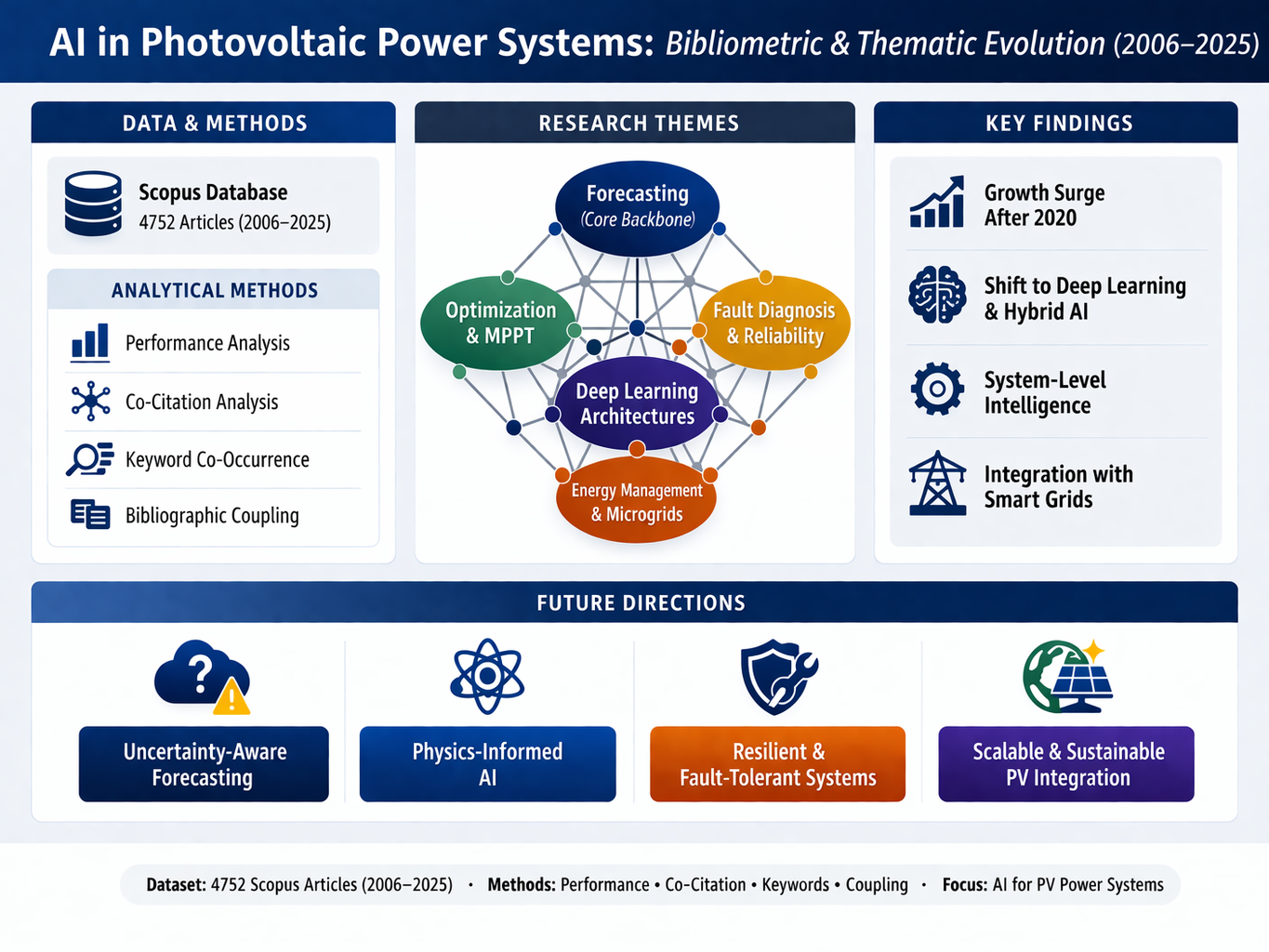
Graphical Abstract
1. Introduction
The PV power systems have become a cornerstone of global strategies to decarbonize energy supply and achieve long-term sustainability. As PV deployment expands across grid-connected and standalone configurations, system operation is increasingly challenged by intermittency, nonlinear dynamics, partial shading, component degradation, and complex interactions with power grids. Addressing these challenges has accelerated the adoption of AI as a key enabler of greater efficiency, reliability, and adaptability in PV power systems.
Over the past two decades, a wide range of AI techniques, including artificial neural networks (ANN), fuzzy logic, evolutionary algorithms, deep learning, and hybrid models, have been applied to critical PV system functions. For example, Garud et al. [1] reviewed ANN, fuzzy logic, genetic algorithms, and hybrid AI approaches for PV system modeling and emphasized their ability to capture nonlinear characteristics more effectively than conventional models. Kumar et al. [2] conducted a systematic evaluation and benchmarking analysis of AI techniques for PV systems, highlighting performance differences and standardization needs. Kurukuru et al. [3] focused specifically on AI applications in grid-connected PV systems, particularly in forecasting, control, and fault diagnostics. Mellit and Kalogirou [4] examined the integration of AI and IoT technologies to enhance remote monitoring and intelligent diagnosis of PV systems. Romero et al. [5] provided a comprehensive review of AI applications in PV, identifying forecasting and maximum power point tracking (MPPT) optimization as dominant research areas. Yap et al. [6] analyzed AI-based MPPT techniques and demonstrated improved tracking performance under dynamic irradiance conditions.
Comparative investigations further demonstrate that AI-based MPPT and forecasting approaches outperform conventional rule-based and physics-driven methods. Ali et al. [7] proposed hybrid metaheuristic-fuzzy-ANN MPPT techniques and reported superior convergence speed and energy extraction efficiency. Eyimaya [8] compared AI-driven and conventional MPPT strategies and confirmed improved performance under fluctuating meteorological conditions. Rukhsar et al. [9] developed AI-based global MPPT approaches that effectively handle complex partial shading scenarios. These advantages have positioned AI as a core component of modern PV system optimization.
Recent contributions further demonstrate the growing maturity of AI-enabled PV research. Sheng et al. [10] introduced knowledge transfer PV yield modeling to improve robustness and generalization across different temporal and geographical domains while reducing dependence on extensive site-specific historical datasets. Al-Hilfi et al. [11] developed a wavelet-assisted neuro-fuzzy estimator to improve the accuracy of PV power output estimation during cloud events. In a related study, Al-Hilfi et al. [12] applied gene expression programming techniques to improve aggregated PV power estimation under variable weather conditions. At the system design level, Nur-E-Alam et al. [13] applied machine learning-supported PV energy modeling to hybrid building-integrated “all PV blended” systems across multiple climate contexts, demonstrating the feasibility of data-driven planning approaches. Kumar et al. [14] evaluated reliability and electrical loss minimization in wind-solar PV-integrated distribution systems, highlighting the importance of optimization-based analytics under high renewable penetration. Saha et al. [15] proposed deployment-oriented diagnostic and mitigation strategies for sensor and measurement faults in grid-connected PV systems, strengthening operational resilience.
More recently, the AI-based PV research domain has evolved beyond algorithm-centric applications toward more integrated and intelligent system architectures. Gomes et al. [16] leveraged explainable AI techniques to improve model transparency and feature selection in solar PV mapping. Kuzlu et al. [17] applied explainable AI tools to PV power forecasting models to enhance interpretability and trust in model predictions. Noura et al. [18] implemented explainable tree-based algorithms for fault detection and diagnosis in grid-connected PV systems, improving both accuracy and interpretability. At the system-integration level, Chiang-Guizar et al. [19] explored the use of AI and integrated optimization strategies in PV-based energy systems. Mamodiya et al. [20] investigated AI-supported hybrid solar energy systems incorporating adaptive PV and smart materials for sustainable power generation. These developments reflect a broader transition toward intelligent, resilient, and data-driven renewable energy infrastructures.
Despite the rapid expansion of AI applications in PV systems, the literature remains fragmented across disciplines, methodological approaches, and application contexts. Existing reviews have primarily focused on specific functional areas. For example, Kurukuru et al. [3] concentrated on AI for grid-connected PV systems, while Romero et al. [5] reviewed AI applications across PV domains from an application-oriented perspective. Yap et al. [6] emphasized AI-based MPPT methods, and Sohani et al. [21] provided a comprehensive review of machine learning applications in PV with emphasis on performance comparison. While these studies provide valuable technical and algorithmic insights, they offer limited coverage of the global knowledge structure and the field’s long-term thematic evolution. Even bibliometric analyses, such as that conducted by Sepúlveda-Oviedo et al. [22], have focused specifically on AI-based fault diagnosis without examining the broader AI-based PV research ecosystem. Consequently, systematic evidence remains scarce regarding how AI-based PV research has diffused across countries, journals, and subject areas, and how emerging research fronts and persistent methodological gaps have evolved, as also indicated in recent systematic and review assessments [1,3].
Bibliometric and science-mapping approaches offer a powerful means to address these limitations by enabling the large-scale quantitative synthesis of research landscapes. Ali Abaker Omer and Dong [23] demonstrated the methodological value of bibliometric software in improving transparency in review studies. Omer et al. [24] further evaluated the application of science-mapping tools such as VOSviewer for identifying thematic structures and collaboration patterns. Sepúlveda-Oviedo et al. [22] illustrated how bibliometric analysis can reveal research clusters in PV fault diagnosis. However, a comprehensive bibliometric and thematic analysis explicitly focused on AI in PV power systems, integrating performance indicators, intellectual structure, thematic evolution, and emerging directions, remains lacking. The primary aim of this study is therefore to systematically map and critically examine the global research landscape at the intersection of AI and PV power systems. By integrating bibliometric performance analysis with science-mapping and thematic evolution techniques, this study seeks to identify publication trends, intellectual foundations, dominant thematic clusters, their structural interconnections, and emerging research fronts, while also assessing the maturity and coherence of the field and highlighting key research gaps relevant to the development of intelligent and resilient PV energy systems.
To achieve this aim, the study is guided by the following research questions (RQ): RQ1. How has scientific literature on AI applications in PV power systems evolved in terms of publication growth, geographic distribution, and influence across countries and journals? RQ2. What are the principal intellectual foundations and knowledge bases underpinning AI-based PV research, as revealed through co-citation relationships? RQ3. What are the dominant thematic clusters that characterize AI applications in PV power systems, and how have they evolved? RQ4. Which emerging topics and methodological frontiers are shaping recent developments in AI-driven PV power systems? RQ5. What conceptual, methodological, and application-level gaps remain in the current literature, and which future research directions can support the transition toward more intelligent and resilient PV energy systems? By addressing these questions, this study provides a structured, evidence-based synthesis of the AI-based PV research domain. The findings are intended to support researchers in identifying emerging opportunities, assist engineers in translating AI advances into practical PV solutions, and inform policymakers seeking to integrate intelligent PV systems into broader sustainable energy transitions.
2. Materials and Methods
2.1. Data Source and Literature Retrieval
The bibliometric dataset analyzed in this study was retrieved from the Scopus database, which provides extensive and standardized coverage of peer-reviewed literature across renewable energy engineering, PV technologies, and AI-related disciplines. Scopus was selected due to its consistency of bibliographic metadata, reliable citation indexing, and widespread use in bibliometric and science-mapping research [23,24]. The literature search was conducted using a structured Boolean query applied to titles, abstracts, and keywords, designed to capture studies that explicitly address AI applications in PV power systems.
The search string was defined as: (“artificial intelligence” OR “machine learning” OR “deep learning” OR “neural network*”) AND (“photovoltaic power*” OR “photovoltaic system*” OR “PV system*” OR “PV power*”). The search was limited to journal articles published in English between 2006 and 2025, corresponding to the emergence and consolidation of AI-driven PV research. Only final, peer-reviewed research articles were included to ensure citation stability and analytical consistency. Conference proceedings, review papers, book chapters, editorials, notes, and other non-research document types were excluded. The final search was conducted on 2 January 2026 using the following Scopus query: TITLE-ABS-KEY ((“artificial intelligence” OR “machine learning” OR “deep learning” OR “neural network*”) AND (“photovoltaic power*” OR “photovoltaic system*” OR “PV system*” OR “PV power*”)) AND PUBYEAR > 2005 AND PUBYEAR < 2026 AND (LIMIT-TO (DOCTYPE, “ar”)) AND (LIMIT-TO (PUBSTAGE, “final”)) AND (LIMIT-TO (SRCTYPE, “j”)) AND (LIMIT-TO (LANGUAGE, “English”)).
This procedure yielded a final dataset of 4752 journal articles, reduced from an initial retrieval of 10,061 records. The identification, screening, and inclusion process followed the PRISMA framework, as illustrated in Figure 1 [25]. All records were exported with complete bibliographic information, including authorship, institutional affiliations, abstracts, author keywords, cited references, and citation counts.
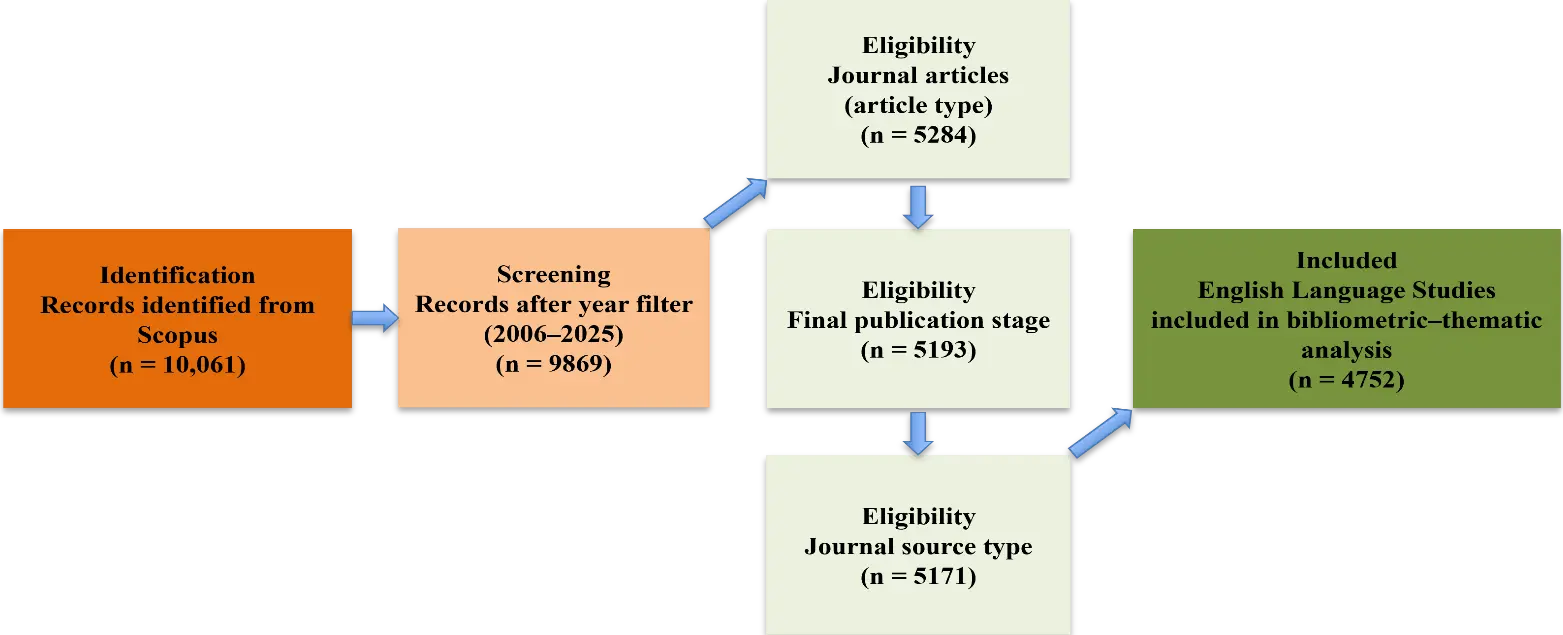
Figure 1. PRISMA 2020 four-column flow diagram illustrates the identification, screening, eligibility assessment, and inclusion of studies for the bibliometric-thematic analysis of AI applications in PV power systems. A total of 10,061 records were identified from the Scopus database. After filtering by publication year (2006–2025), 9869 records remained for screening. Subsequent eligibility assessment based on article type (n = 5284), final publication stage (n = 5193), and journal source type (n = 5171) resulted in 4752 English-language journal articles included in the final bibliometric-thematic analysis.
2.2. Data Cleaning, Keyword Harmonization, and Reference Standardization
To enhance analytical precision and network interpretability, the dataset underwent structured data cleaning, with a focus on author keywords and cited references. Author keywords were harmonized to address inconsistencies arising from synonymy, acronyms, pluralization, spelling variants, and semantic overlap, which can artificially fragment co-word networks and obscure thematic patterns [26,27]. A controlled vocabulary was developed through iterative manual review and applied consistently during analysis. To balance thematic resolution with network clarity, only keywords with a minimum occurrence threshold of five were retained, a criterion commonly adopted in bibliometric studies [23]. Cited references were standardized to correct inconsistencies in author names, journal titles, publication years, and typographical errors. Where necessary, DOIs were used to verify canonical references via CrossRef and Google Scholar. These procedures reduced artificial fragmentation in citation networks and enhanced the robustness of subsequent intellectual and thematic analyses [28].
2.3. Bibliometric Performance Analysis (RQ1)
A descriptive bibliometric performance analysis was conducted to characterize the overall structure, growth dynamics, and disciplinary distribution of the literature. Key indicators included annual publication output, geographic distribution, subject area coverage, and the bibliometric influence of countries and journals. Annual publication trends and geographic and subject area distributions were examined using Scopus analytical tools for the period from 2006 to 2025. The influence of countries and journals was further analyzed using VOSviewer (version 1.6.20) [29], which enables consistent construction and visualization of bibliometric indicators. Together, these metrics provide a macro-level overview of the diffusion, maturation, and institutional anchoring of AI research in PV power systems.
2.4. Science Mapping and Network Analysis (RQ2–RQ4)
To examine the field’s intellectual foundations, thematic structure, and emerging research fronts, three complementary science-mapping techniques were employed. First, co-citation analysis of cited references was used to identify influential publications and foundational knowledge clusters, addressing RQ2. Second, co-word analysis, based on author keyword co-occurrence, was applied to identify dominant thematic clusters and their structural interconnections, addressing RQ3. Third, bibliographic coupling was conducted to identify contemporary and emerging research fronts by grouping documents that share similar reference patterns, addressing RQ4. All network analyses were performed using VOSviewer (version 1.6.20) [29]. Threshold values for keyword occurrences and citation counts were selected iteratively to balance analytical robustness and network readability.
2.5. Qualitative Interpretation and Integrative Synthesis (RQ5)
A qualitative examination of representative publications within each central thematic cluster complemented the quantitative mapping results. Highly cited and recent studies were reviewed to contextualize the identified themes, clarify dominant methodological approaches, and interpret key application domains. This integrative synthesis identified conceptual, methodological, and application-level gaps, informing future research directions toward intelligent, resilient, and sustainable PV energy systems.
2.6. Methodological Limitations
The following limitations should be acknowledged: First, reliance on a single bibliographic database (Scopus) may have led to the omission of relevant studies indexed in other databases, such as Web of Science or Dimensions. Although Scopus provides standardized metadata, strong citation consistency, and extensive interdisciplinary coverage, database-specific indexing policies may introduce coverage bias, particularly for conference proceedings, emerging journals, or regionally indexed publications. Second, language and indexing constraints may have influenced the dataset. As the analysis primarily captures English-language publications and peer-reviewed journal articles, relevant research published in other languages or non-indexed outlets may not be fully represented. This may result in underrepresentation of contributions from certain geographic regions. Third, despite the use of broad AI-related search terminology, some studies employing specific algorithms or application-focused methods may not have been captured if those terms were not explicitly stated in titles, abstracts, or author keywords. Additionally, database indexing delays may affect the most recent publications. These limitations are taken into account when interpreting the findings. While they may influence the absolute counts of publications, they do not undermine the validity of the observed structural patterns, thematic relationships, or methodological trends identified through the analysis. Future studies may enhance robustness through multi-database integration and cross-platform triangulation.
3. Results
3.1. Bibliometric Performance and Global Research Landscape of AI Applications in PV Power Systems (Addressing RQ1)
3.1.1. Temporal Growth and Publication Trends in AI-Driven PV Research
Figure 2 presents the annual publication output related to AI applications in PV power systems over the period 2006–2025. The vertical axis total documents (TD) represents the total number of documents published per year, while each bar corresponds to the annual scientific output within the defined search scope. The numerical values displayed above each bar indicate the exact number of publications recorded for that year. The temporal trajectory reveals a clear and sustained growth pattern, reflecting the progressive maturation and expanding relevance of the AI-based PV research domain. During the initial phase (2006–2012), research activity remained limited, with annual publications ranging from 1 to 23. This early stage involves exploratory investigations into artificial neural networks and rule-based intelligent control methods, primarily applied to localized modelling, MPPT optimization, and small-scale forecasting. At this stage, AI techniques were supplementary rather than structurally integrated within PV system research.
Between 2013 and 2017, a gradual but steady increase was observed, with annual publications rising from 30 in 2013 to 91 in 2017. This period marks methodological consolidation and broader acceptance of machine learning techniques across PV forecasting, control, and performance modelling applications. The increasing slope of the growth curve during this interval indicates expanding research interest and improved data accessibility. A pronounced acceleration becomes evident after 2018. Annual publications increased sharply from 131 in 2018 to 295 in 2020, signaling a structural shift in research intensity. From 2021 onward, the growth pattern becomes markedly exponential, with outputs rising from 409 publications in 2021 to 553 in 2022, 671 in 2023, 921 in 2024, and reaching 1197 publications in 2025. This steep upward trajectory reflects the widespread adoption of deep learning architectures, hybrid AI frameworks, probabilistic forecasting models, and data-driven optimization strategies. It also coincides with greater availability of large-scale operational PV datasets, advances in computational resources (e.g., GPUs and cloud platforms), and the global policy push toward renewable energy integration. The sharp inflection observed after 2020 indicates that AI is no longer a peripheral analytical tool but has become a core enabling technology within PV system research. The sustained and accelerating growth over the most recent five-year period demonstrates strong research momentum. It suggests that the AI-based PV domain has transitioned into a mature, strategically significant field within renewable energy studies. Overall, Figure 2 illustrates a clear evolution from sporadic exploratory studies to a rapidly expanding, high-impact research area characterized by methodological diversification and increasing interdisciplinary integration.
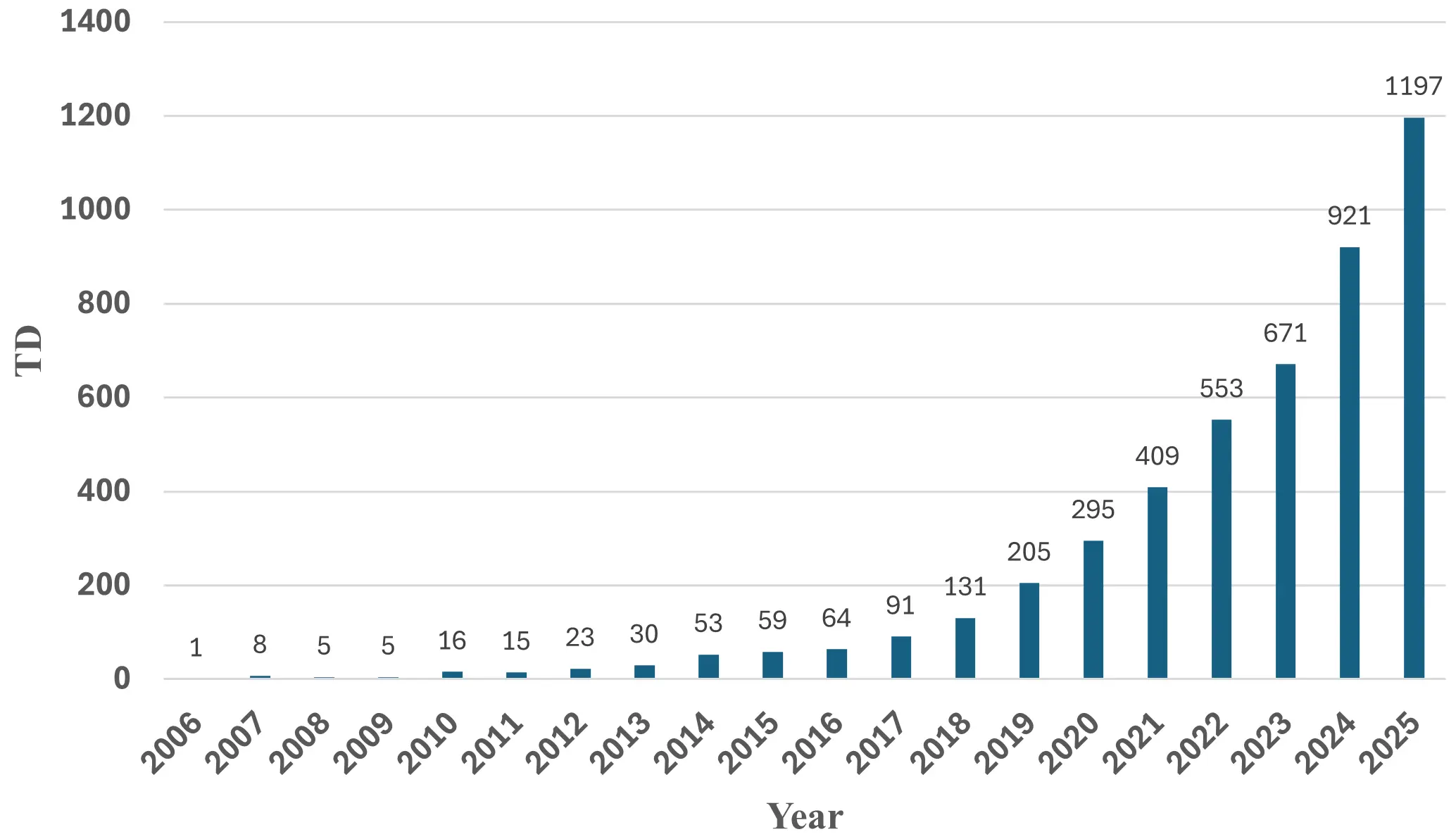
Figure 2. Annual publication growth of scientific literature on AI applications in PV power systems (2006–2025). Bars represent the TD published per year, and numerical labels indicate exact annual counts. The figure highlights the transition from exploratory research to exponential expansion over the past few years.
3.1.2. Geographic Distribution and Regional Contributions to AI-Based PV Research
Figure 3 presents the global geographic distribution of scientific publications on AI applications in PV power systems, based on TD by country. In the map visualization, color intensity corresponds to publication volume, with darker shades indicating higher research output. The numerical labels within each country indicate the exact number of publications attributed to that country during the study period. This representation enables both visual comparison of research concentration and quantitative interpretation of national contributions.
The spatial distribution reveals a pronounced asymmetry in global research output. China clearly dominates the field with 1354 publications, well ahead of the next country. This leadership reflects China’s extensive PV deployment capacity, strong government investment in renewable energy technologies, and the integration of AI research into engineering and energy institutions. The scale of China’s contribution indicates not only quantitative dominance but also structural centrality within the AI-based PV research network. India ranks second with 809 publications, demonstrating the rapid expansion of AI-enabled PV research aligned with national solar missions and grid modernization efforts. The United States follows with 313 publications, maintaining a strong presence particularly in advanced modeling frameworks, control systems, and high-impact interdisciplinary research. The gap between the top two countries and the rest of the field highlights a concentration of research intensity in Asia.
A notable regional cluster is observed across the Middle East and North Africa (MENA) region. Saudi Arabia (272 publications), Algeria (205), Egypt (139), Morocco (136), Tunisia (77), and the United Arab Emirates (82) collectively contribute a significant share of global output. The strong engagement of these countries reflects the strategic importance of PV technologies in high-irradiance climates and the need for AI-driven optimization to address environmental stressors, including dust accumulation, extreme temperatures, and grid stability challenges. The map clearly shows that solar-rich regions are increasingly active contributors rather than passive adopters of technology.
European contributions appear more distributed than concentrated. Italy (178 publications), Spain (169), the United Kingdom (155), Turkey (152), Germany (109), and France (87) form a strong yet decentralized European research presence. This pattern suggests coordinated, yet nationally distributed, engagement in renewable energy integration, intelligent control systems, and smart grid research. Rather than a single European leader, the region demonstrates collective strength across multiple countries.
East and Southeast Asia also exhibit robust participation beyond China and India. South Korea (186), Malaysia (159), Taiwan (103), Japan (88), Singapore (60), and Hong Kong (68) contribute actively, reinforcing Asia’s overall dominance in AI-based PV research output. Australia (171 publications) also maintains a strong presence, reflecting its high solar penetration and active research programs in renewable energy and intelligent energy systems.
Beyond the major contributors, Figure 3 reveals a long tail of countries across Africa, Latin America, Eastern Europe, and Southeast Asia with smaller but meaningful publication counts. While individual outputs from these countries are modest, their collective participation indicates that AI applications in PV systems have become globally relevant. The widespread geographic footprint underscores that AI-based PV research is not confined to a narrow group of technologically advanced economies but is expanding across emerging markets and solar-dependent regions.
Overall, the geographic pattern depicted in Figure 3 demonstrates three key structural characteristics: (1) strong concentration in leading Asian economies, (2) distributed yet coordinated European participation, and (3) growing engagement from solar-rich developing regions. This global diffusion suggests that AI-driven PV research has transitioned into a mature and internationally embedded domain, with increasing cross-regional relevance and potential for collaborative development.
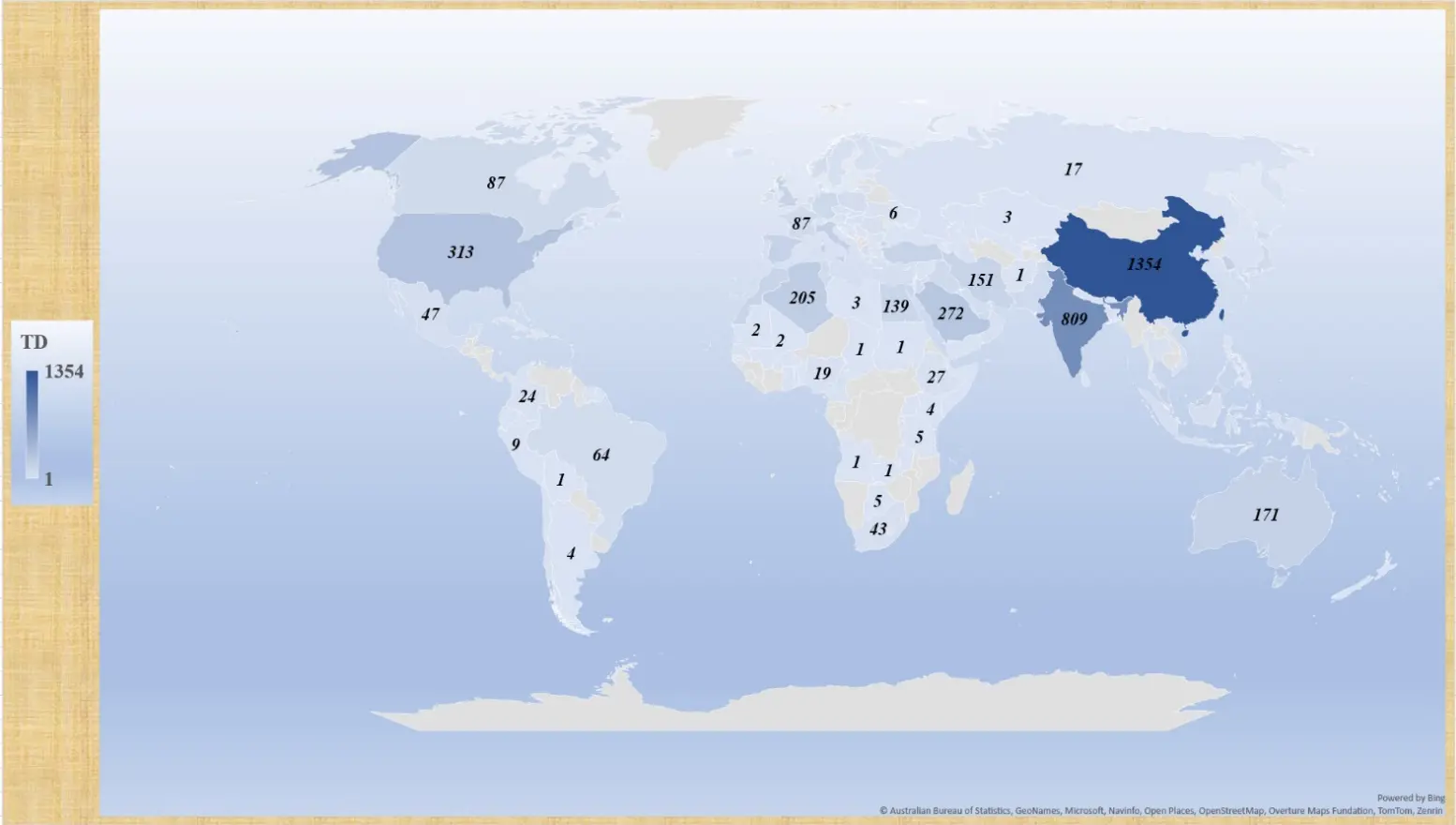
Figure 3. Global geographic distribution of publications on AI applications in PV power systems (2006–2025). Color intensity represents total documents (TD) per country, with darker shades indicating higher publication output. Numerical labels denote exact publication counts. The map illustrates a strong concentration of research activity in Asia, alongside broad and increasing global participation.
3.1.3. Country-Level Scientific Influence in AI-Based PV Research
Table 1 summarizes country-level scientific influence in AI-based PV research using total citations (TC), TD, and average citations per document. The results reveal marked differences between publication volume and citation impact, indicating heterogeneous patterns of productivity and influence across countries. China ranks first in total scientific output (TD = 1354) and overall citations (TC = 38,753), confirming its central role in shaping the global AI-based PV research landscape. Despite this dominance in volume, China’s average citation rate (28.6 citations per document) remains moderate, suggesting a broad and diverse research base with varying levels of international impact. The United States ranks second in total citations (TC = 16,391) and has a substantially smaller publication volume (TD = 313), resulting in a high average citation rate of 52.4 citations per document. This pattern indicates an intense concentration of highly influential studies, often characterized by methodological innovation, system-level modelling, and foundational contributions to AI-driven PV optimization. Similarly, Italy and Australia exhibit high citation efficiency, with average citation rates of 52.6 and 46.1 citations per document, respectively, reflecting strong research quality and international visibility despite comparatively smaller output volumes. India ranks third in total citations (TC = 13,576) and second in publication volume (TD = 809), but records a lower average citation rate (16.8). This suggests a rapidly expanding research ecosystem focused on applied, deployment-oriented AI-based PV studies, with influence distributed across many contributions. A similar volume-driven pattern is observed in Saudi Arabia (TD = 272; average citations = 24.3) and Algeria (TD = 205; average citations = 36.6), underscoring the growing role of solar-rich regions in advancing AI-enabled PV research.
Several European and East Asian countries demonstrate balanced profiles combining moderate output with solid citation impact. The United Kingdom (49.1 citations per document), Spain (34.9), Germany (30.6), South Korea (31.8), Japan (34.1), and Taiwan (39.6) collectively contribute to a diversified and interconnected global research network. Notably, Singapore has the highest average citation rate among the top 20 countries (56.8 citations per document), despite a relatively small publication volume, indicating a high concentration of high-impact research outputs. The country-level influence analysis highlights a clear distinction between high-volume contributors and high-impact producers. While Asian countries, particularly China and India, drive the expansion of the AI-based PV literature in terms of scale, several Western and smaller innovation-focused economies achieve disproportionately high citation impact. This heterogeneity underscores the complementary roles of scale-driven and quality-driven research systems in shaping the global evolution of AI applications in PV power systems.
Table 1. Country-level scientific influence in AI–based PV research, showing TC, TD, and average citations per document for the top 20 contributing countries.
|
Rank |
Country |
TC |
TD |
Average Citations/Document |
|---|---|---|---|---|
|
1 |
China |
38,753 |
1354 |
28.6 |
|
2 |
United States |
16,391 |
313 |
52.4 |
|
3 |
India |
13,576 |
809 |
16.8 |
|
4 |
Italy |
9355 |
178 |
52.6 |
|
5 |
Australia |
7880 |
171 |
46.1 |
|
6 |
United Kingdom |
7618 |
155 |
49.1 |
|
7 |
Algeria |
7495 |
205 |
36.6 |
|
8 |
Saudi Arabia |
6619 |
272 |
24.3 |
|
9 |
South Korea |
5919 |
186 |
31.8 |
|
10 |
Spain |
5901 |
169 |
34.9 |
|
11 |
Iran |
5248 |
151 |
34.8 |
|
12 |
Egypt |
4670 |
139 |
33.6 |
|
13 |
Malaysia |
4547 |
158 |
28.8 |
|
14 |
Taiwan |
4081 |
103 |
39.6 |
|
15 |
Turkey |
4034 |
152 |
26.5 |
|
16 |
Singapore |
3405 |
60 |
56.8 |
|
17 |
Germany |
3340 |
109 |
30.6 |
|
18 |
Pakistan |
3251 |
96 |
33.9 |
|
19 |
Japan |
3004 |
88 |
34.1 |
|
20 |
Canada |
2901 |
87 |
33.3 |
3.1.4. Journal-Level Influence and Source Impact in the AI-Based PV Literature
Table 2 presents the journal-level influence of publications on AI applications in PV power systems, evaluated using TC, TD, and average citations per document. The results reveal a stratified publication landscape in which a limited number of journals function as central knowledge hubs. At the same time, a broader set of outlets supports field expansion through high publication volumes. Solar Energy ranks first in total citations (TC = 11,684) with 206 published articles, corresponding to a high average citation rate of 56.7 citations per document. This position highlights its long-standing role as a core outlet for impactful PV research integrating advanced modeling and intelligent system optimization. Closely following are Applied Energy (TC = 11,097; TD = 206; average = 53.9) and Renewable Energy (TC = 10,335; TD = 183; average = 56.5), both of which demonstrate a strong balance between publication volume and citation influence, reflecting their emphasis on system-level energy analysis and applied AI methodologies.
High citation efficiency is particularly evident in journals with relatively modest publication volumes. Energy Conversion and Management (average = 77.4), IEEE Transactions on Industrial Informatics (78.2), IEEE Transactions on Smart Grid (75.4), and Renewable and Sustainable Energy Reviews (112.2) exhibit some of the highest average citation rates, indicating that articles published in these venues tend to make foundational or integrative contributions to the AI-based PV literature. Similarly, Nature Communications shows the highest average citation rate among the top-ranked journals (114.4), despite a small number of publications, underscoring its role in disseminating highly influential, cross-disciplinary studies. In contrast, high-output journals such as Energies (TD = 346; average = 21.7), Sustainability (TD = 120; average = 19.2), and Applied Sciences (TD = 68; average = 23.5) contribute substantially to the breadth and accessibility of AI-based PV research but display lower average citation rates. These outlets play an essential role in supporting methodological diversity, applied case studies, and emerging research topics, particularly in rapidly developing areas of AI-driven PV applications.
Overall, the journal-level influence analysis indicates a dual publication structure within the AI-based PV research domain. A small group of high-impact journals concentrates foundational and highly cited contributions, while a broader ecosystem of applied and open-access journals facilitates dissemination, experimentation, and field-wide growth. This complementary structure reflects both the scientific maturation of AI-based PV research and its increasing relevance across diverse research communities and application contexts.
Table 2. Journal-level influence of scientific publications on AI applications in PV power systems, showing TC, TD, and average citations per document for the top 20 contributing journals.
|
Rank |
Journal |
TC |
TD |
Average Citations/Document |
|---|---|---|---|---|
|
1 |
Solar Energy |
11,684 |
206 |
56.7 |
|
2 |
Applied Energy |
11,097 |
206 |
53.9 |
|
3 |
Renewable Energy |
10,335 |
183 |
56.5 |
|
4 |
Energy |
9771 |
179 |
54.6 |
|
5 |
Energies |
7518 |
346 |
21.7 |
|
6 |
IEEE Access |
7347 |
193 |
38.1 |
|
7 |
Energy Conversion and Management |
5498 |
71 |
77.4 |
|
8 |
IEEE Transactions on Sustainable Energy |
2790 |
42 |
66.4 |
|
9 |
Sustainability (Switzerland) |
2305 |
120 |
19.2 |
|
10 |
Energy Reports |
2282 |
89 |
25.6 |
|
11 |
IEEE Transactions on Industrial Informatics |
1876 |
24 |
78.2 |
|
12 |
IET Renewable Power Generation |
1832 |
52 |
35.2 |
|
13 |
Electric Power Systems Research |
1687 |
47 |
35.9 |
|
14 |
Renewable and Sustainable Energy Reviews |
1683 |
15 |
112.2 |
|
15 |
Sustainable Energy Technologies and Assessments |
1676 |
62 |
27.0 |
|
16 |
Nature Communications |
1601 |
14 |
114.4 |
|
17 |
Applied Sciences (Switzerland) |
1598 |
68 |
23.5 |
|
18 |
Journal of Cleaner Production |
1597 |
23 |
69.4 |
|
19 |
IEEE Transactions on Smart Grid |
1432 |
19 |
75.4 |
|
20 |
International Journal of Electrical Power and Energy Systems |
1231 |
38 |
32.4 |
3.2. Intellectual Foundations and Knowledge Bases Underpinning AI-Based PV Research (Addressing RQ2)
The co-citation analysis elucidates the intellectual foundations underpinning AI-based PV research by identifying five thematic clusters of highly co-cited references. Table 3 summarizes the major intellectual foundations and representative cited works for each cluster, while Figure 4 presents the co-citation network generated with VOSviewer. In the visualization, node size represents TC, indicating each reference’s influence within the field. At the same time, link thickness reflects total link strength, representing the frequency with which two references are cited together. The spatial proximity of nodes indicates conceptual similarity, and colour coding denotes distinct intellectual clusters. Applying a minimum citation threshold of 20 yielded 64 influential references that formed a structured, interconnected knowledge network. The five clusters collectively define the theoretical and methodological architecture of AI-driven PV research.
Cluster 1: Foundational frameworks of PV power forecasting (red cluster). This cluster represents the conceptual backbone of AI-based PV research. The highly co-cited works synthesize the evolution of PV power forecasting from statistical and physical models toward machine learning and deep learning approaches. These references define forecasting horizons (intra-hour, day-ahead, and short-term), performance metrics, and grid-integration requirements. Importantly, this cluster reflects the early integration of artificial neural networks and later deep learning architectures into PV prediction tasks. The central position of this cluster in Figure 4 indicates that AI-driven forecasting serves as the field’s primary intellectual anchor.
Cluster 2: Comparative evaluation, hybridization, and optimization of AI forecasting models (green cluster). Cluster 2 represents methodological benchmarking and optimization frameworks. The cited studies systematically classify forecasting approaches into physical, statistical, machine learning, hybrid, and ensemble models, and evaluate them across diverse climatic and operational conditions. Within this cluster, AI techniques are explicitly emphasized through hybrid learning strategies and metaheuristic-assisted optimization (e.g., genetic algorithms, particle swarm optimization, and differential evolution). These methods are frequently used for hyperparameter tuning, model selection, and performance enhancement. Rather than forming a standalone cluster, metaheuristic optimization is structurally embedded within this methodological consolidation domain, linking predictive modelling with algorithmic refinement. This cluster, therefore, bridges theoretical forecasting foundations (Cluster 1) with AI-driven performance optimization.
Cluster 3: AI-based reliability, fault detection, and system protection (blue cluster). Cluster 3 captures the operational reliability dimension of AI-enabled PV systems. The co-cited literature focuses on fault detection, degradation analysis, anomaly classification, and intelligent protection strategies. A clear methodological shift is evident within this cluster: early rule-based monitoring approaches are progressively replaced by machine learning classifiers and, more recently, deep learning and computer vision-based diagnostic systems. The proximity between this cluster and forecasting clusters suggests increasing integration between predictive analytics and resilience-oriented system monitoring. Thus, AI in this cluster is not merely predictive but diagnostic and decision-support oriented, reinforcing the operational intelligence of PV systems.
Cluster 4: AI-enhanced maximum power point tracking, modeling, and control (yellow cluster). Cluster 4 forms the control-theoretic and device-level optimization foundation of AI-based PV research. The seminal references in this cluster address MPPT algorithms, converter modelling, and PV array simulation. Over time, AI and metaheuristic optimization techniques have been incorporated into MPPT strategies to improve convergence speed and adaptability under partial shading conditions. Here again, metaheuristic algorithms (e.g., PSO, GA, GWO) are integrated within the cluster rather than forming an independent intellectual stream. The cluster, therefore, represents the intersection of classical power electronics and intelligent optimization.
Cluster 5: Data-driven learning architectures and solar irradiance modelling (purple cluster). Cluster 5 reflects the algorithmic deepening of AI in PV research. The referenced works emphasize machine learning architectures, nonlinear regression models, ensemble strategies, and data-centric feature engineering applied to solar irradiance and PV output forecasting. This cluster highlights the increasing role of deep neural networks, hybrid learning frameworks, and data-rich training strategies. It represents the consolidation of AI as a core analytical engine rather than a supplementary tool. Taken together, the five clusters illustrate how AI permeates multiple layers of PV research: Predictive intelligence (Clusters 1 and 2); Reliability and resilience analytics (Cluster 3); Intelligent control and optimization (Cluster 4); Advanced data-driven learning architectures (Cluster 5). Metaheuristic algorithms and hybrid AI strategies are structurally embedded within Clusters 2 and 4 rather than forming a separate knowledge base. This integration reflects their role as enabling optimization mechanisms across forecasting and control domains. Overall, Figure 4 demonstrates that AI in PV research has evolved from isolated applications toward a multi-layered, interconnected knowledge ecosystem that integrates prediction, optimization, control, and resilience.
Table 3. Major intellectual foundations and knowledge bases of AI-based PV research were identified through co-citation analysis of highly cited references (minimum citation threshold = 20), showing representative cited works, TC, total link strength, and corresponding knowledge domains.
|
Cluster |
Cited References |
TC |
Total Link Strength |
Intellectual Foundations and Knowledge Bases |
|---|---|---|---|---|
|
1 |
[30] |
173 |
257 |
Foundational frameworks for PV power forecasting, establishing grid-oriented prediction principles, temporal horizons (intra-hour to day-ahead), performance metrics, and the transition from physical/statistical models toward machine learning and deep learning architectures. |
|
[31] |
46 |
55 |
||
|
[32] |
45 |
62 |
||
|
[33] |
39 |
63 |
||
|
2 |
[34] |
144 |
200 |
Comparative evaluation, benchmarking, and optimization of AI-based PV forecasting methodologies, including classification of physical, statistical, machine learning, hybrid, and ensemble models, with emphasis on metaheuristic-assisted tuning and performance validation across climatic conditions. |
|
[35] |
129 |
215 |
||
|
[36] |
91 |
151 |
||
|
[37] |
55 |
70 |
||
|
3 |
[38] |
52 |
47 |
AI-driven reliability analytics, fault detection, degradation diagnosis, and protection intelligence in PV systems, highlighting the evolution from rule-based monitoring to machine learning and deep learning diagnostic frameworks for operational resilience. |
|
[39] |
46 |
52 |
||
|
[40] |
38 |
32 |
||
|
[41] |
33 |
25 |
||
|
4 |
[42] |
65 |
36 |
MPPT, PV array modeling, and intelligent control optimization, integrating classical power-electronics foundations with AI-enhanced and metaheuristic-based adaptive control strategies under partial shading and dynamic operating conditions. |
|
[43] |
35 |
12 |
||
|
[44] |
24 |
16 |
||
|
[45] |
23 |
17 |
||
|
5 |
[46] |
56 |
66 |
Data-driven learning paradigms for solar irradiance and PV output forecasting, emphasizing nonlinear learning architectures, deep neural networks, ensemble methods, feature engineering, and hybrid AI frameworks to enhance predictive accuracy and adaptability. |
|
[47] |
46 |
65 |
||
|
[48] |
42 |
83 |
||
|
[49] |
25 |
47 |
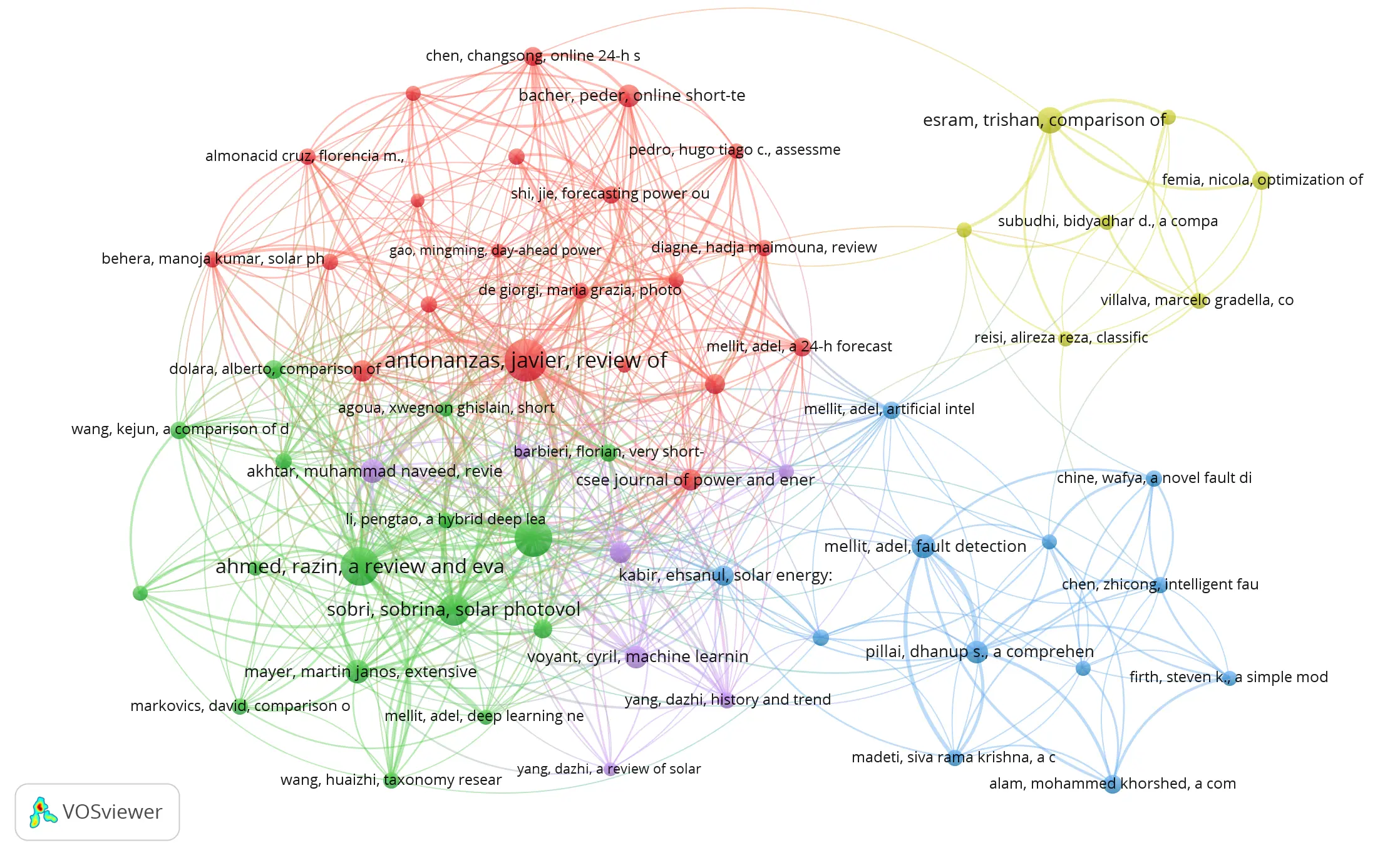
Figure 4. Co-citation network of highly cited references in AI-based PV research generated using VOSviewer. The visualization includes 64 cited references that meet a minimum citation threshold of 20. Node size represents TC, indicating the relative influence of each reference within the field. At the same time, link thickness reflects total link strength, representing the intensity of co-citation relationships between pairs of works. Spatial proximity between nodes indicates conceptual relatedness. Colors represent five major intellectual clusters identified using the VOSviewer clustering algorithm: Cluster 1 (red): foundational frameworks of PV power forecasting; Cluster 2 (green): methodological benchmarking, hybridization, and optimization of AI forecasting models; Cluster 3 (blue): AI-based reliability, fault detection, and system protection; Cluster 4 (yellow): AI-enhanced MPPT, modeling, and control strategies; and Cluster 5 (purple): data-driven learning architectures and solar irradiance modeling. The network structure illustrates the layered, interconnected knowledge bases that underpin AI applications in PV power systems.
3.3. Dominant Thematic Clusters and Temporal Evolution of AI Applications in PV Power Systems (Addressing RQ3)
To address RQ3, the dominant thematic clusters characterizing AI applications in PV power systems and their temporal evolution were identified through keyword co-occurrence analysis. This method captures conceptual relationships among frequently used author keywords, revealing the field’s principal research themes and their structural interconnections. Table 4 summarizes the dominant thematic clusters and their representative keywords, while Figure 5 illustrates their structural relationships and temporal evolution. Using VOSviewer, 85 keywords meeting a minimum occurrence threshold of 20 were identified and organized into six thematic clusters based on co-occurrence strength. In the network visualization (Figure 5a), node size represents keyword frequency, indicating thematic prominence, while link thickness reflects co-occurrence strength, revealing conceptual interdependence between topics. Spatial proximity indicates thematic relatedness, and colour coding denotes distinct clusters. The overlay visualization (Figure 5b) maps the average publication year of keywords, with colour gradients indicating temporal evolution from earlier themes (blue) to more recent or emerging topics (yellow).
Cluster 1: AI-driven PV power forecasting and predictive analytics. Cluster 1 represents the largest and most central thematic domain in the network. Dominated by keywords such as machine learning, long short-term memory, convolutional neural networks, transformers, random forests, support vector machines, ensemble learning, and time-series forecasting, this cluster clearly establishes predictive analytics as the core application of AI in PV systems. The prominence and central positioning of this cluster indicate that forecasting remains the intellectual anchor of AI-based PV research. The strong interconnections with solar radiation and photovoltaic power prediction reflect the integration of meteorological modelling with nonlinear learning architectures. The overlay visualization shows that advanced deep learning models (e.g., transformer architectures and ensemble learning frameworks) are among the more recent developments, indicating an ongoing methodological shift toward data-intensive, hybrid forecasting paradigms.
Cluster 2: PV system modeling, MPPT, and intelligent control optimization. Cluster 2 focuses on system-level operational optimization and intelligent control strategies. Frequently occurring keywords such as MPPT, genetic algorithms, particle swarm optimization (PSO), fuzzy logic, neural networks, partial shading conditions, and digital twin highlight the integration of AI and metaheuristic algorithms into power-electronic control and PV modeling. This cluster reflects the convergence between classical control theory and AI-based optimization. Metaheuristic techniques are particularly prominent, supporting parameter tuning, adaptive MPPT strategies, and improving converter efficiency. The overlay visualization suggests that while MPPT research has long-standing roots, recent developments increasingly incorporate hybrid AI-control architectures and digital twin concepts, reflecting greater system complexity and real-time adaptability.
Cluster 3: Fault detection, condition monitoring, and vision-based diagnostics. Cluster 3 captures the growing emphasis on AI-enabled diagnostic intelligence. Keywords such as anomaly detection, computer vision, semantic segmentation, transfer learning, attention mechanisms, and image processing indicate a shift from conventional monitoring approaches toward data-driven, non-invasive inspection systems. The overlay visualization reveals that many of these keywords are relatively recent, demonstrating that vision-based inspection and deep learning-based anomaly detection have emerged as rapidly expanding research fronts. The proximity of this cluster to forecasting-related themes suggests increasing integration between predictive analytics and reliability assessment, reinforcing the transition toward resilient PV systems.
Cluster 4: AI-enabled energy management, microgrids, and system integration. Cluster 4 reflects the expansion of AI-based PV research from component-level optimization to system-level coordination. Keywords such as energy management systems, reinforcement learning, microgrids, renewable energy integration, electric vehicles, multi-objective optimization, and smart grid illustrate the increasing complexity of interconnected energy systems. The presence of reinforcement learning and model predictive control indicates a move toward adaptive, decision-centric optimization frameworks. The overlay visualization shows that reinforcement learning and multi-objective optimization are among the more recent thematic developments, highlighting the shift toward intelligent energy coordination and distributed control architectures.
Cluster 5: AI-based fault intelligence and reliability analysis of PV arrays. Cluster 5 emphasizes algorithmic fault classification and reliability analytics at the array and system levels. Keywords such as fault classification, fault diagnosis, recurrent neural networks, and photovoltaic arrays indicate a specialized stream focused on pattern recognition and sequence-based fault identification. Although conceptually related to Cluster 3, this cluster is more algorithm-centric and less vision-oriented. It reflects the increasing importance of predictive maintenance and lifecycle reliability modelling as PV installations scale globally.
Cluster 6: Cross-cutting solar and energy forecasting applications. Cluster 6, while smaller, serves an integrative role. Centered on energy forecasting and solar energy, it links PV-specific forecasting with broader renewable energy modelling contexts. Its bridging position within the network underscores the cross-domain relevance of AI-driven forecasting across multiple energy technologies.
The overlay visualization (Figure 5b) provides additional insight into the chronological progression of research themes. Early research (blue tones) concentrated on MPPT, classical neural networks, and baseline forecasting tasks. Over time, there is a clear transition toward deep learning architectures, hybrid optimization strategies, computer vision diagnostics, and reinforcement learning-based energy management (green to yellow tones). This temporal progression reflects two major structural shifts: From isolated algorithmic applications toward integrated, system-level intelligence. From conventional machine learning models toward deep learning, hybrid metaheuristic optimization, and decision-centric control frameworks. Overall, the thematic evolution captured in Figure 5 demonstrates the maturation of AI-based PV research from predictive modelling and efficiency enhancement to intelligent, interconnected, and resilience-oriented energy systems.
Table 4. Dominant thematic clusters of AI applications in PV power systems were identified through keyword co-occurrence analysis (minimum occurrence threshold = 20).
|
Cluster No. |
Representative Keywords |
Dominant Theme |
|---|---|---|
|
1 |
Bayesian optimization, convolutional neural network, ensemble learning, extreme learning machine, feature selection, long short-term memory, machine learning, photovoltaic power, photovoltaic power forecasting, photovoltaic power generation, photovoltaic power prediction, power forecasting, power prediction, prediction, random forest, solar forecasting, solar radiation, support vector machine, time-series forecasting, transformer, variational mode decomposition. |
AI-driven PV power forecasting and predictive modeling, emphasizing deep learning architectures, ensemble methods, feature engineering, and hybrid optimization for multi-horizon PV output prediction. |
|
2 |
adaptive neuro-fuzzy inference system (anfis), dc-dc converters, digital twin, efficiency, energy efficiency, fuzzy logic, genetic algorithms, maximum power point tracking (mppt), modeling, neural networks, optimization, partial shading conditions, particle swarm optimization (pso), photovoltaic systems, photovoltaics, pi controllers, power quality, simulation, solar photovoltaic (pv), total harmonic distortion. |
AI-enhanced PV system modeling, MPPT, and intelligent control optimization, integrating metaheuristic algorithms and hybrid AI-control strategies for efficiency enhancement under dynamic operating conditions. |
|
3 |
anomaly detection, attention mechanisms, classification, computer vision, deep learning, defect detection, feature extraction, forecasting, image processing, photovoltaic modules, photovoltaic panels, remote sensing, semantic segmentation, short-term forecasting, solar irradiance, solar power, time-series analysis, transfer learning. |
AI-based fault detection, condition monitoring, and vision-driven diagnostics, focusing on deep learning and non-invasive inspection techniques for scalable reliability assessment. |
|
4 |
battery systems, demand response, distributed generation, electric vehicles, energy management systems, energy storage systems, internet of things, microgrids, model predictive control, multi-objective optimization, reinforcement learning, renewable energy, renewable energy integration, renewable energy sources, smart grid, solar irradiance forecasting, wind energy systems |
AI-enabled energy management, microgrids, and integrated renewable energy systems, emphasizing reinforcement learning, coordinated control, and multi-objective decision-making in interconnected energy networks. |
|
5 |
artificial intelligence, fault classification, fault detection, fault diagnosis, photovoltaic arrays, photovoltaic power systems, recurrent neural networks. |
Algorithmic fault intelligence and reliability analytics for PV arrays, highlighting sequence-based learning models and AI-driven classification for predictive maintenance and system protection. |
|
6 |
energy forecasting, solar energy |
Cross-domain solar and energy forecasting integration, linking PV-specific predictive modeling with broader renewable energy forecasting applications. |
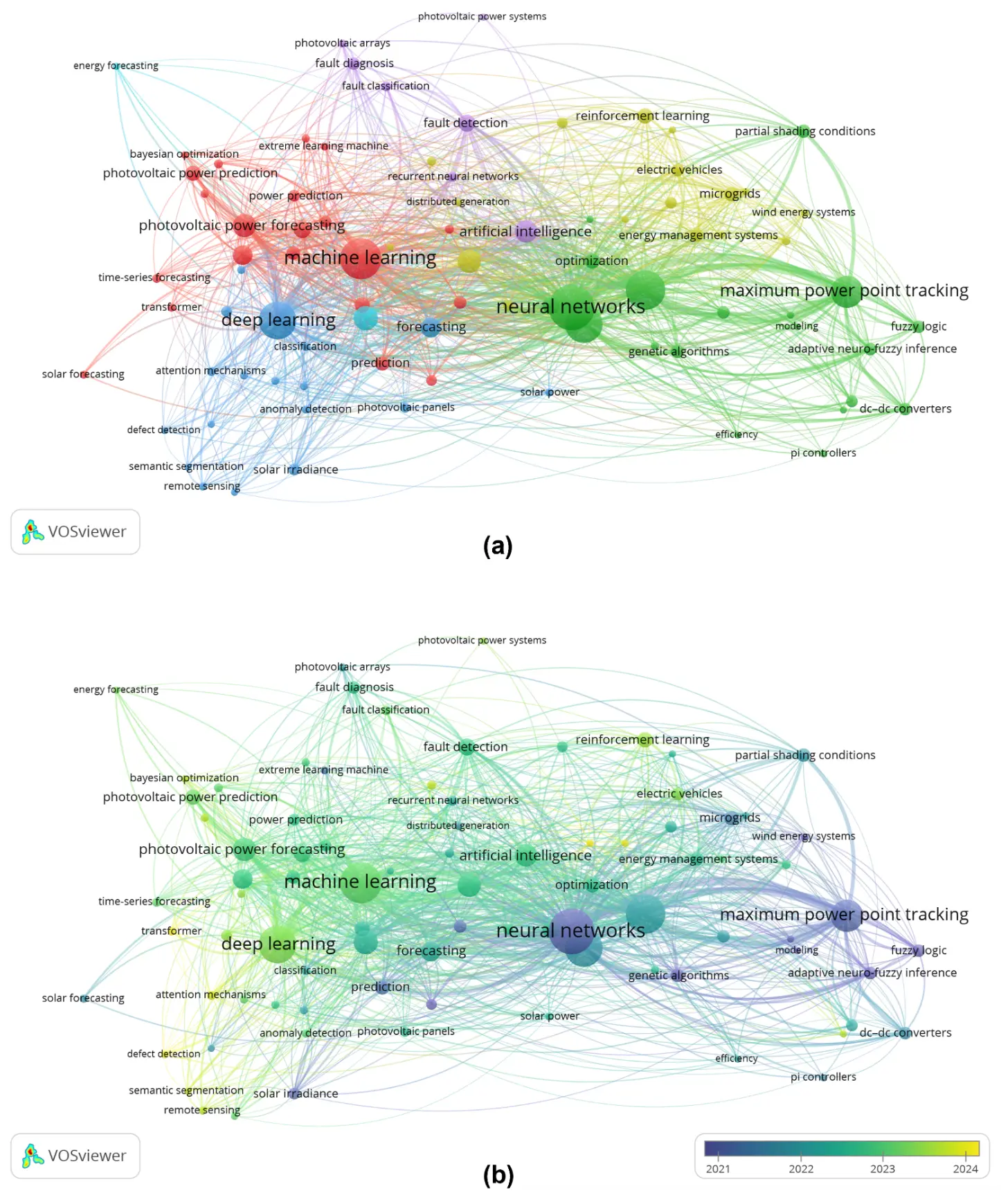
Figure 5. The co-occurrence network of AI applications in PV power systems was generated using VOSviewer, based on 85 author keywords that met a minimum occurrence threshold of 20. (a) Network visualization showing six major thematic clusters; node size represents keyword frequency, link thickness indicates co-occurrence strength, and spatial proximity reflects conceptual relatedness. Colors represent distinct thematic domains identified using the VOSviewer clustering algorithm: Cluster 1 (red): AI-driven PV power forecasting and predictive analytics; Cluster 2 (green): PV system modeling, MPPT, and intelligent control optimization; Cluster 3 (blue): fault detection, condition monitoring, and vision-based diagnostics; Cluster 4 (yellow): AI-enabled energy management and microgrids; Cluster 5 (purple): algorithmic fault intelligence and reliability analysis; and Cluster 6 (cyan): cross-cutting solar and energy forecasting applications. (b) Overlay visualization illustrating temporal evolution, where node color represents the average publication year (blue = earlier themes; yellow = more recent/emerging topics), highlighting the transition from classical forecasting and MPPT research toward deep learning, diagnostic intelligence, and AI-enabled energy management.
3.4. Emerging Topics and Methodological Frontiers in AI-Driven PV Power Systems (Addressing RQ4)
To address RQ4, emerging topics and methodological frontiers shaping recent developments in AI-driven PV power systems were identified through bibliographic coupling analysis. Unlike co-citation analysis, which captures historical intellectual foundations, bibliographic coupling identifies contemporary research trajectories by grouping documents that share common reference bases. This method, therefore, highlights active, forward-looking thematic directions. Table 5 summarizes the emerging topics and methodological frontiers identified across the coupling clusters, while Figure 6 visualizes their structural relationships. Using VOSviewer, a minimum citation threshold of 200 was applied, yielding 59 highly cited documents organized into nine coupling clusters. In the network visualization (Figure 6), node size represents TC, indicating publication influence, while link thickness reflects the strength of shared reference connections between documents. Spatial proximity indicates conceptual similarity, and colour coding distinguishes emerging research fronts.
Cluster 1: Metaheuristic and bio-inspired optimization for MPPT. This cluster captures the sustained evolution of intelligence-driven MPPT strategies under partial shading conditions. The dominant methodological direction involves PSO, ant colony optimization (ACO), genetic algorithms (GA), and neuro-fuzzy controllers. These works represent a shift from perturb-and-observe heuristics toward adaptive, global-search optimization capable of navigating non-convex PV operating landscapes.
Cluster 2: Deep learning-based short-term PV forecasting. Cluster 2 reflects the central frontier of short-term PV power forecasting. Recurrent neural networks (RNN), LSTM architectures, gradient boosting methods, and weather-aware deep learning models dominate this cluster. The strong coupling strength among these publications highlights a coherent research stream focused on multi-site prediction, grid-support forecasting, and market-oriented energy scheduling.
Cluster 3: Hybrid deep convolutional and probabilistic forecasting. This cluster marks the integration of convolutional neural networks (CNN) with probabilistic and uncertainty-aware frameworks. The emphasis shifts from deterministic prediction toward probabilistic forecasting, enabling uncertainty quantification under variable meteorological conditions. This reflects the increasing importance of risk-aware decision-making in grid operations.
Cluster 4: Comparative and hybrid deep learning benchmarking. Cluster 4 consolidates research comparing hybrid architectures for day-ahead forecasting and uncertainty analysis. These works emphasize systematic benchmarking, cross-climate validation, and model generalizability. The frontier here is methodological rigor rather than purely architectural novelty.
Cluster 5: Large-scale time-series and multi-source data integration. This cluster represents advanced spatiotemporal learning frameworks for large-scale PV systems. Hybrid CNN-LSTM models, aerosol-aware forecasting, and multi-source meteorological integration characterize this frontier. The emphasis lies on scaling AI models for utility-level PV deployment.
Cluster 6: AI-based fault diagnosis and resilience-oriented forecasting. Cluster 6 bridges predictive analytics with system reliability. It integrates fault detection models with forecasting systems under extreme weather conditions. This reflects a growing resilience-oriented paradigm in AI-based PV research, where operational robustness is treated as equally important as predictive accuracy.
Cluster 7: Hybrid deep architectures and systematic reviews. This cluster indicates methodological consolidation and field maturation. It includes systematic reviews and hybrid model synthesis studies, signaling a shift toward architectural transparency, reproducibility, and structured benchmarking frameworks.
Cluster 8: GAN-assisted and weather-classification-driven forecasting. Cluster 8 represents a cutting-edge frontier in generative adversarial networks (GANs) and high-resolution scenario modeling. These approaches enhance data richness, enable synthetic weather augmentation, and improve forecasting robustness in data-sparse regions.
Cluster 9: Wavelet-neural and fuzzy-neural hybrid models. This cluster reflects enduring hybrid modeling strategies combining wavelet decomposition with neural and fuzzy inference systems. While methodologically mature, these approaches remain influential for handling non-stationary irradiance signals and uncertainty decomposition. The bibliographic coupling structure reveals a clear methodological transition:
-
From rule-based and heuristic MPPT toward metaheuristic optimization.
-
From single-model forecasting toward deep, hybrid, and probabilistic frameworks.
-
From deterministic prediction toward uncertainty-aware and resilience-driven intelligence.
-
From small-scale experiments toward scalable, multi-source, system-level AI integration.
Figure 6 thus illustrates the forward-looking evolution of AI-based PV research, where forecasting accuracy, uncertainty management, intelligent optimization, and operational resilience converge within hybrid, data-rich learning architectures.
Table 5. Emerging topics and methodological frontiers in AI-driven PV power systems identified through bibliographic coupling (minimum citation threshold = 200).
|
Cluster |
Document |
TC |
Total Link Strength |
Emerging Topics and Methodological Frontiers |
|---|---|---|---|---|
|
1 |
[50] |
487 |
1 |
Metaheuristic and bio-inspired optimization (PSO, GA, ACO, neuro-fuzzy) for adaptive MPPT and parameter extraction under partial shading conditions |
|
[51] |
389 |
6 |
||
|
[52] |
356 |
8 |
||
|
[53] |
347 |
3 |
||
|
[54] |
320 |
9 |
||
|
2 |
[32] |
684 |
20 |
Deep learning–based short-term and multi-site PV power forecasting using RNN/LSTM and weather-aware architectures |
|
[55] |
547 |
11 |
||
|
[56] |
536 |
15 |
||
|
[57] |
365 |
15 |
||
|
3 |
[58] |
370 |
5 |
Hybrid CNN-based deterministic and probabilistic forecasting with uncertainty quantification |
|
[59] |
241 |
2 |
||
|
[60] |
234 |
7 |
||
|
[61] |
234 |
1 |
||
|
4 |
[62] |
526 |
8 |
Comparative and hybrid deep learning benchmarking for day-ahead forecasting and uncertainty analysis |
|
[63] |
450 |
7 |
||
|
[64] |
272 |
9 |
||
|
[65] |
259 |
4 |
||
|
5 |
[66] |
812 |
3 |
Advanced time-series and multi-source spatiotemporal learning for large-scale PV and solar irradiance forecasting |
|
[67] |
387 |
9 |
||
|
[68] |
349 |
5 |
||
|
[69] |
330 |
3 |
||
|
6 |
[70] |
517 |
1 |
AI-based fault diagnosis integrated with resilience-oriented forecasting frameworks |
|
[71] |
326 |
2 |
||
|
[72] |
281 |
10 |
||
|
7 |
[73] |
849 |
6 |
Next-generation hybrid deep architectures and systematic methodological synthesis |
|
[74] |
442 |
8 |
||
|
[75] |
237 |
7 |
||
|
8 |
[76] |
568 |
5 |
GAN-assisted and weather-classification-driven deep learning for high-resolution PV forecasting |
|
[77] |
308 |
6 |
||
|
9 |
[78] |
243 |
3 |
Wavelet–neural and fuzzy–neural hybrid models for solar radiation prediction |
|
[79] |
222 |
4 |
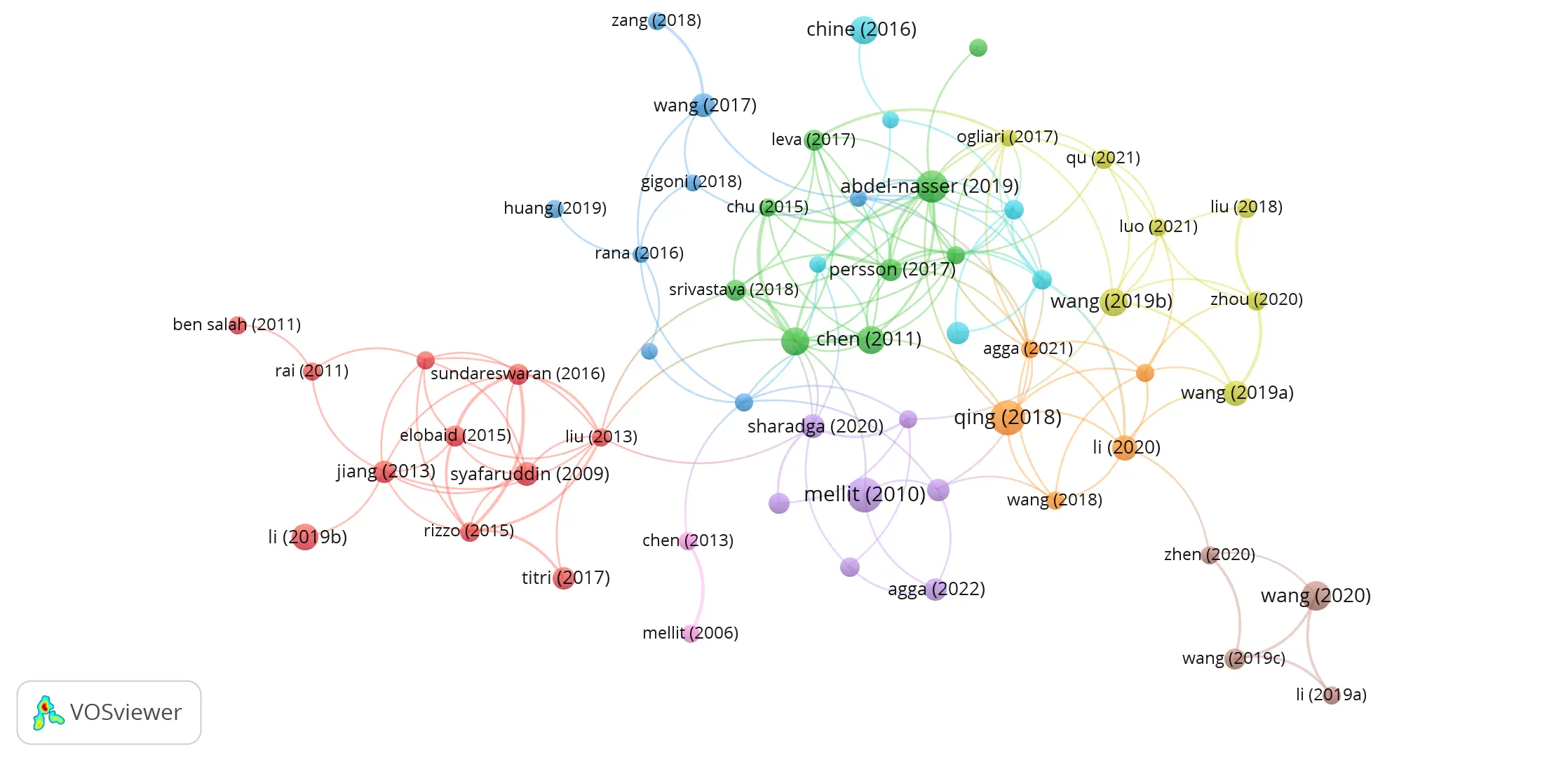
Figure 6. Bibliographic coupling network of highly cited publications in AI-driven PV power systems. The map includes 59 documents meeting a minimum citation threshold of 200. Node size represents total citations (TC), while link thickness indicates shared reference strength (coupling intensity). Colors represent nine distinct thematic clusters identified using the VOSviewer clustering algorithm: Cluster 1 (red): metaheuristic-based MPPT optimization; Cluster 2 (green): deep learning-based short-term forecasting; Cluster 3 (blue): multi-source and spatiotemporal data integration; Cluster 4 (yellow): hybrid and probabilistic forecasting models; Cluster 5 (purple): deep and hybrid data-driven learning architectures; Cluster 6 (cyan): comparative evaluation and benchmarking frameworks; Cluster 7 (orange): hybrid deep architectures and systematic methodological synthesis; Cluster 8 (brown): GAN-assisted and weather-classification-driven forecasting approaches; Cluster 9 (pink): wavelet–fuzzy and hybrid modeling frameworks. The spatial distribution reflects conceptual similarity among research topics.
3.5. Conceptual, Methodological, and Application-Level Gaps and Future Research Directions Toward Intelligent and Resilient PV Energy Systems (Addressing RQ5)
The rapid expansion of AI applications in PV power systems has produced clear advances in forecasting, MPPT, fault diagnosis, and energy management; however, the field still exhibits persistent fragmentation across conceptual framing, methodological practice, and deployment contexts. Building on the mapped knowledge structures and recent research fronts identified in this study, several cross-cutting gaps remain, alongside actionable future directions that can accelerate the transition toward intelligent and resilient PV infrastructures.
3.5.1. Conceptual Gaps
- (1)
-
Limited system-level conceptualization of “intelligence” and “resilience”. Many studies treat intelligence as algorithmic accuracy gains (e.g., lower forecasting error or faster MPPT convergence) rather than as a system property that includes robustness, adaptability, cybersecurity, maintainability, and safe operation under compound stressors. A stronger conceptual framing is needed that links AI functions (prediction–control–diagnosis–decision) to resilience outcomes (fault tolerance, graceful degradation, recovery time, and lifecycle performance) across PV plants, microgrids, and PV-storage-EV ecosystems.
- (2)
-
Weak integration between PV physics, power electronics, and data-driven learning. Forecasting, MPPT/control, and fault diagnosis are often advanced as separate “application silos”, even though they interact operationally (e.g., controller actions influence measured signals; sensor faults can contaminate forecasting features). Future work should formalize coupled architectures that jointly model PV generation, converter dynamics, grid constraints, and degradation pathways, rather than optimizing submodules independently.
- (3)
-
Incomplete representation of real-world stressors and non-stationarity. A large share of AI-based PV studies still assume stable data-generating processes, yet operational PV systems face non-stationarity induced by ageing, soiling, seasonal regime shifts, extreme weather, curtailment, and evolving grid codes. A conceptual shift is needed from “one-off predictive performance” to “continuous learning under drift”, explicitly treating PV as a dynamic socio-technical system.
3.5.2. Methodological Gaps
- (1)
-
Reproducibility and benchmarking deficits. Across forecasting and diagnostics, model comparison is frequently hindered by inconsistent datasets, incomplete reporting of preprocessing, leakage risks (e.g., temporal leakage), and non-standard evaluation windows. Community-aligned benchmarking protocols covering horizon-specific metrics, uncertainty scoring rules, and robustness tests under missing/noisy sensors remain limited. Future studies should adopt transparent pipelines (data splits, hyperparameter search space, computational budget) and evaluate models under comparable operational constraints.
- (2)
-
Overemphasis on point accuracy with limited uncertainty quantification. For grid and market operations, the practical value of forecasts depends on calibrated uncertainty (prediction intervals, quantiles, scenario sets). Yet probabilistic forecasting, conformal prediction, and reliability-aware decision metrics are still less consistently applied than deterministic prediction. Methodological frontiers should prioritize calibrated uncertainty, scenario generation, and decision-centric evaluation (e.g., the cost of reserves and curtailment penalties).
- (3)
-
Generalization, transferability, and domain adaptation remain underdeveloped. Many deep models show high performance in single-site or narrow climatic contexts but degrade across regions, seasons, or sensor configurations. Future directions include transfer learning across PV plants, domain adaptation between climates, and meta-learning for rapid calibration at new sites, supported by explicit reporting of “where the model works” and “where it fails”.
- (4)
-
Limited interpretability and causal robustness. Explainable AI is increasingly referenced, but interpretability is often post hoc and not tied to actionable engineering decisions. The following steps should focus on physically meaningful explanations (feature attributions consistent with irradiance/temperature physics), causal discovery for fault root-cause analysis, and “explanation stability” checks under perturbations so that interpretability directly contributes to trust, compliance, and safety.
3.5.3. Application-Level Gaps
- (1)
-
Deployment constraints are underrepresented in academic validation. Many studies are validated offline using curated datasets, whereas real PV operations require low-latency inference, limited compute (on edge devices), intermittent communication, and strict reliability requirements. Future research should report deployment-relevant indicators (latency, memory footprint, energy use, update frequency, failure modes) and test models under realistic operational constraints.
- (2)
-
Insufficient attention to data governance, cybersecurity, and privacy. As PV becomes increasingly digitized (IoT, digital twins, cloud monitoring, energy trading platforms), the attack surface expands. AI pipelines must be designed with secure data acquisition, robustness against adversarial attacks (including sensor spoofing), and privacy-aware learning, where applicable. These aspects remain peripheral in much of the AI-based PV literature, despite being central to resilience.
- (3)
-
Limited lifecycle and sustainability assessment of AI-enabled PV. AI is typically justified by improved performance, but few studies quantify lifecycle impacts, such as degradation-mitigation benefits, reduced downtime, O&M savings, or the computational footprint of training and frequent updates. Future work should incorporate lifecycle performance indicators (availability, mean time to repair, degradation rate) and techno-economic metrics (LCOE impacts, OPEX reduction, risk-adjusted value).
3.5.4. Future Research Directions Supporting Intelligent and Resilient PV Systems
-
Resilience-by-design AI architectures that integrate forecasting, control, and diagnostics into a unified operational loop (predict → decide → act → verify), with explicit resilience objectives (fault tolerance, safe fallback control, recovery strategies).
-
Hybrid physics-AI modeling (digital twins and physics-informed learning) to improve generalization, reduce data hunger, and enable consistent behavior under rare/extreme operating regimes.
-
Uncertainty-aware and decision-centric forecasting (probabilistic forecasts, scenario generation, calibrated intervals) coupled with grid-aware objectives (reserve planning, congestion, curtailment minimization).
-
Continual learning under drift using robust drift detection, federated or privacy-aware updates when relevant, and governance frameworks for model versioning, auditing, and rollback.
-
Scalable, multimodal condition monitoring combining electrical signals with thermal/visual imagery and remote sensing, supported by domain adaptation and active learning to reduce labeling burden.
-
Edge-native AI for PV plants emphasizing lightweight models, on-device anomaly screening, and hierarchical intelligence (edge + plant controller + cloud) to balance latency, reliability, and interpretability.
-
Standardized benchmarks and reporting checklists for AI-based PV studies, including leakage-safe splits, reproducible preprocessing, operational metrics, uncertainty scoring, and robustness stress tests.
Together, these directions shift the field from isolated algorithm improvements toward integrated, trustworthy, and operationally resilient PV intelligence better aligned with the requirements of high-penetration solar power systems and the broader sustainable energy transition.
3.5.5. Industrial and Community Implications
Beyond academic advancement, the evolution of AI-driven PV research carries significant implications for industrial stakeholders and the broader community. The integration of intelligent forecasting, adaptive control, and resilience-oriented diagnostics directly influences operational efficiency, cost structures, and energy system reliability.
First, improved short-term and probabilistic forecasting enhances grid stability and market participation by reducing forecast uncertainty, reserve requirements, and curtailment events. For grid operators and energy market participants, uncertainty-aware AI models enable more reliable scheduling and dispatch decisions, particularly in high-solar-penetration scenarios.
Second, AI-enhanced MPPT strategies and metaheuristic-based optimization improve energy yield under partial shading and non-ideal operating conditions. These improvements translate into measurable performance gains at the plant level, increasing annual energy production and improving return on investment for utility-scale and distributed PV installations.
Third, intelligent fault detection and predictive maintenance reduce unplanned downtime and maintenance costs. Early anomaly detection, computer vision-based inspection, and resilience-oriented diagnostics allow operators to shift from reactive to proactive maintenance strategies, thereby lowering O&M expenses and improving system availability.
Fourth, system-level AI integration, particularly within microgrids and PV-storage-EV ecosystems, supports higher renewable penetration while maintaining power quality and reliability. Reinforcement learning-based energy management systems and multi-objective optimization frameworks facilitate coordinated control across distributed energy resources, enabling communities to deploy more decentralized, climate-resilient energy infrastructure.
Finally, scalable and edge-compatible AI deployment architectures improve accessibility in remote and resource-constrained environments. Lightweight models and hierarchical intelligence (edge-plant-cloud) structures support low-latency monitoring and decision-making, benefiting rural electrification, community solar projects, and developing regions. Collectively, these impacts demonstrate that AI-driven PV research is not merely an algorithmic endeavor but a critical enabler of economically viable, operationally reliable, and socially beneficial renewable energy systems.
4. Discussion
This study offers a comprehensive and integrative synthesis of the AI-driven PV research landscape by combining bibliometric performance indicators, intellectual structure mapping, thematic clustering, temporal overlay analysis, and bibliographic coupling. Unlike prior reviews that focus on specific technical applications such as MPPT optimization, power forecasting models, or fault diagnosis algorithms, this work adopts a system-level science-mapping perspective that connects foundational knowledge bases, dominant themes, and emerging research fronts within a unified analytical framework. The discussion situates these findings within the broader literature and clarifies the added value of this integrative approach.
4.1. From Algorithmic Optimization to System-Level Intelligence
One of the most significant insights from the analysis is the structural transition from isolated algorithmic enhancements toward integrated system intelligence. Early contributions, as evidenced by the co-citation clusters, focused primarily on improving discrete technical tasks, such as short-term forecasting accuracy and MPPT convergence under partial shading. These studies were often evaluated using narrow performance metrics, such as error reduction or tracking efficiency. Over time, however, AI techniques have become embedded within broader operational ecosystems, including microgrids, energy storage coordination, demand response, and grid-support services. In this more mature phase, AI is not merely an optimization tool but a coordinating intelligence layer that links prediction, control, diagnostics, and decision-making. Performance is increasingly assessed in terms of system flexibility, robustness, and resilience rather than isolated numerical gains. This evolution reflects a field moving from component-level enhancement to holistic energy system orchestration.
4.2. Forecasting as the Intellectual Backbone
Across all analytical layers, publication trends, co-citation mapping, keyword clustering, and bibliographic coupling, PV power forecasting consistently emerges as the intellectual backbone of AI-based PV research. Its dominance is not accidental. Accurate forecasting underpins grid integration, reserve planning, energy market participation, and renewable penetration strategies. The progression from statistical models and shallow neural networks to deep learning architectures, hybrid ensembles, and probabilistic forecasting frameworks mirrors broader developments in AI. Notably, recent research shows a clear shift toward uncertainty-aware and decision-centric forecasting. This indicates a conceptual maturation: forecasting is no longer viewed purely as a regression problem but as a decision-support mechanism embedded within complex grid operations. This study contributes beyond existing forecasting-focused reviews by situating forecasting within the broader AI-based PV ecosystem and clarifying its interactions with control strategies, reliability analytics, and system integration frameworks.
4.3. Convergence of Control, Optimization, and Learning
The thematic clusters related to MPPT and intelligent control demonstrate a gradual convergence between classical power electronics and modern AI methodologies. Earlier heuristic and metaheuristic optimization approaches have evolved into hybrid frameworks incorporating neural networks, reinforcement learning, and digital twin environments. Importantly, the results suggest that AI is increasingly used to augment, rather than replace, physical models. Hybrid physics-AI frameworks enable adaptive control under nonlinear operating conditions and environmental uncertainty. This integration reflects a methodological synthesis in which domain knowledge and data-driven learning operate synergistically. Such convergence is particularly critical as PV penetration increases and operational margins narrow.
4.4. Reliability, Diagnostics, and Resilience as Emerging Priorities
The growing prominence of fault detection, anomaly classification, and vision-based diagnostics reflects the scaling and maturation of global PV deployment. As installations expand in size and geographic diversity, operational reliability becomes a central concern. The distinction between condition monitoring (e.g., vision-based inspection, remote sensing) and algorithmic fault intelligence (e.g., recurrent neural networks for classification) indicates increasing specialization within reliability research. At the same time, the proximity of these clusters to forecasting themes suggests growing integration between predictive analytics and resilience strategies. In this emerging paradigm, AI supports not only performance enhancement but also lifecycle management and operational robustness.
4.5. Expansion Toward Integrated Energy Systems
The emergence of clusters centered on microgrids, reinforcement learning, and multi-objective optimization illustrates a decisive expansion beyond standalone PV plants. PV systems are increasingly embedded within smart grids, storage-integrated networks, and EV-coupled infrastructures. The temporal overlay analysis reveals that these integration-oriented themes represent some of the most recent research directions. This suggests a forward-looking research frontier in which AI serves as a coordinating intelligence across distributed energy resources. The transition from single-system optimization to coordinated multi-energy management aligns with real-world deployment trajectories and underscores the strategic relevance of AI in high-penetration renewable systems.
4.6. Methodological Contribution and Comparative Positioning
From a methodological standpoint, the combined application of co-citation analysis, keyword co-occurrence mapping, and bibliographic coupling enables a layered understanding of field evolution. Co-citation reveals historical intellectual foundations; keyword analysis captures thematic structure and evolution; bibliographic coupling identifies contemporary frontiers. This multi-dimensional mapping reduces the risk of conflating publication volume with conceptual influence. Compared with existing reviews that typically focus on specific techniques or application domains, this study provides: A global structural overview of knowledge bases (RQ2), A dynamic analysis of thematic evolution (RQ3), A forward-looking identification of emerging methodological frontiers (RQ4), and a structured articulation of conceptual and deployment-level gaps (RQ5). By linking these layers, the study advances the literature beyond descriptive summarization and offers a cohesive roadmap for future research.
4.7. Implications for Research and Practice
The findings suggest that future AI-based PV research must move toward holistic, resilient, and deployment-aware frameworks. This includes: Integrating forecasting, control, and diagnostics within unified operational architectures; Embedding uncertainty quantification and probabilistic reasoning into grid decision processes; Strengthening reproducibility and benchmarking standards; Enhancing interpretability and cross-climatic generalization; Addressing real-world constraints such as latency, computational limits, cybersecurity, and lifecycle cost.
For practitioners, the results clarify where AI has achieved operational maturity (e.g., short-term forecasting and MPPT optimization) and where caution remains necessary (e.g., domain transferability, uncertainty calibration, deployment constraints).
The evolution of AI applications in PV power systems reflects a broader transition within renewable energy engineering from algorithm-level improvements to integrated, intelligent, and resilience-oriented infrastructures. By mapping intellectual roots, thematic trajectories, and emerging frontiers within a single analytical framework, this study provides both retrospective insight and prospective guidance. Rather than viewing AI as a collection of isolated techniques, the evidence suggests that it is becoming a systemic intelligence layer shaping the next generation of photovoltaic energy systems.
5. Conclusions
This study provides a comprehensive and integrative assessment of the evolution, structure, and emerging directions of AI applications in PV power systems. By combining bibliometric performance analysis, co-citation mapping, keyword co-occurrence analysis, and bibliographic coupling, the research systematically examined global publication trends, intellectual foundations, dominant thematic clusters, emerging methodological frontiers, and persistent research gaps across the AI-based PV domain.
The findings confirm that PV power forecasting constitutes the intellectual backbone of the field, underpinning grid integration, operational planning, and energy market participation. At the same time, thematic evolution analysis reveals a clear transition from isolated algorithmic optimization, particularly in forecasting and MPPT, toward broader system-level intelligence encompassing adaptive control, fault diagnosis, vision-based monitoring, and AI-enabled energy management within microgrids and hybrid energy systems. Recent research frontiers are increasingly characterized by hybrid deep-learning architectures, uncertainty-aware and probabilistic prediction models, data-enriched multi-source learning strategies, generative approaches, and resilience-oriented diagnostics.
Importantly, this study moves beyond descriptive bibliometric reporting by explicitly linking intellectual structure, thematic evolution, and methodological innovation within a unified analytical framework. In doing so, it clarifies how forecasting, control, diagnostics, and system integration interact to shape the transition toward intelligent and adaptive PV infrastructures. The analysis also identifies critical gaps that must be addressed to ensure meaningful real-world impact, including system-level resilience framing, reproducibility and benchmarking standards, robust uncertainty quantification, cross-climatic model generalization, interpretability, and deployment constraints in operational environments.
From an industrial and societal perspective, the results provide strategic guidance for PV plant operators, grid managers, O&M service providers, and policymakers. Prioritizing uncertainty-aware forecasting, hybrid physics-AI control frameworks, scalable fault diagnostics, and secure, edge-compatible deployment architectures will be essential for enhancing grid stability, reducing operational risk and unplanned downtime, lowering maintenance costs, and enabling higher levels of solar energy penetration.
By strengthening predictive accuracy, operational resilience, and lifecycle performance, AI-driven PV systems can contribute to greater climate resilience and long-term energy security at both utility and community scales. The transition toward integrated and trustworthy PV intelligence supports not only technical optimization but also broader socioeconomic objectives, including affordable access to clean energy, infrastructure reliability, and sustainable decarbonization pathways. Overall, this study offers a structured, evidence-based roadmap to guide the next phase of AI-based PV research, shifting the focus from incremental algorithmic improvements toward integrated, resilient, and industry-ready photovoltaic energy systems aligned with the goals of the global low-carbon transition.
Statement of the Use of Generative AI and AI-Assisted Technologies in the Writing Process
During the preparation of this manuscript, the authors used ChatGPT (OpenAI) to enhance readability and improve the academic language of the text, as well as to assist in the conceptual design of the graphical abstract. After using this tool, the authors reviewed and edited the content as needed and take full responsibility for the content of the published article.
Acknowledgments
The author thanks the School of Tea and Coffee and the Yunnan International Joint Laboratory of Digital Conservation and Germplasm Innovation at Pu’er University for providing institutional support. The authors also acknowledge the constructive academic environment and institutional support that facilitated the completion of this study.
Author Contributions
Conceptualization: A.A.A.O.; Methodology: A.A.A.O., O.M.M.A.; Software: A.A.A.O.; Validation: A.A.A.O., I.I.M.I., M.I.A.B.; Formal Analysis: A.A.A.O.; Investigation: A.A.A.O., O.M.M.A.; Resources: I.I.M.I., M.I.A.B.; Data Curation: A.A.A.O.; Writing—Original Draft Preparation: A.A.A.O.; Writing—Review & Editing: A.A.A.O., I.I.M.I., M.I.A.B., O.M.M.A.; Visualization: A.A.A.O., O.M.M.A.
Ethics Statement
Not applicable.
Informed Consent Statement
Not applicable.
Data Availability Statement
The data that support the findings of this study are available from the corresponding author upon request.
Funding
This research did not receive any specific grant from funding agencies in the public, commercial, or non-profit sectors.
Declaration of Competing Interest
The authors declare that they have no known competing financial interests or personal relationships that could have influenced the work reported in this paper.
References
-
Garud K, Jayaraj S, Lee M. A review on modeling of solar photovoltaic systems using artificial neural networks, fuzzy logic, genetic algorithm and hybrid models. Int. J. Energy Res. 2020, 45, 35–36. DOI:10.1002/er.5608 [Google Scholar]
-
Kumar A, Dubey A, Ramírez IS, Del Río AM, Márquez FG. Artificial Intelligence Techniques for the Photovoltaic System: A Systematic Review and Analysis for Evaluation and Benchmarking. Arch. Comput. Methods Eng. 2024, 31, 4429–4453. DOI:10.1007/s11831-024-10125-3 [Google Scholar]
-
Kurukuru V, Haque A, Khan MA, Sahoo S, Malik A, Blaabjerg F. A Review on Artificial Intelligence Applications for Grid-Connected Solar Photovoltaic Systems. Energies 2021, 14, 4690. DOI:10.3390/en14154690 [Google Scholar]
-
Mellit A, Kalogirou S. Artificial intelligence and internet of things to improve efficacy of diagnosis and remote sensing of solar photovoltaic systems: Challenges, recommendations and future directions. Renew. Sustain. Energy Rev. 2021, 143, 110889. DOI:10.1016/j.rser.2021.110889 [Google Scholar]
-
Romero HFM, Rebollo MÁGG, Cardeñoso-Payo V, Gómez VA, Plaza ARR, Moyo R, et al. Applications of Artificial Intelligence to Photovoltaic Systems: A Review. Appl. Sci. 2022, 12, 10056. DOI:10.3390/app121910056 [Google Scholar]
-
Yap KY, Sarimuthu C, Lim J. Artificial Intelligence Based MPPT Techniques for Solar Power System: A review. J. Mod. Power Syst. Clean. Energy 2020, 8, 1043–1059. DOI:10.35833/mpce.2020.000159 [Google Scholar]
-
Ali M, Mahmoud K, Lehtonen M, Darwish M. Promising MPPT Methods Combining Metaheuristic, Fuzzy-Logic and ANN Techniques for Grid-Connected Photovoltaic. Sensors 2021, 21, 1244. DOI:10.3390/s21041244 [Google Scholar]
-
Eyimaya SE. Efficiency Analysis of Artificial Intelligence and Conventional Maximum Power Point Tracking Methods in Photovoltaic Systems. Appl. Sci. 2025, 15, 5586. DOI:10.3390/app15105586 [Google Scholar]
-
Rukhsar, Ajmal A, Yang Y. Global Maximum Power Point Tracking of Photovoltaic Systems Using Artificial Intelligence. Energies 2025, 18, 3036. DOI:10.3390/en18123036 [Google Scholar]
-
Sheng H, Ray B, Shao J, Lasantha D, Das N. Generalization of solar power yield modeling using knowledge transfer. Expert. Syst. Appl. 2022, 201, 116992. DOI:10.1016/j.eswa.2022.116992 [Google Scholar]
-
Al-Hilfi HAH, Abu-Siada A, Shahnia F. Combined ANFIS–Wavelet Technique to Improve the Estimation Accuracy of the Power Output of Neighboring PV Systems during Cloud Events. Energies 2020, 13, 1613. DOI:10.3390/en13071613 [Google Scholar]
-
Al-Hilfi HAH, Abu-Siada A, Shahnia F. Estimating Generated Power of Photovoltaic Systems During Cloudy Days Using Gene Expression Programming. IEEE J. Photovolt. 2021, 11, 185–194. DOI:10.1109/JPHOTOV.2020.3029217 [Google Scholar]
-
Nur-E-Alam M, Zehad Mostofa K, Kar Yap B, Khairul Basher M, Aminul Islam M, Vasiliev M, et al. Machine learning-enhanced all-photovoltaic blended systems for energy-efficient sustainable buildings. Sustain. Energy Technol. Assess. 2024, 62, 103636. DOI:DOI:10.1016/j.seta.2024.103636 [Google Scholar]
-
Kumar S, Sarita K, Vardhan AS, Elavarasan RM, Saket RK, Das N. Reliability Assessment of Wind-Solar PV Integrated Distribution System Using Electrical Loss Minimization Technique. Energies 2020, 13, 5631. DOI:10.3390/en13215631 [Google Scholar]
-
Saha S, Haque ME, Tan CP, Mahmud MA, Arif MT, Lyden S, et al. Diagnosis and mitigation of voltage and current sensors malfunctioning in a grid connected PV system. Int. J. Electr. Power Energy Syst. 2020, 115, 105381. DOI:DOI:10.1016/j.ijepes.2019.105381 [Google Scholar]
-
Gomes E, Esteves A, Morais H, Pereira L. Leveraging Explainable Artificial Intelligence in Solar Photovoltaic Mappings: Model Explanations and Feature Selection. Energies 2025, 18, 1282. DOI:10.3390/en18051282 [Google Scholar]
-
Kuzlu M, Cali U, Sharma V, Güler Ö. Gaining Insight Into Solar Photovoltaic Power Generation Forecasting Utilizing Explainable Artificial Intelligence Tools. IEEE Access 2020, 8, 187814–187823. DOI:10.1109/access.2020.3031477 [Google Scholar]
-
Noura H, Allal Z, Salman O, Chahine K. Explainable artificial intelligence of tree-based algorithms for fault detection and diagnosis in grid-connected photovoltaic systems. Eng. Appl. Artif. Intell. 2025, 139, 109503. DOI:10.1016/j.engappai.2024.109503 [Google Scholar]
-
Chiang-Guizar C, Hernandez-Martinez J, Sevilla-Camacho P, Solis-Cisneros H. Artificial Intelligence and Integrated Optimization in the Energy Sector: Advances in Photovoltaic System. Energías Renov. 2025, 12. DOI:10.59730/rer.v12n55a5 [Google Scholar]
-
Mamodiya U, Kishor I, Garine R, Ganguly P, Naik N. Artificial intelligence based hybrid solar energy systems with smart materials and adaptive photovoltaics for sustainable power generation. Sci. Rep. 2025, 15, 17370. DOI:10.1038/s41598-025-01788-4 [Google Scholar]
-
Sohani A, Sayyaadi H, Cornaro C, Shahverdian MH, Pierro M, Moser D, et al. Using machine learning in photovoltaics to create smarter and cleaner energy generation systems: A comprehensive review. J. Clean. Prod. 2022, 364, 132701. DOI:10.1016/j.jclepro.2022.132701 [Google Scholar]
-
Sepúlveda-Oviedo EH, Travé-Massuyès L, Subias A, Pavlov M, Alonso C. Fault diagnosis of photovoltaic systems using artificial intelligence: A bibliometric approach. Heliyon 2023, 9, e21491. DOI:10.1016/j.heliyon.2023.e21491 [Google Scholar]
-
Ali Abaker Omer A, Dong Y. Mapping the Use of Bibliometric Software and Methodological Transparency in Literature Review Studies: A Comparative Analysis of China-Affiliated and Non-China-Affiliated Research Communities (2015–2024). Publications 2025, 13, 40. DOI:10.3390/publications13030040 [Google Scholar]
-
Omer AAA, Issa IIM, Abuker YYA, Asad S. Evaluating the Use of VOSviewer in Bibliometric and Science-Mapping Studies: Trends, Current State and Future Directions. Int. J. Cur Res. Sci. Eng. Tech. 2025, 8, 483–497. DOI:10.30967/IJCRSET/Altyeb-Ali-Abaker-Omer/208 [Google Scholar]
-
Page MJ, McKenzie JE, Bossuyt PM, Boutron I, Hoffmann TC, Mulrow CD, et al. The PRISMA 2020 statement: An updated guideline for reporting systematic reviews. BMJ 2021, 372, n71. DOI:10.1136/bmj.n71 [Google Scholar]
-
Donthu N, Kumar S, Mukherjee D, Pandey N, Lim WM. How to conduct a bibliometric analysis: An overview and guidelines. J. Bus. Res. 2021, 133, 285–296. DOI:10.1016/j.jbusres.2021.04.070 [Google Scholar]
-
Van Eck NJ, Waltman L. Visualizing bibliometric networks. In Measuring Scholarly Impact: Methods and Practice; Springer: Cham, Switzerland, 2014; pp. 285–320. [Google Scholar]
-
Zupic I, Čater T. Bibliometric Methods in Management and Organization. Organ. Res. Methods 2014, 18, 429–472. DOI:10.1177/1094428114562629 [Google Scholar]
-
van Eck NJ, Waltman L. Software survey: VOSviewer, a computer program for bibliometric mapping. Scientometrics 2010, 84, 523–538. DOI:10.1007/s11192-009-0146-3 [Google Scholar]
-
Antonanzas J, Osorio N, Escobar R, Urraca R, Martinez-de-Pison FJ, Antonanzas-Torres F. Review of photovoltaic power forecasting. Sol. Energy 2016, 136, 78–111. DOI:10.1016/j.solener.2016.06.069 [Google Scholar]
-
Bacher P, Madsen H, Nielsen HA. Online short-term solar power forecasting. Sol. Energy 2009, 83, 1772–1783. DOI:10.1016/j.solener.2009.05.016 [Google Scholar]
-
Abdel-Nasser M, Mahmoud K. Accurate photovoltaic power forecasting models using deep LSTM-RNN. Neural Comput. Appl. 2019, 31, 2727–2740. DOI:10.1007/s00521-017-3225-z [Google Scholar]
-
Inman RH, Pedro HTC, Coimbra CFM. Solar forecasting methods for renewable energy integration. Prog. Energy Combust. Sci. 2013, 39, 535–576. DOI:10.1016/j.pecs.2013.06.002 [Google Scholar]
-
Ahmed R, Sreeram V, Mishra Y, Arif MD. A review and evaluation of the state-of-the-art in PV solar power forecasting: Techniques and optimization. Renew. Sustain. Energy Rev. 2020, 124, 109792. DOI:10.1016/j.rser.2020.109792 [Google Scholar]
-
Das UK, Tey KS, Seyedmahmoudian M, Mekhilef S, Idris MYI, Van Deventer W, et al. Forecasting of photovoltaic power generation and model optimization: A review. Renew. Sustain. Energy Rev. 2018, 81, 912–928. DOI:10.1016/j.rser.2017.08.017 [Google Scholar]
-
Sobri S, Koohi-Kamali S, Rahim NA. Solar photovoltaic generation forecasting methods: A review. Energy Convers. Manag. 2018, 156, 459–497. DOI:10.1016/j.enconman.2017.11.019 [Google Scholar]
-
Mayer MJ, Gróf G. Extensive comparison of physical models for photovoltaic power forecasting. Appl. Energy 2021, 283, 116239. DOI:10.1016/j.apenergy.2020.116239 [Google Scholar]
-
Mellit A, Tina GM, Kalogirou SA. Fault detection and diagnosis methods for photovoltaic systems: A review. Renew. Sustain. Energy Rev. 2018, 91, 1–17. DOI:10.1016/j.rser.2018.03.062 [Google Scholar]
-
Pillai DS, Rajasekar N. A comprehensive review on protection challenges and fault diagnosis in PV systems. Renew. Sustain. Energy Rev. 2018, 91, 18–40. DOI:10.1016/j.rser.2018.03.082 [Google Scholar]
-
Kabir E, Kumar P, Kumar S, Adelodun AA, Kim KH. Solar energy: Potential and future prospects. Renew. Sustain. Energy Rev. 2018, 82, 894–900. DOI:10.1016/j.rser.2017.09.094 [Google Scholar]
-
Alam MK, Khan F, Johnson J, Flicker J. A Comprehensive Review of Catastrophic Faults in PV Arrays: Types, Detection, and Mitigation Techniques. IEEE J. Photovolt. 2015, 5, 982–997. DOI:10.1109/JPHOTOV.2015.2397599 [Google Scholar]
-
Esram T, Chapman PL. Comparison of photovoltaic array maximum power point tracking techniques. IEEE Trans. Energy Convers. 2007, 22, 439–449. DOI:10.1109/TEC.2006.874230 [Google Scholar]
-
Femia N, Petrone G, Spagnuolo G, Vitelli M. Optimization of perturb and observe maximum power point tracking method. IEEE Trans. Power Electron. 2005, 20, 963–973. DOI:10.1109/TPEL.2005.850975 [Google Scholar]
-
Villalva MG, Gazoli JR, Filho ER. Comprehensive approach to modeling and simulation of photovoltaic arrays. IEEE Trans. Power Electron. 2009, 24, 1198–1208. DOI:10.1109/TPEL.2009.2013862 [Google Scholar]
-
Abo-Sennah MA, El-Dabah MA, Mansour AEB. Maximum power point tracking techniques for photovoltaic systems: A comparative study. Int. J. Electr. Comput. Eng. 2021, 11, 57–73. DOI:10.11591/ijece.v11i1.pp57-73 [Google Scholar]
-
Akhter MN, Mekhilef S, Mokhlis H, Shah NM. Review on forecasting of photovoltaic power generation based on machine learning and metaheuristic techniques. IET Renew. Power Gener. 2019, 13, 1009–1023. DOI:10.1049/iet-rpg.2018.5649 [Google Scholar]
-
Voyant C, Notton G, Kalogirou S, Nivet ML, Paoli C, Motte F, et al. Machine Learning methods for solar radiation forecasting: A review. Renew. Energy 2017, 105, 569–582. DOI:10.1016/j.renene.2016.12.095 [Google Scholar]
-
Raza MQ, Nadarajah M, Ekanayake C. On recent advances in PV output power forecast. Sol. Energy 2016, 136, 125–144. DOI:10.1016/j.solener.2016.06.073 [Google Scholar]
-
Yang D, Kleissl J, Gueymard CA, Pedro HTC, Coimbra CFM. History and trends in solar irradiance and PV power forecasting: A preliminary assessment and review using text mining. Sol. Energy 2018, 168, 60–101. DOI:10.1016/j.solener.2017.11.023 [Google Scholar]
-
Li H, Yang D, Su W, Lü J, Yu X. An overall distribution particle swarm optimization MPPT algorithm for photovoltaic system under partial shading. IEEE Trans. Ind. Electron. 2018, 66, 265–275. DOI:10.1109/TIE.2018.2829668 [Google Scholar]
-
Syafaruddin, Karatepe E, Hiyama T. Artificial neural network-polar coordinated fuzzy controller based maximum power point tracking control under partially shaded conditions. IET Renew. Power Gener. 2009, 3, 239–253. DOI:10.1049/iet-rpg:20080065 [Google Scholar]
-
Jiang LL, Maskell DL, Patra JC. A novel ant colony optimization-based maximum power point tracking for photovoltaic systems under partially shaded conditions. Energy Build. 2013, 58, 227–236. DOI:10.1016/j.enbuild.2012.12.001 [Google Scholar]
-
Titri S, Larbes C, Toumi KY, Benatchba K. A new MPPT controller based on the Ant colony optimization algorithm for Photovoltaic systems under partial shading conditions. Appl. Soft Comput. J. 2017, 58, 465–479. DOI:10.1016/j.asoc.2017.05.017 [Google Scholar]
-
Elobaid LM, Abdelsalam AK, Zakzouk EE. Artificial neural network-based photovoltaic maximum power point tracking techniques: A survey. IET Renew. Power Gener. 2015, 9, 1043–1063. DOI:10.1049/iet-rpg.2014.0359 [Google Scholar]
-
Chen C, Duan S, Cai T, Liu B. Online 24-h solar power forecasting based on weather type classification using artificial neural network. Sol. Energy 2011, 85, 2856–2870. DOI:10.1016/j.solener.2011.08.027 [Google Scholar]
-
Pedro HTC, Coimbra CFM. Assessment of forecasting techniques for solar power production with no exogenous inputs. Sol. Energy 2012, 86, 2017–2028. DOI:10.1016/j.solener.2012.04.004 [Google Scholar]
-
Persson C, Bacher P, Shiga T, Madsen H. Multi-site solar power forecasting using gradient boosted regression trees. Sol. Energy 2017, 150, 423–436. DOI:10.1016/j.solener.2017.04.066 [Google Scholar]
-
Wang H, Yi H, Peng J, Wang G, Liu Y, Jiang H, et al. Deterministic and probabilistic forecasting of photovoltaic power based on deep convolutional neural network. Energy Convers. Manag. 2017, 153, 409–422. DOI:10.1016/j.enconman.2017.10.008 [Google Scholar]
-
Zang H, Cheng L, Ding T, Cheung KW, Liang Z, Wei Z, et al. Hybrid method for short-term photovoltaic power forecasting based on deep convolutional neural network. IET Gener. Transm. Distrib. 2018, 12, 4557–4567. DOI:10.1049/iet-gtd.2018.5847 [Google Scholar]
-
De Giorgi MG, Congedo PM, Malvoni M. Photovoltaic power forecasting using statistical methods: Impact of weather data. IET Sci. Meas. Technol. 2014, 8, 90–97. DOI:10.1049/iet-smt.2013.0135 [Google Scholar]
-
Huang CJ, Kuo PH. Multiple-Input Deep Convolutional Neural Network Model for Short-Term Photovoltaic Power Forecasting. IEEE Access 2019, 7, 74822–74834. DOI:10.1109/ACCESS.2019.2921238 [Google Scholar]
-
Wang K, Qi X, Liu H. A comparison of day-ahead photovoltaic power forecasting models based on deep learning neural network. Appl. Energy 2019, 251, 113315. DOI:10.1016/j.apenergy.2019.113315 [Google Scholar]
-
Wang K, Qi X, Liu H. Photovoltaic power forecasting based LSTM-Convolutional Network. Energy 2019, 189, 116225. DOI:10.1016/j.energy.2019.116225 [Google Scholar]
-
Zhou Y, Zhou N, Gong L, Jiang M. Prediction of photovoltaic power output based on similar day analysis, genetic algorithm and extreme learning machine. Energy 2020, 204, 117894. DOI:10.1016/j.energy.2020.117894 [Google Scholar]
-
Liu L, Zhao Y, Chang D, Xie J, Ma Z, Sun Q, et al. Prediction of short-term PV power output and uncertainty analysis. Appl. Energy 2018, 228, 700–711. DOI:10.1016/j.apenergy.2018.06.112 [Google Scholar]
-
Mellit A, Pavan AM. A 24-h forecast of solar irradiance using artificial neural network: Application for performance prediction of a grid-connected PV plant at Trieste, Italy. Sol. Energy 2010, 84, 807–821. DOI:10.1016/j.solener.2010.02.006 [Google Scholar]
-
Sharadga H, Hajimirza S, Balog RS. Time series forecasting of solar power generation for large-scale photovoltaic plants. Renew. Energy 2020, 150, 797–807. DOI:10.1016/j.renene.2019.12.131 [Google Scholar]
-
Liu J, Fang W, Zhang X, Yang C. An Improved Photovoltaic Power Forecasting Model With the Assistance of Aerosol Index Data. IEEE Trans. Sustain. Energy 2015, 6, 434–442. DOI:10.1109/TSTE.2014.2381224 [Google Scholar]
-
Agga A, Abbou A, Labbadi M, Houm YE, Ou Ali IH. CNN-LSTM: An efficient hybrid deep learning architecture for predicting short-term photovoltaic power production. Electr. Power Syst. Res. 2022, 208, 107908. DOI:10.1016/j.epsr.2022.107908 [Google Scholar]
-
Chine W, Mellit A, Lughi V, Malek A, Sulligoi G, Massi Pavan A. A novel fault diagnosis technique for photovoltaic systems based on artificial neural networks. Renew. Energy 2016, 90, 501–512. DOI:10.1016/j.renene.2016.01.036 [Google Scholar]
-
Hossain MS, Mahmood H. Short-term photovoltaic power forecasting using an LSTM neural network and synthetic weather forecast. IEEE Access 2020, 8, 172524–172533. DOI:10.1109/ACCESS.2020.3024901 [Google Scholar]
-
Yu Y, Cao J, Zhu J. An LSTM Short-Term Solar Irradiance Forecasting under Complicated Weather Conditions. IEEE Access 2019, 7, 145651–145666. DOI:10.1109/ACCESS.2019.2946057 [Google Scholar]
-
Qing X, Niu Y. Hourly day-ahead solar irradiance prediction using weather forecasts by LSTM. Energy 2018, 148, 461–468. DOI:10.1016/j.energy.2018.01.177 [Google Scholar]
-
Li P, Zhou K, Lu X, Yang S. A hybrid deep learning model for short-term PV power forecasting. Appl. Energy 2020, 259, 114216. DOI:10.1016/j.apenergy.2019.114216 [Google Scholar]
-
Rajagukguk RA, Ramadhan RAA, Lee HJ. A review on deep learning models for forecasting time series data of solar irradiance and photovoltaic power. Energies 2020, 13, 6623. DOI:10.3390/en13246623 [Google Scholar]
-
Wang F, Xuan Z, Zhen Z, Li K, Wang T, Shi M. A day-ahead PV power forecasting method based on LSTM-RNN model and time correlation modification under partial daily pattern prediction framework. Energy Convers. Manag. 2020, 212, 112766. DOI:10.1016/j.enconman.2020.112766 [Google Scholar]
-
Wang F, Zhang Z, Liu C, Yu Y, Pang S, Duić N, et al. Generative adversarial networks and convolutional neural networks based weather classification model for day ahead short-term photovoltaic power forecasting. Energy Convers. Manag. 2019, 181, 443–462. DOI:10.1016/j.enconman.2018.11.074 [Google Scholar]
-
Mellit A, Benghanem M, Kalogirou SA. An adaptive wavelet-network model for forecasting daily total solar-radiation. Appl. Energy 2006, 83, 705–722. DOI:10.1016/j.apenergy.2005.06.003 [Google Scholar]
-
Chen SX, Gooi HB, Wang MQ. Solar radiation forecast based on fuzzy logic and neural networks. Renew. Energy 2013, 60, 195–201. DOI:10.1016/j.renene.2013.05.011 [Google Scholar]