
Robotic Assisted Grinding and Polishing: From Perception, Control to Decision Strategies
Robotic Assisted Grinding and Polishing: From Perception, Control to Decision Strategies
Wenbo Cong 1 Cong Mao 1 Zhuming Bi 2 Wentao Wang 1,*
Received: 16 August 2026 Revised: 25 August 2026 Accepted: 29 September 2026 Published: 22 October 2026

© 2026 The authors. This is an open access article under the Creative Commons Attribution 4.0 International License (https://creativecommons.org/licenses/by/4.0/).
1. Introduction
Grinding and polishing operations, as key processes that determine the surface integrity, geometric accuracy, and service life of components, play a crucial and irreplaceable role in strategic fields such as aerospace, automotive manufacturing, semiconductors, and precision optics [1]. For example, in the semiconductor industry, hard, brittle materials such as single-crystal silicon and silicon carbide are widely used as chip substrates and optical components due to their high strength and hardness [2]. However, the grinding process of these materials is prone to generating microcracks, subsurface damage, and edge fragmentation, and traditional processing methods are difficult to balance efficiency and quality [3]. In the manufacturing of aircraft engines, the surface roughness of blades must be strictly controlled, and the contour errors of the leading and trailing edges must meet micron-level requirements [4]. With the development of high-end equipment towards extreme scales and complex shapes, the precision and adaptability requirements of grinding and polishing processes have risen to sub-micron and even nanometer levels, posing severe challenges to manufacturing technology.
Traditional grinding and polishing processes have long relied on manual operation and dedicated machines. Manual grinding, although having flexible adaptability, has inherent defects such as low efficiency, high labor intensity, harsh working environment, and poor-quality consistency [5]. For large and complex components such as blades and high-speed train car bodies, the efficiency of manual grinding is extremely limited [6]. Specialized CNC grinding machines can achieve higher processing accuracy, but their high equipment costs, fixed processing mode, and insufficient flexibility make them unable to meet the requirements of complex curved surfaces and multi-variety small-batch production [7]. In contrast, robot assisted grinding and polishing technology, with its high flexibility, large working space, and cost advantages, has become an effective way to break through these bottlenecks. However, the low rigidity, insufficient accuracy of repetitive positioning, and dynamic coupling effects of industrial robots pose severe challenges forrecision processing [8]. Through force modeling and force control experiments, it was found that the sliding friction force in robot belt grinding could account for more than 75% of the total tangential force [9]. Therefore, constructing a “perception-control-decision” collaborative robot grinding and polishing system that achieves closed-loop integration of environmental perception, dynamic force position adjustment, and process optimization is the core support for improving processing quality and efficiency.
Robot assisted grinding and polishing technology has evolved from a single automated execution to an integrated intelligent integration of perception-control-decision. Early research mainly relied on offline programming and trajectory reproduction, but it could not adapt to shape deviations and stiffness changes in the workpiece [10]. With the introduction of multi-source sensors such as force perception and vision, constant force control and online measurement became possible. Current research focuses on three core modules. In multi-source perception fusion, registration and segmentation techniques based on 3D point clouds are widely used for online modeling and defect identification of the workpiece, achieving sub-millimeter positioning accuracy [11]. In high-precision dynamic control, force/position hybrid control, impedance control, and adaptive control are used to maintain a constant grinding force. For example, Xu et al. [4] proposed force/position hybrid control strategies that reduced the surface roughness of aircraft engine blade surfaces from Ra 1.085 μm to Ra 0.375 μm. In the aspect of intelligent decision optimization, parameter optimization, path planning, and multi-robot coordination strategies based on the material removal model have greatly improved processing efficiency and surface consistency [12]. Moreover, emerging human-machine collaboration methods, through virtual reality and tactile feedback interfaces, enable operators to intuitively plan polishing trajectories and adaptively adjust key parameters, effectively integrating human experience with robot precision [13]. At the same time, for the polishing of large thin-walled shells, Wang et al. [14] found that the force control-based vibration suppression method can reduce the vibration amplitude of the workpiece by 75%. The development of new, small and flexible sensors provides a hardware foundation for human-machine interaction, in-situ monitoring and intelligent feedback during the robot assisted grinding and polishing process [15,16]. Although each module has made significant progress, most existing reviews focus on a single technology or a specific intelligent scenario, lacking a systematic review of the “perception-control-decision” integrated system and its corresponding manufacturing technologies. Several representative reviews have summarized robotic grinding and polishing from various perspectives. For example, Ke et al. [17] focused on robot-assisted polishing technologies with an emphasis on end-effector design and process control. Zhu et al. [6] surveyed robotic grinding of complex components with a focus on path planning and force control. Chen et al. [7] reviewed recent advances in high-precision grinding and polishing with an emphasis on machine tools and process parameters. While these works provide valuable contributions to specific subdomains, they treat perception, control, and decision-making as separate topics rather than as an integrated feedback loop. Consequently, the interdependencies among these three modules, such as perceptual uncertainty, control decision-making, and the influence of decision logic on perceptual requirements, have yet to be explored in existing literature. In robotic polishing systems, these three modules operate in parallel and interact dynamically. A well-calibrated force sensor (perception) can reduce the need for conservative impedance parameters (control), while adaptive control laws compensate for imperfections in workpiece modeling (decision-making). Without an integrated framework, these coupled effects would be overlooked, leading to suboptimal system design and limited generalizability of research outcomes.
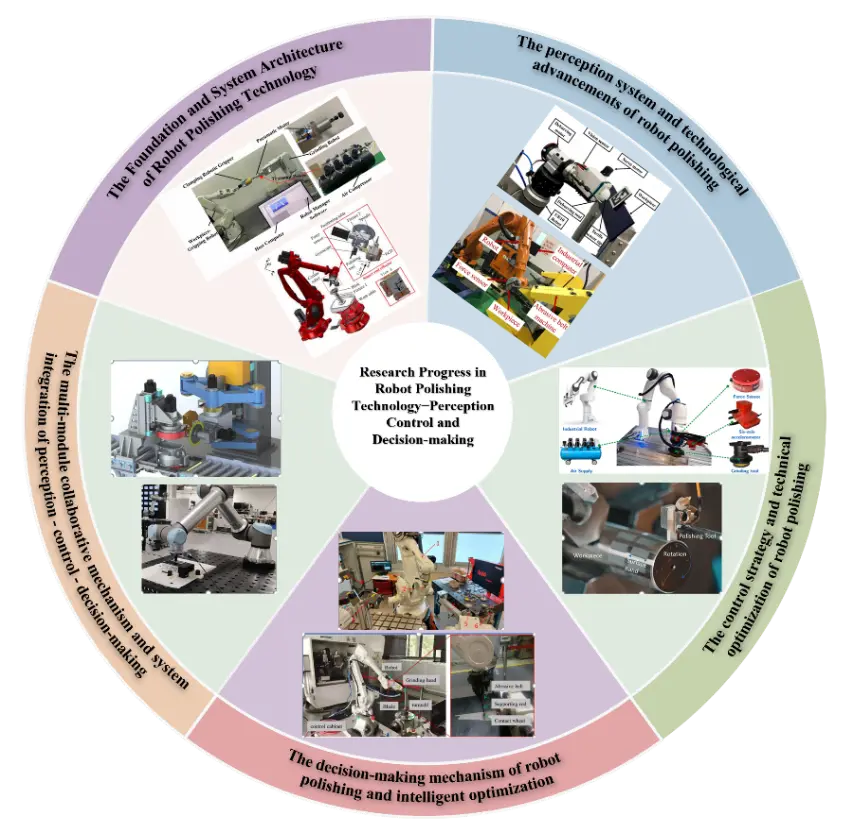
Herein, we take the “perception-control-decision” collaboration as the core logical thread, elaborating on the perception system, control strategy, decision mechanism, and the related multi-module collaboration, application expansion, bottlenecks, and prospects of robot-assisted grinding and polishing technology, as shown in Figure 1. First, the modeling foundation of the grinding and polishing system was introduced, including mechanical modeling, material removal mechanisms, and surface quality evaluation models, along with a perception system based on multi-source information fusion. Secondly, it should be clarified that decision-making here refers to high-level planning, parameter optimization, and task rescheduling based on sensory data, while control strategies involve low-level real-time force/position regulation, impedance adaptation, and stability maintenance. These two aspects differ in both time scale and abstraction level, yet are tightly coupled through sensory feedback loops. The paper discusses force/position control, intelligent control strategies, process decision-making, and path planning optimization methods. Then, the cross-module collaboration mechanism of perception-control-decision was explored. Finally, the typical applications of this technology in aerospace, automotive, and semiconductor fields, as well as the current bottlenecks and future development directions, were summarized. By integrating the entire chain of technologies, this paper aims to provide theoretical support and practical references for the intelligent upgrade of robot polishing systems.
2. Foundation and System Architecture of Robotic Assisted Grinding and Polishing
2.1. Review Methodology
This review was conducted following a systematic literature search procedure to ensure comprehensiveness, objectivity, and reproducibility. The following databases were searched: Web of Science, IEEE Xplore, Scopus, and Google Scholar, covering the period from October 2012 to July 2026. The search strings combined keywords related to three core domains: (1) robotic grinding/polishing; (2) perception/sensing; and (3) control and decision.
The initial search yielded 1247 publications. After removing duplicates (n = 312) and screening titles and abstracts against the inclusion criteria (n = 489 excluded), 446 full-text articles were assessed for eligibility. Following full-text review, 143 publications were ultimately included in this review, reflecting the most relevant and representative works in the field. The selected studies were categorized and analyzed according to the three-module framework: perception (Section 3), control (Section 4), and decision (Section 5), with cross-module collaboration (Section 6) treated as a distinct analytical theme.
The modern robot polishing system is a highly complex system integrating mechanics, control, sensing, and information processing. The rationality of its basic framework directly determines the final processing accuracy, efficiency, and stability. A typical robot polishing system is mainly composed of a core component, that is, the “perception-control-decision” collaborative architecture responsible for information processing and instruction generation.
2.2. Core Components of the Robot Polishing System
The construction of the robot polishing system requires systematic consideration of three aspects: robot body selection, end-effector design, and auxiliary system integration. In the robot body selection, Ke et al. [17] pointed out that industrial robots have higher adaptability and lower costs compared to traditional CNC polishing machines, and thus can complete the processing of large or complex-shaped workpieces without using dedicated fixtures. However, due to the insufficient stiffness of the serial structure, they are difficult to meet the requirements of ultra-precision polishing. To address the issue of insufficient stiffness, Qin et al. [18] proposed a 3-RSS coaxial layout polishing robot, which has three sets of drive arms arranged coaxially along a fixed base column and an asymmetric branch configuration. The dynamic model was established using the virtual work principle and the vector theory, and its accuracy was verified through simulation. Xu et al. [19] further designed a hybrid mechanical arm for ultra-precision free-form surface polishing, consisting of a three-degree-of-freedom parallel module and a two-degree-of-freedom serial module, achieving decoupling of translational and rotational kinematics and using an open numerical control architecture to build a hardware platform. Xu et al. [20] established a stiffness theoretical model based on the virtual work principle and the principle of deformation superposition, and optimized the structural parameters using a genetic algorithm with the goal of workspace and global stiffness.
From the perspective of the end effector and auxiliary system, Schneckenburger et al. [21] focused on the slurry erosion effect of the polishing nozzle and found that when the angle between the nozzle and the workpiece surface exceeds 55°, the polishing liquid jet will independently produce significant material removal, and the nozzle wear after 80 h of use will also change the jet characteristics. This factor must be taken into account in the system auxiliary design. The robot body selection needs to balance flexibility, stiffness, and working space, the design of the end effector must match the specific polishing process, and the integration of the auxiliary system ensures the reliability and processing consistency of the system during long-term operation.
As shown in Figure 2a, Xu et al. [22] proposed a new six-degree-of-freedom hybrid polishing robot, whose structure includes a three-translational-one-rotational parallel mechanism and an A/C-axis serial head. It has been proven that this configuration can achieve ultra-precision polishing of free-form surfaces. In Figure 2b, Wang et al. [23] proposed a five-degree-of-freedom hybrid grinding/cutting robot system, which consists of a vertical guide rail, a two-degree-of-freedom planar parallel mechanism, and integrates a line-type equipment including a five-degree-of-freedom hybrid robot, a two-degree-of-freedom pusher/clamping mechanism, a roller conveyor line, and a laser scanner. It has been proved that this scheme has both high stiffness and high dexterity, and can achieve efficient and automated removal of residual features of medium-sized castings. In Figure 2c, Zeng et al. [24] designed a 3R3P type stone processing hybrid polishing robot, whose structure includes a bridge truss, horizontal/vertical motion sliders, fixed/dynamic platforms, and main/passive motion chains. As in Figure 2d, Zhang et al. [25] designed a passive constant force polishing end effector, which includes a flange, constant force mechanism, slider guide rail, double-row angular contact ball bearings, and polishing spindle, proving that this device can achieve constant force polishing of optical mirrors under the condition of no force sensor and closed-loop control. As shown in Figure 2e, Mohammad et al. [26] designed a force-controlled end effector, whose structure includes a hollow coil motor, spline pair, force sensor, and polished spindle. This design can achieve axial force control without moving the polishing motor, effectively reducing the inertial effect.
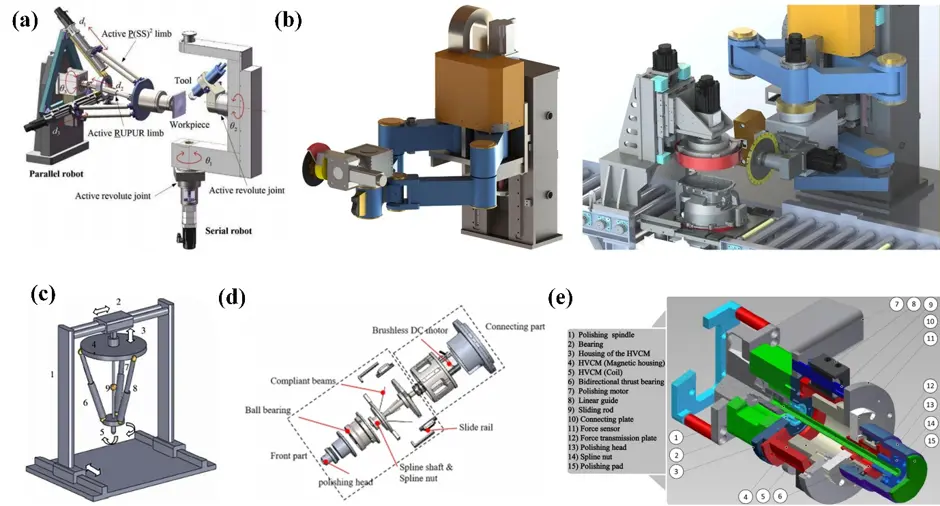
Figure 2. Mechanical configurations of robotic grinding and polishing systems. (a) Structure diagram of the hybrid robot composed of a parallel module with three translations and one rotation, and a connected A/C rotary head [22]. (b) A 5-degree-of-freedom hybrid linkage grinding and cutting robot, along with continuous-flow equipment with laser scanning, is used for small and medium-sized castings [23]. (c) Schematic structure of the 3R3P type stone processing and parallel polishing robot, consisting of a bridge truss, horizontal/vertical sliders, base, and moving platform [24]. (d) The exploded view of the end effector, mainly including the flange, linear guide, and polishing spindle [25]. (e) The structure diagram of the force-controlled end effector consisted of polishing spindle, hollow voice coil motor, force sensor and polishing pad [26].
2.3. Basic Principles and Evaluation Indicators
The material removal mechanisms and evaluation indicators for grinding and polishing provide the theoretical foundation for understanding system design and process optimization. Yan et al. [27] established a material removal rate model considering the overcut and undercut phenomena on the exit paths during robot abrasive belt grinding, decomposing the grinding force into sliding, ploughing and cutting components, and pointing out that the cutting component in the path accounts for more than 40% of the total tangential force, while the sliding components in the normal path and exit path account for 62% and 65% respectively. At the atomic scale processing level, Xie et al. [28] studied the material removal mechanism in atomic and near-atomic scale cutting through molecular dynamics simulation, proposing three typical deformation zones, such as the dislocation slip zone, chip formation zone, and elastic deformation zone. An increase in the radius of the tool edge inhibits the dislocation slip zone and chip formation zone while promoting the expansion of the elastic deformation zone. When the edge radius exceeds the critical value, the material removal mechanism will shift from the shear stress-dominated dislocation movement to compressive stress-dominated extrusion removal. Li et al. [29] compared the variable load experiments of polished and ground single-crystal silicon and combined with smoothed particle hydrodynamics simulation. The residual compressive stress on the grinding state silicon surface can significantly inhibit crack initiation and propagation, increasing the critical normal cutting force from 25.44 mN to 38.93 mN and the critical residual scratch depth from −0.11 μm to −0.14 μm, indicating that the pre-existing compressive stress damage layer is conducive to achieving ductile domain processing.
In the field of evaluation indicators, surface roughness is the core indicator for measuring grinding and polishing quality. Shi et al. [30] conducted an experimental study on robot adaptive hydraulic polishing of NAK80 mold steel, establishing a theoretical relationship model between polishing force, rotational speed, and feed rate and surface roughness, deriving the law that the surface roughness decreases before over-polishing with the increase of polishing force and rotational speed, and increases with the increase of feed rate. Based on the response surface method, they established a roughness prediction model for P800 sandpaper, with a prediction error of less than 7.14%. Zhang et al. [31] systematically summarized eight types of factors affecting surface roughness in the review of ultra-precision machining surface roughness generation, including machine tool performance, cutting parameters, tool geometry, environmental conditions, material properties, chip formation, tool wear, and vibration. From the viewpoint of processing efficiency and energy consumption, Zheng et al. [32] addressed the problem of inconsistent material removal caused by time-varying wear of the sandpaper during polishing, proposing a Gaussian process regression material removal model that considers the Preston coefficient as a function that decays with time rather than a constant, and optimizing the polishing force and feed rate based on genetic algorithms with the goal of minimizing energy consumption. Experiments showed that after optimization, the material removal depth remained consistent throughout the entire travel, and the energy consumption was reduced by 3.34% compared to the unoptimized group, thereby verifying the feasibility of balancing processing quality and energy consumption.
The material removal in grinding and polishing involves the collaborative action of multiple mechanisms, such as mechanical cutting, ploughing, sliding, and dislocation movement, and the material removal mechanism changes with processing scale and process stage. The evaluation indicators need to comprehensively consider multiple dimensions, such as surface roughness, sub-surface damage, processing efficiency, and energy consumption, and there are interdependent relationships among the indicators, requiring theoretical modeling and experimental optimization to seek a balance.
As shown in Figure 3a, Zhang et al. [33] revealed the friction and wear mechanism in SLA grinding. The SiC particles achieve self-sharpening of the grinding wheel through tri-body abrasive wear, while CeO2 particles form a Si–O–Ce chemical adsorption layer through a chemical mechanical reaction with glass ceramics, demonstrating that the two solid lubricants improve the grinding performance through physical wear and chemical action. In Figure 3b, Liu et al. [34] established a three-stage contact force model for abrasive belt grinding, revealing the force evolution patterns in the sliding, ploughing, and cutting stages, and proving that the grinding force shows a phased increase as the cutting depth of the abrasive particles increases. As in Figure 3c, Tao et al. [35] established a chemical mechanical polishing experimental platform for silicon wafers, which includes a rotating polishing head, polishing disc, polishing pad, and dressing device, proving that this device can achieve efficient removal of wafer surface materials and global flattening. In Figure 3d, Mohammad et al. [36] built a robot electrochemical mechanical polishing experimental platform, which includes a computer, RAPCON real-time controller, HVCM driver, stepper motor driver, chemical pump, and electrolyte circulation container, achieving coordinated control of electrolyte circulation supply and polishing force. As in Figure 3e, Wang et al. [37] established a blue sapphire ultra-precision grinding and polishing experimental system, which includes a full-static-pressure ultra-precision grinding machine, polishing tools, and high-speed motor spindle. By designing the full-static-pressure shaft system, processing damage can be effectively suppressed, laying the foundation for subsequent near-atomic-scale non-destructive processing.
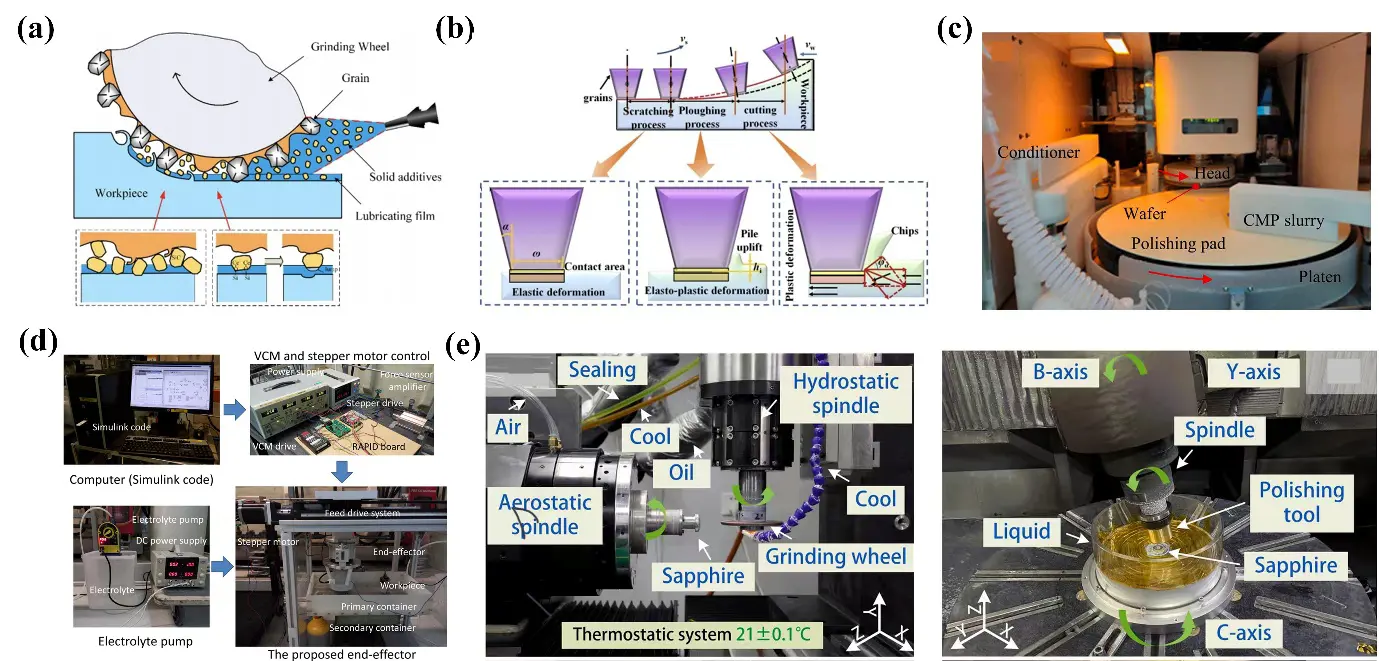
Figure 3. Material removal mechanisms and representative experimental systems for grinding and polishing. (a) The SLA grinding friction and wear mechanism, including the self-sharpening of SiC particle tri-body abrasive wear and the chemical mechanical polishing of CeO2 particles [33]. (b) Three-stage contact force model of abrasive belt grinding, namely the sliding friction stage, the ploughing stage, and the cutting stage [34]. (c) The chemical mechanical polishing (CMP) unit, which includes the rotating head, the polishing disc, and the polishing fluid supply system [35]. (d) Robot-assisted ECMP polishing system including the computer, the RAPCON control platform, the HVCM, the stepper motor driver, the electrolyte pump, the circulation tank, and the DC power supply [36]. (e) The ultra-precision grinding and polishing experimental system, equipped with a liquid hydrostatic guide rail and an air hydrostatic spindle of an ultra-precision grinding machine, the helical feed polishing system, and its tool head structure [37].
2.4. Collaborative Architecture and Enabling Logic of Perception-Control-Decision
The efficiency of robotic polishing systems relies on the organic collaboration among three core modules: perception, decision-making, and control. The closed-loop interaction among these modules is crucial for ensuring precision and stability in processing complex curved surfaces. The perception module acquires geometric features of the workpiece and real-time machining status information, providing a data foundation for subsequent decision-making. Guo et al. [38] integrated a high-precision 3D laser profilometer into an eight-degree-of-freedom redundant polishing robot. By leveraging visual inspection, they achieved accurate extraction and 3D reconstruction of key features, including pipe end positioning, weld start points, highest points along the weld profile, marker points, and left/right toe regions, thereby enabling precise spatial localization of welds.
In the decision-making module, Wen et al. [39] addressed the issue of changing contact areas caused by variations in surface curvature. They employed differential geometry to establish a contact shape model between the sanding disc and the curved surface, estimating contact boundaries and area based on principal curvatures and normal contact forces. Using a binary search method, they iteratively determined adjacent path spacing so that the lower boundary of each subsequent path precisely touches the upper boundary of the previous one. This enabled adaptive, evenly spaced path planning with uniform coverage, effectively resolving issues of missed or excessive overlapping processing associated with fixed-interval paths in regions of varying curvature. Regarding control and system scheduling, Darvish et al. [40] proposed a robotic-assisted system architecture designed for experimental automation. By solving task and motion planning problems simultaneously, they enabled parallel task execution. Utilizing a PDDLStream algorithm, they unified planning and scheduling optimization, minimizing total execution time as the cost function to maximize hardware utilization. This approach reduced experimental execution time by 21.1% compared to serial processing, achieving efficient multi-device coordination and scheduling. The closed-loop integration of perception, decision-making, and control forms the core logic enabling high-quality machining under complex conditions. Based on a synergistic architecture combining visual perception and multi-axis decoupled control, Guo et al. maintained the excess height of spiral welds below 0.3 mm across a 180 mm length at the pipe end.
3. Perception System of Robotic Assisted Grinding and Polishing
In the aerospace, energy equipment, and precision molds fields, the efficient and precise grinding and polishing of complex curved surface parts directly determines the service performance and lifespan of the products. With the vigorous development of robot technology, industrial robots, due to their high flexibility and large working space, are gradually replacing traditional manual or dedicated grinding machines and becoming the mainstream platform for grinding complex surfaces. However, robot assisted grinding and polishing is not simply the robot and tools. Its processing quality is highly dependent on real-time perception and adaptive control of the environment and process conditions. Therefore, the perception system, as the “senses” of the robot for obtaining processing information, has become the core technology that determines the polishing accuracy and consistency of the robot.
3.1. Core Functions of the Perception System
The perception capability of the robot polishing system is the foundation for achieving adaptive processing and quality control. The core functions of the perception system can be summarized into three aspects: state perception, shape perception, and environmental perception. These three aspects work together to provide comprehensive information support for the processing process.
State perception aims to collect key process parameters such as force/torque, vibration, temperature, and grinding wheel wear in real time during the polishing process. Wang et al. [41] addressed the force control problem in blade polishing by using a six-dimensional force/torque sensor to measure the actual normal grinding force and eliminate the influence of gravity across different robot postures through gravity compensation. The compensated signal was then converted to the tool coordinate system as the feedback object for the force controller. Feng et al. [42] studied the robot brushing and grinding of high-speed rail car bodies, used ATI force control sensors to perceive the axial force and normal torque when the brush roller contacts the workpiece. Kim et al. [43] pointed out that force control and path planning are the key to achieving uniform grinding and high surface quality, and sensors play an irreplaceable role in perceiving the grinding state and monitoring the interaction between the actuator and the environment.
Shape perception aims to obtain the original shape of the workpiece, the post-processing surface shape, and the contour reconstruction information of complex curved surfaces, providing a basis for processing trajectory planning and quality assessment. In the offline programming of hub polishing, Liu et al. [44] extracted geometric feature information from the hub CAD model, generated discrete processing path points in the workpiece coordinate system, each point containing position and posture information, thus laying the foundation for subsequent redundant optimization. Li et al. [45] used a laser interferometer to measure the surface shape error of the workpiece, and proposed a statistical chaotic error perception (SCP) model in the polishing of sub-aperture of optical elements. Through experimental data analysis, the statistical predictability of chaotic errors, and achieved quantitative perception of chaotic errors were proved. Cheng et al. [46] proposed a surface shape measurement method based on a dual scanning positioning strategy. Using a laser confocal sensor to achieve non-contact linear scanning and surface scanning, they obtained three-dimensional (3D) shape data, including surface roughness parameters (Sa, Sq, Sz), statistical parameters (Ssk, Sku), and surface isotropic parameters (Str, Std), providing a quantitative basis for polishing quality assessment.
Aim to detect obstacles in the workspace and enable safety perception and distance monitoring in the human-machine collaborative scenario. Ferraguti et al. [47] proposed an online assessment method for polishing surface quality based on augmented reality. With the Microsoft Kinect V2 depth sensor and certified safety laser scanner, a safety perception system was built. Through a dedicated PC and safety PLC, real-time distance monitoring and safety control logic were realized in the collaborative environment where the operator coexists with the robot, providing safety guarantees for the operator to enter the working space for quality assessment. By integrating the perception functions, the robot polishing system can achieve comprehensive perception of the processes, workpiece state, and working environment, laying the foundation for subsequent adaptive control and intelligent decision-making.
The perception capability of the robot polishing system is the foundation for achieving adaptive processing and quality control. In Figure 4a, Lloyd et al. [48] proposed the Synchronous Registration and Alignment (SRAM) framework and verified its advantages in contact stability. In this framework, the error state variables for workpiece registration and tool radius include the translation, rotation, tool radius, and wear. According to the comparison of power spectral density, the SRAM controller maintains low force tracking error across the entire frequency band, proving that this framework can effectively eliminate force tracking errors and improve processing quality through online registration correction and variable damping adjustment. As in Figure 4b, Guo et al. [49] proposed a trajectory generation method for the rough grinding stage of the turbine seals. The system includes point cloud comparisons before and after processing obtained by a 3D camera, the grinding area, and a 3D rough grinding trajectory view. This strategy quickly removes approximately 95% of the honeycomb structure by using a normal offset trajectory, laying the foundation for the subsequent closed-loop fine grinding. As shown in Figure 4c, Zhang et al. [50] proposed a sanding belt condition monitoring method based on sound signals. The system architecture includes a robot, a force sensor, a microphone, and a signal processing module. The grinding capacity factor decreases with increasing grinding time across three contact pressures, providing a data basis for the subsequent OP-ELM prediction model. In Figure 4d, Tian et al. [51] constructed an experimental platform for automatic surface polishing of robots. This system consists of a six-degree-of-freedom industrial robot, an ATI six-dimensional force/torque sensor, polishing tools, and a computer controller. It was demonstrated that this platform can detect the polishing force through the force sensor in real time and convert it into a pressure compensation signal, enabling constant-pressure polishing control of the surface.
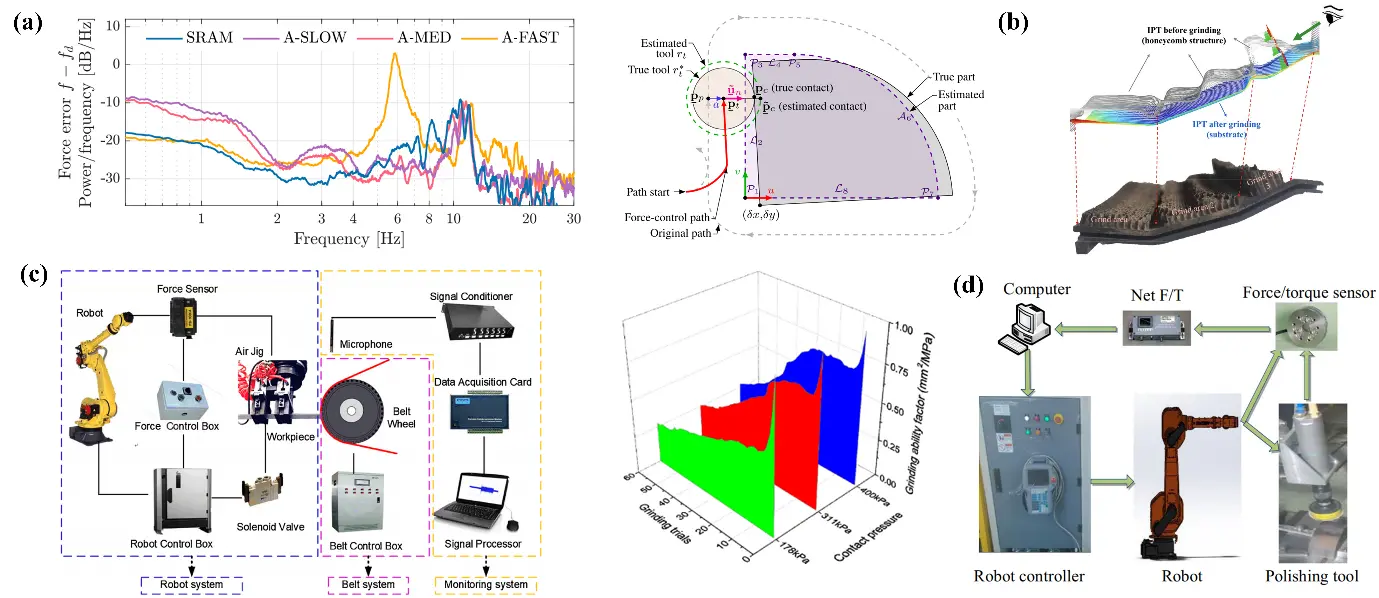
Figure 4. Perception, monitoring, and experimental platforms for robotic polishing. (a) Interacting geometric diagram of workpiece-tool and power spectral density graph of controller force tracking error [48]. (b) Robot grinding trajectory generated during coarse grinding [49]. (c) Schematic diagram of the sanding belt condition monitoring system and the curve showing the variation of the grinding capacity factor [50]. (d) Components of the robot automatic polishing platform [51].
3.2. Key Sensing Technologies and Equipment
Force/torque perception, as the core of contact state perception, is directly influenced by the integration method, signal quality, and dynamic response characteristics of the sensors, which in turn affect the control accuracy and processing consistency. Hong et al. [52] used a six-dimensional force sensor (ATI THETA) to collect the force data at the end, combined with laser tracking instruments to simultaneously measure the deformation amount, and constructed a training data set covering the entire working space and various working conditions through Latin hypercube sampling and variable load systems, providing high-quality haptic information sources for the establishment of deformation prediction models. Dong et al. [53] proposed an indirect detection method for contact force based on joint torque sensors, using the built-in torque sensors and motor encoders of the robot to construct an improved extended state observer (MESO), which can estimate the end contact force in real time without the need for external six-dimensional force sensors, and can still control the force estimation error within ±1 N under the strong vibration interference caused by the high-speed rotation of tools. Shi et al. [54] addressed the accuracy decline of Kalman filter method in non-Gaussian noise environments, proposing a hybrid adaptive-robust Kalman filter method (HARKF), which dynamically switches between adaptive Kalman filtering and robust Kalman filtering through a noise type discrimination module. A parameter transfer mechanism was introduced to eliminate coupling interference between filters, greatly improving the force estimation accuracy in non-stationary noise environments. Zhang et al. [55] further simplified the force perception system architecture by approximating the ratio of the grinding normal force to the tangential force as constant. Thus, a constant force control was achieved based on one-dimensional force sensors, to reduce the force fluctuation to within ±2 N in both planar and curved surface polishing experiments. Li et al. [56] integrated force sensors and laser displacement sensors at the end of the floating polishing actuator, using the force sensor to real-time detect the contact force and the displacement sensor to pre-detect the curvature changes of the workpiece surface to achieve feedforward compensation. The collaboration of two equipment reduced the force fluctuation caused by path deviation. Wan et al. [57] pointed out that micro-nano structure designs, such as interlocking micro-domed arrays, crack structures, and biomimetic whisker structures in sensors, could improve sensitivity and dynamic response speed, providing a device foundation for the end tactile perception of the robot system.
The visual perception technology in robot polishing mainly manifests as the detection of the workpiece and the guidance of the processing path. Hong et al. [52] used a laser tracking instrument as the reference equipment for deformation measurement, achieving high-precision real-time measurement of the end deformation amount, with the measurement error serving as the basis for model verification and compensation strategy evaluation. Dong et al. [53] identified the characteristic frequencies of high-frequency vibrations caused by the rotation of the polishing tool through spectral analysis (100–120 Hz). And based on this, they designed a cascaded band-stop filter and a tracking differentiator adaptive filtering scheme, filtering out the periodic interference of visual and haptic signals.
Multi-source perception fusion is a key approach to improving the overall perception accuracy and robustness of the polishing system. Shi et al. [54] proposed the HARKF method, which is essentially a multi-level perception information fusion framework. By combining the generalized momentum observer with adaptive/robust Kalman filtering, it enables real-time fusion and optimal estimation of multi-source sensing information, such as current signals and joint position/velocity signals, thereby reducing data redundancy and improving the accuracy and robustness of external force estimation. Zhang et al. [55] combined iterative learning with sliding mode control. Through cumulative learning and step-by-step compensation of force errors during multiple grinding processes, they achieved a force control parameter adaptive adjustment mechanism based on time series data fusion. After ten iterations, the force fluctuation decreased from 5–6 N to 2 N.
As in Figure 5a, Dong et al. [58] constructed an adaptive robot polishing platform based on distributed flexible force sensors. This system consists of an AUBO-i5 collaborative robot, a real-time controller, 4 × 4 distributed flexible force sensors, and a terminal actuator including flange connectors, force sensors, and flexible polishing pads. It was demonstrated that this device can achieve coordinated control of contact force values and distribution states, thereby improving the consistency of the polished surface quality. In Figure 5b, Halwani et al. [59] designed a multi-functional sensor system based on vision. This system includes a collaborative robot and an integrated visual-tactile sensor with a movable gate mechanism and a single optical camera. In Figure 5c, Surindra et al. [60] collected the raw signals of the acceleration and force sensors during the belt grinding process. The system includes three-axis accelerometers and three-axis force sensors, installed on the tension arm of the belt and below the workpiece fixture. The differences in X-axis signals under the four new belt conditions indicate that vibration and force signals can effectively reflect the degree of wear. In Figure 5d, Zaki et al. [61] proposed a trajectory accuracy evaluation method based on low-cost 3D cameras and force control. Despite the existence of depth estimation errors, through closed-loop force control, the trajectory deviation can be effectively compensated, meeting the requirements of contact applications. As shown in Figure 5e, Kim et al. [62] designed a new type of six-axis force/torque sensor structure, which consists of a top plate, a deformation plate, a base plate, an enclosure, a bottom plate, and an electrode/signal processing PCB. This module achieves low-cost and lightweight six-dimensional force sensing through simple assembly.
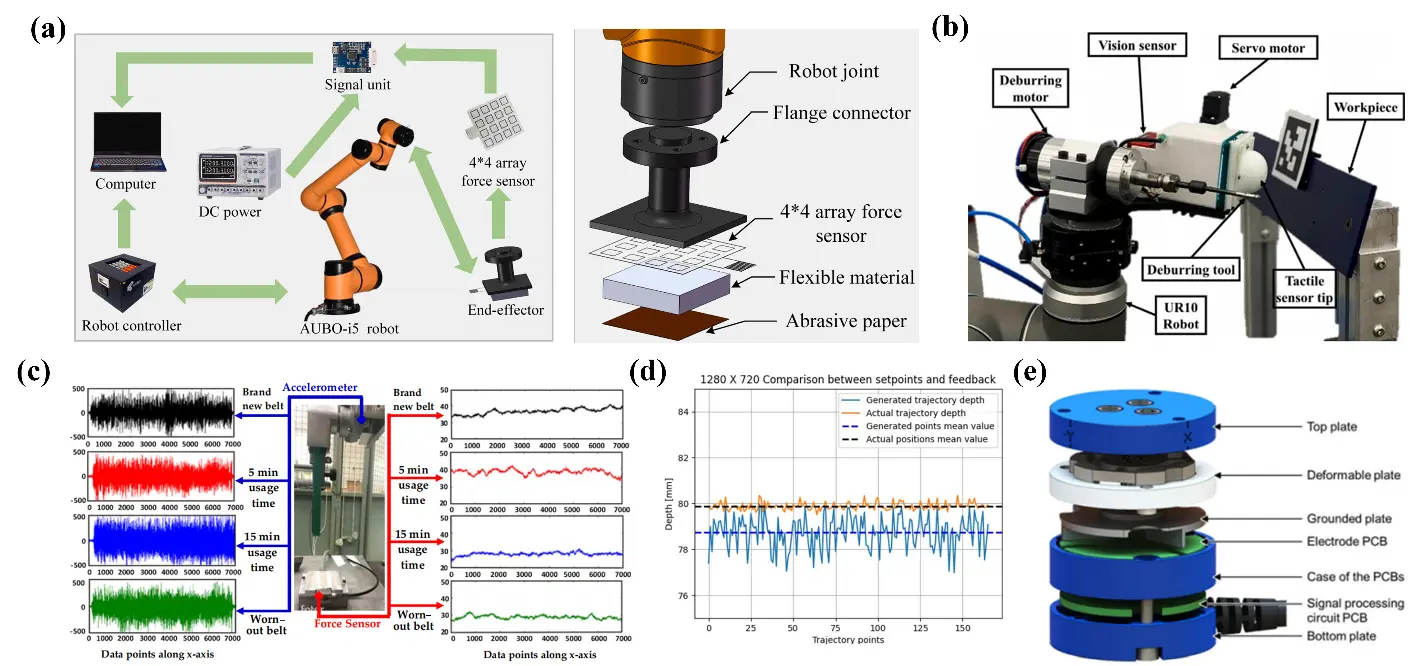
Figure 5. Sensor devices and perception platforms for robotic polishing. (a) Adaptive robot polishing platform and its end-effector structure [58]. (b) A precise manufacturing system for robots based on multi-functional visual sensors [59]. (c) Comparison chart of X-direction acceleration and original signal of force sensor [60]. (d) Comparison of depth between 3D model-generated trajectory points and actual trajectory [61]. (e) Assembly and disassembly diagram of a six-axis force/torque sensor [62].
4. Control Strategies for Robotic Assisted Grinding and Polishing
The robotic assisted grinding and polishing system is a complex electromechanical system involving robot kinematics, dynamics, material removal mechanisms, and multi-physics field coupling. The quality of its control strategy directly determines the final processing accuracy, efficiency, and surface quality. In the early days, robot polishing mostly adopted teaching-playback or offline programming methods, achieving automated processing through pre-planned trajectories. However, in the face of dynamic uncertainties such as workpiece clamping errors, uneven incoming material allowances, and wear of grinding wheels/sand belts, this open-loop control method is difficult to meet the requirements of precision manufacturing. Therefore, modern robot control is evolving towards the direction of softness, adaptability, and intelligence, with its core lying in resolving the inherent contradiction between the rigidity of the robot and the flexibility of the processes.
4.1. Basic Control Strategy and Implementation Method
The basic control strategy of the robot system can be summarized as two core modules: position/pose control and force control. These two modules work together to ensure the surface quality and shape accuracy of complex curved surface processing.
In terms of position/pose control, precise kinematic modeling is the theoretical prerequisite for achieving trajectory tracking and pose adjustment. Song et al. [63] discretized the processing path based on the NURBS surface model and the equal chord high-error algorithm, determined the complete pose information of each path point through the normal vector of the workpiece and the tangent vector of the path, and realized the automatic generation of polishing paths for complex curved surfaces through the NX secondary development platform. As for the airbag polishing process of large-axisymmetric aspherical optical components, Huang et al. [64] established the spatial transformation relationship between the workpiece coordinate system, the local coordinate system of the polishing point, and the tool coordinate system of the airbag center, derived the pre-motion model maintaining a constant precession angle, and verified the correctness of the motion model and control algorithm. In the application of hybrid robots for optical polishing, Huang et al. [65] established a linearized error model including geometric error sources at the joint/rod level based on the spinor theory. The pose error data were collected through a laser tracker for pure translational motion, with the maximum position error and attitude error controlled within 0.06 mm and 0.06 deg respectively. Ouyang et al. [66] proposed a position-domain control method for a two-degree-of-freedom XY motion platfo that performs equidistant sampling of the primary motion and represents the secondary motion as a function of the primary motion. This approach eliminates tracking errors in the primary motion and outperforms time-domain and cross-control methods in straight-line and circular contour tracking. Subsequently, this team extended the position-domain control to multi-degree-of-freedom nonlinear robotic systems with coupled dynamics [67]. This extension enabled straight-line and nonlinear contour tracking for three-degree-of-freedom serial robots. Furthermore, they introduced nonlinear proportional-derivative (NPD) control in the position domain, whose performance surpasses both linear position-domain PD and time-domain NPD control, particularly excelling in nonlinear contour tracking tasks [68]. These three studies collectively establish a systematic control framework for robotic manipulators based on position-domain master-slave contour tracking.
From the viewpoint of force control strategy, the stable control of contact force has a decisive influence on the material removal rate and surface quality. Song et al. [69] analyzed the mapping relationship between grinding force and depth in the robot sand-belt grinding process, established a force-depth model considering the deformation of the contact wheel and the change of grinding contact angle. Experimental results showed that the growth trend of grinding force with the increase of pressure depth (about 344–445%) was greater than that of grinding depth (about 53%). Dong et al. [70] designed an air-pushing force control system based on a high-speed switching valve, and used PWM signals to drive, and combined with the PID control algorithm with moving average filtering. The desired polishing force on the 3-TPS hybrid robot platform was achieved, with the absolute average error percentage decreasing from about 8% to about 2% as the expected force value increased. To further improve the force control bandwidth and response speed, Li et al. [71] proposed a macro-micro robot polishing architecture, by decoupling the polishing motor from the linear force motor to minimize the motion inertia along the spindle direction. A main force control end effector based on a voice coil motor achieved an actual force control bandwidth of 200 Hz. Experiments showed that the force tracking overshoot of this end effector was smaller, and the surface roughness Ra of the polished surface reached 0.4 μm, which was 24.70~34.17% higher than the pure macro robot force control method. Cheng et al. [72] addressed the trajectory tracking problem of a 2-DOF closed-chain five-bar mechanism driven by one constant-velocity (CV) motor and one servomotor. Their adaptive control law estimates unknown dynamic parameters online and is theoretically proven to guarantee that tracking errors converge to zero, providing a rigorous framework for disturbance compensation in robotic polishing systems.
However, the above studies show that the position/pose control and force control strategy in the robot polishing system exhibit strong coupling characteristics. Trajectory planning needs to take into account the geometric constraints of the contact posture, while the force control accuracy is affected by the robot stiffness and end deformation. As shown in Figure 6a, Tian et al. [73] established a force analysis model of the polishing cutter on the curved surface, which includes the robot base coordinate system, the robot end coordinate system, and the force sensor coordinate system. Through coordinate transformation, the interference of tool gravity on the measurement value of the force sensor is eliminated, proving that this gravity compensation method is a key prerequisite for obtaining the actual polishing force. In Figure 6b, Zhang et al. [74] established a coordinate system for the robot sand-banding grinding of aviation blades and proposed a mixed force/position disturbance rejection control strategy. The transformation relationships among the world coordinate system, the robot base coordinate system, the force sensor coordinate system, and the sand-banding coordinate system were demonstrated. The fuzzy PID control framework consists of a position control loop, a force control loop, and a speed gain loop, and proves that this strategy can achieve accurate perception and stable control of contact force. In Figure 6c, Zhao et al. [75] established an attitude solution model for the grinding head in the Frenet frame, which determines the direction of the grinding head by rotating the initial posture matrix around the axis vector. It was shown that this rotation algorithm can compute the posture matrix of the grinding head at each point along the processing trajectory. As in Figure 6d, Tian et al. [76] developed a high shear low pressure intelligent precision grinding system, which includes a robot control module, a motion platform control module, and a force control module. The hardware integrates a six-axis ABB industrial robot, a HS-360 3D precision motion platform, a six-dimensional force sensor, and an ultralow elastic composite abrasive tool SECAT.
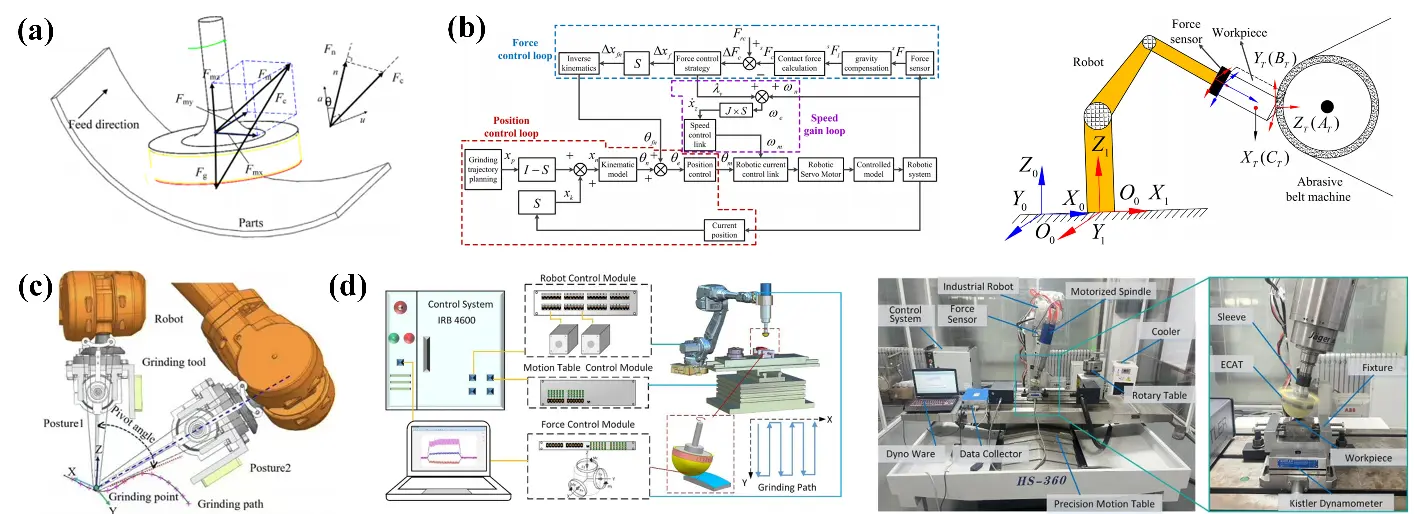
Figure 6. Force/position hybrid control modeling and experimental systems for robotic grinding. (a) Force analysis diagram of the curved surface polishing cutter head, with a reference for force control [73]. (b) Force/position hybrid anti-interference control strategy based on fuzzy PID and coordinate system relationship diagram of the robot automatic grinding system [74]. (c) Rotation calculation of the Frenet frame of the grinding head [75]. (d) Structure and physical diagram of the high shear-low pressure intelligent precision grinding system and grinding experimental device [76].
4.2. Advanced Control Technology
As the objects being polished by robots expand from regular planes to complex free-form surfaces, multiple uncertain factors such as time-varying environmental stiffness, geometric errors of the workpiece, and tool wear. External disturbances have raised higher requirements for force control performance. Traditional impedance control, due to its fixed parameters, is difficult to adapt to the aforementioned dynamic changes; thus, advanced control strategies capable of environmental perception and autonomous adjustment are urgently needed.
In adaptive control, adjusting the impedance parameters online to match the unknown environment is the core idea for achieving high-precision force tracking. Inspired by the adaptive behavior of human arm stiffness, Zhang et al. [77] proposed a novel variable target stiffness (NVTS) control strategy. By designing a PID form of the target stiffness update law, they achieved online adaptive adjustment of environmental stiffness and additionally introduced an impact compensator to enhance the disturbance suppression ability during polishing under strong vibration interference. This controller was verified on two different bandwidth robots, UR5 and Xmate7Pro, and the mean force tracking error could be controlled within 10 N, with a standard deviation of no more than 0.48 N. Wang et al. [78] proposed an adaptive variable impedance control algorithm with pre-PD adjustment for the macro-micro robot polishing system. By first reducing the force error and then applying the adaptive update law, they effectively solved the problem of excessive contact force overshoot in traditional adaptive impedance control. The force tracking experiments in planar, inclined, and curved environments showed that this algorithm could control the force tracking error within 0.78 N, with an overshoot of less than 4.5%, while the force errors of traditional impedance control, adaptive impedance control, and adaptive variable impedance control were 2.08 N, 1.30 N, and 1.34 N respectively, with overshoots of 19.2%, 56.3%, and 11.1% respectively. Seo et al. [79] proposed an impedance control method based on model predictive optimization for the additional disturbance caused by the floating base in large-area polishing operations. Through finite-time domain prediction to optimize the stiffness coefficient of the impedance compensator, they achieved a force tracking adjustment time that was 28.1% faster than traditional impedance control and shortened the recovery time to 0.82 s for a 20 mm step disturbance.
In intelligent control, the introduction of methods such as fuzzy logic, neural networks, and iterative learning significantly improved the control robustness in complex disturbance scenarios. Li et al. [80] studied a visual-guided fuzzy adaptive impedance control (AICVG) strategy for the system stiffness variation caused by material removal, temperature changes, and lubrication state changes during the polishing process of concave curved workpieces. Using the SVR-Jacobian estimator, the mapping relationship between image features and robot joint angles was established. This strategy maintained the force control error within ±1.5 N under time-varying stiffness conditions, and reduced surface roughness by 59.7% compared to traditional impedance control. Zhang et al. [81] combined dynamic time warping and iterative learning control, and proposed a human-machine interaction skill learning and correction framework. By improving the DTW algorithm, they solved the problem of inconsistent test lengths caused by changes in the polishing feed speed. In the path learning stage, the introduction of variable weight factors effectively filtered out the less reliable data affected by the actual trajectory deviation in the human-machine interaction force. In the force tracking stage, by iteratively estimating the polishing contact stiffness and integrating it into the path update law. And, after the 7th iteration, the mean and standard deviation of the force tracking error were reduced to 0.18 N and 0.12 N, respectively.
From the perspective of collaborative control, human-machine collaboration and multi-robot coordinated control are the key to ensuring the safe and efficient completion of complex grinding and polishing tasks. Gaz et al. [82] studied a human-machine collaborative control method based on model residuals to address the physical interaction issues between human operators and robots. Combined with the measured values of end-effector force/torque sensors, they decoupled the intentional reconfiguration force applied by the human operator to the robotic arm and utilized the redundancy of robot kinematics to relax the posture constraints. This method was implemented on the UR10 robot, enabling the human operator to naturally redirect the workpiece posture without external assistance. El et al. [83] proposed a human-machine collaborative posture optimization framework based on virtual units from the perspective of ergonomic optimization. By constructing the human motion chain through a virtual spring-damper model and solving the optimal static posture. When detecting an operator’s non-ergonomic posture, the framework displays the optimized posture through the feedback interface and controls the collaborative robot to adjust the workpiece position. Zhang et al. [81] established a DTW-ILC framework, which also supports human-machine interactive path teaching and correction. The operator can express the intention of path correction by applying interactive force, and the robot gradually approaches the expected polishing trajectory through iterative learning. After three iterations, the mean and standard deviation of the path learning error were reduced to 0.87 mm and 0.42 mm, respectively.
As in Figure 7a, Wahballa et al. [84] used a robot polishing control strategy based on an OSRDF variable impedance controller and gravity compensation, and built an experimental platform. The impedance controller architecture with online stiffness and reverse damping force. The experimental system consists of a UR robot, force sensors, and polishing tools, thereby achieving constant-force polishing and uniform material removal on composite surfaces. As shown in Figure 7b, Xia et al. [85] established a geometric solution model for the inverse kinematics of curved bone grinding, which includes the center point of the ball head tool, the ball center, and the length. Through the geometric relationship between the depth control direction (Z-axis) and the angle control direction (Q-axis), it was proved that this inverse kinematics method can achieve synchronous adjustment. In Figure 7c, Li et al. [86] designed an integrated scheme for the robot grinding and polishing of blades, integrating the VCM module, sanding belt grinding module, and grinding wheel polishing module at the robot end. As shown in Figure 7d, Zhang et al. [87] proposed the main idea of dual-robot collaborative synchronous control, used impedance strategies to soften force behavior, and NMPC strategies to achieve precise motion. As shown in Figure 7e, Solanes et al. [88] built a human-machine collaborative surface treatment experimental platform, which includes the Sawyer 7R robot, guiding force sensor, processing force sensor, T-shaped guide handle, and cylindrical tool. This dual-force sensor configuration can achieve collaborative control of operator guidance and tool normal force/verticality maintenance. As shown in Figure 7f, Han et al. [89] proposed a collaborative robot grinding control scheme based on nonlinear impedance control and trajectory adaptation. This scheme includes a bottom-level nonlinear impedance controller and an upper-level trajectory/force tracking mode switching logic. Through force threshold judgment, it enables seamless switching between the two modes and meets the force tracking requirements of complex grinding tasks.
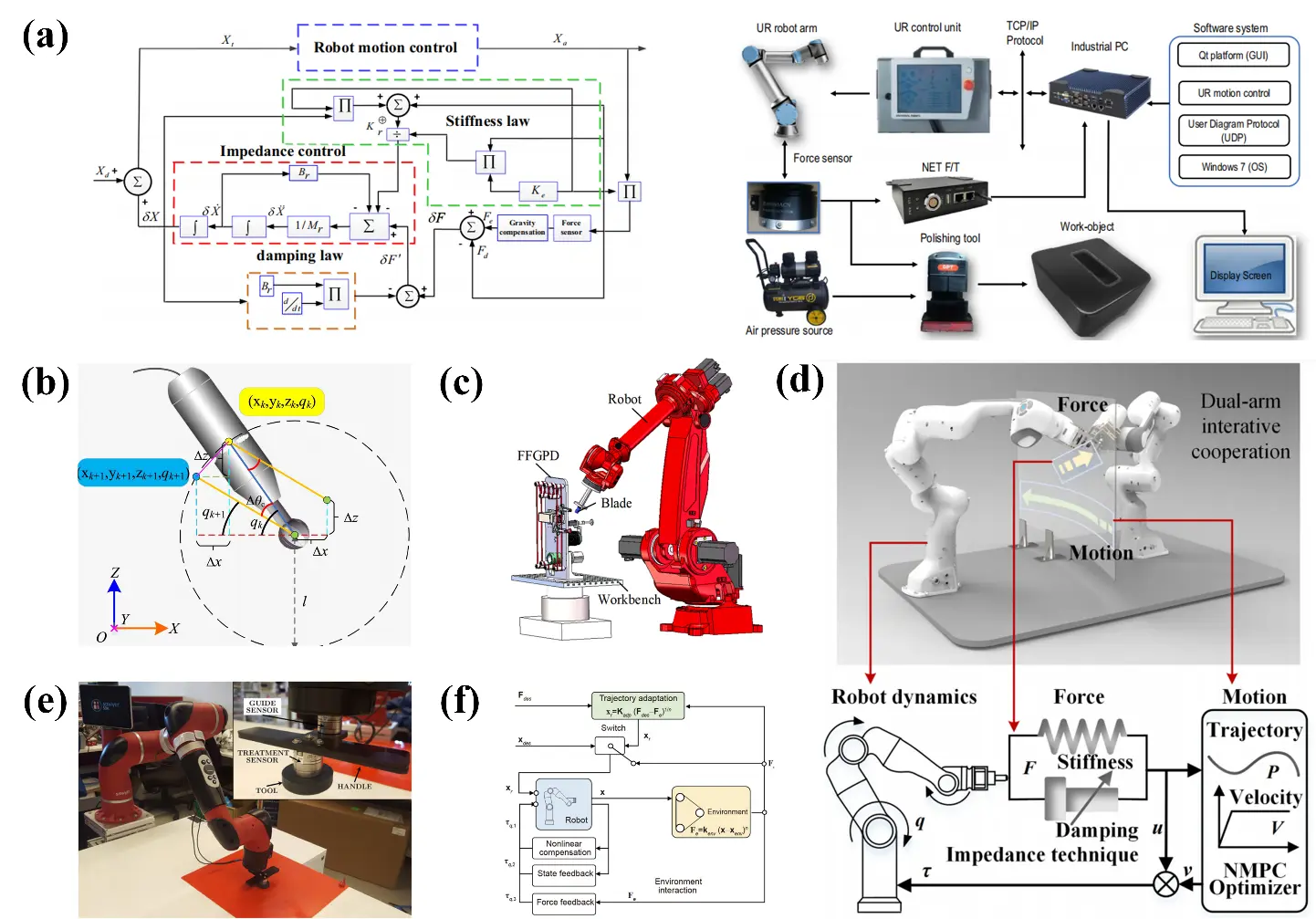
Figure 7. Advanced control strategies and collaborative control platforms for robotic polishing. (a) The OSRDF variable impedance controller with gravity compensation scheme and the composite surface robot polishing experimental setup [84]. (b) Schematic diagram of inverse kinematics geometric solution [85]. (c) Schematic diagram of the robot full-feature grinding and polishing system [86]. (d) Synchronous control framework for two robots [87]. (e) Human-machine collaborative surface processing experimental setup [88]. (f) Nonlinear impedance control and trajectory adaptive control process [89].
4.3. Control Precision and Stability Regulation
The control accuracy and processing stability of the robot polishing system are jointly restricted by mechanical vibration and the matching of process parameters. Due to the low stiffness and small damping of industrial robots, fluctuations in contact force can easily trigger joint flexibility and end-effector vibrations. Moreover, the lack of coordinated optimization between control parameters and process parameters further exacerbates the system’s uncertainty. Therefore, enhancing the system’s stability from the two aspects of mechanical vibration suppression and parameter matching optimization is the key to achieving high-precision polishing control.
Zhu et al. [90] addressed the problem of time-varying stiffness vibration in the aerodynamic grinding of aircraft engine blades, using the D-H method to establish a kinematic model and solving the overall stiffness matrix based on the matrix displacement method. They also established an empirical prediction formula for the displacement and standard deviation of vibration intensity at the end node, and proposed a cutting speed direction constraint condition for the blade boundary area. Experiments showed that the vibration intensity significantly decreased after boundary optimization. Wu et al. [91] designed a six-axis acceleration sensor integrating four piezoelectric three-axis accelerometers. High-precision decoupling of the load-side vibration state was achieved through the Jacobian mapping of Cartesian space six-dimensional acceleration and joint space acceleration. The acceleration feedback enhanced the anti-disturbance ability by introducing active damping. In the grinding experiment of aerospace structural components, the surface roughness decreased from Ra 0.855 μm to Ra 0.233 μm. Considering the robot dynamics changes as additive uncertainties and incorporating them into the controller synthesis, Zhang et al. [92] proposed an H∞-optimized inertial active vibration control strategy for milling chatter problems. In the milling experiment, the surface profile RMS decreased from 16.3 μm to 2.4 μm, with a reduction of 85%.
In parameter matching optimization, Zhang et al. [93] studied the contradiction between path complexity and processing stability in deburring, using a trajectory planning method based on adaptive weights. They quantified path complexity using the interval mutation rate and LS-gradient, and combined them with pose stiffness to construct an adaptive weight function. Experiments showed that compared with the fixed weight method, the processing efficiency increased by 27.9% and the stability improved by 7.4%. Zhang et al. [94] designed a self-anti-disturbance control constant force end-effector for normal force positioning errors that are highly sensitive to normal positioning errors. They achieved an average error of less than 0.05 N for the normal force in uniform polishing and reduced the RMS from 22.15 nm to 7.59 nm after deterministic polishing. Shi et al. [95] proposed a five-degree-of-freedom force/position hybrid control strategy based on fuzzy PID for large curved surface grinding of wind turbine blades. Surface tracking by real-time perception of surface morphology with a laser sensor, and they eliminated the interference on force measurement by gravity compensation. The surface roughness Ra was controlled at 2.48 μm, within the optimal range for subsequent coating. The above studies demonstrate that optimizing control parameters requires considering the matching relationship between sensor information dimensions, path geometric features, and process parameters to ensure consistency and stability.
5. Decision-Making Mechanism of Robotic Assisted Grinding and Polishing
Under the vision of intelligent manufacturing, the robot polishing system is undergoing a profound transformation from “automated execution” to “intelligent decision-making”. The traditional robot polishing relies on offline programming and fixed process parameters, and its decision-making process is essentially open-loop, lacking the ability to autonomously respond to changes in the processing state. However, in the face of complex working conditions such as uneven workpiece allowance distribution, material characteristics differences, and tool wear, the system must possess the ability to perceive, analyze, and make autonomous decisions in real time to achieve stable and consistent high-quality processing. The decision-making mechanism, as the “brain” of the robot polishing system, lies in dynamically planning the process path, optimizing process parameters, and regulating execution strategies.
5.1. Architecture of the Decision System
The robot polishing decision-making system is the core hub for achieving autonomous intelligent processing. Its function lies in autonomously generating decision instructions such as path planning, process parameter matching, and fault handling based on the perception of workpiece morphology, process status monitoring, and task objective constraints. Traditional offline programming methods are difficult to cope with the geometric uncertainty and dynamic changes of the processing process for complex workpieces, and thus, it is urgent to construct a decision-making architecture that integrates path decision-making, process parameter decision-making, and fault decision-making.
Planning polishing paths based on the workpiece morphology and optimizing obstacle avoidance are the primary tasks. Song et al. [96] proposed a dynamic partition trajectory planning method based on improved curvature characteristics for the XY-3-RPS hybrid robot for free surface polishing. Through curvature gradient detection and an adaptive region growth algorithm, they achieved fine division of high-curvature regions and efficient processing of low-curvature regions, and combined a genetic algorithm with a local search for hybrid optimization, thereby reducing the maximum curvature by 73.8% and the number of trajectory points by 96.8%. Chi et al. [97] proposed a human-machine collaborative programming method based on adaptive virtual fixtures for interference problems in the polishing of the narrow and deep twisted flow channel of the impeller, using a flexible virtual fixture centered on the reference trajectory. Ciccarelli et al. [98] generated the trajectory using NX CAM and conducted virtual simulation verification through Tecnomatix Process Simulate. Then, they used the Xsens motion capture system to record the operator’s movements and imported them into the simulation to achieve iterative optimization of accessibility and obstacle avoidance strategies.
The adaptive matching of polishing speed, pressure, and feed rate is the key to achieving stable material removal. Kakinuma et al. [99] proposed a parameter collaborative decision-making method for the macro-micro robot polishing system based on the extended Preston law. The linear regression method was used to identify the weight indices of pressure, speed, and residence time. With a constant feed rate per revolution as the target, the spindle speed and polishing force instructions were dynamically generated to achieve a polishing depth within the fourth quartile of 1 μm. Latifinavid et al. [100] proposed a hybrid force model method for the gentle grinding of parallel hexapod robots. This method extracted time-domain features from indentation tests and used the spindle load rate as a supplementary feature. By using correlation feature selection to screen the optimal subset, the root mean square error of the normal force prediction was reduced from 3.659 N to 3.238 N.
Tool wear identification and emergency handling of processing quality deviations are important lines of defense to ensure the reliable operation of the system. By using various sensor signals such as force, vibration, and acoustic emission, Zhang et al. [101] indirectly detected the abrasive wear method and established a wear mapping. The random forest classifier in the acoustic signal achieved a prediction accuracy of over 94% across different wear cycles. Zhou et al. [102] proposed an energy-aware corrective shared control architecture to address the instability of the system caused by the conflict between the operator’s intention and autonomous behavior during collaborative polishing. This architecture achieves passive operation of the system through the energy coupling scaling strategy at the master and slave ends, and ensures system stability under abnormal intervention through the energy threshold mechanism. Wu et al. [103] designed a force-controlled spherical polishing tool, combining rotational and common rotational movements, to address the problem of polishing force fluctuations caused by robot positioning errors. By using a voice coil motor for main force control, the relative error of force was controlled within 5% within the range of 10 to 40 N. The above studies show that the intelligent decision-making system for polishing robots needs to integrate multiple-level decision modules, such as geometric perception, process optimization, and abnormal handling, to achieve stable manufacturing operations.
As shown in Figure 8a, Oo et al. [104] made a flow chart for a sand belt wear monitoring system. The system works based on image processing with a digital microscope to get images, a random forest classifier (RFC), and a multiple linear regression (MLR) model. Tests show this system can tell the wear state of sand belts. In Figure 8b, Qu et al. [105] built a test platform for robot sand belt grinding. The platform has an ABB IRB4400 six-axis industrial robot, an ATI Omega-160 six-dimensional force sensor, a Ti-6Al-4V titanium alloy workpiece, and a sand belt grinding machine. It can also collect and check surface roughness data with force control. As in Figure 8c, Schneyer et al. [106] propose a method for dividing complex free-form surfaces. The method uses different colors to mark different areas. Blue stands for the center processing strategy, and red stands for the edge strategy. This method can work well on complex surfaces with concave and convex shapes and double curvature features, and lays a base for later path planning that covers the whole surface. In Figure 8d, Mohammad et al. [107] put forward a way to optimize polishing parameters. The method uses neural networks and genetic algorithms. The algorithm has two steps, that is, NNW modeling and GA optimization. The result shows that the fitness function drops fast and becomes stable as the number of evolution rounds increases. As shown in Figure 8e, Nemer et al. [108] put forward two things: a non-processing motion generation algorithm, and a graph search path planning framework. The flow chart shows a strategy to lower calculation complexity. It cuts complexity from O(n2) to O(n) by using withdrawal-free-closer motion. They also built a graph model for the traveling salesman problem. The model has three groups of processing motions, with solid lines representing processing motions and dotted lines representing non-processing motions. As shown in Figure 8f, Wang et al. [109] put forward a simulation method for robot real-time motion planning. The system is based on the local modulation dynamic system (LMDS) with a UR3 robot model and a surface to be touched. The LMDS makes a motion path goes from the starting position to the target position, which can make the end tool move from the start point to the target point. It can realize stable contact path planning.
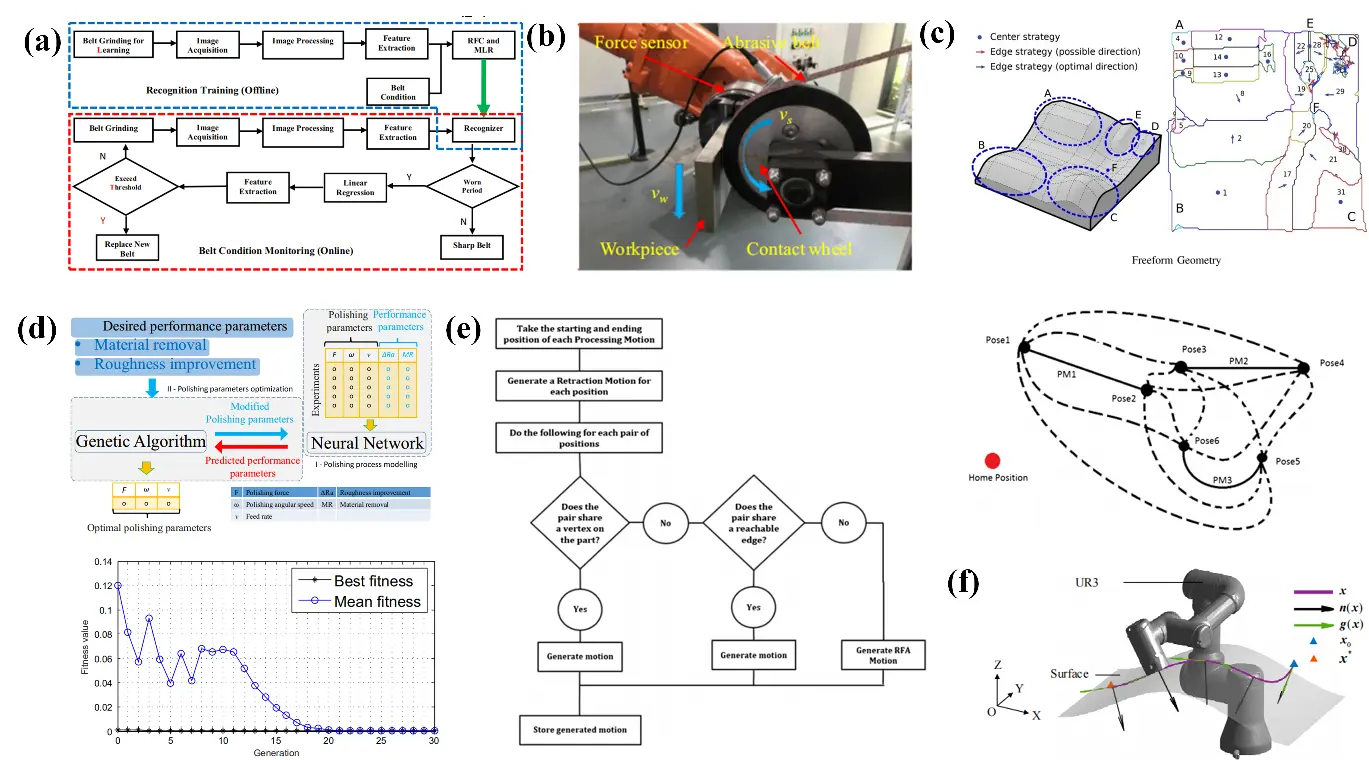
Figure 8. Path planning, parameter optimization, and monitoring decision methods for robotic grinding. (a) A sand belt condition monitoring process consisting of the digital microscope image acquisition unit, the random forest classifier (RFC), and the multiple linear regression (MLR) model [104]. (b) An experimental platform for controlling the grinding force of the robot sand belt [105]. (c) Schematic diagram of the segmentation results of the complex free-form surface [106]. (d) The optimization process of the polishing parameters based on neural networks and genetic algorithms, along with the change of the fitness function with the generations of genetic algorithms [107]. (e) The flowchart of all possible non-processing motion generation processes, as well as the examples of three processing motions and the TSP diagram [108]. (f) The simulation results of the LMDS motion planning [109].
5.2. Intelligent Decision-Making Algorithms
The intelligence level of the robot polishing decision-making system depends on the speed and quality of its underlying algorithms. Intelligent decision-making mainly relies on traditional optimization algorithms, AI-driven decision-making, and digital twin technology.
For traditional optimization algorithms, the particle swarm algorithm is very useful for parameter optimization. Song et al. [110] studied the problem of controlling material removal in robot abrasive belt grinding systems. They built a grinding process model with support vector regression and put forward an adaptive modeling method based on vector field smoothing. This method helps the model adapt quickly to changes in working conditions. Experiments show that CPSO gets a better fitness value than standard PSO with the same number of iterations. After optimization, the change of feed speed is much smaller. Kurc et al. [111] built a Mamdani fuzzy logic system. It is used to decide the feed speed when grinding aircraft engine blades. The system takes measurement point coordinates and material removal amount as inputs. The system has a decision library with 20 fuzzy rules using triangular membership functions and the center-of-gravity method. After three cycles of measurement and grinding, the surface shape accuracy of the blade meets the tolerance requirements.
Machine learning and deep learning technologies have been widely applied in process parameter prediction, quality traceability, and strategy optimization. Segreto et al. [112] built a multi-sensor monitoring system for robot-assisted polishing to monitor acoustic emission, strain, and current. They used principal component analysis (PCA) to reduce the number of features and put the principal component feature vectors into neural networks to judge surface roughness. For the Fy force component, the average absolute percentage error of the two-element PCA feature vector is only 4.2%. For the ten-element sensor fusion PCA vector, the classification accuracy reaches 92.5%. This method can predict the polishing endpoint online. Segreto et al. [113] further used PCA to reduce multi-sensor monitoring signals. These signals include acoustic emission, strain, and current. Then, they put the signals into a neural network. With PCA feature vectors, and thus can classify the polishing process state with high accuracy. Min et al. [114] used a force control method that split human skills into two parts. One is force skills, and the other is motion skills. Using B-spline curve fitting, continuous expected paths are generated from the discrete teaching positions. At the same time, zero-space optimization is combined with the calculation of torque impedance control, thereby achieving constant force tracking on complex surfaces. Wang et al. [115] proposed a force-related skill learning method based on arc-length probability motion primitives (AL-ProMP). This method maps contact force to the polishing path. It makes force and position directly linked. Experiments show that this method reduces surface roughness from Ra 0.909 μm to Ra 0.106 μm. Li et al. [116] built a force feedback model for virtual abrasive belt lapping teaching. Mathematical formulas were established for natural forces, collision forces, and resistance. The variance ratio between the measured force and the simulated force was lower than the critical value of the F-test, which proved that the force feedback model was operating well. Chen et al. [117] pointed out that deep learning is mainly used to recognize sensor signals and extract features. Reinforcement learning makes the best processing strategy by interacting with the environment. Imitation learning passes on and generalizes human skills through teaching.
Digital twin technology also helps a lot. Building virtual polishing scenes and doing decision tests in advance provides a verification platform that combines virtual and real for process optimization. Erdos et al. [118] studied a design method that turns physical robot work units into parametric digital twins. The spatial position changes between parts are described using the kinematic chain data model, and multi-level calibration is carried out, including calibration of the robot controller and fixture calibration. This gradually reduces the differences between the digital twin and the physical object.
In Figure 9a, Cao et al. [119] established an energy optimization framework and algorithm for robot polishing systems. It demonstrates the entire process from finding the task energy consumption model to obtaining the optimized results. By adjusting the task allocation and feed rate, the system’s energy consumption can be reduced. As shown in Figure 9b, Hachimine et al. [120] studied a grinding forming planning framework called Cutting Sequence Diffuser (CSD). It consists of three parts. The first is data collection, which involves generating action sequences in the simulator with a smaller removal limit; the second is diffusion model training, where the point cloud states are compressed using a variational autoencoder; the third is deployment, where M steps of actions are run in a closed loop. This framework reduces the difference between simulation and reality by limiting the removal volume. In Figure 9c, Xiang et al. [121] explored a smart decision method based on multiple algorithms. The result shows the Pareto front distributions of MS-MOGWO, MOGWO, and NSGA-II. It also shows a three-module process including a BLS prediction model, MS-MOGWO multi-objective optimization, and TOPSIS decision-making. In Figure 9d, with a constant force grinding controller, Zhang et al. [122] studied a constant force grinding controller. They examined the change in total reward value during PPO network training. As the number of iterations increases, the total reward value gradually stays at about 2 × 10⁴. After training, the lightweight neural network can be used for real-time displacement compensation.
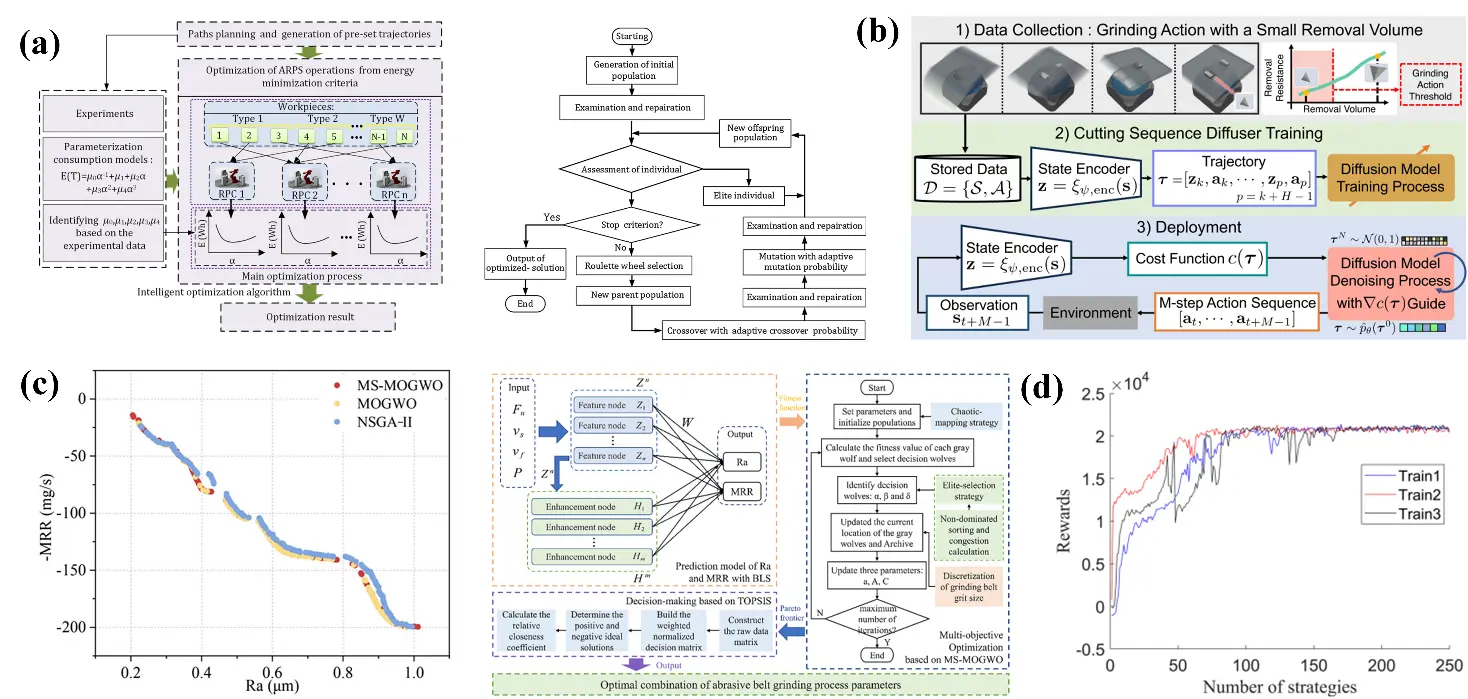
Figure 9. Intelligent decision-making algorithms and optimization frameworks for robotic polishing. (a) Energy optimization process of automated robot polishing system and adaptive genetic algorithm process with elite retention strategy [119]. (b) Cutting Sequence Diffuser (CSD) framework [120]. (c) Pareto front comparison diagram of MS-MOGWO, MOGWO, and NSGA-II, and intelligent decision flowchart [121]. (d) Convergence curves of total rewards for three independent training of PPO algorithms [122].
5.3. Optimization of the Dynamicity and Adaptability of the Decision System
To meet the needs of adaptive decision-making in different situations, Liao et al. [123] put forward a joint learning framework for motion, stiffness, and force. It is based on Riemannian dynamic motion primitives and quadratic programming optimization, and can learn the change rules of multiple parameters from just one human demonstration. Through online optimization, it can achieve adaptive force tracking in contact environments with different hardness. Lakshminarayanan et al. [124] made an iterative learning controller based on impedance control. By repeatedly iterating and simultaneously updating the position and contact force, without the need to obtain force information in advance, it can effectively adapt to the polishing of different materials such as titanium and aluminum alloys. Ren et al. [125] summed up that combining AI methods with multi-sensor fusion and model-free adaptive control provides a good way to make adaptive parameter decisions under different processing conditions. From the viewpoint of real-time decision-making efficiency, Xu et al. [126] put forward an optimization strategy for multi-motor-driven micro-robots. Based on rapid response modeling, the control decoupling calculation can be completed within microsecond timeframes, meeting the real-time requirements in high dynamic scenarios. Tsai et al. [127] used the Taguchi method with L9 orthogonal experiments. It can optimize the polishing parameters offline, providing reliable underlying settings for the decision-making system. In short, the decision-making system needs to combine the online adaptive mechanism and lightweight algorithms to support real-time and stable process decisions in complex processing environments.
6. Multi-Module Integration of Perception-Control-Decision Strategy
Industrial robots face many challenges when grinding and polishing complex curved surfaces. These challenges include geometric adaptability, process changeability, and system modeling of different parts. Optimizing just one module cannot greatly improve processing quality and consistency. So, we need to build a multi-module cooperation mechanism for perception, control, and decision-making. This way, information and execution flows can operate in a closed loop at the system integration level.
Understanding the cross-module interactions is essential, as perception, control, and decision are not independent but tightly coupled. The quality of perception directly constrains the control performance due to sensor noise, latency, and limited bandwidth, which can induce chattering or instability in force control. Sensing limitations also affect decision reliability, while incomplete or corrupted perception data can lead to suboptimal path planning and parameter selection. Real-time integration introduces latency due to sensor data processing (e.g., point cloud registration), which conflicts with the high-bandwidth requirements of force control, while decision updates typically operate on a slower timescale, resulting in synchronization bottlenecks. These multi-level coupling effects are seldom quantitatively characterized in the literature, yet they fundamentally determine the achievable system-level performance.
For software and hardware integration, the physical structure of the robot grinding and polishing system serves as the basis for multi-module cooperation. Ma et al. [128] designed a 3-PUU parallel end tool as a “mini” manipulator. It is installed at the end of the industrial robot in series. They form a macro-micro operation system together. The position control bandwidth of this end tool can reach 100 Hz. With a position-based impedance/force control algorithm, the integrated system can achieve high-bandwidth force/position hybrid control. On this basis, Rahul et al. [129] established a full-process framework for smart deburring. They ran a burr detection model driven by deep learning on a low-cost Raspberry Pi controller. With virtual twin technology, it realizes closed-loop connection between offline programming and real-time simulation. This provides a feasible way to arrange software and hardware resources together. Erkol et al. [130] further proved that common sensors can work well in multi-modal information fusion. Low sampling rate data (100 Hz) were collected from the force/torque sensor at the end of the robot. By combining these data with convolutional neural networks and long short-term memory networks, this method can effectively predict the surface roughness of glass fiber composite materials after grinding. The results show that the perception data is of great value for quality control decisions.
For grinding and polishing complex curved surfaces together, the need for multi-module cooperation is especially urgent. Sun et al. [131] studied the elastic contact problem between free surfaces and abrasive belts. They proposed a method of piecewise approximation with double curvature and the Winkler dimension reduction method, and established a differential stress compensation model in the contact area. The experimental error of the contact stress distribution was controlled within 0.078 MPa. Guo et al. [132] designed a new 5-degree-of-freedom hybrid robot. Its two rotating axes are placed at a 45° angle. This design allows the tool reference point to adjust to any posture in the upper hemisphere without changing its spatial position. Based on this structure, the robot can finish multi-face grinding work in one clamping. Sebeto et al. [133] put forward a zero-sample dense matching framework that combines semantic and geometric features without sample training. Combining the basic visualization model and local geometric descriptors, and optimizing the guiding function mapping, to construct a dense correspondence relationship that can understand the topological structure. This works provides new ideas for the cooperation between perception reconstruction and path decision-making in complex curved surface grinding and polishing.
For grinding and polishing cooperation under changing conditions, time-varying factors bring continuous challenges to processing consistency. These factors include tool wear and environmental changes. Wahballa et al. [134] put forward an adaptive impedance controller. At the same time, they added a damping speed force correction term to the impedance controller. Simulation and polishing experiments prove that this method is better at keeping the contact force stable and path accurate. Liu et al. [135] studied the problem of “over-polishing” and “under-polishing” in robot blade polishing. They proposed a method for controlling the impedance of a fuzzy variable, with the environmental stiffness and feed speed as inputs and the damping parameter as the output. Moreover, the damping can be adjusted online through fuzzy reasoning. This method keeps the blade surface roughness below 0.4 μm and the machining allowance within ±0.06 mm. Tao et al. [136] did a full life cycle wear experiment of sandpaper. They put forward a wear factor based on the relative material removal rate. This factor can quantitatively show how different wear stages affect the residual stress distribution on the GH4169 workpiece surfaces. They found that more wear leads to a lower grinding force ratio and more grinding heat buildup. Wang et al. [137] studied the problem of skill transfer generalization in robot polishing. They put forward B-spline dynamic motion primitives for path learning. They combined the path integration strategy to improve the algorithm. This way, paths can be used in new situations. They also added a contact force model to the cost function. This reduces force tracking error by 29.5%.
To summarize, research on multi-module cooperation mechanisms and system integration of perception, control, and decision-making has been done from many aspects. These aspects include hardware structure, adaptation to complex surfaces, and stability under changing conditions. A closed-loop framework has been initially formed. It is perception (force/visual/misalignment monitoring), decision (path planning/parameter optimization/skill generalization), and control (impedance/force/fuzzy control). But existing research has some gaps. It lacks a unified mathematical description and cooperation optimization rules for three things: multi-modal fusion of perception information, adaptive update of decision strategies, and dynamic matching of control system bandwidth. Therefore, we need to establish a joint modeling framework for perception, decision-making, and control, as well as a collaborative optimization method, to ensure that the three aspects achieve a good match in terms of time scale, information detail level, and control accuracy.
As shown in Figure 10a, He et al. [138] put forward a regional perception robot polishing framework based on Gaussian processes. It has three core modules, that is, surface recognition and segmentation, reference surface and demonstration data building, path mapping, and compliant generalization. This framework proves that it can make adaptive plans for both polishing paths and impedance parameters together, by geometric-mechanical fusion segmentation and multi-output GP mapping for polishing large and complex parts. As in Figure 10b, Li et al. [139] built a virtual environment for robot polishing processing. It includes a six-axis robot, polishing tools, and free-form surface workpieces, and can provide digital twin support for path planning and program verification. As shown in Figure 10c, Zhao et al. [140] put forward a visual-guided grinding strategy for mobile robots. They did real processing experiments on wind turbine blades. It shows a complete process: mobile platform positioning, point cloud collection and stitching, path planning, and force-controlled grinding execution. The scene of the mobile robot grinding 70-meter-level blades in the manufacturing workshop. This system can automatically grind large curved surface workpieces without CAD models or global measurement equipment. In Figure 10d, Yan et al. [141] built a dual-robot cooperative polishing test platform. The system has two EPSON C4 series six-axis industrial robots (C4-A601S and C4-A901S), RC700-A controller, a host computer, a clamping tool, and a polishing tool. This platform can track paths in cooperative motion, so that the calibration method works well in engineering. As shown in Figure 10e, Li et al. [142] put forward a DP-RRL hybrid learning framework. It is composed of a multimodal perception module (combining RGB point cloud, force perception, and proprioceptive perception), a diffusion strategy backbone (for generating basic actions), and a residual reinforcement learning module (for outputting correction offsets). This structure can realize real-time adaptive control of force-sensitive operations by adding baseline actions and residual corrections together. As in Figure 10f, Verl et al. [143] showed the robot CNC structure. It includes an interpolator, a path generator, a position/speed/current controller, and an external sensor interface module. This structure supports real-time path control and signal interaction in processing tasks.
Despite significant advances, a critical examination reveals that perception, control, and decision-making remain largely isolated, and the Table 1 lists representative studies on robot assisted grinding and polishing. Sensing modalities vary without systematic comparison, and multi-modal fusion remains heuristic. Control strategies are difficult to compare due to differing experimental conditions, and the trade-off between accuracy and computational efficiency is rarely addressed. Decision frameworks are task-specific and lack generalizability. Key research gaps include the lack of standardized benchmarks, insufficient real-time adaptability to tool wear and thermal drift, the absence of a unified mathematical framework for the perception-control-decision loop, limited human-robot collaboration, underdeveloped integration of emerging sensors, and unresolved skill transfer across diverse conditions.
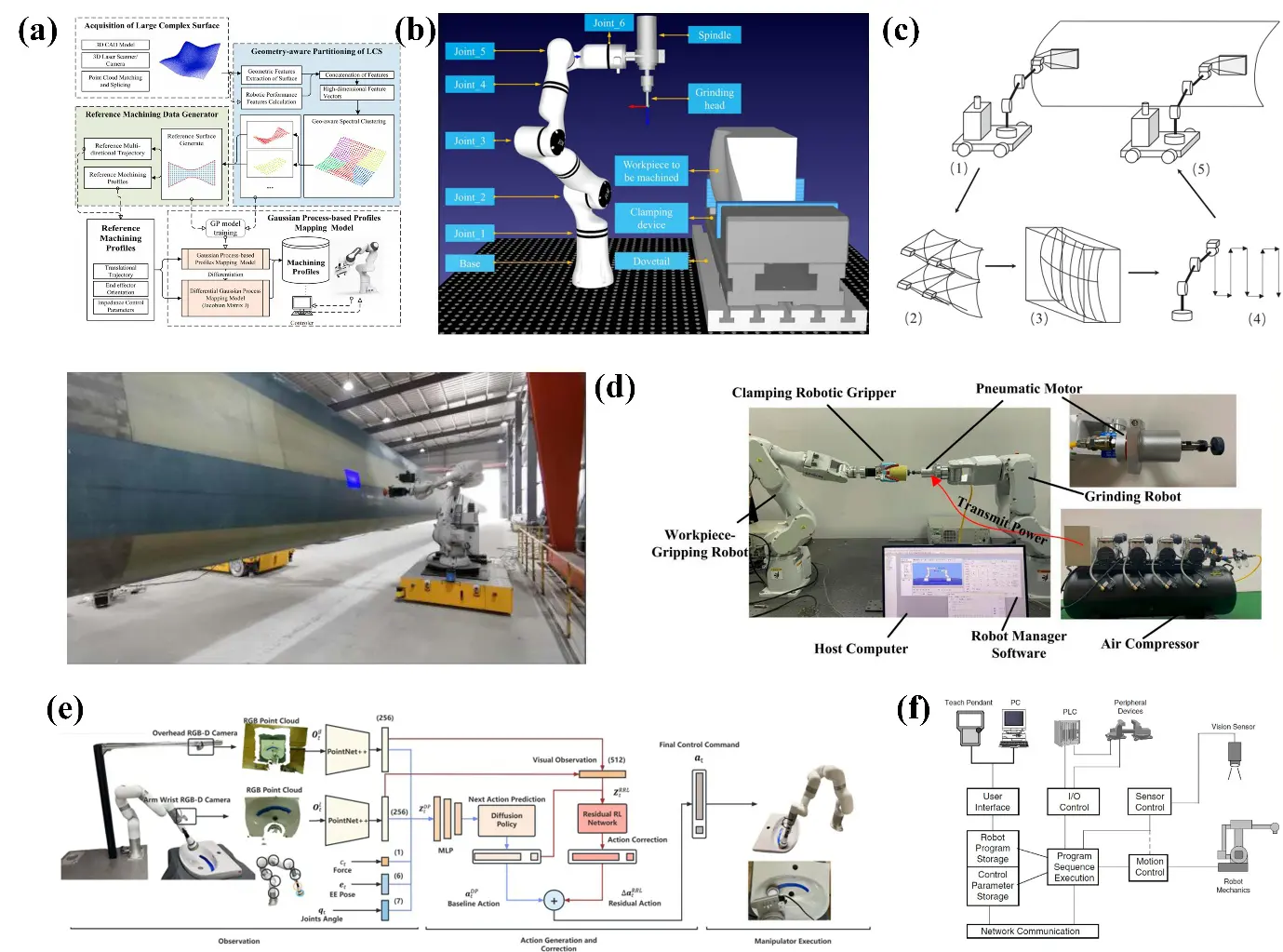
Figure 10. Multi-module collaboration and system integration architectures for robotic polishing. (a) Regional sensing robot polishing motion and compliance synchronization framework [138]. (b) Virtual polishing processing scene constructed in RoboDK simulation software based on the kinematic model and working environment model [139]. (c) Flowchart of mobile robot visual-guided grinding strategy and visual-based mobile robot grinding scene in manufacturing of wind turbine blades [140]. (d) Dual-robot collaborative motion experimental platform [141]. (e) Overview of the DP-RRL overall architecture [142]. (f) Robot CNC architecture composed of offline programming, motion planning, servo control, and I/O signals modules [143].
Table 1. Comparative summary of representative studies on robotic assisted grinding and polishing.
|
Category |
Technology/Approach |
Representative Study |
Key Performance |
Advantages |
Limitations |
Application Area |
|---|---|---|---|---|---|---|
|
Perception |
6-axis force/torque sensor and gravity compensation |
Wang et al. [41] |
Improved normal force accuracy |
Mature, high precision |
High cost, bulky |
Blade polishing |
|
Joint torque sensor and MESO |
Dong et al. [53] |
Force error within ±1 N |
No external sensor |
Sensitive to vibration |
Robotic polishing |
|
|
Thermal compensation in force sensing |
Verl et al. [143] |
Force error <10 N under varying temperature |
Cost-effective, reduces physical sensors |
Requires thermal model calibration |
Robotic polishing |
|
|
Force/position hybrid control |
Xu et al. [4] |
Ra from 1.085 to 0.375 μm |
High accuracy |
Requires accurate model |
Aero-engine blades |
|
|
Adaptive variable impedance |
Zhang et al. [74] |
Force error <0.78 N, overshoot <4.5% |
Good adaptability |
Complex tuning |
Macro-mini polishing |
|
|
Control |
Contour tracking control |
Yan et al. [141] |
Position and orientation contour errors reduced by ~30% and 28% |
High accuracy for 6D tasks |
Requires accurate contour estimation |
Complex surface machining |
|
Decision |
CPSO parameter optimization |
Schneyer et al. [106] |
Smoother feed speed |
Global optimization |
Offline |
Belt grinding |
|
Integration |
Digital twin |
Min et al. [114] |
Debug time from 5 days to hours |
Virtual-real integration |
Model calibration |
Workcell design |
|
Vision-guided mobile robot |
Tao et al. [136] |
70-m blade grinding |
No CAD model needed |
Slow |
Wind turbine blades |
7. Summary and Outlook
7.1. Conclusions
Robot polishing technology is changing from automatic execution to smart decision-making. The closed-loop collaborative mechanism among perception, control, and decision-making, characterized by bidirectional information flow, real-time mismatch compensation, and cross-layer optimization, is the key support for this progress. This paper systematically reviews the research progress of robot polishing technology and covers perception systems, control strategies, decision mechanisms, and multi-module cooperative integration. This cooperation helps overcome the limitations of traditional polishing technology.
- (i)
-
In the perception system, research progress has been made in force sensing, visual perception, and multi-source information fusion technologies. Now, these systems have the comprehensive perception capabilities of multiple modes and functions. Flexible tactile sensors, high-precision three-dimensional vision, and acoustic emission monitoring technologies are jointly applied, enabling the system to accurately grasp the processing status, the shape of the workpiece, and the working environment.
- (ii)
-
For control strategies, traditional force/position hybrid control has been developed. Now there are more advanced control methods, like model predictive control, adaptive impedance control, and control driven by smart algorithms. These methods greatly improve force tracking accuracy and dynamic response speed.
- (iii)
-
In terms of the decision-making mechanism, intelligent decision-making structures have been developed. These structures are supported by traditional optimization algorithms, artificial intelligence, and digital twin technology, and are capable of adaptively optimizing process parameters, planning dynamic paths, and predicting and compensating for faults.
- (iv)
-
The close collaboration of the perception, control, and decision-making modules has surpassed the performance limits of a single module, forming a closed-loop logic. This provides strong technical support for the precise processing of complex components, meeting the strict requirements of emerging industries such as aerospace, precision optics, and semiconductors.
7.2. Future Directions
Looking forward, robot polishing technology will keep making progress in smart decision-making, multi-module cooperation, and high-end equipment. For the innovation of perception-control-decision technology, adaptive decision-making driven by large models is becoming a leading direction. Existing control methods based on reinforcement learning work better than traditional PID in constant force grinding. But model training needs a lot of simulation or experimental data. And its generalization ability needs to be improved. In the future, we need to explore few-shot learning. It combines large pre-trained models with a small number of real samples. We can use structures like a transformer to model multi-modal sequence data of force, position, and shape together. This way, we can generate end-to-end decisions for process parameters, path planning, and fault prediction and compensation. At the same time, digital twin technology will further promote multi-module cooperative optimization. We can build a digital twin system driven by real-time data. It supports online calibration and dynamic model update. For equipment and process optimization, developing lightweight, high-precision smart polishing equipment is the base to improve system flexibility. In the future, we need to develop special end tools that combine force control, vision, and vibration suppression functions. This will help turn “robots with tools” into “robots as precision processing equipment”. Besides, human-machine cooperative smart polishing is developing. It is moving from demonstration and reproduction to intention perception and cooperative decision-making. In the future, we need to develop technologies that can understand the intentions of the operators. This will make the grinding and polishing process of human-machine collaboration safer, more efficient, and more natural.
Author Contributions
W.C.: Writing—original draft, Investigation. C.M.: Conceptualization, Supervision, Funding acquisition. Z.B.: Validation, Methodology, Formal Analysis. W.W.: Writing—Review & Editing, Validation, Data curation.
Ethics Statement
No human participants or animals were involved in this work.
Informed Consent Statement
Informed consent is not applicable to this study, as no human subjects were recruited.
Data Availability Statement
This is a review paper and, as such, does not include any primary datasets. All data discussed and analyzed in this review are derived from the published studies and literature cited in the manuscript.
Funding
This study was funded by the Ministry of Education Foundation for Humanities and Social Sciences (25YJCZH264), National Natural Science Foundation of China (52505463), and Natural Science and Technology Project of Hunan Provincial (2026JJ40052, 2025RC9009).
Declaration of Competing Interest
The authors declare that they have no known competing financial interests or personal relationships that could have appeared to influence the work reported in this paper.
References
- Wang W, Wen Z, Mao C, Xu C, Li X, Tang W, et al. Investigation on machining quality in electrochemical discharge–assisted micro-grinding of monocrystalline silicon. Int. J. Adv. Manuf. Technol. 2025, 140, 6595–6607. DOI:10.1007/s00170-025-16546-z [Google Scholar]
- Wang W, Zhou Z, Wang Q, Gao B, Mao C. Muti-Energy Field-Assisted Grinding of Hard and Brittle Materials: Tools, Equipment and Mechanisms. Intell. Sustain. Manuf. 2025, 2, 10022. DOI:10.70322/ism.2025.10022 [Google Scholar]
- Chang G, Pan R, Xie Y, Yang J, Yang Y, Li J. Research on constant force polishing method of curved mold based on position adaptive impedance control. Int. J. Adv. Manuf. Technol. 2022, 122, 697–709. DOI:10.1007/s00170-022-09943-1 [Google Scholar]
- Xu X, Zhu D, Zhang H, Yan S, Ding H. Application of novel force control strategies to enhance robotic abrasive belt grinding quality of aero-engine blades. Chin. J. Aeronaut. 2019, 32, 2368–2382. DOI:10.1016/j.cja.2019.01.023 [Google Scholar]
- García A, Gracia L, Solanes JE, Girbés-Juan V, Perez-Vidal C, Tornero J. Robotic assistance for industrial sanding with a smooth approach to the surface and boundary constraints. Comput. Ind. Eng. 2021, 158, 107366. DOI:10.1016/j.cie.2021.107366 [Google Scholar]
- Zhu D, Feng X, Xu X, Yang Z, Li W, Yan S, et al. Robotic grinding of complex components: A step towards efficient and intelligent machining—Challenges, solutions, and applications. Robot. Comput. Integr. Manuf. 2020, 65, 101908. DOI:10.1016/j.rcim.2019.101908 [Google Scholar]
- Chen F, Bao R, Peng J, Lv Z, Wang K. Recent advances in high precision grinding and polishing of robots for complex surface. Int. J. Adv. Manuf. Technol. 2025, 140, 5795–5821. DOI:10.1007/s00170-025-16488-6 [Google Scholar]
- Latifinavid M, Donder A, Konukseven EI. High-performance parallel hexapod-robotic light abrasive grinding using real-time tool deflection compensation and constant resultant force control. Int. J. Adv. Manuf. Technol. 2018, 96, 3403–3416. DOI:10.1007/s00170-018-1838-8 [Google Scholar]
- Zhu D, Xu X, Yang Z, Zhuang K, Yan S, Ding H. Analysis and assessment of robotic belt grinding mechanisms by force modeling and force control experiments. Tribol. Int. 2018, 120, 93–98. DOI:10.1016/j.triboint.2017.12.043 [Google Scholar]
- Wu S, Kazerounian K, Gan Z, Sun Y. A simulation platform for optimal selection of robotic belt grinding system parameters. Int. J. Adv. Manuf. Technol. 2013, 64, 447–458. DOI:10.1007/s00170-012-4030-6 [Google Scholar]
- Yu C, Qiao J, Liu N, Hu X, Yang Z, Zhou S, et al. Robotic grinding technology of multi-scale complex components based on 3D point clouds: A review. Measurement 2026, 257, 118663. DOI:10.1016/j.measurement.2025.118663 [Google Scholar]
- Yang J, Tang X, Ding H, Yin Y. A novel electromagnetic end-effector with adaptive force-stiffness coordinated control for robotic grinding with variable workpiece stiffness. CIRP Ann. 2025, 74, 541–545. DOI:10.1016/j.cirp.2025.04.087 [Google Scholar]
- Xie HL, Wang QH, Ong SK, Li JR, Chi ZP. Adaptive human-robot collaboration for robotic grinding of complex workpieces. CIRP Ann. 2022, 71, 285–288. DOI:10.1016/j.cirp.2022.04.015 [Google Scholar]
- Wang Q, Wang W, Zheng L, Yun C. Force control-based vibration suppression in robotic grinding of large thin-wall shells. Robot. Comput. Integr. Manuf. 2021, 67, 102031. DOI:10.1016/j.rcim.2020.102031 [Google Scholar]
- Wang W, Lu L, Ma H, Li Z, Lu X, Xie Y. Self-template manufacturing of on-skin electrodes with 3D multi-channel structure for standard 3-limb-lead ECG suit. Microsyst. Nanoeng. 2024, 10, 196. DOI:10.1038/s41378-024-00838-7 [Google Scholar]
- Xie Y, Lu L, Wang W, Ma H. Wearable multilead ECG sensing systems using on-skin stretchable and breathable dry adhesives. Bio-Des. Manuf. 2024, 7, 167–180. DOI:10.1007/s42242-023-00268-w [Google Scholar]
- Ke X, Yu Y, Li K, Wang T, Zhong B, Wang Z, et al. Review on robot-assisted polishing: Status and future trends. Robot. Comput. Integr. Manuf. 2023, 80, 102482. DOI:10.1016/j.rcim.2022.102482 [Google Scholar]
- Qin H, Jing H, Hou Z, Wang Z, Bai S. Dynamic modeling and sliding mode control of 3-RSS coaxial layout polishing robot. J. Braz. Soc. Mech. Sci. Eng. 2022, 44, 257. DOI:10.1007/s40430-022-03509-8 [Google Scholar]
- Xu P, Li B, Cheung CF, Zhang JF. Stiffness modeling and optimization of a 3-DOF parallel robot in a serial-parallel polishing machine. Int. J. Precis. Eng. Manuf. 2017, 18, 497–507. DOI:10.1007/s12541-017-0060-1 [Google Scholar]
- Xu P, Cheung CF, Li B, Ho LT, Zhang JF. Kinematics analysis of a hybrid manipulator for computer controlled ultra-precision freeform polishing. Robot. Comput. Integr. Manuf. 2017, 44, 44–56. DOI:10.1016/j.rcim.2016.08.003 [Google Scholar]
- Schneckenburger M, Almeida R, Höfler S, Börret R. Material removal by slurry erosion in the robot polishing of optics by polishing slurry nozzles. Wear 2022, 494–495, 204257. DOI:10.1016/j.wear.2022.204257 [Google Scholar]
- Xu P, Cheung CF, Wang C, Zhao C. Novel hybrid robot and its processes for precision polishing of freeform surfaces. Precis. Eng. 2020, 64, 53–62. DOI:10.1016/j.precisioneng.2020.03.013 [Google Scholar]
- Wang M, Song Y, Wang P, Chen Y, Sun T. Grinding/Cutting Technology and Equipment of Multi-scale Casting Parts. Chin. J. Mech. Eng. 2022, 35, 97. DOI:10.1186/s10033-022-00780-7 [Google Scholar]
- Zeng X, Zhu G, Gao Z, Ji R, Ansari J, Lu C. Surface polishing by industrial robots: A review. Int. J. Adv. Manuf. Technol. 2023, 125, 3981–4012. DOI:10.1007/s00170-023-10887-3 [Google Scholar]
- Zhang J, Zhao L, Li L, Ma F, Chen G. Design of Passive Constant-Force End-Effector for Robotic Polishing of Optical Reflective Mirrors. Chin. J. Mech. Eng. 2022, 35, 141. DOI:10.1186/s10033-022-00811-3 [Google Scholar]
- Mohammad AEK, Hong J, Wang D. Design of a force-controlled end-effector with low-inertia effect for robotic polishing using macro-mini robot approach. Robot. Comput. Integr. Manuf. 2018, 49, 54–65. DOI:10.1016/j.rcim.2017.05.011 [Google Scholar]
- Yan S, Xu X, Yang Z, Zhu D, Ding H. An improved robotic abrasive belt grinding force model considering the effects of cut-in and cut-off. J. Manuf. Process. 2019, 37, 496–508. DOI:10.1016/j.jmapro.2018.12.029 [Google Scholar]
- Xie W, Fang F. Effect of tool edge radius on material removal mechanism in atomic and close-to-atomic scale cutting. Appl. Surf. Sci. 2020, 504, 144451. DOI:10.1016/j.apsusc.2019.144451 [Google Scholar]
- Li M, Guo X, Dai S, Yuan S, Ma J, Liu F, et al. Effect of grinding damage on cutting force and ductile machining during single grain scratching of monocrystalline silicon. Mater. Sci. Semicond. Process. 2022, 151, 107019. DOI:10.1016/j.mssp.2022.107019 [Google Scholar]
- Shi D, Zeng X, Wang X, Zhang H. Parameter Optimization and Surface Roughness Prediction for the Robotic Adaptive Hydraulic Polishing of NAK80 Mold Steel. Processes 2025, 13, 991. DOI:10.3390/pr13040991 [Google Scholar]
- Zhang SJ, To S, Wang SJ, Zhu ZW. A review of surface roughness generation in ultra-precision machining. Int. J. Mach. Tools Manuf. 2015, 91, 76–95. DOI:10.1016/j.ijmachtools.2015.02.001 [Google Scholar]
- Zheng Q, Xiao J, Wang C, Liu H, Huang T. A robotic polishing parameter optimization method considering time-varying wear. Int. J. Adv. Manuf. Technol. 2022, 121, 6723–6738. DOI:10.1007/s00170-022-09788-8 [Google Scholar]
- Zhang Z, Yao P, Li X, Wang J, Huang C, Zhu H, et al. Grinding performance and tribological behavior in solid lubricant assisted grinding of glass-ceramics. J. Manuf. Process. 2020, 51, 31–43. DOI:10.1016/j.jmapro.2020.01.020 [Google Scholar]
- Liu P, Liu P. Study on the abrasive belt grinding removal mechanism and surface roughness prediction of DD6 single crystal superalloy. Int. J. Adv. Manuf. Technol. 2025, 139, 175–195. DOI:10.1007/s00170-025-15886-0 [Google Scholar]
- Tao H, Zeng Q, Liu Y, Zhao D, Lu X. Effects of grinding-induced surface topography on the material removal mechanism of silicon chemical mechanical polishing. Appl. Surf. Sci. 2023, 631, 157509. DOI:10.1016/j.apsusc.2023.157509 [Google Scholar]
- Mohammad AEK, Hong J, Wang D, Guan Y. Synergistic integrated design of an electrochemical mechanical polishing end-effector for robotic polishing applications. Robot. Comput. Integr. Manuf. 2019, 55, 65–75. DOI:10.1016/j.rcim.2018.07.005 [Google Scholar]
- Wang S, Wang S, Tie G, Shi F, Tian Y, Yang X. Effect of different grinding strategies on subsequent polishing processes of sapphire. J. Manuf. Process. 2024, 112, 339–357. DOI:10.1016/j.jmapro.2024.01.026 [Google Scholar]
- Guo W, Zhu Y, He X. A Robotic Grinding Motion Planning Methodology for a Novel Automatic Seam Bead Grinding Robot Manipulator. IEEE Access 2020, 8, 75288–75302. DOI:10.1109/ACCESS.2020.2987807 [Google Scholar]
- Wen Y, Jaeger DJ, Pagilla PR. Uniform Coverage Tool Path Generation for Robotic Surface Finishing of Curved Surfaces. IEEE Robot. Autom. Lett. 2022, 7, 4931–4938. DOI:10.1109/LRA.2022.3152695 [Google Scholar]
- Darvish K, Skreta M, Zhao Y, Yoshikawa N, Som S, Bogdanovic M, et al. ORGANA: A robotic assistant for automated chemistry experimentation and characterization. Matter 2025, 8, 101897. DOI:10.1016/j.matt.2024.10.015 [Google Scholar]
- Wang Z, Zou L, Mu Y, Li H, Wang W, Huang Y. Region-Based Force Control Strategy for Improving Profile Accuracy of Blade on 7-Axis Linkage Robotic Grinding System. IEEE/ASME Trans. Mechatron. 2024, 29, 1960–1971. DOI:10.1109/TMECH.2023.3325618 [Google Scholar]
- Feng X, Lv R, Qian C, Wang Y, Tian L, Zhu D. Estimation and compensation of angular misalignment at robot end brush roller-workpiece contact interface via elastic contact force perception. Int. J. Adv. Manuf. Technol. 2022, 121, 367–377. DOI:10.1007/s00170-022-09282-1 [Google Scholar]
- Kim H, Jin H, Moon C, Kim S, Kim T, Seo T. The Abrasion Robotic Solutions: A review. Int. J. Precis. Eng. Manuf. Green Technol. 2025, 12, 381–407. DOI:10.1007/s40684-024-00657-1 [Google Scholar]
- Liu Z, Li R, Zhao L, Xia Y, Qin Z, Zhu K. Automatic joint motion planning of 9-DOF robot based on redundancy optimization for wheel hub polishing. Robot. Comput. Integr. Manuf. 2023, 81, 102500. DOI:10.1016/j.rcim.2022.102500 [Google Scholar]
- Li H, Wan S, Niu Z, Guo H, Zhang L, Lu Q, et al. Statistical perception of the chaotic fabrication error and the self-adaptive processing decision in ultra-precision optical polishing. Opt. Express 2023, 31, 7707. DOI:10.1364/OE.484309 [Google Scholar]
- Cheng F, Fu S, Chen Z. Surface Texture Measurement on Complex Geometry Using Dual-Scan Positioning Strategy. Appl. Sci. 2020, 10, 8418. DOI:10.3390/app10238418 [Google Scholar]
- Ferraguti F, Pini F, Gale T, Messmer F, Storchi C, Leali F, et al. Augmented reality based approach for on-line quality assessment of polished surfaces. Robot. Comput. Integr. Manuf. 2019, 59, 158–167. DOI:10.1016/j.rcim.2019.04.007 [Google Scholar]
- Lloyd S, Irani RA, Ahmadi M. Improved Accuracy and Contact Stability in Robotic Contouring With Simultaneous Registration and Machining. IEEE Trans. Contr. Syst. Technol. 2024, 32, 1140–1155. DOI:10.1109/TCST.2023.3348749 [Google Scholar]
- Guo W, Qi B, Ren X, Chen H, Chen X. Vision-based closed-loop robotic fine grinding of aeroengine turbine seals utilizing Gabor Wavelet Transform. Mech. Syst. Signal Process. 2024, 220, 111632. DOI:10.1016/j.ymssp.2024.111632 [Google Scholar]
- Zhang X, Chen H, Xu J, Song X, Wang J, Chen X. A novel sound-based belt condition monitoring method for robotic grinding using optimally pruned extreme learning machine. J. Mater. Process. Technol. 2018, 260, 9–19. DOI:10.1016/j.jmatprotec.2018.05.013 [Google Scholar]
- Tian F, Li Z, Lv C, Liu G. Polishing pressure investigations of robot automatic polishing on curved surfaces. Int. J. Adv. Manuf. Technol. 2016, 87, 639–646. DOI:10.1007/s00170-016-8527-2 [Google Scholar]
- Hong T, Kim G, Kim SH, Min BK. Generalized machine learning model for deformation prediction and compensation in robotic machining. Robot. Comput. Integr. Manuf. 2026, 101, 103314. DOI:10.1016/j.rcim.2026.103314 [Google Scholar]
- Dong Y, Ren T, Hu K, Wu D, Chen K. Contact force detection and control for robotic polishing based on joint torque sensors. Int. J. Adv. Manuf. Technol. 2020, 107, 2745–2756. DOI:10.1007/s00170-020-05162-8 [Google Scholar]
- Shi H, Ye C, Liu C, Yu J, Lin W. Sensorless Robotic External Force Estimation in Uncertain Interactive Environments: A Hybrid Adaptive-Robust Kalman Filtering Approach. IEEE Trans. Automat. Sci. Eng. 2026, 23, 8234–8247. DOI:10.1109/TASE.2026.3684362 [Google Scholar]
- Zhang T, Yu Y, Zou Y. An Adaptive Sliding-Mode Iterative Constant-force Control Method for Robotic Belt Grinding Based on a One-Dimensional Force Sensor. Sensors 2019, 19, 1635. DOI:10.3390/s19071635 [Google Scholar]
- Li T, Sun Q, Wang C, Yuan X, Wang K. A Robot Floating Grinding and Rust Removal Approach Based on Composite Force-Position Fuzzy Control. Sensors 2025, 25, 2204. DOI:10.3390/s25072204 [Google Scholar]
- Wan Y, Wang Y, Guo CF. Recent progresses on flexible tactile sensors. Mater. Today Phys. 2017, 1, 61–73. DOI:10.1016/j.mtphys.2017.06.002 [Google Scholar]
- Dong YS, Ao SJ, Gong H. Adaptive robotic polishing based on distributed flexible force sensors. Robot. Comput. Integr. Manuf. 2025, 95, 103020. DOI:10.1016/j.rcim.2025.103020 [Google Scholar]
- Halwani M, Ayyad A, AbuAssi L, Abdulrahman Y, Almaskari F, Hassanin H, et al. A novel vision-based multi-functional sensor for normality and position measurements in precise robotic manufacturing. Precis. Eng. 2024, 88, 367–381. DOI:10.1016/j.precisioneng.2024.02.015 [Google Scholar]
- Surindra MD, Alfarisy GAF, Caesarendra W, Petra MI, Prasetyo T, Tjahjowidodo T, et al. Use of machine learning models in condition monitoring of abrasive belt in robotic arm grinding process. J. Intell. Manuf. 2025, 36, 3345–3358. DOI:10.1007/s10845-024-02410-6 [Google Scholar]
- Zaki AMA, Carnevale M, Schlette C, Giberti H. On the use of low-cost 3D stereo depth camera to drive robot trajectories in contact-based applications. Int. J. Adv. Manuf. Technol. 2023, 128, 3745–3759. DOI:10.1007/s00170-023-11851-x [Google Scholar]
- Kim U, Lee DH, Kim YB, Seok DY, Choi HR. A Novel Six-Axis Force/Torque Sensor for Robotic Applications. IEEE/ASME Trans. Mechatron. 2017, 22, 1381–1391. DOI:10.1109/TMECH.2016.2640194 [Google Scholar]
- Song H, Ye R, Xie M. Research on complex surface grinding path planning of grinding robot based on NX and Tecnomatix. Int. J. Adv. Manuf. Technol. 2024, 133, 1961–1971. DOI:10.1007/s00170-024-13838-8 [Google Scholar]
- Huang X, Wang Z, Lin Z. Movement Modeling and Control for Robotic Bonnet Polishing. Chin. J. Mech. Eng. 2022, 35, 68. DOI:10.1186/s10033-022-00751-y [Google Scholar]
- Huang T, Zhao D, Yin F, Tian W, Chetwynd DG. Kinematic calibration of a 6-DOF hybrid robot by considering multicollinearity in the identification Jacobian. Mech. Mach. Theory 2019, 131, 371–384. DOI:10.1016/j.mechmachtheory.2018.10.008 [Google Scholar]
- Ouyang PR, Dam T, Huang J, Zhang WJ. Contour tracking control in position domain. Mechatronics 2012, 22, 934–944. DOI:10.1016/j.mechatronics.2012.06.001 [Google Scholar]
- Ouyang PR, Pano V, Acob J. Position domain contour control for multi-DOF robotic system. Mechatronics 2013, 23, 1061–1071. DOI:10.1016/j.mechatronics.2013.08.005 [Google Scholar]
- Ouyang PR, Pano V, Tang J, Yue WH. Position domain nonlinear PD control for contour tracking of robotic manipulator. Robot. Comput. Integr. Manuf. 2018, 51, 14–24. DOI:10.1016/j.rcim.2017.11.017 [Google Scholar]
- Song K, Xiao G, Chen S, Liu X, Huang Y. A new force-depth model for robotic abrasive belt grinding and confirmation by grinding of the Inconel 718 alloy. Robot. Comput. Integr. Manuf. 2023, 80, 102483. DOI:10.1016/j.rcim.2022.102483 [Google Scholar]
- Dong J, Shi J, Liu C, Yu T. Research of Pneumatic Polishing Force Control System Based on High Speed On/off with PWM Controlling. Robot. Comput. Integr. Manuf. 2021, 70, 102133. DOI:10.1016/j.rcim.2021.102133 [Google Scholar]
- Li J, Guan Y, Chen H, Wang B, Zhang T, Liu X, et al. A High-Bandwidth End-Effector With Active Force Control for Robotic Polishing. IEEE Access 2020, 8, 169122–169135. DOI:10.1109/ACCESS.2020.3022930 [Google Scholar]
- Cheng L, Lin Y, Hou ZG, Tan M, Huang J, Zhang WJ. Adaptive Tracking Control of Hybrid Machines: A Closed-Chain Five-Bar Mechanism Case. IEEE/ASME Trans. Mechatron. 2011, 16, 1155–1163. DOI:10.1109/TMECH.2010.2083680 [Google Scholar]
- Tian F, Lv C, Li Z, Liu G. Modeling and control of robotic automatic polishing for curved surfaces. CIRP J. Manuf. Sci. Technol. 2016, 14, 55–64. DOI:10.1016/j.cirpj.2016.05.010 [Google Scholar]
- Zhang H, Li L, Zhao J, Zhao J. The hybrid force/position anti-disturbance control strategy for robot abrasive belt grinding of aviation blade base on fuzzy PID control. Int. J. Adv. Manuf. Technol. 2021, 114, 3645–3656. DOI:10.1007/s00170-021-07122-2 [Google Scholar]
- Zhao X, Xiao G, Zhang T, Zheng Z, Yu J. Optimization method and experimental research on robot belt grinding trajectory of additive blade with non-uniform allowance distribution. Int. J. Adv. Manuf. Technol. 2024, 131, 4201–4216. DOI:10.1007/s00170-024-13146-1 [Google Scholar]
- Tian Y, Wei C, Wang J, Gu Z, Liu B, Fan X. A high-shear and low-pressure intelligent precision grinding system for complex-curved parts. Int. J. Adv. Manuf. Technol. 2024, 133, 467–478. DOI:10.1007/s00170-024-13776-5 [Google Scholar]
- Zhang X, Zhou H, Liu J, Ju Z, Leng Y, Yang C. A practical PID variable stiffness control and its enhancement for compliant force-tracking interactions with unknown environments. Sci. China Technol. Sci. 2023, 66, 2882–2896. DOI:10.1007/s11431-022-2436-y [Google Scholar]
- Wang G, Deng Y, Zhou H, Yue X. PD-adaptive variable impedance constant force control of macro-mini robot for compliant grinding and polishing. Int. J. Adv. Manuf. Technol. 2023, 124, 2149–2170. DOI:10.1007/s00170-022-10405-x [Google Scholar]
- Seo C, Kim H, Jin H, Kim T, Seo T. Force Control of a Grinding Robotic Manipulator With Floating Base Via Model Prediction Optimization Control. IEEE/ASME Trans. Mechatron. 2023, 28, 1911–1919. DOI:10.1109/TMECH.2023.3276220 [Google Scholar]
- Li Q, Lian X. Vision-Guided Fuzzy Adaptive Impedance-Based Control for Polishing Robots Under Time-Varying Stiffness. Machines 2025, 13, 493. DOI:10.3390/machines13060493 [Google Scholar]
- Zhang R, Xia J, Ma J, Huang D, Zhang X, Li Y. Human-Robot Interactive Skill Learning and Correction for Polishing Based on Dynamic Time Warping Iterative Learning Control. IEEE Trans. Contr. Syst. Technol. 2024, 32, 2310–2320. DOI:10.1109/TCST.2024.3423548 [Google Scholar]
- Gaz C, Magrini E, De Luca A. A model-based residual approach for human-robot collaboration during manual polishing operations. Mechatronics 2018, 55, 234–247. DOI:10.1016/j.mechatronics.2018.02.014 [Google Scholar]
- El Makrini I, Mathijssen G, Verhaegen S, Verstraten T, Vanderborght B. A Virtual Element-Based Postural Optimization Method for Improved Ergonomics During Human-Robot Collaboration. IEEE Trans. Automat. Sci. Eng. 2022, 19, 1772–1783. DOI:10.1109/TASE.2022.3147702 [Google Scholar]
- Wahballa H, Duan J, Dai Z. An automatic robot polishing control method for compound surface comprising plane and curved surfaces. Int. J. Adv. Manuf. Technol. 2024, 132, 3801–3819. DOI:10.1007/s00170-024-13319-y [Google Scholar]
- Xia G, Wang J, Yao B, Dai Y, Xue Y, Zhang J. Tactile Perception-Based Depth and Angle Control During Robot-Assisted Bent Bone Grinding. IEEE Trans. Ind. Inf. 2024, 20, 50–61. DOI:10.1109/TII.2023.3256369 [Google Scholar]
- Li X, Zhao H, Zhou H, Cai Y, Yin Y, Ding H. Robotic grinding and polishing of complex aeroengine blades based on new device design and variable impedance control. Robot. Comput. Integr. Manuf. 2025, 92, 102875. DOI:10.1016/j.rcim.2024.102875 [Google Scholar]
- Zhang Y, Zhao X, Tao B, Ding H. Multi-Objective Synchronization Control for Dual-Robot Interactive Cooperation Using Nonlinear Model Predictive Policy. IEEE Trans. Ind. Electron. 2023, 70, 582–593. DOI:10.1109/TIE.2022.3150090 [Google Scholar]
- Solanes JE, Gracia L, Muñoz-Benavent P, Valls Miro J, Girbés V, Tornero J. Human-robot cooperation for robust surface treatment using non-conventional sliding mode control. ISA Trans. 2018, 80, 528–541. DOI:10.1016/j.isatra.2018.05.013 [Google Scholar]
- Han F, Tam S, Cao Z, Zhao X, Tao B, Ding H. Nonlinear impedance control with trajectory adaptation for collaborative robotic grinding. Sci. China Technol. Sci. 2023, 66, 1928–1936. DOI:10.1007/s11431-022-2418-4 [Google Scholar]
- Zhu G, Zeng X, Gao Z, Gong Z, Duangmu W, Zeng Y, et al. Study on vibration stability of aircraft engine blades polished by robot controlled pneumatic grinding wheel. J. Manuf. Process. 2023, 99, 636–651. DOI:10.1016/j.jmapro.2023.05.090 [Google Scholar]
- Wu C, Guo K, Sun J, Liu Y, Zheng D. Active vibration control in robotic grinding using six-axis acceleration feedback. Mech. Syst. Signal Process. 2024, 214, 111379. DOI:10.1016/j.ymssp.2024.111379 [Google Scholar]
- Zhang R, Wang Z, Keogh P. H-infinity optimised control of external inertial actuators for higher precision robotic machining. Int. J. Comput. Integr. Manuf. 2022, 35, 129–144. DOI:10.1080/0951192X.2021.1972467 [Google Scholar]
- Zhang Y, Liu H, Cheng W, Hua L, Zhu D. A novel trajectory planning method for robotic deburring of automotive castings considering adaptive weights. Robot. Comput. Integr. Manuf. 2024, 86, 102677. DOI:10.1016/j.rcim.2023.102677 [Google Scholar]
- Zhang L, Zhang C, Fan W. Robotic Magnetorheological Finishing Technology Based on Constant Polishing Force Control. Appl. Sci. 2022, 12, 3737. DOI:10.3390/app12083737 [Google Scholar]
- Shi X, Li M, Dong Y, Feng S. Research on Surface Tracking and Constant Force Control of a Grinding Robot. Sensors 2023, 23, 4702. DOI:10.3390/s23104702 [Google Scholar]
- Song X, An J, Ma X. Study on Trajectory Planning for Polishing Free-Form Surfaces of XY-3-RPS Hybrid Robot. Actuators 2025, 14, 269. DOI:10.3390/act14060269 [Google Scholar]
- Chi ZP, Wang QH, Xie HL, Ni JL, Nee AYC, Ong SK. Human-robot collaborative programming for robotic polishing of impeller using adaptive virtual fixtures and haptic interface. Robot. Comput. Integr. Manuf. 2026, 98, 103166. DOI:10.1016/j.rcim.2025.103166 [Google Scholar]
- Ciccarelli M, Forlini M, Papetti A, Palmieri G, Germani M. Advancing human–robot collaboration in handcrafted manufacturing: Cobot-assisted polishing design boosted by virtual reality and human-in-the-loop. Int. J. Adv. Manuf. Technol. 2024, 132, 4489–4504. DOI:10.1007/s00170-024-13639-z [Google Scholar]
- Kakinuma Y, Ogawa S, Koto K. Robot polishing control with an active end effector based on macro-micro mechanism and the extended Preston’s law. CIRP Ann. 2022, 71, 341–344. DOI:10.1016/j.cirp.2022.04.074 [Google Scholar]
- Latifinavid M, Konukseven EI. Hybrid model based on energy and experimental methods for parallel hexapod-robotic light abrasive grinding operations. Int. J. Adv. Manuf. Technol. 2017, 93, 3873–3887. DOI:10.1007/s00170-017-0798-8 [Google Scholar]
- Zhang B, Wu S, Wang D, Yang S, Jiang F, Li C. A review of surface quality control technology for robotic abrasive belt grinding of aero-engine blades. Measurement 2023, 220, 113381. DOI:10.1016/j.measurement.2023.113381 [Google Scholar]
- Zhou H, Zhang X, Liu J. A corrective shared control architecture for human–robot collaborative polishing tasks. Robot. Comput. Integr. Manuf. 2025, 92, 102876. DOI:10.1016/j.rcim.2024.102876 [Google Scholar]
- Wu X, Huang Z, Wan Y, Liu H, Chen X. A Novel Force-Controlled Spherical Polishing Tool Combined With Self-Rotation and Co-Rotation Motion. IEEE Access 2020, 8, 108191–108200. DOI:10.1109/ACCESS.2020.2997968 [Google Scholar]
- Oo H, Wang W, Liu Z. Tool wear monitoring system in belt grinding based on image-processing techniques. Int. J. Adv. Manuf. Technol. 2020, 111, 2215–2229. DOI:10.1007/s00170-020-06254-1 [Google Scholar]
- Qu C, Lv Y, Yang Z, Xu X, Zhu D, Yan S. An improved chip-thickness model for surface roughness prediction in robotic belt grinding considering the elastic state at contact wheel-workpiece interface. Int. J. Adv. Manuf. Technol. 2019, 104, 3209–3217. DOI:10.1007/s00170-019-04332-7 [Google Scholar]
- Schneyer S, Sachtler A, Eiband T, Nottensteiner K. Segmentation and Coverage Planning of Freeform Geometries for Robotic Surface Finishing. IEEE Robot. Autom. Lett. 2023, 8, 5267–5274. DOI:10.1109/LRA.2023.3293309 [Google Scholar]
- Khalick Mohammad AE, Hong J, Wang D. Polishing of uneven surfaces using industrial robots based on neural network and genetic algorithm. Int. J. Adv. Manuf. Technol. 2017, 93, 1463–1471. DOI:10.1007/s00170-017-0524-6 [Google Scholar]
- Nemer M, Konukseven EI. Off-line nominal path generation of 6-DoF robotic manipulator for edge finishing and inspection processes. Int. J. Adv. Manuf. Technol. 2018, 99, 85–96. DOI:10.1007/s00170-016-9872-x [Google Scholar]
- Wang X, Wang X, Yang Z, Zou Y. An Investigation of Real-Time Robotic Polishing Motion Planning Using a Dynamical System. Machines 2024, 12, 278. DOI:10.3390/machines12040278 [Google Scholar]
- Song Y, Liang W, Yang Y. A method for grinding removal control of a robot belt grinding system. J. Intell. Manuf. 2012, 23, 1903–1913. DOI:10.1007/s10845-011-0508-6 [Google Scholar]
- Kurc K, Burghardt A, Muszyńska M, Pietruś P, Szybicki D. Measurements of Geometrical Quantities and Selection of Parameters in the Robotic Grinding Process of an Aircraft Engine. Electronics 2024, 13, 4077. DOI:10.3390/electronics13204077 [Google Scholar]
- Segreto T, Karam S, Teti R. Signal processing and pattern recognition for surface roughness assessment in multiple sensor monitoring of robot-assisted polishing. Int. J. Adv. Manuf. Technol. 2017, 90, 1023–1033. DOI:10.1007/s00170-016-9463-x [Google Scholar]
- Segreto T, Teti R. Machine learning for in-process end-point detection in robot-assisted polishing using multiple sensor monitoring. Int. J. Adv. Manuf. Technol. 2019, 103, 4173–4187. DOI:10.1007/s00170-019-03851-7 [Google Scholar]
- Min K, Ni F, Chen Z, Liu H. A Force Control Method Integrating Human Skills for Complex Surface Finishing. Machines 2024, 12, 756. DOI:10.3390/machines12110756 [Google Scholar]
- Wang Y, Chen C, Peng F, Zheng Z, Gao Z, Yan R, et al. AL-ProMP: Force-relevant skills learning and generalization method for robotic polishing. Robot. Comput. Integr. Manuf. 2023, 82, 102538. DOI:10.1016/j.rcim.2023.102538 [Google Scholar]
- Li JR, Ni JL, Xie HL, Wang QH. A novel force feedback model for virtual robot teaching of belt lapping. Int. J. Adv. Manuf. Technol. 2017, 93, 3637–3646. DOI:10.1007/s00170-017-0733-z [Google Scholar]
- Chen C, Wang Y, Gao Z, Peng F, Tang X, Yan R, et al. Intelligent learning model-based skill learning and strategy optimization in robot grinding and polishing. Sci. China Technol. Sci. 2022, 65, 1957–1974. DOI:10.1007/s11431-022-2112-4 [Google Scholar]
- Erdős G, Paniti I, Tipary B. Transformation of robotic workcells to digital twins. CIRP Ann. 2020, 69, 149–152. DOI:10.1016/j.cirp.2020.03.003 [Google Scholar]
- Cao H, Zhou J, Jiang P, Hon KKB, Yi H, Dong C. An integrated processing energy modeling and optimization of automated robotic polishing system. Robot. Comput. Integr. Manuf. 2020, 65, 101973. DOI:10.1016/j.rcim.2020.101973 [Google Scholar]
- Hachimine T, Morimoto J, Matsubara T. Cutting Sequence Diffuser: Sim-to-Real Transferable Planning for Object Shaping by Grinding. IEEE Robot. Autom. Lett. 2025, 10, 1162–1169. DOI:10.1109/LRA.2024.3519873 [Google Scholar]
- Xiang Y, Lu X, Cai D, Chen J, Bao C. Multi-algorithm fusion–based intelligent decision-making method for robotic belt grinding process parameters. Int. J. Adv. Manuf. Technol. 2024, 132, 6053–6068. DOI:10.1007/s00170-024-13734-1 [Google Scholar]
- Zhang T, Yuan C, Zou Y. Research on the algorithm of constant force grinding controller based on reinforcement learning PPO. Int. J. Adv. Manuf. Technol. 2023, 126, 2975–2988. DOI:10.1007/s00170-023-11129-2 [Google Scholar]
- Liao Z, Tassi F, Gong C, Leonori M, Zhao F, Jiang G, et al. Simultaneously Learning of Motion, Stiffness, and Force From Human Demonstration Based on Riemannian DMP and QP Optimization. IEEE Trans. Automat. Sci. Eng. 2025, 22, 7773–7785. DOI:10.1109/TASE.2024.3469961 [Google Scholar]
- Lakshminarayanan S, Kana S, Mohan DM, Manyar OM, Then D, Campolo D. An adaptive framework for robotic polishing based on impedance control. Int. J. Adv. Manuf. Technol. 2021, 112, 401–417. DOI:10.1007/s00170-020-06270-1 [Google Scholar]
- Ren X, Huang X, Gao K, Xu L, Li L, Feng H, et al. A review of recent advances in robotic belt grinding of superalloys. Int. J. Adv. Manuf. Technol. 2023, 127, 1447–1482. DOI:10.1007/s00170-023-11574-z [Google Scholar]
- Xu T, Huang C, Lai Z, Wu X. Independent Control Strategy of Multiple Magnetic Flexible Millirobots for Position Control and Path Following. IEEE Trans. Robot. 2022, 38, 2875–2887. DOI:10.1109/TRO.2022.3157147 [Google Scholar]
- Tsai MH, Tseng SC, Huang CF. Evaluation of immersed robotic polishing strategies for mold and die surface finishing via Taguchi design. Int. J. Adv. Manuf. Technol. 2026, 142, 657–663. DOI:10.1007/s00170-025-17041-1 [Google Scholar]
- Ma Z, Poo AN, Ang MH, Hong GS, See HH. Design and control of an end-effector for industrial finishing applications. Robot. Comput. Integr. Manuf. 2018, 53, 240–253. DOI:10.1016/j.rcim.2018.04.010 [Google Scholar]
- Rahul MR, Chiddarwar SS. Integrating Virtual Twin and Deep Neural Networks for Efficient and Energy-Aware Robotic Deburring in Industry 4.0. Int. J. Precis. Eng. Manuf. 2023, 24, 1517–1534. DOI:10.1007/s12541-023-00875-8 [Google Scholar]
- Erkol HO, Bailey M, Palardy G, Barbalata C. Predicting composite laminates roughness: data-driven modeling approaches using force sensor data from robotic manipulators. Int. J. Adv. Manuf. Technol. 2023, 128, 1801–1813. DOI:10.1007/s00170-023-11909-w [Google Scholar]
- Sun J, Gong Y, Liu M, Zhao Q. Piecewise approximation and local differential compensation of contact stress distribution of workpiece surface in robotic belt grinding. Int. J. Adv. Manuf. Technol. 2024, 135, 1329–1342. DOI:10.1007/s00170-024-14549-w [Google Scholar]
- Guo W, Li R, Zhu Y, Yang T, Qin R, Hu Z. A Robotic Deburring Methodology for Tool Path Planning and Process Parameter Control of a Five-Degree-of-Freedom Robot Manipulator. Appl. Sci. 2019, 9, 2033. DOI:10.3390/app9102033 [Google Scholar]
- Sebeto P, Hartl-Nesic C, Weibel JB, Zimmer D, Holzinger A, Vincze M. SGFAM: Semantic and Geometric Features Aggregation for Dense Shape Matching in Generalizable Robotic Manipulation. IEEE Robot. Autom. Lett. 2026, 11, 7254–7261. DOI:10.1109/LRA.2026.3685940 [Google Scholar]
- Wahballa H, Ahmed A, Mustafa GIY, Gibreel M, Weining L. Robotic Contact on Complex Curved Surfaces Using Adaptive Trajectory Planning Through Precise Force Control. Machines 2025, 13, 794. DOI:10.3390/machines13090794 [Google Scholar]
- Liu J, Zhang J, Li J, Yang S, Qiao Z, Ju C, et al. Research on fuzzy impedance force control technology of robot-assisted abrasive cloth wheel polishing blade. Int. J. Adv. Manuf. Technol. 2023, 127, 2537–2551. DOI:10.1007/s00170-023-11648-y [Google Scholar]
- Tao Z, Qin Z, Luo X, Qi J, Hu X, Zhang D. Analysis of abrasive belt wear effect on residual stress distribution in robotic belt grinding of GH4169. Int. J. Adv. Manuf. Technol. 2024, 133, 1651–1665. DOI:10.1007/s00170-024-13820-4 [Google Scholar]
- Wang Y, Chen C, Hong Y, Zheng Z, Gao Z, Peng F, et al. PI2-BDMPs in Combination With Contact Force Model: A Robotic Polishing Skill Learning and Generalization Approach. IEEE/ASME Trans. Mechatron. 2025, 30, 978–988. DOI:10.1109/TMECH.2025.3547829 [Google Scholar]
- He Z, Wu H, Pan J, Liao Z, Xu Z, Zhou X. Region-aware robotic polishing profiles generation of large complex components with Gaussian processes and differentiation. Robot. Comput. Integr. Manuf. 2026, 100, 103260. DOI:10.1016/j.rcim.2026.103260 [Google Scholar]
- Li B, Liu C, Qin S, Li Z, Wang Y, He Z. Automatic programming for robot grinding and polishing free-form surfaces with the fusion of physical and virtual entities. Int. J. Adv. Manuf. Technol. 2026, 143, 439–453. DOI:10.1007/s00170-026-17441-x [Google Scholar]
- Zhao X, Lu H, Yu W, Tao B, Ding H. Vision-based Mobile Robotic Grinding for Large-scale Workpiece and Its Accuracy Analysis. IEEE/ASME Trans. Mechatron. 2023, 28, 895–906. DOI:10.1109/TMECH.2022.3212911 [Google Scholar]
- Yan W, Xu L, Sun Y, Xu H, Ji Z. Research on Kinematic Calibration and Trajectory Tracking of the Dual-Robot Collaborative Grinding and Polishing System. Sensors 2025, 25, 4075. DOI:10.3390/s25134075 [Google Scholar]
- Li Y, Lyu Q, Yang J, Salam Y, Wang W. A Hybrid Framework Using Diffusion Policy and Residual RL for Force-Sensitive Robotic Manipulation. IEEE Robot. Autom. Lett. 2025, 10, 10266–10273. DOI:10.1109/LRA.2025.3596487 [Google Scholar]
- Verl A, Valente A, Melkote S, Brecher C, Ozturk E, Tunc LT. Robots in machining. CIRP Ann. 2019, 68, 799–822. DOI:10.1016/j.cirp.2019.05.009 [Google Scholar]