SCIEPublish

Intelligent Vibration Monitoring and Chatter Control in Sustainable Machining: From Physics-Based Models to Machine Learning and Digital Twins

Review Open Access

Intelligent Vibration Monitoring and Chatter Control in Sustainable Machining: From Physics-Based Models to Machine Learning and Digital Twins

Author Information
1
Department of Mechanical Engineering, İzmir Katip Çelebi University, 35620 Çiğli, İzmir, Türkiye
2
Department of Mechanical Engineering, İzmir University of Economics, 35330 Balçova, İzmir, Türkiye
3
Kırkağaç Vocational School, Manisa Celal Bayar University, 45700 Manisa, Manisa, Türkiye
*
Authors to whom correspondence should be addressed.

Received: 21 September 2026 Revised: 09 October 2026 Accepted: 13 October 2026 Published: 27 October 2026

Creative Commons

© 2026 The authors. This is an open access article under the Creative Commons Attribution 4.0 International License (https://creativecommons.org/licenses/by/4.0/).

Views:27
Downloads:18
Intell. Sustain. Manuf. 2026, 3(2), 10028; DOI: 10.70322/ism.2026.10028
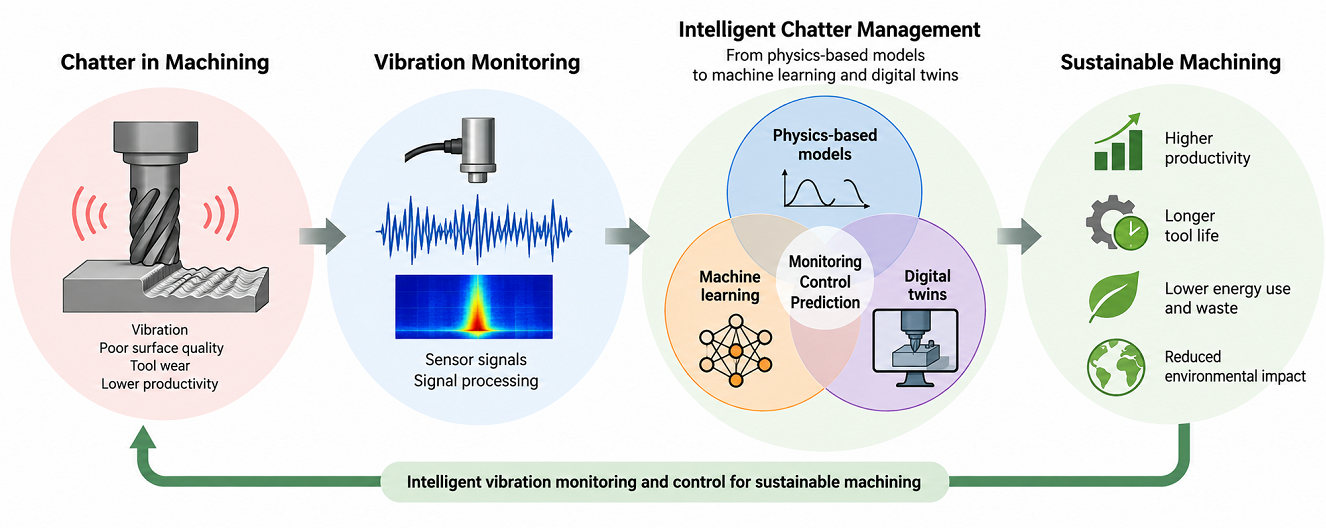
ABSTRACT: Chatter is a persistent self-excited vibration problem in machining that affects productivity, surface quality, tool life, energy consumption, and process sustainability. This review examines the evolution of intelligent chatter management and evaluates its implications for sustainable machining. The review considers the transition from analytical stability prediction and stability-lobe methods to sensor-based monitoring, machine learning, physics-informed approaches, adaptive control, and digital twins, with particular attention to deployment readiness and sustainability evidence. The literature indicates that productivity and surface-quality effects of chatter are well established, whereas direct evidence concerning energy use, material waste, carbon emissions, life-cycle impacts, and component durability remains comparatively limited. Data-driven approaches offer strong potential for real-time monitoring but face challenges related to transferability, changing process conditions, and validation across different machines, tools, materials, and geometries. A clear gap is identified between technology maturity and sustainability-evidence maturity. To address this gap, the review introduces the Sustainability Evidence Level (SEL) framework for organizing and assessing sustainability evidence according to whether reported benefits are measured, modelled, or scenario-assumed. The review highlights the need for future studies to integrate intelligent chatter management with measurable resource-use, productivity, durability, and environmental indicators.
Keywords: Chatter; Sustainable machining; Digital twin; Machine learning; Physics-informed models; Condition monitoring

Graphical Abstract

TOP