

SCIEPublish

Valorization of Agricultural Byproducts into Bacterial Cellulose via Kombucha Symbiotic Consortia: A Review on the ‘Feedstock–Strain–Property–Application’ Paradigm

Review Open Access

Valorization of Agricultural Byproducts into Bacterial Cellulose via Kombucha Symbiotic Consortia: A Review on the ‘Feedstock–Strain–Property–Application’ Paradigm

Author Information
1
National Research Center of Engineering and Technology for Utilization of Botanical Functional Ingredients, Hunan Agricultural University, Changsha 410128, China
2
Key Laboratory of Tea Science of Ministry of Education, Co-Innovation Center of Education Ministry for Utilization of Botanical Functional Ingredients, Hunan Agricultural University, Changsha 410128, China
3
Key Laboratory for Evaluation and Utilization of Gene Resources of Horticultural Crops, Ministry of Agriculture and Rural Affairs of China, Hunan Agricultural University, Changsha 410128, China
*
Authors to whom correspondence should be addressed.

Received: 30 July 2026 Revised: 14 August 2026 Accepted: 24 September 2026 Published: 29 September 2026

Creative Commons

© 2026 The authors. This is an open access article under the Creative Commons Attribution 4.0 International License (https://creativecommons.org/licenses/by/4.0/).
Views:159
Downloads:73
Biobreeding 2026, 1(3), 10016; DOI: 10.70322/biobreeding.2026.10016
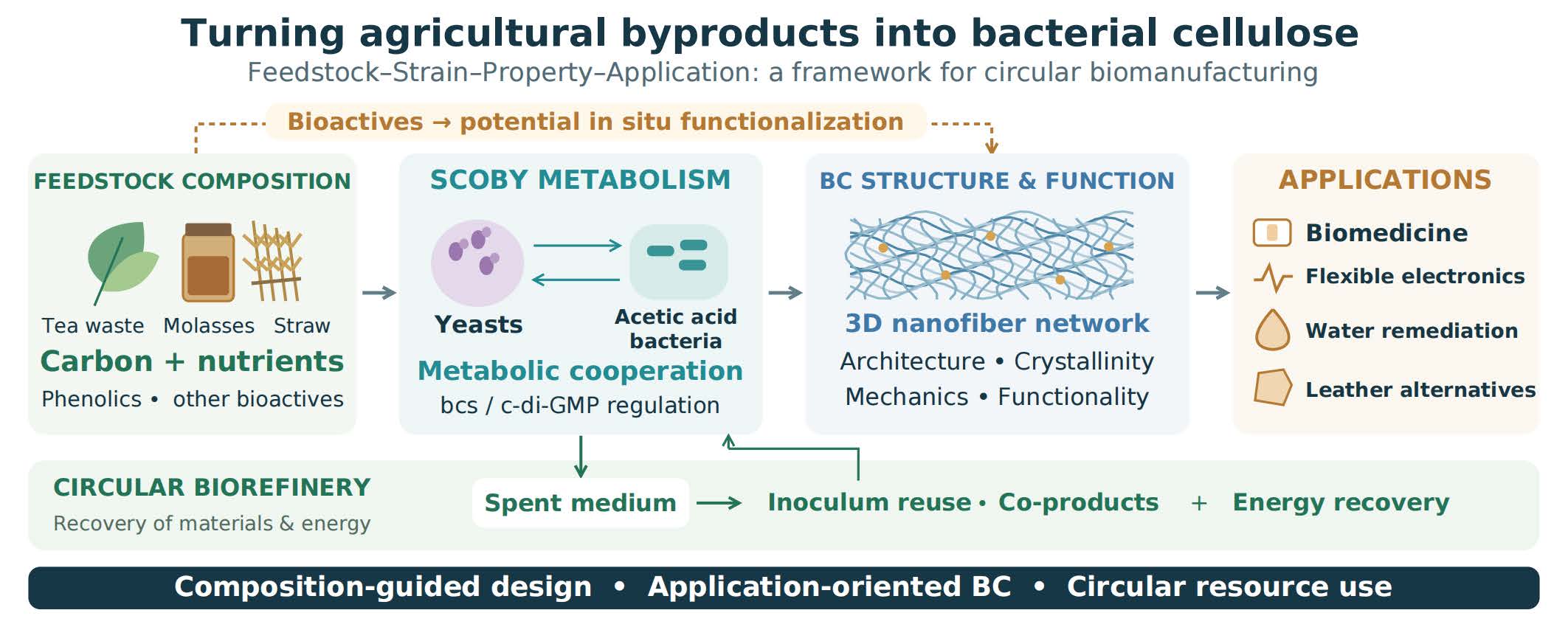
ABSTRACT: Bacterial cellulose is a class of sustainable biopolysaccharides with a three-dimensional nanofiber network structure. Owing to its high chemical purity, excellent mechanical properties, and good biocompatibility, it has broad application prospects in biomedicine, active packaging, and flexible electronics. The high economic and environmental costs of traditional synthetic culture media represent a key bottleneck limiting their industrial-scale production. By leveraging the metabolic synergy of the Symbiotic Culture of Bacteria and Yeast (SCOBY), agricultural byproducts such as molasses, tea waste, and crop straw can be converted into high-value bacterial cellulose, providing a viable pathway for low-carbon, green biomanufacturing. This paper establishes a systematic research paradigm of “feedstock–strain–property–application” and comprehensively reviews research progress on the production of bacterial cellulose from agricultural byproducts via kombucha fermentation: it elucidates the metabolic symbiosis patterns of yeast, Acetobacter, and lactic acid bacteria in the kombucha symbiotic culture, as well as the molecular regulatory mechanisms of the bcs operon and the second messenger c-di-GMP in cellulose biosynthesis; it analyzes the chemical composition characteristics of typical agricultural byproducts, revealing the regulatory roles of carbohydrates, nitrogen sources, minerals, and phenolic compounds in the substrates on microbial community structure, bacterial cellulose yield, as well as the material’s microstructure, crystallinity, and thermomechanical properties, and clarifies that endogenous active components in waste materials can enable in-situ functionalization of bacterial cellulose; summarize technical strategies for screening high-yield strains, rational optimization of symbiotic microbial communities, and genetic engineering modifications; introduce a closed-loop biorefining model for the high-value utilization of all fermentation components, as well as diverse application scenarios for functionalized bacterial cellulose. This review provides a systematic theoretical reference on the utilization of agricultural waste as a resource and the large-scale production of low-cost, high-performance bacterial cellulose, thereby contributing to the development of green biomanufacturing within the context of a circular bioeconomy.
Keywords: Bacterial cellulose; Kombucha symbiotic consortia; Agricultural byproducts; Microbial breeding; Strain-property relationships; Circular bioeconomy

Graphical Abstract

TOP