

SCIEPublish

PacBio Iso-Seq and RNA-Seq Reveal Gene Expression Divergence in Early-Flowering Gynoecious and Androecious Ramie Mutants

Article Open Access

PacBio Iso-Seq and RNA-Seq Reveal Gene Expression Divergence in Early-Flowering Gynoecious and Androecious Ramie Mutants

Author Information
1
Ramie Research Institute, Hunan Agricultural University, Changsha 410128, China
2
Yuelushan Laboratory, Changsha 410128, China
3
Xiangxi Tujia and Miao Autonomous Prefecture Academy of Agricultural Sciences, Jishou 416000, China
4
Hunan Key Laboratory of Germplasm Resources Innovation and Resource Utilization Crop Breeding Center, Changsha 410128, China
*
Authors to whom correspondence should be addressed.
These authors contributed equally to this work.

Received: 11 June 2026 Revised: 30 July 2026 Accepted: 24 August 2026 Published: 09 September 2026

Creative Commons

© 2026 The authors. This is an open access article under the Creative Commons Attribution 4.0 International License (https://creativecommons.org/licenses/by/4.0/).
Views:131
Downloads:80
Biobreeding 2026, 1(3), 10015; DOI: 10.70322/biobreeding.2026.10015
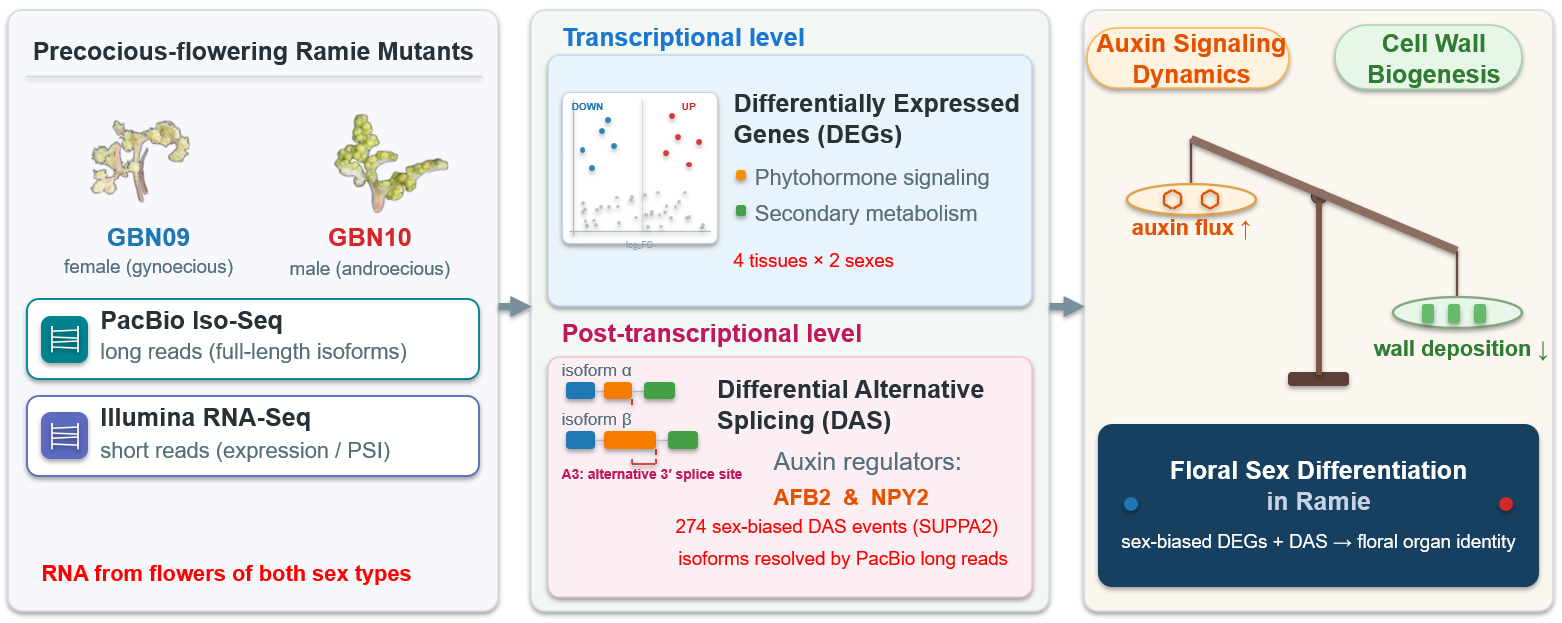
ABSTRACT: Ramie (Boehmeria nivea L.) is an economically valuable bast fiber crop, yet a high-quality full-length transcriptome reference for sex-divergent lines remains lacking. To fill this gap, we combined PacBio Iso-Seq with Illumina RNA-Seq to construct a full-length transcriptome for the gynoecious mutant GBN09 and compared transcriptomes of four tissues (leaves, bast fibers, stems, and flowers) between GBN09 and the androecious mutant GBN10. The analysis generated 63,082 high-quality isoforms and annotated 30,885 genes. Regulatory element mining revealed 565 transcription factors (predominantly IAA, AP2/ERF, and WRKY families), 16,617 long non-coding RNAs (lncRNAs), and 31,759 simple sequence repeats (SSRs). Transcriptomic comparisons identified 8414 differentially expressed genes (DEGs), with the most profound transcriptional shifts in floral and young stem tissues. Enrichment analysis linked these DEGs primarily to linoleic acid metabolism, phytohormone signaling cascades, and secondary metabolite biosynthesis, highlighting their roles in sexual differentiation. Furthermore, we detected 274 sex-biased differential alternative splicing (DAS) events, many of which mapped to cell wall biogenesis and core auxin signaling components such as AFB2 and NPY2. These results indicate that post-transcriptional modifications provide an additional regulatory layer during ramie floral sex differentiation. Validated by qRT-PCR, this dataset establishes a robust molecular resource and identifies candidate genes to elucidate sex differentiation and support molecular breeding in ramie.
Keywords: Ramie; Sex differentiation; PacBio Iso-Seq; RNA-Seq

Graphical Abstract

TOP