SCIEPublish

Occupationally Triggered Fibrosing Sarcoidosis: A Case Report

Case Report Open Access

Occupationally Triggered Fibrosing Sarcoidosis: A Case Report

Author Information
Department of Internal Medicine, Ibn Rochd Hospital, Casablanca 20100, Morocco
*
Authors to whom correspondence should be addressed.

Received: 10 August 2026 Revised: 28 August 2026 Accepted: 11 September 2026 Published: 16 September 2026

Creative Commons

© 2026 The authors. This is an open access article under the Creative Commons Attribution 4.0 International License (https://creativecommons.org/licenses/by/4.0/).

Views:109
Downloads:18
Fibrosis 2026, 4(3), 10013; DOI: 10.70322/fibrosis.2026.10013
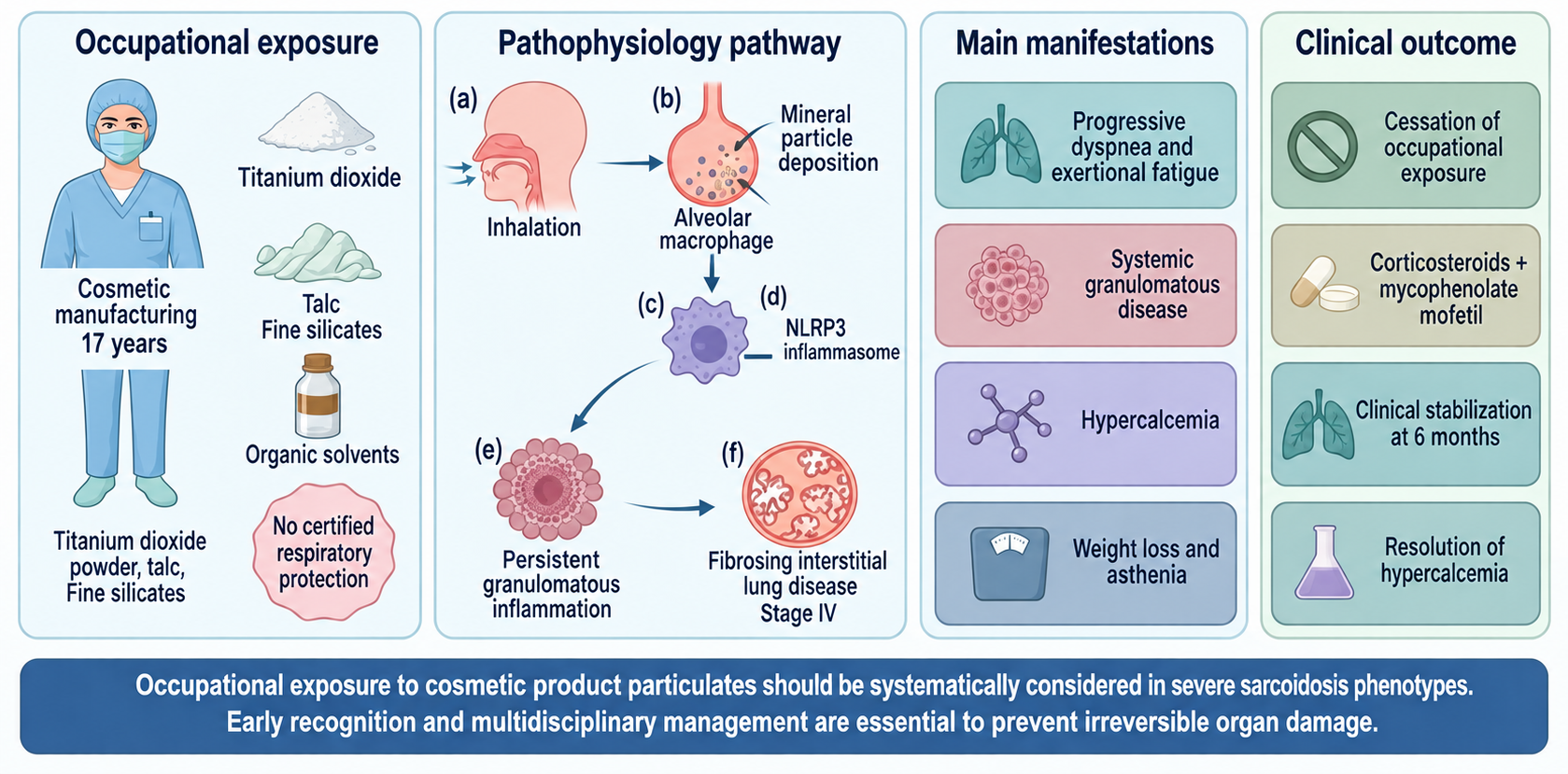
ABSTRACT: (1) Sarcoidosis is a systemic granulomatous disease of multifaceted etiology, characterized predominantly by pulmonary parenchymal involvement. While genetic susceptibility represents a foundational prerequisite, environmental and occupational xenobiotics are increasingly recognized as pivotal etiologic triggers. In cosmetic formulation environments, prolonged inhalation of mineral micro- and nanoparticles—such as titanium dioxide, talc, and fine silicates—alongside volatile organic solvents, provides a persistent antigenic stimulus that can drive aberrant granulomatous cascades toward aggressive, fibrosing phenotypes. (2) A 54-year-old female industrial worker presented with a 17-year history of occupational exposure in cosmetic manufacturing (handling airborne inorganic powders, titanium dioxide, talc, and organic vehicles without certified particulate respiratory protection), exhibiting progressive dyspnea, marked asthenia, and weight loss. Examination revealed inspiratory crackles at the pulmonary apices, violaceous nasal plaques consistent with lupus pernio, subcutaneous nodules, and sarcoid acropathy. Imaging and histology confirmed stage IV systemic sarcoidosis with fibrosing interstitial lung disease and multiple deep lymphadenopathies. Biologically and histologically, sarcoidosis was confirmed. Complete cessation of occupational exposure was achieved through workplace reassignment. Following combination therapy with oral corticosteroids and mycophenolate mofetil, the patient demonstrated clinical stabilization, resolution of hypercalcemia, and static lung function at 6-month follow-up. (3) This case underscores the importance of considering occupational exposures, including handling cosmetic products, in the pathogenesis and progression of fibrosing sarcoidosis. Early recognition and multidisciplinary management, integrating immunosuppressive therapy and occupational health interventions, are critical to limit irreversible organ damage.
Keywords: Sarcoidosis; Occupational exposure; Cosmetic industry; Granulomatous inflammation; Fibrosing interstitial lung disease; Immunosuppressive therapy

Graphical Abstract

TOP