
Good, Fair, or Poor? The Reality of Stream Macroinvertebrate Biomonitoring in an Impaired Agricultural Watershed
Good, Fair, or Poor? The Reality of Stream Macroinvertebrate Biomonitoring in an Impaired Agricultural Watershed

Received: 27 June 2026 Revised: 27 July 2026 Accepted: 07 September 2026 Published: 11 September 2026

© 2026 The authors. This is an open access article under the Creative Commons Attribution 4.0 International License (https://creativecommons.org/licenses/by/4.0/).
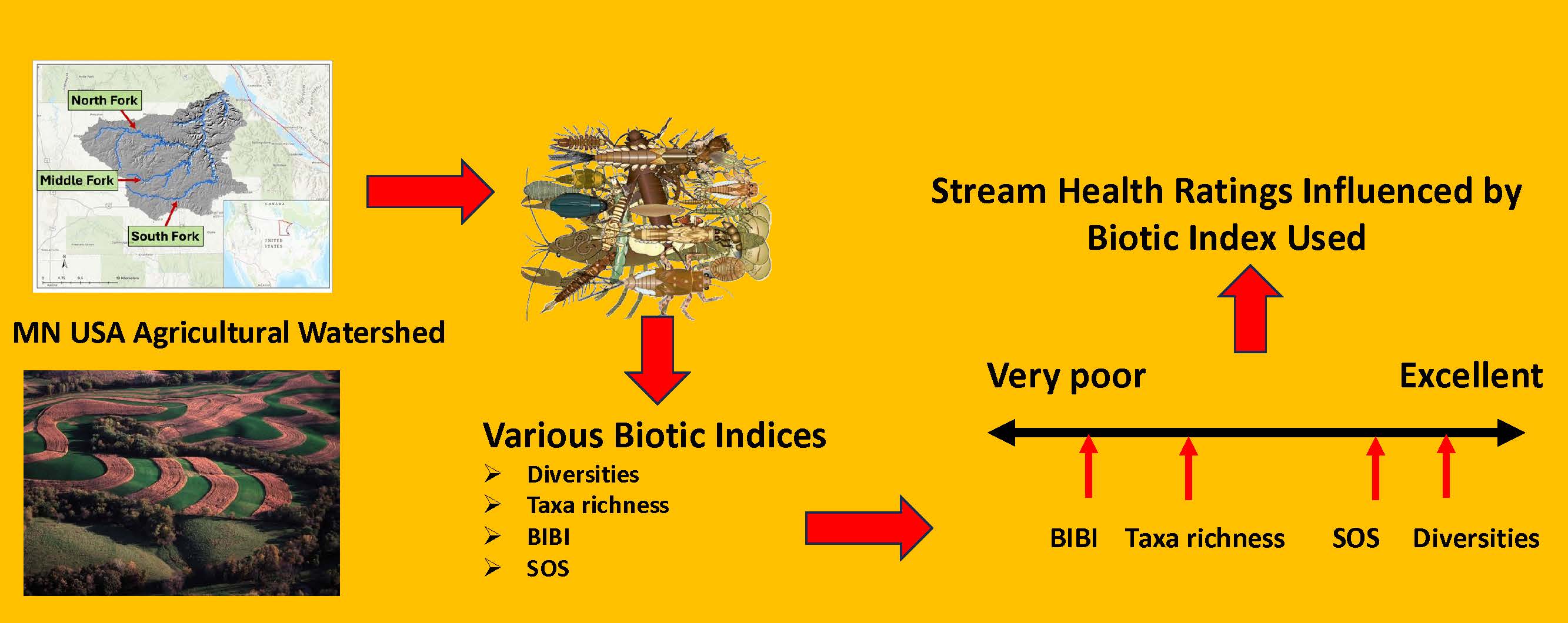
Graphical Abstract
1. Introduction
Agriculture is the dominant land use in the upper midwestern USA and plays a crucial role in the economy of the region [1]. Hundreds of thousands of farms in the upper Midwest grow and harvest row crops, grains, and forage, and raise a variety of livestock using confined feedlots or various grazing systems [1,2]. While providing valuable commodities and employment opportunities, agricultural activities can also have negative effects on the quality of surface waters within the region [3,4,5,6]. Eroded soils, agricultural chemicals (herbicides, pesticides, fertilizer), livestock wastes, and organic crop residues can be lost from production fields and pastures during rainfall and snowmelt events, entering wetlands, lakes, streams, and rivers via overland runoff and/or shallow groundwater discharge [7,8,9,10]. Acting either individually or in tandem with other factors, agricultural contaminants can impair surface water quality, degrade stream habitats, and impact native aquatic community structure and function [11].
The negative effects of agricultural activities on streams and rivers are well known. Lotic habitats can be degraded by accumulations of eroded soil that smother coarse stream-bottom substrates and homogenize habitats [12]. Autochthonous primary production may decline due to reduced water clarity and dissolved herbicides [12,13,14,15,16]. Reduced plant resources, harmful levels of pesticides, and degraded stream bottom habitats can eliminate sensitive invertebrates and reduce community diversity [14,17]. Ultimately, valued recreational fish species may decline in abundance and/or be replaced by tolerant and undesirable fish taxa [18,19].
Numerous types of conservation or best management practices (BMPs) have been implemented to insulate streams and rivers from the side-effects of agricultural activities [20,21]. BMPs may include reduced or altered tillage practices, integrated pest management, livestock waste controls, and installation of riparian buffers [20,21,22,23]. Despite these efforts, communities of stream-dwelling benthic macroinvertebrates in agricultural watersheds often remain impaired, characterized by poor diversity and a lack of sensitive species [4,6].
Many different approaches have been used to assess the status of benthic macroinvertebrate communities in streams and rivers, and/or use invertebrates to evaluate overall stream health. Ranging from simple abundance and taxa richness counts to community diversity and tolerance indices to multi-metric biotic integrity procedures, various measures have been proposed, developed, tested, refined, and used to assess the effects of various environmental disturbances on the condition of stream benthic communities (e.g., [24,25,26,27,28,29]). Different biotic indices have been used to examine macroinvertebrate assemblages in relatively pristine river systems [30,31] and those exposed to pollutants from mines [32], municipal wastewater treatment discharges [33], and various agricultural operations [4,34]. Comparative studies examining the performance of multiple community measures have indicated that multi-metric and taxa richness indicators regularly (but not always) out-perform other indices (e.g., diversities) across a broad range of benthic community conditions [27,30,31,32,33,34,35].
In this study, we compare the use of several different biotic indices to assess the macroinvertebrate communities within streams of an agricultural watershed in southeastern Minnesota, USA, with known impairment. Our objectives were to use multiple biotic indices to compare communities in three different streams within the watershed, and to determine whether various indices rated stream communities differently from one another. We hypothesized that (1) the various indices would be able to detect significant differences in the communities in the three streams examined; and (2) that multi-metric and taxa richness indices would provide more accurate ratings of the macroinvertebrate communities than would diversity measures, which we expected would overrate community “quality” relative to the other indices.
2. Study Area
This study was conducted within the Whitewater River watershed, which encompasses 83,059 hectares in southeastern Minnesota, USA (Figure 1). This agricultural watershed (70% agricultural land use [49% tilled croplands and 21% non-tilled ag lands], 22% forested, 5% developed) [6]. Agricultural land uses typically include row crops (field [hard] and sweet corn, soybeans), small grains, hay lands, livestock pastures, and confinement feedlots (dairy and beef cattle, hogs, poultry). It lies within the Driftless Area ecoregion that spans portions of four USA states (Minnesota, Wisconsin, Iowa, Illinois), with karst geology that produces a surface network of cold, spring-fed rivers and streams and [36,37].
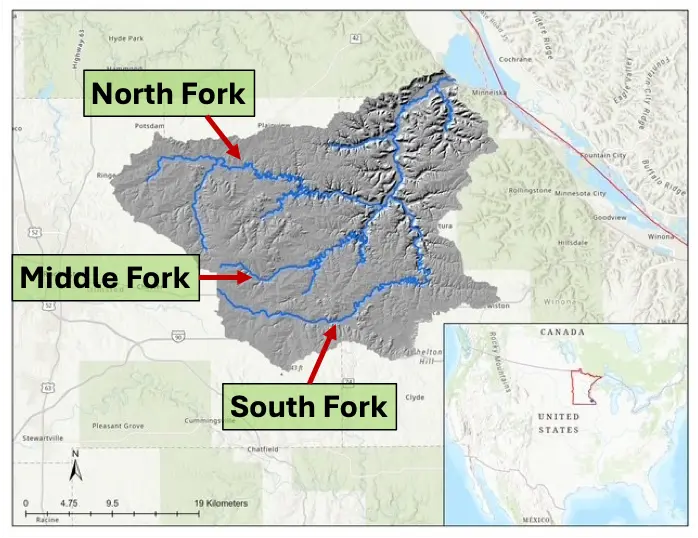
Figure 1. Hillshade map of the Whitewater River watershed, highlighting the three river forks. Individual study sites are not indicated. The inset map indicates the location of the study area in southeastern Minnesota, USA.
The Whitewater watershed has a long history of land abuse due to improper agricultural practices [38,39,40]. The earliest European immigrants to the region during the 1800s tilled undulating native grasslands to plant wheat and cleared trees and brush from steep wooded hillslopes to encourage grass production for grazing livestock [36,40]. These farming practices led to severe soil erosion, choking streams with heavy loads of fine sediments and burying stream valleys under several meters of eroded soil [36,38]. Lack of sustainable practices and continued soil and nutrient losses resulted in reduced crop production, and valley farms were abandoned after repeated flooding and crop failures [36,40]. Eroded soil deposits in streams and riparian areas produced catastrophic damage to native aquatic communities and led to species extirpations [36,38]. Some localized recovery of stream reaches within the watershed has occurred, driven by a combination of implementation of agricultural best management practices (BMPs), stream restoration projects, and long-term fish stocking until self-sustaining populations were developed [4,5,6,39].
The Whitewater River watershed has three main forks (North, Middle, South) that join to form the mainstem river, plus several low-order tributaries (e.g., Beaver Creek, Trout Valley Creek, Crow Spring, Logan Creek, Trout Run, other smaller creeks and springs) [36]. Most of these systems are classified and managed as coldwater systems by the Minnesota Department of Natural Resources and support native brook trout (Salvelinus fontinalis), non-native brown trout (Salmo trutta), and non-native rainbow trout (Oncorhynchus mykiss) for recreational angling [41]. All streams within the watershed sustain perennial flows due to a combination of spring discharges and precipitation runoff [36].
3. Materials and Methods
3.1. Field and Lab Work
Within each of the three main forks of the Whitewater River (Figure 1), we sampled 19 sites for benthic macroinvertebrates, for a total of 57 sites within the watershed. Whenever possible, we selected sites spaced approximately 1.5 km apart, stretching from the headwater sources of each fork to the confluence of each fork with the mainstem. However, the inability to obtain permission to access some sites on private property and otherwise difficult access due to steep hillslopes resulted in one or more sampling gaps within each fork.
Macroinvertebrates were sampled once from each stream site during the summer or autumn of 2018 or 2019. All sites except for two on each of the North and Middle forks and one on the South fork were sampled in 2019. At each site, we collected three benthic macroinvertebrate samples, each from a separate riffle (i.e., habitats with coarse substrates, shallow water, faster current velocity, and disturbed water surfaces). Macroinvertebrates were collected with a D-frame aquatic dip net (0.5-mm mesh) placed against the stream bottom and facing upstream. Gravel and rocks upstream from the net were agitated by kicking and/or scrubbing for 30 s, dislodging invertebrates and washing them into the net. Two, 30-s kicks/scrubs were used in each riffle (in fast and slow sections, respectively), and all invertebrates collected were combined to form a single sample. Organisms and debris collected in the net were placed into a labelled sample jar and preserved (70% ethanol) prior to lab processing. Overall, three samples from each of 57 stream sites resulted in 171 separate macroinvertebrate samples.
In the laboratory, invertebrates were sorted from the debris, counted, and identified (mostly to genus) [42,43,44,45,46,47,48] using a lighted magnifier (Taber Luxo-Lighting, Strathmore, CA, USA) with 10× magnification and a dissecting microscope (Nikon SMZ645, Nikon Instruments Inc., Melville, NY, USA) with 8 to 50× magnification. Chironomidae (midge larvae and pupae) were not identified below the family level.
3.2. Data Analyses
Seven different abundance, taxa richness, diversity, and biotic integrity indices were calculated for each benthic macroinvertebrate sample. First, the total count of all organisms in each sample was used as a general estimate of overall invertebrate abundance or density. Second, the total number of taxa (total taxa richness) and the number of mayfly (Ephemeroptera), stonefly (Plecoptera), and caddisfly (Trichoptera) taxa (EPT taxa richness) were tabulated for each sample. Third, Simpson and Shannon (base 10) diversity indices (base 10) were calculated for each individual sample using Quantan statistical software (May 1997 version) [49]. Fourth, we calculated a regional, multi-metric benthic invertebrate biotic integrity index (BIBI) [50,51] for each macroinvertebrate sample as an indicator of benthic biological integrity. This index was previously validated using known high-quality reference and impaired benthic communities and was proven to be responsive to physical stream impairments [50,51]. Total scoring for this BIBI (with possible scores ranging between 0 and 100) was based on sub-scores for each of 10 various macroinvertebrate community metrics, including various types of taxa richness, tolerance categories, feeding guilds, and lifespan measures (Table 1). Each metric was scored as 0, 5, or 10 based on the value for that metric, and combined produced ratings of: very poor (total BIBI scores ranging from 0 to 5), poor (10 to 25), fair (30 to 45), good (50 to 60), and excellent (65 to 100) [50]. Finally, a national Izaak Walton League of America Save Our Streams (SOS) macroinvertebrate water quality rating score [52] typically used by citizen scientists to evaluate stream health was determined for each sample. This score was determined by differentially weighting the presence of sensitive taxa (number of taxa in this category multiplied by 3), less sensitive taxa (number multiplied by 2), and tolerant taxa (number multiplied by 1) in each sample, combined to produce a total SOS score (possible scores from 0 to 50). Taxa in each sensitivity category are shown in Table 2. Total SOS scores produced ratings such as excellent (>22), good (17–22), fair (11–16), and poor (<11) [52].
Table 1. Regional BIBI metrics and scores (0, 5, or 10) are assigned to various levels of abundance for each metric. Scores for all metrics were summed to produce a total BIBI score for each sample, ranging from 0 to 100. Modified from [50].
|
Metric |
Score 10 |
Score 5 |
Score 0 |
|---|---|---|---|
|
Percent Plecoptera |
>12 |
6–12 |
<6 |
|
Percent long-lived |
>12 |
6–12 |
<6 |
|
Percent predators |
>13 |
6.5–13 |
<6.5 |
|
Number of total taxa |
>12 |
7–12 |
0–6 |
|
Number of Plecoptera taxa |
>1 |
1 |
0 |
|
Number of Trichoptera taxa |
>3 |
2–3 |
0–1 |
|
Number of long-lived taxa |
>1 |
1 |
0 |
|
Number of Diptera taxa |
>4 |
3–4 |
0–2 |
|
Number of intolerant taxa |
>3 |
2–3 |
0–1 |
|
Number of filterer taxa |
>4 |
3–4 |
0–2 |
Table 2. Macroinvertebrate taxa were categorized as sensitive, less sensitive, and tolerant for the Izaak Walton League of America SOS rating system [52].
|
Sensitive Taxa |
|---|
|
Cased caddisflies (Trichoptera except Hydropsychidae) |
|
Mayflies (Ephemeroptera) |
|
Stoneflies (Plecoptera) |
|
Watersnipe flies (Diptera: Athericidae) |
|
Riffle beetles (Coleoptera: Elmidae) |
|
Water pennies (Coleoptera: Psephenidae) |
|
Gilled snails (Gastropoda, mostly Pleuroceridae, Viviparidae) |
|
Less Sensitive Taxa |
|
Dobsonflies (Megaloptera: Corydalinae) |
|
Fishflies (Megaloptera: Chauliodinae) |
|
Crane flies (Diptera: Tipulidae) |
|
Damselflies (Odonata) |
|
Dragonflies (Odonata) |
|
Alderflies (Megaloptera: Sialidae) |
|
Common net-spinning caddisflies (Trichoptera: Hydropsychidae) |
|
Crayfish (Decapoda) |
|
Scuds (Amphipoda) |
|
Aquatic sowbugs (Isopoda) |
|
Clams (Bivalvia: mostly Sphaeriidae) |
|
Mussels (Bivalvia: mostly Unionidae) |
|
Tolerant Taxa |
|
Aquatic worms (Oligochaeta) |
|
Black flies (Diptera: Simuliidae) |
|
Midge flies (Diptera: Chironomidae) |
|
Leeches (Hirudinea) |
|
Lunged snails (Gastropoda: Pulmonata) |
To initiate data analyses, macroinvertebrate abundance, taxa richness, diversity, and BIBI and SOS scores were grouped by stream fork. Each community measure was then compared using a separate Kruskal-Wallis test to assess whether the index differed among forks (VassarStats: Website for Statistical Computation; vassarstats.net; accessed on 20 January 2026). We treated each of the three samples collected at each of the 57 stream sites as separate, independent samples (171 in total) in our analyses, as neither within-site nor among-site variabilities were relevant to our comparisons among the biotic indices. As each sample was collected from a separate riffle, even those samples from the same stream site might not be considered true replicates, as the organisms in each riffle likely were exposed to differing velocities, water depths, substrate sizes, predation pressures, and so on.
Next, data from all forks were combined, and multivariate analyses (JMP Pro 18.0.1; JMP Statistical Discovery LLC, Cary, NC, USA) were used in two ways. One analysis was used to produce a Spearman’s rank correlation coefficient table and a scatterplot matrix comparing the strengths of the relationships among all seven different macroinvertebrate community measures. A second procedure used principal components analysis (PCA) to explore the distribution of individual samples and the directions of influence of each community index within a two-dimensional ordination space.
Because we were interested in how stream community rating patterns by the various individual indices would compare among stream forks and relative to one another, we compared the rating distributions (i.e., how ratings for all individual samples were distributed among rating categories) using two different approaches. However, we first needed to delineate rating categories for those indices that did not already have them. We used the rating categories for BIBI and SOS as previously established (see above) [50,52]. For diversity indices, we simply subdivided the possible range of values into five equal parts, assigning ratings as: poor (≤0.2), fair (0.21–0.40), good (0.41–0.60), very good (0.61–0.80), and excellent (greater than 0.8). For total taxa richness and EPT taxa richness, we used benthic macroinvertebrate taxa richness data for reference-quality and impaired streams in southeastern Minnesota [50] to establish the following rating categories: total taxa richness—very poor (1–4 taxa), poor (5–8 taxa), fair (9–12 taxa), good (13–16 taxa), and excellent (17 taxa or more); EPT taxa richness—very poor (0–2 taxa), poor (3–4 taxa), fair (5–6 taxa), good (7–8 taxa) and excellent (9 taxa or more). We did not attempt to devise any rating categories for total macroinvertebrate abundance, as both low and high abundances can be indicative of impaired stream conditions [53,54].
With these rating categories established, we first compared the distributions of rating categories for each biotic index across samples collected from the three forks of the Whitewater River using Chi-square contingency table analyses [55] to determine whether rating patterns for any index differed significantly among forks. We also used Chi-square contingency table analyses to compare rating category distributions (for all samples from all forks combined) between each pair of rating indices (six indices, 15 pairwise comparisons) to determine if rating patterns differed among the various indices.
4. Results
In total, >25,000 benthic macroinvertebrates were collected and identified from the 57 sites along the three forks of the Whitewater River (North Fork = 5998; Middle Fork = 12,713; South Fork = 7071). Organisms per sample differed significantly among river forks, with the greatest abundances in the Middle Fork (Table 3). A typical sample contained approximately 10 total taxa, with four of those being EPT taxa, but neither total taxa richness nor EPT taxa richness differed significantly among river forks (Table 3). Common taxa collected in all forks included: the amphipod Gammarus, the mayfly Baetis, the caddisflies Hydropsyche and Brachycentrus, riffle beetles Optioservus and Stenelmis, blackflies Simulium, and midges Chironomidae.
Numbers of EPT taxa collected across all forks were limited, with only 18 total genera identified (Table 4). Nearly all these taxa were collected from the South Fork, but only 61 and 67% were detected in the Middle and North forks, respectively. The caddisfly taxa generally were more uniformly distributed across the forks compared to either mayflies or stoneflies (Table 4). Almost every sample (91% or more) from all forks contained both mayflies and caddisflies, but stoneflies were uncommon among samples, especially those from the North and Middle forks (Table 4).
The two diversity indices displayed differing patterns among river forks than did BIBI and SOS scores (Table 3). Both the Simpson and Shannon indices differed significantly among forks, with diversity values in the South Fork significantly higher than those in the other forks. By contrast, neither BIBI scores nor SOS scores differed significantly among forks (Table 3).
All seven of the benthic macroinvertebrate community indices assessed were significantly correlated with one another (Table 5). However, the strongest relationships (Spearman coefficients > 0.7) were between the two diversity indices, between total taxa richness and both BIBI and SOS scores, and between BIBI and SOS scores. The pairwise relationships among the seven indices are illustrated in Figure 2.
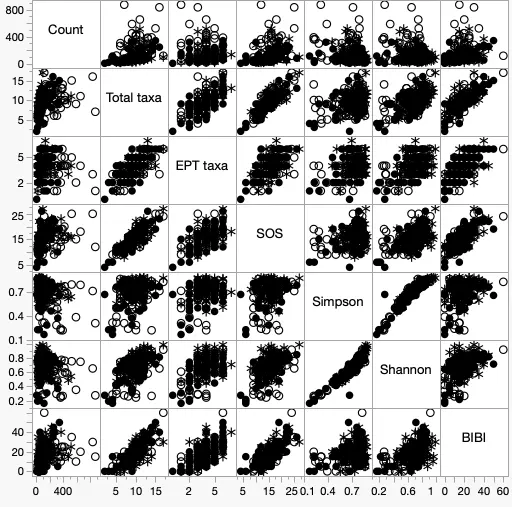
Figure 2. Scatterplot matrix depicting pairwise relationships among the seven biotic measures used to assess benthic macroinvertebrate communities at 57 sites within the Whitewater River watershed, southeastern Minnesota, USA. Row (top to bottom) and column (left to right) units are organisms/sample, number of total taxa, number of EPT taxa, SOS score, Simpson diversity value, Shannon diversity value, and BIBI score. Symbols represent the North (solid circles), Middle (open circles), and South (asterisks) forks of the Whitewater River.
The PCA ordination plot depicts the direction of influence of each macroinvertebrate community measure along the two axes (Figure 3). EPT taxa richness, total taxa richness, BIBI score, and SOS score had the most influence on PCA axis 1, with the latter three having nearly identical influences within the ordination. Organism count (or sample abundance) and the two diversity indices were most influential along PCA axis 2. Samples from the three forks displayed much overlap within the ordination space, indicating similar ranges in community composition/structure among the three forks. However, the ordination indicates that several samples from the Middle Fork had the highest sample counts. In addition, many samples from the North and Middle forks had low taxa richness and low BIBI and SOS scores. Finally, several samples from the South Fork had the highest diversities.
The distribution of samples among the rating categories differed significantly among the three river forks for three of the six biotic measures examined (Figure 4). EPT taxa richness, Simpson diversity, and Shannon diversity values received higher ratings for samples from the South Fork and lower values in the North Fork. Total taxa richness ratings showed a similar, though not significant, pattern. Samples from all forks displayed similar distributions for both BIBI and SOS ratings.
When rating distributions for the various biotic indices were compared to one another, statistically significant differences were detected for 13 of the possible 15 pairwise comparisons (Table 6, Figure 5). The only two rating distributions that did not show significant differences were the BIBI score versus EPT taxa richness and Shannon diversity versus Simpson diversity. Both diversity indices tended to rate benthic macroinvertebrate communities the highest (mostly very good to excellent), whereas BIBI scores and EPT taxa richness values produced the poorest ratings (mostly poor and very poor) (Figure 5). In order from highest ratings to lowest ratings, the indices were: Simpson diversity, Shannon diversity, SOS score, total taxa richness, EPT taxa richness, and BIBI score (Figure 5).
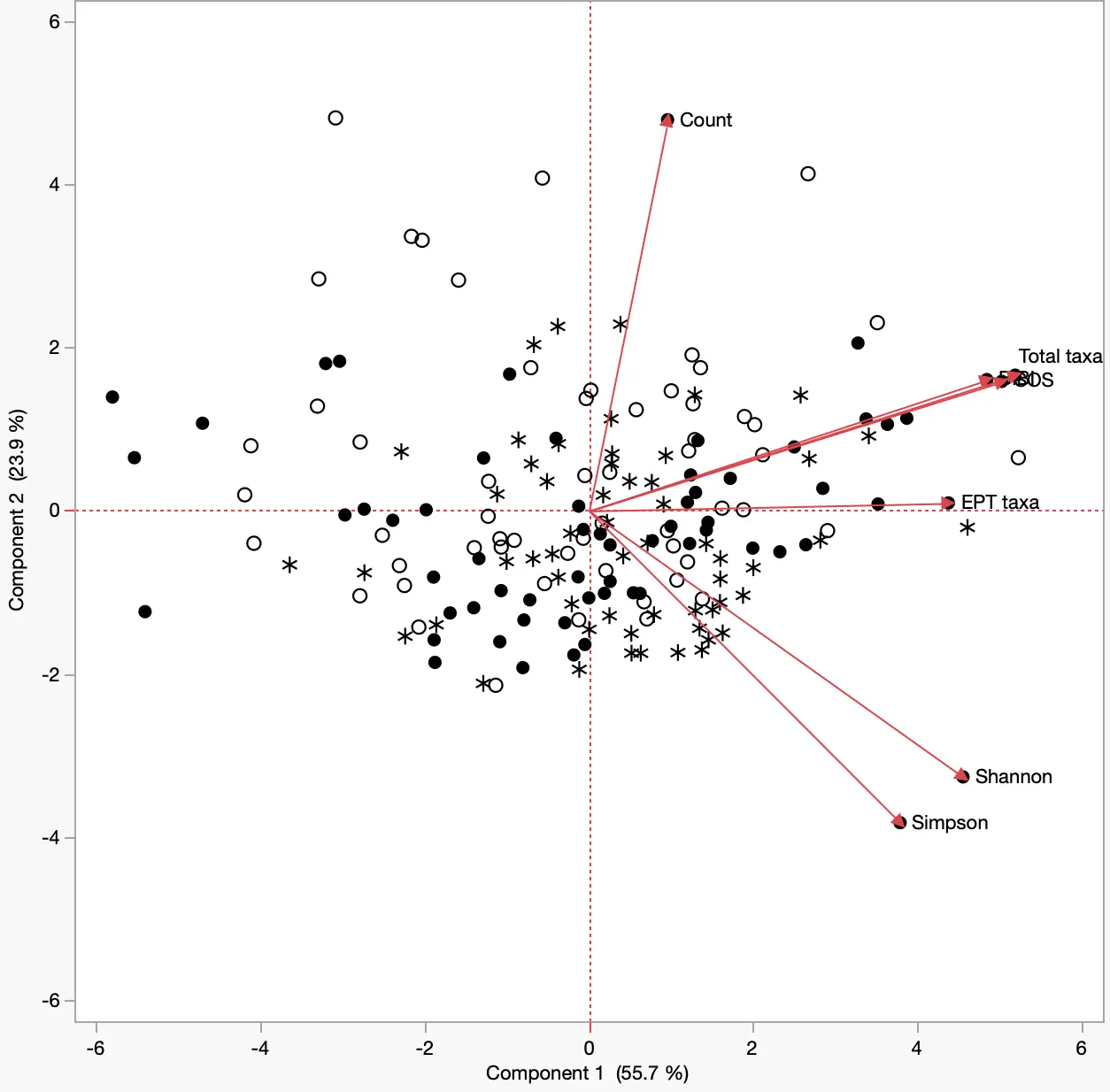
Figure 3. PCA ordination depicting relationships among 171 benthic macroinvertebrate samples from the North (solid circles), Middle (open circles), and South (asterisks) forks of the Whitewater River based on seven biotic measures. Loading vectors are shown for each biotic measure. Labels for BIBI and SOS vectors are hidden below the vectors near the Total taxa label.
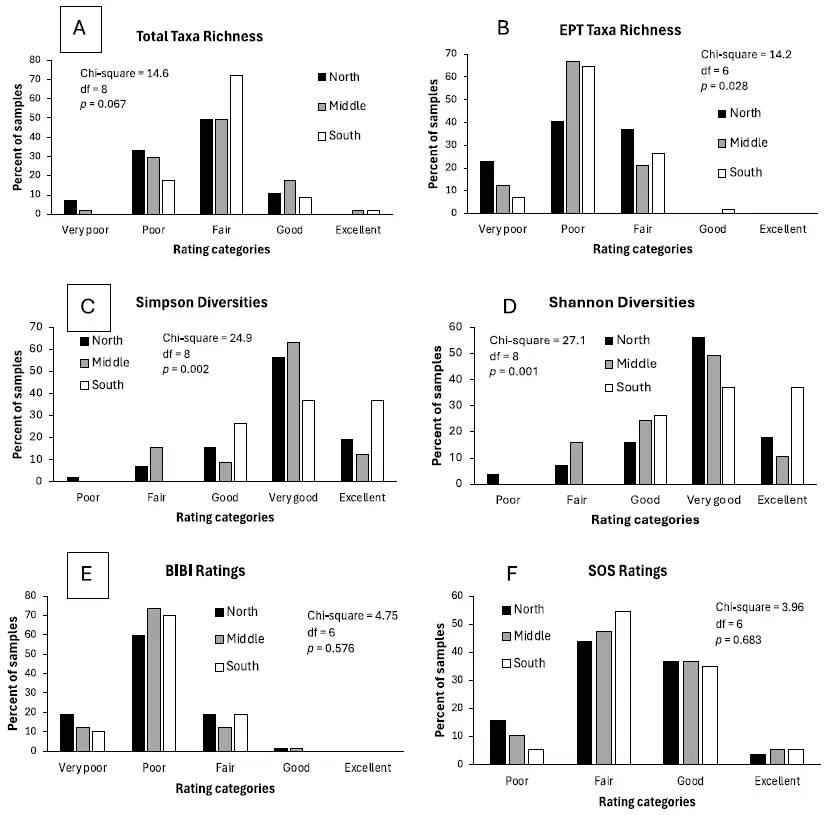
Figure 4. Distributions of ratings for each of the three forks of the Whitewater River for each of six biotic indices based on 171 benthic macroinvertebrate samples (57 samples from each river fork). (A) Taxa richness ratings shown for each river fork (North, Middle, South). (B) EPT (Ephemeroptera-Plecoptera-Trichoptera) taxa richness ratings shown for each river fork. (C) Simpson diversity ratings shown for each river fork (North, Middle, South). (D) Shannon diversity ratings shown for each river fork (North, Middle, South). (E) BIBI (Benthic Invertebrate Biotic Index) ratings shown for each river fork (North, Middle, South). (F) SOS (Save Our Streams) ratings shown for each river fork (North, Middle, South).
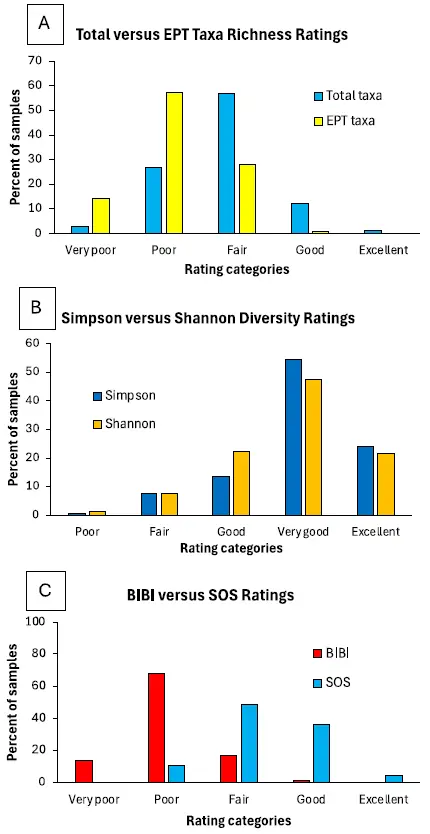
Figure 5. Distributions of ratings for each of six biotic indices based on all 171 benthic macroinvertebrate samples from the Whitewater River combined. (A) Total and EPT taxa richness ratings. (B) Simpson and Shannon diversity ratings. (C) BIBI and SOS ratings.
Table 3. Median (25th and 75th percentile) biotic index values for samples from each Whitewater River stream fork and results of Kruskal-Wallis tests comparing values among forks.
|
Variable |
North Fork |
Middle Fork |
South Fork |
Kruskal-Wallis H |
p |
|---|---|---|---|---|---|
|
Count |
75 (41, 148) |
151 (70, 332) |
89 (50, 173) |
13.82 |
0.001 |
|
Total taxa richness |
9 (8, 11) |
9 (7, 11) |
10 (9, 11) |
3.76 |
0.153 |
|
EPT taxa richness |
4 (3, 5) |
4 (3, 4) |
4 (3, 5) |
1.41 |
0.494 |
|
SOS score |
15 (12, 19) |
16 (12, 18) |
16 (14, 17) |
0.61 |
0.737 |
|
Simpson diversity |
0.74 (0.59, 0.79) |
0.71 (0.60, 0.77) |
0.75 (0.64, 0.84) |
8.47 |
0.015 |
|
Shannon diversity |
0.71 (0.59, 0.78) |
0.65 (0.53, 0.75) |
0.71 (0.58, 0.85) |
8.8 |
0.012 |
|
BIBI score |
15 (10, 25) |
15 (10, 25) |
20 (15, 25) |
0.93 |
0.628 |
Table 4. Presence (denoted by X) of various Ephemeroptera, Plecoptera, and Trichoptera taxa in each of the three forks of the Whitewater River.
|
Taxa |
North Fork |
Middle Fork |
South Fork |
|---|---|---|---|
|
Ephemeroptera (mayflies) |
|||
|
Baetis |
X |
X |
X |
|
Baetisca |
X |
X |
|
|
Caenis |
X |
||
|
Ephemerella |
X |
X |
X |
|
Heptagenia |
X |
X |
X |
|
Hexagenia |
X |
||
|
Pseudocloeon |
X |
||
|
Stenonema |
X |
X |
X |
|
Tricorythodes |
X |
X |
|
|
Total Ephemeroptera taxa |
5 |
5 |
9 |
|
Number (%) of samples with mayflies |
52 (91.2) |
57 (100) |
55 (96.0%) |
|
Plecoptera (stoneflies) |
|||
|
Acroneuria |
X |
||
|
Isoperla |
X |
X |
|
|
Pteronarcys |
X |
X |
|
|
Total Plecoptera taxa |
1 |
1 |
3 |
|
Number (%) of samples with stoneflies |
2 (3.5) |
2 (3.5) |
10 (17.5) |
|
Trichoptera (caddisflies) |
|||
|
Brachycentrus |
X |
X |
X |
|
Cheumatopsyche |
X |
X |
X |
|
Hydropsyche |
X |
X |
X |
|
Hydroptila |
X |
X |
X |
|
Lepidostoma |
X |
X |
X |
|
Limnephilus |
X |
||
|
Total Trichoptera taxa |
6 |
5 |
5 |
|
Number (%) of samples with caddisflies |
54 (94.7) |
53 (93.0) |
56 (98.2) |
|
Total EPT taxa |
12 |
11 |
17 |
Table 5. Spearman rank correlation matrix comparing the seven biotic indices used to assess benthic macroinvertebrate communities in the Whitewater River.
|
Variable |
Count |
Total Taxa Richness |
EPT Taxa Richness |
SOS Score |
Simpson Diversity |
Shannon Diversity |
|---|---|---|---|---|---|---|
|
Total taxa richness |
0.495 **** |
|||||
|
EPT taxa richness |
0.228 ** |
0.632 **** |
||||
|
SOS score |
0.452 **** |
0.814 **** |
0.498 **** |
|||
|
Simpson diversity |
−0.259 *** |
0.314 **** |
0.298 **** |
0.289 *** |
||
|
Shannon diversity |
−0.154 * |
0.509 **** |
0.420 **** |
0.462 **** |
0.950 **** |
|
|
BIBI score |
0.416 **** |
0.765 **** |
0.569 **** |
0.763 **** |
0.288 *** |
0.450 **** |
**** p < 0.0001; *** p < 0.001; ** p < 0.01; * p < 0.05.
Table 6. Results of pairwise Chi-square contingency table tests comparing rating category distributions of six biotic indices used to assess benthic macroinvertebrate communities in the Whitewater River. Values are p values. Total counts were excluded from these comparisons due to lack of ratings for total count data.
|
Variable |
Total Taxa Richness |
EPT Taxa Richness |
SOS Score |
Simpson Diversity |
Shannon Diversity |
|---|---|---|---|---|---|
|
EPT taxa richness |
<0.001 |
||||
|
SOS score |
<0.001 |
<0.001 |
|||
|
Simpson diversity |
<0.001 |
<0.001 |
<0.001 |
||
|
Shannon diversity |
<0.001 |
<0.001 |
<0.001 |
0.282 |
|
|
BIBI score |
<0.001 |
0.088 |
<0.001 |
<0.001 |
<0.001 |
5. Discussion
Based on our observations of benthic macroinvertebrate communities at 57 stream sites in an impaired agricultural watershed, several biotic indices differ in their assessments of those communities, the general health of the stream sites, and the degree of stream impairment due to human activities. Even though all indices were highly correlated with one another, various measures were more strongly related to certain indices than to others. In addition, some indices rated most benthic communities as very good and excellent, others classified the same macroinvertebrate collections as fair and good, whereas others rated those samples as poor and very poor.
We chose the Whitewater River watershed for this study because of its agricultural setting, history of land abuse, and stream impairments [4,5,36,38,39,40]. This watershed lies within a larger region generally dominated by agriculture, where many river and stream communities remain impaired [56] despite long-term and on-going efforts to better manage soil erosion, chemical runoff, and livestock wastes [6,39,40,57]. However, some regional streams dominated by groundwater spring flows support diverse and healthy macroinvertebrate communities [3], providing the potential to assess a wide range of impaired and non-impaired communities using various biotic indices.
Based on previous surveys [4,19], we expected (1) that there would be differences in stream impairment at sites on the different river forks, and (2) that most stream site communities would be rated as fair to very poor due to continuing environmental stressors. Both expectations were met, although most biotic indices were unable to detect differences among forks. Previous studies in this watershed [4,6] reported significant differences in stream health among the three river forks, but they used a combination of biotic and habitat measures in their comparisons, different from only the benthic macroinvertebrate communities used in our study. In addition, most biotic indices in our study were unable to detect greater levels of impairment (e.g., poor or very poor communities). In particular, both diversity indices detected significant differences in communities among river forks, but these diversity measures, and to a lesser extent, SOS scores, typically rated stream communities as good to excellent.
Previous studies [4,26,27,30,31,32,33,34,35] using diversity and other biotic indices to assess macroinvertebrate communities have shown that not all indices rate stream impairments in the same way, and that some may be less useful for detecting water quality differences among sites. Even though they may be strongly correlated with other biotic indices, simple diversity measures frequently fail to document and respond to important differences in community composition (e.g., sensitive versus tolerant species) due to their reliance on counts rather than identities [33]. Other indices (including many multi-metric indices) that consider species identities and/or tolerance categories, along with abundance measures, are often better at assessing varying levels of impairment across many different types of stream and river systems [26,27,30,31,32,33,34,35].
Our PCA analysis indicated that total taxa richness, BIBI score, and SOS score exhibited virtually identical “signatures” or influence on the ordination when all 171 samples were examined, with EPT taxa richness also exhibiting a similar influence. The BIBI index includes a total taxa richness metric plus additional taxa richness metrics for both Plecoptera and Trichoptera [50], and the SOS index is largely based on taxa richness with additional weighting for Ephemeroptera, Plecoptera, and Trichoptera [52]. These indices all seem to assess benthic macroinvertebrate communities in a similar fashion, using both the number of taxa present and the number of sensitive taxa in the community. Consequently, taxa-rich communities with many EPT taxa should produce high scores for both the BIBI and SOS.
Despite the strong correlations among both taxa richness indices, BIBI, and SOS, there were highly significant differences among the indices in how they each rated the Whitewater River benthic macroinvertebrate communities. While SOS rated a majority of the 171 samples as fair and good, a majority of the samples were rated as fair based on taxa richness, and poor based on both EPT taxa richness and BIBI. A small number of samples were rated as excellent according to both SOS and total taxa richness, but none were rated excellent by either EPT taxa richness or BIBI. Overall, sample ratings did not differ significantly between EPT taxa richness and BIBI, but both differed significantly from total taxa richness and SOS.
We devised a rating system for both total taxa richness and EPT taxa richness based on our regional fauna, sampling protocol, and a largely genus-based level of identification [50]. Taxa richness expectations likely would be different in other regions of the USA [45,58,59] and in other countries [32,60,61,62], so our rating categories for taxa richness should not be used outside our specific locale. Taxa richness expectations may increase when organisms are identified to species and decrease when identification is limited to the family level. Finally, different field sampling (e.g., fixed area, fixed effort, or composite sampling) and lab protocols (e.g., complete sampling versus fixed count) that result in either smaller or larger collections of invertebrates [58] would likely change the number of taxa collected. Researchers in other geographic regions would need to develop and/or use their own benthic macroinvertebrate taxa richness rating categories based on their own collecting procedures and levels of organism identification.
Even though our Whitewater River BIBI and SOS scores were strongly correlated with one another, BIBI and SOS ratings differed greatly from one another. BIBI scores were based on combined scoring for 10 different community metrics [50], whereas SOS scores were based on order- or family-level presence/absence data weighted by organism sensitivity [52]. We suspect that the BIBI, developed for use in southeastern Minnesota, USA, validated using known high-quality reference and impaired benthic communities, and proven to be responsive to physical stream impairments [50], produced accurate, realistic ratings for the Whitewater River samples. However, the SOS, developed for use by citizen scientists throughout the USA, appeared to significantly overrate the condition of the macroinvertebrate communities in the Whitewater River by one to two rating categories.
Although the SOS protocol has been used throughout the USA by citizen scientists engaged in monitoring the condition of streams and rivers for more than 50 years [52], it has not been tested or validated in many regions to determine if it is performing as intended. In some regions, the SOS procedures have been modified to produce invertebrate community ratings that are better correlated with stream water quality measures and statewide water quality assessment program findings [29,63]. For example, in Virginia, the field sampling protocols and levels of identification remain largely the same as in the original SOS, but the evaluation and ratings have been changed to a six-metric system that relies on organism abundance rather than simple presence/absence [63]. In Wisconsin, a citizen scientist program to monitor stream macroinvertebrates has been in place for 30 years, but they now (beginning in 2026) use a weighted presence/absence protocol similar to SOS, but with four sensitivity categories rather than three and with a final averaging procedure to arrive at a community sample score and rating [29].
The original nationwide SOS procedure and rating system is being used increasingly in southeastern Minnesota and throughout the bordering state of Iowa [64]. Citizen scientists in these regions are being recruited and trained by various conservation groups, in partnership with SOS staff and designated trainers, to supplement the more rigorous, standardized stream and river monitoring efforts of state agencies. However, the usefulness of SOS ratings may be low, and the efforts of volunteer citizen scientists may be diminished if the SOS procedures do not rate benthic communities realistically. Although volunteers may be more excited about their monitoring efforts if their sampled stream receives good or excellent ratings, providing potentially inaccurate rating data that gets added to a national database [64] is not helpful and may lead to suspicion and disagreements when volunteer ratings conflict with agency-produced ratings.
If SOS use continues to grow in Minnesota and Iowa (and likely other regions of the USA as well), efforts should be made to modify or adjust the SOS evaluation and rating procedures in some way to make ratings more realistic. We examined the possibility of simply subtracting a set value (e.g., 7 or 8) from the final SOS score and then using the same SOS score ranges to assign ratings. This procedure increased rating agreement between SOS and BIBI from <15% to 70%, but failed to rate any samples as “excellent” even when they were so rated by the BIBI. We feel that the best approach would be to adjust SOS evaluation and rating procedures in a manner similar to what has been done in Virginia and Wisconsin (i.e., keeping citizen collecting and identifications the same, but including organism counts and new multi-metric rating categories such as % mayflies, stoneflies, and caddisflies, % tolerant organisms, % non-insects), to make the final macroinvertebrate community ratings more in line with actual stream health.
6. Conclusions
By using several different biotic indices to rate the benthic macroinvertebrate communities at 57 stream sites spread across three forks of a single river in an agricultural region of southeastern Minnesota, we determined that only diversities and total sample abundances differed among the three forks (Middle Fork with higher abundances but lower diversities). Two widely used taxa richness indices, a regional multi-metric biotic index, and a nationwide citizen scientist stream monitoring index were unable to detect differences among the stream forks.
Although all indices were strongly correlated with one another, there were significant differences in how each index rated the macroinvertebrate communities in the agriculture-impacted river system. The two diversity indices and the national SOS index tended to rate most communities as fair to excellent, whereas two taxa richness indices and a regional multi-metric BIBI index typically rated communities as very poor to fair. Consequently, the choice of which biotic index to use when assessing benthic communities can greatly affect the conclusions drawn regarding the overall health of those communities. Finally, given its popularity among citizen scientists for monitoring macroinvertebrate communities, we recommend that SOS index evaluation and rating procedures be modified for more regions within the USA (e.g., Minnesota and Iowa, where its use is growing) to make the SOS stream health ratings more in line with those generated by professional scientists employed by state natural resource agencies.
Acknowledgments
We thank the many individuals who assisted with the field collections and lab processing of macroinvertebrate samples. Macroinvertebrate samples originally were collected for a project funded by Minnesota’s Environment and Natural Resources Trust Fund, as recommended by the Legislative-Citizen Commission on Minnesota Resources (M.L. 2017, Chp. 96, Sec. 2, Subd. 04d/Water Quality Monitoring in Southeastern Minnesota Trout Streams).
Author Contributions
N.D.M. developed the concept for the paper. N.D.M and W.L.V. participated in field work and benthic invertebrate sample sorting and identification. N.D.M. performed the analyses and led the writing of the paper. Both authors have edited the manuscript and approve of the submitted version.
Ethics Statement
Not applicable.
Informed Consent Statement
Not applicable.
Data Availability Statement
Date are available from the authors upon reasonable request.
Funding
This project was funded by Minnesota’s Environment and Natural Resources Trust Fund, as recommended by the Legislative-Citizen Commission on Minnesota Resources (M.L. 2017, Chp. 96, Sec. 2, Subd. 04d/Water Quality Monitoring in Southeastern Minnesota Trout Streams).
Declaration of Competing Interest
The authors declare that they have no known competing financial interests or personal relationships that could have appeared to influence the work reported in this paper.
References
-
University of Arkansas. Economic Impact of Agriculture; University of Arkansas Division of Agriculture, Research and Extension: Fayetteville, AR, USA, 2026. Available online: https://economic-impact-of-ag.uada.edu (accessed on 3 February 2026).
-
Food Law and Policy Clinic. More Than CAFOs and Corn: A Statistical Analysis of Agriculture in Six Midwestern States; Food Law and Policy Clinic at Harvard Law School: Cambridge, MA, USA, 2024. Available online: https://chlpi.org/wp-content/uploads/2024/01/CHPLI-Midwest-Agriculture-Summary-Tables-January-2024.pdf (accessed on 16 February 2026).
-
Troelstrup NH, Jr, Perry JA. Water quality in southeastern Minnesota streams: Observations along a gradient of land use and geology. J. Minn. Acad. Sci. 1989, 55, 6–13. Available online: https://digitalcommons.morris.umn.edu/jmas/vol55/iss1/2/ (accessed on 8 August 2026).
-
Nerbonne BA, Vondracek B. Effect of local land use on physical habitat, benthic macroinvertebrates, and fish in the Whitewater River, Minnesota, USA. Environ. Manag. 2001, 28, 87–99. DOI:10.1007/s002670010209 [Google Scholar]
-
Vondracek B, Blann KL, Cox CB, Nerbonne JF, Mumford KG, Nerbonne BA, et al. Land use, spatial scale, and stream systems: Lessons from an agricultural region. Environ. Manag. 2005, 36, 775–791. DOI:10.1007/s00267-005-0039-z [Google Scholar]
-
Varela WL, Mundahl ND, Bergen S, Staples DF, Cochran-Biederman J, Weaver CR. Physical and biological stream health in an agricultural watershed after 30+ years of targeted conservation practices. Water 2023, 15, 3475. DOI:10.3390/w15193475 [Google Scholar]
-
Cooper CM. Biological effects of agriculturally derived surface water pollutants on aquatic systems—A review. J. Environ. Qual. 1993, 22, 402–408. DOI:10.2134/jeq1993.00472425002200030003x [Google Scholar]
-
Novotny V. Diffuse pollution from agriculture—A worldwide outlook. Water Sci. Technol. 1999, 39, 1–13. DOI:10.2166/wst.1999.0124 [Google Scholar]
-
Pericherla S, Karnena MK, Vara S. A review on impacts of agricultural runoff on freshwater resources. Int. J. Emerg. Technol. 2020, 11, 829–833. Available online: https://www.researchgate.net/publication/341151832_A_Review_on_Impacts_of_Agricultural_Runoff_on_Freshwater_Resources (accessed on 8 August 2026).
-
Hughes RM, Vadas RL, Jr. Agricultural effects on streams and rivers: A western USA focus. Water 2021, 13, 1901. DOI:10.3390/w13141901 [Google Scholar]
-
Schmidt TS, Van Metre PC, Carlisle DM. Linking the agricultural landscape of the Midwest to stream health with structural equation modeling. Environ. Sci. Technol. 2019, 53, 452–462. DOI:10.1021/acs.est.8b04381 [Google Scholar]
-
Waters TF. Sediment in Streams: Sources, Biological Effects and Control; American Fisheries Society Monograph 7; American Fisheries Society: Bethesda, MD, USA, 1995. [Google Scholar]
-
Parkhill KL, Gulliver JS. Effect of inorganic sediment on whole-stream productivity. Hydrobiologia 2002, 472, 5–17. DOI:10.1023/A:1016363228389 [Google Scholar]
-
Henley WF, Patterson MA, Neves RJ, Lemly AD. Effects of sedimentation and turbidity on lotic food webs: A concise review for natural resource managers. Rev. Fish. Sci. 2000, 8, 125–139. DOI:10.1080/10641260091129198 [Google Scholar]
-
Lorente C, Causapé J, Glud RN, Hancke K, Merchán D, Muñiz S, et al. Impacts of agricultural irrigation on nearby freshwater ecosystems: The seasonal influence of triazine herbicides in benthic algal communities. Sci. Total Environ. 2015, 503–504, 151–158. DOI:10.1016/j.scitotenv.2014.06.108 [Google Scholar]
-
Lozano VL, Dohle SA, Vera MS, Torremorell A, Pizarro HN. Primary production of freshwater microbial communities is affected by a cocktail of herbicides in an outdoor experiment. Ecotoxicol. Environ. Saf. 2020, 201, 110821. DOI:10.1016/j.ecoenv.2020.110821 [Google Scholar]
-
Houghton DC, DeWalt RE. The caddis aren’t alright: Modeling Trichoptera richness in streams of the northcentral United States reveals substantial species losses. Front. Ecol. Evol. 2023, 11, 1163922. DOI:10.3389/fevo.2023.1163922 [Google Scholar]
-
Effert-Fanta EL, Fischer RU, Wahl DH. Effects of forest buffers and agricultural land use on macroinvertebrate and fish community structure. Hydrobiologia 2019, 841, 45–64. DOI:10.1007/s10750-019-04006-1 [Google Scholar]
-
Mundahl ND, Mundahl ED. Aquatic community structure and stream habitat in a karst agricultural landscape. Ecol. Process. 2022, 11, 18. DOI:10.1186/s13717-022-00365-1 [Google Scholar]
-
Kroll SA, Oakland HC. A review of studies documenting the effects of agricultural best management practices on physiochemical and biological measures of stream ecosystem integrity. Nat. Areas J. 2019, 39, 58–77. DOI:10.3375/043.039.0105 [Google Scholar]
-
Liu Y, Yang W, Bass B, Rao YR. Effectiveness of agricultural BMPs on phosphorus load reduction for the Canadian Lake Erie Basin: A literature review. Environ. Rev. 2025, 33, 1–24. DOI:10.1139/er-2024-0069 [Google Scholar]
-
Palacios-Linares D, Guzman SM. Systematic review of best management practice implementation for agricultural phosphorus management in Florida: A 30-year overview. J. Nat. Resour. Agric. Ecosyst. 2024, 2, 139–152. DOI:10.13031/jnrae.15912 [Google Scholar]
-
Bodrud-Doza M, Yang W, Liu Y, Yerubandi R, Daggupati P, DeVries B, et al. Evaluating best management practices for nutrient load reductions in tile-drained watersheds of the Laurentian Great Lakes Basin: A literature review. Sci. Total Environ. 2025, 965, 178657. DOI:10.1016/j.scitotenv.2025.178657 [Google Scholar]
-
Krebs CJ. Ecological Methodology; Harper and Row: New York, NY, USA, 1989. [Google Scholar]
-
Hilsenhoff WL. Using a Biotic Index to Evaluate Water Quality in Streams; Wisconsin Department of Natural Resources Technical Bulletin No. 132; Wisconsin Department of Natural Resources: Madison, WI, USA, 1982. [Google Scholar]
-
Plafkin JL, Barbour MT, Porter KD, Gross SK, Hughes RM. Rapid Bioassessment Protocols for Use in Streams and Rivers: Benthic Macroinvertebrates and Fish; United States Environmental Protection Agency EPA/444/4-89-001; United States Environmental Protection Agency: Washington, DC, USA, 1989. [Google Scholar]
-
Herman MR, Nejadhashemi AP. A review of macroinvertebrate- and fish-based stream health indices. Ecohydrol. Hydrobiol. 2015, 15, 53–67. DOI:10.1016/j.ecohyd.2015.04.001 [Google Scholar]
-
Rumschlag SL, Mahon MB, Jones DK, Battaglin W, Behrens J, Bernhardt ES, et al. Density declines, richness increases, and composition shifts in stream macroinvertebrates. Sci. Adv. 2023, 9, adf4896. DOI:10.1126/sciadv.adf4896 [Google Scholar]
-
Bates LM, Thompson AM, Prasad LR. Investigating interactions between macroinvertebrate indices, water quality parameters, and stream quality classifications in a Wisconsin agricultural watershed. J. Environ. Qual. 2026, 55, e701222. DOI:10.1002/jeq2.70122 [Google Scholar]
-
Leunda PM, Oscoz J, Miranda R, Ariño AH. Longitudinal and seasonal variation of the benthic macroinvertebrate community and biotic indices in an undisturbed Pyrenean river. Ecol. Indic. 2009, 9, 52–63. DOI:10.1016/j.ecolind.2008.01.009 [Google Scholar]
-
Türkmen G, Kazanci N. Applications of various biodiversity indices to benthic macroinvertebrate assemblages in streams of a national park in Turkey. Rev. Hydrobiol. 2010, 3, 111–125. Available online: https://www.academia.edu/download/26493944/3-2b.pdf (accessed on 10 August 2026).
-
Gray NF, Delaney E. Comparison of benthic macroinvertebrate indices for the assessment of the impact of acid mine drainage on an Irish river below an abandoned CU–S mine. Environ. Pollut. 2008, 155, 31–40. DOI:10.1016/j.envpol.2007.11.002 [Google Scholar]
-
Lydy MJ, Crawford CG, Frey JW. A comparison of selected diversity, similarity, and biotic indices for detecting changes in benthic-invertebrate community structure and stream quality. Arch. Environ. Contam. Toxicol. 2000, 39, 469–479. DOI:10.1007/s002440010129 [Google Scholar]
-
Gonçalves FB, de Menezes MS. A comparative analysis of biotic indices that use macroinvertebrates to assess water quality in a coastal river of Paraná estate, southern Brazil. Biota Neotrop. 2011, 11, 27–36. DOI:10.1590/S1676-06032011000400002 [Google Scholar]
-
Rico E, Rallo A, Sevillano MA, Arretxe ML. Comparison of several biological indices based on river macroinvertebrate benthic community for assessment of running water quality. In Annales de Limnologie-International Journal of Limnology; EDP Sciences: Les Ulis, France, 1992; Volume 28, pp. 147–156. [Google Scholar]
-
Waters TF. The Streams and Rivers of Minnesota; University of Minnesota Press: Minneapolis, MN, USA, 1977. [Google Scholar]
-
Anderson D. Economic Impact of Recreational Trout Angling in the Driftless Area; University of Wisconsin-La Crosse: La Crosse, WI, USA, 2016. [Google Scholar]
-
Surber T. Biological surveys and investigations in Minnesota. Trans. Am. Fish. Soc. 1923, 52, 225–238. DOI:10.1577/1548-8659(1922)52[225:BSAIIM]2.0.CO;2 [Google Scholar]
-
Thorn WC, Anderson CS, Lorenzen WE, Hendrickson DL, Wagner JW. A review of trout management in southeast Minnesota streams. N. Am. J. Fish. Manag. 1997, 17, 860–872. DOI:10.1577/1548-8675(1997)017%3C0860:AROTMI%3E2.3.CO;2 [Google Scholar]
-
Trimble SW. Historical Agriculture and Soil Erosion in the Upper Mississippi Valley Hill Country; CRC Press: Boca Raton, FL, USA, 2013. [Google Scholar]
-
Minnesota Department of Natural Resources. Trout Angling Opportunities in Southern and Central Minnesota; Minnesota Department of Natural Resources: Saint Paul, MN, USA, 2025. [Google Scholar]
-
Hilsenhoff WL. Key to Genera of Wisconsin Plecoptera (Stonefly) Nymphs, Ephemeroptera (Mayfly) Nymphs, Trichoptera (Caddisfly) Larvae; Wisconsin Department of Natural Resources Research Report 67; Wisconsin Department of Natural Resources: Madison, WI, USA, 1970. [Google Scholar]
-
Hilsenhoff WL. Aquatic Insects of Wisconsin: Generic Keys and Notes on Biology, Ecology and Distribution; Technical Bulletin No. 89; Wisconsin Department of Natural Resources: Madison, WI, USA, 1975. [Google Scholar]
-
Pennak RW. Fresh-Water Invertebrates of the United States, 2nd ed.; John Wiley & Sons: New York, NY, USA, 1978. [Google Scholar]
-
Merritt RW, Cummins KW. (Eds.). An Introduction to the Aquatic Insects of North America, 2nd ed.; Kendall-Hunt Publishing Company: Dubuque, IA, USA, 1984. [Google Scholar]
-
Thorp JH, Covich AP. (Eds.). Ecology and Classification of North American Freshwater Invertebrates; Academic Press: San Diego, CA, USA, 1991. [Google Scholar]
-
Wiggins GB. Larvae of the North American Caddisfly Genera (Trichoptera), 2nd ed.; University of Toronto Press: Toronto, ON, Canada, 1996. [Google Scholar]
-
Bouchard RW, Jr. Guide to Aquatic Invertebrates of the Upper Midwest: Identification Manual for Students, Citizen Monitors, and Aquatic Resource Professionals; University of Minnesota: Minneapolis, MN, USA, 2004. [Google Scholar]
-
Brower JE, Zar JH, von Ende CN. Field and Laboratory Methods for General Ecology, 4th ed.; WCB McGraw-Hill: Boston, MA, USA, 1998. [Google Scholar]
-
Wittman E, Mundahl ND. Development and Validation of a Benthic Index of Biotic Integrity (B-IBI) for Streams in Southeastern Minnesota; Winona State University, College of Science and Engineering: Winona, MN, USA, 2003. [Google Scholar]
-
Magner JA, Vondracek B, Brooks KN. Grazed riparian management and stream channel response in southeastern Minnesota (USA) streams. Environ. Manag. 2008, 42, 377–390. DOI:10.1007/s00267-008-9132-4 [Google Scholar]
-
Izaak Walton League of America. Save Our Streams; Izaak Walton League of America: Gaithersburg, MD, USA, 2026. Available online: https://iwla.org/save-our-streams/ (accessed on 13 January 2026).
-
McGabe DJ, Gotelli NJ. Effects of disturbance frequency, intensity, and area on assemblages of stream macroinvertebrates. Oecologia 2000, 124, 270–279. DOI:10.1007/s004420000369 [Google Scholar]
-
Feio MJ, Hughes RM, Serra SRQ, Nichols SJ, Kefford BJ, Lintermans M, et al. Fish and macroinvertebrate assemblages reveal extensive degradation of the world’s rivers. Glob. Change Biol. 2023, 29, 255–374. DOI:10.1111/gcb.16439 [Google Scholar]
-
Kirkman TW. Statistics to Use; College of Saint Benedict/Saint John University: Saint Joseph, MN, USA, 1996. Available online: http://www.physics.csbsju.edu/stats/ (accessed on 10 January 2026).
-
Mundahl ND. Intra- and inter-watershed variability in benthic macroinvertebrate community diversity, taxa richness, and biotic integrity: Citizen scientist sampling within a Minnesota USA region dominated by agriculture. Ecol. Divers. 2026, 3, 10003. DOI:10.70322/ecoldivers.2026.10003 [Google Scholar]
-
Mundahl ND. Driftless Area streams in karstic agricultural watersheds: Best management practices, biotic integrity, and environmental stressors. J. Watershed Ecol. 2026, 1, 10006. DOI:10.70322/jwe.2026.10006 [Google Scholar]
-
Carter JL, Resh VH. Analytical Approaches Used in Stream Benthic Macroinvertebrate Biomonitoring Programs of State Agencies in the United States; U.S. Geological Survey Open-File Report 2013-1129; U.S. Geological Survey: Reston, VA, USA, 2013. [Google Scholar]
-
Paller MH, Blas SA, Kelley RW. Macroinvertebrate taxonomic richness in minimally disturbed streams on the southeastern USA coastal plain. Diversity 2020, 12, 459. DOI:10.3390/d12120459 [Google Scholar]
-
Castella E, Adalsteinsson H, Brittain JE, Gislason GM, Lehmann A, Lencioni V, et al. Macrobenthic invertebrate richness and composition along a latitudinal gradient of European glacier-fed streams. Freshw. Biol. 2001, 46, 1811–1831. DOI:10.1046/j.1365-2427.2001.00860.x [Google Scholar]
-
Statzner B, Bonada N, Dolédec S. Conservation of taxonomic and biological trait diversity of European stream macroinvertebrate communities: A case for a collective public database. Biodivers. Conserv. 2007, 16, 3609–3632. DOI:10.1007/s10531-007-9150-1 [Google Scholar]
-
Medupin C. Distribution of benthic macroinvertebrate communities and assessment of water quality in a small UK river catchment. SN Appl. Sci. 2019, 1, 544. DOI:10.1007/s42452-019-0464-x [Google Scholar]
-
Engel SR, Voshell JR, Jr. Volunteer biological monitoring: Can it accurately assess the ecological condition of streams? Am. Entomol. 2002, 48, 164–177. DOI:10.1093/ae/48.3.164 [Google Scholar]
-
Izaak Walton League of America. Clean Water Hub; Izaak Walton League of America: Gaithersburg, MD, USA, 2026. Available online: https://www.cleanwaterhub.org (accessed on 23 June 2026).