

SCIEPublish

Making Rice More Planet-Friendly: Selection of Rice Mutant Lines Under Continuous and Intermittent Irrigation

Article Open Access

Making Rice More Planet-Friendly: Selection of Rice Mutant Lines Under Continuous and Intermittent Irrigation

Author Information
1
Plant Genomics and Breeding Center, Eliseu Maciel School of Agronomy, Federal University of Pelotas (UFPel), Pelotas 96010‑900, RS, Brazil
2
Embrapa Genetic Resources and Biotechnology (CENARGEN), Brasília 70770‑900, DF, Brazil
3
Soil Science Department, Eliseu Maciel School of Agronomy, Federal University of Pelotas (UFPel), Pelotas 96010‑900, RS, Brazil
*
Authors to whom correspondence should be addressed.

Received: 17 July 2026 Revised: 31 July 2026 Accepted: 21 August 2026 Published: 04 September 2026

Creative Commons

© 2026 The authors. This is an open access article under the Creative Commons Attribution 4.0 International License (https://creativecommons.org/licenses/by/4.0/).
Views:290
Downloads:104
Biobreeding 2026, 1(3), 10014; DOI: 10.70322/biobreeding.2026.10014
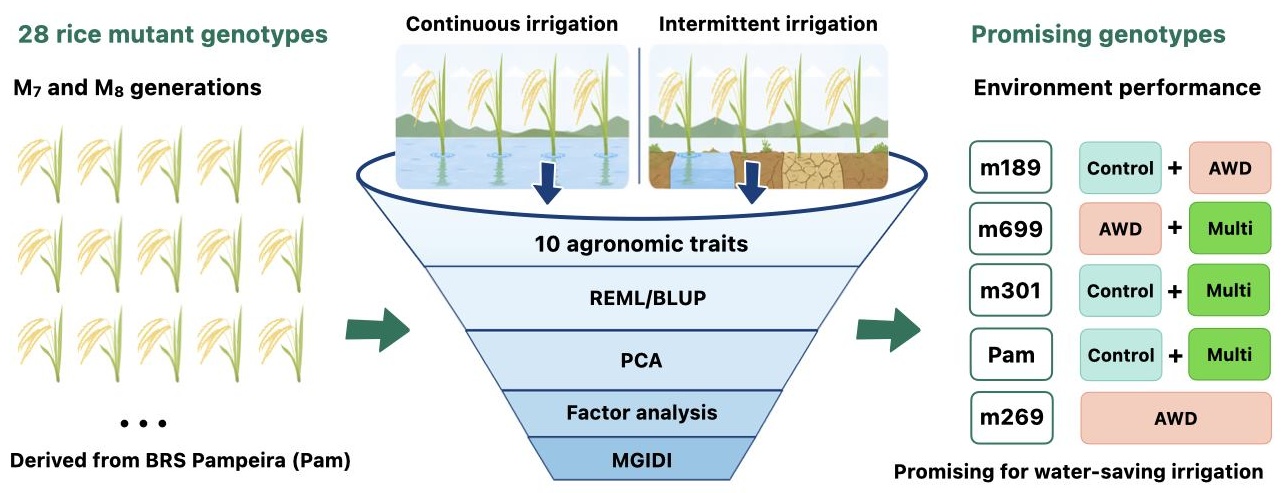
ABSTRACT: Genotype × environment (G×E) interactions complicate the identification of stable, high-performing genotypes in plant breeding, particularly under increasing climate variability and water scarcity. To support the development of water-efficient rice cultivars, we evaluated 28 mutant lines derived from the cultivar BRS Pampeira under two irrigation regimes: continuous flooding and alternate wetting and drying (AWD). Agronomic traits were assessed using mixed models (REML/BLUP) to estimate genotypic values, while principal component analysis (PCA) and the multi-trait genotype–ideotype distance index (MGIDI) were used to support genotype selection. Significant G×E interactions were observed for yield-related traits, demonstrating differential responses to irrigation regimes. The MGIDI index identified superior genotypes according to selection scenarios, with m189 showing recurrence under both individual scenarios, m699 selected under AWD and in the multi-environment analysis, and m301 and BRS Pampeira selected under Control and multi-environment conditions. Under AWD, m269 was selected as a promising genotype due to its proximity to the ideotype and balanced multi-trait performance. These findings highlight substantial genetic variability among mutant lines and provide promising candidates for improving rice productivity and adaptation under water-limited production systems.
Keywords: Induced mutagenesis; Water restriction; Multivariate analysis; Ideotype selection

Graphical Abstract

TOP