
Comprehensive Characterization and Analysis of Key Agronomic Traits and Glucosinolate Profiles in Leaf Mustard
Comprehensive Characterization and Analysis of Key Agronomic Traits and Glucosinolate Profiles in Leaf Mustard
Zhenzhu Hu 1,2,† Lianyong Yang 3,† Jiawei Hu 1,2 Huiping Huang 1,2 Xincheng Sun 3 Lin Huang 3 Junwei Wang 1,2 Ke Huang 1,2,* Qiuyun Wu 1,2,*
Received: 11 June 2026 Revised: 29 June 2026 Accepted: 30 July 2026 Published: 12 August 2026

© 2026 The authors. This is an open access article under the Creative Commons Attribution 4.0 International License (https://creativecommons.org/licenses/by/4.0/).
1. Introduction
Mustard (Brassica juncea; AABB), an allopolyploid species in the Brassicaceae family, originated from the hybridization of Brassica rapa (AA) and Brassica nigra (BB) [1]. As an important vegetable crop, mustard species are classified into four categories based on the harvested organs: leaf-type (var. multiceps), stalk-type (var. utilis), stem-type (var. tsatsai), and root-type (var. megarrhiza) [2]. These distinct types reflect considerable genetic diversity and phenotypic variation [3,4]. The high diversity in mustard species may be driven by widespread interspecific and intervarietal hybridizations [5]. Additionally, other morphological traits, such as leaf shape and plant height, also vary among species and varieties.
Leaf mustard, an important vegetable for both fresh consumption and processing, is particularly rich in glucosinolates—compounds responsible for its distinctive flavor and associated health benefits [6,7]. Glucosinolates are sulfur-containing secondary metabolites predominantly found in Brassicaceae species and play a crucial role in plant defense [8,9]. They are classified into three categories based on their amino acid precursors: aliphatic glucosinolates (AGS, derived from isoleucine, alanine, valine, methionine, and leucine), aromatic glucosinolates (RGS, derived from tyrosine and phenylalanine), and indolic glucosinolates (IGS, derived from tryptophan) [10]. Glucoraphanin is a known precursor of sulforaphane, a compound widely reported to inhibit several cancers, including lung, liver, and prostate cancers [11,12,13,14]. Given the moderate to high heritability of glucosinolate content and its demonstrated health benefits, selecting varieties with high glucoraphanin levels for breeding offers a promising approach to enhancing the nutritional profile of leaf mustard [15].
Germplasm resources form the foundation for cultivar improvement, genomic studies, and agricultural production. Genetic diversity within plant germplasm can be assessed through two primary approaches: phenotypic evaluation and molecular genetic analysis [16,17]. Phenotypic assessment, a traditional yet effective method, provides direct insights into the morphological and physiological characteristics of plants [18]. Phenotypic diversity, arising from the complex interaction between genotype and environment, plays a crucial role in biological research and crop improvement [5]. Recently, several studies have reported germplasm evaluations of vegetable crops, including purple flowering stalk [18], amaranth [5], and cabbage [19]. However, despite its commercial importance, research on the germplasm resources and nutritional traits of leaf mustard remains limited. Moreover, long-term selective breeding has narrowed the genetic background and reduced genetic diversity in leaf mustard [4]. Therefore, comprehensive investigation and evaluation of leaf mustard germplasm are essential for future breeding efforts. In this study, 86 accessions of leaf mustard were used to investigate genetic diversity based on key agronomic traits and glucosinolate content. Several statistical methods were employed to elucidate trait relationships. Additionally, we applied an integrated approach to identify promising germplasm for further breeding.
2. Materials and Methods
2.1. Plant Materials and Sample Preparation
In this study, a total of 86 leaf mustard varieties were selected from Hunan, Hubei, Fujian, and Beijing, China. The leaf mustard seeds were initially sown in a plant growth chamber, and seedlings at the four-leaf stage were subsequently transplanted into greenhouses at the Changde Academy of Agricultural and Forestry Sciences, Changde (29°02′ N, 111°41′ E), China. All plant samples were measured and harvested during the early flowering stage.
2.2. Morphological and Phenotypic Characterization
A total of 24 traits were identified based on previously reported methods for leaf mustard [3], including 17 qualitative and seven quantitative traits. The qualitative traits examined were plant type, leaf shape, serrated leaf margin, leaf lobe, leaf surface gloss, serrated leaf edge, leaf apex, leaf type, number of leaf lobes, leaf surface wrinkling, leaf surface prickles, petiole cross-section, tillering, leaf color, petiole color, mustard-like pungency, and heading ability. The quantitative traits assessed included plant width, plant height, petiole width, leaf petiole thickness, leaf width, leaf length, and petiole length.
2.3. Measurement of Glucosinolate Content
Glucosinolate extraction and quantification were performed using previously published methods [20,21]. Dried, powdered leaf samples (0.5 g) were initially extracted with 70% methanol in a water bath at 75 °C for 20 min. After adding 1 mL of barium acetate and subsequent centrifugation, the supernatant was collected in a polypropylene tube. The residue underwent a second extraction under identical conditions following the addition of sinigrin (Sigma, Kanagawa, Japan, internal standard). The combined supernatants were then loaded onto an ion-exchange column packed with DEAE-Sephadex A-25. Subsequently, the column was treated with 2 mL of 20 mM sodium acetate, after which 900 μL of sulfatase (Sigma) was added to facilitate desulfation. Following incubation overnight at 37 °C, the column was rinsed twice with deionized water. The eluate was collected into a sample vial for further processing after passing through a 0.45 μm membrane filter. Glucosinolate separation was performed using a high-performance liquid chromatography (HPLC) system. The mobile phase consisted of water and methanol at a flow rate of 1 mL/min. The gradient elution program was set as follows: 5% methanol (0–1 min), linear gradient to 100% methanol (1–9 min), 100% methanol (9–11 min), and re-equilibration to 5% methanol (11–13 min). Detection and quantification were conducted by UV absorbance at 229 nm, with desulfo-sinigrin serving as the reference standard.
2.4. Statistical Analysis
Principal component analysis (PCA) was performed using the prcomp function in R. Hierarchical cluster analysis (HCA) was conducted using Euclidean distance and Ward linkage in R. Correlation analysis was calculated using the cor.test function and visualized as heatmaps [22]. To generate a comprehensive ranking of varieties, a comprehensive evaluation value (D) was calculated for each accession as the weighted sum of PC1–PC8 scores, using their respective variance contribution rates as weights (D = Σλᵢ × PCᵢ).
3. Results
3.1. Agronomic Traits of Leaf Mustard
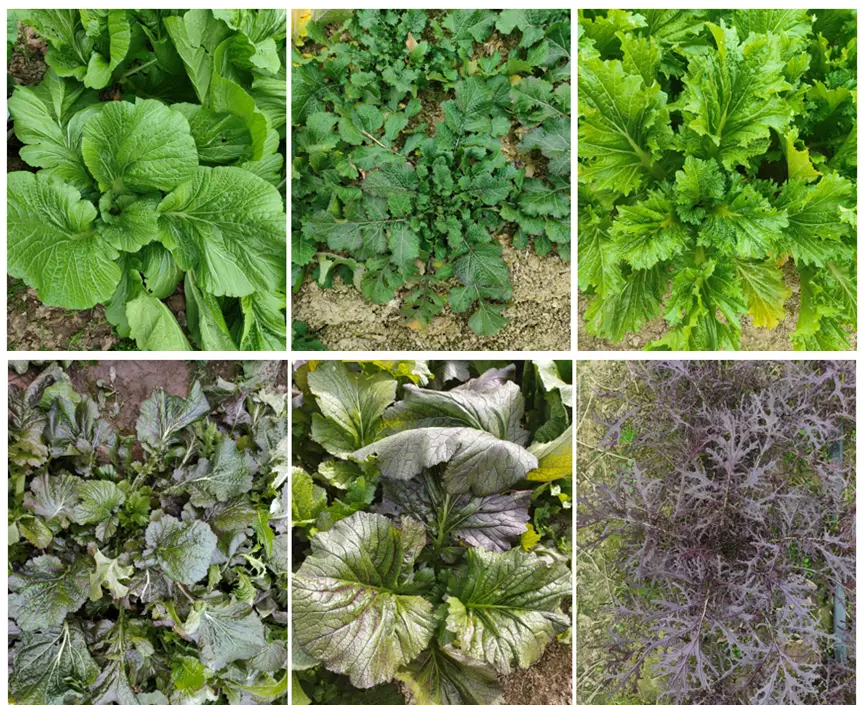
The genetic diversity of 17 qualitative traits was evaluated, as summarized in Table 1 and illustrated in Figure 1. The Shannon-Wiener Index (H′) averaged 0.98, ranging from 0.10 (leaf surface gloss) to 1.60 (leaf shape). Among these traits, 11—including leaf shape, leaf lobe, leaf color, leaf surface wrinkling, leaf surface prickles, petiole cross-section, number of leaf lobes, plant type, serrated leaf edge, leaf apex, and petiole color—exhibited H′ values greater than 1, indicating substantial genetic diversity. In contrast, qualitative traits such as leaf surface gloss, heading ability, leaf type, and mustard-like pungency displayed H′ values below 0.6, suggesting limited variability. For example, 98.04% of accessions exhibited glossy leaf surfaces, 86.27% had entire margins, 96.10% were non-heading types, and 80.00% showed mild mustard-like pungency.
Table 1. Qualitative traits of leaf mustard varieties.
|
Traits |
Distribution |
H′ |
|||||||
|---|---|---|---|---|---|---|---|---|---|
|
0 |
1 |
2 |
3 |
4 |
5 |
6 |
7 |
||
|
Plant type |
27.45 |
40.20 |
32.35 |
1.09 |
|||||
|
Leaf shape |
2.94 |
13.73 |
1.96 |
20.59 |
41.18 |
11.76 |
7.84 |
1.60 |
|
|
Serrated leaf margin |
9.80 |
22.55 |
67.65 |
0.83 |
|||||
|
Serrated leaf edge |
14.71 |
59.80 |
18.63 |
6.86 |
1.09 |
||||
|
Leaf apex |
29.41 |
38.24 |
32.35 |
1.09 |
|||||
|
Leaf type |
86.27 |
13.73 |
0.40 |
||||||
|
Leaf lobe |
13.73 |
48.04 |
21.57 |
16.67 |
1.25 |
||||
|
Number of leaf lobe |
13.73 |
54.90 |
24.51 |
6.86 |
1.13 |
||||
|
Leaf surface wrinkling |
8.82 |
38.24 |
42.16 |
10.78 |
1.19 |
||||
|
Leaf surface prickles |
43.14 |
35.29 |
15.69 |
5.88 |
1.19 |
||||
|
Leaf color |
1.96 |
20.59 |
54.90 |
7.84 |
14.71 |
1.21 |
|||
|
Petiole cross-section |
42.16 |
22.55 |
33.33 |
1.96 |
1.14 |
||||
|
Tillering |
72.55 |
15.69 |
11.76 |
0.78 |
|||||
|
Leaf surface gloss |
1.96 |
98.04 |
0.10 |
||||||
|
Petiole color |
26.47 |
52.94 |
20.59 |
1.01 |
|||||
|
Mustard-like pungency |
80.00 |
18.00 |
2.00 |
0.57 |
|||||
|
Heading ability |
97.40 |
2.60 |
0.13 |
||||||
Qualitative traits were scored as follows: Plant type (1 = upright, 2 = half upright, 3 = spread), Leaf shape (1 = near circular, 2 = ovate, 3 = long ovate, 4 = obovate, 5 = elliptic, 6 = oblong-obovate, 7 = broadly obovate), Serrated leaf margin (1 = entire, 2 = gyrose, 3 = shallow sawtooth), Serrated leaf edge (0 = none, 1 = small, 2 = middle, 3 = large), Leaf apex (1 = wide circle, 2 = circle, 3 = pointed), Leaf type (1 = variegated leaf, 2 = flat leaf), Leaf lobe (0 = none, 1 = less, 2 = deeply, 3 = entirely), Number of leaf lobe (0 = no lobe, 1 = one lobe, 2 = two lobes, 3 = three lobes), Leaf surface wrinkling (1 = smoothness, 2 = slightly wrinkled, 3 = wrinkled, 4 = highly wrinkled), Leaf surface prickles (0 = none, 1 = less, 2 = middle, 3 = more), Leaf color (1 = light green, 2 = yellowish green, 3 = green, 4 = purplish-green, 5 = dark green), Petiole cross-section (1 = medium-round, 2 = broad-flattened, 3 = slender-rounded, 4 = broad-thick), Tillering (1 = weak, 2 = medium, 3 = strong), Leaf surface gloss (0 = non-glossy, 1 = glossy), Petiole color (1 = white-green, 2 = light green, 3 = green), Mustard-like pungency (1 = mild, 2 = medium, 3 = strong), Heading ability (0 = non-heading, 1 = heading).
The H′ values for quantitative traits ranged from 1.85 (petiole length) to 2.07 (leaf width), with an average of 1.98. Notably, leaf width, petiole width, plant height, and leaf petiole thickness also exhibited H′ values equal to or greater than 2, indicating substantial genetic diversity across most quantitative traits (Table 2). Genetic diversity can also be assessed by the coefficient of variation (CV), where higher CV values indicate lower homogeneity [23]. In this study, CV values for quantitative traits ranged from 14.38% to 61.70%, with an average of 32.27%. Traits such as petiole length and petiole width showed the highest CV values, while plant width and leaf length had the lowest (Table 2). This suggests that breeders have greater potential to select parental materials based on traits such as petiole length and width, whereas improving plant width and leaf length may be more challenging [24]. These findings underscore the potential for utilizing this genetic diversity in breeding programs aimed at developing superior leaf mustard varieties.
Table 2. Quantitative traits of leaf mustard varieties.
|
Traits |
Min |
Max |
Mean |
SD |
Range |
CV (%) |
H′ |
|---|---|---|---|---|---|---|---|
|
Plant height |
6.20 |
78.25 |
42.82 |
12.43 |
72.05 |
29.03 |
2.00 |
|
Plant width |
34.60 |
107.80 |
84.95 |
12.21 |
73.20 |
14.38 |
1.95 |
|
Leaf length |
25.15 |
103.58 |
61.90 |
12.90 |
78.43 |
20.84 |
1.99 |
|
Leaf width |
9.08 |
48.10 |
28.84 |
8.55 |
39.02 |
29.65 |
2.07 |
|
Petiole length |
0.30 |
19.15 |
4.89 |
3.02 |
18.85 |
61.70 |
1.85 |
|
Petiole width |
0.45 |
6.10 |
3.00 |
1.34 |
5.65 |
44.64 |
2.03 |
|
Leaf petiole thickness |
0.20 |
2.13 |
1.27 |
0.33 |
1.93 |
25.63 |
2.00 |
SD: standard deviation; CV: coefficient of variation.
3.2. Glucosinolate Profile of Leaf Mustard
Of the 86 varieties evaluated for agronomic traits, glucosinolates were detected at quantifiable levels in 45 varieties. Among these, a total of nine glucosinolates were identified, including five aliphatic glucosinolates (AGS: glucoiberin, progoitrin, sinigrin, glucoraphanin, glucoalyssin), three indolic glucosinolates (IGS: glucobrassicin, neoglucobrassicin, 4-methoxyglucobrassicin), and one aromatic glucosinolate (RGS: gluconasturtiin) (Figure 2). Significant variability in glucosinolate composition and content was observed among the varieties. Total glucosinolate content ranged from 0.09 μmol/g to 13.82 μmol/g. AGS constituted the predominant fraction, accounting for an average of 77% of total glucosinolates, while IGS and RGS represented averages of 16.39% and 6.61%, respectively. Notably, RGS was absent in 35 varieties.
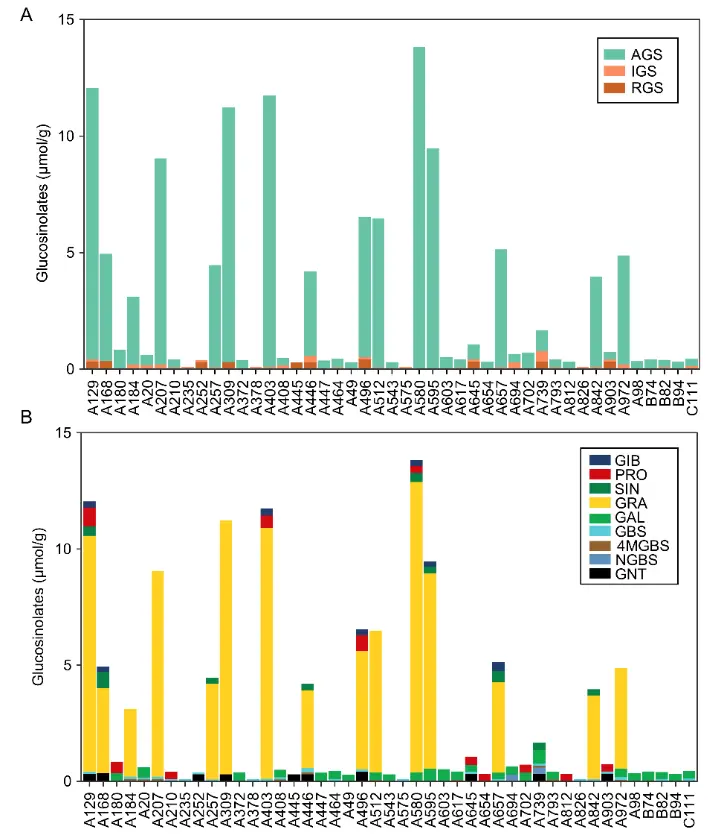
Figure 2. Total (A) and specific (B) glucosinolate content in different varieties of leaf mustard. AGS: aliphatic glucosinolates; IGS: indolic glucosinolates; RGS: aromatic glucosinolates; GIB: glucoiberin; PRO: progoitrin; SIN: sinigrin; GRA: glucoraphanin; GAL: glucoalyssin; GBS: glucobrassicin; 4MGBS: 4-methoxy glucobrassicin; NGBS: neoglucobrassicin; GNT: gluconasturtiin.
3.3. Principal Component Analysis (PCA) of Yield-Related Traits and Glucosinolate Content
Principal component analysis was conducted using yield-related traits (plant height, plant width, leaf length, leaf width, mustard-like pungency, tillering) and glucosinolate contents (Figure 3). Eight principal components (PCs) were extracted, collectively explaining 87.44% of the total variance. The first principal component (PC1), accounting for 24.68% of the variance, showed the highest loadings on variables including plant height, leaf length, leaf width, tillering, glucoalyssin (GAL), and glucobrassicin (GBS). The second principal component (PC2), explaining 16.83% of the variance, was predominantly associated with aliphatic glucosinolates: glucoiberin (GIB), sinigrin (SIN), 4-methoxy glucobrassicin (4MGBS), glucoraphanin (GRA), and progoitrin (PRO). Based on the PCA results, leaf mustard varieties were evaluated and ranked (Table 3). Among the top five varieties, ‘A694’, ‘A512’, ‘A739’, and ‘A617’ scored highly on PC1, indicating greater leaf length and width, taller plant height, reduced tillering, and lower levels of GBS. Varieties such as ‘A617’, ‘A372’, ‘A464’, and ‘A694’ exhibited higher scores on PC2, reflecting lower AGS content and higher IGS content.

Figure 3. PCA plot of 45 leaf mustard varieties based on glucosinolate content and yield-related traits, including leaf width, leaf length, plant height, plant width, and tillering.
Table 3. Comprehensive evaluation of leaf mustard varieties by glucosinolate content and yield-related traits.
|
Accession |
PC1 |
PC2 |
PC3 |
PC4 |
PC5 |
PC6 |
PC7 |
PC8 |
Comprehensive Evaluation Value (D) |
Rank |
|---|---|---|---|---|---|---|---|---|---|---|
|
A645 |
1.00 |
−0.06 |
−1.45 |
0.55 |
1.16 |
0.16 |
0.51 |
1.58 |
0.50 |
1 |
|
A464 |
−0.17 |
0.98 |
1.57 |
1.53 |
−0.46 |
−0.33 |
0.36 |
0.68 |
0.47 |
2 |
|
A512 |
2.49 |
−0.28 |
1.35 |
−2.99 |
−2.09 |
1.08 |
−0.49 |
1.97 |
0.46 |
3 |
|
A702 |
1.00 |
0.55 |
−0.84 |
1.47 |
−0.36 |
0.41 |
−0.70 |
0.36 |
0.45 |
4 |
|
A445 |
−0.95 |
0.82 |
−1.28 |
−0.40 |
0.27 |
1.71 |
0.36 |
−0.37 |
0.41 |
5 |
3.4. Hierarchical Cluster Analysis
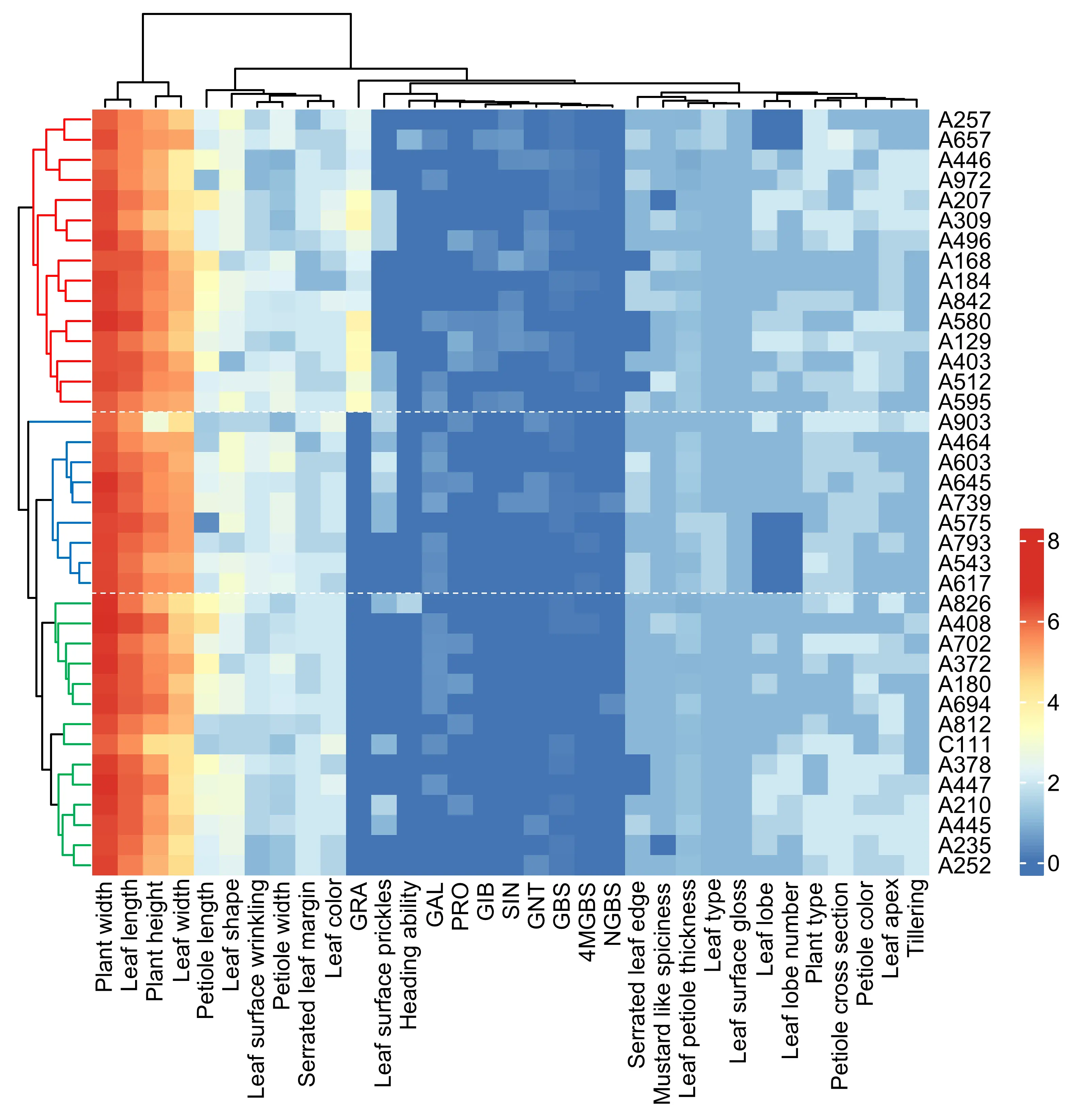
Three distinct clusters were identified among all varieties through hierarchical cluster analysis (HCA) using the Ward method (Figure 4). The first cluster (red), comprising 15 accessions, was characterized by higher AGS content—particularly GRA, SIN, and GIB—as well as longer petioles, increased plant height, and larger leaves. The second cluster (blue), consisting of nine accessions, exhibited greater leaf and petiole widths but shorter petiole length. The third cluster (green), containing 14 accessions, was distinguished by a wider plant spread and fewer leaf surface prickles.
3.5. Correlation Analysis
Correlation analysis revealed both positive and negative relationships between agronomic traits and glucosinolate contents. As shown in Figure 5, yield-related traits—including leaf length and plant width—were positively correlated with plant height, leaf surface wrinkling, and petiole width, but negatively correlated with plant type and leaf color. Glucosinolate content, especially GRA, was positively correlated with leaf lobe number and leaf lobe size. RGS compounds, such as GNA, were positively associated with tillering and negatively associated with leaf surface wrinkling. IGS, particularly GBS, showed negative correlations with leaf surface wrinkling, plant height, leaf width, and petiole width.
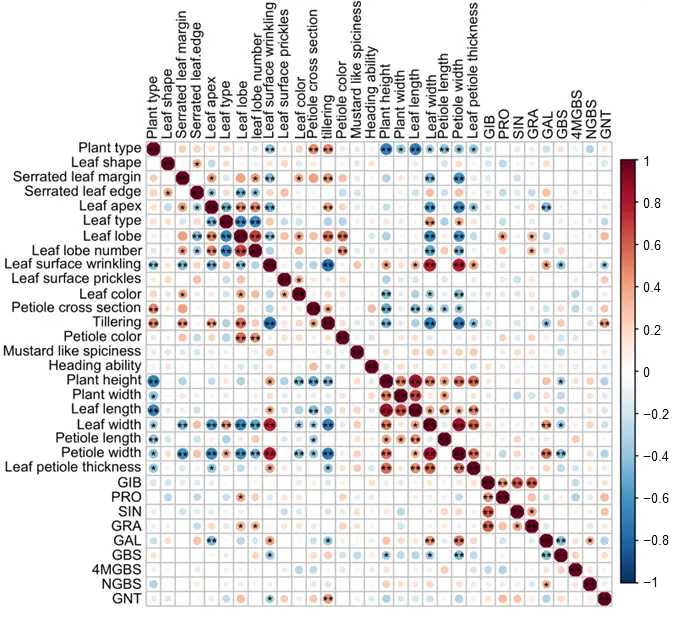
Figure 5. Correlation analysis between agricultural traits and glucosinolate content. * p ≤ 0.05, ** p ≤ 0.01.
4. Discussion
The leaf mustard materials in this study exhibit substantial genetic diversity. The Shannon-Wiener Index (H′) exceeded 1 for all quantitative traits and 13 qualitative traits, including leaf shape, color, and yield-related characteristics. These traits are critical for breeding programs, as they provide a rich genetic reservoir for developing high-yield, high-quality varieties [25]. While leaf width and plant height showed high H′ values, their coefficients of variation (CV) were notably low. In contrast, traits such as petiole width exhibited both high H′ and high CV values. This discrepancy likely reflects differing market demands: stable preferences for optimal plant size contrast with evolving requirements for edible portion size and yield, necessitating the development of new varieties to meet these needs.
Leaf mustard exhibited a total glucosinolate content ranging from 0.09 to 13.82 μmol/g, which was lower than that of broccoli (0.467–57.156 μmol/g) but significantly higher than that of B. napus (0.238–7.384 μmol/g) [26,27]. These variations may be attributed to differences in tissue types, varieties, growing conditions, field management practices, and analytical methodologies. Aliphatic glucosinolates (AGS) were the predominant class, followed by indolic glucosinolates (IGS). This study identified nine glucosinolates, including five AGS, three IGS, and one aromatic glucosinolate (RGS). Although the number and composition of glucosinolates were similar to those reported in previous studies, some differences were observed. For example, Huang et al. detected nine glucosinolates, five of which overlapped with our findings [3]. Assefa et al. identified five glucosinolates, including glucoraphanin, progoitrin, and glucoalyssin [28].
PCA of yield-related and glucosinolate traits revealed that PC1, accounting for 24.68% of the total variance, was strongly associated with plant height, leaf width and length, GBS, and GAL. These findings align with HCA results, underscoring the importance of yield and glucosinolate traits in evaluating leaf mustard diversity. The significant positive correlation between leaf lobe development and glucoraphanin (GRA) accumulation is highly relevant to both plant biology and agricultural practice. As the key precursor of sulforaphane, GRA content directly determines the nutraceutical potential of cruciferous vegetables [29]. Agronomically, this correlation suggests that leaf morphology, especially leaf lobation, could serve as a visual marker for selecting high-GRA cultivars [12,30]. Ecologically, this finding supports hypotheses that leaf lobation may represent a defense strategy, consistent with the role of glucosinolates in anti-herbivore defense [31,32,33].
Yield improvement and high quality remain key goals in leaf mustard breeding. Considering both yield-associated traits and glucosinolate content has facilitated the identification of the best-performing materials for breeding programs. Notably, the top five accessions exhibited complementary characteristics, enabling precise selection based on specific breeding objectives.
5. Conclusions
This study conducted a comprehensive analysis of genetic diversity in leaf mustard, focusing on agronomic traits and glucosinolate content. The evaluated accessions exhibited significant variability in leaf morphology and plant type. Based on a combined assessment of yield-related traits and glucosinolate profiles, the top five varieties were identified as superior accessions with both high yield potential and elevated glucosinolate levels. These varieties represent valuable genetic resources for improving leaf mustard cultivars. Consumers are encouraged to select leaf mustard cultivars with deeper or more numerous leaf lobes, as these may contain higher levels of glucoraphanin, which is beneficial for health.
Statement of the Use of Generative AI and AI-Assisted Technologies in the Writing Process
During the preparation of this manuscript, the authors used Grammarly for language polishing and grammar correction. After using this tool, the authors reviewed and edited the content as needed and take full responsibility for the content of the published article.
Acknowledgments
The authors acknowledge financial assistance from the Yuelushan Laboratory Talent Program (2024RC2073) for conducting this research.
Author Contributions
Q.W. and K.H. designed the research. Z.H. and L.Y. performed the experiments. J.H., L.Y., X.S. and L.H. collected the data. Z.H., H.H. and J.W. analyzed the data. Z.H., L.Y., Q.W. and K.H. wrote the manuscript. All authors read and edited the manuscript before publication.
Ethics Statement
Not applicable.
Informed Consent Statement
Not applicable.
Data Availability Statement
The authors declare that the data supporting the findings of this study are available within the paper.
Funding
This work was supported by Yuelushan Laboratory Talent Program (2024RC2073).
Declaration of Competing Interest
The authors declare that they have no known competing financial interests or personal relationships that could have appeared to influence the work reported in this paper.
References
- Kang L, Qian L, Zheng M, Chen L, Chen H, Yang L, et al. Genomic insights into the origin, domestication and diversification of Brassica juncea. Nat. Genet. 2021, 53, 1392–1402. DOI:10.1038/s41588-021-00922-y [Google Scholar]
- Wu XM, Chen BY, Lu G, Wang HZ, Xu K, Guizhan G, et al. Genetic diversity in oil and vegetable mustard (Brassica juncea) landraces revealed by SRAP markers. Genet. Resour. Crop Evol. 2009, 56, 1011–1022. DOI:10.1007/s10722-009-9420-8 [Google Scholar]
- Huang H, Wang J, Mao S, Wu Q, Tian Y, Wang F, et al. Variation Characteristics of Glucosinolate Contents in Leaf Mustard (Brassica juncea). Agronomy 2022, 12, 2287. DOI:10.3390/agronomy12102287 [Google Scholar]
- Cheng W, Luo A, Li H, Chen Z, Guan Z, Escalona VH, et al. Variation in Nutritional Qualities and Antioxidant Capacity of Different Leaf Mustard Cultivars. Horticulturae 2025, 11, 59. DOI:10.3390/horticulturae11010059 [Google Scholar]
- Nyonje WA, Schafleitner R, Abukutsa-Onyango M, Yang RY, Makokha A, Owino W. Precision phenotyping and association between morphological traits and nutritional content in Vegetable Amaranth (Amaranthus spp.). J. Agric. Food Res. 2021, 5, 100165. DOI:10.1016/j.jafr.2021.100165 [Google Scholar]
- Herr I, Büchler MW. Dietary constituents of broccoli and other cruciferous vegetables: Implications for prevention and therapy of cancer. Cancer Treat. Rev. 2010, 36, 377–383. DOI:10.1016/j.ctrv.2010.01.002 [Google Scholar]
- Augustine R, Bisht NC. Biotic elicitors and mechanical damage modulate glucosinolate accumulation by co-ordinated interplay of glucosinolate biosynthesis regulators in polyploid Brassica juncea. Phytochemistry 2015, 117, 43–50. DOI:10.1016/j.phytochem.2015.05.015 [Google Scholar]
- Santamaria ME, Garcia A, Arnaiz A, Rosa‐Diaz I, Romero‐Hernandez G, Diaz I, et al. Comparative transcriptomics reveals hidden issues in the plant response to arthropod herbivores. J. Integr. Plant Biol. 2021, 63, 312–326. DOI:10.1111/jipb.13026 [Google Scholar]
- Qin H, King GJ, Borpatragohain P, Zou J. Developing multifunctional crops by engineering Brassicaceae glucosinolate pathways. Plant Commun. 2023, 4, 100565. DOI:10.1016/j.xplc.2023.100565 [Google Scholar]
- Harun S, Abdullah-Zawawi MR, Goh HH, Mohamed-Hussein ZA. A Comprehensive Gene Inventory for Glucosinolate Biosynthetic Pathway in Arabidopsis thaliana. J. Agric. Food Chem. 2020, 68, 7281–7297. DOI:10.1021/acs.jafc.0c01916 [Google Scholar]
- Singh AV. Sulforaphane induces caspase-mediated apoptosis in cultured PC-3 human prostate cancer cells and retards growth of PC-3 xenografts in vivo. Carcinogenesis 2003, 25, 83–90. DOI:10.1093/carcin/bgg178 [Google Scholar]
- Vanduchova A, Anzenbacher P, Anzenbacherova E. Isothiocyanate from Broccoli, Sulforaphane, and Its Properties. J. Med. Food 2019, 22, 121–126. DOI:10.1089/jmf.2018.0024 [Google Scholar]
- Conaway CC, Wang CX, Pittman B, Yang YM, Schwartz JE, Tian D, et al. Phenethyl Isothiocyanate and Sulforaphane and their N-Acetylcysteine Conjugates Inhibit Malignant Progression of Lung Adenomas Induced by Tobacco Carcinogens in A/J Mice. Cancer Res. 2005, 65, 8548–8557. DOI:10.1158/0008-5472.CAN-05-0237 [Google Scholar]
- Kallifatidis G, Rausch V, Baumann B, Apel A, Beckermann BM, Groth A, et al. Sulforaphane targets pancreatic tumour-initiating cells by NF-κB-induced antiapoptotic signalling. Gut 2009, 58, 949–963. DOI:10.1136/gut.2008.149039 [Google Scholar]
- Augustine R, Mukhopadhyay A, Bisht NC. Targeted silencing of BjMYB28 transcription factor gene directs development of low glucosinolate lines in oilseed Brassica juncea. Plant Biotechnol. J. 2013, 11, 855–866. DOI:10.1111/pbi.12078 [Google Scholar]
- Jia C, Zhao F, Wang X, Han J, Zhao H, Liu G, et al. Genomic Prediction for 25 Agronomic and Quality Traits in Alfalfa (Medicago sativa). Front. Plant Sci. 2018, 9, 1220. DOI:10.3389/fpls.2018.01220 [Google Scholar]
- Hu Z, Wu Z, Zhu Q, Ma M, Li Y, Dai X, et al. Multilayer regulatory landscape and new regulators identification for bud dormancy release and bud break in Populus. Plant Cell Environ. 2024, 47, 3181–3197. DOI:10.1111/pce.14938 [Google Scholar]
- Tian Y, Nie J, Fei D, Mao S, Wang J, Wu Q, et al. Phenotypic evaluation and analysis of important agronomic traits and nutritional quality in purple flowering stalk (Brassica campestris L. ssp. chinensis var. purpurea Hort.). Sci. Hortic. 2025, 340, 113921. DOI:10.1016/j.scienta.2024.113921 [Google Scholar]
- Kong C, Chen G, Yang L, Zhuang M, Zhang Y, Wang Y, et al. Germplasm screening and inheritance analysis of resistance to cabbage black rot in a worldwide collection of cabbage (Brassica oleracea var. capitata) resources. Sci. Hortic. 2021, 288, 110234. DOI:10.1016/j.scienta.2021.110234 [Google Scholar]
- Wu Q, Mao S, Huang H, Liu J, Chen X, Hou L, et al. Chromosome-scale reference genome of broccoli (Brassica oleracea var. italica Plenck) provides insights into glucosinolate biosynthesis. Hortic. Res. 2024, 11, uhae063. DOI:10.1093/hr/uhae063 [Google Scholar]
- Hu Z, Wang T, Fei D, Zhong Y, Wang J, Huang K, et al. CHG Hypomethylation of BoCYP83A1 May Contribute to Methyl Jasmonate‐Induced Sulforaphane Accumulation in Broccoli. Plant Cell Environ. 2026, 49, 6797–6810. DOI:10.1111/pce.70667 [Google Scholar]
- Hu Z, Liao X, Ding J. Alternative splicing of FLOWERING LOCUS T1 fine-tunes bud dormancy release in hybrid poplar. Plant Physiol. 2026, 201, kiag300. DOI:10.1093/plphys/kiag300 [Google Scholar]
- Tiwari DN, Tripathi SR, Tripathi MP, Khatri N, Bastola BR. Genetic Variability and Correlation Coefficients of Major Traits in Early Maturing Rice under Rainfed Lowland Environments of Nepal. Adv. Agric. 2019, 2019, 5975901. DOI:10.1155/2019/5975901 [Google Scholar]
- Khadivi-Khub A, Sarooghi F, Abbasi F. Phenotypic variation of Prunus scoparia germplasm: Implications for breeding. Sci. Hortic. 2016, 207, 193–202. DOI:10.1016/j.scienta.2016.05.023 [Google Scholar]
- Li F, Gong Y, Mason AS, Liu Q, Huang J, Ma M, et al. Research progress and applications of colorful Brassica crops. Planta 2023, 258, 45. DOI:10.1007/s00425-023-04205-0 [Google Scholar]
- Missinou AA, Ferreira de Carvalho J, Marnet N, Delhaye T, Hamzaoui O, Abdel Sayed D, et al. Identification and Quantification of Glucosinolates and Phenolics in a Large Panel of Brassica napus Highlight Valuable Genetic Resources for Chemical Ecology and Breeding. J. Agric. Food Chem. 2022, 70, 5245–5261. DOI:10.1021/acs.jafc.1c08118 [Google Scholar]
- Li Z, Zheng S, Liu Y, Fang Z, Yang L, Zhuang M, et al. Characterization of glucosinolates in 80 broccoli genotypes and different organs using UHPLC-Triple-TOF-MS method. Food Chem. 2021, 334, 127519. DOI:10.1016/j.foodchem.2020.127519 [Google Scholar]
- Assefa AD, Kim SH, Ko HC, Ro N, Subramanian P, Chung YJ, et al. Leaf Mustard (Brassica juncea) Germplasm Resources Showed Diverse Characteristics in Agro-Morphological Traits and Glucosinolate Levels. Foods 2023, 12, 4374. DOI:10.3390/foods12234374 [Google Scholar]
- Wang J, Mao S, Wu Q, Yuan Y, Liang M, Wang S, et al. Effects of LED illumination spectra on glucosinolate and sulforaphane accumulation in broccoli seedlings. Food Chem. 2021, 356, 129550. DOI:10.1016/j.foodchem.2021.129550 [Google Scholar]
- Conzatti A, Fróes FC, Schweigert Perry ID, Souza CG. Clinical and molecular evidence of the consumption of broccoli, glucoraphanin and sulforaphane in humans. Nutr. Hosp. 2014, 31, 559–569. Available online: https://scielo.isciii.es/scielo.php?script=sci_abstract&pid=S0212-16112015000200005&lng=e&tlng=en (accessed on 20 June 2026).
- Campitelli BE, Simonsen AK, Rico Wolf A, Manson JS, Stinchcombe JR. Leaf shape variation and herbivore consumption and performance: A case study with Ipomoea hederacea and three generalists. Arthropod-Plant Interact. 2008, 2, 9–19. DOI:10.1007/s11829-007-9028-x [Google Scholar]
- Xuexiao Z. Biobreeding, a Bridge between Fundamental Research and Agricultural Application. Biobreeding 2026, 1, 10001. DOI:10.70322/biobreeding.2025.10001 [Google Scholar]
- Yingying Z, Iram B, Kangni Z, Ling X, Qian H, Fakhir H, et al. Beyond Oil: Molecular Breeding for Multifunctional Innovation in Oilseed Brassica. Biobreeding 2026, 1, 10008. DOI:10.70322/biobreeding.2026.10008 [Google Scholar]