
The Suspected Presence of Scab as a Potential Risk for Sustainable Pecans Production in Northern Mexico

The Suspected Presence of Scab as a Potential Risk for Sustainable Pecans Production in Northern Mexico

Received: 30 June 2026 Revised: 16 July 2026 Accepted: 21 August 2026 Published: 04 September 2026

© 2026 The authors. This is an open access article under the Creative Commons Attribution 4.0 International License (https://creativecommons.org/licenses/by/4.0/).
1. Introduction
For a long time ago, in the United States, scab poses significant risks to pecans production [1,2]. In different production areas in the southern United States and northern Mexico, it has generally been believed that scab is caused by Cladosporium caryigenum G. Winter (synonym: Fusicladium effusum). In the United States, it is considered the most significant disease affecting pecan trees. However, Walker [3] found that at least three species (C. cladosporioides, C. pseudocladosporioides, and C. subuliforme) cause pecan scab in Brazil. In Mexico, there are no reports on its distribution and prevalence in pecan-producing areas, however, over the past five growing seasons, trees with foliage damage—typically associated with zinc deficiency—were observed in various pecan orchards in Chihuahua, in northern Mexico. Although the exact distribution and extent of the problem have not yet been determined, we have been detecting these symptoms since 2011 in the pecan-producing areas of Jiménez, Villa López, and Valle de Allende in southern Chihuahua.
This disease affects stems, branches, leaves, and developing nuts, causing yield reductions. If the disease is not controlled, entire crops can be lost during periods of prolonged rain or dew in other pecan-producing regions, where it is a major constraint on production [4,5,6]. The aim of this Opinion article is to alert of new disease in the region based on preliminary observations. Here, we present observed facts, preliminary interpretations, and future research needs.
2. Early Observations
The first inspections were conducted at the request of some affected farmers, in affected trees, the symptoms are initially characterized by the presence of black or olive-colored spots on the foliage or on the young nuts (Figure 1A–E). These spots often merge to form larger, irregular patches. Lesions on leaves reduce photosynthesis and cause defoliation. In defoliated trees, growth, vigor, and nut production are reduced the following year. Severe infections can lead to the loss of the current year’s growth. In several orchards, it has been observed that infections on petioles often spread to the smallest branches, causing terminal shoots to dry out completely because necrosis in the branches leads to a lack of water and nutrients. When shucks and nuts are infected, they develop dark lesions and take on an oily appearance.
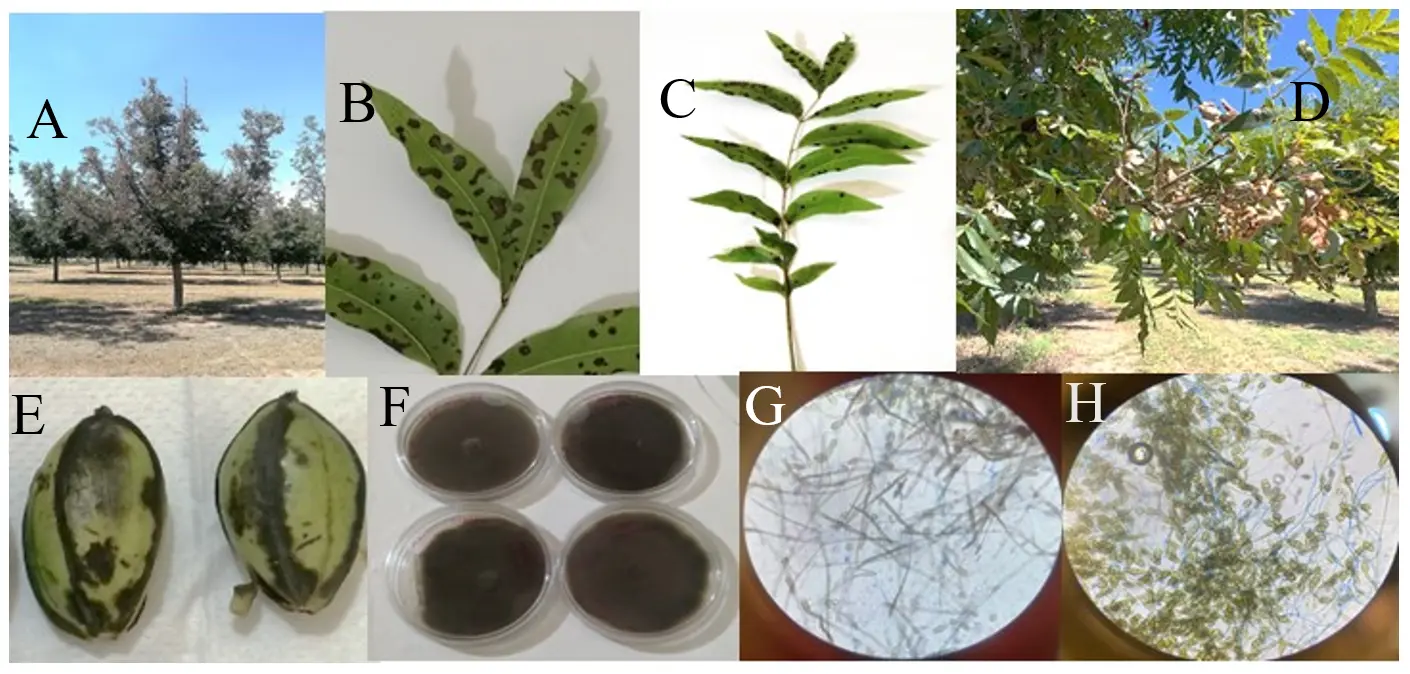
Figure 1. Symptoms observed on pecan trees. (A) defoliated trees. (B) black or olive-colored spots on leaflets. (C,D) Infections on leaves and petioles often spread to the smallest branches, causing terminal shoots to dry out completely. (E) dark lesions in shucks. (F) Microbiological cultures in Petri dishes and microscopic images of the isolated fungi (G) Cladosporium-like and (H) Alternaria-like. Note that these symptoms are not diagnostic and may overlap with other leaf diseases.
Afterwards, in the spring and summer of 2024–2025, a survey was conducted in various pecan-growing areas in the south-central region of the state of Chihuahua, in northern Mexico. The sampling was designed based on the availability of cooperating farmers. The orchards were selected based on the willingness of their owners and because they exhibited scab-like symptoms. A zigzag path was followed through each orchard, and samples were collected from five trees. From each tree, samples of at least five units of each type—leaves, twig fragments, and affected fruit—were collected in each of the four cardinal orientations (north, south, east, and west). The samples from each tree were grouped together. Since this was a targeted sample, incidence and severity were not assessed on this specific occasion. Samples were analyzed using conventional microbiological methods, such as PDA cultures, purification of isolates using the hyphae tip technique, and macroscopic and microscopic morphological characterization. In the spring, it was common to see colonies developing in the cultures, ranging in color from dark olive to brown, with septate, brown, erect, simple, or branched mycelium. The conidia were brown, obovate, and bicellular; a few were clavate or elongated and had more than two cells (Figure 1F,G). These characteristics coincide with the description of a fungus similar to the genus Cladosporium. In the summer, in addition to Cladosporium-like fungus, another very similar dark mycelium was detected, with dark conidiophores, mostly simple, determinate, or sympodial; conidia dark, almost always with transverse and longitudinal septa; shape obclavate to elliptical or ovoid. This mycelium exhibits characteristics similar to those of fungi of the genus Alternaria. Nevertheless, given that neither molecular identification nor pathogenicity testing has been performed, it is not possible to definitively determine the disease etiology.
According to the data in Figure 2, the disease was frequently detected in symptomatic samples from multiple municipalities in the south-central Chihuahua pecan-producing region. We sampled 60 pecan orchards, mainly in Delicias and Rosales, which were the municipalities that provided the most samples, followed by Camargo, Meoqui, and Saucillo. All samples analyzed tested positive for Cladosporium-like fungus, while Alternaria-like was a fungus with an intermittent presence, commonly after mid-July.
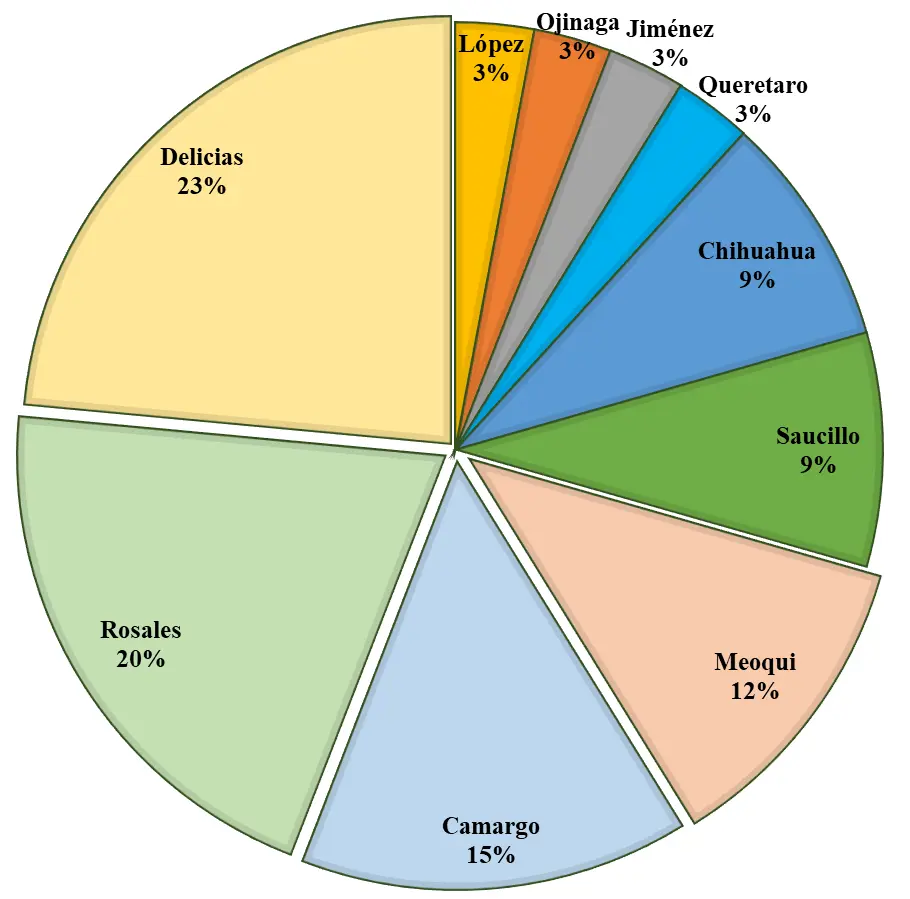
Figure 2. Municipalities affected by scab-like symptoms in the south-central region of Chihuahua (Mexico). The presence of disease was confirmed in all samples analyzed (n = 60 pecan orchards). The percentage values refer to the sample distribution by municipality. Querétaro is a state located in central Mexico, from which samples infected with pecan scab were received.
3. Preliminary Interpretations and Research Needs
In a region of great economic and social importance, such as south-central Chihuahua, a pecan tree disease similar to pecan scab was frequently detected. Preliminary observations show scab-like symptoms on various above-ground parts of the trees (leaves, petioles, twigs, and nuts), indicating the disease poses a potential risk to pecan production. Therefore, it is important for everyone involved in pecan production to determine whether the cause of the problem is biological or nutritional, so that it can be properly addressed and resources can be allocated to its study and control. In this regard, the incidence and severity of this disease in the various producing regions must be determined, and crop losses must be estimated. The presence of the Cladosporium-like fungus is significant, given international reports that identify Cladosporium spp. as one of the agents that cause disease in pecans. The presence of an Alternaria-like fungus should be viewed with caution. Alternaria is not mentioned in the United States or Brazil, but given its frequency in the analyzed samples, it is advisable to determine its role in the progression of the disease or in the severity of symptoms. The Alternaria species are ubiquitous in the environment, acting as saprotrophs, human allergens, and plant pathogens [7]. Therefore, it is important to use molecular techniques to accurately identify the Cladosporium-like and Alternaria-like fungi present in different pecan-producing regions. Pathogenicity tests should be conducted to determine how these fungi, both individually and in combination, contribute to the development of the disease. The epidemiology of the disease will be studied, and integrated management strategies will be designed with an emphasis on biological control and forecasting systems that enable the rational use of chemical fungicides. These actions will help prevent the problems caused by other similar diseases in other pecan-producing regions around the world. However, to achieve this, it is essential to involve farmers, the government, and companies, as well as to allocate funds for research into the problem and its solution.
In conclusion, pecan scab-like disease is present in Chihuahua, Mexico, affecting the above-ground parts of trees such as leaves, twigs, and nuts. Without suitable diagnosis and management, this disease can represent a potential risk to pecan production. Two fungi, Cladosporium-like and Alternaria-like, were isolated from the affected parts; however, further research is needed to confirm the etiology of the disease and to assess its incidence, severity, and the magnitude of crop losses in different growing regions. It is also necessary to study the disease epidemiology and its integrated management.
Statement of the Use of Generative AI and AI-Assisted Technologies in the Writing Process
During the preparation of this manuscript, the authors used ChatGPT in order to draw the graphical abstract. After using this tool/service, the authors reviewed and edited the content as needed and take full responsibility for the content of the published article.
Acknowledgments
The authors would like to thank Juan Carlos Gonzalez (technical advisor of the farmers), for his assistance with the sampling.
Author Contributions
Conceptualization, C.G.-L.; Methodology, C.G.-L, J.R.-C.; Investigation, C.G.-L., J.R.-C., E.T.-T.; Formal Analysis, C.G.-L., J.R.-C., E.T.-T.; Visualization, C.G.-L., E.T.-T.; Writing—Original Draft Preparation, C.G.-L.; Writing—Review & Editing, C.G.-L., E.T.-T.
Ethics Statement
Not applicable.
Informed Consent Statement
Not applicable.
Data Availability Statement
This article did not generate additional data requiring accessibility. Access to the original research photographs related to this article can be obtained directly from the corresponding author.
Funding
This research received no external funding.
Declaration of Competing Interest
The authors declare that they have no known competing financial interests or personal relationships that could have appeared to influence the work reported in this paper.
References
-
Payne AF, Smith DL. Development and evaluation of two pecan scab prediction models. Plant Dis. 2012, 96, 1358–1364. DOI:10.1094/PDIS-03-11-0202-RE [Google Scholar]
-
Bock CH, Hotchkiss MW, Brenneman TB, Stevenson KL, Goff WD, Smith MW, et al. Severity of scab and its effects on fruit weight in mechanically hedge-pruned and topped pecan trees. Plant Dis. 2017, 101, 785–793. DOI:10.1094/PDIS-10-16-1473-RE [Google Scholar]
-
Walker C, Muniz MFB, Rolim JM, Martins RRO, Rosenthal VC, Maciel CG, et al. Morphological and molecular characterization of Cladosporium cladosporioides species complex causing pecan tree leaf spot. Genet. Mol. Res. 2016, 15, gmr.15038714. DOI:10.4238/gmr.15038714 [Google Scholar]
-
Percival GC, Graham S, Percival C, Banks J. The Influence of Chitin-and Chitosan-Based Soil Amendments on Pathogen Severity of Apple and Pear Scab. Arboric. Urban For. 2023, 49, 64–74. DOI:10.48044/jauf.2023.006 [Google Scholar]
-
Bock CH, Hotchkiss MW, Shapiro-Ilan DI, Brock JH, Brenneman TB, Wilkins B, et al. A comparison of organic fungicides: Alternatives for reducing scab on pecan. Org. Agric. 2019, 9, 305–314. DOI:10.1007/s13165-018-0229-7 [Google Scholar]
-
Bock CH, Shapiro-Ilan DI, Hotchkiss MW, Toledo PF, Wells L, Schmidt JM, et al. Scab Intensity in Pecan Trees in Relation to Hedge-Pruning Methods. Plant Dis. 2024, 108, 3381–3392. DOI:10.1094/PDIS-10-23-2247-RE [Google Scholar]
-
Armitage AD, Dez JB, Harrison RJ, LANE CR, Prasad SS, Woodhall JW, et al. Discrete lineages within Alternaria alternata species group: Identification using new highly variable loci and support from morphological characters. Fungal Biol. 2015, 119, 994–1006. DOI:10.1016/j.funbio.2015.06.012 [Google Scholar]