
Fungal Research: An Inaugural Editorial
Fungal Research: An Inaugural Editorial
Received: 31 August 2026 Accepted: 31 August 2026 Published: 02 September 2026

© 2026 The authors. This is an open access article under the Creative Commons Attribution 4.0 International License (https://creativecommons.org/licenses/by/4.0/).
We are delighted to present the inaugural issue of Fungal Research, the official journal of Fujian Agriculture and Forestry University. Published online by SCIE Publishing Ltd., Fungal Research is an international, peer-reviewed, open-access journal dedicated to advancing research across the broad spectrum of fungal science. The launch of this journal reflects our commitment to providing an international platform for scientific discovery, academic exchange, and interdisciplinary collaboration in mycology.
Over the years, it has become increasingly evident that fungal science has advanced remarkably. For example, in studies of Aspergillus flavus, a species that has attracted broad attention for its relevance to food safety, fungal development, secondary metabolism, and host-environment interactions. Work from our group has contributed to this wider field by focusing on several specific questions, including the detection of aflatoxins using various assays, such as monoclonal antibody-based immunoassays, and the characterization of genes involved in hyphal development, sclerotial formation, and secondary metabolite biosynthesis. In earlier stages of this research, we often wondered how much more deeply these questions could be explored if more advanced technologies were available. Today, high-throughput sequencing, advanced imaging, multi-omics approaches, structural biology, computational modeling, and artificial intelligence are providing researchers with increasingly powerful ways to investigate fungi from complementary perspectives. These advances are not only revealing new dimensions of fungal biology but are also opening new opportunities to address important challenges in human health, agriculture, biotechnology, and environmental sustainability.
Against this background, we believe that establishing Fungal Research is timely. Fungi are among the most diverse and ecologically significant groups of organisms, with profound influences on ecosystems, agriculture, food production, human health, and biotechnology. At the same time, fungal research has become increasingly interdisciplinary, bringing together molecular biology, genetics, genomics, ecology, chemistry, medicine, computational science, and engineering. Fungal Research aims to provide a forum where these different perspectives can meet and where fundamental discoveries can be connected with emerging applications and real-world challenges.
The journal welcomes high-quality original research, authoritative reviews, methodological advances, and other scholarly contributions that deepen our understanding of fungi. Our scope encompasses, but is not limited to, fungal diversity, evolution, and ecology; molecular genetics and genomics; host-fungus interactions; secondary metabolite biosynthesis and chemistry; fungal biotechnology and synthetic biology; bioinformatics; systems biology; and other emerging areas of mycological research. We particularly encourage interdisciplinary studies that combine rigorous methodologies with meaningful biological insights.
Scientific integrity and rigorous peer review are central to the mission of Fungal Research. We are committed to maintaining a fair, constructive, and transparent editorial process and to publishing research that is reliable, reproducible, and scientifically meaningful. We encourage authors to promote transparency and reproducibility by sharing data, analytical code, protocols, and research materials whenever practicable. We also place strong emphasis on responsible research practices, including appropriate authorship, conflict-of-interest disclosure, responsible data management, and compliance with relevant biosafety and standards.
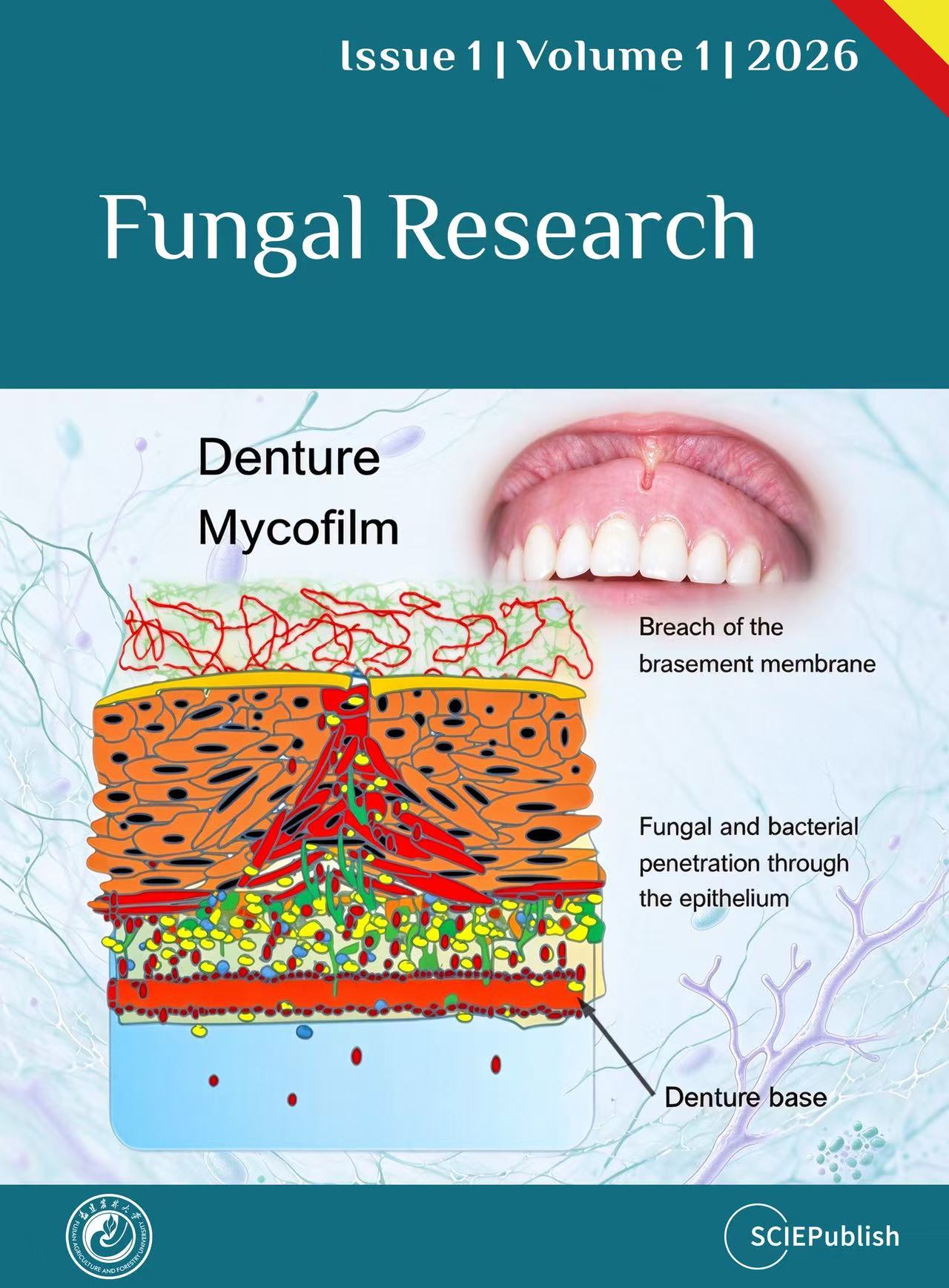
The inaugural issue provides an initial illustration of the breadth of research that we hope to encourage. It includes a review of the fungal component of denture-associated plaque; a study combining morphological and genomic approaches to characterize Alternaria alternata associated with blueberry leaf spot in Peru; a review examining host regulation and pathogenesis in zoonotic microsporidia; a research article investigating the effects of an antifungal protein on fungal growth and developmental processes in Aspergillus flavus, and a review address the industrial production and biogenesis of entomopathogenic fungal blastospores for biocontrol applications. We welcome the submission of more manuscripts to the journal.
As we embark on this new journey, we hope that Fungal Research will develop into a dynamic and inclusive international forum for researchers working across the fungal sciences. We welcome contributions that advance fundamental knowledge, introduce innovative methodologies, foster interdisciplinary collaboration, and translate scientific discoveries into meaningful applications. Most importantly, we hope the journal will facilitate open scientific exchange and encourage new ideas, perspectives, and collaborations within the global mycological community.
The journal is supported by an international editorial board comprising both established and emerging scholars from diverse areas of mycology and related disciplines. We are deeply grateful to all members of the editorial board for their expertise, guidance, and commitment to the journal’s development. We also sincerely thank the authors who have entrusted their work to Fungal Research and the reviewers who have generously contributed their time and critical judgment.
Declaration of Competing Interest
The authors declare that they have no known competing financial interests or personal relationships that could have appeared to influence the work reported in this paper.