
Drone-Assisted Vision for Offshore Wind Turbine Inspection and Maintenance: A Systematic Review

Drone-Assisted Vision for Offshore Wind Turbine Inspection and Maintenance: A Systematic Review
Owen Fiddy
1,*
 Dena Bazazian
1
Asiya Khan
1
Lars Johanning
1
Deborah Greaves
2
Dena Bazazian
1
Asiya Khan
1
Lars Johanning
1
Deborah Greaves
2
Received: 15 June 2026 Revised: 31 July 2026 Accepted: 05 August 2026 Published: 19 August 2026

© 2026 The authors. This is an open access article under the Creative Commons Attribution 4.0 International License (https://creativecommons.org/licenses/by/4.0/).
1. Introduction
Offshore wind turbines operate in harsh marine environments that accelerate structural degradation and increase the likelihood of faults across blades, towers, drivetrains, and electrical systems [1,2,3]. Compared with onshore installations, offshore turbines are exposed to stronger winds, salt spray, high humidity, wave-induced stress, and restricted maintenance access, all of which increase inspection difficulty and operational costs. As offshore wind farms continue to expand in size and distance from shore, the need for reliable, scalable, and cost-effective inspection strategies has become increasingly important [4].
Conventional inspection approaches remain heavily dependent on rope-access technicians, vessel support, and manual visual assessment [1,5]. While these methods can provide detailed information, they are labour intensive, weather restricted, expensive to deploy, and difficult to scale efficiently across large offshore farms. Non-destructive testing methods such as infrared thermography, ultrasonic inspection, and vibration monitoring can improve inspections, but many of these techniques still require close-range specialist operators or fixed sensors.
Recent advances in unmanned aerial vehicles (UAVs), computer vision, thermal imaging, and embedded artificial intelligence (AI) have created new opportunities for more autonomous inspection systems [6,7]. UAVs can capture high-resolution visual data while reducing the need for direct human access, and machine learning methods can support automated detection of structural and surface defects [8]. Infrared thermography further extends inspection capability by enabling the detection of subsurface anomalies, moisture ingress, and overheating in electrical components [9,10]. Together, these technologies offer strong potential for improving offshore wind turbine maintenance.
The motivation for this review arises from the inequality between the rapid expansion of offshore wind farms and the limitations of existing inspection and maintenance. As wind farms grow, turbines become larger and move farther from shore, increasing the complexity of inspection with reliance on vessel use, operational downtime, and weather-dependent access. Although UAVs, computer vision, infrared thermography, and robotic systems each offer improvements, their effectiveness cannot be assessed solely as isolated technologies. An autonomous offshore inspection system would connect data, defect detection, autonomous navigation, environmental robustness, and decision-making within a systematic framework. Therefore, there is a need for a comprehensive review that evaluates not only the performance of individual inspection methods but also the ability to enable safe, scalable, and increasingly autonomous offshore wind turbine inspection and maintenance.
UAV systems also create opportunities for dual data collection for environmental monitoring around offshore wind turbines. Drone-based aerial imagery has already been shown to automate wildlife detection and monitoring, like waterbirds, showing that UAV inspection platforms could also collect useful ecological data during routine missions [11]. Since drones and fixed cameras can repeatedly collect visual, thermal, acoustic, and spatial data, the same platforms could also record environmental information such as bird activity, weather conditions, rainfall, visibility, sea state, tidal behaviour, and surface temperature variation. Red, green, and blue (RGB) cameras could support bird and wildlife observation, infrared sensors could provide thermal information from turbine components and surrounding sea surfaces, and acoustic sensors could capture turbine or environmental sound data. This is important because offshore wind facilities still require improved technologies for monitoring birds and marine mammals [12]. Therefore, future autonomous offshore inspection systems may contribute not only to fault detection and maintenance planning, but also to wider environmental monitoring.
Existing review papers have already examined aspects of wind turbine inspection and maintenance. Previous studies have reviewed non-destructive testing and monitoring for wind turbine blades [13,14], drone-based inspection of wind turbine blades [15], and UAV inspection of floating offshore wind turbines [16]. Other recent reviews have focused on autonomous UAV navigation using deep-learning-based computer vision frameworks [17] and infrared-visible image fusion methods [18,19]. These reviews summarise individual inspection, sensing, and defect detection.
Despite this progress, the literature remains disconnected. Many studies focus on individual elements of the inspection pipeline, such as UAV navigation [17,20], defect detection algorithms [6,8], or thermal sensing [9,21], rather than fully integrated systems. In addition, many vision-based approaches are trained and evaluated using controlled or onshore datasets, making them vulnerable to motion blur, glare, humidity, and sea spray. As a result, few studies present a comprehensive framework that integrates autonomous flight, multimodal sensing, and real-time onboard intelligence for offshore wind turbine inspection.
Several recent review papers have examined wind turbine blade inspection, drone inspection, and computer vision health monitoring. For example, recent reviews have discussed drone and deep-learning technologies for wind turbine blade inspection, while others have focused on computer vision techniques for blade structural health monitoring or surface defect detection. These studies provide valuable summaries of inspection algorithms, sensing, and defect detection challenges. However, many existing reviews centre on blade-level damage detection, general drone inspection, or computer vision performance separately, rather than examining how UAV autonomy, onboard inference, RGB and infrared sensing, offshore environmental robustness, public dataset limitations, and future repair capability connect within a single offshore inspection framework.
Rather than reviewing computer vision models alone, this paper evaluates the wider inspection pipeline, including offshore failure mechanisms, conventional inspection constraints, UAV and robotic platforms, RGB defect detection, infrared thermography, multimodal fusion, onboard versus offline inference, public dataset availability, and drone-assisted maintenance potential. This broader structure allows the review to identify not only which detection techniques perform well, but also whether they are practically robust for autonomous offshore wind turbine inspection.
This review examines the current state of research on offshore wind turbine faults, inspection methods, UAV and robotic inspection platforms, computer-vision-based defect detection, infrared thermography, multimodal sensing, and the development of drone-assisted maintenance. The paper is structured as follows. Section 2 outlines the review methodology, search strategy, screening process, and thematic structuring of the literature. Section 3 covers the main topics in offshore wind turbine inspection, traces the development of autonomous inspection research, and explores turbine fault types, maintenance difficulties, and current inspection methods. Section 4 focuses on drones and robotic systems, including UAV-based inspection, alternative robotic platforms, and the emerging potential of drone-based repair and maintenance. Section 5 examines computer vision and deep learning methods for fault detection, infrared thermography, and RGB-infrared fusion for sensing. Section 6 provides a comparison of the reviewed literature, comparing inspection platforms, sensing methods, autonomy levels, datasets, validation settings, and offshore readiness. Finally, Section 7 discusses the main research trends, limitations, and future directions required to support autonomous offshore inspection in real offshore environments.
2. Review Methodology
This review used a structured methodology to identify, evaluate, and synthesise relevant literature on autonomous offshore wind turbine inspection. The objective was to capture research spanning offshore engineering, non-destructive testing, unmanned aerial vehicles, computer vision, infrared thermography, multimodal sensing, and drone-assisted repair. A transparent and reproducible review process was adopted to reduce bias, providing a reliable evidence base for the analysis in this paper.
The review was conducted in accordance with the principles of the Preferred Reporting Items for Systematic Reviews and Meta-Analyses (PRISMA) framework. Given the engineering and robotics focus of the topic, PRISMA guidelines were adapted to suit technical literature rather than clinical or medical studies. The framework was used to structure the identification, screening, assessment, and final inclusion of relevant publications.
A structured search was carried out across four major academic databases: IEEE Xplore, ScienceDirect, Google Scholar, and the Computer Vision Foundation (CVF Open Access). These databases were selected to ensure comprehensive coverage across electrical engineering, robotics, computer vision, industrial inspection, and offshore energy research. The search covered publications from 2000 to 2026. This timeframe was selected to capture foundational developments in UAV systems and early computer-vision methods while prioritising more recent advances in deep learning, multimodal sensing, and autonomous inspection systems.
The study selection process followed the four principal phases defined by PRISMA: identification, screening, eligibility, and inclusion. Titles and abstracts were reviewed to assess relevance to autonomous offshore inspection, and full-text assessments were conducted against the inclusion and exclusion criteria. Emphasis was placed on empirical validation, environmental testing conditions, and potential transferability to offshore environments.
The review process followed PRISMA principles to document the progression of records. This approach was used to ensure that the final body of literature was relevant to offshore wind turbine inspection, UAV-based monitoring, multimodal sensing, computer vision, and related autonomous maintenance technologies. The selection process of the records is shown in Figure 1.
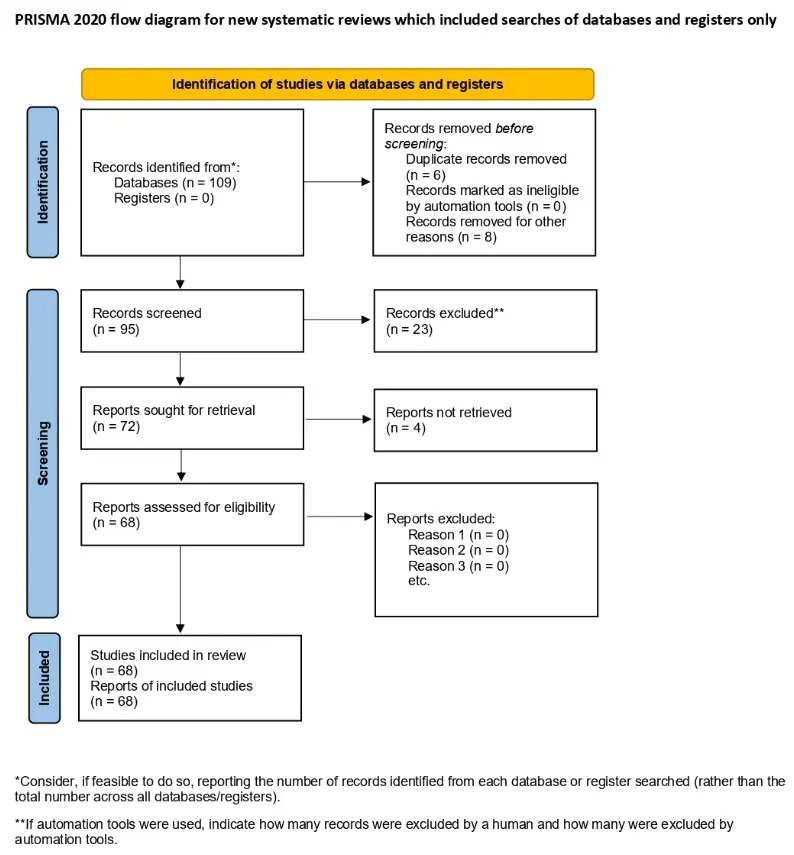
The initial database search returned 109 records. After the removal of 6 duplicate records and 8 records excluded for other reasons, 95 records remained for title and abstract screening. Following this stage, 23 records were excluded for not meeting the scope of the review. The remaining 72 reports were sought for retrieval, of which 4 were not retrieved. A total of 68 full-text articles were therefore assessed for eligibility against the predefined inclusion and exclusion criteria. Following full-text review, 68 studies were retained for detailed analysis and thematic synthesis, forming the evidence base for the systematic literature review presented in this paper.
Additional supporting references were also used where required to provide a wider context on offshore wind operation and maintenance costs, environmental monitoring, inspection safety, and related infrastructure inspection. These references are included in the final reference list but were not counted as part of the PRISMA screened core study set.
Structure of the Literature Review
The literature is organised into themes. These themes represent both foundational and emerging technologies in autonomous offshore wind turbine inspection. The review begins with turbine failure mechanisms and conventional inspection approaches, progressing to UAV-based inspection platforms, computer vision techniques, and thermal sensing. Finally, the review considers multimodal sensing systems, AI-driven autonomy, and broader research trends. The authors developed Figure 2 to summarise the thematic structure identified across the reviewed literature.
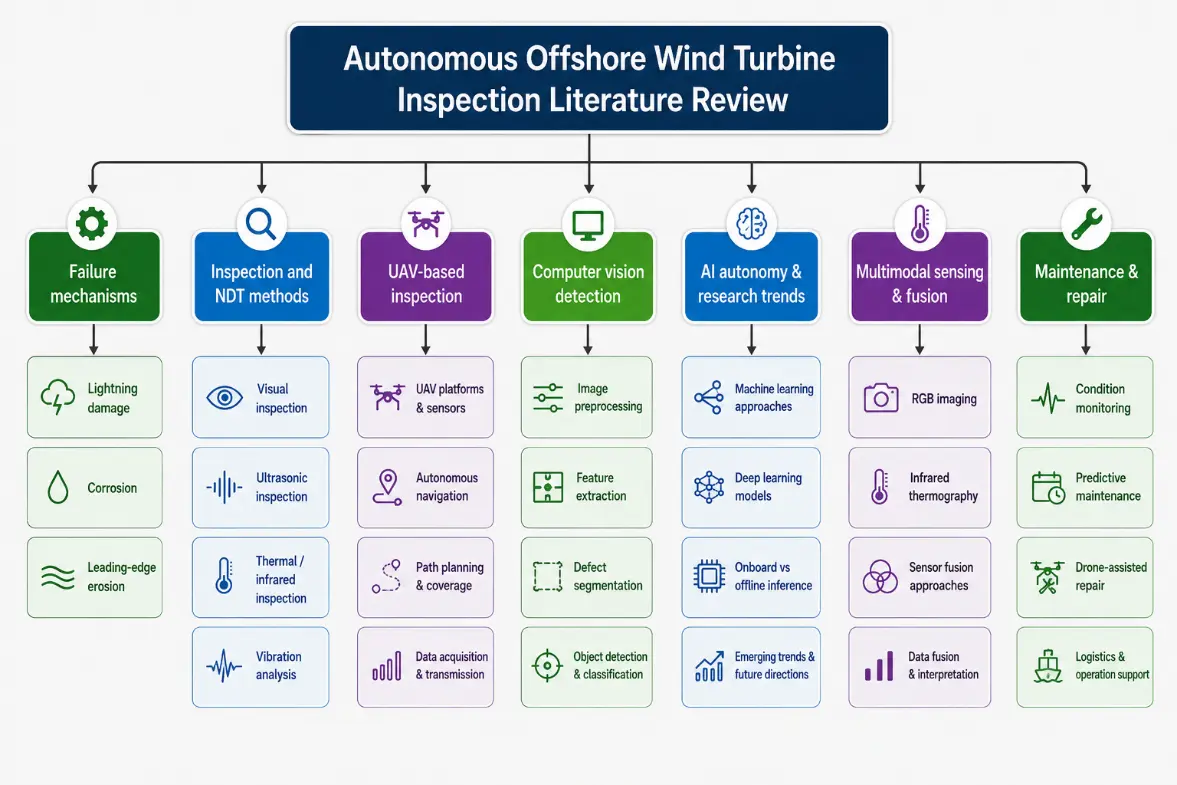
Figure 2. Thematic structure of the literature review, developed by the authors based on the reviewed literature.
3. Thematic Literature Review
3.1. Evolution of Autonomous Wind Turbine Inspection Research
Research into wind turbine inspection technologies has evolved significantly over the past two decades as wind energy infrastructure increases in both scale and complexity [1,5]. Early inspection methods relied heavily on manual approaches, including rope-access inspections and ground-based visual surveys conducted by trained personnel. While these methods provided reliable structural assessments, they were time-consuming, costly, and often posed safety risks for maintenance workers working at significant heights and in challenging offshore environments.
Throughout the 2000s, wind turbine blade inspection research was largely centred on conventional testing, non-destructive testing (NDT), and structural monitoring approaches, such as ultrasonic inspection, acoustic emission monitoring, and vibration analysis [13,14]. These techniques enabled early detection of structural faults within turbine components but required direct physical access to the turbine structure and specialised equipment.
The rapid development of unmanned aerial vehicle (UAV) technology in the late 2000s and early 2010s marked a significant shift in inspection approaches. UAV platforms enabled remote visual inspection of turbine blades and towers by capturing images. This significantly reduced the need for manual access and allowed inspection to be conducted more quickly and safely.
From the late 2010s onwards, advances in computer vision and deep learning began transforming wind turbine inspection research. Convolutional neural networks (CNNs) and object detection models have been increasingly applied to analyse aerial images captured by drones, enabling automated detection of common blade defects such as cracks, erosion, and lightning damage. These developments significantly improved inspection efficiency by reducing reliance on manual image analysis.
More recently, research has expanded toward multimodal inspection systems that combine multiple sensing technologies. The integration of RGB imaging with infrared thermography has shown promise for improving defect detection by capturing both visual surface damage and subsurface thermal anomalies. At the same time, advances in autonomous navigation and onboard computing have enabled the development of UAV systems capable of performing semi-autonomous or fully autonomous inspection missions.
Despite these advances, fully integrated inspection systems combining UAV autonomy, multimodal sensing, and real-time onboard defect detection remain an active area of research. Many existing studies focus on individual components of the inspection process, such as drone platforms, sensing technologies, or computer vision algorithms, rather than complete inspection solutions.
Timeline of Technological Development in Wind Turbine Inspection
To illustrate how the field has evolved, Figure 3 presents a milestone timeline of wind turbine inspection research. Rather than showing only broad technology, the timeline highlights relevant studies and developments that mark the progression from manual inspection and conventional non-destructive testing toward UAV-based imaging, AI-enabled fault detection, multimodal sensing, and more autonomous inspection systems. Deep learning inspection is using increasingly more object-detection methods like You Only Look Once (YOLO) and Faster Region-based Convolutional Neural Network (Faster R-CNN). Figure 4 provides representative examples of the main research directions shown in the timeline, while Table 1 summarises the supporting studies associated with each stage of development.
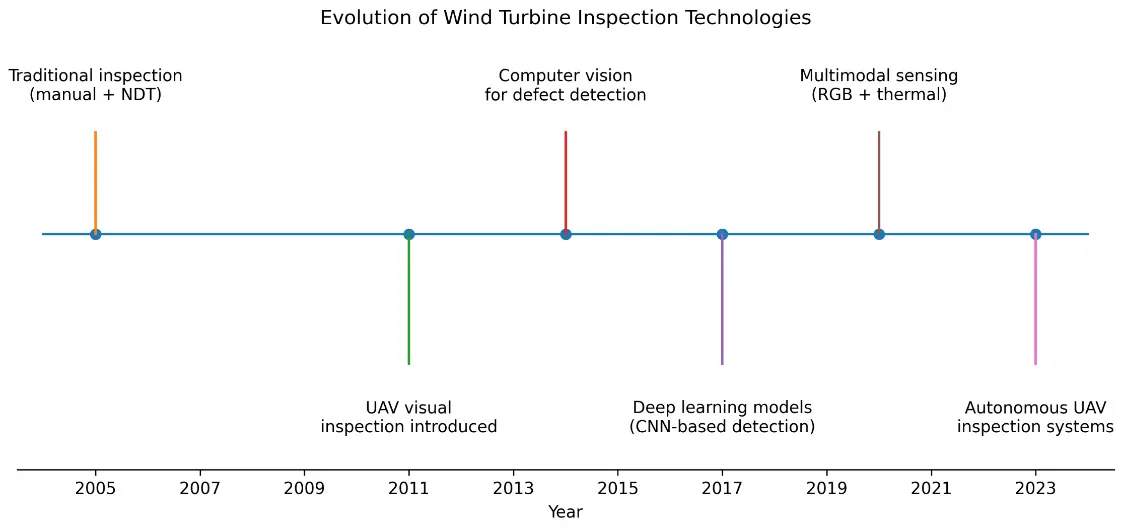
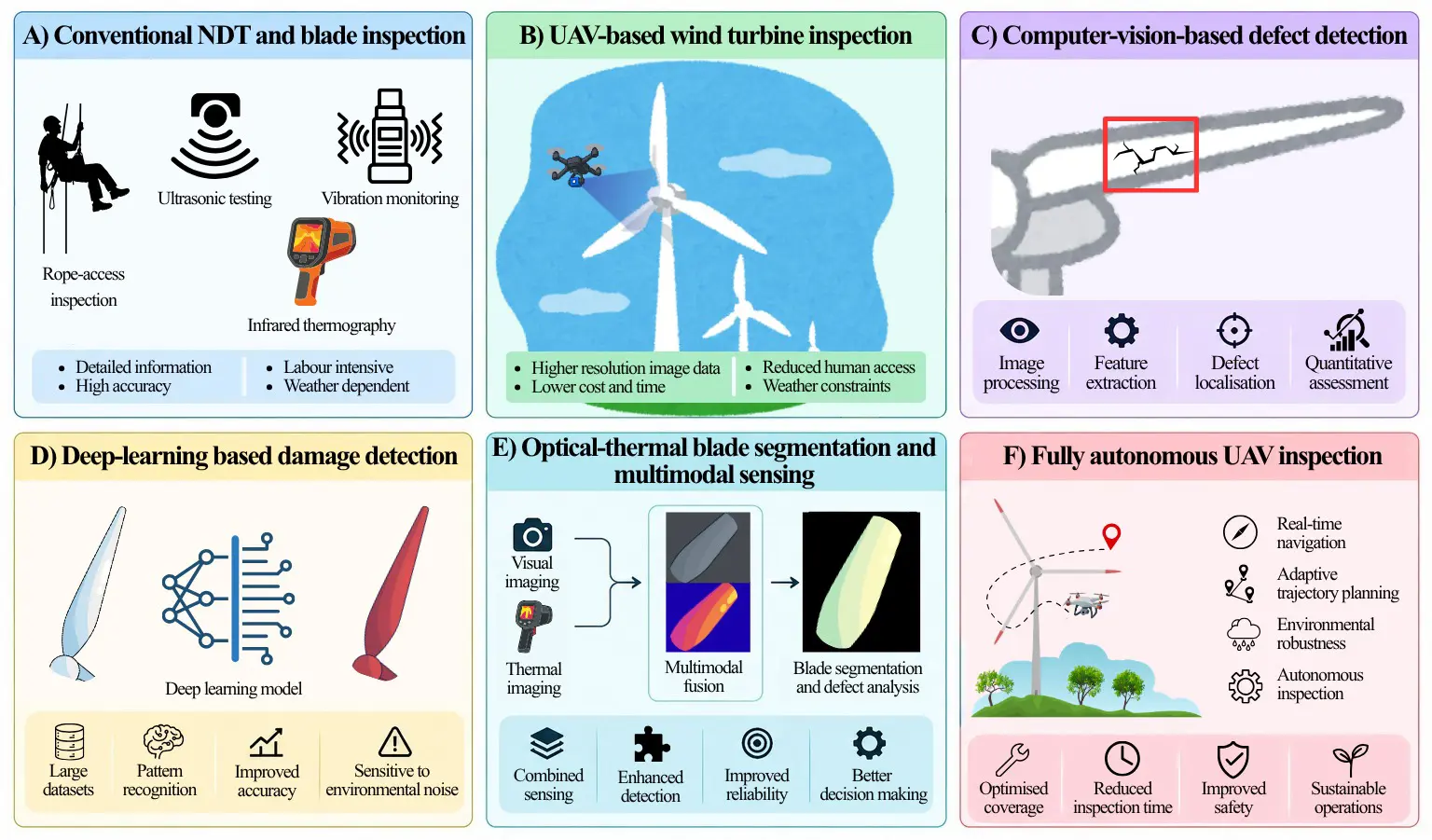
Figure 4. Author-created schematic illustrating the six main research directions identified in the reviewed literature: (A) conventional non-destructive testing (NDT) and blade inspection [1,14]; (B) unmanned aerial vehicle (UAV)-based wind turbine inspection [1]; (C) computer-vision-based defect detection [8]; (D) deep-learning-based damage detection [23]; (E) optical–thermal blade segmentation and multimodal sensing [7]; and (F) fully autonomous UAV inspection [6,24]. Created by the authors based on the reviewed literature.
Table 1. Supporting studies and selected topics represented in the wind turbine inspection research time.
|
Year/Period |
Timeline Topic |
Research Focus |
Supporting Studies |
Example |
|---|---|---|---|---|
|
2000–2010 |
Traditional inspection and NDT methods |
Manual inspection, rope-access assessment, ultrasonic testing, vibration analysis, and early condition-monitoring methods for wind turbine maintenance. |
Manual blade inspection and conventional NDT methods. |
|
|
2011–2014 |
UAV visual inspection introduced |
Early use of UAVs and remote imaging platforms for capturing close-range images of wind turbine blades and towers. |
UAV image-capture setup for blade inspection. |
|
|
2015–2018 |
Computer vision for defect detection |
Transition from image capture alone toward automated image processing and computer-vision-based detection of visible defects such as cracks, erosion, and surface damage. |
Image showing detected blade cracks, erosion, or defect regions. |
|
|
2017–2020 |
Deep learning models for automated inspection |
Use of convolutional neural networks, object detection models, and segmentation approaches for automated wind turbine defect classification and localisation |
[23,49,50,51,52,53,54,55,56,57,58,59, |
CNN, YOLO, Faster R-CNN, or U-Net detection output. |
|
2020–2023 |
Multimodal sensing using RGB and infrared |
Integration of RGB imagery with infrared thermography to improve the detection of both visible surface faults and non-visible thermal anomalies. |
[7,9,10,18,19,21,70,71,72,73,74,75, |
Paired RGB and thermal image or fusion-based detection result. |
|
2023–2026 |
Autonomous UAV inspection systems |
Movement toward UAV systems combining autonomous navigation, onboard intelligence, perception-guided inspection, and real-time fault detection. |
Autonomous UAV inspection framework and onboard AI pipeline. |
3.2. Offshore Wind Turbine Faults and Maintenance Challenges
Offshore wind turbines operate under harsh marine conditions that increase the likelihood of faults. Compared with onshore turbines, offshore systems are exposed to stronger winds, salt spray, high humidity, wave-induced loading, temperature fluctuations, and restricted access. These factors not only increase the rate of component deterioration but also complicate the detection, diagnosis, and repair of faults.
Failures may occur across all components of wind turbines. Rotor blades are particularly vulnerable due to continuous operation and direct exposure to environmental stressors. Common blade-related defects include surface cracking [33], leading-edge erosion [34], delamination, adhesive joint failure, lightning strike damage, and moisture ingress [8,26,29,31,32]. These faults can reduce aerodynamic efficiency, accelerate long-term deterioration, and in severe cases lead to complete failure.
Other turbine components are also at risk. Towers and support structures are vulnerable to corrosion, coating degradation, and fatigue-related damage [1,5]. Gearboxes, bearings, and drivetrain components are subject to wear, lubrication degradation, vibration-induced stress, and misalignment [10]. Electrical systems, including generators, converters, cabling [28], and transformers, may experience overheating, insulation degradation, and intermittent faults that are difficult to detect without specialised monitoring methods.
It is important that inspection methods are designed to be flexible and incorporate the detection of a variety of faults that can occur in an offshore wind turbine. Some defects, such as surface cracks, erosion, and visible lightning damage [26,29,31], are well suited to RGB-based visual inspection. Others, including subsurface delamination, moisture ingress, or overheating in friction-based parts or electrical components, may be more effectively detected using infrared thermography or other non-destructive testing techniques. This reinforces the need for inspection frameworks that can combine sensing modalities rather than relying on a single imaging source.
3.2.1. Major Fault Categories in Offshore Wind Turbines
The literature shows that offshore wind turbine faults can be broadly grouped into blade faults, structural faults, drivetrain faults, cable faults, and electrical faults. Blade faults are the most frequently discussed in inspection literature due to their accessibility to camera-based inspection and their strong influence on energy efficiency. However, a complete maintenance strategy must also account for less visually obvious faults occurring in internal components and electrical systems.
Table 2 summarises the major fault categories commonly discussed in offshore wind turbine maintenance literature and links them to suitable inspection approaches [36,37].
Table 2. Major offshore wind turbine fault categories, suitable detection methods, and supporting studies.
|
Fault Type |
Fault Location |
Potential Risk |
Detection Method |
Supporting Studies |
|---|---|---|---|---|
|
Surface cracks |
Rotor blade |
Reduced structural integrity |
RGB visual inspection |
|
|
Leading-edge erosion |
Blade surface |
Reduced aerodynamic efficiency |
RGB visual inspection |
|
|
Delamination |
Composite blade |
Structural weakening |
Infrared thermography/ultrasonic |
|
|
Lightning strike damage |
Blade tip/surface |
Surface and internal damage |
RGB + infrared |
|
|
Moisture ingress |
Blade structure |
Long-term internal degradation |
Infrared thermography |
|
|
Corrosion |
Tower/blades |
Material degradation |
RGB visual inspection |
|
|
Gearbox wear |
Gearbox/drivetrain |
Reduced reliability, failure risk |
Vibration/condition monitoring |
|
|
Bearing faults |
Bearings/drivetrain |
Increased friction and failure risk |
Vibration monitoring |
|
|
Electrical overheating |
Generator/converter/cables |
Efficiency loss, fire/failure risk |
Infrared thermography |
|
|
Coating degradation |
Exterior |
Increased corrosion exposure |
RGB visual inspection |
The impact of these faults is linked to their downtime, repair complexity, and whether maintenance can be planned before failure occurs. Minor surface faults, such as coating degradation, early corrosion, surface cracks, and leading-edge erosion, may initially cause less downtime, but can progressively reduce aerodynamic performance, increase material degradation, and develop into more costly structural repairs if left untreated. Drivetrain and electrical failures can have a much greater operational impact because they may require specialist labour, vessel deployment, component replacement, and suitable offshore access windows before the turbine can return to service. Offshore analysis shows that failures can be grouped into minor repairs, major repairs, and major replacements, with average repair times of approximately 6.67 days, 17.64 days, and 116.19 days, respectively [38]. This demonstrates that while many faults may begin as minor defects, they can progress to more severe failures, producing long periods of insignificance and non-operational windows, particularly when major replacement is required.
The economic impact of faults is also dependent on the affected system. Recent offshore wind farm maintenance analysis shows that operations and maintenance costs can represent around 30% of wind farm costs, making fault prevention and maintenance planning critical for reducing overall cost [39]. In the same study, electrical components represented approximately 28% of all failures and nearly 40% of revenue loss due to downtime, while gearbox maintenance was mainly driven by high replacement costs rather than downtime [39]. Early fault detection is valuable not only because it identifies physical damage, but because it allows operators to plan maintenance, avoid shutdowns, reduce downtime and revenue loss, and prevent developing faults from progressing into major failures.
3.2.2. Sensitivity of Offshore Wind Turbine Structures
Sensitivity analysis determines how variations and uncertainties in design and environmental parameters influence the response of offshore structures. This is particularly important for floating offshore wind turbines because their hydrodynamic and structural behaviour depends on interactions between the turbine, floating platform, mooring system, and surrounding marine environment.
The parameters considered in sensitivity studies can be divided into three groups. Mooring-system parameters include line length, type, configuration, diameter, and pretension. Platform and structural parameters include connector stiffness, platform configuration, natural periods, centre-of-mass position, material properties, and other structural characteristics. Environmental parameters include wind turbulence, wave conditions, current velocity, and uncertain boundary conditions. The reviewed evidence shows that variations in these parameters can influence platform motion, structural loads, mooring tension, hydrodynamic and hydroelasticity responses, and overall design reliability [97].
For autonomous inspection, these findings imply that structural and environmental variability should also be considered when planning UAV operations. Variations in platform heave, pitch, roll, yaw, and horizontal motion can alter the relative position between the UAV and the turbine. This may affect flight stability, stand-off distance, viewing angle, image sharpness, and the repeatability of inspection data. Structural sensitivity may also influence inspection priorities because components, connectors, and mooring elements that experience greater load variation or localised stress may require more frequent monitoring.
Laboratory experiments and simulations remain valuable for system development, but they may not fully reproduce the combined uncertainty associated with wind, waves, platform motion, sea spray, visibility, and changing UAV-to-structure distances. Realistic field trials and offshore flight data are therefore important for validating autonomous flight-control and inspection systems under the conditions in which they are expected to operate. Sensitivity-informed inspection planning could help identify both the components requiring closer monitoring and the environmental conditions under which inspection data can be collected reliably. However, the literature currently provides limited integration between structural sensitivity analysis and autonomous UAV inspection, representing an important direction for future research.
3.2.3. Maintenance Challenges in Offshore Environments
Many wind turbine faults are well understood; however, offshore maintenance is still difficult to operate. Windows of good weather, sea state, vessel availability, technician safety requirements, and high costs constrain access to offshore turbines. Even routine inspections may require extensive logistical planning, making frequent manual monitoring inefficient and expensive [1,2,5]. Another critical challenge is that many traditional inspection techniques require close-range access or direct contact with sensors [13]. Rope-access inspection provides a detailed visual assessment, but it is labour intensive, hazardous, and difficult to scale across large offshore farms [1,5]. Similarly, non-destructive testing techniques such as ultrasonic inspection, vibration monitoring, and thermographic surveys can provide valuable diagnostic information, but often depend on specialist operators, dedicated hardware, or controlled inspection conditions [10,13].
These challenges have motivated increasing interest in UAV-based and autonomous inspection methods [6,17,20]. However, offshore deployment introduces additional complications, including strong wind gusts, platform motion, salt contamination, glare, changing illumination, and unstable stand-off distances during image capture [1,5,42]. These factors can degrade image quality, reduce defect visibility, and limit the reliability of vision-based fault detection models trained only on controlled or onshore datasets [6,8,9].
Overall, the literature suggests that the main challenge is not simply detecting faults, but doing so reliably, safely, and repeatedly under real offshore conditions. This creates a strong case for multimodal and autonomous inspection systems that combine robust sensing, intelligent fault detection, and adaptive flight control within a unified inspection framework.
3.3. Current Wind Turbine Inspection Techniques
Inspection approaches have evolved from traditional manual methods to more remote, data-driven, and automated techniques in response to the need for improved safety, reduced downtime, and lower maintenance costs [1,2,5]. In the context of offshore wind turbines, inspection techniques must not only accurately identify structural and operational faults but also remain practical under harsh environmental conditions [1,5,42]. Current approaches can broadly be divided into manual inspection methods, ground-based remote inspection systems, and UAV-based inspection platforms [1,6,13].
3.3.1. Manual and Ground-Based Inspection Methods
Manual inspection has been the primary method for wind turbine assessment and is widely used in industry, particularly when close-range examination is required [1,2,13]. Technicians physically access turbine components using rope-access systems, suspended platforms, cranes, or internal tower access in order to visually inspect surfaces or perform non-destructive testing [1,5,13]. Manual methods are especially useful for detecting visible blade damage, coating degradation, surface cracks, leading-edge erosion, and lightning strike effects [1,8,32].
However, the disadvantages of manual inspection are significant. These methods are labour intensive, time-consuming, and expensive, particularly in offshore environments where access depends on vessel deployment, good weather, and strict safety procedures [1,2,5]. Rope-access inspection is also dangerous for technicians due to working at height and in variable offshore conditions [1,5]. The transfer of technical staff from service vessels to turbine platforms poses an additional safety risk, as workers may be exposed to wave motion, unstable access conditions, slippery surfaces, and sudden changes in weather conditions during boarding or disembarkation. These access-related hazards make offshore inspection not only costly and weather dependent, but also a safety challenge. For large offshore farms containing many turbines, manual inspection is difficult to scale and may result in long inspection intervals, delaying the identification of faults [1,2,6].
Remote ground inspection techniques were developed to reduce the need for direct human access while still allowing visual or sensor-based assessment of turbine structures [1,2,5]. These methods typically use high-resolution cameras, laser scanning systems, or other remote sensing devices positioned onshore, at nearby service locations, or on vessels [1,13]. Ground-based methods support rapid assessment, but image quality may be reduced by long stand-off distances, poor lighting, atmospheric distortion, sea spray, and restricted viewing angles [1,8]. As a result, ground-based methods may be useful for preliminary assessment, but often lack the flexibility and image detail needed for reliable defect characterisation across all turbine components [1,5,8].
3.3.2. UAV-Based Inspection
UAV-based inspection has become one of the most significant developments in wind turbine monitoring because it enables close-range image capture while reducing the need for direct technician access to hazardous areas [1,5,6]. By flying near turbine blades, towers, and nacelles, drones can capture high-resolution imagery from viewpoints that are difficult or impossible to achieve using ground-based systems.
The main advantages of UAV inspection are improved safety, faster deployment, greater flexibility, capacity for repeated monitoring, and automated image analysis [1,2,6]. This makes UAVs a good foundation for future intelligent inspection systems, particularly when combined with computer vision, thermal sensing, and autonomous navigation [6,7,17,20].
However, UAV inspection remains challenging in offshore environments. Stable flight near large turbine structures can be affected by wind turbulence, moving launch platforms, salt contamination, glare, variable illumination, and unstable stand-off distances [1,5,42]. Image-based inspection also depends heavily on data quality, meaning that poor camera angles, motion blur, or insufficient training data can reduce the reliability of automated defect detection methods [6,8,9]. Therefore, UAV inspection provides a strong foundation for offshore monitoring, but further integration with robust sensing, computer vision, and autonomous control is still required.
3.3.3. Comparative Assessment of Inspection Techniques
Side by side, the three inspection categories show strong differences. Manual inspection provides the greatest opportunity for detailed close-range assessment, but it is the least efficient and most hazardous option [1,2,5]. Ground-based methods reduce safety risks and can support rapid preliminary assessment, but they are restricted by viewpoint limitations and often provide lower-quality data [1,8,13]. UAV-based inspection offers a stronger balance between safety, flexibility, and inspection coverage, although it introduces new technical challenges related to flight control, sensing reliability, and environmental variation [6,17,42].
Although the continuous monitoring of wind turbines with these autonomous systems may not be as effective at identifying every issue, it is still beneficial in observing the operations of a wind turbine. Simply noticing a decrease in operational efficiency in any category can help diagnose and repair issues without relying on manual inspection. Furthermore, the frequency with which UAVs can be deployed is vastly greater than that achievable with manual inspection [1,2,6]. The average manual inspection of a wind turbine happens 1–2 times a year at most [1]. Therefore, continuous monitoring using autonomous systems can detect and categorise faults much earlier than what is currently available, reducing future issues and making green energy more efficient [5,6,17].
Another avenue for improving inspection is the development of sensors embedded into inspection platforms. This can already be seen in wind turbine condition-monitoring systems, where vibration, strain, temperature, acoustic emission, electrical, and supervisory control and data acquisition (SCADA)-based measurements are used to observe turbine behaviour and identify early signs of faults during operation [2,3]. For drone-assisted inspection, this creates an opportunity to move beyond simple image capture by integrating additional sensors onto UAV platforms, such as thermal cameras, acoustic sensors, light detection and ranging (LiDAR), vibration sensing attachments, and environmental monitoring sensors. These systems could allow drones to collect multiple forms of diagnostic data during repeated inspection missions, helping to detect faults that may not be visible through RGB imagery alone.
However, the use of UAV-mounted or contact-based sensing remains underdeveloped, especially where accurate physical contact with turbine components is required. Unlike fixed sensors installed within the turbine, drones currently face limitations in stable contact, payload capacity, flight time, sensor calibration, and operation in harsh offshore weather. Despite these challenges, UAV-based sensing offers major advantages in scalability and flexibility, since the same mobile platform can inspect multiple turbines without requiring permanent sensors to be installed on every component. Therefore, future offshore inspection systems may benefit from combining fixed condition-monitoring with drone-mounted multimodal sensing, allowing embedded turbine sensors to identify abnormal behaviour and UAVs to perform targeted visual, thermal, acoustic, or close-range follow-up inspection when needed [39].
This comparison explains why recent literature increasingly favours UAV-based inspection as the most practical direction for offshore monitoring research. While manual and ground-based approaches still have value in specific situations, UAV platforms provide the most effective foundation for integrating advanced sensing, computer vision, and autonomous control. As a result, they have become the dominant platform in many modern wind turbine inspection studies [5,6,7,17]. A comparison of the main inspection techniques is shown in Table 3.
Table 3. Comparison of current wind turbine inspection techniques and supporting studies.
|
Inspection Type |
Primary Use |
Strengths |
Weaknesses |
Efficiency |
Supporting Studies |
|---|---|---|---|---|---|
|
Manual |
Confirmatory close-range inspection |
High detail, direct confirmation of damage |
Dangerous, slow, expensive |
Low |
|
|
Ground-based |
Preliminary screening |
Safer, simpler deployment, lower cost |
Limited angles, reduced image detail |
Medium |
|
|
UAV-based |
Remote inspection platform |
Safe, flexible, scalable, high-quality close-range imagery |
Weather sensitivity, flight complexity, and data quality dependence |
High |
|
|
Autonomous UAV |
Large-scale inspection solution |
Repeatable, reduced labour, integration with AI |
Technically complex, still developing |
Very High |
4. Drones and Robotic Systems for Inspection
Drones and robotic systems are transforming wind turbine inspections, breaking free from traditional access methods and driving a new era of fully automated, high-efficiency inspections. As offshore turbines have increased in size, number, and distance from shore, inspection has become not only a sensing problem but also a platform-deployment problem. The choice of robotic platform affects how inspection data is collected, what components can be accessed, and how easily systems can operate under offshore constraints [1,2,5,16].
Among the available platforms, unmanned aerial vehicles (UAVs) have become the most widely used due to their mobility and compatibility with imaging-based inspection [1,6,17]. However, they do not represent robotic inspection research as a whole. Systems such as climbing robots, crawler platforms, and marine robotic support systems are also being explored for tasks that require stable contact, specialised access, or coordination between different parts of the turbine [2,5].
Recent research points to broader inspection ecosystems in which UAVs, contact-based robots, and offshore support systems operate together [5,6]. This wider look is important because it positions robotic inspection not only as a method for image capture, but as an essential component of intelligent and autonomous offshore maintenance [5,17,20].
4.1. Unmanned Aerial Vehicles for Wind Turbine Inspection
UAVs are the dominant robotic platform in wind turbine inspection research and form the foundation of recent autonomous inspection systems [1,6,15,17]. Their main importance lies in their ability to act as mobile sensing platforms that can support image capture, multimodal sensing, and perception-guided inspection without requiring direct human access to hazardous turbine surfaces [5,6,7].
UAVs are unique in their exceptional ability to combine platform mobility with modern sensing and AI-based analysis [6,17,20]. They can carry RGB cameras, thermal sensors, LiDAR, and embedded computing hardware, allowing them to support a wide range of inspection objectives while also integrating with computer vision and autonomous navigation frameworks [6,7,9,17]. This makes them particularly relevant to offshore inspection, where flexible deployment and high data coverage are essential.
UAV technology has many strengths but is in its infancy, so it is limited in the contact it can achieve and in its repair capabilities [2,5]. Regardless, drones provide the most useful platform due to their omnidirectional control, making them suitable for non-contact inspection, such as RGB and infrared, and have major potential for the future of inspection and repair [1,6,7].
4.2. Robotic and Alternative Inspection Platforms
Although UAVs dominate recent literature, they are not the only robotic systems considered for turbine inspection. Alternative robotic platforms have been explored to address limitations associated with aerial flight or to provide access to areas that UAVs cannot easily inspect [2,5].
Climbing robots represent one such approach. These systems are designed to attach to turbine towers or blade surfaces and move along the structure while capturing close-range inspection data [5]. Their main advantage lies in their ability to maintain consistent proximity to the inspection surface, potentially improving image stability and data quality. However, their deployment can be mechanically complex, and their mobility is more constrained than that of UAVs [1,5].
The literature also suggests that future offshore inspection and maintenance may rely on coordinated robotic ecosystems rather than UAVs alone. This can be seen in the work of Jiang et al. [5], who developed a multirobot system for the autonomous deployment and recovery of a blade crawler for offshore wind turbine blade operations and maintenance. Although this is not an aerial inspection platform, it is highly relevant because it demonstrates how different robotic agents can be combined to support access, interaction, and maintenance on offshore structures. In this context, UAVs may be most effective when used for rapid survey, defect localisation, and situational awareness, while contact-based robotic systems undertake close-range inspection or repair tasks.
Marine robotic systems may also be relevant in offshore environments. Remotely operated vehicles (ROVs) and autonomous surface or underwater platforms are more commonly associated with subsea inspection tasks, such as foundation or cable monitoring, but they remain part of the broader offshore maintenance ecosystem [5].
Other alternative systems include fixed camera installations, robotic arms for repair or close-contact sensing, and hybrid inspection concepts combining multiple platforms [5]. While many of these approaches remain less mature than UAV-based inspection, they demonstrate that turbine monitoring is gradually moving toward integrated robotic ecosystems rather than a single-platform solution.
4.3. Comparing the Roles of Inspection Platforms
When inspection platforms are compared, UAVs currently offer the strongest balance between flexibility, inspection coverage, deployment practicality, and compatibility with image-based defect detection [5,6]. Their ability to rapidly capture detailed data from multiple turbine components makes them the most suitable platform for routine visual inspection and for research involving computer vision and autonomous monitoring.
In contrast, climbing robots and other contact-based systems may provide more stable sensing under certain conditions, but they are generally more limited in mobility and operational scalability. Marine robotic systems are highly valuable for offshore support and subsea asset inspection, but they are less suited to the blade and nacelle inspection tasks that dominate much of the wind turbine defect detection literature [5].
For these reasons, the literature increasingly shows UAVs as the primary platform for future offshore wind turbine inspection systems [1,6]. However, the long-term direction of research is likely to involve collaboration between multiple robotic systems, with UAVs providing rapid aerial assessment and other robotic or marine platforms supporting specialised inspection, repair, or maintenance tasks. This broader perspective is important because it positions autonomous inspection not only as a drone problem, but as part of a wider intelligent maintenance framework.
4.4. Drone-Based Repair and Maintenance Potential
Research into drone-based repair remains at an early stage, yet it represents an emerging direction for reducing offshore maintenance costs and enabling faster response to developing faults [5]. While most current UAV research in wind energy focuses on inspection and monitoring, work has also begun to explore whether aerial robotic systems could support minor repair and maintenance operations [91,93]. This possibility is particularly useful in offshore environments, where technician access is costly, weather-dependent, and often hazardous.
The literature increasingly suggests that inspection and maintenance may converge. This can again be seen in the work of Jiang et al. [5], whose multirobot system for the deployment and recovery of a blade crawler illustrates how offshore maintenance may involve cooperation among different robotic platforms rather than reliance on a single vehicle type. Although their system is not a UAV-based repair solution in itself, it is highly relevant because it suggests that autonomous drone inspection may eventually serve as one component of a larger organization comprising aerial, surface, and contact-based robotic agents.
Existing repair-oriented studies primarily investigate lightweight, contact-based UAV systems designed to assist, rather than replace, human technicians [91,93]. Early demonstrations have explored drones equipped with small robotic manipulators capable of performing simple maintenance actions such as surface cleaning, coating application, brushing, and dispensing repair materials. These studies suggest that aerial systems may eventually support localised intervention tasks, particularly in areas where manual access is difficult or unsafe.
More advanced concepts extend this idea toward cooperative robotic maintenance. UAVs may operate alongside ground-based robots, climbing systems, or remotely operated marine vehicles to support inspection and repair of both above-water and submerged infrastructure [5]. These concepts are particularly relevant to offshore wind farms, where maintenance is not limited to blades and nacelles but may also involve towers, foundations, cables, and support structures. As a result, drone-based repair should be understood not only as an aerial manipulation problem, but as part of a broader autonomous maintenance ecosystem [47].
A major challenge in aerial repair is the need for stable and controlled physical interaction with the turbine surface [91,92]. Unlike inspection, which can often be performed without contact, repair tasks require the UAV to maintain accurate positioning while applying force, manipulating a tool, or dispensing material. To address this, some studies have investigated suction anchors, compliant end-effectors, passive force-control structures, and lightweight stabilisation mechanisms intended to improve contact reliability [91,92,93]. Although promising in principle, these systems remain difficult to deploy under realistic offshore conditions.
The offshore environment can have many barriers to aerial repair. Rotor-wake turbulence, varying wind conditions, drone motion, salt contamination, moisture, and limited stand-off stability all complicate precise manipulation near large turbine structures [1,5,42]. Payload capacity is another key limitation, since repair tools, stabilisation systems, sensors, and onboard computation all compete for mass and power within a constrained aerial platform. These factors make high-precision UAV repair significantly more challenging than image-based UAV inspection [91,92,93].
Despite these limitations, research trends point toward increasing autonomy and capability in aerial maintenance systems. Advances in lightweight manipulators, force sensing, tactile feedback, compliant control, and perception-guided planning may eventually enable UAVs to perform tasks such as crack sealing, erosion patching, resin injection, or targeted coating restoration with ease [91,92,93]. In the longer term, integrating such repair functions with real-time defect detection could allow UAVs not only to identify faults but also to respond to them immediately, reducing downtime and improving turbine availability.
However, drone-based repair systems remain at low technology readiness levels, and no autonomous system has yet demonstrated reliable, high-precision offshore turbine repair under realistic operating conditions [5,93]. The current literature, therefore, suggests that drone-based maintenance should be viewed as a promising but immature research area [92,93].
Overall, drone-based repair and maintenance remains a long-term opportunity rather than a near-term operational solution. However, it is an important direction as it increases the role of UAVs beyond passive inspection toward active intervention, thereby getting closer to a complete autonomous offshore maintenance system.
5. Computer Vision and Deep Learning in Fault Detection
Computer vision and deep learning are central to wind turbine inspection research because they enable the automated analysis of inspection imagery collected from drones, ground-based systems, and other sensing platforms [6,8,9]. As wind farms continue to increase in scale, manual review of large volumes of inspection data becomes increasingly impractical. Automated image analysis, therefore, plays an important role in reducing workload, improving inspection efficiency, and supporting more consistent identification of turbine defects [6,7,8].
Computer vision methods are primarily used for wind turbine maintenance to detect, classify, and segment visible damage from image data [6,8,9]. These methods are especially relevant to UAV-based inspection systems, where high-resolution images can be captured rapidly and then analysed either offline or, in more advanced systems, through embedded onboard processing [6,7,17].
5.1. Computer Vision for Wind Turbine Inspection
Early computer vision approaches for wind turbine inspection relied on traditional image processing and handcrafted feature extraction. These methods typically use edge detection, thresholding, colour analysis, texture descriptors, and segmentation techniques to identify visible irregularities on blade or tower surfaces [6,8,9]. These approaches were useful in controlled conditions and helped demonstrate the feasibility of automated defect assessment, particularly for clear surface-level damage [6,8].
However, traditional image processing methods often struggle under realistic inspection conditions [44]. Wind turbine images are commonly affected by variable lighting, shadows, reflections, blade curvature, motion blur, and inconsistent viewpoints. In offshore environments, these challenges are further intensified by glare, haze, sea spray, moisture, and unstable image capture during UAV flight. As a result, handcrafted feature-based approaches tend to be more vulnerable when applied to diverse real-world turbine inspection scenarios [6,8,42].
The practical relevance of computer vision for blade inspection is further supported by studies that quantify real damage from operational imagery. Aird, Barthelmie, and Pryor [8] demonstrated automated quantification of wind turbine blade leading-edge erosion from field images, showing that image-based analysis can be used to assess operationally meaningful forms of blade degradation. This is important because it confirms that computer vision is not limited to laboratory classification exercises but can be applied to genuine field-acquired inspection imagery. However, the study also reflects a broader limitation in the literature, namely that successful defect analysis from stored or pre-captured images does not necessarily equate to real-time fault detection during autonomous UAV operation.
This limitation encouraged a shift toward data-driven vision methods capable of learning richer and more adaptable representations from image data, so rapid and adaptive inspection can occur live rather than offline.
5.2. Deep Learning Models for Defect Detection
The adoption of deep learning has significantly advanced the state of the art in wind turbine defect detection. Convolutional neural networks (CNNs) are particularly well suited to inspection imagery because they can automatically learn hierarchical visual features directly from data, reducing dependence on manually designed rules [6,8,9]. This has enabled more accurate and scalable detection of complex defect patterns across a wide range of inspection conditions.
The literature outlines deep learning models used for turbine inspection, that fall into three broad categories: classification models, object detection models, and segmentation models [6,7,9]. Classification models are used when the goal is to determine whether an image contains damage or to assign a broad defect label. Object detection models are used to localise defects within an image, usually through bounding boxes. Segmentation models provide a more detailed output by identifying the extent of damage, which is useful when estimating fault attributes.
Deep learning has also been combined with thermal data to improve wind turbine blade defect identification. This can be seen in the work of Bounenni, Castanedo and Maldague [9], who used infrared thermography, image processing, and a U-Net architecture for blade defect detection. Their study is particularly relevant because it demonstrates how thermal imagery can be integrated with segmentation-based deep learning to improve the visibility and localisation of blade anomalies. Nevertheless, although the methodology is promising, it remains more representative of a structured defect detection pipeline than a fully autonomous field-ready UAV inspection loop operating under offshore conditions. Classification models are commonly used for rapid screening, particularly in studies where the objective is to separate defective blade images from non-defective ones [6,8]. Object detection models, including architectures from the YOLO, Faster R-CNN, and Single Shot MultiBox Detector (SSD) families, are especially useful for UAV inspection because they combine localisation with relatively efficient inference [6,17,63]. Segmentation approaches, such as U-Net, Mask R-CNN, and related encoder-decoder networks, are valuable when more detailed damage mapping is required [7,9].
Recent studies have also begun exploring transformer-based vision models, multimodal fusion architectures, and synthetic-data-driven approaches to improve accuracy and reduce dataset limitations [6,7,9]. These methods show promise, particularly for handling complex scenes and integrating information from RGB and thermal sensors. However, many of these newer approaches remain computationally demanding and are not yet widely validated for real-time deployment in offshore UAV inspection systems [6,7,17].
5.3. Limitations and Research Challenges
Despite its strong potential, deep learning-based fault detection still faces several important limitations for wind turbine inspection. One of the main challenges is the limited availability of large, diverse, and well-annotated datasets. Many published studies rely on relatively small, curated, or onshore image collections captured under controlled conditions [6,8,9]. These datasets do not fully represent the environmental complexity of offshore turbine inspection.
A recurring issue in the literature is that many advanced inspection approaches still depend heavily on post-capture analysis rather than fully real-time onboard autonomy. This limitation is evident in the work of Aird, Barthelmie, and Pryor [8], who showed that leading-edge erosion can be quantified from field images, but did not fully resolve the challenge of live defect detection during autonomous inspection. In practice, the distinction between analysing imagery after a mission and identifying faults during flight is significant because real-time perception can influence route adaptation, revisit behaviour, fault prioritisation, and operational safety. Many vision systems still perform inference offline after flight, which limits the ability of an autonomous UAV to adapt its behaviour in real time [6,8]. Without onboard perception, the drone cannot easily adjust its viewing angle, request additional close-range imagery, or modify its inspection path in response to detected features. Real-time embedded deployment also remains challenging due to power limitations, thermal constraints, and the computational demands of advanced models [6,7,17].
A greater issue is that several studies approach full integration but lack real-world validation. For example, Ma et al. [6] presented a fully autonomous inspection approach for wind turbine blades based on drones and artificial intelligence. This is an important development because it suggests that the field is moving beyond isolated perception components toward more complete system architectures. However, such work should still be interpreted with caution, as important questions remain regarding reliability under realistic environmental conditions, the completeness of the evaluation, and whether inference is truly live and onboard rather than partially deferred to offline analysis [66]. As a result, these systems are best understood as promising prototypes rather than definitive demonstrations of offshore autonomy [6,17,42].
A related issue is model applicability. Systems trained on stable or simplified datasets may report high accuracy in laboratory evaluation yet perform poorly when exposed to real turbine surfaces under dynamic flight conditions [6,8,42]. This creates a gap between reported model performance and practical offshore readiness.
Finally, some important turbine faults are not fully visible in RGB imagery alone. Subsurface delamination, moisture ingress, and thermal anomalies in electrical components require additional sensing modalities for reliable detection. This limitation strengthens the case for multimodal inspection systems that combine computer vision with infrared thermography and other non-destructive sensing methods.
Overall, the literature shows that computer vision and deep learning provide a strong foundation for intelligent wind turbine inspection. However, further progress is still needed in offshore dataset development, multimodal learning, and real-time UAV integration before these methods can reliably support autonomous offshore inspection at scale.
5.4. Infrared Thermography for Wind Turbine Inspection
Infrared thermography has become an important non-destructive testing approach in industrial inspection because it enables the detection of thermal anomalies without requiring physical contact with the target surface [9,21]. In the context of wind turbine inspection, thermographic imaging is particularly valuable because many critical faults are not fully visible in standard RGB imagery [9,10]. While optical cameras are effective for identifying surface-level damage, infrared sensing provides an additional layer of diagnostic information by revealing temperature variations associated with hidden or developing faults [9,10,21].
For offshore wind turbine inspection, this capability is especially relevant. Blade structures, electrical systems, and other turbine components may exhibit subsurface degradation, moisture ingress, bond-line failure, or overheating that cannot be reliably identified from colour imagery alone [9,10,21]. Infrared thermography, therefore, offers an important complementary sensing modality within intelligent inspection.
Infrared thermography operates by measuring thermal radiation emitted from a surface and converting that information into a temperature-based image [9,21,72]. Variations in material condition, internal structure, or energy dissipation can produce abnormal thermal patterns that appear as localised hot or cold regions within the image [9,21]. In wind turbine applications, this principle is relevant not only to external blade structures but also to electrical and mechanical subsystems where heat generation may provide an early warning of abnormal behaviour [9,10,21].
Several studies demonstrate the diagnostic value of infrared imagery when combined with modern image analysis. Hwang, An, and Sohn [21] proposed continuous line laser thermography for damage imaging of rotating wind turbine blades, showing that active thermographic methods can generate useful damage imagery under rotating conditions. Corley et al. [10] combined thermal modelling and machine learning for fault detection in wind turbine gearboxes, showing that thermal information can contribute to the identification of drivetrain-related abnormalities. Bounenni, Castanedo, and Maldague [9] showed that defect detection in wind turbine blades can be supported through the combined use of infrared thermography, image processing, and U-Net segmentation.
Despite its advantages, infrared thermography also presents important limitations. Thermal measurements are sensitive to environmental and operational conditions, meaning that image interpretation can be affected by wind-induced cooling, ambient temperature variations, changing solar exposure, surface emissivity, reflections, and sensor angle. These factors can distort apparent temperature patterns and make it more difficult to distinguish genuine defects from environmental artefacts [9,10,21,88].
Some limitations are particularly significant in offshore settings. Sea-surface reflections, moisture, salt contamination, rapid weather changes, and continuous turbine motion may all reduce the reliability of thermal interpretation. In practice, this means that thermographic inspection often requires careful calibration, controlled assumptions, or post-processing to produce dependable results [9,10,21]. These requirements can become more difficult to satisfy when sensing is performed from a moving UAV platform rather than under stable laboratory or industrial conditions [6,7,42].
A further challenge is that thermal data alone may not always provide sufficient context for confident diagnosis. A hotspot or anomalous cool region may indicate an internal fault, but without visual context, it may be difficult to determine the exact location, extent, or structural meaning of the abnormality [9,10]. For this reason, many recent studies increasingly consider infrared thermography alongside RGB imaging rather than as a standalone sensing solution [7,9].
Overall, the evidence suggests that infrared thermography has clear diagnostic value in wind farm and offshore inspections, particularly for detecting electrical and subsurface faults. Nevertheless, its transition from useful manual practice to autonomous deployment remains incomplete. This gap provides a strong justification for further research into UAV-based thermographic inspection systems capable of operating reliably in real offshore environments.
5.5. RGB and Infrared Fusion
The combination of RGB imaging and infrared thermography has emerged as a promising direction in intelligent wind turbine inspection because the two sensing modalities provide complementary information [7,9,10,18]. RGB cameras are effective for identifying visible surface defects. In contrast, infrared sensors provide thermal information that can reveal subsurface anomalies and other non-visible fault signatures. When used together, these modalities offer a broader and more reliable representation of turbine condition than either sensing source alone [7,9,18,19,87].
The theoretical foundation for combining visible and thermal sensing is well established in the wider image-fusion literature. Yang et al. [19] reviewed infrared and visible image fusion algorithms based on neural networks and showed that multimodal fusion can be implemented at different levels of the perception pipeline, including raw data, extracted features, and final decision outputs. This is especially relevant to offshore wind inspection because thermal imagery can help reveal heat-related or low-visibility anomalies, while RGB imagery preserves geometric structure, texture, and surface detail. The implication is that multimodal fusion is not simply a hardware combination, but a computational strategy for combining complementary sources of information [7,19].
This complementary relationship is particularly important in offshore inspection scenarios, where individual sensing modalities may be unreliable under changing environmental conditions [1,7,42]. RGB imagery is highly sensitive to illumination, shadowing, glare, fog, and surface reflectance, while infrared imagery may be affected by thermal drift, convective cooling, emissivity variation, and environmental reflections. By combining visual and thermal data, fusion-based systems can improve fault detectability and reduce the risk of missed or ambiguous detections arising from the weaknesses of a single sensor [7,9,19].
Evidence from related infrastructure inspection domains further supports the value of this approach. Xincong Yang, Guo, and Li [85] compared multimodal RGB-thermal fusion techniques for exterior wall multi-defect detection and found that combining visible and thermal modalities can improve defect discrimination relative to single-modality sensing. Although this work is not turbine-specific, it remains highly relevant because it demonstrates that multimodal fusion can improve defect detection in built environment inspection tasks. However, compared with static wall inspection, offshore turbine inspection introduces more severe challenges related to calibration stability, motion, stand-off distance, and environmental variability, meaning that successful transfer requires careful adaptation rather than direct adoption [1,7,42].
In practical terms, RGB and infrared fusion may be implemented at different levels [7,19]. Data level fusion combines the raw or pre-processed outputs of both sensors before feature extraction. Feature-level fusion combines learned or engineered features from each modality to create a richer joint representation. Decision-level fusion combines independent outputs from RGB-based and thermal-based detection models to reach a more robust final judgement. Each of these strategies offers different benefits depending on the sensing platform, computational budget, and inspection objective [19].
A particularly relevant wind turbine-specific example is provided by Jia and Chen [7], who developed an AI-based optical-thermal video data fusion method for near real-time blade segmentation during normal wind turbine operation. This study demonstrates optical-thermal fusion under realistic turbine operating conditions, moving beyond tightly controlled laboratory experiments. However, its main contribution lies in blade segmentation rather than complete autonomous fault detection. In other words, it shows that multimodal sensing can function in a realistic turbine context, but it does not yet provide a full end-to-end inspection system in which faults are autonomously detected, classified, prioritised, and acted upon by a UAV in real time. This makes it an important transitional study between multimodal proof-of-concept work and fully autonomous offshore inspection.
Recent research increasingly suggests that multimodal sensing can improve the robustness of automated inspection systems, particularly when environmental conditions are variable or when fault appearance is complex [7,19,85]. This is highly relevant for offshore applications, where wind, moisture, reflections, changing light, and unstable sensing geometry can significantly reduce the reliability of single-modality inspection. By integrating thermal and visual information, UAV-based inspection systems may become more resilient to noise, viewpoint variation, and partial observability [1,7,42].
Despite this, RGB and infrared fusion remains an emerging area within wind turbine inspection literature. Many current studies are still limited to small datasets, controlled experiments, or post-flight analysis rather than real-time autonomous deployment [7,9]. A further challenge is that multimodal fusion requires accurate synchronisation and spatial alignment between RGB and thermal sensors, which can be difficult to maintain on moving UAV platforms [7,19]. Differences in sensor resolution, field of view, calibration, and environmental response may also complicate reliable fusion [19].
In addition, the computational demands of multimodal processing can create practical challenges for onboard inference [7,17,19]. Combining multiple sensing streams may improve detection performance but also increase data volume, model complexity, and processing requirements. This creates a trade-off between richer perception and real-time autonomy, particularly on embedded UAV hardware with limited energy and thermal capacity [7,17].
Despite these limitations, the literature indicates that RGB and infrared fusion represent one of the most promising directions for future offshore wind turbine inspection systems [7,9,19]. By combining the strengths of visible-spectrum imaging with thermal anomaly detection, multimodal inspection frameworks have the potential to improve defect coverage, reduce uncertainty, and support more intelligent autonomous monitoring. For this reason, fusion-based sensing is increasingly relevant not only as a technical enhancement but as a key step toward reliable real-world offshore inspection [1,7,42].
Overall, RGB and infrared fusion provide a strong conceptual and practical foundation for next-generation wind turbine inspection. However, further validation under realistic offshore conditions, improved multimodal datasets, and tighter integration with autonomous UAV control systems are still needed before these approaches can be deployed reliably at scale.
6. Cross-Study Comparison
The studies reviewed show wide variation in inspection techniques, robotic systems, and computer vision models, highlighting the separation of offshore wind turbine inspection research. The following comparative tables summarise key trends across sensing technologies, UAV autonomy frameworks, and vision-based fault-detection methods, along with their strengths, limitations, and offshore readiness.
6.1. Representative UAV and Robotic Systems
The purpose of this subsection is to provide evidence showing how different UAV and robotic inspection systems vary.
Table 4 shows that UAV and robotic inspection research has progressed from manually piloted image-capture workflows toward more autonomous and system-level concepts. However, the literature still indicates that offshore validation remains limited, and many platforms that demonstrate robust navigation or sensing in adjacent domains have not yet been tested under genuine offshore wind turbine conditions.
6.2. Representative Perception and Fault-Detection Studies
In addition to inspection platforms, the reviewed literature also varies significantly in how perception and fault detection are implemented. Some studies focus on RGB-based image analysis, others on infrared thermography, and more recent work explores multimodal RGB with thermal fusion and more autonomous AI-enabled inspection systems. The following table outlines studies discussed throughout this review to show differences in sensing modality, model choice, task type, validation setting, and remaining offshore-readiness limitations.
Table 5 highlights the diversity of perception strategies used across the reviewed literature. RGB-based methods remain dominant, particularly for visible blade damage, while infrared thermography and RGB with thermal fusion are increasingly explored to improve robustness and expand fault detection capability beyond surface level defects.
Most studies remain limited by controlled validation, post-flight processing, or incomplete integration with real-time autonomous UAV behaviour. This supports the broader conclusion that although perception performance has improved substantially, offshore-ready deployment still depends on better multimodal datasets, embedded inference capability, and stronger real-world validation.
Table 4. Representative UAV and robotic systems related to offshore wind turbine inspection and maintenance.
|
Study |
Year |
System |
Platform |
Sensors |
Autonomy |
Validation |
Main Contribution/Limitation |
|---|---|---|---|---|---|---|---|
|
Kulsinskas et al. [43] |
2021 |
Internal wind turbine blade inspection concepts |
UAV/inspection concept |
Camera, lighting and localisation sensors |
Low–medium |
Review/design analysis |
Reviewed UAV-based internal blade inspection requirements, including confined-space flight, lighting, localisation and sensing constraints, but did not experimentally validate a complete autonomous inspection system |
|
Katkuri et al. [17] |
2024 |
Deep-learning UAV navigation review |
UAV |
Vision-based sensors, depth and depth and inertial measurement unit (IMU) where applicable |
Medium–high |
Systematic review/adjacent domains |
Reviewed deep-learning computer vision frameworks for autonomous UAV navigation and obstacle avoidance, but did not provide offshore wind turbine inspection validation |
|
Garg et al. [41] |
2023 |
Drone operational capability in logistics |
UAV |
Global Positioning System (GPS) and operational flight data |
Medium |
Systematic review/adjacent domain |
Reviewed drone use in last-mile delivery, highlighting operational factors such as range, efficiency, accessibility, sustainability and weather constraints, but the study was not designed for wind turbine inspection or defect detection. |
|
Lyu et al. [42] |
2023 |
UAV sensing and navigation in search-and-rescue |
UAV |
RGB, thermal and other mission sensor |
Medium–high |
Survey/harsh-environment adjacent domain |
Reviewed UAV perception, sensing, path planning and collision avoidance for search-and-rescue missions in difficult environments but did not validate these methods for real wind turbine inspection. |
|
Jiang et al. [5] |
2023 |
Multi-robot blade maintenance support |
UAV, crawler and deployment system |
LiDAR, visual localisation, Global Navigation Satellite System (GNSS) and crawler sensors |
Medium |
Prototype/system-level validation |
Demonstrated coordinated UAV and robotic deployment for blade maintenance support using a representative blade setup, but did not demonstrate a full operational offshore turbine inspection or repair mission. |
|
Chermprayong et al. [93] |
2019 |
Aerial manipulator repair prototype |
UAV with delta manipulator |
Position sensing, camera and stabilisation hardware |
Low–medium |
Laboratory/controlled trials |
Demonstrated an aerial manipulator concept for contact-based repair under controlled conditions, but the work was not wind-turbine-specific and offshore repair readiness remains unproven. |
Table 5. Representative perception and fault-detection studies reviewed in this paper, showing sensing modality, method type, task focus, validation context, and remaining limitations for offshore deployment.
|
Study |
Year |
Inspection Target |
Modality |
Method/Model |
Task |
Validation |
Main Contribution/Limitation |
|---|---|---|---|---|---|---|---|
|
Aird, Barthelmie and Pryor [8] |
2023 |
Leading-edge erosion on blades |
RGB field images |
Supervised CNN and unsupervised image-analysis approach |
Erosion quantification/classification |
Field image dataset |
Automated quantification of leading-edge erosion from real blade imagery but did not demonstrate live onboard defect detection during autonomous UAV flight. |
|
Ma et al. [6] |
2023 |
Wind turbine blade defects |
RGB and thermal imaging |
Autonomous UAV inspection with edge computing and AI-based dual-light defect detection |
Autonomous inspection/defect localisation |
Prototype/wind-farm inspection context |
Proposed a fully autonomous UAV inspection workflow using onboard sensing and AI-based defect detection, but offshore robustness, repeatability and independent validation is limited |
|
Bounenni, Ibarra-Castanedo and Maldague [81] |
2026 |
Wind turbine blade defects |
Infrared thermography |
Thermographic NDT and image analysis |
Defect detection/localisation |
Technical study/NDT context |
Discussed infrared thermographic inspection for detecting defects in wind turbine blades, but it is not an autonomous inspection system. |
|
Hwang, An and Sohn [21] |
2017 |
Rotating blade damage imaging |
Active thermography |
Continuous line-Laser thermography |
Thermal damage imaging |
Scaled rotating-blade experiment |
Demonstrated non-contact thermographic damage visualisation under rotating blade conditions, but validation was limited to controlled scaled testing. |
|
Corley et al. [10] |
2021 |
Gearbox fault detection |
Thermal/operational data |
Thermal network modelling with machine learning |
Drivetrain fault detection |
Gearbox fault-detection study |
Combined thermal modelling and machine learning for wind turbine gearbox fault detection but does not provide autonomous perception for UAV inspection. |
|
Yang et al. [19] |
2024 |
Infrared–visible image fusion |
Visible/RGB and infrared |
Neural-network-based image-fusion review |
Fusion methodology |
General computer-vision literature |
Reviewed neural-network methods for infrared–visible image fusion but the work is not wind-turbine-specific and does not validate offshore inspection. |
|
Xincong Yang, Guo and Li [85] |
2023 |
Exterior-wall multi-defect inspection |
RGB and thermal imaging |
Comparison of RGB–thermal fusion strategies |
Multi-defect detection |
Built-environment testing |
Showed multimodal RGB–thermal fusion for infrastructure defect detection, but was exterior-wall inspection rather than wind turbine specific |
|
Jia and Chen [7] |
2024 |
Wind turbine blades in operation |
Optical and Thermal video |
AQUADA-Seg optical and thermal fusion with temporal memory |
Near-real-time blade segmentation |
Operational turbine video dataset |
Demonstrated real-time blade segmentation using optical–thermal video from turbines, but the task is not autonomous defect classification |
|
Memari et al. [86] |
2024 |
Small wind turbine blade faults |
Thermal-RGB/Multi-Spectral Dynamic Imaging (MSX) support |
Data fusion and ensemble deep learning classifiers |
Healthy/faulty blade classification |
Small-scale controlled dataset |
Demonstrated classification performance using thermal and RGB-informed imaging, but the dataset was controlled and limited |
6.3. Comparison of Inspection and Sensing Techniques
This section compares major inspection and sensing techniques used in wind turbine maintenance. The methods are evaluated in terms of detectable fault types, operational advantages, deployment limitations, and suitability for offshore environments. The comparison highlights trade-offs between diagnostic precision, scalability, autonomy potential, and environmental robustness. A comparison of these inspection and sensing techniques is provided in Table 6.
Table 6. Comparison of inspection and sensing techniques.
|
Inspection Type |
Fault Types |
Strengths |
Limitations |
Suitability |
|---|---|---|---|---|
|
Manual Visual Inspection |
Surface cracks, erosion, lightning marks |
High detail |
Slow, dangerous, weather-dependent, subjective |
Low |
|
Infrared Thermography (IRT) |
Subsurface defects, overheating, delamination |
Fast, non-contact, large areas |
Affected by humidity, wind cooling, variation |
Medium–high |
|
Ultrasonic Testing |
Internal cracks, voids, laminate separation |
High accuracy |
Physical contact, downtime |
Low–Medium |
|
Vibration Analysis |
Bearing/generator faults, structural imbalance |
Continuous monitoring |
Requires sensors installed on turbine |
Medium |
|
High-Resolution Optical Imaging |
Surface defects, erosion, cracks |
Works from UAVs, detailed imagery |
Lighting dependent, angle sensitivity |
High |
|
RGB + Thermal Fusion |
Surface and subsurface defects |
Robust in varied conditions |
Requires multimodal system integration |
Very high |
The comparison indicates that although traditional non-destructive testing techniques provide strong diagnostic accuracy, their offshore scalability and autonomy potential remain limited. In contrast, optical imaging and RGB with thermal fusion are more compatible with UAV deployment and large-scale monitoring. However, reliable offshore autonomy still depends on improved multimodal integration and perception-guided flight control.
6.4. Distribution of Research Across Domains
Table 7 summarises the distribution of the reviewed literature across the main standard categories. This provides a clearer view of the current evidence base and helps show which parts of the field have received the greatest research attention.
Table 7. Distribution of reviewed PRISMA reviewed studies across the research domains.
|
Standard Category |
Paper Count |
Share of Review |
Supporting Studies |
|---|---|---|---|
|
Wind turbine faults |
18 |
26.5% |
|
|
Thermal sensing |
12 |
17.6% |
|
|
Computer vision/deep learning |
11 |
16.2% |
|
|
UAV inspection systems |
8 |
11.8% |
|
|
Repair robotics |
8 |
11.8% |
|
|
Multimodal sensing |
5 |
7.4% |
|
|
General offshore wind context |
4 |
5.9% |
|
|
Repair methods |
2 |
2.9% |
|
|
Total |
68 |
100.0% |
– |
Table 7 shows that the revised literature documented is strongest in wind turbine faults, followed by thermal sensing, computer vision/deep learning, and UAV inspection systems. Each study was assigned to one primary research domain according to its main contribution to avoid double counting across overlapping categories. This distribution is visualised in Figure 5.
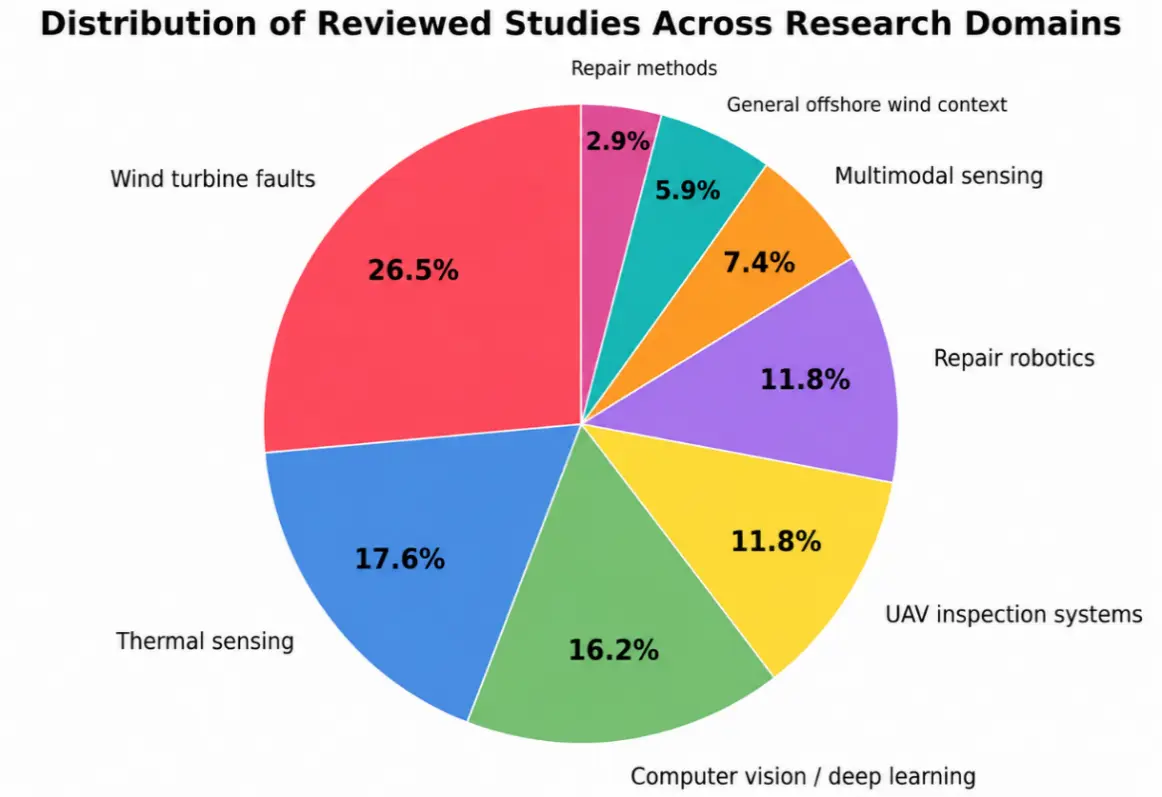
Figure 5. Pie chart illustrating the distribution of reviewed studies across the main research domains.
6.5. Comparison of UAV and Robotic Systems
This section compares UAV and robotic inspection systems, including sensor configurations, autonomy levels, operational strengths, and limitations. The analysis considers whether these systems have been validated in offshore conditions and whether perception and navigation are integrated as summarised in Table 8.
Table 8. Comparison of UAV and robotic systems relevant to offshore inspection and maintenance.
|
Study |
Sensors Used |
Autonomy Level |
Strengths |
Limitations |
|---|---|---|---|---|
|
Katkuri et al. (2024) [17]—deep-learning-based UAV navigation review |
Vision-based sensors, depth and IMU where applicable |
Medium–high |
Reviews deep learning methods for UAV navigation, perception and obstacle avoidance |
Systematic review rather than a single validated offshore inspection system |
|
Garg et al. (2023) [41]—Delivery UAVs |
GPS and operational flight data |
Medium |
Highlights UAV operational factors: range, efficiency, accessibility, sustainability and weather constraints |
Adjacent logistics domain, not designed for wind turbine inspection, blade imaging or defect detection |
|
Lyu et al. (2023) [42]—search-and-rescue UAVs |
RGB, thermal and other mission sensors |
Medium–high |
Reviews UAV, perception, path planning and collision avoidance for search and rescue in challenging environments |
Search and rescue focus, not turbine specific and not validated for offshore wind turbine inspection |
|
Kulsinskas et al. (2021) [43]—Internal blade inspection |
Camera, lighting and localization sensors |
Low–medium |
Identifies design requirements for UAV internal blade inspection, lighting, localisation and confined-space operation |
Mainly a review analysis, no complete autonomous UAV inspection system was experimentally validated |
|
Chermprayong et al. (2019) [93]—UAV manipulator repair |
Camera, position sensing and stabilisation hardware |
Low–medium |
Demonstrates an aerial manipulator for contact-based repair |
Not wind turbine specific and mainly tested in controlled conditions. |
|
Jiang et al. (2023) [5]—Multi-robot maintenance |
LiDAR, visual localisation, GNSS and crawler/deployment sensors |
Medium |
Demonstrates coordinated UAV and robotic deployment for blade maintenance |
Prototype validation, not fully operational |
The comparison reveals that although UAV platforms demonstrate strong autonomous navigation in adjacent domains, most systems lack turbine-specific validation and integrated real-time defect detection. Manual piloting remains common, and perception-driven control is rarely implemented. Offshore validation remains minimal across all identified systems.
6.6. Comparison of Computer Vision Models
This section evaluates computer vision models used for wind turbine fault detection, comparing their task focus, strengths, and offshore readiness. The models range from traditional convolutional architectures to transformer-based systems and multimodal fusion approaches as summarised in Table 9.
Table 9. Comparison of computer vision models for wind turbine fault detection.
|
Model Type |
Study |
Task Focus |
Strengths |
Limitations |
Offshore Readiness |
|---|---|---|---|---|---|
|
CNNs (ResNet, Visual Geometry Group (VGG), DenseNet) |
Classification, localisation and erosion quantification |
Strong feature extraction |
Needs large datasets and field variation |
Medium |
|
|
SegFormer/transformer-based segmentation |
Li, Pan, Zhu and Du (2024) [64] |
Defect segmentation and measurement |
Accurate pixel-level blade defect analysis |
Needs offshore UAV workflow validation |
Medium |
|
Faster R-CNN |
Shihavuddin et al. (2019) [67] |
Damage detection |
High detection accuracy |
Slower inference, mainly offline analysis |
Medium |
|
U-Net-based segmentation |
Bounenni, Ibarra-Castanedo and Maldague (2025) [9] |
Thermographic defect segmentation |
Good pixel-level localisation |
Controlled validation, not autonomous |
Medium |
|
Vision Transformers (ViT, hybrid models) |
Mansoor et al. (2025) [68] |
Classification and detection |
Strong global feature modelling |
Higher computational demand |
Medium |
|
Segment Anything Model (SAM) + SAM-Adapter |
Chen et al. (2023) [51] |
Segmentation/adaptation |
Adaptable foundation-model approach |
Not turbine-Specific, requires adaptation |
Emerging |
|
Thermal–RGB Fusion Models |
Jia and Chen (2024) [7], Yang et al. (2024) [19], Memari et al. (2024) [86] |
Multimodal segmentation/detection |
Improves robustness using visible and thermal data |
Calibration, alignment and onboard inference issues |
Medium-high |
|
Neural Rendering/Synthetic Data (4D Gaussian Splatting) |
Wu et al. (2024) [50] |
Synthetic data/scene reconstruction |
Potential to reduce dataset scarcity |
Not yet validated for turbine defects |
Emerging |
The table indicates that while many models achieve strong performance under controlled conditions, offshore readiness is constrained by dataset scarcity, lighting variability, and computational limitations. Real-time onboard deployment remains rare, and multimodal approaches show promise but require further validation under dynamic offshore conditions.
6.7. Public Datasets and Data Availability for Automated Inspection
The availability of suitable datasets is a critical factor in the development of reliable computer vision and deep learning models for wind turbine inspection. Many studies report promising results for defect detection, segmentation, or multimodal analysis, however, these results are often based on limited, private, or controlled datasets. This makes direct comparison between methods difficult and reduces confidence in how well models will generalise to offshore environments. Public datasets are particularly important because they allow models to be benchmarked under repeatable conditions and enable other researchers to test whether proposed methods remain effective across different turbine types, defect appearances, imaging sensors, and environmental conditions.
In the reviewed literature, datasets vary considerably in terms of image modality, defect type, annotation quality, and field realism. Some studies use RGB drone imagery for surface damage detection, while others use infrared thermography or optical–thermal video data for blade segmentation and thermal anomaly detection. Although these datasets are valuable, many are not fully representative of offshore inspection conditions, where image quality can be affected by wind, sea spray, glare, variable illumination, unstable UAV motion, and changing stand-off distance. Therefore, the lack of large, public, well-annotated offshore RGB and thermal datasets remains a major limitation for the development of robust autonomous inspection systems. The datasets and data sources identified in the reviewed literature are summarised in Table 10.
Table 10. Datasets and data sources reported in computer vision and multimodal wind turbine inspection studies.
|
Model Type |
Study |
Dataset/Data Source |
Availability |
Offshore Relevance |
|---|---|---|---|---|
|
CNNs |
Ma et al. (2023) [6] |
UAV inspection data using visible-light cameras, thermal imagers, laser ranging, and edge-computing hardware. |
Not stated/unclear |
Relevant to autonomous blade inspection, but offshore validation and dataset access are unclear. |
|
CNNs |
Aird, Barthelmie and Pryor (2023) [8] |
140 RGB field inspection images of blade leading-edge erosion from a central US wind farm. |
Not public, confidential image sets |
Highly relevant to real blade-damage analysis, but not offshore UAV imagery. |
|
SegFormer/transformer-based segmentation |
Li et al. (2024) [64] |
Blade-defect images used for improved SegFormer training and testing, exact public dataset release is unclear. |
Not stated/unclear |
Relevant to blade-defect segmentation, but public release and offshore validation are unclear. |
|
Faster R-CNN/deep learning detection |
Shihavuddin et al. (2019) [67] |
EasyInspect images and the Technical University of Denmark (DTU) drone inspection dataset, including leading-edge erosion, vortex-generator defects, and lightning receptors. |
Partly public, DTU dataset public, EasyInspect non-public |
Highly relevant to UAV blade damage detection but based on test-site rather than offshore inspection. |
|
U-Net/infrared segmentation |
Bounenni, Ibarra-Castanedo and Maldague (2025) [9] |
Infrared blade image sequences and COMSOL simulations of a 60 m blade with simulated subsurface |
Not currently public, future release stated |
Relevant to thermal blade-defect localisation, but not offshore UAV-based |
|
Vision Transformers/hybrid models |
Mansoor et al. (2025) [68] |
Blade-defect images labelled as damage, edge, erosion, and normal, with additional pretraining on surface-defect datasets. |
Not clearly released |
Relevant to blade-defect classification, but offshore field validation and dataset access remain limited. |
|
SAM + SAM-Adapter |
Chen et al. (2023) [51] |
General segmentation datasets, including COD10K, CHAMELEON, CAMO, and ISTD. |
Public datasets and released code/checkpoints |
Transferable segmentation method, but not wind-turbine-specific. |
|
Thermal–RGB fusion models |
Jia and Chen (2024) [7] |
100 optical–thermal video pairs and 55,880 images from 22 operational wind turbines. |
Partly public, DTU Vestas V52 subset released |
Highly relevant to operational turbine inspection, but focused on segmentation rather than autonomous fault response |
|
Thermal–RGB fusion models |
Yang et al. (2024) [19] |
Review of public infrared–visible fusion datasets, including TNO, RoadScene, LLVIP, MSRS, M3FD, and others. |
Public benchmark datasets reviewed |
Useful fusion-method foundation, but not wind-turbine-specific |
|
Thermal–RGB fusion models |
Memari et al. (2024) [86] |
1000 thermal images of healthy and faulty small wind turbine blades captured using a FLIR C5 camera. |
Public dataset available |
Relevant to thermal/RGB blade anomaly detection, but appears controlled rather than offshore UAV-based |
|
Neural rendering/synthetic data |
Wu et al. (2024) [50] |
Dynamic-scene rendering benchmarks such as D-NeRF, HyperNeRF, and Plenoptic Video. |
Public benchmarks/code available |
Potentially useful for synthetic inspection data but not validated on turbine imagery. |
6.8. Quantitative Analysis and Technological Maturity of Reviewed Studies
While Sections 6.1–6.7 compare inspection techniques, UAV systems, and computer vision models, it is also important to analyse the reviewed literature as a whole. Quantitative analysis helps identify which research areas receive the greatest attention, how the field has evolved over time, and the technological maturity of inspection approaches. This section, therefore, examines three aspects of the literature: the distribution of research across domains, the evolution of research, and the technological readiness of the proposed inspection systems.
Technology Readiness of Inspection Approaches
This subsection assesses the technological maturity of the inspection approaches. Technology Readiness Levels (TRLs) provide a widely used framework for assessing the maturity of emerging technologies, ranging from early conceptual research (TRL 1) to fully operational systems deployed in real-world environments (TRL 9).
Across the reviewed literature, traditional inspection techniques such as manual visual inspection, ultrasonic testing, and industrial infrared thermography exhibit high technology readiness levels due to their extensive industrial deployment.
By contrast, UAV inspection systems are already highly mature and field-proven technology. Drones are commercially mature, but most research systems still rely on manual piloting or predefined waypoint navigation rather than fully autonomous inspection. The estimated technology readiness levels of reviewed inspection approaches are illustrated in Figure 6.
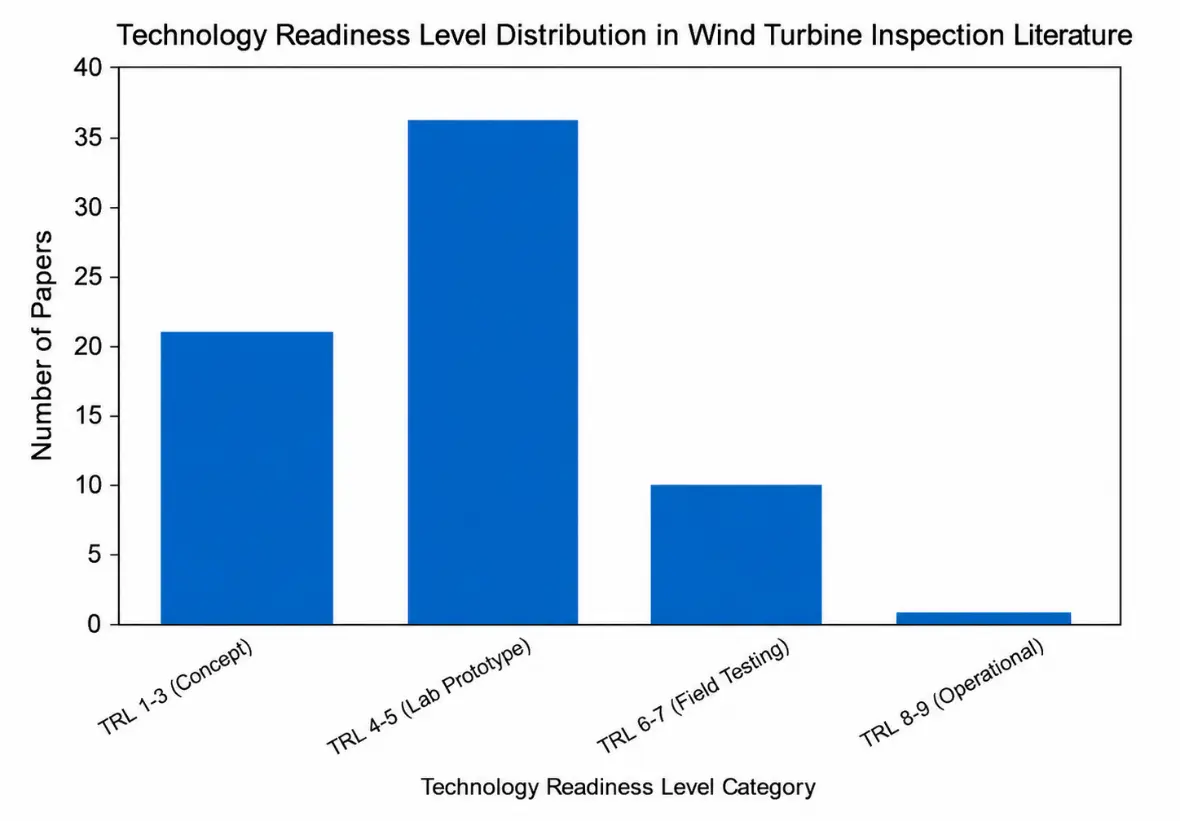
Table 11 shows that most reviewed studies remain concentrated at TRL 4–5, indicating that the literature is dominated by laboratory validation, controlled testing, and prototype-level development. Fewer studies demonstrate field or relevant-environment validation, and only a small number provide evidence of operational or mature deployment.
Table 11. Distribution of reviewed PRISMA studies by estimated technology readiness level.
|
Technology Readiness Level |
Paper Count |
Share of Review |
Supporting Studies |
|---|---|---|---|
|
TRL 1–3: Concept/review/early-stage evidence |
21 |
30.9% |
[1,2,3,4,13,14,15,16,17,18,19,20,25,26,27,28,34,35,36,43,71] |
|
TRL 4–5: Laboratory or controlled prototype validation |
36 |
52.9% |
[9,10,21,22,23,24,29,32,33,44,45,46,47,48,56,59,60,61,63, |
|
TRL 6–7: Field or relevant-environment validation |
10 |
14.7% |
|
|
TRL 8–9: Operational or mature deployment |
1 |
1.5% |
[30] |
|
Total |
68 |
100.0% |
– |
Computer vision defect detection models demonstrate strong performance under controlled laboratory conditions. However, their readiness for offshore deployment is low. Many models are trained using curated datasets captured under stable environmental conditions and are typically evaluated offline after flight operations.
Emerging multimodal approaches combining RGB and infrared sensing show promise for improving detection robustness under challenging environmental conditions. Nevertheless, these systems remain largely experimental and have not yet been validated extensively on operational offshore wind farms.
Overall, the literature shows that individual technologies, computer vision algorithms, and thermal sensing have achieved high levels of refinement, but fully integrated autonomous inspection frameworks remain at relatively low technology readiness levels. Bridging this gap between component-level capability and system autonomy represents a key challenge for future research.
7. Discussion and Future Directions
The reviewed literature shows that offshore wind turbine inspection is progressing from manual inspection toward more intelligent, autonomous, and multimodal systems. UAVs are now the dominant platform for remote inspection because they provide safer and more flexible access to blades and towers than human intervention using rope access or ground-based methods. At the same time, computer vision, deep learning, infrared thermography, and RGB with thermal fusion have improved the ability to detect, classify, and localise faults from inspection imagery.
However, the field is limited by a gap between individual strengths and complete offshore-ready inspection systems. Many studies demonstrate useful advances in UAV navigation, image fault detection, thermal sensing, or multimodal fusion, but these are often evaluated separately. Most systems still rely on controlled datasets, onshore trials, manual piloting, or post-flight analysis. As a result, relatively few studies demonstrate integrated inspection frameworks that combine autonomous flight, multimodal sensing, real-time onboard inference, and robust validation under realistic offshore conditions.
7.1. Research Trends in Offshore Wind Turbine Inspection
Figure 7 illustrates the number of relevant studies published each year between 2010 and 2025.
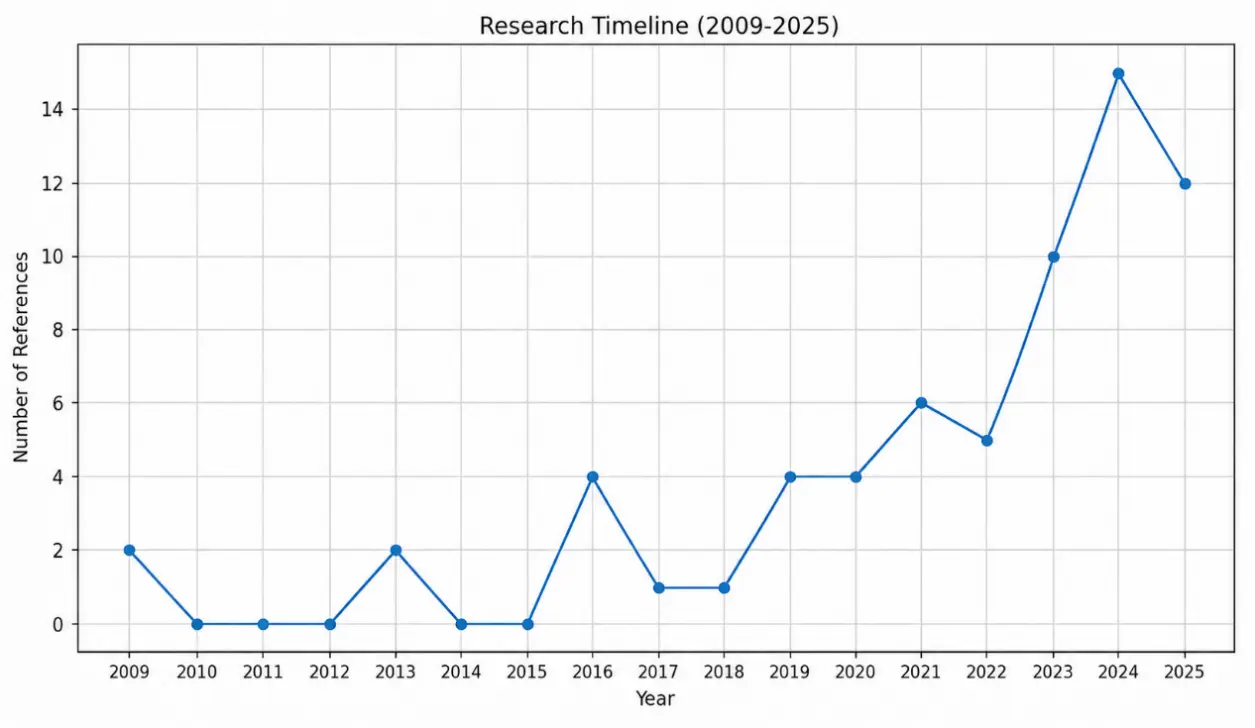
The results demonstrate a clear increase in research activity over the past decade. Prior to 2015, relatively few studies focused specifically on automated wind turbine inspection, with most work addressing general condition monitoring or structural fault analysis. However, from around 2018 onwards, the number of publications begins to rise steadily.
This increase corresponds with the growing use of unmanned aerial vehicles (UAVs) for infrastructure inspection and the rapid advancement of computer vision techniques capable of identifying structural defects. The most significant growth occurs after 2022, reflecting the increasing integration of deep learning algorithms, advanced sensing technologies, and robotic inspection platforms.
Overall, the trend indicates that wind turbine inspection has evolved into a rapidly expanding interdisciplinary research area combining robotics, sensing technologies, and artificial intelligence.
7.2. Evolution of Inspection Technologies
The research timeline highlights the overall growth of research, but it does not indicate which specific technologies are driving this increase. To explore this further, the reviewed studies were grouped according to key technological approaches, including RGB-based visual inspection, thermal sensing methods, and autonomous UAV inspection systems as illustrated in Figure 8.
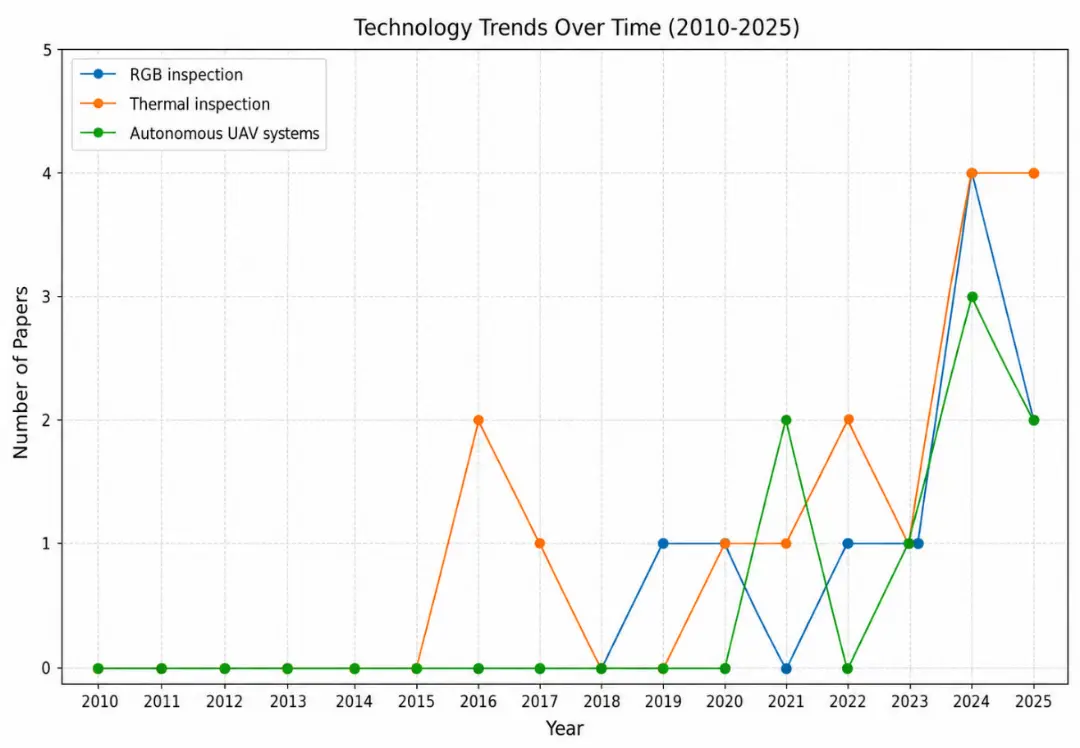
RGB-based inspection approaches appear consistently across the literature and remain one of the most commonly used methods due to the accessibility and relatively low cost of optical cameras. These sensors are easily integrated into UAV platforms, enabling rapid visual inspection of turbine blades and structural components.
Thermal inspection methods have also gained increasing attention in recent years. Thermal imaging enables the detection of subsurface defects, structural delamination, and thermal anomalies that may not be visible through standard optical imaging. As thermal cameras have become more affordable and easier to integrate with UAV systems, their use in wind turbine inspection has expanded significantly.
In addition, there is a noticeable rise in research investigating autonomous UAV inspection systems. Earlier approaches typically relied on manually piloted drones or semi-assisted inspection procedures. However, more recent work explores higher levels of autonomy, including automated flight planning, visual navigation, and AI-driven defect detection. These developments reflect a broader shift toward intelligent robotic inspection systems capable of operating with reduced human intervention.
7.3. Key Limitations and Future Research Directions
A major barrier is the lack of large, public, broad offshore datasets. Deep learning models frequently perform well on curated image sets, but their reliability may decrease when exposed to offshore conditions such as glare, fog, sea spray, motion blur, changing illumination, and unstable stand-off distances. Future work should therefore prioritise offshore-specific RGB and thermal datasets, supported by synthetic augmentation, neural rendering, and simulation-based data generation.
The use of UAVs for inspection is not limited to offshore wind turbines. Similar drone-based inspections are used on bridges, towers, solar farms, and other assets, where UAVs can improve efficiency and reduce the need for direct human access to hazardous locations. However, offshore wind turbine inspection presents additional challenges. Turbines that are offshore are exposed to marine weather, salt contamination, high wind, glare, restricted access windows, and moving operational components. These challenges become greater for floating offshore wind structures, where wave-induced platform motion, pitch, roll, yaw, and changing positions between the UAV and turbine structure can make autonomous flight control, image stabilisation, stand-off distance management, and data capture much more difficult.
Therefore, the main research gap identified in this review is not the absence of UAV inspection research, but the lack of real offshore testing, offshore datasets, and validated end-to-end systems that combine autonomous flight, multimodal sensing, and onboard fault detection. This gap provides a clear direction for future research. The focus could be on addressing this limitation by collecting or generating offshore RGB and thermal inspection data, developing perception-guided UAV inspection methods, and validating fault-detection approaches under realistic offshore wind conditions. Even where full offshore deployment is not immediately possible, controlled experiments, simulation, synthetic data generation, and staged field trials could be used to bridge the gap between laboratory model performance and real offshore readiness.
Future autonomous inspection systems should also focus on lightweight onboard intelligence and perception-guided control. Models must be efficient enough to run on embedded UAV hardware while still supporting reliable real-time detection. This may require model compression, pruning, quantisation, or knowledge distillation. UAVs should also be able to adapt their trajectory, viewing angle, stand-off distance, and inspection priority according to visual or thermal cues detected during flight.
Multimodal inspection remains one of the most promising directions for improving offshore robustness. RGB imagery provides surface detail and structural context, while infrared thermography can reveal thermal anomalies, subsurface faults, and electrical overheating. Future systems should therefore not isolate RGB or thermal analysis but develop systems integrated with RGB and thermal inspection frameworks with reliable calibration, synchronisation, and onboard fusion.
Drone-based repair and cooperative robotic maintenance remain longer-term opportunities. Current repair UAV systems are still at low technology readiness levels and are limited by payload, stability, contact control, and environmental disturbance. However, future offshore maintenance will benefit from UAVs working alongside crawlers, ROVs, or other robotic agents to support inspection, localisation, and eventually minor intervention tasks.
Overall, the literature indicates that the central challenge is no longer the absence of individual technologies, but the lack of robust integration across sensing, perception, autonomy, and offshore validation. Addressing this gap will be essential for developing practical drone-assisted inspection systems capable of operating reliably in real offshore environments.
Offshore wind turbine inspection is becoming increasingly important as wind farms expand in scale, complexity, and distance from shore. This review examined the current state of research across turbine failure mechanisms, inspection and non-destructive testing methods, UAV and robotic inspection platforms, computer vision, infrared thermography, multimodal sensing, and emerging drone-assisted maintenance. Together, these studies show that substantial progress has been made in the individual technologies required for intelligent inspection. However, the literature also shows that these capabilities remain insufficiently integrated for real-world offshore deployment. Many existing approaches still rely on laboratory validation, onshore datasets, manual piloting, or offline analysis, while few studies demonstrate unified systems that combine autonomous navigation, multimodal sensing, and real-time onboard fault detection under realistic offshore conditions. This gap between component capability and operational system readiness remains the central challenge in the field.
Overall, the review indicates that future progress will depend on the development of robust inspection frameworks supported by offshore-specific datasets, lightweight embedded intelligence, perception-guided flight control, and stronger validation in real marine environments. Addressing these challenges is essential for enabling autonomous, resilient, and scalable offshore wind turbine inspection.
Statement of the Use of Generative AI and AI-Assisted Technologies in the Writing Process
During the preparation of this manuscript, the corresponding author used ChatGPT (OpenAI) to refine sentence structure, enhance clarity, and ensure grammatical accuracy, without altering the core arguments or original ideas presented in the paper. After using this tool/service, the authors reviewed and edited the content as needed and take full responsibility for the content of the published article.
Acknowledgments
The authors would like to acknowledge the support of the School of Engineering, Computing and Mathematics at the University of Plymouth.
Author Contributions
Conceptualization, D.B. and A.K.; Methodology, O.F.; Investigation, O.F.; Resources, D.B., A.K., L.J. and D.G.; Writing—Original Draft Preparation, O.F.; Writing—Review & Editing, O.F., D.B., A.K., L.J. and D.G.; Supervision, D.B., A.K., L.J. and D.G.; Project Administration, D.B. and A.K. All authors have read and agreed to the published version of the manuscript.
Ethics Statement
Not applicable.
Informed Consent Statement
Not applicable.
Data Availability Statement
This review is based on previously published literature. No new experimental datasets were generated or analysed during the preparation of this manuscript. All sources reviewed are cited in the reference list.
Funding
The corresponding author is supported by a University Doctoral Landscape Award (UDLA) Research Studentship funded by the Engineering and Physical Sciences Research Council (EPSRC).
Declaration of Competing Interest
The authors declare that they have no known competing financial interests or personal relationships that could have appeared to influence the work reported in this paper.
References
- Shafiee M, Zhou Z, Mei L, Dinmohammadi F, Karama J, Flynn D. Unmanned Aerial Drones for Inspection of Offshore Wind Turbines: A Mission-Critical Failure Analysis. Robotics 2021, 10, 26. DOI:10.3390/robotics10010026 [Google Scholar]
- Gao Z, Odgaard P. Real-time monitoring, fault prediction and health management for offshore wind turbine systems. Renew. Energy 2023, 218, 119258. DOI:10.1016/j.renene.2023.119258 [Google Scholar]
- Hameed Z, Hong YS, Cho YM, Ahn SH, Song CK. Condition monitoring and fault detection of wind turbines and related algorithms: A review. Renew. Sustain. Energy Rev. 2009, 13, 1–39. DOI:10.1016/j.rser.2007.05.008 [Google Scholar]
- Ma X, Li M, Li W, Liu Y. Overview of Offshore Wind Power Technologies. Sustainability 2025, 17, 596. DOI:10.3390/su17020596 [Google Scholar]
- Jiang Z, Jovan F, Moradi P, Richardson T, Bernardini S, Watson S, et al. A multirobot system for autonomous deployment and recovery of a blade crawler for operations and maintenance of offshore wind turbine blades. J. Field Robot. 2023, 40, 73–93. DOI:10.1002/rob.22117 [Google Scholar]
- Ma M, Liu H, Gao Y, Li S, Ma C, Hu D. Fully Autonomous Inspection of Wind Turbine Blades Based on Drones and Artificial Intelligence. In Proceedings of the 2023 International Conference on Intelligent Sensing and Industrial Automation, Virtual, China, 9–10 December 2023; pp. 1–8. DOI:10.1145/3632314.3632348 [Google Scholar]
- Jia X, Chen X. AI-based optical-thermal video data fusion for near real-time blade segmentation in normal wind turbine operation. Eng. Appl. Artif. Intell. 2024, 127, 107325. DOI:10.1016/j.engappai.2023.107325 [Google Scholar]
- Aird JA, Barthelmie RJ, Pryor SC. Automated Quantification of Wind Turbine Blade Leading Edge Erosion from Field Images. Energies 2023, 16, 2820. DOI:10.3390/en16062820 [Google Scholar]
- Bounenni L, Castanedo CI, Maldague X. Defect Detection in Wind Turbine Blades Using Infrared Thermography, Image Processing, and U-Net. In Proceedings of the 18th International Workshop on Advanced Infrared Technology and Applications (AITA 2025), Kobe, Japan, 15–19 September 2025.DOI:10.3390/proceedings2025129042 [Google Scholar]
- Corley B, Koukoura S, Carroll J, McDonald A. Combination of Thermal Modelling and Machine Learning Approaches for Fault Detection in Wind Turbine Gearboxes. Energies 2021, 14, 1375. DOI:10.3390/en14051375 [Google Scholar]
- Kabra K, Xiong A, Li W, Luo M, Lu W, Yu T, et al. Deep object detection for waterbird monitoring using aerial imagery. In Proceedings of the 2022 21st IEEE International Conference on Machine Learning and Applications (ICMLA), Nassau, Bahamas, 12–15 December 2022; pp. 455–460. DOI:10.1109/ICMLA55696.2022.00073 [Google Scholar]
- Courbis S, Williams K, Stepanuk J, Etter H, McManus M, Campoblanco F, et al. Technology Gaps for Monitoring Birds and Marine Mammals at Offshore Wind Facilities. Mar. Technol. Soc. J. 2024, 58, 5–22. DOI:10.4031/MTSJ.58.3.1 [Google Scholar]
- Yang B, Sun D. Testing, inspecting and monitoring technologies for wind turbine blades: A survey. Renew. Sustain. Energy Rev. 2013, 22, 515–526. DOI:10.1016/j.rser.2012.12.056 [Google Scholar]
- García Márquez FP, Peco Chacón AM. A review of non-destructive testing on wind turbines blades. Renew. Energy 2020, 161, 998–1010. DOI:10.1016/j.renene.2020.07.145 [Google Scholar]
- Heo SJ, Na WS. Review of Drone-Based Technologies for Wind Turbine Blade Inspection. Electronics 2025, 14, 227. DOI:10.3390/electronics14020227 [Google Scholar]
- Zhang K, Pakrashi V, Murphy J, Hao G. Inspection of Floating Offshore Wind Turbines Using Multi-Rotor Unmanned Aerial Vehicles: Literature Review and Trends. Sensors 2024, 24, 911. DOI:10.3390/s24030911 [Google Scholar]
- Katkuri AVR, Madan H, Khatri N, Abdul-Qawy ASH, Patnaik KS. Autonomous UAV navigation using deep learning-based computer vision frameworks: A systematic literature review. Array 2024, 23, 100361. DOI:10.1016/j.array.2024.100361 [Google Scholar]
- Sun C, Zhang C, Xiong N. Infrared and Visible Image Fusion Techniques Based on Deep Learning: A Review. Electronics 2020, 9, 2162. DOI:10.3390/electronics9122162 [Google Scholar]
- Yang K, Xiang W, Chen Z, Zhang J, Liu Y. A review on infrared and visible image fusion algorithms based on neural networks. J. Vis. Commun. Image Represent. 2024, 101, 104179. DOI:10.1016/j.jvcir.2024.104179 [Google Scholar]
- Ayala A, Portela L, Buarque F, Fernandes BJT, Cruz F. UAV control in autonomous object-goal navigation: A systematic literature review. Artif. Intell. Rev. 2024, 57, 125. DOI:10.1007/s10462-024-10758-7 [Google Scholar]
- Hwang S, An YK, Sohn H. Continuous Line Laser Thermography for Damage Imaging of Rotating Wind Turbine Blades. Procedia Eng. 2017, 188, 225–232. DOI:10.1016/j.proeng.2017.04.478 [Google Scholar]
- Page MJ, McKenzie JE, Bossuyt PM, Boutron I, Hoffmann TC, Mulrow CD, et al. The PRISMA 2020 statement: an updated guideline for reporting systematic reviews. BMJ 2021, 372, n71. DOI:10.1136/bmj.n71 [Google Scholar]
- Liu L, Li P, Wang D, Zhu S. A wind turbine damage detection algorithm designed based on YOLOv8. Appl. Soft Comput. 2024, 154, 111364. DOI:10.1016/j.asoc.2024.111364 [Google Scholar]
- Svystun S, Scislo L, Pawlik M, Melnychenko O, Radiuk P, Savenko O, et al. DyTAM: Accelerating Wind Turbine Inspections with Dynamic UAV Trajectory Adaptation. Energies 2025, 18, 1823. DOI:10.3390/en18071823 [Google Scholar]
- Zhang Z, Zhang H, Zhang X, Hu Q, Jiang X. A Review of Wind Turbine Icing and Anti/De-Icing Technologies. Energies 2024, 17, 2805. DOI:10.3390/en17122805 [Google Scholar]
- Ikhazuangbe GI, Gomes C, Mohanna S, Dagogo B, Osarimwian ON, Jaja E, et al. A Review of Lightning Protection Methods for Wind Turbine Blades. IOSR J. Electr. Electron. Eng. 2023, 18, 1–13. Available online: https://www.researchgate.net/profile/Godson-Ikhazuangbe/publication/367299237_Review_of_Lightning_Protection_Methods_for_Wind_Turbine_Blades/links/63cb1ff3e922c50e99ad1442/Review-of-Lightning-Protection-Methods-for-Wind-Turbine-Blades.pdf (accessed on 14 July 2026).
- Snyder B, Kaiser MJ. A comparison of offshore wind power development in Europe and the U.S.: Patterns and drivers of development. Appl. Energy 2009, 86, 1845–1856. DOI:10.1016/j.apenergy.2009.02.013 [Google Scholar]
- Qin X, Zhang M, Fu S, Li H, Hou J, Xu Y. Review on researches and main influencing factors on mechanical properties of offshore wind power cables. J. Ocean Eng. Sci. 2025, 10, 426–437. DOI:10.1016/j.joes.2024.06.001 [Google Scholar]
- Zhang M, Li Q, Li H, Yu W, Guo Z, Siew WH. Damage mechanism of wind turbine blade under the impact of lightning induced arcs. J. Renew. Sustain. Energy 2019, 11, 053306. DOI:10.1063/1.5118717 [Google Scholar]
- Soraghan C, Shenton S. Repairing Lightning Strike Damage: Executing Rope-Access Blade Repairs at a UK Offshore Wind Farm; O&M Case Study CS-0019; Offshore Renewable Energy Catapult: Blyth, UK, 2018. [Google Scholar]
- Garolera CA, Madsen SF, Nissim M, Myers JD, Holboell J. Lightning Damage to wind turbine blades from wind farm in US. IEEE Trans. Power Del. 2014, 31, 1043–1049. DOI:10.1109/TPWRD.2014.2370682 [Google Scholar]
- Ataya S, Ahmed MMZ. Damages of wind turbine blade trailing edge: Forms, location, and root causes. Eng. Fail. Anal. 2013, 35, 480–488. DOI:10.1016/j.engfailanal.2013.05.011 [Google Scholar]
- Miao XY, Chen X. Structural transverse cracking mechanisms of trailing edge regions in composite wind turbine blades. Compos. Struct. 2023, 308, 116680. DOI:10.1016/j.compstruct.2023.116680 [Google Scholar]
- Mishnaevsky L, Hasager CB, Bak C, Tilg AM, Bech JI, Doagou Rad S, et al. Leading edge erosion of wind turbine blades: Understanding, prevention and protection. Renew. Energy 2021, 169, 953–969. DOI:10.1016/j.renene.2021.01.044 [Google Scholar]
- Cai C, Guo J, Song X, Zhang Y, Wu J, Tang S, et al. Review of Data-Driven Approaches for Wind Turbine Blade Icing Detection. Sustainability 2023, 15, 1617. DOI:10.3390/su15021617 [Google Scholar]
- Olabi AG, Wilberforce T, Elsaid K, Sayed ET, Salameh T, Abdelkareem MA, et al. A Review on Failure Modes of Wind Turbine Components. Energies 2021, 14, 5241. DOI:10.3390/en14175241 [Google Scholar]
- Mishnaevsky L. Repair of wind turbine blades: Review of methods and related computational mechanics problems. Renew. Energy 2019, 140, 828–839. DOI:10.1016/j.renene.2019.03.113 [Google Scholar]
- Carroll J, McDonald A, McMillan D. Failure rate, repair time and unscheduled O&M cost analysis of offshore wind turbines. Wind Energy 2016, 19, 1107–1119. DOI:10.1002/we.1887 [Google Scholar]
- Moros D, Berrabah N, Searle KD, Ashton IG. Maintenance & failure data analysis of an offshore wind farm. J. Phys. Conf. Ser. 2024, 2767, 062006. DOI:10.1088/1742-6596/2767/6/062006 [Google Scholar]
- Nisingizwe MP, Ndishimye P, Swaibu K, Nshimiyimana L, Karame P, Dushimiyimana V, et al. Effect of unmanned aerial vehicle (drone) delivery on blood product delivery time and wastage in Rwanda: a retrospective, cross-sectional study and time series analysis. Lancet Glob. Health 2022, 10, e564–e569. DOI:10.1016/S2214-109X(22)00048-1 [Google Scholar]
- Garg V, Niranjan S, Prybutok V, Pohlen T, Gligor D. Drones in last-mile delivery: A systematic review on Efficiency, Accessibility, and Sustainability. Transp. Res. Part D Transp. Environ. 2023, 123, 103831. DOI:10.1016/j.trd.2023.103831 [Google Scholar]
- Lyu M, Zhao Y, Huang C, Huang H. Unmanned Aerial Vehicles for Search and Rescue: A Survey. Remote Sens. 2023, 15, 3266. DOI:10.3390/rs15133266 [Google Scholar]
- Kulsinskas A, Durdevic P, Ortiz-Arroyo D. Internal Wind Turbine Blade Inspections Using UAVs: Analysis and Design Issues. Energies 2021, 14, 294. DOI:10.3390/en14020294 [Google Scholar]
- Best O, Khan A, Sharma S, Collins K, Gianni M. Leading Edge Erosion Classification in Offshore Wind Turbines Using Feature Extraction and Classical Machine Learning. Energies 2024, 17, 5475. DOI:10.3390/en17215475 [Google Scholar]
- Natili F, Castellani F, Astolfi D, Becchetti M. Video-Tachometer Methodology for Wind Turbine Rotor Speed Measurement. Sensors 2020, 20, 7314. DOI:10.3390/s20247314 [Google Scholar]
- Liao YH, Wang L, Yan Y. Instantaneous Rotational Speed Measurement of Wind Turbine Blades using a Marker-Tracking Method. In Proceedings of the 2022 IEEE International Instrumentation and Measurement Technology Conference (I2MTC), Ottawa, ON, Canada, 16–19 May 2022; pp. 1–5. DOI:10.1109/I2MTC48687.2022.9806658 [Google Scholar]
- Gao W, Liu J, Cui C, Liu X, Fang Y. An efficient image stitching method of wind-turbine blades for damage measurement in online repair robots. Measurement 2025, 256, 118125. DOI:10.1016/j.measurement.2025.118125 [Google Scholar]
- Gao W, Cui C, Liu X, Yang H, Zhang H, Fang Y. An improved image stitching method for blades of wind turbine based on online repair technology. Comput. Ind. 2026, 176, 104446. DOI:10.1016/j.compind.2026.104446 [Google Scholar]
- Xiao B, Wu H, Xu W, Dai X, Hu H, Lu Y, et al. Florence-2: Advancing a Unified Representation for a Variety of Vision Tasks. In Proceedings of the IEEE/CVF Conference on Computer Vision and Pattern Recognition (CVPR), Seattle, WA, USA, 17–21 June 2024; pp. 4818–4829. DOI:10.1109/CVPR52733.2024.00461 [Google Scholar]
- Wu G, Yi T, Fang J, Xie L, Zhang X, Wei W, et al. 4D Gaussian Splatting for Real-Time Dynamic Scene Rendering. In Proceedings of the IEEE/CVF Conference on Computer Vision and Pattern Recognition (CVPR), Seattle, WA, USA, 17–21 June 2024; pp. 20310–20320. DOI:10.1109/CVPR52733.2024.01920 [Google Scholar]
- Chen T, Zhu L, Ding C, Cao R, Wang Y, Zhang S, et al. SAM-Adapter: Adapting Segment Anything in Underperformed Scenes. In Proceedings of the IEEE/CVF International Conference on Computer Vision Workshops (ICCVW), Paris, France, 2–6 October 2023; pp. 3359–3367. DOI:10.1109/ICCVW60793.2023.00361 [Google Scholar]
- He K, Zhang X, Ren S, Sun J. Deep Residual Learning for Image Recognition. In Proceedings of the IEEE Conference on Computer Vision and Pattern Recognition (CVPR), Las Vegas, NV, USA, 27–30 June 2016; pp. 770–778. DOI:10.1109/CVPR.2016.90 [Google Scholar]
- Lin TY, Dollar P, Girshick R, He K, Hariharan B, Belongie S. Feature Pyramid Networks for Object Detection. In Proceedings of the IEEE Conference on Computer Vision and Pattern Recognition (CVPR), Honolulu, HI, USA, 21–26 July 2017; pp. 936–944. DOI:10.1109/CVPR.2017.106 [Google Scholar]
- Carion N, Massa F, Synnaeve G, Usunier N, Kirillov A, Zagoruyko S. End-to-End Object Detection with Transformers. In Proceedings of the European Conference on Computer Vision (ECCV), Glasgow, UK, 23–28 August 2020; pp. 213–229. DOI:10.1007/978-3-030-58452-8_13 [Google Scholar]
- Kirillov A, Mintun E, Ravi N, Mao H, Rolland C, Gustafson L, et al. Segment Anything. In Proceedings of the IEEE/CVF International Conference on Computer Vision (ICCV), Paris, France, 1–6 October 2023; pp. 3992–4003. DOI:10.1109/ICCV51070.2023.00371 [Google Scholar]
- Sun Z, Qian J, Liu A, Yao S, Lv X, Shao L. Icing Detection of Wind Turbine Blades Based on an Improved PP-YOLOE Detection Network. Sensors 2025, 25, 6438. DOI:10.3390/s25206438 [Google Scholar]
- Jiang W, Jin J. Intelligent icing detection model of wind turbine blades based on SCADA data. arXiv 2021, arXiv:2101.07914. DOI:10.48550/arXiv.2101.07914 [Google Scholar]
- Tang Z, Jian X. Thermal fault diagnosis of complex electrical equipment based on infrared image recognition. Sci. Rep. 2024, 14, 5547. DOI:10.1038/s41598-024-56142-x [Google Scholar]
- Attallah O, Ibrahim RA, Zakzouk NE. Fault diagnosis for induction generator-based wind turbine using ensemble deep learning techniques. Energy Rep. 2022, 8, 12787–12798. DOI:10.1016/j.egyr.2022.09.139 [Google Scholar]
- Kiczek B, Batsch M. Exploration of Unsupervised Deep Learning-Based Gear Fault Detection for Wind Turbine Gearboxes. Energies 2025, 18, 3630. DOI:10.3390/en18143630 [Google Scholar]
- Zhou J, Zhao Y. A distance-aware approach for reliable out-of-distribution detection of wind turbine gearbox fault diagnosis. Front. Energy Res. 2024, 12, 149630. DOI:10.3389/fenrg.2024.1496130 [Google Scholar]
- Lee C, Maceren EDC. Wind energy system fault classification and detection using deep convolutional neural network and particle swarm optimization‐extreme gradient boosting. IET Energy Syst. Integr. 2024, 6, 479–497. DOI:10.1049/esi2.12144 [Google Scholar]
- Zhao Z, Li T. Enhancing wind turbine blade damage detection with YOLO-Wind. Sci. Rep. 2025, 15, 18667. DOI:10.1038/s41598-025-03639-8 [Google Scholar]
- Li W, Pan Z, Zhu Q, Du Y. Wind turbine blade defect detection and measurement technology based on improved SegFormer and pixel matching. Opt. Laser Technol. 2024, 179, 111381. DOI:10.1016/j.optlastec.2024.111381 [Google Scholar]
- Zhang L, Fan Q, Lin J, Zhang Z, Yan X, Li C. A nearly end-to-end deep learning approach to fault diagnosis of wind turbine gearboxes under nonstationary conditions. Eng. Appl. Artif. Intell. 2023, 119, 105735. DOI:10.1016/j.engappai.2022.105735 [Google Scholar]
- Sheiati S, Jia X, McGugan M, Branner K, Chen X. Artificial intelligence-based blade identification in operational wind turbines through similarity analysis aided drone inspection. Eng. Appl. Artif. Intell. 2024, 137, 109234. DOI:10.1016/j.engappai.2024.109234 [Google Scholar]
- Shihavuddin A, Chen X, Fedorov V, Nymark Christensen A, Andre Brogaard Riis N, Branner K, et al. Wind Turbine Surface Damage Detection by Deep Learning Aided Drone Inspection Analysis. Energies 2019, 12, 676. DOI:10.3390/en12040676 [Google Scholar]
- Mansoor M, Tan X, Mirza AF, Gong T, Song Z, Irfan M. WindDefNet: A Multi-Scale Attention-Enhanced ViT-Inception-ResNet Model for Real-Time Wind Turbine Blade Defect Detection. Machines 2025, 13, 453. DOI:10.3390/machines13060453 [Google Scholar]
- Tong Z, Cheng L, Xie S, Kersemans M. A flexible deep learning framework for thermographic inspection of composites. NDT E Int. 2023, 139, 102926. DOI:10.1016/j.ndteint.2023.102926 [Google Scholar]
- Wilson AN, Gupta KA, Koduru BH, Kumar A, Jha A, Cenkeramaddi LR. Recent Advances in Thermal Imaging and its Applications Using Machine Learning: A Review. IEEE Sens. J. 2023, 23, 3395–3407. DOI:10.1109/JSEN.2023.3234335 [Google Scholar]
- Balakrishnan GK, Yaw CT, Koh SP, Abedin T, Raj AA, Tiong SK, et al. A Review of Infrared Thermography for Condition-Based Monitoring in Electrical Energy: Applications and Recommendations. Energies 2022, 15, 6000. DOI:10.3390/en15166000 [Google Scholar]
- Khatri A, Khadka S, Lamichhane N, Shrestha R. A comprehensive review of infrared thermography and deep learning applications for solar photovoltaic systems. Infrared Phys. Technol. 2025, 148, 105878. DOI:10.1016/j.infrared.2025.105878 [Google Scholar]
- Sheinin M, Sankaranarayanan AC, Narasimhan SG. Projecting Trackable Thermal Patterns for Dynamic Computer Vision. In Proceedings of the IEEE/CVF Conference on Computer Vision and Pattern Recognition (CVPR), Seattle, WA, USA, 16–22 June 2024; pp. 25223–25232.DOI:10.1109/CVPR52733.2024.02383 [Google Scholar]
- Stadler D, Specker A. A Strong Baseline for Multi-Person Tracking in Thermal Infrared Imagery. In Proceedings of the IEEE/CVF Conference on Computer Vision and Pattern Recognition Workshops (CVPRW), Nashville, TN, USA, 11–15 June 2025; pp. 4540–4550. DOI:10.1109/CVPRW67362.2025.00439 [Google Scholar]
- Shyam P, Yoo H. Lightweight Thermal Super-Resolution and Object Detection for Robust Perception in Adverse Weather Conditions. In Proceedings of the IEEE/CVF Winter Conference on Applications of Computer Vision (WACV), Waikoloa, HI, USA, 3–7 January 2024; pp. 7471–7482. DOI:10.1109/WACV57701.2024.00730 [Google Scholar]
- Yun H, Lo S, Diepenbrock CH, Bailey BN, Earles JM. VisTA-SR: Improving the Accuracy and Resolution of Low-Cost Thermal Imaging Cameras for Agriculture. In Proceedings of the IEEE/CVF Conference on Computer Vision and Pattern Recognition Workshops (CVPRW), Seattle, WA, USA, 17–21 June 2024; pp. 5470–5479. DOI:10.1109/CVPRW63382.2024.00556 [Google Scholar]
- Wang C, Gu Y. Research on infrared nondestructive detection of small wind turbine blades. Results Eng. 2022, 15, 100570. DOI:10.1016/j.rineng.2022.100570 [Google Scholar]
- Wang L, Fan Y, Wang Y, Luo G, Shen M, Zhu G. Research on the Online Monitoring and Fault Early Warning System of Infrared Thermography for Wind Power Equipment Based on Deep Learning Algorithm. Distrib. Gener. Altern. Energy J. 2025, 40, 771–792. DOI:10.13052/dgaej2156-3306.4047 [Google Scholar]
- Lysyi A, Sachenko A, Radiuk P, Lysyi M, Melnychenko O, Zahorodnia D. Method of UAV-Based Inspection of Photovoltaic Modules Using Thermal and RGB Data Fusion. Radioelectron. Comput. Syst. 2025, 116, 186–205. DOI:10.32620/reks.2025.4.13 [Google Scholar]
- Vasconcelos HM, Sousa PJ, Dias S, Viriato N, Domingues T, Tavares PJ, et al. UAV-Based Thermographic Inspection of Wind Turbine Blades for Structural Integrity Assessment: Preliminary Findings. Procedia Struct. Integr. 2025, 68, 795–801. DOI:10.1016/j.prostr.2025.06.132 [Google Scholar]
- Bounenni L, Ibarra Castanedo C, Maldague XPV. Infrared Defect Detection in Wind Turbine Blades. eJNDT 2026, 31, 32481. DOI:10.58286/32481 [Google Scholar]
- Fan Y, Mai J, Xue F, Lau SSY, Jiang S, Tao Y, et al. UAV and Deep Learning for Automated Detection and Visualization of Façade Defects in Existing Residential Buildings. Sensors 2025, 25, 7118. DOI:10.3390/s25237118 [Google Scholar]
- Li XL, Chen DP, Zeng Z, Shen JL, Wang X, Zhao YJ. The Inspection of Wind Blades Using Thermography with Different Exciting Methods. In Proceedings of the 2nd Annual International Conference on Advanced Material Engineering (AME 2016), Wuhan, China, 15–17 April 2016; pp. 946–955. DOI:10.2991/ame-16.2016.154 [Google Scholar]
- Chaudhuri S, Stamm M, Lapšanská I, Lançon T, Osterbrink L, Driebe T, et al. Infrared Thermography of Turbulence Patterns of Operational Wind Turbine Rotor Blades Supported with High‐Resolution Photography: KI‐VISIR Dataset. Wind Energy 2025, 28, e2958. DOI:10.1002/we.2958 [Google Scholar]
- Yang X, Guo R, Li H. Comparison of multimodal RGB-thermal fusion techniques for exterior wall multi-defect detection. J. Infrastruct. Intell. Resil. 2023, 2, 100029. DOI:10.1016/j.iintel.2023.100029 [Google Scholar]
- Memari M, Shekaramiz M, Masoum MAS, Seibi AC. Data Fusion and Ensemble Learning for Advanced Anomaly Detection Using Multi-Spectral RGB and Thermal Imaging of Small Wind Turbine Blades. Energies 2024, 17, 673. DOI:10.3390/en17030673 [Google Scholar]
- Svystun S, Melnychenko O, Radiuk P, Savenko O, Sachenko A, Lysyi A. Thermal and RGB Images Work Better Together in Wind Turbine Damage Detection. Int. J. Comput. 2024, 23, 526–535. DOI:10.47839/ijc.23.4.3752 [Google Scholar]
- Worzewski T, Krankenhagen R, Doroshtnasir M. Thermographic inspection of wind turbine rotor blade segment utilizing natural conditions as excitation source, Part II: The effect of climatic conditions on thermographic inspections—A long term outdoor experiment. Infrared Phys. Technol. 2016, 76, 767–776. DOI:10.1016/j.infrared.2016.04.012 [Google Scholar]
- Bu Y, Yan Y, Yang Y. Advancement Challenges in UAV Swarm Formation Control: A Comprehensive Review. Drones 2024, 8, 320. DOI:10.3390/drones8070320 [Google Scholar]
- Jacobson A, Chen Z, Milford M. Autonomous Multisensor Calibration and Closed‐loop Fusion for SLAM. J. Field Robot. 2015, 32, 85–122. DOI:10.1002/rob.21500 [Google Scholar]
- Sanchez-Cuevas PJ, Gonzalez-Morgado A, Cortes N, Gayango DB, Jimenez-Cano AE, Ollero A, et al. Fully-Actuated Aerial Manipulator for Infrastructure Contact Inspection: Design, Modeling, Localization, and Control. Sensors 2020, 20, 4708. DOI:10.3390/s20174708 [Google Scholar]
- Ladig R, Paul H, Miyazaki R, Shimonomura K. Aerial Manipulation Using Multirotor UAV: A Review from the Aspect of Operating Space and Force. JRM 2021, 33, 196–204. DOI:10.20965/jrm.2021.p0196 [Google Scholar]
- Chermprayong P, Zhang K, Xiao F, Kovac M. An Integrated Delta Manipulator for Aerial Repair: A New Aerial Robotic System. IEEE Robot. Automat. Mag. 2019, 26, 54–66. DOI:10.1109/MRA.2018.2888911 [Google Scholar]
- Zhang K, Chermprayong P, Xiao F, Tzoumanikas D, Dams B, Kay S, et al. Aerial additive manufacturing with multiple autonomous robots. Nature 2022, 609, 709–717. DOI:10.1038/s41586-022-04988-4 [Google Scholar]
- Orr L. Autonomous Aerial Additive Manufacturing and Infrastructure Repair. Ph.D. Thesis, Imperial College London, London, UK, August 2023. [Google Scholar]
- Lyu C, Lin S, Lynch A, Zou Y, Liarokapis M. UAV-based deep learning applications for automated inspection of civil infrastructure. Autom. Constr. 2025, 177, 106285. DOI:10.1016/j.autcon.2025.106285 [Google Scholar]
- Amouzadrad P, Mohapatra SC, Guedes Soares C. Review on Sensitivity and Uncertainty Analysis of Hydrodynamic and Hydroelastic Responses of Floating Offshore Structures. JMSE 2025, 13, 1015. DOI:10.3390/jmse13061015 [Google Scholar]