
Progress in Research on Abiotic Stress in Apple Trees in China
Progress in Research on Abiotic Stress in Apple Trees in China
Jiaqi Hou 1,† Shuang Song 1,2,3,† Jie Meng 2,3 Chunqiang Xing 2,3 Yu Sun 2,3 Aishuang Hu 2,3,* Yi Feng 1,*
Received: 07 May 2026 Revised: 23 June 2026 Accepted: 28 July 2026 Published: 10 August 2026

© 2026 The authors. This is an open access article under the Creative Commons Attribution 4.0 International License (https://creativecommons.org/licenses/by/4.0/).
China holds the distinction of being the world’s foremost apple-producing region. According to data from the Food and Agriculture Organization of the United Nations (FAO, http://www.fao.org/home/zh/ accessed on 5 May 2026), global apple cultivation covered an area of 4.6183 million hectares (hm2) in 2023, with China contributing 1.9966 million hm2 and producing 49.6031 million metric tons (t), thereby accounting for 51.88% of the global apple output. China leads the world in both apple production volume and cultivated area. However, in recent years, the increasing frequency of extreme weather events and the worsening issue of land salinization have led to natural disasters that directly threaten the sustainable development of the apple industry. Currently, research on abiotic stress in apples in China closely aligns with the industrial challenges faced in major apple-producing regions, primarily focusing on drought, cold, and salt-alkali tolerance [1]. Notably, the Loess Plateau region experiences severe issues related to drought and low temperatures, whereas the regions surrounding the Bohai Bay and the ancient channel of the Yellow River predominantly confront challenges associated with salt-alkali conditions.
1. Effects of Abiotic Stress on the Growth of Apple Trees
1.1. Effects of Drought on the Growth of Apple Trees
Drought can induce physiological damage in apple trees, such as wilting and drying of branches and leaves. In severe cases, it can even trigger programmed cell death and negatively impact fruit quality and yield. The root system serves as the primary organ for apples to absorb water and nutrients, and a well-developed root system enables apples to survive during drought periods. Under drought conditions in the semi-arid hilly regions of the Loess Plateau, fine roots of apple trees exhibit a significant increase in both average depth and biomass [2]. This change represents an adaptive response by apple trees to cope with drought, allowing them to obtain water from deeper soil layers to sustain normal growth and development [3]. Specifically, the root system of apple trees possesses the ability to sense the surrounding soil moisture conditions and can precisely regulate its own water absorption capacity based on these sensory inputs. Under drought stress, roots synthesize abscisic acid (ABA). As an important plant hormone, ABA can induce stomatal closure in leaves, thereby reducing water loss through transpiration [4]. Simultaneously, cavitation occurs in the xylem, leading to embolism. This process significantly reduces the hydraulic conductivity of the xylem, further limiting water loss at the whole-plant level and ultimately achieving the goal of water conservation under drought conditions [5]. Research has demonstrated a close association between the decline in root hydraulic conductivity of apple rootstocks and alterations in root anatomical structural characteristics, as well as a reduction in aquaporin (AQPs) activity. When confronted with progressively intensifying drought stress, root hydraulic conductivity exhibits a significant decrease [6]. To effectively counteract the adverse impacts of drought stress, plants need to upregulate the expression levels of AQPs. By increasing the quantity of AQPs, they can enhance the water transport capacity of roots, thereby mitigating, to a certain extent, the damage caused by drought stress to plant growth [7]. Meanwhile, the response of apple rootstocks to drought stress is closely linked to differences in the growth capacity of scion shoots among various rootstock-scion combinations. Among different rootstock-scion combinations, rootstocks that promote the growth of scion shoots generally have significantly higher tissue conductivity compared to those that restrict scion shoot growth. Furthermore, the water potential of rootstocks promoting scion shoot growth is also notably lower than that of rootstocks limiting scion shoot growth [8]. Leaves, as key organs for photosynthesis and transpiration, play a central role in apple trees’ response to drought. Apple leaves can enhance their drought adaptability through morphological and structural characteristics such as smaller leaf area, increased leaf thickness, and higher leaf tissue density. Under drought stress, the turgor pressure of apple leaves decreases significantly, accompanied by reduced photosynthetic rate, leading to decreased leaf area [9]. Changes in the ultrastructural characteristics of leaves and chlorophyll content can directly reflect the growth status of apple trees after exposure to drought stress. In a drought environment, the thickness of the spongy tissue, palisade tissue, and chlorophyll content in the leaves of Malus prunifolia (Willd.) Borkh. cv. Fupingqiuzi all show varying degrees of decline [10]. When soil water content falls within the range of moderate drought, the contents of antioxidant substances such as total ascorbic acid, reduced ascorbic acid (AsA), total glutathione, and glutathione (GSH) in apple leaves increase significantly. This helps enhance the antioxidant capacity of leaves and alleviate the damage caused by drought stress to leaf cells [11]. Thus, it can be seen that apple trees can effectively resist the adverse impacts of drought stress and maintain normal growth and development by actively regulating the physiological and biochemical reactions of leaves and activating their own stress resistance mechanisms.
Flower bud differentiation and fruit growth and development are critical fundamental processes that determine the yield and quality of fruit trees. During the flower bud differentiation stage of apples, short-term drought treatment can induce changes in the contents of various endogenous hormones within the flower buds. These alterations in endogenous hormone levels are conducive to the normal formation of flower buds and can effectively increase their number [12]. During the fruit enlargement period, moderate control of water supply has a positive impact on the growth and development of apples. Appropriate water control facilitates the accumulation of photosynthates within apple plants, promotes the orderly transition from vegetative growth to reproductive growth, and thereby enhances the fruit-setting rate. However, when apples are subjected to severe drought stress, a series of adverse effects will occur on processes such as flower bud differentiation, flowering, fruit setting, and fruit development. Severe drought stress can result in incomplete flower bud differentiation, delay the flowering period of apples, significantly reduce pollen viability, and decrease the fruit-setting rate [13].
The varying degrees of drought stress also exert differentiated impacts on fruit quality. Mild drought stress does not significantly affect the appearance quality and yield of apples, but it significantly enhances their internal quality. Moderately reducing irrigation volume can effectively promote fruit ripening, elevate fructose, glucose, and sorbitol levels, and improve fruit firmness indicators. It also reduces the incidence of mechanical damage to fruits during storage, thereby enhancing their storability. During the late stages of fruit development, appropriate mild drought stress can decrease the occurrence rate of surface cracks on fruits and improve the smoothness of the fruit surface. However, under conditions of severe drought stress, both the yield and quality of apple fruits suffer significant negative impacts. Severe drought stress weakens the nutrient transport efficiency of apple plants, hindering the effective accumulation of mineral elements in the fruits. Additionally, severe drought stress leads to a decline in the edible rate and a deterioration in apple crispness, thereby reducing their commercial value [14].
1.2. Effects of Low Temperature on the Growth of Apple Trees
With the continued intensification of the global greenhouse effect, the stability of air temperature has declined significantly, increasing the risk of chilling injury (temperatures above 0 °C) or freezing injury (temperatures below 0 °C) to apples at different stages of their growth and development. The critical periods mainly include late autumn to early winter, mid-winter, and late winter to early spring.
During the transitional period from late autumn to early winter, the daily mean temperature remains relatively high, causing some apple plants to not fully terminate their growth processes. At this time, the continuously growing autumn shoots are semi-lignified, and their physiological characteristics are not yet stabilized. Meanwhile, the incomplete abscission of leaves hinders the full reflux of nutrients, resulting in a shallow dormancy level of various organs and tissues in the tree, a shortened duration of low-temperature acclimation, and a significantly increased sensitivity of the tree to low-temperature environments. If a sharp temperature drop occurs over a short period, freezing injury is highly likely to occur. After freezing injury, leaves fail to shed normally, and the continuous respiration accelerates the consumption of nutrients in the tree, thereby weakening the tree’s vigor and increasing the susceptibility of apple trees to freezing injury during the severe cold of mid-winter. Additionally, the cambium of autumn shoot twigs exhibits varying degrees of browning, and flower buds in the differentiation stage are also highly vulnerable to the adverse effects of low temperatures [15].
The cold tolerance of apple trees in mid-winter is closely related to their degree of cold acclimation and dormancy depth. Cold acclimation is a low-temperature adaptation mechanism that apple trees have developed through long-term evolution during their natural growth process. This mechanism induces a series of molecular, physiological, and biochemical changes in the tree by exposing it to low-temperature environments, thereby gradually enhancing its freezing tolerance. Dormancy is a physiological phenomenon in which apple trees, upon perceiving low-temperature signals, induce a temporary halt in their growth activities. By entering dormancy, apple trees can reduce energy consumption and water loss, thus maintaining a homeostatic balance during winter. Timely completion of the cold acclimation process and entry into dormancy are key biological strategies for apple trees to survive winter safely. However, the current trend of global warming may prevent apple trees from accumulating sufficient low-temperature units during winter dormancy. Additionally, rising temperatures may prolong the growing season of apple trees, delaying their entry into dormancy and consequently reducing their cold tolerance. Persistent extremely low temperatures during midwinter significantly increase the risk of freezing injury to apple trees. Specifically, the pith of flower buds and leaf buds undergoes browning, leading to malformed bud development and affecting pollination and fruit setting in apples. The phloem or xylem of vigorous but unproductive shoots exhibits browning and necrosis, with tree trunks cracking longitudinally and bark detaching along the cracks. Moreover, this condition is prone to induce various diseases such as canker, ring rot, and dry rot [16]. The exposed root collar of apple trees, being the part of the above-ground portion that enters dormancy last and exits dormancy earliest, is highly susceptible to freezing, causing the phloem of its root system to turn brown. This can result in weakened tree vigor or even death. In years with severe low-temperature disasters in mid-winter, orchards may even suffer complete destruction.
Under the continuous influence of global warming, the rate of temperature increase during late winter and early spring has significantly accelerated. This change prompts apple trees to complete deacclimation prematurely, leading to a gradual decline in the cold tolerance of their various organs and an earlier flowering period. However, the spring climate is characterized by significant fluctuations, with frequent sudden cold spells that are highly likely to cause adverse consequences, including freeze injury to apple flower organs, premature abscission of young fruits, and fruit malformation. Freeze injury during the flowering period directly results in frozen inflorescences in apples, affecting the normal development and function of flower organs. Late frost damage exerts a severe impact on apple yield, having previously led to varying degrees of yield reduction across the country’s apple-producing regions. Numerous studies have indicated that late frost damage occurring during late winter and early spring has become one of the primary meteorological disasters affecting apple yield and quality. Some scholars have pointed out that in temperate climate zones, the damage caused by spring flowering freeze injury to fruit tree production has surpassed that of winter freeze injury [17].
1.3. Effects of Saline-Alkali Conditions on the Growth of Apple Trees
Apple trees are moderately salt-sensitive fruit trees, and soil salinization poses a significant constraint on their survival and growth, affecting apple production in many regions of China. Low-concentration saline-alkali stress can promote the growth of apple trees, whereas high-concentration saline-alkali stress markedly inhibits growth. When the stress level reaches a certain threshold, it can even lead to tree death. The growth increment of apple trees under saline-alkali stress is often regarded as one of the crucial quantitative indicators for evaluating their salt-alkali tolerance.
Both plant height and stem diameter of apple trees gradually decrease as stress concentration increases, and the extent of reduction varies among cultivars with different salt-alkali tolerances [18,19]. Under saline-alkali stress, the root anatomical structure plays a crucial regulatory role in the absorption and transport efficiency of water and nutrients. Saline-alkali stress can cause the collapse of cortical cells in fine roots, disrupting the mechanical coupling between the cortex and the stele, significantly reducing root tensile strength and affecting the anchoring function and mechanical resistance of roots in the soil. By maintaining the hydration state of cortical cells and reconstructing the elastic fiber network, the plastic deformation capacity of roots can be effectively enhanced. On one hand, this forms a physical barrier that prevents harmful ions from entering cells; on the other hand, it blocks the transport of water and mineral ions to the stele via the apoplastic pathway, thereby mitigating the toxic effects of saline-alkali stress on the root vascular system [20,21]. Leaf anatomical characteristics are also closely related to salt-alkali tolerance. The ratio of the thickness of spongy tissue to that of palisade tissue, as well as the cuticle thickness, both exhibit a significant positive correlation with the salt-alkali tolerance of apple trees. Under saline-alkali stress, the overall thickness of apple leaves increases, and the cuticle thickens, which helps reduce water loss from the leaf surface. Simultaneously, the stomatal aperture decreases, and stomatal density decreases, further reducing transpiration and enhancing the water retention capacity of apple plants in saline-alkali environments [18,19].
2. Effects of Abiotic Stress on the Physiology and Biochemistry of Apple Trees
2.1. Effects of Drought on the Physiology and Biochemistry of Apple Trees
Drought directly impacts photosynthesis in apple leaves. As the relative water content (RWC) of the soil decreases, the net photosynthetic rate (Pn), transpiration rate (Tr), intercellular CO2 concentration (Ci), and stomatal conductance (Gs) of apple leaves all exhibit a declining trend, while the water use efficiency (WUE) of the leaves increases significantly [8]. Under mild drought stress, stomatal limitation is the primary factor leading to a reduction in photosynthetic rate, as partial stomatal closure restricts CO2 entry into mesophyll cells and inhibits the CO2 fixation process. In contrast, under severe drought stress, non-stomatal factors dominate, and the decline in photosynthetic rate is mainly attributed to reduced activity of the Photosystem II (PSⅡ) reaction center, thereby triggering photoinhibition. The main regulatory mechanisms for enhancing WUE in apple leaves include: maintaining carbon assimilation function by upregulating the activity of key enzymes in the Calvin cycle (e.g., Rubisco activase); and stabilizing photosynthetic electron transport by optimizing the configuration of components in the photosynthetic electron transport chain (e.g., cytochrome b6f complex), thereby preventing photoinhibition and improving Pn [22]. Apple trees can adaptively regulate photosynthesis in response to drought stress by dynamically adjusting physiological processes such as stomatal opening/closing and photosynthetic rate.
Osmotic adjustment is a crucial physiological mechanism by which apple trees cope with drought stress, enhancing their ability to adapt to adverse conditions by reducing cellular osmotic potential and maintaining cell turgor. Osmotic adjustment substances primarily include inorganic ions absorbed from the external environment (e.g., Na+, K+) and organic osmolytes synthesized within the plant. Under drought stress, the proline (Pro) content and soluble sugar concentration in apple leaves exhibit an upward trend. Despite the reduced photosynthetic carbon fixation in drought-stressed leaves, the accumulation of water-soluble carbohydrates indicates that apple plants can undergo extensive carbon redistribution [23]. To respond to short-term water deficits, the sorbitol metabolic pathway can be induced and activated, with high levels of hexoses from photosynthetic products being transported into vacuoles for storage, thereby maintaining cellular osmotic balance. Ion pumps for Na+, K+, H+, and other ions can also modify cellular osmotic potential by regulating the concentrations of inorganic ions inside and outside the cells. Changes in the types and concentrations of osmotic adjustment substances across various organs of apple trees under drought stress influence water absorption and utilization by the tree.
Drought stress disrupts the dynamic equilibrium between the production and scavenging of reactive oxygen species (ROS) in apple trees, leading to excessive accumulation of intracellular ROS and subsequent oxidative damage to cellular structures [24]. The antioxidant system within plants can neutralize the toxicity of ROS, encompassing a series of ROS scavengers. Among these, the enzymatic components include superoxide dismutase (SOD), peroxidase (POD), and catalase (CAT), while the non-enzymatic components comprise ascorbic acid, glutathione, proline, carotenoids, and flavonoids. Under drought stress, the precise regulation of these enzymatic and non-enzymatic substances is crucial for maintaining ROS homeostasis [25,26].
Under drought stress, the ABA content increases in the cells of the meristematic and elongation zones of apple roots, exhibiting a gradual shift from the nucleus and cytoplasm to the cell wall, plasma membrane, and nuclear envelope. Additionally, substantial amounts of ABA are detected in the cytoplasm of vessel cells [27,28]. The interactions among hormones also influence the apple’s response to drought stress. ABA and indole-3-acetic acid (IAA) jointly regulate the accumulation of ascorbic acid to scavenge ROS through antagonistic effects [29]. ABA and jasmonic acid (JA) share a synergistic signaling pathway in apple’s tolerance to drought stress [30]. Stomatal opening and closure are modulated by the interaction between ABA and cytokinins (CTK), with stomatal closure further triggering an increase in ethylene (ETH) concentration [31,32].
2.2. Effects of Low Temperature on the Physiology and Biochemistry of Apple Trees
Chlorophyll, as a key pigment in photosynthesis, plays a central role in regulating the mechanisms of photosynthetic energy absorption and conversion in apple trees under low-temperature stress. Low-temperature stress significantly reduces chlorophyll content in apple leaves, leading to the partial conversion of absorbed light energy into chlorophyll fluorescence. By closing the PSⅡ reaction center, plants effectively reduce light energy capture, thereby lowering the risk of photooxidative damage and enhancing cold tolerance. When exposed to low temperatures, photosynthesis-related components can perceive stress signals and counteract cold injury by enhancing physiological processes associated with energy metabolism. During this process, the content of polyamines such as putrescine and spermine in the antenna complex undergoes significant changes, and their regulatory effects influence the structure and function of the photosynthetic system. Low-temperature stress induces a series of adaptive alterations in the photosynthetic system that are interrelated with declines in photosynthetic electron transport rates. These changes collectively lead to the inactivation of active reaction centers, the enhancement of energy dissipation pathways such as non-photochemical quenching (NPQ), and ultimately result in reduced photosynthetic efficiency and a marked decline in the maximum photosynthetic rate [33].
Under low-temperature stress, a substantial accumulation of osmoregulatory substances, such as soluble sugars and soluble proteins, occurs in apple trees, representing a crucial mechanism for enhancing their cold tolerance [34,35]. The process of starch hydrolysis in flower buds during the dormant period of apple trees is closely and positively correlated with dormancy depth. During this process, sucrose, fructose, and glucose continuously accumulate, not only providing essential energy reserves for flower bud development and early spring germination but also effectively improving their cold tolerance [36]. Studies have demonstrated that apple rootstocks with strong cold tolerance exhibit relatively high levels of soluble proteins when subjected to low-temperature stress during natural overwintering. Furthermore, the soluble protein content in one-year-old branches continuously increases as environmental temperatures decline [37]. Additionally, the significant accumulation of proline also contributes to mitigating the damage caused by low temperatures.
Low-temperature stress can disrupt the dynamic equilibrium of electron transfer and redox processes in apple trees, leading to a significant increase in ROS content. On one hand, ROS can serve as signaling molecules to trigger metabolic processes in response to low temperatures within apple trees. On the other hand, when ROS accumulate excessively, they cause oxidative damage to biological macromolecules, including biomembranes, proteins, and nucleic acids, potentially leading to cell death under severe conditions [38]. Studies have demonstrated that antioxidant capacity is closely related to cold tolerance in apple trees. Apple rootstocks with strong cold tolerance exhibit higher activities of SOD and POD, with antioxidant enzyme activities increasing substantially as the severity of low-temperature stress intensifies. Notably, SOD activity can serve as a primary physiological indicator for evaluating cold tolerance in Malus sieversii (a wild apple species native to Xinjiang) [15].
ABA, serving as a critical hub in low-temperature signal transduction, rapidly accumulates during the cold acclimation process of apple plants in autumn and winter, thereby inducing bud dormancy and protecting them from low-temperature stress. Studies have demonstrated that ABA can synergize with the JA signaling pathway to collectively enhance cold tolerance in apple trees [39]. Additionally, reducing the ratio of IAA to ABA in apple plants promotes anthocyanin accumulation, which also contributes to improved cold tolerance [40]. Conversely, blocking ETH signal transduction pathways or disrupting CTK homeostasis significantly reduces cold tolerance in apple seedlings [41,42].
2.3. Effects of Saline-Alkali Stress on the Physiology and Biochemistry of Apple Trees
Chlorophyll content exhibits a significant positive correlation with saline-alkali tolerance in apple trees. On one hand, saline-alkali stress markedly reduces the contents of chlorophyll a and chlorophyll b, leading to a decline in the efficiency of light energy capture and conversion in leaves. On the other hand, osmotic stress and ionic toxicity caused by the accumulation of saline-alkali ions directly disrupt the ultrastructural integrity of chloroplasts, alter their internal component composition, and compromise the functional stability of the photosynthetic membrane system [43]. The decline in photosynthetic rate under saline-alkali stress in apple trees demonstrates stage-specific characteristics: during mild stress, partial stomatal closure restricts CO2 supply, with stomatal limitation serving as the primary factor inhibiting photosynthesis. As stress intensity increases, non-stomatal limitation becomes the dominant mechanism, characterized by impaired activity of PSⅡ reaction centers, significantly reduced initial light energy capture capacity and light energy assimilation efficiency, and increased dissipation of excess light energy as heat.
Maintaining intracellular ion homeostasis is a crucial factor for apple trees to exhibit saline-alkali tolerance, a process involving the coordinated regulation of multiple ion transporters. Among them, the Salt Overly Sensitive (SOS) signaling pathway serves as the core mechanism for regulating Na+ homeostasis, encompassing SOS1 (a plasma membrane Na+/H+ antiporter), SOS2 (a CBL-interacting protein kinase, CIPK), and SOS3 (a calcium-binding protein) [44]. Under saline-alkali stress, excessive accumulation of Na+ disrupts the structural and functional integrity of cellular membrane systems, whereas an increase in K+ content helps maintain cellular water balance and reduce cellular osmotic potential. Apple plants can sustain a high intracellular K+/Na+ ratio by selectively absorbing K+ and limiting Na+ uptake, thereby ensuring normal physiological activities [45]. Under saline-alkali stress conditions, apple leaves actively accumulate soluble organic solutes and inorganic salt ions to lower intracellular osmotic potential, accompanied by elevated levels of proline and soluble proteins. Apple glycosyltransferases enhance saline-alkali tolerance by mediating the synthesis of cell wall polysaccharides [46]. Treatment with γ-aminobutyric acid (GABA) increases soluble sugar content and ion transport capacity in apple trees under saline-alkali stress [47]. Additionally, dopamine treatment elevates soluble protein levels and antioxidant enzyme activities in apple trees subjected to saline-alkali stress [48].
Saline-alkali stress disrupts intracellular ion homeostasis in apple plants, triggering metabolic disturbances and leading to excessive accumulation of ROS. The primary types of ROS include hydroxyl radicals (OH), hydrogen peroxide (H2O2), and superoxide anions (O2−). The overaccumulation of ROS can cause damage to various cellular components, including membrane systems, photosynthetic pigments, proteins, and lipids, thereby subjecting apple plants to more severe oxidative stress [49]. However, as early stress signals, excessive scavenging of ROS renders apple plants more sensitive to saline-alkali stress. Protein modifications of antioxidant enzymes facilitate the maintenance of ROS homeostasis [50,51].
Under saline-alkali stress, ABA binds to specific receptors, triggering phosphorylation modifications of ion channels, which subsequently promote the efflux of K+ and Cl−. This process leads to stomatal closure and helps maintain intracellular ion homeostasis. Moreover, it effectively suppresses excessive Cl− accumulation within the plant, thereby alleviating damage caused by chloride salt toxicity [52]. Strigolactones (SLs) also influence ABA concentration and its signaling response. Studies have demonstrated that SLs interact with ABA to jointly regulate stomatal aperture. When apple plants are subjected to saline-alkali stress, endogenous ABA levels increase significantly, directly inducing stomatal closure through related physiological processes. This, in turn, reduces transpiration and minimizes water loss. The effect of SLs on stomatal movement depends on ABA synthesis and transport [53]. Brassinosteroids (BR) and CTK also enhance saline-alkali tolerance in apple plants by mitigating the sharp decline in K+ and Ca2+ contents under stress conditions, thereby maintaining ROS homeostasis and promoting proline accumulation [54,55].
3. Effects of Abiotic Stress on the Gene Regulatory Networks in Apple Trees
3.1. Effects of Drought on the Gene Regulatory Networks in Apple Trees
When apple trees perceive drought stress, downstream transcriptional regulatory responses are immediately activated. In this context, both ABA-dependent and ABA-independent signal transduction pathways play crucial regulatory roles. Under the ABA-dependent regulatory mechanism, ABA signaling molecules or drought stress signals can induce the expression of the MdABI5 transcription factor. By specifically binding to the promoter regions of ABA-responsive genes, MdABI5 upregulates the expression levels of these genes, promoting ABA accumulation within apple trees and ultimately enhancing their tolerance to drought stress [56]. In the ABA-independent signal transduction pathway, studies have demonstrated that transcription factors from families such as bZIP, bHLH, DREB, MYB, NAC, WOX, and WRKY play pivotal roles in the apple tree’s response to drought stress (Table 1) [2,6,25,26].
In addition, through transcription and translation processes, certain functional genes in apple trees encode the synthesis of various bioactive substances with distinct functions, thereby effectively enhancing their drought tolerance. These functional genes include those involved in the synthesis of osmoregulatory substances, genes encoding ROS-scavenging enzymes, key enzyme genes in plant hormone synthesis or degradation pathways, and AQP-encoding genes, among others. Notably, enzyme genes participating in the synthesis of osmoregulatory substances (such as proline, betaine, sorbitol, and mannitol) can actively regulate the drought response mechanisms of apple trees from multiple dimensions following overexpression or heterologous expression [38]. Drought stress induces the enhanced activity of a series of key ROS-scavenging enzymes, including SOD, POD, and CAT, while simultaneously promoting the upregulated expression of their encoding genes. Under drought stress, MdSOD1 is transcriptionally activated, triggering ROS scavenging and enhancing drought tolerance in apple trees—a process that can be regulated by the ABA cascade [26]. Maintaining stable expression of MdIPT5b under drought stress facilitates CTK homeostasis and ROS balance [6]. Under conditions of insufficient water supply, overexpression of the AQP genes MdTIP1.3 and MdTIP1.4 in apple dwarfing rootstocks improves drought tolerance by enhancing antioxidant enzyme activity, alleviating ROS-induced damage to cell membranes, and reducing malondialdehyde (MDA) accumulation [7].
MicroRNAs (miRNAs) also serve as key regulators of drought tolerance in apple trees. Overexpression of miR156 significantly enhanced the tolerance of transgenic apple callus to PEG-induced drought stress [57]. Analysis of miR160 expression levels in the scion and rootstock of apple trees revealed that miR160 can translocate from the scion to the rootstock, promoting root system development in the rootstock and thereby enhancing drought tolerance in apple trees [57]. In addition, miR171i was found to directly target MsSCL26.1 and to function as a key regulator of drought response by modulating the homeostasis of ascorbic acid metabolism [57]. Under drought stress, autophagic activity is elevated in apple trees, facilitating the clearance of damaged organelles and proteins through autophagy. Overexpression of the autophagy-related gene MdATG10 enhances autophagic activity in apple trees, reduces drought-induced damage to the biological membrane system, and improves plant drought tolerance [58].
3.2. Effects of Low Temperature on the Gene Regulatory Networks in Apple Trees
Under low-temperature stress, apple plants perceive cold signals and induce the expression of numerous genes associated with low-temperature responses (Table 1). This process facilitates the synthesis of cold-protective proteins and metabolic regulatory complexes, establishing new systems for energy balance, metabolite balance, and redox balance, ultimately enhancing their cold tolerance. Among these mechanisms, Ca2+ serves as a critical second messenger in cells, and its intracellular concentration rapidly increases under low-temperature stress. This elevation is sensed by downstream calcium signaling receptors, triggering a cascade of low-temperature signal transduction events. Calcium-dependent protein kinases (CDPKs) represent an important class of calcium receptors. In apple plants overexpressing the MdCPK1a gene, cold tolerance is enhanced through the scavenging of intracellular ROS accumulation and the regulation of stress-related gene expression. Cation/H+ exchanger proteins (CAXs) mediate the transport of Ca2+ into vacuoles, effectively maintaining low cytoplasmic Ca2+ concentrations. However, under low-temperature stress, promoting the expression of the MdCAX3L-2 gene inhibits low-temperature-induced Ca2+ signaling pathways, thereby reducing cold tolerance in apple plants [59].
CBFs, as key transcription factors that respond to low-temperature stress, can specifically recognize and bind to the DRE/CRT cis-acting elements within the promoters of cold-responsive (COR) genes. This binding activates the transcription of downstream genes, triggering a series of cold-responsive cascades. In studies focusing on the CBF-dependent low-temperature signal transduction pathway in apple trees, multiple members of the CBF transcription factor family have been successfully isolated and identified, and their biological functions in enhancing cold tolerance in apple have been verified [36]. Notably, numerous other transcription factors in apple trees can also influence plant cold tolerance by directly regulating CBF genes [37,39,42,60,61,62,63]. Therefore, the CBF-dependent low-temperature signal transduction pathway involves a complex network of interactions among multiple transcription factors and proteins, which collectively and precisely modulate the expression patterns and levels of COR genes, thereby enhancing cold tolerance in apple trees.
The CBF-independent low-temperature signal transduction pathway also represents an indispensable and critical mechanism for apple trees to adapt to low-temperature environments. The key enzyme gene MdGolS5 in the raffinose family oligosaccharides (RFOs) metabolic pathway enhances osmotic balance within cells under low-temperature stress by increasing the intracellular contents of galactinol and raffinose. Simultaneously, it mitigates oxidative damage to cells caused by ROS induced by low temperatures, thereby improving cold tolerance in apple plants [64]. The apple ferritin receptor kinase MdMRLK2 can specifically interact with the transcription factor MdMYBPA1, which regulates anthocyanin synthesis. Under low-temperature stress, this interaction induces the synthesis and accumulation of anthocyanins, enhancing cold tolerance [12]. Additionally, under low-temperature stress, the MdHY5 transcription factor suppresses the expression of auxin amido synthetase genes MdGH3-2/12 while activating the expression of the key ABA synthesis enzyme gene MdNCED2. This effectively reduces the intracellular IAA/ABA ratio, thereby enhancing cold tolerance in apple trees [40].
Post-translational modifications of proteins play a crucial role in regulating protein stability and enhancing the adaptability of apple trees to low-temperature stress. In apples, the transcription of the SUMO E3 ligase gene MdSIZ1 is upregulated under low-temperature stress, promoting the expression of genes related to anthocyanin synthesis and thereby improving cold tolerance [65]. The U-box-type E3 ubiquitin ligase MdPUB23 in apples acts as a negative regulator of low-temperature stress by specifically interacting with MdICE1, a key regulator of cold stress response, and inhibiting the activation of the CBF signaling pathway [66]. The histone deacetylase MdHDA6 modifies the histones of the cold-negative regulatory gene MdTCP15 through deacetylation, altering chromatin structure and gene expression activity. This modification reduces the expression of the cold-negative regulatory gene MdABI1 while enhancing the expression of the cold-positive regulatory gene MdCOR47, thereby positively regulating cold tolerance in apple trees [67]. When exposed to low temperature, the expression levels of miR156 and miR160 are elevated in cold-sensitive MdHYL1 RNAi transgenic apple plants [57].
3.3. Effects of Saline-Alkali Stress on the Gene Regulatory Networks in Apple Trees
Functional genes involved in the response of apple trees to saline-alkali stress play a central regulatory role. Based on their biological functions, these genes can be categorized into three major groups: genes responsible for the synthesis of osmoregulatory substances, genes encoding stress-resistant proteins, and genes involved in ion transport and the re-establishment of ion balance. Under saline-alkali treatment, overexpression of the apple glycosyltransferase gene MhGolS2 can effectively maintain cellular osmotic balance by regulating the intracellular content of osmoregulatory substances, thereby enhancing tolerance to saline-alkali stress [46]. Under salt stress, overexpression of the apple zinc finger protein gene MdZAT17 significantly promotes root growth in seedlings, induces anthocyanin accumulation, and mitigates cellular damage caused by salt stress [51]. MdCCX1 and MdCCX2 are Na+/H+ antiporters localized to the plasma membrane of apple cells. Under salt stress, MdCCX1 and MdCCX2 expel intracellular Na+ to the extracellular space, thereby reducing the toxic effects of Na+ on cells and improving salt tolerance in apple trees [45,59]. Notably, the Na+ efflux mechanisms mediated by MdCCX1 and MdCCX2 differ from the Na+ compartmentalization mechanism mediated by MdNHX1.
Transcription factors also play a pivotal role when apple plants are subjected to saline-alkali stress (Table 1). The apple genome harbors a diverse array of transcription factor families, with different family members exhibiting distinct functions and effects in response to saline-alkali stress. The apple transcription factor MdERF106 physically interacts with MdMYB63, which enhances the binding affinity of MdMYB63 to the promoter of the MdSOS1 gene, thereby positively regulating salt tolerance in apple plants [68]. The apple transcription factor MdWRKY18 specifically recognizes and binds to the promoters of the salt-responsive genes MdSOS2 and MdSOS3, thereby activating their transcription and enhancing salt tolerance in apple plants [44]. The apple transcription factor MdHB7 binds to the promoter of the autophagy-related gene MdATG18a and regulates its expression, thereby augmenting intracellular autophagic activity under salt stress [45]. The apple MdMYB44-like transcription factor interacts with the ABA receptor MdPYL8 to form a complex that jointly suppresses the expression of the protein phosphatase gene MdPP2CA and precisely regulates ABA-mediated physiological processes related to salt tolerance in apples [68]. The mdm-MIR156a in apples targets the MdSPL13 transcription factor, upregulating the transcription of MdWRKY100 to modulate the salt tolerance of the plants [69].
Table 1. Stress-responsive transcription factors in Malus species.
|
Transcription Factors |
Members |
Mechanisms |
Stresses |
|---|---|---|---|
|
AP2/ERF |
MhDREB2A [70] |
Root development |
Drought |
|
MsDREB6.2 [71] |
Stomatal closure/ROS scavenging |
Drought |
|
|
MdERF38 [72] |
Anthocyanin biosynthesis |
Drought |
|
|
MdERF1B [42] |
CBF dependent/ETH biosynthesis |
Low-temperature |
|
|
MdDREB76 [73] |
ROS scavenging |
Saline-alkali |
|
|
MdERF4 [74] |
ETH biosynthesis |
Saline-alkali |
|
|
MdERF106 [75] |
Regulating MdSOS1 expression |
Saline-alkali |
|
|
ZFP |
MdBBX7 [76] |
ROS scavenging/Root development |
Drought |
|
MdBBX10 [77] |
ROS scavenging/Root development |
Drought |
|
|
MdDof54 [78] |
ROS scavenging/Root development |
Drought |
|
|
MdZAT5 [79] |
miRNA biogenesis |
Drought |
|
|
MdZAT10 [70] |
Root development/ROS scavenging/Target gene expression |
Drought/Low-temperature |
|
|
MdBBX37 [80] |
CBF dependent/Anthocyanin biosynthesis/JA mediated response |
Low-temperature |
|
|
MdBBX20 [81] |
Anthocyanin biosynthesis |
Low-temperature |
|
|
bHLH |
MdbHLHm1 [82] |
Stomatal closure |
Drought |
|
MdbHLH130 [83] |
Stomatal closure |
Drought |
|
|
MdbHLH160 [26] |
ROS scavenging |
Drought |
|
|
CBF dependent/ETH biosynthesis |
Low-temperature |
||
|
MdbHLH3 [85] |
Anthocyanin biosynthesis |
Low-temperature |
|
|
MdbHLH33 [86] |
Anthocyanin biosynthesis |
Low-temperature |
|
|
MxbHLH18 [87] |
ROS scavenging |
Saline-alkali |
|
|
MdSAT1 [82] |
ABA response |
Saline-alkali |
|
|
MYB |
MdMYB1 [72] |
Anthocyanin biosynthesis |
Drought |
|
MdSIMYB1 [88] |
Anthocyanin biosynthesis/Root development |
Drought |
|
|
MdMYB44-like [68] |
Stomatal closure |
Drought/Saline-alkali |
|
|
Stomatal closure/Root development/CBF dependent/Anthocyanin biosynthesis/ROS scavenging |
Drought/Low-temperature |
||
|
MdMYB94 [92] |
ROS scavenging/Cuticular wax biosynthesis/Root development |
Drought |
|
|
MdMYB23 [93] |
CBF dependent/Anthocyanin biosynthesis |
Low-temperature |
|
|
Lignin biosynthesis/Target gene expression |
Low-temperature |
||
|
MdMYB83 [95] |
Lignin biosynthesis |
Low-temperature |
|
|
MdMYB108L [96] |
CBF dependent |
Low-temperature |
|
|
MdMYB308L [86] |
Anthocyanin biosynthesis |
Low-temperature |
|
|
MdMYB63 [75] |
Regulating MdSOS1 expression |
Saline-alkali |
|
|
NAC |
MdNAC1 [97] |
ROS scavenging |
Drought |
|
MdNAC143 [98] |
ROS scavenging |
Drought |
|
|
MbNAC25 [99] |
ROS scavenging |
Low-temperature |
|
|
MdNAC029 [100] |
CBF dependent |
Low-temperature |
|
|
MdSND1 [95] |
Target gene expression/ROS scavenging |
Low-temperature/Saline-alkali |
|
|
MdNAC047 [101] |
ETH biosynthesis |
Saline-alkali |
|
|
WRKY |
MbWRKY1 [102] |
ROS scavenging |
Drought |
|
MbWRKY2 [103] |
ROS scavenging |
Drought |
|
|
MbWRKY3 [104] |
ROS scavenging |
Drought |
|
|
MbWRKY5 [105] |
ROS scavenging |
Drought/Saline-alkali |
|
|
MdWRKY17 [106] |
Chlorophyll stability |
Drought |
|
|
MbWRKY4 [107] |
ROS scavenging |
Saline-alkali |
|
|
MdWRKY18 [44] |
Regulating MdSOS2 and MdSOS3 expression |
Saline-alkali |
|
|
MdWRKY30 [108] |
ABA response |
Saline-alkali |
|
|
MxWRKY53 [109] |
ROS scavenging |
Saline-alkali |
|
|
MxWRKY55 [110] |
ROS scavenging |
Saline-alkali |
|
|
MxWRKY64 [111] |
ROS scavenging |
Saline-alkali |
|
|
MdWRKY100 [69] |
ROS scavenging |
Saline-alkali |
4. Combinatorial Stresses: Unraveling the Complexity of Interacting Abiotic Factors
In natural and agricultural ecosystems, apple trees are rarely exposed to a single abiotic stress in isolation. More commonly, they face a combination of simultaneous or sequential stresses, such as drought coupled with high salinity, or a late spring frost following a period of unseasonable warmth. These combinatorial stresses create unique physiological and molecular challenges that are not simply the sum of their individual parts. Understanding these complex interactions is critical for developing resilient apple cultivars.
4.1. Shared and Divergent Regulatory Hubs in Stress Responses
The regulatory networks governing apple’s response to different abiotic stresses are not isolated but are intricately interconnected, sharing common signaling hubs while also employing stress-specific pathways (Figure 1).
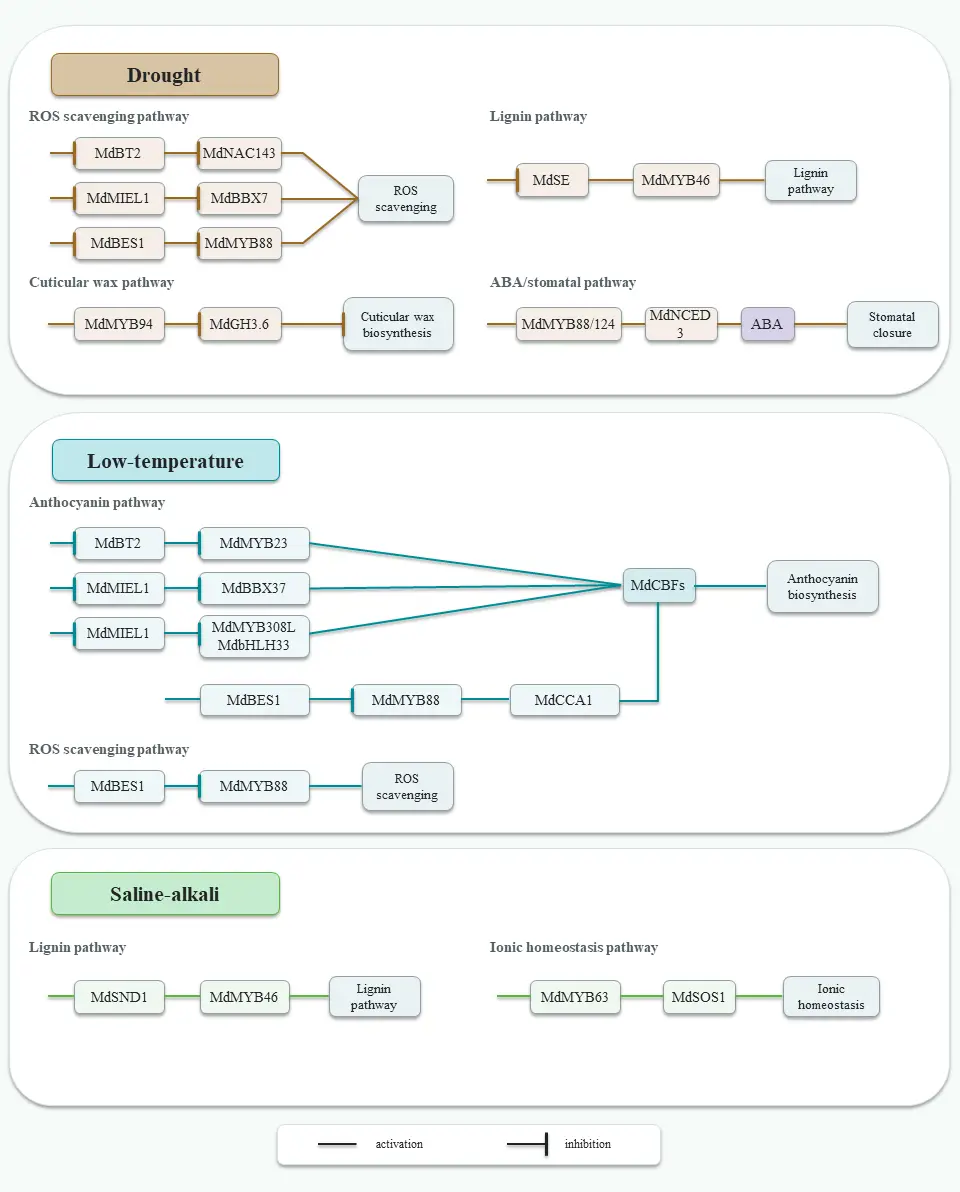
Apple trees employ several core physiological and molecular strategies to combat multiple forms of abiotic stress.
ROS Scavenging: The management of oxidative stress is a universal defense mechanism. The ROS scavenging pathway is a central component of the response to all three stresses—drought, low-temperature, and saline-alkali conditions (Figure 1). This is mediated by a common set of transcription factors, including members of the NAC (e.g., MdNAC143), WRKY (e.g., MdWRKY17, MxWRKY53), and MYB (e.g., MdMYB88) families (Table 1), which orchestrate the expression of antioxidant enzymes to maintain cellular redox homeostasis.
The Central Role of ABA: ABA acts as a master regulator, integrating signals from various stresses. It is crucial for stomatal closure under both drought and saline-alkali stress to minimize water loss (Figure 1). The MdMYB88/124-MdNCED3 module, which regulates ABA biosynthesis, is a key node in the drought response [89]. Furthermore, ABA signaling is a critical component of cold acclimation, working in concert with other hormones, such as JA, to enhance freezing tolerance [39].
Transcriptional Convergence: Certain transcription factors act as master regulators across multiple stress types. For instance, MdMYB88 is a prime example of a regulatory hub, participating in ROS scavenging during drought, anthocyanin biosynthesis, and CBF-dependent pathways during low-temperature stress, and contributing to overall stress resilience (Figure 1). Similarly, MdERF and MdbHLH family members are implicated in responses to all three major stresses, highlighting their versatile roles in stress signaling (Table 1).
Despite these commonalities, each stress elicits unique responses tailored to its specific challenge.
Saline-Alkali Stress and Ionic Homeostasis: The most distinct feature of the saline-alkali response is the imperative to maintain ionic balance. This involves specialized pathways, such as the SOS pathway, which is not a primary feature of drought or cold responses (Figure 1). The MdMYB63-MdSOS1 module is dedicated to regulating Na+/H+ transport to mitigate ion toxicity [75]. This focus on ion transporters represents a key divergence from the primarily osmotic-focused responses to drought and cold.
Low-Temperature Stress and the CBF Regulon: While all stresses can affect photosynthesis, the low-temperature response is uniquely governed by the CBF-dependent pathway. This pathway acts as a master switch for cold acclimation, activating a large suite of COR genes (Figure 1). Multiple upstream regulators, including MdBBX37 and MdbHLH33, converged on MdCBFs to initiate this specialized cold-hardening program [80,86], a level of regulation not seen in the other two stresses.
Drought Stress and Physical Barriers: In response to water deficit, apple trees uniquely enhance physical barriers to prevent water loss. This includes the biosynthesis of cuticular wax, regulated by the MdMYB94-MdGH3.6 module, and the lignin pathway, which strengthens cell walls [92]. While lignin biosynthesis is also involved in the saline-alkali response, its role in creating a hydrophobic barrier is particularly critical for drought survival (Figure 1).
4.2. Critical Appraisal: What Is Truly “New” and What Remains Controversial
Truly novel breakthroughs from the past five years can be categorized into four areas. (1) The discovery of long-distance mobile signals—the demonstration that miR160 can translocate from scion to rootstock to coordinate drought responses [57] challenges the cell-autonomous view of stress signaling and opens new avenues for rootstock-mediated stress resistance breeding. (2) The mechanistic elucidation of post-translational modifications (PTMs)—the MdPUB23-MdICE1 ubiquitination module [66] and MdHDA6-mediated histone deacetylation [67] represent concrete examples of how PTMs and epigenetic modifications, rather than just transcriptional changes, are the primary drivers of cold tolerance. These mechanisms are genuinely new and have been functionally validated in apple, not merely inferred from Arabidopsis. (3) The demonstration of stress-specific ROS functions—the finding that excessive ROS scavenging can be detrimental under salinity [49] has fundamentally altered the paradigm that “higher antioxidant activity is always better”. This nuanced understanding of ROS as signaling molecules, rather than just toxic byproducts, is a major conceptual advance. (4) The integration of autophagy with ion transport—the MdHB7-like-MdATG18a module linking autophagy to Na+ efflux [45] reveals a previously unrecognized intersection between cellular recycling and ion homeostasis, which is a novel and exciting direction for enhancing salinity tolerance.
Controversial and unresolved issues also warrant explicit acknowledgment. (1) The primacy of CBF-dependent vs. CBF-independent pathways in cold tolerance remains fiercely debated. While MdCBF1/2 overexpression enhances cold tolerance, the discovery that MdNAC104 functions through both CBF-dependent and -independent routes [60], and that MdGolS5 acts entirely independently of CBFs [64], suggests that the field may have overemphasized the CBF-centric model. Whether the CBF-independent pathways are quantitatively as important as the CBF cascade under field conditions is unknown. (2) The functional overlap of MYB88/124 in multiple stresses—although these transcription factors are promoted as master regulators of drought, cold, and salinity, the precise molecular targets that confer stress-specific outputs remain poorly defined. It is unclear whether MYB88/124 directly activate distinct downstream genes under each stress or whether stress-specific co-factors modulate their activity. (3) The interaction between ABA and other hormones under combinatorial stress—while single-stress studies have established ABA-JA synergy under drought [30] and ABA-ethylene antagonism under cold [42], very little is known about how these hormonal interactions shift when two stresses co-occur. For instance, drought + salinity might override ABA-ethylene crosstalk, leading to unexpected outcomes. (4) The translational gap from controlled conditions to field reality most regulatory mechanisms have been characterized under controlled growth-chamber conditions with single stresses. The relevance of these findings to field-grown trees subjected to fluctuating, multi-factorial stress combinations is a critical and as-yet-unanswered question.
5. Issues and Prospects
The prevailing paradigm in apple abiotic stress research, which extrapolates mechanistic insights largely from studies in Arabidopsis thaliana and other herbaceous model systems, is fundamentally mismatched to the unique biological attributes of Malus domestica: a long-lived woody perennial whose annual cycle is partitioned into functionally distinct growth and dormancy phases governed by specialized regulatory pathways. This limitation is further exacerbated under real field conditions, where apple trees experience simultaneous, fluctuating combinations of abiotic stresses such as mixed salinity-alkalinity, generating highly intricate stress response networks that cannot be fully recapitulated in model plant experimental setups [112]. As a result, dedicated dissection of apple-native stress physiology and molecular regulation has become an urgent research priority. In applied breeding, conventional sexual hybridization still represents the mainstream approach for developing stress-resilient apple germplasm. Even with transformative progress in apple multi-omics data integration and pan-genome assembly, the end-to-end workflow that converts high-confidence candidate gene discoveries into agronomically superior cultivars still encounters multiple unaddressed technical bottlenecks [113].
Over recent decades, accelerating climate change has driven a sharp rise in extreme weather events that pose systemic threats to the sustainability of global apple production [114]. These pressures manifest as geographically heterogeneous abiotic constraints: declining summer precipitation in Belgium and southwestern Germany [115,116], progressive reduction of winter chill hours in Spain [117], the overlapping emergence of spring frost risk and insufficient winter chilling in the northeastern and midwestern United States [118,119], and increasingly severe reproductive-stage frost damage across major production regions in South Korea and India [120,121,122]. In China’s core apple-growing ecosystems, a suite of recurrent climatic hazards—including bloom-period frost, catastrophic hailstorms, prolonged summer heatwaves, and extended autumn rainfall—has become pervasive. The inherent unpredictability and high destructive potential of these events far exceed the buffering capacity of current routine protective practices, leading to irreversible losses in both crop yield and marketable fruit quality. To establish climate-resilient apple production systems, a set of precision-targeted interventions must be implemented, covering evidence-based orchard site zoning, genetic improvement via late-flowering cultivar breeding, and the synergistic deployment of agronomic technologies (regulated irrigation, trunk whitening, orchard smoke mitigation, hail-proof netting, and rain-shelter cultivation) to reinforce tree stress tolerance and stabilize the orchard microclimate against climatic extremes.
To advance apple stress resistance research, concerted international collaborative efforts are required to deeply mine and functionally validate key abiotic stress-associated genes and loci. By harnessing integrated multi-omics technologies, the field can move beyond single-stress models to systematically unravel the dynamic and interactive gene regulatory networks that underpin apple responses to combinatorial stresses such as drought, chilling, and saline-alkalinity. A central focus must be elucidating crosstalk mechanisms between distinct stress signaling pathways and identifying master regulatory nodes, thereby providing a mechanistic foundation for precision breeding. Concurrently, the development of a holistic parent evaluation framework is imperative. Such a system should integrate multi-omics datasets—spanning genomics, phenomics, and environmental profiles—to enable a comprehensive assessment of critical traits, including fruit quality metrics, stress resilience, and genetic architecture [123]. This will facilitate the strategic selection of elite cultivated varieties and stress-adapted wild relatives as parents for distant hybridization, an approach capable of overcoming interspecific reproductive barriers, generating breeding populations with enriched genetic diversity, and substantially expanding the allelic variation available for developing novel heterotic germplasm [124]. When integrated with high-throughput molecular marker-assisted selection, this pipeline allows for the early and precise identification of superior hybrid progeny, dramatically accelerating the stacking and stable inheritance of complex trait combinations. Furthermore, the rapid establishment of a next-generation breeding platform that seamlessly combines genome-wide selection with high-fidelity gene editing is a critical priority [125]. Leveraging high-density marker maps and large-scale, high-resolution phenotyping datasets will empower accurate genomic prediction models, enabling early selection for stress tolerance and quality traits and drastically compressing breeding cycles [126]. In parallel, the deployment of optimized, high-specificity gene editing systems—with minimized off-target risks—will allow for the precise engineering of key stress-resistance genes, paving the way for the creation of innovative apple cultivars and rootstocks endowed with multi-stress resilience, thereby securing the long-term sustainability and climate adaptability of the global apple industry.
Statement of the Use of Generative AI and AI-Assisted Technologies in the Writing Process
During the preparation of this manuscript, the authors used OpenAI Codex for grammar checking and figure enhancement. After using this tool, the authors reviewed and edited the content as needed and take full responsibility for the content of the published article.
Acknowledgments
We thank Han Zhenhai and Wang Yi from the College of Horticulture, China Agricultural University, for their guidance throughout this study.
Author Contributions
Y.F. and A.H. conceptualized and designed the study. J.M. and C.X. collected literature materials. J.H. and S.S. wrote the draft manuscript. Y.F. and Y.S. edited the draft manuscript. All authors read and approved the final manuscript.
Ethics Statement
Not applicable.
Informed Consent Statement
Not applicable.
Data Availability Statement
This study did not generate any new datasets. All data analyzed are from publicly available sources, as cited in the manuscript.
Funding
This study was supported by grants from the Hebei Natural Science Foundation (C2025301066), the Earmarked Fund for China Agriculture Research System (CARS-27), the National Natural Science Foundation of China (31901974), and 2115 Talent Development Program of China Agricultural University.
Declaration of Competing Interest
The authors declare that they have no known competing financial interests or personal relationships that could have appeared to influence the work reported in this paper.
References
- Li J, Zhu Q, Feng Y. Advancements in balancing of growth and stress response in horticultural crops. Acta Hortic. 2024, 1401, 271–274. DOI:10.17660/ActaHortic.2024.1401.40 [Google Scholar]
- Yan J, Wang S, Xiao D, Yang M, Miao B, Niu B, et al. Comparative Transcriptomic Profiling Reveals Divergent Drought-Response Mechanisms Between Resistant and Susceptible Apple Genotype Roots. Agronomy 2025, 15, 748. DOI:10.3390/agronomy15030748 [Google Scholar]
- Su Y. Effects of Increased Organic Fertilizer Application on Root Zone Environment and Root Growth of Apple under Drought Stress. Master’s Thesis, Northwest A&F University, Xianyang, China, 2025. [Google Scholar]
- Li W, Deng M, Wang S, Wang C, Guo M, Song Y, et al. HISTONE DEACETYLASE 6 interaction with ABSCISIC ACID-INSENSITIVE 5 decreases apple drought tolerance. Plant Physiol. 2023, 193, 2711–2733. DOI:10.1093/plphys/kiad468 [Google Scholar]
- Lei Y. Mechanism of MdIAA29-MdARF4 Regulating Plant Height and Tolerance to of Apple Through the Auxin and Abscisic Acid. Ph.D. Dissertation, Shenyang Agricultural University, Shenyang, China, 2025. [Google Scholar]
- Feng Y, Wang Y, Zhang G, Gan Z, Gao M, Lv J, et al. Group‐C/S1 bZIP heterodimers regulate MdIPT5b to negatively modulate drought tolerance in apple species. Plant J. 2021, 107, 399–417. DOI:10.1111/tpj.15296 [Google Scholar]
- Liu H. The Molecular Mechanism of MdTIP1.3 and MdTIP1.4 Involed in Apple Rootstock of M26 in Drought Resistance. Master’s Thesis, Gansu Agricultural University, Lanzhou, China, 2024. [Google Scholar]
- Cheng Y. Evaluation of Water Use Efficiency of Different Apple Scion-Rootstook Combinations under Long-Term Drought. Master’s Thesis, Northwest A&F University, Xianyang, China, 2023. [Google Scholar]
- Cao F. Natural Variation of HDG5 and Its Post Translational Modifications in Modulating Apple Leaf Cuticular Wax Deposition and Drought Response. Ph.D. Dissertation, Northwest A&F University, Xianyang, China, 2024. [Google Scholar]
- Sun P, Tahir MM, Lu X, Liu Z, Zhang X, Zuo X, et al. Comparison of leaf morphological, anatomical, and photosynthetic responses to drought stress among eight apple rootstocks. Fruit Res. 2022, 2, 20. DOI:10.48130/FruRes-2022-0020 [Google Scholar]
- Zhu Q, Lv J, Wu Y, Peng M, Wu X, Li J, et al. MdbZIP74 negatively regulates osmotic tolerance and adaptability to moderate drought conditions of apple plants. J. Plant Physiol. 2023, 283, 153965. DOI:10.1016/j.jplph.2023.153965 [Google Scholar]
- Jing Y, Liu C, Liu B, Pei T, Zhan M, Li C, et al. Overexpression of the FERONIA receptor kinase MdMRLK2 confers apple drought tolerance by regulating energy metabolism and free amino acids production. Tree Physiol. 2023, 43, 154–168. DOI:10.1093/treephys/tpac100 [Google Scholar]
- Hu L. Effects of Exogenous Arginine on Fruit Quality and Drought Resistance of Apple. Master’s Thesis, Northwest A&F University, Xianyang, China, 2023. [Google Scholar]
- Han J. Effects of Exogenous Hydrogen Peroxide on Fruit Quality and Seedling Drought Resistance in ‘Qincui’ Apple. Master’s Thesis, Northwest A&F University, Xianyang, China, 2025. [Google Scholar]
- Zhang B. Study on Cold Resistance Mechanism of Flower Bud of Malus sieversii in Xinjiang. Master’s Thesis, Xinjiang Agricultural University, Ürümqi, China, 2022. [Google Scholar]
- Jing J. Evaluation of Cold Resistance Different Dwarf Rootstocks and Superior Lines of Apple. Master’s Thesis, Hebei Agricultural University, Baoding, China, 2022. [Google Scholar]
- Fan T. Study on the Change Characteristics of Initial Flowering Period of Apple and Prevention and Control of Freezing Injury in Flowering Period in Baishui County. Master’s Thesis, Northwest A&F University, Xianyang, China, 2021. [Google Scholar]
- Li C. Evaluation of Salt Resistance and Nitrogen Use Efficiency of Seven Apple Rootstocks. Master’s Thesis, Northwest A&F University, Xianyang, China, 2023. [Google Scholar]
- Xie Y. Comprehensive Evaluation of Alkali Tolerance and Cold Resistance of Different Hybrid Elites of Apple Dwarf Rootstocks. Master’s Thesis, Northwest A&F University, Xianyang, China, 2022. [Google Scholar]
- Chen Y. Effects of Dopamine on Root Development and Physiological Characteristics of Apple under Salt Stress. Master’s Thesis, Shandong Agricultural University, Tai’an, China, 2022. [Google Scholar]
- Liu C. Response Mechanisms of Amino Acid Metabolism in Roots of Malus prunifolia under Alkali Stress. Master’s Thesis, Northwest A&F University, Xianyang, China, 2022. [Google Scholar]
- Zhao S, Gao H, Jia X, Zhou K, Wang H, Mao K, et al. MdHB7-like confers drought tolerance and improves water-use efficiency through modulating stomatal density in apple (Malus domestica). Sci. Hortic. 2022, 294, 110758. DOI:10.1016/j.scienta.2021.110758 [Google Scholar]
- Yang J, Zhan R, Wang L, Li J, Ma B, Ma F, et al. Overexpression of MdFRK2 enhances apple drought resistance by promoting carbohydrate metabolism and root growth under drought stress. Hortic. Plant J. 2023, 9, 884–897. DOI:10.1016/j.hpj.2022.10.010 [Google Scholar]
- Niu C, Jiang L, Cao F, Liu C, Guo J, Zhang Z, et al. Methylation of a MITE insertion in the MdRFNR1-1 promoter is positively associated with its allelic expression in apple in response to drought stress. Plant Cell 2022, 34, 3983–4006. DOI:10.1093/plcell/koac220 [Google Scholar]
- Zhang D. Characterization of Transcription Factors MdMYB88, MdMYB124, and MdMYB3 in Response to Drought and Low Nitrate Stresses in Apple. Ph.D. Dissertation, Northwest A&F University, Xianyang, China, 2021. [Google Scholar]
- Mao K, Yang J, Sun Y, Guo X, Qiu L, Mei Q, et al. MdbHLH160 is stabilized via reduced MdBT2-mediated degradation to promote MdSOD1 and MdDREB2A-like expression for apple drought tolerance. Plant Physiol. 2024, 194, 1181–1203. DOI:10.1093/plphys/kiad579 [Google Scholar]
- Liu Y. Mechanism Research of ABA Responsive Protein MdABI5 in Regulating Nitrate Transport and Drought Resistance. Ph.D. Dissertation, Shandong Agricultural University, Tai’an, China, 2021. [Google Scholar]
- Tian J, Song C, Gao X, Gong J, Yu L, Tian X, et al. MhNF‐YA1‐Like‐MhDnaJC76‐MhAAO3 Transcriptional Cascade Enhances ABA Biosynthesis and Drought Tolerance in Apple. Plant Cell Environ. 2025, 48, 7440–7454. DOI:10.1111/pce.70029 [Google Scholar]
- Lei Y, Chen C, Chen W, Dai H. The MdIAA29-MdARF4 complex plays an important role in balancing plant height with salt and drought stress responses. Plant Physiol. 2024, 196, 2795–2811. DOI:10.1093/plphys/kiae467 [Google Scholar]
- Sun T, Zhang J, Zhang Q, Li X, Li M, Yang Y, et al. Exogenous application of acetic acid enhances drought tolerance by influencing the MAPK signaling pathway induced by ABA and JA in apple plants. Tree Physiol. 2022, 42, 1827–1840. DOI:10.1093/treephys/tpac034 [Google Scholar]
- Xu S. Cytokinin Response Factor MdARR11 Regulates Drought Tolerance in Apples. Master’s Thesis, Shandong Agricultural University, Tai’an, China, 2024. [Google Scholar]
- Fei X. Functional Identification of Drought Resistance of AP2/ERF Transcription Factor MdERF109. Master’s Thesis, Henan Agricultural University, Zhengzhou, China, 2025. [Google Scholar]
- Ma H. Screening of Differentially Expressed Genes and Proteins for Photosynthetic Characteristics of Malus sieversii Seedlings in Response to Freezing Stress. Master’s Thesis, Shihezi University, Shihezi, China, 2022. [Google Scholar]
- Wang P. Physiological Basis of Different Exogenous Sugars Regulating the Roots of Malus baccata Borkh. Response to Sub-Low Root Zone Temperature. Master’s Thesis, Shenyang Agricultural University, Shenyang, China, 2023. [Google Scholar]
- Peng Y. Effects of Exogenous γ-Aminobutyric Acid on Chilling Tolerance and Freezing Tolerance of Apple Seedlings. Master’s Thesis, Northwest A&F University, Tai’an, China, 2022. [Google Scholar]
- Li B, Qu S, Kang J, Peng Y, Yang N, Ma B, et al. The MdCBF1/2‐MdTST1/2 module regulates sugar accumulation in response to low temperature in apple. Plant J. 2024, 118, 787–801. DOI:10.1111/tpj.16633 [Google Scholar]
- Liu T, Li Y, Shi Y, Ma J, Peng Y, Tian X, et al. γ-Aminobutyric acid mediated by MdCBF3- MdGAD1 mitigates low temperature damage in apple. Int. J. Biol. Macromol. 2024, 279, 135331. DOI:10.1016/j.ijbiomac.2024.135331 [Google Scholar]
- Li H, Yang X, Mao M, Xue X, Yao G, Zhang Q, et al. 24-Epibrassinolide treatment alleviates frost damage of apple flower via regulating proline, ROS, and energy metabolism. Plant Physiol. Biochem. 2025, 220, 109507. DOI:10.1016/j.plaphy.2025.109507 [Google Scholar]
- An JP, Xu RR, Liu X, Su L, Yang K, Wang XF, et al. Abscisic acid insensitive 4 interacts with ICE1 and JAZ proteins to regulate ABA signaling-mediated cold tolerance in apple. J. Exp. Bot. 2022, 73, 980–997. DOI:10.1093/jxb/erab433 [Google Scholar]
- Liu X. Mechanism of Apple MdHY5 Regulating Auxin Signal Response to Low-Temperature and Low-Nitrogen Stresses. Ph.D. Dissertation, Northwest A&F University, Xianyang, China, 2025. [Google Scholar]
- Feng Y, Lv J, Peng M, Li J, Wu Y, Gao M, et al. Genome-wide identification and characterization of the IPT family members in nine Rosaceae species and a functional analysis of MdIPT5b in cold resistance. Hortic. Plant J. 2023, 9, 616–630. DOI:10.1016/j.hpj.2022.12.010 [Google Scholar]
- Wang Y, Jiang H, Mao Z, Liu W, Jiang S, Xu H, et al. Ethylene increases the cold tolerance of apple via the MdERF1B–MdCIbHLH1 regulatory module. Plant J. 2021, 106, 379–393. DOI:10.1111/tpj.15170 [Google Scholar]
- Zhang R. Physiological Characteristics of Malus halliana in Response to Saline-Alkali Stress and Verification of MhPR1 Functional Based on Transcriptomic. Master’s Thesis, Gansu Agricultural University, Lanzhou, China, 2021. [Google Scholar]
- Fan Z, Zhu Y, Kuang W, Leng J, Wang X, Qiu L, et al. The 14-3-3 protein GRF8 modulates salt stress tolerance in apple via the WRKY18-SOS pathway. Plant Physiol. 2024, 194, 1906–1922. DOI:10.1093/plphys/kiad621 [Google Scholar]
- Yang J, Qiu L, Mei Q, Sun Y, Li N, Gong X, et al. MdHB7‐like positively modulates apple salt tolerance by promoting autophagic activity and Na+ efflux. Plant J. 2023, 116, 669–689. DOI:10.1111/tpj.16395 [Google Scholar]
- Wang X. Glycosyltransferases MhGolS2 and MhGATL1 Mediate the Mechanism by Which Cell Wall Polysaccharide Synthesis Improve Saine-Alkali Resistance in Apple. Master’s Thesis, Gansu Agricultural University, Lanzhou, China, 2024. [Google Scholar]
- Shi Y. The Alleviating Effects of γ-Aminobutyric Acid on Salt Stress in Apple Seedlings and Its Mechanism. Master’s Thesis, Northwest A&F University, Xianyang, China, 2024. [Google Scholar]
- Wang X. Physiological Mechanism of Dopamine and Ascorbic Acid Alleviate the Effect of Salt Stress in Apple. Master’s Thesis, Shandong Agricultural University, Tai’an, China, 2021. [Google Scholar]
- Duan D, Yi R, Shi M, Zhou J, Dong Q, Mao K, et al. The MdVQ17/MdVQ37-MdWRKY100 module coordinates apple salt tolerance by modulating Na+/K+ homeostasis and reactive oxygen species scavenging. Plant Physiol. 2025, 199, 434. DOI:10.1093/plphys/kiaf434 [Google Scholar]
- Yang F. Oxidative Post-Translational Modification of Catalase Regulates the Adaptation to Salt Stress of Malus hupehensis. Master’s Thesis, Shandong Agricultural University, Tai’an, China, 2023. [Google Scholar]
- Wang D. MdZAT5 and MdZAT17 Regulate Salt Stress Tolerance Through ROS Regulation in Apple. Master’s Thesis, Shandong Agricultural University, Tai’an, China, 2023. [Google Scholar]
- Song J. Molecular Mechanism of Abscisic Acid in Regulating Chloride Ion Flux and Chloride Salt Toxicity in the Roots of Malus hupehensis. Ph.D. Dissertation, Shandong Agricultural University, Tai’an, China, 2025. [Google Scholar]
- Zhang J. Study on the Effect of Different Concentrations of Strigolactones on the Salt Resistance of M9T337 Apple Rootstock. Master’s Thesis, Shandong Agricultural University, Tai’an, China, 2023. [Google Scholar]
- Zhang H. Functional Studies on the Apple BR Biosynthesis Gene MdBR6OX2 in Salt Stress. Master’s Thesis, Shandong Agricultural University, Tai’an, China, 2024. [Google Scholar]
- Feng Y, Liu J, Zhai L, Gan Z, Zhang G, Yang S, et al. Natural variation in cytokinin maintenance improves salt tolerance in apple rootstocks. Plant Cell Environ. 2019, 42, 424–436. DOI:10.1111/pce.13403 [Google Scholar]
- Liu Y, An J, Gao N, Wang X, Chen X, Wang X, et al. MdTCP46 interacts with MdABI5 to negatively regulate ABA signalling and drought response in apple. Plant Cell Environ. 2022, 45, 3233–3248. DOI:10.1111/pce.14429 [Google Scholar]
- Shen X. Characterization of Regulatory Loop of Mdm-miR160-MdARF17-MdHYL1 under Drought Stress in Malus × domestica. Ph.D. Dissertation, Northwest A&F University, Xianyang, China, 2021. [Google Scholar]
- Guo Z. Functional Analysis of Apple Autophagy-Related Gene MdATG10 under Nitrogen-Deficiency and Drought Stress. Master’s Thesis, Northwest A&F University, Xianyang, China, 2021. [Google Scholar]
- Yang J. Study on the Function and Regulatory Mechanism of Apple CaCA Family in Response to Cold and Salt Stresses. Ph.D. Dissertation, Northwest A&F University, Xianyang, China, 2022. [Google Scholar]
- Mei C, Yang J, Mei Q, Jia D, Yan P, Feng B, et al. MdNAC104 positively regulates apple cold tolerance via CBF‐dependent and CBF‐independent pathways. Plant Biotechnol. J. 2023, 21, 2057–2073. DOI:10.1111/pbi.14112 [Google Scholar]
- Deng M. Functional Analysis of Transcription Factor MdABI5 in Malus domestica under Drought and Cold Stress. Master’s Thesis, Northwest A&F University, Xianyang, China, 2024. [Google Scholar]
- Zhi F. Molecular Mechanism of MdKIN10-MdMIEL1-MdBBX7 Module Response to Cold Stress in Apple. Ph.D. Dissertation, Northwest A&F University, Xianyang, China, 2025. [Google Scholar]
- An JP, Liu ZY, Zhang XW, Wang DR, Zeng F, You CX, et al. Brassinosteroid signaling regulator BIM1 integrates brassinolide and jasmonic acid signaling during cold tolerance in apple. Plant Physiol. 2023, 193, 1652–1674. DOI:10.1093/plphys/kiad371 [Google Scholar]
- Xu G, He M, Yan S, Lyu D, Cheng C, Zhao D, et al. Galactinol synthase gene 5 (MdGolS5) enhances the cold resistance of apples by promoting raffinose family oligosaccharide accumulation. Plant Physiol. Biochem. 2025, 220, 109416. DOI:10.1016/j.plaphy.2024.109416 [Google Scholar]
- Jiang H, Zhou LJ, Gao HN, Wang XF, Li ZW, Li YY. The transcription factor MdMYB2 influences cold tolerance and anthocyanin accumulation by activating SUMO E3 ligase MdSIZ1 in apple. Plant Physiol. 2022, 189, 2044–2060. DOI:10.1093/plphys/kiac211 [Google Scholar]
- Wang DR, Zhang XW, Xu RR, Wang GL, You CX, An JP. Apple U-box-type E3 ubiquitin ligase MdPUB23 reduces cold-stress tolerance by degrading the cold-stress regulatory protein MdICE1. Hortic. Res. 2022, 9, uhac171. DOI:10.1093/hr/uhac171 [Google Scholar]
- Guo M, Wang S, Liu H, Yao S, Yan J, Wang C, et al. Histone deacetylase MdHDA6 is an antagonist in regulation of transcription factor MdTCP15 to promote cold tolerance in apple. Plant Biotechnol. J. 2023, 21, 2254–2272. DOI:10.1111/pbi.14128 [Google Scholar]
- Chen C. Mechanism of MdMYB44-Like Positively Regulating Salt and Drought Stress Tolerance of Apple Through ABA Signaling Pathway. Ph.D. Dissertation, Shenyang Agricultural University, Shenyang, China, 2024. [Google Scholar]
- Ma Y, Xue H, Zhang F, Jiang Q, Yang S, Yue P, et al. The miR156/SPL module regulates apple salt stress tolerance by activating MdWRKY100 expression. Plant Biotechnol. J. 2021, 19, 311–323. DOI:10.1111/pbi.13464 [Google Scholar]
- Li XL, Meng D, Li MJ, Zhou J, Yang YZ, Zhou BB, et al. Transcription factors MhDREB2A/MhZAT10 play a role in drought and cold stress response crosstalk in apple. Plant Physiol. 2023, 192, 2203–2220. DOI:10.1093/plphys/kiad147 [Google Scholar]
- Liao X, Guo X, Wang Q, Wang Y, Zhao D, Yao L, et al. Overexpression of MsDREB6.2 results in cytokinin‐deficient developmental phenotypes and enhances drought tolerance in transgenic apple plants. Plant J. 2017, 89, 510–526. DOI:10.1111/tpj.13401 [Google Scholar]
- An J, Zhang X, Bi S, You C, Wang X, Hao Y. The ERF transcription factor MdERF38 promotes drought stress‐induced anthocyanin biosynthesis in apple. Plant J. 2020, 101, 573–589. DOI:10.1111/tpj.14555 [Google Scholar]
- Sharma V, Goel P, Kumar S, Singh AK. An apple transcription factor, MdDREB76, confers salt and drought tolerance in transgenic tobacco by activating the expression of stress-responsive genes. Plant Cell Rep. 2019, 38, 221–241. DOI:10.1007/s00299-018-2364-8 [Google Scholar]
- An JP, Zhang XW, Xu RR, You CX, Wang XF, Hao YJ. Apple MdERF4 negatively regulates salt tolerance by inhibiting MdERF3 transcription. Plant Sci. 2018, 276, 181–188. DOI:10.1016/j.plantsci.2018.08.017 [Google Scholar]
- Yu L, Liu W, Guo Z, Li Z, Jiang H, Zou Q, et al. Interaction between MdMYB63 and MdERF106 enhances salt tolerance in apple by mediating Na+/H+ transport. Plant Physiol. Biochem. 2020, 155, 464–471. DOI:10.1016/j.plaphy.2020.08.017 [Google Scholar]
- Chen P, Zhi F, Li X, Shen W, Yan M, He J, et al. Zinc-finger protein MdBBX7/MdCOL9, a target of MdMIEL1 E3 ligase, confers drought tolerance in apple. Plant Physiol. 2022, 188, 540–559. DOI:10.1093/plphys/kiab420 [Google Scholar]
- Liu X, Li R, Dai Y, Yuan L, Sun Q, Zhang S, et al. A B-box zinc finger protein, MdBBX10, enhanced salt and drought stresses tolerance in Arabidopsis. Plant Mol. Biol. 2019, 99, 437–447. DOI:10.1007/s11103-019-00828-8 [Google Scholar]
- Chen P, Yan M, Li L, He J, Zhou S, Li Z, et al. The apple DNA-binding one zinc-finger protein MdDof54 promotes drought resistance. Hortic. Res. 2020, 7, 195. DOI:10.1038/s41438-020-00419-5 [Google Scholar]
- Bao C, Qin G, Cao F, He J, Shen X, Chen P, et al. MdZAT5 regulates drought tolerance via mediating accumulation of drought‐responsive miRNAs and mRNAs in apple. New Phytol. 2022, 236, 2131–2150. DOI:10.1111/nph.18512 [Google Scholar]
- An JP, Wang XF, Espley RV, Lin-Wang K, Bi SQ, You CX, et al. An Apple B-Box Protein MdBBX37 Modulates Anthocyanin Biosynthesis and Hypocotyl Elongation Synergistically with MdMYBs and MdHY5. Plant Cell Physiol. 2020, 61, 130–143. DOI:10.1093/pcp/pcz185 [Google Scholar]
- Fang H, Dong Y, Yue X, Hu J, Jiang S, Xu H, et al. The B‐box zinc finger protein MdBBX20 integrates anthocyanin accumulation in response to ultraviolet radiation and low temperature. Plant Cell Environ. 2019, 42, 2090–2104. DOI:10.1111/pce.13552 [Google Scholar]
- Yang YY, Zheng PF, Ren YR, Yao YX, You CX, Wang XF, et al. Apple MdSAT1 encodes a bHLHm1 transcription factor involved in salinity and drought responses. Planta 2021, 253, 46. DOI:10.1007/s00425-020-03528-6 [Google Scholar]
- Zhao Q, Fan Z, Qiu L, Che Q, Wang T, Li Y, et al. MdbHLH130, an Apple bHLH Transcription Factor, Confers Water Stress Resistance by Regulating Stomatal Closure and ROS Homeostasis in Transgenic Tobacco. Front. Plant Sci. 2020, 11, 543696. DOI:10.3389/fpls.2020.543696 [Google Scholar]
- Feng XM, Zhao Q, Zhao LL, Qiao Y, Xie XB, Li HF, et al. The cold-induced basic helix-loop-helix transcription factor gene MdCIbHLH1encodes an ICE-like protein in apple. BMC Plant Biol. 2012, 12, 22. DOI:10.1186/1471-2229-12-22 [Google Scholar]
- Xie X, Li S, Zhang R, Zhao J, Chen Y, Zhao Q, et al. The bHLH transcription factor MdbHLH3 promotes anthocyanin accumulation and fruit colouration in response to low temperature in apples. Plant Cell Environ. 2012, 35, 1884–1897. DOI:10.1111/j.1365-3040.2012.02523.x [Google Scholar]
- An J, Wang X, Zhang X, Xu H, Bi S, You C, et al. An apple MYB transcription factor regulates cold tolerance and anthocyanin accumulation and undergoes MIEL1‐mediated degradation. Plant Biotechnol. J. 2020, 18, 337–353. DOI:10.1111/pbi.13201 [Google Scholar]
- Liang X, Li Y, Yao A, Liu W, Yang T, Zhao M, et al. Overexpression of MxbHLH18 Increased Iron and High Salinity Stress Tolerance in Arabidopsis thaliana. Int. J. Mol. Sci. 2022, 23, 8007. DOI:10.3390/ijms23148007 [Google Scholar]
- Li X, Xie Y, Lu L, Yan M, Fang N, Xu J, et al. Contribution of methylation regulation of MpDREB2A promoter to drought resistance of Mauls prunifolia. Plant Soil 2019, 441, 15–32. DOI:10.1007/s11104-019-04149-z [Google Scholar]
- Xie Y, Bao C, Chen P, Cao F, Liu X, Geng D, et al. Abscisic acid homeostasis is mediated by feedback regulation of MdMYB88 and MdMYB124. J. Exp. Bot. 2021, 72, 592–607. DOI:10.1093/jxb/eraa449 [Google Scholar]
- Geng D, Chen P, Shen X, Zhang Y, Li X, Jiang L, et al. MdMYB88 and MdMYB124 Enhance Drought Tolerance by Modulating Root Vessels and Cell Walls in Apple. Plant Physiol. 2018, 178, 1296–1309. DOI:10.1104/pp.18.00502 [Google Scholar]
- Xie Y, Chen P, Yan Y, Bao C, Li X, Wang L, et al. An atypical R2R3 MYB transcription factor increases cold hardiness by CBF‐dependent and CBF‐independent pathways in apple. New Phytol. 2018, 218, 201–218. DOI:10.1111/nph.14952 [Google Scholar]
- Jiang L, Zhang D, Liu C, Shen W, He J, Yue Q, et al. MdGH3.6 is targeted by MdMYB94 and plays a negative role in apple water‐deficit stress tolerance. Plant J. 2022, 109, 1271–1289. DOI:10.1111/tpj.15631 [Google Scholar]
- An J, Li R, Qu F, You C, Wang X, Hao Y. R2R3‐MYB transcription factor MdMYB23 is involved in the cold tolerance and proanthocyanidin accumulation in apple. Plant J. 2018, 96, 562–577. DOI:10.1111/tpj.14050 [Google Scholar]
- Chen K, Song M, Guo Y, Liu L, Xue H, Dai H, et al. MdMYB46 could enhance salt and osmotic stress tolerance in apple by directly activating stress‐responsive signals. Plant Biotechnol. J. 2019, 17, 2341–2355. DOI:10.1111/pbi.13151 [Google Scholar]
- Chen K, Guo Y, Song M, Liu L, Xue H, Dai H, et al. Dual role of MdSND1 in the biosynthesis of lignin and in signal transduction in response to salt and osmotic stress in apple. Hortic. Res. 2020, 7, 204. DOI:10.1038/s41438-020-00433-7 [Google Scholar]
- Wang Y, Mao Z, Jiang H, Zhang Z, Chen X. A feedback loop involving MdMYB108L and MdHY5 controls apple cold tolerance. Biochem. Biophys. Res. Commun. 2019, 512, 381–386. DOI:10.1016/j.bbrc.2019.03.101 [Google Scholar]
- Jia D, Jiang Q, van Nocker S, Gong X, Ma F. An apple (Malus domestica) NAC transcription factor enhances drought tolerance in transgenic apple plants. Plant Physiol. Biochem. 2019, 139, 504–512. DOI:10.1016/j.plaphy.2019.04.011 [Google Scholar]
- Ji XL, Li HL, Qiao ZW, Zhang JC, Sun WJ, Wang CK, et al. The BTB-TAZ protein MdBT2 negatively regulates the drought stress response by interacting with the transcription factor MdNAC143 in apple. Plant Sci. 2020, 301, 110689. DOI:10.1016/j.plantsci.2020.110689 [Google Scholar]
- Han D, Du M, Zhou Z, Wang S, Li T, Han J, et al. Overexpression of a Malus baccata NAC Transcription Factor Gene MbNAC25 Increases Cold and Salinity Tolerance in Arabidopsis. Int. J. Mol. Sci. 2020, 21, 1198. DOI:10.3390/ijms21041198 [Google Scholar]
- An JP, Li R, Qu FJ, You CX, Wang XF, Hao YJ. An apple NAC transcription factor negatively regulates cold tolerance via CBF-dependent pathway. J. Plant Physiol. 2018, 221, 74–80. DOI:10.1016/j.jplph.2017.12.009 [Google Scholar]
- An J, Yao J, Xu R, You C, Wang X, Hao Y. An apple NAC transcription factor enhances salt stress tolerance by modulating the ethylene response. Physiol. Plant. 2018, 164, 279–289. DOI:10.1111/ppl.12724 [Google Scholar]
- Han D, Ding H, Chai L, Liu W, Zhang Z, Hou Y, et al. Isolation and characterization of MbWRKY1, a WRKY transcription factor gene from Malus baccata (L.) Borkh involved in drought tolerance. Can. J. Plant Sci. 2018, 98, 1023–1034. DOI:10.1139/cjps-2017-0355 [Google Scholar]
- Han D, Zhang Z, Ding H, Chai L, Liu W, Li H, et al. Isolation and characterization of MbWRKY2 gene involved in enhanced drought tolerance in transgenic tobacco. J. Plant Interact. 2018, 13, 163–172. DOI:10.1080/17429145.2018.1447698 [Google Scholar]
- Han D, Zhang Z, Ding H, Wang Y, Liu W, Li H, et al. Molecular cloning and functional analysis of MbWRKY3 involved in improved drought tolerance in transformed tobacco. J. Plant Interact. 2018, 13, 329–337. DOI:10.1080/17429145.2018.1478994 [Google Scholar]
- Han D, Hou Y, Wang Y, Ni B, Li Z, Yang G. Overexpression of a Malus baccata WRKY transcription factor gene (MbWRKY5) increases drought and salt tolerance in transgenic tobacco. Can. J. Plant Sci. 2019, 99, 173–183. DOI:10.1139/cjps-2018-0053 [Google Scholar]
- Shan D, Wang C, Song H, Bai Y, Zhang H, Hu Z, et al. The MdMEK2–MdMPK6–MdWRKY17 pathway stabilizes chlorophyll levels by directly regulating MdSUFB in apple under drought stress. Plant J. 2021, 108, 814–828. DOI:10.1111/tpj.15480 [Google Scholar]
- Han D, Hou Y, Ding H, Zhou Z, Li H, Yang G. Isolation and preliminary functional analysis of MbWRKY4 gene involved in salt tolerance in transgenic tobacco. Int. J. Agric. Biol. 2018, 20, 2045–2052. DOI:10.17957/IJAB/15.0728 [Google Scholar]
- Dong Q, Zheng W, Duan D, Huang D, Wang Q, Liu C, et al. MdWRKY30, a group IIa WRKY gene from apple, confers tolerance to salinity and osmotic stresses in transgenic apple callus and Arabidopsis seedlings. Plant Sci. 2020, 299, 110611. DOI:10.1016/j.plantsci.2020.110611 [Google Scholar]
- Han D, Xu T, Han J, Liu W, Wang Y, Li X, et al. Overexpression of MxWRKY53 increased iron and high salinity stress tolerance in Arabidopsis thaliana. Vitr. Cell. Dev. Biol.-Plant 2022, 58, 266–278. DOI:10.1007/s11627-021-10241-w [Google Scholar]
- Han D, Zhou Z, Du M, Li T, Wu X, Yu J, et al. Overexpression of a Malus xiaojinensis WRKY transcription factor gene (MxWRKY55) increased iron and high salinity stress tolerance in Arabidopsis thaliana. Vitr. Cell. Dev. Biol.-Plant 2020, 56, 600–609. DOI:10.1007/s11627-020-10129-1 [Google Scholar]
- Han D, Han J, Xu T, Li T, Yao C, Wang Y, et al. Isolation and preliminary functional characterization of MxWRKY64, a new WRKY transcription factor gene from Malus xiaojinensis Cheng et Jiang. Vitr. Cell. Dev. Biol.-Plant 2021, 57, 202–213. DOI:10.1007/s11627-021-10171-7 [Google Scholar]
- Wang J, Mao Z, Cong P, Lv D, Ma F, Ren X, et al. Fruit scientific research in New China in the past 70 years: Apple. J. Fruit Sci. 2019, 36, 1255–1263. DOI:10.13925/j.cnki.gsxb.Z01 (In Chinese) [Google Scholar]
- Li W, Wang Z, Sun H, Wang S, Chen D, Xiong Y, et al. Advances in multi-omics-based elucidation of traits and molecular breeding in apple. J. China Agric. Univ. 2025, 30, 121–134. DOI:10.11841/j.issn.1007-4333.2025.10.10 (In Chinese) [Google Scholar]
- Ma F. Reflections on the development of China’s apple industry-Current situation, problems and solutions. Dec. Fruits 2023, 55, 1–4. DOI:10.13925/j.cnki.gsxb.Z01 (In Chinese) [Google Scholar]
- Bamps B, Gobin A, Somers B, Van Orshoven J. From past to future: Spatiotemporal insights into drought stress on Belgian pome fruit production for 1991–2090. Agric. Water Manag. 2026, 325, 110151. DOI:10.1016/j.agwat.2026.110151 [Google Scholar]
- Föll S, McCormick RJ, Biegert K. Three-year evaluation of irrigation strategies on apple yield and quality in Germany. Sci. Hortic. 2026, 359, 114764. DOI:10.1016/j.scienta.2026.114764 [Google Scholar]
- González-Martínez E, Munné-Bosch S, Lordan J. Chilling and heat requirements of apple cultivars: Future perspectives in a global climate change context. Sci. Hortic. 2025, 345, 114134. DOI:10.1016/j.scienta.2025.114134 [Google Scholar]
- Clark JS, Andrus R, Arianoutsou M, Ascoli D, Bergeron Y, Bogdziewicz M, et al. Continental Contrasts in Climate Extremes That Control Tree Fecundity. Glob. Change Biol. 2026, 32, e70738. DOI:10.1111/gcb.70738 [Google Scholar]
- Ford TW, Chen L, Fernandez E, Wahle E, Luedeling E, Todey D, et al. Historical and Projected Changes in Chill Accumulation and Spring Freeze Risk in the Midwest United States. Agric. For. Meteorol. 2025, 368, 110532. DOI:10.1016/j.agrformet.2025.110532 [Google Scholar]
- Choi YM, Kim SB, Choi DG, Kim SH, Song JH. Effects of Meteorological Factors and Frost Injury on Flowering Stage of Apples and Pears Across Regions at Varying Altitudes. Horticulturae 2025, 11, 249. DOI:10.3390/horticulturae11030249 [Google Scholar]
- Lee J, Heo J. Assessment of floral stage-specific frost injury under controlled conditions and evaluation of mitigation systems in a ‘Fuji’ apple orchard. J. Anim. Plant Sci. 2026, 36, 97–103. DOI:10.36899/JAPS.2026.1.0008 [Google Scholar]
- Garima, Kumar S, Nehta R, Verma P, Kurbah I, Gupta V, et al. Characterizing Biochemical Traits and Hormonal Profiling Linked to Stress Resilience in Apple Cultivars from the Mid-Hills of Himachal Pradesh, India. Appl. Fruit Sci. 2026, 68, 119. DOI:10.1007/s10341-026-01837-w [Google Scholar]
- Zhan M, Wang Q, Niu D, Li C, Li C, Zou Y, et al. Evaluation system for abiotic stresses resistance in apple. Shaanxi J. Agric. Sci. 2025, 71, 16–21. DOI:10.3969/j.issn.0488-5368.2025.12.004 (In Chinese) [Google Scholar]
- Song S, Guo W, Meng J, Hu A, Xing C, Sun Y. Study on the compatibility of a new salt-tolerant Malus × robusta ‘Yanxing’ rootstock with different apple cultivars. J. Fruit Sci. 2025, 42, 314–321. DOI:10.13925/j.cnki.gsxb.20240567. In Chinese [Google Scholar]
- Li X, Ma Z, Song Y, Shen W, Yue Q, Khan A, et al. Insights into the molecular mechanisms underlying responses of apple trees to abiotic stresses. Hortic. Res. 2023, 10, uhad144. DOI:10.1093/hr/uhad144 [Google Scholar]
- Wang Y, Li W, Xu X, Qiu C, Wu T, Wei Q, et al. Progress of Apple Rootstock Breeding and Its Use. Hortic. Plant J. 2019, 5, 183–191. DOI:10.1016/j.hpj.2019.06.001 [Google Scholar]