
What Should Ecology Study for Watershed?
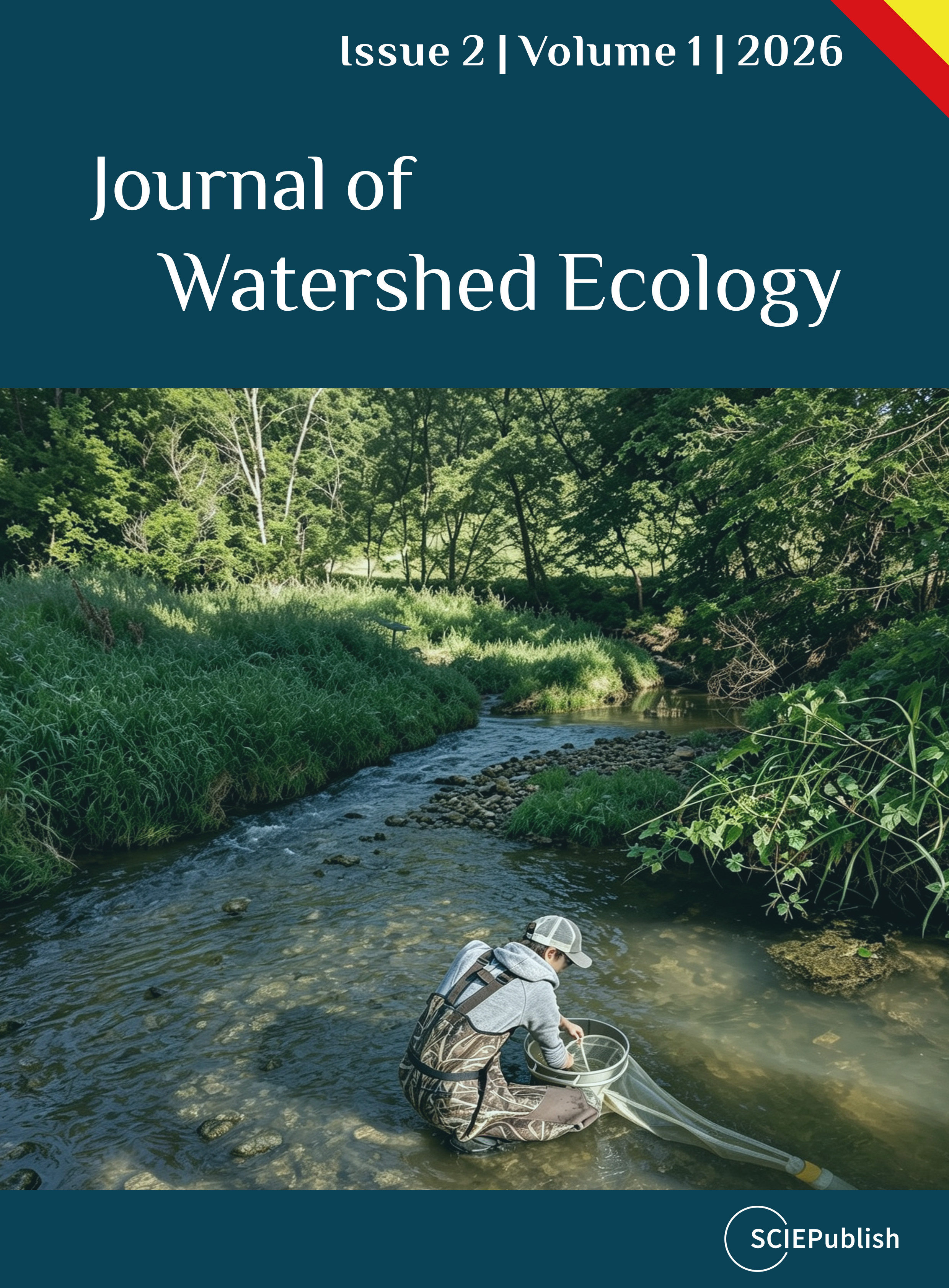
What Should Ecology Study for Watershed?

Received: 18 May 2026 Accepted: 08 July 2026 Published: 20 July 2026

© 2026 The authors. This is an open access article under the Creative Commons Attribution 4.0 International License (https://creativecommons.org/licenses/by/4.0/).
Ecology aims to understand the complexity of how organisms interact among themselves and with their environment within a given-boundary ecosystem, from the microcosm to the Earth. This complexity emerges as scaling along spatial heterogeneity and temporal dynamics within an ecosystem and among ecosystems [1]. The function of an ecosystem depends on this complexity, which varies dramatically with the size of the system and changing environmental conditions [2]. For example, a population can display exponential growth in a microcosm but rarely persists at larger scales due to the influence of ecological processes at multiple scales [3]. As such, ecology has evolved into a transdisciplinary science to generate a better knowledge of processes and functions for ecosystem management and restoration.
Watershed is considered, in the analogy to cells in life systems, the basic unit of structure and function in Earth’s ecosystems. The “cell” is characterized as a complex system that holds surface precipitation within a hydrological boundary, integrating a series of processes and functions within the hierarchical structure of typology between terrestrial and aquatic ecosystems [4,5,6]. It is structured by drainage networks with landscape dynamics to transfer water, sediments, and nutrients from terrestrial ecosystems to freshwater and marine ecosystems [7,8]. The drainage network is dammed worldwide with the regulation of water flows to achieve economic and social needs, as this regulation can prevent floods and droughts, supply water for domestic utilization, agricultural irrigation, and industrial production, generate hydropower energy as well as enable inland navigation [9,10]. As the complex system in which humans expect to live in harmony with water, the watershed serves as a living laboratory for ecology, ecosystem management, and restoration.
Sustainability is a long-term vision of economic and social development for the watershed ecosystem, as it can provide diverse services and values for human well-being. The typology of watershed ecosystems encompasses the ways humans conceive of and interact with nature [11], and it can help ecologists develop a sustainability knowledge system to better understand relationships among people, ecosystems, and nature. This knowledge system helps policymakers strengthen inclusive governance of watersheds for sustainable development goals through legalization, institutionalization, differentiation, and dynamization [12,13]. Such inclusive governance can address the major challenges of sustainable development (i.e., biodiversity loss, climate change and environmental pollution) by enhancing the co-benefit contribution of watershed ecosystems to a good life for all people within the same boundary [11,14]. The co-benefit contribution of nature to people should be measured quantitatively and described qualitatively in watershed-scale modelling of sustainability with biophysical, monetary, and socio-cultural terms [14,15]. Thus, ecology should generate an integrated knowledge system for watershed sustainability by integrating inclusive governance and co-benefit contributions.
Biodiversity is an integral component of multiple ecosystem services within a watershed to support the sustainability of human health and well-being. Biodiversity loss results from the increase in human demand for provisioning services and leads to the decrease in regulating services [16]. A holistic understanding of biodiversity across spatial scales is fundamental to addressing the co-benefits and trade-offs among multiple ecosystem services [16,17]. Measuring resilience is vital for characterizing changes in multiple ecosystem services by investigating the resistance of biodiversity to perturbations, recovery times, and return rates [17,18]. Watershed matures mostly as a spatial scale of ecological management to operate the policy instrument of paying for ecosystem services [19,20]. Strategies for biodiversity conservation must be informed with the application of watershed model that can visualize the big data on what is threatening biodiversity, where risks occur, as well as how fast threats change [21]. Obviously, a watershed offers a natural boundary within which ecology can better understand the complex relationships among biodiversity, stressors, and ecosystem services across temporal and spatial scales.
Complexity is a fundamental property of natural, social, and economic systems, as their constituents engage in heterogeneous interactions within high-dimensional nonlinear patterns and dynamics. The complexity of natural systems requires the ecological study to scale from microscopic patterns and dynamics to macroscopic ones [22,23]. The metabolic theory of ecology provides a predictive model between species diversity and environmental temperature, and it emphasizes that metabolic rate controls all ecological processes with fractal scaling from individuals and ecosystems [24,25]. Fractal scaling law occurs in chemical pollutants within a watershed at temporal fluctuations from hours to decades, and it implies the time that pollutants take to travel from rainfall to stream [26]. The drainage area of watershed scales fractally with channel length in tributary networks, and this scaling relationship is called Hack’s law [8]. In social systems that interact closely with natural systems in a watershed, this scaling law can reveal the temporal and spatial spectrum of human mobility on the basis of large-scale data [27]. Watershed couples a series of natural, social, and economic systems across fractal dimensions, offering ecology the potential to study complexity within and among ecosystems.
In short, watershed ecology is the ecology for watersheds on sustainability, the ecology of watersheds on biodiversity, and the ecology in watersheds on complexity. Watersheds vary widely in size, from less than a square kilometer to more than a million square kilometers, and are a critical variant of the fractal scaling law for ecosystems that determines the complexity of how biodiversity can work for sustainability. As a transdisciplinary science, watershed ecology aims to study the complexity of sustainability and biodiversity across varying watersheds and to provide a scientific basis for harmonious coexistence between humans and nature at a specific scale.
Declaration of Competing Interest
The author declares that he has no known competing financial interests or personal relationships that could have appeared to influence the work reported in this paper.
References
- Brodie JF, Gonzalez A, Mohd-Azlan J, Nelson CR, Tabor G, Vasudev D, et al. A well-connected Earth: The science and conservation of organismal movement. Science 2025, 388, eadn2225. DOI:10.1126/science.adn2225 [Google Scholar]
- Clark JS, Carpenter SR, Barber M, Collins S, Dobson A, Foley JA, et al. Ecological forecasts: An emerging imperative. Science 2001, 293, 657–660. DOI:10.1126/science.293.5530.657 [Google Scholar]
- Scheffers BR, De Meester L, Bridge TCL, Hoffmann AA, Pandolfi JM, Corlett RT, et al. The broad footprint of climate change from genes to biomes to people. Science 2016, 354, aaf7671. DOI:10.1126/science.aaf7671 [Google Scholar]
- Strahler A. Quantitative analysis of watershed geomorphology. Eos Trans. Am. Geophys. Union 1957, 38, 913–920. DOI:10.1029/TR038i006p00913 [Google Scholar]
- Keith DA, Ferrer-Paris JR, Nicholson E, Bishop MJ, Polidoro BA, Ramirez-Llodra E, et al. A function-based typology for Earth’s Ecosystems. Nature 2022, 610, 513–518. DOI:10.1038/s41586-022-05318-4 [Google Scholar]
- Cai Q. Why watershed ecology? J. Watershed Ecol. 2026, 1, 10001. DOI:10.70322/jwe.2026.10001 [Google Scholar]
- Dethier EN, Renshaw CE, Magilligan FJ. Rapid changes to global river suspended sediment flux by humans. Science 2022, 376, 1447–1452. DOI:10.1126/science.abn7980 [Google Scholar]
- Dong TY, Vulis L, Ma H, Tejedor A, Goudge TA. Apparent Hack’s law in river deltas. Science 2026, 392, 493–498. DOI:10.1126/science.ady6805 [Google Scholar]
- Poff NL, Schmidt JC. How dams can go with the flow. Science 2016, 353, 1099–1100. DOI:10.1126/science.aah4926 [Google Scholar]
- Ensign SH, Halls JN, Peck EK. Watershed sediment cannot offset sea level rise in most US tidal wetlands. Science 2023, 382, 1191–1195. DOI:10.1126/science.adj0513 [Google Scholar]
- Pascual U, Balvanera P, Anderson CB, Chaplin-Kramer R, Christie M, González-Jiménez D, et al. Diverse values of nature for sustainability. Nature 2023, 620, 813–823. DOI:10.1038/s41586-023-06406-9 [Google Scholar]
- Biermann F, Sun Y, Banik D, Beisheim M, Bloomfield MJ, Charles A, et al. Four governance reforms to strengthen the SDGs. Science 2023, 381, 1159–1160. DOI:10.1126/science.adj5434 [Google Scholar]
- Malekpour S, Allen C, Sagar A, Scholz I, Persson Å, Miranda JJ, et al. What scientists need to do to accelerate progress on the SDGs. Nature 2023, 621, 250–254. DOI:10.1038/d41586-023-02808-x [Google Scholar]
- Díaz S, Pascual U, Stenseke M, Martín-López B, Watson RT, Molnár Z, et al. Assessing nature’s contributions to people. Science 2018, 359, 270–272. DOI:10.1126/science.aap8826 [Google Scholar]
- Chaplin-Kramer R, Sharp RP, Weil C, Bennett EM, Pascual U, Arkema KK, et al. Global modeling of nature’s contributions to people. Science 2019, 366, 255–258. DOI:10.1126/science.aaw3372 [Google Scholar]
- Pereira HM, Martins IS, Rosa IMD, Kim H, Leadley P, Popp A, et al. Global trends and scenarios for terrestrial biodiversity and ecosystem services from 1900 to 2050. Science 2024, 384, 458–465. DOI:10.1126/science.adn3441 [Google Scholar]
- Metz T, Farwig N, Dormann CF, Schaefer HM, Guevara-Andino JE, Brehm G, et al. Biodiversity resilience in a tropical rainforest. Nature 2026, 652, 1232–1239. DOI:10.1038/s41586-026-10365-2 [Google Scholar]
- Pimm SL, Donohue I, Montoya JM, Loreau M. Measuring resilience is essential to understand it. Nat. Sustain. 2019, 2, 895–897. DOI:10.1038/s41893-019-0399-7 [Google Scholar]
- Kinzig AP, Perrings C, Chapin FS, Polasky S, Smith VK, Tilman D, et al. Paying for ecosystem services—Promise and peril. Science 2011, 334, 603–604. DOI:10.1126/science.1210297 [Google Scholar]
- Salzman J, Bennett G, Carroll N, Goldstein A, Jenkins M. The global status and trends of payments for ecosystem services. Nat. Sustain. 2018, 1, 136–144. DOI:10.1038/s41893-018-0033-0 [Google Scholar]
- Joppa LN, O’Connor B, Visconti P, Smith C, Geldmann J, Hoffmann M, et al. Filling in biodiversity threat gaps. Science 2016, 352, 416–418. DOI:10.1126/science.aaf3565 [Google Scholar]
- Anderson PW. More is different. Science 1972, 177, 393–396. DOI:10.1126/science.177.4047.393 [Google Scholar]
- Cortés Guzmán D. The complexity of scale in biodiversity change. Nat. Rev. Biodivers. 2025, 1, 211. DOI:10.1038/s44358-025-00036-x [Google Scholar]
- West GB, Brown JH, Enquist BJ. The fourth dimension of life: Fractal geometry and allometric scaling of organisms. Science 1999, 284, 1677–1679. DOI:10.1126/science.284.5420.1677 [Google Scholar]
- Allen AP, Brown JH, Gillooly JF. Global biodiversity, biochemical kinetics, and the energetic-equivalence rule. Science 2002, 297, 1545–1548. DOI:10.1126/science.1072380 [Google Scholar]
- Kirchner JW, Feng X, Neal C. Fractal stream chemistry and its implications for contaminant transport in catchments. Nature 2000, 403, 524–527. DOI:10.1038/35000537 [Google Scholar]
- Schläpfer M, Dong L, O’Keeffe K, Santi P, Szell M, Salat H, et al. The universal visitation law of human mobility. Nature 2021, 593, 522–527. DOI:10.1038/s41586-021-03480-9 [Google Scholar]