
Microalgae as a Sustainable Bioresource for Bioplastic Production
Microalgae as a Sustainable Bioresource for Bioplastic Production
Ahmad Abd-El-Aziz
1,2,*
 Spiros N. Agathos
2,3
Jian Li
2,4,*
Spiros N. Agathos
2,3
Jian Li
2,4,*
Received: 30 April 2026 Revised: 12 June 2026 Accepted: 09 July 2026 Published: 17 July 2026

© 2026 The authors. This is an open access article under the Creative Commons Attribution 4.0 International License (https://creativecommons.org/licenses/by/4.0/).
Graphical Abstract
1. Introduction
Bioplastics, bio-derived plastics made in whole or in part from biological sources, have become an attractive alternative to conventional petrochemical-based plastics. Plastics are defined as organic materials that are based on polymeric structures composed of monomers that determine the physical and chemical properties of the plastics. Once the material is soft, it can be molded into shape and set to form a rigid or elastic material. However, bioplastics are not as well defined, since the term has been used to describe bio-based and biodegradable plastics. The terminology has been used in the literature by many scientists; however, some have focused specifically on biodegradable bioplastics [1,2]. The focus of this review article is on bio-based plastics, including polyhydroxyalkanoates (PHAs) such as polyhydroxybutyrates (PHBs) [3], as well as precursor biopolymers that can be used to make bioplastics such as the polysaccharides starch and chitin [4,5], and synthetic plastics such as polyethylene (PE), which can be prepared from biomaterial precursors [6]. Unlike petrochemical-based plastics, bioplastics are derived from renewable sources such as plants, bacteria, and algae and are usually, but not always, biodegradable [7,8]. A shift from conventional petrochemical-based plastics produced from fossil fuels to bioplastics might be imperative for reasons including plastic pollution and associated health risks from their propagation through the food chain, the use of non-renewable resources, which makes plastics less sustainable, and the mitigation of CO2 emissions to address the ongoing climate crisis. Regarding plastic pollution, a recent study estimated that between 48.3 and 56.3 million metric tons of plastic waste are discharged each year [9]. Further, the use of bioplastics has the potential to reduce greenhouse gas (GHG) emissions [10]. Also, even when comparing petrochemical-derived high-density polyethylene (HDPE) and polyethylene terephthalate (PET) with chemically similar but biologically-derived HDPE and PET, the GHG emissions and use of fossil fuels tended to be lower for the bioplastics [11]. However, it has been estimated that 61 million hectares of land would be required to attain the same annual production from plant-derived bioplastics as conventional plastics [12]. It is therefore necessary to develop a more sustainable alternative with lower impacts on land use for bioplastics.
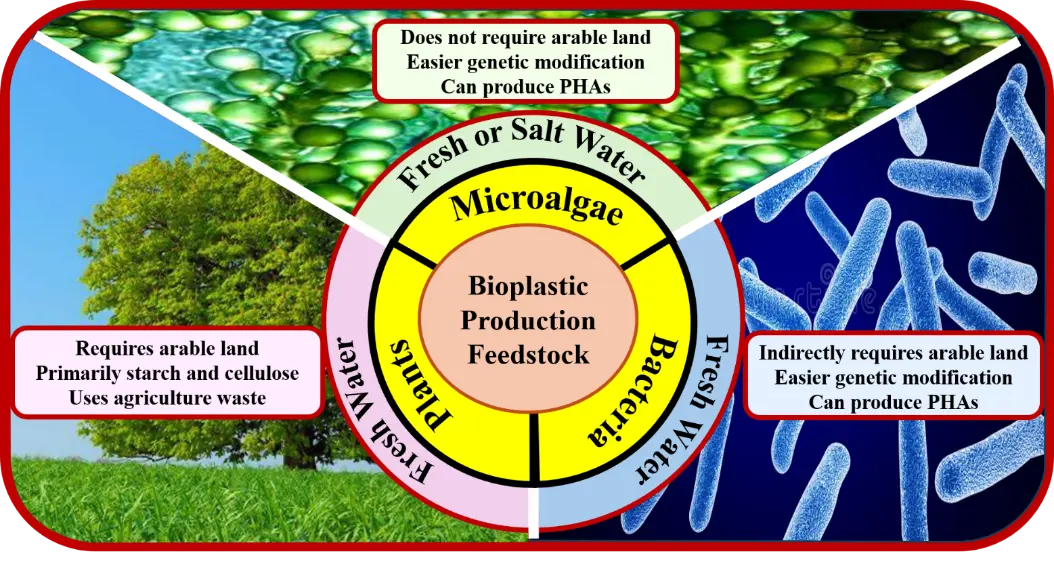
As a third-generation source of biomass, microalgae can be more sustainable than plants and bacteria (Figure 1), with high growth rates and strong potential for the production of organic compounds [13,14]. Unlike crops, algal cultures do not require arable land for growth, preventing competition with food crops and associated costs [15,16]. While bacteria do not compete with food crops directly for arable land, the majority of bacteria used as a source of biomass require organic carbon sources, most commonly from agriculture [17], but photosynthetic microalgae are more sustainable by minimizing the amount of organic carbon compounds needed for growth [18]. Another advantage of microalgae is their ability to be cultivated in a controlled environment, potentially enabling year-round production, compared to crops, which have a growing season [19]. Microalgae can also be used for carbon fixation, providing the carbon compounds needed for growth and bioplastic synthesis while sequestering atmospheric CO2 [20]. Not only is this valuable for reducing the costs of organic carbon nutrients, but carbon fixation could potentially help with climate change mitigation strategies. Currently, bioplastics only account for <1% of annual plastic production, but the market growth rate for algal bioplastics has been predicted to grow by 13.2% by 2030 [21,22].
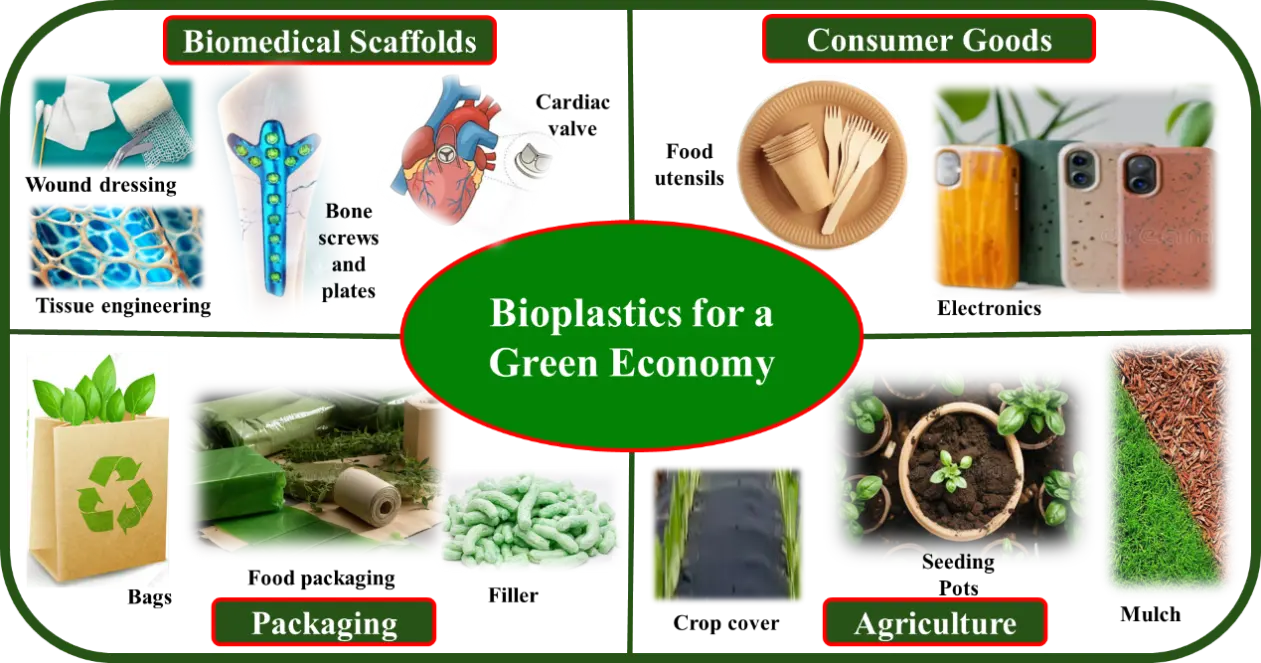
The biomanufacturing of bioplastics has been identified as a potential method of mitigating the environmental impacts of plastics. As outlined in Figure 2, bioplastics have found applications in food packaging [23], as mulch films in agriculture [24], biodegradable biomedical scaffolds [25], and other household items [26]. As of 2025, it is estimated that ~0.5% of plastics produced annually are bioplastics, with this proportion projected to increase [21].
The biomanufacturing processes for bioplastics from microalgae can be an essential element of the green economy. As an example, microalgal cultivation may be able to capture carbon and perform wastewater valorization [27,28,29]. Biodegradable bioplastics can reduce microplastic dissemination by being completely degraded upon disposal, unlike most petroleum-based plastics, although caution should be taken, as microplastics may still form if the digestion of bioplastics is incomplete [30]. Addition of algal biomass to biocomposites may also improve biodegradability, although this needs further study [31]. Life cycle assessments (LCAs) of bioplastics have shown lower GHG emissions and energy use as well as end-of-life biodegradability compared to conventional petrochemical-derived plastics [32,33]. It should be noted, however, that the land use change for the microalgae cultivation sites, as well as chemical additives to the bioplastics, may still increase overall GHG emissions [34,35]. Both positive and negative environmental impacts of bioplastics should therefore be considered in quantitatively evaluating the sustainability of microalgae-derived bioplastics.
Microalgae have shown great potential for biomanufacturing bioplastics, but technical and economic factors have limited their implementation. This review is therefore aimed at assessing potential scenarios for microalgae-derived bioplastics biomanufacturing, starting with microalgal bioresources for bioplastics and followed by technical routes for polymerization, microalgal cultivation, and downstream processing of microalgal biomass, from both technical and economic perspectives. We put our primary emphasis on reviewing established and emerging microalgal technologies suitable for bioplastic manufacturing from microalgae, such as synthetic biology, cultivation strategy, inexpensive dewatering, etc., with particular focus on advancements over the past decade. Lastly, several technical and economic challenges that prevent the large-scale adoption of microalgae-derived bioplastics are discussed, along with emerging technologies that may help overcome these obstacles.
2. Microalgae as Bioresources for Bioplastics
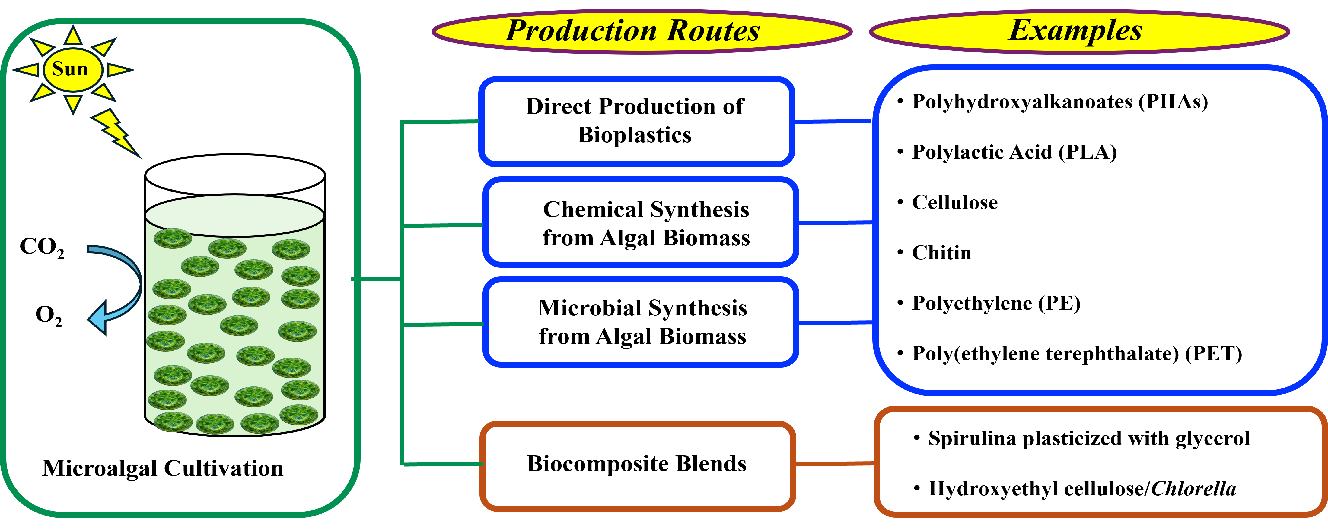
Microalgae can be used to manufacture bioplastics due to their ability to provide biopolymers and their precursors in their biomass, and the process’s sustainability can be enhanced by the fact that microalgae can utilize nutrients from waste streams such as wastewater or agricultural runoff for carbon and nitrogen, as well as CO2 from flue gases [36]. Microalgae have more flexibility to grow on a variety of nutrient supply scenarios compared to terrestrial plants and bacteria in suspension cell culture. Waste streams can be used to provide nutrients for the algal cultures, thereby integrating the processes into a circular economy framework, such as the cultivation of Tribonema minus on wastewater from food waste using Tribonema minus [37]. For an example of this approach in bioplastic production, polyhydroxybutyrates (PHBs) have been produced from B. braunii microalgae grown on sewage wastewater [38]. Microalgae can capture carbon and nitrogen compounds from flue gases and use them for growth, although pretreatment, such as photocatalysis, is required due to the inhibitory effect of nitric oxide on algal growth [39]. However, this process could be enhanced by upregulating microalgal genes to use sulfate (SOx) and nitrate compounds (NOx) found in flue gases. For example, Cheng et al. used strains of Chlorella exposed to simulated flue gases (composed of 10% CO2, 100 ppm SOx, and 200 ppm NOx), which showed upregulation of genes involved in sulfur and nitrogen metabolism, such as sulfur transport (CysA) and nitrate reductase (NR) [40]. These microalgae could therefore directly use sulfate and nitrate compounds in metabolic processes, increasing their tolerance to these compounds.
As an illustration of the advantages of microalgae-derived bioplastics, PHA synthesis can be compared and contrasted with other synthetic methodologies. Synthetic production of PHAs, especially PHBs produced from β-butyrolactone, is more controllable and tailorable than biosynthesis, but conventional chemical synthesis approaches require metal catalysts, which are toxic both to human health and the environment, may affect the conductivity of the resulting plastics, and are costly [41]. For biosynthesis, PHAs can be produced from plant biomass [42]. However, plants require arable land to grow and may still require an additional microbial fermentation step due to lower PHA production levels. As previously described, photosynthetic microalgae do not require arable land or the addition of large quantities of organic compounds for cultivation. Another potential advantage of using microalgae would be the ability to generate various products from the biomass, including PHAs and/or high-value products [43].
In this section, we will describe the biochemical composition of microalgae used in the manufacturing of bioplastics and their precursor molecules. A description of the algal species and the biopolymers they produce is given in Table 1. Species of microalgae (including cyanobacteria) that either produce a large quantity of precursors or can be engineered to do so using synthetic biology approaches will also be highlighted.
Table 1. Production of biopolymers from eukaryotic microalgae and cyanobacteria.
|
Algae Species |
Algal Product |
Bioplastics |
Approach |
Yields and Productivity |
References |
|---|---|---|---|---|---|
|
Eukaryotic |
|||||
|
Botryococcus braunii |
PHBs |
PHBs |
Biosynthesis from microalgae isolated from lake water |
0.382 mg/g dry weight by day 25 16.4% purity |
[44] |
|
Chlorella vulgaris |
Starch |
Thermoplastic starch |
Biosynthesis with nitrogen starvation |
200 g of starch from 430 g dry weight, with recovery of 98.5% and purity of 86.9% |
[45] |
|
PHAs |
PHAs |
Biosynthesis |
20.0% (dry weight) |
[46] |
|
|
Lipids |
PHAs |
Supercritical CO2 fluid extraction of lipids for PHA synthesis |
46.74% (w/w) lipids (PHA precursors) |
[47] |
|
|
Biomass |
PLA |
Bacterial fermentation of biomass for lactic acid production |
Lactic acid yield of 0.99 g/g, with productivity of 9.93 g/L/h |
[48] |
|
|
Nannochloropsis oceania |
Cellulose |
Cellulose nanofibrils |
Extraction of cellulose followed by oxidation |
Celulose content was 34 % of solid waste Produced nanofibrils with average height of 9.0 nm |
[49] |
|
Selenastrum gracile |
PHBs |
PHBs |
Biosynthesis followed by extraction with chloroform |
325 μg/mL PHB |
[50] |
|
Chlorococcum sp. |
PHBs |
PHBs |
Bacterial fermentation of biomass from microalgae grown on wastewater |
0.27 g PHB/g biomass (dry weight) |
[51] |
|
Chlamydomonas reinhardtii |
PHBs |
PHBs |
Biosynthesis enhanced by expression of bacterial PHB pathway genes |
Up to 21.6 mg/g (dry weight) 3600-fold increase compared to production in cytosol |
[52] |
|
Phaeodactylum tricornutum |
PHBs |
PHBs |
Biosynthesis enhanced by expression of bacterial PHB pathway genes |
27.9 mg/L with supplemented CO2, which was three-fold greater than with ambient CO2 |
[53] |
|
Desmodesmus communis |
PHBs |
PHBs |
Biosynthesis using two-phase cultivation (phototrophic growth phase and mixotrophic stresss phase) |
0.11 g (w/w) PHB per day 95% recovery of extracted PHBs |
[54] |
|
Scenedesmus sp. |
PHAs |
PHAs |
Biosynthesis with nutrient-enrichment by carbon dots |
5.7% per dry weight 26.92% increase compared to control |
[55] |
|
Cladophora sp. |
Cellulose |
Cellulose-ECH hydrogel |
Biosynthesis followed by cross-linking with ECH |
28% yield 97% purity |
[56] |
|
Cyanobacteria |
|||||
|
Arthrospira platensis |
PHBs |
PHBs |
Biosynthesis with supplementation of trehalose |
15.2 % PHBs (dry weight) DW 0.003 M trehalose increased biomass and PHB concentration |
[57] |
|
Leptolyngbya sp. SB090721 |
PHAs |
PHAs |
Biosynthesis by consortium with C. vulgaris |
31.4% w/w PHAs using cranberry residues as a carbon source |
[58] |
|
Nostoc |
PHBs |
PHBs |
Biosynthesis enhanced by expression of bacterial PHB pathway genes |
Over 20% PHB (dry weight) after 7 days of cultivation |
[59] |
|
Synechococcus elongatus |
PHBs |
PHBs |
Biosynthesis enhanced by expression of bacterial PHB pathway genes |
607.2 mg/L with acetate and 225 mg/L without |
[60] |
|
Synechocystis |
PHBs |
PHBs |
Biosynthesis enhanced by expression of bacterial PHB pathway genes |
Maximum yield of 12.0% PHBs (dry weight) compared to 8.0% for wild-type |
[61] |
2.1. Microalgal Metabolites for Bioplastics
There are several metabolites produced by microalgae that have potential applications in the manufacturing of bioplastics. Microalgae contain lipids (7–23%), carbohydrates (5–23%), and proteins (6–52%) [62]. These biopolymers may be used as macromolecule precursors or serve as substrates in the synthesis of precursor molecules. Additionally, the algal cells may synthesize other biopolymers for energy or carbon storage that, in turn, can be employed for the preparation of bioplastics. Two common polymers used in bioplastic biomanufacturing from microalgae will be discussed here: polyhydroxyalkanoates (PHAs) and polylactic acid (PLA). A schematic illustration of these biopolymers and two polysaccharides commonly used in bioplastic production, starch and cellulose, and their metabolic pathways within microalgal cells, is shown in Figure 3.
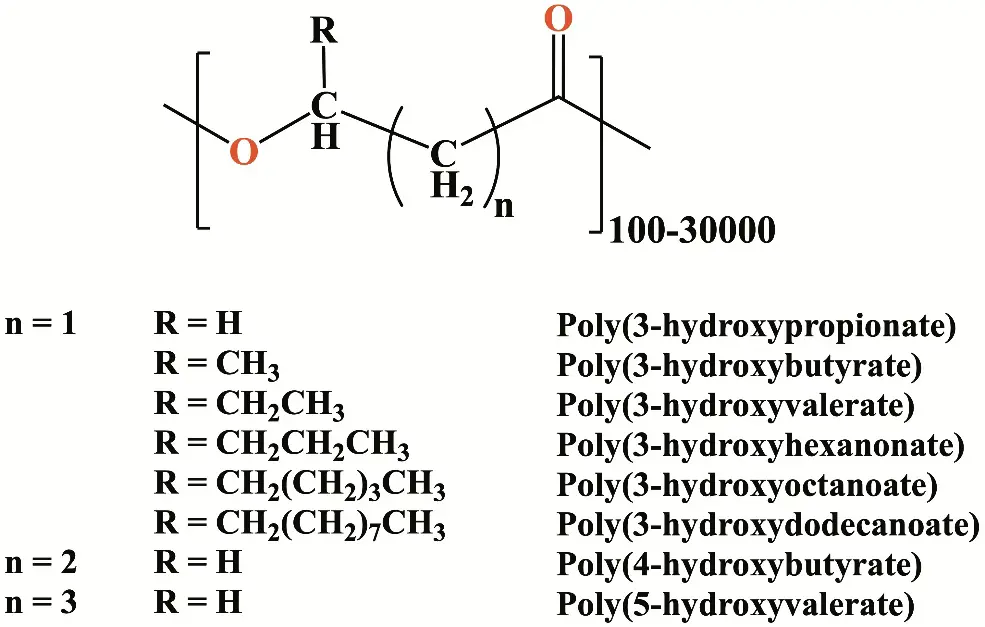
One of the biopolymers mostly studied for their application in bioplastics is PHAs, which have been demonstrated to have protective roles against cold and salinity stress for microbes [63,64]. The chemical structure of PHAs is polyesters, with a variable main chain length and side chain (R) for each monomer that can be repeated between 100 and 30,000 times, as shown in Scheme 1. The length of the side chain can be used to further divide PHAs into classes of short-, medium-, and long-chain PHAs. Short-chain PHAs such as poly(3-hydroxybutyrate) and poly(3-hydroxyvalerate) contain 4–5 carbons in the side chain, while medium-chain PHAs contain 6–14 carbons, such as poly(3-hydroxyhexanoate), and long-chain PHAs contain 15 or more carbons, such as poly(3-hydroxyhexadecanoate) [65].
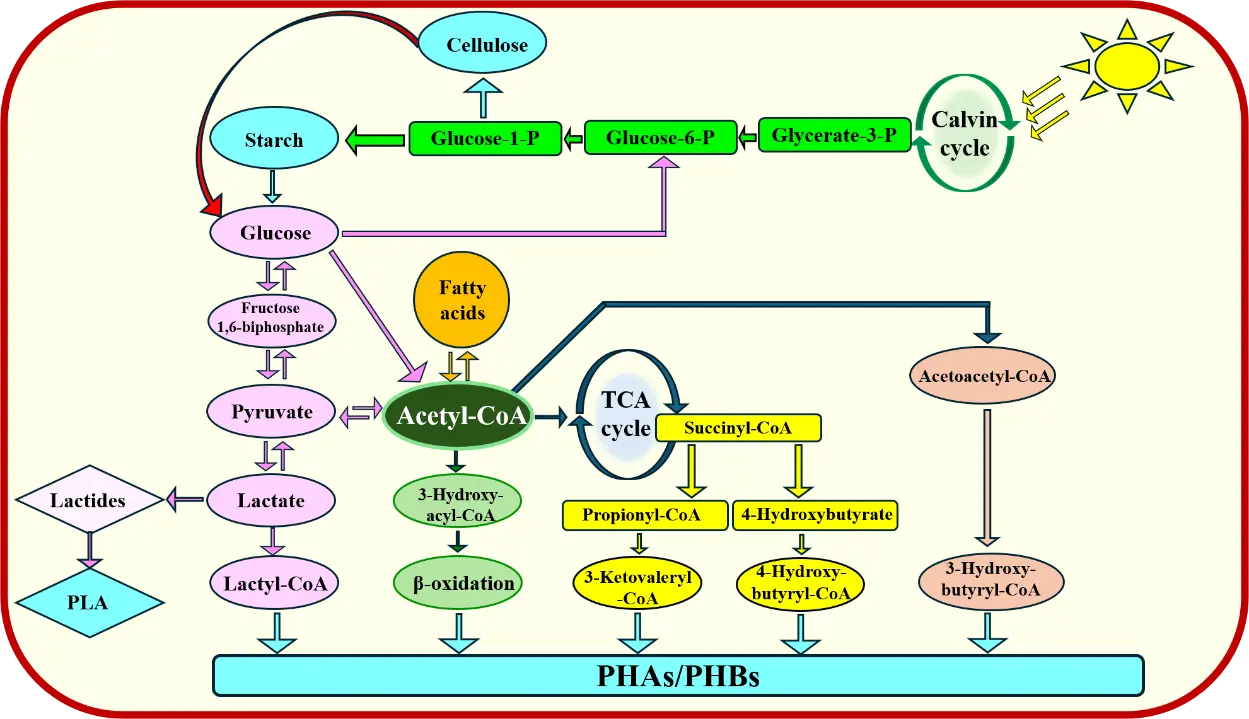
Figure 3. Schematic diagram of microalgal metabolic pathways towards biopolymers PLA, PHAs (including PHBs), starch, and cellulose.
Special interest should be paid to poly(3-hydroxybutyrate) in the formation of PHBs, which have been commonly explored from various sources, including bacteria and microalgae [66]. Both lipid and carbohydrate content can be converted to acetyl-CoA, which can then lead to the synthesis of various monomers for PHAs.
PLA is a polymer of lactic acid, which is usually found in cells in the form of lactate. Lactate can be biosynthesized using fermentation from different carbon sources, including carbohydrates and lipids, which form pyruvate that can then be reduced to lactate via the enzyme lactate dehydrogenase (LDH) [67]. In addition to providing lactate for chemical synthesis of PLA, microalgae can be metabolically engineered to produce PLA using the PHA synthetic pathway, although with lower specificity than PHAs [68]. The biosynthesis of PLA uses a similar polycondensation mechanism to PHA synthesis, with the exception that coenzyme A (CoA) is first transferred from acetyl-CoA to lactate to form lactyl-CoA (via the enzyme CoA transferase), then the lactyl-CoA is used as the monomer for PHA synthase [69].
Not surprisingly, commonly occurring biopolymers from microalgal cells, such as carbohydrates (especially polysaccharides) and proteins, can be modified for use as bioplastics. Polysaccharides in algal cells have been used for bioplastics, including starch and cellulose [70,71]. As polysaccharides are produced by microalgae for structural or energy storage uses and are readily digestible by many microbes, they are easy to produce and biodegradable. This makes polysaccharide-based bioplastics attractive for further modification [72]. Downsides of this class of bioplastics include their hydrophilicity, brittle structures, and thermal instability [73]. Hydrophilicity is a particular issue for food packaging, and though biodegradable, such materials would also be less effective at repelling water [74]. A more hydrophobic polysaccharide that has been investigated for bioplastics applications is chitin, which is commonly found in the shells of crustaceans [75]. In fact, chitin is also a component of the cell walls of some microalgae, such as Chlorella vulgaris, which has recently been studied as a potential alternative source for chitin [76]. Additionally, chitin nanofibers are excreted by diatoms of the genera Cyclotella and Thalassiosira [77,78]. Protein-based bioplastics have been less of a focus in microalgae due to their less desirable mechanical properties, particularly their higher hydrophilicity and stiffness, as well as lower tensile strength [79,80,81]. However, the high protein content of the cyanobacterium Spirulina and its low production cost have led to the whole-cell biomass being explored for manufacturing biocomposites rather than extracting proteins [82,83], which will be discussed further in Section 3.3: Biocomposite Blends.
2.2. Wild-Type Microalgal Species for Bioplastics
There are several microalgae that have shown potential for bioplastic and biocomposite biomanufacturing, including both wildtype strains that can produce large quantities of the precursor molecules, such as Chlorella sp., Spirulina (Arthrospira platensis), Botryococcus braunii, and Nannochloropsis sp., as well as algae that can be engineered using synthetic biology approaches for bioplastic biomanufacturing, such as Chlamydomonas reinhardtii and Phaeodactylum tricornutum. A few examples of microalgal species and their potential bioplastic applications are discussed below.
The microalga Chlorella, especially the species C. vulgaris, is commonly used in commercial microalgae cultivation, and it can accumulate starch for bioplastic manufacturing [45]. Botryococcus braunii has shown the ability to accumulate large amounts of PHBs [44]. This species also undergoes cycles of natural algal blooms that can generate large quantities of biomass, making it a potential source of bioplastics that can be harvested from natural environments [84]. Nannochloropsis is a microalga with high lipid content that is easy to cultivate and has therefore been commonly used in aquaculture [85]. Residual biomass of N. gaditana from biodiesel biomanufacturing has been plasticized with glycerol for incorporation into biocomposites with poly(butylene adipate-co-terephthalate (PBAT) [86]. Another species, N. oceania, has been used in the preparation of cellulose nanofibrils [49]. Other microalgae investigated for bioplastic biomanufacturing from PHBs include Selenastrum gracile [50] and Chlorococcum sp. [51].
Several cyanobacteria have also found applications as bioplastic producers. Most notably, biomass consisting of whole dried Spirulina cells has shown potential use for biopolymers and biocomposites [87]. PHB production from A. platensis has been induced in nitrogen-deficient conditions when supplemented with the disaccharide trehalose [57]. The marine cyanobacteria species Leptolyngbya valderiana, Oscillatoria salina, and Synechococcus elongatus have also demonstrated the ability to produce PHAs, with the highest growth and extraction of most thermally stable PHAs being exhibited by L. valderiana [88]. Another species of Leptolyngbya was cultivated in a consortium with C. vulgaris and yielded 31.4% w/w PHAs using cranberry residues as a carbon source [58].
2.3. Microalgal Species Modified by Synthetic Biology
Synthetic biology can promote bioplastic manufacturing from microalgae through two commonly employed strategies. One strategy is to use synthetic biology to modify wild-type microalgae to improve yield. Another strategy is to develop commonly used microalgal strains that are easier to grow or less sensitive to changes in cultivation conditions into chassis and to further engineer these chassis for bioplastic manufacturing. Transgenic strains of C. reinhardtii were developed earlier to increase PHB production [89]. More recently, transgenic C. reinhardtii were used to express the phaA, phaB, and phaC genes for PHB synthesis and to target the products to peroxisomes rather than the cytosol, thereby further increasing PHB concentration [52]. The diatom P. tricornutum has been used to biosynthesize PHBs by increasing the expression of the phaA, phaB, and phaC genes [53,90]. Increased PHB production could then be achieved by supplementation of P. tricornutum with glycerol as an organic carbon substrate. A mutant strain of the cyanobacterium Synechocystis with a knockout of the adc1 gene (which codes for the enzyme arginine decarboxylase (ADC)) achieved an increase of 36.1% by weight for PHB, without having a significant impact on cell growth [91]. A better understanding of metabolic pathways for PHA synthesis would be needed to more precisely control the biosynthetic processes. For example, a recent study used genomic and phylogenetic analyses to examine Spirulina cyanobacteria to identify the mechanisms involved in PHB biosynthesis [92]. In particular, Spirulina major was found to utilize other stress mechanisms such as degradation of chlorophyll as well as metabolism of xanthine and selenocysteine instead of PHBs, while a strain of Limnospira fusiformis was identified for relatively high PHB production under nutrient limitation. Further study into the evolution of these adaptive mechanisms together with systematic metabolic engineering approaches could therefore provide new opportunities to optimize strains for processes such as bioplastic biomanufacturing.
3. Technical Routes of Bioplastic Manufacturing from Microalgal Biomass
Microalgal biomass represents a promising renewable feedstock for bioplastic production, offering advantages such as rapid growth, high photosynthetic efficiency, and the ability to thrive in non-arable environments while sequestering carbon dioxide. Unlike traditional petroleum-based plastics, bioplastics derived from microalgae can be biodegradable, reducing environmental pollution and supporting circular economy principles. This section explores the primary technical routes for converting microalgal biomass into bioplastics, including direct synthesis within the algae, chemical or microbial processing of extracted precursors, and the formation of biocomposite materials. These approaches leverage the natural accumulation of polymers such as PHAs, polysaccharides, and lipids in microalgae while addressing challenges in yield, cost, and scalability through innovative cultivation, extraction, and engineering strategies.
3.1. Direct Microbial Synthesis
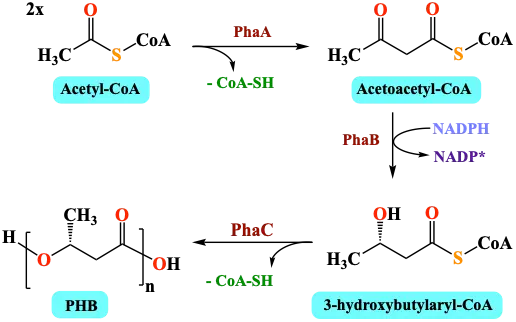
In addition to common polymers such as carbohydrates, lipids, and proteins, certain species of microalgae can naturally synthesize PHAs [93,94]. A schematic diagram of the major PHA synthetic pathway is shown in Scheme 2. Two acetyl-CoA molecules are subsequently converted to acetoacetyl-CoA by an acetyl-CoA transferase (encoded by the gene phaA). Next, the resulting acetoacetyl-CoA can be reduced by an acetoacetyl-CoA reductase (encoded by the gene phaB) to produce the corresponding monomer, such as 3-hydroxylbutanoyl-CoA for PHBs. The polymerization of these monomers into PHAs is catalyzed by the enzyme PHA synthase, encoded by the gene phaC [95]. Both Spirulina and C. vulgaris have been identified as potential PHA-producing organisms, specifically PHB with comparable properties to commercial products [46]. Stress conditions can be used to trigger the production of precursors that are used for carbon and energy reserves, including PHAs, lactic acid, and lipids. The stress may be due to nutrient limitation, especially nitrogen or phosphorus [66], or salinity [64]. Direct synthesis of bioplastics such as PHAs is desirable not only for reducing chemical synthesis, which can reduce toxic or environmentally harmful waste products, but as a simpler and potentially cost-effective synthetic approach. On one hand, PHAs synthesis by microalgae may result in better quality control and higher molecular weight polymers than can be achieved synthetically [96]. On the other hand, microalgae generally produce lower quantities of PHAs compared to bacteria, but the corresponding increased costs may be offset using circular economy and biorefinery approaches.
A variety of strategies have been applied to increase the synthesis of biopolymers in microalgae. Higher production of PHB was achieved in Desmodesmus communis using a two-phase cultivation approach, with a phototropic phase to enhance growth of the cells, followed by a mixotrophic stress induction and PHB production phase [54]. Carbon dots with attached nitrogen and phosphorus compounds were added to cultures of Scenedesmus sp. to enhance growth and PHA production [55]. These carbon dots enabled more concentrated nutrients that can be used for growth, despite general nutrient-depletion conditions in the media, thereby triggering a stress response. In addition to cultivation conditions, the extraction of precursor molecules can also be enhanced to achieve higher recovery from algal cells. For instance, the extraction of PHA precursors with supercritical CO2 after cultivation of C. vulgaris demonstrated improved recovery and reduced heavy metal contamination [47]. Finally, consortia of photosynthetic algae (including cyanobacteria and eukaryotes) may reduce the chance of contamination by heterotrophic microbial species while maintaining the output of precursors such as PHAs and polysaccharides [97]. However, it is important to consider that interactions among individual species in the consortium will be critical for promoting the synthesis of specific molecules of interest [98].
Synthetic biology can be used to upregulate the synthetic pathways to increase the yield of precursors for further conversion into bioplastics. For example, a recombinant strain of Nostoc has been used to enhance PHB synthesis using the phaC1AB operon of the PHB pathway from the heterotrophic bacterial strain Cupriavidus necator H16 [59]. Genes from the same operon have previously been used in the genetically modified cyanobacterium Synechococcus elongatus, with the addition of acetate to increase the concentration of acetyl-CoA, yielding an increase in PHB concentration [60]. Random mutations using the chemical mutagen ethyl methanesulfonate (EMS) followed by selection using fluorescence-activated cell sorting (FACS) have been used to identify PHB producing mutant strains of Synechocystis [61]. These mutant strains not only serve as potential PHB overproducers, but future work could be done to introduce stable mutations into wild-type strains using synthetic biology. Modification of microalgae using synthetic biology approaches such as metabolic pathway engineering or ab initio design of biosynthetic networks would allow for a simpler approach using direct biosynthesis of bioplastic precursors, while potentially achieving production comparable to chemical or microbial synthesis using the algal biomass.
3.2. Chemical and Microbial Synthesis from Algal Biomass
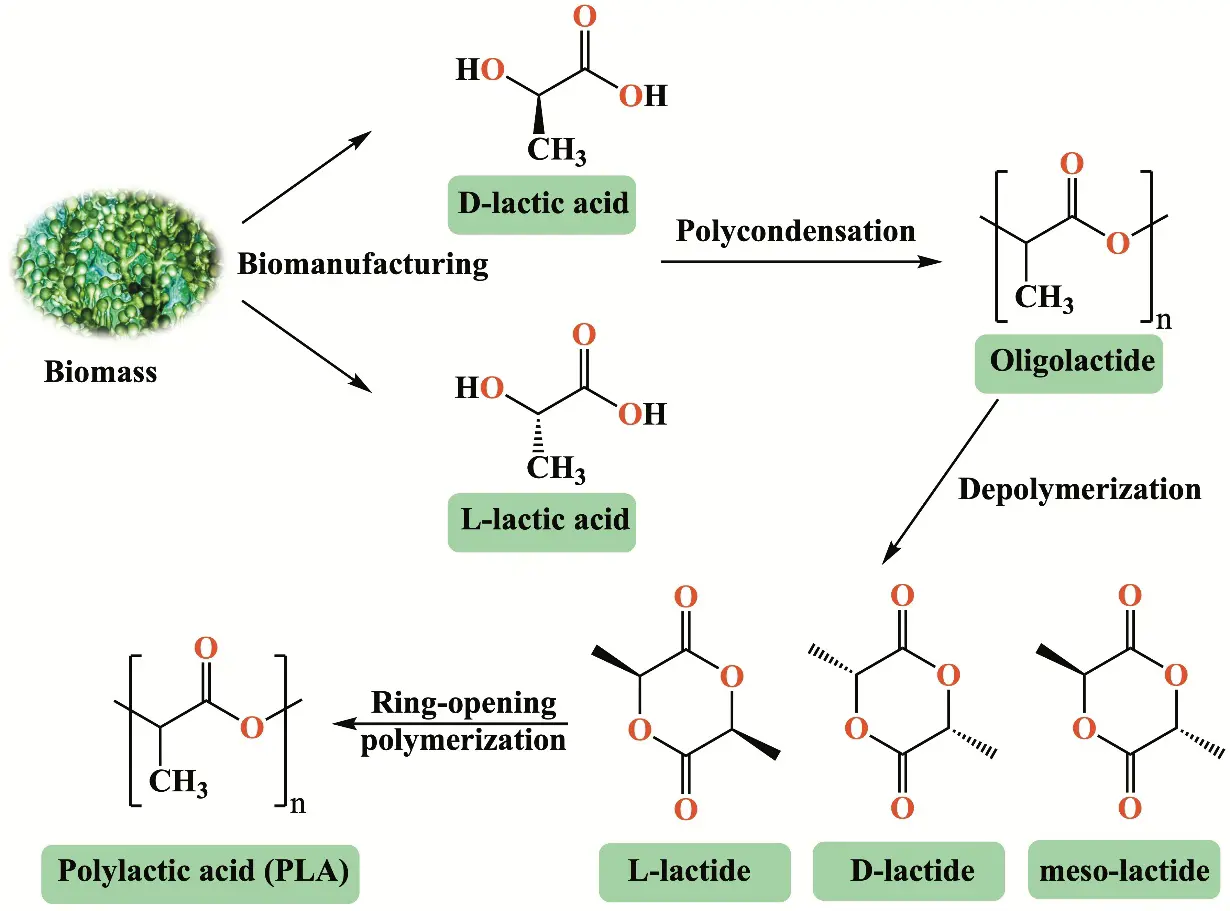
Another approach to bioplastic biomanufacturing is to cultivate the microalgae to produce biomass, then synthesize the bioplastics from the precursors either through chemical treatments or by further processing using other microbes, such as bacteria. For example, chemical synthesis of PLA can use lactic acid derived from microalgae. After cultivation, the lactic acid monomers (both l- and d-isomers) can be converted to oligolactides via polycondensation, as shown in Scheme 3 [99]. The resulting oligolactides then undergo depolymerization into cyclic lactide dimers. These cyclic l-, d-, or meso-lactides subsequently undergo ring-opening polymerization, resulting in PLAs with a range of potential stereoisomers.
Biopolymers from microalgae may also be chemically modified to form bioplastics. For instance, cellulose from Cladophora sp. was crosslinked through epichlorohydrin (ECH) in a hydrogel method [56]. The resulting bioplastic showed improved thermal and mechanical performance due to higher crosslinking. In addition, after five days of being buried in soil, the bioplastic exhibited 40% weight loss, showing that it was highly biodegradable. A common approach used for bioplastics is the polymerization of ethanol to form bio-PE, which is chemically identical to PE derived from petrochemicals [100]. While biorefinery for ethanol from microalgae has been a focus of research [101], these “drop-in” bioplastics are identical to petrochemical-derived plastics, which tend to be non-biodegradable [102]. Drop-in bioplastics are, therefore, less sustainable and should be avoided in favor of more sustainable, biodegradable alternatives. An advantage of these synthetic approaches includes a higher yield that can be refined into bioplastic precursors. Alternatively, chemical treatments have more adverse impacts on sustainability (especially if the resulting plastics are non-biodegradable) and energy consumption compared to biosynthesis.
Bacterial biomanufacturing could also be performed on microalgal biomass rich in carbohydrates and/or lipids to produce the bioplastics or their precursors [103]. Advantages of this method include improved yields due to the higher growth rates of heterotrophic bacteria, as well as the previously described advantages of microalgae, including no need for arable land and ability to perform carbon fixation. Conversely, this method requires an extra step compared to biomanufacturing by the microalgae alone, which in turn would increase process costs. Bacterial cultivation has been used to produce lactic acid for PLA using Lactobacillus plantarum to ferment hydrolyzed biomass of C. vulgaris as a feedstock [48]. There has been some recent research into improving the activity of bacterial fermentation of microalgal hydrolysates for the production of lactic acid. For example, Bilgin et al. used pretreatment of C. vulgaris by the commercial enzymes Viscozyme and Alcalase for enzymatic hydrolysis, producing 151.18 mg/g dry weight of reducing sugars, which were converted into 17.35 g/L lactic acid by Lactobacillus plantarum [104]. Similarly, Tu et al. used dilute sulfuric acid to hydrolyse C. vulgaris, which allowed for 10.7 g/L lactic acid after 24 h of fermentation by Lactobacillus casei. However, the use of these approaches in the polymerization of PLA, as well as production on larger scales, would require further investigation [105]. A combination of microbial and chemical treatments may also be applied, as shown by the work of Won and coworkers [106]. The authors proposed an integrated co-production process for PLA and azelaic acid using microbial biosynthesis, while polyurethane (PU) was derived from microalgal triglycerides through chemical conversion to polyols and reaction with toluene diisocyanate for crosslinking [106]. Additionally, PHB may be efficiently generated from microbial fermentation of the de-oiled biomass cake (of Chlorella or Scenedesmus) remaining after biodiesel biomanufacturing [107,108]. These studies used aerobic bacteria from wastewater for the fermentation process, demonstrating the potential for circular economies in both microalgal-derived biofuel and bioplastic biomanufacturing. Additionally, the combination of biofuel and bioplastic biomanufacturing could be more cost-effective than either process alone. Engineering of E. coli has been employed to improve biomanufacturing, while using the microalgae as a feedstock for bacterial fermentation [109]. While direct synthesis by microalgae is simpler as it requires only a single step, growth and levels of precursor production are higher for bacterial biomanufacturing. In addition, synthetic biology approaches for the synthesis of bioplastic precursors, such as PHAs, have been better established in bacteria than in microalgae [110]. As a result, bacteria are currently used for biomanufacturing large quantities of bioplastics using algal feedstock as raw material. However, if the growth and production of precursors in algae could be enhanced, direct synthesis of bioplastics could become competitive with bacterial biomanufacturing.
3.3. Biocomposite Blends
In addition to bioplastics, various biopolymers may be blended to create biocomposites with improved properties that serve similar purposes to bioplastics. Ideally, biocomposites may be made from multiple biodegradable biopolymers to take advantage of each component’s properties without use of petrochemical-derived plastics. For example, blends of starch and chitosan can be extracted from microalgae to generate biodegradable plastic films with greater water stability and strength than similar starch-based films [111]. The addition of plasticizers, such as glycerol, and compatibilizers, such as maleic anhydride, to biopolymers can also improve mechanical properties [112,113].
Algal biomass can also be used directly to make biocomposites with existing polymers. Biomass from the cyanobacterium Spirulina of particular interest due to its ability to form fibers with relatively high tensile strength. A PE composite with Spirulina was constructed through rotational molding and represented up to 15% biomass by weight [114]. This composite also had increased thermal stability due to inhibited oxidation of PE. A biocomposite of gluten, plasticized with glycerol and 1,4-butanediol, using Spirulina biomass as a filler, reduced water absorption in addition to maintaining the elasticity and strength of the resulting materials [115]. Spirulina biomass, treated with glycerol as a plasticizer, has also been shown to form plastic sheets [116]. These sheets were not just non-toxic but even edible, which made them usable as food packaging materials. Although the energy consumption to produce them (3.83 MJ/kg) was higher compared to two conventional plastic films, 22% higher than for polyvinyl chloride (PVC) and 12% for LDPE, only 1.99 kg CO2 equivalents were released, i.e., 47% lower than PVC and 23% lower than LDPE.
While Spirulina has been a focus of study, other microalgae have also been investigated for the formation of biocomposites. Addition of C. sorokiniana to ethylene vinyl acetate (EVA) resulted in a higher level of crosslinking, which was consistent with the larger foam expansion and tensile strength exhibited in comparison with EVA alone [117]. Also, the microalgal biomass yielded superior melt flow (2–5x higher) for EVA foam, improving its recyclability. A composite of PLA and microalgal residual biomass from a water treatment plant was prepared by Machado et al., who noted that 10% algal biomass improved the elasticity and tensile strength properties of the resulting composite, with an increase in Young’s modulus from 2140.15 MPa of PLA alone to 6442.58 MPa and the stress at break from 25.01 to 84.15 MPa [118]. Further, composites with 40–50% algal content could be rapidly biodegraded within 120 days. Similarly, microalgal residual biomass from a water treatment station in China was added to PLA as well as PBAT to form a biodegradable composite with low phytotoxicity [119]. PU and an extract of Scenedesmus obliquus in chloroform were combined to form antimicrobial biocomposite films. Films containing 40% PU by weight resulted in complete inhibition of Gram-positive Enterococcus faecalis and Gram-negative Escherichia coli growth after two hours [120]. Finally, microalgae have recently also shown potential for being integrated into 3D-printed scaffolds [121]. For example, a composite of hydroxyethyl cellulose with Chlorella was used to prepare a bioink for 3-D printing [122]. Hydrogen bonding between the polymer and the microalgal cells formed a stronger, more flexible material that could serve as a thermal insulator, while controlled dehydration ensured the biocomposite would not crack during drying. These examples (summarized in Table 2) demonstrate the potential value of biocomposites containing microalgal biomass. It should be noted, however, that the effect of algal biomass on biodegradability in biocomposites is not well-explored and needs further study as this field continues to expand [123].
Table 2. Physical, mechanical and thermal properties of biocomposites containing microalgal biomass.
|
Biocomposite |
Physical |
Mechanical |
Thermal |
References |
|---|---|---|---|---|
|
PE-Spirulina |
Water absorption increased from 0.34% for PE to 18.77% for composite containing 15% biomass, allowing for greater dimensional stability |
Tensile strength reduced by 18% by addition of 5% biomass.
Tensile elastic modulus was not significantly different from PE (~16 MPa) |
Microalgal biomass allows composite to resist thermooxidation of PE, increasing oxidation induction time from 0 min (pure PE) to 58.0 min (10% biomass)
Reduction in the initial thermal degradation temperature (T5%) by 32% for composite containing 15% biomass, but these temperatures are below the mold temperature and would not affect processability |
[114] |
|
Gluten-Spirulina |
Reduced the water contact angle from 41° to 22°, resulting in higher hydrophobicity of the composite |
Increased tensile modulus from 36.5 to 273.1 MPa
Increased tensile strength from 3.3 to 4.9 MPa |
Improved thermal stability up to 120 °C |
[115] |
|
EVA-C. sorokiniana |
8.8–16.7 times larger foam expansion relative to EVA due to nucleation around microalgal cells |
Higher stress values for spray dried formulation 1.23–1.29 MPa compared to freeze dried (0.86–0.90 MPa) |
Yielded superior melt flows of 5–12 g/10 min, 2–5x higher than EVA foam, improving its recyclability |
[117] |
|
PLA-residual algal biomass |
Increase in film thickness to 0.270 mm for 50% algal biomass content |
Optimal 10% algal biomass content increased Young’s modulus three-fold from 2140.15 to 6442.58 MPa and stress at break from 25.01 to 84.15 MPa |
Maximum thermal degradation temperature decreased from ~350 °C for PLA to as low as ~330 °C for films containing 50% biomass, but still within a narrow range close to PLA |
[118] |
|
PLA-PBAT-residual algal biomass |
Biodegradable with a maximum weight loss of ~18% after burial in soil for 8 weeks, no detectable phytotoxicity |
20% biomass yielded tensile strength of 6.24 MPa, with low flexural modulus of 200 MPa in blends with high PLA content, showing increased softness. |
Enhanced thermal stability ranged from 120–180 °C, which would improve processing below melting points of either PLA or PBAT |
[119] |
|
PU-S. obliquus |
Film containing 40% algal extract inhibits growth of Gram-positive S. aureus and E. faecalis, Gram-negative E. coli and P. aeruginosa, and fungus C. albicans by >99.7% after 2 h of contact |
10% algal extract increased Young modulus 11.56 MPa and tensile strength to 58.9 MPa (compared to 9.98 MPa and 10.72 MPa for pure PU ) |
Increased thermal stability, as shown by increased mass residue of 25.6% after addition of larger proportions of algal extract (20–40%) compared to 21.9% for pure PU. |
[120] |
|
Hydroxyethyl cellulose-Chlorella |
HEC content increased density of composite due to smaller defects on the surface, from 0.87 g/cm3 for 3% HEC to 0.96 g/cm3 for 10% HEC |
Chlorella with 10% HEC exhibited bending stiffness of 1.7 GPa·cm3/g |
Low thermal conductivity of 0.10 W/mK, allowing these materials to act as thermal insulators |
[122] |
4. Microalgal Technologies for Bioplastic Biomanufacturing
Microalgae represent a promising platform for the sustainable production of bioplastics, offering a renewable, carbon-neutral alternative to petroleum-based polymers. These photosynthetic microorganisms can convert CO₂ and sunlight into valuable biomass rich in biopolymer precursors, such as PHAs, PHBs, and starches, while requiring minimal arable land and potentially integrating with wastewater treatment or carbon capture systems. This section explores the key microalgal technologies underpinning bioplastic biomanufacturing, beginning with the selection of cultivation modes—autotrophic, heterotrophic, and mixotrophic—to optimize growth and precursor accumulation. It then delves into process optimization strategies, including nutrient management, light distribution, temperature control, and pH regulation, which are essential for maximizing yields. A comparative analysis of cultivation systems follows, contrasting open ponds with closed photobioreactors (PBRs) and their various designs, highlighting trade-offs in scalability, contamination risk, and energy efficiency. Subsequent discussion addresses biomass harvesting techniques, such as flocculation, centrifugation, sedimentation, filtration, and flotation, which constitute a significant share of production costs and require innovation to achieve industrial viability. The section concludes with an examination of research needs, future directions, and emerging technologies, including synthetic biology tools like CRISPR/Cas9, IoT-enabled monitoring, and AI-driven optimization, to overcome current bottlenecks and enhance economic and environmental sustainability. By addressing these technological facets, this review underscores the potential of microalgae to drive a circular bioeconomy in bioplastics production.
4.1. Optimization of Cultivation Conditions
Optimization of the cultivation conditions for microalgae is critical to enhancing their growth and bioplastic output. Therefore, optimizing these parameters involves strategic manipulation of environmental and nutritional factors to maximize biomass accumulation and the synthesis of bioplastics such as PHAs and polysaccharides in microalgae [124,125]. One of these parameters is the growth mode used to cultivate the microalgae, including both autotrophy and heterotrophy. For autotrophy (specifically phototrophy), algae harness sunlight and inorganic carbon to grow via photosynthesis, resulting in lower yields of biomass and biopolymer precursors but ensuring low levels of microbial contamination. Autotrophic cultivation enhances environmental sustainability through carbon sequestration and synergy with wastewater remediation, but suffers from inherently lower biomass productivity and bioplastic precursor accumulation rates [126]. The other downside of autotrophy is its vulnerability to environmental fluctuations and microbial contamination in outdoor open cultivation systems, making the process highly influenced by local climate conditions. Heterotrophic growth of microalgae allows the use of organic carbon sources for energy, which can lead to higher biomass yields. Conversely, heterotrophic cultivation, dependent as it is on organic carbon feeds often sourced from industrial byproducts, excels in delivering superior precursor content and rapid growth under controlled conditions, minimizing external dependencies like weather while facilitating scalability in bioreactors [127]. However, this comes at the expense of heightened energy demands and potential substrate costs, underscoring the need for waste-integrated strategies to bolster sustainability and affordability. Therefore, a synergistic mixture of both modes, known as mixotrophy, has been employed to enhance microalgal growth [128]. Mixotrophic approaches, blending photosynthetic and heterotrophic mechanisms, offer a compelling middle ground by optimizing resource utilization, such as combining CO2 fixation with organic supplements from effluents to enhance productivity and bioplastic precursor yields, while reducing operational complexity compared to pure heterotrophy [129,130]. An advantage of mixotrophy is that microalgae can grow effectively even under nutrient stress, thereby enabling stimulation to produce diverse high-value compounds [131]. On the other hand, the addition of high concentrations of organic compounds in mixotrophic conditions may actually inhibit algal growth [132]. As an example of mixotrophy for bioplastic biomanufacturing, the mixotrophic cultivation of Synechococcus elongatus grown under the stress of nitrogen and phosphorus deficiency resulted in an increase in yield for both biomass and production of PHAs [133]. Also, the use of mixotrophy has been shown to cause accumulation of long-chain carbohydrates such as starches [134]. The challenges for mixotrophy can stem from instrumentation and implementation because the relatively inexpensive mixotrophic cultivation systems have not yet been fully developed and established. In summary, cultivation modes might be the primary factor influencing overall process viability of microalgal bioplastics in terms of environmental impact, economic feasibility, and operational efficiency. Ultimately, in order to advance microalgal bioplastics toward commercial maturity, it will be important to integrate these modes with emerging tools like genetic modifications and adaptive stress protocols, which together could unlock greater efficiencies, particularly in circular economy frameworks where wastewater valorization plays a pivotal role.
In addition to the growth mode, nutrient management, particularly through controlled depletion of elements like nitrogen or phosphorus, can trigger metabolic shifts that favor the storage of lipids and carbohydrates, thereby enhancing the overall quality of biomass suitable for biopolymer production. While microalgae require nutrients to grow effectively, specific nutrient depletion can stimulate enhanced production of lipids and fatty acids [135], as well as specific biomolecules used as bioplastic precursors such as PHBs [136]. There are also factors that can fluctuate across the volume and duration of the microalgal culture, resulting in variable growth rates, including light, temperature, gas exchange, and pH. Light and CO2 are necessary for photosynthesis, but need to be distributed evenly throughout the culture. Light optimization focuses on adjusting intensity, duration, and spectral composition, often emphasizing red and blue wavelengths to improve photosynthetic efficiency and carbon fixation, while ensuring even distribution to prevent photoinhibition and support uniform growth across the culture. [137]. The pH of the culture media affects growth and nutrient uptake, particularly nitrogen in the form of ammonium (NH4+), although the ideal range varies based on the microalgal species [138]. Temperature regulation, maintained within species-appropriate ranges, influences enzymatic activities and metabolic processes, with advanced monitoring and modeling techniques helping to mitigate fluctuations and sustain consistent productivity [139]. Additionally, CO2 enrichment paired with pH control in alkaline conditions promotes better carbon uptake and nutrient assimilation, though mixing methods must be balanced to avoid shear stress that could harm sensitive strains [140]. Several different cultivation systems have therefore been designed to optimize these conditions for the industrial cultivation of microalgae. Complementary approaches, such as integrating symbiotic microbial communities or utilizing industrial waste streams for CO2 and nutrients, can reduce costs and boost precursor accumulation through efficient resource cycling, further aided by data-driven tools like machine learning for parameter fine-tuning [141]. Moreover, synthetic biology techniques offer potential to develop more resilient strains tailored for higher yields under varying conditions, but face ongoing challenges related to ethics and regulations [142]. In essence, these holistic optimizations are crucial for advancing sustainable bioplastic production from microalgae and ultimately depend on balanced assessments of energy use and scalability for industrial viability.
Finally, although extremophilic microalgae have not been well studied for their use in the production of bioplastics, their ability to grow in extreme conditions that inhibit potential contamination may have potential applications in this area. For example, the extremophilic algal species Galdieria sulphuraria has been investigated for cultivation in non-sterile culture conditions, thanks to its high tolerance to acidity and heat [143]. In particular, this alga can be grown in the heterotrophic mode, allowing for greater biomass production while maintaining extreme culture conditions. Although G. sulphuraria has not been studied for the production of bioplastics, it has been shown to produce biomass rich in proteins and lipids that could serve as potential feedstocks for bioplastic production [144]. Another extremophile microalga, Chlamydomonas pacifica, has been a focus of research for high lipid and starch by the Mayfield group due to its ability to tolerate extremely basic pH (up to 11.5), high salinity (up to 2% sodium chloride), and heat (up to 42 °C) [145]. Genetic engineering was performed using mutagenesis via exposure to UV light followed by breeding and selection to yield a strain that showed increased light tolerance as well as lipid and starch production [146]. The biomass produced by this mutant strain was then converted into PU as a proof of concept for the use of C. pacifica in bioplastic production.
4.2. Cultivation Systems for Microalgae
To grow sufficient microalgal biomass at a large scale, industrial cultivation systems are needed. These may be open or closed, depending on whether they are exposed to the environment or enclosed inside a vessel, which can have drastically different impacts on microalgal growth, environmental impacts, and associated costs [147]. A key aspect of these cultivation systems is the scale, as some approaches may be highly efficient at smaller scales in the laboratory, but increase in cost or complexity at larger scales. A summary of open ponds and closed photobioreactors (PBRs) will be discussed, as well as examples of different designs and their advantages and disadvantages.
4.2.1. Open Ponds
In open ponds, microalgae are exposed to the environment, allowing access to air and light [148]. The main type of open system used for industrial cultivation is the raceway pond, which forms closed loops with microalgal cell culture circulating around the loop in order to mix the culture for homogeneous nutrient dispersion and to enhance convective gas transfer, typically with the stirring action of a paddle wheel [149]. Open ponds are cost-effective and suitable for large-scale cultivation, as the light for photosynthesis is provided by solar radiation, and atmospheric gas exchange can prevent accumulation of O2 [150]. Raceway ponds are the most widely used systems for high-tonnage, low-cost products like bulk algal biomass, as they have relatively low capital and operating costs, as well as lower energy consumption than closed systems [151]. Open systems, particularly raceway ponds using paddle wheels for mixing, are also simpler and more robust, as well as being easier to clean and maintain [152]. On the other hand, the exposure to the ambient environment in open systems can lead to an increased risk of contamination [153]. In addition, open ponds may have environmental impacts from accidental discharges, including potential eutrophication from high nitrogen and phosphorus concentrations [154]. Another disadvantage of cultivation with an open system is photoinhibition, a decrease in photosynthetic quantum yield due to excessive light exposure [155]. This can be handled in closed systems by improved vertical mixing, which is more difficult in open systems [156,157]. With regard to bioplastics, a pilot-scale open raceway pond was employed by Grivalský et al. for the production of PHBs from Synechocystis using urban wastewater, with a volume of 100 L, a depth of 15–25 mm, 5 m2 surface area, 0.2 m/s flow speed, and a maximum light intensity of 100–800 μmol·photons·m−2·s−1 [158].
4.2.2. Photobioreactors (PBRs)
An alternative to open systems is the use of closed photobioreactors (PBRs). In PBRs, the microalgae are grown in closed vessels filled with media supplemented with CO2 and light, provided either from sunlight or artificial lamps [159]. The enclosed environment allows for greater control over the growth conditions, reducing emissions and contamination while improving productivity [160]. Also, PBRs can be used in the capture of emissions to use as nutrients for microalgal growth [161]. However, depending on the context, PBRs can have a number of disadvantages, including being energy-intensive and more difficult to scale up [162]. As a result, open ponds remain more commonly used in industrial cultivation, although research is ongoing into designing PBRs with higher yields that can work on larger scales [163,164].
A few examples of different PBR designs are shown in Figure 4 [165]. Stirred tank PBRs agitate the microalgae culture broth in a tank using an impeller to mix the nutrients and promote gas exchange [166]. This class of PBRs is often not suitable for use in industrial cultivation due to the low surface area to volume ratio of the tank, which continually decreases while scaling up, as well as the force of the impeller on the medium, which results in shear stress that may kill or inhibit the growth of algal cells. For PHB generation from Synechocystis salina, Thuan and coworkers used cylindrical PBRs (volume 30 L) containing paddle stirrers, which were integrated with wastewater treatment [167]. However, the authors did identify the difficulty in scaling up this system for a pilot-scale bioreactor, although the high efficiency of nutrient removal by the cyanobacteria may reduce associated costs. Bubble column PBRs use large columns of algal cultures with CO2 bubbles to simultaneously deliver gas and stir the culture [168]. As an example of a bioplastic production using a bubble column, Dey et al., in a hybrid PBR that employed a 3D printed bubble generator attached to a 1.2 m bubble column, combined with a 200 L high-rate algal pond (HRAP) [169]. This system was designed for the fixation of atmospheric CO2 and production of PHBs from the indigenous microalga Poterioochromonas malhamensis. These bubbles may result in greater shear stress on the algal cells [170]. As with the stirred tank, the columns will have a lower surface area for light distribution, which will affect the overall efficiency of algal growth [171]. Tubular PBRs, such as vertical tube PBRs and horizontal tube PBRs [172], circulate microalgae through narrow tubes arranged in loops. Tubular PBRs increase light exposure and contain a degasser that can remove accumulated oxygen. Limitations of tubular PBRs include potential oxygen accumulation and a relatively narrow diameter, which may lead to fouling by the microalgae or difficulty removing contamination [173]. A horizontal tubular PBR (HTH-PBR) was applied for the valorization of wastewater effluents, with a volume of 2.5L (for a laboratory scale PBR) [174]. This reactor was used for the cultivation of Synechocystis sp., Synechococcus sp., or mixed cultures, using a mixture of wastewater from a septic tank and agricultural run-off. The highest PHB concentration achieved using this PBR was found for Synechocystis sp., with 5.04% PHB by dry weight. Another example of a tubular PBR was used with non-sterile conditions to grow Synechocytis for the production of PHB [175]. This hybrid PBR consisted of a 200 L reactor with an inner diameter of 60 mm, combined with a 2 m bubble column for degassing and LED lighting to compensate for the shaded location of the PBR. Flat panel PBRs, in which the culture flows in a thin layer mixed by agitation or gas bubbles, allow for equal distribution of light across the entire culture [176]. Flat panel PBRs could be scaled up by not increasing the size of the panel but rather adding more panels. However, the thin panels can lead to biofilm formation, causing biofouling that can result in shear stresses on the cells [177]. Innovative PBR designs combining distinct chemical reactor elements like airlift modules with features such as columns or flat panels are especially promising in terms of scalability and energy efficiency [178,179].
As can be seen from these examples, several parameters are important to consider for selecting PBR designs. First, light exposure is critical and needs to be well distributed throughout the reactor to prevent both photoinhibition and low light exposure. Additionally, effective mixing is required for gas exchange, homogeneous nutrient dispersion, and preventing temperature or pH gradients without causing stress to the cells. Finally, scaling up is a major concern, especially for PBR designs, which do not scale well regarding volume vs. surface area.
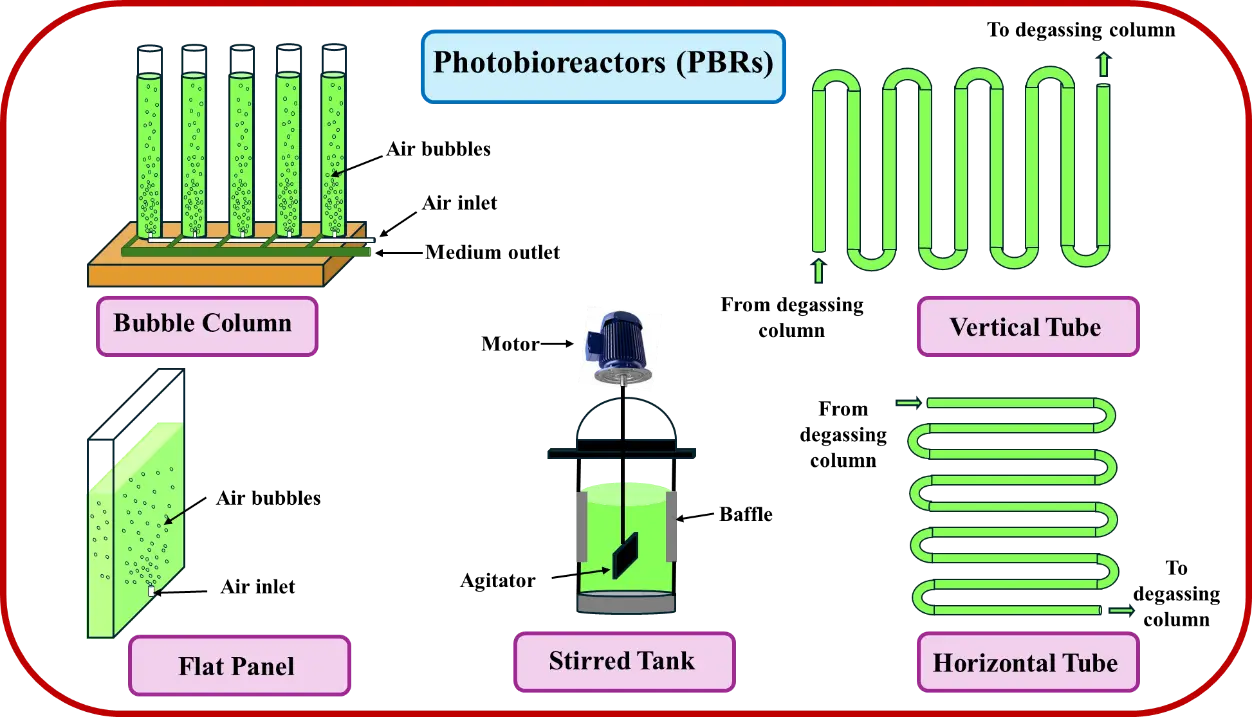
Figure 4. Different types of PBRs, including bubble column, stirred tank, flat panel, and vertical/horizontal tubes.
4.3. Microalgal Biomass Harvesting
After algal cultivation, the biomass needs to be harvested to continue with processing into bioplastics. Harvesting microalgal biomass uses similar approaches for biofuels, bioproducts, and wastewater treatment, although there are advantages for different downstream methods based on certain desirable properties. For example, harvesting via flocculation for the biomanufacturing of biogas needs to maintain methane generation by the cells [180]. However, the process of harvesting microalgae from liquid media can cost up to 20% to 30% of the total cultivation process [181]. Several different harvesting methods include flocculation, centrifugation, sedimentation, membrane filtration, and flotation, which are illustrated in Figure 5. There are several considerations for methods of harvesting microalgal biomass, including their cost, potential for scale up, and environmental impacts.
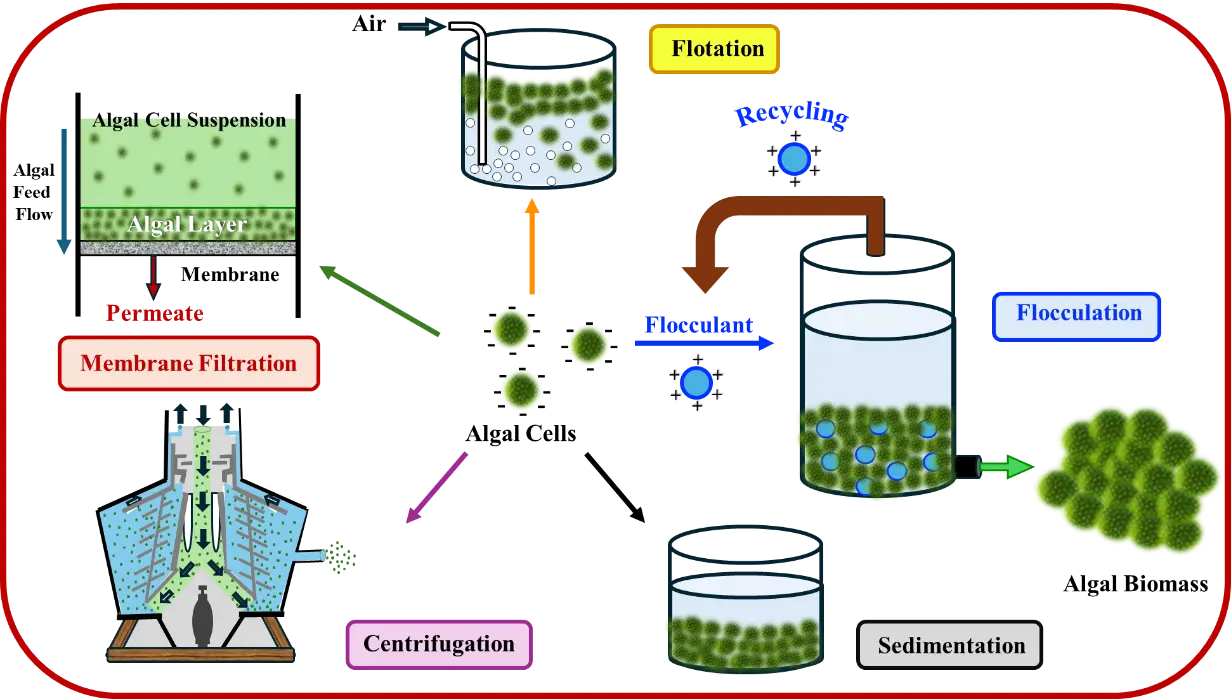
Flocculation involves the aggregation of cells into flocs (small clumps of suspended particles), thereby enabling easier, more cost-effective separation [182]. Flocculation has therefore been a commonly used step in the harvesting process. Several methods of flocculation have been developed, with the goal of overcoming charges that keep cells separate [183]. Self-flocculation (also known as auto-flocculation) can occur in nature due to extracellular polymeric substances (EPS) or other cationic molecules produced by the microalgae interacting with anionic cellular membranes [184]. For example, cellulose hydroxyapatite extracted from EPS of Chlorella sorokiniana and Scenedesmus abundans triggered flocculation when introduced to other cultures [185]. Self-flocculation in the microalgal culture can also be induced by changing conditions, such as the addition of ZnCl2, which has been demonstrated to initiate self-flocculation of Scenedesmus quadricauda [186]. Bio-flocculation uses similar mechanisms, but includes co-flocculation with other microbes like bacteria, such as Melaminivora jejuensis for the alga C. sorokiniana [187] or yeast, such as Saccharomyces cerevisiae for the alga Chlorella pyrenoidosa [188]. Further, bio-flocculation can also utilize the flocculants extracted from other microbes alone, such as EPS taken from Klebsiella bacteria [189]. Synthetic flocculants can also be added, including polyelectrolytes such as polydiallyldimethylammonium chloride (PDADMAC), which are less desirable than environmentally friendly biomolecule alternatives [190]. Other methods have been studied for inducing flocculation, including electrochemical flocculation and magnetic harvesting, both of which have been demonstrated for Chlorella vulgaris [191,192]. Microalgal cell surfaces are mostly negatively charged, and therefore, the cells can be collected by application of an electrical current to attract the cells to a positively charged electrode [192]. Similarly, magnetic harvesting involves the uptake of magnetite nanoparticles by the microalgae, followed by application of a magnetic field [191].
Centrifugation may also be used to collect the cells for harvesting [193]. It can be combined with filters to improve solid-liquid separation by increasing the removal of water. Unfortunately, while the centrifugal force can effectively collect the cells, it can also cause cellular damage due to shear stress [194]. Centrifuges are also difficult and costly to scale up as the volume of algal cultures increases, making this approach less effective at an industrial scale.
Microalgal cells can also be allowed to settle by relying on gravity, a process referred to as sedimentation [195]. This separation method is simpler and less energy-intensive, requires no chemical additives, and is easily scalable. On the other hand, the efficiency is low, and there are many factors that can affect the sedimentation rate, including but not limited to pH, ion concentrations, the properties of the microalgal cells, and the composition of the growth medium. Non-invasive imaging of sedimentation by C. sorokiniana and Monoraphidium convolutum was used to optimize cultivation conditions, thereby increasing harvesting efficiency [196]. Another advantage of sedimentation is that it can be combined with other approaches, such as flocculation, to further dewater microalgal biomass, thereby improving sedimentation efficiency while keeping overall cost and energy requirements low.
Filtration separates the media from the cells using a membrane without the addition of chemical treatments [197]. Filtration can also be combined with other harvesting methods to further concentrate the cells. However, filtration can be difficult to scale up, as the filters can be overloaded, requiring larger filters for larger volumes to prevent fouling or slow filtration. Using other methods of harvesting and dewatering the cells before filtering, such as the use of flocculation, may be potential solutions for this issue [198].
Flotation allows the algal cells to rise to the surface, usually through the use of air bubbles, where they can then be skimmed off the surface to collect the biomass [199]. This approach includes both dispersed air flotation, in which the air is injected through a diffuser to form bubbles [200], and dissolved air flotation, in which the bubbles are generated through pressurization of recycled water [201]. Flotation has been used in water treatment to remove algae, but it can also be used to harvest microalgal cells. As with filtration, this technique can be used after other methods, such as flocculation, allowing for enhanced harvesting efficiency. Different algae and media will affect flotation behavior, so the treatment will not be universal for different algal species. While flotation does not necessarily require chemical additives, different surfactants may be applied to assist in the harvesting process [202].
As an example of the importance of the specificity of the harvesting method, Rahman et al. examined the effects of different techniques on the production of PHB from bacterial fermentation (using E. coli) of mixed culture microalgal biomass cultivated with wastewater [203]. Two bioflocculants, cationic potato starch and cationic corn starch, one inorganic flocculant, potassium aluminum sulfate (alum), and centrifugation were used to harvest the algal slurry. Although centrifugation may have been expected to be less effective than flocculation, the significantly highest PHB production (7.8% PHB of E. coli dry weight) was observed for the centrifuged biomass, because all flocculants inhibited bacterial growth more than centrifugation. Therefore, the harvesting method would need to be suitable not only for the microalgal cells, but also for the downstream processes involved in the bioplastic production methodology.
4.4. Research Needs and Future Directions
Several challenges remain for the adoption of bioplastics produced from microalgae. First, several technical factors reduce the output or efficiency of bioplastic biomanufacturing. The biomass productivity can be low for wild-type microalgae, though this may be overcome using synthetic biology methods to improving biomass concentration. Further, open systems are inexpensive but increase the risk of contamination with other organisms, which can reduce productivity and increase higher maintenance costs (such as with antibiotics), while research into photobioreactors that can be cost-effectively scaled up while achieving comparable yields to open systems remains ongoing [204]. Factors that can impact scaling up include light, gas exchange, contamination, and fouling [204,205]. Information on mixing and self-shading effects on light exposure is key to maintaining algal growth at a larger scale due to different light path lengths, which makes modelling valuable for scaling up [157,206]. In addition, there are requirements that will vary for specific species, including media and acetate supplementation [207]. The cost per kilogram for biomanufacturing of currently available bioplastics is approximately twice that of conventional plastics derived from petrochemicals (US$2.68 per kg and US$1.37 per kg, respectively) [208].
Even with a large quantity of microalgal biomass, efficient harvesting methods are needed to make bioplastic biomanufacturing viable on a larger scale [209]. Methods such as filtration and centrifugation are less efficient at larger scales than in the laboratory, whereas flocculation is simple, inexpensive, and energy-efficient, as flocs can be separated more easily by sedimentation than dispersed cells [210]. However, the flocculants used need to be sustainable and be able to achieve high recovery, which can be species-specific. For example, chitosan caused flocculation of the cyanobacterium Synechococcus bigranulatus, while CaCl2 was effective against the eukaryotic Pseudococcomyxa simplex and Porphyridium cruentum, but not Galdieria phlegrea [211]. Bioflocculants are less toxic, reducing biomass lost during harvesting, contamination of the end products, and environmental impacts, but the aggregation is slower (hours or days compared to minutes for other approaches), and the mechanisms have not been comprehensively studied, especially at large scales [212]. Additionally, newer methods such as magnetic or electrocoagulation-flocculation are faster than bioflocculation but still require development and large-scale investigation [191,213]. Magnetic flocculation maintains the low energy requirements, but needs optimization of the addition of nanoparticles and the design of the magnetic separator [191]. Electroflocculation can be faster and more effective, but requires energy for the application of the electric current. On the other hand, green electricity produced in other aspects of a larger circular economy scenario could provide the electric current for this process. Chemical or bioflocculants may be added as part of the electroflocculation process to improve the formation of flocs, but the flocculant concentration and mixing time will impact the removal efficiency [213]. Other hybrid methods, such as the use of flotation with flocculation, reduce the number of processing steps and improve efficiency, but, again, require optimization for maximal effect [201].
Microalgae could be more cost-effective sources of bioplastics if the potential environmental and economic benefits are sufficient to offset the costs of capacity expansion, although techno-economic analyses are therefore required for the biomanufacturing pipeline [214,215]. Price et al. conducted a techno-economic analysis using cyanobacteria such as Synechocystis cultivated in raceway ponds and harvested by centrifugation [214]. They calculated a yield of 10% PHB (dry weight), with operating costs for the plant of $147.3 million USD/year and a capital cost of $193.5 million USD. The capital costs were primarily related to establishing the raceway ponds, which made up 70% ($136.3 million USD). However, 60% of the yearly operating costs ($88.5 million USD/year) were projected to be from the energy needed for dewatering and drying microalgal biomass. This could be reduced by flocculation using polyacrylamide, reducing the operating costs by $41.1 million USD/year and the capital costs by $10.4 million USD, with additional costs of only 1.2 million USD for the flocculation tank and 7 million USD/year to pay for the flocculant. As an example of a circular economy approach, Watkins et al. conducted a techno-economic analysis on the production of bioplastics using microalgae from wastewater cultivated in a rotating algae biofilm reactor (RABR) [215]. The biofilm reactor would reduce the cost of concentrating the slurry for harvesting, which would result in a cost of $1.415 million USD for dewatering and drying, while producing 577 tonnes of a PLA-microalgal biomass composite. Lipid extraction pretreatment of the microalgae for conversion to bioplastic would yield 561 tonnes of the biocomposite, as well as reduced costs of $751,000 USD for dewatering and drying. However, the lipid extraction process would add a cost of $2.009 million USD. The authors therefore concluded that, if the lipid extraction process resulted in bioplastics with similar properties, the biocomposites using whole algae would be more cost-effective. An analysis by Chaudry et al. was performed for a production facility comprising 557 ponds with 4 hectares of surface area each [216]. The capital costs were determined to be $298.24 million USD, with operating costs of $84.07 million USD/year, and a corresponding output of 100,000 tonnes/year of algal biomass. An important finding is that the residual algal biomass determined the economic viability of PHA- and starch-based bioplastics produced from microalgae, as the bioplastics alone would not be viable. However, the biomass would be rich in protein and or carbohydrates, which would be valuable, and if the resulting byproducts generated revenue worth more than $1 USD/kg, the overall process would become viable. This reinforces the importance of examining microalgae-based bioplastic production as part of larger systems, whether the valorization of waste in circular economies or use of residual algal biomass. A potential solution to improving the economic impacts of bioplastics is to couple their biomanufacturing with other industries in circular economies [217]. The photosynthetic nature of microalgae also facilitates their use in carbon fixation, such as for the removal of CO2 from biogas [218].
Although bioplastics are generally thought of as an environmentally friendly alternative to conventional petrochemical-derived plastics, their biodegradability is a measure that reflects a spectrum ranging from full degradation to minor partial degradation, and may be dependent on environmental factors [219,220,221]. Therefore, not all bioplastics may be completely degraded in a short time, especially in landfills as opposed to composting, which may contribute to GHG and microplastic emissions [222,223]. A proper regulatory framework would also be needed to implement industrial biomanufacturing, especially given its critical role in mitigating the environmental impacts of both algal cultivation as well as the bioplastics themselves from cradle to grave. Moreover, infrastructure for plastic recycling has been well established, but installations for degradation or mechanical recycling of bioplastics and biocomposites vary due to differences in biodegradability [224,225]. By contrast, chemical recycling of biopolymers is much less effective. A recent method has been developed, using crotonic acid as a breakdown product to serve as a carbon source for bacteria, with potential for circular economy approaches by feeding back more directly into the production process [226]. Given recent findings on the end-of-life outcomes of bioplastics, improved standardized LCAs are needed to fully understand the potential impacts of microalgae-derived bioplastics on health and the environment [227]. Further, a focus on compostable biodegradable bioplastics from microalgae would be important to improve the efficiency of mitigating emissions. Also, some of these bioplastics or biocomposites are not just compostable but even edible, such as a composite of Chlorella sp. biomass plasticized using pomegranate seed oil to make an edible film [228]. Biodegradation of a biocomposite of PLAs/PHBs with starch as a filler was investigated in a home compost using kitchen waste as well as an industrial composter [229]. Both conditions achieved full degradation within six months, which would be highly desirable for sustainable bioplastics. A crucial point is that PLAs, PHBs, and starch can all be produced by microalgae, demonstrating their ability to synthesize multiple biodegradable biopolymers.
4.5. Emerging Technologies for Manufacturing of Bioplastics from Microalgae
The past decade has seen tremendous progress in the transformative technologies of the internet-of-things (IoT), machine learning (ML) algorithms, artificial intelligence (AI), and synthetic biology, in light of the ever-growing advancements in computational processing power and data storage, as well as the development of new synthetic biology techniques [230,231,232,233,234,235]. In this section, we will briefly highlight the potential advantages of these emerging technologies in the field of microalgae-derived bioplastics.
4.5.1. IoT, ML, and AI for Cultivation of Microalgae and Production of Bioplastics
There are a variety of emerging technologies that, when used in a targeted manner, may contribute to improving the cultivation of microalgae and biomanufacturing of bioplastics, including IoT, ML, and AI. For example, new IoT-compatible LED sensors have been developed that may allow for precise continuous measurement of biomass concentration during large-scale cultivation [236]. These sensors use multiple wavelengths in the ultraviolet and near-infrared regions to quantify biomass concentration, with internet connectivity allowing real-time monitoring of the culture. The cultivation of S. obliquus was analyzed using the sensing system, which was able to precisely determine the biomass concentration of the algae between 40–800 mg/L (dry weight). Additionally, PBRs could be designed with integrated sensors that could detect different key cultivation parameters, including pH, temperature, and illumination, which could in turn communicate using IoT technologies for better monitoring and online control [237]. The integrated system constructed by Rahmat et al. combined with electronic sensors for these parameters to the temperature control to maintain optimal temperature and actuators to circulate media. IoT could not only be used to automate these processes, but the graphical user interface (GUI) allowed the operator to examine the data from PBR as well as manually control the conditions. ML and AI algorithms have also been used to optimize algae cultivation by predicting these parameters [238]. For instance, two artificial neural networks have been designed for differentiating between various algal strains, which is critical in assessing the state of the algal cultures [239]. The networks were used to analyze results from FlowCAM, a flow imaging microscope that can detect particles in moving fluids. The resulting networks were trained on light absorption features of two microalgae, namely C. vulgaris and Scenedesmus almeriensis. Both networks exhibited training errors below 4%, and a maximum validation error of 6.5%, and the methodology of the networks could be applied to other algal species with the extension of the training data. Finally, predictive modelling has been used to optimize the production system design for PHAs to select the most cost-effective approach. Ramos et al. optimized a PHA production plant via a mixed integer nonlinear programming (MINLP) model bacterial fermentation with several choices of carbon sources and techniques for extraction and purification [240]. The optimal carbon source was sugarcane, while enzymatic digestion provided the best extraction route, with a net present value (NPV) of 75.01 million USD. The resulting production cost and energy consumption per kilogram of PHA produced were 3.02 USD and 22.56 MJ, respectively. Although this system was implemented for bacteria rather than microalgae, the use of PHAs suggests that this type of model could be used for similar algal biomanufacturing systems.
4.5.2. Synthetic Biology Approaches for Microalgae-Derived Bioplastic Production
Furthermore, synthetic biology methods, such as metabolic and genetic engineering of microalgal strains, may be optimized to enhance growth and biopolymer biomanufacturing. As an example of a metabolic engineering approach, a mutant Synechocystis strain without the PirC regulator protein increased PHB production by 15% [241]. A key advancement for the genetic modification of microalgae is the landmark CRISPR/Cas9 system for gene editing [242]. There is currently limited research on CRISPR in microalgae compared to other model organisms, with one of the major issues being overcoming Cas9 toxicity [243]. However, there is potential for gene editing in microalgae and for using CRISPR to improve the biomanufacturing of bioplastics from microalgae [244]. CRISPR has been a primary focus of research, but other genetic engineering approaches, such as transcription activator-like effector nucleases (TALENs) and RNA interference (RNAi), may also be applied for microalgae. TALENs recognize specific nucleotide positions referred to as repeat variable di-residues (RVDs), while CRISPR uses guide RNA to recognize protospacer-adjacent motifs (PAM) for the Cas9 enzyme [245]. As a result, TALENs can be more precisely targeted, while CRISPR is easier to use. As an example, a system using TALEN vectors was designed in Nannochloropsis oceanica by employing yeast centromere and autonomous replication sequence (CEN/ARS) as episomes [246]. The presence of these episomes allowed for genetic modification of the microalgae without transgenic strains and also decreased the likelihood of disruption of endogenous genes that may occur using the CRISPR/Cas9 system. RNAi suppresses target gene expression by forming dsRNA and has been utilized to select for lipid synthesis pathways over carbohydrate synthesis in Nannochloropsis salina [247]. Lipid biosynthesis was promoted by using RNAi to downregulate the expression of the enzyme uridine diphosphate-glucose pyrophosphorylase (UGPase), which is involved in forming the polysaccharide chrysolaminarin. The effects of these systems for biomanufacturing bioplastic precursors have not been well-explored. However, these examples demonstrated their applications for synthesis of lipids, which are necessary for the biosynthesis of PHAs and other bioplastic precursors. Another synthetic biology technique with potential to enhance biosynthesis in microalgae is plastome engineering, which alters the chloroplast genome (the plastome) rather than the nuclear genome [248]. While this approach has not been explored for bioplastics, it may serve as a potential avenue for strain optimization in the biomanufacturing process. Advantages of using the plastome for transformation include high copy number, which improves expression of the target recombinant gene(s), and the absence of transgene silencing in the chloroplast. This technique has several drawbacks that can lead to lower expression levels in microalgae, including the lack of glycosylation in the chloroplast, the absence of a secretory system for the proteins, and potential incorrect protein folding, and therefore, research into plastome engineering is still ongoing [249]. A summary of selected synthetic biology approaches used for the production of biopolymers in microalgae is shown in Table 3.
Table 3. Synthetic biology approaches are used for the production of microalgae biopolymers.
|
Algal Species |
Target Genes |
Techniques |
Outcomes |
References |
|---|---|---|---|---|
|
Eukaryotic |
||||
|
C. reinhardtii |
phaA, phaB, and phaC genes from C. necator |
Transfection
Targeted products to peroxisomes using type-2 peroxisomal targeting signal (PTS2) sequence |
>3000-fold increase in PHB production |
[52] |
|
P. tricornutum |
phaA, phaB, and phaC genes from C. necator
|
Construction of episomes using inducible alkaline phosphatase 1 (AP1) promoter |
By day 3, 27.9 mg/L PHB with supplemented CO2 compared to 8.0 mg/L with ambient CO2 |
[53] |
|
N. oceanica |
yeast centromere and autonomous replication sequence (CEN/ARS) |
Platinum transcription activator-like effector nucleases (PtTALEN) |
Higher lipid concentration of 0.0484 mg/mL triacylglycerols (TAG) compared to 0.0319 mg/mL for wild-type |
[246] |
|
N. salina |
uridine diphosphate-glucose pyrophosphorylase (UGPase) |
RNAi to downregulate expression |
71.0% increase in lipid production with no detectible change in lipid composition |
[247] |
|
Cyanobacteria |
||||
|
Synechocystis sp. PCC 6803 |
adc1 |
Gene knockout using restriction enzyme sequences
Supplementation with acetate and restricted nitrogen-phosphorous nutrients |
Increase in PHB accumulation to 36.1% (dry weight) compared with 24.9% for wild-type cells |
[91] |
|
Nostoc |
phaC1AB operon from C. necator expanded with phasin gene phaP1 from the same species |
Constitutive promoter PpsbA from Amaranthus hybridus cloned into plasmid pRL1049 |
Over 20% PHB (dry weight) after 7 days of cultivation |
[59] |
|
S. elongatus |
phaC1AB operon from C. necator |
Constitutive promoter Pcpc560
Cultivation with acetate supplementation |
Increased acetyl-CoA leading to PHB concentration of 607.2 mg/L with acetate and 225 mg/L without |
[60] |
|
Synechocystis |
Random (identification of suitable mutant strains) |
Mutation with ethyl methanesulfonate (EMS) |
Highest concentration of PHB from mutant strain of 18.8 mg/L vs. 10.7 mg/L for wild-type |
[61] |
|
Synechocystis |
PirC |
Gene knockout using restriction enzyme sequences
Supplementation with acetate and restricted nitrogen-phosphorous nutrients |
Enhanced PHB synthesis up to 81% (dry weight) with acetate and 63% without |
[241] |
5. Conclusions
Biodegradable plastics, especially bioplastics, are needed to reduce emissions to mitigate global climate change and plastic pollution. Microalgal biomass shows promise as a more sustainable bioresource than bacteria or plants, given that it could be produced by relatively fast-growing microalgae, requires less arable land, and may be cultivated using waste products. Microalgal-derived bioplastics have potential for environmental mitigation and the growth of the bioeconomy, especially in circular economies. This review discussed the cultivation of both wild-type and genetically modified microalgae (including cyanobacteria) for the biomanufacturing of sustainable bioplastics and biocomposites. These materials may be prepared from microalgae alone or through chemical/microbial treatments of microalgal feedstocks. However, several challenges remain, including microalgal cultivation and bioplastic synthetic methodologies, as well as the costs involved in scaling up to industrial processes. Future research will focus on enhancing growth of microalgae and/or improvement of bioplastic biomanufacturing using synthetic biology, guided by new techniques such as artificial intelligence or machine learning.
Acknowledgments
The authors would like to thank Harbin Engineering University and the College of Agricultural Sciences of Panzhihua University for their support.
Author Contributions
Conceptualization, A.A.-E.-A., S.N.A. and J.L.; Formal analysis, A.A.-E.-A., S.N.A. and J.L.; Writing—Original Draft Preparation, A.A.-E.-A.; Writing—Review & Editing, A.A.-E.-A., S.N.A. and J.L.; Visualization, A.A.-E.-A., S.N.A. and J.L.; Project Administration, J.L.
Ethics Statement
Not applicable.
Informed Consent Statement
Not applicable.
Data Availability Statement
No datasets were generated or analyzed during the current study.
Funding
This research received no external funding.
Declaration of Competing Interest
The authors declare that they have no known competing financial interests or personal relationships that could have appeared to influence the work reported in this paper.
References
- Walker S, Rothman R. Life cycle assessment of bio-based and fossil-based plastic: A review. J. Clean. Prod. 2020, 261, 121158. DOI:10.1016/j.jclepro.2020.121158 [Google Scholar]
- de Mello AFM, Machado CMB, Neyra LCR, Ocán-Torres DY, Barros RN, Medeiros MC, et al. Biorefinery-based production of biodegradable bioplastics: Advances and challenges in circular bioeconomy. NPJ Mater. Sustain. 2025, 3. DOI:10.1038/s44296-025-00086-4 [Google Scholar]
- Rosenboom JG, Langer R, Traverso G. Bioplastics for a circular economy. Nat. Rev. Mater. 2022, 7, 117–137. DOI:10.1038/s41578-021-00407-8 [Google Scholar]
- Heredia-Guerrero JA, Benítez JJ, Porras-Vázquez JM, Tedeschi G, Morales Y, Fernández-Ortuño D, et al. Plasticized, greaseproof chitin bioplastics with high transparency and biodegradability. Food Hydrocoll. 2023, 145, 109072. DOI:10.1016/j.foodhyd.2023.109072 [Google Scholar]
- Sobeih MO, Sawalha S, Hamed R, Ali F, Kim MP. Starch-Derived Bioplastics: Pioneering Sustainable Solutions for Industrial Use. Materials 2025, 18, 1762. DOI:10.3390/ma18081762 [Google Scholar]
- Siracusa V, Blanco I. Bio-Polyethylene (Bio-PE), Bio-Polypropylene (Bio-PP) and Bio-Poly(ethylene terephthalate) (Bio-PET): Recent Developments in Bio-Based Polymers Analogous to Petroleum-Derived Ones for Packaging and Engineering Applications. Polymers 2020, 12, 1641. DOI:10.3390/polym12081641 [Google Scholar]
- Lackner M, Mukherjee A, Koller M. What Are “Bioplastics”? Defining Renewability, Biosynthesis, Biodegradability, and Biocompatibility. Polymers 2023, 15, 4695. DOI:10.3390/polym15244695 [Google Scholar]
- Goel V, Luthra P, Kapur GS, Ramakumar SSV. Biodegradable/Bio-plastics: Myths and Realities. J. Polym. Environ. 2021, 29, 3079–3104. DOI:10.1007/s10924-021-02099-1 [Google Scholar]
- Cottom JW, Cook E, Velis CA. A local-to-global emissions inventory of macroplastic pollution. Nature 2024, 633, 101–108. DOI:10.1038/s41586-024-07758-6 [Google Scholar]
- Mattlar T, Ekholm T. The impact of bioplastics production on climate change mitigation, fossil fuels and land-use. Renew. Sustain. Energy Rev. 2025, 212, 115234. DOI:10.1016/j.rser.2024.115234 [Google Scholar]
- Tsiropoulos I, Faaij APC, Lundquist L, Schenker U, Briois JF, Patel MK. Life cycle impact assessment of bio-based plastics from sugarcane ethanol. J. Clean. Prod. 2015, 90, 114–127. DOI:10.1016/j.jclepro.2014.11.071 [Google Scholar]
- Brizga J, Hubacek K, Feng K. The Unintended Side Effects of Bioplastics: Carbon, Land, and Water Footprints. One Earth 2020, 3, 45–53. DOI:10.1016/j.oneear.2020.06.016 [Google Scholar]
- Nateras-Ramírez O, Carrillo-Cañedo KI, Aguilar-Palazuelos E, Fitch-Vargas PR. Microalgae Biomass as a Sustainable Source of Bioplastics. In Microalgae as Promising Source of Commercial Bioproducts: Advances and Emerging Technologies in Bioactive Compounds, Biofuels, Food and Biorefineries; Santos Ballardo DU, Rossi S, Eds.; Springer Nature: Cham, Switzerland, 2025; pp. 263–283. DOI:10.1007/978-3-031-86433-9_18 [Google Scholar]
- Lee RA, Lavoie JM. From first- to third-generation biofuels: Challenges of producing a commodity from a biomass of increasing complexity. Anim. Front. 2013, 3, 6–11. DOI:10.2527/af.2013-0010 [Google Scholar]
- Helm LT, Venier-Cambron C, Verburg PH. The potential land-use impacts of bio-based plastics and plastic alternatives. Nat. Sustain. 2025, 8, 190–201. DOI:10.1038/s41893-024-01492-7 [Google Scholar]
- Wellenreuther C, Wolf A, Zander N. Cost competitiveness of sustainable bioplastic feedstocks – A Monte Carlo analysis for polylactic acid. Clean. Eng. Technol. 2022, 6, 100411. DOI:10.1016/j.clet.2022.100411 [Google Scholar]
- Santos‐Corona AM, Lázaro‐Mixteco PE, Vargas‐Tah AA, Castro‐Montoya AJ. Lactic acid production from food waste using the lactogenic Escherichia coli strain JU15: optimization of reducing sugar recovery. J. Chem. Tech. Biotech. 2022, 97, 668–675. DOI:10.1002/jctb.6949 [Google Scholar]
- Roy Chong JW, Tan X, Khoo KS, Ng HS, Jonglertjunya W, Yew GY, et al. Microalgae-based bioplastics: Future solution towards mitigation of plastic wastes. Environ. Res. 2022, 206, 112620. DOI:10.1016/j.envres.2021.112620 [Google Scholar]
- Dahlin LR, Gerritsen AT, Henard CA, Van Wychen S, Linger JG, Kunde Y, et al. Development of a high-productivity, halophilic, thermotolerant microalga Picochlorum renovo. Commun. Biol. 2019, 2. DOI:10.1038/s42003-019-0620-2 [Google Scholar]
- Yadav G, Dash SK, Sen R. A biorefinery for valorization of industrial waste-water and flue gas by microalgae for waste mitigation, carbon-dioxide sequestration and algal biomass production. Sci. Total Environ. 2019, 688, 129–135. DOI:10.1016/j.scitotenv.2019.06.024 [Google Scholar]
- Ishimwe S. BIOPLASTICS MARKET DEVELOPMENT UPDATE 2024. Available online: https://www.european-bioplastics.org/bioplastics-market-development-update-2024/ (accessed on 23 September 2025)
- PW Consulting Chemical & Energy Research Center. Algae-Based Bioplastics Market. Available online: https://pmarketresearch.com/chemi/algae-based-bioplastics-market/ (accessed on 6 October 2025)
- Hussien NA, Salah Al-Deen MK, Al-zahrani MS, Alwathnani SF, Al-Sahli RY, Albunyusi SR, et al. Green synthesis of eco-friendly bioplastics from Chlorella and Lithothamnion algae for safe and sustainable solutions for food packaging. Green Process. Synth. 2025, 14. DOI:10.1515/gps-2024-0208 [Google Scholar]
- Wang JH, Tian Y, Zhou B. Degradation and Stabilization of Poly(Butylene Adipate-co-Terephthalate)/Polyhydroxyalkanoate Biodegradable Mulch Films Under Different Aging Tests. J. Polym. Environ. 2022, 30, 1366–1379. DOI:10.1007/s10924-021-02279-z [Google Scholar]
- Dhayer M, Barral V, Cleret D, Jordao A, Drucbert AS, Germain N, et al. Material and biological characterization of 3D knitted bioresorbable poly (D,L-lactide) (PLA) and polycaprolactone (PCL) scaffolds for soft tissue regeneration: From fabrication to in vivo performance. J. Biol. Eng. 2025, 19. DOI:10.1186/s13036-025-00504-0 [Google Scholar]
- Berger NJ, Masri MA, Brück T, Garbe D, Pfeifer C, Lindorfer J. Utilizing a CHP Power Plant’s Energy and CO2 Emissions for the Manufacture of Affordable and Carbon Neutral Algae Bioplastic for Re-Useable Packaging. Ind. Eng. Chem. Res. 2023, 62, 7275–7296. DOI:10.1021/acs.iecr.3c00590 [Google Scholar]
- Razzak SA. In situ biological CO2 fixation and wastewater nutrient removal with Neochloris oleoabundans in batch photobioreactor. Bioprocess. Biosyst. Eng. 2019, 42, 93–105. DOI:10.1007/s00449-018-2017-x [Google Scholar]
- Sharma R, Solanki P, Chaudhary M, Gupta N, Kaur P. Unveiling the potential of microalgae for bioplastic production from wastewater—Current trends, innovations, and future prospects. Biotechnol. Sustain. Mater. 2024, 1, 10. DOI:10.1186/s44316-024-00010-1 [Google Scholar]
- Abbas Q, Arif M, Ullah H, Fazal T, Ubaid Ali M, Irshad S, et al. Carbon capture through alkaline solvents coupled with conversion into bioplastics via microalgae: Towards a sustainable bioconversion pathway. Renew. Sustain. Energy Rev. 2025, 223, 115999. DOI:10.1016/j.rser.2025.115999 [Google Scholar]
- Duan Z, Cheng H, Duan X, Zhang H, Wang Y, Gong Z, et al. Diet preference of zebrafish (Danio rerio) for bio-based polylactic acid microplastics and induced intestinal damage and microbiota dysbiosis. J. Hazard. Mater. 2022, 429, 128332. DOI:10.1016/j.jhazmat.2022.128332 [Google Scholar]
- Kalita NK, Damare NA, Hazarika D, Bhagabati P, Kalamdhad A, Katiyar V. Biodegradation and characterization study of compostable PLA bioplastic containing algae biomass as potential degradation accelerator. Environ. Chall. 2021, 3, 100067. DOI:10.1016/j.envc.2021.100067 [Google Scholar]
- Beckstrom BD, Wilson MH, Crocker M, Quinn JC. Bioplastic feedstock production from microalgae with fuel co-products: A techno-economic and life cycle impact assessment. Algal Res. 2020, 46, 101769. DOI:10.1016/j.algal.2019.101769 [Google Scholar]
- Islam MM, Chaudry S, Thornton AW, Haque N, Lau D, Bhuiyan M, et al. Environmental footprint of polylactic acid production utilizing cane-sugar and microalgal biomass: An LCA case study. J. Clean. Prod. 2025, 496, 145132. DOI:10.1016/j.jclepro.2025.145132 [Google Scholar]
- Crema A, Dinelli E, Fabbri E, Galletti P, Greggio N, Lastella V, et al. Additives in bioplastics: Chemical characterization, migration in water and effects on photosynthetic organisms. Sci. Total Environ. 2024, 955, 177205. DOI:10.1016/j.scitotenv.2024.177205 [Google Scholar]
- Irfan F, Tasnim N, Razzak SA, Uddin S. Advances in capturing carbon and producing bioplastics through the microalgal approach towards a sustainable future: A review. J. Clean. Prod. 2025, 486, 144576. DOI:10.1016/j.jclepro.2024.144576 [Google Scholar]
- Kumar PK, Vijaya Krishna S, Verma K, Pooja K, Bhagawan D, Himabindu V. Phycoremediation of sewage wastewater and industrial flue gases for biomass generation from microalgae. S. Afr. J. Chem. Eng. 2018, 25, 133–146. DOI:10.1016/j.sajce.2018.04.006 [Google Scholar]
- Wang F, Gao B, Su M, Dai C, Huang L, Zhang C. Integrated biorefinery strategy for tofu wastewater biotransformation and biomass valorization with the filamentous microalga Tribonema minus. Bioresour. Technol. 2019, 292, 121938. DOI:10.1016/j.biortech.2019.121938 [Google Scholar]
- Kavitha G, Kurinjimalar C, Sivakumar K, Kaarthik M, Aravind R, Palani P, et al. Optimization of polyhydroxybutyrate production utilizing waste water as nutrient source by Botryococcus braunii Kütz using response surface methodology. Int. J. Biol. Macromol. 2016, 93, 534–542. DOI:10.1016/j.ijbiomac.2016.09.019 [Google Scholar]
- Eynde EV, Lenaerts B, Tytgat T, Blust R, Lenaerts S. Valorization of Flue Gas by Combining Photocatalytic Gas Pretreatment with Microalgae Production. Environ. Sci. Technol. 2016, 50, 2538–2545. DOI:10.1021/acs.est.5b04824 [Google Scholar]
- Cheng D, Li X, Yuan Y, Yang C, Tang T, Zhao Q, et al. Adaptive evolution and carbon dioxide fixation of Chlorella sp. in simulated flue gas. Sci. Total Environ. 2019, 650, 2931–2938. DOI:10.1016/j.scitotenv.2018.10.070 [Google Scholar]
- Sánchez-Roa D, Sessini V, Mosquera MEG, Cámpora J. N-Heterocyclic Carbene-Carbodiimide (NHC-CDI) Betaines as Organocatalysts for β-Butyrolactone Polymerization: Synthesis of Green PHB Plasticizers with Tailored Molecular Weights. ACS Catal. 2024, 14, 2487–2501. DOI:10.1021/acscatal.3c05357 [Google Scholar]
- Martínez-Herrera RE, Rutiaga-Quiñones OM, Alemán-Huerta ME. Integration of Agave plants into the polyhydroxybutyrate (PHB) production: A gift of the ancient Aztecs to the current bioworld. Ind. Crops Prod. 2021, 174, 114188. DOI:10.1016/j.indcrop.2021.114188 [Google Scholar]
- Samadhiya K, Ghosh A, Nogueira R, Bala K. Newly isolated native microalgal strains producing polyhydroxybutyrate and energy storage precursors simultaneously: Targeting microalgal biorefinery. Algal Res. 2022, 62, 102625. DOI:10.1016/j.algal.2021.102625 [Google Scholar]
- Kavitha G, Kurinjimalar C, Sivakumar K, Palani P, Rengasamy R. Biosynthesis, purification and characterization of polyhydroxybutyrate from Botryococcus braunii kütz. Int. J. Biol. Macromol. 2016, 89, 700–706. DOI:10.1016/j.ijbiomac.2016.04.086 [Google Scholar]
- Six A, Dauvillée D, Lancelon-Pin C, Dimitriades-Lemaire A, Compadre A, Dubreuil C, et al. From raw microalgae to bioplastics: Conversion of Chlorella vulgaris starch granules into thermoplastic starch. Carbohydr. Polym. 2024, 342, 122342. DOI:10.1016/j.carbpol.2024.122342 [Google Scholar]
- Zhila NO, Kiselev EG, Shishatskaya EI, Ghorabe FDE, Kazachenko AS, Volova TG. Comparative study of the synthesis of polyhydroxyalkanoates by cyanobacteria Spirulina platensis and green microalga Chlorella vulgaris. Algal Res. 2025, 85, 103826. DOI:10.1016/j.algal.2024.103826 [Google Scholar]
- Abdul Rahman SNS, Chai YH, Lam MK. Taguchi approach for assessing supercritical CO2 (sCO2) fluid extraction of polyhydroxyalkanoate (PHA) from Chlorella vulgaris sp. microalgae. J. Environ. Manag. 2024, 355, 120447. DOI:10.1016/j.jenvman.2024.120447 [Google Scholar]
- Chen PT, Hong ZS, Cheng CL, Ng IS, Lo YC, Nagarajan D, et al. Exploring fermentation strategies for enhanced lactic acid production with polyvinyl alcohol-immobilized Lactobacillus plantarum 23 using microalgae as feedstock. Bioresour. Technol. 2020, 308, 123266. DOI:10.1016/j.biortech.2020.123266 [Google Scholar]
- Lee HR, Kim K, Mun SC, Chang YK, Choi SQ. A new method to produce cellulose nanofibrils from microalgae and the measurement of their mechanical strength. Carbohydr. Polym. 2018, 180, 276–285. DOI:10.1016/j.carbpol.2017.09.104 [Google Scholar]
- Mohamed HE, Abdo SM, Salah El Din RA. Biopolymer detection in Egyptian microalgae: A pathway to eco-friendly bioplastics. Bioresour. Technol. Rep. 2024, 28, 102002. DOI:10.1016/j.biteb.2024.102002 [Google Scholar]
- Mehariya S, Plöhn M, Jablonski P, Stagge S, Jönsson LJ, Funk C. Biopolymer production from biomass produced by Nordic microalgae grown in wastewater. Bioresour. Technol. 2023, 376, 128901. DOI:10.1016/j.biortech.2023.128901 [Google Scholar]
- Zhang H, Ma S, Dou X, Chen R, Lu H, Chi Z, et al. Harnessing Algal Peroxisomes for Efficient Poly Hydroxybutyrate Production. ACS Sustain. Chem. Eng. 2024, 12, 3312–3321. DOI:10.1021/acssuschemeng.3c07974 [Google Scholar]
- Windhagauer M, Abbriano RM, Pittrich DA, Doblin MA. Phosphate-inducible poly-hydroxy butyrate production dynamics in CO2 supplemented upscaled cultivation of engineered Phaeodactylum tricornutum. J. Appl. Phycol. 2022, 34, 2259–2270. DOI:10.1007/s10811-022-02795-y [Google Scholar]
- Pezzolesi L, Samorì C, Zoffoli G, Xamin G, Simonazzi M, Pistocchi R. Semi-continuous production of polyhydroxybutyrate (PHB) in the Chlorophyta Desmodesmus communis. Algal Res. 2023, 74, 103196. DOI:10.1016/j.algal.2023.103196 [Google Scholar]
- Sánchez-Pineda PA, López-Pacheco IY, Villalba-Rodríguez AM, Godínez-Alemán JA, González-González RB, Parra-Saldívar R, et al. Enhancing the production of PHA in Scenedesmus sp. by the addition of green synthesized nitrogen, phosphorus, and nitrogen–phosphorus-doped carbon dots. Biotechnol. Biofuels 2024, 17. DOI:10.1186/s13068-024-02522-4 [Google Scholar]
- Steven S, Fauza AN, Mardiyati Y, Santosa SP, Shoimah SM. Facile Preparation of Cellulose Bioplastic from Cladophora sp. Algae via Hydrogel Method. Polymers 2022, 14, 4699. DOI:10.3390/polym14214699 [Google Scholar]
- Mudtham NA, Promariya A, Duangsri C, Maneeruttanarungroj C, Ngamkala S, Akrimajirachoote N, et al. Exogenous Trehalose Improves Growth, Glycogen and Poly-3-Hydroxybutyrate (PHB) Contents in Photoautotrophically Grown Arthrospira platensis under Nitrogen Deprivation. Biology 2024, 13, 127. DOI:10.3390/biology13020127 [Google Scholar]
- Serrano-Blanco S, Cimon MA, Pham TTH, Harvey AP, Barnabé S, Velasquez-Orta SB. Isolation and characterisation of a native cyanobacteria for a microalgal consortium producing PHAs in agrifood residues. Algal Res. 2025, 89, 104030. DOI:10.1016/j.algal.2025.104030 [Google Scholar]
- Fink P, Menzel C, Kwon JH, Forchhammer K. A novel recombinant PHB production platform in filamentous cyanobacteria avoiding nitrogen starvation while preserving cell viability. Microb. Cell Fact. 2025, 24, 43. DOI:10.1186/s12934-025-02650-y [Google Scholar]
- Lee SY, Lee JS, Sim SJ. Cost-effective production of bioplastic polyhydroxybutyrate via introducing heterogeneous constitutive promoter and elevating acetyl-Coenzyme A pool of rapidly growing cyanobacteria. Bioresour. Technol. 2024, 394, 130297. DOI:10.1016/j.biortech.2023.130297 [Google Scholar]
- Price S, Kuzhiumparambil U, Pernice M, Herdean A, Ralph P. Enhancement of cyanobacterial PHB production using random chemical mutagenesis with detection through FACS. Bioprocess Biosyst. Eng. 2023, 46, 297–306. DOI:10.1007/s00449-022-02834-5 [Google Scholar]
- Chandra R, Venkata Mohan S. Enhanced bio-hydrogenesis by co-culturing photosynthetic bacteria with acidogenic process: Augmented dark-photo fermentative hybrid system to regulate volatile fatty acid inhibition. Int. J. Hydrogen Energy 2014, 39, 7604–7615. DOI:10.1016/j.ijhydene.2014.01.196 [Google Scholar]
- Grzesiak J, Rogala MM, Gawor J, Kouřilová X, Obruča S. Polyhydroxyalkanoate involvement in stress-survival of two psychrophilic bacterial strains from the High Arctic. Appl. Microbiol. Biotechnol. 2024, 108. DOI:10.1007/s00253-024-13092-8 [Google Scholar]
- Ugya AY, Yan C, Ari HA, Chen H, Wang Q. Salinity stress adaptation enhances metabolic flux towards polyhydroxyalkanoate biosynthesis in microalgae biofilm. Chem. Eng. J. 2025, 519, 165423. DOI:10.1016/j.cej.2025.165423 [Google Scholar]
- Getino L, Martín JL, Chamizo-Ampudia A. A Review of Polyhydroxyalkanoates: Characterization, Production, and Application from Waste. Microorganisms 2024, 12, 2028. DOI:10.3390/microorganisms12102028 [Google Scholar]
- Thepsuthammarat K, Imai T, Plangklang P, Sittijunda S, Reungsang A. Two-step polyhydroxybutyrate production from hydrogenic effluent by freshwater microalgae Coelastrella sp. KKU-P1 and Acutodesmus sp. KKU-P2 under mixotrophic cultivation. Heliyon 2024, 10, e37261. DOI:10.1016/j.heliyon.2024.e37261 [Google Scholar]
- Yamamoto M, Osanai T, Ito S. l-Lactate dehydrogenase from Cyanidioschyzon merolae shows high catalytic efficiency for pyruvate reduction and is inhibited by ATP. Plant Mol. Biol. 2024, 114. DOI:10.1007/s11103-024-01495-0 [Google Scholar]
- Shi M, Li M, Yang A, Miao X, Yang L, Pandhal J, et al. Class I Polyhydroxyalkanoate (PHA) Synthase Increased Polylactic Acid Production in Engineered Escherichia Coli. Front. Bioeng. Biotechnol. 2022, 10, 919969. DOI:10.3389/fbioe.2022.919969 [Google Scholar]
- Tran TT, Charles TC. Lactic acid containing polymers produced in engineered Sinorhizobium meliloti and Pseudomonas putida. PLoS ONE 2020, 15, e0218302. DOI:10.1371/journal.pone.0218302 [Google Scholar]
- Mathiot C, Ponge P, Gallard B, Sassi JF, Delrue F, Le Moigne N. Microalgae starch-based bioplastics: Screening of ten strains and plasticization of unfractionated microalgae by extrusion. Carbohydr. Polym. 2019, 208, 142–151. DOI:10.1016/j.carbpol.2018.12.057 [Google Scholar]
- Xiang Z, Gao W, Chen L, Lan W, Zhu JY, Runge T. A comparison of cellulose nanofibrils produced from Cladophora glomerata algae and bleached eucalyptus pulp. Cellulose 2016, 23, 493–503. DOI:10.1007/s10570-015-0840-7 [Google Scholar]
- Chaffa TY, Meshesha BT, Mohammed SA, Jabasingh SA. Production, characterization, and optimization of starch-based biodegradable bioplastic from waste potato (Solanum tuberosum) peel with the reinforcement of false banana (Ensete ventricosum) fiber. Biomass Conv. Bioref. 2024, 14, 27365–27377. DOI:10.1007/s13399-022-03426-9 [Google Scholar]
- Oliver I, Conesa JA, Fullana A. Thermal Decomposition of Bio-Based Plastic Materials. Molecules 2024, 29, 3195. DOI:10.3390/molecules29133195 [Google Scholar]
- Chen Q, Shi Y, Chen G, Cai M. Enhanced mechanical and hydrophobic properties of composite cassava starch films with stearic acid modified MCC (microcrystalline cellulose)/NCC (nanocellulose) as strength agent. Int. J. Biol. Macromol. 2020, 142, 846–854. DOI:10.1016/j.ijbiomac.2019.10.024 [Google Scholar]
- Zhou Y, He Y, Lin X, Feng Y, Liu M. Sustainable, High-Performance, and Biodegradable Plastics Made from Chitin. ACS Appl. Mater. Interfaces 2022, 14, 46980–46993. DOI:10.1021/acsami.2c12764 [Google Scholar]
- Zanchetta E, Mercier B, Frabboni M, Damergi E, Ludwig C, Pick H. Purification of Cellulose and Chitin Polymers and Other Value-Added Products from the Microalga Chlorella vulgaris Using a Green Biorefinery Process. Fermentation 2025, 11, 120. DOI:10.3390/fermentation11030120 [Google Scholar]
- Jeffryes C, Agathos SN, Rorrer G. Biogenic nanomaterials from photosynthetic microorganisms. Curr. Opin. Biotechnol. 2015, 33, 23–31. DOI:10.1016/j.copbio.2014.10.005 [Google Scholar]
- Chiriboga N. OG, Rorrer GL. Control of chitin nanofiber production by the lipid‐producing diatom Cyclotella Sp. through fed‐batch addition of dissolved silicon and nitrate in a bubble‐column photobioreactor. Biotechnol. Prog. 2017, 33, 407–415. DOI:10.1002/btpr.2445 [Google Scholar]
- Sakarika M, Brancart J, Rabaey K. The properties of bio-based plastics from microbial biomass and extracted microbial protein. Chem. Eng. J. 2026, 535, 175490. DOI:10.1016/j.cej.2026.175490 [Google Scholar]
- Sakarika M, Brancart J, Gujar SA, De Meester S, Allegue LD, Bastiaens L, et al. Microbial protein-derived bioplastics from renewable substrates: Pathways, challenges, and applications in a circular economy. Environ. Sci. Ecotechnol. 2025, 28, 100635. DOI:10.1016/j.ese.2025.100635 [Google Scholar]
- Qazanfarzadeh Z, Kumaravel V. Hydrophobisation approaches of protein-based bioplastics. Trends Food Sci. Technol. 2023, 138, 27–43. DOI:10.1016/j.tifs.2023.06.002 [Google Scholar]
- Yeo JB, Jang JH, Koo JW, Jo YI, Yoon SE, Kim JE, et al. High Captured Carbon Content Bioplastic Film from Spirulina. Adv. Sustain. Syst. 2025, 9, 2400961. DOI:10.1002/adsu.202400961 [Google Scholar]
- Kothawale C, Varma P, Kandasubramanian B. Innovations in biodegradable materials: Harnessing Spirulina algae for sustainable biocomposite production. Bioresour. Technol. Rep. 2024, 28, 101965. DOI:10.1016/j.biteb.2024.101965 [Google Scholar]
- Nath P, Borah D, Paul P, Rout J. Integrated biorefinery approach for sustainable production of biodiesel, bioplastics and high value bioproducts from a bloom forming alga, Botryococcus braunii. Sci. Total Environ. 2025, 964, 178599. DOI:10.1016/j.scitotenv.2025.178599 [Google Scholar]
- Marchi A, Benini E, Dondi F, Ferrari MG, Scicchitano D, Palladino G, et al. The use of fishery and aquaculture by-products with Nannochloropsis sp. allows total dietary replacement of wild-caught fishmeal, fish oil and soy protein in European sea bass juveniles. Aquaculture 2024, 590, 741015. DOI:10.1016/j.aquaculture.2024.741015 [Google Scholar]
- Torres S, Navia R, Campbell Murdy R, Cooke P, Misra M, Mohanty AK. Green Composites from Residual Microalgae Biomass and Poly(butylene adipate-co-terephthalate): Processing and Plasticization. ACS Sustain. Chem. Eng. 2015, 3, 614–624. DOI:10.1021/sc500753h [Google Scholar]
- Iyer H, Grandgeorge P, Jimenez AM, Campbell IR, Parker M, Holden M, et al. Fabricating Strong and Stiff Bioplastics from Whole Spirulina Cells. Adv. Funct. Mater. 2023, 33. DOI:10.1002/adfm.202302067 [Google Scholar]
- Roja K, Ruben Sudhakar D, Anto S, Mathimani T. Extraction and characterization of polyhydroxyalkanoates from marine green alga and cyanobacteria. Biocat. Agric. Biotechnol. 2019, 22, 101358. DOI:10.1016/j.bcab.2019.101358 [Google Scholar]
- Chaogang W, Zhangli H, Anping L, Baohui J. BIOSYNTHESIS OF POLY-3-HYDROXYBUTYRATE (PHB) IN THE TRANSGENIC GREEN ALGACHLAMYDOMONAS REINHARDTII. J. Phycol. 2010, 46, 396–402. DOI:10.1111/j.1529-8817.2009.00789.x [Google Scholar]
- Windhagauer M, Doblin MA, Signal B, Kuzhiumparambil U, Fabris M, Abbriano RM. Metabolic response to a heterologous poly-3-hydroxybutyrate (PHB) pathway in Phaeodactylum tricornutum. Appl. Microbiol. Biotechnol. 2024, 108, 104. DOI:10.1007/s00253-023-12823-7 [Google Scholar]
- Utharn S, Yodsang P, Incharoensakdi A, Jantaro S. Cyanobacterium Synechocystis sp. PCC 6803 lacking adc1 gene produces higher polyhydroxybutyrate accumulation under modified nutrients of acetate supplementation and nitrogen-phosphorus starvation. Biotechnol. Rep. 2021, 31, e00661. DOI:10.1016/j.btre.2021.e00661 [Google Scholar]
- Thajuddin F, Rasheed AS, Palanivel P, Thajuddin SF, Nooruddin T, Dharumadurai D. Evolutionary adaptations of cyanobacterial polyhydroxybutyrate (PHB) biosynthesis and metabolic pathways in Spirulina, Arthrospira, and Limnospira spp. Sci. Rep. 2025, 15. DOI:10.1038/s41598-025-04501-7 [Google Scholar]
- Abdo SM, Ali GH. Analysis of polyhydroxybutrate and bioplastic production from microalgae. Bull. Natl. Res. Cent. 2019, 43. DOI:10.1186/s42269-019-0135-5 [Google Scholar]
- Altamira-Algarra B, Lage A, Meléndez AL, Arnau M, Gonzalez-Flo E, García J. Bioplastic production by harnessing cyanobacteria-rich microbiomes for long-term synthesis. Sci. Total Environ. 2024, 954, 176136. DOI:10.1016/j.scitotenv.2024.176136 [Google Scholar]
- Zher Neoh S, Fey Chek M, Tiang Tan H, Linares-Pastén JA, Nandakumar A, Hakoshima T, et al. Polyhydroxyalkanoate synthase (PhaC): The key enzyme for biopolyester synthesis. Curr. Res. Biotechnol. 2022, 4, 87–101. DOI:10.1016/j.crbiot.2022.01.002 [Google Scholar]
- Costa SS, Miranda AL, Andrade BB, Assis DDJ, Souza CO, de Morais MG, et al. Influence of nitrogen on growth, biomass composition, production, and properties of polyhydroxyalkanoates (PHAs) by microalgae. Int. J. Biol. Macromol. 2018, 116, 552–562. DOI:10.1016/j.ijbiomac.2018.05.064 [Google Scholar]
- Romero-Frasca E, Buitrón G. Assessment of polyhydroxyalkanoates and polysaccharides production in native phototrophic consortia under nitrogen and phosphorous-starved conditions. Int. J. Environ. Sci. Technol. 2024, 21, 4997–5006. DOI:10.1007/s13762-023-05332-7 [Google Scholar]
- Abd-El-Aziz A, Elnagdy SM, Han J, Mihelič R, Wang X, Agathos SN, et al. Bacteria-microalgae interactions from an evolutionary perspective and their biotechnological significance. Biotechnol. Adv. 2025, 82, 108591. DOI:10.1016/j.biotechadv.2025.108591 [Google Scholar]
- Masutani K, Kimura Y. Chapter 1: PLA Synthesis. From the Monomer to the Polymer. In Poly(lactic acid) Science and Technology: Processing, Properties, Additives and Applications; Jiménez A, Peltzer M, Ruseckaite R, Eds.; The Royal Society of Chemistry: London, UK, 2014; pp. 1–36. DOI:10.1039/9781782624806-00001 [Google Scholar]
- Belboom S, Léonard A. Does biobased polymer achieve better environmental impacts than fossil polymer? Comparison of fossil HDPE and biobased HDPE produced from sugar beet and wheat. Biomass Bioenergy 2016, 85, 159–167. DOI:10.1016/j.biombioe.2015.12.014 [Google Scholar]
- Chatzimaliakas PF, Koutsaftis-Fragkos E, Mai S, Malamis D, Barampouti EM. From Microalgae to Biofuels: Investigating Valorization Pathways Towards Biorefinery Integration. Processes 2024, 12, 2936. DOI:10.3390/pr12122936 [Google Scholar]
- Sharada D, Naresh U, Shiva KV, Kumar RJ. 2—Drop-in plastics. In Advanced Catalysis for Drop-in Chemicals; Sudarsanam P, Li H, Eds.; Elsevier: Amsterdam, The Netherlands, 2022; pp. 31–46 DOI:10.1016/B978-0-12-823827-1.00007-9 [Google Scholar]
- Khomlaem C, Aloui H, Kim BS. Biosynthesis of Polyhydroxyalkanoates from Defatted Chlorella Biomass as an Inexpensive Substrate. Appl. Sci. 2021, 11, 1094. DOI:10.3390/app11031094 [Google Scholar]
- Bilgin H, Aboobacker S, Šipailienė A, Kitrytė-Syrpa V, Syrpas M. Enhancing bioactivity of Chlorella vulgaris through enzymatic pretreatment and lactic acid fermentation. Bioresour. Bioprocess. 2026, 13. DOI:10.1186/s40643-026-01050-3 [Google Scholar]
- Tu WL, Huang JM, Ou CM. Lactic acid production from green microalgal biomass hydrolysates via dilute acid pretreatment and fermentation. BioRes 2026, 21, 535–546. DOI:10.15376/biores.21.1.535-546 [Google Scholar]
- Ahn B, Yun S, Yun S, Kim YJ, Won W. System-level analysis of strategies for biodegradable plastics production from microalgae. Sustain. Prod. Consumpt. 2025, 55, 340–352. DOI:10.1016/j.spc.2025.02.028 [Google Scholar]
- Arun J, Vigneshwar SS, Swetha A, Gopinath KP, Basha S, Brindhadevi K, et al. Bio-based algal (Chlorella vulgaris) refinery on de-oiled algae biomass cake: A study on biopolymer and biodiesel production. Sci. Total Environ. 2022, 816, 151579. DOI:10.1016/j.scitotenv.2021.151579 [Google Scholar]
- Naresh Kumar A, Chatterjee S, Hemalatha M, Althuri A, Min B, Kim SH, et al. Deoiled algal biomass derived renewable sugars for bioethanol and biopolymer production in biorefinery framework. Bioresour. Technol. 2020, 296, 122315. DOI:10.1016/j.biortech.2019.122315 [Google Scholar]
- Lin YC, Diankristanti PA, Chen PY, Yi YC, Ng IS. Sustainable Polyhydroxybutyrate Production via Metabolic Flux Redirection Using Clustered Regularly Interspaced Short Palindromic Repeats Interference in Escherichia coli and Carbon Capture with Microalgae. ACS Sustain. Chem. Eng. 2025, 13, 4418–4426. DOI:10.1021/acssuschemeng.4c09128 [Google Scholar]
- McGregor C, Minton NP, Kovács K. Biosynthesis of Poly(3HB-co-3HP) with Variable Monomer Composition in Recombinant Cupriavidus necator H16. ACS Synth. Biol. 2021, 10, 3343–3352. DOI:10.1021/acssynbio.1c00283 [Google Scholar]
- Di Caprio F, Pedram N, Brugnoli B, Francolini I, Altimari P, Pagnanelli F. Exploring different processes for starch extraction from microalgae and synthesis of starch-chitosan plastic films. Bioresour. Technol. 2024, 413, 131516. DOI:10.1016/j.biortech.2024.131516 [Google Scholar]
- Nath D, Rodriguez-Uribe A, Wang T, Misra M, Mohanty AK. Green composites from plasticized poly(3-hydroxybutyrate-co-3-hydroxyvalerate) bioplastic and cellulosic fiber: Effect of compatibilizer and grafting percentage on interfacial adhesion and biocomposite performance. Int. J. Biol. Macromol. 2025, 315, 144107. DOI:10.1016/j.ijbiomac.2025.144107 [Google Scholar]
- Valerio O, Pin JM, Misra M, Mohanty AK. Synthesis of Glycerol-Based Biopolyesters as Toughness Enhancers for Polylactic Acid Bioplastic through Reactive Extrusion. ACS Omega 2016, 1, 1284–1295. DOI:10.1021/acsomega.6b00325 [Google Scholar]
- Díaz S, Romero F, Suárez L, Ríos R, Alemán M, Venuleo M, et al. Characterization of Microalgae Biomass-Based Composites Obtained through Rotational Molding. Polymers 2024, 16, 1807. DOI:10.3390/polym16131807 [Google Scholar]
- Ciapponi R, Turri S, Levi M. Mechanical Reinforcement by Microalgal Biofiller in Novel Thermoplastic Biocompounds from Plasticized Gluten. Materials 2019, 12, 1476. DOI:10.3390/ma12091476 [Google Scholar]
- Chalermthai B, Nootong K, Olsen BD, Assabumrungrat S, Charoensuppanimit P. Cradle-to-gate life cycle assessment of Spirulina bioplastic produced via plasticization with glycerol. Environ. Res. 2024, 251, 118622. DOI:10.1016/j.envres.2024.118622 [Google Scholar]
- Yeh YS, Wei YT, Chang JS, Ng IS. Fabrication and characterization of microalgae-based additive ethylene vinyl acetate composites as sustainable bioplastics. Int. J. Biol. Macromol. 2025, 319, 145323. DOI:10.1016/j.ijbiomac.2025.145323 [Google Scholar]
- Machado GDO, De Assis ML, Reis MFDC, Alexandre MADS, Arruda TR, Pereira ASADP, et al. Microalgae-Derived Biopolymers: An Ecological Approach to Reducing Polylactic Acid Dependence. Sustainability 2026, 18, 1302. DOI:10.3390/su18031302 [Google Scholar]
- Yang Y, Qi C, Zhang R, Li Y, Tian G, Gao L, et al. Upcycling algal biomass into biodegradable materials: Enhancing structural properties and performance through hydrophobic modifications. Algal Res. 2025, 90, 104175. DOI:10.1016/j.algal.2025.104175 [Google Scholar]
- Abdo SM, Youssef M, El Nagar I, Mohamed HE, El-Kholy SA, Youssef AM. Processing and characterization of antimicrobial bioplastic films based on green microalgae Scenedesmus obliquus extract-loaded polyurethane. Int. J. Biol. Macromol. 2024, 257, 128711. DOI:10.1016/j.ijbiomac.2023.128711 [Google Scholar]
- Thakare K, Jerpseth L, Pei Z, Tomlin B, Qin H. Three-Dimensional Printing of Hydrogel Filters Containing Algae Cells for Copper Removal From Contaminated Water. J. Manuf. Sci. Eng. 2021, 143. DOI:10.1115/1.4050761 [Google Scholar]
- Kellersztein I, Tish D, Pederson J, Bechthold M, Daraio C. Multifunctional Biocomposite Materials from Chlorella vulgaris Microalgae. Adv. Mater. 2025, 37. DOI:10.1002/adma.202413618 [Google Scholar]
- Eckel F, Sinzinger K, Van Opdenbosch D, Schieder D, Sieber V, Zollfrank C. Influence of microbial biomass content on biodegradation and mechanical properties of poly(3-hydroxybutyrate) composites. Biodegradation 2024, 35, 209–224. DOI:10.1007/s10532-023-10038-1 [Google Scholar]
- Maltsev Y, Kulikovskiy M, Maltseva S. Nitrogen and phosphorus stress as a tool to induce lipid production in microalgae. Microb. Cell Fact. 2023, 22, 239. DOI:10.1186/s12934-023-02244-6 [Google Scholar]
- Sousa SA, Machado CA, Esteves AF, Salgado EM, Dias JM, Vilaça JS, et al. Microalgae-based wastewater remediation: Linking N:P ratio and nitrogen sources to treatment performance by Chlorella vulgaris and biomass valorisation. Chem. Eng. J. 2025, 518, 164701. DOI:10.1016/j.cej.2025.164701 [Google Scholar]
- Novoveská L, Nielsen SL, Eroldoğan OT, Haznedaroglu BZ, Rinkevich B, Fazi S, et al. Overview and Challenges of Large-Scale Cultivation of Photosynthetic Microalgae and Cyanobacteria. Mar. Drugs 2023, 21, 445. DOI:10.3390/md21080445 [Google Scholar]
- Abreu AP, Morais RC, Teixeira JA, Nunes J. A comparison between microalgal autotrophic growth and metabolite accumulation with heterotrophic, mixotrophic and photoheterotrophic cultivation modes. Renew. Sustain. Energy Rev. 2022, 159, 112247. DOI:10.1016/j.rser.2022.112247 [Google Scholar]
- Castillo T, Ramos D, García-Beltrán T, Brito-Bazan M, Galindo E. Mixotrophic cultivation of microalgae: An alternative to produce high-value metabolites. Biochem. Eng. J. 2021, 176, 108183. DOI:10.1016/j.bej.2021.108183 [Google Scholar]
- Ansari FA, Singh P, Guldhe A, Bux F. Microalgal cultivation using aquaculture wastewater: Integrated biomass generation and nutrient remediation. Algal Res. 2017, 21, 169–177. DOI:10.1016/j.algal.2016.11.015 [Google Scholar]
- Patel AK, Singhania RR, Dong CD, Obulisami PK, Sim SJ. Mixotrophic biorefinery: A promising algal platform for sustainable biofuels and high value coproducts. Renew. Sustain. Energy Rev. 2021, 152, 111669. DOI:10.1016/j.rser.2021.111669 [Google Scholar]
- Liaqat F, Khazi MI, Bahadar A, He L, Aslam A, Liaquat R, et al. Mixotrophic cultivation of microalgae for carotenoid production. Rev. Aquac. 2023, 15, 35–61. DOI:10.1111/raq.12700 [Google Scholar]
- Young EB, Reed L, Berges JA. Growth parameters and responses of green algae across a gradient of phototrophic, mixotrophic and heterotrophic conditions. PeerJ 2022, 10, e13776. DOI:10.7717/peerj.13776 [Google Scholar]
- Mendhulkar VD, Shetye LA. Synthesis of Biodegradable Polymer Polyhydroxyalkanoate (PHA) in Cyanobacteria Synechococcus elongates Under Mixotrophic Nitrogen- and Phosphate-Mediated Stress Conditions. Ind. Biotechnol. 2017, 13, 85–93. DOI:10.1089/ind.2016.0021 [Google Scholar]
- Lai YH, Puspanadan S, Lee CK. Nutritional optimization of Arthrospira platensis for starch and Total carbohydrates production. Biotechnol. Progr. 2019, 35, e2798. DOI:10.1002/btpr.2798 [Google Scholar]
- Yaakob MA, Mohamed RMSR, Al-Gheethi A, Aswathnarayana Gokare R, Ambati RR. Influence of Nitrogen and Phosphorus on Microalgal Growth, Biomass, Lipid, and Fatty Acid Production: An Overview. Cells 2021, 10, 393. DOI:10.3390/cells10020393 [Google Scholar]
- García G, Sosa-Hernández JE, Rodas-Zuluaga LI, Castillo-Zacarías C, Iqbal H, Parra-Saldívar R. Accumulation of PHA in the Microalgae Scenedesmus sp. under Nutrient-Deficient Conditions. Polymers 2020, 13, 131. DOI:10.3390/polym13010131 [Google Scholar]
- Wang X, Gao S, Zhang Y, Zhao Y, Cao W. Performance of different microalgae-based technologies in biogas slurry nutrient removal and biogas upgrading in response to various initial CO2 concentration and mixed light-emitting diode light wavelength treatments. J. Clean. Prod. 2017, 166, 408–416. DOI:10.1016/j.jclepro.2017.08.071 [Google Scholar]
- Yu H, Kim J, Rhee C, Shin J, Shin SG, Lee C. Effects of Different pH Control Strategies on Microalgae Cultivation and Nutrient Removal from Anaerobic Digestion Effluent. Microorganisms 2022, 10, 357. DOI:10.3390/microorganisms10020357 [Google Scholar]
- Gharib A, Djema W, Casagli F, Bernard O. Adaptive temperature model for microalgae cultivation systems. J. Process Control 2024, 141, 103280. DOI:10.1016/j.jprocont.2024.103280 [Google Scholar]
- Zhu C, Ji Y, Du X, Kong F, Chi Z, Zhao Y. A smart and precise mixing strategy for efficient and cost-effective microalgae production in open ponds. Sci. Total Environ. 2022, 852, 158515. DOI:10.1016/j.scitotenv.2022.158515 [Google Scholar]
- Singh V, Verma M, Chivate MS, Mishra V. Machine learning-based optimisation of microalgae biomass production by using wastewater. J. Environ. Chem. Eng. 2023, 11, 111387. DOI:10.1016/j.jece.2023.111387 [Google Scholar]
- Fu S, Ma K, Song X, Sun T, Chen L, Zhang W. Synthetic Biology Strategies and Tools to Modulate Photosynthesis in Microbes. IJMS 2025, 26, 3116. DOI:10.3390/ijms26073116 [Google Scholar]
- Pleissner D, Händel N, Schönfelder S, Petrusan JI, Queiroz Silva B, Schröder J, et al. Long-term heterotrophic cultivation of Galdieria sulphuraria at technical scale under non-sterile conditions. Sustain. Chem. One World 2025, 8, 100116. DOI:10.1016/j.scowo.2025.100116 [Google Scholar]
- Guo Z, Liu W, Chen B, Yin Y, Zhang X, Lin J, et al. Synergistic pollutant removal and high-value biomass production via Galdieria sulphuraria-based starch wastewater treatment. J. Environ. Manag. 2026, 397, 128405. DOI:10.1016/j.jenvman.2025.128405 [Google Scholar]
- Molino JVD, Oliver A, Sethuram H, Kang K, Saucedo B, Diaz CJ, et al. Description of a novel extremophile green algae, Chlamydomonas pacifica, and its potential as a biotechnology host. Algal Res. 2025, 88, 104034. DOI:10.1016/j.algal.2025.104034 [Google Scholar]
- Gupta A, Dutra Molino JV, Wnuk-Fink KMJ, Bruckbauer A, Tessman M, Kang K, et al. Engineering the Novel Extremophile Alga Chlamydomonas pacifica for High Lipid and High Starch Production as a Path to Developing Commercially Relevant Strains. ACS EST Eng. 2025, 5, 36–49. DOI:10.1021/acsestengg.4c00443 [Google Scholar]
- Prado LDO, Bolzani HR, Souza HHDS, Ruas G, da Silva GHR. Microalgal cultivation in open and closed systems under a tropical climate: A life cycle comparison. J. Clean. Prod. 2023, 422, 138631. DOI:10.1016/j.jclepro.2023.138631 [Google Scholar]
- Costa JAV, Freitas BCB, Santos TD, Mitchell BG, Morais MG. Chapter 9—Open pond systems for microalgal culture. In Biofuels from Algae, 2nd ed.; Pandey A, Chang J-S, Soccol CR, Lee D-J, Chisti Y, Eds.; Elsevier: Amsterdam, The Netherlands, 2019, pp. 199–223. DOI:10.1016/B978-0-444-64192-2.00009-3 [Google Scholar]
- Hassan H, Ansari FA, Rawat I, Bux F. Drying strategies for maximizing polyhydroxybutyrate recovery from microalgae cultivated in a raceway pond: A comparative study. Environ. Poll. 2024, 361, 124821. DOI:10.1016/j.envpol.2024.124821 [Google Scholar]
- Lage S, Toffolo A, Gentili FG. Microalgal growth, nitrogen uptake and storage, and dissolved oxygen production in a polyculture based-open pond fed with municipal wastewater in northern Sweden. Chemosphere 2021, 276, 130122. DOI:10.1016/j.chemosphere.2021.130122 [Google Scholar]
- Chiaramonti D, Prussi M, Casini D, Tredici MR, Rodolfi L, Bassi N, et al. Review of energy balance in raceway ponds for microalgae cultivation: Re-thinking a traditional system is possible. Appl. Energy 2013, 102, 101–111. DOI:10.1016/j.apenergy.2012.07.040 [Google Scholar]
- Onen Cinar S, Chong ZK, Kucuker MA, Wieczorek N, Cengiz U, Kuchta K. Bioplastic Production from Microalgae: A Review. IJERPH 2020, 17, 3842. DOI:10.3390/ijerph17113842 [Google Scholar]
- Wang Y, Gong Y, Dai L, Sommerfeld M, Zhang C, Hu Q. Identification of harmful protozoa in outdoor cultivation of Chlorella and the use of ultrasonication to control contamination. Algal Res. 2018, 31, 298–310. DOI:10.1016/j.algal.2018.02.002 [Google Scholar]
- Sfez S, Van Den Hende S, Taelman SE, De Meester S, Dewulf J. Environmental sustainability assessment of a microalgae raceway pond treating aquaculture wastewater: From up-scaling to system integration. Bioresour. Technol. 2015, 190, 321–331. DOI:10.1016/j.biortech.2015.04.088 [Google Scholar]
- Nikolaou A, Hartmann P, Sciandra A, Chachuat B, Bernard O. Dynamic coupling of photoacclimation and photoinhibition in a model of microalgae growth. J. Theor. Biol. 2016, 390, 61–72. DOI:10.1016/j.jtbi.2015.11.004 [Google Scholar]
- Akca MS, Kinaci OK, Inanc B. Improving light availability and creating high-frequency light–dark cycles in raceway ponds through vortex-induced vibrations for microalgae cultivation: a fluid dynamic study. Bioprocess. Biosyst. Eng. 2024, 47, 1863–1874. DOI:10.1007/s00449-024-03074-5 [Google Scholar]
- Legrand J, Artu A, Pruvost J. A review on photobioreactor design and modelling for microalgae production. React. Chem. Eng. 2021, 6, 1134–1151. DOI:10.1039/D0RE00450B [Google Scholar]
- Grivalský T, Lakatos GE, Štěrbová K, Manoel JAC, Beloša R, Divoká P, et al. Poly-β-hydroxybutyrate production by Synechocystis MT_a24 in a raceway pond using urban wastewater. Appl. Microbiol. Biotechnol. 2024, 108. DOI:10.1007/s00253-023-12924-3 [Google Scholar]
- Riihiaho KA, Lind L, Calderini ML, Halonen V, Pölönen I, Salmi P. Photobioreactor design utilizing procedural three-dimensional modelling and ray tracing. J. R. Soc. Interface. 2025, 22, 20240451. DOI:10.1098/rsif.2024.0451 [Google Scholar]
- Narala RR, Garg S, Sharma KK, Thomas-Hall SR, Deme M, Li Y, et al. Comparison of Microalgae Cultivation in Photobioreactor, Open Raceway Pond, and a Two-Stage Hybrid System. Front. Energy Res. 2016, 4. DOI:10.3389/fenrg.2016.00029 [Google Scholar]
- Wilson MH, Shea A, Groppo J, Crofcheck C, Quiroz D, Quinn JC, et al. Algae-Based Beneficial Re-use of Carbon Emissions Using a Novel Photobioreactor: a Techno-Economic and Life Cycle Analysis. Bioenerg. Res. 2021, 14, 292–302. DOI:10.1007/s12155-020-10178-9 [Google Scholar]
- Dharmaraja J, Shobana S, Huy M, Vatland AK, Ashokkumar V, Kumar G. Chapter 2—Design and scale-up of photobioreactors. In Current Developments in Biotechnology and Bioengineering; Sirohi R, Pandey A, Sim S, Chang J-S, Lee D-J, Eds.; Elsevier: Amsterdam, The Netherlands, 2023; pp. 11–32. DOI:10.1016/B978-0-323-99911-3.00010-5 [Google Scholar]
- Paladino O, Neviani M. Scale-up of photo-bioreactors for microalgae cultivation by π-theorem. Biochem. Eng. J. 2020, 153, 107398. DOI:10.1016/j.bej.2019.107398 [Google Scholar]
- Zittelli GC, Biondi N, Rodolfi L, Tredici MR. Photobioreactors for Mass Production of Microalgae. Handb. Microalgal Cult. 2013, 225–266. DOI:10.1002/9781118567166.ch13 [Google Scholar]
- de Vree JH, Bosma R, Janssen M, Barbosa MJ, Wijffels RH. Comparison of four outdoor pilot-scale photobioreactors. Biotechnol. Biofuels 2015, 8, 215. DOI:10.1186/s13068-015-0400-2 [Google Scholar]
- Aslanbay Guler B, Deniz I, Demirel Z, Oncel SS, Imamoglu E. Computational fluid dynamics modelling of stirred tank photobioreactor for Haematococcus pluvialis production: Hydrodynamics and mixing conditions. Algal Res. 2020, 47, 101854. DOI:10.1016/j.algal.2020.101854 [Google Scholar]
- Van DTC, Dung NTP, Uyen BTT, Thuan TD, Giang LT. Integrated valorization of domestic wastewater for phycoremediation and polyhydroxybutyrate (PHB) production by Synechocystis salina M8. Bioresour. Technol. Rep. 2026, 33, 102521. DOI:10.1016/j.biteb.2025.102521 [Google Scholar]
- Patil SS, Behera B, Sen S PB. Performance evaluation of bubble column photobioreactor along with CFD simulations for microalgal cultivation using human urine. J. Environ. Chem. Eng. 2021, 9, 104615. DOI:10.1016/j.jece.2020.104615 [Google Scholar]
- Dey S, Sahu A, Dalvi V, De BS, Malik A. Engineering an automated microbubble-assisted hybrid photobioreactor for CO2 capture and valorisation to polyhydroxybutyrate in indigenous algal biomass. Front. Chem. Eng. 2025, 7. DOI:10.3389/fceng.2025.1701857 [Google Scholar]
- López-Rosales L, Sánchez-Mirón A, Contreras-Gómez A, García-Camacho F, Battaglia F, Zhao L, et al. Characterization of bubble column photobioreactors for shear-sensitive microalgae culture. Bioresour. Technol. 2019, 275, 1–9. DOI:10.1016/j.biortech.2018.12.009 [Google Scholar]
- Ghosh G, Atta A, Chakraborty S. Multiscale effects of radial mixing on mixotrophic microalgal growth and macromolecular synthesis in tubular bubble-column photobioreactors. Algal Res. 2024, 80, 103518. DOI:10.1016/j.algal.2024.103518 [Google Scholar]
- García-Galán MJ, Gutiérrez R, Uggetti E, Matamoros V, García J, Ferrer I. Use of full-scale hybrid horizontal tubular photobioreactors to process agricultural runoff. Biosyst. Eng. 2018, 166, 138–149. DOI:10.1016/j.biosystemseng.2017.11.016 [Google Scholar]
- Segura-Morales FJ, Molina-Miras A, Cerón-García MC, Sánchez-Mirón A, Seoane S, Contreras-Gómez A, et al. Unveiling potential of promising filamentous microalga Klebsormidium cf. nitens: Shear stress resilience and carotenoid-fatty acid dynamics in tubular photobioreactor. Bioresour. Technol. 2024, 407, 131147. DOI:10.1016/j.biortech.2024.131147 [Google Scholar]
- Rueda E, García-Galán MJ, Díez-Montero R, Vila J, Grifoll M, García J. Polyhydroxybutyrate and glycogen production in photobioreactors inoculated with wastewater borne cyanobacteria monocultures. Bioresour. Technol. 2020, 295, 122233. DOI:10.1016/j.biortech.2019.122233 [Google Scholar]
- Troschl C, Meixner K, Fritz I, Leitner K, Romero AP, Kovalcik A, et al. Pilot-scale production of poly-β-hydroxybutyrate with the cyanobacterium Synechocytis sp. CCALA192 in a non-sterile tubular photobioreactor. Algal Res. 2018, 34, 116–125. DOI:10.1016/j.algal.2018.07.011 [Google Scholar]
- Carone M, Frungieri G, Costamagna L, Zanetti M, Vanni M, Riggio VA. Advanced Design and Characterization of a Flat Panel Photobioreactor Equipped with a Customizable Light-Emitting Diode Lighting System. ACS Sustain. Chem. Eng. 2024, 12, 2550–2562. DOI:10.1021/acssuschemeng.3c05176 [Google Scholar]
- Zakova TF, Belohlav V, Jirout T. Scalable photobioreactor monitoring: A validated approach to biofouling detection via light transmission method. Algal Res. 2025, 91, 104314. DOI:10.1016/j.algal.2025.104314 [Google Scholar]
- Li J, Stamato M, Velliou E, Jeffryes C, Agathos SN. Design and characterization of a scalable airlift flat panel photobioreactor for microalgae cultivation. J. Appl. Phycol. 2015, 27, 75–86. DOI:10.1007/s10811-014-0335-1 [Google Scholar]
- Jeffryes C, Severi V, Delhaye A, Urbain B, Grama BS, Agathos SN. Energy conversion in an internally illuminated annular‐plate airlift photobioreactor. Eng. Life Sci. 2016, 16, 348–354. DOI:10.1002/elsc.201500042 [Google Scholar]
- Gutiérrez R, Passos F, Ferrer I, Uggetti E, García J. Harvesting microalgae from wastewater treatment systems with natural flocculants: Effect on biomass settling and biogas production. Algal Res. 2015, 9, 204–211. DOI:10.1016/j.algal.2015.03.010 [Google Scholar]
- Coons JE, Kalb DM, Dale T, Marrone BL. Getting to low-cost algal biofuels: A monograph on conventional and cutting-edge harvesting and extraction technologies. Algal Res. 2014, 6, 250–270. DOI:10.1016/j.algal.2014.08.005 [Google Scholar]
- Li S, Hu T, Xu Y, Wang J, Chu R, Yin Z, et al. A review on flocculation as an efficient method to harvest energy microalgae: Mechanisms, performances, influencing factors and perspectives. Renew. Sustain. Energy Rev. 2020, 131, 110005. DOI:10.1016/j.rser.2020.110005 [Google Scholar]
- Gerchman Y, Vasker B, Tavasi M, Mishael Y, Kinel-Tahan Y, Yehoshua Y. Effective harvesting of microalgae: Comparison of different polymeric flocculants. Bioresour. Technol. 2017, 228, 141–146. DOI:10.1016/j.biortech.2016.12.040 [Google Scholar]
- Xu H, Tang Z, Yang D, Dai X, Chen H. Enhanced growth and auto-flocculation of Scenedesmus quadricauda in anaerobic digestate using high light intensity and nanosilica: A biomineralization-inspired strategy. Water Res. 2023, 235, 119893. DOI:10.1016/j.watres.2023.119893 [Google Scholar]
- Shah SV, Lamba BY, Tiwari AK, Sharma R. Self-flocculation behaviour of cellulose-based bioflocculant synthesized from sewage water grown Chlorella sorokiniana and Scenedesmus abundans. Bioprocess Biosyst. Eng. 2024, 47, 725–736. DOI:10.1007/s00449-024-03009-0 [Google Scholar]
- Aljuboori AHR, Uemura Y, Thanh NT. Flocculation and mechanism of self-flocculating lipid producer microalga Scenedesmus quadricauda for biomass harvesting. Biomass Bioenergy 2016, 93, 38–42. DOI:10.1016/j.biombioe.2016.06.013 [Google Scholar]
- Kim DH, Yun HS, Kim YS, Kim JG. Effects of Co-culture on Improved Productivity and Bioresource for Microalgal Biomass Using the Floc-Forming Bacteria Melaminivora jejuensis. Front. Bioeng. Biotechnol. 2020, 8. DOI:10.3389/fbioe.2020.588210 [Google Scholar]
- Mathur M, Kumar A, Ariyadasa TU, Malik A. Yeast assisted algal flocculation for enhancing nutraceutical potential of Chlorella pyrenoidosa. Bioresour. Technol. 2021, 340, 125670. DOI:10.1016/j.biortech.2021.125670 [Google Scholar]
- Yuan Y, Lu J, Wang Q. Evaluating Bioflocculation Harvesting of Freshwater and Marine Microalgae Using Exopolysaccharides (EPSs) from Klebsiella sp. Separations 2024, 11, 355. DOI:10.3390/separations11120355 [Google Scholar]
- Borchert KBL, Steinbach C, Schwarz S, Schwarz D. A Comparative Study on the Flocculation of Silica and China Clay with Chitosan and Synthetic Polyelectrolytes. Mar. Drugs 2021, 19, 102. DOI:10.3390/md19020102 [Google Scholar]
- Savvidou MG, Dardavila MM, Georgiopoulou I, Louli V, Stamatis H, Kekos D, et al. Optimization of Microalga Chlorella vulgaris Magnetic Harvesting. Nanomaterials 2021, 11, 1614. DOI:10.3390/nano11061614 [Google Scholar]
- Yakamercan E, Guleria S, Karimi M, Aygun A, Bhasin A, Simsek H. Improving microalgae harvesting efficiency: electrochemical techniques and parameter optimization. Environ. Sci. Water Res. Technol. 2025, 11, 2650–2664. DOI:10.1039/D5EW00518C [Google Scholar]
- Dassey AJ, Theegala CS. Harvesting economics and strategies using centrifugation for cost effective separation of microalgae cells for biodiesel applications. Bioresour. Technol. 2013, 128, 241–245. DOI:10.1016/j.biortech.2012.10.061 [Google Scholar]
- Michels MHA, van der Goot AJ, Vermuë MH, Wijffels RH. Cultivation of shear stress sensitive and tolerant microalgal species in a tubular photobioreactor equipped with a centrifugal pump. J. Appl. Phycol. 2016, 28, 53–62. DOI:10.1007/s10811-015-0559-8 [Google Scholar]
- Moorthy RK, Premalatha M, Arumugam M. Batch Sedimentation Studies for Freshwater Green Alga Scenedesmus abundans Using Combination of Flocculants. Front. Chem. 2017, 5, 37. DOI:10.3389/fchem.2017.00037 [Google Scholar]
- Ayyad AM, Eltanahy EG, Hussien MH, Refaay DA. Response surface optimization of sedimentation efficiency for sustainable green microalgae harvesting using automated non-invasive methods. Microb. Cell Fact. 2025, 24, 165. DOI:10.1186/s12934-025-02765-2 [Google Scholar]
- Wan Osman WNA, Mat Nawi NI, Samsuri S, Bilad MR, Khan AL, Hunaepi H, et al. Ultra low-pressure filtration system for energy efficient microalgae filtration. Heliyon 2021, 7, e07367. DOI:10.1016/j.heliyon.2021.e07367 [Google Scholar]
- Musa M, Ward A, Ayoko GA, Rösch C, Brown R, Rainey TJ. Single-step dynamic dewatering of microalgae from dilute suspensions using flocculant assisted filtration. Microb. Cell Fact. 2020, 19, 222. DOI:10.1186/s12934-020-01472-4 [Google Scholar]
- Xia L, Li Y, Huang R, Song S. Effective harvesting of microalgae by coagulation–flotation. R. Soc. Open sci. 2017, 4, 170867. DOI:10.1098/rsos.170867 [Google Scholar]
- Alhattab M, Puri M. Harvesting optimization and Omega-3 recovery improvement from Schizochytrium DT3 using surfactant-aided dispersed air flotation: Response surface methodology. Algal Res. 2024, 80, 103512. DOI:10.1016/j.algal.2024.103512 [Google Scholar]
- Rao NRH, Beyer VP, Henderson RK, Thielemans W, Muylaert K. Microalgae harvesting using flocculation and dissolved air flotation: Selecting the right vessel for lab-scale experiments. Bioresour. Technol. 2023, 374, 128786. DOI:10.1016/j.biortech.2023.128786 [Google Scholar]
- Shen Z, Li Y, Wen H, Ren X, Liu J, Yang L. Investigation on the role of surfactants in bubble-algae interaction in flotation harvesting of Chlorella vulgaris. Sci. Rep. 2018, 8. DOI:10.1038/s41598-018-21629-x [Google Scholar]
- Rahman A, Anthony RJ, Sathish A, Sims RC, Miller CD. Effects of wastewater microalgae harvesting methods on polyhydroxybutyrate production. Bioresour. Technol. 2014, 156, 364–367. DOI:10.1016/j.biortech.2014.01.034 [Google Scholar]
- Díaz JP, Inostroza C, Acién FG. Yield and production cost of Chlorella sp. culture in a Fibonacci-type photobioreactor. Process Biochem. 2023, 129, 209–220. DOI:10.1016/j.procbio.2023.03.028 [Google Scholar]
- Altamira-Algarra B, Garcia J, Gonzalez-Flo E. Cyanobacteria microbiomes for bioplastic production: Critical review of key factors and challenges in scaling from laboratory to industry set-ups. Bioresour. Technol. 2025, 422, 132231. DOI:10.1016/j.biortech.2025.132231 [Google Scholar]
- Saccardo A, Wolf J, Hankamer B, Bezzo F. Scaling-up information from high-throughput pulsed light data to predict microalgae growth dynamics in photobioreactors. Algal Res. 2025, 89, 104073. DOI:10.1016/j.algal.2025.104073 [Google Scholar]
- Sahu A, Dey S, Dalvi V, Malik A, Sahu JK. Exploring media optimization and extraction methods to enhance poly-β-hydroxybutyrate (PHB) yield in Synechocystis pevaleikii: Scale-up from shake flask to 10 L photobioreactor. Int. J. Biol. Macromol. 2025, 329, 147862. DOI:10.1016/j.ijbiomac.2025.147862 [Google Scholar]
- Döhler N, Wellenreuther C, Wolf A. Market dynamics of biodegradable bio-based plastics: Projections and linkages to European policies. EFB Bioecon. J. 2022, 2, 100028. DOI:10.1016/j.bioeco.2022.100028 [Google Scholar]
- Elcik H, Cakmakci M. Harvesting microalgal biomass using crossflow membrane filtration: Critical flux, filtration performance, and fouling characterization. Environ. Technol. 2017, 38, 1585–1596. DOI:10.1080/09593330.2016.1237560 [Google Scholar]
- Ruggeri MVR, Godoy RFB, Arroyo PA, Trevisan E. Evaluation of natural flocculant efficiency in the harvest of microalgae Monoraphidium contortum. SN Appl. Sci. 2021, 3, 627. DOI:10.1007/s42452-021-04614-4 [Google Scholar]
- Imbimbo P, Ferrara A, Giustino E, Liberti D, Monti DM. Microalgae Flocculation: Assessment of Extraction Yields and Biological Activity. IJMS 2024, 25, 10238. DOI:10.3390/ijms251910238 [Google Scholar]
- Ayad HI, Matter IA, Gharieb MM, Darwesh OM. Bioflocculation harvesting of oleaginous microalga Chlorella sp. using novel lipid-rich cellulolytic fungus Aspergillus terreus (MD1) for biodiesel production. Biomass Conv. Bioref. 2024, 14, 30315–30327. DOI:10.1007/s13399-023-04822-5 [Google Scholar]
- Parmentier D, Manhaeghe D, Baccini L, Van Meirhaeghe R, Rousseau DPL, Van Hulle S. A new reactor design for harvesting algae through electrocoagulation-flotation in a continuous mode. Algal Res. 2020, 47, 101828. DOI:10.1016/j.algal.2020.101828 [Google Scholar]
- Price S, Kuzhiumparambil U, Pernice M, Ralph P. Techno-economic analysis of cyanobacterial PHB bioplastic production. J. Environ. Chem. Eng. 2022, 10, 107502. DOI:10.1016/j.jece.2022.107502 [Google Scholar]
- Watkins J, Zhu Y, Valdez P, Lords C, Zeller A, Bohutskyi P, et al. Techno-economic analysis of bioplastic and biofuel production from a high-ash microalgae biofilm cultivated in effluent from a municipal anaerobic digester. Algal Res. 2024, 84, 103774. DOI:10.1016/j.algal.2024.103774 [Google Scholar]
- Chaudry S, Cheng KY, Speight R, Kaksonen AH. Techno-economic framework for sustainable use of microalgae for industrial production—A bioplastics case study. J. Clean. Prod. 2025, 536, 147158. DOI:10.1016/j.jclepro.2025.147158 [Google Scholar]
- Rueda E, Senatore V, Zarra T, Naddeo V, García J, Garfí M. Life cycle assessment and economic analysis of bioplastics production from cyanobacteria. Sustain. Mater. Technol. 2023, 35, e00579. DOI:10.1016/j.susmat.2023.e00579 [Google Scholar]
- Collura F, Santin A, Gupte AP, Favaro L, Treu L, Morosinotto T. Coupling biogas upgrading with biopolymers accumulation through cyanobacteria CO2 fixation. J.CO2 Utiliz. 2025, 95, 103083. DOI:10.1016/j.jcou.2025.103083 [Google Scholar]
- Gutiérrez-Rial D, Villar I, Feijóo P, Soto B, Garrido J, Mato S. Biodegradation assessment tests of biopolymers in standardised water: different sources of variability. Biodegradation 2025, 36, 46. DOI:10.1007/s10532-025-10143-3 [Google Scholar]
- Nizamuddin S, Baloch AJ, Chen C, Arif M, Mubarak NM. Bio-based plastics, biodegradable plastics, and compostable plastics: biodegradation mechanism, biodegradability standards and environmental stratagem. Int. Biodeterior. Biodegrad. 2024, 195, 105887. DOI:10.1016/j.ibiod.2024.105887 [Google Scholar]
- Chinaglia S, Tosin M, Degli-Innocenti F. Biodegradation rate of biodegradable plastics at molecular level. Polym. Degrad. Stab. 2018, 147, 237–244. DOI:10.1016/j.polymdegradstab.2017.12.011 [Google Scholar]
- Chen H, Wang Y, Sun X, Peng Y, Xiao L. Mixing effect of polylactic acid microplastic and straw residue on soil property and ecological function. Chemosphere 2020, 243, 125271. DOI:10.1016/j.chemosphere.2019.125271 [Google Scholar]
- Mousavi S, Brown T, Malmsheimer RW, Kumar D, Frank J. End-of-life climate impacts of polyhydroxyalkanoates in the United States: the role of feedstock variability and temporal dynamics—A systematic review. Polym. Degrad. Stab. 2025, 240, 111500. DOI:10.1016/j.polymdegradstab.2025.111500 [Google Scholar]
- Beltrán FR, Gaspar G, Dadras Chomachayi M, Jalali-Arani A, Lozano-Pérez AA, Cenis JL, et al. Influence of addition of organic fillers on the properties of mechanically recycled PLA. Environ. Sci. Pollut. Res. 2021, 28, 24291–24304. DOI:10.1007/s11356-020-08025-7 [Google Scholar]
- Serrano‐Aguirre L, Prieto MA. Can bioplastics always offer a truly sustainable alternative to fossil‐based plastics? Microb. Biotechnol. 2024, 17. DOI:10.1111/1751-7915.14458 [Google Scholar]
- Samorì C, Martinez GA, Bertin L, Pagliano G, Parodi A, Torri C, et al. PHB into PHB: Recycling of polyhydroxybutyrate by a tandem “thermolytic distillation-microbial fermentation” process. Resour. Conserv. Recycl. 2022, 178, 106082. DOI:10.1016/j.resconrec.2021.106082 [Google Scholar]
- Bishop G, Styles D, Lens PNL. Environmental performance comparison of bioplastics and petrochemical plastics: A review of life cycle assessment (LCA) methodological decisions. Resour. Conserv. Recycl. 2021, 168, 105451. DOI:10.1016/j.resconrec.2021.105451 [Google Scholar]
- Medeiros Teodosio AEM, Carlos Rocha Araújo RH, Figueiredo Lima Santos BG, Linné JA, da Silva Medeiros ML, Alves Onias E, et al. Effects of edible coatings of Chlorella sp. containing pomegranate seed oil on quality of Spondias tuberosa fruit during cold storage. Food Chem. 2021, 338, 127916. DOI:10.1016/j.foodchem.2020.127916 [Google Scholar]
- Fogašová M, Figalla S, Danišová L, Medlenová E, Hlaváčiková S, Vanovčanová Z, et al. PLA/PHB-Based Materials Fully Biodegradable under Both Industrial and Home-Composting Conditions. Polymers 2022, 14, 4113. DOI:10.3390/polym14194113 [Google Scholar]
- Zhao Y, Yang C, Xue B, Liu H, Wang S, Su H. Deep Learning Meets Synthetic Biology: Applications Across Molecular, Cellular, and Metabolic Scales. Green Carbon 2026. DOI:10.1016/j.greenca.2025.11.003 [Google Scholar]
- Groff-Vindman CS, Trump BD, Cummings CL, Smith M, Titus AJ, Oye K, et al. The convergence of AI and synthetic biology: The looming deluge. NPJ Biomed. Innov. 2025, 2. DOI:10.1038/s44385-025-00021-1 [Google Scholar]
- Goshisht MK. Machine Learning and Deep Learning in Synthetic Biology: Key Architectures, Applications, and Challenges. ACS Omega 2024, 9, 9921–9945. DOI:10.1021/acsomega.3c05913 [Google Scholar]
- Hein ZM, Guruparan D, Okunsai B, Che Mohd Nassir CMN, Ramli MDC, Kumar S. AI and Machine Learning in Biology: From Genes to Proteins. Biology 2025, 14, 1453. DOI:10.3390/biology14101453 [Google Scholar]
- Parks DF, Voitiuk K, Geng J, Elliott MAT, Keefe MG, Jung EA, et al. IoT cloud laboratory: Internet of Things architecture for cellular biology. Int. Things 2022, 20, 100618. DOI:10.1016/j.iot.2022.100618 [Google Scholar]
- Iram A, Dong Y, Ignea C. Synthetic biology advances towards a bio-based society in the era of artificial intelligence. Curr. Opin. Biotechnol. 2024, 87, 103143. DOI:10.1016/j.copbio.2024.103143 [Google Scholar]
- Christian Barbosa R, Soares J, Arêdes Martins M. Low-cost and versatile sensor based on multi-wavelengths for real-time estimation of microalgal biomass concentration in open and closed cultivation systems. Comput. Electron. Agric. 2020, 176, 105641. DOI:10.1016/j.compag.2020.105641 [Google Scholar]
- Rahmat A, Jaya I, Hestirianoto T, Jusadi D, Kawaroe M. Design a Photobioreactor for Microalgae Cultivation with the IOTs (Internet of Things) System. Omni Akua 2020, 16, 53. DOI:10.20884/1.oa.2020.16.1.791 [Google Scholar]
- Saboe D, Ghasemi H, Gao MM, Samardzic M, Hristovski KD, Boscovic D, et al. Real-time monitoring and prediction of water quality parameters and algae concentrations using microbial potentiometric sensor signals and machine learning tools. Sci. Total Environ. 2021, 764, 142876. DOI:10.1016/j.scitotenv.2020.142876 [Google Scholar]
- Otálora P, Guzmán JL, Acién FG, Berenguel M, Reul A. Microalgae classification based on machine learning techniques. Algal Res. 2021, 55, 102256. DOI:10.1016/j.algal.2021.102256 [Google Scholar]
- Ramos FD, Delpino CA, Villar MA, Diaz MS. Design and optimization of poly(hydroxyalkanoate)s production plants using alternative substrates. Bioresour. Technol. 2019, 289, 121699. DOI:10.1016/j.biortech.2019.121699 [Google Scholar]
- Koch M, Bruckmoser J, Scholl J, Hauf W, Rieger B, Forchhammer K. Maximizing PHB content in Synechocystis sp. PCC 6803: A new metabolic engineering strategy based on the regulator PirC. Microb. Cell Fact. 2020, 19, 231. DOI:10.1186/s12934-020-01491-1 [Google Scholar]
- Jinek M, Chylinski K, Fonfara I, Hauer M, Doudna JA, Charpentier E. A Programmable Dual-RNA–Guided DNA Endonuclease in Adaptive Bacterial Immunity. Science 2012, 337, 816–821. DOI:10.1126/science.1225829 [Google Scholar]
- Wang Q, Lu Y, Xin Y, Wei L, Huang S, Xu J. Genome editing of model oleaginous microalgae Nannochloropsis spp. by CRISPR/Cas9. Plant J. 2016, 88, 1071–1081. DOI:10.1111/tpj.13307 [Google Scholar]
- Nguyen THT, Park S, Jeong J, Shin YS, Sim SJ, Jin E. Enhancing lipid productivity by modulating lipid catabolism using the CRISPR-Cas9 system in Chlamydomonas. J. Appl. Phycol. 2020, 32, 2829–2840. DOI:10.1007/s10811-020-02172-7 [Google Scholar]
- Bhardwaj A, Nain V. TALENs—an indispensable tool in the era of CRISPR: A mini review. J. Genet. Eng. Biotechnol. 2021, 19, 125. DOI:10.1186/s43141-021-00225-z [Google Scholar]
- Kurita T, Iwai M, Moroi K, Okazaki K, Nomura S, Saito F, et al. Genome editing with removable TALEN vectors harboring a yeast centromere and autonomous replication sequence in oleaginous microalga. Sci. Rep. 2022, 12, 2480. DOI:10.1038/s41598-022-06495-y [Google Scholar]
- Koh HG, Park K, Park SH, Kim M, Kang NK. Enhancing lipid production in Nannochloropsis salina via RNAi-mediated downregulation of carbohydrate biosynthesis. Front. Microbiol. 2025, 16. DOI:10.3389/fmicb.2025.1601691 [Google Scholar]
- Esquível MDG, Matos RG, Arraiano CM. Plastome Engineering in Microalgae: The Future of the Green Biotechnology. In Microalgal Bioengineering; Costa JAV, Mitchell BG, Benemann J, Eds.; Springer International Publishing: Cham, Switzerland, 2024; pp. 167–180. DOI:10.1007/978-3-031-61253-4_8 [Google Scholar]
- Melero‐Cobo X, Gallemí M, Carnicer M, Monte E, Planas A, Leivar P. MoCloro: an extension of the Chlamydomonas reinhardtii modular cloning toolkit for microalgal chloroplast engineering. Physiol. Plantarum 2025, 177. DOI:10.1111/ppl.70088 [Google Scholar]