
A Co-Benefits Analytical Framework: Overlap in Protection for People and Ecosystems from Power-Generating Tidal Range Infrastructure
A Co-Benefits Analytical Framework: Overlap in Protection for People and Ecosystems from Power-Generating Tidal Range Infrastructure

Received: 04 February 2026 Revised: 17 April 2026 Accepted: 10 June 2026 Published: 15 June 2026

© 2026 The authors. This is an open access article under the Creative Commons Attribution 4.0 International License (https://creativecommons.org/licenses/by/4.0/).
1. Introduction
The coasts of Canada, Australia, Central America, Taiwan, Japan, the Philippines, Norway, France and the UK have some of the largest tidal ranges in the world, offering substantial untapped potential for renewable energy generation [1]. In certain locations, for example, Myanmar and Brazil, tidal energy provides a higher capacity factor than solar and wind, in addition to being more predictable [2]. In the UK, harnessing this tidal energy could contribute up to 20% of the country’s electricity demand, contributing importantly to the transition to a low-carbon energy future [3]. Recent years have seen substantial progress in the development of tidal stream energy, which uses a range of turbine styles to extract energy from moving water [4]. Tidal range power, which uses barrages with inset turbines to create water height differentials by delaying tidal flows, has yet to be extensively exploited [5].
Tidal range systems, with their tidal power plants (TPPs), are reliable electricity generators. The La Rance Tidal Power Station in France is an example of long-term (60+ years) success [6]. The more recent, retrofit TPP at Sihwa Lake in South Korea has an annual output of 550 GWh and has produced stably since 2011 [7]. Tidal barrages are large, dam-like structures built across the entrance to estuaries or tidal basins, designed to capture the natural ebb and flow of tides to generate electricity [6]. These systems work by allowing water to flow into and out of a basin through electricity-generating turbines. This capacity to harness both incoming and outgoing tides maximises energy generation [8]. Due to their long lifespan and predictable energy output, TPPs are increasingly seen as reliable and valuable contributors to renewable energy goals [9].
Despite their energy delivery potential, the challenges surrounding TPP development remain substantial. High initial investment and concerns about the environmental impacts on marine ecosystems have made it difficult to move forward with major proposals, such as the Severn or Mersey Barrages [6]. Recent years have seen a shift of interest to tidal lagoons, such as the proposed Swansea Bay, Cardiff Bay and West Somerset Lagoons [10,11], which may not offer as much co-benefit as estuarine tidal barrages [9].
We outline here some of the key co-benefits that may be provided by tidal barrages, highlighting their potential to play a key role in the renewable energy transition. Beyond energy generation, tidal barrages can offer protection to vulnerable coastal areas, which are increasingly threatened by climate change. Rising sea levels (RSL) and more frequent, intense storm surges are expected to lead to greater flooding and inundation of key coastal zones [12,13]. These areas are not only home to valuable natural ecosystems [14] but also support high human population densities and critical infrastructure [15]. We assess the dual role of tidal barrages by examining their potential to generate renewable energy and provide coastal protection in an example of an Integrated Nature-Climate Action (INCA). The INCA concept extends beyond Nature-based Solutions, promoting structural changes essential for tackling climate change and biodiversity loss, while delivering positive human outcomes such as livelihood support and upholding the rights of stakeholder communities [16]. We do this through a spatial analysis in ArcGIS Pro, in which we visualize and layer four primary map layers—tidal range, marine and coastal conservation areas, population density, and sea-level rise/flood risk—to identify regions in the UK with the greatest potential for tidal barrage projects to deliver broadly the range of these associated co-benefits.
We initially outline the current predictions of the effects on the UK coast of climate change, outline briefly the principal barriers to progress in TPP development, as well as some of the potential benefits that TPPs may deliver to coastal protection. Using the UK as a case study, our mapping uses superimposition to highlight areas which maximise the co-benefit potential of TPP development. We then consider implications for future policy and planning, emphasising the need for systems thinking and integrated solutions that address both climate change adaptation and renewable energy goals [16,17]. We conclude by highlighting the potential of tidal barrages to be a long-term solution for coastal resilience and sustainable energy generation.
1.1. Current Context
The impacts of climate change are becoming increasingly evident, particularly for coastal areas, which are experiencing a rapid and escalating threat from sea-level rise (SLR) and increased storm activity [14]. These changes pose substantial risks, including more frequent flooding events, coastal erosion, and the degradation or permanent loss of vital estuarine habitats, which are ‘among the most biologically productive ecosystems on the planet’ [12]. Predictions for future SLR, based on a range of emission scenarios, present a stark picture for the coming decades and are considered to be widely underestimated [18]. This rise will not be uniform, with regions, for example, the UK, experiencing above-average increases due to factors such as land subsidence and ocean currents [19]. The IPCC reports that under an intermediate emission pathway (RCP4.5), sea levels around London could rise by 0.38 m to 0.84 m, whereas with unmitigated emissions (RCP8.5), levels could rise by as much as 1.16 m by 2100; similar increases are expected across the UK [20]. The implications for coastal communities, infrastructure, and ecosystems are profound.
In addition to SLR, climate change is also driving an increase in the intensity and frequency of storms [13]. The western and northern UK coasts have already seen more extreme weather events, with storm surges and heavy rainfall becoming increasingly common [19]. This trend is expected to continue, further heightening the vulnerability of coastal areas to flooding and erosion.
Historically, many towns and cities were built along coasts, rivers, and estuaries due to their importance for trade, transport, and access to maritime resources [15]. Today, these densely populated areas are home to millions of people and critical infrastructure, including ports, roads, and power stations. As these areas face the threats of SLR and stronger storms, they must either retreat or require protection to prevent severe economic, social, and environmental consequences [21,22]. The cost of inaction is steep, with potential damage to property, loss of life, and displacement of communities [22].
Coastal and estuarine areas are also among the UK’s most ecologically valuable regions [14,23]. The importance of these ecosystems is underscored by their designation as Special Areas of Conservation and Special Protection Areas under EU and national conservation laws [24]. Estuaries and wetlands provide critical services, including carbon sequestration, water filtration, and flood protection. These are some of the most productive ecosystems globally, supporting high levels of primary production and a wide variety of species [25]. These ecosystems, such as saltmarsh which has now declined by 46% globally and by 85% in the UK, are highly vulnerable to climate change impacts [23]. Increased storminess and SLR will drive habitat loss, species displacement, and disruptions to vital ecosystem services [13]. Given this, protection of coastal and estuarine habitats is considered a conservation priority [26].
1.2. Brief View of the Principal Barriers to Tidal Range Barrage Systems
1.2.1. Environmental Perception
Concerns about the ecological impact of tidal barrages, such as impedance of migration in animals and detrimental changes to habitats and to critical environmental processes, have created substantial obstacles to their development, leading to widespread public opposition and substantial barriers to project development [9]. Recent synthesis of the longer-term evidence suggests that many of these concerns are either overstated or unfounded and that barrages may even contribute to positive ecological outcomes [27]. Negative effects observed in early projects were most often linked to specific construction methods, construction phases, and early operational practices, rather than the inherent operation of tidal power plants [27]. Thus, by learning from past projects and adopting informed and improved mitigation strategies, there is an opportunity to avoid these. With design attention, TPPs may now be reconsidered as viable and environmentally responsible renewable energy solutions. Cooperation and co-learning between barrage flow managers and conservation experts could enable optimisation of ecosystem restoration opportunities within impoundments.
1.2.2. Financial Barriers and Regulatory Context
Another barrier to tidal barrage development is the challenging financial landscape. There is high upfront capital expenditure (CapEx) for construction costs [6]. Unlike many other renewable technologies, TPPs require large-scale infrastructure, such as sea walls that can extend many kilometres in length. Lake Sihwa, for example, has a 12.7 km seawall [7]. A TPP itself typically comprises five key components: turbo-generators, powerhouse, sluices, cofferdam, and the barrage embankment [28]. This cost, coupled with the absence of a supportive regulatory framework, creates difficulties in securing the necessary funding [28], as these elements together require considerable upfront investment.
The current financial support framework for renewable energy in the UK, namely Contracts for Difference (CfD), offers subsidies for up to 25–30 years [29], which is out of line with the expected 120-year lifespan of TPPs. For example, the La Rance TPP, the world’s oldest commercial plant, has been operating consistently and successfully for >60 years and has required only replacement of the electrical control system and other minimal maintenance [30]. Furthermore, the CfD scheme offers a fixed indexed rate for electricity produced, which does not account for, or place additional value on, the reliability of TPPs and their ease of integration into the grid, relative to less predictable technologies such as wind and solar [31]. A more comprehensive understanding of the costs and benefits of TPP construction, operation, and power production should account for these additional elements, such as predictability and long lifespan.
1.3. Protective Value of Tidal Barrages
Tidal barrages may offer a promising solution to the escalating threats of SLR and more frequent storm surges [8]. While the concept of using tidal barrages for coastal protection is not new, with evidence of the protective value of barrages dating back to 1994 [32], the growing understanding of the scale and urgency of SLR makes this technology more relevant than ever [18]. While traditional storm surge barriers offer valuable flood defence [33], TPPs can provide a more adaptive solution as they are able to respond to both increased storm surges and SLR.
A detailed impact study [34] on the proposed Severn Estuary tidal barrages emphasised the mitigation potential of barrages on coastal flooding from storm surges. While this study is site specific, the findings that a barrage provides “considerable protection against flooding”, are transferable. The work modelled several approaches, which led to small but potentially important variations in the outcomes. They found that TPPs have the potential to provide protection against coastal flooding, but that protection can also extend to riverine flooding in estuarine tributaries, as deliberately lowered water level within the basin provides a drainage pathway for heavy river flows, reducing the risk of bank-burst upstream [34]. It is likely that TPPs could provide dynamic and manipulable flood defence able to respond to specific scenarios, thus reducing flood risk in densely populated coastal areas.
Protection against storm surge flooding offers substantial value, however TPPs offer a key advantage over traditional storm surge barriers for coastal protection through their defence against SLR. Initially, SLR will manifest through increased flooding from higher spring tides. In addition to people and infrastructure, tidal estuarine ecosystems are also vulnerable to this and can be protected by preventing submergence while maintaining the natural tidal rhythm. Vandercruyssen et al. [8] found that TPPs could protect intertidal zones, providing “net benefit to ecology and the environment” by maintaining these intertidal areas despite rising sea levels. Further modelling of a barrage across Morecambe Bay confirmed that operating the system in a two-way mode, including some pumping, could preserve the natural tidal range while maintaining pre-SLR water levels in the basin, with little reduction in energy generation [8]. This method could prevent the inundation and loss of vital habitats such as salt marshes, mudflats, and estuarine wetlands, all ecosystems highly vulnerable to SLR [34].
Although traditional storm surge barriers, such as the Thames Barrier in London, are effective for flood protection, they are not appropriate for long-term SLR adaptation. When deployed, these absolute barriers disrupt tidal dynamics, potentially damaging brackish ecosystems by altering water quality and ecological processes [35]. As sea levels rise, the frequency of high tides exceeding trigger levels for storm surge barrier activation will increase, leading to more frequent closure and greater disruption of both riverine flow and natural tidal cycles. Although some disruption of the natural tidal cycle by a TPP would still occur during major storm surges, the frequency would be minor compared to that of a storm surge barrier under the same SLR condition [36]. Increased frequency and duration of storm surge barrier closure would cause reduced and inconsistent water exchange, incurring greater ecological impacts and with implications extending to a ‘rising probability of trapped river water flooding’ [35]. Thus, storm surge barriers are likely to be ineffective and ecologically inappropriate as a long-term climate solution, and the capacity of TPPs to maintain the water exchange necessary for the health of these valuable ecosystems, whilst offering optimised flood protection, appears as a key and unique advantage.
Overlap analyses allow us to visualise areas in which there is potential to achieve additive or synergistic benefits and can also permit identification of areas in which risks or costs may be high or benefits inconsequential. The interest here is to explore areas of the UK in which tidal range is sufficient for economic interest and where both human populations/infrastructure and coastal natural ecosystems are at risk from flooding and SLR.
2. Materials and Methods
The mapping used ArcGIS Pro, where four primary map layers were visualized and overlain to identify areas with potential for tidal barrage projects and their associated co-benefits. These layers included tidal range, conservation areas, population density, and sea-level rise/flooding risk. Below is a detailed description of how each map layer was created and processed.
2.1. Tidal Range Layer
Tidal range was modelled using the OSU Tidal Prediction Software (OTPS, August 2024 update) [37] with the TPXO9-atlas tidal harmonics. Tide heights were modelled for the period 1 January to 31 December 2024 at a resolution of 10 min, on a regular lat/lon grid of 1/30° resolution, covering all locations within 20 km of the UK coastline. In total, 16,519 locations were evaluated, and those with a tidal range of greater than 5 metres, the range considered to provide economic viability to a TPP [38], were highlighted in yellow.
2.2. Conservation Layer
The conservation area map, the green layer, was produced using 32 open-source digital datasets, which cover 10 different types of protected areas in the UK. These include:
-
-
Areas of Outstanding Natural Beauty (AONBs)
-
-
Marine Conservation Zones (MCZs)
-
-
National Nature Reserves (NNRs)
-
-
National Parks (NPs)
-
-
Ramsar Sites
-
-
RSPB Reserves and Important Bird Areas
-
-
Special Areas of Conservation (SACs)
-
-
Special Protection Areas (SPAs)
-
-
Sites of Special Scientific Interest (SSSIs)
Datasets for RSPB Reserves and Important Bird Areas were available for the entire UK, while data for other protected areas were provided at the country level (England, Wales, Scotland, and Northern Ireland). To create a unified UK-wide conservation layer, the country-specific datasets were merged using ArcGIS Pro’s Geoprocessing Tool.
The conservation areas were visually enhanced by colouring the respective layers green and adjusting their transparency to allow areas protected under multiple designations to appear brighter or more intense on the map. A final combined map was produced by merging all individual conservation designations into a single layer with constant transparency, providing a comprehensive view of the UK’s protected areas.
Original datasets were sourced from various platforms, including:
-
-
Natural England Open Data Geoportal (Natural England 2022)
-
-
NatureScot Sitelink Map and Open Data Hub (NatureScot 2024)
-
-
SpatialData.gov.scot Metadata Portal (Scottish Spatial Data Infrastructure 2007)
-
-
Data Map Wales Catalogue (DataMapWales)
-
-
DAERA Publications Site (Department of Agriculture, Environment and Rural Affairs)
-
-
RSPB Open Data Portal (RSPB Open Data)
Due to data availability issues, National Parks (NP) and Marine Conservation Zones (MCZ) for Northern Ireland were excluded from the map. Additionally, in Scotland, a National Scenic Area (NSA) dataset was used as a substitute for AONBs due to the absence of the latter.
2.3. Population Layer
The population density map was generated using an open-source digital dataset of UK population density (2019) from ArcGIS Online. To focus on regions with higher population concentrations, areas with a population density greater than 2000 people per hectare were selected using the Select by Attribute tool in ArcGIS Pro. A new layer was created using the Layer from Selection function, highlighting these densely populated areas. This layer was visually represented in grey with its transparency adjusted to overlay with other map layers.
2.4. Sea-Level Rise and Flood Risk Layer
The extent of sea-level flooding was calculated following the method of NOAA [39]. This approach is used in NOAA’s Sea-Level Rise Viewer [40], but only for the continental US. Climate Central [41] provides global coverage using a similar approach, but their data are not made freely available.
Sea water inundation was calculated by identifying contiguous areas of land that are below a threshold elevation and are directly connected to the sea. The Copernicus GLO-30 Digital Elevation Model (DEM) was used with 30 m spatial resolution [42], downloaded via the CopernicusDEM package [43]. The threshold elevation was based on high tide level plus a chosen amount of sea-level rise, here, 1 m. The level of high tide was calculated for all coastal locations using OTPS (as above) and then inferred for all inland locations on the same 30 × 30 m grid used by the DEM, using bicubic interpolation in GDAL [44]. Terra [45] was used to first classify DEM pixels below the threshold height, then group these as contiguous patches of pixels. Those not connected to the open ocean were discarded, leaving a raster of areas that would be inundated by sea-level rise without additional flood protection. This layer was coloured semi-transparent blue.
2.5. Combined Map
The final map synthesis, which represents the areas with potential for TPP development, was produced by overlaying the relevant map layers: tidal range, conservation areas, population density, and sea-level rise/flooding risk zones. These layers were saved as individual layer packages and combined on a single map to identify regions with sufficient tidal range, high conservation value, dense populations, and high flooding risk.
3. Results
Four main areas of interest emerge within which estuaries were considered broadly economically suitable for the development of tidal barrages (Figure 1: Yellow layer). Tidal lagoons could also be considered in these regions outside of estuary zones, although we specifically focus here on evaluating the co-benefits associated with estuarine tidal barrages.
Ten relevant conservation areas were selected for their ecological importance (Figure 1: Green layer). These areas are subject to a range of conservation designations at both UK national and international levels, underscoring their importance for biodiversity and ecosystem services. At the UK level, some of these areas are designated as Sites of Special Scientific Interest (SSSIs) or Special Protection Areas (SPAs), while others hold international designations such as Special Areas of Conservation (SACs) or Ramsar sites, which are recognized for their critical role in protecting wetland ecosystems. These conservation areas are home to a diverse array of species and habitats, many of which are protected under various environmental frameworks, reflecting their key contribution to the preservation of biodiversity.
Combined sea-level rise and flood risk, highlighting areas that are vulnerable to increased flooding, were based on projections for 2050 (Figure 1: Blue layer). Here, a flood risk scenario corresponding to a 1-in-25-year flood event was mapped (~+1 m on the current day). Sea-level rise was derived from climate projections, which consider ongoing emission trends and their expected influence on global and regional sea levels.
Population density and the location of urban areas were assessed to indicate coastal communities that may be vulnerable to the impacts of rising sea levels and flooding. A population density map was created to highlight regions with large populations, which are likely to represent significant infrastructure, economic, and social value (Figure 1: grey layer). There are undoubtedly more areas existing at lower population densities that are missed by this method, so this is acknowledged as an underestimate.
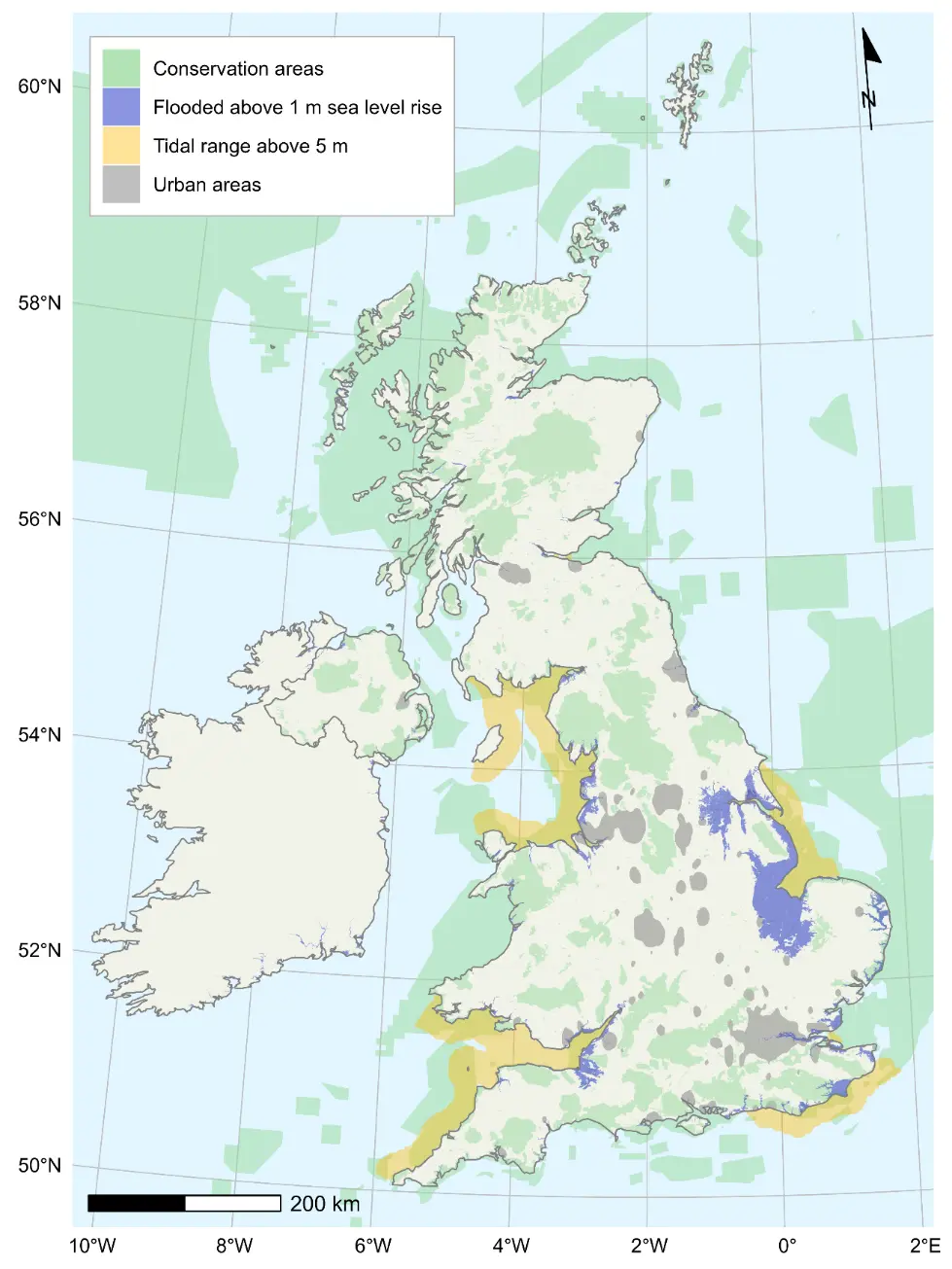
Figure 1. Combined UK map of the factors considered in this work. Tidal range of 5 m or more (Yellow), Areas with conservation designation (Green), Flood risk (1:25 year, 2050) (Blue), and High human population density (Grey).
The combined map highlights areas in which the key factors overlap, identifying locations with potential for tidal barrage development and the delivery of associated co-benefits (Figure 1). These areas are characterized by having either coastal communities or valuable ecological sites that are threatened by rising sea levels, storm surges, and flooding, alongside a sufficient tidal range to make TPP projects economically viable. Among the four primary areas in the UK that have sufficient tidal range for a major TPP, only three include estuaries that can support such infrastructure. The south-east coastal region, although it has sufficient tidal ranges, lacks estuary zones of sufficient magnitude and was not considered further. This leaves three key broad areas suitable for tidal barrage development.
This overlap highlights the opportunity for integrated solutions that serve multiple climate-mitigation and adaptation objectives. These coastal areas are under increasing threat from climate change, and the co-benefits of tidal barrage projects, such as flood protection, habitat protection, and renewable energy generation, could be key in enhancing resilience to both environmental and socio-economic challenges.
4. Discussion
4.1. Areas with Co-Benefit Potential
The coastal areas we highlight here are particularly vulnerable to sea-level rise and flooding. These areas are important to protect as they are characterized by high ecological value, dense human populations, and infrastructure, or a combination of both. The increasing flood likelihood in these areas poses a risk of irreversible damage to both critical infrastructure and sensitive ecosystems. By identifying locations in which these vulnerable zones intersect with areas with sufficient tidal range, we highlight an opportunity to use tidal barrages and TPPs not only as a renewable energy source but also as a means of protecting some of the most at-risk coastal regions. Beyond protection, the shelter and tidal attenuation possible with managed, less-violent tidal flows creates opportunity for extensive planned conservation and habitat restoration, and, while this example is in the UK, opportunities for such co-benefits exist in other regions. Restored coastal ecosystems, such as mangrove and, in this context, saltmarsh, themselves offer benefit to coastal resilience [23,46,47]. The combination of ecosystem gain and ‘hard’ infrastructure may integrate nature and climate action positively [16].
Indeed, several of the identified areas have previously been considered for tidal barrages (Figure 2). Proposed UK projects include the Severn Barrage, Morecambe Bay Barrage, Mersey River Barrage, Wyre Barrage, and the Centre Port Barrage at The Wash in East Anglia [8,48]. Despite these sites’ tidal energy potential, many of these projects faced obstacles, largely due to ecological concerns, planning, and financial constraints, that prevented progress [9]. Each of these locations, however, offers substantial additional value in terms of either ecological or socio-economic benefits, or both, beyond serving as a consistent and reliable energy source. These sites intersect with conservation areas, flood prone areas, or densely populated coastal communities, indicating that the proposed barrages may provide co-benefits which extend the proposal value. Taking a holistic view, a comprehensive reassessment should reveal and quantify these benefits, as we now have a better understanding of the range of ecological and economic advantages these projects may offer. With the coupled biodiversity and climate crises we face, TPPs could well be considered integrated actions [16,49].
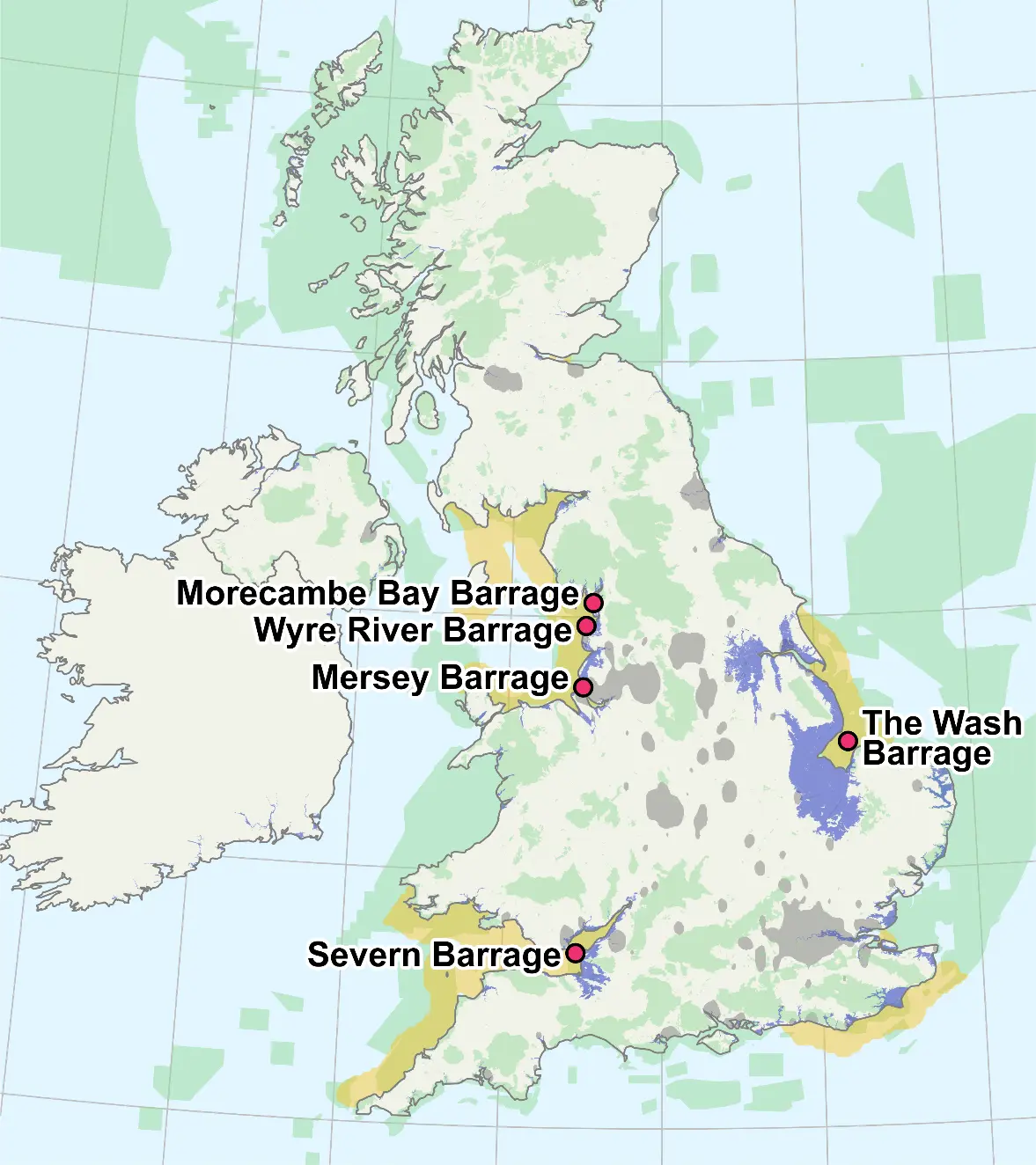
Figure 2. Previously proposed major tidal range barrages in the UK. Tidal range of 5 m or more (Yellow), Areas with conservation designation (Green), Flood risk (1:25 year, 2050) (Blue), and High human population density (Grey).
4.2. Shaping Future Policy and Planning
This overlap analysis provides insights that can guide future policy and planning for both coastal protection and renewable energy. As flooding and SLR increasingly threaten ecologically valuable and densely populated coastal zones [14,15,50], policymakers now face an urgent need to adopt frameworks to support multi-benefit, INCA solutions such as TPPs. Critical to this will be research to explore and estimate the ecological effects and elucidate potential human and infrastructure costs and benefits. After these quantifications, wide engagement with relevant stakeholders such as local communities, conservation interests, statutory bodies, council authorities, and insurance providers would permit a structured and informed conversation among them [51]. These discussions would underpin future planning for policy or financing mechanisms to address costs to particular groups or inform specific mitigation measures.
Governments stand to benefit from facilitating the development of TPPs, as they bear much of the responsibility for mitigating the impacts of sea-level rise and managing the economic consequences of flooding [52]. Marine renewables are rising in consideration [53], and by strategically promoting or investing in tidal barrage infrastructure, governments would reduce future expenditure on flood response and deliver long-term climate resilience measures, while simultaneously advancing renewable energy goals. To support the development of TPPs, governments in countries where opportunity arises should consider implementing targeted incentives. Subsidies specifically aimed at TPP development would not only reduce the substantial CapEx but also make them more attractive to investors and developers. A policy framework that fully recognises these multiple benefits could help in tidal project approval processes and reduce opposition based on potentially ill-founded environmental concerns.
Ultimately, we highlight the need for a coordinated and holistic approach in policy and planning, one that integrates ecological, societal, and energy-generation considerations. For this, it will be critical to engage widely with stakeholders and to have the co-production element representing different values and views so vital to developing plans and gaining support [51,54]. Through an informed consideration of the potential costs and benefits as well as the range of views on these, policymakers can enable conditions in which TPPs could contribute to ecological protection, coastal resilience strategies, and national renewable energy targets.
4.3. Research Gaps
Power-generating tidal barrages offer a range of benefits that extend beyond their primary purpose. Their contribution to aspects of coastal protection greatly enhances their value, and this multifaceted role highlights their potential to support climate change mitigation and adaptation needs.
While TPPs have been linked to ecological concerns, modern design and construction techniques, and careful planning could minimise many of these. The long-term benefits emerging from combined coastal protection and ecosystem conservation may outweigh the potential drawbacks. From a financial perspective, tidal barrages may thus offer a compelling return on investment, generating renewable energy while providing valuable non-energy benefits, particularly in coastal resilience. These should be quantified, and there is a need for loss-averted estimates from flood risk reduction.
We now need to expand our understanding of TPPs, looking beyond their energy production value and the historical concerns over ecological impact. As the UK Parliament [55] points out, “a significant issue is that there is no current mechanism to allow tidal range projects to receive a return from long life and non-energy benefits, in particular to coastal defence benefit”. Recognising and accounting for these additional benefits is critical to fully appreciate the value of tidal range projects and to ensure they are properly integrated into both policy and investment strategies [53].
5. Conclusions
Tidal barrages present a unique opportunity for addressing some of the most pressing challenges of our time. While the world possesses important untapped tidal range potential, ecological fears, high initial costs, and the complex regulatory landscape have long hindered the development of tidal range power plants. With growing concern, however, over rising sea levels, increased storm intensity, and consequently the increasing vulnerability of coastal areas, the case for re-evaluating TPPs has become stronger than ever.
We underscore the dual role that TPPs could play, not only as a sustainable energy source but also for protecting vulnerable coastal communities and ecologically significant estuarine habitats from the escalating impacts of climate change. The long lifespan of TPPs, which extends over 100 years, makes them a stable long-term investment that continues to provide returns in the form of both energy production and coastal protection.
There is now a compelling case for rethinking coastal protection and energy generation in the face of climate change. Supported by the experiences of range plants in other countries, conversations among a wide range of stakeholders could lead to careful planning, design, and policy support. TPPs could become valuable to resilience against rising sea levels while contributing to a sustainable energy future. It is essential that we begin to quantify the potential co-benefits so that policymakers can recognise and incorporate these into regulatory frameworks and financial incentives.
Acknowledgments
We wish to thank the Centre for Sectoral Economy Performance team & Nigel Steward at Imperial College London for their support and encouragement.
Author Contributions
Conceptualization, C.M.C., I.G., S.A. and I.S.; Methodology, I.G., S.A. and I.S.; Formal Analysis, I.G. and I.S.; Investigation, I.G. and S.A.; Data Curation, I.G., S.A. and I.S.; Writing—Original Draft Preparation, I.G. and S.A.; Writing—Review & Editing, C.M.C., I.G., S.A. and I.S.; Visualization, I.G., S.A. and I.S.; Supervision, C.M.C.; Project Administration, C.M.C.; Funding Acquisition, C.M.C. and I.S.
Ethics Statement
Not applicable.
Informed Consent Statement
Not applicable.
Data Availability Statement
Data are available from public data sets as indicated in the methods section.
Funding
SEA & IMG were supported as research assistants by the Centre for Sectoral Economy Performance in the Dyson School of Design Engineering at Imperial College London.
Declaration of Competing Interest
The authors declare that they have no known competing financial interests or personal relationships that could have appeared to influence the work reported in this paper.
References
-
Chowdhury MS, Rahman KS, Selvanathan V, Nuthammachot N, Suklueng M, Mostafaeipour A, et al. Current trends and prospects of tidal energy technology. Environ. Dev. Sustain. 2021, 23, 8179–8194. DOI:10.1007/s10668-020-01013-4 [Google Scholar]
-
Staffell I, Pusey A, Xie J, Johnson N. The global potential and hourly capacity factors of tidal range and tidal stream technologies. R. Soc. Proc. A 2026, Submitted. [Google Scholar]
-
Waters S, Aggidis G. A World First: Swansea Bay Tidal lagoon in review. Renew. Sustain. Energy Rev. 2016, 56, 916–921. DOI:10.1016/j.rser.2015.12.011 [Google Scholar]
-
Coles DS, Adcock TAA, Cornett A, Haas K, Jo CH, Liu H, et al. A review of global tidal stream energy resources. Proc. R. Soc. A Math. Phys. Eng. Sci. 2025, 481, 20240841. DOI:10.1098/rspa.2024.0841 [Google Scholar]
-
Jo CH, Hwang SJ. Review on Tidal Energy Technologies and Research Subjects. China Ocean. Eng. 2020, 34, 137–150. DOI:10.1007/s13344-020-0014-8 [Google Scholar]
-
Neill SP, Angeloudis A, Robins PE, Walkington I, Ward SL, Masters I, et al. Tidal range energy resource and optimization—Past perspectives and future challenges. Renew. Energy 2018, 127, 763–778. DOI:10.1016/j.renene.2018.05.007 [Google Scholar]
-
Tethys. Sihwa Tidal Power Plant. 2019. Available online: https://tethys.pnnl.gov/project-sites/sihwa-tidal-power-plant (accessed on 10 November 2025).
-
Vandercruyssen D, Baker S, Howard D, Aggidis G. Tidal range electricity generation into the twenty-second century. Proc. Inst. Civ. Eng.—Energy 2024, 177, 205–213. DOI:10.1680/jener.23.00031 [Google Scholar]
-
Neill SP, Haas KA, Thiébot J, Yang Z. A review of tidal energy—Resource, feedbacks, and environmental interactions. J. Renew. Sustain. Energy 2021, 13, 062702. DOI:10.1063/5.0069452 [Google Scholar]
-
Vandercruyssen D, Baker S, Howard D, Aggidis G. Tidal range electricity generation: A comparison between estuarine barrages and coastal lagoons. Heliyon 2022, 8, e11381. DOI:10.1016/j.heliyon.2022.e11381 [Google Scholar]
-
Guo B, Ahmadian R, Falconer RA. Refined hydro-environmental modelling for tidal energy generation: West Somerset Lagoon case study. Renew. Energy 2021, 179, 2104–2123. DOI:10.1016/j.renene.2021.08.034 [Google Scholar]
-
Day JW, Crump BC, Kemp WM, Yáñez-Arancibia A. Estuarine Ecology; Wiley: Hoboken, NJ, USA, 2012. DOI:10.1002/9781118412787 [Google Scholar]
-
Lowe JA, Gregory JM. The effects of climate change on storm surges around the United Kingdom. Philos. Trans. R. Soc. A Math. Phys. Eng. Sci. 2005, 363, 1313–1328. DOI:10.1098/rsta.2005.1570 [Google Scholar]
-
Burden A, Smeaton C, Angus S, Garbutt A, Jones L, Lewis HD, et al. Impacts of climate change on coastal habitats, relevant to the coastal and marine environment around the UK. MCCIP Sci. Rev. 2020, 2020, 228–255. DOI:10.14465/2020.arc11.chb [Google Scholar]
-
Neumann B, Vafeidis AT, Zimmermann J, Nicholls RJ. Future Coastal Population Growth and Exposure to Sea-Level Rise and Coastal Flooding—A Global Assessment. PLoS ONE 2015, 10, e0118571. DOI:10.1371/journal.pone.0118571 [Google Scholar]
-
Folkard-Tapp H, Boran I, Chan S, Dombrowsky I, Penney TL, Bazely D, et al. Beyond Nature-based Solutions: The case for Integrated Nature-Climate Action. J. Appl. Ecol. 2025, 62, 2478–2486. DOI:10.1111/1365-2664.70130 [Google Scholar]
-
Howarth C, Robinson EJZ. Effective climate action must integrate climate adaptation and mitigation. Nat. Clim. Change 2024, 14, 300–301. DOI:10.1038/s41558-024-01963-x [Google Scholar]
-
Seeger K, Minderhoud PSJ. Sea level much higher than assumed in most coastal hazard assessments. Nature 2026, 652, 667–674. DOI:10.1038/s41586-026-10196-1 [Google Scholar]
-
Palmer M, Howard T, Lowe J, Bricheno L, Calvert D, Edwards T, et al. UKCP18 Marine Report; Met Office Hadley Centre: London, UK, 2018. [Google Scholar]
-
Met Office Hadley Centre. UKCP18 Factsheet: Sea-Level Rise and Storm Surge; Met Office Hadley Centre: London, UK, 2023. [Google Scholar]
-
van Ginkel KCH, Rijken B, Hoogvliet M, van Veggel W, Botzen WJW, Filatova T. How an economic and financial perspective could guide transformational adaptation to sea level rise. Npj Clim. Action 2025, 4, 89. DOI:10.1038/s44168-025-00297-4 [Google Scholar]
-
Bachner G, Lincke D, Hinkel J. The macroeconomic effects of adapting to high-end sea-level rise via protection and migration. Nat. Commun. 2022, 13, 5705. DOI:10.1038/s41467-022-33043-z [Google Scholar]
-
Brook T, Millington-Drake M, Garbutt A, McGarrigle A, Rodriguez K, du Plessis N. The State of the Worlds Saltmarshes 2025: A Global Call to Action for Coastal Resilience and Adaptation; The World Wildlife Fund: Gland, Switzerland, 2025. [Google Scholar]
-
Gibbs D, While A, Jonas AEG. Governing Nature Conservation: The European Union Habitats Directive and Conflict around Estuary Management. Environ. Plan A Econ. Space 2007, 39, 339–358. DOI:10.1068/a37399 [Google Scholar]
-
Barbier EB, Hacker SD, Kennedy C, Koch EW, Stier AC, Silliman BR. The value of estuarine and coastal ecosystem services. Ecol. Monogr. 2011, 81, 169–193. DOI:10.1890/10-1510.1 [Google Scholar]
-
Xiang Z, Li Y, Zhang Z. Global conservation priorities of coastal habitats towards extreme sea level rise risks. J. Clean. Prod. 2024, 473, 143455. DOI:10.1016/j.jclepro.2024.143455 [Google Scholar]
-
Ascher SE, Gray IM, Collins T. Misplaced fears? What the evidence reveals of the ecological effects of tidal power generation. Environ. Solut. Evid. 2025, 6, e70124. DOI:10.1002/2688-8319.70124 [Google Scholar]
-
NESO, Arup. Strategic Case for Tidal Range; NESO: Warwick, UK; Arup: London, UK, 2025. [Google Scholar]
-
Watson N, Bolton P. Contracts for Difference. House of Commons Library. London, UK 2024. Available online: https://commonslibrary.parliament.uk/research-briefings/cbp-9871/ (accessed on 10 November 2025).
-
Tethys. La Rance Tidal Barrage. 2019. Available online: https://tethys.pnnl.gov/project-sites/la-rance-tidal-barrage (accessed on 10 November 2025).
-
Parliamentary Office of Science and Technology (POST). Marine Renewables; POST: London, UK, 2020. [Google Scholar]
-
Sathiamoorthy M, Probert SD. The integrated Severn barrage complex: Harnessing tidal, wave and wind power. Appl. Energy 1994, 49, 17–46. DOI:10.1016/0306-2619(94)90055-8 [Google Scholar]
-
Kennish MJ, Paerl HW, Crosswell JR. Climate Change and Estuaries; CRC Press: Boca Raton, FL, USA, 2023. DOI:10.1201/9781003126096 [Google Scholar]
-
Ma Q, Moreira TM, Adcock TAA. The impact of a tidal barrage on coastal flooding due to storm surge in the Severn Estuary. J. Ocean Eng. Mar. Energy 2019, 5, 217–226. DOI:10.1007/s40722-019-00143-w [Google Scholar]
-
Chen Z, Orton P, Wahl T. Storm Surge Barrier Protection in an Era of Accelerating Sea-Level Rise: Quantifying Closure Frequency, Duration and Trapped River Flooding. J. Mar. Sci. Eng. 2020, 8, 725. DOI:10.3390/jmse8090725 [Google Scholar]
-
Hall JW, Harvey H, Manning LJ. Adaptation thresholds and pathways for tidal flood risk management in London. Clim. Risk Manag. 2019, 24, 42–58. DOI:10.1016/j.crm.2019.04.001 [Google Scholar]
-
Egbert GD, Erofeeva SY. Efficient Inverse Modeling of Barotropic Ocean Tides. J. Atmos. Ocean. Technol. 2002, 19, 183–204. DOI:10.1175/1520-0426(2002)019<0183:EIMOBO>2.0.CO;2 [Google Scholar]
-
Shetty C, Priyam A. A review on tidal energy technologies. Mater. Today Proc. 2022, 56, 2774–2779. DOI:10.1016/j.matpr.2021.10.020 [Google Scholar]
-
NOAA Office for Coastal Management. METHOD DESCRIPTION. Detailed Method for Mapping Sea Level Rise Inundation; NOAA Office for Coastal Management: North Charleston, SC, USA, 2017. [Google Scholar]
-
NOAA. Sea Level Rise Viewer. 2024. Available online: https://coast.noaa.gov/digitalcoast/tools/slr.html (accessed on 10 May 2026).
-
Climate Central. Coastal Risk Screening Tool. 2025. Available online: https://coastal.climatecentral.org/ (accessed on 10 May 2026).
-
Copernicus. Copernicus DEM; Copernicus: Göttingen, Germany, 2024. DOI:10.5270/ESA-c5d3d65 [Google Scholar]
-
Mouselimis L. Digital Elevation Models. In R Package Version 1.0.5. 2024. Available online: https://dataspace.copernicus.eu/copernicus-data-space-ecosystem-dashboard (accessed on 10 May 2026).
-
GDAL/OGR Contributors. GDAL/OGR Geospatial Data Abstraction Software Library. 2025. Available online: https://gdal.org/en/stable/ (accessed on 10 May 2026).
-
Hijmans RJ. Terra: Spatial Data Analysis. CRAN: Contributed Packages. 2023. Available online: https://cran.r-project.org/web/packages/terra/index.html (accessed on 10 May 2026).
-
Perkins MS, Bakker JD, Arkema KK. Exploring the disaster risk reduction and energy resilience benefits of coastal ecosystems and protected areas in Puerto Rico. Ecosyst. Serv. 2026, 79, 101847. DOI:10.1016/j.ecoser.2026.101847 [Google Scholar]
-
Pétillon J, McKinley E, Alexander M, Adams JB, Angelini C, Balke T, et al. Top ten priorities for global saltmarsh restoration, conservation and ecosystem service research. Sci. Total Environ. 2023, 898, 165544. DOI:10.1016/j.scitotenv.2023.165544 [Google Scholar]
-
Burrows R, Yates NC, Hedges TS, Li M, Zhou JG, Chen DY, et al. Tidal energy potential in UK waters. Proc. Inst. Civ. Eng.—Marit. Eng. 2009, 162, 155–164. DOI:10.1680/maen.2009.162.4.155 [Google Scholar]
-
Pörtner H-O, Scholes RJ, Arneth A, Barnes DKA, Burrows MT, Diamond SE, et al. Overcoming the coupled climate and biodiversity crises and their societal impacts. Science 2023, 380, eabl4881. DOI:10.1126/science.abl4881 [Google Scholar]
-
Palmer L, Gillespie D, MacAulay JDJ, Sparling CE, Russell DJF, Hastie GD. Harbour porpoise (Phocoena phocoena) presence is reduced during tidal turbine operation. Aquat. Conserv. 2021, 31, 3543–3553. DOI:10.1002/aqc.3737 [Google Scholar]
-
Manuel L, Meselhe E, Kleiss BA, Lewis KA, Madill H, Allison M, et al. A roadmap to the Co-production of a decision support tool for coastal ecosystems. Environ. Sci. Policy 2023, 144, 31–42. DOI:10.1016/j.envsci.2023.03.001 [Google Scholar]
-
Burnett N, Bolton P. Flood Risk Management and Funding; House of Commons: London, UK, 2024. [Google Scholar]
-
House of Commons. Marine Renewables Industry; Hansard HC Deb; House of Commons: London, UK, 2025; Volume 760. [Google Scholar]
-
Muhl E-K, Armitage D, Anderson K, Boyko C, Busilacchi S, Butler J, et al. Transitioning toward “deep” knowledge co-production in coastal and marine systems: examining the interplay among governance, power, and knowledge. Ecol. Soc. 2023, 28, 17. DOI:10.5751/ES-14443-280417 [Google Scholar]
-
Environmental Audit Committee. Technological Innovations and Climate Change: Tidal Power; House of Commons: London, UK. 2021. Available online: https://committees.parliament.uk/work/780/technological-innovations-and-climate-change-tidal-power/publications/ (accessed on 10 May 2026).