
Unsustainable River Management Will Prevent the Achievement of the SDGs
Unsustainable River Management Will Prevent the Achievement of the SDGs
Wen-Li Zhang
1,2
Matthew F. Johnson
3
 Faith Ka Shun Chan
4,5
Nai-Cheng Wu
6
Yao-Yang Xu
1
Zhao-Feng Guo
1
Tao Lin
1
Cai Chen
1,*
Faith Ka Shun Chan
4,5
Nai-Cheng Wu
6
Yao-Yang Xu
1
Zhao-Feng Guo
1
Tao Lin
1
Cai Chen
1,*
Received: 26 March 2026 Revised: 22 April 2026 Accepted: 26 May 2026 Published: 09 June 2026

© 2026 The authors. This is an open access article under the Creative Commons Attribution 4.0 International License (https://creativecommons.org/licenses/by/4.0/).
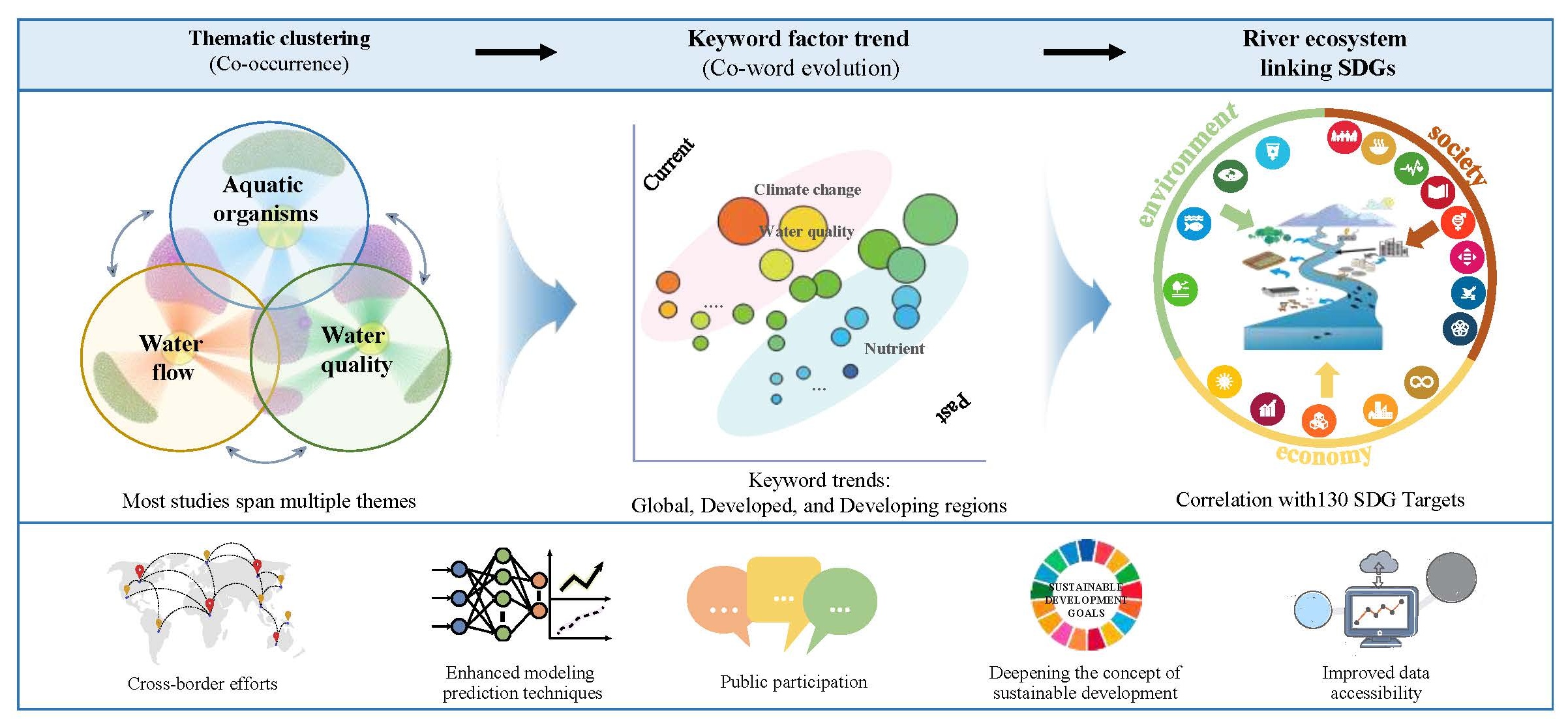
Graphical Abstract
1. Introduction
Rivers connect freshwater, terrestrial, and marine ecosystems and provide essential services to human society. River ecosystems are integral to socio-economic development due to their provisioning services (water, food, electricity) and cultural services (tourism, aesthetic enjoyment) [1,2]. River flow and condition drive the development of fisheries and tourism, and control land drainage with implications for agricultural land use and river hazards. Access to waterways for transportation can provide a strong boost to industry. In addition, rivers’ cultural and ecological resources attract people, and riverside property is often highly desirable [3]. As such, people are highly dependent on the services provided by river ecosystems, and human development over millennia has been closely aligned with river use and management [4]. This close association between rivers and people over thousands of years has had detrimental impacts on river ecosystems due to a multitude of impacts, including habitat simplification, altered hydrological flows and functioning, pollution, and the spread of invasive species [5,6]. Anthropogenically altered river ecosystems are also more vulnerable to future changes due to continuing environmental and climate change [7,8].
Challenges to sustainably managing rivers are multifaceted and change as society develops. Urbanization and industrial development have brought significant benefits to human society, but also pose increasing challenges to river ecosystems. The inherent temporal variability and spatial heterogeneity of river ecosystems can make them unpredictable and challenging to manage. Competing human uses of river resources have also led to significant declines in river conditions globally, further increasing the challenge of sustainable river management. For example, the proliferation of global trade and e-commerce is closely linked to the introduction of alien species [9], and the construction of dams to reduce river hazards and provide electricity disrupts the continuity of rivers [10,11]. Studies have shown that river ecosystems in densely populated areas are particularly impacted and almost all experience altered flow regimes [7]. New pressures have also emerged over recent decades, including plastic pollution and novel pesticides [12,13]. Therefore, both emerging and persistent threats to river ecosystems need to be identified to develop appropriate responses.
The intricate relationship between human activities and river ecosystems requires the development of sustainable river management measures to balance river ecosystem health with human needs. The success of the Millennium Goals [14], the predecessors of the United Nations Sustainable Development Goals (SDGs), shows how global goals can be used to drive management. The SDGs [15], comprising 17 goals and multiple targets, from the perspective of economic development and social inclusion, aim to promote economic prosperity while protecting the planet, eradicating poverty, improving the environment, and the lives of all people. Several SDGs are directly related to freshwater ecosystems and biodiversity [16,17] (e.g., Goal 6: Clean Water and Sanitation; Goal 14: Life below water), and targets are proposed to achieve them, providing directions for the management and development of river ecosystems. The implementation of other SDGs could hinder or benefit the sustainable development of river ecosystems, so understanding the synergies and trade-offs between SDG actions is essential for river conservation and management [18].
While previous studies have explored links between water ecosystems and the SDGs in terms of water security [15], there remains a lack of nuanced understanding of the linkages between river ecosystems and specific SDGs targets. To promote the management of rivers within the context of sustainable development, we build on previous research, supported by a scientific mapping approach to (1) explore the temporal evolution, changing research priorities, and emerging challenges in river ecosystem management; (2) compare the distinct frontier trends in river ecosystem research between developed and developing regions; and (3) identify the interdependencies between river ecosystem management and the SDGs targets. By answering these aims, the linkages between river ecosystems and SDGs can be understood in more detail, informing researchers in formulating future management policies and development plans, and providing guidance for the management of river ecosystem development.
2. Data Source and Methodology
2.1. Data Source and Preprocessing
The Web of Science Core Collection was used for literature searches. In this study, the exact query for river ecosystems was TS = (“river* ecosystem*”), and the period was from 1990 to 2025 because the number of articles before 1990 was less than 0.7% of the total number of articles, and there was no systematic generation of keywords. In the initial screening of the search, only research articles and reviews were selected. Raw data, including title, author, abstract, year of publication, journal of publication, author affiliation, and several citations, were derived from the retrieved documents. 4397 papers were obtained in this search, including 4195 research articles and 202 reviews.
2.2. Theme Co-Occurrence
Papers were initially classified based on broad themes related to the provision of ecosystem services. These were: water quality, water flow, and aquatic organisms, and common keywords within each theme were recorded and listed in Supplementary Table S1 (see Supplementary Text S1 for the classification and screening of keywords). The theme literature was categorized by the keywords according to Supplementary Table S1, and where a single article had keywords in multiple themes, that article was noted as cross-theme. The search results showed that a total of 4309 papers were obtained through the keyword search, and an additional 88 un-retrieved papers were manually classified. Meanwhile, 8 papers were deleted as irrelevant to river ecosystems. Therefore, a total of 4389 papers were included in the analysis. After establishing the node files and link files, the distribution of literature in different themes was visualized with Gephi 0.10.1 (Figure 1), and a force-directed layout algorithm enabled the visualization of the connections and distribution characteristics of the theme distribution [19,20].
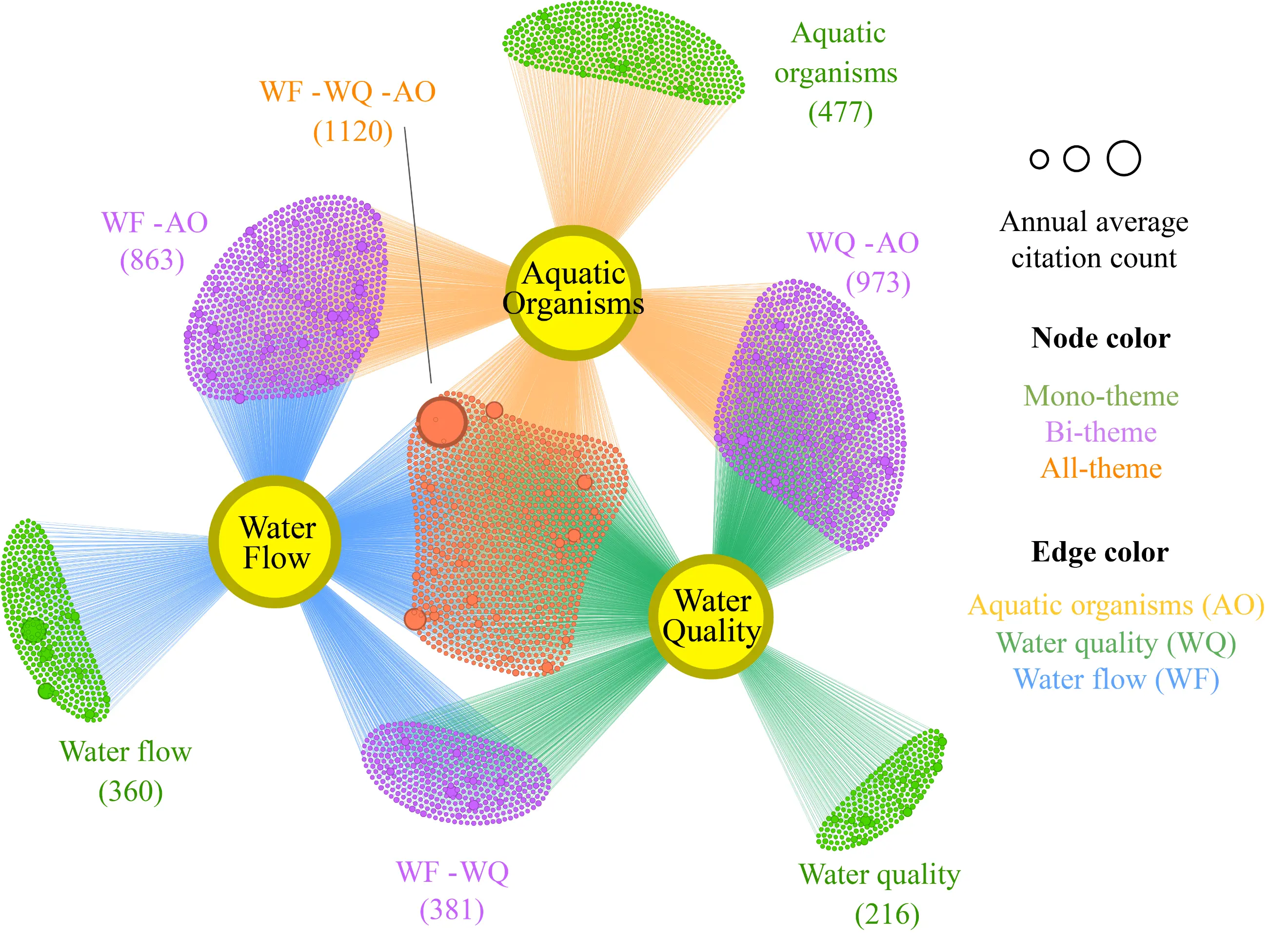
Figure 1. Distribution of literature into one or more of three broad themes (water flow, water quality, aquatic organisms) was identified based on subject classification analysis. Yellow circles represent the number of studies in each of the three research areas; small circles with different colors represent individual papers, and their colors indicate how many themes each paper includes. The size of the circles indicates the average per year citation frequency for the document.
2.3. Keywords Analysis
It is necessary to select time series keywords before analysis and visualization. We primarily utilized author keywords to represent the core focus of the literature. For publications where author-provided keywords were unavailable (such as articles published in Nature or Science), representative terms were extracted directly from the article title [21]. Specifically, this extraction involved removing common stop-words (e.g., “the”, “effect”, “study”) and isolating meaningful noun phrases that align with our thematic scope. To ensure the accuracy and reliability of the co-word analysis, we conducted a standardized merging and cleaning process for the keywords [22]. Keywords were standardized by merging terms with similar meanings, including singular and plural forms (e.g., “pollutant” and “pollutants”), full names and abbreviations (e.g., “ecosystem services” and “ES”), and spelling variants such as hyphenated forms (e.g., “land-use” and “land use”). Second, non-informative words were removed. In addition, to focus on generalizable scientific concepts, proper nouns (e.g., names of specific countries, cities, and rivers) were excluded. Finally, to prevent high-frequency background words from dominating the network structure and obscuring potential thematic associations, the initial search terms used to build the corpus of this study (e.g., river ecosystems, rivers, systems, ecology) were deleted.
Time series analysis of keywords can reveal the temporal evolution of research directions. The approach of co-word network evolution assists in understanding current research frontiers (Figure 2). To understand the shift in research hotspots between previous studies and river ecosystem research in the last decade, as well as the impact of the publication of the SDGs on river ecosystem research, we divided the research period from 1990 to 2025 into two time periods (1990–2015 and 2016–2025). By comparing keyword frequencies across these two periods, temporal trends in research focus were identified.
When the frequency of keywords appearing in the first period is higher than that in the second period, it means that the keywords show a decreasing trend, and vice versa. Since the number of annual publications varies through time, normalized frequencies ($${F}_{yr}$$) were used to standardize comparisons of topics through time. The normalized keyword cumulative frequency (F) was calculated based on the keyword frequency and the number of papers ($$N$$). The past ($${F}_{past}$$) or current ($${F}_{current}$$) normalized cumulative keyword frequency was defined as representing the number of keyword-related papers per 1000 papers in the past or current period, respectively. The logarithm of the ratio of $${F}_{current}$$ to $${F}_{past}$$ was also used to reflect the keyword change trend [23].
To visualize the results, a bubble chart was drawn with $${F}_{current}$$ as the y-axis and $${F}_{past}$$ as the x-axis. Each bubble represents a keyword and uses color to indicate the differentiation of the trend factor, and the bubble size indicates keywords frequency. Keywords with trend factors greater than 0.4 and those that did not appear during the period 1990–2015 were further analyzed with heat maps to assess annual trends and reveal current hot topics in river ecosystem science. For emerging keywords, we selected the 50 most frequent keywords to create a heat map to show the trend of new research (there may be keywords that are not shown in the author’s keywords in the first phase of research, but are slowly being applied to the environmental field as more research is done). Furthermore, considering that differences in regional development lead to distinct spatial distribution characteristics in the research focus on river ecosystems, we classified the countries into developed and developing regions based on United Nations standards [24], in order to compare and reveal the historical evolution and frontier trends of river ecosystem management across different stages of development.
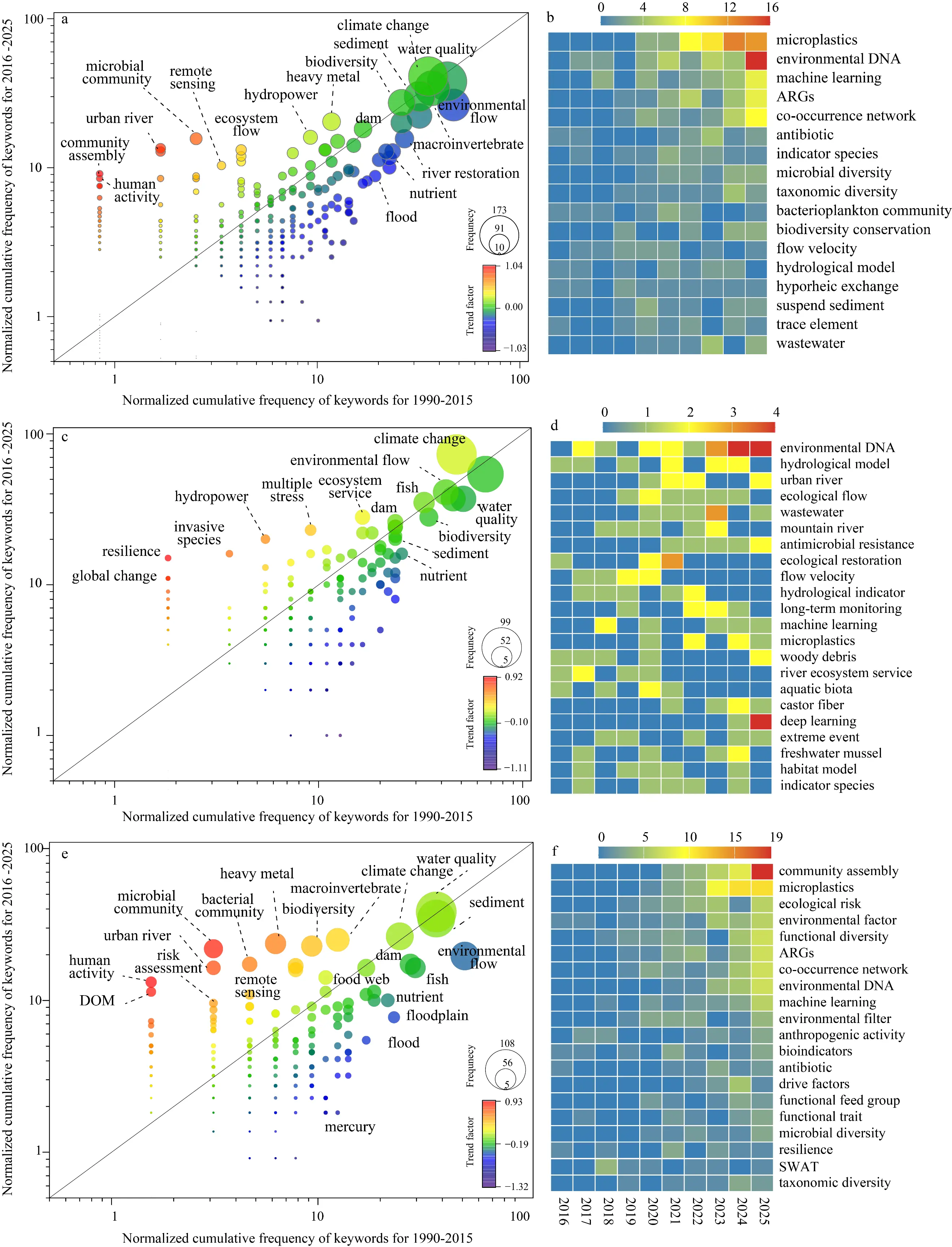
Figure 2. (a,c,e) Keywords with an occurrence frequency greater than 5 (bubbles) based on the time trend distribution of past (1990–2015) and recent (2016–2025) normalized cumulative frequencies (some bubbles with the same trend factor and normalized cumulative frequency will appear superimposed). The shade of color indicates the magnitude of the trend factor value of the keyword. The size of the bubble indicates the cumulative frequency of the keyword. (b,d,f) Temporal trends of emerging keywords for the period 2016–2025. Keywords are ranked by cumulative frequency. Emerging keywords indicate new keywords that did not appear in the first stage and appeared exclusively in the latter period. Among these, (c,d) represent the keyword trends in developed regions, while (e,f) represent the keyword trends in developing regions.
2.4. Linking to SDGs
Research on river ecosystems is closely linked to the SDGs. Building on this premise, we aim to establish connections between research hotspots and priorities in river ecosystem studies and the SDGs. First, emerging, high-trend, and high-frequency keywords are extracted from the literature, after which core keywords are identified within three thematic frameworks: water quality, water flow, and aquatic organisms. High-frequency keywords are defined as those ranked within the top 10% by cumulative frequency (after excluding keywords with a frequency below 10) [25]. High-trend keywords are identified using a threshold of a trend factor greater than 0.4, ensuring that selected keywords exhibit sustained and significant growth while minimizing interference from low-frequency stochastic fluctuations and edge effects caused by temporal segmentation [23,26]. Emerging keywords refer to author- and title-derived terms that appear exclusively in the second stage. The resulting keyword set is then subjected to semantic normalization: generic background terms lacking clear ecological specificity (e.g., “ecosystem”) are removed, and semantically similar or redundant terms are consolidated. Ultimately, 20 representative keywords were selected for correlation mapping with the SDGs.
To link SDGs to current research on river ecosystems, we used an ecosystem-SDGs correlation analysis method. This was performed via the following three steps. Keywords for the 169 SDGs were first identified (bolded keywords in each goal sentence statement in Table S2), and we used the keywords identified in the article by Wang et al. [16]. Secondly, the keywords associated with each SDG were searched in the database of keywords compiled from academic publications related to rivers (e.g., “freshwater biodiversity”, “aquatic ecosystem,” or “fluvial ecosystem”). Thirdly, potential links between SDGs and river ecosystems were explored by manually scrutinizing the search results. Assessments of the interactions between SDGs and river ecosystems may differ between experts and approaches, but the approach using keywords was deemed appropriate given the focus of this work on exploring the scientific evidence for linkages in our understanding, which is being iteratively updated, between SDGs and river ecosystem science.
3. Results
3.1. Thematic Characteristics of River Ecosystem Research
Among the services provided by rivers, those related to water quality, water flow, and aquatic organisms were most often quantified. The results of the analysis here show that studies that included multiple themes tended to have higher publication volume and higher citation values than those focused on a single theme (Figure 1). Specifically, out of the 4389 documents included in the analysis, cross-thematic papers hold an absolute advantage in terms of publication volume, totaling 3814 papers and accounting for 86.74% of all literature related to river ecosystems. Among these, cross-thematic papers involving all three themes reached 1120 publications, representing 25.5% of the total. Notably, whether in single-theme or cross-thematic contexts, research on aquatic organisms consistently accounted for a larger proportion than other themes at the corresponding level. In terms of academic influence, cross-thematic papers achieved an average annual citation frequency of 4.39, which was significantly higher than the 3.96 citations per year observed for single-theme papers.
3.2. Changing the Focus of River Ecosystem Science
The major research themes identified through keyword analysis shifted between 1990–2015 and 2016–2025 periods (Figure 2). From a global perspective, the keyword evolution maps (Figure 2a,b) indicate that the foundational themes of river ecosystem research have remained stable, while emerging topics have rapidly expanded. At the macro level, “water quality”, “climate change”, and “biodiversity” consistently exhibit very high cumulative frequencies, representing the core focus of global river ecosystem research and forming an important research foundation. Concurrently, river ecosystem science is undergoing a significant transition. While traditional topics such as physical habitat restoration have maintained relatively stable levels of attention, new research frontiers have emerged in the latter period. These include emerging pollutants, such as “microplastics” and “antibiotic resistance genes”, as well as high-throughput molecular monitoring and artificial intelligence approaches, such as “environmental DNA(eDNA)” and “machine learning”. Overall, river ecosystem research interests are evolving from conventional assessments of water quality and water flow toward more mechanistic investigations of emerging pollutants and micro-scale community dynamics. Furthermore, a regionally stratified analysis of the global literature reveals clear heterogeneity in research patterns across regions with different levels of socio-economic development.
In developed regions, research hotspots in river ecosystems have notably shifted from basic pollution control and single-species surveys to macro-level research on global change and comprehensive ecosystem management. Over the past decade, “climate change”, “ecosystem services”, and “multiple stressors” have emerged as core topics in these regions. Notably, “resilience” and “global change” exhibit exceptionally high trend factors (Figure 2c, indicated by the red bubbles in the upper-left section of the chart). Developed regions place a strong emphasis on biological stressors, such as “invasive species”, and extensively utilize eDNA techniques to conduct large-scale, high-throughput monitoring, which provide a scientific foundation for enhancing system resilience. In addition, within the realm of river hydrology, research related to “hydropower” also occupies a prominent position.
The research trends in developing regions (Figure 2e,f) exhibit distinctly different characteristics, with research focus highly concentrated on the assessment of severe environmental disturbances and acute pollution caused by human activities. The bubble plot indicates that while “water quality” accounted for a significant proportion in both periods, “heavy metals”, “risk assessment”, and “urban rivers” emerged as strong trends during the 2016–2025 period. Furthermore, regarding microecological responses, “microbial/bacterial communities” and “dissolved organic matter (DOM)” exhibited exceptionally high activity; heatmap data further corroborate this trend, showing a sharp increase in the frequency of “community assembly” between 2024 and 2025.
3.3. Synergies Between River Ecosystem Science and Achieving SDGs
According to the theme analysis, river ecosystems are still facing many historical environmental problems as well as emerging issues, which intersect with multiple aspects of the SDGs (Figure 2). The results show that the 20 screened keywords are strongly associated with the 17 goals (Figure 3). In the SDGs correlation analysis, SDG 6 (Clean water and sanitation) and SDG 15 (Life on land) exhibit the highest mapping weights, constituting the core foundation of current river ecosystem research. Concurrently, against the backdrop of multiple environmental constraints, related research hotspots have further expanded to include goals such as SDG 3 (Good health and well-being), SDG 11 (Sustainable cities and communities), and SDG 13 (Climate action). Given the current state of research and trends in river ecosystems, managing river ecosystems so that they develop in a sustainable direction and reduce potential negative impacts is an urgent issue. Therefore, analyzing and understanding the links between river ecosystems and the SDGs aims to provide valuable insights for the sustainable management of river ecosystems.
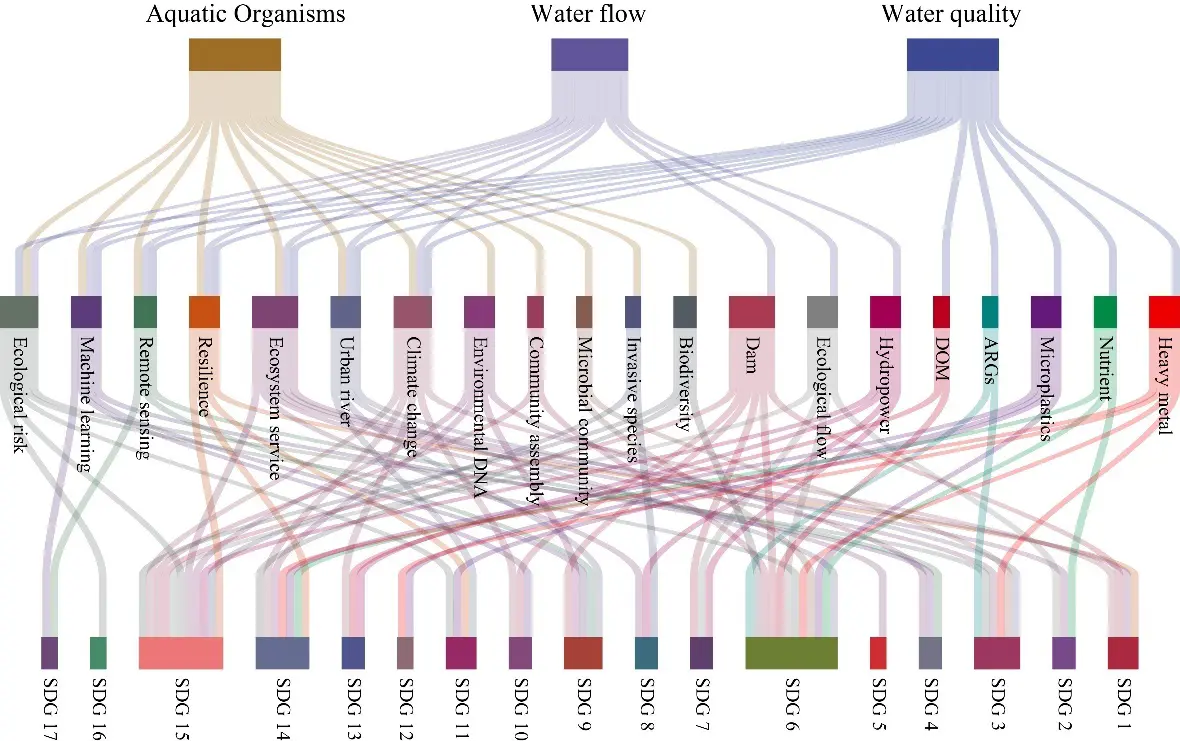
Figure 3. Links between river ecosystem keyword hotspots and SDGs. The connection between the first and second columns indicates how themes are connected to individual keywords, and the thickness of the connecting lines indicates the trend factor (i.e., thicker lines mean use of this term has disproportionately been in the last ten years). The second and third columns indicate how keywords are connected to specific SDG targets.
Keyword analysis identified interdependencies between river ecosystems and 104 of the 169 targets. Only one of the targets had a trade-off with river ecosystems, and 26 targets had both negative and positive effects on rivers, while the remaining 38 targets were not related to river ecosystems (Figure 4). The bi-directional links between river ecosystems and SDGs are grouped based on whether SDGs have a predominantly environmental, social, or economic focus. The target matrix (Figure 4b) further reveals that the interactions between river ecosystems and the SDGs are predominantly characterized by synergies, a feature that is particularly pronounced among the environmentally focused targets (green squares). Conversely, the identified trade-offs (red squares) and mixed impacts (yellow squares) are heavily concentrated within the social and economic target groups.
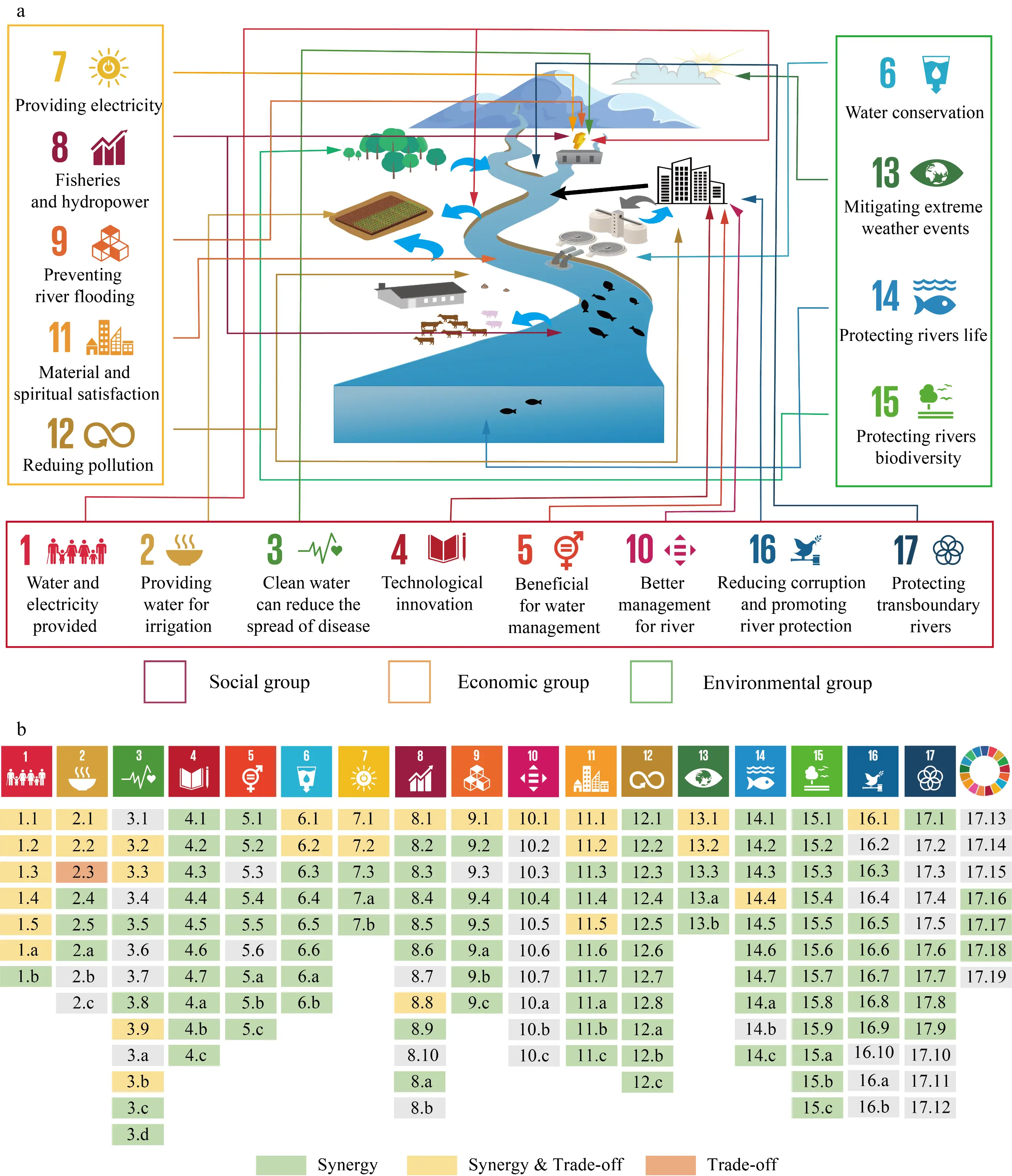
Figure 4. Links between keywords of publications on river ecosystems and the UN Sustainable Goals. The second and third columns indicate how keywords are connected to specific SDG targets. (a) Subdivisions of SDGs related to river ecosystems are divided into those with social (red), economic (yellow), and environmental (green) concerns. Within the squares, the main links between river ecosystems and each of the SDGs are listed. (b) Synergies and trade-offs between the river ecosystem and the SDGs targets. Each rectangle indicates a target, with green indicating synergy between the target and the river ecosystem, red indicating trade-offs, and yellow indicating that there is both synergy and trade-off between the target and the river ecosystem. Grey squares indicate no evidence of a link in the papers studied. Table S2 provides detailed information on the linkages between each target and the river ecosystem.
4. Discussion
4.1. Global Trends and Regional Heterogeneity
Cross-thematic studies dominate river ecosystem research, reflecting both its inherent complexity and integrative nature. This pattern reflects not only a trend in academic output, but also the strong coupling among physical, chemical, and biological processes inherent to river ecosystems, as highlighted by frameworks such as the WFD [27]. The health of the aquatic organisms serves as an “indicator” for measuring the effectiveness of water quality and hydrological regulation [28]. For instance, alterations in hydrological connectivity significantly influence pollutant transport, while changes in water quality directly shape the structure and composition of biological communities [29]. Consequently, traditional single-perspective approaches are no longer sufficient to address the complexities of modern watershed management. Interdisciplinary assessments that integrate multiple stressors are gradually becoming the consensus, providing a more effective framework for understanding the combined impacts that shape river ecosystems.
The evolution of keywords from a global perspective reveals that research hotspots have shifted from traditional basic physicochemical indicators to emerging pollutants and high-throughput microscopic monitoring. With increasing global emphasis on environmental protection, traditional high-concentration point source pollution (such as heavily polluted water bodies and heavy metals) has been effectively controlled to some extent. However, driven by modern industry and intensive agriculture, the massive consumption of global plastic products, and the widespread use of antibiotics in the medical and aquaculture sectors, the impact of emerging pollutants on ecosystems has gradually become prominent, and hidden chronic pollution problems have become a new focus [30]. For example, microplastics entering river ecosystems can easily accumulate in aquatic organisms and transfer along the food web, ultimately harming human health [13,31]. The cross-species horizontal gene transfer ability of ARGs poses a potential threat to global public health [11,32]. It should not be ignored that extreme hydrological events and abnormal water temperatures caused by global climate change affect the transfer and diffusion of various pollutants, further increasing the vulnerability of river ecosystems [8]. Therefore, the development of various technologies has become a key driver of river ecosystem research at both micro and macro scales. The application of technologies such as remote sensing, stable isotope tracing, eDNA, and machine learning enables continuous monitoring of river ecosystems over broader spatial and temporal scales and allows high-precision dynamic simulation, thereby contributing to the shift in this field from traditional descriptive analysis to predictive and management-oriented research [33,34,35,36].
For developed regions, as the process of urbanization has basically been completed, the research focus has shifted from early pollution control to later macro-ecological management and the enhancement of system resilience. Current research focuses more on ecological problems caused by historical changes in hydrological patterns (such as the disruption of river connectivity due to dam construction), increasingly frequent extreme weather events, and invasions of alien species [37]. Corresponding measures are also being taken to address these issues. Europe and the United States have reconstructed ecological connectivity by removing old dams [38]. On the other hand, large-scale monitoring of biological stressors (e.g., invasive species) has been strengthened to protect aquatic organisms [39]. On this basis, efforts are being made to explore new balances between human water demand, renewable energy (hydropower) development, and ecosystem sustainability, in order to enhance the ecological resilience of highly artificialized watershed systems in response to global change [40].
Developing regions are undergoing rapid and concurrent processes of industrialization and urbanization, resulting in more direct and intense human disturbances to river ecosystems [41]. Therefore, research in these areas still mainly focuses on water quality deterioration and related risks, with issues such as heavy metal pollution and urban river degradation being particularly prominent. Due to the high toxicity, bioaccumulation, and environmental persistence of toxic metals, these pollutants continue to attract attention in developing regions, making the analysis of their sources, exposure tracking, and health risk management important research directions at this stage [42]. At the same time, ecological responses at the micro level are gradually receiving attention. Microbial communities in benthic or aquatic environments, which are highly sensitive to environmental changes, are widely used as key indicators for assessing water ecological stress and system health [43].
4.2. Complex Interactions Between River Ecosystems and Socio-Economic
Water Quality. Water quality is critical to the sustainability of river ecosystems and human well-being, and its improvement is highly synergistic with environment-focused SDGs (e.g., SDGs 3, 6, 14). By reducing anthropogenic pollution stresses (e.g., controlling heavy metals, nutrients, and addressing novel pollutants like microplastics and antibiotics), it can not only restore degraded aquatic populations but also offset some of the debt of climate change to a certain extent (e.g., Targets 6.3, 6.6, 13.1, 14.1, 14.2) [44]. At the same time, the SDGs promote resource efficiency and waste minimization (Targets 9.4, 11.b, 12.2), as well as the construction of green infrastructure (such as green swales and wetlands) [45], which are mostly synergistic with reductions in river pollution inputs from the source. Furthermore, driven by social forces such as educational popularization (Target 4.7) and women’s participation (Target 5.5) [46,47], and coupled with the support of new technologies like stable isotope tracing, remote sensing, and big data, the spatial and temporal scale of land management and water quality research is expanding, providing solid scientific and policy support for holistic basin management and pollution prevention [33,34].
However, when pursuing specific socio-economic goals, water quality protection often faces profound trade-offs and sacrifices. For example, agricultural expansion and intensification aimed at alleviating poverty and hunger (Targets 1.1–1.2, 2.1–2.3) lead to increased use of fertilizers, pesticides, and antibiotics, often exacerbating ecosystem degradation at the expense of river water quality [48]. Global assessments reveal that, driven by food demand, up to 64% of global agricultural land is at risk of pesticide pollution, with nearly one-third (approximately 10 million square kilometers) at high risk. These pollutants deeply contaminate basin river networks through surface runoff and infiltration, severely compromising the resilience of natural aquatic ecosystems [49]. In addition, climate change contributes to and can exacerbate water quality problems (e.g., reducing greenhouse gas emissions would prevent further environmental problems triggered by rising water temperature). However, the implementation of some climate mitigation actions, if not linked to the local dynamics, could also create trade-offs for river ecology (Targets 13.1, 13.2) [50]. For example, an excessive pursuit of vegetation carbon sinks can lead to a surge in evapotranspiration that approaches the carrying capacity of regional water resources, thereby substantially reducing surface runoff [51]. Meanwhile, although improvements in sanitation facilities have led to an overall decline in waterborne diseases, novel health risks from multiple environmental pollution (e.g., exposure to polluted water bodies and chemicals) still exist, further highlighting the extreme complexity of multi-objective coordination in water resources management (Targets 3.3, 3.8) [12].
Water Flow. Sustainable river flow management has significant synergistic value with multiple SDGs, particularly in increasing system resilience and restoring essential ecological functions. By implementing sustainable flow regulation to balance water demand, it is possible to mitigate adverse impacts on river communities while maintaining essential public services, thereby improving the management of the hydrological system downstream of the dam (Target 6.5) [52]. The development of flow regime models and the sharing of data and experience across transboundary rivers (Target 17.6) provide safeguards against water allocation problems and help alleviate regional conflicts. Furthermore, infrastructure upgrades also support synergies; for example, pumped storage hydropower plants can provide decarbonized grid power while minimizing impacts to river regimes (Target 7.2) [53], and reservoir infrastructure can provide comprehensive water quantity and water quality regulation. As the foundational carrier for renewable energy like hydropower, the rational utilization of river flow reduces reliance on fossil energy while indirectly avoiding large-scale, concentrated water withdrawals by fossil fuel-fired power plants and the discharge of thermal pollution, thereby forming a synergistic relationship between water flow regulation and the alleviation of water resource pressures (Targets 7.2, 7.a, 7.b, 8.4, 12.c) [54,55].
Nevertheless, the trade-offs and conflicts between water flow regulation and water resource development are particularly intense. Global water management paradigms must intrinsically account for hydro-climatic heterogeneity across fine-scale spatial zones. For instance, in water-abundant regions, priorities predominantly center on mitigating extreme flood hazards and restoring longitudinal river connectivity. Conversely, in water-scarce areas—such as subtropical arid regions—the management paradigm fundamentally transitions toward a “scarcity-efficiency” framework, focusing on the highly efficient allocation of limited water resources [10,56]. For example, excessive water extraction by intensive agriculture is in direct conflict with the baseline Environmental Flow Requirements (EFRs) necessary to maintain river health (Targets 2.1–2.3). Studies indicate that approximately 41% of global agricultural irrigation occurs at the expense of environmental flows. Returning this water volume to ecosystems would subject more than half of the irrigated areas to a 10–30% decline in crop yields [57]. This highlights that without improvements in water-use efficiency, a singular focus on increasing food production can readily exceed the ecological carrying capacity of water resources, leading to ecological degradation. Furthermore, the expansion of feed crops driven by growing meat consumption (SDG 2) has become a dominant factor in river desiccation in livestock-producing regions, placing nearly 60 freshwater fish species in the western US at risk of extinction (SDGs 14 and 15) [58]. Conversely, implementing crop rotation and fallow management for feed crops can significantly alleviate water scarcity pressures. Therefore, the management of river water resources requires not only engineering regulation but also the integration of agricultural cropping structure optimization into a comprehensive governance framework. In addition, small hydropower, often regarded as renewable energy, has expanded rapidly worldwide in recent years. Its intensive damming effects disrupt the longitudinal connectivity of rivers and natural hydrological regimes, sparking widespread ecological controversy [59]. Therefore, there is an urgent need to clarify the evolutionary patterns of river runoff, seek optimal scientific solutions to balance environmental flow allocation and energy production [60], and systematically evaluate river engineering projects at the basin scale to reach a dynamic balance.
Aquatic Organisms. The protection of aquatic organisms (e.g., freshwater fish, zooplankton, and microbial communities) is central to maintaining river biodiversity and the stability of food webs, and this protection is highly synergistic with broader ecological and social goals. Preventing water pollution and maintaining environmental flows directly provide suitable river conditions for the survival of aquatic populations (Target 15.1) [9]. At the same time, preventing the introduction and spread of invasive species (Target 15.8) is a key synergistic action to protect native ecological structures [61,62]. As technology advances, the development of more efficient, low-cost biomonitoring tools and new methods such as genetics and isotopes, combined with various ecological models, enables the scientific community to more accurately assess river biodiversity (Target 9.5) [63]. Combined with payments for environmental services (PES) mechanisms and organizational coordination at the national planning level, these efforts provide reliable data and financial support to maintain ecosystem services and promote river protection (Target 15.9).
The survival of aquatic organisms is also constrained by the habitat trade-offs resulting from human development activities. Climate change, water quality degradation, and changes to water quantity and the physical and chemical environment caused by dam construction pose direct threats to survival at the population level (Targets 7.1, 7.2). For instance, assessments of the Amazon, Congo, and Mekong river basins indicate that unregulated water infrastructure development not only threatens the survival of approximately one-third of freshwater fish species but also undermines food and livelihood security by degrading flood-dependent production systems (SDGs 1 and 2) [64]. The development of transportation and economic trade has broken down bio-geographical barriers (Target 8.1), greatly exacerbating the risk of the spread of invasive species. These invasive, non-native species typically have strong environmental adaptability and benefit from a lack of predation, and their competitive advantage is expected to be further magnified under climate change. For example, the spread of the chytrid fungus (Batrachochytrium dendrobatidis), which has driven the decline or even extinction of 501 amphibian species globally, is intrinsically linked to the international wildlife trade [65]. Because rivers are particularly susceptible due to their close association with humans and their longitudinal connectivity, once an invasive species establishes a population, it can readily spread, causing enormous damage to native biodiversity and economic loss [66]. This highlights the conflict between globalized economic development and the protection of native aquatic biomes.
5. Conclusions
Human activities are causing serious detriment to river ecosystems. As such, there remains an urgent need for better river ecosystem management that enables people to benefit from freshwater resources, whilst reducing freshwater-related risks and improving freshwater ecosystems. Here it has been shown that sustainable and successful river management underpins the achievement of most SDGs as an essential component of water security, human and wildlife health, food production, and resilient global ecosystems (Figure S1). Trends in river ecosystem science show continuing and increasing focus on the impacts of climate change and the need for environmental flows to balance growing human water demand with ecosystem functioning in a period of weather extremes and an uncertain climatic future (Figure 2). Achievement of many of the SDGs is synergistic with sustainable river management, although careful consideration will be required where potential trade-offs exist, for example, around increasing agricultural productivity.
With 263 transboundary lake and river basins covering nearly half of the Earth’s land surface, managing water resources will require cross-regional cooperation [67]. Policymakers, water engineers, environmentalists, and ecologists are needed to balance water use among humans, agriculture, and industry, and ecosystems, particularly during periods of drought [40]. For cross-political border rivers, information sharing should be promoted between countries on information-sharing platforms, so water resources can be managed with equity, and response to flood and drought hazards can be better coordinated and managed (SDGs 13 and 17). Meanwhile, to address the implications of poor water quality for water availability, major initiatives will be needed to promote cleaner production technologies and water recycling. Furthermore, leveraging new methodologies with high spatial and temporal resolution, such as remote sensing, environmental DNA, and big data analysis approaches, enables river hazards to be monitored and managed at scales not previously plausible [68].
However, this study still has certain limitations in its macro-level comprehensive analysis at the global scale. First, methodologically, the current literature analysis primarily relies on keyword co-occurrence and clustering algorithms to reveal the evolutionary trajectory of research hotspots and map SDG linkages. Although this approach effectively outlines the global landscape of river management and interdisciplinary nodes, it essentially reflects semantic associations within the literature. There remains a lack of in-depth data mining and rigorous quantitative causal validation when exploring the underlying physical, hydrological, and biological mechanisms between various river governance measures and ecosystem restoration. Second, the adoption of a macroscopic perspective obscures the inherent heterogeneity of specific hydro-climatic zones to some extent. Particularly in water-abundant regions, the management priorities, which center on mitigating flood hazards, maintaining natural flood pulses, and restoring longitudinal river connectivity, differ fundamentally from the challenges of resource scarcity and allocation faced by arid regions. Therefore, building upon the existing macroscopic framework, further in-depth data mining can be conducted to strengthen the quantitative validation of the ecological mechanisms behind SDG synergies and trade-offs, as well as to deeply explore the research priorities and policies across different resource zones.
Finally, the sustainable management of the river ecosystem needs to continuously reflect on the social context of environmental activities and the importance of society in the long-term sustainability of environmental actions. At the societal level, awareness of river conservation and biodiversity protection can be raised through education for all (SDG 4). Education reform and increased publicity can increase public awareness and understanding of river ecosystem protection, strengthen public supervision, and improve unreasonable production and consumption behaviours (SDGs 12 and 16). Therefore, river ecosystem protection requires not only government involvement and the scientific community but also multilateral efforts from all social levels to jointly promote the implementation of environmental protection policies and sustainable practices.
Supplementary Materials
The following supporting information can be found at: https://www.sciepublish.com/article/pii/1053, Text S1: Classification criteria for subject keywords; Figure S1: Contribution of river ecosystems to SDGs. River ecosystem services were found to directly and indirectly contribute to 68 of the 169 SDG targets. A small circle represents an SDG target, with grey indicating that the river does not contribute to that SDG target, green indicating a direct contribution of river ecosystems to that target, and yellow indicating an indirect link; Table S1: Keywords related to the theme found in the study of river ecosystems. These keywords were then used to construct Boolean search queries, which were applied to the Web of Science database to retrieve relevant literature; Table S2: Synergies and trade-offs between river ecosystems and the UN Sustainable Development Goals. The table presents detailed information for each target. Keywords shown in bold were used to retrieve content related to river ecosystems and to establish linkages between the targets and river ecosystems. The table further summarizes these linkages, the reasoning, and the corresponding references.
Acknowledgments
Thanks to Tenna Riis for comments on the early version of the manuscript. Acknowledge Ruo-wen Wu and Qian-ling-lin Qiu for their invaluable insights on co-word analysis.
Author Contributions
W.-L.Z. performed the data collection and drafted the first version of the paper. Y.-Y.X., M.F.J., F.K.S.C., N.-C.W. and C.C. provided numerous modifications to the structure and content of the paper, Z.-F.G. and T.L. contributed significantly to the graphical and analytical aspects of the manuscript. All authors contributed to the interpretation of the results and to the writing and editing of the manuscript.
Ethics Statement
Not applicable.
Informed Consent Statement
Not applicable.
Data Availability Statement
All data used in this study were obtained from the Web of Science database. Additional data processing details are available upon request from the authors.
Funding
This study was funded by the Ministry of Science and Technology of China with the National Key Research and Development Program (NO: 2025YFE0111305) and the National Natural Science Foundation of China (NSFC) with Young Scientists Programs (No: 42307066; 32301334).
Declaration of Competing Interest
The authors declare that they have no known competing financial interests or personal relationships that could have appeared to influence the work reported in this paper.
References
-
Naeem S, Duffy E, Zavaleta E. The functions of biological diversity in an age of extinction. Science 2012, 336, 1401–1406. DOI:10.1126/science.1215855 [Google Scholar]
-
Xu R, Zeng Z, Pan M, Ziegler AD, Holden J, Spracklen DV, et al. A global-scale framework for hydropower development incorporating strict environmental constraints. Nat. Water 2023, 1, 113–122. DOI:10.1038/s44221-022-00004-1 [Google Scholar]
-
Wang Y, Chen X, Borthwick AGL, Li T, Liu H, Yang S, et al. Sustainability of global Golden Inland Waterways. Nat. Commun. 2020, 11, 1553. DOI:10.1038/s41467-020-15354-1 [Google Scholar]
-
Hanna DEL, Tomscha SA, Ouellet Dallaire C, Bennett EM. A review of riverine ecosystem service quantification: Research gaps and recommendations. J. Appl. Ecol. 2018, 55, 1299–1311. DOI:10.1111/1365-2664.13045 [Google Scholar]
-
Best J. Anthropogenic stresses on the world’s big rivers. Nat. Geosci. 2019, 12, 7–21. DOI:10.1038/s41561-018-0262-x [Google Scholar]
-
Cai Q. Why Watershed Ecology? J. Watershed Ecol. 2026, 1, 10001. DOI:10.70322/jwe.2026.10001 [Google Scholar]
-
Nilsson C, Reidy CA, Dynesius M, Revenga C. Fragmentation and flow regulation of the world’s large river systems. Science 2005, 308, 405–408. DOI:10.1126/science.1107887 [Google Scholar]
-
van Vliet MTH, Thorslund J, Strokal M, Hofstra N, Flörke M, Ehalt Macedo H, et al. Global river water quality under climate change and hydroclimatic extremes. Nat. Rev. Earth Environ. 2023, 4, 687–702. DOI:10.1038/s43017-023-00472-3 [Google Scholar]
-
Reid AJ, Carlson AK, Creed IF, Eliason EJ, Gell PA, Johnson PTJ, et al. Emerging threats and persistent conservation challenges for freshwater biodiversity. Biol. Rev. 2019, 94, 849–873. DOI:10.1111/brv.12480 [Google Scholar]
-
Grill G, Lehner B, Thieme M, Geenen B, Tickner D, Antonelli F, et al. Mapping the world’s free-flowing rivers. Nature 2019, 569, 215–221. DOI:10.1038/s41586-019-1111-9 [Google Scholar]
-
Vannote RL, Minshall GW, Cummins KW, Sedell JR, Cushing CE. The river continuum concept. Can. J. Fish Aquat. Sci. 1980, 37, 130–137. DOI:10.1139/f80-017 [Google Scholar]
-
Wilkinson JL, Boxall ABA, Kolpin DW, Leung KMY, Lai RWS, Galbán-Malagón C, et al. Pharmaceutical pollution of the world’s rivers. Proc. Natl. Acad. Sci. USA 2022, 119, e2113947119. DOI:10.1073/pnas.2113947119 [Google Scholar]
-
Rochman CM. Microplastics research—From sink to source. Science 2018, 360, 28–29. DOI:10.1126/science.aar7734 [Google Scholar]
-
United Nations. United Nations Millennium Declaration; United Nations: New York, NY, USA, 2000. Available online: https://undocs.org/A/RES/55/2 (accessed on 22 March 2023).
-
United Nations General Assembly. Transforming Our World: The 2030 Agenda for Sustainable Development, A/RES/70/1; United Nations: New York, NY, USA, 2015. Available online: https://undocs.org/A/RES/70/1 (accessed on 22 March 2023).
-
Wang M, Janssen ABG, Bazin J, Strokal M, Ma L, Kroeze C. Accounting for interactions between Sustainable Development Goals is essential for water pollution control in China. Nat. Commun. 2022, 13, 730. DOI:10.1038/s41467-022-28351-3 [Google Scholar]
-
Blicharska M, Smithers RJ, Mikusiński G, Rönnbäck P, Harrison PA, Nilsson M, et al. Biodiversity’s contributions to sustainable development. Nat. Sustain. 2019, 2, 1083–1093. DOI:10.1038/s41893-019-0417-9 [Google Scholar]
-
Rockström J, Gupta J, Qin D, Lade SJ, Abrams JF, Andersen LS, et al. Safe and just Earth system boundaries. Nature 2023, 619, 102–111. DOI:10.1038/s41586-023-06083-8 [Google Scholar]
-
Moody J, McFarland D, Bender DeMoll S. Dynamic network visualization. Am. J. Sociol. 2005, 110, 1206–1241. DOI:10.1086/421509 [Google Scholar]
-
Perer A, Shneiderman B. Balancing systematic and flexible exploration of social networks. IEEE Trans. Vis. Comput. Graph. 2006, 12, 693–700. DOI:10.1109/TVCG.2006.122 [Google Scholar]
-
Aria M, Cuccurullo C. bibliometrix: An R-tool for comprehensive science mapping analysis. J. Informet. 2017, 11, 959–975. DOI:10.1016/j.joi.2017.08.007 [Google Scholar]
-
Donthu N, Kumar S, Mukherjee D, Pandey N, Lim WM. How to conduct a bibliometric analysis: An overview and guidelines. J. Bus. Res. 2021, 133, 285–296. DOI:10.1016/j.jbusres.2021.04.070 [Google Scholar]
-
Zhu J, Dressel W, Pacion K, Ren ZJ. ES&T in the 21st century: A data-driven analysis of research topics, interconnections, and trends in the past 20 years. Environ. Sci. Technol. 2021, 55, 3453–3464. DOI:10.1021/acs.est.0c07551 [Google Scholar]
-
United Nations. World Economic Situation and Prospects 2024; United Nations: New York, NY, USA, 2024. [Google Scholar]
-
Cobo MJ, López-Herrera AG, Herrera-Viedma E, Herrera F. An approach for detecting, quantifying, and visualizing the evolution of a research field: A practical application to the fuzzy sets theory field. J. Informetr. 2011, 5, 146–166. DOI:10.1016/j.joi.2010.10.002 [Google Scholar]
-
Small H. Tracking and predicting growth areas in science. Scientometrics 2006, 68, 595–610. DOI:10.1007/s11192-006-0132-y [Google Scholar]
-
European Commission. Directive 2000/60/EC of the European Parliament and of the Council of 23 October 2000 Establishing a Framework for Community Action in the Field of Water Policy. Off. J. Eur. Communities 2000, L327, 1–73. Available online: https://eur-lex.europa.eu/eli/dir/2000/60/oj/eng. (accessed on 1 March 2023).
-
Bunn SE, Arthington AH. Basic principles and ecological consequences of altered flow regimes for aquatic biodiversity. Environ. Manag. 2002, 30, 492–507. DOI:10.1007/s00267-002-2737-0 [Google Scholar]
-
Paase P, Bowler DE, Baker NJ, Bonada N, Domisch S, Garcia Marquez JR, et al. The recovery of European freshwater biodiversity has come to a halt. Nature 2023, 620, 582–588. DOI:10.1038/s41586-023-06400-1 [Google Scholar]
-
Kümmerer K, Dionysiou DD, Olsson O, Fatta-Kassinos D. A path to clean water. Science 2018, 361, 222–224. DOI:10.1126/science.aau2405 [Google Scholar]
-
MacLeod M, Arp HP, Tekman MB, Jahnke A. The global threat from plastic pollution. Science 2021, 373, 61–65. DOI:10.1126/science.abg5433 [Google Scholar]
-
Larsson DGJ, Flach CF. Antibiotic resistance in the environment. Nat. Rev. Microbiol. 2022, 20, 257–269. DOI:10.1038/s41579-021-00649-x [Google Scholar]
-
Reichstein M, Camps-Valls G, Stevens B, Jung M, Denzler J, Carvalhais N, et al. Deep learning and process understanding for data-driven Earth system science. Nature 2019, 566, 195–204. DOI:10.1038/s41586-019-0912-1 [Google Scholar]
-
Gnann N, Baschek B, Ternes TA. Close-range remote sensing-based detection and identification of macroplastics on water assisted by artificial intelligence: A review. Water Res. 2022, 222, 118902. DOI:10.1016/j.watres.2022.118902 [Google Scholar]
-
Carraro L, Mächler E, Wüthrich R, Altermatt F. Environmental DNA allows upscaling spatial patterns of biodiversity in freshwater ecosystems. Nat. Commun. 2020, 11, 3585. DOI:10.1038/s41467-020-17337-8 [Google Scholar]
-
Dietze MC, Fox A, Beck-Johnson LM, Betancourt JL, Hooten MB, Jarnevich CS, et al. Iterative near-term ecological forecasting: Needs, opportunities, and challenges. Proc. Natl. Acad. Sci. USA 2018, 115, 1424–1432. DOI:10.1073/pnas.1710231115 [Google Scholar]
-
Barbarossa V, Schmitt RJ, Huijbregts MAJ, Zarfl C, Flörke M, Schipper AM. Impacts of current and future large dams on the geographic range connectivity of freshwater fish worldwide. Proc. Natl. Acad. Sci. USA 2020, 117, 3648–3655. DOI:10.1073/pnas.1912776117 [Google Scholar]
-
Belletti B, Garcia de Leaniz C, Jones J, Bizzi S, Börger L, Segura G, et al. More than one million barriers fragment Europe’s rivers. Nature 2020, 588, 436–441. DOI:10.1038/s41586-020-3005-2 [Google Scholar]
-
Gallardo B, Clavero M, Sánchez MI, Vilà M. Global ecological impacts ofinvasive species in aquatic ecosystems. Glob. Change Biol. 2015, 22, 151-163. DOI:10.1111/gcb.13004 [Google Scholar]
-
Tonkin JD, Poff NL, Bond NR, Horne A, Robinson WA, Lytle DA, et al. Prepare river ecosystems for an uncertain future. Nature 2019, 570, 301–303. DOI:10.1038/d41586-019-01877-1 [Google Scholar]
-
Vörösmarty CJ, McIntyre PB, Gessner MO, Dudgeon D, Prusevich A, Green P, et al. Global threats to human water security and river biodiversity. Nature 2010, 467, 555–561. DOI:10.1038/nature09440 [Google Scholar]
-
Li J, Xie Z, Qiu X, Yu Q, Bu J, Sun Z, et al. Heavy metal habitat: a novel framework for mapping heavy metal contamination over large-scale catchment with a species distribution model. Water Res. 2022, 226, 119310. DOI:10.1016/j.watres.2022.119310 [Google Scholar]
-
Sagova-Mareckova M, Boenigk J, Bouchez A, Cermakova K, Chonova T, Cordier T, et al. Expanding ecological assessment by integrating microorganisms into routine freshwater biomonitoring. Water Res. 2021, 191, 116767. DOI:10.1016/j.watres.2020.116767 [Google Scholar]
-
Lade SJ, Steffen W, de Vries W, Carpenter SR, Donges JF, Gerten D, et al. Human impacts on planetary boundaries amplify Earth system translation to SDGs. Nat. Sustain. 2020, 3, 119–128. DOI:10.1038/s41893-019-0454-4 [Google Scholar]
-
Chung MG, Frank KA, Pokhrel Y, Dietz T, Liu J. Natural infrastructure in sustaining global urban freshwater ecosystem services. Nat. Sustain. 2021, 4, 1068–1075. DOI:10.1038/s41893-021-00786-4 [Google Scholar]
-
Pahl-Wostl C, Tàbara D, Bouwen R, Craps M, Dewulf A, Mostert E, et al. The importance of social learning and culture for sustainable water management. Ecol. Econ. 2008, 64, 484–495. DOI:10.1016/j.ecolecon.2007.08.007 [Google Scholar]
-
Lau JD, Kleiber D, Lawless S, Cohen PJ. Gender equality in climate policy and practice hindered by assumptions. Nat. Clim. Change 2021, 11, 186–192. DOI:10.1038/s41558-021-00999-7 [Google Scholar]
-
Giuliani M, Lamontagne JR, Hejazi MI, Reed PM, Castelletti A. Unintended consequences of climate change mitigation for African river basins. Nat. Clim. Change 2022, 12, 187–192. DOI:10.1038/s41558-021-01262-9 [Google Scholar]
-
Tang FHM, Lenzen M, McBratney A, Maggi F. Risk of pesticide pollution at the global scale. Nat. Geosci. 2021, 14, 206–210. DOI:10.1038/s41561-021-00712-5 [Google Scholar]
-
Fuso Nerini F, Sovacool B, Hughes N, Cozzi L, Cosgrave E, Howells M, et al. Connecting climate action with other Sustainable Development Goals. Nat. Sustain. 2019, 2, 674–680. DOI:10.1038/s41893-019-0334-y [Google Scholar]
-
Feng X, Fu B, Piao S, Wang S, Ciais P, Zeng Z, et al. Revegetation in China’s Loess Plateau is approaching sustainable water resource limits. Nat. Clim. Change 2016, 6, 1019–1022. DOI:10.1038/nclimate3092 [Google Scholar]
-
Chen W, Olden JD. Designing flows to resolve human and environmental water needs in a dam-regulated river. Nat. Commun. 2017, 8, 2158. DOI:10.1038/s41467-017-02226-4 [Google Scholar]
-
Kunzig R. Water batteries: Pumped storage hydropower plants can bank energy for times when wind and solar power fall short. Science 2024, 383, 358–363. DOI:10.1126/science.ado2170 [Google Scholar]
-
Porkka M, Virkki V, Wang-Erlandsson L, Gerten D, Gleeson T, Mohan C, et al. Notable shifts beyond pre-industrial streamflow and soil moisture conditions transgress the planetary boundary for freshwater change. Nat. Water 2024, 2, 240–251. DOI:10.1038/s44221-024-00208-7 [Google Scholar]
-
Lohrmann A, Farfan J, Caldera U, Lohrmann C, Breyer C. Global scenarios for significant water use reduction in thermal power plants based on cooling water demand estimation using satellite imagery. Nat. Energy 2019, 4, 1040–1048. DOI:10.1038/s41560-019-0501-4 [Google Scholar]
-
D’Odorico P, Davis KF, Rosa L, Carr JA, Chiarelli DD, Dell’Angelo J, et al. The global food-energy-water nexus. Rev. Geophys. 2018, 56, 456–531. DOI:10.1029/2017RG000591 [Google Scholar]
-
Jägermeyr J, Pastor A, Biemans H, Gerten D. Reconciling irrigated food production with environmental flows for Sustainable Development Goals. Nat. Commun. 2017, 8, 15900. DOI:10.1038/ncomms15900 [Google Scholar]
-
Richter BD, Bartak D, Caldwell P, Davis KF, Debaere P, Hoekstra AY, et al. Water scarcity and fish imperilment driven by beef production. Nat. Sustain. 2020, 3, 319–326. DOI:10.1038/s41893-020-0483-z [Google Scholar]
-
Kuriqi A, Pinheiro AN, Sordo-Ward A, Bejarano MD, Garrote L. Ecological impacts of run-of-river hydropower plants—Current status and future prospects on the brink of energy transition. Renew. Sustain. Energy Rev. 2021, 142, 110833. DOI:10.1016/j.rser.2021.110833 [Google Scholar]
-
Kuriqi A, Pinheiro AN, Sordo-Ward A, Garrote L. Flow regime aspects in determining environmental flows and maximising energy production at run-of-river hydropower plants. Appl. Energy 2019, 256, 113980. DOI:10.1016/j.apenergy.2019.113980 [Google Scholar]
-
Wallingford PD, Morelli TL, Allen JM, Beaury EM, Blumenthal DM, Bradley BA, et al. Adjusting the lens of invasion biology to focus on the impacts of climate-driven range shifts. Nat. Clim. Change 2020, 10, 398–405. DOI:10.1038/s41558-020-0768-2 [Google Scholar]
-
Pyšek P, Hulme PE, Simberloff D, Bacher S, Blackburn TM, Carlton JT, et al. Scientists’ warning on invasive alien species. Biol. Rev. 2020, 95, 1511–1534. DOI:10.1111/brv.12627 [Google Scholar]
-
Carraro L, Hartikainen H, Jokela J, Rinaldo A. Estimating species distribution and abundance in river networks using environmental DNA. Proc. Natl. Acad. Sci. USA 2018, 115, 11724–11729. DOI:10.1073/pnas.1813843115 [Google Scholar]
-
Winemiller KO, McIntyre PB, Castello L, Fluet-Chouinard E, Giarrizzo T, Nam S, et al. Balancing hydropower and biodiversity in the Amazon, Congo, and Mekong. Science 2016, 351, 128–129. DOI:10.1126/science.aac7082 [Google Scholar]
-
Scheele BC, Pasmans F, Skerratt LF, Berger L, Martel A, Beukema W, et al. Amphibian fungal panzootic causes catastrophic and ongoing loss of biodiversity. Science 2019, 363, 1459–1463. DOI:10.1126/science.aav0379 [Google Scholar]
-
Diagne C, Leroy B, Vaissière AC, Gozlan RE, Roiz D, Jarić I, et al. High and rising economic costs of biological invasions worldwide. Nature 2021, 592, 571–576. DOI:10.1038/s41586-021-03405-6 [Google Scholar]
-
UN-Water. Summary Progress Update 2021: SDG 6-Water and Sanitation for All. 2021. Available online: https://www.unwater.org/publications/summary-progress-update-2021-sdg-6-water-and-sanitation-all (accessed on 22 March 2023).
-
Vinca A, Parkinson S, Riahi K, Byers E, Siddiqi A, Muhammad A, et al. Transboundary cooperation a potential route to sustainable development in the Indus basin. Nat. Sustain. 2021, 4, 331–339. DOI:10.1038/s41893-020-00654-7 [Google Scholar]