
Holdiversity (和多样性): An Integrative Concept Toward Sustainability
Holdiversity (和多样性): An Integrative Concept Toward Sustainability
Wen Xiao 1,2,3,4,5,6,* Wei Deng 1,4,5 Yi-Ting Cheng 1,4,5
Received: 16 February 2026 Revised: 19 March 2026 Accepted: 27 May 2026 Published: 08 June 2026

© 2026 The authors. This is an open access article under the Creative Commons Attribution 4.0 International License (https://creativecommons.org/licenses/by/4.0/).
Graphical Abstract
1. Introduction
Global change and human activities are comprehensively undermining the sustainability of the human community, manifested by the rapid loss of biodiversity, exacerbated economic losses caused by species invasion, rising risks of war and conflict, and frequent occurrences of infectious diseases. To address these complex challenges, the United Nations proposed the Sustainable Development Goals (SDGs) [1].
Sustainability scientists and managers have pointed out that the realization of the SDGs cannot rely on the separate advancement of isolated goals, but must be based on a holistic framework of deeply coupled human societies and natural systems for collaborative governance [2,3,4,5]. Over the past few decades, researchers have proposed various coupled frameworks to integrate “society” and “nature”. For example, the Social-Economic-Natural Complex Ecosystem (SENCE) relatively early on regarded social, economic, and natural subsystems as an interdependent and interacting complex system, emphasizing the balancing of social, economic, and natural goals in system evaluation and decision analysis [6,7]. Subsequently, the Social-Ecological Systems (SES) framework further understood social and ecological systems as interdependent, co-evolving, and highly adaptable complex wholes, focusing on system resilience, adaptive governance, and cross-scale interactions [8,9,10,11]. The Coupled Human and Natural Systems (CHANS) framework emphasizes that human systems (including economy, society, culture, and institutions) and natural systems (including hydrology, atmosphere, biology, and geology) are deeply intertwined, forming an inseparable, complex macroscopic system with bidirectional feedback [12]; in this system, there is no pure nature entirely free from human influence, nor is there a society free from natural constraints. The One Health framework takes human health, animal health, and environmental health as core elements, highlighting the close connections among the three [13,14]. In recent years, the Social-Ecological-Technological Systems (SETS) framework has viewed social, ecological, and technological systems as a mutually coupled whole, particularly emphasizing the relationships between technological infrastructure, social governance, and ecological processes in urban and human-dominated landscapes [15,16].
However, while existing frameworks have all promoted a systematic understanding of social-natural relationships from their respective perspectives, shortcomings remain: First, in implementing the SDGs, the treatment of “nature” or “ecosystems” is overly general, failing to adequately distinguish between biological elements and the abiotic environment. For instance, SDGs 6, 7, 12, and 13 primarily address abiotic environmental conditions such as water and climate, whereas SDGs 2, 3, 14, and 15 are more directly related to biological elements such as biodiversity and ecological functions. Second, existing frameworks still generally possess an anthropocentric tendency [17]. SENCE tends to highlight economic development needs; SES mostly aims to enhance the resilience of human society; CHANS often takes human activities as the analytical starting point; One Health ultimately serves human health and safety; and SETS may reinforce the logic of maintaining the operation of human society through technological means. In the future, there should be a shift from the perspective of industrial civilization to the understanding of a human-nature community—that is, shifting from a nature-conquering perspective that views nature as an exploitable object to an epistemological angle of equal rights and balance between humans and the Earth. Third, there is a lack of consensus on the end goal. The goals of existing frameworks differ in emphasis but provide limited support for elucidating the ultimate goal of sustainable development [18,19]. The common end goal of humanity needs to be sought within different civilizations, such as the core philosophy of “harmony between humanity and nature” (天人合一) in Chinese civilization [20]; the holistic cosmology of “the oneness of all things” in Native American culture [21]; the principle of Ahimsa (non-violence) in Indian civilization [22]; and the Stoic cosmology of ancient Greece. A new framework should be able to effectively integrate contemporary and historical wisdom on sustainable development.
We believe that the macro-history of Earth’s evolution provides a natural logic for addressing the above shortcomings and constructing a new sustaiable framework and agenda. Looking back at the Earth’s approximately 4.6 billion years of history, it has roughly gone through three stages: “abiotic—biological—human”. Before the emergence of life, the Earth system was primarily composed of abiotic environmental elements, and the formation and differentiation of environmental diversity provided the foundational conditions for the origin and evolution of life. After the emergence of life, the interactions, mutual feedbacks, and co-shaping between biodiversity and environmental diversity have long constituted the fundamental processes of the Earth’s surface system evolution, ultimately nurturing humanity [23]. Since entering the Anthropocene, humans, as a special kind of biological element, have joined this process, exerting continuous and profound impacts on biological systems and abiotic environments, while simultaneously being subjected to positive or negative feedback brought about by changes in biodiversity and environmental diversity. The cosmologies of several major civilizations reflect the aforementioned processes to varying degrees.
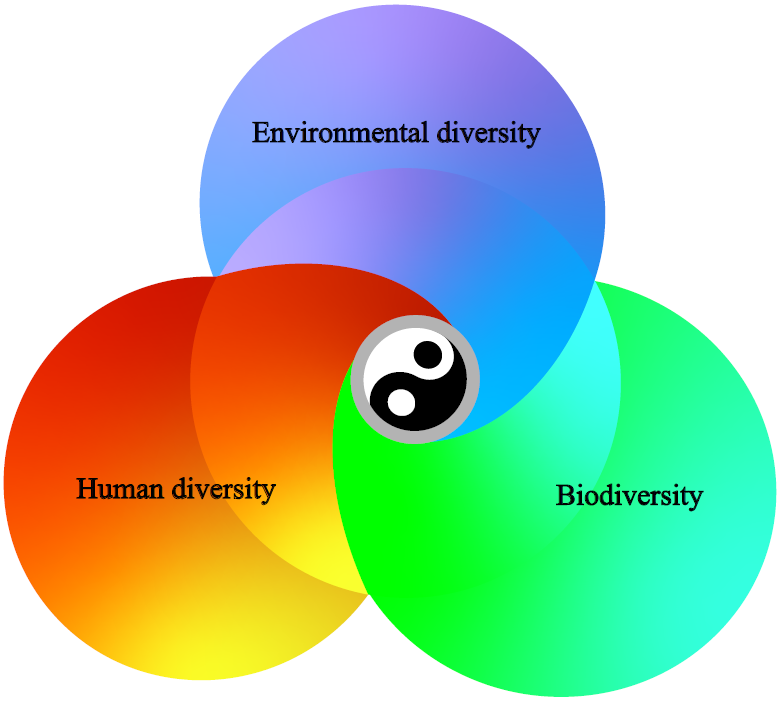
Based on this, the present paper proposes the concept of Holdiversity (和多样性), aiming to integrate the multidimensional aspects of natural and human systems in a more comprehensive manner, identify the spatiotemporal relationships among the three elements, and reconstruct the coupled evolutionary processes of the environmental-biological-human triad since the Anthropocene (Box 1; Figure 1).
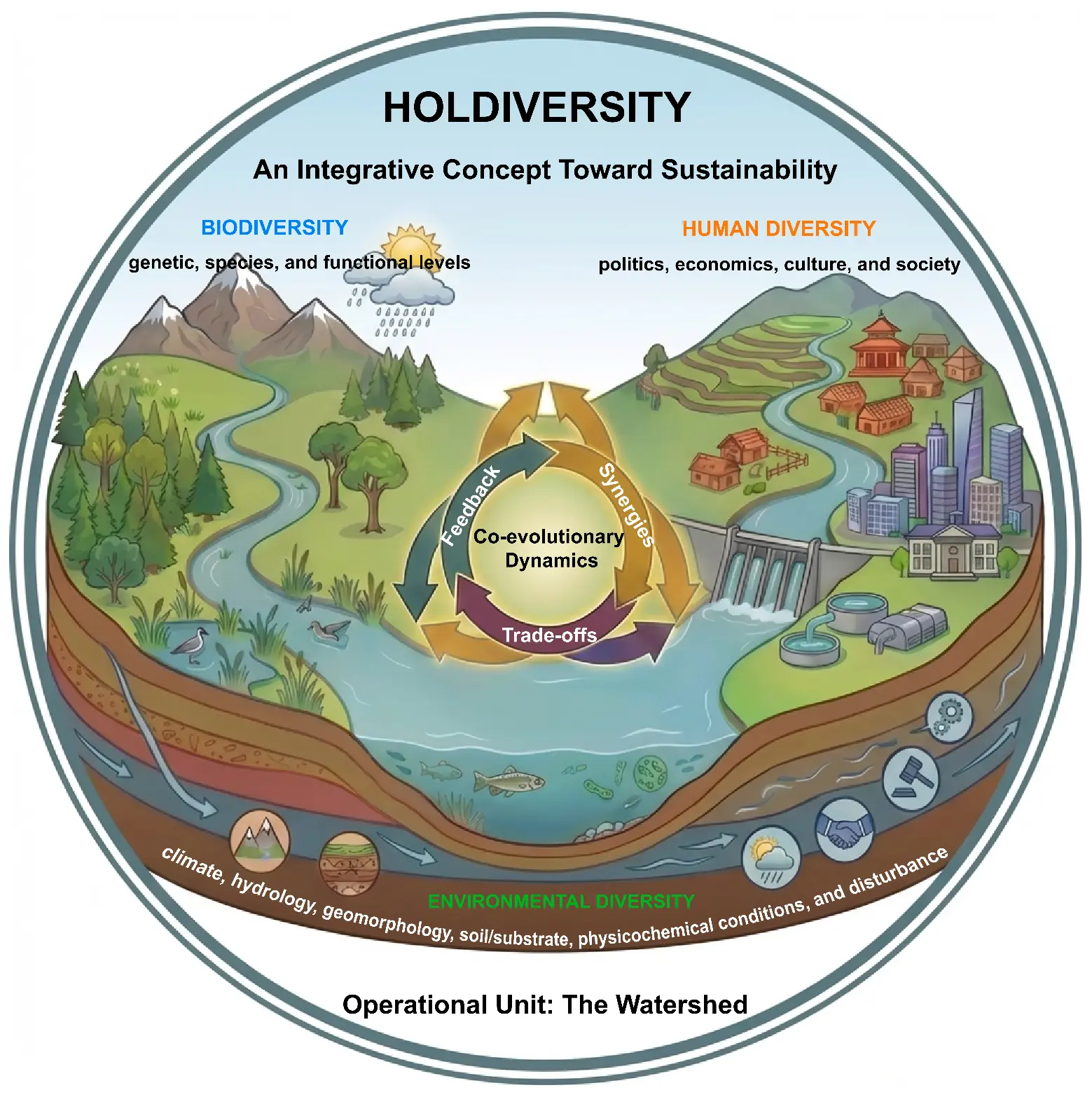
Figure 1. Conceptual diagram of Holdiversity. Holdiversity integrates three interdependent dimensions: environmental diversity (bottom; abiotic conditions including climate, hydrology, and geomorphology), human diversity (right; political, economic, cultural, and social forms ranging from traditional to urban systems), and biodiversity (left; genetic, species, and ecosystems). These dimensions interact through co-evolutionary dynamics (center), encompassing feedback loops, synergies, and trade-offs. The watershed serves as the operational unit for analyzing these coupled processes toward sustainability.
Box 1. Concept Definition: Holdiversity.
-
Holdiversity is a diversity community composed of human diversity, biological diversity, and environmental diversity, emphasizing their interactions, mutual constraints, and co-evolution across different spatiotemporal scales. Its connotations include:
Environmental diversity: The total variability of abiotic environmental elements (e.g., climate, hydrology, geomorphology, soil/substrate, physicochemical conditions, and disturbance processes), used to characterize the background constraints and process support provided by natural systems for life and human activities.
Biodiversity: The total variability of living organisms across genetic, species, and ecosystem levels [24].
Human diversity: The sum of diverse forms of human politics, economics, culture, and society. It encompasses knowledge systems, technological pathways, institutional arrangements, and security elements, representing the pluralistic structure and differentiated action capacities of humans as both regulators and service targets of sustainable development.
2. Theoretical and Methodological Significance
2.1. Interdisciplinary Compatibility and Unified Expression
The Holdiversity framework can simultaneously align with the standpoint of modern industrial civilization and the perspectives of traditional wisdom from various civilizations. Through the division of three dimensions—“environment–biology–human”—“Holdiversity” can simultaneously encompass abiotic environments, biological systems, and elements of human society. By incorporating institutions, culture, technology, and the economy into the human dimension, it forms an integrated framework compatible with fields such as environmental science, ecology, biodiversity science, social sciences, economics, and sustainability science [25,26].
From the perspective of knowledge hierarchies, environmental science, the social sciences, economics, and related technological applications primarily correspond to the levels of engineering and technological sciences, serving to identify problems, inform governance practices, and construct policy tools. Meanwhile, ecology and biodiversity science provide basic disciplinary theories, revealing system structures, functional processes, and interaction mechanisms. Together, this constructs a sustainability science system that integrates natural systems, human development, and value goals. Therefore, the construction of the Holdiversity framework can not only achieve an interdisciplinary unified expression but also promote the systematic development of sustainability science.
2.2. Systematically Depicting Anthropocene Coupling Realities and Revealing Emergent Properties
Holdiversity understands the world as a collection of three interdependent, interacting, and dynamically evolving diversities. It includes not only the key elements within each of the three dimensions but also emphasizes the coupled evolutionary relationships between cross-level feedbacks and intra-level structures. Due to cross-scale coupling and feedback, Holdiversity is not a simple summation of the three diversities; the system as a whole can generate emergent properties that cannot be deduced from a single dimension, such as synergies and trade-offs, threshold effects, path dependence, and resilience disparities. This provides a conceptual foundation for explaining why identical policies yield varied results across different contexts [24,25,26].
2.3. Establishing Ontological Equivalence
By unifying the three elements (environment, biology, humans) under the lexicon of “diversity”, Holdiversity assigns equal ontological importance to environmental diversity, biological diversity, and human diversity. This helps prevent sustainability value systems from becoming excessively skewed toward single objectives—such as purely economic growth, ecological protection, or environmental governance. It encourages research and policy to establish more balanced target settings and evidence organization among the three diversities, thereby facilitating a more systematic identification of cross-target synergistic opportunities and unavoidable trade-off boundaries.
3. Practical Validation of Holdiversity Science
Spatiotemporal scales are core elements of ecological research, and consequently, watersheds have long been regarded as the optimal units for such studies [27,28,29,30,31]. As natural spatial units characterized by distinct physical boundaries, closed-loop processes, and tightly interwoven social-ecological systems, river watersheds undoubtedly serve as a fundamental unit and natural scale for biodiversity observation, analysis, and management.
3.1. Theoretical and Practical Adaptability of Watershed Units
The rationale for adopting the watershed as the operational unit for Holdiversity lies in its three irreplaceable attributes. First, the consistency between natural and governance boundaries. Watershed divides define the basic closure of material cycling and hydrological processes. Throughout long-term human settlement and resource utilization, they have shaped relatively stable water-use communities and governance units, providing an identifiable spatial carrier for the interactions of environmental, biological, and human diversities. From the headwaters to the estuary, a watershed continuously encompasses highlands, slopes, river channels, lakes/reservoirs, floodplains, and artificial ecosystems, allowing the three diversities to coexist and couple within the same observable geographic space. Second, the intuitiveness and traceability of feedback loops. Material, energy, and information flows across subsystems within a watershed form traceable feedback loops, enabling the non-linear coupling between human activities and environmental-biological processes to be concretely identified and mechanistically explained. Third, natural hierarchical nesting. Watersheds possess inherent hierarchies, providing a natural scale for integrated multi-scale and cross-scale research [27,28,29,30,31].
3.2. Case 1: Specific Analysis of the Formation Mechanism of the “Rao San Ling” Cultural Settlement in the Erhai Basin
Taking the Erhai Basin in China as an example, this region is located in the Hengduan Mountains. The elevation drop between the Cangshan Mountains and Erhai Lake exceeds 2000 m. This massive elevation gradient creates significant climatic differentiation, thereby nurturing rich biodiversity. “Rao San Ling”, an intangible cultural heritage unique to the Bai people living in the Erhai Basin, is a large-scale touring activity composed of various specific regional cultural elements. It is also the historical memory of Holdiversity evolution in the basin. Previous sociological or folkloric discussions on its origin and evolution have proposed hypotheses such as ancestor worship, rain-praying, disaster prevention, and romantic rendezvous, failing to reach a consensus [32,33].
However, applying the Holdiversity framework allows us to reconstruct the origins of this cultural settlement and understand the historical dynamics of human development in the basin. Water level fluctuations in Erhai Lake were the key drivers shaping Holdiversity and the Rao San Ling cultural settlement:
In the first stage, the basin’s high water levels (ca. 2100 m) restricted early humans to high-altitude valleys, relying primarily on foraging and hunting. In the second stage, as water levels dropped (ca. 2000 m), portions of the alluvial plains at the foot of the Cangshan Mountains were exposed. This promoted agricultural development and drove population growth and social prosperity. However, human impacts on the Cangshan forest ecosystems have led to disasters such as mudslides. Responding to such disasters became the critical task of this stage. In the third stage, water levels dropped further, releasing more alluvial plains and further expanding agricultural prosperity. Simultaneously, streamflow from the Cangshan Mountains became insufficient to support agricultural irrigation. The resulting dependence on rainfall made rain-praying a crucial cultural element during this stage. The touring route and configuration of elements in Rao San Ling are fundamentally a synthesis of the environment, biology, and human culture across these three stages in the Erhai Basin. It is the manifestation of Holdiversity’s spatial evolutionary process over millennia.
3.3. Case 2: Co-Management of Yunnan Snub-Nosed Monkey Habitats and Local Production Modes
The conservation management of the Yunnan snub-nosed monkey over the past 50 years provides another scenario for applying the Holdiversity framework. The Yunnan snub-nosed monkey is the highest-altitude dwelling primate globally, distributed exclusively in the Yunling range of the Hengduan Mountains. Grazing is a critical livelihood for local residents. Prior to the 1980s, high-altitude dark coniferous forests—the monkeys’ habitat—were removed via logging and burning to expand pastures [34]. To protect the monkeys, management authorities implemented strict logging and fire bans, and the monkey habitats began a comprehensive recovery at the turn of this century. However, this led to new challenges. Pastures below the tree line began reverting to shrublands and forests. The reduction in pasture area continuously increased the livestock carrying capacity per unit area until overgrazing occurred. Overgrazed pastures experienced desertification and erosion, culminating in disasters such as landslides, floods, and mudslides. This not only affected local community livelihoods but also altered the watershed topography in high-altitude areas. Unquestionably, the localized processes in these high-alpine ecosystems cascade downstream through the watershed, impacting overall basin development and management. Prior to this protection-centric phase, human production modes continuously impacted biological habitats; subsequently, management favoring biodiversity maintenance altered human production modes, creating a continuous feedback loop within the biological and environmental systems over the past half-century. It is conceivable that over a 100- or 1000-year timeframe, this process will grow even more complex, presenting immense challenges for single-target sustainability planning. Within the Holdiversity framework, advancing research that systematically tracks and analyzes the coupled interactions and co-evolutionary dynamics among environmental, biological, and human systems, while moving beyond the traditional zero-sum paradigm of human–nature competition, will be pivotal to identifying a development pathway that is aligned with global trajectories and capable of addressing future grand challenges.
3.4. Establishing Holdiversity as a Scenario-Applied Discipline in Watershed Ecology
Conducting research under the Holdiversity framework—tracking and analyzing the coupled interactions and co-evolution of environment, biology, and humans—may be the key to solving this issue in the future. Using the “environment-biology-human” triad framework, Holdiversity can reconstruct watershed analysis units and systematically align human social elements (e.g., irrigation rules, water conservancy structures, land tenure arrangements) with biodiversity and environmental diversity. Characterizing the transfer of mass, energy, and information flows across systems—such as water flow, biological migration, technological diffusion, and institutional learning—as unified “Holdiversity flows” will support the holistic upgrading of watershed ecology, establishing it as a scenario-applied discipline in ecology [27]. Accordingly, the watershed serves not only as an organizational unit of hydrological processes, but also as a foundational analytical unit for understanding regional sustainability; a comparative examination of Holdiversity relationships both within and across watersheds provides a critical pathway for elucidating the coupling mechanisms linking human, biological, and environmental systems.
4. Application and Future Prospects of the Holdiversity Framework
Although the watershed has been proposed as a practical operational unit, Holdiversity is still an emerging conceptual framework. Several issues remain before it can genuinely serve sustainable development strategic decision-making. We believe the key agenda items to be addressed include the following three aspects:
- (1)
- Clarify the Spatiotemporal Scales and Boundaries of Sustainable Development
The ecological perspective offers new avenues for sustainable development. Although the definition of ecology has expanded from “the relationship between organisms and their environment” to encompass various subjects such as populations, communities, ecosystems, landscapes, and even global changes, its core remains understanding the relationship between organisms and their environment within specific spatiotemporal scales. In other words, the evolution of various definitions in ecology essentially reflects the continuous expansion of spatiotemporal scales. Holdiversity requires assigning explicit spatiotemporal scales to research subjects. The five-millennium continuity of Chinese civilization provides unparalleled temporal-scale experience for human sustainability thought. Temporally, sustainability goal-setting should adopt a long-term perspective. Prof. Jianguo Wu suggested one century as appropriate [35]; Yong Shao proposed 300 years as an “epoch” (Shi), aligning with the longest dynastic succession cycles [36]. Spatially, for instance, the Yellow and Yangtze River basins nurtured Chinese civilization. The distribution patterns of different hierarchical watersheds shaped the prominent characteristic of “macro-dispersion and micro-concentration” of the Chinese nation, which is also the source of the unity and diversity of Chinese civilization.
- (2)
- Deepen from Conceptual Framework to Dynamic Mechanisms to Enhance System Prediction
Currently, Holdiversity has successfully broadened the research scope of multidimensional element coupling and equilibrium. Its core contribution lies in providing a novel methodology for organizing questions and analyzing phenomena. Moving forward, research must transcend static conceptual descriptions and delve into how human, biological, and environmental diversities interact at high frequencies via mass, energy, and information flows. Future focus should shift to characterizing the non-linear feedback networks among these multidimensional elements, identifying critical thresholds and conditions that trigger state transitions. By incorporating complex systems modeling and system dynamics analysis, the Holdiversity framework will evolve beyond merely explaining the past to possessing the robust capacity to quantitatively simulate and predict future system dynamics [37]. In terms of methodology, system dynamics, agent-based models, and coupled socio-ecological system models can be used to transform conceptual frameworks into testable scenario simulations, and to compare the synergistic benefits and trade-off costs under different governance pathways [12,15,16,37]. It should be emphasized that Holdiversity is not a completed quantitative model, but a conceptual framework for organizing future research questions, indicator systems, and cross-scale comparisons. Precisely because there are currently no unified indicators or common endpoints, this framework is needed to promote collaborative development among different disciplines, focusing on diversity states, coupling processes, and governance feedback.
- (3)
- Consolidate Quantitative Empirical Foundations, Cross Disciplinary Boundaries, and Build an Integrated Multidisciplinary System
Current discussions on Holdiversity remain largely at the level of qualitative descriptions and historical case analyses, lacking large-scale, long-term modern field control experiments and quantitative data validation. Synchronously acquiring high-precision natural environmental evolution parameters, long-term biological community dynamics, and high-spatiotemporal-resolution socioeconomic activity data presents immense technical and cost challenges for future Holdiversity monitoring systems. Fortunately, the rapid development of Big Data and Artificial Intelligence is poised to resolve these difficulties. Simultaneously, Holdiversity science inherently demands deep integration across history, anthropology, sociology, economics, ecology, and environmental science. However, different disciplines vary vastly in conceptual usage, data types, and evaluation standards. Breaking down disciplinary silos in the future will require establishing standardized, comprehensive systems for monitoring, analysis, and evaluation. Therefore, future research needs to establish long-term, cross-scale, and replicable monitoring systems. These systems should integrate continuous observation and adaptive monitoring with the problem-oriented approach of sustainability science, preventing concepts from remaining confined to case-specific interpretations [25,26].
It has been over 40 years since SENCE was proposed. Over these four decades, that theoretical framework has progressively evolved from early conceptual construction to an analytical framework encompassing structural elucidation, process coupling, and comprehensive regulation, though limitations remain regarding cross-scale representation, quantitative simulation, and integrated governance [7,38]. Given time, Holdiversity can also be iteratively refined to robustly support the integrated development of ecology and sustainability science.
5. Conclusions
This paper proposes the concept of “Holdiversity”, attempting to re-understand the relationship between humans and nature from the perspective of the mutual coupling of human diversity, biodiversity, and environmental diversity. Compared with existing sustainable development frameworks, this framework comprehensively considers the formation history and development goals of these three elements, constructing a relatively balanced framework in terms of weights. It recognizes the coupled evolutionary mechanisms of the human, biological, and abiotic environments from a consistent perspective, and establishes values for sustainable development under appropriate spatiotemporal scales.
This paper further argues that watersheds, due to their clear natural boundaries, continuous spatial scales, distinct ecological processes, and complete picture of human–biological–environmental diversity, serve as suitable units for monitoring, researching, and understanding the evolution of Holdiversity. Taking watersheds as the entry point helps translate the abstract conceptual framework into analyzable and comparable Holdiversity issues.
This framework aligns with the systemic demands of the United Nations Sustainable Development Goals (SDGs), enabling the coordinated integration of social objectives such as poverty reduction and cultural preservation, ecological objectives such as habitat protection, and environmental objectives such as climate action. Under the framework of “Holdiversity”, we can truly realize the ideal vision depicted in The Doctrine of the Mean (《中庸》): “All things grow together without harming each other; different paths proceed in parallel without conflicting” (万物并育而不相害, 道并行而不相悖) [39]. This provides solid interdisciplinary theoretical support for building a “Community with a Shared Future for Mankind” characterized by harmonious coexistence between humans and nature.
Statement of the Use of Generative AI and AI-Assisted Technologies in the Writing Process
During the preparation of this manuscript, the authors used generative artificial intelligence tools to assist with language proofreading, figure drawing and responses to editorial proof queries. After using these tools, the authors reviewed and edited the content and figures as needed and take full responsibility for the content of the published article.
Acknowledgments
The authors are grateful to Kun Tan and Na Li for their valuable suggestions and support during manuscript revision.
Author Contributions
Conceptualization, W.X.; Writing—Original Draft Preparation, W.X.; Writing—Review & Editing, W.D. and Y.-T.C.; Supervision, W.X.
Ethics Statement
Not applicable.
Informed Consent Statement
Not applicable.
Data Availability Statement
Data sharing is not applicable to this article as no new data were created or analyzed in this study.
Funding
This work was supported by National Natural Science Foundation of China (32371557).
Declaration of Competing Interest
The authors declare that they have no known competing financial interests or personal relationships that could have appeared to influence the work reported in this paper.
References
- United Nations. Transforming Our World: The 2030 Agenda for Sustainable Development; United Nations: New York, NY, USA, 2015. Available online: https://sdgs.un.org/2030agenda (accessed on 15 February 2026).
- Liu J, Mooney H, Hull V, Davis SJ, Gaskell J, Hertel T, et al. Systems integration for global sustainability. Science 2015, 347, 1258832. DOI:10.1126/science.1258832 [Google Scholar]
- Nilsson M, Griggs D, Visbeck M. Policy: Map the interactions between Sustainable Development Goals. Nature 2016, 534, 320–322. DOI:10.1038/534320a [Google Scholar]
- Fu B, Wu X, Wang Z, Wu X, Wang S. Coupling human and natural systems for sustainability: Experience from China’s Loess Plateau. Earth Syst. Dyn. 2022, 13, 795–808. DOI:10.5194/esd-13-795-2022 [Google Scholar]
- Hermwille L, Dzebo A, Iacobuţă GI, Obergassel W. Global stocktake and the SDG midterm review as opportunities for integration. Nat. Clim. Change 2023, 13, 1002–1004. DOI:10.1038/s41558-023-01813-2 [Google Scholar]
- Ma SJ, Wang RS. The social-economic-natural complex ecosystem. Acta Ecol. Sin. 1984, 4, 1–9. Available online: https://www.sciengine.com/doi/10.0000/j.1000-0933.198440119 (accessed on 15 February 2026) (In Chinese)
- Wang RS, Ouyang ZY. Social-economic-natural complex ecosystem and sustainability. Bull. Chin. Acad. Sci. 2012, 27, 337–345. DOI: 10.3969/j.issn.1000-3045.2012.03.012 (In Chinese) [Google Scholar]
- Berkes F, Folke C, Colding J. (Eds.). Linking Social and Ecological Systems: Management Practices and Social Mechanisms for Building Resilience; Cambridge University Press: Cambridge, UK, 1998. [Google Scholar]
- Berkes F, Colding J, Folke C. (Eds.). Navigating Social-Ecological Systems: Building Resilience for Complexity and Change; Cambridge University Press: Cambridge, UK, 2002. DOI:10.1017/CBO9780511541957 [Google Scholar]
- Ostrom E. A general framework for analyzing sustainability of social-ecological systems. Science 2009, 325, 419–422. DOI:10.1126/science.1172133 [Google Scholar]
- Wang H, Zhang DN, Hua T, Zhao YH, Wang ZY, Wu JS. Social-ecological systems: Research trends, thematic evolution, and regional practice. Acta Ecol. Sin. 2023, 43, 6499–6513. DOI:10.5846/stxb202208212395 (In Chinese) [Google Scholar]
- Liu J, Dietz T, Carpenter SR, Alberti M, Folke C, Moran E, et al. Complexity of coupled human and natural systems. Science 2007, 317, 1513–1516. DOI:10.1126/science.1144004 [Google Scholar]
- Zinsstag J, Schelling E, Waltner-Toews D, Tanner M. From “One Medicine” to “One Health” and systemic approaches to health and well-being. Prev. Vet. Med. 2011, 101, 148–156. DOI:10.1016/j.prevetmed.2010.07.003 [Google Scholar]
- Adisasmito WB, Almuhairi S, Behravesh CB, Bilivogui P, Bukachi SA, Casas N, et al. One Health: A new definition for a sustainable and healthy future. PLoS Pathog. 2022, 18, e1010537. DOI:10.1371/journal.ppat.1010537 [Google Scholar]
- McPhearson T, Cook EM, Berbés-Blázquez M, Cheng C, Grimm NB, Andersson E, et al. A social-ecological-technological systems framework for urban ecosystem services. One Earth 2022, 5, 505–518. DOI:10.1016/j.oneear.2022.04.007 [Google Scholar]
- Krueger E, Constantino S, Centeno MA, Elmqvist T, Weber EU, Levin SA. Governing sustainable transformations of urban social-ecological-technological systems. NPJ Urban Sustain. 2022, 2, 10. DOI:10.1038/s42949-022-00053-1 [Google Scholar]
- Washington H, Taylor B, Kopnina H, Cryer P, Piccolo JJ. Why ecocentrism is the key pathway to sustainability. Ecol. Citizen 2017, 1, 35–41. Available online: https://www.ecologicalcitizen.net/pdfs/v01n1-08.pdf (accessed on 15 February 2026).
- Lim MML, Jørgensen PS, Wyborn CA. Reframing the Sustainable Development Goals to achieve sustainable development in the Anthropocene: A systems approach. Ecol. Soc. 2018, 23, 22. DOI:10.5751/ES-10182-230322 [Google Scholar]
- Le Blanc D. Towards integration at last? The Sustainable Development Goals as a network of targets. Sustain. Dev. 2015, 23, 176–187. DOI:10.1002/sd.1582 [Google Scholar]
- Tu WM. The ecological turn in New Confucian humanism: Implications for China and the world. Daedalus 2001, 130, 243–264. Available online: https://www.jstor.org/stable/20027726 (accessed on 15 February 2026).
- Cajete G. Native Science: Natural Laws of Interdependence; Clear Light Publishers: Santa Fe, NM, USA, 2000. [Google Scholar]
- Chapple CK. (Ed.). Jainism and Ecology: Nonviolence in the Web of Life; Harvard Divinity School, Center for the Study of World Religions: Cambridge, MA, USA, 2002. [Google Scholar]
- Lenton T, Watson A. Revolutions That Made the Earth; Oxford University Press: Oxford, UK, 2011. DOI:10.1093/acprof:oso/9780199587049.001.0001 [Google Scholar]
- Groombridge B. The Convention on Biological Diversity; Springer: Dordrecht, The Netherlands, 1992. DOI:10.1007/978-94-011-2282-5_35 [Google Scholar]
- Kates RW, Clark WC, Corell R, Hall JM, Jaeger CC, Lowe I, et al. Environment and development: Sustainability science. Science 2001, 292, 641–642. DOI:10.1126/science.1059386 [Google Scholar]
- Clark WC, Dickson NM. Sustainability science: The emerging research program. Proc. Natl. Acad. Sci. USA 2003, 100, 8059–8061. DOI:10.1073/pnas.1231333100 [Google Scholar]
- Cai QH. Why Watershed Ecology? J. Watershed Ecol. 2026, 1, 10001. DOI:10.70322/jwe.2026.10001 [Google Scholar]
- Cai QH. Yangtze River protection and watershed ecology. People’s Yangtze River 2020, 51, 70–74. DOI:10.16232/j.cnki.1001-4179.2020.01.011 (In Chinese) [Google Scholar]
- Zhao B. Watershed is the best natural segmentation unit in ecological research. Sci. Technol. Rev. 2014, 32, 12. Available online: https://castjournals.cast.org.cn/joweb/kjdb/CN/1242131451169288752 (In Chinese) [Google Scholar]
- Deng W, Zhang F, Li YP, Yang Y, Liu X, He X, et al. Uncovering the biogeographic pattern of the widespread nematode-trapping fungi Arthrobotrys oligospora: Watershed is the key. Front. Microbiol. 2023, 14, 1152751. DOI:10.3389/fmicb.2023.1152751 [Google Scholar]
- Fornacca D, Deng W, Yang Y, Zhang F, Yang X, Xiao W. Linking watershed formation with the phylogenetic distribution of a soil microscopic fungus in Yunnan Province, China. BMC Microbiol. 2024, 24, 305. DOI:10.1186/s12866-024-03451-w [Google Scholar]
- Wang MQ, Lv YJ, Xiao W, He LD. Influence of highway on bai minority's rao san ling. J. Chongqing Jiaotong Univ. (Soc. Sci. Ed.) 2015, 15, 82–92. Available online: http://xbskb.cqjtu.edu.cn/CN/Y2015/V15/I4/27 (accessed on 15 February 2026) (In Chinese)
- Lü YJ, Xiao W. Bai minority’s rao san ling from the perspective of disaster folklore. Guizhou Ethn. Stud. 2020, 41, 33–39. DOI: 10. 13965/j. cnki.gzmzyj10026959.2020.08.005 (In Chinese) [Google Scholar]
- Xiao W, Ding W, Cui LW, Zhou RL, Zhao QK. Habitat degradation of Rhinopithecus bieti in Yunnan, China. Int. J. Primatol. 2003, 24, 389–398. DOI:10.1023/A:1023009518806 [Google Scholar]
- Wu J. Landscape sustainability science: Ecosystem services and human well-being in changing landscapes. Landsc. Ecol. 2013, 28, 999–1023. DOI:10.1007/s10980-013-9894-9 [Google Scholar]
- Shao Y. Huangji Jingshi Shu; Zhongzhou Ancient Books Publishing House: Zhengzhou, China, 2007. (In Chinese) [Google Scholar]
- Gao Y, Shen Z, Zhang Z, Xiong JH. Advance in simulation of social-ecological system coupling under the perspective of ecosystem services. Acta Geogr. Sin. 2024, 79, 134–146. DOI:10.11821/dlxb202401009 (In Chinese) [Google Scholar]
- Zheng H, Chen L, Zhou W, Liu J, Wang R, et al. Social-economic-natural complex ecosystem (SENCE) theory and its application: Historical contributions and future prospects. J. Environ. Sci. 2026, 161, 56–63. DOI:10.1016/j.jes.2025.09.064 [Google Scholar]
- Zisi. The Doctrine of the Mean. In The Chinese Classics, Vol. 1: Confucian Analects, The Great Learning, and The Doctrine of the Mean; Legge J, Translator; Clarendon Press: Oxford, UK, 1893. [Google Scholar]