
Acoustic Resonance Weapons for Drone Interdiction
Acoustic Resonance Weapons for Drone Interdiction
Received: 13 February 2026 Revised: 22 April 2026 Accepted: 04 June 2026 Published: 08 June 2026

© 2026 The authors. This is an open access article under the Creative Commons Attribution 4.0 International License (https://creativecommons.org/licenses/by/4.0/).
Graphical Abstract
1. Introduction
Recently, it has become important to be able to shoot down the multi-rotor drones without causing significant damage, allowing for their subsequent thorough inspection. This is necessary for both military and civilian purposes, preventing unauthorized flights in sensitive areas such as airports, government buildings, military zones, public demonstration sites, pyrotechnic factories, and other critical facilities.
A sound with a resonant frequency (or a multiple thereof) will cause a strong vibration of the structure with increasing amplitude and, at a certain point, will lead to its destruction. There are publications devoted to the influence of sound waves on multi-rotor drones with the aim of creating resonance in the structural components of the drone, however, the amount of publicly available information on this topic remains extremely limited. Among them, Wang et al. [1] investigated the impact on DJI Phantom 3 (DJI, Shenzhen, China) (a consumer-grade quadcopter), detailing how acoustic interference compromises its flight stability. An ultrasonic emitter held close to the drone caused the propeller motors to spin at different speeds. This particular quadcopter was on the ground with its rotors removed, but the same phenomenon in flight would have caused the drone to tilt sharply and most likely crash.
A group of researchers from South Korea studied 15 types of gyroscopes from four suppliers [2]. Most came from two companies, STMicroelectronics (Genevra, Switzerland) and InvenSense (San Jose, CA, USA), whose gyroscopes are used in various drones. Seven gyroscopes resonated at their own resonant frequencies when exposed to the corresponding sound. At resonant frequencies, gyroscopes are reported to “produce very strange output signals”. Some types of drones can be attacked with sound frequencies. For their tests, the researchers attached a small consumer-grade speaker to a drone, which was wirelessly connected to a nearby laptop. The drone took off normally, but when the desired noise was played through the speaker, it fell to the ground. It is reported that with a noise level of 140 decibels emitted by this speaker, it is possible to attack a drone from a distance of about 40 m.
As reported in [3,4], Fractal Antenna Systems, Inc. (Bedford, MA, USA) quite recently has introduced Acoustic Resonance Mitigation (ARM) technology that disables drones using precisely directed acoustic energy. However, no information was provided on specific details such as frequency, intensity, and distance, or on methods of impact that could disable the drones. From the images and some details of the description, it can be understood that the method of action is a directed ultrasonic beam, which is produced by a grid of piezoelectric transducers.
2. The Influence of Resonant Sound/Ultrasound Waves on the Drone Inertial Measurement Unit
The IMU system is very important; it controls the flight of the drone, determines acceleration and speed, provides spatial orientation, and triangulates the direction of movement in all three planes of motion: pitch, roll, and yaw. IMU can include three types of MEMS (microelectromechanical sensors): accelerometers, gyroscopes, and magnetometer. One of the simplest is the accelerometer, which is a microcapsule measuring about 1 × 1 mm, in which tiny weights on tiny springs move under the action of gravity, changing the capacitance of the capacitor as they slide back and forth. A MEMS gyroscope is more complex, but it can be thought of as one accelerometer placed inside another, so that each is at right angles to the other. Sound and ultrasound emitters can be used to disrupt the operation of these sensors by resonating with the natural oscillations of the mass-spring sensor. Some research on this topic can be found in open publications.
For example, Ref. [5] describes a monolithic CMOS/MEMS accelerometer manufactured using a 0.18 μm CMOS/MEMS process compatible with application-specific integrated circuits (ASIC). The triaxial accelerometer has an area of 1096 μm × 1256 μm. Experiments have shown that the resonance frequency of the proposed triaxial accelerometer was approximately 5.35 kHz for out-of-plane vibration. A comparison of the resonance frequencies of out-of-plane oscillations of accelerometers obtained using different types of modern technological processes was also presented. The corresponding values range from 9.5 kHz to 1.7 kHz, depending on the design and manufacturing process used.
As for gyroscopes, a comprehensive analysis of their resonant frequencies was carried out in [2] for some well-known models widely used in drones. The researchers exposed the gyroscopes to single-tone noises using a consumer-grade speaker at frequencies ranging from 100 Hz to 30 kHz, spaced at 100 Hz intervals. The measured sound pressure level in the experiment was approximately 90 dB. For STMicroelectronics gyroscopes, the resonant frequency was found to be approximately 9 kHz for the L3G4200D (STMicroelectronics, Geneva, Switzerland) chip, but around 20 kHz for the L3GD20 and LSM330 models (STMicroelectronics, Geneva, Switzerland) across all three axes. It should be noted that higher oscillation amplitudes were observed along the X (pitch) and Y (roll) axes than along the Z (yaw) axis. A different situation was observed for InvenSense gyroscopes: the resonant frequency was in the range of approximately 26–28 kHz, but only for the Z axis, with the exception of one MPU6500 (InvenSense, San Jose, CA, USA) model, where a resonance response was observed across all three axes. As shown in this study, increased vibration generated by sound at the resonant frequency along the X and Y axes causes the drone to fall down. However, if the gyroscope shows a significant increase in vibration only along the Z (yaw) axis, this does not affect the drone’s continued flight.
Other studies also illustrate the resonant frequencies of MEMS sensors, such as accelerometers, gyroscopes, and magnetometers. However, it must be emphasized that they all exhibit different resonant frequencies over a very wide range, from acoustic to ultrasonic, depending on the model, integrated circuit manufacturing technology, manufacturer, etc. Consequently, it is possible to disrupt a drone’s IMU by deploying high-intensity acoustic or ultrasonic emissions. However, this poses several challenges. First, when targeting an unidentified UAV with an acoustic beam, the resonant frequencies of its internal sensors are not known a priori. So, at best, you can vary the frequency in the range of, say, 2–30 kHz, thereby reducing the time the UAV is exposed to the resonance frequency. Alternatively, you can use a broadband frequency range, but this will significantly decrease the power at the desired frequency. Second, there are known countermeasures that notably reduce the frequency response. For example, encasing sensors in various materials, such as foam [2], or using an additional structure in the gyroscope that responds only to the resonant frequency to suppress the resonant output [6], or using methods such as resonant tuning [7]. Therefore, based on the above, attacking an unknown drone with sound and/or ultrasonic waves by affecting its MEMS sensors does not seem to be very effective.
3. The Effect of Acoustic Waves of Resonant Frequency on the Motor-Propeller Unit of Multi-Rotor Drones
The impact of sound waves on the drone’s motor-propeller units appears more functional. This unit cannot be effectively protected from external influences, as it is the one that enables flight. But more importantly, the fundamental frequency—specifically the Blade Passage Frequency (BPF)—of an unidentified UAV can be reliably estimated from a distance using a microphone array. When the frequency of sound vibrations from an external source, such as a speaker, resonates with the rotation frequency of the propeller, it begins to vibrate strongly. Under certain conditions, the motor-propeller unit may break down or, in any case, cause serious malfunction. In addition, a vibrating motor produces more electrical noise than a smoothly running one. This electrical noise can interfere with the gyroscopic sensor, further degrading flight performance, and can also degrade the quality of FPV drone video [8].
The rotational speed of the motor using for multi-rotor drones can vary from approximately 7000 to 20,000 rpm, which corresponds to a frequency of 100–300 Hz [8,9]. But the BPF depends on the number of blades in the propeller. If there are 2 blades, the motor shaft frequency must be multiplied by a factor of 2 [8,9]. However, the angular speed of the motor shaft under load is lower and is approximately 60–80% of the idle speed, so the blade passing frequency of almost all types of multi-rotor drones is in the range of approximately 100–500 Hz [9,10]. Thus, the fundamental rotation frequency of the drone’s propeller is entirely within the audio frequency range.
The following sections analyze methods for spatial drone localization, blade passage frequency identification, and the concept of a directional acoustic cannon.
4. Acoustic Sensing and Localization of Drones: Core Principles
The noise level emitted by a drone depends on various design features, such as the type and number of propellers, weight, dimensions, electric motors type, and others. Table 1 shows the sound levels comes from some drones at different distances. The measurement data were taken from [11] and recalculated using the inverse square law [12] for distances of 3000 and 5000 m.
Table 1. SPL (sound pressure level) of some drones at different distances.
|
Drone Type |
Data from [11] |
dB at 3000 m |
dB at 5000 m |
|---|---|---|---|
|
Large quardcopter |
55 dB at 100 m |
25.5 |
21.1 |
|
Small fixed wings drone |
50 dB at 100 m |
20.5 |
16.1 |
|
Octocopter (3.5 kg) |
70 dB at 30 m |
30.0 |
25.6 |
|
Matrice 600 Pro (DJI) |
43 dB at 350 m |
24.3 |
19.9 |
Note that sensitive microphones can detect sound pressure levels as low as 10–11 dB, depending on their noise level [13]. Thus, theoretically, these microphones are capable of “hearing” most types of drones at a fairly large distance. However, various interference factors, such as traffic and other factors, must be taken into account [9]. In this regard, the study [14] reported that the tests conducted demonstrated the ability to detect large multi-rotor drones (1.5 m in diameter) at a distance of approximately 500 m.
Various solutions for detecting the direction of arrival of flying UAVs have been developed recently: based on drone radio signals, infrared radiation, visual systems, radar, lidar, and others. However, we will only consider detection based on acoustic waves emitted by UAV, as this is the most common method of UAV movement, is more effective in nighttime conditions (favorable conditions for attack drones), and provides the necessary information for the use of a resonant acoustic cannon. Acoustic drone detection has been the subject of numerous engineering studies [9,14,15]. For example, Ref. [9] shows that a drone signal mixed with a traffic noise signal can be detected when its level becomes 3 dB lower than the ambient noise level.
Position determination is based on the same principle as radar and is known as beamforming. A spatial microphone array is used to capture the drone’s sound signal. Because the wavefront is incident at some angle) to the array plane, the microphone closest to the sound source receives the signal first, followed by microphones located further away, and so on. Knowing the distance between the microphones and the signal time delay, the angle of arrival (AoA) can be calculated using the speed of sound. More precisely, this is done using a steering vector (time delays) for the simplified case of a uniform linear array with ‘m’ microphones in line, as follows [16]:
|
```latexY = v(\theta) X``` |
where Y—is the output vector, $$v\left(\theta \right)=exp\left(-j\pi msin\left(\theta \right)\right)$$—steering vector, the value $$msin\left(\theta \right)$$—corresponds to the time delay based on the physical location of the element (microphone) ‘m’, X—is the vector of the input signal. The spatial arrangement of the microphones allows one to determine the direction of arrival (DoA) with sufficient precision, consisting of the azimuth and elevation angles [14,15,16].
It is critical to match the acoustic beam frequency to the drone’s blade-passage frequency. It should be noted that the noise from a propeller-driven UAV consists of many different sound frequencies, namely BPF, its harmonics, motor vibration, generated by air turbulence, and others. These frequencies can have different amplitudes, for example, as shown in [14], the frequency power spectrum shows peaks in the range of 5–7 kHz.
Therefore, when detecting and processing drone noise, it is necessary to identify the fundamental frequency, which for propeller-type drones is in the low-frequency range (see Table 2).
5. A New Approach for the Sound-Based Interdiction of Multirotor Drones
To achieve high directivity, long-range devices utilize ultrasonic carrier waves at frequencies of 30–60 kHz (wavelengths of 5–10 mm) modulated by audible sound [18]. A functional model for such modulation can be implemented using standard components, including piezoelectric transducers and a 555 timer oscillator [19,20,21]. However, the primary disadvantage of these solutions is the poor propagation of ultrasound waves. The absorption coefficient increases with frequency according to the relationship α ∝ f2, causing the carrier to attenuate rapidly. This physical limitation dissipates the energy over distance, restricting the effective pressure zone to the near field and rendering traditional parametric pushers inefficient for long-range applications.
In alternative, Genasys Corporation (San Diego, CA, USA) produces high-powered LRAD (Long Range Acoustic Device) emitters, such as the portable LRAD 500X-RE, which delivers a peak sound pressure level of 154 dB at the source, enabling effective communication up to 2000 m [22]. The stationary LRAD 2000X achieves a level of 162 dB at the source, reaching distances of up to 5.5 km. The primary advantage of these devices over parametric pushers is their use of lower sound frequencies, which suffer significantly less atmospheric attenuation. However, these systems face major disadvantages: they require a high quantity of bulky compression drivers, leading to excessive weight and size. Furthermore, they suffer from a large emission cone; unlike the “pencil-beam” of ultrasonic systems, the broader dispersion of LRADs prevents a high concentration of energy on the target, reducing the effective impact and increasing the risk of affecting unintended areas.
The proposed solution firstly takes into account the analysis of drone behavior under the acoustic resonance effect. As previously established, the Blade Passing Frequency (BPF) of multi-rotor drones typically ranges between 200 Hz and 500 Hz. To induce mechanical resonance within the UAV structure, the acoustic cannon must emit frequencies within this specific range. However, achieving a narrow acoustic beam at these low frequencies presents a significant engineering challenge. According to the Huygens-Fresnel principle and the Rayleigh criterion$$D\approx \lambda /\theta$$, maintaining a focused beam at such wavelengths would require an emitter with an enormous diameter—potentially several tens of meters. Furthermore, such a system would generate extreme noise pollution, making it impractical for tactical or urban deployment.
Nevertheless, the resonance effect on the drone construction is not exclusively induced by the fundamental frequency (1st harmonic) of the BPF. Higher harmonics—specifically the 3rd, 4th, and 5th—are equally effective at inducing structural resonance and instability. These higher-order frequencies disrupt laminar flow and trigger aerodynamic instability, leading to critical failure of the blades and other drone components. Consequently, an optimal trade-off is reached by operating the acoustic cannon in the 1000–2000 Hz range, balancing effective resonance induction with the requirements for a relatively compact, focused emitter.
However, even under these conditions, achieving a narrow beam requires an emitter with relatively large dimensions, which can lead to excessive weight and high aerodynamic drag (windage). So, the principal idea of the proposed solution is to avoid using a solid, fully-filled array of drivers. Instead, it utilizes a sparse distribution of emitters arranged according to the Vicsek fractal topology [23]. This topology suppresses grating lobes by disrupting the spatial periodicity inherent in standard grid arrays. Grating lobes typically occur when emitters are spaced at a constant interval greater than $$\lambda /2$$. The recursive, multi-scale geometry of the Vicsek fractal ensures that the phase-matching conditions for parasitic beams are never met simultaneously across the array [24]. This results in the destructive interference of off-axis radiation, concentrating the energy into a single high-intensity central peak while “smearing” side-lobes into a negligible low-level floor. This approach creates a synthesized aperture that maintains high directivity while drastically reducing the structural mass and wind resistance of the device.
To assess the efficiency of the proposed solution, we evaluate a practical device based on the aforementioned principles. Suppose the system has the following design specifications: an average operating frequency of 1500 Hz and the utilization of nine high-power compression drivers. These drivers are selected for their high electro-acoustic efficiency (~13%) and superior thermal stability under pulsed operation [25]. Then these drivers were arranged across a 2.8-m frame according to the Vicsek fractal topology. Such a device achieves the performance characteristics presented in Table 3, shown in comparison with the Genasys Co. (San Diego, CA, USA) LRAD 2000X and a parametric HyperSonic Sound (HSS) device, such as the ultrasonic sound gun described in [20].
Table 3. Comparative analysis of acoustic systems (4 m configuration).
|
Parameter |
LRAD 2000X |
Parametric Device |
Proposed Solution |
|---|---|---|---|
|
Driver topology |
Solid planar array |
Dense piezo matrix |
Recursive Vicsek fractal |
|
Driver quantity |
128 units |
~4500 units |
9 units |
|
Driver type |
Proprietary compression driver |
piezoelectric transducer |
High-power neodymium compression driver [25]. |
|
Emitter size (aperture) |
1.52 m (circle) |
~1.20 m (square) |
2.8 m (skeletal frame) |
|
Peak electric power (Pel) |
3000 W |
~2500 W |
2700 W (pulsed) * |
|
System weight |
~227 kg |
~55 kg |
~85 kg |
|
Beam width (conus) |
10° (±5°) |
~6° (±3°) |
~4° (±2°) |
|
Spot diameter at 100 m |
17.5 m |
10.5 m |
~7.0 m |
|
Peak SPL at 100 m |
122 dB |
~100 dB |
~136 dB |
|
Peak intensity at 100 m (Ip) |
1.58 W/m2 |
0.01 W/m2 |
39.8 W/m2 |
* Unlike LRAD systems engineered primarily for continuous voice transmission, this solution is designed for high-intensity pulsed impact. By utilizing at about 10–15% duty cycle the system safely drives the transducers at their maximum thermal limits.
The conventional design, LRAD 2000X utilizes a high-density, “wall-to-wall” arrangement of drivers on a continuous solid surface. While this provides a flat phase front ideal for long-range voice intelligibility, it results in excessive structural weight and massive aerodynamic drag (wind sail effect). The focusing capability is strictly limited by the physical diameter of the heavy enclosure. As shown in the table, the sound pressure level (SPL) at long distances is approximately 122 dB, which is insufficient for effective UAV interdiction.
In contrast, the proposed design employs a sparse, non-continuous distribution of high-power drivers based on recursive Vicsek fractal geometry. By spreading only a few (one to two dozen) high-output drivers across a ~3 m frame, the system achieves a “Synthesized Aperture”. This allows for a narrow beam with minimal energy loss, maintaining a high sound pressure level of ~136 dB (corresponding to ~210 Pa) even at significant distances. This overpressure, by stressing the blades into resonance, leads to rapid failure of electric motors and other structural elements while simultaneously inducing erratic output from navigation sensors. Also, this open-frame configuration significantly reduces the total system mass compared to the LRAD 2000X while maintaining superior focus and intensity.
As concerns the ultrasonic parametric device, it shows low effectiveness at 100 m due to the extreme atmospheric suppression of ultrasonic waves. Although the parametric approach offers high directivity, the rapid energy decay at high frequencies prevents the delivery of the mechanical pressure necessary for drone interdiction.
6. Conclusions and Discussions
In this study, using open-source intelligence (OSINT), we analyzed the resonant frequency characteristics of MEMS sensors within drone Inertial Measurement Units (IMUs). Their resonant frequencies vary significantly depending on the design and manufacturer, ranging from 1.7 to 30 kHz. Also, it has been shown that drones can become disoriented and fall when exposed to sound at the gyroscope’s resonant frequency, due to a sudden increase in the noise level of the output signal. However, deploying the resonant effect of an acoustic cannon against a drone’s IMU is considered impractical for two reasons: first, the resonant frequency of the IMU sensors is unknown in advance, and second, sensors can be easily protected with noise-absorbing materials.
Then we demonstrated the principles of determining the direction of arrival (DOA) of a drone by acquisition its acoustic noise. This also involved extracting the fundamental harmonic of the propeller BPF from the noise by bandpass filtering in the 100–500 Hz range.
Finally, we have proposed a new conceptual design for a long-range directional acoustic cannon, based on the following three main postulates. First, the primary target of the resonance impact is the drone propeller, as it is a critical component that cannot be shielded without compromising flight capability, and its blade passing frequency can be accurately identified at long distances. Second, the interdiction operating frequencies are designed to coincide with the 3rd to 5th harmonics of the BPF, addressing the significant engineering challenges of achieving high sound-beam directivity at the 1st harmonic. Third, the emitter consists of a low quantity of powerful acoustic drivers arranged according to a Vicsek fractal topology; this configuration further concentrates the sound beam and effectively eliminates energy losses in the lateral lobes.
The principal advantages of the proposed solution include:
-
-
The price per shot is negligible;
-
-
The system targets the propeller of the multi-rotor drone that cannot be protected, as is essential for maintaining flight;
-
-
The use of a skeletal frame based on fractal topology generates a powerful, needle-like acoustic beam capable of delivering effective mechanical disruption at long ranges;
-
-
It is highly energy-efficient, maintaining relatively lightweight and compact dimensions compared to existing devices.
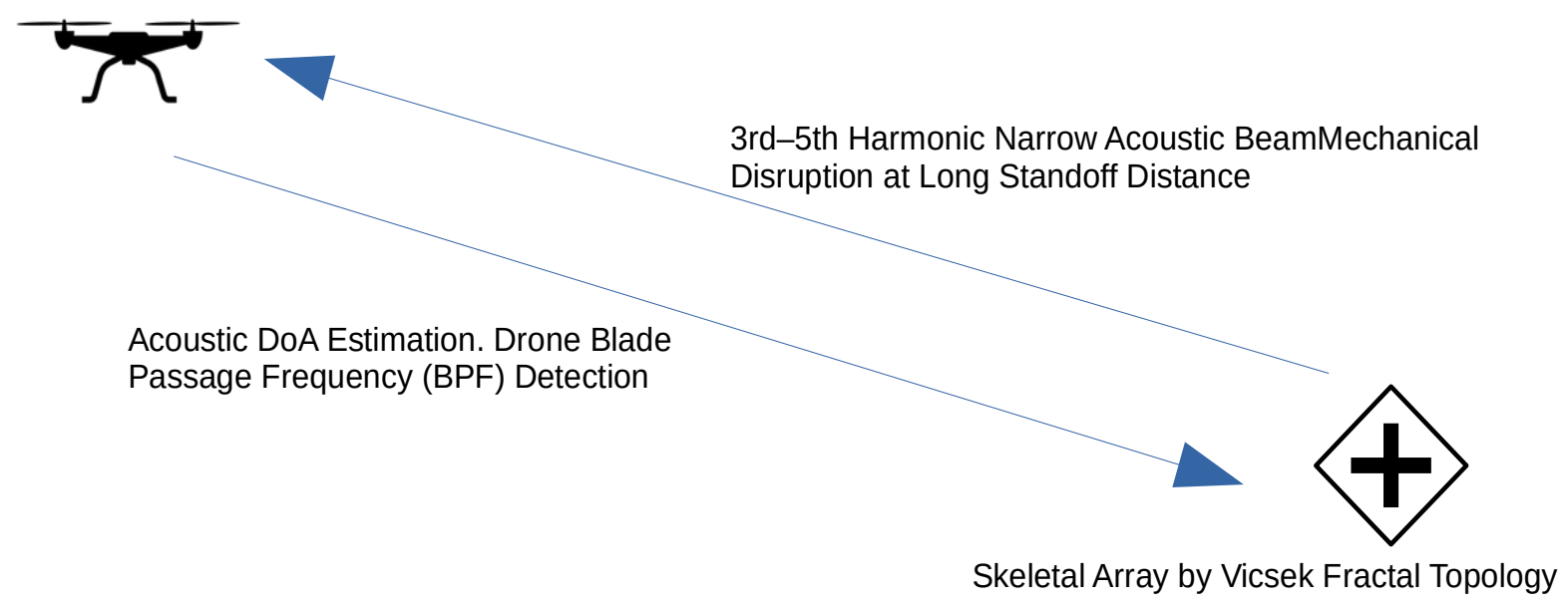
In conclusion, we demonstrated the feasibility of an integrated counter-UAV system comprising a long-range directional acoustic effector and a microphone array detection unit. This system enables the determination of the drone’s Direction of Arrival (DoA), the identification of its frequency (BPF), and the generation of a high-intensity, narrowband acoustic beam to engage the target at a significant standoff distance, utilizing frequencies that match the resonant harmonics of the drone.
Statement of the Use of Generative AI and AI-Assisted Technologies in the Writing Process
During the preparation of this manuscript, the author used AI tools in order to assist with English proofreading, formatting compliance, and editorial comment clarification during the final production stage. After using this tool/service, the author reviewed and edited the content as needed and takes full responsibility for the content of the published article.
Ethics Statement
Not applicable.
Informed Consent Statement
Not applicable.
Data Availability Statement
All data and newly developed theoretical calculations supporting the findings of this study are entirely presented within the text of the manuscript.
Funding
This research received no external funding.
Declaration of Competing Interest
The author declares that he has no known competing financial interests or personal relationships that could have appeared to influence the work reported in this paper.
References
-
Wang Z, Wang K, Yang B, Li S, Pan A. Sonic Gun to Smart Devices: Your Devices Lose Control Under Ultrasound or Sound. Black Hat USA. 27 July 2017. Available online: https://blackhat.com/docs/us-17/thursday/us-17-Wang-Sonic-Gun-To-Smart-Devices-Your-Devices-Lose-Control-Under-Ultrasound-Or-Sound.pdf (accessed on 7 February 2026).
-
Son Y, Shin H, Kim D, Park Y, Noh J, Choi K, et al. Rocking Drones with Intentional Sound Noise on Gyroscopic Sensors. In Proceedings of the 24th USENIX Security Symposium, Washington, DC, USA, 12–14 August 2015. Available online: https://embed.documentcloud.org/documents/2194008-rocking-drones-with-intentional-sound-noise-on (accessed on 2 February 2026).
-
Macey J. New Technology Uses Acoustic Energy to Neutralize Drone Threats. Unmanned Systems Technology. 4 April 2025. Available online: https://www.unmannedsystemstechnology.com/2025/04/new-technology-uses-acoustic-energy-to-neutralize-drone-threats/ (accessed on 7 February 2026).
-
Sound Energy Emerges as Next-Gen Drone Defense Tool. Spacewar. 4 April 2025. Available online: https://www.spacewar.com/reports/Sound_energy_emerges_as_next_gen_drone_defense_tool_999.html (accessed on 7 February 2026).
-
Liu Y-S, Wen K-A. Implementation of a CMOS/MEMS Accelerometer with ASIC Processes. Micromachines 2019, 10, 50. DOI:10.3390/mi10010050 [Google Scholar]
-
Soobramaney P. Mitigation of the Effects of High Levels of High-Frequency Noise on MEMS Gyroscopes. Ph.D. Thesis, Auburn University, Auburn, AL, USA, 2013. [Google Scholar]
-
Jeong C, Seok S, Lee B, Kim H, Chun K. A study on resonant frequency and Q factor tunings for MEMS vibratory gyroscopes. J. Micromech. Microeng. 2004, 14, 1530–1536. DOI:10.1088/0960-1317/14/11/014 [Google Scholar]
-
Liang O. How to Choose FPV Drone Motors—Considerations and Best Motor Recommendations. Oscar Liang, 17 May 2024. Available online: https://oscarliang.com/motors/ (accessed on 2 February 2026).
-
Djurek I, Petosic A, Grubesa S, Suhanek M. Analysis of a Quadcopter’s Acoustic Signature in Different Flight Regimes. IEEE Access 2020, 8, 10662–10670. DOI:10.1109/ACCESS.2020.2965177 [Google Scholar]
-
Intaratep N, Alexander WN, Devenport WJ, Grace SM, Dropkin A. Experimental Study of Quadcopter Acoustics and Performance at Static Thrust Conditions. In Proceedings of the 22nd AIAA/CEAS Aeroacoustics Conference, Lyon, France, 30 May–1 June 2016. Available online: https://www.bu.edu/ufmal/files/2016/07/aiaa-2016-2873.pdf (accessed on 7 February 2026).
-
Drone Noise Levels. Nextech. 2024. Available online: https://nextech.online/drone-noise-levels/ (accessed on 7 February 2026).
-
Sound Attenuation—Inverse Square Law Calculator. WKC Group. 2024. Available online: https://www.wkcgroup.com/tools-room/inverse-square-law-sound-calculator/ (accessed on 7 February 2026).
-
How to Read Microphone Specifications. DPA Microphones. 2024. Available online: https://www.dpamicrophones.com/mic-university/technology/how-to-read-microphone-specifications/ (accessed on 7 February 2026).
-
Dumitrescu C, Minea M, Costea IM, Chiva IC, Semenescu A. Development of an Acoustic System for UAV Detection. Sensors 2020, 20, 4870. DOI:10.3390/s20174870 [Google Scholar]
-
Anwar MZ, Kaleem Z, Jamalipour A. Machine learning inspired sound-based amateur drone detection for public safety applications. IEEE Trans. Veh. Technol. 2019, 68, 2526–2534. DOI:10.1109/TVT.2019.2893615 [Google Scholar]
-
Berrios I. Introduction to Sensor Arrays. Medium. 2 July 2024. Available online: https://medium.com/@itberrios6/introduction-to-sensor-arrays-bf585ac8e463 (accessed on 7 February 2026).
-
Altena A, Snellen M, Luesutthiviboon S, de Croon G, Voskuijl M. Frequency band analysis and comparison of localisation techniques for drones using microphone array measurements. JASA Express Lett. 2025, 5, 024802. DOI:10.1121/10.0035915 [Google Scholar]
-
Pompei FJ. Sound from Ultrasound: The Parametric Array as an Audible Sound Source. Ph.D. Thesis, Massachusetts Institute of Technology, Cambridge, MA, USA, 2002. [Google Scholar]
-
Bryner J. Crowd Control: How the ‘Sonic Cannon’ Works. Live Science. 25 September 2009. Available online: https://www.livescience.com/7900-crowd-control-sonic-cannon-works.html (accessed on 11 February 2026).
-
Ultrasonic Sound Gun (Parametric Speaker). Instructables, Autodesk. 2024. Available online: https://www.instructables.com/Ultrasonic-Sound-Gun-Parametric-Speaker/ (accessed on 11 February 2026).
-
The Monostable Multivibrator. Electronics Tutorials. 2024. Available online: www.electronics-tutorials.ws (accessed on 11 February 2026).
-
LRAD Overview and Product Guide. Genasys. March 2024. Available online: https://genasys.com/wp-content/uploads/2024/03/LRAD-Law-Enforcement-brochure-2024.pdf (accessed on 11 February 2026).
-
Vicsek T. Fractal Models with Simulation Programs for Physical, Chemical, and Biological Systems; North-Holland: Amsterdam, The Netherlands, 1989. [Google Scholar]
-
Werner DH, Ganguly S. An Overview of Fractal Antenna Engineering Research. IEEE Antennas Propag. Mag. 2003, 45, 38–57. DOI:10.1109/MAP.2003.1189650 [Google Scholar]
-
Borwick J. Loudspeaker and Headphone Handbook, 3rd ed.; Focal Press: Oxford, UK, 2001; pp. 240–255. [Google Scholar]