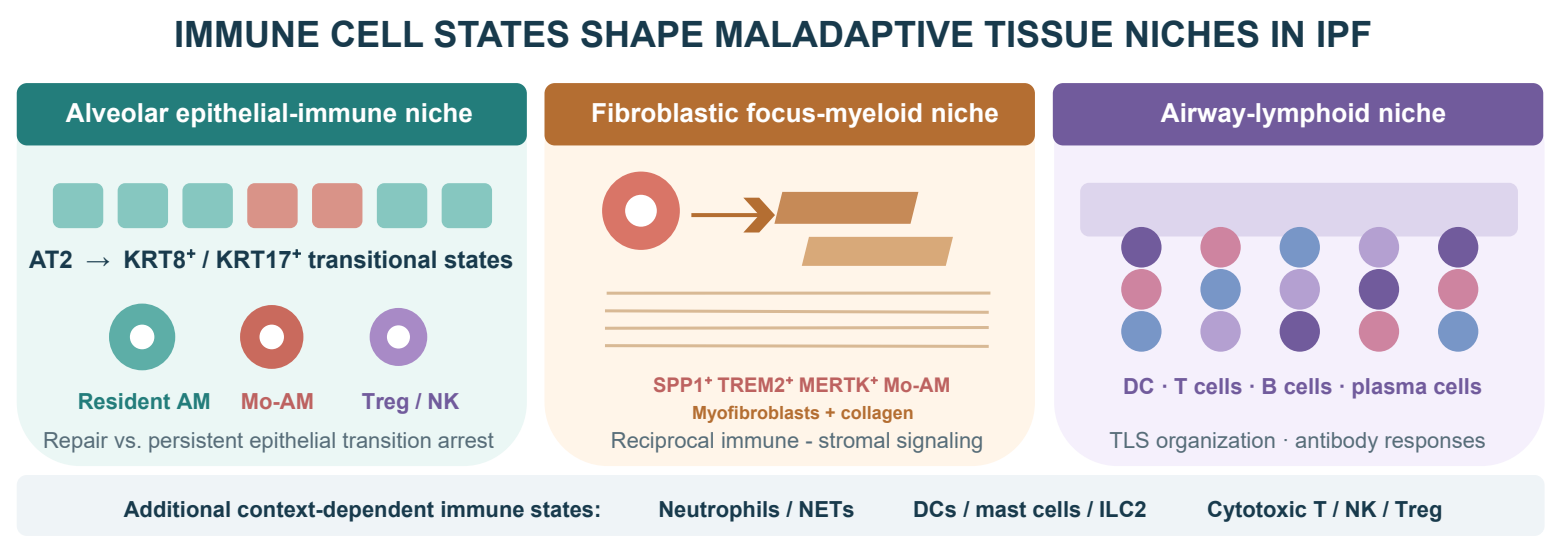
Idiopathic pulmonary fibrosis (IPF) is defined by recurrent alveolar injury, failed epithelial regeneration, and progressive scarring of functional lung tissue. Broad immunosuppression worsens outcomes in IPF, yet selected immune states remain integral to disease biology. Human single-cell and spatial studies now identify reproducible immune states within transitional epithelial regions, fibroblastic foci, remodeled airspaces, and lymphoid aggregates, while lineage-resolved experiments show that selected immune populations can alter epithelial fate, fibroblast activation, matrix turnover, and fibrosis resolution. Here, we integrate these findings through four linked variables: developmental origin, acquired state, spatial location, and disease stage. The strongest evidence centers on monocyte-derived alveolar macrophages that persist in injured alveoli and acquire secreted phosphoprotein 1 (SPP1), triggering receptor expressed on myeloid cells 2 (TREM2), MER proto-oncogene tyrosine kinase (MERTK), galectin-3, lipid, and lysosome associated programs. Neutrophils, dendritic cells, mast cells, innate lymphoid cells, T cells, natural killer cells, B cells, and plasma cells contribute with greater context dependence and, in several cases, opposing functions during injury and repair. We also distinguish human association from experimental causation and clinical efficacy, including the failure of phase III zinpentraxin alfa and phase IIb GB0139 despite encouraging early studies. These data support a precision immunology strategy in which a defined pathogenic cell state or intercellular circuit is targeted in a biomarker-selected patient population while host defense, immune surveillance, and reparative immunity are preserved.
Chronic obstructive pulmonary disease (COPD) is associated with substantial hospitalization burden. We evaluated temporal changes in associations of COVID-19 and major comorbidities with clinical and hospital utilization outcomes among COPD hospitalizations from 2019 to 2023. National Inpatient Sample data were used to identify hospitalizations with any COPD diagnosis. Outcomes included in-hospital mortality, acute kidney injury (AKI), total hospital charges, and time-to-routine discharge. Year-specific logistic, linear, and Fine–Gray models were adjusted for demographics, hospital characteristics, COVID-19, and comorbidities. Cohorts included 881,008, 737,636, 714,315, 714,230, and 748,441 hospitalizations in 2019–2023, respectively. COVID-19 had the strongest association with mortality in 2020 (adjusted odds ratio, 5.95; 95% confidence interval [CI], 5.78–6.13), declining to 1.48 (95% CI: 1.41–1.56) in 2023. Similar attenuation was observed for AKI, total charges, and time to routine discharge. Malnutrition remained consistently associated with adverse outcomes. Metastatic cancer showed higher odds of mortality (range, 2.59–3.13 across 2019–2023), chronic kidney disease with higher odds of AKI (range, 2.99–3.37), and dementia with lower routine discharge rate (adjusted subdistribution hazard ratio range, 0.52–0.55). COVID-19 associations with adverse outcomes were strongest early in the pandemic and attenuated, whereas chronic comorbidity associations remained relatively stable.
Down syndrome (trisomy 21, T21) is associated with abnormal lung development and features of accelerated biological aging, but the role of cellular senescence in the developing human lung remains unclear. We investigated cellular senescence and associated molecular alterations in human fetal T21 lungs using histological and immunofluorescence analyses, single-cell RNA sequencing, and quantitative proteomics. T21 fetal lungs exhibited impaired branching morphogenesis, increased mesenchymal cellularity, thickened septa, and reduced pulmonary vascularization. Single-cell transcriptomic analysis identified epithelial cells as a major compartment with increased senescence signatures, with significant enrichment in type I alveolar and Club cells. Immunofluorescence confirmed increased RAGE+/lamin b1− and RAGE+/γH2AX+ type I alveolar cells as well as UGRP1+/lamin b1− and UGRP1+/γH2AX+ Club cells in T21 lungs. T21 epithelial cells showed increased expression of inflammatory and senescence-associated genes, accompanied by suppression of genes involved in epithelial differentiation, developmental signaling, and lung morphogenesis. Proteomic analyses independently demonstrated enrichment of inflammatory, complement, metabolic, extracellular matrix, and cellular stress-related pathways, together with suppression of cell-cycle, DNA replication, DNA repair, and genome-maintenance programs. In conclusion, these findings identify cell-specific epithelial senescence as a prominent molecular and cellular feature of T21 fetal lungs and suggest its potential involvement in impaired pulmonary development.
Inflammatory lung diseases can be caused either by direct pulmonary insults via inhaled pathogens, such as bacteria or virus, or by indirect insults secondary to systemic inflammation, such as sepsis. The pathogenesis of inflammatory lung diseases has been extensively investigated. Recent studies focusing on protein ubiquitination provide mechanistic insights into the regulation of inflammatory responses in lung epithelial and endothelial cells. F-box and leucine-rich repeat protein 19 (FBXL19) is a substrate-recognition component of the SKP1-Cullin-1-F-box (SCF) E3 ubiquitin ligase complex. Previous studies have demonstrated that FBXL19 plays an important role in regulating pulmonary inflammation by targeting multiple inflammatory signaling proteins, including interleukin 33 receptor (IL-33R), CREB-Binding Protein (CBP), and Nuclear Factor-κB subunit p65 (NF-κB p65). Furthermore, FBXL19 overexpression attenuates lung inflammation and injury in experimental models of LPS exposure, bacterial infection, and sepsis. FBXL19 exhibits anti-inflammatory property and regulates cytoskeletal organization by targeting multiple substrates, including IL-33R (ST2L/IL1RL1), CBP, FOXM1, NF-κB p65, and Rho GTPases. In this review, we outline recent advances in FBXL19 research, highlighting its critical role in regulating inflammatory responses within the lungs. This review also highlights current knowledge gaps and future research directions, including the potential therapeutic applications of FBXL19 in inflammatory lung diseases, which require further preclinical and clinical validation.
The Western Pacific Region (WPRO) made the biggest success in the prevention and control of chronic respiratory diseases (CRD) before the outburst of the COVID-19 epidemic. This encouraging situation did not worsen substantially during the epidemic. NCD management indicators in middle-income countries (MIC) remained better accomplished in WPRO same concerned tobacco control. Visible deterioration of public education campaigns on physical activity during the epidemic has happened globally and especially in WPRO. In view of this, it’s critical to reestablish these activities to maintain achievements reached in the region before the COVID-19 epidemic. Population of the less-resourced settings continue to have lack of access to different services and technologies linked with the prevention of NCD. This disparity restrains a comprehensive reaction to the world crisis.
