Intelligent Rehabilitation and Engineering Open Access

ISSN: 3079-4935 (Online)

3079-4927 (Print)


Intelligent Rehabilitation and Engineering is an international, peer-reviewed, and open access journal, which publishes papers on all aspects of research and engineering application of intelligent rehabilitation medicine and engineering. It is published quarterly online by SCIE Publishing Ltd. View full Aims&Scope

Editor-in-Chief Editorial Board

Articles (2) All Articles

Open Access

Article

04 January 2026

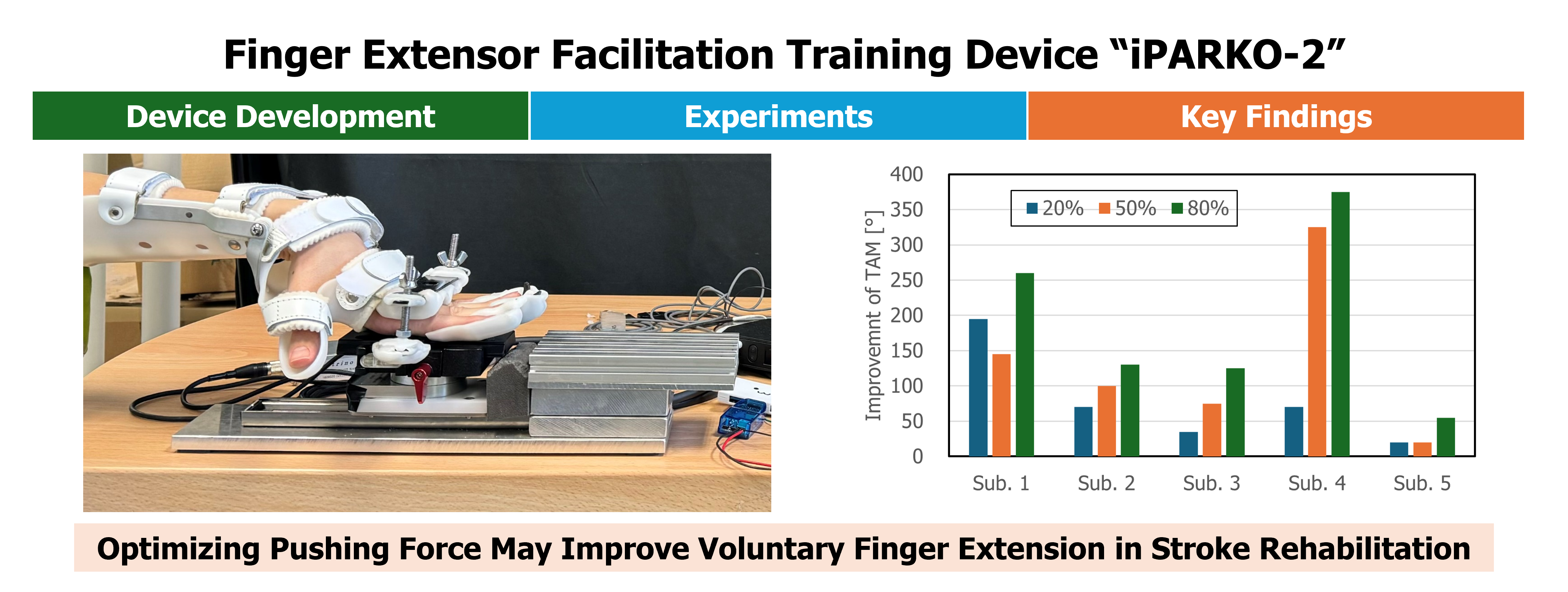
Relationship between Pushing Force and Improvement in Total Active Motion in Training with Finger Extensor Facilitation Training Device “iPARKO-2”

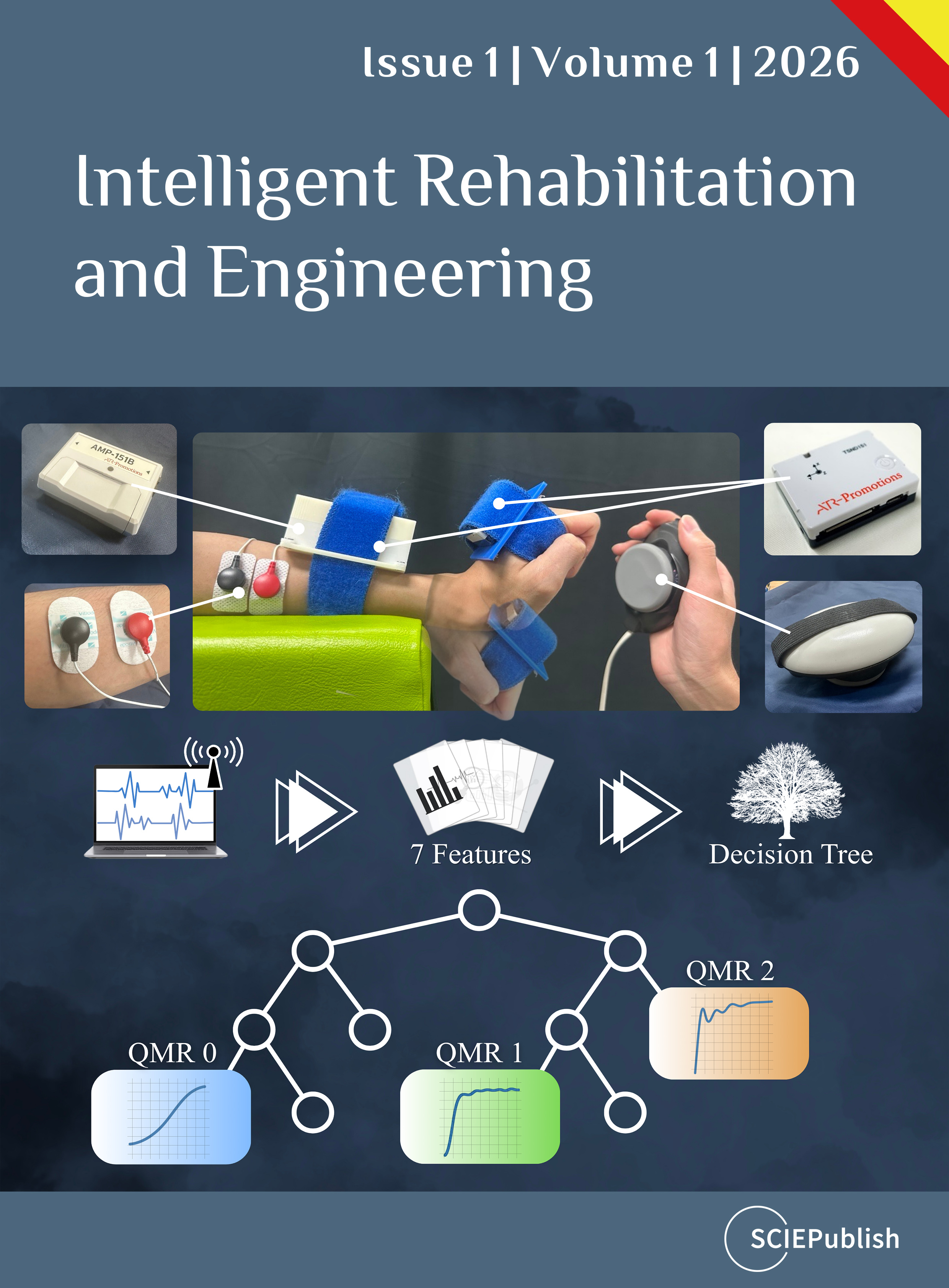
The recovery of hand function in chronic stroke survivors is challenging because of finger complexity and post-stroke spasticity. This study developed iPARKO-2, a novel device that simulates the manual finger extensor facilitation technique while overcoming the limitations of the original device. iPARKO-2 enables the simultaneous fixation of the index through the little fingers and applies resistance from the proximal phalanges, allowing training in patients with strong fingertip spasticity. This study is a pilot study aimed at technical validation and feasibility. Five participants underwent training at three distinct target-pushing force levels. Concurrently, their active range of motion and extensor muscle activity were measured. The results show a direct correlation between the increased pushing force and the improvement in total active motion. Furthermore, the level of muscle activity exhibited a positive correlation with the extent of the observed improvement. iPARKO-2 also reduced the fixation time and enhanced usability. These findings suggest that iPARKO-2 effectively enhances voluntary hand movements and that pushing force is a key factor in determining training efficacy.

Open Access

Editorial

19 February 2025
Open Access

Editorial

19 February 2025
Open Access

Article

04 January 2026

Relationship between Pushing Force and Improvement in Total Active Motion in Training with Finger Extensor Facilitation Training Device “iPARKO-2”

The recovery of hand function in chronic stroke survivors is challenging because of finger complexity and post-stroke spasticity. This study developed iPARKO-2, a novel device that simulates the manual finger extensor facilitation technique while overcoming the limitations of the original device. iPARKO-2 enables the simultaneous fixation of the index through the little fingers and applies resistance from the proximal phalanges, allowing training in patients with strong fingertip spasticity. This study is a pilot study aimed at technical validation and feasibility. Five participants underwent training at three distinct target-pushing force levels. Concurrently, their active range of motion and extensor muscle activity were measured. The results show a direct correlation between the increased pushing force and the improvement in total active motion. Furthermore, the level of muscle activity exhibited a positive correlation with the extent of the observed improvement. iPARKO-2 also reduced the fixation time and enhanced usability. These findings suggest that iPARKO-2 effectively enhances voluntary hand movements and that pushing force is a key factor in determining training efficacy.

YoshifumiMorita
ShotaIshigaki
ReikaYokoyama
HirofumiTanabe
Intell. Rehabil. Eng.
2026,
1
(1), 10002; 
Open Access

Article

04 January 2026

Relationship between Pushing Force and Improvement in Total Active Motion in Training with Finger Extensor Facilitation Training Device “iPARKO-2”

The recovery of hand function in chronic stroke survivors is challenging because of finger complexity and post-stroke spasticity. This study developed iPARKO-2, a novel device that simulates the manual finger extensor facilitation technique while overcoming the limitations of the original device. iPARKO-2 enables the simultaneous fixation of the index through the little fingers and applies resistance from the proximal phalanges, allowing training in patients with strong fingertip spasticity. This study is a pilot study aimed at technical validation and feasibility. Five participants underwent training at three distinct target-pushing force levels. Concurrently, their active range of motion and extensor muscle activity were measured. The results show a direct correlation between the increased pushing force and the improvement in total active motion. Furthermore, the level of muscle activity exhibited a positive correlation with the extent of the observed improvement. iPARKO-2 also reduced the fixation time and enhanced usability. These findings suggest that iPARKO-2 effectively enhances voluntary hand movements and that pushing force is a key factor in determining training efficacy.utf-8

YoshifumiMorita
ShotaIshigaki
ReikaYokoyama
HirofumiTanabe
Intell. Rehabil. Eng.
2026,
1
(1), 10002; 
Open Access

Editorial

19 February 2025
TOP