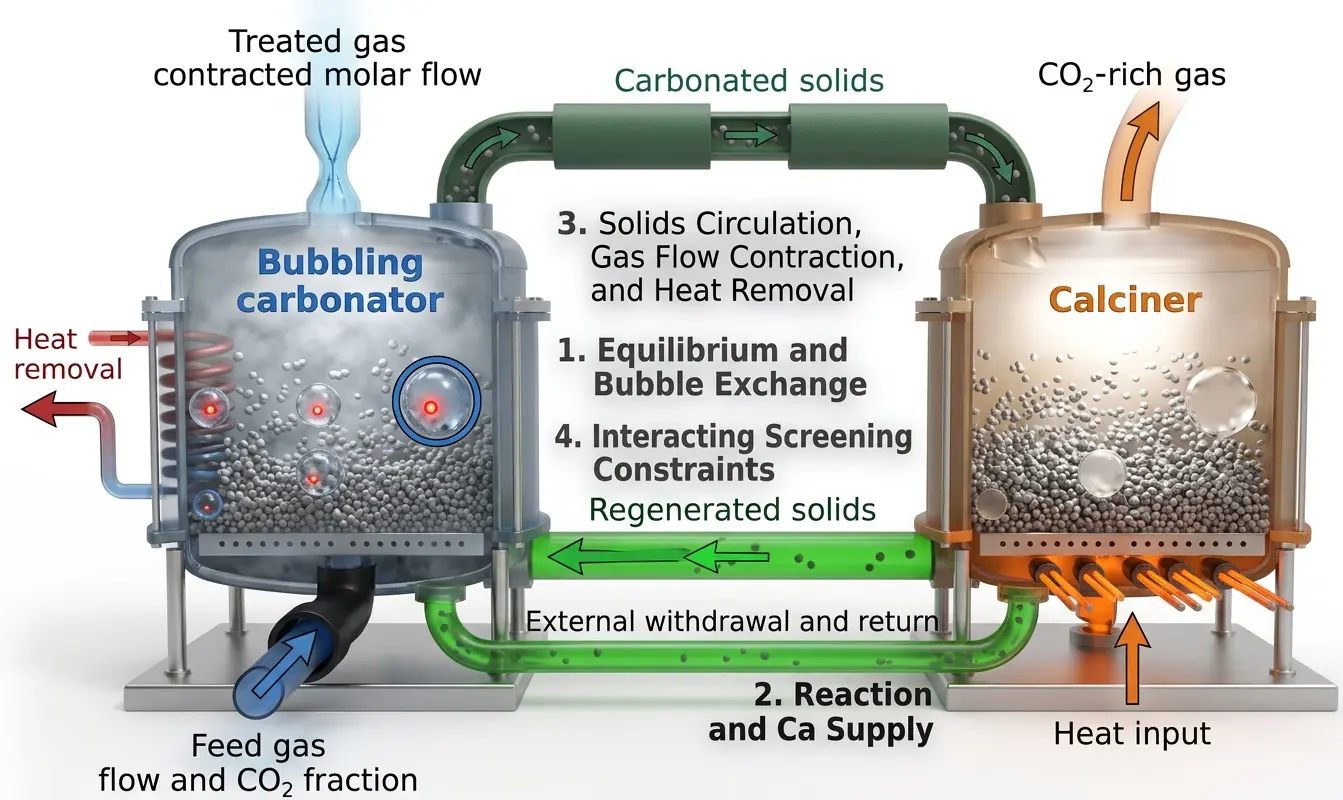
Bubbling fluidized beds are used in calcium looping for sorbent testing, thermochemical energy storage, and selected carbon-capture and sorption-enhanced processes. Their performance depends on gas distribution between bubbles and emulsion, the evolving properties of CaO/CaCO3 particles, sorbent circulation, and heat removal. This critical narrative review examines these interactions for particles exhibiting Geldart Group B behaviour. Coupled fluidized-reactor modelling is established, including earlier bubbling-bed calcium-looping models; the contribution here is a synthesis of that literature with transparent screening calculations and an evidence-based validation agenda. A four-constraint representation organizes equilibrium; interphase transport; kinetics and sorbent supply; and thermal feasibility at a specified operating state. The constraints interact, and their minimum is not a substitute for a coupled reactor solution. Calculations account for gas-flow contraction, compare alternative bubble-growth correlations, and examine sensitivity to interchange coefficients, bubble-size distributions, and immersed internals. A reduced coupled example illustrates how finite kinetics and thermal feedback can lower capture below separate limiting estimates. Conversion-dependent particle properties are represented by a conditional constant-envelope calculation and contrasted with measurements of fluidization, bulk density, and fragmentation. Bubble growth can limit capture, but the binding constraint depends on operating conditions and available sorbent. Likewise, the relationship between bubbling and bed-to-surface heat transfer is regime dependent. Reproducible calculations and plotting data accompany the review, and a proposed validation programme identifies the simultaneous measurements needed to evaluate these screening concepts in hot reacting beds.
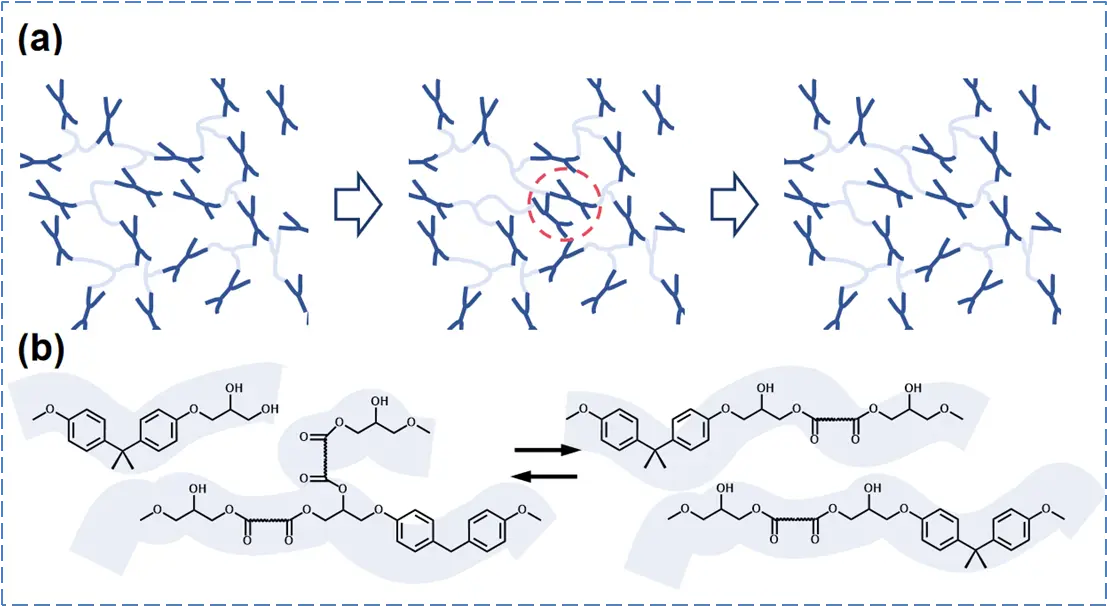
The accumulation of massive post-consumer poly(ethylene terephthalate) (PET) waste poses severe ecological hazards. Conventional mechanical recycling induces irreversible chain scission and severe property depreciation, while chemical depolymerization consumes excessive energy and toxic solvents, creating a performance-cost downcycling bottleneck limiting high-value PET reuse. This comprehensive critical review highlights vitrimer chemistry based on associative dynamic exchange as a transformative upcycling solution. The field is organized around two fabrication routes—depolymerization-reconstruction and in-situ/direct network construction while preserving the PET backbone—together with a cross-cutting transesterification catalytic dimension covering externally catalyzed, self-catalytic, and metal-free, no-added-catalyst (including residual-catalyst-assisted), and fully catalyst-free designs. Solvolysis-derived oligomers afford vitrimers with tunable glass transition temperature (Tg) (38~240 °C) and tensile strength up to 117 MPa; solvent-free extrusion fits continuous industrial lines, and metal-free designs may reduce heavy-metal contamination. Several optimized systems retain over 80% mechanical performance after cyclic reprocessing, although significant variations exist; for example, the bis(2-hydroxyethyl) terephthalate (BHET)/pyromellitic dianhydride (PMDA)/trimethylolpropane (TMP) vitrimer decreases from approximately 30 MPa to 16 MPa after two compression-molding cycles. These technologies show potential for closed-loop recycling and reprocessability, may reduce virgin resin demand, and may reduce carbon footprints, pending full life-cycle assessment. Major industrial barriers include insufficient creep resistance, incomplete monomer recovery, and non-uniform testing standards. This work delivers integrated theoretical and engineering guidance for scalable PET vitrimer circular-material development.
Solvents constitute a major material and environmental burden in pharmaceutical manufacturing, yet sustainability assessment is still largely based on proportional metrics such as Process Mass Intensity (PMI) and aggregated life-cycle indicators. Building on our previously published solvent-centric sustainability framework, which integrated PMI, circular PMI (cPMI), Global Warming Potential (GWP), and Cumulative Energy Demand (CED) for solvent-focused process assessment, the present study develops a phenomenological material–energy scaling formulation for recovery-constrained solvent sustainability. The proposed relationship is formulated as a testable phenomenological scaling framework, with its present scope limited to a system-specific relationship rather than a universal physical law. The framework represents the total sustainability burden, L(η), as a combination of a material-driven contribution and a recovery-associated nonlinear contribution: L(η) = c + kM(η) + β[ηn/(1 − η)], where M(η) is solvent material intensity, η is the recovery fraction, c is an intercept, k is a material-impact coefficient, β represents system-specific recovery-associated sensitivity, and n is a phenomenological recovery exponent. A dimensionless form is: L* = c* + αM* + λ[ηn/(1 − η)], where L* = L/L0, M* = M/M0, c* = c/L0, α = kM0/L0, and λ = β/L0. The nonlinear coordinate, Φ(η;n) = ηn/(1 − η), is used as a practical representation of recovery-associated asymptotic behaviour rather than as a first-principles thermodynamic equation. The parameters β, λ, and n are therefore expected to depend on the solvent, process configuration, recovery technology, operating conditions, response being measured, and system boundary. A seven-record pharmaceutical case-study dataset was used to examine the linear material relationship, the proposed nonlinear recovery coordinate, and an extended material–recovery interaction. Across the records, solvent mass decreases from 150 to 45 kg·kg−1 API as recovery increases from 30% to 92%, while energy use decreases from 520 to 380 MJ·kg−1 API. The linear model explains most of the observed variation (R2 = 0.979), whereas adding the nonlinear recovery term provides only a small improvement (R2 = 0.981), is penalized by information criteria, and gives an exponent at its imposed upper limit. An extended interaction model gives a closer fit to the seven observations, but its five-parameter structure relative to only seven observations does not support claims of independent predictive performance. These results therefore provide a basis for treating the proposed formulation as a testable phenomenological scaling hypothesis, rather than as evidence for a universal material–energy law. A complementary step-resolved analysis examines how solvent-related material and environmental burdens are distributed across individual process operations and how recovery may shift the balance between material use and recovery-associated energy requirements. This analysis identifies high-contributing operations and defines an Impact Concentration (IC) Index: IC = Σi fi2, where fi = Li/Ltotal represents the fractional contribution of operation i to a specified sustainability burden. IC is used as a descriptive measure of burden concentration and process localization, rather than as a thermodynamic variable, causal parameter, or universal recovery criterion. Thus, the step-resolved analysis identifies where burdens are concentrated, while the scaling formulation examines how material intensity and recovery-associated burden may be related. Solvent-level descriptor and impact analyses show substantial variation in GWP and CED among the supplied solvents, while exploratory machine-learning analysis indicates the potential for relating molecular descriptors to solvent sustainability. These analyses remain exploratory because of their small sample sizes and differences in data sources and system boundaries. A separate desalination comparison examines whether similar recovery–energy patterns can be observed across other recovery-constrained separation systems. Because membrane, thermal, and solvent-recovery processes differ in their mechanisms, feed characteristics, product requirements, and energy use, this comparison is treated as an empirical comparison of recovery–energy relationships rather than evidence of a common physical mechanism or universal master curve. Finally, a compact cross-domain analysis using 24 observations from independent recovery-related datasets examines whether the proposed recovery coordinate can also provide a useful comparative description beyond pharmaceutical solvent systems. The exponent was not refitted to create a new universal relationship. Furthermore, the broader, forward-looking exergy-based Computational Sustainability Physics (CSP) framework, representing an original conceptual development by the present author, has not included in this study. Overall, the results indicate a system-specific and testable material–energy scaling framework in which increasing solvent recovery can reduce virgin-material demand while changing the relative importance of recovery-associated energy and process-level burden concentration. Further studies using independently documented process data, wider recovery ranges, consistent system boundaries, and independent validation across different solvents and recovery technologies are needed to determine the broader predictive value and transferability of the proposed formulation.
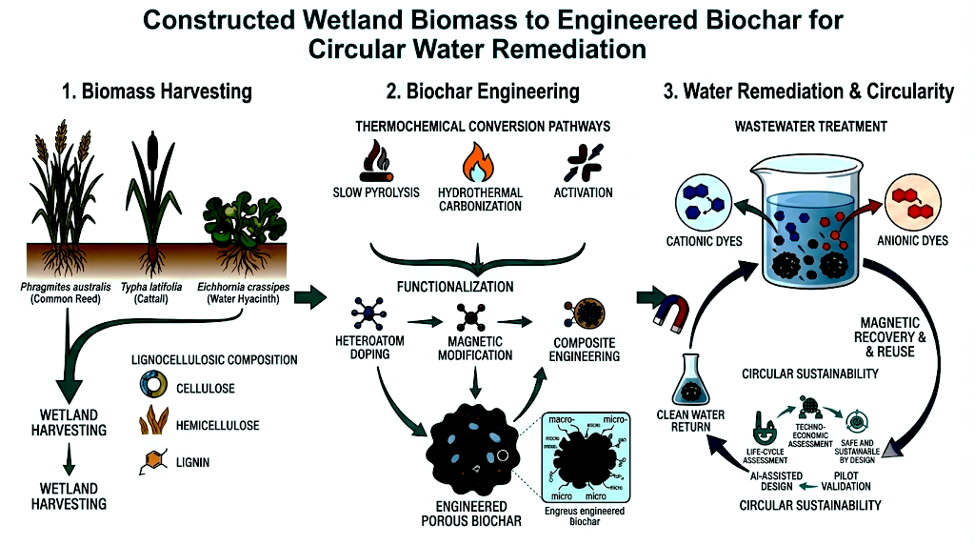
Constructed wetlands produce large amounts of lignocellulosic biomass due to harvesting operations, which are conventionally considered as waste. Such biomass, which is characterized by a high content of cellulose, hemicellulose, and lignin, is a renewable source of carbon material for engineered biochar production. Recent developments in thermochemical conversion processes (slow pyrolysis, hydrothermal carbonization, activation), surface functionalization (doping with heteroatoms, magnetization, composite formation), and carbon architecture engineering have made it possible to turn pure biochar into a highly efficient adsorbent that can remove both cationic and anionic dyes from industrial textile wastewater. This review adopts a feedstock-engineering-structure-performance-sustainability perspective, correlating biomass composition, conversion processes, surface chemistry, adsorption phenomena, and performance in wastewater. Reported adsorption capacities vary considerably with biomass origin, thermochemical processing, surface modification, dye characteristics, and experimental conditions. Although several engineered biochars have demonstrated promising adsorption and reuse behaviour under laboratory conditions, the available evidence remains insufficient to establish their general performance in real industrial wastewater treatment. Further research involving authentic constructed-wetland biomass, standardized adsorption protocols, long-term regeneration, contaminant-leaching assessments, and pilot-scale validation is required. Feedstock-specific life-cycle and techno-economic assessments will also be essential to determine the environmental and economic feasibility of these materials within circular water-remediation systems. Amongst the emerging possibilities are the artificial intelligence (AI)-assisted search for new materials, pilot scale continuous flow demonstrations, and the use of International Organization for Standardization (ISO) protocols for life cycle and techno-economic analysis. The convergence of materials science, environmental engineering, and sustainability policy makes engineered biochar from constructed wetland biomass a promising candidate as the foundation of a circular water treatment strategy for dye-contaminated wastewater. Literature was collected from major scientific databases including Scopus, Web of Science, and ScienceDirect, focusing on publications related to constructed wetland biomass-derived biochar for water remediation.