Engineering Constructed Wetland Biomass into Multifunctional Biochar
Composites for Circular Water Remediation
Author Information
Other Information
ABSTRACT:
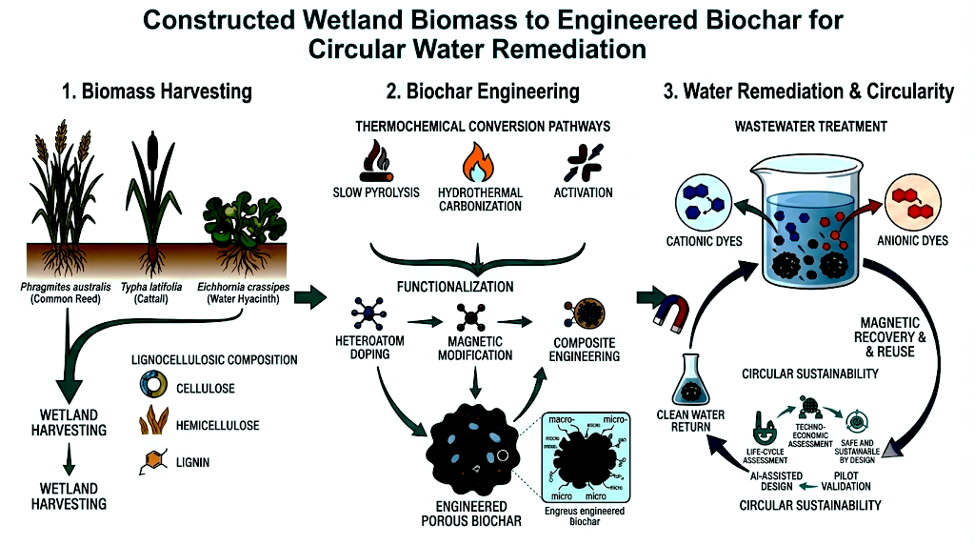
Constructed wetlands
produce large amounts of lignocellulosic biomass due to harvesting operations,
which are conventionally considered as waste. Such biomass, which is
characterized by a high content of cellulose, hemicellulose, and lignin, is a
renewable source of carbon material for engineered biochar production. Recent
developments in thermochemical conversion processes (slow pyrolysis,
hydrothermal carbonization, activation), surface functionalization (doping with
heteroatoms, magnetization, composite formation), and carbon architecture
engineering have made it possible to turn pure biochar into a highly efficient
adsorbent that can remove both cationic and anionic dyes from industrial
textile wastewater. This review adopts a feedstock-engineering-structure-performance-sustainability
perspective, correlating biomass composition, conversion processes, surface
chemistry, adsorption phenomena, and performance in wastewater. Reported
adsorption capacities vary considerably with biomass origin, thermochemical
processing, surface modification, dye characteristics, and experimental
conditions. Although several engineered biochars have demonstrated promising
adsorption and reuse behaviour under laboratory conditions, the available
evidence remains insufficient to establish their general performance in real
industrial wastewater treatment. Further research involving authentic
constructed-wetland biomass, standardized adsorption protocols, long-term
regeneration, contaminant-leaching assessments, and pilot-scale validation is
required. Feedstock-specific life-cycle and techno-economic assessments will
also be essential to determine the environmental and economic feasibility of
these materials within circular water-remediation systems. Amongst the emerging
possibilities are the artificial intelligence (AI)-assisted search for new
materials, pilot scale continuous flow demonstrations, and the use of International Organization for
Standardization (ISO)
protocols for life cycle and techno-economic analysis. The convergence of
materials science, environmental engineering, and sustainability policy makes
engineered biochar from constructed wetland biomass a promising candidate as
the foundation of a circular water treatment strategy for dye-contaminated
wastewater. Literature was collected from major scientific databases including
Scopus, Web of Science, and ScienceDirect, focusing on publications related to
constructed wetland biomass-derived biochar for water remediation.
Keywords:
Constructed wetland biomass; Engineered biochar; Macrophytes; Dye
adsorption; Surface modification; Wastewater remediation; Circular economy