New Horizons in IPF Pathogenesis and Treatment

Deadline for manuscript submissions: 31 March 2026.

Guest Editor (1)

Marta  Bueno
Prof. Marta Bueno 
Department of Medicine, University of Pittsburgh, Pittsburgh, PA, 15260, USA;
Interests: Idiopathic Pulmonary Fibrosis (IPF); Lung Injury; Lung Fibrosis; Mitochondrial Dysfunction; Scleroderma-ILD; Chronic Rejection After Lung Transplantation

Special Issue Information

Idiopathic Pulmonary Fibrosis (IPF) is a chronic and progressive interstitial lung disease that poses ongoing challenges in both clinical practice and scientific research. Although notable advances have been made in recent years, current diagnostic tools and treatment options remain inadequate. Active investigations across basic, translational, and clinical domains are gradually uncovering the underlying mechanisms of IPF and offering new prospects for therapeutic intervention.

This Special Issue aims to bring together recent developments and provide a forum for advancing understanding of the disease’s complexity. Manuscripts are invited in the form of original research, comprehensive reviews, short communications, perspectives, and case reports, with a particular emphasis on the following topics: 

• Mechanistic studies of molecular and cellular pathways involved in fibrosis
• Genetic and environmental contributors to disease onset and progression
• Discovery and validation of biomarkers for diagnosis, prognosis, and patient stratification
• Development and refinement of in vivo, ex vivo, and in vitro models of pulmonary fibrosis
• Emerging therapeutic strategies and their translational relevance
• Technological innovations that enhance the understanding or management of IPF
• Comparative or cross-cutting research addressing other fibrotic or interstitial lung diseases with relevance to IPF

The 9th IPF Summit (https://ipf-summit.com/) will take place in Boston, USA, from 19 to 21 August 2025. As a partner, Fibrosis warmly invites conference participants in the field to submit their manuscripts to this Special Issue.

Published Papers (1 Papers)

Open Access

Perspective

28 January 2026

The Double Face of Exosomes Derived from Mesenchymal Stromal Cells in Fibrotic Lung Diseases: Pathology Contribution or Treatment?

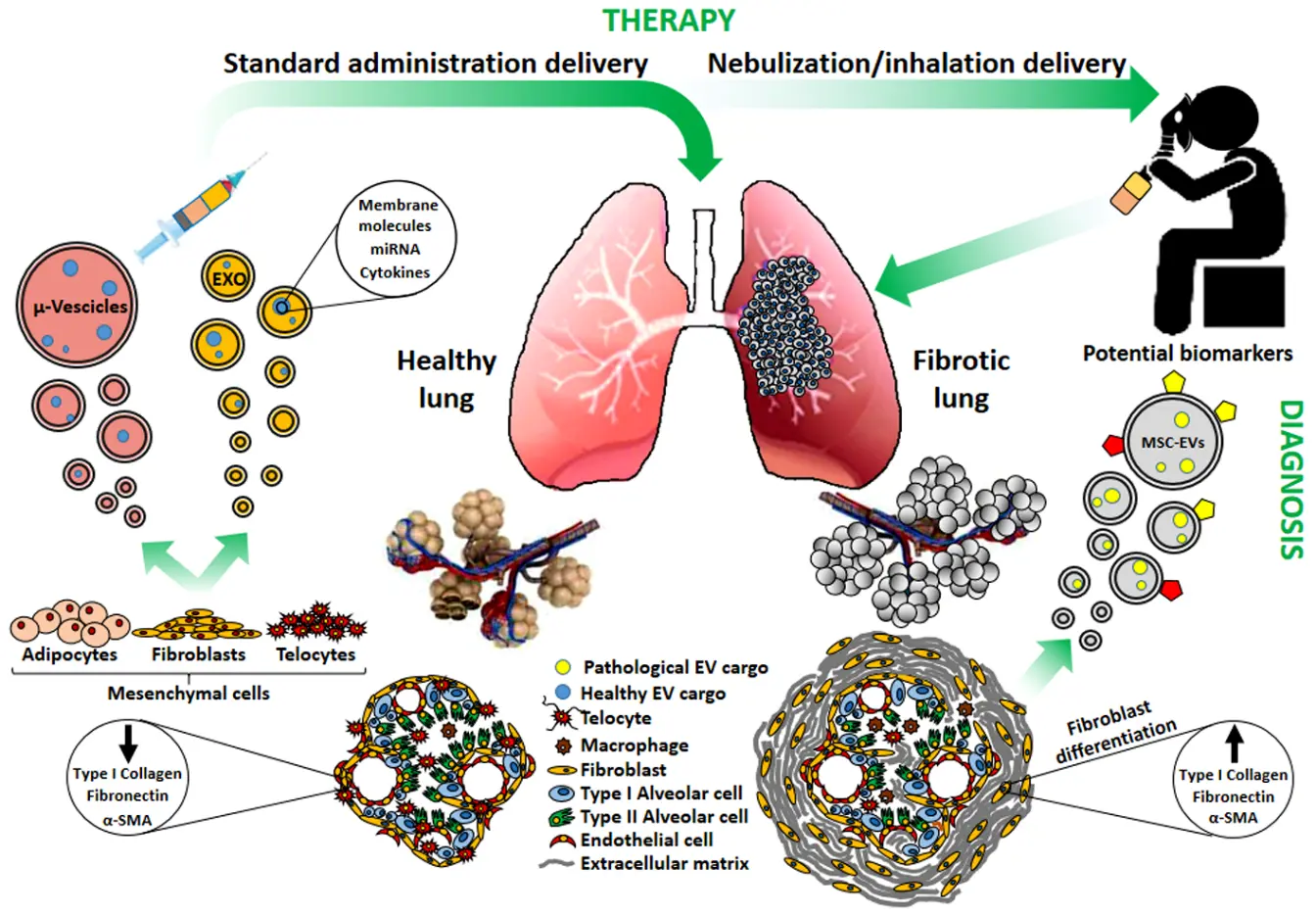
Several studies have attempted to clarify the role of exosomes and/or microvesicles derived from mesenchymal stromal cells (MSCs) (collectively indicated as extracellular vesicles: MSCs-EVs) in pulmonary fibrosis. Depending on their origin and on the micro-environmental context, MSCs-EVs may support or attenuate the fibrotic invasion of the lung, a hallmark of all Interstitial Lung Diseases (ILDs). Indeed, EVs have emerged as pivotal intercellular mediators and their potential diagnostic and therapeutic applications have been suggested. We aim here to elucidate the dual role of MSCs-derived exosomes and microvesicles: the contribution to pulmonary fibrosis progression, exerted by the MSCs-EVs originated from resident MSCs, or the potential therapeutic activity of those generated from healthy MSCs. Actually, MCSs-EVs appear as the frontiers of cell-free therapy and nano-medicine research in a great number of pre-clinical studies, but developments are needed to optimize and standardize their isolation, production and delivery. Interestingly, since the respiratory system directly communicates with the external environment, lung treatment could be approached by MSCs-EVs nebulization as a preferential administration route, integrating targeted pulmonary delivery with an enhanced patient’s compliance. Hence MSCs-EVs may contribute to ILD pathogenesis, display a potential as biomarkers, and still hold promise as therapeutic agents to reduce lung fibrosis. However further researches are needed to validate their clinical application.

Paolo Giannoni*
Marco Grosso
Emanuela Barisione
Daniela de Totero
Fibrosis
2026,
4
(1), 10005; 
TOP