
A Transboundary Network of Protected Areas for the Conservation of the Far Eastern Leopard (Panthera pardus orientalis)
A Transboundary Network of Protected Areas for the Conservation of the Far Eastern Leopard (Panthera pardus orientalis)
Yury Darman
1,2,*
 Evgeny Egidarev
3
Evgeny Egidarev
3
Received: 27 December 2025 Revised: 16 March 2026 Accepted: 10 April 2026 Published: 20 April 2026

© 2026 The authors. This is an open access article under the Creative Commons Attribution 4.0 International License (https://creativecommons.org/licenses/by/4.0/).
1. Introduction
The Far Eastern leopard (Panthera pardus orientalis) is the rarest between nine existing leopard subspecies. It has different names, like Amur or Northeast China leopard, but it would be more correct to call it Korean leopard, because the Korean Peninsula was the main core area of this subspecies in the 19th century. Genetically, the Far Eastern leopard is very close to the North Chinese leopard (P. p. japanensis) [1,2], and even the IUCN SSC Cats Specialist Group proposed combining these subspecies into one—P. p. orientalis [3]. But the connection between the Far Eastern leopard and the North Chinese leopard was interrupted about some hundred years ago, when the narrow forest corridor between the Bohai Bay and the Gobi Desert was severed as a result of increased human activity. Currently, the last existing populations of these two subspecies are separated by 1700 km.
The Far Eastern leopard is listed in the IUCN Red List as critically endangered CR C2a(ii) and in Appendix A to CITES [4]. This subspecies is under reliable protection of legislation in all countries in its range. It is listed in the Red Book of the Russian Federation (1983, updated in 2000 and 2021) and DPRK (2000), and listed in China as a Class I protected species. They are special Strategy for the Far Eastern leopard conservation in Russia (1996, 2013, 2022) and the National Biodiversity Strategy and Action Plan of DPRK (1996, updated in 2007).
Life at the limit of physical capabilities and hunting pressure has brought the last population of this subspecies to the brink of extinction, with the worldwide number declining to only 35–40 individuals, and the total range has decreased by 40 times. Historically, the leopard has spread throughout the Korean peninsula, but the last animal in Republic of Korea was killed in 1970 [5]. Until the 1990s, several leopards remained in North Korea. Studies and questionnaires estimated that 3–5 individuals may persist in the Baekdu Mountains [6].
In Northeast China, the leopard inhabited the eastern part of Liaoning, Jilin, and Heilongjiang provinces up to Xinkaihu. In Jilin province they were about 45 leopards in 1976/1977, decreased to 30 individuals in 1982/1983, and to 15 in 1991. The minimum number in Northeast China was counted in 1998–1999—only 4–7 in Jilin [7] and 3–5 in Heilongjiang [8], mostly along the border with Russia.
In the Russian Far East, the leopard historically inhabited Primorsky Krai south of a line between Lake Khanka and Olga Bay, with occasional registrations of transient individuals northward up to the Lesser Khingan Mountains [9]. Abramov and Pikunov [10] at the first rigorous assessment in the winter of 1972–1973, counted a total of 38 to 46 leopards, which were already subdivided into three populations. By 1980, the Far Eastern leopard had been extirpated from the Southern Sikhote-Alin and Pogranichny Ridge [11]. At the beginning of the 21st century, the only breeding population of the endangered subspecies remained in the Southwest Primorsky Krai [12], where the last 27–32 animals inhabited in foci on an area of 2233 km2 [13].
Active protection measures in Russia and China, with support of international environmental organizations, have ensured significant restoration of the Far Eastern leopard. Huge efforts have been made to combat poachers in the leopard’s range with the support of public funds. But in the long term, the most important task was to ensure the reliable conservation of key habitats of a rare species. The creation of a network of protected areas (PAs), especially for transboundary populations, is aimed at solving this problem [14,15]. This review is devoted to the formation of such a “leopard econet”, in which the authors participated at various stages. The tasks of our article are: (1) review of the history and status of protected areas in the Far Eastern leopard range; (2) assessment of the effectiveness of protected areas network for the conservation of suitable habitats for the leopard, and (3) put together the data on the recently established Sino-Russian Transboundary Protected Area “Land of Big Cats”.
2. Materials and Methods
2.1. Study Area
The current range of the only wild population of Far Eastern leopards is limited exclusively confined to the Southwestern Primorsky province (SWP) in the Russian Far East (RFE) and the bordering areas of Laoyeling-Dalongling Mountains (LDM) in Jilin and Heilongjiang Provinces of Northeast China (NEC). In Russia, the leopard inhabits all forest areas in SWP, with the exception of wetlands and agricultural lands, covering a total of about 5387 km2 [16]. Animals from the SWP play the role of a source for the restoration of the leopard in the LDM. According to Chinese scientists, 32,750 km2 are potentially suitable for leopards in Jilin and Heilongjiang provinces, of which 8625 km2 are already inhabited by leopards [17]. In total, the current range of the Far Eastern leopards’ transboundary population is already about 14,000 km2—4 times more than at the beginning of the 21st century (Figure 1).
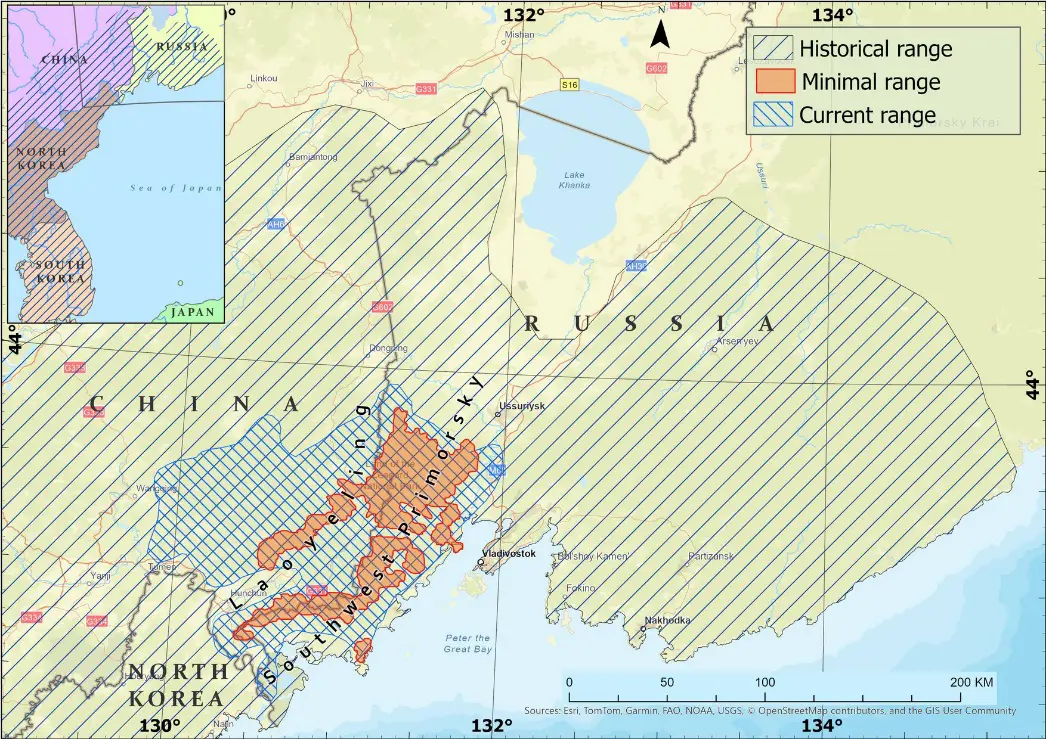
Figure 1. Distribution of the Far Eastern leopard (Panthera pardus orientalis): historical, minimal (2000), and current (2022).
The Far Eastern leopard prefers low mountains reaching 900 m above sea level, with highly rugged terrain covered with coniferous-broad-leaved forests. The most valuable habitats are forest stands with Korean pine (Pinus koraiensis) and Black fir (Abies holophylla). Oak forests (Quercus mongolica) are most common in the territory in a mixture with lime trees, Manchurian ash (Fraxinus mandshurica), Manchurian walnut (Júglans mandshurica), and Amur cork tree (Phellodendron amurénse). In the south, sparse forests of Jagged oak (Quercus robur) with black birch (Betula daurica) appear. The southern and coastal parts are mainly a hilly plain dominated by open woodlands and marshlands with low outcrops towering among them. In the valleys and on the flat areas, they are meadows of ground weinik (Calamagrostis epigejos), miscanthus blushing (Miscanthus sinensis), and lowland sedge-weinik meadows.
The most important conditions for the Far Eastern leopard are the absence or low height of snow cover, safe havens on rocky cliffs, and a fairly high population density of prey. Leopard relies mainly on the three ungulate species—sika deer (Cervus nippon), Siberian roe deer (Capreolus pygargus), and wild boar (Sus scrofa). According to the aerial census of 2023, the total number of three species in SWP was estimated at 31–33 thousand individuals, with an average population density of 57 animals per 10 km2 [18]. Recently, a new small ungulate, the water deer (Hydropotes inermis), appeared as additional prey for the leopard [19,20]. Another ungulate species, like musk deer (Moschus moschiferus) and long-tailed goral (Naemorhedus caudatus), is rare, as well as Manchurian red deer (Cervus elaphus xanthopygus). Asian badger (Meles leucurus amurensis), raccoon dog (Nyctereutes procyonoides), Manchurian hare (Lepus mandshuricus), and pheasant (Phasianus colchicus) are the secondary prey species for the Far Eastern leopard. During the last decade, the number of transboundary Eastern Changbaishan (Eastern Manchurian) population of Amur tiger (Panthera tigris altaica) has been growing to at least 70–75 individuals plus 13–15 cubs [21]. Asiatic black bear (Ursus thibetanus) and brown bear (Ursus arctos) are other enemies and competitors. The Eurasian lynx (Lynx lynx) and wolf (Canis lupus) are very rare.
Main leopard habitats in its current range have a low level of anthropogenic disturbance due to the governmental restrictions along the Sino-Russian border [22]. They were only selective logging at the end of the 20th century, which allow to keep forest cover. Even though the human density on the Chinese side in Hunchun and Wangqing municipalities is about 20.5 people per square kilometer on average, they are mostly in two towns and in small villages in the river valleys. On the Russian side, the human density is only 5.9 people per km2, and they are concentrated along the coastal zone of Peter the Great Bay. At the same time, the Far Eastern leopard gets along well with humans and does not show aggression towards them.
2.2. Methods
Since 1999, the authors have been involved in the design and creation of new PAs in the RFE, collecting information and creating a GIS database [23,24,25]. Technical reports and publications in Russian, English, and Chinese were used. The current borders and territories of the PAs have been verified with government sources and legislative acts. Recent data on the number of leopards in different PAs has been obtained from their websites, technical reports, and personal communications with directors and leading researchers.
The distribution and abundance of the Far Eastern leopard were analyzed based on available technical reports and published papers. In the RFE, such data were collected from a network of 400 camera traps (200 stations) on the territory of the Kedrovaya Pad Nature Reserve (KPNR), the Land of the Leopard National Park (LLNP), and its buffer zone (3688 km2). Standard methodology used; the details are published in the monograph [16]. The data from the Chinese side were collected from scientific papers [17,26,27,28,29,30,31,32]. Because of different survey periods and reporting system, we can use only a simplified index of the absolute minimum number known alive (MNA) as annual counts of individually identified leopards from camera-trap photographs. Because individuals frequently cross the border, these national indices cannot be simply summed; joint mark–recapture analyses are required for unbiased abundance estimation. Only in 2014–2015, the entire Sino-Russian population of the Far Eastern leopard was assessed based on the exchange of images from a camera trap survey in both countries [33,34]. These two joint analyses of camera trap databases proved that just summing the results of separate surveys in Russia and China, thus ignoring individual movement across the border, overestimated abundance compared to the combined analyses of transboundary population size by 17.9–28.6%, or 21.5 ± 3.0% in average for 5 different estimates. Since 2016, the exchange of raw image data between Russia and China has been discontinued, so no spatially explicit capture–recapture (SECR) estimate is available for the entire transboundary population. Therefore, the current population size is approximated here by combining national MNA values and applying a correction factor derived from the previously documented proportion of shared individuals.
Data on the distribution and abundance of wild ungulates in the SWP were collected from published reports using three different methods. Winter track survey allows for the estimation of the number of daily footprints per 10 km of the transect. Camera trap survey provides an indicator of the Relative Abundance Index (RAI)—the number of registered animals per 100 trap-days. The density and absolute number of ungulates are determined every 3 years using aerial census on transects [18].
The habitat suitability for the Far Eastern leopard in the Sino–Russian Transboundary Protected Area “Land of Big Cats” was assessed in 2023 under the framework of the NEASPEC project. The spatial analyses were carried out using a unified geodetic system (Albers-Far East projection, Pulkovo 1942 datum) to ensure consistency between Russian and Chinese datasets. The modelling approach was based on a multi-criteria raster framework integrating the principal environmental and anthropogenic factors known to influence leopard distribution. Input data included the land-cover structure, terrain characteristics, snow regime, and indicators of human disturbance. Land-cover classes were derived from Sentinel-2 and Landsat-8 imagery (2019–2020) [35] using a combination of spectral indices (NDVI, NDWI) [36,37] and expert interpretation. Topographic variables (elevation, slope aspect, and terrain ruggedness) were extracted from the ALOS AW3D30 digital elevation model [38]. Seasonal snow conditions were characterized using MODIS MOD10A2 data [39], expressed as the proportion of winter days with persistent snow cover.
Anthropogenic disturbance was represented by buffer zones around settlements of different population sizes and linear avoidance zones along major roads and railways, reflecting documented avoidance behavior of the Far Eastern leopard. All factors were converted into raster layers with a spatial resolution of 250 × 250 m and normalized to a common scale (Table 1). The 250 m resolution was chosen to match the coarsest input layer (MODIS snow, originally 500 m) while maintaining computational efficiency and consistency across the transboundary area. Although finer resolutions exist for some layers, 250 m is appropriate for regional habitat assessment given the leopard’s large home range. The land cover data (2019–2020) and snow climatology (2015–2020) are temporally aligned with the study period; the static DEM (ALOS, 2006–2011) does not introduce temporal bias. Potential minor land cover changes after 2020 are unlikely to affect the broad suitability patterns. The conceptual foundation is aligned with earlier habitat assessments in the region [32,40].
Table 1. Datasets used in the habitat suitability modelling and population monitoring.
|
Dataset |
Source |
Resolution |
Year(s) |
Application |
|---|---|---|---|---|
|
Land cover |
Sentinel-2/Landsat-8 (ESRI) |
10 m (resampled to 250 m) |
2019–2020 |
HSI (land-cover classes) |
|
Digital elevation model |
ALOS AW3D30 |
30 m (resampled to 250 m) |
2006–2011 |
HSI (elevation, ruggedness) |
|
Snow cover duration |
MODIS MOD10A2 |
500 m |
2015–2020 (winter) |
HSI (snow persistence) |
|
Settlements and roads |
OpenStreetMap + national maps |
vector |
2020 |
HSI (anthropogenic disturbance) |
|
Camera-trap data (Russia) |
FSBI Land of the Leopard [16] |
point locations |
2014–2022 |
Population monitoring, HSI validation |
|
Camera-trap data (China) |
point locations |
2013–2015 |
HSI validation |
Habitat suitability was quantified using a weighted linear combination model, where each factor was assigned a species-specific weight based on published ecological studies and expert knowledge. The Habitat Suitability Index (HSI) was calculated as:
where Fᵢ represents the standardized score of a given factor and Wᵢ its relative weight.
The complete set of factor weights and classifications is provided in the Appendix A. The resulting HSI values were classified into three suitability categories (high, medium, and low) using natural breaks. To evaluate the sensitivity of the HSI to the assigned weights, we performed a one at a time perturbation analysis. Each of the five factor weights (land cover, relief, slope exposure, ruggedness, snow, anthropogenic impact) was individually increased and decreased by 20% while keeping the other weights at their original values. The resulting changes in the extent of high suitability habitat were recorded. The model proved robust, with deviations ≤5% in all cases. To validate the HSI map, we used independent camera-trap presence records from the Russian part of the transboundary PA (n = 462 detections of independent leopards) [16], and published presence locations from China (n = 58) [26,31]. Because the data are presence-only, we computed the Boyce index [41] by binning HSI values into ten equal-interval classes and calculating the predicted-to-expected (P/E) ratio for each class. A monotonic increase of P/E with HSI class indicates good predictive performance. Additionally, we tested whether the proportion of leopard records falling into high-suitability cells exceeded random expectation using a binomial test.
3. Results and Discussion
3.1. History and Status of Protected Areas within the Far Eastern Leopard’s Range in Russia
The creation of PAs for the Far Eastern leopard dates back to the proclamation in 1916 of a protected forest on 45 km2 in the SWP of Russia. On 26 July 1922, the Provisional Amur Government officially decided to establish the Kedrovaya Pad Nature Reserve (KPNR) on its basis. On 5 August 1924, it became an independent organization. In 1926, the area of the reserve expanded to 95 km2, and by 1956 it had grown to 179 km2. Since 1935, it has been under the jurisdiction of the Academy of Sciences, and in 2008, it was transferred to the Ministry of Natural Resources and Environment of Russia [42]. Since 2012, it has been managed by the Federal State Budget Institution “Land of Leopard” (FSBI “Land of Leopard”). Currently, between 3 and 5 leopards permanently reside in the reserve over an area of 181 km2 [16].
In the winter of 1972–1973, a first leopard survey was conducted in the Primorsky Krai. Due to the critically low population, the urgent organization of the federal wildlife refuge “Barsovyi” was necessary in 1976 (1069 km2) [43]. In 1996, a provincial Wwildlife refuge called “Borisovskoe Plateau” was established in the northern part of the SWP, covering an area of 634 km2 [44]. However, these PAs did not include some of the most valuable habitats for leopards, such as the interfluves of the Nezhinka and Krounovka rivers. These areas remained part of hunting leases.
Thus, by the beginning of the third millennium, the PAs system for the Far Eastern leopard in Russia had reached 1883 km2, but these areas were managed by different government agencies, whose activities were not coordinated. None of them was a legal entity with a developed infrastructure or sufficient funding to become a leader in restoring the population of rare big cats, and they were not considered by local authorities or local people.
At the same time, the situation with the Far Eastern leopard population continued to worsen: in 2000, a winter track survey recorded only 22–28 individuals, including two broods [12]. Due to the critical situation, an international conference on “Conservation of the Far Eastern Leopard” was organized in May 2001 in Vladivostok with the support of WCS and WWF. It was proposed to merge existing PAs into one federal entity, in the form of a national park, whose zoning could combine the interests of local people and the needs of leopard conservation [45].
In 2002, an Action Plan for the Conservation of Biodiversity in the Far Eastern Ecoregion was developed [23], which included a special section on the Far Eastern leopard. This was coordinated with scientists from the Far Eastern Branch of the Russian Academy of Sciences and representatives from international non-governmental organizations. Within the framework of this collaboration, the first “Ecological and Economic Justification for the Creation of the Barsovy National Park” was prepared by the Pacific Geographical Institute FEB RAS [46]. However, the process was halted due to disagreements between different agencies, while the situation for the leopard became even worse. According to various sources, at least five animals (15% of the overall population) were illegally hunted in 2002 and 2003. Additionally, catastrophic snowfall in January–March 2002 resulted in a 20–30% reduction in the number of roe deer and young sika deer.
The rescue of the leopards began with a large-scale educational campaign called “Save Each of the Remaining Ones”, which involved thousands of local residents and amateur hunters. Schoolchildren joined in, and Leopard Friends clubs were formed in every school in the SP. Annual contests and the Leopard Day festival were held. Special anti-poaching mobile teams funded by international organizations were able to significantly reduce poaching activities. Funds were also invested in the development of hunting societies, including the creation of Ungulate Management Plans, supporting additional winter foraging sites and mineral licks for roe and sika deer. Thus, measures for leopard conservation helped to restore the ungulate populations after catastrophic snowfall, which made it possible to increase the shooting limit in hunting estates as well.
Since 2007, things have started to improve. The film “Save Each of the Remaining Ones” by Vasily Solkin caught the attention of S.B. Ivanov, Deputy Prime Minister of the Russian Federation. Thanks to his efforts, the governmental instruction “On the Creation of a Unified Protected Area of Federal Significance for the Conservation of the Far Eastern Leopard” was approved, giving a powerful boost to the organization of a national park. With support from ANO Far Eastern Leopards, a comprehensive set of project documents was developed [47].
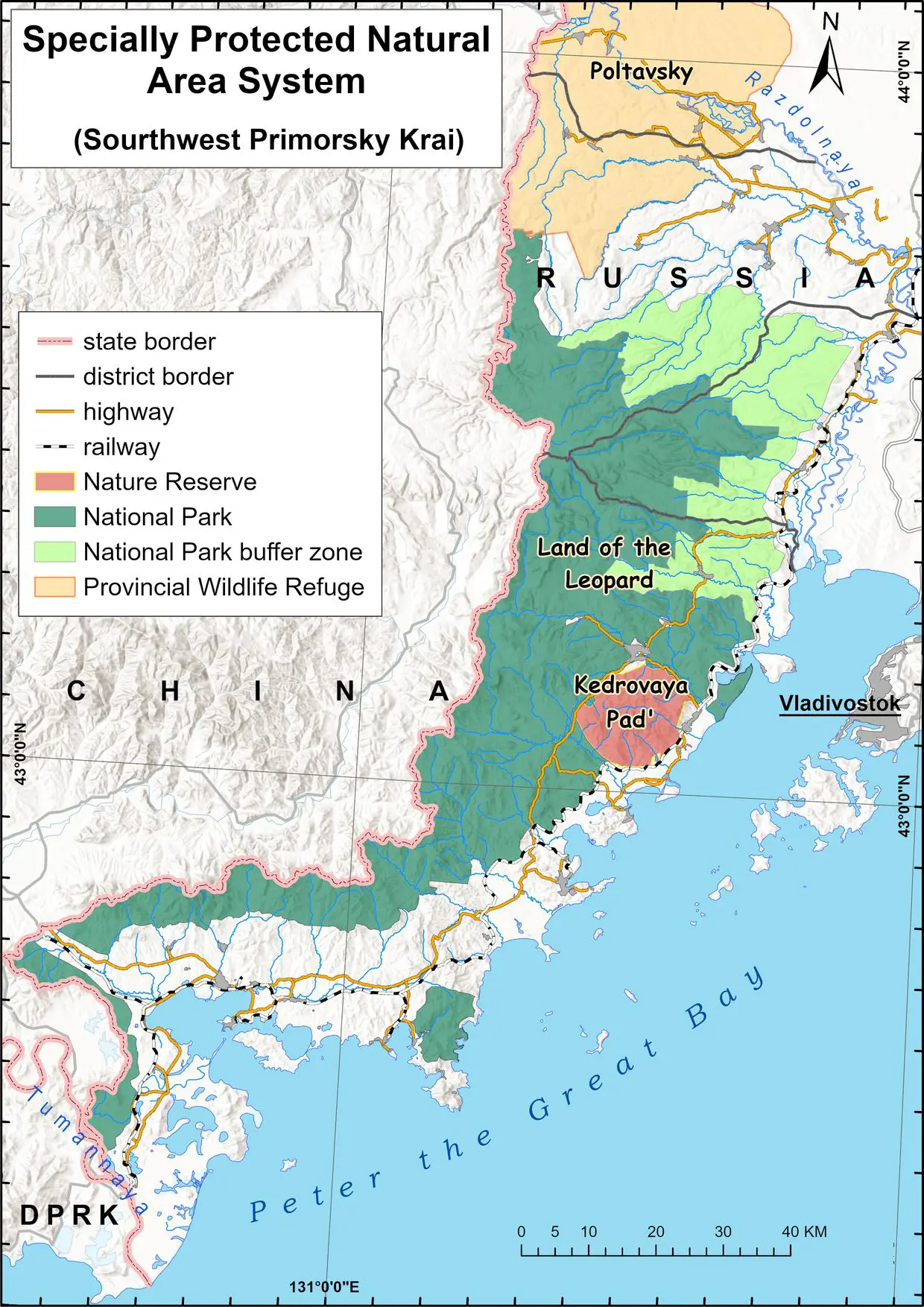
The approvals of dozens of organizations, tenants, and owners of land plots were obtained. Public hearings were held in four districts, and a positive conclusion from the State Environmental Assessment was received. Following this, project documentation was approved at the federal level, and the Land of the Leopard national park (LLNP) was officially established by a decree of the government of the Russian Federation on 5 April 2012. In 2019, the Gamov Deer Farm joined the national park as the fifth cluster, increasing its total area to 2688 square kilometers [48]. The buffer zone (823 km2) was created along the north-east border of the national park (Decree of the Governor of Primorsky Krai dated 15 January 2013). This brought the total area under the control of FSBI Land of the Leopard to 3720 km2, or about 70% of the leopard species’ range (Figure 2).
In accordance with the IUCN assigning management categories and governance types [14], the territory of the KPNR is a strict scientific reserve (IUCN Ia-A). Any human activity is prohibited there, and only research and monitoring are permitted. The LLNP (IUCN II-A) has a flexible zoning system that takes into account the interests of the local population and the need for socio-economic development. The core zone occupies only 231 km2 of the most important leopard habitats on the Borisovskoe Plateau, while the strip along the border with China is declared a specially protected zone with the task of protecting nature and the state border, covering 825 km2. The remaining areas of state forestry and military forestry are included in the recreational zone (794 km2), where ecological tourism and outdoor recreation are added to nature conservation tasks. The economic zone (838 km2) includes all agricultural land and municipal reserved lands that are not withdrawn from the owners and users. Citizens can visit the last two zones with permission from the park administration, free of charge if they are local residents. The timing and volume of fishing, harvesting of berries, mushrooms, nuts, and firewood are determined by regulatory legal acts of the Primorsky Krai.
According to the proposals of local and provincial authorities, all settlements within the territory of the national park have been excluded, as well as transportation corridors for highways, railways, and pipelines to North Korea and China. The existing land use in the buffer zone surrounding the northeastern border of the park has remained unchanged. Amateur hunting is permitted in this zone, but it must be done without the use of traps or hunting dogs. The buffer zone regime does not apply to settlements, including a 500-m radius around them.
In addition to the nature reserve and national park, there is a provincial wildlife refuge called “Poltavsky” (Figure 2). It is established to protect hunting species and increase the feeding capacity of wild ungulates. The southern part of this refuge is located in SWP, and 254 km2 are suitable for Far Eastern leopards and Amur tigers. In the southern corner of SWP, Khasansky Provincial Nature Park has been established along the border with DPRK, covering an area of 95 km2 to preserve the wetlands of the Tumannaya River delta. This area also has some suitable habitats for leopards in the riverine willows, with a high density of roe deer and water deer. Overall, the PAs network at of the national and provincial significance in cover about 4000 km2—74 percent of the current range of the Far Eastern leopard (Table 2).
Table 2. The network of protected areas in the southwest of Primorsky Krai, Russia, is important for the conservation of the existing population of the Far Eastern leopard.
|
Name |
Category |
Total Area, km2 |
Including Leopard Range, km2 |
|---|---|---|---|
|
Kedrovaya Pad |
Strict scientific nature reserve (IUCN 1a) |
180.84 |
180.84 |
|
Land of the Leopard |
National park (IUCN 1b) |
2687.97 |
2687.97 |
|
Khasansky |
Provincial nature park (IUCN 3) |
99.85 |
27.50 |
|
Poltavsky |
Provincial wildlife refuge (IUCN 4) |
520.00 |
254.34 |
|
Forest monuments (10 sites) |
Provincial nature monument (IUCN 5) |
8.27 |
8.27 |
|
Buffer zone of Land of the Leopard National Park |
Buffer zone of protected areas (IUCN 6) |
822.58 |
822.58 |
|
Buffer zone of Far Eastern Marine Nature Reserve |
Buffer zone of protected areas (IUCN 6) |
29.15 |
29.15 |
|
Total |
4348.66 |
4010.65 |
The formation of a PAs network and the real protection provided by the staff of the established FSBI “Land of the Leopard” played a key role in the conservation and restoration of the Far Eastern leopard. After being on the verge of extinction, its population in SWP increased 3.4 times: from an absolute minimum number of 25–34 leopards (including cubs) in 2007 [12], to 51 in 2014 [49] and 116 (including cubs) in 2022 [50]. Just after the establishment of LLNP, a SECR analysis made with the SPACECAP package in R estimated the average leopard density in PAs in 2014 as 0.98 ± 0.064 individuals per 100 km2 (95% CI: 0.87–1.10), while the abundance estimated as 57.4 ± 3.8 (51–65) adults [49]. In 2022, the density in PAs increased to 2.46 individuals per 100 km2 (SE = 0.002), and the estimated population size of the Far Eastern leopards within the LLNP using SECR was 118 ± 1.36 (115–121) individuals [50]. We assume that this is near the carrying capacity level for the Far Eastern leopard population under current conditions in SP.
3.2. History and Status of Protected Areas within the Far Eastern Leopard’s Range in China
In the late 1990s, an international team of scientists conducted winter track surveys in the LDM area, bordering the SWP area. Based on the results obtained, they prepared proposals for the development of a network of PAs in potential habitats suitable for the leopards and tigers [6,51]. In December 2001, with the support of WCS and WWF, the Hunchun nature reserve was established along the Sino-Russian border. The reserve covers 1087 km2 and, five years later, received national status.
In 2008–2010, scientists from Russia, the USA, and China prepared an analysis of the suitability of LDM habitats for the restoration of the Amur tiger [52]. In 2011–2014, Wangqing and Suiyang (later renamed as Laoyeling) nature reserves were established in identified priority areas, with areas of 674 and 713 square kilometers, respectively. The foresters of the State Forest Service of China carried out a lot of work to remove tens of thousands of poaching snares [53]. Due to a complete ban on commercial logging, forest ecosystems began to recover rapidly. By 2015, 13 to 18 leopards were living there, including the first signs of breeding females with two cubs [26,30].
In 2017, thanks to the initiative of Professor Ge Jianping from Beijing Normal University, the Northeast Tiger and Leopard National Park (NTLNP) was included in a China System Pilot Program for National Parks. A Master Plan for its development was developed for the period from 2017 to 2025 [54]. Although the interim administration of the park was formed on 19 August 2007, its official establishment date is considered to be 10 December 2021. Its vast territory of 14,600 km2 incorporates 12 previously created PAs, including Hunchun, Wangqing, Tumen, Laoyeling, Dongning, Ninyang, Muling nature reserves, as well as three forest parks, one wetland park, and a genetic reserve for aquatic plants covering a total area of 5500 km2 (37.6% of the national park territory). The core habitats for leopards cover 7625 km2, including breeding areas, frequent activity areas, population diffusion habitats, and migration corridors [55,56].
The NTLNP is divided into functional zones according to their importance for the conservation of biodiversity, the provision of ecosystem services, and the strictness of protection regimes. The main goal of the key protected zone (52.2% of the territory) is to maintain habitat for breeding and settlement of tigers and leopards: patrols and fire prevention, and scientific research. Even artificial reforestation is not desirable in order to maintain natural processes. During the transition period, locals are allowed to continue traditional activities such as grazing, harvesting wild plants, and maintaining frog farms, ginseng, and mushroom plantations [55].
In the zone of general control, many types of economic activity are limited, except for those related to special strategic needs of the state. The national park gradually clears the territory of industrial and mining enterprises, but traditional nature management by indigenous people remains without the possibility of expansion or intensification. New settlements in the forest are prohibited, and voluntary resettlement with support from a state program is encouraged. Tourism can only develop with the authorization of park directors. In the border area between China and Russia, joint control by border guards and rangers ensures both the protection of the border and the conservation of tigers and leopards. Residents living in this area are allowed to access with passes, while border engineering structures will be removed along routes for wild animals’ movements [55].
In 2014–2015, the camera trap network in the LDM recorded 22–25 adult leopards, and the estimated density was 0.38–0.40 individuals per 100 km2 (SE 0.07; Limits 0.29–0.55), calculated abundance was 31 adults (SE 2.7, Limits 27.6–38.8) [34]. There is no reliable estimation of the current population of the Far Eastern leopard in NEC. Data from mass media reports that after the establishment of NTLNP, yearly records based on camera-traps increased from 42 to 60 individuals with more than 7 cubs (interview with Mr. Zhao Li, head of the administration bureau of the park https://merotribune.com/2022/03/05/22770/, accessed on 1 April 2026. In 2021, Xinhua News reported that records have also increased to 80 leopards, including 15 cubs https://english.news.cn/20240730/ba3402f890ba4decb9d055c3f436194a/c.html, accessed on 1 April 2026. However, a large portion of these leopards is shared between China and Russia.
3.3. Creation of the Transboundary Protected Area within the Far Eastern Leopard’s Range
Russian-Chinese cooperation on the conservation of rare big cats was launched back in 1996–1998 as part of the Tumen River Area Development Project (TRADP). The Transboundary Diagnostic Analysis of the region, which was performed [57], became the basis for subsequent studies. In 2002–2004, a first version of a transboundary nature reserve was developed under the framework of the NEASPEC project (North-East Asian Subregional Program for Environmental Cooperation) [58]. In 2014, an updated version was prepared, taking into account the creation of the LLNP [25].
FSBI “Land of the Leopard” has been cooperating with China’s PAs since 2014 through a trilateral agreement with Hunchun and Wangqing nature reserves. Russian scientists have participated in winter track surveys and camera trap monitoring. Russia and China have formed a large camera trap network covering the entire range of the Far Eastern leopard. Agreements with Beijing Normal University and the Feline Research Center in Harbin allowed for the first exchange of images of big cats in 2014 and 2015 to estimate the entire Sino-Russian population of Far Eastern leopards and the Eastern Changbaishan (East Manchurian) population of the Amur tiger [33,34]. The NEASPEC project “Rescue of Amur Tiger and Far Eastern Leopard: Transborder Movement of Amur Tigers and Far Eastern Leopards Using Photo Traps and Molecular Genetic Analysis” became an important milestone in international scientific cooperation. Approximately 20% of all leopards were photographed in 2013–2015 in both Russia and China, indicating extensive cross-border movement and the need to protect existing habitats along this international border.
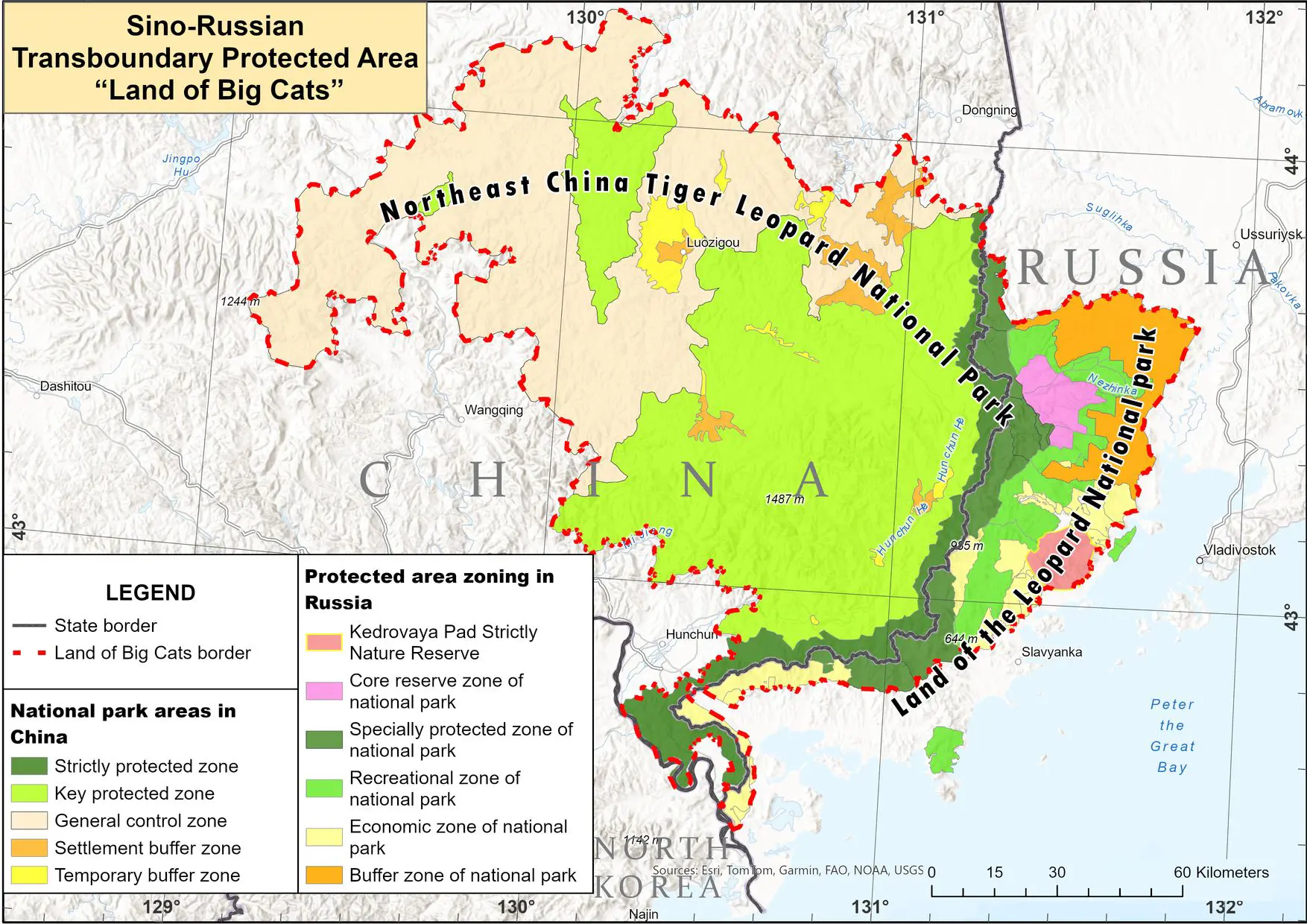
On 26 February 2019, the FSBI “Land of the Leopard” and the newly established NTLNP Administration signed a Memorandum of Understanding. The International Tiger and Leopard Conservation Forum (Harbin, 27–30 July 2019) helped launch the third NEASPEC project, “Transboundary cooperation on the conservation of Amur tigers, Amur leopards and Snow leopards in North-East Asia” (2022–2024). It supports collecting data on proposed transboundary PA [59]. After years of effort, an agreement was reached during the Summit Meeting to create the Sino-Russian transboundary protected area “Land of Big Cats” (Beijing, 16 May 2024). This has become one of the largest PA in Northeast Asia, covering more than 18 thousand km2. It includes the KPNR, the LLNP, and their buffer zones, as well as the NTLNP, which are connected by a 280-km long forested corridor (Figure 3).
In the framework of the NEASPEC project, the GIS team from the Pacific Geographical Institute of the Far Eastern Branch of the Russian Academy of Sciences has developed a set of maps for the territory of the transboundary protected area. The modelling framework integrates the main ecological factors that are known to affect the distribution of the Far East leopard: land cover, terrain characteristics, snow conditions, and anthropogenic disturbance. Suitability models, created using various biotic and abiotic variables, have identified approximately 17,239 km2 of suitable habitat for the Far East Leopard, accounting for 93% of the total transboundary PA (Table 3 and Figure 4). Validation using independent camera trap records confirmed the predictive ability of the HSI map. The Boyce index was 0.86, indicating a strong positive relationship between suitability class and frequency of leopard occurrence. Leopard detections were significantly concentrated in high suitability cells (67% of records in the high class, which covers only 22% of the area; binomial test p < 0.001). Medium suitability cells contained 28% of the records, and low suitability cells only 5%.
Table 3. The suitability of habitats for the Far Eastern leopard within the Sino-Russian transboundary protected area “Land of Big Cats”.
|
Country |
Total Area, km2 |
Far Eastern Leopard Habitats, km2 |
|||
|---|---|---|---|---|---|
|
Not Suitable |
Minimum Suitable |
Medium Suitable |
Maximum Suitable |
||
|
Russia |
3705 |
129 |
619 |
1532 |
1425 |
|
China |
14,838 |
1175 |
5051 |
5923 |
2689 |
|
Total |
18,543 |
1304 |
5670 |
7455 |
4114 |
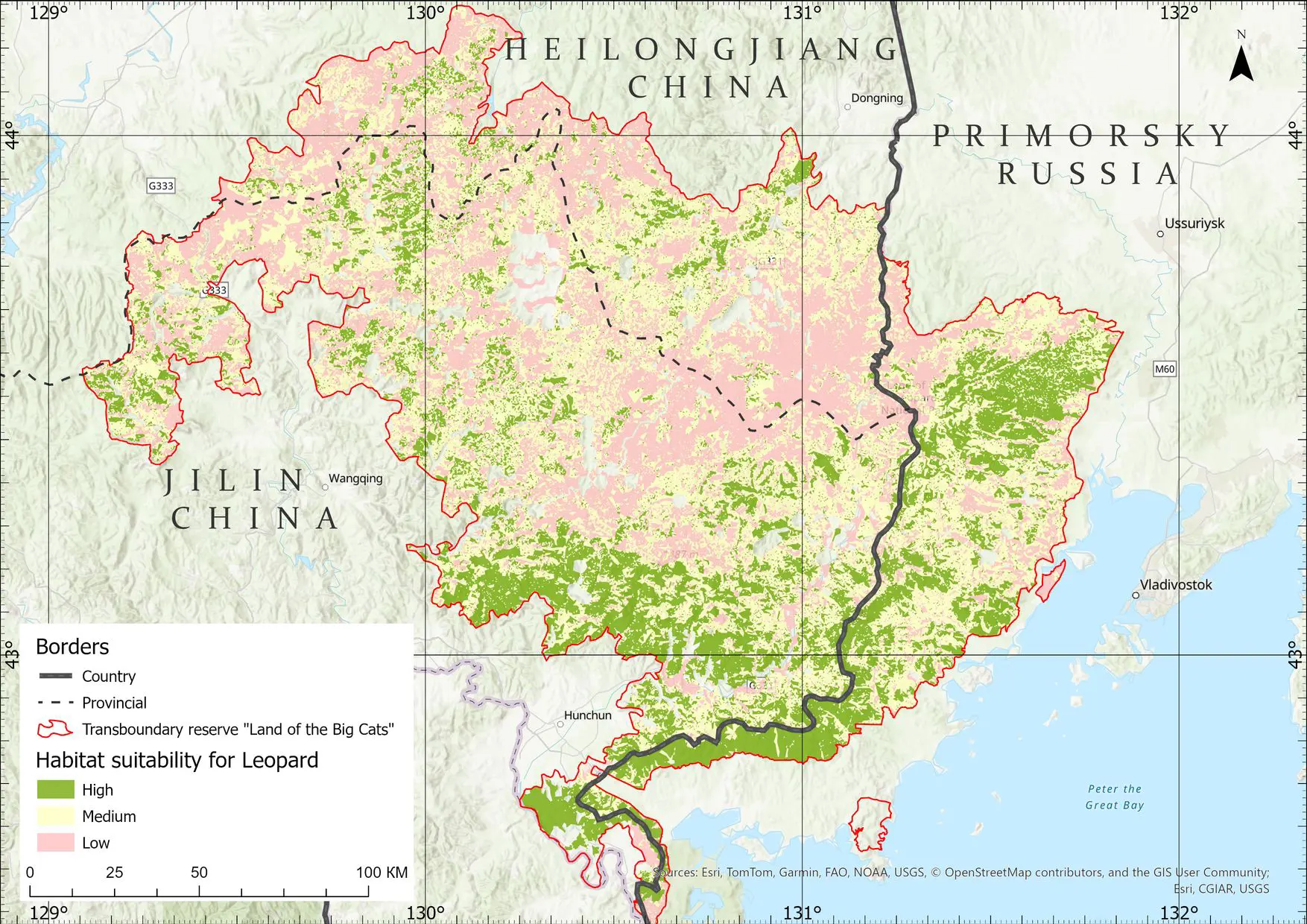
Figure 4. The suitability of habitats for the Far Eastern leopard within the Sino-Russian transboundary protected area “Land of Big Cats”(our data).
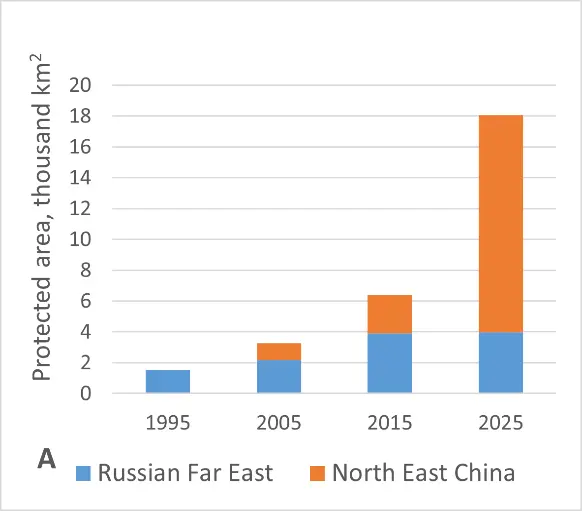
Thus, over the past 30 years, the PAs network in the SWP and LDM has increased 12-fold—from 1.532 km2 to 18.961 km2, covering at least 12,000 km2 of the current range of the Far Eastern leopard in Russia and China (Figure 5A).
 |
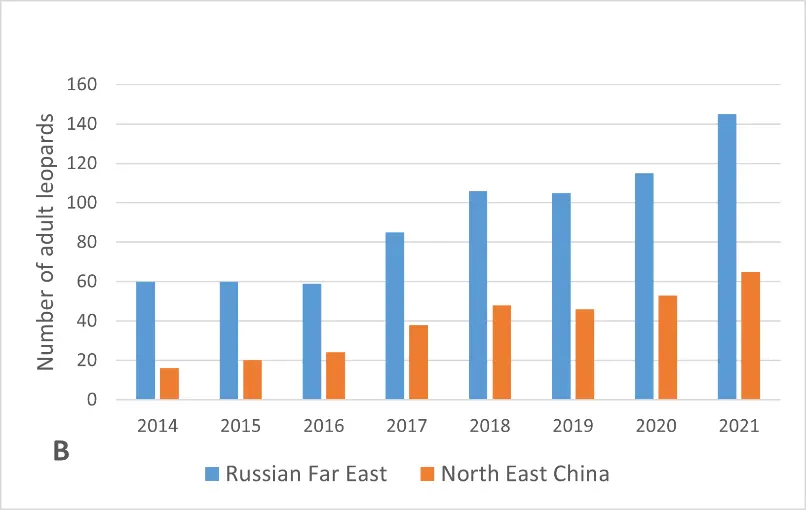 |
Figure 5. Change in the size of protected areas in the Far Eastern leopard range (A) and (B)—the yearly number of photographed adult Far Eastern leopards according to parallel camera trap monitoring in Southwest Primorye, Russia, and Laoyeling-Dalongling Mountains, China, based on: [16,32,33,49,59].
The first Sino-Russian winter track survey (1998–1999) determined the Far Eastern leopard’s entire transboundary population to be only 47–56 individuals with cubs, including 7–12 in the LDM in China and 40–44 in SWP in Russia. However, by 2003, the entire population had further declined to around 30–35 individuals, including 27–30 in Russia [7,8,12]. Due to unprecedented conservation measures taken in Russia and China, it has been possible to prevent the threat of complete extinction for the world’s last remaining wild population of the Far Eastern leopard. The absolute minimum number of entire transboundary population, defined on the basis of individually identified leopards during a 90-day survey period, was 64 leopards (including 5 cubs) in 2014 and 67 leopards (8 cubs) in 2015. The SECR modeling suggested the spatially explicit estimate over both years was 84 adults (SE 7.9; Limits 70–108 at 95% confidence interval) [34]. And that is the only robust estimate of the entire transboundary population.
Because they have not exchanged data on camera traps since 2016, we can only calculate the possible size of the Far Eastern leopard’s entire transboundary population based on the available records from parallel national surveys (Figure 5B). Since the start of camera trap monitoring in 2014, the yearly number of independent leopards photographed in Russia has increased by 2.4 times, and in China, even more, by 4.0 times. That is not an accurate number, as the population is not “closed” during the year. However, in any case, the parallel surveys have demonstrated a significant recovery in the Far Eastern Leopard in both countries. Due to large-scale cross-border movements, about 17.9–28.6% of leopards were shared between Russia and China [33,34]. So, to avoid overestimation, we can assume that in 2021 the entire transboundary population may be between 163 and 178 individuals. Recent robust estimates of 118 adults in SWP during the survey period of 2022 [50] confirm this proposition. Based on our expert assessments of habitat suitability and prey abundance, we can predict the potential carrying capacity of the transboundary protected area to be more than 300 leopards, a value consistent with the prognostic estimates of Chinese colleagues [32].
4. Conclusions
The formation of a transboundary network of PAs in the range of the Far Eastern leopard played a crucial role in the restoration of this subspecies, which was on the verge of extinction. The only wild population of this rarest big cat has increased by 3.5 times in 25 years in RFE and has probably reached carrying capacity in the LLNP. Strong protection and restrictions on human activities have provided sufficient habitats for doubling the current population and long-term persistence of the leopard. Conservation measures have been favorable for both big cat species. The entire East Manchurian/Eastern Changbaishan population of Amur tiger at the end of the 20th century was estimated by an international team to be at a minimum of 20–25 individuals. In 2022, the Amur tigers in the SP increased to between 55 and 58, while the entire transboundary population, by expert assessment, can reach 75 adult tigers [17]. The rescue of the Far Eastern leopard and restoration of this isolated population of the Amur tiger are world-class successes.
Under the patronage of these charismatic species, the entire ecosystem of mixed broadleaf forests in the RFE and NEC is being restored. There is mutual enrichment of fauna, including the influx of tigers, leopards, and Sika deer from Russia into the NTLNP. Meanwhile, Korean water deer, Manchurian red deer, and sables appear in the LLNP from China. All this confirms the undoubted role of the international network of PAs in restoring rare species, conserving biodiversity, and all natural components of transboundary ecosystems.
The Ranger Service of the FSBI “Land of the Leopard” provides control over 70% of Far Eastern leopard habitats in the SP. They extinguish forest-steppe fires, the area of which has significantly decreased in the national park. The ungulate recovery program includes mineral licks and additional winter forage to prevent mass winter deaths, supporting a sufficient prey base for big cats. Due to enhanced protection, the park serves as a source of wildlife for neighboring hunting areas. As a result, despite the decrease in the territory of hunting areas after the creation of the PA, the number of sika deer in adjacent territories has doubled, allowing hunting societies to increase their shooting limits [21].
At NTLNP, about 14,000 foresters patrol their sites, engage in forestry activities, and maintain a network of camera traps to monitor wildlife. Over the past few years, approximately 56 km of fences were removed from the forest, 9800 poaching snares were destroyed, and additional winter feeding for ungulates was organized at 300 locations. As a result, the killing of tigers and leopards was no longer recorded, and the number of ungulate species increased significantly [56].
The role of PAs in maintaining ecosystem services remains underappreciated. All rivers that serve as sources of drinking water in SP have their origins in the national park and remain unpolluted. They also provide spawning grounds for salmon (cherry trout and chum), maintaining a high level of fishing in adjacent marine areas of Peter the Great Bay. The estimated value of the NTLNP’s ecosystem services was 69.8 billion yuan in 2022 and is projected to rise to 70.4 billion by 2040 [60]. The total area of forest decommissioned for logging operations reaches 1.66 million hectares, making a significant contribution to carbon sequestration and climate change mitigation.
The proclamation of the Sino-Russian Transboundary Protected Area, “Land of Big Cats”, requires a dramatic expansion of border cooperation, and also opens great opportunities for attracting financial resources from both countries and international foundations. It is important that the format of national parks allows combining environmental goals with socio-economic interests. The most significant contribution to the green economic development of the area can be seen in ecotourism, which is growing rapidly.
However, PAs are under threat from increasing fragmentation due to the possible closure of ecological corridors during the construction of border crossings and reconstruction of access roads [61]. It is necessary to change the Scheme of Territorial Planning in SWP in order to move a new federal highway along Peter the Great Bay to a dedicated transport corridor to Hunchun, China, and Raijin-Songbon, North Korea, ensuring the development of coastal settlements while not causing damage to PAs. To mitigate anthropogenic impact on the LLNP, it is proposed to create a buffer zone along the southern border of the national park [62].
Both the Far Eastern leopard and the Changbaishan population of the Amur tiger face potential genetic threats due to their recent population bottlenecks. Genetic studies have documented low microsatellite diversity and signs of inbreeding in the leopard population. To mitigate these risks, we recommend: (i) establishing a long-term genetic monitoring programme using faecal and other non-invasive samples; (ii) ensuring the functionality and security of ecological corridors between Russia and China to promote natural gene flow; and (iii) evaluating the feasibility of carefully managed translocations if genetic diversity continues to decline.
Appendix A
Table A1. Data for territory suitability modeling and habitat mapping for the Far Eastern leopard.
|
Layer (Raster) Name |
Subtype |
Indicator (Value) |
Manifestation Factor for Cats |
Indicator Weight (How Favorable), % |
Weight of Indicator in Total |
Total |
|---|---|---|---|---|---|---|
|
Structure of the Lands (Landuse\Landcover) |
Anthropogenically modified territory |
0 |
disturbance (avoidance of such territories) |
0 |
40% |
0 |
|
Water bodies |
0 |
disturbance (avoidance of such territories) |
0 |
0 |
||
|
Agricultural territories |
0 |
disturbance (avoidance of such territories) |
0 |
0 |
||
|
Meadows |
1 |
1 |
0.4 |
|||
|
Bushes with light forest |
2 |
5 |
2 |
|||
|
Valley forests |
2 |
10 |
4 |
|||
|
Broadleaf forests |
3 |
Availability of food for ungulates |
12 |
4.8 |
||
|
Oak-broad-leaved forests |
5 |
Availability of food for ungulates |
20 |
8 |
||
|
Oak-broad-leaved with the presence of coniferous trees (up to 30%) |
5 |
Availability of food for ungulates |
30 |
12 |
||
|
Oak-broad-leaved with the presence of coniferous trees (30–80%) |
4 |
Availability of food for ungulates |
20 |
8 |
||
|
Conifers (80–100%) |
4 |
2 |
0.8 |
|||
|
Relief |
Height |
Up to 200 m |
10 |
5% |
0.5 |
|
|
Height 200–400 m |
45 |
2.25 |
||||
|
Height 400–600 m |
30 |
1.5 |
||||
|
Height 600–800 m |
15 |
0.75 |
||||
|
Above 800 m |
0 |
0 |
||||
|
Slope exposure |
northeast |
Avoidance during snowy season |
5 |
10% |
0.5 |
|
|
north |
Avoidance during snowy season |
5 |
0.5 |
|||
|
northwest |
Avoidance during snowy season |
5 |
0.5 |
|||
|
west |
10 |
1 |
||||
|
southwest |
Preferably during the snowy season |
25 |
2.5 |
|||
|
south |
Preferably during the snowy season |
25 |
2.5 |
|||
|
southeast |
Preferably during the snowy season |
15 |
1.5 |
|||
|
east |
10 |
1 |
||||
|
Relief ruggedness (topographic index):
|
1 |
The convenience of hunting and the presence of rocks, shelters, dens, etc. |
10 |
15% |
1.5 |
|
|
2 |
20 |
3 |
||||
|
3 |
40 |
6 |
||||
|
4 |
30 |
4.5 |
||||
|
Snow |
Duration of snow occurrence per season (average annual number of days)—correlates with snow depth (% of time of occurrence) |
0–25% |
Distribution of ungulates in winter |
50 |
20% |
10 |
|
25–50% |
30 |
6 |
||||
|
50–75% |
15 |
3 |
||||
|
75–100% |
5 |
1 |
||||
|
Anthropogenic impact |
Highways and Railway |
exclude |
Obstacle at crossing |
everything outside these zones—100% |
10% |
|
|
Buffer distance from the settlement, depending on the number of populations:
|
1 |
Level of avoidance of such territories |
0 |
|||
|
2 |
100 |
10 |
||||
|
3 |
0 |
|||||
|
4 |
0 |
Acknowledgments
We thank the WWF and the many international foundations that have supported our 25-year efforts to create a network of protected areas sufficient for the restoration and long-term survival of the Far Eastern leopard. The creation of the Land of the Leopard National Park was almost impossible without the direct involvement of Sergei Ivanov (Head of the Presidential Administration of Russia), Yuriy Trutnev (Deputy Prime Minister of the Russian Federation) and Vladimir Miklushevsky (Governor of Primorsky province).
Author Contributions
Conceptualization, Y.D.; Methodology, Y.D. and E.E.; Formal Analysis, Y.D.; Data Curation, Y.D. and E.E.; Writing, Y.D.; Visualization, E.E.
Ethics Statement
Not applicable.
Informed Consent Statement
Not applicable.
Data Availability Statement
The data that support the findings of this study are available on request from the corresponding author.
Funding
This work was funded by FSBIS Pacific Geographical Institute, using grant from Ministry of Education and Science of the Russian Federation No. 075-15-2023-584; and contracts with FSBI Land of the Leopard No. 7A, 27 June 2022 under the framework of ESCAP project “Transboundary cooperation on the conservation of Amur tigers, Amur leopards and Snow leopards in North-East Asia”.
Declaration of Competing Interest
The authors declare that they have no known competing financial interests or personal relationships that could have appeared to influence the work reported in this paper.
References
-
Uphyrkina O, Miquelle D, Quigley H, Driscoll C, O’Brien SJ. Conservation genetics of the Far Eastern leopard (Panthera pardus orientalis). J. Hered. 2002, 93, 303–311. DOI:10.1093/jhered/93.5.303 [Google Scholar]
-
Yin Q, Ren Z, Wen X, Liu B, Song D, Zhang K, et al. Assessment of population genetic diversity and genetic structure of the North Chinese leopard (Panthera pardus japonensis) in fragmented habitats of the Loess Plateau, China. Glob. Ecol. Conserv. 2023, 42, e02416. DOI:10.1016/j.gecco.2023.e02416 [Google Scholar]
-
Kitchener AC, Breitenmoser-Würsten C, Eizirik E, Gentry A, Werdelin L, Wilting A, et al. A revised taxonomy of the Felidae: The final report of the Cat Classification Task Force of the IUCN/SSC Cat Specialist Group. Cat News 2017, 11, 1–80. Available online: https://researchportal.murdoch.edu.au/esploro/outputs/journalArticle/A-revised-taxonomy-of-the-Felidae/991005545023807891 (accessed on 25 December 2025).
-
Stein AB, Gerngross P, AI Hikmani H, Balme G, Bertola L, Drouilly M, et al. Panthera pardus (Amended Version of 2024 Assessment). The IUCN Red List of Threatened Species, 2025; e.T15954A274970607. Available online: https://www.iucnredlist.org/species/15954/274970607 (accessed on 25 December 2025).
-
Jo YS, Baccus JT. Are Large Cats Compatible with Modern Society on the Korean Peninsula? Ecol. Restor. 2016, 34, 173–183. DOI:10.3368/er.34.3.173 [Google Scholar]
-
Pikunov DG, Miquelle DG. Conservation of Amur tigers and Far Eastern leopards in the Tumen River area, Northeast Asia. In The 7th Meeting of the UNESCO-MAB East Asian Biosphere Reserve Network: Capacity Building for Sustainable Management of East Asia Biosphere Reserves; Dalnauka: Vladivostok, Russia, 2002; pp. 163–176. [Google Scholar]
-
Yang S, Jiang J, Wu Z, Li T, Yang X, Han X, et al. Report on the Sino-Russian joint survey of Far Eastern leopards and Siberian tigers and their habitat in the Sino-Russian boundary area, eastern Jilin Province, China, winter 1998. In A Final Report to the UNDP and the Wildlife Conservation Society; UNDP: New York, NY, USA, 1998; Wildlife Conservation Society: Bronx, NY, USA, 1998; p. 52. [Google Scholar]
-
Sun B, Miquelle D, Xiochen Y, Zhan E, Hiai S, Goshen G, et al. Investigation of Population of Amur Tiger and Far Eastern Leopard in 1999 in Eastern Part of Heilongjiang Province, China, and Recommendations for Their Conservation; WCS: Bronx, NY, USA, 1999; p. 68. [Google Scholar]
-
Heptner VG, Sludsky AA. Mammals of the Soviet Union, Volume 2 (Part 3): Carnivorous (Hyenas and Cats); Vysshaya Shkola: Moscow, Russia, 1972; p. 552. (In Russian) [Google Scholar]
-
Abramov VR, Pikunov DG. The leopard (“bars”) in the Far East of the USSR and its protection. Doklady Mosskovskogo Obschestva Ispytatey Prirody. Otdel Biologii 1974, 79, 5–15. [Google Scholar]
-
Pikunov DG, Korkishko VG. Leopard Dalnego Vostoka (The Far Eastern Leopard); Nauka: Moscow, Russia, 1992; p. 192. (In Russian) [Google Scholar]
-
Pikunov DG, Seroydkin IV, Aramilev VV, Nikolaev IG, Murzin AA. Krupnye khischniki i kopytnye yugo-zapada Primorskogo Kraya (Large Predators and Wild Ungulates of the Southwestern Primorsky Province); Dalnauka: Vladivostok, Russia, 2009; p. 96. (In Russian) [Google Scholar]
-
Miquelle DG, Murzin AA. Spatial Distribution of the Far Eastern Leopard at Southwest Primorye and Recommendations on Its Conservation; WCS and WWF: Vladivostok, Russia, 2000; p 46. [Google Scholar]
-
Dudley N. (Ed.). Guidelines for Applying Protected Area Management Categories; IUCN: Gland, Switzerland, 2008; p. 86. [Google Scholar]
-
IUCN WCPA. Transboundary Protected Areas for Peace and Co-Operation; IUCN WCPA: Gland, Switzerland, 2001; p. 111. [Google Scholar]
-
Vitkalova VA, Darman YA, Marchenkova TV, Matukhina DS, Rybin AN, Storozhuk AS, et al. Camera Trap Monitoring of the Far Eastern Leopard in Southwest Primorsky Province (2014–2020); Apelsin: Vladivostok, Russia, 2023; p. 110. [Google Scholar]
-
Jiang G, Qi J, Gu J, Chang Y, Shi Q, Liu P. Population and Habitat of Amur Leopard in China; Science Press: Beijing, China, 2016; p. 202. [Google Scholar]
-
Petrov TA, Darman YA, Titov AS, Storozhuk VB, Sonin PL, Marchenkova TV. Changes in the number of wild ungulates in the southwest Primorskiy province, Russia. Russ. J. Ecosyst. Ecol. 2025, 10, 1–15. DOI:10.21685/2500-0578-2025-1-2 (In Russian) [Google Scholar]
-
Darman YA, Sedash GA. Korean water deer (Hydropotes inermis argyropus Heude, 1884): General outline for enlisting into the Red Data Book of Russian Federation. Rare Species Biota 2020, 4, 35–40. Available online: https://biosoil.ru/storage/entities/fscpublication/2452/ed7a9260-ac04-43cf-a3da-9db3f4438124.pdf (accessed on 25 December 2025). (In Russian)
-
Li Y, Kim JH, Li H, Peng Y, Chen M, Zhu W, et al. Northward Range Expansion of Water Deer in Northeast Asia: Direct Evidence and Management Implications. Animals 2022, 12, 1392. DOI:10.3390/ani12111392 [Google Scholar]
-
Darman YA, Matiukhina DS. Winter track survey of the Amur tiger (Panthera tigris altaica) in the southwest Primorsky Province of Russia. Wildl. Lett. 2025, 1–10. DOI:10.1002/wll2.70022 [Google Scholar]
-
Darman YA, Zharikov VV, Karakin VP, Bardyuk VV, Ganzei KS. Priorities of the Russian-Chinese cooperation on biodiversity conservation in the transboundary geosystems of the south of the Russian Far East and Northeast China. Geogr. Nat. Resour. 2024, 45, 42–51. DOI:10.15372/GIPR20240505 (In Russian) [Google Scholar]
-
Darman Y, Karakin V, Marteynenko A, Williams L. (Eds.). Conservation Action Plan for the Russian Far East Ecoregion Complex; Part 2; WWF: Vladivostok, Russia, 2003; pp. 1–80. [Google Scholar]
-
Darman YA, Egidarev EG, Karakin VP, Kachur AN. Specially protected nature areas as the specific type of nature resource use. In Pacific Russia: Past, Modern and Future; Baklanov PY, Ed.; Dalnauka: Vladivostok, Russia, 2012; pp. 118–136. [Google Scholar]
-
Darman YA, Bardyuk VV, Karakin VP. Sino-Russian transboundary nature reserve “Land of Big Cats” as a basis for biodiversity conservation of the East Manchurian Mountains. In Geosytems of North-East Asia: Natural, Social and Economic Systems; Pacific Geographical Institute FEBRAS: Vladivostok, Russia, 2025; pp. 440–447. DOI:10.35735/9785605278788_440 (In Rusian) [Google Scholar]
-
Jiang G, Qi J, Wang G, Shi Q, Darman Y, Hebblewhite M, et al. New hope for the survival of the Amur leopard in China. Sci Rep. 2015, 5, 15475. DOI:10.1038/srep15475 [Google Scholar]
-
Jiang G, Wang G, Holyoak M, Yu Q, Jia X, Guan Y, et al. Land sharing and land sparing reveal social and ecological synergy in big cat conservation. Biol. Conserv. 2017, 211, 142–149. DOI:10.1016/j.biocon.2017.05.018 [Google Scholar]
-
Li Z, Wang T, Smith JLD, Feng R, Feng L, Mou P, et al. Coexistence of two sympatric flagship carnivores in the human-dominated forest landscapes of Northeast Asia. Landsc. Ecol. 2018, 34, 291–305. DOI:10.1007/s10980-018-0759-0 [Google Scholar]
-
Qi J, Shi Q, Wang G, Li Z, Sun Q, Hua Y, et al. Spatial distribution drivers of Amur leopard density in Northeast China. Biol. Conserv. 2015, 191, 258–265. DOI:10.1016/j.biocon.2015.06.034 [Google Scholar]
-
Wang TM, Feng LM, Mou P, Wu JG, Smith JLD, Xiao WH, et al. Amur tigers and leopards returning to China: Direct evidence and a landscape conservation plan. Landsc. Ecol. 2015, 31, 491–503. DOI:10.1007/s10980-015-0278-1 [Google Scholar]
-
Wang TM, Feng LM, Yang HT, Han BY, Zhao YH, Juan L, et al. A science-based approach to guide Amur leopard recovery in China. Biol. Conserv. 2017, 210, 47–55. DOI:10.1016/j.biocon.2016.03.014 [Google Scholar]
-
Wen D, Qi J, Long Z, Gu J, Tian Y, Roberts NJ, et al. Conservation potentials and limitations of large carnivores in protected areas: A case study in Northeast China. Conserv. Sci. Pract. 2022, 4, e12693. DOI:10.1111/csp2.12693 [Google Scholar]
-
Shevtsova E, Jiang G, Vitkalova A, Gu J, Qi J, Chaika M, et al. Saving the Amur Tiger and Amur Leopard: Transborder Movement of Amur Tigers and Amur Leopards Using Camera Trapping and Molecular Genetic Analysis; NEASPEC Project Report; UNESCAP: Seoul, Republic of Korea, 2018; p. 52. [Google Scholar]
-
Vitkalova A, Feng L, Rybin A, Gerber B, Miquelle D, Wang T, et al. Transboundary cooperation improves endangered species monitoring and conservation actions: A case study of the global population of Amur leopards. Conserv. Lett. 2018, 11, e12574. DOI:10.1111/conl.12574 [Google Scholar]
-
Hansen MC, Potapov P, Pickens AH, Tyukavina A, Hernández-Serna A, Zalle V, et al. Global land use extent and dispersion within natural land cover using Landsat data. Environ. Res. Lett. 2022, 17, 034050. DOI:10.1088/1748-9326/ac46ec [Google Scholar]
-
Tucker CJ. Red and photographic infrared linear combinations for monitoring vegetation. Remote Sens. Environ. 1979, 8, 127–150. DOI:10.1016/0034-4257(79)90013-0 [Google Scholar]
-
Gao B. NDWI—A normalized difference water index for remote sensing of vegetation liquid water from space. Remote Sens. Environ. 1996, 58, 257–266. DOI:10.1016/S0034-4257(96)00067-3 [Google Scholar]
-
JAXA. ALOS AW3D30 Digital Elevation Model; Japan Aerospace Exploration Agency: Tokyo, Japan, 2016. [Google Scholar]
-
Hall DK, Riggs GA. MODIS/Terra Snow Cover L3 8-Day Global 500 m Grid; NASA NSIDC DAAC: Boulder, CO, USA, 2016. [Google Scholar]
-
Liu F. Habitat Evaluation and Potential Corridor Analysis of Wild Amur Tiger Habitat in Hunchun, Jilin. Ph.D. Thesis, Beijing Forestry University, Beijing, China, 2016. [Google Scholar]
-
Boyce MS, Vernier PR, Nielsen SE, Schmiegelow FKA. Evaluating resource selection functions. Ecol. Model. 2002, 157, 281–300. DOI:10.1016/S0304-3800(02)00200-4 [Google Scholar]
-
Maslova IV, Korkishko RI. Nature Reserve «Kedrovaya Pad’» (1916–2016). Biodivers. Environ. Far East Reserves 2017, 1, 19–66. Available online: https://biosoil.ru/storage/entities/fscpublication/2350/25735b36-3f67-4c2a-a9f5-0b3d3954ff8b.pdf (accessed on 25 December 2025). (In Russian)
-
Pikunov DG, Korkishko VG. Sovremennoe raspredelenie I chislennost leoparda (Panthera pardus) na Dalnem Vostoke SSSR [Current distribution and number of the Far Eastern leopard in USSR]. Zool. J. 1985, 164, 897–905. (In Russian) [Google Scholar]
-
Aramilev VV. (Ed.). Borisovskoe Plato. Ecologo-Economicheskoe Obosnovanie Sozdaniya Okhranyaemoi Prirodnoi Territorii; [Borisovskoe Plateau. Ecological and Economic Backgrounds for the Establishment of Protected Area]; Dalnauka: Vladivostok, Russia, 1999; p. 112. (In Russian) [Google Scholar]
-
Darman Y. Recommendations for optimizing the protected areas system in Southwest Primorye. In Proceedings of the Workshop for the Conservation of the Far Easter Leopard in the Wild, Vladivostok, Russia, 11–14 May 2001; pp. 18–23. [Google Scholar]
-
Karakin VP, Darman YA. (Eds.). Ecologo-Economicheskoe Obosnovanie Sozdaniya Nacionalnogo Parka “Barsovy” [Ecological and Economic Justification of the Creation of the National Park “Barsovy”]; Report of the Pacific Geographical Institute FEB RAS; FEB RAS: Vladivostok, Russia, 2002; p. 138. (In Russian) [Google Scholar]
-
Kachur AN, Darman YA, Khokhryakov SA. (Eds.). Materialy Complexnogo Ecologicheskogo Obsledovaniya Dlya Pridania Territorii Statusa OOPT Nacionalnogo Parka “Zemlya Leoparda”; [Materials of a Comprehensive Ecological Survey of the Territory Justifying the Status of the National Park “Land of the Leopard” in Primorsky Province]; Report of the Pacific Geographical Institute FEB RAS; FEB RAS: Vladivostok, Russia, 2012; Volume 1–4, p. 894. (In Russian) [Google Scholar]
-
Darman YA, Karakin VP, Surmach SG, Chubar EA. New territory of national park “Land of the Leopard”—The cluster “Gamovskiy”. Biota Environ. Nat. Areas 2020, 2, 63–84. Available online: https://biosoil.ru/storage/entities/fscpublication/2446/23cc51a1-3f6a-4222-aaec-2fb776c46655.pdf (accessed on 25 December 2025). (In Russian)
-
Vitkalova AV, Schevtsova EY. A complex approach to study the Amur leopard using camera traps in the Protected areas in the southwest of Primorsky krai (Russian Far East). Nat. Conserv. Res. 2016, 1, 16–21. DOI:10.24189/ncr.2016.027 [Google Scholar]
-
Marchenkova TV, Reebin AN, Matiukhina DS, Blidchenko EY, Maksimova DA, Storozhuk VB, et al. Estimation of population size and density of the Far Eastern Leopard (Panthera pardus orientalis) in the Southwest of Primorsky Krai. Wildl. Lett. 2025, 3, 152–160. DOI:10.1002/wll2.70024 [Google Scholar]
-
Darman Y, Karakin V. The WWF priorities in biodiversity conservation at Russia Far East. In Proceedings of the 7th Meeting of UNESCO-MAB East Asian Biosphere Reserve Network (ERBN-7). Capacity Building for Sustainable Management of East Asia Biosphere Reserves, Vladivostok, Russia, 6–13 September 2001; pp. 101–113. [Google Scholar]
-
Hebblewhite M, Zimmermann F, Li Z, Miquelle D, Zhang M, Sun H, et al. Is there a future for Amur tigers in a restored tiger conservation landscape in Northeast China. Anim. Conserv. 2012, 15, 579–592. DOI:10.1111/j.1469-1795.2012.00552.x [Google Scholar]
-
Li Q, Qi J, Peng J, Qu L, Xu Q, Wenzel C, et al. Habitat accessibility and snares impact large cats and their prey in Northeast Tiger and Leopard National Park, China. Biol. Conserv. 2024, 289, 110414. DOI:10.1016/j.biocon.2023.110414 [Google Scholar]
-
State Forestry Administration, Jilin Provincial People’s Government, Heilongjiang Provincial People’s Government. Siberian Tiger and Leopard National Park Master Plan (2017–2025); State Forestry Administration, Jilin Provincial People’s Government, Heilongjiang Provincial People’s Government: Beijing, China, 2017; p. 104. (In Chinese) [Google Scholar]
-
Liu Y. Study on the zoning of Northeast China Tiger and Leopard national park. Int. J. Geoheritage Parks 2022, 10, 113–123. DOI:10.1016/j.ijgeop.2022.03.002 [Google Scholar]
-
Song T. The exploration of China’s National Park Pilot Project: Taking Northeast China Tiger and Leopard National Park System Pilot Area as an example. Int. J. Geoheritage Parks 2020, 8, 203–209. DOI:10.1016/j.ijgeop.2020.10.001 [Google Scholar]
-
Baklanov PY, Ganzey SS, Kachur AN. Transboundary Diagnostic Analyses; Dalnauka: Vladivostok, Russia, 2002; p. 259. (In Russian) [Google Scholar]
-
Davies I, Neronov V, Sang-min N, Darman Y, Zhang C, Kachur A, et al. Lower Tumen River Area Transboundary Biosphere Reserve Proposal; UNDP Final Report; Korean National Commission for UNESCO: Seoul, Republic of Korea, 2004; p. 103. [Google Scholar]
-
North-East Asian Subregional Programme for Environmental Cooperation (NEASPEC). Transboundary Cooperation for Conservation of Amur Tigers, Amur Leopards and Snow Leopards in NorthEast Asia; NEASPEC: Seoul, Republic of Korea, 2026; pp. 1–40. [Google Scholar]
-
Wu R, Liu Q, Wang H. Spatial spillover effects of ecosystem service values in northeast China tiger and leopard national park based on spatial Durbin model. Ecol. Indic. 2024, 166, 112509. DOI:10.1016/j.ecolind.2024.112509 [Google Scholar]
-
Karakin VP, Darman YA, Bardyuk VV. The impact of transport infrastructure on the wildlife conservation in the Sino-Russian transboundary geosystems. In Geosystems of North-East Asia: Natural and Socio-Economic Factors and Structures; PGI FGEB RAS: Vladivostok, Russia, 2024; pp. 425–433. DOI:10.35735/9785604968338_425 (In Russian) [Google Scholar]
-
Darman YA, Bardyuk VV. Rationale for establishing buffer zones around Land of the Leopard National Park and Kedrovaya Pad’ Nature Reserve. Biota Environ. Nat. Areas 2021, 2, 95–108. Available online: https://biosoil.ru/storage/entities/fscpublication/2476/985537f0-d469-46ed-bb59-54a5cf7e5d78.pdf (accessed on 25 December 2025). (In Russian)